alt.humor.best-of-usenet
The best-of-Usenet compilation group.
alt.humor.best-of-usenet was the moderated showcase where the funniest genuine posts from across Usenet were reposted with attribution — a curated highlight reel of the medium at its best, run by volunteer moderators for years.
Its companion FAQ lived on faqs.org, which still links this address; the group is one of the better time capsules of what Usenet found funny about itself.
On this page
- The group's own paperwork
- The founding policy, and what it defined itself against
- A group made of other groups' postings
- How a submission became an article
- Moderation as a postal arrangement
- Consent, attribution and the opt-out
- Copyright, as the documents state it
- Encryption as an editorial instrument
- What the group carried
- The humour groups around it
- The other groups made of other groups
- Who decides what a site carries
- Where it went
- What the record does not show
- Scope and limits of this page
The group's own paperwork
For a hierarchy that keeps no minutes, alt.humor.best-of-usenet left an unusually full paper trail. Nearly everything a Usenet group can possess by way of founding documents survives: a creation request, a statement of editorial policy written into that request, a companion discussion group created in the same hour, a run of later appeals to news administrators, and a maintained list of frequently asked questions that ran to fifteen numbered answers. Most of it survives in the archive that has preserved Usenet's administrative traffic since early 1991 — an archive candid enough to declare its own gap, of about a month of messages around August 1992. The Internet Systems Consortium mirrors the stream of control messages that news servers pass among themselves, filed one compressed file per group; the file for this group holds five messages spread across the nine and a half months from July 1993 to May 1994, and between them they amount to a birth certificate.
The first is dated 22 July 1993. It was sent by Joel Furr, a Usenet figure of the period, posting from Nyx, the public-access Unix system that the University of Denver's mathematics and computer science department ran for the Denver community; the message carries the standard Nyx disclaimer that the university had neither control over nor responsibility for the opinions of its users. Its control line asks servers to create the group with the keyword moderated, and its own Approved: header carries an address at Virginia Tech. The body begins by pointing at where the proposal had been aired:
Pursuant to discussion in alt.config, alt.humor.best-of-usenet is hereby newgrouped. This group is intended to serve the purpose that alt.best.of.internet tried to achieve and failed miserably at: providing a place for humorous postings from other newsgroups in a central location.
The message adds that as a moderated group it would have a tighter focus than its predecessor, and that the discussion in alt.config had been unusually supportive. That is the whole of the group's public justification, and by the standards of the hierarchy it is a generous one: alt.* required no vote, no quorum and no charter, and a great many of its names arrived with nothing attached at all. What the mechanism of an alt.* newgroup actually is — a request rather than an instruction, obeyed or ignored server by server — belongs to the alt.* hub and is not restated here.
A second newgroup message went out the same day from a different hand, at Virginia Tech, and it is candid about why. It states that the group is moderated, that local postings will be forwarded to the moderation address, and then explains itself in a sentence that says a good deal about how alt.* actually worked: it was created on behalf of Joel Furr, who did not know how to set up a moderated group and had written to ask. The technical distinction mattered. A newgroup message that omits the moderated keyword produces an ordinary open group of the same name, and a group intended to be edited that propagates as an unedited one is broken from the first article.
The companion group was created in the same hour. Its message describes alt.humor.best-of-usenet.d as the discussion group for the new moderated newsgroup for postings from other newsgroups, and the founding announcement had already set out its purpose: to keep followups out of the edited group and give anyone who wished to argue about the selection a room of their own. The pairing of an edited publication with an unedited comment room, marked by a bare .d, was a settled Usenet convention by 1993, and it is the arrangement under which almost every edited group on the network operated.
Every one of those messages ends with a line offered for the receiving administrator's newsgroups file — the two-column table of name and one-line description from which a newsreader builds its group list, the two fields separated by a tab. Four different versions of the line went out in the group's first year, which is itself a small record of the founders working out what they had made:
- 22 July 1993, from the creation message:
alt.humor.best-of-usenet Funniest posts from other groups (moderated) - 22 July 1993, from the corrected newgroup issued the same day:
alt.humor.best-of-usenet Funniest bits of the net (Moderated) - 22 December 1993, from a booster message:
alt.humor.best-of-usenet humorous posts originating on usenet (moderated). - 9 May 1994, from a further booster:
alt.humor.best-of-usenet Original humor found on usenet (moderated) - and in the master file today:
alt.humor.best-of-usenet What readers think is funniest in netnews. (Moderated)
The two boosters of December 1993 were sent by a different person again, from the computer centre of Youngstown State University in Ohio, and they record a change of hands: the moderation address is no longer at Virginia Tech but at Youngstown State. A booster is a re-issued creation request, sent so that servers which missed the original, or which had been installed since, will add the group; it is the only lever anyone in alt.* has, and it has to be pulled repeatedly. The last message in the file, of 9 May 1994, is the fullest, and it is addressed less to servers than to the people who run them:
This is a booster newgroup, if you do not carry alt.humor.best-of-usenet, please consider doing so. Newsgroup alt.humor.best-of-usenet is a forum for posting original humor found on usenet newsgroups. The group is moderated to attempt to prevent copyright violations, inappropriate followups (all followups are directed to alt.humor.best-of-usenet.d), and non-original posts. The moderator also edits the headers to match a standard format for readability.
That is the last entry in the control record. Everything known about the group after May 1994 comes from its own periodic posting, the frequently asked questions file it published to itself, to its discussion group and to the network's two answers groups under the archive name best-of-usenet-humor, at a stated frequency of twice a month. The copy mirrored in the Usenet FAQ archives carries a maintainer's credit, a last-modified date of 20 January 2002, and submission and moderator-contact addresses in the duke.edu domain, with a note that the old Youngstown State address was retained as an alias pointing at the new one. By then the group was no longer run by one person: the document states plainly that it is moderated by a team, and describes a queue that distributed incoming submissions among them in rotation. Nothing in the surviving record dates the move to Duke, names the size of the team, or explains the change.
One further corroboration of the start date comes from the group's own documentation rather than from the control archive. Answering the question of how to read the group without a news server, the FAQ reports that a search of the Google Groups archive had turned up what appeared to be a complete run of articles going back to late July of 1993 — which is exactly where the control messages put the creation, and is the closest thing to an independent check that a group of this kind ever gets.
The founding policy, and what it defined itself against
The creation message did something most alt.* newgroups never bother with: it published an editorial policy, in the same breath as the request to create the group, and credited the policy to somebody else. Furr introduces it as his proposed moderation policy, notes that it was taken from a named third party, and sets it out in full. Its first clause is the one everything else in the group's history follows from.
alt.humor.best-of-usenet will accept any post which is a repost of material from another group, excepting proprietary groups such as the ClariNet hierarchy. I will encourage, but not absolutely require, that all posts clearly identify the author, newsgroup, and title of post (except in cases where the purpose of the post is to show how dumb someone was).
Three things are decided in those two sentences, and each of them separated this group from every other edited humour group on the network. First, the material was to be exclusively second-hand: not jokes written for the group, but articles taken from elsewhere. Second, there was a commercial exclusion from the outset — ClariNet was a subscription news service distributed over Usenet in its own hierarchy, and the policy carved it out before anyone had tested the question. Third, and most consequentially, attribution was encouraged rather than required. A group whose entire content was other people's work chose, in its founding document, not to make crediting that work an absolute condition of publication.
The policy's final sentence is the one that fixes the group's editorial theory, and it does so by measuring the group against its neighbour: the moderator undertakes not to imitate the practice, followed at rec.humor.funny, of screening out material the moderator personally did not find funny. The sentence makes its point by invoking somebody by first name alone; nothing in the sources consulted here establishes who was meant, so the name is not reproduced. The relationship is worth stating exactly, because it is the axis the two groups turn on. rec.humor.funny — whose history, moderators and digest arrangements belong to the rec.* hub and are not retold here — published jokes submitted to be judged, and judged them. alt.humor.best-of-usenet published articles submitted to be forwarded, and declined to judge them. The first was a magazine with an editor. The second was a reprint service with a queue.
That difference is not a matter of taste but of governance, and the group's later documentation defends it in those terms. Its FAQ opens by contrasting the group with moderated newsgroups described as carrying what the moderator thinks is funny, states that this is not true here, and gives the group's actual grounds for moderation as three procedural ones: minimising reposts, keeping followups out, and excluding material that is off-topic. It then lists, without apology, the classes of thing that will consequently appear — posts that not everyone will get, posts that are not particularly funny or are in poor taste, and posts that some readers will find offensive — and observes that since acceptance is close to automatic there is no distinction in getting in, so contributors should send their best rather than their next.
A group that will not judge quality still has to defend itself against volume, and the FAQ describes the mechanism the moderators eventually adopted: a blacklist. Its terms are set out with a precision that would not disgrace a disciplinary code. Blacklisting was to follow only drastic or prolonged abuse, was to be guided by complaints from readers rather than by the moderators' own irritation, was to be notified to the person by e-mail or, failing an address, by a posting to both groups, and was to last six weeks; a second occasion was permanent. The document is explicit that this is the price of the no-judgement rule rather than an exception to it — a submitter on the list is refused unread, however good the submission, precisely so that no submission is ever weighed on its merits.
A group made of other groups' postings
Almost every newsgroup is a room people write in. This one was not. Its content was, by design and by rule, material that had already been published somewhere else on the same network, moved one hop sideways and printed again. Nothing originated here; something was chosen. That single inversion produces two problems an ordinary group never has to solve, and the group's documents show it solving both, in public, over a decade.
The first is selection. No moderator can read the network, so the queue can only be filled by whoever happens to be reading something, recognises it, remembers that a submission address exists and takes the trouble to forward it. The consequence is a sampling bias that no amount of editorial care removes: a best-of group covers the groups its scouts read, and is silent about everything else on the network in exact proportion to how few of its readers go there. What such a group records is therefore two things at once and inseparably — what Usenet said, and what a small self-selected set of readers happened to notice it saying. A repost is evidence about its source group and evidence about its finder, and no later reader can pull the two apart.
The second problem is permission. Forwarding somebody's article into another group republishes it to an audience they did not choose, under a heading that frames it as an exhibit. The person quoted has no part in the transaction and, in the ordinary case, no notice of it. Every convention this group developed after 1993 — the required headers, the ban on editing, the opt-out markers, the deference to other groups' local norms — is an attempt to answer that objection without abandoning the format, and they are set out in the sections that follow.
There is a third consequence, less obvious and more structural. A group with no native content has no natural constituency to defend it. An ordinary group's readers are also its writers, and will argue for its survival because it is where their own work lives; a repost group's readers own nothing in it. This is one reason the format proliferated and then thinned: the names are still in the master file, and there is very little behind them.
How a submission became an article
The group's FAQ is unusually specific about the pipeline, and the pipeline is the most interesting thing about the group, because it is a small piece of publishing machinery assembled by volunteers out of mail, shell scripts and header conventions.
A contributor had two routes in. They could save the original article to a file and post it to the group in the ordinary way, in which case correctly configured news software would not inject it into the network at all but mail it to the submissions address — and the FAQ notes drily that if such a post actually appeared in the newsgroup, the reader's provider had probably not recorded the group as moderated. Or they could mail it directly to the same address, which is where the news software would have sent it anyway.
Four headers had to survive the journey: the original From:, Subject:, Newsgroups: and Message-ID: lines. The absence of any one of them was stated grounds for rejection. Contributors were told not to trim headers or tidy the article up, even with good intentions, because the processing script extracted what it needed and any editing risked removing something load-bearing; submitters using tin were asked to use its mail command rather than its cross-posting command, because the latter mangled headers and could cut away part of the original author's name.
At the moderators' end the article was reformatted to a house style. Most of the original headers were stripped; what remained was the original author's From: line and the original Subject:, edited to name the group or groups the article had been found in. A script then attached the remaining headers and the group's standing disclaimers. Signatures and sign-offs might be removed at the posting moderator's discretion, or kept where they were part of the point, and a submitter who wanted one preserved was advised to say so and explain why. Electronic mail addresses, postal addresses and web addresses inside the submitted article were removed or masked — routinely where they looked like advertising, and otherwise at the moderator's judgement — a small privacy measure adopted, in the document's own account, to protect both the moderators and the person being reprinted.
Two headers were the group's own inventions. Every article carried an X-Posting-Moderator: line, unique to whichever member of the team had handled it and consistent across everything they posted, so that a reader could tell who had passed a given item; the FAQ notes that the value might be a name, an address or something less revealing, but would identify the moderator to anyone paying attention. And because submissions were distributed round-robin, a popular find could reach several moderators at once and be posted several times. The fix was elegant: the original article's Message-ID:, prefixed with a short marker, became the message identifier of the reprint. Two moderators posting the same find therefore produced two articles with identical identifiers, and every server on the network discarded the second automatically as a duplicate it had already seen. A distributed editorial team with no shared database used the network's own loop-suppression to deduplicate itself.
It did not always work, and the FAQ says why with some care: the moderators read the group before posting in order to catch duplicates by eye, but they were spread across North America and Europe, and propagation delays of several days between continents had been observed, which made complete duplicate detection impossible for even the most attentive of them. The queue was drained at each moderator's own pace; there was no service level, and the document says so.
Moderation as a postal arrangement
Moderation on Usenet was a routing convention before it was an editorial stance, and the convention is worth stating plainly because nothing on the modern web works quite like it. An article addressed to a moderated group was not handed to the network. The posting software mailed it to an address recorded against the group, and it reached readers only when the moderator sent it out again carrying an Approved: header; conforming servers refused to propagate articles in moderated groups without that header. The general account of the mechanism, and of how thoroughly it depended on the honour system, is given on the soc.* hub and is not re-argued here.
In alt.* the arrangement was rarer and considerably more fragile. Moderation is a flag in the two files a news server keeps — a letter m against the group's name in the active file, and the parenthetical marker in the newsgroups file — and in a hierarchy where every administrator decides individually which control messages to obey, nothing guarantees that any given server ever received the message setting the flag, or set it correctly. Fewer than one alt.* name in fifty carries the moderated flag even now. The group's own documentation identifies this as the reason unapproved material kept appearing in what was supposed to be an edited group, and describes the failure precisely: the diversion of local posts to the moderators and the rejection of unapproved articles offered by remote servers are two separate mechanisms, and both are subject to misadjustment, failure and forgery.
The practical advice the FAQ gives its readers is a period artefact in itself. A reader seeing unapproved postings was told to take it up with their own provider's administrator, to explain politely that the group was moderated, and to point them at the moderators' contact address; the document adds that because moderated alt.* groups are relatively uncommon, an administrator was quite likely simply not to know. That is what enforcement looked like on a network with no enforcement: a volunteer editorial team asking readers to write to their sysadmins.
Consent, attribution and the opt-out
The permission problem was the group's standing difficulty, and the answer it arrived at is the most interesting thing in its documentation, because it is a genuine attempt at consent machinery built out of nothing but header conventions and good faith.
By the time the FAQ reached its final form the moderators had committed themselves not to approve any submission whose original carried one of three signals. The first was the header X-No-Archive: yes — a marker that had entered general Usenet use as a way of telling archive services not to retain an article, and which the moderators chose to read as a general refusal of republication. The second was a marker of their own devising, X-No-ahbou: yes, recognised in any capitalisation, which existed for authors who were content to be archived but not to be reprinted here. Either would be honoured if it appeared in the body of the article as well as in the headers, provided it was formatted like a header, alone on its line and flush left. The third was an explicit statement in the author's signature that they did not wish to be reposted.
The document then states the flaw in its own scheme, unprompted and without mitigation: the whole arrangement depends on the integrity of submitters, because a submitter who strips the header or the signature — through ignorance or malice — leaves the moderator with no way of knowing it was ever there, the moderators being neither required nor always able to find the original article. Moderators would do the best job they could; some submissions would fall through. It is a rare thing to find a volunteer editorial policy that publishes the exact conditions under which it fails.
Two further rules pointed the same way. Submissions had to be complete: any article found to have been modified by the submitter in any way, expressly including editing for humour value, was liable to rejection, and a contributor who thought only part of an article funny was told to add a clearly marked note pointing at the passage rather than cut it. And the moderators asked submitters to respect the local norms of the group a posting came from, observing that the culture of some newsgroups was such that most regulars would prefer not to be quoted here at all, and that reading the source group's own FAQ was usually enough to find out. Consent, in other words, was sought at three levels: the individual article, the individual author, and the community the article was taken from.
Against that, the contrast with the network's other edited humour group is stark, and it is the clearest statement of the argument the period actually had. The submission guidelines published by rec.humor.funny — a group named here only for the comparison, its own story being the rec.* hub's — instruct contributors not to submit other people's postings at all, excepting only articles posted from the United States before 1 April 1989 without a copyright notice; a reader who saw something funny in a group that had not been trying to be funny was told to write to the author and encourage them to submit it themselves, mentioning the policy sheet when they did. Two groups doing very nearly the same job, and between their two rulebooks the entire question.
Copyright, as the documents state it
The reason the two rulebooks diverge is that a Usenet article is a copyrighted work, and both groups knew it. Under the Berne Convention protection attaches automatically the moment a work is fixed in a tangible form, with no registration, deposit or notice required. The United States enacted its accession in 1988 and the convention took effect there on 1 March 1989, ending the older American rule under which publication without a copyright notice could forfeit protection outright. The date is why the rec.humor.funny exception exists at all; the month's discrepancy between the statutory 1 March and the policy sheet's 1 April is not explained in any source consulted here.
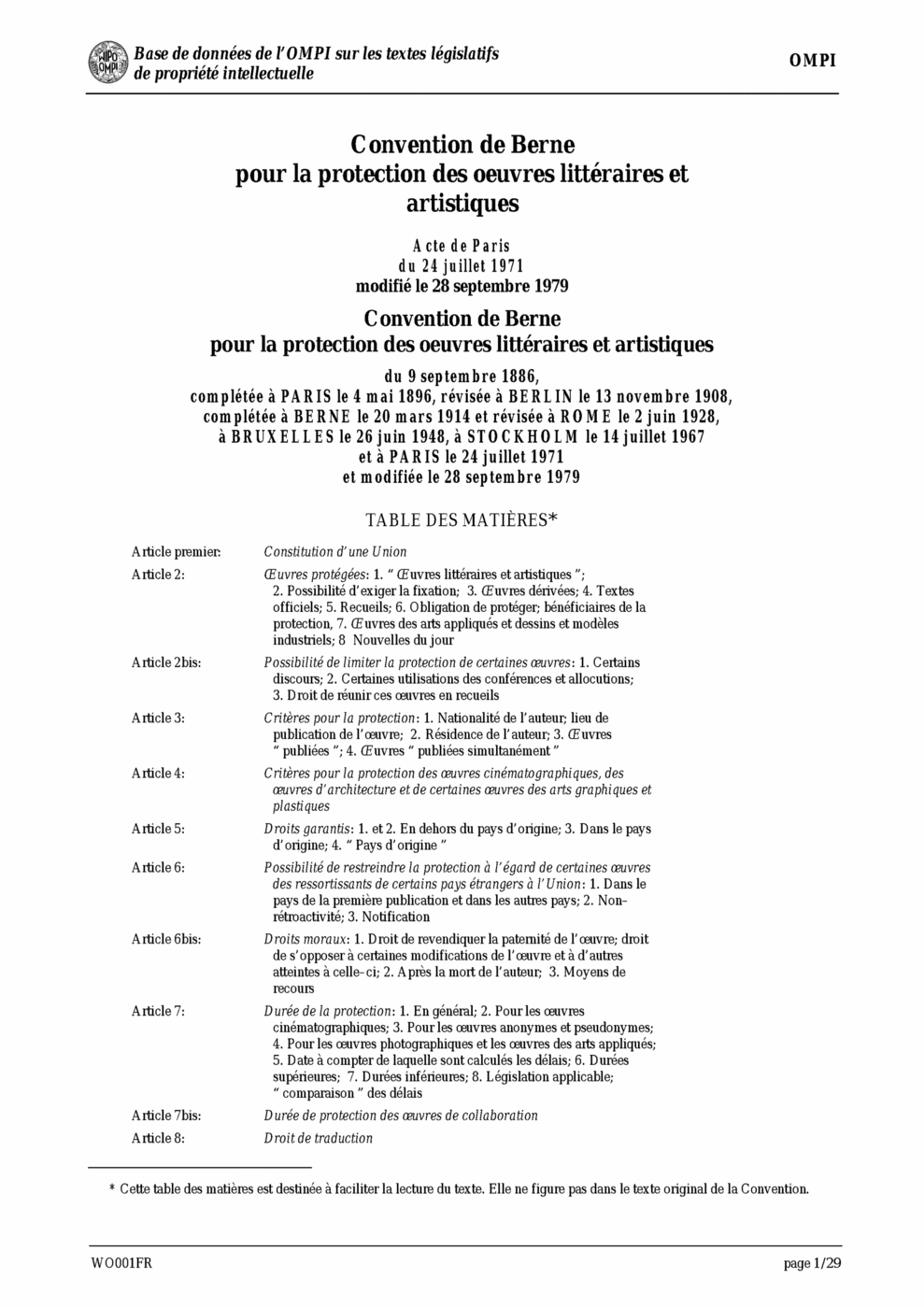
The positions taken around this group can be set out without adjudicating between them, which is as far as the record permits anyone to go.
- The group's own working position, stated in the May 1994 booster, was that moderation existed in part to attempt to prevent copyright violations — an acknowledgement that reposting could infringe, coupled with the claim that an editorial filter reduced the risk.
- The founding policy excluded proprietary material by hierarchy rather than by argument, carving out the commercial ClariNet feed and leaving everything else in.
- The FAQ's rejection list refuses commercially published articles outright, and gives as its example a newspaper humour column; it also asks submitters who notice that an accepted item came from a commercial source to say so, undertaking that a moderator will then cancel the article.
- Two further classes are excluded on grounds of provenance rather than law: material that circulated by photocopier and office noticeboard rather than originating in a newsgroup, and urban legends, where the FAQ draws a careful line — a posting from a folklore group is admissible, but the humour has to be in the posting rather than in the much-circulated legend it discusses.
- The moderator of rec.humor.funny published the other documented stance, and published it as a compilation claim: the collection is asserted as an editor's or collection copyright in the work of selecting, editing, collecting, correcting, typesetting and publishing — the same claim, the notice says, that the publisher of a dictionary makes over the collection without owning the words — on the explicit basis that the editor owns no individual joke, most of them being, so far as the editor knows, in the public domain, with attributed excerpts reproduced under the news reporting and fair use provisions and any wrongly included item removed on request.
The counter-argument the period made against all of this was structural: Usenet functions only by copying, every server storing and retransmitting every article it accepts, so posting to it must imply a licence to redistribute. Where that implied licence stopped — at the next server, at a cross-post, at a repost into another group, at a printed anthology — nobody could say authoritatively. It was argued in the humour groups for years and settled in none of them. This page records the positions; it does not resolve them.
Encryption as an editorial instrument
The group did not judge submissions, but it did mark some of them, and the marking was done with ROT13 — the substitution that shifts each letter thirteen places along the alphabet and undoes itself when applied twice. Its history as a Usenet convention, for punchlines and for spoilers alike, is older than this group and belongs to the recreation hierarchy, where it was written into charters; what is specific to this group is the use it was put to and the reasoning published for it.
The FAQ states that moderators did not edit for content, and that all modification was for readability and uniformity — and then, in the same answer, that some articles were encoded because the moderator judged they might offend, normally preceded by a disclaimer to that effect. The analogy offered is a bookseller's: material likely to give offence is placed on a higher shelf, as a courtesy to the customer rather than as a refusal to stock it. The document is candid that this produced inconsistency, since numerous moderators meant numerous standards, and asks readers who thought an item wrongly encoded — or wrongly left in clear — to write in so that their view could be taken into account next time. That is an editorial policy expressed as a reversible text transformation, applied by a rotating team, with an appeals procedure.
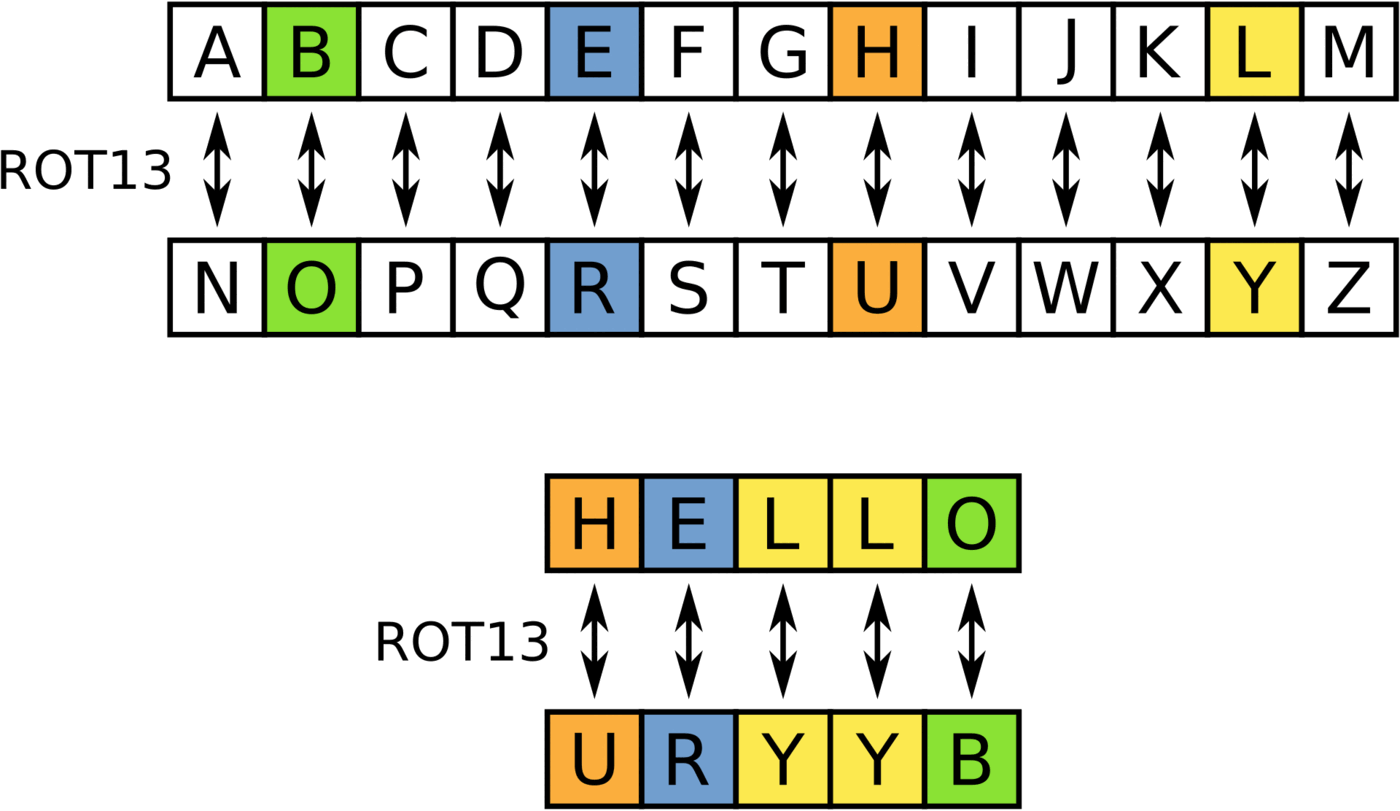

Because the encoding only works if the reader can undo it, the FAQ carries a table of the keystroke for it in every newsreader the moderators had been told about — a control character in one, a single letter in another, an escape sequence in a third, a menu item on the graphical readers of the mid-1990s, one chord shared by three RISC OS clients, a web page that would do the job for anyone who could not, and, for whoever still had no way of reading an encoded article, a three-line shell script built on the character-translation utility, with a note explaining why the author had written both alphabets out in full rather than using a range. Little else in the surviving documentation conveys so exactly what the network was made of at the time.
The policy did not arrive from nowhere. The FAQ explains the disclaimers carried in every article's headers and signature by saying that the moderators hoped not to be forced to resign the moderatorship — or their jobs — under duress on account of postings submitted by others, and directs a sceptical reader to the archived discussion in the companion group for January 1994, where a single item posted by the then moderator produced a furore the document still cites eight years later. The item is named there; it is not reproduced here. What matters for this page is the lesson the moderators drew: after that episode they erred, in their own words, on the side of caution.
What the group carried
The classes of material a best-of group collects can be described without reprinting any of it, and on a page about a redistribution mechanism reprinting would merely perform the act under discussion. No article, excerpt, joke or subject line from the group appears anywhere on this page.
What the documents describe, then, is a group whose staple was the unintended: humour produced by people who had not been trying to produce it, in groups that had nothing to do with comedy. The founding policy allowed for material submitted specifically to show how badly somebody had written, and made that the one case in which attribution might be waived — a revealing exception, since it is precisely the case where being named is a penalty. The FAQ's own framing is that the group exists for reposts from other newsgroups which the submitter believes to be humorous, and that the standard is the submitter's judgement, not the moderator's.
The exclusions are more informative than the inclusions, because they were written down. The group refused, by rule: articles sent to the wrong address; articles arriving without their original headers; articles altered by the submitter; requests for old material to be reprinted; commercially published writing; material of the kind that circulates by photocopier rather than by newsgroup; urban legends where the joke belongs to the legend rather than to the posting; articles so badly mangled by a newsreader that the original formatting had become illegible, including whole threads saved to one file and submitted as a single lump; and articles submitted only because the author's signature block was funny — for which the FAQ nominates a different group entirely, the long-running room devoted to oversized signatures, and asks that anyone posting there read that group's own FAQ first.
Read as a list, those rules describe a publication with a strong and quite specific idea of provenance. The material had to have been written by a person, in a newsgroup, without intending this destination, and had to arrive intact enough to prove it. Almost everything the group refused, it refused because the provenance could not be established or had been damaged in transit.
The humour groups around it
The master files the Internet Systems Consortium publishes — the same files a news server builds its group table from, consulted here in the edition of 1 September 2026 — list seventeen names beginning alt.humor, of which exactly one, this group, carries the moderated flag. The rest are open groups, and the branch is a fair sample of what an unregulated namespace does with a subject.
- alt.humor itself has no description in the master file at all. Its control file records a newgroup message of October 1996 and, in December 1997, a removal request generated automatically by a commercial news server product — the sort of accidental control message the hierarchy has always had to absorb. The name is still listed.
- alt.humor.puns was created in April 1994 from the same University of Denver department that had injected this group's newgroup nine months earlier, with a body three words long describing it as hideous word play. Its master-file description today reads, in full,
Not here. - alt.humor.parodies was created in November 1996 from a British address and is described as being for humorous parodies; the master file now records no description.
- alt.humor.net-abuse was created in June 1997, also from a British address, and is described as the lighter side of spam-fighting — a joke group about the network's own policing, of which the alt.* hub tells the serious half.
- alt.humor.jewish was created in February 1997, from an ordinary commercial address and under an ordinary name, and is described in the master file as a place to discuss and exchange Jewish humour. What was later built beneath its name had nothing to do with it, and the distinction is drawn in the paragraph below.
- alt.humor.dutch and alt.humor.dutch.terrace are a Dutch-language pair on the same convention as a group and its discussion room. alt.humor.mad-magazine, alt.humor.bluesman and alt.humor.mylarcity are single-subject rooms of the ordinary alt.* kind.
Five further names are of a different order, and honesty about the record requires saying so. Between 1 and 25 March 1998 a run of newgroup messages created alt.humor.holocaust and four names beneath alt.humor.jewish — not that group itself, which predates the run by a year and was created by somebody else entirely. The senders of the March messages are forged or nonsensical: three purport to come from a domain in the Vatican, two from a loopback address that cannot send mail at all, and one from a free webmail domain under a plainly invented name. Two of them were removed within hours by an administrator issuing rmgroup messages; one was recreated the next day from a different forged address and removed again. All of them are still in the master file today, because in this hierarchy removal requests are discarded by default and creation requests are not. Nothing in the record consulted here shows any of them becoming a working group. They are graffiti on a namespace that cannot be cleaned, and they sit permanently under the same prefix as the group this page is about.
The rec.* hierarchy's humour branch is a different animal: six names, three of them moderated. rec.humor is the open joke group, rec.humor.d the room for arguing about it; this group's FAQ treats rec.humor as the place the network's recycled material ends up, dismissing one class of submission on the ground that it has probably been posted there within the month. rec.humor.funny is the network's celebrated edited digest, the group this one defined itself against — founded in 1987 by Brad Templeton and, on the readership surveys of the day, for a stretch running from 1989 into the mid-1990s the most widely read publication on the network — with rec.humor.funny.reruns beside it for the archive; its history is the rec.* hub's subject and is not repeated here. rec.humor.oracle and rec.humor.oracle.d carry the collaborative question-and-answer institution renamed the Internet Oracle in March 1996, also covered there.
Two neighbours outside the humour branch belong in the same account. alt.folklore.urban, the group that worked the seam where the funny story meets the false one, is named in this group's FAQ as an acceptable source with a caveat attached; it is also the group out of which the urban-legend reference site later known as Snopes grew, its founders having been active there before starting the site in 1994. And alt.fan.warlord, the group devoted to mocking oversized signature blocks, appears in the FAQ as the correct destination for a submission whose only merit was the signature — a small piece of evidence that the humour groups understood themselves as a division of labour rather than a set of rivals.
The other groups made of other groups
This was not the only attempt at the format, and the others are instructive because the record shows what happened to each.
alt.best.of.internet came first, created on 21 May 1992 with a charter far more ambitious than anything this group attempted: it was to carry the most interesting articles from the whole namespace, expressly including news stories, jokes, memorable flames and poems; no article was to be original; the whole of the source article was to be included, with only irrelevant sections removable if it ran long; and the founder anticipated, in writing, that the traffic would soon require a hierarchy of subdivisions beneath it. It was unmoderated. Two administrators tried to undo it within ten weeks: rmgroup messages of 15 and 26 July 1992 called it a group created on a whim with no traffic to speak of, and remarked that it was not the internet and that what appeared in it was far from the best of anything. The name survived both, and is in the master file still. Fourteen months later this group's creation message described it as having failed miserably at the job. Its entry in the master file today reads It was a time of sorrow, it was a time of joy. — a line that describes nothing, and is the last thing any administrator agreed to write down about it. The two names differ by a single word, and were confusable for as long as both existed; the distinction that actually mattered is in the two charters. This group took Usenet postings only, and was moderated. The other took anything from anywhere, and was not.
alt.usenet.reposts followed on 22 May 1995, from a Berkeley address, and read the same problem the opposite way. Its charter is a plain statement of the case for the format: there were, it observed, over ten thousand groups, and even someone who wanted to could not read them all, so a reader could instead read this one and find the ends of flame wars, newcomers' mistakes, witty replies and other articles a wider audience might otherwise miss. Reposts only; discussion to the companion group. Boosters followed from a provider in Alabama in July 1995 and from Washington State University in June 1996, the second describing it as an established newsgroup not currently available on some systems. It too was unmoderated, and this group's FAQ later described it accurately as a similar service with no restrictions, where an article might merely be interesting rather than funny. Its master-file description today consists of an instruction to use alt.best.of.internet instead — a redirection to the group that had already failed.
The format also crossed a language boundary. The Croatian hierarchy carries hr.rec.humor.best-of-usenet, described in the master file as humorous articles from groups that are not for humour, sitting alongside hr.rec.humor, its discussion group and a binaries room. The control archive holds no file for it, so nothing here can date it or say who created it; the name is the whole of the surviving evidence, and it is enough to show that the idea travelled.
One statistic sums up what became of the word. Ninety names in the current master file contain the string repost, and eighty-two of them are under alt.binaries — where a repost is not a reprint of somebody's writing at all but a request to re-transmit a file whose parts arrived incomplete. The vocabulary of the reprint group was absorbed, within a decade, by the file-distribution branch, and the meaning inverted on the way: from choosing something worth showing again to replacing something that failed to arrive.
Who decides what a site carries
Nothing in Usenet obliges any server to carry any group. That is the mechanism the alt.* hub sets out in full, and the point need not be re-argued here. What this page can add is the other half of it: carriage was refused on grounds of content long before it was refused on grounds of volume, the humour groups were among the earliest to be refused — the removal of rec.humor.funny from Stanford University's central computers in 1989 is the documented case, and it belongs to the rec.* hub — and the paperwork of this particular group shows what that felt like from the inside.
Begin with the booster messages. A group in the Big Eight was created once, by an authority whose control messages administrators had agreed in advance to honour. A group in alt.* had to be sold, repeatedly, to strangers. The May 1994 message is not a technical instruction; it is an advertisement, opening with a request that any administrator not carrying the group should consider doing so, and going on to list the reasons an administrator might want it — that it is moderated, that followups are diverted elsewhere, that copyright violations are screened for, that the headers are tidied for readability. Every clause in it answers an objection a news administrator might raise. The group's moderator had to argue for shelf space, in public, to people he could not name.
The second half of the problem was that carrying a group is not the same as carrying it correctly. A site that added alt.humor.best-of-usenet without the moderated flag turned an edited publication into an open one on that site alone, and the group's FAQ describes exactly that outcome: unapproved articles appearing in a group that was supposed to contain none, including submissions that were never forwarded, followups that should have gone to the discussion group, and advertising. The FAQ's list of reasons a provider might not honour the flag is the most quietly remarkable sentence in the whole document, because it names the legal argument outright: idealism, laziness, or law — the last glossed as supporting a provider's claim to be a common carrier and therefore not responsible for what it transmits.
That is the carrier-or-publisher question in its Usenet form, stated in 2002 by volunteers describing their own group's failure modes. An intermediary that edits looks like a publisher; one that passes everything on looks like a carrier; and a provider that declined to implement moderation at all could argue it had never chosen anything. The group's moderators observed the argument being made against them and recorded it without comment. This page does the same.
The third pressure was personal, and the group's documentation is unusually frank about it. The disclaimers appended to every article existed, the FAQ says, because the moderators hoped not to be forced out of the moderatorship or out of their employment on account of material submitted by other people. Moderators of this period were, characteristically, staff or students at universities, using institutional machines and institutional addresses: the group's own succession of moderation addresses runs from a university in Virginia to a university in Ohio to a university in North Carolina. A volunteer editor in that position is exposed twice — the institution can withdraw the mailbox, and the employer can take an interest in the contents — and the group's answer was a boilerplate disclaimer in every header and every signature, which is the cheapest liability insurance ever written.
Then there is what the namespace did to the neighbourhood. An administrator deciding in 1998 whether to carry alt.humor.* wholesale was deciding, whether or not they knew it, to carry a set of names created that March from forged addresses for the purpose of causing offence. Pattern-matching on a prefix is how large feeds are actually configured, and a prefix is only as carriable as its worst member. Nothing in the hierarchy could remove those names; the only available response was to decline the branch, or to enumerate the groups one at a time. Content-based refusal, in other words, was not simply a matter of squeamish administrators objecting to jokes. It was frequently the only tool available.
Two things follow, and they are worth separating. Carriage was a decision, taken locally, revisited rarely, and invisible to readers, who experienced it only as a group that was not in the list. And because it was a decision rather than a policy, it left almost no record: this page can document that the group's own moderators expected to be dropped and argued against it, but it cannot name a single site that dropped this group, because no such list was ever kept.
Where it went
The format outlived the group comprehensively, which is the awkward part of its history. Reposting somebody else's remark to an audience assembled to appreciate it is now a substantial fraction of what the public internet does, and the mechanisms that do it descend, structurally if not by inheritance, from exactly this arrangement.
The first move was to the web, and the humour groups made it early because curated material is easy to mirror: it has already been selected, already formatted, and is small. rec.humor.funny's collection is still published on its own site, under a compilation-copyright notice covering the years 1987 to 2008 — more than two decades of selection asserted as one edited work. The urban-legend site that grew out of alt.folklore.urban began in 1994. The periodic postings of the humour groups, this group's FAQ among them, went into the Usenet FAQ archives and stayed readable long after the groups themselves had thinned.
The second move was to the link aggregator, and the dates make the lineage plain. Slashdot launched on 5 October 1997, running on reader-submitted stories chosen by editors. Fark followed in 1999, its founder having spent the preceding years mailing interesting news items to friends. Digg launched on 5 December 2004 and Reddit in June 2005, both replacing the editor with a vote. Each of them is a best-of group with the moderation queue rebuilt in software: submissions from readers, selection by somebody other than the author, discussion in a room attached to the item rather than mixed into it. What none of them kept was the part this group was most careful about. A repost here arrived with the original author's name, the group it came from, and the identity of the moderator who had passed it. That is the habit that dates the group, and the one part of the design its successors did not adopt.
The third move was archival, and it is why any of this can be checked. Deja News began archiving Usenet in March 1995; the archive was bought by Google in February 2001 and reopened as Google Groups, supplemented by the end of that year with donated collections reaching back to 1981. The service's Usenet gateway closed in February 2024, but what it already held remained. The group's own FAQ had, characteristically, anticipated the archival question and answered it as a service question: asked how to read the group without access to a news server, it reported that there was no known file archive, pointed readers at Google's web interface, and named a mail gateway that would deliver postings to an inbox on registration — the gateway whose surviving directory this page belongs to.
What the record does not show
The gaps in this group's history are large and should be stated, because a page that fills them with plausible detail would be worthless.
- There is no readership figure. The network's readership surveys of the early 1990s did not produce a usable estimate for this group in any source consulted here, and no number is offered.
- There is no message count, no measure of traffic in messages or megabytes, and no record of how many submissions were received against how many were posted.
- The moderators are not enumerated. The founding moderation address was at Virginia Tech in July 1993; it was at Youngstown State by December 1993; it was at Duke by the time the FAQ took its final form. The record names the person who created the group and the person who ran it from Ohio, and credits a maintainer for the FAQ. It does not say how large the team became, when it was assembled, or when any individual joined or left.
- No end is recorded. There is no rmgroup message, no farewell posting in the archive consulted here, and no announcement of closure. The group is still in the master file, still flagged moderated. What the record shows is a FAQ last modified in January 2002 and still being posted automatically in 2004, and silence afterwards.
- The alt.config discussion that preceded the creation is not preserved. The creation message names it, and the message identifiers it replies to survive in the headers, but the thread itself is not in the control archive, which keeps control messages only.
- Nothing dates the Croatian analogue, and nothing establishes whether it was modelled on this group or arrived at independently.
- It is not known whether the opt-out marker the moderators invented was ever used by anybody, nor how often a submission was refused on those grounds. The FAQ describes the policy; no instance of its operation survives.
One correction belongs on the record. An earlier version of this page stated that the group's FAQ was still being maintained well into the 2010s. That is not what the documents show. The FAQ's own last-modified date is 20 January 2002, and the latest posting of it traced here is dated 4 May 2004. The archive page that still serves it does carry a site-generated stamp of 27 March 2014, but that is a mirror touching a file it is holding, not evidence that anyone was revising the document. What persisted into the 2010s was the mirror, not the maintenance. The distinction matters on a page about the difference between a thing and a copy of it.
Scope and limits of this page
Four bodies of evidence stand behind this article. The first is the Internet Systems Consortium's mirror of Usenet control messages, which holds the creation and booster messages for alt.humor.best-of-usenet and its discussion group, and the corresponding files for the neighbouring groups named above; those files are the source of every date, address and quoted newsgroups-file line here. That archive begins in early 1991, declares one gap of about a month in 1992, and keeps control messages and nothing else, so it can show what was asked of news servers and never what any server did about it. The second is the same organisation's master newsgroups and active files, consulted in the edition of 1 September 2026, which supply the current descriptions, the moderation flags and the counts of names. The third is the group's own frequently asked questions file as mirrored in the Usenet FAQ archives, which is the source for everything about the submission pipeline, the moderation team, the opt-out markers and the encoding policy. The fourth is the submission and copyright pages published by the moderator of rec.humor.funny, cited only for the contrasting position they state.
Where those sources disagree with each other the disagreement is reported rather than resolved, and where they are silent this page is silent. No thread, poster, subject line, quotation, joke or statistic has been supplied from anywhere else, and none has been invented. The group descriptions elsewhere in this directory are editorial summaries written for the archive; the directory itself reflects what one mail-to-news gateway carried between 2000 and 2004, which is a partial and particular view of the network and is not represented as more than that.
Reading alt.humor.best-of-usenet today
- Historical archive: Google Groups — alt.humor.best-of-usenet (coverage varies by group and era).
- Open in a newsreader:
news:alt.humor.best-of-usenet— the original site offered exactly this link, and it still works if your system has a newsreader registered for thenews:scheme. - Live access: point an NNTP newsreader at a modern server — see accessing Usenet today.
- The original news2mail e-mail subscription service ended in the mid-2000s and no longer operates.