The alt.* hierarchy
The anarchic wing of Usenet: alt.* groups could be created by anyone who could format a control message, which produced both indispensable communities and deliberate nonsense — often adjacent. Groups carried by the gateway are listed below.
- alt.america
- alt.astrology
- alt.astrology.metapsych
- alt.autos.ford.focus
- alt.bbs.elebbs
- alt.bible
- alt.binaries.autographs
- alt.binaries.e-books
- alt.bmx
- alt.books.arthur-clarke
- alt.cellular.nokia.ringtones
- alt.comp
- alt.complainers.bitch-n-moan
- alt.conspiracy.jfk
- alt.culture.zambia
- alt.dcom.telecom
- alt.drugs.chemistry
- alt.evolution
- alt.fan.godzilla
- alt.fan.regular-guys
- alt.fan.starwars.jar-jar-binks.die
- alt.food.mexican-cooking
- alt.fr.comp.os.ms-windows.xp
- alt.humor.best-of-usenet
- alt.idiot.marsrules
- alt.impeach.bush
- alt.music.bluegrass
- alt.music.country.classic
- alt.music.ontario-emperor
- alt.netscape.sucks
- alt.nettime
- alt.new-england
- alt.new.cracks
- alt.newbie
- alt.nl.support
- alt.pets.chia
- alt.politics.bush
- alt.privacy
- alt.psychology
- alt.psychology.help
- alt.psychology.jung
- alt.psychology.nlp
- alt.psychology.personality
- alt.support.jock-strap
- alt.support.ocd
- alt.support.ocd.moderated
- alt.tesla
- alt.verizon-sucks
On this page
- The barbecue at G.T.'s Sunset
- A newgroup message is only a request
- What each administrator actually decided
- alt.config, and the etiquette that grew without authority
- Two disputes the control archive records
- The arithmetic of a namespace nobody owns
- How to read an alt.* name
- Names that are the posting
- What lived here
- The binaries branch
- Spam, cancels and the Breidbart index
- Where alt.* stands now
- Scope and limits of this page
The barbecue at G.T.'s Sunset
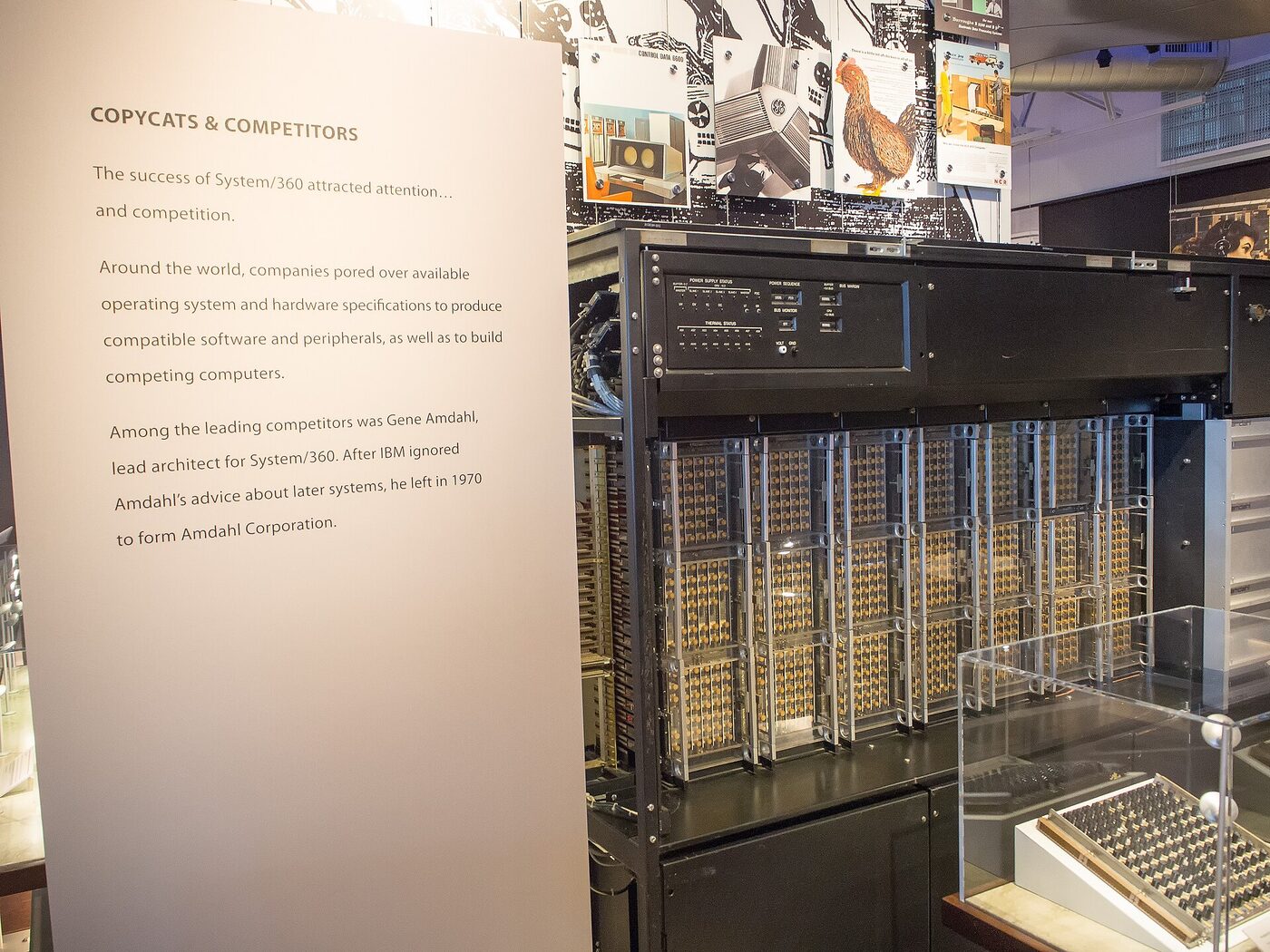
alt.* was founded at a table in Mountain View, California, and the founder wrote down the date. Brian Reid's own account, given to Henry Hardy for his 1993 history of the network and reproduced widely since, opens: The famous barbecue at which the alt net was created was held at G.T.'s Sunset Barbecue in Mountain View California on May 7, 1987. Reid and John Gilmore were both, in his words, unhappy with the decision-making process of the ordinary net: Gilmore because the net would not create rec.drugs, Reid because he was being pressed to adopt the name rec.food.recipes for the recipe newsgroup he had built out of his USENET Cookbook project. Gordon Moffett of Amdahl sat with them and, Reid recorded, had no specific grievance or goal but wanted to help.

.jpg)
What they built that month was not a policy but a topology. Gilmore's home computer was hoptoad and Reid's was mejac; they set up a link between the two machines, each of them also set up a link to amdahl, and they undertook to pass all alt traffic to one another and, in Reid's phrase, to nurse the net along. Reid at the time also managed decwrl, so he quietly added alt to the list of groups that machine carried. That is the whole of the founding infrastructure: three UUCP links between three sites, plus one entry added to a fourth machine's configuration by a man who happened to have the password.
.jpg)
The occasion for it was the Great Renaming, the 1987 reorganisation that sorted the old net.* namespace into the seven topical trees of the Big Seven. That story — why it happened, what B News 2.11 had to do with it, and who made it stick — belongs to the Usenet explainer, whose account of it is headed with the founding of alt.* precisely because the two events are one event seen from two sides. What matters here is the consequence. Reid proposed alt.* as an alternative to talk.*, the tree into which the Renaming had swept the network's most contentious subjects and which the backbone sites could still decline to carry; the talk.* side of that argument is told on the talk.* hub. alt.* was to be a network without the backbone sites, and therefore free of the backbone's influence over what could exist.
Creating groups on it was, at first, a matter of persistence rather than procedure. In those days, Reid wrote, one sent out numerous newgroup messages in the hope that one would take; by the end of May 1987 the groups alt.test, alt.config, alt.drugs and alt.gourmand were active. alt.gourmand — Reid's own recipe group, the one whose name the Big Seven had wanted changed — is generally named as the first newsgroup in the hierarchy, and it is still in the master newsgroups list today, flagged moderated, with the description Recipes & cooking info. alt.config was there from the first month too, which tells you something about what the founders expected to need.
The famous message came nearly a year later. A vote had been taken on creating soc.sex; it passed, and Gene Spafford declined to create the group. Reid created alt.sex on 3 April 1988 instead and wrote to the backbone mailing list at Purdue to say so:
To end the suspense, I have just created alt.sex. That meant that the alt network now carried alt.sex and alt.drugs. It was therefore artistically necessary to create alt.rock-n-roll, which I have also done. I have no idea what sort of traffic it will carry. If the bizzarroids take it over I will rmgroup it or moderate it; otherwise I will let it be.
He signed it T5 (5th thoracic), a vertebra, which he later explained was his attempt to remind the recipients that he was an official voting member of the backbone. The joke has outlasted almost everything else about the episode: thirty-eight years later the master newsgroups file distributed by the Internet Systems Consortium still describes alt.rock-n-roll as Counterpart to alt.sex and alt.drugs. — and, with a certain administrative deadpan, still describes alt.drugs as Use rec.drugs.misc instead.
Reid's closing reflection is the most quoted sentence in the hierarchy's history and the most accurate description of its mechanics. At the time he sent that message, he wrote, he did not yet realise that alt groups were immortal and could not be killed by anyone; in retrospect that was the joy of the alt network — you create a group and nobody can kill it, it can only die when people stop reading it. No artificial death, only natural death. Everything in the rest of this page is a consequence of that sentence being true.
One caution about the record. A second contemporary account, quoted in the same history, tells the story differently: it has Richard Sexton proposing rec.sex, the group passing its vote, the backbone administrators declining to carry or create it, the alt distribution being set up almost immediately, alt.sex and alt.drugs as the first groups created, and Brian Kantor issuing the newgroup for alt.rock-n-roll the next day for aesthetic reasons. Hardy prints both and corrects the last point in his own voice: it was Brian Reid, not Brian Kantor, who took part in creating the alt net. The two versions disagree about the order of the groups, the trigger and the name of the man at the keyboard, and they were set down only a year apart — the second account is dated 1992, Reid's 1993 — by people who were there. A hierarchy founded by three men over barbecue, with no minutes and no vote, was never going to have a tidy provenance. The one thing both accounts agree on is the shape of the grievance: a group had been asked for, the people who ran the links had said no, and the answer was to build links that did not go through them.
The folklore arrived quickly and has never left. The periodically posted creation guide records the standing joke, attributed there to Eric Ziegast, that ALT stands for Anarchists, Lunatics and Terrorists. The same document gives the boring truth: alt is short for alternative, meaning alternative to the mainstream comp, misc, news, rec, soc, sci and talk hierarchies, and nothing more.
A newgroup message is only a request
The mechanism is worth stating exactly, because almost everything peculiar about alt.* follows from it and no other page on this site can carry it. A control message is an ordinary Usenet article that happens to carry a Control header; the body of that header holds a command and its arguments. A newgroup control message names a group to be created, optionally followed by the keyword moderated. An rmgroup message names a group to be removed. Neither of them removes or creates anything by itself.
Two older conventions for marking the same thing survive all over the archives: a Subject line beginning cmsg followed by the command, and a Newsgroups line naming a pseudo-group whose name ends in .ctl. RFC 5537, the current Netnews standard, forbids software from treating either as a control message; the traditional Subject line is nonetheless still written, out of habit and for the benefit of human readers, on control messages issued this century.
The message then travels exactly like any other article. It floods from server to server, and at each server the news software either acts on it or files it away, according to what that server's administrator has configured. Creation is therefore not an operation performed on the network but a request put separately to several thousand independent operators, each of whom answers privately and without telling anyone. There has consequently never been a canonical list of alt.* groups, and two readers on two providers can disagree, correctly, about whether a group is real.
One refinement makes the mechanism sharper than it first looks. Under RFC 5537 a newgroup message aimed at a group that already exists does not fail; it changes that group's moderation status or its description. A newgroup message is therefore an edit as well as a creation, which is why the archives are full of second, third and fortieth newgroup messages for groups that plainly existed already. Some are boosters, reissued to improve propagation to sites that missed the first one. Some are attempts to change a group's flag. And some, as the standard administrative documentation warns, are attempts to convert a moderated group back to unmoderated in order to break it.
In alt.* the rmgroup acquired a second meaning that it has nowhere in the Big Eight. Because unsigned newgroup messages in this hierarchy function as a formalised proposal rather than an instruction, objections to the proposal are expressed by issuing an rmgroup. The same convention governs free.*, whose control.ctl entry is the alt.* entry with the name changed, and the German de.alt.* branch runs it in both directions at once: there an unsigned rmgroup is itself a formal proposal to remove a group, and objections to that are made by issuing a newgroup. An rmgroup in alt.* is not a deletion. It is a vote against, cast in public, which each administrator may find persuasive or may ignore.
The last piece of the mechanism is the smallest and the most consequential for anyone reading a group list today. The creation guide instructs a proposer to include in the body of the message two lines, the first reading exactly For your newsgroups file: and the second the group name, whitespace and a one-line description. News software lifts that second line into the description file that newsreaders display; RFC 5537 records the practice as the convention that preceded its own structured replacement, and permits a server to go on honouring it. The one-line descriptions quoted throughout this page are not editorial summaries written by anybody in authority; they are whatever the last newgroup message an administrator chose to honour happened to say.
What each administrator actually decided
The decision is not hypothetical, and the file in which it is written down is public. INN, the news server software most sites run, reads a configuration file called control.ctl that says, hierarchy by hierarchy, whose control messages to obey. The Internet Systems Consortium distributes a maintained edition of it. Its alt.* section is four lines long and reads, in effect, do everything and undo nothing: accept newgroup messages from anybody, drop them if they appear to come from either of the two addresses that issue Big Eight controls and therefore never issue alt.* ones, and silently discard every rmgroup.
The comment block above those four lines is the most honest document in Usenet administration, and it is worth quoting because it is written by people who run servers rather than by people who write about them. Small sites, it says, are strongly recommended to change the policy to drop all newgroups and rmgroups for alt.* and add groups only when a user asks, because — in its own words — tons of alt.* newgroups are sent out regularly with the intent more to create nonsense entries in active files than to actually create a useable newsgroup. It then explains how to tell the difference: look the group up in the control-message archive, since many junk control messages are malformed and are never archived at all, and read the first and last few messages to see whether the group is supposed to be moderated.
And then it disclaims itself:
Be aware that there is no official, generally accepted alt.* policy and all information about alt.* groups available is essentially someone's opinion, including these comments. There are nearly as many different policies with regard to alt.* groups as there are Usenet sites.
That is the answer to the question of what it means for a group to exist here. It exists on the machines whose administrators have decided it should, and the number of those machines is not published, not knowable and not stable. A group can be complete on one server, absent from the next and full of holes on a third. Propagation is the only currency, and the creation guide is blunt about the exchange rate: some administrators will not add any group that was not discussed in alt.config first, so a group created without discussion is usually carried badly, which on a network where existing widely is the only thing that counts is punishment enough.
Institutions made the same call and sometimes minuted it, and the best-documented set of minutes belongs to a single Canadian university. In May 1990 the associate provost for computing at the University of Waterloo cut off the whole of alt.*, which then held about seventy groups; the reasons the administration gave in public were inconsistent, ranging from disc costs to the avoidance of controversy, and the staff who ran the machines disputed the economics, pointing out that the feed came in over a fixed link and that alt.* was about a tenth of it. Some groups came back that November, the alt.sex.* branch did not, and everything that had been cut was finally restored on 3 October 1991.
The same university then made the decision twice more, on quite different grounds. In November 1993 it removed alt.fan.karla-homolka, the group discussed below, because a newspaper article circulating there appeared to breach a publication ban imposed on a murder trial by an Ontario judge that July; the group was restored on 4 October 1995, a month after the related trial ended. Then, on 1 February 1994, the provost announced that the university's ethics committee had reviewed a number of newsgroups with legal advice, concluded that several of them from time to time carried material contrary to the obscenity provisions of the Canadian Criminal Code, and recommended the removal of five: four in the alt.sex.* branch and alt.tasteless. The committee's own report identified only the first two as having been named by the university's solicitor and described the removal as largely symbolic. Nothing about any of these decisions touched any other site. They were configuration changes at one university, which is the only kind of decision the hierarchy has ever been able to produce — and the only reason they are quotable at all is that a member of that university's computer science faculty wrote them down.
This directory contains its own small demonstration. Of the forty-eight alt.* groups listed above, four are not in the current ISC master list at all — among them alt.nl.support, alt.new.cracks and alt.music.ontario-emperor. They were carried by the gateway that produced this snapshot, so for its users they existed; they are not carried by whoever maintains the master file today, so for that file they do not. Both statements are true, and in this hierarchy they were always going to be.
Forgery was the obvious weakness, and the Big Eight eventually closed it: those hierarchies now sign their control messages with a hierarchy key, and conforming servers execute controls carrying the right signature and ignore everything else. A hierarchy with no central authority has no key to be the right one. Signed alt.* control messages nevertheless exist — several of the rmgroups in the archive carry PGP signatures and point administrators at a key they may install if they wish — but that is signing without authority: it proves who sent the message, not that the message should be obeyed. The older defence remained the real one. In the reorganisation of the picture groups in 1991 the proposer warned that some sites would try to re-create the groups he was removing, told administrators to consider the source of any re-creation message before acting on it, and offered to help them switch off automatic execution altogether — for B News, by recompiling with the NONEWGROUPS option defined; for C News, by replacing the newgroup script. Thirty-five years later that is still how alt.* is governed: one administrator, one message, one decision.
alt.config, and the etiquette that grew without authority
alt.config was one of the four groups active in the hierarchy's first month, and it is still listed, with a description that has never needed expanding: config. It is where proposals go. It binds nobody, decides nothing and has no officers, and it has nevertheless produced a body of convention detailed enough to fill a document that was posted to news.answers every fourteen days for years.
That document, So You Want to Create an Alt Newsgroup, is the closest thing the hierarchy has to a constitution, and it opens by refusing the job:
There are no Guidelines or Rules for creating alt groups. There is no one "in charge" of the alt hierarchy. The key to creating a successful alt newsgroup depends only on convincing the thousands of news administrators across the globe to carry your newsgroup.
It is a collaborative text: its credits name Jamie Andrews, Christopher Samuel, Mark H. Weber and Eric Ziegast as the authors of the pieces it was assembled from, with submissions from Tim Pierce and Joe George. On the one question everybody asked, it is emphatic — let me repeat, it says, there are no votes in alt, period — and it goes on to explain, wearily, that every few months somebody proposes a group, somebody else replies I vote yes, and alt.config spends a fortnight on a poll that means nothing. The contrast with the Big Eight's Request for Discussion, Call for Votes, published tally and hundred-vote margin is total; that machinery is described in full on the comp.* hub, and the point of this page is its absence.
What a well-formed proposal looked like can be read off the control archive, because the good ones say so. On 25 April 1994 Thomas Koenig, at the University of Karlsruhe, issued the newgroup for alt.current-events.net-abuse. The body of the message explains that the group is a forum to discuss current net abuses such as the spamming of Usenet by the law firm Canter and Siegel, observes that this discussion was at that moment taking up most of the bandwidth in news.admin.misc and news.admin.policy and clearly merited a separate forum, cites the message-id of the alt.config posting in which it had been proposed, notes that it met no opposition there at all, and ends with the two-line newsgroups-file entry. That is the whole procedure: propose, wait, cite, create. The green-card advertisements had gone out thirteen days earlier. The Big Eight's equivalent took a vote: news.admin.net-abuse.misc was created in April 1995, and the reorganisation that produced the rest of news.admin.net-abuse.* not until November 1996 — a story told on the news.* hub. The advisory rmgroup that eventually retired Koenig's group says so in one line, giving 10 April 1995 as the date on which the Big Eight group superseded it. Thirteen days against a year is the entire argument for alt.*, stated once, in a single archived message.
A fuller example, and one whose subject this directory holds, is the November 1999 newgroup for alt.support.ocd.moderated. It carries the newsgroups-file line, a group submission address, a separate moderator contact address, the sentence Newsgroup alt.support.ocd.moderated has been successfully discussed in alt.config, a charter, a justification and the names of three proponents who would also be the initial moderators. The charter is specific in the way charters written by people who have been on the receiving end of something tend to be: no binaries will be permitted; one advertisement per month per organisation or individual, subject lines to begin with AD; a FAQ to be kept on the web with the address posted every couple of weeks. The justification explains that the group exists because the unmoderated alt.support.ocd had been subject to recurrent invasions, and that people who needed support had been driven back into lurking or had left. Nobody had to approve any of it. The proponents wrote it because a proposal that answers the objections in advance propagates better than one that does not.
Those objections were catalogued, and the catalogue is a fair summary of what forty years of unregulated namespace design actually taught. The creation guide's list of reasons proposals get refused includes:
- Characters that break things. Components should use only the letters a to z, digits, the dash and the plus sign. The guide records that one joke group named
.cabalwas created and lots of software mysteriously stopped working in bizarre fashion. - Components longer than fourteen characters. C News enforced the old flat-spool limit; hence alt.fan.bgcrisis rather than alt.fan.bubblegum-crisis.
- Useless components. Strip the last component off a name and you should be left with a plausible branch; use a dash as a word separator, not a dot.
- Joke, revenge and shock groups, discouraged not because they are unfunny but because they are permanent.
- Names ending in the same word three times. The guide notes that the first was alt.swedish.chef.bork.bork.bork, that dozens of lookalikes followed, and that the joke was old five years in.
- All-numeric components, because on a Unix spool the directory holding the articles of alt.indianapolis would contain a file called 500, and the group alt.indianapolis.500 would want a directory of the same name.
- Acronyms, on three grounds: they do not say what the group is about, they are not unique across trades and countries, and nobody browsing can find them.
- Top-level sprawl. Put the group under an existing second level rather than hanging another bare name off alt.
- The threat to move to the Big Seven later: because alt groups are permanent, the guide records, many administrators will oppose a group outright if its proposer says he may move it to rec, soc or talk in the future. Try to create it there first.
- Extremely limited or regional interest — as the guide puts it, people in Saudi Arabia generally do not care much about great places to eat in Houston, Texas.
- Not proposed in alt.config, which some administrators treated as disqualifying on its own.
Two arguments are singled out as worthless. The first is that some other silly group exists, so this one should too — an argument, the guide observes, in which the proposer willingly likens his proposal to every ridiculous name already in the hierarchy. The second is that nobody is forced to accept it, which ignores that administrators are the people who have to decide, every time it is created and every time it is re-created.
Behind all of it sits the fact the guide states plainly and that Reid had discovered in 1988: alt groups are effectively immortal. Some people, it notes, insist that once created a group can never be destroyed and make sure that whenever someone tries to remove one it gets re-created; even without them, ordinary mistakes at new sites revive almost-dead groups everywhere. Alt groups never die, it concludes, they just fade away — though some fade faster than others.
The tone of the whole enterprise is captured by the epilogue Mark Weber wrote for it. This may sound like a lot of rigmarole, he says, and it is; the purpose is to discourage groups that would be better off in the mainstream hierarchies or better off uncreated. And then: do not take it too seriously, because the alt net is the last remaining refuge away from the control freaks, namespace purists and net.cops — like myself — who maintain and enforce the mainstream newsgroup guidelines. Almost any non-forged, serious newgroup message will at least be considered.
Which is how alt.pets.chia got in. Its creation message, sent from Johns Hopkins on 20 December 1992, begins: Sorry for not discussing this beforehand in alt.config, but Christmas is almost here and this group has to be created as soon as possible. Then the newsgroups-file line, then a short list of suggested topics including what to do with the sprouts when they are dead. Six and a half years later a booster message re-created it, with a note explaining that the sender was issuing newgroups for groups that seemed to have quite a bit of traffic and had an okay charter but were missing from the ISC newsgroups file, and that this one was made in 1992 — Ahh, simpler times. The original apology is quoted verbatim inside the booster, because in this hierarchy the paperwork travels with the group.
Two disputes the control archive records
The archive that makes all of this checkable is maintained by the Internet Systems Consortium. By its own policy document it holds every valid newgroup, rmgroup and checkgroups control message seen on Usenet since early 1991 — one file per group, arranged by top-level hierarchy, with about a month around August 1992 missing; it began at rpi.edu, moved to uu.net in the autumn of 1992 and later to isc.org. Only well-formed messages are kept: an article must carry an Approved header, must be under 64 kilobytes for a newgroup or rmgroup, and must name a group whose components are lower-case, contain no character outside a small set, avoid the reserved sequences all and ctl, and total no more than eighty octets. A great deal of what alt.* has been sent over the years fails those tests and is not there at all. The same document declines to claim completeness: propagation is imperfect, the archiving software is imperfect, and no guarantee is offered that anything in particular was caught.
The file for alt.config itself is a fair sample of what is. It holds one hundred and seventy-three control messages between April 1992 and December 2006 — about one hundred and thirty-two asking servers to create the group, sixteen of those asking for it to be created moderated, and forty asking them to delete it. In March 1994 someone issued an rmgroup for alt.config with a one-word body; two days later somebody else newgrouped it back. The last message in the file, from December 2006, is a booster carrying the word BOOSTER, the newsgroups-file line, and beneath them a quoted copy of the 1992 message that started the file, reproduced in full under the words Above copy of the _original_ cmsg. A hierarchy in which the group for discussing group creation is itself created and deleted, on paper, a hundred and seventy times over is not malfunctioning. That is the function.
The first instructive dispute concerns the moderated OCD group described above. It was created on 21 November 1999. In the month that followed, one large American access provider issued its own automatic newgroup to add the group across its news servers, which is a provider agreeing. On Christmas Eve an rmgroup arrived from an account describing itself as an alt rmgroup account, PGP-signed and pointing at a published key, giving two reasons in a two-item list: No Charter and No Traffic Rate Measurement. In January the proponents reissued the newgroup as a booster, with the charter attached and a header noting that the group had been newgrouped a while ago. Both sides were doing exactly what the hierarchy provides for. The objector held that a group should demonstrate traffic and publish a charter through the accepted channel; the proponents held that they had discussed it in alt.config and written a charter, and reissued. No third party adjudicated, because there is no third party. The group is in the master file today, flagged moderated.
The second is the best-known rmgroup in the history of the network. The earliest archived control message for alt.religion.scientology is dated 17 July 1991 and carries a From line at a church address that misspells the name of the organisation's leader; the group's own encyclopaedia entry cites this same archive for the date and records that the creation message was formatted to disguise the poster's identity, and that arguments about a forgery have followed the group ever since. On 11 January 1995 an rmgroup went out from Helena Kobrin, who signed it Counsel for trademark and copyright owner. Its body asked administrators to remove the group and gave four reasons: that it was started with a forged message; that it was not discussed on alt.config; that the word Scientology in the name is a trademark and the name misleading; and that the group was being used for copyright and trade-secret violations. It closed by asking sites to confirm that they had removed it.
What happened next is a demonstration of the mechanism rather than of anybody's merits. The message was largely ignored and openly protested by the administrators who carried the group. Within hours a counter-newgroup went out from a university machine in Tennessee, quoting the lawyer's four reasons and answering each of them in turn — one does not rmgroup an active, thriving group merely because it was not discussed on alt.config, it says, especially several years after it was newgrouped — and closing with two alternative one-line descriptions for the newsgroups file, one of them a joke. Both messages sit in the same archived file, a few kilobytes apart, and both are still there. The group is still in the master list. The episode is regularly cited as an early case of a suppression attempt producing the opposite of its intent, and it is also the cleanest illustration available of what the rmgroup line in control.ctl means in practice: an rmgroup in alt.* is an argument, and it persuades or it does not.
The arithmetic of a namespace nobody owns
Two files let anyone count the hierarchy rather than guess at it. The ISC distributes a master active file, recording each group's posting status, and a master newsgroups file pairing each name with its one-line description. The edition consulted while this page was written is timestamped 28 August 2026 and carries 45,003 names across every hierarchy it tracks. Of those, 20,466 begin with alt. That is a little over forty-five per cent of the entire file, and roughly thirty times the size of comp.*, which has 677 names and is the largest of the Big Eight.
Within alt.*, 20,069 names are flagged y — unmoderated and open to posting — and 397 are flagged m for moderated. Neither flag is a statement about traffic, and the article counters shipped beside each name are placeholders: the same pair appears against all 45,003 entries. No number on this page is a measurement of how busy anything was.
The shape of the tree is where alt.* parts company with everything else on this site. A Big Eight hierarchy has a small, stable second-level vocabulary that hardly changed in twenty years, which is why a reader who had never heard of a group could often guess its address. alt.* has 3,208 distinct second-level components. It has 1,677 bare two-component names hanging directly off the root, which is exactly the top-level sprawl the creation guide spent a paragraph discouraging. And it goes deep: the file holds names of nine, twelve, fifteen and — in one case — twenty-one dot-separated components.
The gap between what exists and what is listed is the most telling figure of all. The ISC control archive holds a file for 36,207 distinct alt.* group names, every one of them the subject of at least one syntactically valid control message since 1991. The current master list acknowledges 20,466. Fifteen thousand seven hundred and forty-one names have had a real, well-formed request made on their behalf and are not in anybody's canonical inventory — and, because the archive discards malformed messages, that undercounts the requests considerably.
The debris is instructive rather than merely funny. The master file contains 141 names beginning alt.bainaries — a misspelling of binaries, propagated far enough to be listed, and unremovable because rmgroups in this hierarchy are dropped by default. It contains runs of names made of random letter groups, the residue of automated newgroup floods, sitting permanently in the active files of every site that honours newgroups without reading them. Under one national branch it contains a handful of names that are simply eight-character hexadecimal strings.
And because a newgroup message rewrites the description of a group that already exists, the descriptions drift. alt.autos.ford.focus is described in the current master file as an adjunct to an Australian debating group for the posting of binaries, which it plainly is not. alt.evolution carries a line in French about the evolution of the galaxy. alt.nettime, whose subject is net criticism, is described as It's 18:08 here, how about there? — a line that plainly belongs to some other group. Several groups carry descriptions that are redirections rather than descriptions: alt.psychology reads Use sci.psychology.misc instead. Each of these is the last thing an administrator somewhere agreed to write down, and there is no mechanism by which any of them will ever be corrected.
How to read an alt.* name
Read left to right, narrowing, with the second component naming the department — the same convention the Big Eight uses. The difference is that in alt.* nobody controls the vocabulary of departments, so the convention is a habit rather than a rule, and the counts below record how far the habit got. All are from the master active file of 28 August 2026 and count names, not readers; each figure includes the branch's own bare name where the file lists one.
- alt.binaries.* (2,619) — the file-posting branch, dealt with at length below. Alone it is nearly four times the size of the whole of comp.*. This directory holds alt.binaries.e-books and alt.binaries.autographs, whose description is the entire specification of the group: Scanned signatures.
- alt.fan.* (1,985) — one group per performer, author, character, public figure or grievance. alt.fan.godzilla is listed as King of the Monsters!; alt.fan.regular-guys, for a radio programme, has no description at all.
- alt.music.* (865) — genre, band and instrument, with alt.music.bluegrass and alt.music.country.classic here as the traditional-repertoire end of it.
- alt.games.* (563) and alt.tv.* (421) — the two branches that most directly duplicate the ground rec.* already held, at roughly the same size as the whole of comp.* between them. The bare name alt.games is in the file with the description Use rec.games.misc instead., which is the two hierarchies arguing in a description field.
- alt.comp.* (362) — a shadow computing hierarchy alongside the real one, which this directory holds a page for at alt.comp. Its existence is a standing comment on how long a comp.* proposal took.
- alt.sex.* (360) — the branch whose carriage was always a separate decision, taken group by group rather than as a block.
- alt.support.* (302) — one group per illness, bereavement or circumstance, discussed below.
- alt.sports.* (228) and alt.sport.* (73) — the creation guide asked for individual teams under the plural and subjects under the singular, and the plural won three to one, which is roughly what happens to any convention nobody can enforce.
- alt.religion.* (186), alt.drugs.* (181) — including the synthesis room alt.drugs.chemistry — and alt.politics.* (152): the three subjects the Renaming had tried to fence into talk.*, reappearing under their own names within a year.
- alt.family-names.* (148) — a surname-by-surname genealogy branch, built on the same instinct as soc.genealogy.* and with none of the paperwork.
- alt.culture.* (126) — including alt.culture.zambia, which is what a country group looks like when it does not have to survive a vote.
Then there are the national branches, which are a hierarchy inside a hierarchy: alt.fr.* has 1,101 names, alt.pl.* 527, alt.nl.* 205, alt.uk.* 91. These do the same job as the separately governed de.*, fr.* and nl.* trees, but with alt.*'s creation rules, and they were often quicker to fill. This directory holds alt.fr.comp.os.ms-windows.xp — a six-component French-language name for one release of one operating system, which no Big Eight hierarchy would have entertained for a moment — and alt.nl.support.
The creation guide had its own short list of second levels it considered safe: alt.binaries, .books, .comp, .culture, .fan, .games, .lang, .music, .politics, .religion, .sex, .society and .tv, described as all fairly well accepted, with the advice to keep top-level branches as broad as possible. Almost every one of those is still among the largest branches in the file, which suggests the advice was taken more often than the sprawl statistics make it look.
Two of this directory's pages sit at the awkward edges. alt.dcom.telecom shadows comp.dcom.telecom, which the master file flags moderated, with a room whose own description opens on the word Unmoderated — which is a common alt.* pattern: where the Big Eight built an edited group, alt.* built the unedited one beside it. And alt.psychology.help is described as An alt.support group away from home, a name filed under the wrong second level and a description that admits it.
Names that are the posting
alt.* invented a genre in which the newsgroup name is the entire contribution. The archetype is alt.swedish.chef.bork.bork.bork, whose master-file description — The beginning of the end. — is either resigned or prophetic depending on how the reader feels about the next twenty thousand names. The creation guide, which had to deal with the consequences, noted that dozens of lookalikes followed and that the joke was old five years in.
The second archetype is the triple imperative. The current master file holds 183 names whose last three components are the same word repeated — flonk.flonk.flonk, spank.spank.spank, moo.moo.moo, bork.bork.bork — of which twenty-four end in die.die.die, beginning with alt.barney.dinosaur.die.die.die and running through television characters, a boy band, a film character and, less charmingly, a good many named individuals. This directory holds alt.fan.starwars.jar-jar-binks.die, and the situation around that name is a small case study in the whole hierarchy: the shorter form the gateway carried is not in the master file, while two longer variants are — one hyphenated and one not, the same joke made twice by two people who did not check first, and both now permanent.
The complaint genre is larger than either. One hundred and five names in the current alt.* list contain the word sucks. This directory holds two of them, alt.netscape.sucks and alt.verizon-sucks, and the second comes with its paperwork. Its newgroup message of 14 July 2003 supplies a description, a two-line charter stating that the group is unmoderated and that no advertising will be tolerated, and a justification consisting of exactly seven words: substantial interest, appropriate name, freedom of alt.*. That is a complete and, by the standards of the hierarchy, entirely proper proposal. Beside it sits the general-purpose version, alt.complainers.bitch-n-moan, listed as a place to freely complain about anything that you want.
At the far end the name stops being a label and becomes a sentence. The master file contains alt.music.radiohead.what.does.the.guy.say.at.the.end.of.the.just.video, which is a question, an address and a posting at once, and which no reply could improve. The longest alt.* names in the master file run to ninety-five characters, and the control archive is longer-winded still: it holds files for 117 alt.* names above the eighty-octet limit its own current policy sets, the longest of them 244 characters, which is a sentence with full stops for spaces. That limit belongs to a policy document written long after those names were created, and the files that predate it are still on the server — so the archive holds requests for groups its own current admission criteria would refuse.
The genre has a darker half, and the creation guide's warning about revenge groups was written with it in view. A substantial run of names in the file exists only to insult a named individual, and because alt.* cannot delete anything, those names outlive the quarrel, the participants and usually the readers' memory of what it was about. Whole sub-branches — alt.flame.* at 121 names, alt.idiot.* at 70, alt.bonehead.* at 63, and a long tail hanging off alt.config itself — consist of little else. This directory holds one specimen, alt.idiot.marsrules, whose description names its target as a Usenet kook. The individuals concerned are not public figures and are not named here; what is worth recording is structural. A hierarchy that made it costless to create a permanent public address also made it costless to create a permanent public address about somebody else, and it never found an answer to that, because finding one would have required exactly the authority it was founded to do without.
What lived here
The strongest argument the hierarchy ever had is the alt.support.* branch, and the argument is made simply by reading the names. The current file holds three hundred and two of them, eleven flagged moderated, and the first two dozen alphabetically run: abortion, with a moderated variant; abuse by partners; acne scarring; addiction; Addison's disease; adoption advocacy; agoraphobia; partners of people with AIDS; Alzheimer's disease; amputation; angioplasty; anhedonia; anxiety and panic disorder, with a drug-free variant and a moderated one; arthritis in three forms; and the Artist's Way. Not one of those groups could have survived the two-month Big Eight ritual in the state its founders were in when they wanted it. Every one of them could have an address the same afternoon. The same stretch of the alphabet also carries alt.support.acre-shifting, alt.support.anal-itching and a group for the former customers of a news provider, which is the price of the same afternoon.
This directory preserves a cluster of them and of their neighbours in the psychology branch: alt.support.ocd and its moderated sibling, alt.psychology.jung, alt.psychology.nlp and alt.psychology.personality, the last described in the master file as personality taxonomy, such as Myers-Briggs. It also holds alt.support.jock-strap, whose one-line description — Helping genitals cope. — is a joke filed among the illnesses, which is the branch's other half: the same namespace, the same zero cost of entry, and no filter between the two.
Fandom is the largest single behaviour the hierarchy recorded. Nearly two thousand alt.fan.* names is one group for every performer, author, programme, character and irritation that could find three readers, and the branch was also used, as its encyclopaedia entry notes drily, for self-promotion by otherwise unknown people — of which this directory holds an example, a group named for one person's online persona. The same openness made it a tool. During the Canadian prosecutions arising from the Homolka and Bernardo murders, a group named for the accused was created in the alt.fan.* branch and used to circulate material covered by the publication ban an Ontario judge imposed on 5 July 1993, which is what a namespace with no gatekeeper looks like when somebody wants to route around a jurisdiction rather than a committee. Two Canadian universities removed the group from their own servers rather than test the point, and one of them put it back two years later.
Beyond those, the hierarchy filled up with the ordinary subjects the formal trees were too slow or too grand to accommodate, and this directory's list is a fair core sample of them: alt.bmx for the subculture of riding BMX bikes; alt.books.arthur-clarke for one writer; alt.food.mexican-cooking for one cuisine; alt.conspiracy.jfk and alt.tesla for two enthusiasms that the sci.* hierarchy would have found trying; alt.astrology, listed as Twinkle, twinkle, little planet, and its offshoot alt.astrology.metapsych; alt.bible for general discussion of the text; alt.privacy for privacy issues in cyberspace, years before that was a policy field; alt.bbs.elebbs for a single bulletin-board package, listed in the master file together with the name of the man who wrote it; alt.cellular.nokia.ringtones for the ringtones of one manufacturer's handsets; alt.impeach.bush and alt.politics.bush, the latter described as The politics of shrubbery; alt.new-england and alt.america, whose description in the master file is not a description but an insult aimed at the group's British founder followed by a guess at what the group now contains; and alt.newbie, listed as the altnet housewarming committee, which is the hierarchy being unexpectedly kind.
One group in the list existed to read the rest of the network. alt.humor.best-of-usenet is moderated, and its description — What readers think is funniest in netnews — describes a reprint magazine assembled from submissions, which is to say that alt.* produced not only the material but the anthology.
Reading an alt.* archive therefore requires a different posture from reading comp.* or soc.*. Those hierarchies had a quality floor, enforced by the cost of getting a group created at all; this one had none, so its best communities and its worst rubbish sit in the same list, sorted alphabetically and indistinguishable by name. The directory entries here preserve both kinds without grading them, and where a group was a joke, a shell or a spam artefact, they say so.
The binaries branch
The largest thing on Usenet started as a G-rated GIF group. The control message that created alt.binaries.pictures was sent on 29 May 1991 by Tim Ramsey, a system administrator in the mathematics department at Kansas State University, and its entire body reads: As discussed in alt.config, this group is for posting G and PG images. The preferred format is GIF since just about everything has a GIF viewer. Two sentences, one of them a courtesy to readers with limited software.
Five months later the branch acquired its policy. In a control message dated 1 November 1991, Mark H. Weber — the same Mark Weber whose epilogue closes the alt creation guide — set out what he had done: proposed moving all the remaining alt.*.pictures groups into alt.binaries, discussed it for about ten days, issued the newgroups for the replacements, delayed the corresponding rmgroups when it became clear the discussion had not reached everyone, and then sent them. The message doubles as a migration guide, listing the replacement names, the newsgroups-file lines to go with them and the alias entries to add to an active file under both B News and C News. The rationale in the body of that message is the founding statement of the binaries branch as an idea:
My primary reason for doing this is to make the administration of binary postings on the alt.net easier, and to try to channel these postings into a more appropriate hierarchy. With the rate of advancement of digital information technology, the future trend will be toward the posting of more binary information, whether it be pictures, or sound, or multimedia. By creating a legitimate home for these postings, it becomes possible to encourage the exchange of this information, and at the same time discourage the posting of binary information in regular discussion groups.
The immediate provocation is named in the message: four megabytes of pictures posted into the alt.tv.twin-peaks groups. The new descriptions Weber circulated for the newsgroups file carried, after several of the names, a one-word warning in parentheses: Huge! And he saw the trade clearly enough to write it down: if the increased visibility of the binaries groups causes some sites to lose access to these groups, so be it — this was not my intent. Thirty-five years later that sentence describes the whole subsequent history of Usenet provision.
The mechanics were awkward from the start and never really improved. Usenet articles are text; the standard assumes seven-bit ASCII. uuencode, written by Mary Ann Horton at Berkeley in 1980 and named for the Unix-to-Unix Copy programs it travelled with, represents arbitrary bytes as printable characters at a cost of roughly a third in size, and once that was routine any file could travel as an article. It was designed for mail rather than for news, and it was never really adapted. Articles in the late 1980s were commonly limited to around sixty thousand characters, so large files were split into numbered parts that the reader reassembled by hand or, later, with a newsreader that understood the subject-line conventions. The practice hardened into a toolchain — the file archived, split, and accompanied by parity files so that a download missing a few parts could still be reconstructed.
The one native invention was the encoding. yEnc, released by Jürgen Helbing in early 2001 with a draft specification that July, passes 252 of the 256 possible byte values through unencoded and escapes only four, cutting the overhead from the 33 to 40 per cent of uuencode and Base64 to something between one and two per cent. It was adopted by newsreader after newsreader through 2002 and was the de facto standard for Usenet binaries by 2003. It has never been an RFC and was never submitted to the IETF; it was argued about at length by people who thought it reinvented, badly, problems MIME had solved years earlier; and it won anyway, because it took an overhead of a third off every file on a network where volume was the only thing anybody was paying for. That is a very alt.* outcome.
What the branch did to the economics of the network is visible in one series of figures. Measured as feed size per day, Usenet carried about 4.5 gibibytes in December 1996, 82 in January 2000, 1.52 tebibytes in January 2005, 5.42 in January 2010, 62.4 in January 2020 and 274.49 in February 2024. Over the same period the text side stayed a rounding error: the count usually quoted for 2010 puts all text postings in all Big Eight newsgroups at around 1,800 messages an hour, some 25,000 a day. The figure often repeated — that alt.binaries.* accounts for more than ninety-nine per cent of all article data — is an estimate rather than a measurement, and the encyclopaedia article that carries it has flagged it as uncited since 2024; the underlying point does not depend on the decimal place.
Carrying a full feed accordingly stopped being a courtesy any university could extend and became a capital expense. Restricted feeds became the norm, and the branch omitted from them was almost always this one. The creation guide had anticipated the split and recommended it: put the discussion in a topic group and the files in an alt.binaries.* group, it advised, because administrators expire the binaries groups faster to compensate for their size, and because it lets small sites take part in the conversation without being deluged. The anti-spam volunteers built the same distinction into their tooling: one of the recognised third-party cancel criteria, identified by the pseudo-site name bincancel inserted into the Path header so that an administrator who disagreed could filter out that class of cancel and no other, is a binary posted to a group that does not take binaries. And the norm was written into charters: the moderated OCD group's charter, quoted above, states in four words that no binaries will be permitted.
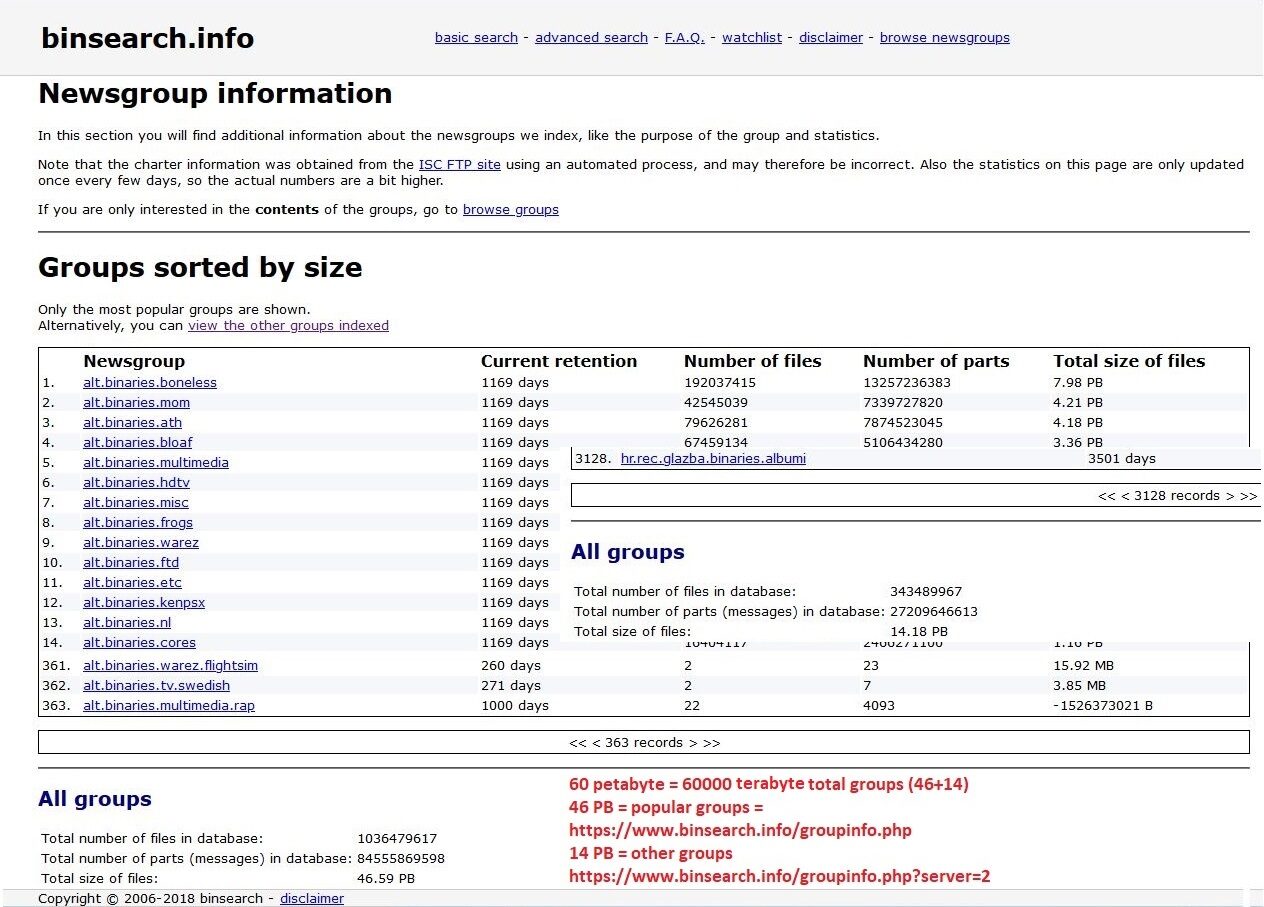

What survived is an industry. Longest-retention commercial providers advertise holding articles for more than twelve years; a binary indexing service's own figures, screenshotted in October 2020, put the spool it covered at more than sixty petabytes. The text hierarchies and the binary hierarchies are now effectively two networks sharing a protocol, one free and quiet and one paid and enormous. This directory belongs entirely to the first: its two alt.binaries.* pages are text-network relics of a branch that long ago became something else.
Spam, cancels and the Breidbart index
The commercial era arrived in 1994 and arrived twice. On 18 January a message headed Global Alert for All: Jesus is Coming Soon was posted across the network by a system administrator at Andrews University; it is generally counted as the first widely recognised Usenet spam. On 12 April the Arizona law firm of Laurence Canter and Martha Siegel advertised its immigration practice under the heading Green Card Lottery – Final One?, posted separately into thousands of groups by a script, and that is counted as the first commercial one. Because the copies were individually posted rather than cross-posted, they could not be filtered as a single article, and every group got its own.
Usenet's working definition of the offence was mechanical rather than editorial, and this matters more than it sounds. Spam meant excessive multiple posting — the same article repeated across the namespace — not advertising; a culture that declined to judge content could still count copies. The companion term for the other abuse, excessive cross-posting, was velveeta, after the processed cheese. alt.* was exposed twice over: nothing stood between a poster and a group, and the same openness let advertisers create groups of their own, which is where a good part of the phantom-name problem described earlier came from.
Counting copies needed an agreed sum, and the Breidbart Index, devised by Seth Breidbart, is it. The definition is exact and is frequently misquoted, so it is worth stating twice. For a set of substantively identical articles, take each copy, count the number of newsgroups that copy was cross-posted to, take the square root of that number, and add the roots together. Two copies, one to nine groups and one to sixteen, give three plus four: an index of seven. The generally accepted threshold is an index above twenty within forty-five days, applied across all hierarchies, above which the set may be cancelled by anyone.
The square root is the whole design. Because it is concave, twenty separate copies to five groups each score about forty-five while a single copy cross-posted to a hundred groups scores ten — and the single cross-post is also the one that costs the network almost nothing to carry, since servers store one article and show it in every group named. The index therefore penalises exactly the behaviour that consumes resources and largely forgives the behaviour that merely annoys. A more aggressive variant, Breidbart Index version 2, adds the raw group count to the root count and halves the total, which brings a single cross-post to thirty-five groups over the threshold; a further variant substitutes the Followup-To count for the Newsgroups count in that sum, in order to reward posters who direct replies to one place. Individual hierarchies set their own limits by their own procedures, usually by a vote: the German de.* hierarchy measures over seven days with a limit of five, the Austrian at.* tree uses an index of its own in which every posting scores three plus its group count, the Dutch nl.* tree uses the Followup-To variant, and the branches where repetition does most damage are tightest of all — two for the German classified-advertisement groups, one for the German file-posting groups.
Enforcement was a request like everything else. RFC 1036 permits a cancel only from the article's author or the local news administrator; the standard says so in one sentence and offers no way to check it. Everyone else who issued one was, in the vocabulary the volunteers themselves settled on, a rogue canceller. Third-party cancels issued against spam were held by some administrators to be necessary hygiene and by others to be censorship without a mandate, and that argument was never settled — it was merely automated. Cancelbots did the work: one of the earliest was run by the microbiology professor Richard DePew against anonymous postings in the science groups, and the best known by Arnt Gulbrandsen in June 1994, within minutes of the first article of the second wave of green-card advertisements; the detail of that episode belongs to the news.* hub. Three conventions grew up so that administrators could accept some cancels and refuse others, and all three are visible in the headers: a pseudo-site name inserted into the Path declaring which criterion the cancel was issued under, so that a site could alias out that one class; a monitored contact address in an X-Cancelled-By header, on the understanding that a canceller who ignored the resulting mail had forfeited the convention; and the $alz rule, named for the author of INN, that a third-party cancel's own Message-ID is the target's with cancel. prefixed to it, so that no article gets cancelled twice.
Other approaches deleted nothing. Filtering left the article in place and hid it: readers kept killfiles of patterns to skip, and servers refused feeds from the worst sources outright. NoCeM — pronounced no see 'em, and devised by the pseudonymous Cancelmoose, who was also the first large-scale spam canceller — generalised the idea by replacing the third-party cancel with a digitally signed notice, posted to a newsgroup of its own, listing the articles its issuer considered spam. Its own FAQ puts the design in a sentence: the weight a notice carries is no greater than the reputation of the person who issued it. Each server or reader could act on the notice or ignore it according to whose signatures it trusted, which put the decision back where the hierarchy always put it. It demanded key management from everyone who used it, and it never displaced the cancel. At the other extreme sat the Usenet Death Penalty, in which administrators announced in advance that everything originating from a particular provider would be refused or cancelled until it dealt with what came out of it.
One technique deserves naming because alt.* is where it was documented. Sporgery — a portmanteau of spam and forgery, coined by Tilman Hausherr — is a flood of articles whose headers are falsified so that they appear to come from other people, with the object not of advertising anything but of making a group unreadable. Its best-recorded use is against the Scientology group discussed above, and it is the purest expression of the hierarchy's central weakness: a network in which nobody can compel a server to do anything is also a network in which nobody can compel a server to refuse.
The argument itself needed somewhere to live, and in April 1994 alt.* provided it within a fortnight, in the shape of alt.current-events.net-abuse. Its master-file description today is a single instruction — Use news.admin.net-abuse.misc instead. — which is the record of the debate migrating from the hierarchy that could host it immediately to the one that could govern it eventually.
Where alt.* stands now
The hierarchy's open creation eventually met the same discretion at the other end, and in 2008 it met it all at once. Verizon, Time Warner Cable and Sprint Nextel signed an agreement with the New York attorney general, Andrew Cuomo, over sources of child abuse material; AT&T responded to the same campaign. The four outcomes were different in every case. Time Warner Cable stopped offering Usenet access altogether. Verizon reduced its feed to the Big Eight, and dropped Usenet altogether the following year. Sprint dropped alt.* entirely. AT&T dropped alt.binaries.* and, in June 2009, announced it would discontinue Usenet completely from 15 July that year. Cuomo's office said it had found illegal material in eighty-eight of the roughly hundred thousand groups it counted in alt.*; Cuomo never named Usenet as such in the campaign, and a contemporary account in PC World recorded the suspicion that some providers had used the campaign as cover for shutting down a service that was expensive to run and little used. Whatever the motive, the mechanism was the one the hierarchy was built on. No vote was taken and none was needed: an entire hierarchy left those networks by an administrator changing a configuration file, which is exactly how it had arrived.
The rest of the withdrawal was slower and had nothing to do with content. AOL had already dropped Usenet in 2005. In May 2010 Duke University, where the software that became Usenet had been written three decades earlier, decommissioned its news server, citing low usage and rising costs; the news link at the University of North Carolina at Chapel Hill, the other end of the original Duke–Chapel Hill connection, is recorded as having been retired on 4 February 2011 after thirty-two years, though the source for that date has carried a request for a citation for years and nothing here depends on it. Britain's academic network stopped carrying Usenet in July 2010 and Microsoft closed its own public news servers a month earlier. None of those were alt.* decisions. They were the same decision alt.* had always run on, taken by administrators who had simply stopped wanting to take it.


alt.* has not gone away. As of the master files of 28 August 2026 the hierarchy has 20,466 listed names, 397 of them moderated, which is still by a wide margin the largest hierarchy tracked. Its text groups are carried by text-only news servers, including free ones, and can still be posted to; most are very quiet and many have been quiet for a decade or more. What is still available and how to reach it is set out on the Usenet access page. Its binaries groups are the commercial product that Usenet has largely become.
The archives are the substantial thing, and their status changed recently. Google Groups, which had held the searchable historical archive since acquiring Deja News in 2001, stopped supporting Usenet for new content with effect from 22 February 2024: no new posting, no NNTP peering, no exchange with other servers, with viewing and searching of the historical material retained. What that archive holds is articles; the control messages that create and remove groups were never part of it, so the administrative record of alt.* has always been kept somewhere else. It is kept at the ISC: every valid newgroup and rmgroup since 1991, one file per group, thirty-six thousand files deep for alt.* alone.
Nothing about the mechanism has changed in thirty-nine years. Booster messages still go out; administrators still decide one at a time; rmgroups are still dropped by default at most sites. The last control message in the alt.config file carries the same two lines Brian Reid's generation used, a word of explanation and an entry for the newsgroups file, and asks — it can only ask — that somebody act on it.
Scope and limits of this page
No alt.* message archive is preserved on this site. What this directory holds is a page for each group that one mail-to-news gateway carried between 2000 and 2004, with links out to the archives that do hold messages. The forty-eight pages listed above are a sample of a namespace of more than twenty thousand names, and the sample reflects the gateway's users rather than the hierarchy's shape.
No traffic figure, readership figure or message count for any individual group is claimed anywhere on this page. Where a number about a particular group appears, it is quoted from a named contemporary document — a control message, a charter, a proposal — and is that document's claim, not a measurement made here. The counts of names are taken from the ISC master active and newsgroups files of 28 August 2026 and record names that somebody still maintains, not groups that anybody reads; the article counters in that file are placeholders and are not used.
Quotations come from three public sources and nowhere else: the ISC control-message archive, the maintained edition of control.ctl, and the periodically posted alt newsgroup creation guide, together with Brian Reid's founding account as it appears in Henry Hardy's history of the network. Where two sources disagree about the founding, both are given. Two further public sources are used for a single passage each and named where they appear: an account of the newsgroup removals at the University of Waterloo written by a member of that university's computer science faculty, which quotes the internal memoranda, and the periodically posted FAQ on cancel messages, for the conventions attached to third-party cancels. No thread title, poster name, quotation or message count on this page has been invented, and where the record is thin it has been left thin. The full group index lists everything else the gateway carried.