A directory of Usenet newsgroups
Formerly a Usenet-to-e-mail gateway, 2000–2004. Now a reference.
Between 2000 and 2004, news2mail.com delivered Usenet newsgroups to e-mail inboxes — a small free service in the era when Usenet was still where the internet talked to itself. The gateway is long gone, but pages of this directory are still cited by university course notes, library guides and reference sites across the web.
Rather than let those references rot, this site preserves the directory: 179 newsgroup pages across the soc, alt, comp, rec, sci and talk hierarchies, the German de.* and Dutch nl.* branches, Usenet’s own news.* administrative groups, and the vendor branches — microsoft.public.* and adobe.* — each page describing what the group was, who used it, and how to reach its archive today.
soc
Society and culture — Cultures, Yugoslavia, Syria…
sci
Sciences — Earth sciences, Agriculture, Maths…
talk
Debate — Philosophy, Humanism…
news
Usenet itself — Administrative groups…
microsoft
Vendor groups — microsoft.public.*, adobe.*…
de
German — de.*, Genealogie…
Start somewhere
- soc.culture.* — a room for nearly every country on earth
- comp.soft-sys.math.maple — the group your calculus course cited
- rec.music.country.western — the country-music reference room
- What is Usenet? — if all of this is news to you
Usenet itself has not died — it has retired to the countryside. Here is how to visit.
On this page
The service, plainly described
The service this directory once fronted did one narrow thing. A visitor found the page for a newsgroup, entered an e-mail address, and articles from that group began arriving as ordinary mail messages. It belonged to a genre — the news-to-mail gateway — that flourished briefly in the years when e-mail was universal and news access was not. Nothing about it was technically remarkable, which is part of the point: it was plumbing, of the kind the early web produced in quantity and documented barely at all.
The site around the gateway had a simple anatomy. There was one page per newsgroup — the group’s name, the hierarchy it sat in, a plain description of what was discussed there, and a subscription form. There were lists: of all the groups the gateway carried, and of news servers that could be reached publicly, for readers who preferred to cut out the middleman. And there were help pages explaining what Usenet was and how the gateway worked. That anatomy survives here, repurposed: the forms no longer submit anywhere, but the catalogue they once fronted is the skeleton of the present directory.
The gateway stopped in 2004, and it stopped the way such services usually stopped — without announcement, obituary or archive. Small free infrastructure tends to end mid-sentence, which is why descriptions of this gateway survive mostly in the present tense, on pages nobody went back to edit: a free service, delivering articles from the newsgroups you choose to your inbox. That sentence was once true. It has not been true for more than two decades, and one job of this rebuilt site is to say so on every page where an old link might land.
Mail and news, near relations
Gateways between mail and news were easy to build because the two systems are cousins by design. A Usenet article is, structurally, an e-mail message with a different set of delivery headers: the same From, Subject and Date lines, the same header-then-body shape, with Newsgroups and Path fields doing the routing work that To and Received do in mail. This was deliberate. The B News software that carried Usenet through the 1980s adopted a message format compatible with Internet mail, and the formal standards for netnews were written as adaptations of the mail message standard. Converting one into the other is mostly a matter of rewriting headers.
Mechanically, a news-to-mail gateway was a news client with a mailing habit. It held its own subscription to the groups it offered, receiving new articles over NNTP — the news transfer protocol specified in 1986 by Brian Kantor and Phil Lapsley — exactly as any newsreader would. As articles arrived, the gateway matched each one against its list of subscribers, wrapped it as a mail message, and handed it to a mail server for delivery. Some services in the genre sent every article individually; some offered digests; some let subscribers pick. The scale could stay modest because the gateway only ever needed to follow the groups people had actually asked for, not the whole of Usenet.
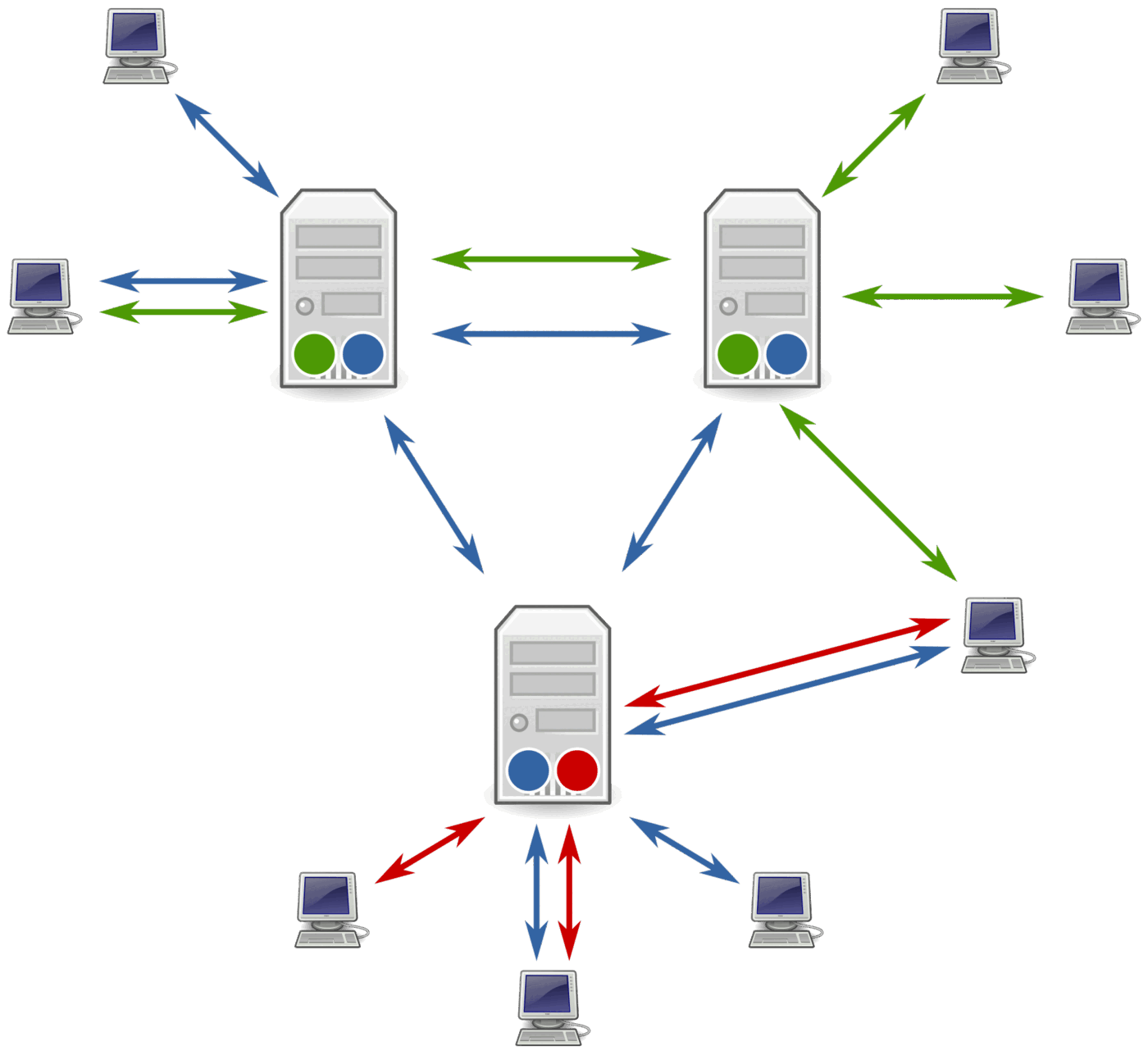

Direction was the real design decision. A one-way gateway delivered news into mailboxes and did nothing else. A two-way gateway also accepted mailed replies and posted them back to the group — more useful, and considerably more dangerous, since a posting address is an invitation to spammers and a forged mail message becomes a forged article. Many small gateways therefore stayed read-only. It is worth noting that mail was already load-bearing inside Usenet itself: a posting to a moderated group was not injected directly but sent by e-mail to the group’s moderator for approval. Mail-to-news gatewaying was not a bolt-on to Usenet; it was written into the system’s constitution.
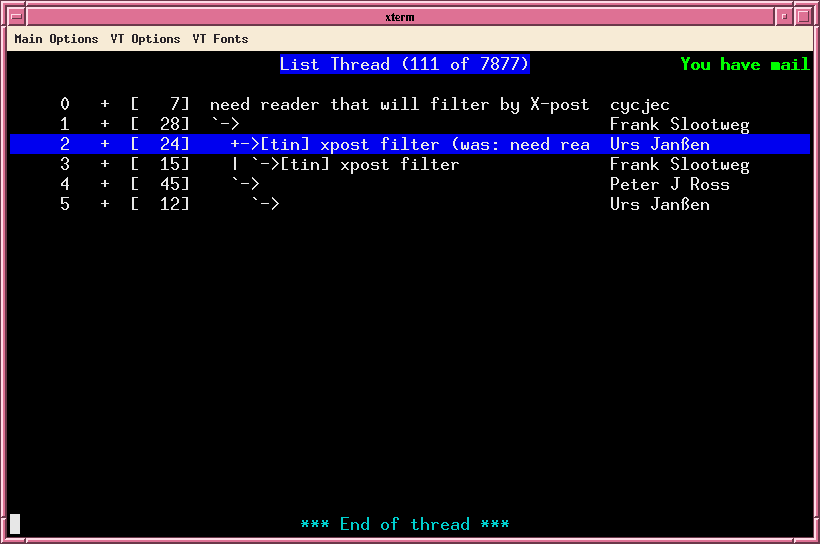
Even threading survived the trip. The discussion trees a newsreader draws are built from Message-ID and References headers, and those headers are common property — mail clients speak them too, because mailing lists thread the same way. An active discussion gatewayed into a competent mail client re-assembled itself into the same tree a newsreader would have shown, which is why reading a busy group by mail was less strange than it now sounds. The mailbox and the newsgroup were always two arrangements of the same kind of object.
The translation was lossy only at the margins, and the losses are instructive. Crossposting — one article addressed to several groups at once — had no clean mail equivalent, so a subscriber to two related groups might see the same article twice unless the gateway took care to deduplicate. Cancel messages, Usenet’s always-shaky mechanism for retracting an article, did not reach into mailboxes at all: once delivered, a message was the subscriber’s property. And expiry inverted. On a news server articles aged out in days or weeks; in a mailbox they stayed until deleted, which means a diligent subscriber ended up holding a private archive of their group — sometimes, in the end, a better record than the servers kept.
Why anyone wanted news in a mailbox
The demand the gateways met was a problem of unequal plumbing. By 2000 practically everyone online had an e-mail address, but a large and growing share of them had no working path to Usenet. Office and school firewalls blocked the news port while letting mail through. Webmail accounts — by then many people’s only account — came with no newsreader at all. Many internet subscriptions included no news server, or a neglected one; and where a server existed, configuring a newsreader to use it was one more piece of software and one more set of settings than most people wanted. E-mail reached where news could not, so a gateway stood at the junction and translated.


Connectivity itself argued for mail. In the dial-up years a connection was something you opened, used and closed, often paying by the minute, and mail was the medium built for that rhythm: messages queued on the server, downloaded in one gulp, and read at leisure offline. Newsreaders could be coaxed into offline habits too, but a mailbox did it by default. For a reader following two or three groups — a support group, a software group, the newsgroup for their home country — having the articles simply appear alongside the day’s mail was less a workaround than an upgrade.
And there was the quieter attraction of the single in-tray. Mail clients of the period were where people already lived: they had folders, filters, search, archives that persisted for as long as you kept them. Route a newsgroup into that machinery and it inherited all of it — a filter to file the group into its own folder, another to discard a tiresome poster, a private archive of every article the group had carried since you subscribed. None of this required learning anything new, which for most subscribers was the entire proposition.
The shape of this site’s own catalogue suggests who those subscribers were. Not power users — a power user ran a newsreader — but people attached to a small number of specific conversations: an expatriate following the newsgroup for their home country, someone in a support group for a condition, a programmer watching one product’s support channel, a musician in one genre’s group. For that reader, Usenet was not a medium to be explored; it was two or three rooms they wanted to keep visiting after the corridor became impassable. A mailbox subscription was exactly that: the room, delivered, without the corridor.
A recognisable genre
news2mail.com was one instance of a pattern nearly as old as Usenet itself. In 1980, when Usenet was connected to the ARPANET through Berkeley, one of the first things carried across the join was mail: ARPANET mailing lists were fed into Usenet as newsgroups in a hierarchy prefixed fa, for “from ARPANET”. The traffic of one medium presented in the dress of the other — that is the whole trick, and it was being performed within a year of the network’s founding.
The pattern scaled up wherever a mailing-list culture and the news culture touched. The academic BITNET network ran its discussion lists under the LISTSERV software, and a whole Usenet hierarchy, bit.listserv, existed to mirror many of them as newsgroups, so that a list subscriber and a news reader could hold one conversation without either changing tools. In the other direction, mail-to-news gateways gave mail users a way to post into newsgroups they could not otherwise reach, a facility that anonymous-remailer operators also leaned on. None of these bridges was glamorous; all of them rested on the family resemblance between an article and a message.
The genre’s most substantial later cousin ran the idea in reverse. Gmane, built by Lars Magne Ingebrigtsen — one of the authors of the Gnus newsreader — and opened to the public in February 2002, presented thousands of e-mail mailing lists as newsgroups, complete with permanent archives, so that developers could follow hundreds of software lists through a newsreader instead of drowning a mailbox. Gmane’s own later history — a near-shutdown in 2016, a change of hands, a web archive that never properly returned — is a compact parable of what happens to beloved small infrastructure maintained by very few people.

Seen from this family album, a service like news2mail.com is easy to place: the humblest branch of the tree, doing for a casual web audience what bit.listserv did for BITNET academics and Gmane would do for programmers. The gateways themselves were usually free, usually one operator deep, and tended to end without ceremony. What distinguishes this one is only that its catalogue was widely linked — and that the links outlived the service by twenty years.
Reading Usenet at one remove
Mail delivery was one form of indirect access; the web was the other, and its story frames the gateway years. Deja News, started in March 1995 by Steve Madere in Austin, Texas, put a searchable archive of Usenet on the public web: any browser could search across newsgroups, read results instantly, and find messages that would long since have expired from any news server. It changed what Usenet was. A medium designed to be ephemeral became, retroactively, a permanent record — to the delight of researchers and the alarm of anyone who had posted carelessly under their own name, which is roughly everyone. The X-No-Archive header, honoured by Deja News, dates from this discovery.
Deja’s corporate arc was brief. Rebranded Deja.com, it pivoted to comparison shopping in 1999, sold that business off, and in February 2001 its Usenet archive and related assets were acquired by Google, which relaunched the collection as Google Groups. By the end of that year Google had extended the archive back to May 1981, incorporating donated collections — notably the archive Henry Spencer had kept at the University of Toronto, donated by way of the University of Western Ontario — producing a twenty-year record of the network’s conversation. For the next two decades, Google Groups was how most of the web read Usenet, when it read it at all.
Meanwhile the direct routes narrowed. Usenet’s open architecture had assumed good faith, and from the first mass commercial posting — the immigration lawyers’ “green card” advertisement of 1994 — spam tested that assumption to destruction. Open news servers closed to outsiders or shut down; providers found their news feeds dominated by enormous binary traffic that had little to do with discussion; and one by one the big consumer ISPs stopped bothering. AOL dropped newsgroup access in 2005. In 2010 Duke University, where Usenet began, decommissioned its news server, citing low usage and cost. The gateway era — roughly the decade either side of 2000 — was exactly the interval when Usenet was still worth reaching but increasingly awkward to reach, and services like this one lived in that gap.
The largest indirect door has since closed as well: in February 2024 Google Groups ended its support for posting to and reading Usenet, retaining the historical archive but severing the live connection. Usenet itself continues over NNTP, on commercial and volunteer servers. But the disappearance of the one web interface everybody knew has made the old questions current again — what a given group was, and how a person with a browser reaches its remains — which happen to be the two questions a directory page answers.
Why every group had a page
A gateway needed a catalogue before it needed anything else. Usenet carried tens of thousands of groups, and nobody subscribes to a name they cannot find, so the service published a page for each group it carried: the name, the hierarchy it sat in, a plain account of what was discussed there. Those pages did double duty as subscription interface and as documentation, and it was the documentation that lasted.
It lasted because a newsgroup had no home page of its own. Its native address was a news: URI that only worked if the reader’s software knew about a news server, which increasingly it did not. Anyone on the web who wanted to write “ask this in the Maple group” — a course handout, a departmental FAQ, somebody’s further-reading list — needed an ordinary web page to point at, and a gateway’s directory pages were exactly that: stable, descriptive and linkable. Many of those links were never taken down, and they are why this site still receives visitors from university course notes and library guides written a generation ago.
The other steady source of links was the web directory, that vanished institution in which volunteers filed websites under category headings. A service like this one would be filed once, under some Computers-then-Usenet heading, and the listing would then travel: the Open Directory Project licensed its data to anyone who wanted it, and its mirrors and clones copied such entries wholesale, one volunteer’s sentence propagating across dozens of sites. Directories linking to a directory: the early web was like that.
What this directory is now
What you are reading is the catalogue without the gateway: roughly 130 pages, of which 113 describe individual newsgroups. The centre of gravity is the Big Eight and alt: the soc, comp, rec and sci hierarchies and a long tail of alt groups, from psychology and OCD support through bluegrass, BMX and vintage DOS utilities to the group dedicated to disliking a Star Wars character. Around that centre sit the corners a real subscriber base produces: German-language de.* groups, a Dutch nl.* group, a French alt.fr group, a shelf of microsoft.public.* support channels and an Adobe one. The largest single cluster is soc.culture.* — over forty national and regional culture groups, whose story as the meeting-places of diasporas is told on its own page.
Each group page keeps the same two layers. The short charter-style description is the period layer — what the gateway’s catalogue said the group was for. Beneath it sits an editorial article written for this rebuild: what the group actually was, the world it belonged to, what became of it, and where its archive can be read now. The rebuild was done in 2026, and it states the essential fact everywhere rather than in a footnote: the gateway is dead. No page here subscribes anyone to anything, forwards anything, or connects to a news server.
Provenance, stated once and plainly: this rebuild is not the work of the original operator and has no connection to them. The directory is preserved because it was cited — by course pages, library guides and reference sites that deserve working links — not because anyone here has a claim on its history. Each page tries only to say true things about its group: a smaller promise than the original service made, and an easier one to keep.
Using the directory
The four hierarchy hubs linked at the top of this page — soc, alt, comp and rec — are the intended front doors, each listing its preserved groups with a note on what the hierarchy was for. The soc hub carries the deeper history that the others lean on: how the Great Renaming of 1987 reorganised the network into the hierarchies used ever since, and how their governance actually worked. The smaller corners — de.*, nl.*, microsoft.public.* and the rest — are reachable from the complete list below.
- The full list of groups — every newsgroup page on the site, in one place, in hierarchy order.
- The free news servers list — a preserved period artefact: the servers the gateway once pointed readers at. Treat it as history, not as a working resource; most of those servers are long gone.
- What is Usenet? — the from-scratch explainer, for readers who arrived here without ever having seen a newsgroup.
- Reading Usenet today — the practical guide: current archives, servers and newsreaders, kept honestly up to date.
The original service’s own help pages — what the gateway was, and how subscribing worked — are preserved under their old addresses as documents of the genre, clearly marked as historical. A reader who has followed a twenty-year-old link to some group’s page needs none of this navigation: the page itself says what the group was and where its archive lives, which is the transaction the old link promised.
The case for keeping it
Most of the web this site belonged to has resolved into parked domains and error pages. Link rot is the ordinary fate of ordinary pages, and reference material suffers it worst, because references are exactly the pages people cite and never revisit: the course handout from 2003 still tells students to ask their question in a particular newsgroup, and the URL it gives now leads, in most cases, nowhere in particular. Keeping one small directory standing does not solve that. It keeps a few thousand old citations honest, which is the solvable version of the problem.
There is also the record itself. What a small gateway chose to carry is evidence: the groups described here — national and regional cultures, mathematics software, country music, psychotherapy, Microsoft’s public support channels — amount to a core sample of where conversation actually happened around the turn of the century, taken by an operator with no reason to flatter it. This was a list assembled to be used, not admired, and that is precisely what makes it worth keeping: nobody curates a subscription catalogue for posterity, so posterity can trust it.
The ambition here stays modest. Usenet’s history has proper custodians — the archives, the surviving hierarchies, the people who wrote it down as it happened — and this site does not compete with them. It maintains one intersection: the place where a particular set of old links meets the present, and where each of them should land on a page telling the truth about the group, about the gateway, and about the difference between the two. A dead service honestly described is still a reference. A dead link is only a dead link.