rec.sport.olympics
The Olympic Games, summer and winter.
A group that surged every two years: event schedules in every timezone, medal-table nationalism (mostly good-natured), judging scandals relitigated in detail, and bid-city politics between Games.
Atlanta, Nagano, Sydney, Salt Lake, Athens — the archive is a fan’s-eye chronicle of each.
On this page
A group that ran on a two-year clock
The tempo of this newsgroup was set by an administrative decision taken before it had much to talk about. At its 91st Session in 1986 the International Olympic Committee resolved to put the Summer and Winter Games on separate four-year cycles, both in even-numbered years. The 1992 Winter Games at Albertville were the last to be held in the same year as a Summer Games; Lillehammer in 1994 was the first of the new arrangement. The stated reasoning was practical — spreading the logistical and financial load of the two events, and producing a Games, with the advertising revenue attached to it, every two years rather than every four.
For a Usenet group the consequence was a long trough followed by a fortnight of flood. Between Games the traffic was speculative and administrative: venue construction, qualification, television rights, and the manoeuvring of candidate cities. During a Games it became something closer to a rolling wire service maintained by amateurs in every meaning of that word.
The structure of that fortnight was dictated by geography. Every host inside this group's lifetime sat several time zones away from a large part of its readership: Nagano and Sydney are far to the east of Europe and the Americas, Athens several hours east of the Atlantic, Atlanta and Salt Lake City several hours west of Europe. Sydney runs ten hours ahead of Greenwich, so its evening finals fell around the middle of the European day and before dawn across North America. Broadcasters routinely recorded events and transmitted them in their own peak hours, which meant that in many markets the result was public knowledge for hours before the pictures were.
A newsgroup sits on the wrong side of that gap. Anyone awake in the host country, or reading an agency wire, could post a result within minutes; anyone waiting for an evening broadcast could not read the group safely. Usenet already had a convention for the problem — the word SPOILER in the subject line, followed by blank lines or a rotated-alphabet block so that the outcome could not be read by accident — and Olympic groups inherited it. Whether a medal decided in a Japanese morning was still a spoiler in a Californian evening was, in its own small way, a recurring procedural argument.
The other structural feature was breadth. A single group covered every event of a programme that at Atlanta ran to twenty-six sports, most of which have a public only once every four years. The recurring genres of traffic followed from that: schedule questions phrased in one time zone and answered in another, requests for broadcast details in a particular country, explanations of scoring systems written for people encountering a sport for the first time since the previous Games, and the perennial arithmetic of medal tables — whether to rank by gold or by total, whether to weight by population, whether to count anything at all.
Atlanta, 1996
The Games of the XXVI Olympiad were held from 19 July to 4 August 1996 in Atlanta, Georgia, with 10,318 athletes from 197 National Olympic Committees competing in twenty-six sports. Beach volleyball, mountain biking and softball made their Olympic debuts. Muhammad Ali was chosen to light the cauldron at the opening ceremony, which was opened by President Bill Clinton. Some 8.3 million tickets were sold, a figure not surpassed until 2024.
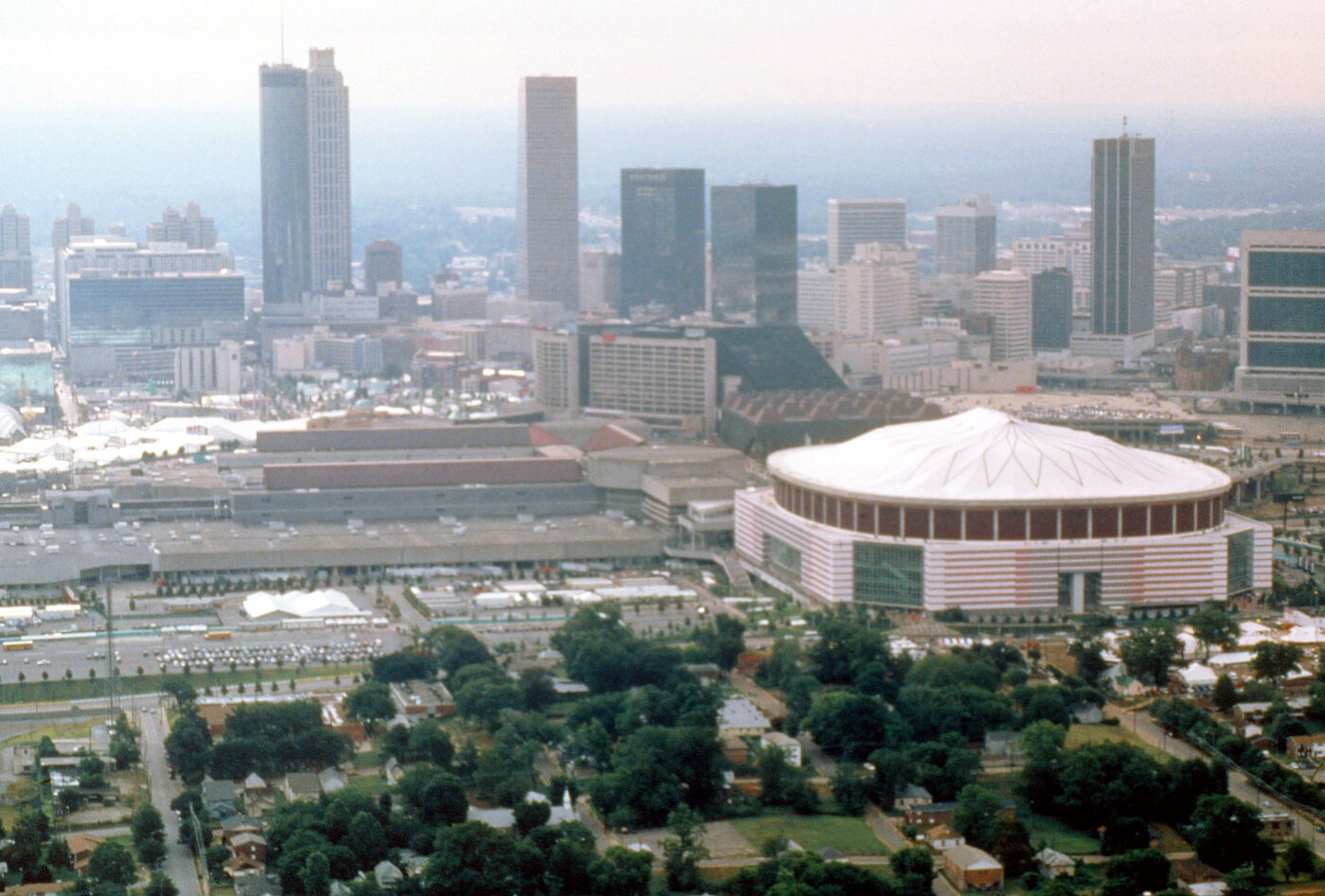

The organisation drew criticism at the time. Contemporary complaints centred on the perceived over-commercialisation of the Games and, from European officials in particular, on the availability of food and on transport; the transport operation was hampered by driver shortages, navigation errors on unfamiliar routes and consequent delays. These were the sort of grievances that a group of foreign visitors and armchair spectators is well placed to catalogue, and they were catalogued.
On 27 July 1996 a pipe bomb was detonated in Centennial Olympic Park, the free public gathering space at the centre of the Games, killing two people and injuring 111. The Games continued. The investigation that followed, and the treatment of an early suspect who was subsequently cleared, became a long-running story in its own right and is not summarised here; what belongs to this page is that the group, like the rest of the world, spent part of the second week of the Atlanta Games discussing a bombing rather than the sport.
Nagano, 1998
The 1998 Winter Games were held from 7 to 22 February 1998, mainly in Nagano Prefecture, Japan. Three additions to the programme arrived together — women's ice hockey, curling and snowboarding — and National Hockey League players were permitted to take part in the men's ice hockey tournament for the first time, which for North American readers turned the tournament into a competition between recognisable club colleagues.
The episode most often revisited afterwards concerned the first Olympic champion in men's snowboarding giant slalom, Ross Rebagliati of Canada. His sample showed 17.8 nanograms per millilitre of THC metabolites, against the 15 ng/mL threshold used by the International Ski Federation. The IOC executive board voted 3-2 to disqualify him on 11 February 1998; on 13 February an appeal ruled in his favour and the medal was restored, on the ground that cannabis had not been formally banned by the IOC and that it therefore lacked the authority to strip the title. The case is a compact illustration of a problem the movement spent the following decade addressing: the substance list, the threshold and the jurisdiction each belonged to a different body.
Sydney, 2000
Sydney staged the Games from 15 September to 1 October 2000, with teams from 199 countries. At the opening ceremony the athletes of North and South Korea entered together behind a specially designed unification flag. Cathy Freeman lit the Olympic flame and then won the 400 metres, becoming the first competitor to do both at the same Games; the attendance for that evening's athletics session, 112,524, was the largest recorded for any sport at an Olympic Games.
Two doping matters ran through the fortnight. Hours after Marion Jones won the first of her gold medals the IOC announced that the shot putter C. J. Hunter, then her husband, had failed four pre-Olympic drug tests. Shortly after the gymnastics all-around final the Romanian winner, Andreea Raducan, was disqualified and stripped of her gold medal after testing positive for pseudoephedrine. She and her coaches maintained that the substance had come from two cold-medicine tablets given to her by a team physician; the Court of Arbitration for Sport, the Romanian Olympic Committee and the International Gymnastics Federation each exonerated her of personal wrongdoing and she was not given the ban that normally follows a positive test, while the doctor who supplied the medicine was suspended through the 2002 and 2004 Games. Appeals from the gymnast, her coaches and the Romanian federation did not restore the medal.
Salt Lake City, 2002
Salt Lake City, selected as host in June 1995, staged the Winter Games from 8 to 24 February 2002 with 2,399 athletes from 78 nations across 78 events. Two controversies from these Games outlasted the fortnight by years, and both concerned the machinery of the sport rather than the athletes.
The pairs figure skating competition was held on 9 and 11 February at the Salt Lake Ice Center. In the days that followed, the result became the subject of a dispute over the conduct of the judging panel, in which the French judge Marie-Reine Le Gougne was the central figure. On 15 February the IOC President, Jacques Rogge, announced that Jamie Sale and David Pelletier of Canada would be awarded gold medals while Elena Berezhnaya and Anton Sikharulidze of Russia retained theirs. On 30 April 2002 the International Skating Union announced that Le Gougne and Didier Gailhaguet had each been suspended for three years. In 2004 the ISU voted to retire the 6.0 marking system on the ground that it was too subjective, and created the ISU Judging System in its place; the episode is the reason competitive figure skating is scored the way it is today.
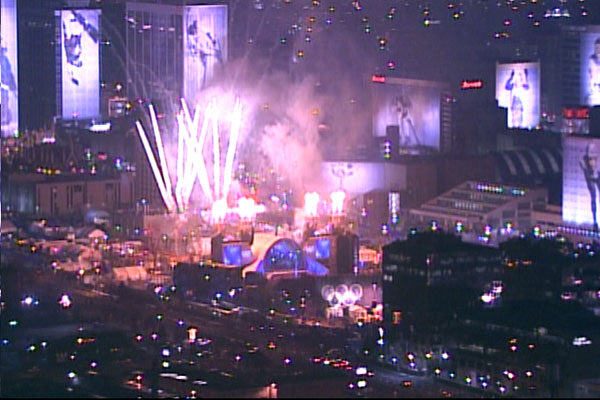

The second matter was pharmacological. Johann Muhlegg, skiing for Spain, won the 30 km freestyle and the 10 km + 10 km pursuit, then finished first in the 50 km classical on 23 February; he was disqualified from that race and expelled from the Games the following day after testing positive for darbepoetin, a red-cell-boosting medicine so recently developed that it did not appear on the banned list. The IOC initially let him keep the earlier two titles. In December 2003 the Court of Arbitration for Sport found that those medals should also be withdrawn and remitted the matter, together with the comparable cases of the Russian skiers Olga Danilova and Larisa Lazutina, to the IOC Executive Board, which confirmed the rulings in February 2004 — nearly two years after the closing ceremony.
Athens, 2004
The 2004 Games were held from 13 to 29 August 2004 in Athens, the first time the city had staged them since the first modern Olympiad of 1896, and were accompanied by 5,501 team officials from 201 countries. The men's shot put was held on 18 August in the ancient stadium at Olympia, the site of the classical Games; it was won on the day by Yuriy Bilonoh of Ukraine, who was stripped of the title on 5 December 2012 after stored samples were re-tested, the gold passing in March 2013 to the original silver medallist, Adam Nelson of the United States.
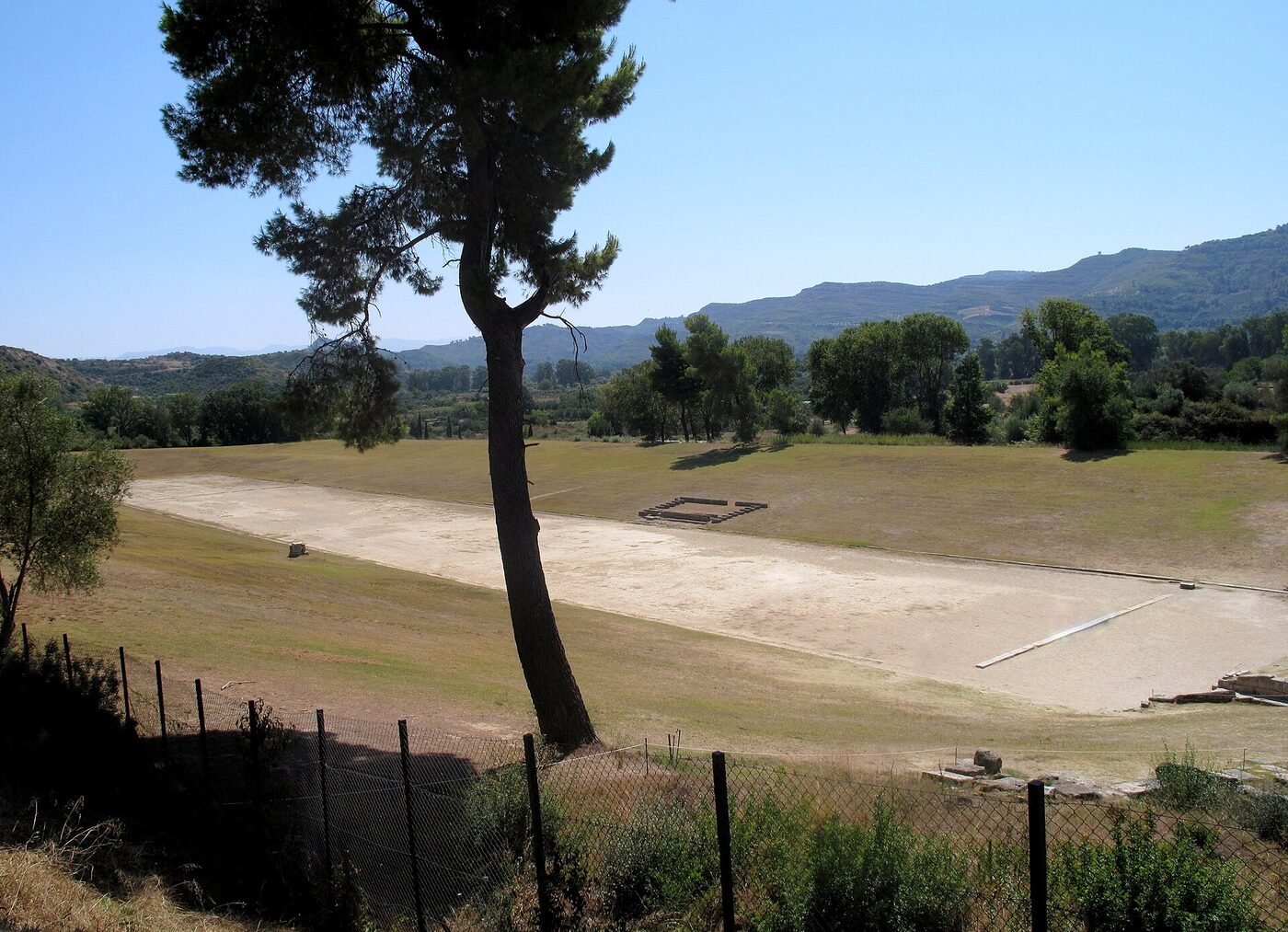

On the day before the opening ceremony the Greek sprinters Konstantinos Kenteris and Ekaterini Thanou failed to attend a drug test. They said they had been injured in a motorcycle accident while hurrying back to the Olympic Village on hearing of the test through the media; a later official Greek investigation found that the accident had been staged. Both withdrew from the Games on 18 August after a hearing before the IOC Disciplinary Commission. In May 2011 each received a suspended custodial sentence of 31 months for staging the crash, and an appeals court subsequently overturned the ruling.
The closing day produced an incident of a different kind. On 29 August, leading the marathon, Vanderlei de Lima of Brazil was halted and grappled with by a spectator, Neil Horan, an Irish priest who was later defrocked. Lima finished third in 2:12:11 and was awarded the Pierre de Coubertin medal for sportsmanship at the close of the event.
Bidding, and the scandal of 1998-99
Between Games, the recurring subject is who will host the next ones, and in the middle of this group's life the bidding process itself became the story. On 24 November 1998 a report disclosed a letter concerning a child of an IOC member which indicated that the Salt Lake Organizing Committee had been paying the child's tuition. Four separate investigations followed. What they described was a pattern of assistance to members' relatives: help in gaining admission to the University of Utah, and employment arranged at a local bank.
The outcome was without precedent in the institution's history. Ten members of the IOC were expelled and another ten were sanctioned — the first expulsions or sanctions for corruption in more than a century of the committee's existence. The rules were rewritten in consequence: ceilings were imposed on what members might accept from bid cities, and term and age limits were introduced for membership. The United States Department of Justice brought charges against the two senior figures of the Salt Lake bid, Tom Welch and David Johnson, who were acquitted of all criminal charges in December 2003.
For readers of a newsgroup the affair had a particular flavour, because bid campaigns are conducted largely in public relations material and the documented findings gave that material a context it had previously lacked. Every subsequent contest between candidate cities was read through it.
Amateurism, and its abolition
By the time this group was busy, the question that had defined the Olympic movement for most of its first century was settled — but the settlement was recent enough that the argument was still live in the archive. The founding conception was of competition by amateurs, and its enforcement produced the movement's most famous reversal: Jim Thorpe, winner of the pentathlon and decathlon at the 1912 Games in Stockholm, was declared a professional and stripped of his titles after it emerged in January 1913 that he had played semi-professional baseball. In 1983, thirty years after his death, the IOC restored his medals with replicas, on the ground that the original protest had fallen outside the thirty-day window the 1912 rulebook required.
Whole sports were shaped by the rule. Tennis had been on the programme from 1896 but was dropped after the 1924 Games amid disputes between the International Lawn Tennis Federation and the IOC over how an amateur was to be defined.
Avery Brundage, IOC president from 1952 to 1972, was the rule's last uncompromising defender, holding that an athlete should compete for the love of the game without thought of reward or payment of any kind. In 1972 he banned the Austrian skier Karl Schranz from the Sapporo Winter Games for commercial activities, calling him a walking billboard. In his final speech to the IOC, at Munich in 1972, he put the position at its plainest:
There are only two kinds of competitors. Those free and independent individuals who are interested in sports for sport's sake, and those in sports for financial reasons.
After his retirement that year the amateurism rules were relaxed steadily. In 1986 the IOC voted to allow all athletes to compete from 1988 onwards, leaving each international federation to decide whether it wished to admit professionals. Tennis returned as a full medal sport in 1988, open to all players regardless of age or status. On 7 April 1989, at a special congress in Munich, FIBA delegates voted 56-13 to allow professional basketball players into its international events; the United States team at the 1992 Games was the first American Olympic side to include active NBA players. Formal amateur regulation was effectively abandoned during the 1990s.
What survived into this group's era was not the rule but its residue: arguments about whether professionalism had improved the competition or hollowed it out, about which sports still fielded genuine part-timers, and about what the word amateur had ever really meant.
Doping, and the arrival of WADA
The regulatory history is older than most readers assume. In 1967 the IOC banned the use of performance-enhancing drugs, instituted a Medical Commission and drew up a list of prohibited substances; mandatory testing began at the Games of the following year. The first Olympic athlete to test positive was the Swedish modern pentathlete Hans-Gunnar Liljenwall, whose two beers to steady his nerves cost the Swedish team its bronze medal in 1968. The case that made doping a permanent subject of public argument came twenty years later, when Ben Johnson of Canada won the men's 100 metres at Seoul in 1988, tested positive for stanozolol, and was stripped of the gold medal, which passed to Carl Lewis.
The institutional answer came in the middle of this group's life. The World Anti-Doping Agency was set up on 10 November 1999 in Lausanne, nearly a year after the meetings that produced the document known as the Declaration of Lausanne. It was co-founded by the IOC and the governments of more than 140 nations, and it is funded accordingly: half its budget comes from the IOC and half from national governments. Its World Anti-Doping Code was implemented by sports organisations before the 2004 Games in Athens, so that the Athens Games were staged under it.
One consequence matters especially to anyone reading an archive. Results are no longer final when the closing ceremony ends. Marion Jones, who won five medals at Sydney, admitted on 5 October 2007 to having lied to federal agents about her use of steroids before those Games, and on 12 December 2007 the IOC formally stripped her of all five. The Salt Lake City cross-country titles were not settled until February 2004, and the Athens shot put not until 2013. The medal tables posted to this group during each Games were accurate to the evening on which they were written and are, in several particulars, no longer the official record — which is precisely what makes them period documents rather than reference material.
The longer background
Boycotts
No Games inside this group's lifetime was boycotted on a significant scale, but the memory of boycotts governed how political disputes were discussed. Twelve countries stayed away from Melbourne in 1956. Thirty-seven nations abstained from Montreal in 1976, the core of the withdrawal being African states objecting to New Zealand's rugby contacts with apartheid South Africa. Sixty-eight countries did not go to Moscow in 1980, in a withdrawal led by the United States following the Soviet invasion of Afghanistan; nineteen, principally Soviet-aligned states, stayed away from Los Angeles in 1984 in response; seven, including Cuba, Ethiopia, Albania and North Korea, did not attend Seoul in 1988. South Africa itself was excluded over apartheid from 1964 and did not return until 1992.
That sequence is why an argument about a flag, an anthem, a delegation's name or a head of state's attendance was never a small argument in an Olympic forum. It is also why the joint Korean march at Sydney was read as significant rather than ceremonial.
The Paralympic Games
The Paralympic Games descend from a competition organised at Stoke Mandeville Hospital by the German-Jewish physician Ludwig Guttmann, who had fled Nazi Germany in 1939 with the help of the Council for Assisting Refugee Academics. The first of these events, the 1948 International Wheelchair Games, was timed to coincide with the London Olympics and was open to British war veterans with spinal injuries. The first official Paralympic Games, no longer restricted to veterans, were held in Rome in 1960; the first Winter Paralympics took place at Ornskoldsvik, Sweden, in 1976. The International Paralympic Committee was founded on 22 September 1989.
The formal link to the Olympic Games was made during this group's life. In June 2001 the IPC and the IOC signed an agreement under which the staging of the Paralympic Games is automatically included in the bid for the Olympic Games. It was set to take effect at the 2008 Summer Paralympics in Beijing and the 2010 Winter Paralympics in Vancouver, though Salt Lake City in 2002 and Athens in 2004 had already chosen to run both Games through a single organising committee. The period also produced the movement's own integrity crisis. After the Sydney Paralympic Games of 2000 a member of the gold-medal-winning Spanish basketball team in the intellectual disability category alleged that several of his team-mates did not have such a disability; all competition in that category was suspended in 2001, and the ban was lifted after the 2008 Games once the criteria and controls governing admission had been tightened.
Reading rec.sport.olympics today
- Historical archive: Google Groups — rec.sport.olympics (coverage varies by group and era).
- Open in a newsreader:
news:rec.sport.olympics— the original site offered exactly this link, and it still works if your system has a newsreader registered for thenews:scheme. - Live access: point an NNTP newsreader at a modern server — see accessing Usenet today.
- The original news2mail e-mail subscription service ended in the mid-2000s and no longer operates.