alt.music.bluegrass
Bluegrass music: players, records and festivals.
Pickers and listeners on Monroe, Stanley, Flatt & Scruggs and every generation since — with instrument setup threads (banjo bridges, mandolin tone) and festival reports from the circuit.
The group’s discography and lyric-correction threads served as a working reference before dedicated databases existed.
On this page
- The group's own paperwork
- The Big-8 counterpart that never existed
- What the music is, and when it was made
- The banjo, and the roll that defines the style
- The mandolin, the guitar and the thing called a dobro
- The festival circuit
- Associations, awards and the machinery of a scene
- Generations, and the argument that will not close
- Lyrics and transcriptions: a repertoire catalogued in public
- Who owns a tune nobody wrote
- The rooms next door
- Where it went
- What the record does not show
- Scope and limits
The group's own paperwork
The one document of this group's own that survives whole is its birth certificate. The Internet Systems Consortium's mirror of the Usenet control archive holds a single file for alt.music.bluegrass, and that file contains one message: the newgroup control message that created the group. It was sent on 16 June 1996 from the address [email protected], by way of a Dutch provider called Telebyte, and carried the header Control: newgroup alt.music.bluegrass. There is no rmgroup after it, no reissue, no correction. For an alt.* group that is the entire administrative record, and it is a good deal more than most alt.* groups leave behind.
The message did what alt newgroups conventionally did. First it supplied the line a news administrator would paste into the server's newsgroups file, prefaced with the standard instruction: For your newsgroups file. The line it proposed was alt.music.bluegrass Exchange of information, lyrics, transcriptions, .... The line the group actually carries today, in the newsgroups file the ISC still distributes, is the same sentence with its collar straightened:
alt.music.bluegrass Bluegrass information, lyrics, transcriptions, etc.
Thirty years of copy-editing by hand, and both of the load-bearing nouns survived: lyrics and transcriptions. That is not a generic music-group description. It names two specific kinds of document, and it tells you what the room was expected to produce as well as what it was expected to discuss.
The rest of the control message is a rationale, indented and twenty-one lines long, written by someone whose first language was plainly not English. It is worth taking seriously, because nothing else this group produced has survived in comparable form. It opens by calling bluegrass perhaps the only native North-American music style, credits it to Bill Monroe, and derives the name from the blue-ish color of the Kentucky grasslands. It describes the music as a derivative of American acoustic country music using the banjo, guitar, mandoline, fiddle, bass and dobro as leading instruments — the proposer's spelling throughout. It names as legends Bill Monroe, Lester Flatt and Earl Scruggs, the Kentucky Colonels (with the late Clarence White) and Country Gazette; as moderns Tony Rice, Bela Fleck, Jerry Douglas, Dan Crary and "David Grissman"; and it offers "Ricky Scaggs" and Doc Watson as examples of country artists who every now and then step aside to bluegrass. It also observes that bluegrass by then reflected most of American musical culture, and that hybrids the proposer calls jazz-grass and cow-punk had become more or less common. The misspellings are the proposer's and are left here as he left them. The list is otherwise a competent short course in the genre, and every band and player on it can be verified against reference works.
Then it closes with the actual argument, which is a period document in its own right:
Strange as it is may be: bluegrass is highly represented through the search-engines in Cyberspace. It even has its own cyberspace magazine. And yet there is no newsgroup. This can not go on!
What the proposer conspicuously did not need was a vote. The alt.* hierarchy's founding arrangement — described on this directory's alt.* page and not repeated here — was that anyone could issue a newgroup control message and every news administrator decided individually whether to honour it. Enough of them honoured this one that the group is still there. The active file the ISC distributes today lists alt.music.bluegrass with the posting flag y, one of 864 alt.music.* groups in a namespace of roughly forty-five thousand.
One date makes the June 1996 message sadder than its author could have known. Bill Monroe, named in its second sentence as the man who originated the music, gave his last performance on 15 March 1996, stopped touring in April after a stroke, and died on 9 September that year, four days short of his eighty-fifth birthday. The newsgroup was not quite three months old. Whatever else it was for, it opened in time to be a room in which the father of the music could be discussed in the past tense almost immediately.
The Big-8 counterpart that never existed
This directory keeps meeting the same structural question: why did some subjects get a formal Big-8 group, decided by a public vote with a published tally, while others were simply willed into existence in alt.*? For most alt groups the question is unanswerable, because the Big 8 leaves no record of a proposal that was never made. Here it is checkable, and the answer turns out to be documented.
There is no rec.music.bluegrass. It is not in the newsgroups file the ISC distributes, which lists ninety-one rec.music.* groups covering everything from a cappella singing to ragtime to the Grateful Dead. It is not in the news.announce.newgroups archive either — the archive that preserves, group by group, the Request for Discussion, the Calls for Votes and the published result of Big-8 proposals, and sometimes, where a proposal stalled, an RFD and nothing else. There is no file for rec.music.bluegrass, and none for rec.music.country.bluegrass. So far as the Big 8's own paperwork shows, it was never asked.
What the Big 8 did get was the parent music. rec.music.country.old-time was proposed in an RFD dated 7 November 1994 by Steve Goldfield of the University of California, Berkeley, for discussion of music based in but not limited to fiddle and banjo music from the southern Appalachian region — the charter names Virginia, North Carolina, West Virginia, Kentucky and Tennessee, and then generously extends the franchise to Missouri, Quebec and New England contra dancing. Its topic list is a tidy inventory of what a traditional-music newsgroup expected to carry: fiddle tunes, banjo tunes, performers, recordings, books and periodicals, instruments, instrument techniques, festivals, contests and concerts, and — a phrase we shall return to — Lyrics (if not copyrighted).
The RFD was cross-posted to news.announce.newgroups, news.groups, rec.music.folk, rec.music.misc, alt.banjo and alt.banjo.clawhammer, and set a discussion period of just over three weeks. The vote closed at 23:59:59 UTC on 6 January 1995, and the result posted two days later recorded 265 YES votes against 32 NO, 297 valid votes in all, with 28 invalid ballots and a single abstention. Both Big-8 conditions were comfortably met: a two-thirds supermajority and a margin of at least a hundred. Somewhere in the world, 265 people cared enough about southern fiddle and banjo music to send a formatted e-mail ballot about it.
And in its rationale, the same RFD explains in two sentences why bluegrass had no Big-8 group of its own:
The bgrass-l mailing list includes much old-time discussion but has overwhelmed some because of its heavy traffic, most of which is not related to old-time music. There is no usenet newsgroup focusing on old-time music.
BGRASS-L is addressed in the Call for Votes as [email protected] — a LISTSERV list on the University of Kentucky's mainframe, to which the votetaker submitted the ballot alongside three folk-music lists and an old-time-radio list. The old-time proposal was written explicitly to supplement rather than displace it. That is the whole answer, and it is a good one: bluegrass had already organised itself on the net, on a heavy-traffic academic mailing list, in the state the music is named after, years before anyone proposed a newsgroup. A mailing list requires no Request for Discussion, no three-week debate over whether the group should be called old-time or old-timey — a question this RFD explicitly left open, to be settled during the discussion, probably by a straw vote — and no hundred-vote margin. It requires a subscribe message.
The instruments tell the same story from the other end. The Big 8 built a whole makers' family: the newsgroups file the ISC distributes today carries twenty-two rec.music.makers.* groups, with rooms for the bagpipe, the dulcimer, the squeezebox, the bowed strings, the hand drum and the people who build and repair instruments. There is no room in it for the five-string banjo. The banjo went to alt.*, three times over: alt.banjo, whose description in the newsgroups file is the unimprovable Someone's in the kitchen with Dinah, plus alt.banjo.clawhammer and alt.banjo.minstrel.
That was not for want of asking, and the paperwork records the asking as carefully as it records the votes. The news.announce.newgroups archive holds a file for rec.music.banjo, and it contains one message: a Request for Discussion posted on 13 March 1992 by Ed Stokes of General Electric's research centre in Schenectady, New York. Stokes was prompted by a remark in rec.music.makers, which he quotes: since alt.guitar had produced a phenomenal burst of interesting postings, perhaps someone should start an alt.banjo. His objection was infrastructural rather than aesthetic — many sites, his own included, did not carry alt.* at all — so he proposed to put the banjo on the recnet instead, unmoderated, with a topic list of bluegrass banjo, jazz banjo, discussions of hot banjo pickers, swapping hot licks and banjo maintenance. There is no Call for Votes in the file and no result. The Big-8 banjo group was proposed, discussed as far as anyone bothered to discuss it, and never created; alt.banjo exists to this day. Four years later the man who wanted a bluegrass group did not attempt any of that. He sent a control message.
So when the 1996 control message declared that bluegrass had no newsgroup and that this could not go on, it was precisely right about Usenet and slightly behind on the net. The room already existed. It just arrived in your inbox.
What the music is, and when it was made
Bluegrass is a genre of American roots music that took shape in the 1940s, and the unusual thing about it — unusual for a traditional-sounding music — is that the moment of its assembly is documented, dated and attributable to a specific band. That is why a newsgroup could argue about it productively for years. Most of the disputed points have answers.
Its raw material is older. The form grew out of old-time and Appalachian string-band music, itself a compound: fiddle tunes carried into the southern mountains by settlers from Britain and Ireland in the eighteenth century, with the jigs and reels intact; the banjo, brought to the Americas through the African slave trade and taken up in Appalachia; and, in the twentieth century, blues and jazz phrasing absorbed from the records and the radio. The commercial recording industry found this music in the 1920s and filed it under hillbilly. It was dance music before it was listening music, accompanying the solo southern step dancing variously called buckdancing, flatfooting or clogging — a subject that belongs to rec.folk-dancing rather than here.
The assembly is credited to Bill Monroe, a mandolin player from Rosine, Kentucky, born on 13 September 1911. He formed the Blue Grass Boys in 1939 and auditioned successfully for the Grand Ole Opry that October, reportedly winning over the Opry's founder George D. Hay with a hard-driven "Mule Skinner Blues". He recorded that song among seven others at his first session for RCA Victor in 1940. Those early sides are recognisably fast and recognisably virtuoso, but they are still string-band records; Monroe was experimenting. A 1945 Columbia session used an accordion, which was soon dropped. David "Stringbean" Akeman had joined on banjo in 1942, playing in an older, plainer style and rarely taking solos.
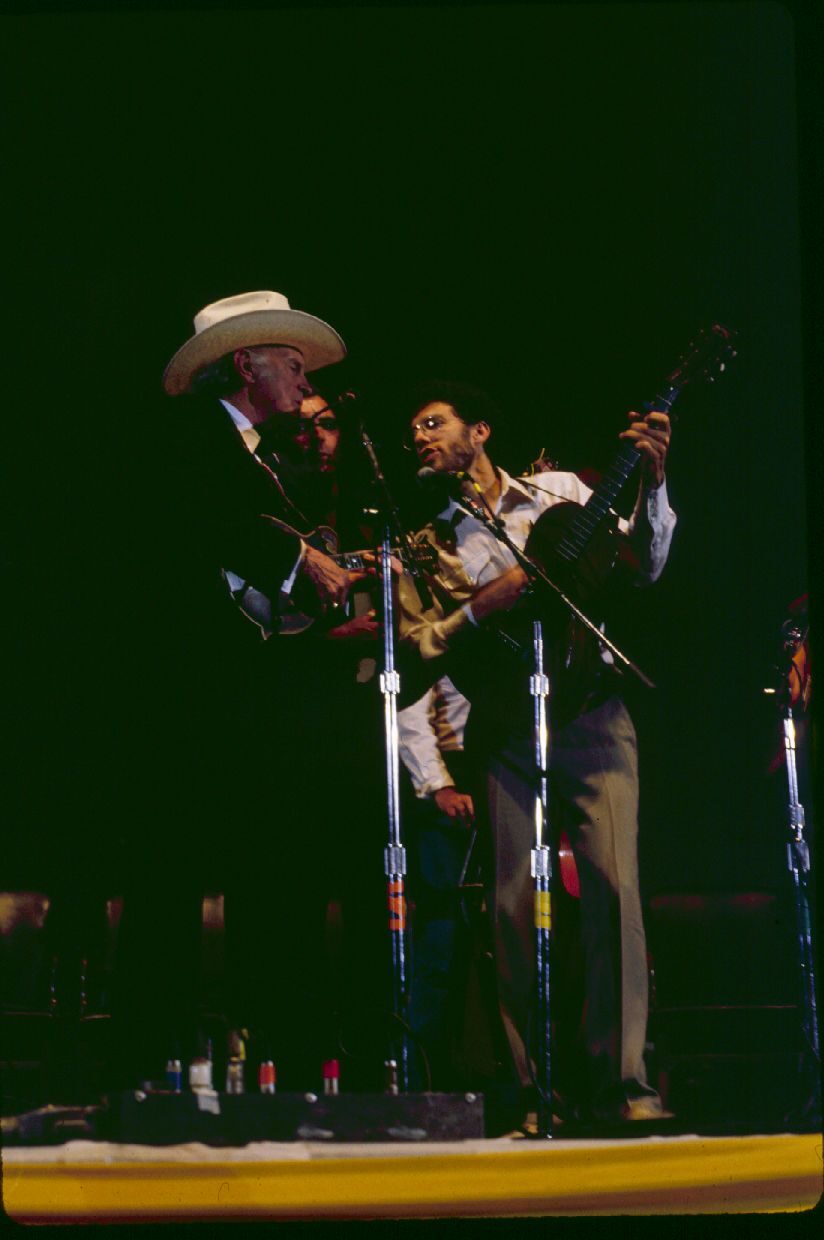
The decisive change is dated to December 1945, when Lester Flatt joined on guitar and Earl Scruggs on banjo. Flatt supplied a rhythm-guitar style that set the music's timing; Scruggs supplied a three-finger picking technique that turned the banjo from background texture into a lead instrument and, by contemporary accounts, caused a sensation at the Opry. With fiddler Chubby Wise and bassist Howard Watts, who worked under the name Cedric Rainwater, this line-up has been called ever since the original bluegrass band. Between 1946 and 1947 it recorded twenty-eight songs for Columbia, including "Toy Heart", "Blue Grass Breakdown", "Molly and Tenbrooks", "Little Cabin Home on the Hill" and "Blue Moon of Kentucky" — a waltz that Elvis Presley would record in 1954 as the B-side of his first Sun single, with Monroe's blessing and, afterwards, with Monroe's own faster re-recording in emulation.
.jpg)
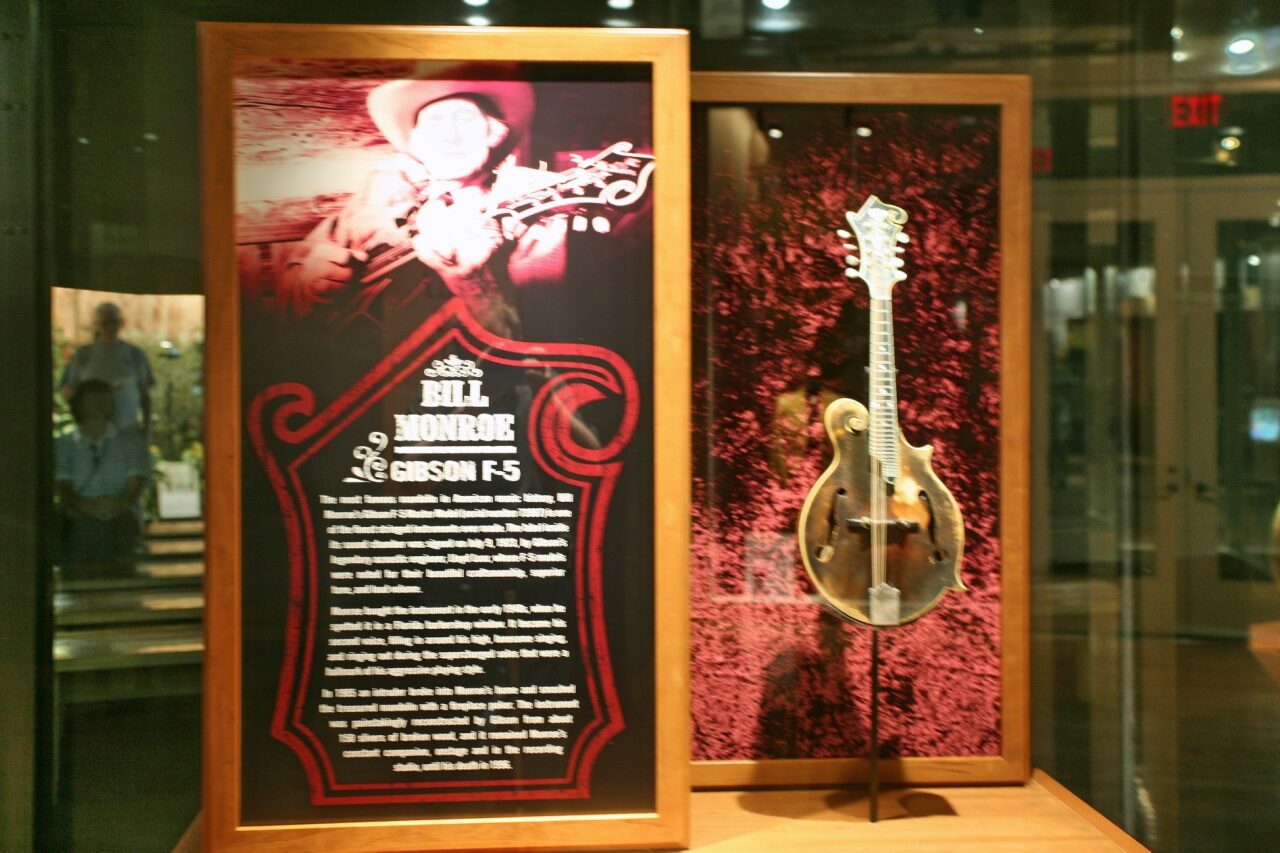
By this point Monroe was playing the instrument that would define the sound and the argument: a 1923 Gibson F-5 mandolin from the Lloyd Loar period, which stayed with him for the rest of his career.
What the classic line-up settled was not only instrumentation but arrangement. Breakneck tempos; short instrumental breaks handed from player to player over the song's chord shape; the breakdown, an instrumental in which each instrument takes a break in turn; and vocal harmony in two, three or four parts with a characteristically high, sometimes modal top line — the high lonesome sound. The standard stack puts the baritone at the bottom, the lead in the middle carrying the melody and the tenor above, though the Stanley Brothers and the Osborne Brothers both made repeated use of a high lead with the harmony parts underneath it, so the arrangement was never as fixed as the shorthand suggests.
One useful argument about origins has a defensible answer, and it is the one the scholarship gives: while the Blue Grass Boys were the only band playing this way, it was a band's sound rather than a style. It became a style when other bands adopted it. The usual marker is the Stanley Brothers' 1948 recording of the traditional "Molly and Tenbrooks" in the Blue Grass Boys' manner — a rival band demonstrating that the thing was reproducible.
The name arrived late and by committee. Bluegrass is an American common name for grasses of the genus Poa, and a region of central Kentucky is called the Bluegrass; the band took its name from the state, and the music took its name from the band. The word does not appear as a genre label until the late 1950s, and did not reach the Music Index until 1965. Ralph Stanley's account, given in a 2008 magazine interview, is the plainest on record:
Oh, (Monroe) was the first. But it wasn't called bluegrass back then. It was just called old-time mountain hillbilly music. When they started doing the bluegrass festivals in 1965, everybody got together and wanted to know what to call the show, y'know. It was decided that since Bill was the oldest man, and was from the bluegrass state of Kentucky and he had the Blue Grass Boys, it would be called 'bluegrass.'
A genre named retrospectively, at a festival, by a committee of its performers, roughly twenty years after its founding recordings: this is not the usual origin story, and it is one reason discussions of what does and does not count have never entirely closed. Meanwhile the trade filed it commercially: from 1948 the music was charted for radio purposes under country and western, which is how a distinctly acoustic mountain style ended up permanently adjacent to Nashville. That adjacency, and the arguments it produced, belong to rec.music.country.western and alt.music.country.classic, which own that ground in this directory.
The banjo, and the roll that defines the style
If a single technical fact makes bluegrass identifiable in two seconds, it is the banjo, and specifically Scruggs style — three-finger style, named for Earl Scruggs, born 6 January 1924, died 28 March 2012.
The mechanics are worth stating exactly, because they are the part that instrument threads are actually about. The player wears picks on the thumb, index and middle fingers; the ring and little fingers are braced against the head of the instrument to steady the hand. The strings are picked in rapid repeating sequences called rolls — forward, backward, mixed, forward-reverse — and the governing rule is that the same string is not normally picked twice in succession. Melody notes are threaded through the arpeggios rather than played as a line, which is why a Scruggs-style break sounds like a melody surrounded by a cascade rather than a melody with accompaniment. The result is syncopated, often with a slight shuffle at medium tempo, and it works equally as a solo and as backing, where the banjo's lower register counterweights the fiddle and mandolin above it.
Scruggs also contributed a vocabulary of licks — short reusable phrases, embellished with slides, string bends, hammer-ons and left-hand plucking, many of them leaning on blue notes. Because these were copied wholesale by everyone who came after, the licks themselves became part of the definition of the style. This is the technical basis of a durable disagreement: whether a player who avoids the standard licks is playing bluegrass banjo at all.
Scruggs was careful about the credit. He did not claim to have invented three-finger picking, and said it was the commonest way to play the five-string banjo in his part of western North Carolina; he named the local banjoist DeWitt "Snuffy" Jenkins as an early influence, and the historian and player Tony Trischka has written that Jenkins came about as close to Scruggs style as one could without actually playing it. What Scruggs did was codify it, record it and, in 1968, publish it: Earl Scruggs and the 5-String Banjo is one of the earliest instruction books of its kind for bluegrass banjo, and it made the technique learnable at second hand by anyone who could not sit next to the man.
Against Scruggs style sit the alternatives, and knowing the difference is the entry qualification for any banjo argument. Clawhammer, also called frailing, is the older Appalachian technique: a downward strike with the back of a fingernail, thumb catching the short fifth string, no picks, and the tonal character of old-time rather than bluegrass. It was the popular approach before the Civil War and remains the characteristic old-time sound — which is why the Usenet room for it was alt.banjo.clawhammer and not part of any bluegrass group. Within bluegrass, two later refinements are named for their originators: melodic or Keith style, introduced in the 1960s by Bill Keith (1939–2015), which lets the banjo play scalar fiddle-tune melodies note for note rather than through rolls; and the single-string or Reno style associated with Don Reno (1926–1984). Both are, in practice, departures a Scruggs-style player makes and returns from.
The hardware attracts equally exact discussion. A modern banjo's body, the pot, is a circular rim — wood on most instruments, metal on some older ones — carrying a tensioned head. Heads were traditionally animal skin and are now usually synthetic, which alone accounts for a great deal of tonal argument. Bluegrass banjos almost invariably have a resonator: a closed back plate that projects the sound forward and makes the instrument loud enough to compete with a fiddle and two guitars in an unamplified room. Open-back banjos are lighter and mellower, are set up differently — typically with higher string action — and are the old-time player's instrument.
The canonical instrument is a pre-war Gibson Mastertone, and the canonical example has provenance. Scruggs's own banjo was a 1934 Gibson Granada RB Mastertone, serial number 9584-3, the instrument heard on "Foggy Mountain Breakdown"; by the time Gibson issued a replica in 1984 as the Earl Scruggs Standard, the original had been modified so often that only the rim, the tone ring and the resonator remained original. Scruggs had earlier put his name to a Vega model, signed in the late 1950s with the Boston maker that already had a Pete Seeger model in its catalogue. His Granada was donated by his family to the Country Music Hall of Fame and Museum's permanent collection on 22 May 2023. The reverence is not affectation: a specific pre-war instrument, altered over fifty years, is the physical reference standard for a sound that thousands of players are trying to approximate.
The mandolin, the guitar and the thing called a dobro
The instrumentation the newgroup message listed — banjo, guitar, mandolin, fiddle, bass, dobro — is the standard set, and each element of it has a canonical form that is argued about with the seriousness of liturgy.
The mandolin's canonical form is the Gibson F-5, and it is a design with an author. Lloyd Loar (1886–1943) worked for the Gibson Mandolin-Guitar Manufacturing Company from 1919 to 1924, and the F-5 he designed there, introduced in 1922, carried a set of ideas imported wholesale from the violin family: f-holes in place of a round or oval sound hole; a longer neck, which moves the bridge nearer the centre of the body; a fingerboard floating above the top rather than glued to it; and tops individually tuned by shaving wood from the tone bars and the edges of the sound holes until the sound chamber resonated at a chosen pitch. Loar signed and dated every instrument he approved for as long as he worked at Gibson, which is why collectors identify them by their signing date rather than by serial number alone — a July 9. The most famous of all is a 9 July 1923 F-5, serial number 73987, which became Bill Monroe's mandolin. The F-5 went on to be the most imitated American mandolin ever built, and Monroe is the reason it is the bluegrass mandolin specifically.
%2C_Bill_Monroe%2C_CMHF.jpg)
The guitar in a bluegrass band is primarily a rhythm instrument, and its canonical form is a Martin dreadnought. C. F. Martin introduced the D-28 in 1931, a large square-shouldered body built for volume and low-end projection; the pre-war examples, with herringbone top binding and scalloped braces, are the ones the reissues chase, which is why a modern player after that sound buys an HD-28 rather than a D-28. Playing technique moved as well. Early bluegrass guitarists including Lester Flatt used a thumb pick and finger pick; the modern default is flatpicking with a plectrum, and the transformation of the flat-top guitar into a lead instrument within bluegrass is generally credited to Clarence White of the Kentucky Colonels — the player the 1996 newgroup message identified simply as "the late Clarence White", killed by a drunk driver on 15 July 1973 at the age of twenty-nine.
The bass is almost always played pizzicato, alternating between the root and the fifth of each chord with occasional walking excursions and the odd slap to mark the beat. The fiddle is the one instrument in the set that needed no adaptation to be here: it was among the first instruments carried to America, it was small and versatile enough to travel, and it had been the lead voice of southern dance music long before anyone assembled a bluegrass band around it.
The resonator guitar is the interesting one, because it is a piece of industrial engineering that wandered into a folk idiom and stayed. A resonator guitar routes the string vibration through the bridge into one or more spun metal cones instead of into a wooden soundboard. The design was worked out in the 1920s by John Dopyera, a Slovak immigrant instrument-maker, in response to the steel guitarist George Beauchamp's demand for more volume — the problem being that an acoustic guitar could not be heard against brass and reeds. Dopyera and Beauchamp founded the National String Instrument Corporation in 1927 to build metal-bodied instruments with three ganged cones, the tricone. Dopyera then left National, and in 1928 he and his brothers set up the Dobro Manufacturing Company — the name a contraction of Dopyera Brothers, and also the Slovak word for good — to build the design National would not: a single, inverted, outward-facing cone, cheaper than the tricone and louder.
The mechanical distinction survives in the vocabulary. A National-type single cone is convex, uppermost, with the bridge sitting on a wooden biscuit at its apex. A Dobro-type cone is inverted, concave side up, with the bridge carried at the centre of an eight-legged aluminium casting called the spider, whose legs rest on the rim of the cone and carry the string energy to it. Bluegrass took the second. Bluegrass players almost always use a square-necked instrument, held flat and played with a steel bar in lap-steel fashion rather than fretted. And the word itself is a trademark: Dobro has been owned by Gibson since 1993, which announced that it would defend its exclusive use of the name for a design that half the world had spent sixty years calling a dobro generically. This is exactly the kind of distinction — brand, mechanism, playing position, all three different questions wearing one word — that a text newsgroup is unusually good at pulling apart.
Its adoption into bluegrass is dated and attributable. Josh Graves (1927–2006), known as Uncle Josh, joined Flatt and Scruggs's Foggy Mountain Boys in 1955, originally on bass, and worked with Scruggs to adapt the three-finger syncopated banjo roll to the resonator guitar. That transfer of a technique from one instrument to another is what made the dobro a lead instrument in bluegrass rather than a novelty, and it is why the instrument is simultaneously canonical and, to strict traditionalists, a departure — Monroe's Blue Grass Boys did not carry one.
Which is the real substance of the instrumentation argument, and it is documented rather than invented. The traditionalist position is that the correct line-up is Monroe's: guitar, mandolin, fiddle, banjo and bass, full stop. Departures over the years have included the dobro, accordion, harmonica, piano, autoharp, drums, electric guitar and electrified versions of the acoustic instruments. The awkward fact for the strict position, duly recorded in the literature, is that Monroe himself experimented freely — a 1945 session with an accordion, and on at least one occasion a string orchestra, a choir and a pre-recorded birdsong track. Purism in bluegrass has always had to work around its founder.
The festival circuit
Bluegrass organised itself around festivals to a degree unusual even among roots musics, and the reason is partly structural: the repertoire is largely shared, the instrumentation is standard and portable, and the arrangement conventions are simple enough that strangers can play together on sight. A genre with those properties will generate multi-day gatherings whether or not anyone plans them.
The sequence is documented. A one-day event at Watermelon Park near Berryville, Virginia, on 14 August 1960 is the earliest generally cited. On 4 July 1961 Bill Clifton organised a larger one-day festival at Oak Leaf Park in Luray, Virginia, with a bill including Bill Monroe, the Stanley Brothers, Jim and Jesse, Red Allen and Frank Wakefield. The format that stuck, though, is the weekend festival, and it dates to 1965, when Carlton Haney (1928–2011) — a booking agent who had worked for Monroe from 1953 and managed Reno and Smiley — produced the first multi-day bluegrass festival at Cantrell's Horse Farm in Fincastle, Virginia, with the help of the folklorist Ralph Rinzler. Haney continued the event in later years at other sites including his own land at Camp Springs, North Carolina, and in the 1970s published Muleskinner News, one of the earliest bluegrass magazines. His multi-day model became the standard; there are now reckoned to be more than five hundred such events a year.
Monroe founded his own in 1967 at Bean Blossom in Brown County, southern Indiana, on a park he had bought in 1951. The Bill Monroe Bean Blossom Bluegrass Festival is the oldest continuously running annual bluegrass festival in the world, and a double live album drawn from it in 1973 — with Monroe, Jimmy Martin, Lester Flatt, and Jim and Jesse — is one of the genre's better-known documents of what a festival actually sounded like. Later festivals widened the definition: Telluride, in Colorado, first held in 1974 and now booking well outside bluegrass proper; MerleFest, founded in 1988 at Wilkes Community College in Wilkesboro, North Carolina, by Doc Watson in memory of his son Eddy Merle Watson, and now drawing crowds above seventy-five thousand.
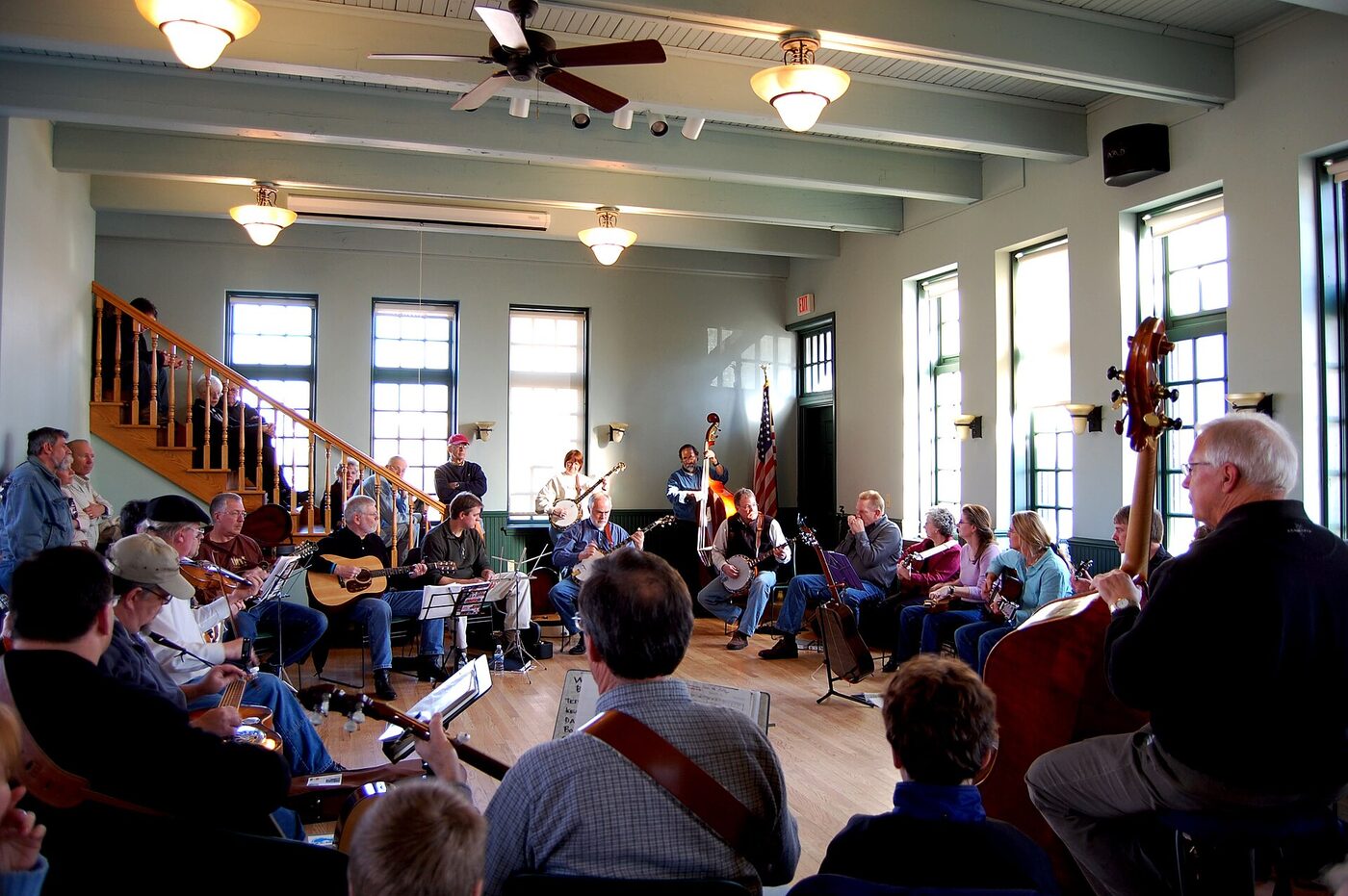
The institution that matters most for understanding a newsgroup, though, is not the stage. It is the car park. Parking-lot picking — informal jamming in the car parks and campgrounds of a festival, running in parallel with and often outlasting the paid programme — is treated in the literature as a constituent part of the music rather than a fringe activity, and it also happens in music shops, bars and restaurants year-round. Bluegrass jams stratify themselves by ability with some precision: slow jams exist as a deliberate entry point for beginners; open jams admit all comers but expect competence, specifically the ability to hear a chord progression, keep time, and take an improvised break that at least gestures at the melody; and jams above that level are generally private and by invitation. That is a social structure with tiers, unwritten admission standards and a strong preference for demonstrated skill over stated credentials — which is to say, a structure a Usenet reader would have recognised at once.

Associations, awards and the machinery of a scene
By the time the newsgroup existed, bluegrass had acquired the full apparatus of a formalised genre, and the dates are on the record.
- The International Bluegrass Music Association was formed in 1985 as a trade association, with its first headquarters in Owensboro, Kentucky. It moved to Nashville in 2003.
- In 1987 the IBMA established World of Bluegrass, a combined trade show, festival and awards presentation, originally in Owensboro, later in Louisville from 1997, Nashville from 2005, Raleigh, North Carolina, from 2013 to 2024 and Chattanooga, Tennessee, from 2025.
- In 1991 it established the International Bluegrass Music Hall of Honor, at what became the International Bluegrass Music Museum in Owensboro, to recognise lifetime contributions by performers and non-performers alike. Bill Monroe was an inaugural inductee. Carlton Haney, who invented the festival weekend, was inducted in 1998.
- The recording industry followed. A Grammy Award for Best Bluegrass Recording was created for the 1989 ceremony, renamed Best Bluegrass Album from 1992. Its inaugural recipient was Bill Monroe.
Monroe's own honours are a rough index of how the genre's standing changed over his lifetime: the Country Music Hall of Fame in 1970; the Nashville Songwriters Hall of Fame in 1971; a National Heritage Fellowship from the National Endowment for the Arts in 1982, in the very first year those fellowships were awarded; a Grammy Lifetime Achievement Award in 1993; the National Medal of Arts in 1995; and, posthumously, the Rock and Roll Hall of Fame in 1997 as an early influence. He is one of only five performers honoured by the country, songwriters' and rock institutions alike; the others are Jimmie Rodgers, Bob Wills, Hank Williams and Johnny Cash.
None of this apparatus is what the newsgroup was for, but all of it is what the newsgroup's regulars were reading about, arguing over and travelling to. An awards ceremony and a museum give a scene a calendar and a canon; a newsgroup gives it somewhere to complain about both.
Generations, and the argument that will not close
The genre's internal history is usually told in generations, and the divide that organises all of them is between traditional practice and everything else. It is a real argument with real recordings on both sides, and it was live throughout the newsgroup's existence.
Traditional bluegrass takes the late-1940s Blue Grass Boys as the specification: acoustic instruments only, folk songs and simple progressions, short breaks derived from the melody, the guitar staying out of the lead except on gospel numbers, a great deal of it in G. Amplification of acoustic instruments on a large stage is tolerated; amplified instruments are not.
The progressive turn is conventionally dated to the Country Gentlemen, a band formed in the Washington, D.C. area in the 1950s, and specifically to their 1960 album Country Songs, Old and New, which set traditional ballads against mandolin and banjo parts markedly unlike Monroe's and Scruggs's. The folk revival of the early 1960s then delivered bluegrass to college campuses and coffeehouses and to musicians who had grown up on rock and roll, and who imported both. The Kentucky Colonels, formed in Burbank, California in 1954 and at their peak with the 1964 album Appalachian Swing!, are the revival-era band the 1996 newgroup message singled out.
The argument then split the genre's most famous partnership. Earl Scruggs had shown progressive instincts early — jazz-inflected banjo and bass duets, extended chord progressions — and by the late 1960s was recording duets with the saxophonist King Curtis and putting Bob Dylan songs into the repertoire, while Lester Flatt, a traditionalist, objected. Flatt and Scruggs broke up in 1969 over precisely that disagreement, after more than twenty years together. It is difficult to think of a cleaner demonstration that the traditional-versus-progressive dispute is not a fan's invention.
What followed is the material the 1996 message called the moderns. New Grass Revival, active from 1971 to 1989 with a membership that at various times included Sam Bush, Courtney Johnson, Curtis Burch, John Cowan and Béla Fleck, took electric instrumentation and imported repertoire far enough that "newgrass" became a synonym for progressive bluegrass. David Grisman built an acoustic hybrid of bluegrass, folk and jazz he named dawg music and founded a label, Acoustic Disc, to release it. Tony Rice became the reference point for bluegrass and acoustic-jazz guitar; Jerry Douglas did the same for the resonator guitar; Béla Fleck carried the banjo into jazz and beyond. Alison Krauss signed to Rounder Records in 1985, still in her early teens, released her first solo album in 1987 and has since taken more awards in the Grammy bluegrass category than anyone else. Del McCoury sustained a traditional line into the present and joined the Grand Ole Opry in 2003. Festivals such as Telluride and MerleFest deliberately mixed bluegrass with acts from outside it.
Two further strands emerged around and after the newsgroup's active years. The jam-band scene that followed the death of Jerry Garcia — who had himself played bluegrass banjo before the Grateful Dead, and who travelled to Bean Blossom in May 1964 to tape Monroe's performances — absorbed a set of bands playing long improvised bluegrass, generally called jamgrass. And a younger, formally ambitious tendency arrived with Nickel Creek, formed in Carlsbad, California in 1989, whose self-titled 2000 album, produced by Alison Krauss, went platinum; later the Punch Brothers made arrangements on bluegrass instruments that owe as much to contemporary classical writing as to Monroe. Meanwhile a neo-traditional current, from the 1990s onward, went back to reconstruct the late-1940s sound deliberately. Both directions were available to a reader in 1996, and the group's own description — players, records and festivals — committed it to neither.
Lyrics and transcriptions: a repertoire catalogued in public
The group's description names lyrics and transcriptions, and the page above notes that its discography and lyric-correction threads worked as a reference before dedicated databases existed. That claim is best understood not as a claim about particular threads — no thread of this group has been read for this article, and none is described here — but as a claim about a form. It is worth setting out what that form was, because it long predates Usenet and is unusually well documented.
Bluegrass draws on a repertoire that is partly traditional, which means partly anonymous, orally transmitted, and existing in variants rather than in a single authoritative text. Cataloguing such a repertoire has been an amateur and semi-amateur enterprise for a century and a half, conducted in public and by correspondence. Francis James Child, Harvard's first professor of English, anthologised 305 traditional English and Scottish ballads, with their variants, in The English and Scottish Popular Ballads, published in five volumes between 1882 and 1898; his numbering is still how those ballads are identified. Cecil Sharp, with Maud Karpeles, made collecting expeditions into the southern Appalachians between 1916 and 1918, taking down in 1917 and 1918 four variants of one song alone under the title "In Old Virginny"; the collection was published in 1932 as English Folk Songs from the Southern Appalachians. In the twentieth century the Roud Folk Song Index consolidated the field: around 250,000 references to nearly 25,000 songs in English collected from oral tradition worldwide, compiled by Steve Roud, subsuming the printed sources known to Child, and now hosted by the English Folk Dance and Song Society. The Roud number's entire function is to gather variants of one song under a single identifier, which is a formal admission that the same song exists in many texts.
What a repertoire like that needs is precisely what a newsgroup produces: someone posts a text, someone else posts a different text, a third party says where they heard theirs, and the disagreement is the data. A song with a Roud number has no correct lyric to converge on, only a family of attested ones. Correcting a lyric in public, with the correction visible next to what it corrects, is closer to the collecting tradition than a database entry is.
The specific problem Usenet had was retention. Articles expired from news servers within days or weeks to make room for new ones, so anything posted to a newsgroup was, in practice, a broadcast rather than a record. The best-documented consequence is not from bluegrass but from the neighbouring guitar groups, and it is exact. In about 1992 James Bender, a student at the University of Nevada, Las Vegas, began collecting tablature posted to rec.music.makers.guitar.tablature and alt.guitar.tab and republishing it on the university's FTP server, because — in the plain account of the archive's own history — retention meant the tabs were often available for only a couple of days. That collection became the On-Line Guitar Archive, OLGA, the first Internet library of plain-text chord charts and tablature; Cathal Woods took over as curator in June 1994, and by 1997 it held an estimated 22,000 files mirrored on more than twenty sites.
The other relevant collection was already running. The Digital Tradition song database was begun in 1988 by pooling the electronic song collections of Dennis Cook and Susan Friedman, in askSam format; the Mudcat Café, founded in October 1996 — four months after this newsgroup — as a blues discussion site and soon a folk one, later gave the database a permanent home and now carries the words to over 9,000 folk songs, many with a MIDI file attached. Between them, OLGA and DigiTrad are the answer to the question of what "before dedicated databases existed" means: the databases were being assembled, by volunteers, out of exactly the same impulse and often out of the newsgroup postings themselves.
One more detail from the Big-8 paperwork shows how well understood the legal position was at the time. When the old-time proposal listed the topics its group would carry, it wrote — in a bullet list, without comment or elaboration — Lyrics (if not copyrighted). That parenthesis was in a formal charter in November 1994, and the next section explains why.
Who owns a tune nobody wrote
The question of who holds rights in a traditional song is not an abstraction in this repertoire. It has named cases, decided outcomes and a documented pattern, and it is reported here neutrally: the point is what happened, not who deserved what.
The mechanism is simple and has been available since the beginning of commercial recording. A song in the public domain can be copyrighted in a particular arrangement or a particular text. The person who does so is frequently the collector, the performer or the publisher rather than any of the anonymous people through whose mouths the song passed on its way to the microphone. This is neither fraud nor an accident of the system; it is what the system provides for. It nonetheless produces results that look strange when you read them next to a folk-song index.
"Man of Constant Sorrow" is the cleanest illustration in the bluegrass repertoire. Its first documented publication is a six-song songbook dated 1913, Songs Sung by R. D. Burnett — The Blind Man — Monticello, Kentucky, in which it appears as "Farewell Song". Dick Burnett, a partially blind Kentucky fiddler, had been blinded in a shooting during a robbery in 1907, and the line about being blind for six years dates his version. Asked later whether the song was his, Burnett gave an answer that is quoted in the literature and is very nearly the whole problem in one sentence:
No, I think I got the ballad from somebody — I dunno. It may be my song ...
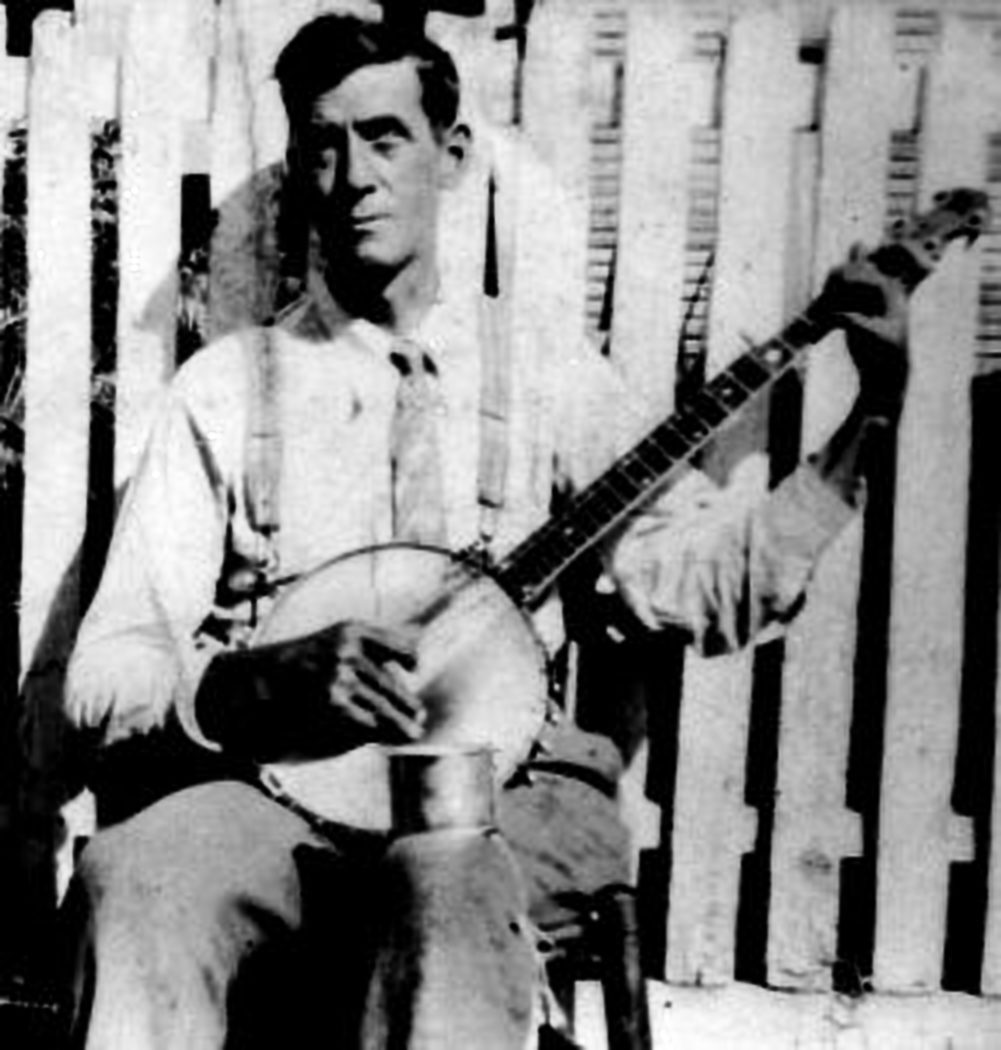

Emry Arthur, a friend of Burnett's, recorded it in January 1928 for Vocalion, gave it the title it now carries, and also claimed to have written it. Burnett had recorded it for Columbia in 1927, but that version was never released and the master was destroyed. Cecil Sharp, independently, had collected four related versions in Kentucky and Virginia in 1917–18. The Stanley Brothers recorded their version — learned, they said, from their father, who sang it as an unaccompanied hymn — for Columbia at Castle Studios in Nashville on 3 November 1950, and it is the Stanley reading that carried the song into bluegrass and, by way of their performances and Mike Seeger's, into urban folksong circles during the revival; Bob Dylan recorded it in 1961. Because neither Burnett nor Arthur had ever copyrighted the song, Carter Stanley was able to copyright it as his own work in 1951. Fifty years after that, the version sung by Dan Tyminski for the 2000 film O Brother, Where Art Thou? made it a hit. No single person can be said to have written it; several have been credited with it; all of the claims are documented and none of them is straightforwardly false.
The best-documented dispute concerns a song from the same tradition. "Tom Dooley" is a North Carolina murder ballad, Roud 4192, about the 1866 killing of Laura Foster and the hanging of Tom Dula. It was recorded commercially by G. B. Grayson and Henry Whitter for Victor in 1929. The folklorists Anne and Frank Warner met the Appalachian singer Frank Proffitt in 1938 at the home of his father-in-law, the dulcimer maker Nathan Hicks; Frank Warner took the song down from Proffitt in 1940 and passed it to Alan Lomax, who published it in Folk Song: USA. The Kingston Trio recorded it in 1958 for Capitol; the single reached number one, sold in the millions, won a Grammy at the inaugural 1959 ceremony — in the country and western category, there being no folk category yet — and is generally credited with setting off the folk boom. Dave Guard of the Trio claimed copyright in the song and eventually lost a suit over it to Lomax, Warner and Proffitt: supported by the Warners' testimony, Proffitt was acknowledged by the courts as the preserver of the original version, and the Trio were ordered to pay him royalties for the uncredited use of it. The recording is now in the Library of Congress's National Recording Registry.
Those cases concern songs. The parallel question for transcriptions — the second noun in this group's description — was settled during and just after the newsgroup's life, and not in the transcribers' favour. OLGA, the guitar tablature archive assembled from newsgroup postings, attracted a complaint from EMI Publishing to the University of Nevada, Las Vegas in 1996; the university removed the project from its server. In 1998, at its new home, it received a similar complaint from the Harry Fox Agency and shut down, re-emerging as a non-profit. In June 2006 lawyers acting for the National Music Publishers Association and the Music Publishers Association sent a takedown letter stating that the archive made available tablature versions of copyrighted compositions controlled by their members. The archive removed all 34,000 tablatures and did not return. Its long-serving archivist's summary, posted on his own site, was a single line: "For twelve years I ran OLGA — the On-Line Guitar Archive. RIP."
The two halves fit together with some irony. A traditional song may have no author to pay, and courts have been asked to decide which twentieth-century collector or performer stands in for the missing one. A twentieth-century song has an author, a publisher and an agency, and posting a chord chart of it to a public archive is an infringement. A newsgroup whose description promises lyrics and transcriptions was sitting, whether or not its readers thought about it, on both problems at once — which is presumably why an unrelated Big-8 charter of the same era wrote the caveat straight into its topic list.
The rooms next door
A newsgroup is best understood by its neighbours, and this one had an unusually well-populated street.
rec.music.country.old-time— the Big-8 group for southern fiddle and banjo music, described above; the parent music, formally chartered, with a published vote.alt.banjo,alt.banjo.clawhammer,alt.banjo.minstrel— the instrument's own rooms, all three in alt.*, covering the bluegrass and pre-bluegrass techniques separately.rec.music.folkfor the wider tradition, andrec.music.folk.tablature, described in the newsgroups file as folk music tune discussion and trade — the folk equivalent of the transcription traffic.rec.music.makers.builders, for the design, building and repair of instruments, andrec.music.makers.dulcimerfor the other Appalachian string instrument.rec.music.country.westernandalt.music.country.classic, the commercial cousin and its back catalogue, each covered on its own page in this directory.alt.binaries.sounds.mp3.bluegrass, which the current newsgroups file lists with the placeholderNo description.— the late-1990s binaries answer to a text group, and a different proposition legally.
The distribution is itself an argument. The Big 8 chartered the ancestor music and the instrument-makers' rooms; alt.* got the banjo, the bluegrass and the binaries. That is roughly what one would expect of a hierarchy in which creating a group cost a formal proposal, weeks of public discussion, a votetaker and a hundred-vote margin, next to one in which it cost a single control message from a Dutch dial-up account. The full list this directory preserves is at the all-groups index.
Where it went
The traffic went where all Usenet traffic went, and in this case it had somewhere specific to go, because it had come from there in the first place. Bluegrass discussion on the net began on a mailing list, and mailing lists proved considerably more durable than newsgroups: they had no shared retention policy to expire them, no spam-exposed public address space in the same sense, and an owner. The web then supplied dedicated forums, and the song-and-lyric traffic in particular flowed into sites built for it. The Mudcat Café, founded four months after this newsgroup, absorbed the Digital Tradition database and is still running as a folk-song discussion site and searchable song archive; that combination — forum plus database, threads sitting next to the texts they argue about — is essentially what a newsgroup with a good FAQ had been approximating.
The genre's largest commercial moment arrived after the years in which such groups were busiest and demonstrated how much the audience had grown while nobody was counting. The soundtrack to O Brother, Where Art Thou?, produced by T Bone Burnett and released at the end of 2000, reached number one on the Billboard 200, won the Grammy for Album of the Year in 2002 and Album of the Year at the Country Music Association Awards, and was certified eight times platinum by October 2007. It contained Ralph Stanley singing "O Death" unaccompanied, and the song the Stanley Brothers had carried into bluegrass sung by Dan Tyminski, and it sold to people who had never bought a bluegrass record. The institutions carried on: the IBMA still runs World of Bluegrass and the Hall of Honor, the festival calendar still runs to several hundred events a year, and the Grammy category persists.
The newsgroup itself did not die so much as stop being where the conversation was. It has never been rmgrouped. It remains in the newsgroups file with the description quoted at the top of this article, and in the active file with the posting flag set, which means a reader with a news client and a server that carries alt.* can still post to it. Whether anyone answers is a separate question, and not one the administrative record can settle.
What the record does not show
This page is deliberate about the difference between what is documented and what would be nice to know. For alt.music.bluegrass, the gap is large and worth stating item by item.
- No vote, because none was required. There is no RFD, no CFV and no result, because alt.* has never worked that way. The 265-to-32 tally quoted above belongs to the neighbouring Big-8 group, not to this one, and is included precisely to show what the alt.* record does not contain.
- No readership figure of any kind. Nothing in the surviving material supports a subscriber count, a posting rate, or a claim about how busy the group was in any year.
- No thread has been read for this article, and none is described. The page above says the group's discography and lyric-correction threads served as a working reference; that is the directory's own editorial characterisation of the group, and this article treats it as a claim about a kind of activity, not as a citation of any particular exchange. No thread title, no participant and no quotation from the group appears anywhere here.
- No FAQ has been recovered. Many long-running music groups maintained one. If this one did, it has not surfaced in the archives consulted.
- Almost nothing about the proposer. The control message gives an e-mail address at a Dutch provider and a posting host. It does not give a name beyond the local part of the address, and nothing further about the person has been established. The fact that the founding document of a newsgroup about the only music style its author considered natively North American was sent from the Netherlands is left here as a fact rather than a thesis.
- No moderation, no charter revision, no dispute. The file holds one message. Whatever governance the group had was the governance every unmoderated alt group had: none.
Scope and limits
What can be said with confidence about this group comes from three kinds of source, and they are of very different weights. The strongest is the Usenet administrative record: the control message of 16 June 1996, quoted here verbatim from the ISC mirror, and the current newsgroups and active files, which are machine-generated and unambiguous. Next is the Big-8 paperwork for the neighbouring old-time group, which is a primary document of the same period and the same community, and which happens to answer a question about bluegrass that the bluegrass record itself does not. Weakest — though entirely adequate for the purpose — is the general history of the music, its instruments and its institutions, which is well documented in reference works and has been checked here name by name and date by date.
What cannot be reconstructed is the group's own conversation. That is the ordinary condition of alt.* groups in this directory, and it is not treated as a defect to be papered over. A page that invented a plausible thread about banjo bridges would be more entertaining and worth nothing. Instead the honest description is this: an unmoderated alt.* group, created in June 1996 by one person with a strong opinion and a news client, in a genre that had been organising itself online by e-mail for years already, listed to this day as a place for bluegrass information, lyrics and transcriptions — a description that named exactly the kind of shared, correctable, contested document that a text-only public medium is unusually good at producing, and that copyright law has spent a century deciding who owns.
Reading alt.music.bluegrass today
- Historical archive: Google Groups — alt.music.bluegrass (coverage varies by group and era).
- Open in a newsreader:
news:alt.music.bluegrass— the original site offered exactly this link, and it still works if your system has a newsreader registered for thenews:scheme. - Live access: point an NNTP newsreader at a modern server — see accessing Usenet today.
- The original news2mail e-mail subscription service ended in the mid-2000s and no longer operates.