de.alt.motorroller
German-language group on motor scooters (de.alt hierarchy).
Vespa restorations, 50cc licensing questions and commuter-scooter advice, in German, in the informal de.alt.* branch.
Kept as a directory entry for the de.* slice of the gateway’s catalogue.
On this page
- A newgroup message from Karlsruhe, July 1996
- de.alt.*: the branch where asking was enough
- What a Motorroller is, and what the law thought it was
- Thresholds: a century of German small-vehicle law
- The plate that changes colour every March
- Vespa, Lambretta and their German licensees
- The German scooter industry and its short summer
- Suhl: Simson, the Schwalbe, and a rule that outlived its state
- Two-stroke practice, the TÜV and the parts problem
- The revival of the 1990s and the end of the two-stroke
- What is known about the group, and how it ended
- Scope and limits
A newgroup message from Karlsruhe, July 1996
Most groups in the informal German branch left no paperwork at all. This one did. The Internet Systems Consortium mirrors the Usenet control-message archive, and the file for de.alt.motorroller opens at 12:51 GMT on 18 July 1996 with a newgroup control message sent by Philip Herzog from a student machine at the Universität Karlsruhe. It was crossposted to de.alt.admin, to the motorcycle group de.rec.motorrad and to de.alt.test, with follow-ups directed to de.alt.admin. It carried the one-line entry a news administrator would paste into the server's newsgroups file — de.alt.motorroller, Alles rund um Motorroller, everything to do with motor scooters — and a charter of two short paragraphs.
Die Gruppe de.alt.motorroller wendet sich an alle, die an Motorrollern und damit verbundenen Themen interessiert sind. Es soll hier ausdruecklich nicht nur um technische Fragen gehen, sondern auch um soziale Themen wie Sportveranstaltungen (Rollerrennen) und Roller im Alltag als Ersatz fuer Autos, Sicherheitsaspekte u.a.
In translation: the group addresses everyone interested in motor scooters and related subjects; it is expressly not to be about technical questions alone, but also about social ones — sporting events (scooter racing), scooters in everyday use as a substitute for the car, questions of safety, and so on. The umlauts are written out as ue and ae, which is what a hierarchy running over seven-bit-safe transport did to its own official texts as a matter of course.
Under the heading Off-Topic the proponent added one further line: Mein erster Newgroup. Sorry wenn ich was falsch gemacht habe. My first newgroup; sorry if I did something wrong. That sentence is the branch in miniature. In the formal part of the hierarchy nobody sends their own control message and nobody has occasion to apologise for the attempt, because the moderation sends it for them after a ballot. Here the proposer was also the executive.
Five newgroup messages went out in all between 18 and 30 July 1996: two on the first day, one on 20 July, two on 30 July. They are near-identical, and the small differences are the interesting part. The first carried no Approved header; some three hours later a second went out with one added and a new off-topic note, Hoffentlich langt's wenn ich selber im Approved-Header stehe :-) — hopefully it is enough if I put myself in the Approved header. The fourth is prefaced ...und noch ein Versuch..., and one more attempt. Repeats like these are boosters, and they are normal rather than desperate: a newgroup message is a request that each server decides on individually, and repeating it catches machines that were down, that had not yet been fed, or whose administrator had swept the group away in the meantime.
One further stray arrived on 30 September 1996. It repeated the creation request but carried every mark of an unconfigured news installation — a sender of [email protected], the placeholder organisation My organization, a distribution called mydistrib — and it was posted not into any discussion group but into de.alt.motorroller.ctl, the .ctl pseudo-group form that RFC 1036 records older software treating as control traffic.
What the control archive holds is control messages. It does not hold ordinary articles, so nothing in it says how many people read the group, what was discussed in it, or whether the discussion in de.alt.admin that Appendix A of the hierarchy's rules asks for actually took place before the first newgroup went out. Those things are not known here and are not guessed at below.
de.alt.*: the branch where asking was enough
The German-language hierarchy governs itself by a written procedure with a formal Request for Discussion, a Call for Votes, a published count that names every voter by real name and address, an objection period and a moderation, itself elected, which sends the control messages. That machinery, and the hierarchy's history, belong to the de.* hierarchy page and are not retold here. What matters for this group is the one place the machinery deliberately does not reach.
The rulebook — Regeln für die Einrichtung, Änderung und Entfernung von Usenet-Gruppen, still posted weekly to de.admin.infos and de.alt.admin, and carrying a last-modified date of 13 December 2021 — excludes de.alt.* from its own scope in the first section and disposes of it in a short Appendix A. In translation, the whole of the operative part reads:
Here everything is much simpler. The basic rule is: fairness. Setting up a group in de.alt.* goes like this. You ask in de.alt.admin whether anyone has objections to the proposed group; you wait, in fairness, long enough that somebody really can complain (response times — despite by now only slight transport delays — are still in the region of several days, so a waiting period of seven days is customary); and if the protest was not too fierce, you simply send the newgroup message.
Two institutions carry that arrangement. The first is de.alt.admin itself, described in the hierarchy's own group list as Neue de.alt-Newsgroups und deren Verbreitung — new de.alt newsgroups and their distribution. When an unauthorised removal message for that group went out in April 1999, the counter-message asking administrators to put it back described it in one line as the de.alt equivalent of alt.config, which is exactly right: a room where namespace proposals are aired and nothing is voted on.
The second is the news server configuration itself, and it is the sharper of the two. The control.ctl file — the file that tells a machine whose control messages to believe, maintained centrally and shipped with the INN news server — treats de.* and de.alt.* as different countries. For de.*, newgroup and rmgroup messages from anybody are dropped, and only messages from the moderation address, verified against a published PGP key, are acted on. For de.alt.*, the entry for newgroup is doit: a creation message from any sender at all is honoured. Removal is the reverse, accepted only from the same verified moderation address. Anyone may open a room in this branch; only the hierarchy's own officers may close one. The asymmetry is the whole design.
It also explains a feature of the German namespace that looks odd from outside: the same subject holding two rooms in two branches. A subject could get an alt room in a week because one person wanted one, and a rec room a year later because enough people voted for one. Scooters did exactly that. This directory preserves both, and de.rec.motorroller — created through the full procedure and still in the hierarchy's current group list — has its own page here, which is where the rec branch and the question of why one subject wanted two rooms belong. The other de.alt group in this catalogue is de.alt.augenoptik, on eyes, spectacles and contact lenses; its creation message went out on 17 August 1997, crossposted to de.alt.admin, in exactly the same one-man form.
What a Motorroller is, and what the law thought it was
A Motorroller is a scooter in the ordinary sense: a two-wheeler with an open step-through between handlebars and seat, no fuel tank or engine at knee height, a floor pan instead of footrests, a full leg shield in front, and the engine, tank and transmission grouped low at the rear. A motorcycle puts the engine and tank between the rider's knees and asks to be gripped; a scooter is sat on like a chair, which is why period advertising sold it to people in ordinary clothes, and why the shape survived the machines that invented it.
German law, however, has never classified two-wheelers by shape. It classifies them by displacement, by design speed and, for a long stretch of the twentieth century, by such details as wheel diameter, pedal-crank radius and permitted engine revolutions. The result is that the word Motorroller is a description of a body style while Mofa, Moped, Mokick, Kleinkraftrad and Leichtkraftrad are legal categories, and a scooter can be any of them depending on how it is built and geared. A scooter-bodied machine limited to 25 km/h is a Mofa; the same body at 45 km/h is a Kleinkraftrad; at 125 cm³ it is a Leichtkraftrad and needs a different licence and a periodic roadworthiness test.
That is why licensing questions were charter business rather than trivia. A charter that promises everyday use as a car substitute is promising, in practice, a great deal of argument about which piece of paper the rider needs, what the machine may legally do, and which of those two facts changed most recently.
Thresholds: a century of German small-vehicle law
The categories were rebuilt repeatedly, and almost every rebuilding left a cohort of machines behind under grandfathering rules that are still in force. The dated sequence for the Federal Republic, taken from the German legal-history summaries of the vehicle and licence classes, runs roughly as follows.
- 1923–1928. The motor traffic act of 21 July 1923 already names the Kleinkraftrad, defined then by tyre diameter and taxable power. From 1 April 1928 a Kleinkraftrad could have up to 200 cm³ and be ridden from the age of sixteen without a licence and without tax — the cheapest possible entry to motorisation, and the reason the 98 cm³ machine became the standard cheap motorcycle of the 1930s. Licences became compulsory for the class again on 1 January 1938.
- 1 January 1953. A new Straßenverkehrs-Zulassungs-Ordnung defines the Fahrrad mit Hilfsmotor, the bicycle with auxiliary motor, as a two-wheeler of at most 50 cm³ and at most 33 kg unladen. Kreidler's K 50, in production since 1951, weighed 45 kg and fell straight out of the definition.
- 24 August 1953. The legislature answers with a licence-requiring Kleinkraftrad class, without a speed limit, into which machines like the K 50 fit. The amendment went into traffic history as the Lex Kreidler.
- 1 August 1960. The licence classes are re-cut: class 4 for motorcycles of not more than 50 cm³ with no speed limit at all, class 5 for powered bicycles and for Kleinkrafträder limited to 40 km/h. Rules on wheel diameter and pedal-crank radius fall away, and motorcycle-shaped fifties become possible. The word Mokick — motor plus kickstarter — dates from this split.
- 1965. The Mofa is created below all of it: a single-seat powered bicycle with a design speed of 25 km/h, achieved at not more than 4,800 rpm, needing neither registration nor a driving licence. The amending ordinance is dated 23 April 1965; the class itself took effect on 1 May.
- 1970. With the open fifties in a power race, the three market leaders — Hercules, Zündapp and Kreidler — adopt a voluntary self-restriction of 4.6 kW (6.25 PS) and 85 km/h to forestall legislation.
- 1 January 1976. Helmets become compulsory for motorcycles and for Kleinkrafträder capable of more than 40 km/h. The requirement was lifted again for 25 km/h Mofas in July 1978.
- 1 April 1980. The reform that ended the open fifty. Old class 4 becomes new class 1b and its machines are reclassified as Leichtkrafträder; old class 5 becomes the new class 4, restricted to 50 cm³ and 40 km/h; a practical riding test is required for it from 1 January 1981; and Mofa riders need a Mofa-Prüfbescheinigung for the first time, except for anyone born before 1 April 1965.
- 1 October 1985. Helmets become compulsory for Mofa riders too.
- 1 April 1986. The Kleinkraftrad speed ceiling rises from 40 to 50 km/h.
- 1 January 1999. The Fahrerlaubnis-Verordnung of 18 August 1998 comes into force, replacing the numbered German classes with the harmonised European letters in implementation of Directive 91/439/EEC of 29 July 1991. The moped class is now called M.
- 1 January 2002. European harmonisation cuts the Kleinkraftrad ceiling from 50 to 45 km/h. Later the same year, Directive 2002/24/EC of 18 March 2002 finally drops the old rev-limit and pedal-crank requirements, which is what allows the modern automatic scooter to be sold as a Mofa.
- 19 January 2013. The third driving-licence directive, 2006/126/EC, takes effect: the card-format licence becomes the only model issued, and class M is renamed AM.
None of these changes removed the machines that preceded them. German law grandfathers by date of first entry into service, and the table of exceptions to the Kleinkraftrad speed ceiling is the plainest example: 60 km/h for machines first placed in service up to the end of February 1992, 50 km/h up to 31 December 2001, 45 km/h thereafter. A rider in 2000 could therefore be sitting on one of three legally distinct fifties, each perfectly lawful, each with a different top speed, and each requiring a different answer to the question of what a licence permitted. This is fertile ground for a newsgroup.
The plate that changes colour every March
The single most distinctive piece of German scooter administration is the Versicherungskennzeichen, the insurance plate. Kleinkrafträder and Mofas are not registered vehicles. They carry no official registration plate, pay no vehicle tax, and are not subject to the periodic Hauptuntersuchung. What they must have is third-party insurance, and the proof of it is a small plate issued not by an authority but by the insurer.
The system dates from 1957, when the plates measured 102 mm square, were lettered in black until 1960, and changed background colour each year between white, yellow and green. The format still in use was introduced in 1961: 130 mm by 105.5 mm, upright, two lines of three digits and three letters on a reflective white ground, with the validity year printed along the bottom edge and the letters identifying the issuing company. The lower margin carries the mark of the German insurance association, the GDV, formerly the HUK-Verband.
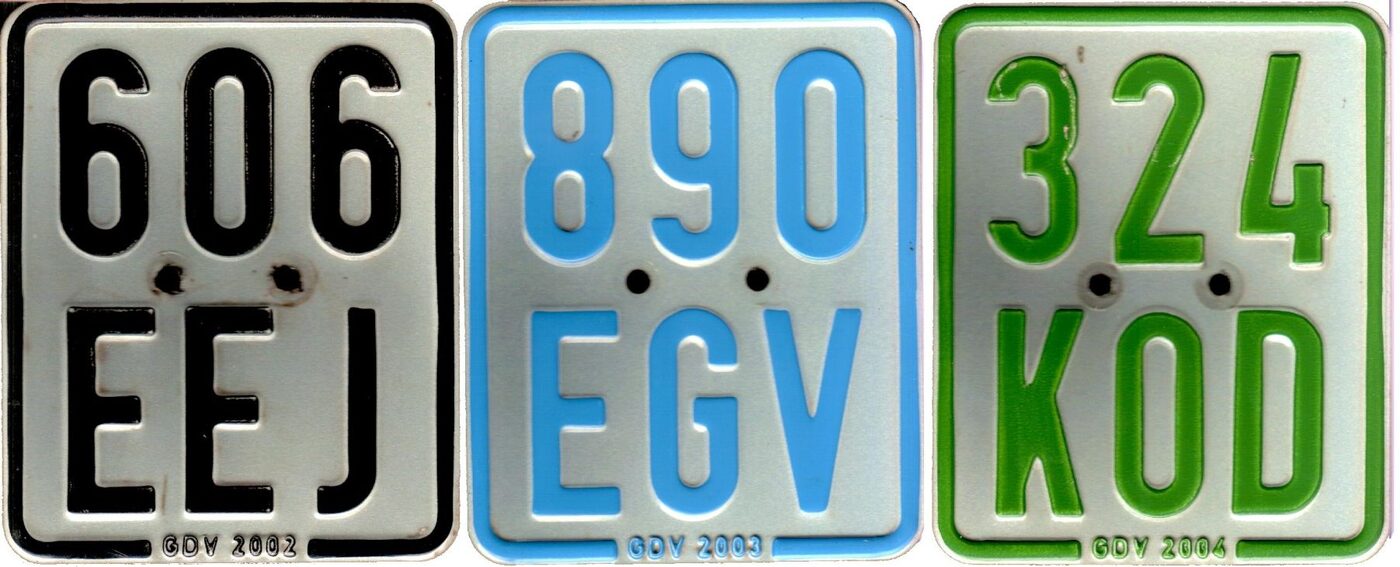

Two details give the system its character. First, the insurance year runs from 1 March to the end of February, so cover lapses on a fixed date without anyone having to cancel anything. Second, the script colour rotates annually on that date through black, blue and green, so that a police officer can tell at a glance whether a plate is current. Because the year is also printed on the plate, the three-year colour cycle cannot be gamed by keeping an old plate in a shed. Red plates with a leading Z exist for dealers, for test and delivery runs.
The whole arrangement is the reason the fifty was, for decades, the cheapest legal way to be motorised in Germany: no registration, no tax, no test lane, one plate a year, and a machine that could be bought second-hand for very little. It is also the reason that riding a tuned machine was so much more serious an offence than it looked. Raising a Mofa above its 25 km/h ceiling did not merely breach the operating permit; it moved the machine into a class the rider might not be licensed for and the plate did not cover, so a single modification could bundle riding without a licence together with riding without insurance.
Vespa, Lambretta and their German licensees
The scooter as the group understood it is an Italian post-war invention with a German second act. Piaggio's Vespa — the name was filed for protection on 23 April 1946 — was designed at the firm's Pontedera works near Pisa by Corradino d'Ascanio, an aeronautical engineer whose ambition had been helicopters and who had never designed a motorcycle. He began from a seated person and arranged the machinery around them: engine fully enclosed so that nothing could dirty the rider, a swing-arm carrying the whole drive unit so that no exposed chain was needed in a period when chain was scarce, and a wheel that could be changed as easily as a car's. The first model, the Vespa 98, had 98 cm³, 3.2 PS and a top speed of about 60 km/h. By 1965 more than three million had been sold worldwide.
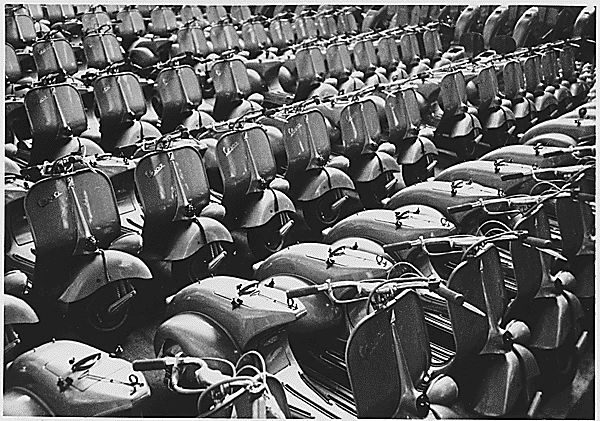

Innocenti of Milan followed in 1947 with the Lambretta, designed by Pierluigi Torre and named after the Lambro, the river running through the Lambrate district where the works stood. Italian production ran until 1972 and passed four million units at the parent plant alone; the Indian firm SIL then acquired the rights and built Lambrettas until 1997, which is why the marque has a longer life in Asia than in Europe.
Both makes reached Germany by licence rather than by import, and both licences ended badly. Jakob Oswald Hoffmann signed with Piaggio in 1949 and built Vespas at Lintorf in the Rhineland from the spring of 1950 — the HA model from 1950 to 1953 and the HB in 1953 alone. Facing the more powerful Lambrettas, Hoffmann developed the machine further, and its engine in particular, without Piaggio's permission, and launched the result as the Königin in 1954. Piaggio terminated the licence without notice. Hoffmann was simultaneously losing a patent action to BMW over a bubble car too close to the Isetta, and the works went bankrupt at the end of 1954; German Vespa production moved to the Messerschmitt plants at Augsburg and Regensburg.
NSU took the Lambretta licence and built it at Neckarsulm from 1950, having shown it at the Frankfurt spring fair that year. The contract forbade NSU to export, and by the time it ended in 1956 the works had built 117,043 machines. Its replacement, the NSU Prima, was initially so similar in look and layout that the succession is barely visible: the Prima D of 1956–1960 had a 146 cm³ two-stroke of 6.2 PS, a three-speed twistgrip change and shaft drive to the rear wheel, and the Prima V of 1957 moved to 175 cm³, 9.5 PS and four speeds. The Prima ran to 160,645 machines before NSU left the scooter business in 1964 and sold the tooling to a Yugoslav manufacturer near Sarajevo.
The German scooter industry and its short summer
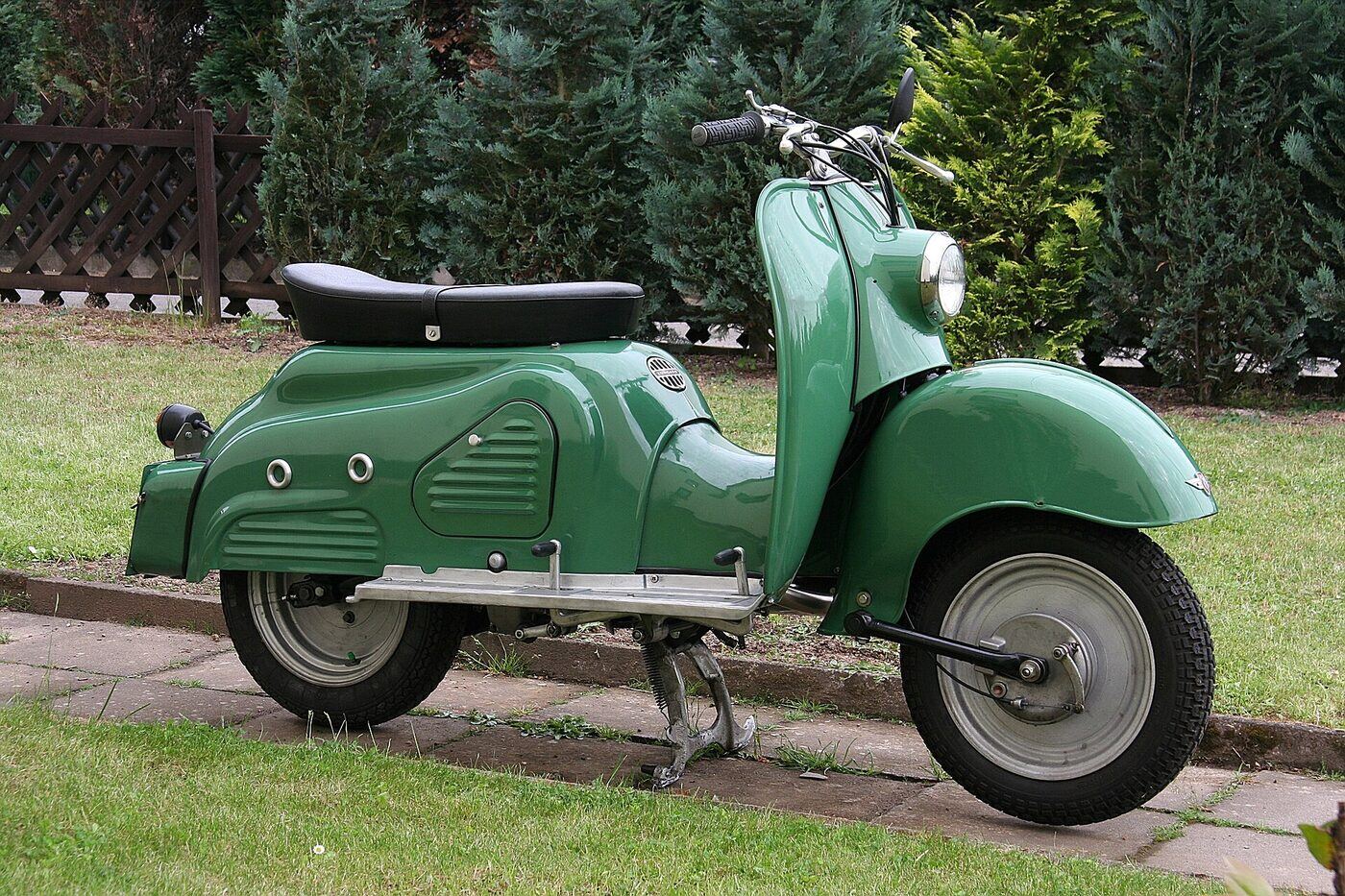
The German industry's own scooters were not copies of the Italians so much as an argument with them. Where the Vespa was minimal, the German machines were heavy, enclosed and touring-minded, and several of them were built by firms that had until recently been making aircraft.
- Maico presented the fully bodied Maicomobil at Reutlingen in June 1950, advertised as das Auto mit den zwei Rädern, the car with two wheels.
- Heinkel — Ernst Heinkel AG, the former aircraft manufacturer, rebuilding at Stuttgart — built the Tourist from 1953 to 1965, moving production to a new plant at Karlsruhe in 1954. It was a fan-cooled four-stroke single with overhead valves and a fully enclosed oil-bath chain case; an electric starter was optional from June 1954 and standard afterwards, and in its 174 cm³ form the machine made 9.2 to 9.5 PS and about 95 km/h. German accounts single it out for reliability and robustness rather than for performance.
- Zündapp built the Bella at Nuremberg and later Munich from 1953 to 1964, more than 130,000 of them, with a two-stroke single, 12-inch wheels and a four-speed gearbox taken from the firm's motorcycles of the same capacity and shifted by a rocker pedal on the right. The 198 cm³ R 200 was the commonest version of all; the last of the 200s, the R 204 of 1958, made 12 PS.
- Auto Union built the DKW Hobby from 1954 to 1957 — 45,303 units — with a continuously variable belt transmission to Edmond Uher's design, which made it the first German two-wheeler with a fully automatic gearbox, four decades before the belt automatic became the standard scooter drive.
_Seitenansicht_ret.jpg)
The summer was short. In 1961 there were 518,000 motor scooters registered in the Federal Republic. Their market share reached its absolute low in 1971, and by the early 1990s the figure was 72,000. The affordable small car had taken the market the scooter had been invented for, and the licence reform of 1980 finished the German fifty as a product: the open class died, insurance premiums for it became unpayable, and Kreidler of Kornwestheim closed after bankruptcy in 1982 and Zündapp in 1984. Hercules of Nuremberg survived into the Sachs group but had no answer to Japanese machines that needed only to reduce a 125 to 80 cm³ to fit the new Leichtkraftrad class. The 50 cm³ class of the motorcycle world championship, which had run since 1962, was abolished in 1983.
Suhl: Simson, the Schwalbe, and a rule that outlived its state
The other German scooter tradition ran on the far side of the inner-German border and never stopped being used. Simson of Suhl in Thuringia was founded in 1856 by the brothers Löb and Moses Simson out of an ironworks, and made its name in guns and later in bicycles; under the East German state it became, by volume, the largest manufacturer of powered two-wheelers Germany has ever had, with something close to six million Kleinkrafträder built.
Its scooter was the KR 51 Schwalbe — swallow — the first of the firm's bird-named series, built from 1964 to 1986 in 1,176,640 examples. The designation is prosaic: KR for Kleinroller, 5 for the 50 cm³ class, 1 to distinguish it from the KR 50 it replaced. Its specification was a fan-cooled 50 cm³ two-stroke single, three speeds and later four, fully enclosed chain drive, drum brakes and 60 km/h. The design brief of 1962 had actually asked for 68 km/h and an unlimited Kleinkraftrad competitive with Western machines; ministries cut the figure to 60 in 1963, and the third-gear ratio was changed to suit. One of its own designers later remarked that nobody with a feeling for aesthetics could call the Schwalbe beautiful, which has not affected its standing in the slightest. Mechanically it is less a scooter than a mokick in sheet metal.
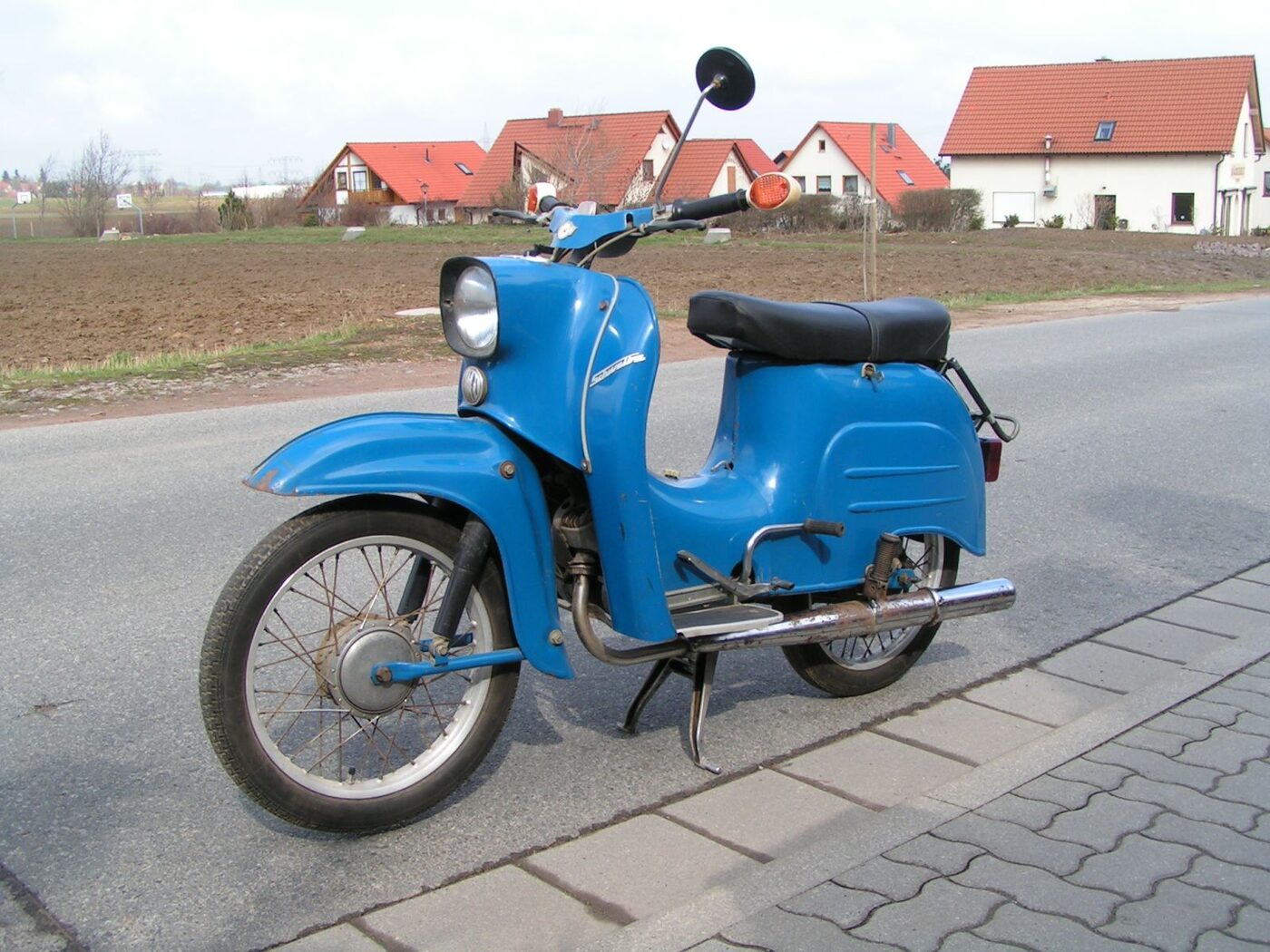

The conditions around it mattered as much as the machine. In the German Democratic Republic a Kleinkraftrad licence could be had at fifteen, and until 1981 by a simplified test without attending a driving school; there was no helmet requirement until the mid-1980s; machines were exempt from registration and from tax; third-party insurance cost 8.50 Mark a year; and from the middle of 1963 the permitted design speed was 60 km/h rather than the West German 40 or 50. With cars in short supply, the fifty was often used as a substitute for one. The most-built German Kleinkraftrad of all is the Simson S 50/S 51, over 1.6 million between 1975 and 1990. Rally culture had a state-organised form too: the Zentrale Mokick-Rallye der FDJ, run once a year from 1983 to 1987, combined road sections with traffic-law questions, first-aid tasks and skill tests, and was reported by the magazine Jugend + Technik.
Reunification then produced the legal curiosity that keeps these machines on the road. The Unification Treaty provides that Kleinkrafträder built to the previous East German rules, of not more than 50 cm³ and not more than 60 km/h, first placed in service by the end of February 1992, count as Kleinkrafträder under the federal regulation. The entitlement attaches to the machine, not to the person: a holder of today's class AM, or of the earlier classes rolled into it, may ride one at 60 km/h, on an insurance plate, with no registration and no roadworthiness test, at an age at which the EU category otherwise tops out at 45 km/h. A Schwalbe or an S 51 is thus faster, in law, than any fifty sold new since. That single paragraph is the reason a discontinued East German two-stroke still has a live parts market: since 2003 a successor firm has held the drawings and the rights and makes spares for very nearly every Simson model ever built, and since 2009 new 50 and 70 cm³ engines as well.
The works themselves did not survive the group's own era. Suhler Zweirad GmbH filed for insolvency in January 2000; production resumed that June under new owners as Simson Motorrad GmbH & Co KG; a second insolvency followed in June 2002; vehicle production ended for good on 30 September 2002, and the plant went to forced auction on 1 February 2003. Of everything sold under the name after 1992, some 95 per cent were versions of the East German S 53 and SR 50/1 designs — which is a verdict on the new models as much as on the old ones.
Two-stroke practice, the TÜV and the parts problem
Almost every machine discussed so far is a two-stroke, and the everyday texture of scooter ownership follows from that. A two-stroke completes its cycle in one crankshaft revolution, has no valve train, and in the classic small-engine form is lubricated by oil mixed into the petrol rather than by a separate circuit. It is light, cheap, mechanically simple and tolerant of neglect up to a point; past that point it is unforgiving, because a mixture error starves the bearings rather than merely running badly. From the late 1980s scooter manufacturers largely removed the arithmetic from the owner by fitting separate oil tanks with automatic metering pumps. The older machines the group's readers might have been restoring did not have them.
The legal frame for any modification is short and strict. A German road vehicle runs on a Betriebserlaubnis, an operating permit derived from the type approval issued by the Kraftfahrt-Bundesamt, which has held that responsibility since its establishment on 4 August 1951. Under § 19(2) of the Straßenverkehrs-Zulassungs-Ordnung that permit lapses if a modification changes the approved vehicle type, if a hazard to other road users is to be expected, or if the exhaust or noise behaviour is made worse; § 19(3) adds the cases where a part required an inspection on fitting and did not get one. Riding a machine whose operating permit has lapsed is a regulatory offence. Since an unsilenced expansion chamber or a big-bore cylinder engages at least two of those three limbs at once, the boundary between restoration and an unroadworthy machine is legally sharper in Germany than workshop practice suggests.
The Hauptuntersuchung — universally called the TÜV after the inspection bodies that carry it out, though DEKRA and others do it too — does not touch the fifty at all: vehicles on an insurance plate are outside it. It applies at 24-month intervals to motorcycles and Leichtkrafträder, which is to say to the 125 cm³ scooter and the large-capacity Großroller, and it is what an owner of those has to satisfy with a machine whose brakes, lighting, frame and emissions were engineered decades ago. For older machines generally, German law has since defined the collector's category precisely: under the vehicle registration regulation an Oldtimer is a vehicle first placed in service at least thirty years ago, largely in original condition, well preserved, and serving the maintenance of motoring heritage — and since March 2007 that status requires an expert report.
Behind all of it sits the parts problem, which is structural rather than anecdotal. The German makes whose machines were being restored in the 1990s had been dead for a decade or more: Kreidler since 1982, Zündapp since 1984, Heinkel's Tourist and Zündapp's Bella since the mid-1960s, NSU's scooters since 1964. Nobody was producing consumables for them, so supply came from remaining old stock, from breaking donor machines, from small remanufacturers and from the swap meets. The Italian marques are the opposite case: Vespa and Lambretta stayed in production somewhere in the world for decades after Europe lost interest, which is why a Vespa restoration and a Zündapp restoration are different hobbies with different economics. Simson is the third case again, kept supplied by a legal privilege rather than by a manufacturer.
The revival of the 1990s and the end of the two-stroke
The market the group was created into was not a nostalgia market. It was a boom. From the early 1990s cheap, modern-looking fifty-cc scooters, largely from Korean and Taiwanese makers alongside the established Italian and Japanese ones, displaced the mokick as the machine a German sixteen-year-old actually bought; insurance premiums had fallen sharply, purchase prices were low, and the trade discovered that the scooter could be sold as a sporting object rather than as transport for the practical. Aprilia's SR 50 is the usual marker — a sports fifty with a front disc brake, dated by its own model history to 1992 and by the general scooter literature to 1994 — and it went on to a succession of firsts through the decade: liquid cooling in 1994, discs at both ends in 1997, and electronic fuel injection in 1999, the first in the class. Larger machines followed the same logic upward: the Honda CN 250 Helix reached Germany in 1992, the Yamaha Majesty in 1996, the Suzuki Burgman in 1998, and BMW's roofed C1 in 2000.
What ended the two-stroke was European emissions law, applied to two- and three-wheelers a decade after it reached cars, and applied to mopeds on a schedule of its own. For mopeds, Euro 1 applied to new type approvals from 17 June 1999 and Euro 2 from 17 June 2002, both measured on the ECE R47 cycle. There was no Euro 3 for mopeds at all: the step was skipped, and the class went straight to Euro 4, which applied to new type approvals from 1 January 2017 and to newly registered vehicles from 1 January 2018, and then to Euro 5 from 1 January 2020 and 1 January 2021. Motorcycles ran a different ladder over the same period, with Euro 2 in 2003–04, Euro 3 in 2006–07 and Euro 4 in 2016–17.
The engineering consequences arrived in stages, and the group's era caught the first of them. Euro 1 brought unregulated oxidation catalysts to two-stroke scooters from 1999 — a converter in the exhaust, and with it a machine that ran hotter, was less tolerant of a rich mixture and could no longer be re-piped casually. Two-stroke scooters above 50 cm³ disappeared from the new-vehicle market after 2003. The fifty held on longer, on catalysts and eventually injection, but Euro 4 effectively closed it: the fifty-cc two-stroke was replaced in the showroom by a four-stroke of the same capacity, quieter, cleaner, less powerful for its size and considerably less interesting to modify. The environmental case against the old engines is not marginal. A study published in Nature Communications in 2014 measured two-stroke scooters emitting 124 times the unburnt and part-burnt hydrocarbons and up to 771 times the organic aerosol of other road vehicles, and found that in extreme cases they accounted for up to 96 per cent of the organic exhaust emissions in a street.
For a newsgroup, the shift changed the subject matter twice over. In the 1990s the discussion was about a living product line; by the middle of the 2000s the same machines were becoming a preservation subject, and the manufacturers whose scooters were being preserved were mostly gone.
What is known about the group, and how it ended
The group's end is documented as precisely as its beginning, and the two events are the same event. Message identifiers in the record date a first Request for Discussion for de.rec.motorroller to 4 July 1997, a second to 10 July, a first Call for Votes to 18 July, a second to 6 August and the result to 15 September. On 20 September 1997 the hierarchy's moderation created de.rec.motorroller by a PGP-signed control message, crossposted — pointedly — to de.alt.motorroller. Nine days later, on 29 September 1997, the same moderation address sent the removal message for the alt group; unusually, the body of that removal is not a removal notice but the published result of the rec group's ballot. A booster removal followed on 7 November 1997 as part of a general tidy-up of the branch. The alt room was closed because the rec room had opened, and the two charters are almost the same text: ausdruecklich becomes explizit, Ersatz fuer Autos becomes Auto-Ersatz, and otherwise the wording is carried straight across.
That should have been the end of the name in the control record, and it was not. On 31 October and 1 November 2001 de.alt.motorroller reappears as the target of removal messages from two entirely unrelated quarters. One was posted to de.config, de.control and news.groups by an administrator who called the group bogus and told anyone whose server had been broken enough to create it that it should now be deleted. The other came from the administrator of the biz.* hierarchy, was addressed to biz.config and biz.control, and explained that it was countering forged newgroup commands and that the forger had sent over a hundred of them already. The same two sweeps also swept up de.alt.augenoptik and de.rec.motorroller on the same two days. A dead German scooter group had been picked up by a control-message forger and scattered across hierarchies it had never belonged to. It is a small, precise illustration of the point the hierarchy's own rules make: a control message is a request, servers differ in what they honour, and a name once created can outlive every decision made about it.
That is also the most plausible reading of how the group reached this directory. news2mail carried Usenet to e-mail between 2000 and 2004, and its catalogue lists de.alt.motorroller — a group the hierarchy had formally removed three years before the gateway opened. Servers that had honoured the 1996 creation and missed or ignored the 1997 removal would have carried the name for years afterwards, and a gateway building its list from a server's active file would have picked it up as an ordinary group.
Set against that, the list of things not known is long. There is no record here of how many people read the group, how much traffic it carried, when its last article was posted, or whether it was ever much used at all in the fourteen months between the first newgroup of July 1996 and the removal of September 1997. No archive of its articles has been located for this page. Nothing is known about its readership beyond what the charter says it hoped for. The hierarchy's current group list, fetched in August 2026, contains de.alt.augenoptik and de.rec.motorroller but not de.alt.motorroller, which is exactly what the 1997 removal would predict.
One structural point about the language is worth stating plainly, because it is easy to misread the presence of a German group in an English-language directory. The group was conducted in German; the hierarchy's rules, charters and administrative texts are German; the descriptions on this site are in English because English is this site's language, not because anything about the group was. A mail-to-news gateway is indifferent to the language of what it forwards, and a subscriber roster records what somebody asked for rather than what somebody could read.
Scope and limits
This article is assembled from documents rather than from recollection. The group's creation and removal, its charter text, its short description and the dates and senders of every control message concerning it come from the Usenet control-message archive mirrored by the Internet Systems Consortium, which is the primary record for such things and quotes itself exactly. The rules for the branch come from the hierarchy's own weekly-posted rulebook and its Appendix A; the server-side treatment of de.alt.* comes from the control.ctl file as currently distributed; the current group list comes from the hierarchy's own maintained file. The vehicle law, licence classes, insurance-plate system, emission standards and manufacturer histories come from German-language reference works, checked item by item; where an ordinance is issued on one date and takes effect on another — as with the Mofa class in 1965 — both dates are given above rather than one standing in for the other.
What no source consulted here supplies is the group's interior: no article, no participant, no volume figure, no account of what was actually argued. Readers who expect a newsgroup page to reconstruct conversations will find that this one does not, and the omission is deliberate. The wider context above is offered because the group's charter is unusually explicit about what it wanted to cover — technical questions, racing, everyday use as a car substitute, safety — and because the German legal and industrial background to those four subjects is genuinely documented, unlike the group's own traffic. Corrections from anyone who read the group are welcome; the full picture of the de.* procedure the branch was exempted from is on the hierarchy page, and the successor group has its own page here.
Further reference on the subjects above: Vespa and Lambretta for the two Italian marques; Kleinkraftrad for the German vehicle class and its legal history; Kfz-Kennzeichen (Deutschland) for the insurance plate; Simson Schwalbe for the Suhl scooter; and European emission standards for the emissions ladder.
Reading de.alt.motorroller today
- Historical archive: Google Groups — de.alt.motorroller (coverage varies by group and era).
- Open in a newsreader:
news:de.alt.motorroller— the original site offered exactly this link, and it still works if your system has a newsreader registered for thenews:scheme. - Live access: point an NNTP newsreader at a modern server — see accessing Usenet today.
- The original news2mail e-mail subscription service ended in the mid-2000s and no longer operates.