de.alt.augenoptik
German-language group on optics and eyewear (de.alt hierarchy).
Part of the informal de.alt.* branch: spectacles, contact lenses and optician trade talk in German.
Kept as a directory entry for the de.* slice of the gateway’s catalogue; the group was small and its surviving record is thin.
On this page
- A newgroup message from Berlin, August 1997
- Removed in 2001, and still on the list a quarter of a century later
- What the charter asked for
- Augenoptiker: a trade with a statute
- Three years, two examinations, and a Meisterbrief
- Why the English word optician misleads
- Refraction: how the number gets found
- Jena: Zeiss, Abbe, Schott and the theory of the lens
- Von Rohr, the Punktal, and the coated lens
- Rathenow, the town of optics
- Rodenstock and the shape of the German lens industry
- Spectacles before the trade: 1290 to 1752
- Contact lenses: Zürich, Mönchengladbach, Kiel
- Materials, indices and coatings
- Progressive lenses and the arithmetic of getting older
- What the trade argued about in the group's years
- The economics behind the counter
- What the record does not show
- Scope and limits
A newgroup message from Berlin, August 1997
Most groups in the informal German branch left no paperwork at all. This one left exactly one page of it, and the page is worth reading in full, because it is very nearly everything that is known about the group from the inside. The Internet Systems Consortium mirrors the Usenet control-message archive, and the file for de.alt.augenoptik opens at 21:36:51 GMT on 17 August 1997 with a newgroup control message from Bettina Fink, sent from a private machine called krell.snafu.de whose path line shows the article entering the wider network through the Free University of Berlin. It was crossposted to de.alt.admin and to the group it was creating, and its body ran to fourteen lines.
The first of those lines is the whole of the group's constitutional history: Die unmoderierte Gruppe de.alt.augenoptik wird nach Diskussion in de.alt.admin eingerichtet — the unmoderated group de.alt.augenoptik is being set up following discussion in de.alt.admin. That is the entire procedure in this branch of the German hierarchy: ask, wait, and if nobody objects loudly enough, send the message yourself. How that arrangement came to exist, and why it sits so oddly beside the elaborate balloting used everywhere else in de.*, belongs to the de.alt.motorroller page and to the hierarchy page, and is not retold here.
Next came the line a news administrator would paste into the server's newsgroups file: the group name, a tab, and a short description of three words and two hyphens — Auge - Brille - Kontaktlinse. Eye, spectacles, contact lens, with a full stop. Name, tabulator and description together take up barely half of an eighty-column terminal line, which is the practical constraint such a line is written against, and the description has never been altered since. Then came the charter, three sentences long:
Die Gruppe dient der Diskussion rund um Fehlsichtigkeiten des menschlichen Auges und deren Korrektur. Ein zentrales Thema ist die Tätigkeit des Augenoptikers/Augenarztes. Weiterhin erwünscht sind Diskussionen über Mode-Themen, z.B. Sonnenbrillen, Farb-Kontaktlinsen etc.
In translation: the group is for discussion of defects of vision of the human eye and their correction; a central subject is the work of the optician and the eye doctor; discussion of matters of fashion — sunglasses, coloured contact lenses and the like — is also welcome. Three sentences of subject matter, written in the ASCII-with-umlauts style the hierarchy used, and a proposal that turns out to describe a genuinely large field. Everything below is an attempt to say what that field contained in the years the group existed, using documents rather than recollection, because no recollection has survived.
Removed in 2001, and still on the list a quarter of a century later
The second thing in the control archive is a removal, and it arrives a little over four years later. On 31 October 2001 the file records four rmgroup messages for de.alt.augenoptik, all bearing the address of Jonas Luster, all crossposted to de.config, de.control and news.groups, and all carrying the same eleven-line body. Three of the four Date headers name the wrong day of the week — Thursday for a Wednesday — and each message carries a different randomised message identifier, which is the signature of something generated in bulk rather than typed.
The text is worth quoting because it is the only surviving opinion anybody ever expressed about this group: If your newsserver was broken enough to add de.alt.augenoptik, I trust it's broken enough to remove it now without looking for a PGP sig, and then de.alt.augenoptik is a bogus newsgroup (heh, the name kinda implies that already) and should be deleted. The joke is at the expense of the compound word. It is a fair joke to make in English and, as it happens, not an original one in German either: the humorist Hans Reimann objected in 1931 that Augenoptiker was a pleonasm, on the ground that one sees with nothing but the eyes — an objection the language ignored, since Optiker also covers the physicist, the instrument maker and the precision-optics grinder, and the trade needed a word of its own.
On 1 November a fifth removal arrived from an entirely different quarter: the administration of the biz.* hierarchy, crossposted to biz.config, biz.control and news.groups, explaining that it was a control cmsg to counter numerous forged newgroup commands and that the forger had sent over a hundred so far. A small German group about spectacles had been scattered into a hierarchy for business announcements it had never had anything to do with.
The same day the hierarchy pushed back. A booster newgroup went out from [email protected], describing itself as a message sent following the recent hipcrime rmgroup attacks which removed parts of de.alt.* on some servers, printing the two control.ctl lines that tell an INN server to honour de.alt.* creations and merely mail de.alt.* removals to the local administrator, and re-printing the newsgroups-file line unchanged. Then, on 2 November, three further booster newgroups arrived from the very address the removals had claimed to come from, saying that someone rmgrouped de.alt.ALL impersonating us and asking administrators to restore the wrongly removed groups. The record therefore contains, within four days, removals in two names and messages in the same two names disowning them. The wider sweep of forgeries that autumn is not this group's story and is not retold here.
What matters here is the arithmetic of the aftermath, because it is unusually clean. A control message is a request, not an instruction: every news server decides for itself, by configuration, which senders it will believe, and a server that honoured the 1997 creation and ignored or never saw the 2001 removals simply carried on carrying the group. The master lists agree with the servers. The newsgroups file published by the Internet Systems Consortium, fetched for this page on 25 August 2026 and last modified at eleven o'clock GMT that morning, contains the line de.alt.augenoptik Auge - Brille - Kontaktlinse. — one of 233 de.* entries, 38 of them under de.alt. The list maintained by the hierarchy's own moderation says the same thing, with the same description, to the character.
So the group was opened by one person after a discussion in an administrative group of which nothing survives, declared bogus and deleted in 2001 by messages whose apparent senders publicly disclaimed them two days later, and is still, in 2026, a valid entry in the master list of the world's newsgroups. That is not an anomaly in the record; it is what the record is. Nothing in Usenet's design ever produced a single authoritative answer to the question of whether a group exists, and de.alt.augenoptik is a tidy demonstration of the fact: a creation and a removal can coexist in the same archive for twenty-five years, and the list can side with the creation.
What the charter asked for
Charters in de.alt.* are usually a sentence. This one names four distinct subjects, and each is a real field with a documented history. Taken in order, the charter asks for: defects of vision and their correction; the work of the Augenoptiker and the Augenarzt; matters of fashion; and, named explicitly, sunglasses and coloured contact lenses.
The second of those is the interesting one. Die Tätigkeit des Augenoptikers/Augenarztes puts two occupations on either side of a solidus, and in Germany that solidus marks a real and long-argued boundary: on one side a skilled trade regulated by the crafts code, on the other a medical specialty. A group that names both in its founding sentence has, whether or not its author intended it, written the trade's central professional question into its charter. The sections that follow set out what each side of that line actually is, because it is the part of this subject an English-speaking reader following an old German link is most likely to get wrong.
The fourth subject dates the charter neatly. Coloured contact lenses without corrective power were, in 1997, an unregulated novelty sold in Germany much like sunglasses. They are not that now: Regulation (EU) 2017/745 on medical devices, dated 5 April 2017, in force from 25 May 2017 and applicable from 26 May 2021, extended the medical-device regime to a list of products with no intended medical purpose, and Annex XVI of that regulation lists cosmetic contact lenses among them. A charter written in one summer can turn into a period document simply by standing still.
Augenoptiker: a trade with a statute
The German optician is not a shop assistant who has taken a course. The occupation is a Handwerk — a skilled trade — and it sits inside a statutory system that has no close equivalent in English-speaking countries. The governing law is the Gesetz zur Ordnung des Handwerks, universally called the Handwerksordnung and abbreviated HwO, enacted on 17 September 1953 and in force from 24 September 1953, re-promulgated in its consolidated form on 24 September 1998 and amended many times since. It regulates the practice of the trades, vocational training and further training within them, and the self-administration of the whole sector.
The code divides trades into three classes. Those requiring a licence are listed in Anlage A; those that do not are in Anlage B. The training ordinance for opticians states the position without ambiguity: the occupation is recognised under paragraph 25 of the Handwerksordnung as training for Gewerbe Nummer 33 der Anlage A — trade number 33 on the licensed list. Running such a business independently requires entry in the Handwerksrolle, the register kept by the regional Handwerkskammer, and entry in the register requires proof of qualification, for which the standard evidence is the Meisterbrief, the master craftsman's certificate.
How exclusive that list is became a live political question in the middle of the group's life. The 2004 reform of the crafts code, part of the Agenda 2010 package and in force from 1 January 2004, cut the number of licensed trades from ninety-four to forty-one. The government's stated criterion was danger: Anlage A was to be confined to trades whose practice can create hazards to the health or life of third parties, in order to put the qualification requirement on firmer constitutional ground. Opticians stayed. More than that, the same reform created a new route into the register for experienced journeymen — six years in the trade, four of them in a leading position — and then expressly withheld it from six occupations: chimney sweeps, opticians, hearing-aid acousticians, orthopaedic technicians, orthopaedic shoemakers and dental technicians. Five of those six are the Gesundheitshandwerke, the health trades. In the German scheme, spectacle-making is filed with the making of prostheses and dentures, not with retail.
That is the frame within which every shop the group's readers might have worked in or walked into operated: a licensed trade, a register, a chamber, a guild structure, and a national association — the Zentralverband der Augenoptiker, legal successor to a Centralverband formed in Dresden in 1905, re-founded in 1951 with its seat in Düsseldorf, and renamed the Zentralverband der Augenoptiker und Optometristen in 2015.
Three years, two examinations, and a Meisterbrief
The training is a duale Ausbildung: an apprenticeship contract with a firm, plus attendance at a vocational school, governed by a federal ordinance issued under the crafts code. The ordinance in force when the group was created had been issued on 4 March 1997, a few months before the newgroup message went out; it was replaced by the current one on 1 August 2011. Both set the length of training at three years.
The current ordinance is a good short description of what the trade thinks the job is, because it lists the content. The occupational profile has nine core areas: working and glazing spectacle lenses; maintaining tools and machines; modifying and repairing spectacles; judging lenses, contact lenses and magnifying aids by their optical properties; establishing the customer's visual requirements and advising them, which is subdivided into determining the correction needed and advising on services; fitting spectacles optically and anatomically; handing the finished aid over; selling goods; and keeping accounts and doing the costing. Beside those sit the integrative subjects every German apprenticeship carries — employment and collective-bargaining law, the structure of the training firm, health and safety, environmental protection, planning of work and technical communication, and the application of the trade's own standards.
The final examination is unusual enough to be worth setting out, because it shows what the qualification actually tests. It is a gestreckte Gesellenprüfung, a journeyman's examination stretched across two sittings that count towards one result: part one, taken before the end of the second year, weighs thirty per cent; part two weighs seventy. Part one is a single examination area called Instandsetzung von Sehhilfen, the repair of visual aids, and its two set tasks are the repair of a spectacle frame and the reworking of a pair of lenses by hand into a metal full-rim frame, with 330 minutes allowed, ninety of them for written work. Part two has four areas: making a rimless pair of correction spectacles from multifocal lenses on an automatic edger, in 150 minutes; optical dispensing as a practical exercise, in 120 minutes; a written paper called Auge und Sehhilfe, the eye and the visual aid, in 180 minutes; and economics and social studies in sixty.
The written paper is where the trade draws its own line. It requires the candidate to describe the effects of conditions and diseases that reduce visual performance when selecting visual aids, to explain the effects of corrective devices on anatomical, physiological and optical circumstances, to distinguish the properties of materials for contact lenses, lenses and frames, to distinguish the modes of action of contact-lens care products, and to carry out optical calculations. The ordinance also makes that paper effectively compulsory to pass: the examination is failed unless Auge und Sehhilfe is graded at least sufficient, whatever the average.
Above the journeyman stands the master. The master's examination in German trades has four parts — a practical trade examination, a theoretical trade examination, an economic and legal examination, and a vocational-pedagogy examination under the trainers' aptitude ordinance — of which the last two are identical across all trades and the first two are set by a trade-specific ordinance, in this case the ordinance on parts I and II of the master examination in the optician's trade. Passing it produces the Meisterbrief, which is what admits the holder to the Handwerksrolle and permits them to take on apprentices. Admission to the master's examination requires a passed journeyman's examination; the three years of practice formerly demanded were dropped in the 2004 reform.
Why the English word optician misleads
An English-speaking reader arriving at a German group about Augenoptik will import a three-way division that does not map. In the United Kingdom the professions are regulated as health professions: the General Optical Council keeps the registers under the Opticians Act 1989, which received royal assent on 16 November 1989 and commenced on 16 February 1990, and it registers optometrists and dispensing opticians separately, with the sight test itself a restricted act. In the United States and Canada an optometrist holds a four-year post-baccalaureate Doctor of Optometry degree and is licensed by a state or provincial board; the dispensing optician, where licensed at all, is licensed separately and by a different body.
Germany arrived at the same practical result by a completely different legal road. There is no register of optometrists corresponding to the British one and no doctoral licensing board corresponding to the American one; there is a crafts code, a chamber, a register of businesses and a master's certificate. The consequence that surprises visitors is at the counter: determining the correction is part of the trade, taught inside the apprenticeship and examined in it — the training ordinance lists Korrektionsbedarf ermitteln, establishing the correction required, and requires the apprentice to analyse it with reference to myopia, hyperopia, astigmatism and presbyopia — and a customer may walk into a shop, have the measurement done and walk out with spectacles without a doctor being involved at any point. A prescription written by an ophthalmologist exists and is common, especially for children and for anything unusual, but it is not the gate.
The gate is somewhere else. German law reserves the practice of healing to physicians and to licensed non-medical practitioners, and the outer edge of the optician's field is defined by that reservation rather than by a professional register. This is precisely the ground on which the trade's own longest-running argument is fought: how far an optician or optometrist may go into screening, into binocular and prismatic work that overlaps the ophthalmological specialty of strabismus, and into anything that could be characterised as diagnosis. The German reference literature records the question as argued, unresolved, between eye doctors, optometrists, orthoptists and opticians — specifically over how far prismatic and binocular work strays across the line into diagnosis and treatment reserved by the law on non-medical practitioners — and the trade association lists the Refraktionsrecht, the right to refract, among the standing questions of professional politics it exists to handle. It was a live question in 1997 and it is a live question now.
One further asymmetry deserves a note, since it explains a good deal about how German optician's shops look. Because the trade is a trade, the shop is a workshop: the apprenticeship teaches grooving, drilling, filing, milling and polishing lenses and mounting them in rimless spectacles, and the master examination has a practical component. Industrial pre-manufacture has reduced how much of that is done on the premises, and the German reference literature says so plainly, but the qualification still assumes a bench at the back.
Refraction: how the number gets found
Everything the trade sells depends on a measurement, and the measurement has two halves. Objective refraction is measured with instruments and describes the refractive state of the eyeball itself; subjective refraction requires the person being examined to say which of two lenses looks sharper, and takes into account everything the instruments cannot see. German usage is careful to distinguish both from a mere Sehtest, a sight test: determining refraction is a measurement of refractive power, not a reading of letters.
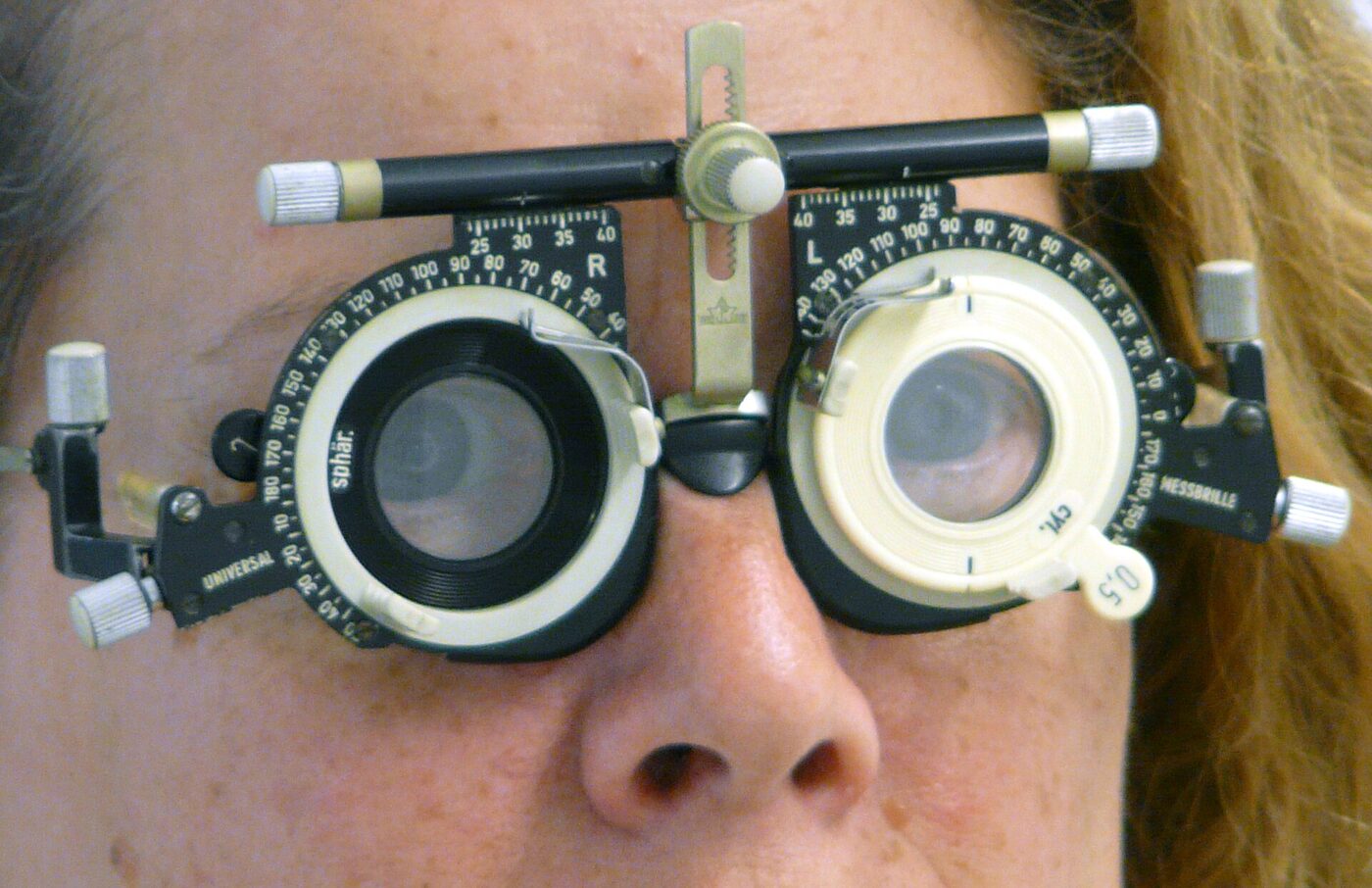
The classical objective method is retinoscopy — Skiaskopie in German, from the Greek for shadow — in which the examiner watches the movement of a reflex across the pupil while neutralising it with trial lenses. It needs only a retinoscope and a set of lenses, it is cheap, and the reference literature is blunt that it demands considerable experience and time; it remains the method of choice where the subject cannot cooperate, which in practice means small children. Automatic refractometers, which project a target and find focus with photosensors, are quick and need little skill to operate, and are described in the same literature as more expensive and less precise than a well-done retinoscopy. The subjective half is done with a phoropter, or with the older trial frame and lens case, which many practitioners never abandoned.
.jpg)
Two German conventions are worth knowing because they turn up in any German discussion of a prescription. Cylinder axes are recorded on the TABO scheme, a semicircular scale running anticlockwise from zero to 180 degrees, named after the Technischer Ausschuss für Brillenoptik that proposed it in 1928; it beat an international system that used opposite directions for the two eyes, and it is the German industry standard to this day. And the prescription form itself, the Sehhilfenverordnung, carries fields not only for sphere, cylinder and axis but for prism strength and base direction, for the back vertex distance and for the interpupillary distance — the two millimetre measurements that decide whether a strong correction sits where it was calculated to sit.
Jena: Zeiss, Abbe, Schott and the theory of the lens
The reason Germany has a serious optical industry at all is a nineteenth-century decision to stop grinding lenses by trial and error. Carl Zeiss, born in Weimar on 11 September 1816 and dead in Jena on 3 December 1888, opened a workshop in Jena in 1846 with a hundred thalers borrowed from his brother. He was a good instrument maker who had reached the limit of what good instrument making could do, and in July 1866 he began a collaboration with a 26-year-old private lecturer at the university, Ernst Abbe (23 January 1840 – 14 January 1905), with the stated goal of building an objective by calculation rather than by successive approximation.
It took six years. By 1872 Abbe had recomputed the whole existing range of microscope objectives for systematic production and added new ones, and the catalogue could announce that the systems were built on the basis of Professor Abbe's theoretical calculations. Along the way he defined numerical aperture, formulated the sine condition that bears his name, and produced the dispersion measure still universally called the Abbe number — a figure that will reappear below, because it is the number a modern optician uses when explaining why the thinnest lens is not automatically the best one. Zeiss took him into the firm as a partner: the agreement was concluded in July 1876 and backdated to May 1875, which is why the sources give both years.
The next bottleneck was the glass itself: the corrections Abbe could calculate required optical glasses that did not exist. The chemist Otto Schott (17 December 1851 – 27 August 1935) had been writing to Abbe about characterising experimental melts; he was persuaded to move to Jena, and in 1884 Abbe, Zeiss, Zeiss's son Roderich and Schott founded the glass-technical laboratory Schott & Genossen, the later Jena glassworks, which within a few years could supply dozens of well-characterised optical glasses of repeatable composition. The apochromatic objectives that the whole exercise had been aimed at reached the market in 1886. In 1889 Abbe established and endowed the Carl Zeiss Foundation, transferring ownership of the firm to it; in 1900 he introduced the eight-hour working day, in memory, he said, of his own father's fourteen-hour one.
None of this was about spectacles. It is nevertheless the precondition for everything the German spectacle industry did afterwards, because it established in one town the three things ophthalmic optics needs: a theory of image formation good enough to compute with, a glassworks that could make a specified glass to order, and a firm organised to pay for long research.
Von Rohr, the Punktal, and the coated lens
Spectacle lenses got their theory from a man who joined Zeiss to work on camera lenses. Moritz von Rohr (4 April 1868 – 20 June 1940) took a doctorate in 1892, came to Jena in 1895, spent four years in the photographic department and then several more computing microscope objectives as Abbe's personal assistant. In 1908 he became scientific head of the firm's newly created spectacle department. That department is the origin of the modern spectacle lens.
Working in close contact with the Swedish ophthalmologist Allvar Gullstrand, von Rohr first produced the Katral lenses of 1912, aspheric designs for the eye left without a lens after a cataract operation, at powers far beyond anything a conventional lens could handle. The calculations behind them yielded, in the same year, the Punktal range: meniscus lenses computed so that the image stays sharp whichever way the eye turns behind them, rather than only on the optical axis. The trade adopted them fast. The old biconvex and biconcave forms disappeared from the German market between 1913 and 1915 and were replaced by meniscus designs at the other established makers as well. Von Rohr founded the Zeitschrift für ophthalmologische Optik in 1913, the same year the University of Jena appointed him extraordinary professor of optics in medicine, and he retired in 1935 having published something in the region of 570 papers and books.
The other Zeiss contribution the wearer notices every day arrived at the very end of that period. In 1935 Olexander Smakula, working for the firm, invented the interference-based anti-reflection coating and it was patented in Germany that November. The technique was treated as a German military secret for several years, until the Allies discovered it during the Second World War. Every reference to Entspiegelung in a German optician's price list descends from that patent.
Rathenow, the town of optics
The other pole of the German trade is a small town in Brandenburg, and its story begins earlier than Jena's. Johann Heinrich August Duncker (14 January 1767 – 14 June 1843) was a clergyman's son who studied theology at Halle, returned to Rathenow in 1789, and began making and selling microscopes and spectacles from the parsonage at around 1790. On 10 March 1801, together with Samuel Christoph Wagener, who ran the garrison's industrial school, he opened the Königlich privilegierte optische Industrie-Anstalt. In the same year he patented a multi-spindle grinding machine of his own design that could grind and then polish eleven lenses at once, which is what turned lens-making from a craft into a manufacture: the first workers taken on were disabled soldiers and orphans. Rathenow has called itself the town of optics ever since.
The business passed to Duncker's son Eduard in 1824 and in 1845 to his nephew Emil Busch, under whom the workforce reached 130 by 1851 and the product range extended to cameras and photographic objectives; in 1872 it became the Emil Busch Aktiengesellschaft. Other optical firms grew up around it from 1850 onwards, so that the town supported an entire industry rather than a single works.
After 1945 the Rathenow firms were expropriated and consolidated, eventually into the VEB Rathenower Optische Werke, from 1980 carrying the additional name Hermann Duncker, and for the last years of the German Democratic Republic that single enterprise was the sole manufacturer of spectacles in the country. At the end of 1989 it employed some 4,420 people. It was detached from the Carl Zeiss combine at the end of that year, converted into a limited company in July 1990, stripped of its microscope division by the privatisation agency in 1991, and largely dismantled: the workforce was mostly dismissed, the old production halls demolished and the remaining businesses sold off in 1992. One part passed to Essilor and was closed in 2013. Fielmann bought the former administrative building in 1996 and had it restored; the town administration has rented it since February 1997.
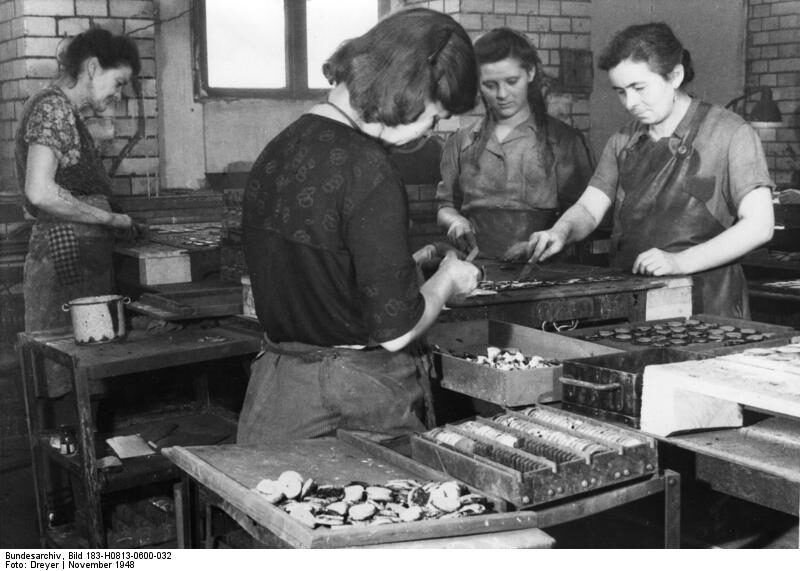

That last paragraph is not incidental background. It describes the state of the German spectacle industry in exactly the months the newsgroup was created — a two-hundred-year-old manufacturing town in the middle of being taken apart and partly bought up by the retail chain that had rewritten the economics of the trade.
Rodenstock and the shape of the German lens industry
The other great German name is Munich's. Josef Rodenstock founded a precision-mechanical workshop in Würzburg in 1877, making barometers, scales, measuring instruments, spectacle lenses and frames; the firm patented its first product, the diaphragm spectacle lens, in 1880, moved its headquarters to Munich in 1883, and built a grinding works at Regen in the Bavarian Forest in 1898. It became a very large concern in the postwar decades under Rolf Rodenstock, who took over in 1953, and it kept a second life in photographic and projection optics alongside the ophthalmic business. From 1989 much of the Munich production moved to new plants abroad.
By the group's own years the German lens market had settled into a small number of firms, and there is an unusually precise public record of who they were, because in June 2010 the Federal Cartel Office fined the five leading spectacle-lens manufacturers in Germany, seven responsible employees and the trade association a total of 115 million euros for price-fixing. The five were named as Rodenstock of Munich, Carl Zeiss Vision of Aalen, Essilor of Freiburg, Rupp + Hubrach of Bamberg and Hoya Lens Deutschland of Müllheim. That is the industry the group's readers were buying from.
Contact lenses had a separate German lineage, and it ran through Kiel; it is told two sections below, because it belongs with the history of the object rather than with the history of the firms.
Spectacles before the trade: 1290 to 1752
The object is older than any of this by five centuries, and its history is well enough documented to be given precisely rather than vaguely. Spectacles were first made in central Italy, most probably in Pisa or Florence, by about 1290. The best single piece of evidence is a sermon preached on 23 February 1306 by the Dominican friar Giordano da Pisa, who said that it was not yet twenty years since the art of making spectacles had been found, and added that he had seen and spoken with the man who first discovered and practised it. His colleague Alessandro della Spina of Pisa, who died in 1313, was soon making them and, according to the chronicle of his monastery, sharing the method freely with everyone. Venice became a centre of manufacture almost immediately: guild regulations governing the sale of spectacles date from 1301, and a separate guild of Venetian spectacle makers was formed in 1320.
German-speaking Europe enters the picture early and materially. The oldest surviving spectacles anywhere were found in 1953 in the convent at Wienhausen near Celle: two pairs of rivet spectacles, dated to the fourteenth century by the German literature and to about 1400 by the English, and still kept there. The oldest known depictions are the frescoes Tommaso da Modena painted in the chapter house of San Nicolò at Treviso around 1352; north of the Alps the winged altar from Schloss Tirol of about 1370 to 1372 shows an apostle holding a pair of rivet spectacles to his face, and the celebrated Brillenapostel painted by Conrad von Soest in 1403 for the town church of Bad Wildungen is usually cited as the earliest German one. Two apostles in the choir of Aachen cathedral, carved between 1414 and 1430, carry a spectacle case and a half-open pair of rivet spectacles respectively.
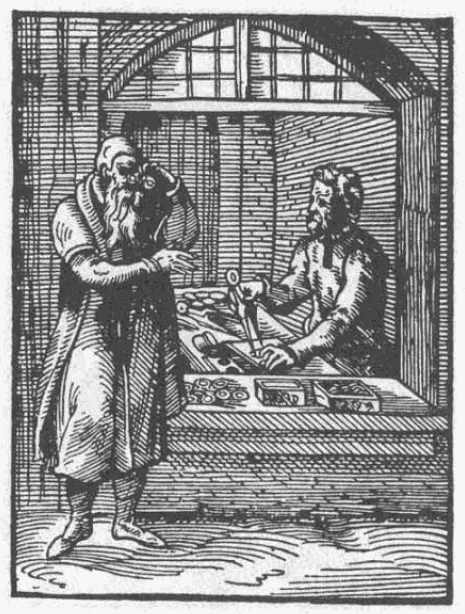

Concave lenses for short sight were known from the sixteenth century, though not attested before 1525. Frames took longer than lenses. The modern arrangement, held by temples passing over the ears, was in use before 1727 and is usually credited — the reference works say possibly — to the English optician Edward Scarlett, who advertised a temple spectacle with side arms reaching to the temples; James Ayscough followed in 1752 with double-hinged side pieces, the first design in which the arm passed above the ear and the spectacles were held at the back of the head. Benjamin Franklin is credited with the bifocal, around 1784, and the first corrective lenses for astigmatism were designed by the British astronomer George Airy in 1825. Everything in between — pince-nez, lorgnettes, scissors-glasses, monocles — remained in fashion alongside the temple spectacle well into the twentieth century.
Contact lenses: Zürich, Mönchengladbach, Kiel
The contact lens is largely a German-language invention, and its three founding figures are all documented in detail. Adolf Gaston Eugen Fick (22 February 1852 – 11 February 1937), a German ophthalmologist working as a lecturer in Zurich, built the first successful model in 1887: a shell of heavy brown glass, 18 to 21 millimetres across, resting on the tissue beside the cornea with the gap between filled by a sugar solution. He tried it on a rabbit, then on himself, then on a small group of volunteers, and published the result under the title Contactbrille in the Archiv für Augenheilkunde in March 1888. It was large, unwieldy and wearable for a few hours a day.
August Müller (4 March 1864 – 5 September 1949), from Mönchengladbach, published his dissertation Brillengläser und Hornhautlinsen in 1889, describing his attempts to grind scleral shells from mouth-blown glass, and dedicated it to his fellow sufferers in short sight; with them he brought his own myopia of minus fourteen dioptres down to about half a dioptre. He grasped the essential point — that the lens would be held by capillary action in the tear film — and had three lenses made for him by Carl Zeiss in Jena. He could tolerate them for half an hour, they had to be inserted under water to avoid trapping air, and cocaine was required to numb the eye; Zeiss did not pursue the idea. He became an orthopaedist instead.
The line from those experiments to a wearable product runs through Kiel. Heinrich Wöhlk (9 April 1913 – 23 December 1991) was very long-sighted, wearing plus nine dioptres, and in 1936 was fitted with a Zeiss glass scleral shell that had to be removed almost at once. Working as a designer at a Kiel instrument firm, he was allowed to take home offcuts of the new acrylic, and between 1938 and 1939 he experimented with wooden models, plaster forms and wax impressions; in 1940 he made a Plexiglas scleral shell he could wear for five hours, although it had no optical power and he could see nothing through it. After the war he made wax impressions of seventy different eyes with the director of the Kiel eye clinic and used them as standard forms. The breakthrough was accidental: out of frustration he put in only the worked optical portion of a shell, twelve millimetres across with a rounded edge, and found he could wear it all day and see well. He called it a Contactlinse, opened a shop in a bombed-out flat in Kiel in 1949, brought the acrylic Parabolar to production in 1951, and had a firm with two employees by 1952. It moved to a new building at Schönkirchen in 1971 and brought out its first soft lens, the Hydroflex, in 1974.
Elsewhere the same decades produced polymethyl methacrylate as a lens material in the 1930s, the first fully acrylic corneal lens filed for patent by Kevin Tuohy in 1948, and the decisive materials advance at the end of the 1950s, when the Czech chemists Otto Wichterle and Drahoslav Lím developed the HEMA hydrogel and gave the soft lens its substance; their paper Hydrophilic gels for biological use appeared in Nature in January 1960. Rigid gas-permeable lenses reached the market in 1976; silicone hydrogels, which combine very high oxygen transmission with the comfort of a hydrogel, were first released by Ciba Vision in Mexico in 1998, although German sources date the first such lens to 1999. Replacement systems — lenses discarded daily, weekly or monthly instead of being kept for a year — gained importance in the mid-1990s, and the older German makers followed: Wöhlk began supplying replacement lenses from its own production in 2000. That is to say: the single largest change in how contact lenses were sold and cared for happened precisely across the years this newsgroup existed.
Materials, indices and coatings
The vocabulary an optician uses to sell a pair of lenses is a set of trade-offs, and all of them were mature enough by 1997 to argue about. Lenses are made of mineral glass or of plastic. Plastic is lighter and does not shatter; glass is harder and resists scratching. A higher refractive index makes a thinner and therefore lighter lens: the practical range runs from about 1.5 to 1.75 in plastics and from 1.5 to 1.9 in mineral glasses. Against that stands Abbe's number, the measure of dispersion, and it moves the wrong way — high-index materials and plastics generally have lower Abbe numbers, which means more colour fringing towards the edge of the lens. The thinnest lens is not the best lens, and explaining why is a large part of what the counter conversation consists of.
The dominant plastic has a name that is itself a piece of industrial history. CR-39 stands for Columbia Resin number 39, the thirty-ninth formulation of a thermosetting plastic developed by the Columbia Resins project in 1940; chemically it is poly(allyl diglycol carbonate), with a refractive index of about 1.50. It is markedly lighter than mineral glass and correspondingly thicker, unbreakable in ordinary use, and easier to scratch, which is why hard coatings exist — either a brittle silicon dioxide layer applied by vapour deposition or a flexible lacquer applied by dipping, neither of which does anything to stop the lens breaking. Polycarbonate is lighter still and extremely impact-resistant, which recommends it for children's and sports spectacles, at the cost of noticeable dispersion and a surface that resists scratching poorly even when sealed.
Anti-reflection coatings, descended from Smakula's 1935 patent, are sold in grades — single, multiple and so-called super coatings — and are the standard answer to reflections at night. Photochromic lenses, which darken in ultraviolet light, came out of the silver-halide glasses developed by William H. Armistead and Stanley Donald Stookey at Corning in the 1960s; Rodenstock's own company history dates Europe's first self-tinting spectacle lenses to 1968. The German reference literature notes, with characteristic caution, that their slow reaction makes them only conditionally suitable for driving. Tints, filters, hard coats, anti-reflection layers and photochromics were all separately priced options in 1997, which is the commercial reason the trade discussed them so much.
Progressive lenses and the arithmetic of getting older
Presbyopia is the one refractive change that comes for everybody, and the progressive lens is the trade's most technically demanding answer to it. The idea is old: the first patent for a progressive lens was British patent 15,735, granted to Owen Aves with a 1907 priority date, and it was never commercialised; a lens of similar design appears to have been drawn by H. Newbold around 1913, and the first commercially available progressive, the Ultrifo, is attributed to Duke Elder in 1922.
The modern form dates from the 1950s. Bernard Maitenaz patented Varilux in 1953 and the Société des Lunetiers, later Essilor, brought it to market in 1959. The first version still had a surface close to a bifocal, with an aberration-free upper half and a large reading segment; the real breakthrough in adaptation and in peripheral and dynamic vision came with Varilux 2 in 1972, for which Maitenaz produced a fully aspheric design and the manufacturing process to go with it. Carl Zeiss developed free-form technology in 1983 with its own patented Gradal HS series.
What makes progressives a permanent subject in any optician's trade conversation is that they cannot be made without compromise. A surface whose power increases continuously from top to bottom necessarily carries unwanted astigmatism in the flanks, so every design is an argument about where to put the distortion and how wide to make the corridor; and a proportion of wearers never adapt to them at all. Fitting one demands centration data measured to the millimetre, which is exactly what the German apprenticeship teaches in its second half and examines at the end. It is also expensive, which in the German market after 2004 meant expensive to the wearer.
What the trade argued about in the group's years
Nothing that follows is a reconstruction of a thread. No archive of this group's articles has been located for this page, no participant is known, and no posting is quoted anywhere below. What can honestly be described is the shape of the field the charter opened onto — the questions that were demonstrably live in the German optical trade between 1997 and the middle of the 2000s, established from the trade's own documents, its statutes and the public record of its disputes. A German-language group whose charter named defects of vision, their correction, the work of the optician and the eye doctor, and matters of fashion would have had these subjects available to it, and a reader looking for orientation is better served by an honest map of the territory than by invented anecdotes about it.
The genres, then, in the order the charter suggests them:
- Lens choice as a set of trade-offs. Index against Abbe number, glass against plastic, weight against thickness, the cost and durability of coatings, and whether the thinnest option a shop can supply is the one a given prescription actually wants.
- Progressive lenses. Corridor length and width, the placement of unwanted astigmatism, adaptation and non-tolerance, the accuracy of centration, and the perennial question of what distinguishes a cheap design from an expensive one.
- Contact lens types. Rigid gas-permeable against soft; oxygen transmissibility; toric lenses for astigmatism; the several approaches to presbyopia in a contact lens, from segmented bifocals through concentric multifocals to monovision; and, during exactly these years, the shift from lenses kept for a year to replacement systems.
- Care systems. The German training ordinance itself requires an apprentice to be able to distinguish the modes of action of contact-lens care products and to justify the necessity of care, which is a fair indication of how much of the trade's daily conversation the subject occupied: peroxide systems against all-in-one solutions, protein deposits, the matching of a solution to a lens material, and the storage case.
- Refraction and the boundary with the ophthalmologist. The right to refract, screening for signs that warrant referral, prismatic correction and its overlap with the ophthalmological specialty of squint, and the limits imposed by the reservation of healing to physicians.
- Frames, fitting and fashion. Materials and hinges, anatomical adjustment, and the subjects the charter named outright — sunglasses, and coloured contact lenses sold for appearance rather than correction.
- The shop as a business. Ready-made reading spectacles sold in department stores, mail order and then internet sales, chains against independents, and the pricing structure described in the next section.
One thing this article does not do, and cannot do, is give advice. Nothing above or below is guidance about eyes, spectacles, contact lenses or their care; it is a description of what a trade discussed and of the documents that record its arrangements. Anyone with a question about their own vision has, in Germany as everywhere else, two professions to ask, and the boundary between them is the subject of this page rather than its verdict.
The economics behind the counter
The commercial world the group lived in was shaped by two things: the statutory health insurance funds, and one retailer.
Until the early 1980s the funds paid for spectacles from a fixed and very small range. West Germany had six plastic frames for adults and two for children whose cost the statutory insurance would cover; they were called Kassengestelle, they were instantly recognisable, and nobody liked them. In 1972 an optician named Günther Fielmann opened a shop in Cuxhaven, spotted the gap, and in 1981 concluded a special contract with the local sickness fund at Esens under which he offered ninety models in metal and plastic in 640 variants at no cost to the insured person. That ended the era of the standard-issue insurance spectacle. A television campaign followed in 1984 built around a child's line about his father not having paid a pfennig; the company was listed on the stock exchange in 1994 and had 294 branches and nearly five thousand staff that year.
The GKV-Modernisierungsgesetz of 14 November 2003, in force for the most part from 1 January 2004, removed visual aids from the benefits of statutory health insurance for adults. The current text of the relevant provision of the social code shows what survived: insured persons are entitled to visual aids up to the age of eighteen; adults only if they have a severe visual impairment of at least category one under the 2017 revision of the international classification, or a prescribed distance correction of more than six dioptres for myopia or hyperopia or more than four for astigmatism. Therapeutic visual aids for treating injury or disease are a separate case. Contact lenses are covered only in medically compelling exceptional cases, and care products are expressly not paid for. Even where an entitlement exists, it does not extend to the frame; and for anyone over fourteen a replacement pair requires a change of at least half a dioptre.
That single change turned nearly the whole German spectacle market, overnight, into a private-purchase market — which sharpens every argument in the list above, because from 1 January 2004 the person choosing between a 1.5 and a 1.67 index, or between a basic and a premium progressive, was paying for the difference out of pocket.
How the price of the lens was arrived at is a matter of public record, and it is unflattering. The Federal Cartel Office's decision of 10 June 2010 found that the five leading manufacturers had met regularly since the middle of 2000 in a discussion circle known by their initials, coordinating surcharges, terms, discounts and bonuses offered to opticians and informing one another of forthcoming price rises. Separately, within a working group on price structures at the trade association, the same five agreed the recommended retail prices they published to opticians — prices from which, the office noted, a large proportion of opticians simply took the figure the customer paid, since those recommendations were calculated by formulas that already included the optician's own craft labour. The fines totalled 115 million euros; they were open to appeal to the Higher Regional Court in Düsseldorf, and two of the firms and the association agreed a settlement. The conduct described began in mid-2000.
For scale: the trade association's sector report for 2019 and 2020 counted 48,400 people employed in 11,550 specialist optician's shops in Germany, with 7,645 apprentices, a turnover of just under 6.5 billion euros and 12.97 million pairs of spectacles sold in 2019. The same survey series that found 43 per cent of the population wearing spectacles at its first sounding in 1952 found, in 2008, that 62 per cent of Germans over sixteen wore or needed a corrective pair. It is a large trade, and it was large when the group existed.
What the record does not show
The list of unknowns is longer than the list of knowns, and it should be stated plainly rather than papered over.
- Nothing is known about how many people read de.alt.augenoptik, how much traffic it carried, or when its last article was posted. No readership estimate for it exists in any source consulted here.
- No archive of its articles has been located for this page. Google Groups, which absorbed the Deja News archive and would be the obvious place to look, stopped accepting and displaying new Usenet content on 22 February 2024; whether it holds articles from this group, and how complete they would be, could not be confirmed while writing, and no posting from the group is quoted or characterised above.
- It is not known whether the group's participants were opticians, wearers of spectacles, or both, or in what proportion. The charter names the trade explicitly, which is suggestive and nothing more.
- Nothing is known about why Bettina Fink proposed it, what was said in de.alt.admin before the newgroup message, or whether anyone objected. The discussion is referred to in the creation message and is not preserved with it.
- Nothing connects the 2001 removals to anything about this group in particular. It was one name among many in an automated sweep, and the sweep's own targets included groups in hierarchies the forger had no relationship with at all.
- Whether the group was ever much used is genuinely open. A group can sit in every server's active file for decades and carry a dozen articles a year; the master list records existence, not life.
One structural point about language is worth making, because a German group in an English-language directory invites a misreading. Everything the group itself produced was German, down to the one-line description quoted above. What is English here is the directory, not the subject. A mail-to-news gateway is indifferent to the language of what it forwards. The other German groups in this catalogue are de.rec.motorroller, de.sci.genealogie and de.talk.liebesakt.
Scope and limits
This article is assembled from documents. The group's creation date and time, its sender, its crossposting, the exact text of its short description and of its charter, and the dates, senders and wording of every removal and booster message concerning it come from the Usenet control-message archive mirrored by the Internet Systems Consortium, which is the primary record for such things and is quoted here exactly or not at all. The group's present status comes from the master newsgroups file published by the same body, fetched on 25 August 2026, and from the group list maintained by the German hierarchy's own moderation, which agrees with it.
The legal material comes from the statutes themselves rather than from summaries: the crafts code, the federal ordinance on training in the optician's trade with its schedule of training content and examination areas, the ordinance on parts I and II of the master examination in the trade, and the provision of the social code that governs entitlement to visual aids. Where a figure or a date is contested or company-supplied, it has either been attributed in the text or left out; several claims in manufacturers' own histories about being first with a given product have been left out for that reason. The cartel findings are taken from the Federal Cartel Office's own published decision of 10 June 2010, including its note that the fines were not yet final.
The histories of the trade, of the firms and of the objects come from German- and English-language reference works checked item by item, and where those disagree — as they do, for instance, about which surviving painting is the earliest German depiction of spectacles — both positions are given above rather than one standing in for the other. Nothing here is health advice, no thread, poster, subscriber count or posting figure has been invented, and where the record is silent the silence is reported. Corrections from anyone who read the group would be welcome; the procedure the branch was exempted from is set out on the de.* hierarchy page.
Reading de.alt.augenoptik today
- Historical archive: Google Groups — de.alt.augenoptik (coverage varies by group and era).
- Open in a newsreader:
news:de.alt.augenoptik— the original site offered exactly this link, and it still works if your system has a newsreader registered for thenews:scheme. - Live access: point an NNTP newsreader at a modern server — see accessing Usenet today.
- The original news2mail e-mail subscription service ended in the mid-2000s and no longer operates.