de.rec.motorroller
German-language scooter group (de.rec branch).
The de.rec.* counterpart of the scooter conversation: touring reports, maintenance and licensing questions in German, alongside the informal de.alt room preserved elsewhere in this directory.
A German dealer’s link pages still point here — fourteen live links at last count — which is why both addresses are preserved.
On this page
- The line that is still in the file
- The paperwork: a ballot in the summer of 1997
- What the count actually says
- The two rooms
- Why a room of its own, next door to the motorcycles
- The forged removals of 2001
- What the machine was actually for: the daily journey
- Touring: passes, holiday roads and the five-month season
- Long distance on a small engine
- Clubs, rallies and the organised run
- The scooter in German life
- Why this address still matters
- What the record does not show
- Scope and limits
The line that is still in the file
Most of the groups in this directory have to be reconstructed from the record of their own deaths. This one does not. The Internet Systems Consortium distributes the reference copy of the Usenet namespace — the newsgroups file that a news administrator uses to fill in the one-line descriptions a reader sees beside a group name — and the copy fetched for this page, in August 2026, carries the entry at line 23,499, between the motorcycle group above it and the hi-fi group below:
de.rec.motorroller Alles rund um Motorroller.
Everything to do with motor scooters. The gap is a single tab character, which is what the German hierarchy's own rules ask for; they ask that group name and description together, set with an eight-column tab, come to fewer than eighty characters and end in a full stop, and this line does all three. There is no entry for de.alt.motorroller anywhere in the file. The scooter subject held two rooms on Usenet in the second half of the 1990s; one of them is still a live entry in a maintained namespace nearly three decades later, and the other is not. Explaining that difference is most of what this page is for.
The companion file, the reference active list from the same source, carries de.rec.motorroller with the posting flag y — unmoderated, posting permitted. It is worth being exact about what that does and does not say. Every line in that distributed file carries the same placeholder article numbers, 0000000000 and 0000000001, for every group in it, from comp.lang.c to the smallest regional test group. The file describes a namespace, not a traffic report. It records that the group exists, is unmoderated and may be posted to. It says nothing whatever about whether anybody has posted to it this decade.
The neighbours in the same file show the house style, and incidentally the exact place the scooter room was given in the scheme of things. de.rec.motorrad reads Alles rund ums Motorrad; de.rec.fahrrad reads Alles rund um's Fahrrad; de.rec.motorroller reads Alles rund um Motorroller. Motorcycle, bicycle, scooter: three formula descriptions, three rooms, one branch. The German hierarchy set out to be themenvollstaendig — topic-complete — and this is what topic-completeness looks like at the level of a single line of a configuration file.
The paperwork: a ballot in the summer of 1997
Unlike its informal twin, this group should have left a paper trail, because the branch it belongs to is the formally governed part of the German-language hierarchy. It did. The control-message archive mirrored by the Internet Systems Consortium holds the creation message, and the creation message carries its own bibliography in the References header — the chain of administrative articles that had to exist before it could be sent. Read in order, the message identifiers date the procedure precisely:
- [email protected] — a first Request for Discussion, 4 July 1997.
- [email protected] — a second Request for Discussion, 10 July 1997, six days later.
- [email protected] — a first Call for Votes, 18 July 1997.
- [email protected] — a second Call for Votes, 6 August 1997.
- [email protected] — the result, 15 September 1997.
All five identifiers are stamped @dana.de, the domain of de.admin.news.announce, the hierarchy's moderated announcement group. The proposal was not posted by its author into a discussion group; it was submitted to the moderation, checked, and published by it. The full route — what an RfD must contain, how long discussion runs, how the votes are collected and counted, and who is allowed to send the resulting control message — is set out on the de.* hierarchy page and is not repeated here. What follows is only what this particular procedure produced.
On 20 September 1997 at 03:45:12 GMT the group was created. The control message came from [email protected], with the Sender and Approved headers reading i. V. Heiko Schlichting — in Vertretung, acting for the office rather than in a personal capacity — and its Path shows it entering the network through a machine at the Freie Universitaet Berlin. It was crossposted to de.admin.news.announce, to de.admin.news.groups, and, pointedly, to de.alt.motorroller. It carried a PGP signature over nine named headers: Message-ID, Newsgroups, Followup-To, Date, Subject, Control, From, Sender and Approved. That list matters more than it looks, because it is exactly the set of fields a forger would need to alter, and a group in this branch that is not signed over them is not created.
Two days later, on 22 September 1997 at 19:56 local time, a second, near-identical message went out over the same address from a different machine and a different pair of hands: the X-Sender header reads [email protected], for Lutz Donnerhacke, and the Path runs through a news server at Jena. Repeated control messages are ordinary housekeeping — a newgroup is a request that each server decides on individually, and a repeat catches machines that were down or unfed the first time. What is mildly unusual is the body. Neither message reads like a creation notice. The first carries the ballot result, the short description, the status line and the charter; the second adds the thresholds the count had to clear, the five-day objection period that follows a published result, and the proponent's name and address. In both, the instruction arrives wrapped in the evidence for it.
What the count actually says
The result is reproduced inside the creation message, where it runs to three lines — a headline and two lines of arithmetic:
unmoderierte Gruppe de.rec.motorroller angenommen 138:57 — Es gab 138 JA-Stimmen und 57 NEIN-Stimmen, insgesamt 195 gueltige Stimmen. Es gab 3 Enthaltungen und 1 ungueltigen Wahlschein.
Unmoderated group de.rec.motorroller accepted, 138 to 57. One hundred and thirty-eight yes votes and fifty-seven no votes, 195 valid votes in all, with three abstentions and one invalid ballot. The umlauts are written out as ue, which is what the hierarchy did to its own official texts as a matter of course on transport that could not be relied on to carry anything but plain ASCII.
The second message states the rule the count had to satisfy, in the form it then took:
Damit eine Gruppe passiert, muessen die Ja-Stimmen mindestens 2/3 aller gueltigen (JA- und NEIN-) Stimmen ausmachen. Ausserdem muessen mindestens 30 JA-Stimmen eingehen.
For a group to pass, the yes votes must make up at least two-thirds of all valid yes-and-no votes, and at least thirty yes votes must be received. The arithmetic is worth doing, because it is the one thing about this group's reception that can be established rather than guessed. Two-thirds of 195 is 130. The proposal took 138. It passed by eight votes.
That is a narrower margin than a scooter group might be expected to need, and the proportion is the striking part: fifty-seven people out of 195 took the trouble to write in and vote against a room for talking about motor scooters. Twenty-nine per cent opposition is a contested ballot by any reading. The record consulted here does not say why. Objections in the German hierarchy's namespace debates were characteristically about whether a subject deserved a room of its own rather than about the subject itself — an existing group could be argued to cover it, or the expected traffic could be argued too thin — but that is a general observation about the branch, not a finding about this vote, and it is offered as the former.
One further point of comparison is available and is genuinely informative. The threshold quoted in 1997 was thirty yes votes in absolute terms; the hierarchy's current rulebook sets that floor at fifteen. The ratio requirement is unchanged and is merely worded differently — twice as many yes votes as no votes is the same arithmetic as two-thirds of the valid total — but the absolute floor has halved in the intervening quarter-century, which is what a shrinking electorate looks like written into a rule.
The rules also require the count to be published in full. After the poll closes the vote-taker compiles a list showing, for each voter, e-mail address, real name and vote; the moderation then posts it, and the name and address may be withheld only in justified individual cases. The ballot is described in the rulebook in as many words as general, equal, free and not secret. That list should therefore have been the substance of the RESULT article of 15 September 1997, whose identifier the creation message cites. The article itself is not in the control-message archive, which holds control messages and nothing else, and no copy of it was located for this page.
The two rooms
This is the question the page exists to answer, and the honest answer has two halves: a sequence that is documented exactly, and a motive that is not documented at all.
The documented sequence runs like this. On 18 July 1996 a student at the Universitaet Karlsruhe sent a newgroup message for de.alt.motorroller over his own name, with four boosters following over the next twelve days, in the one-man form that the informal branch permits and the formal one does not; that story, its charter and its machinery belong to the de.alt.motorroller page. Fourteen months later the formal procedure described above ran its course for de.rec.motorroller, and on 20 September 1997 the hierarchy's moderation created the rec group with a signed control message crossposted into the alt group. Nine days after that, on 29 September 1997, the same moderation address sent the removal message for de.alt.motorroller — crossposted, symmetrically, into de.rec.motorroller. A booster removal followed on 7 November 1997. The alt room closed; the rec room opened; the two events were carried out by the same office within nine days and each was announced in the other room.
The two charters make the continuity even plainer. Set side by side, they are the same text with a handful of cosmetic edits. The 1996 alt charter says the group addresses everyone interested in motor scooters and related subjects, and that it should ausdruecklich — expressly — not be about technical questions alone but also about social ones: sporting events, scooter racing, scooters in everyday use as a substitute for the car, questions of safety and so on. The 1997 rec charter says the same thing, with ausdruecklich replaced by explizit, Ersatz fuer Autos compressed to Auto-Ersatz, and the line breaks moved. Both end on the same abbreviation, u.a. — and the 1997 copy dropped its closing full stop somewhere in transit. The short description — Alles rund um Motorroller — was carried across unaltered, and it is the line that is still in the namespace file today. Whatever else happened, somebody had the 1996 text in front of them when the 1997 proposal was written.
Here is what the record does not establish. It does not establish that the rec proposal was a response to the alt room. The two names in the paperwork are different people at different universities — the 1996 proponent posted from Karlsruhe, the 1997 proponent is given in the control message as Rasmus Althoff at the Technische Universitaet Hamburg-Harburg — and nothing in the archive connects them. It does not establish whether the alt room was busy, quiet or dead by mid-1997; no article from it has been located for this page. It does not establish whether the alt room's readers moved, whether the rec proposal grew out of a conversation inside the alt room, whether it grew out of the neighbouring motorcycle group, or whether it grew out of nothing more than one person deciding a subject deserved a properly voted room. Reusing a charter proves that a text was copied. It does not prove who copied it, or why.
What the record does establish, and what is easy to miss, is that the two rooms were never equals. The branches have different doors. In the informal branch a creation message from any sender at all is honoured by a correctly configured server, and removal is accepted only from the hierarchy's own verified moderation address. In the formal branch both are reserved to that address. So the alt room could be opened by one person in a week, but it could only ever be closed by the office that also ran the ballots — and it was. The asymmetry is deliberate, it is documented in the news server configuration the hierarchy publishes for itself, and it is set out in full on the alt group's page. Its consequence here is that the closure of one room and the creation of the other were not two communities settling a question between them. They were two acts of the same office, nine days apart.
Why a room of its own, next door to the motorcycles
de.rec.* is the recreation branch of the German-language hierarchy: the place for what people do when they are not working. The branch in the current namespace file runs to thirty-four groups, and the whole list is a fair sketch of German leisure as the hierarchy's own participants classified it — books, the bicycle, film, photography, gardening, do-it-yourself, radio drama, aviation, food and drink, a general miscellany, the motorcycle, the scooter, six music groups, being outdoors away from civilisation, classical camping, other travel subjects, four science-fiction groups including one for Perry Rhodan alone, games, football, sport in general, sailing, cats, animals in general, and three television groups. The naming borrows its branch label from the English-language rec.* hierarchy, as much of de.* does, which is why a German-language namespace has an English word at its second level.
The motorcycle group was already there. de.rec.motorrad is in the current file and was plainly in service by July 1996, because the informal scooter group's very first control message was crossposted into it. So the obvious question about a scooter room — why not simply use the motorcycle room? — was answerable in 1997 the same way it is answerable now, and the answer is not sentimental. In German law a scooter is not a kind of motorcycle in any way that helps a rider. It is a body style laid across a set of legal categories defined by displacement and design speed, so that two machines of identical shape can require different licences, carry different plates, face different roadworthiness obligations and be permitted different speeds. A room about motorcycles and a room about scooters were, in practice, rooms about two different sets of paperwork attached to two different sets of journeys. That legal architecture — the classes, the licences, the insurance plate that changes colour every March — is documented on the de.alt.motorroller page and is not repeated here.
The charter both rooms shared makes the same point from the other direction. It goes out of its way to say that the group is not to be about technical questions alone, and it names three non-technical subjects: sporting events, everyday use as a substitute for the car, and safety. Whoever wrote that sentence in 1996, and whoever copied it in 1997, was describing a machine defined by what it was for rather than by what it was.
The forged removals of 2001
The group's one documented brush with drama came four years after its creation, and it had nothing to do with scooters. On 31 October 2001, at 19:42 and again at 21:50 GMT, two removal messages for de.rec.motorroller went out from an address at baysec.org over the name Jonas Luster, crossposted to de.config, de.control and news.groups. The text of both is identical and worth quoting for its tone, since it is the only piece of writing in the group's entire control record with a sense of humour:
If your newsserver was broken enough to add de.rec.motorroller, I trust it's broken enough to remove it now without looking for a PGP sig. […] de.rec.motorroller is a bogus newsgroup (heh, the name kinda implies that already) and should be deleted.
The following day, 1 November 2001, a third removal arrived from an entirely unrelated quarter: the administrator of the biz.* hierarchy, writing as BIZ hierarchy administration, crossposting to biz.config and biz.control and explaining that the message was a counter to forged newgroup commands — over 100 forgeries so far — for a group that had never been created according to the rules of the biz hierarchy, which it had of course never been in. Both sweeps caught de.alt.motorroller and de.alt.augenoptik as well; the first of them also caught the motorcycle group de.rec.motorrad, three times over between 30 and 31 October.
What had happened is that somebody running a control-message forger had scattered German group names across hierarchies they had never belonged to, and the administrators of those hierarchies were tidying up after it with removals of their own. The joke about the name is the giveaway: to an English-speaking administrator sweeping up forgeries in 2001, de.rec.motorroller looked exactly like the kind of nonsense string a forgery generator emits. It was in fact a properly voted group with a 138-to-57 mandate and four years of standing.
None of it worked, and the reason is the PGP requirement described above. A correctly configured server in this branch acts on a removal only if it is signed by the hierarchy's own key; three unsigned removals from two unauthorised senders are three articles. The group is in the namespace file today and the sweeps of 2001 are in the archive as a footnote. Its informal twin, already formally removed in 1997, needed no such protection and got none. The episode is a small, precise demonstration of what the signature is for, and of the point the hierarchy's own rules make about itself: a control message is a request, every server decides individually, and a name once created can outlive every decision anybody makes about it.
What the machine was actually for: the daily journey
The rec branch is the leisure branch, but the charter's own list puts everyday use as a car substitute second of three, and the ordinary journey is where the subject starts. It is also where German road law shapes it most sharply.
The decisive rule is one sentence of the Strassenverkehrs-Ordnung. Under paragraph 18, subsection 1, an Autobahn or a Kraftfahrstrasse — the motorway and the trunk expressway — is reserved for motor vehicles whose design-determined top speed exceeds 60 km/h. A 45 km/h Kleinkraftrad is therefore barred outright. So, precisely, is an East German fifty grandfathered at 60 km/h, because sixty does not exceed sixty. Only the larger machine — the 125 or the big-wheeled Grossroller — gets onto the motorway network at all.
The practical shape of that is a matter of two numbers. The German motorway network measured 13,223 kilometres at the start of 2025; the Bundesstrassen, the federal trunk roads below it, run to roughly 37,800. A small scooter is excluded from the first and confined to the second plus the Land and district roads beneath it — which is to say confined to exactly the roads that go through the middle of towns, past the school and the level crossing, with a speed limit it can meet and traffic behind it that cannot. Everything that follows about scooter journeys in Germany follows from that: distances measured in an hour rather than in kilometres, routes chosen for what they avoid, and a permanent negotiation with the vehicles queued behind.
The machine's shape is a response to the same journey. A scooter has a free step-through between handlebars and seat, so it can be mounted like a chair rather than swung over like a horse — the German reference description makes the point that this suits a rider with restricted movement or a long skirt, which is a fair summary of who the shape was drawn for. It usually has a floor pan instead of footrests, and a continuous leg shield or fairing in front whose stated purpose is effective protection against dirt. It is that last feature, and not performance, that made the type. When the English mod subculture took up the Italian scooter in the 1960s, the reasons on record are style and cleanliness together: the enclosed bodywork hid the moving parts, so oil and road dirt stayed off a tailored suit, and a surplus parka over the top did the rest. Their opposite numbers on motorcycles wore leather.
Capacity is the other everyday question. The seat of a scooter is almost always laid out for two people, and where a single seat is fitted it is often combined with a luggage rack — the delivery machine being the standard case. The original Vespa of 1946 offered a rear pillion seat or, as an alternative, a storage compartment in its place, and the flat front shield soon became a double skin so that the space behind it could serve as a glove box. A scooter is not a large vehicle, but almost every part of it that is not engine has been made to hold something.
Touring: passes, holiday roads and the five-month season
The other half of the rec side is the journey taken for its own sake, and here the German-speaking rider has an unusually well-defined set of destinations, most of them dated, tolled and shut for more than half the year.
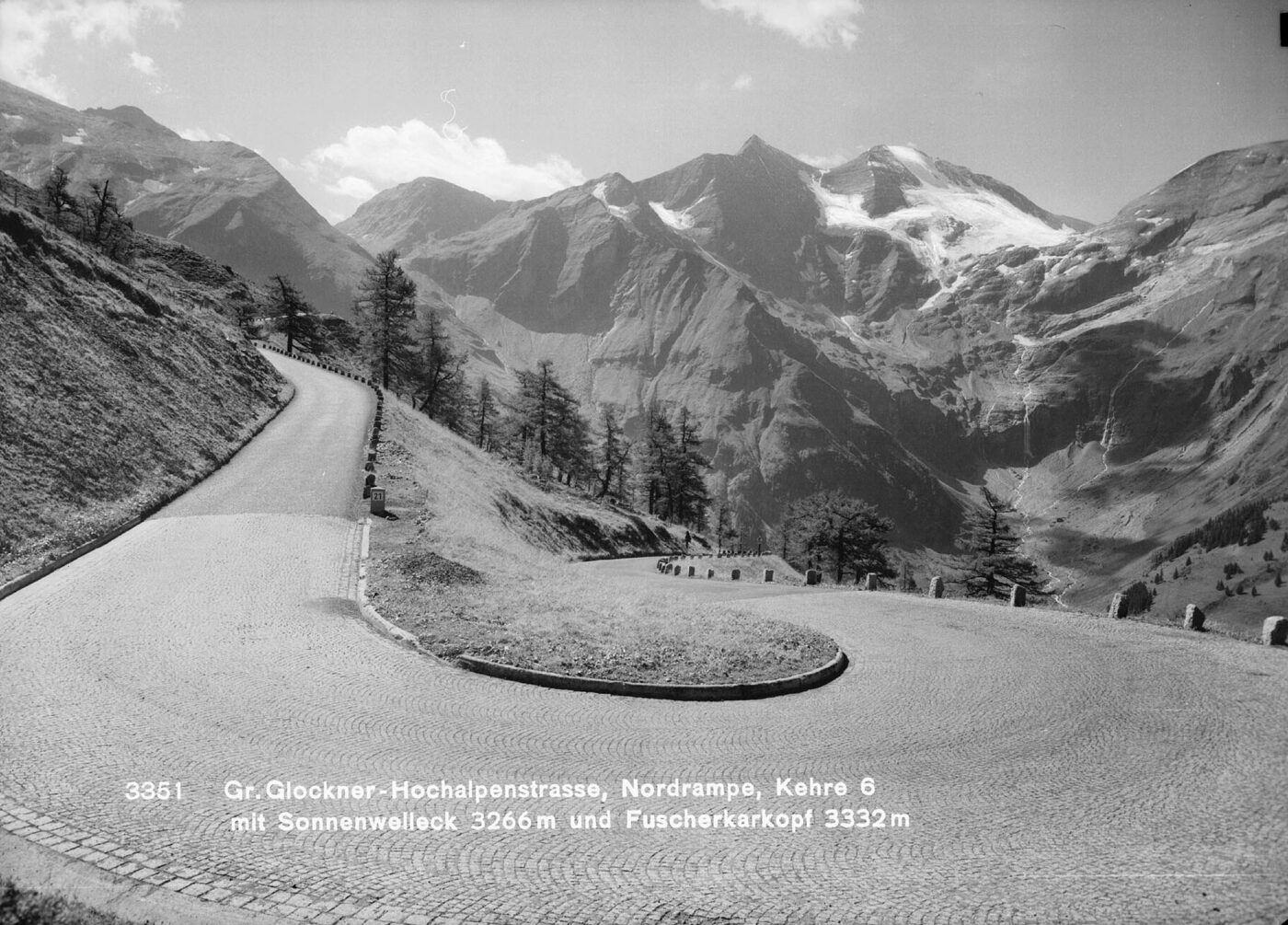
The Grossglockner High Alpine Road is the archetype. It opened on 3 August 1935 and was put into full service the following day with an international automobile and motorcycle race — a detail that tells you what the road was built to be. It climbs from Bruck in the Salzach valley to Heiligenblut in Carinthia by way of the Fuscher Toerl at 2,428 metres and the Hochtor at 2,504, with a branch to the Edelweissspitze viewpoint at 2,571, and it has charged a toll from the beginning: the state advanced the construction cost and the users were to pay it off. It was conceived in the 1920s, when Austria, Germany and Italy between them held 154,000 private cars, 92,000 motorcycles and about 2,000 kilometres of long-distance asphalt, and the plan for it was ridiculed on exactly those grounds.
.jpg)
The Grossglockner also keeps an unusually long record of what happened to two-wheeled touring in the German-speaking world, because its traffic has been counted by vehicle type. In the road's early years the motorcycle — the poor man's car — accounted for up to a quarter of everything crossing it. The high point was 1955, with 47,500 motorcycles, twenty-six per cent of the total. By 1968 the count was 2,071. By 2003 it was over 76,000. Those four numbers are the rise, the collapse and the return of the two-wheeler as a leisure object, measured at one toll booth over seventy years, and they say it more plainly than any registration statistic.
The rest of the Alpine repertoire has the same character. The Timmelsjoch, between the Oetztal and the Passeier valley, is open to traffic from roughly the first half of June to the second half of October depending on snow, daily from seven in the morning to eight at night, tolled on the Austrian side and closed to lorries and to anything towing a trailer. The Stelvio, at 2,757 metres, is the highest paved pass in the Eastern Alps and the second highest in the Alps as a whole. A pass is not a road that is there when you want it; it is a road with an opening season, a closing time and a price, and planning around those three things is a genre of conversation in itself.
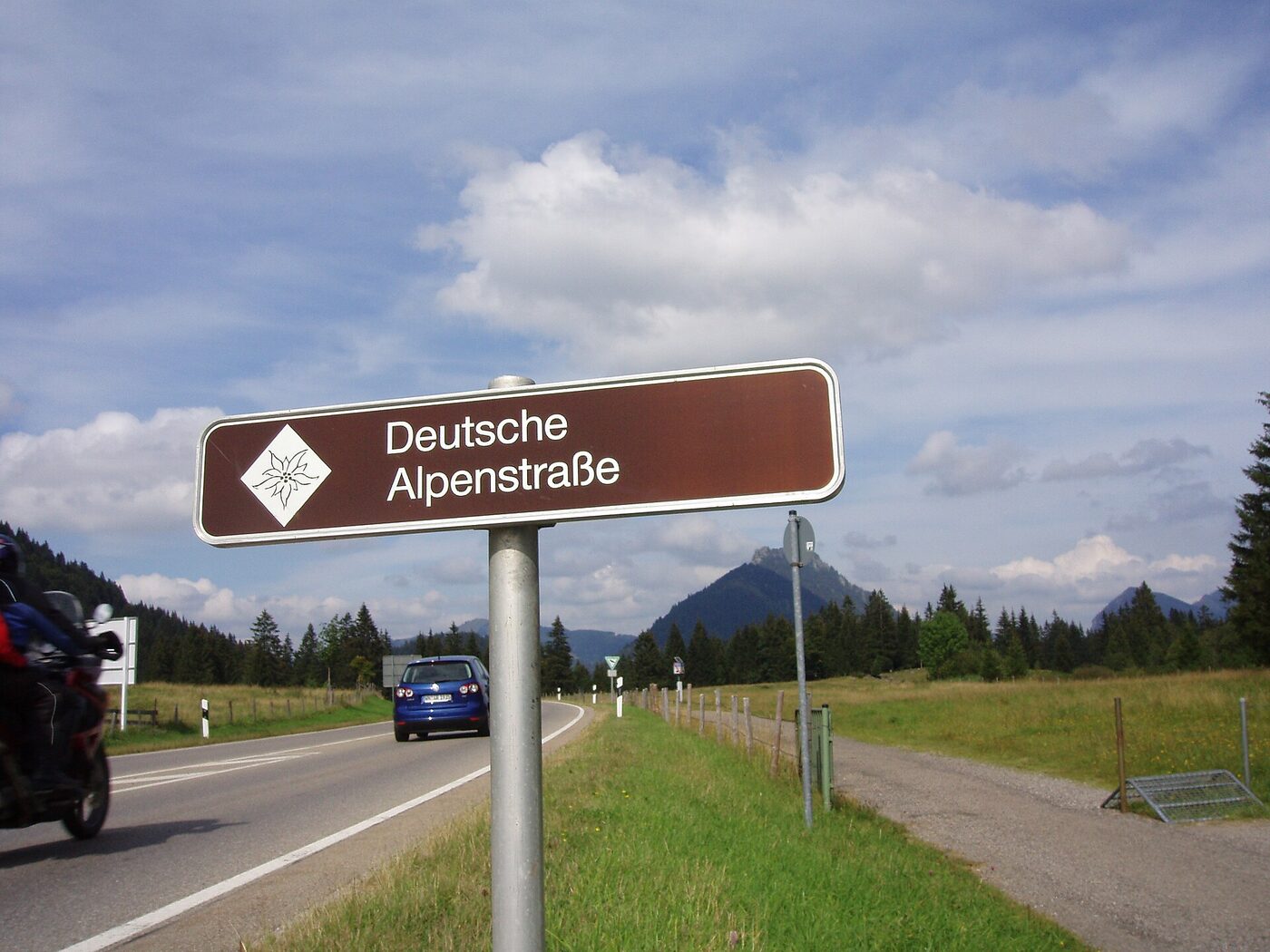
Closer to home the German holiday roads offered the same shape of journey without the altitude. The Deutsche Alpenstrasse runs about 484 kilometres west to east from Lindau on Lake Constance to the Koenigssee, crossing the transverse valleys of the Bavarian Alps by way of the Oberjochpass and a string of lakes; the idea dates from 1927, its present alignment was settled in the 1930s, and it is generally called the oldest of the German holiday routes. The Romantic Road is the opposite kind of artefact: a theme route assembled by promotion-minded travel agents in the 1950s out of ordinary surface roads between Wuerzburg and Fuessen, strung between the walled towns and the castles, and given a length of anything between 413 and 460 kilometres depending on the reference work and the alignment counted. Neither is a road in the engineering sense. Both are itineraries with signposts, and both are the right length and the right speed for a machine that cannot use a motorway.

Crossing a border added paperwork, and the timing here is almost comic. Austria introduced its motorway vignette on 1 January 1997 — six months before the first Request for Discussion for this group — requiring vehicles under twelve tonnes to display one on motorways and expressways, at an initial 550 schillings, roughly forty euros. Motorcycles have their own price category, and the rule for fixing one is specific: on a motorcycle the vignette goes on a clean, non-exchangeable external part, a fork leg or the tank, because there is no windscreen to stick it to. Switzerland got there earlier, by referendum on 26 February 1984 and in force from 1985, at thirty francs a year until a second referendum raised it to forty from 1 January 1995. For a rider on a small machine the vignettes are mostly moot, since the roads they buy are the roads the machine may not use — which is itself the sort of thing a touring conversation exists to establish.
Long distance on a small engine
The arithmetic of a long ride on a restricted machine is unforgiving and completely public. At a legal maximum of 45 km/h, three hundred kilometres is six and three-quarter hours of running flat out, and comfortably over seven once the towns are counted, before a single stop is added. At the 60 km/h an older or grandfathered machine may be entitled to, the same distance is five. A day's touring on a fifty is therefore a decision about how much of the day is to be spent moving, and route planning on a scooter is a much more consequential exercise than route planning in a car, because there is no reserve of speed to recover a bad decision with.
Altitude complicates it further, and does so mechanically. A simple fixed-jet carburettor meters fuel against the volume of air passing through it rather than against the mass of it, so as air thins with height the mixture richens. A machine set up at four hundred metres and taken over a pass at two and a half thousand is running on a setting it was not given. On a four-stroke car engine that is a loss of power and a smell; on a small two-stroke, whose lubrication arrives dissolved in its fuel, mixture is not only a tuning question. The two-stroke's habits, the premix arithmetic and the automatic oil pumps that eventually removed it from the owner belong to the alt group's page, which sets them out in full.
Protective equipment is the other standing subject, and its documentary history is clearer than its folklore. The United Nations regulation that governs European helmets is ECE Regulation 22, first issued in 1972, and its title is precise about who it covers: uniform provisions concerning the approval of protective helmets and their visors for drivers and passengers of motor cycles and mopeds. From the beginning it set requirements for head coverage, field of vision, the wearer's hearing, projections from the shell and the durability of materials, with tests for cold, heat and moisture treatment, shock absorption, penetration, rigidity, chinstraps and flammability, and a maximum helmet mass of one kilogram. Successive amendment series tightened the tests; the current European series is 22.06.
Everything below the helmet is a later arrival, and the dates are worth stating because they place the group's era on the early side of a change. The European standard for impact protectors, EN 1621, now runs in three parts dated 2012, 2014 and 2018; the standard for professional riders' clothing, EN 13595, dates from 2002; the glove standard EN 13594 from 2015; and the general garment standard EN 17092, with its class A, AA and AAA ratings, was begun only in 2017 and published in 2020. A rider in 1997 buying a jacket with armour in the shoulders and elbows was buying into a framework that had not finished being written.
Weather is the last of it and needs no standards to explain. The leg shield keeps spray off; it does not keep a rider warm at five degrees for four hours, and a scooter offers nothing to grip with the knees, so a crosswind on an exposed stretch is met with the arms and the body rather than with the machine. These are the conditions under which the equipment conversation — what to wear, what actually works in November, what to carry when the forecast is wrong — becomes a recurring genre rather than a beginner's question. What that conversation said in this particular group is not recorded anywhere consulted for this page.
Clubs, rallies and the organised run
The charter's first named non-technical subject is Sportveranstaltungen (Rollerrennen) — sporting events, scooter racing — and the organised side of scooter riding in Germany is genuinely well documented, which is fortunate, because the group's own traffic is not.
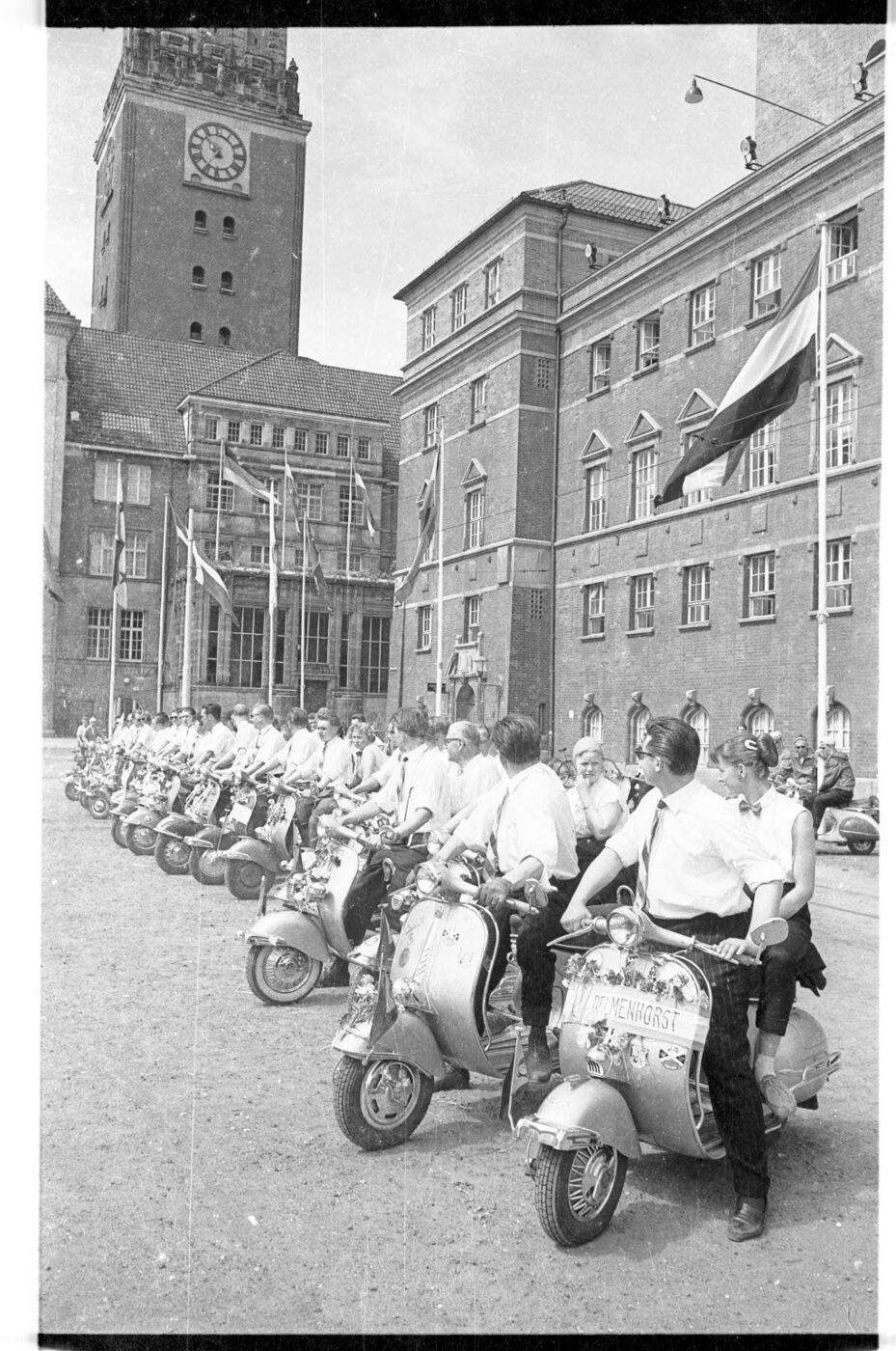
The club movement arrived with the machine and grew faster. Vespa clubs appeared across Europe in the years after the war, and worldwide Vespa Club membership is recorded as having passed fifty thousand by 1952. The German umbrella body, the Vespa Club von Deutschland, was founded in that same year by representatives of the existing regional clubs; among those behind it was Jakob Oswald Hoffmann, whose Lintorf works built Vespas in Germany under licence from Piaggio. Its first president was Ernst-August Prinz zur Lippe, and the delegates elected the racing driver Huschke von Hanstein as sports commissioner and vice-president; the racing driver Hans Stuck held the presidency from 1958 to 1975.
One detail preserves the social register of the thing better than any amount of description. At the club's meetings a dress code applied, and it was enforced: without a suit and tie, or an evening dress, a guest was not admitted to the evening event — the Vespa-Ball. The German scooter of the 1950s was not a rebel machine. It was respectable transport with a formal dinner attached.
.jpg)
The sporting side moved from local events to long-distance racing with European entries on the AVUS circuit in Berlin from the early 1960s. Since the 1990s — which is to say, in exactly the years this group existed — the same body has run the Deutsche Vespa-Sportmeisterschaft, a championship whose rounds are spread through the year and combine speed events, enduro rallies and long-distance runs, and which can cross into neighbouring countries. There are also skill and trial championships. As an umbrella it represented around two hundred local clubs and roughly four thousand riders as of July 2020, publishes a magazine called Vespina, set up a historical register for old machines in 1998, became a corporate member of the ADAC in 2010 and joined Vespa Club Europa in 2021.
Marque clubs exist alongside it — the Heinkel-Club Deutschland for the German machine, the Lambretta Club Deutschland for the Italian rival, and others — and beside all of those sit the marque-independent scooter clubs, whose members call themselves Scooterists or Scooterboys, favour steel-bodied machines with gearboxes, and organise their own meetings, all-nighters and racing. That is a different tradition with a different aesthetic, descended from the British scooter scene of the 1960s rather than from the Vespa-Ball, and the two have coexisted in Germany for decades.
The genres of conversation this produces are predictable and were the same everywhere: where the season's meetings are, who is riding to which one and by what route, what to do about a machine that fails two hundred kilometres from home, whether a club run should wait for its slowest bike. None of that requires invention to describe, and none of it can be attributed to this group in particular, because no archive of its articles has been found.
The scooter in German life
The machines and the marques belong to the alt group's page. What belongs here is the place the machine occupied in ordinary German life, and the reason it lost it.
The West German boom gives the setting. 1955 was the strongest growth year in German history: the economy grew 10.5 per cent in real terms, real wages rose ten per cent, and the stock of motor vehicles increased by nineteen per cent in that single year. In 1948 cars had still been running on wood-gas generators over empty motorways; by 1955 the first holiday traffic jams were forming, the one-millionth Volkswagen Beetle came off the line on 5 August, and the word Wirtschaftswunder became a commonplace. German vehicle production multiplied fivefold between 1950 and 1960.
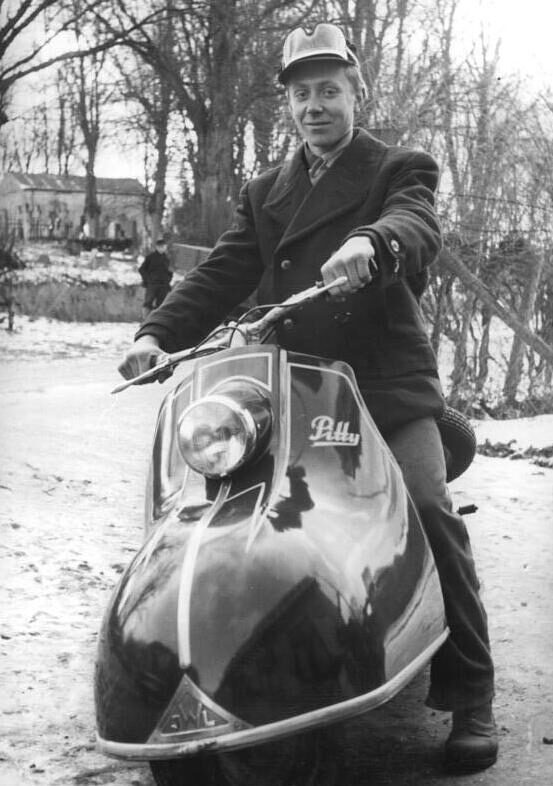
The scooter's place in that was as the first rung. It was the vehicle that motorised people who could not yet afford to be motorised, in the years when the alternative was a bicycle, and it was bought by people in ordinary clothes because it could be ridden in ordinary clothes. The Grossglockner's own traffic history is the cleanest measure of it: for a road built as a scenic route and priced accordingly, the fact that up to a quarter of its traffic in the early years arrived on two wheels says exactly what two wheels were for.

The decline shows up in the same records, and one institution embodies it almost too neatly. The ADAC — today Europe's largest motoring association, with around twenty-one million members — was founded on 24 May 1903 at a hotel in Stuttgart, and it was founded as the Deutsche Motorradfahrer-Vereinigung, an association of motorcyclists. Motorcycles were cheaper than cars, so there were more motorcyclists than motorists, and the motorcyclists' club soon had more members than the established motorists' one. By 1911 the growth in car-owning members had made the name wrong, and it was renamed the Allgemeiner Deutscher Automobil-Club. Its roadside patrol, begun in 1928, ran on motorcycle-and-sidecar outfits, and when the service was rebuilt after the war in 1954 the first fifty-six patrolmen rode sidecar machines. At the end of 1962 the club announced the retirement of the outfits and their replacement by forty suitably equipped Volkswagens. Even the breakdown service stopped arriving on two wheels.
The Grossglockner figures record the same decade from the road: 47,500 motorcycles in 1955, and 2,071 in 1968. What happened to the German scooter market itself over those years — the collapse in registrations, the licence reform, and the firms that survived neither — is set out on the alt group's page and is not repeated here. The short version is the one the toll booth records: inside a decade and a half, two wheels stopped being how ordinary people got about.
What came back was a different thing wearing the same body. By 2003 the Grossglockner was counting more than 76,000 motorcycles a year, well over its 1955 peak, but they were not there because their riders could not afford a car; they were there because riding a pass is a way to spend a Sunday. The scooter of the 1990s came back the same way, on an image rather than on a necessity; the product history of that revival, and the emissions law that ended the two-stroke, are on the alt group's page. What matters for this one is that a room chartered in 1996 to cover scooters in everyday use as a substitute for the car was opening at the moment when, for most of its likely readers, the scooter had stopped being a substitute for anything. The touring and the meetings were no longer the leisure fringe of a transport subject. They were the subject.
The tradition has outlasted the group's own era without difficulty. The Vespa Alp Days have been held at Zell am See — thirty kilometres north of the Grossglockner and next door to Bruck, where the toll road begins — since 2010, which is six years after the gateway that produced this directory shut down.
Why this address still matters
There is a plain and slightly odd reason this page exists at all, and it deserves stating precisely rather than impressively.
The backlink export held for this address contains fourteen rows. All fourteen resolve: every target returns HTTP 200, none is recorded as lost, and none is flagged as spam. They come from fourteen distinct pages. Those fourteen pages sit on one host — the site of a German two-wheeler dealer. The de.alt twin carries twelve more from the same host. That is fourteen links from one domain, not links from fourteen sites, and the distinction is the whole of the fact: a single site's link pages, listing scooter resources, happen to include two 1990s Usenet addresses among them.
It is worth being clear about what that measures. It measures what one crawler found on one site. It does not measure readership, it does not measure traffic in the group, and it certainly does not measure the group's standing in 1997. What it does measure, and the only thing it does, is that somebody in the German two-wheeler trade once thought a Usenet scooter group was a resource worth listing, and that the listing was never taken down. Two decades of link rot have removed almost everything else that pointed at either address; a dealer's resource page did not get around to it.
That is a thin thread, and it is an honest one. It is also the reason both halves of this pair are preserved here rather than one. A directory that kept only the group with the ballot and the surviving namespace entry would lose the more interesting half of the story, which is that the same subject had two rooms with nearly the same charter, opened by two different people through two different procedures, fourteen months apart — and that the one that took the trouble to hold a vote is the one still in the file.
What the record does not show
The list of what is not known about this group is longer than the list of what is, and it is set out here rather than papered over.
- No article from the group has been located. Not one. Nothing here describes a thread, a participant, a dispute or an opinion held in de.rec.motorroller, because no such material was found.
- No traffic figure of any kind is available: not subscriber counts, not article counts, not a date of last posting. The namespace and active files record that the group exists and is unmoderated; they carry placeholder article numbers for every group in them.
- The texts of the two Requests for Discussion, the two Calls for Votes and the result are not in the control archive, which mirrors control messages only. Their dates and identifiers survive because the creation message cites them; their contents do not, apart from the result summary reprinted inside the creation message itself.
- The full voter list required by the hierarchy's rules — every name, address and vote — is therefore also missing here. One hundred and ninety-five valid votes were cast; not one of the voters can be named from the material consulted.
- Why fifty-seven people voted against the group is not recorded in anything found for this page.
- Whether the rec proposal was prompted by the existing alt room, by dissatisfaction with it, by its emptiness, or by nothing to do with it at all, is not established. The reused charter text shows copying; it does not show motive.
- Whether the two proponents knew each other, corresponded, or were the same circle of people is not established either.
- Whether the group carries traffic today is not known. It is listed. Listing is not traffic.
- Nothing has been found about how the German dealer's link pages came to point here, or when.
None of this is unusual. A Usenet group's administrative life is documented by design, because control messages are archived and the hierarchy publishes its own procedure; its actual conversation is documented only by accident, because somebody's archive happened to survive. For most groups in this catalogue it did not.
Scope and limits
The group-specific facts above come from two files and one archive. The creation of de.rec.motorroller, the identifiers and dates of its Requests for Discussion, Calls for Votes and result, its vote count, its charter, its short description, the senders and signature coverage of its control messages and the forged removals of 2001 all come from the Usenet control-message archive mirrored by the Internet Systems Consortium, which quotes itself exactly and is the primary record for such things. The current namespace entry and posting status come from the reference newsgroups and active files distributed from the same source and fetched in August 2026. The German quotations are reproduced as they appear, with the umlauts transliterated as the hierarchy itself transliterated them.
The procedural framework — what an RfD is, how the moderation is elected, why de.alt.* is exempt from all of it — is documented on the de.* hierarchy page and is summarised here only far enough to make this group's paperwork legible. The machines, the marques, the German vehicle and licence classes, the insurance-plate system, restoration, parts and the emissions story are documented on the de.alt.motorroller page and are deliberately not retold. The other German-language groups in this catalogue are de.alt.augenoptik on eyes and spectacles, de.sci.genealogie on family history and de.talk.liebesakt.
The road law, the network lengths, the Alpine passes and their seasons, the holiday routes, the vignette systems, the helmet and clothing standards, the club history and the economic figures come from standard reference works and were checked item by item; where a date of decision and a date of entry into force differ — as with the Swiss vignette, decided by referendum in 1984 and introduced in 1985 — both are given rather than one standing in for the other. The Grossglockner traffic counts are the road's own published figures as reported in those works.
What no source consulted here supplies is the group's interior. This article describes the world the group was chartered to discuss and the administrative record of its existence; it does not reconstruct its conversations, and where it describes genres of discussion it describes them as genres common to the subject rather than as things known to have happened in this room. Corrections from anyone who read the group are welcome, and would be the only way most of the gaps listed above will ever be filled.
Reading de.rec.motorroller today
- Historical archive: Google Groups — de.rec.motorroller (coverage varies by group and era).
- Open in a newsreader:
news:de.rec.motorroller— the original site offered exactly this link, and it still works if your system has a newsreader registered for thenews:scheme. - Live access: point an NNTP newsreader at a modern server — see accessing Usenet today.
- The original news2mail e-mail subscription service ended in the mid-2000s and no longer operates.