rec.arts.sf.written.robert-jordan
Robert Jordan’s Wheel of Time.
Book-by-book analysis of the Wheel of Time as it was being published — prophecy-parsing, timeline reconstruction and theory threads (Asmodean’s killer, most famously) pursued across the gaps between volumes.
The group’s FAQ — the WOTFAQ, created for it and handed on in 2010 to editors at Dragonmount — is the part of that work with a documented life outside Usenet.
On this page
- The paperwork, and for once it is complete
- Two proposals, eight months apart
- The name, and the two other Jordans
- The traffic argument
- The vote
- Two names in a hundred and three
- The alt.* route, not taken
- The series, dated
- Publication pace, and what it does to a discussion group
- Forms of amateur textual scholarship
- The FAQ as an institution
- Spoilers, and a book that had not been written yet
- The author and the network
- Two control messages that did nothing
- What the record does not show
- Scope and limits
The paperwork, and for once it is complete
Most of the groups in this directory left almost nothing behind. Their charters survive as a single line in a distribution file, their arguments survive nowhere at all, and an honest page about them is mostly a page about the world they belonged to. rec.arts.sf.written.robert-jordan is the exception. Because it was a Big-8 group, its creation had to be conducted in public, in writing, in a moderated group whose contents the Internet Systems Consortium still mirrors; and because nobody has ever tidied that mirror, the whole file is there.
The proposal file at ftp.isc.org/pub/usenet/news.announce.newgroups/rec/rec.arts.sf.written.robert-jordan runs to just over sixty kilobytes and holds six documents in sequence: a Request for Discussion of November 1993 for a differently named group; a second Request for Discussion of June 1994 under the name that was eventually used; one posting from the naming argument in news.groups; a first and a last Call for Votes; and the result, complete with the roll of everyone who voted and how. The companion archive of control messages, at ftp.isc.org/pub/usenet/control/rec/rec.arts.sf.written.robert-jordan.gz, holds five messages: the newgroup message that actually created the group, dated 27 July 1994, two identical reissues of it over the following month, and two later messages that did nothing at all.
Set out in order, with the dates the files themselves carry:
- 5 November 1993 — RFD for rec.arts.books.robert-jordan, posted by Doug Moran. Never went to a vote.
- 8 June 1994 — RFD for rec.arts.sf.written.robert-jordan, posted by Bill Garrett of the computer science department at UNC Chapel Hill.
- 24 June 1994 — a posting from the naming discussion in news.groups, preserved in the file because it settled a recurring question about what the letters sf stand for.
- 29 June 1994 — First Call for Votes, issued by Brennan T. Price for the Usenet Volunteer Votetakers.
- 11 July 1994 — Last Call for Votes, superseding the first and carrying a bounce list of voters whose acknowledgements had failed.
- 21 July 1994 — RESULT: passes 406:71.
- 27 July 1994 — newgroup control message, issued by David C. Lawrence as moderator of news.announce.newgroups.
The charter that the Call for Votes put before the electorate, and that the newgroup message then reproduced verbatim, reads in full:
rec.arts.sf.written.robert-jordan is for the discussion of books by contemporary author Robert Jordan (actually a pseudonym for James Oliver Rigney, Jr). In particular, this newsgroup will be concerned with his ongoing "Wheel of Time" series, but will also cover past and future works by him.
The newsgroups line was fixed at the same moment. In the file it is the group name, a tab, and the description a newsreader shows beside it: rec.arts.sf.written.robert-jordan followed by Books by author Robert Jordan.
That line has not changed since. It appears in the First Call for Votes of 29 June 1994, in the Last Call of 11 July, in the result of 21 July, in the newgroup message of 27 July, and — unaltered, full stop and all — in the newsgroups file the Internet Systems Consortium distributed on the day this article was written, thirty-two years later. Very little else about the group has survived that intact.
Two proposals, eight months apart
The first attempt was not made from within the science fiction branch at all. On 5 November 1993 Doug Moran posted a Request for Discussion for rec.arts.books.robert-jordan, cross-posted to rec.arts.books, rec.arts.sf.announce, rec.arts.sf.misc and rec.arts.sf.written. Its rationale was already the argument that would carry the day the following summer: "For the last several months, a significant proportion of the traffic in rec.arts.sf.written has been concerned with various discussions relating to the works of Robert Jordan."
Moran's proposal was unusual in being frank about what it did not know. Rather than defending a placement, it invited the network to choose one, listing rec.arts.books.robert-jordan, rec.arts.sf.robert-jordan and rec.arts.sf.written.robert-jordan as candidates and asking for opinions; it also asked whether the shorter form rec.arts.books.jordan might be preferred. The precedent it leaned on was rec.arts.books.tolkien, which had passed its own vote on 26 March 1993 and which, as the RFD put it, the proposed group would be juxtaposed with in the books branch rather than the speculative-fiction one.
Nothing followed. The archive contains no Call for Votes for rec.arts.books.robert-jordan and no withdrawal notice; the thirty-day discussion period simply lapsed, as it did for a great many 1990s proposals whose proponents ran out of energy before the paperwork ran out of stages. The reason the file is worth reading anyway is that it shows the second proposal starting from a settled question rather than an open one.
That second proposal arrived on 8 June 1994, from Bill Garrett. It was cross-posted only to news.announce.newgroups, news.groups and rec.arts.sf.written — a narrower distribution, aimed at the group whose traffic was the problem — and it opened with the compact header block that the guidelines of the period asked for: name, status unmoderated, distribution world-wide, summary "books by contemporary author Robert Jordan", proposed by Bill Garrett. Its closing line is a fair sample of the register in which Usenet's constitutional documents were written: "This RFD has been written in accordance with the Guidelines for Usenet Group Creation and has been brought to you by the letter Q."
The name, and the two other Jordans
Garrett's RFD devoted a section to naming, and the reasoning is worth preserving because the namespace has since proved him right in a way he cannot have intended.
He set out three live options. Placing the group under rec.arts.sf.written signalled that the discussion concerned written speculative fiction and marked the new group as, in his phrase, "a relief valve for an overburdened r.a.sf.w group". Placing it under rec.arts.books instead would sit better with the fact that the author's output was not confined to fantasy — the RFD notes westerns, international intrigue and historical fiction, as well as literary reviews and criticism — and would avoid adding another five-level group to the rec.arts.sf tree. And a third camp simply wanted the name shortened to jordan. On that last point the RFD is unambiguous:
We think the longer name is necessary to distinguish the group from other possible meanings of "jordan", such as American sports star Michael Jordan and the Middle-East country of Jordan. Note that the subname robert-jordan conforms to Usenet name length standards.
Both of the collisions he anticipated are in the current namespace. The distribution file lists soc.culture.jordan, described as "All topics concerning The Hashemite Kingdom of Jordan.", which is exactly the Middle-Eastern ambiguity he named. It also lists alt.fan.robert-jordan — an alt.* group carrying the full two-part name — whose description reads, in its entirety, "Baseball's most popular minor leaguer." The other Jordan got in anyway, under the longer name, in the hierarchy where nobody checks.
The naming argument also produced the one piece of ordinary discussion the archive preserves. On 24 June 1994 Stephen Graham, replying in news.groups to a suggestion that the group belonged under a fantasy label rather than an sf one, gave the standard answer of the branch, and gave it twice:
No.
Longer, more polite explanation: the sf in rec.arts.sf.written stands for Speculative Fiction. SF includes both science fiction and fantasy. Yes, we realize that this isn't as clear as it might be. When the groups were formed, no-one could think of a better abbreviation.
He added that the fantasy-versus-science-fiction split was a long-standing topic in the hierarchy, that no two people were able to agree where the line fell, and that the consensus in rec.arts.sf.* was that no such split was possible without massive problems. The proposal stayed where it was.
The traffic argument
The case for the group was not made on literary merit and was not, in the end, made on enthusiasm. It was made on measurement, and the measurement is in the file.
Garrett counted articles. For the month of 1 May to 31 May 1994 he recorded a weekly average of 1,027 articles arriving at his site for rec.arts.sf.written, of which an average of 212 a week concerned Robert Jordan's series directly, and a further 20 a week concerned the argument about moving that traffic somewhere else. He was explicit that this was a quiet period: he estimated, without hard numbers, that Jordan discussion had exceeded two thirds of a stream of more than 150 messages a day for several months in the autumn of 1993, following the release of that year's volume. The Call for Votes restated the same finding in monthly terms — sustained traffic of about 1,000 articles a month relating directly to Robert Jordan, with gusts as high as 2,000 immediately after a new book.
Beside the article counts, Garrett recorded three other facts about a readership that had already organised itself before it had an address. He had run a straw poll in rec.arts.sf.written and received 141 responses, 125 in favour of the new group and 16 against. Mailing lists devoted to the subject already existed on the Internet, on AOL and elsewhere. And, most consequentially for everything the group afterwards became, the readers had for more than a year been maintaining a Frequently Asked Questions document of their own, which by his account already included contributions from over a hundred people.
The RFD then took on the objection it knew was coming, which was not about traffic but about principle: that a newsgroup for one living author is a bad shape for a namespace, because the subject may not last. Garrett's answer was that the traffic had already lasted almost two years, that the series would not be finished for at least another two based on word from the author and his publisher, that discussion would not stop when it was, and that the author would go on writing — here he paraphrased a remark of Jordan's — "until they nail his coffin shut." He was right that the series had at least two more years to run. It had eighteen and a half, and he was right about the discussion as well.
The vote
The mechanics of a Big-8 vote are described at hub level on the soc.* page and are not retold here; what follows is only this group's instance of them.
Brennan T. Price took the vote as a neutral third party for the Usenet Volunteer Votetakers, running the tallying program UseVote 3.0. The First Call for Votes went out on 29 June 1994 and the Last Call on 11 July, the second superseding the first by Message-ID. Ballots were cast by electronic mail, on a form the voter was instructed not to alter, carrying a per-call token — the first call's ballots were stamped RASFWRJ-0001, the second's RASFWRJ-0002 — and requiring a real name, without which the vote would be rejected. Voting closed at 23:59:59 UTC on 20 July 1994. The Last Call also carried a bounce list of seven voters whose acknowledgements had failed to reach them, published so that they would know not to vote a second time.
The result was posted on 21 July 1994. There were 406 YES votes and 71 NO votes, for a total of 477 valid votes, plus 2 abstentions and 11 ballots rejected as invalid. The rejection notes are itemised in the file, and they are all clerical: no ballot enclosed, no vote statement in the message, no name or no real name given, an invalid address. The result then restated the two thresholds it had to clear — at least two thirds of valid votes in favour, and at least 100 more YES votes than NO — and observed, correctly, that both had been met. 406 against 71 is a margin of 335 and a share of 85 per cent.
As the procedure required, the result was followed by a five-day period in which irregularities could be alleged. None were. The newgroup control message went out on 27 July 1994 over the signature of David C. Lawrence, then moderator of news.announce.newgroups, and consisted, as such messages did, of a statement of the vote, the newsgroups line for administrators to paste into their files, and the charter "culled from the call for votes".
One feature of the result deserves noting for what it says about the period rather than about this group. The document publishes every voter's electronic mail address and real name, sorted, in four lists: voted yes, voted no, abstained, and votes in error — the last with the reason for each rejection printed beside the name. That was the transparency rule of the time; a tally nobody could audit was a tally nobody trusted, and it is why the file is sixty kilobytes rather than six. Those hundreds of names are not reproduced here.
Two names in a hundred and three
The RFD's own framing was that a single-author group was an unusual thing to ask for. The distribution files let that be checked rather than asserted.
The newsgroups file the Internet Systems Consortium currently distributes lists 659 groups under rec.*, of which 103 sit under rec.arts.*. Of those 103, exactly two carry the name of an individual writer: rec.arts.books.tolkien, described as "The works of J.R.R. Tolkien.", and rec.arts.sf.written.robert-jordan. The nearest thing to a third is rec.arts.wobegon, which is named not for Garrison Keillor but for the fictional town in his radio programme. Under rec.arts.sf.written itself there is exactly one subgroup, and this is it — the branch that the RFD described as overburdened never subdivided again.
The proposal archive explains why. Three author-specific groups were ever proposed under rec.arts.sf.written, and their files sit next to one another on the same server:
- rec.arts.sf.written.robert-jordan — RFD June 1994, passed 406:71 on 21 July 1994.
- rec.arts.sf.written.m-lackey — RFD 6 March 1996, second RFD 18 June 1996, for a group described as "The books and worlds of Mercedes Lackey." The file contains no Call for Votes and no result. It stopped at the discussion stage.
- rec.arts.sf.written.frank-herbert — first RFD 26 February 1997, two Calls for Votes, and a result of 5 May 1997: fails 116:36.
The Herbert result is the instructive one, because it failed on the arithmetic rather than on the argument. 116 yes votes out of 152 valid is a shade over 76 per cent, comfortably past the two-thirds bar; but 116 minus 36 is 80, and the rule required a hundred. The same thing had happened the previous year to a related proposal in the same corner of the namespace: rec.arts.sf.dune failed on 13 June 1996 by 142:48, and its result prints the two tests side by side in a little table, with "Yes" in the two-thirds column and "No" in the hundred-vote column. Both proposals had large majorities. Neither could assemble a large enough electorate for the majority to count.
The picture in the sibling books branch is the same shape. rec.arts.books.tolkien passed 488:109 on 26 March 1993 after three Calls for Votes. rec.arts.books.authors.anne-rice failed 127:103 on 7 September 1994 — and failed both tests at once, since 127 of 230 valid votes is 55 per cent and the margin was 24. rec.arts.books.orson-s-card got an RFD on 12 December 1995 and nothing else. Set against those, a single-author proposal clearing 406:71 at the first attempt is a genuinely unusual result, and the plainest measure of how much traffic the subject was generating in 1994. Every author-specific proposal that followed it in these two branches either failed at the ballot or never reached one.
The alt.* route, not taken
There was of course another way to get a group, and almost every author fandom used it. The alt.* hierarchy required no Request for Discussion, no votetaker and no hundred-vote margin: it required someone to send a newgroup control message and enough administrators to honour it. The current distribution file lists 85 groups under alt.books.*, the large majority of them named for a single writer — Asimov, Bradbury, Bukowski, Chesterton, Clarke, Crichton, Dick, Follett, Grisham, Joyce, King, L'Amour, Lackey, Nabokov, Niven, Orwell, Pratchett, Pullman, Pynchon, Vonnegut, Wells, Zelazny and some forty others — and 1,984 groups under alt.fan.*. The alt.books.arthur-clarke page in this directory covers that route and that author.
What is missing from the alt.books.* list is instructive: there is no alt.books.robert-jordan and no alt.books.jordan. This fandom went straight to the Big-8 procedure and passed it. The only alt.* groups in the file that carry the name are alt.binaries.fan.robert-jordan, whose description is truncated mid-word in the distribution file at "Binaries related to Robert Jordan's 'Wheel of T", and the mislabelled alt.fan.robert-jordan already mentioned.
Both of the later rec.arts.sf.written proposals were explicit that they were trying to escape alt.*, and their reasons are a useful period document. The Mercedes Lackey RFD argued that its existing alt.books.m-lackey group "has begun to lose current as well as potential subscribers due to the practice of many news servers dropping the alt.* hierarchy", and added that there were difficulties in propagating a busy newsgroup in the alt hierarchy. The Frank Herbert RFD of 1997 put it less diplomatically: a venue outside alt.* was needed because "alt.* groups have an awful signal-to-noise ratio with massive spamming and have a more limited audience than the rec.* hierarchy".
That was the trade. A Big-8 group cost a month of argument, a month of voting and a hundred net supporters, and bought carriage on the great majority of news servers plus the presumption that the name meant what the charter said. An alt.* group cost nothing and bought whatever propagation you could get. For a subject generating a thousand articles a month, the Big-8 price was worth paying; the hierarchy's own history is told on the rec.* page.
The series, dated
The bibliography of The Wheel of Time is easy to get wrong, chiefly because the prequel is often filed by internal chronology rather than by publication date and because the final three volumes are sometimes counted as one. Publication dates for the first United States editions from Tor Books, in the order they reached shops:
- The Eye of the World — 15 January 1990
- The Great Hunt — 15 November 1990
- The Dragon Reborn — 15 October 1991
- The Shadow Rising — 15 September 1992
- The Fires of Heaven — 15 October 1993
- Lord of Chaos — 15 October 1994
- A Crown of Swords — 15 May 1996
- The Path of Daggers — 20 October 1998
- Winter's Heart — 7 November 2000
- Crossroads of Twilight — 7 January 2003
- New Spring (prequel) — 6 January 2004
- Knife of Dreams — 11 October 2005
- The Gathering Storm — 27 October 2009
- Towers of Midnight — 2 November 2010
- A Memory of Light — 8 January 2013
Fourteen numbered volumes plus the prequel novel, which began life as a novella in the 1998 anthology Legends before being expanded. The sequence was originally planned as a trilogy; work on the first volume began in 1984 and the scope expanded from there. Robert Jordan was the pen name of James Oliver Rigney Jr., born in Charleston, South Carolina on 17 October 1948, a Vietnam veteran who served two tours as a helicopter gunner, and a graduate in physics of The Citadel who had worked as a nuclear engineer for the United States Navy before turning to fiction in 1977. His editor, and from 1981 his wife, was Harriet McDougal.
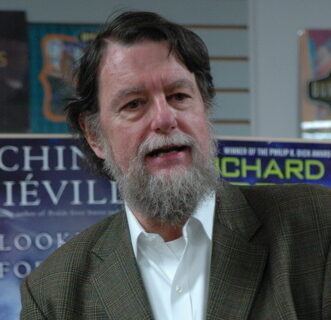

On 23 March 2006 Jordan disclosed a diagnosis of cardiac amyloidosis and a median life expectancy, with treatment, of four years. He died on 16 September 2007, with the concluding volume unwritten but extensively noted. On 7 December 2007 Tor announced that Brandon Sanderson would complete it; on 30 March 2009 the single planned final book was announced as three, and they appeared between October 2009 and January 2013, the last of them keeping Jordan's title. A reference volume assembled from Jordan's notes, The Wheel of Time Companion, followed on 3 November 2015. The completed sequence was nominated as a single work for the 2014 Hugo Award for Best Novel, credited jointly to Jordan and Sanderson, under an interpretation of the rules confirmed by the World Science Fiction Society permitting a multi-part work to be nominated whole so long as no individual part had ever been on the shortlist.
The television adaptation, developed by Rafe Judkins for Amazon Prime Video, premiered on 19 November 2021, ran to three seasons, aired its last episode on 17 April 2025, and was cancelled the following month. By then the newsgroup had been quiet for the better part of two decades, and the adaptation belongs to this article only as the last dated item in a sequence the group was created in the middle of.
Publication pace, and what it does to a discussion group
The interesting number in that list is not the total but the spacing, because the spacing is what produced the group's characteristic behaviour.
The first six volumes appeared in fifty-seven months, from January 1990 to October 1994, at intervals of ten to thirteen months. That is roughly the cadence of a serial: a reader who finished one book had a year to wait, which is long enough to speculate and short enough that speculation stays cheap. The newsgroup was created on 27 July 1994, under three months before the sixth volume, which means it came into existence precisely at the point where the cadence broke.
What followed was nineteen months to the seventh volume, twenty-nine to the eighth, a little over twenty-four to the ninth, twenty-six to the tenth and thirty-three to the eleventh — relieved only by the prequel, which arrived a year into that last gap — and then, after the author's death, forty-eight months to the twelfth. From 1994 to 2005 the group's subject was a corpus that grew by one substantial instalment roughly every second year and did not change at all in between.
That is an unusual condition for a reading community and it has predictable effects. A closed corpus with no new evidence rewards the re-reader over the fast reader, because the only way to bring anything new to a two-year-old argument is to find something in a book everybody has already read. It rewards precision, because a claim can be checked against the page. It rewards systematisation, because the corpus is large enough that nobody can hold it in memory and somebody therefore has to index it. And it converts disagreement into a durable structure rather than a passing exchange: an argument that cannot be settled by the next chapter, because the next chapter is two years away, becomes a position with adherents, a literature and a name.
Every one of the group's documented practices follows from that. What looks from outside like obsessiveness is, structurally, what a large readership does when it is given a great deal of text, a great deal of time, and no new information.
Forms of amateur textual scholarship
The group's methods can be described precisely, because the document it produced survives with its apparatus intact. Five recognisable scholarly techniques are visible in it, arrived at independently by people who mostly were not scholars, together with the kind of question that called them into being.
A citation standard
The FAQ printed its convention at the head of the document: "Standard Reference Format: [Book Abbreviation: Chapter Number, Chapter Name, Tor HC page number]". Book abbreviation, chapter number, chapter title and the page in the Tor hardback. Fixing on the hardback pagination was the substantive decision — it gave everyone a single physical edition to point at, in a fandom reading across hardbacks, paperbacks and several territories, and it made an assertion checkable by a stranger. A community that agrees on a citation format has stopped exchanging opinions and started building a shared apparatus.
Concordance and search
Before full-text search of anything was ordinary, the fandom built its own. The FAQ's credits thank Daniel Posey for a search engine over the series, which the editor described, with feeling, as her "Sanity Flotation Device". The function it served is the function a concordance serves: it converts "I think somebody says this somewhere" into a citation, and it makes negative claims possible, which is the harder and more valuable half.
Internal chronology
A separate contributor, Steven Cooper, maintained a chronology of the series — the reconstruction of a single consistent internal timeline from narrative that jumps between simultaneous storylines in different places. The FAQ credits it as "comprehensive and endlessly useful". This is straightforwardly the work of establishing a chronology from a source that does not present events in order, and it is done for the same reason: because a great many other questions cannot be posed until you know what happened before what.
Prophecy collation
An entire top-level division of the FAQ, section 4, was given over to prophecy, in seven parts: Egwene's Dreams, Min's Viewings, Miscellaneous Prophecies, The Dark Prophecy, The Karaethon Cycle, Perrin's Dreams and Fourth Age Histories. The section's stated method was to list the prophecies and visions as they had appeared in the books and to discuss, after each, what it meant or might mean. A prophecy in an unfinished series is a promissory note, and a corpus of them, collated and cross-referenced, is a set of constraints on every subsequent theory. Collating the scattered oracular passages of a text and testing later events against them is one of the oldest exercises in textual commentary; here it was being done to a fantasy series in progress, by post, by hundreds of people.
Source-hunting
Section 3, headed "Sources of Knowledge" in the contents and "Trivial Pursuits: References, Sources, Allusions and Parallels" at the top of the section itself, was a comparative-mythology apparatus in fourteen articles: Judeo-Christian and biblical parallels, Norse mythology, Greek and Roman mythology, Celtic myths, Arthurian legend, the Fisher King, dragon legends, Asian influences, Shadowspawn, miscellaneous references, similarities with other science fiction including Dune, the question of whether the setting is a future Earth, the Aiel set beside Native Americans and the Zulu, and the real nations behind the invented ones. This was the one part of the document for which the editor accepted submissions by private mail instead of requiring prior discussion in the newsgroup — a distinction that looks very like the difference between a fact and a theory.
The unanswerable question
And then there were the questions of fact within the fiction that the text posed and did not resolve. The most famous of them concerned the death of the character Asmodean, killed by an unidentified assailant at the end of the fifth volume in 1993 and left unattributed for years afterwards. That this was a real and widely argued question, rather than a retrospective legend, is documented by the FAQ's own structure: it occupied a numbered article, 1.1.6, "The Death of Asmodean", inside section 1.1, "The Forsaken: The Old Guard". It is also documented by the FAQ's defence of its own accuracy, in which Bill Garrett — the same person who had written the RFD — explained why a compendium of contested answers is useful even when most of the answers are wrong:
Of course the FAQ isn't 100% correct. Much of it is devoted to describing opposing viewpoints on key questions. For example, consider the "Who killed Asmodean?" entry. Numerous theories are presented, but at most one of them is correct and the rest are wrong -- unless Asmodean was killed by a posse consisting of various Forsaken, Myrddraal, darkfriend Aiel, Padan Fain, and Bela.
No particular answer, and no particular thread or advocate, is attributed here; the point of record is the form. A named, numbered, multi-position article on a question the text had left open, maintained across successive editions of a reference document, is the shape amateur textual scholarship takes when it is done in public over a decade.
The FAQ as an institution
Usenet FAQs were not, as the name now suggests, a page of housekeeping. In their developed form they were maintained documents with named editors, version numbers, contributor rolls, copyright statements, posting schedules and succession. The general mechanism — news.answers, the periodic-posting machinery and the archive that collected them — belongs to the news.* page and is not retold here. What belongs here is that this group's FAQ was one of the more elaborate of its kind, and that unusually much of its internal record survives. Its own expansion of its initials was "the Wheel of Time Wondrous Masterpiece of Assembled Knowledge, Theories, and Discussion".
It predates the group. Garrett's RFD of June 1994 notes a Robert Jordan FAQ maintained on rec.arts.sf.written "for more than a year" with contributions from over 100 people, and the document's own later web incarnation carried the standing line "Serving the Pattern since 1993". Two independent sources, sixteen years apart, agree on the date.
Its editorship was formalised to the point of parody, with offices named after institutions in the books. The credits of the 2004 edition list a Keeper of the Chronicles for the FAQ maintainer and HTML implementation, a Defender of the Dragonwall for the site maintainer, a Master of the Blades for the original site design, and a Mother of the FAQ for the originator, with the working editor styled the FAQueen. The named holders were Erica Sadun as originator, Pam Korda as site maintainer and FAQueen Emeritus, Matthew Hunter for the original design, and Leigh Butler as editor, in post for every edition from January 2003 onwards. The copyright line of the 2004 edition reads: "The Wheel of Time FAQ. Copyright 2004 by Leigh Butler, Pamela Korda and Erica Sadun." Individual contributors retained copyright in their own contributions, as cited in the text — an attribution model closer to an edited collection than to a fan page.
Its editorial policy was written down and was strict about provenance. The 2005 front page states the rule plainly:
The WOTFAQ is (almost) exclusively based on discussion in the Usenet group rec.arts.sf.written.robert-jordan, with the emphasis on "discussion". If you have a thought or theory about WOT that you think should be in the FAQ, you are invited to join the newsgroup and post your theory there. If it generates sufficient discussion and/or consensus, it will probably get added to the FAQ during the next update.
As a general policy, I do not accept or use theories which have not been thoroughly discussed in the newsgroup, so emailing them to me alone is basically a waste of your time.
That is a peer-review rule. Nothing entered the reference document that had not survived public argument in the group first, and the editor declined submissions precisely because they had not. It also explains the update cycle, which was tied to the publication schedule rather than the calendar: asked when the next edition would appear, the editor answered that she first had to collect the new book's discussion, theories and trivia from the newsgroup, "which usually takes a couple of months to die down after the release date", and then do the update itself.
Its scale can be read off its own front matter. The edition of June 2004 was version 7.1, succeeding a version 6.0 of January 2003; the 2010 successor was version 8.0. The top-level divisions were 0 Administrivia, 1 The Dark Side, 2 Things Not Necessarily of the Dark, 3 Sources of Knowledge, 4 Prophecy and 99 Publishing Stuff, running to about a hundred and fifty numbered articles between them. The contributor roll printed in the introduction runs to more than four hundred names in a single alphabetical list, among them Patrick Nielsen Hayden of Tor Books; Bill Garrett, who had written the RFD; Stephen Graham, who had explained what sf stood for; and — as a credit line rather than as evidence of participation — "Robert Jordan (duh.)".
Spoilers, and a book that had not been written yet
A group discussing a series in progress has a problem that a group discussing a finished one does not: at any moment its readers are at different points in the same text, and the group's most valuable content is precisely the content that ruins the book for whoever has not got there yet. Usenet had worked out conventions for this before the group existed, and the conventions were written down.
The canonical statement is in RFC 1855, Netiquette Guidelines, published as FYI 28 in October 1995 by Sally Hambridge of Intel — an informational document rather than a standard, which describes rather than invents the practice. Two adjacent bullet points in its Usenet section cover the ground:
Some groups permit (and some welcome) posts which in other circumstances would be considered to be in questionable taste. Still, there is no guarantee that all people reading the group will appreciate the material as much as you do. Use the Rotate utility (which rotates all the characters in your post by 13 positions in the alphabet) to avoid giving offense. The Rot13 utility for Unix is an example.
In groups which discuss movies or books it is considered essential to mark posts which disclose significant content as "Spoilers". Put this word in your Subject: line. You may add blank lines to the beginning of your post to keep content out of sight, or you may Rotate it.
Three mechanisms, then, in ascending order of protection: the word in the subject line, so that a threaded newsreader could skip the article unopened; blank lines at the head of the body, so that a screenful of nothing stood between the reader and the disclosure; and rot13, a trivially reversible substitution that no newsreader would decode by accident and every newsreader could decode on request. None of them is a security measure and all of them work, because they require the reader to make a deliberate second gesture before seeing the text.
That these conventions were live in this corner of the namespace, and not merely in an RFC, can be shown from the branch's own paperwork. The charter proposed in 1997 for the neighbouring rec.arts.sf.written.frank-herbert group wrote the practice into the group's constitution: "Please use keywords such as book titles and 'SPOILER' whenever appropriate." The rec.arts.sf.dune charter of the year before carried the same clause in shorter form. Subject-line marking was considered a charter-level obligation, not a courtesy.
The Wheel of Time FAQ solved the same problem at document scale, and its solution is the more revealing one. Each edition declared its spoiler horizon at the top: the 2004 edition warned that it contained spoilers for all books up to and including the tenth, Crossroads of Twilight, and the 2010 edition up to and including the twelfth, The Gathering Storm. Crucially, superseded editions were not deleted. The 2004 introduction points readers to earlier versions of the FAQ from before the tenth volume, described as having "no spoilers, but some out-dated theories" — a reference work deliberately maintained in parallel editions, each frozen at a different point in the source text, so that a reader could consult the state of scholarship as of the last book they had read. That is an editorial response to serial publication that a good many professional reference publishers never attempted.
The author and the network
It is tempting, writing about a single-author group, to assume the author was in it. On the evidence, he was not, and the fandom's own reference document says so in as many words.
The FAQ carried a standing article, numbered 0.09, headed "How can I contact Robert Jordan?" Its first line is a flat sentence of six words: "RJ is not on the net." The rest of the article directs readers to write to the author care of Tor Books at the Fifth Avenue address printed on the copyright page, notes that Tor forwarded such mail and had been known to forward printed-out copies of electronic mail received for him, and warns that the publisher's own FAQ said "Don't send us email meant for our authors", so the reader was taking their chances. That is the whole of the documented channel: a postal address and a publisher's goodwill.
What the record does establish is engagement of other kinds, at other times. The FAQ's own defence of its accuracy turns on a remark of the author's about the FAQ itself — his standard comment, as the document reports it, was that it was "about one-third correct, one-third close but not quite, and one-third dead wrong", a line the FAQ sources to a signing in Charleston, South Carolina on 21 June 1996, reported by an attendee, Brian Ritchie. That is the characteristic circuit of the period: the author speaks at a bookshop, a reader takes notes, the notes are posted, and the posting becomes a citable source in the reference document. It also establishes that he knew the FAQ existed and had a settled opinion of it.
He also granted permission to at least one online project. A multi-user dungeon based on the setting, in operation almost continuously since 1993, had written permission from the author to use his creation, excepting the major characters. And in his last years he did come online directly, writing a weblog hosted by the fan site Dragonmount: his diagnosis was made public on 23 March 2006 in a letter published elsewhere, and he used the weblog the next day to tell readers not to worry about him, returning to it later on subjects ranging from his treatment to his Vietnam service. None of that is newsgroup participation, and none of it should be read backwards into the group's first decade.
The honest summary is that between 1994 and roughly 2005 the group conducted its argument in the certain knowledge that its subject was not reading it and could not be appealed to — which is, incidentally, one more reason the argument took the form it did. When the author cannot be asked, the text is the only witness, and a community that wants an answer has to learn to read.
Two control messages that did nothing
The control archive holds five messages for this group, and only the first three did anything.
The newgroup message of 27 July 1994 was reissued twice more by the same authority, on 11 August and 19 August 1994, with identical bodies — routine practice, since a site that had been down or badly fed during the first pass would otherwise never learn the group existed.
Then, on 22 August 1997, a newgroup message for the group arrived from the news account of a university server in the United States, with the body "Control message generated by Netscape Collabra Server." and the organisation line "Another Netscape Collabra Server User". It is best read as a local server emitting a control message it should have kept to itself.
The last, dated 4 November 2001, is a removal request. It carries a From line naming the maintainer of a well-known Unix newsreader project, an Approved line to match, and a one-line body: "please remove the bogus newsgroup rec.arts.sf.written.robert-jordan". Several things about it do not hold up. It was posted through a Quebec consumer service provider. It was cross-posted to rec.config, rec.control and rec.groups, none of which appears in the newsgroups file the hierarchy distributes. Its signature block is a line of nonsense: "Hardly any units will be blank hollow wrinkles." Whatever it was, it was not an act of the hierarchy's administration.
It also could not have worked, and the reason is worth stating because it is the practical definition of what a Big-8 group is. The control.ctl file distributed by the Internet Systems Consortium and shipped with INN, which most administrators run more or less unmodified, contains two lines for the eight hierarchies which instruct the server to drop any newgroup or rmgroup for comp.*, humanities.*, misc.*, news.*, rec.*, sci.*, soc.* or talk.* from anybody at all; and further lines which accept newgroup, rmgroup and checkgroups from a single address, [email protected], and only after verifying a PGP signature against the news.announce.newgroups key. A Big-8 group is not a group somebody voted for. It is a group whose existence a signed key vouches for, which is why an unsigned rmgroup in 2001 was an annoyance rather than an extinction, and why the group's one-line description is still in the file today.
What the record does not show
Everything above comes from documents that survive. It is worth being equally explicit about what does not.
There is no readership figure. Usenet never had subscriber counts, only the sampled estimates produced by the periodic readership reports of the period, and no such estimate for this group has been located. The 477 people who cast a valid ballot in July 1994 are the only hard number of participants that exists, and they are a measure of who cared enough to send a formal e-mail ballot in a particular fortnight, not of who read the group.
There is no article count. The traffic figures quoted in this article — 212 articles a week, about a thousand a month, gusts of two thousand — are Bill Garrett's measurements of Robert Jordan discussion in the parent group, rec.arts.sf.written, in the spring of 1994, before this group existed. They are evidence for the case that was made. They are not evidence of what the new group subsequently carried, and no measurement of that has been found.
There is no history of the group's own governance, because it had none to have: it was unmoderated, so there were no moderators, no vacancies, no succession notices and no second vote. The proposal file ends with the 1994 result; the control archive ends with a removal request that nobody honoured; nothing else was ever filed.
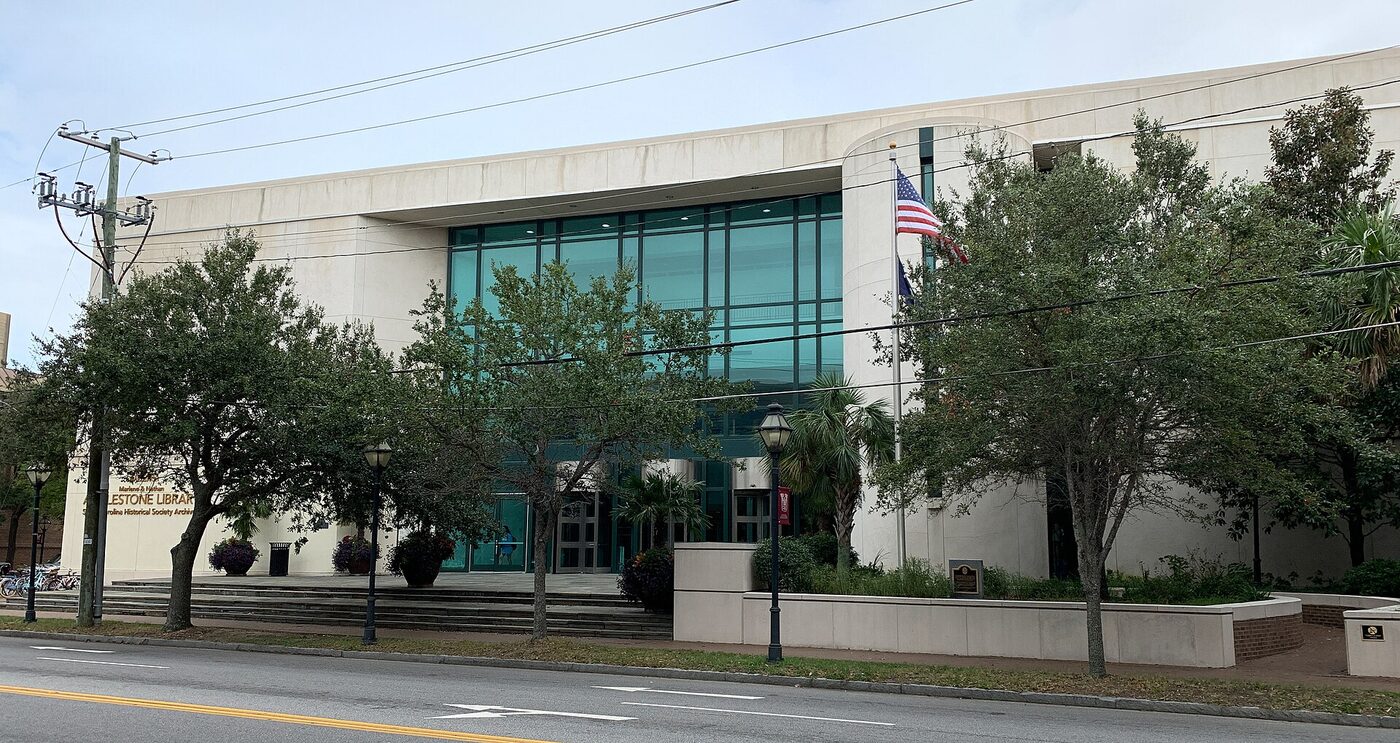
One body of evidence exists but is closed. Jordan's papers — writing notes and unpublished manuscripts among them — were given to the College of Charleston by Harriet McDougal in 2012, and are held there as the James Oliver Rigney Jr. papers. Access to part of the collection, his correspondence included, is restricted until thirty years after his death, in September 2037. Whether anything in it touches the newsgroup is simply not known, and will not be known for another decade.

No individual posting, thread or argument is described here, because verifying any one of them would mean reading the archive rather than the paperwork, and an article that invented one would be worthless. The group's postings are held in the Google Groups Usenet archive, which could not be fetched while this article was being checked; the specific claims here that concern the group's practice are drawn instead from the FAQ, which is a published document with named editors and a stated relationship to the newsgroup.
And the fate of the group's material after the FAQ left Usenet is only partly documented. What is documented is the handover: after a long hiatus the FAQ was updated in the autumn of 2010 and passed to Jennifer Liang and Jason Denzel at Dragonmount, with the old copy left online so that existing links would still resolve. The former editor's explanation, posted with the handover, is also the closest thing to an obituary the group received from its own people:
the Usenet group rec.arts.sf.written.robert-jordan, for which the WOTFAQ was created and from which the FAQ drew 99% of its material for theories and discussion, died.
It still exists, technically, but it is little more than a ghost town now, and has been that way for years.
The 2010 edition described itself as no longer drawing on the newsgroup alone but as including contributions from "many different people and sources in the online Wheel of Time fandom community". That the fandom's reference apparatus subsequently became wiki-shaped rather than FAQ-shaped is the general pattern of the 2000s and is visible here in outline; a specific documented transfer of FAQ text into a specific wiki has not been established for this article, and is therefore not asserted.
Scope and limits
This page is about a newsgroup, not about a novel sequence, and the proportions above reflect that. The bibliography is here because the group's behaviour is unintelligible without the publication dates; the author's biography is here only to the extent that it bears on whether he was reachable, which was a live question in the group. Readers wanting the fiction should start at the encyclopaedia articles linked above, which this page does not attempt to duplicate.
The sources are of three kinds and are worth distinguishing. The proposal and control documents mirrored by the Internet Systems Consortium are primary and are quoted exactly; where this article gives a date, a vote count or a charter clause from them, it is transcribed rather than summarised. The FAQ is a published secondary source produced by the community itself, and its statements are reported as its statements — the reader should treat "the FAQ says" as doing real work in those sentences. Facts about the books, the author, the completion and the adaptation are taken from general reference sources and were checked individually against them.
Two conventional pitfalls have been avoided deliberately. No thread titles, participant names beyond those printed in the public administrative record and the FAQ's own credits, post counts or dates of activity are given, because none could be verified. And no answer is offered to any of the questions the group argued about — not because the answers are unknown today, some of them being settled by the books themselves, but because this directory documents what was argued on Usenet and does not join in.
The hierarchy's own story is on the rec.* page; the group-creation procedure at hub level is on the soc.* page; the FAQ and periodic-posting machinery is on the news.* page; and the full set of groups carried by this directory is on the all groups list.
Reading rec.arts.sf.written.robert-jordan today
- Historical archive: Google Groups — rec.arts.sf.written.robert-jordan (coverage varies by group and era).
- Open in a newsreader:
news:rec.arts.sf.written.robert-jordan— the original site offered exactly this link, and it still works if your system has a newsreader registered for thenews:scheme. - Live access: point an NNTP newsreader at a modern server — see accessing Usenet today.
- The original news2mail e-mail subscription service ended in the mid-2000s and no longer operates.