alt.books.arthur-clarke
The works of Sir Arthur C. Clarke.
Dedicated discussion of Clarke’s fiction and non-fiction — Childhood’s End, Rendezvous with Rama, the 2001 cycle and the Odyssey sequels, plus his essays on satellites and the future he part-invented.
The group overlapped with rec.arts.sf.written but offered a slower, single-author focus, including news threads during Clarke’s final years in Sri Lanka.
On this page
- What the group left behind
- Sixty-five writers with a room of their own
- The writer, dated: 1917 to 1963
- The Sentinel, Kubrick, and a novel published after its own film
- Rama, the Fountains, and the collaborations
- The non-fiction, which was half the output
- Wireless World, October 1945
- What the paper did, and what it did not do
- Three laws, and where they actually come from
- The space elevator
- Religion, prophecy and the future: his positions, as stated
- Sri Lanka, the reef and the honours
- What a slower single-author room was for
- The threads a group acquires as its subject ages
- What the record does not show
- Scope and limits
What the group left behind
Almost everything in this directory is a group with no paperwork. A Big-8 newsgroup had to be argued for in public and voted on in writing, and the file survives; an alt.* group needed one person, one control message and the goodwill of several thousand news administrators, and it usually left nothing at all. alt.books.arthur-clarke is a partial exception. There is no vote, because alt.* has never had votes, and there is no Request for Discussion in the moderated-group archive — the Internet Systems Consortium's news.announce.newgroups tree has no file for this name, and returns a plain 404 when asked for one. What it does have is the control-message archive, and that archive holds five messages.
The file is 5,099 bytes uncompressed. Set out in the order the messages carry, with the dates and times taken from their own headers:
- 21 June 1995, 20:07:51 GMT — newgroup control message for alt.books.arthur-clarke, posted by Michael Jennings, whose organisation header and signature both give the Department of Applied Mathematics and Theoretical Physics at the University of Cambridge. The body of the message is one line of explanation and one line for the newsgroups file.
- 7 July 1995, 15:18:59 GMT — a second newgroup message from the same sender, described in its own text as a booster.
- 8 July 1995, 20:20:44 GMT — a third, carrying the same booster text.
- 1 August 1995, 09:19:04 CDT — a fourth newgroup message, issued by the news system at acad.stedwards.edu, with an empty body and a world distribution.
- 22 August 1995, 19:54:13 +0100 — an rmgroup control message, issued by the news administration of BT Access Operations and Maintenance, carrying
Distribution: uk.
The first message says, in its entirety before the newsgroups line, As discussed in alt.config. That is the whole of the group's constitutional history: a discussion in the newsgroup where alt.* proposals are aired, followed by somebody sending the message. The line offered for administrators' newsgroups files reads exactly:
alt.books.arthur-clarke The writings of sf writer Arthur C Clarke
Lower-case sf, no full stop, no Sir — the description was written five years before Clarke was knighted and has never been rewritten to notice. The two booster messages are more informative than most alt.* paperwork, because they report on how the creation went:
After discussion in alt.config, alt.books.arthur-clarke was created several weeks ago. The group appears to have been widely accepted, propagation is good, and there is a considerable amount of traffic. This is simply a booster message to hopefully improve propagation further.
That is a contemporaneous statement by the group's creator, sixteen days after his own newgroup message, that the group was carried widely and busy. It is not a measurement, and no measurement of this group's traffic has been found; but it is the only description of the group's early life that anybody wrote down, and it comes with a date and a name attached. The creator's own several weeks ago is, on the evidence of the file, a fortnight.
The removal request of 22 August is the most instructive document in the file, precisely because nothing came of it. It was sent from a British telecommunications operator's news administration address and its distribution header limits it to the uk hierarchy of servers, so it was never a bid to delete the group from the network. It would have failed even if it had been: the reference control.ctl, which is kept in step between the Internet Systems Consortium's archive and the INN news server distribution, sets the policy for alt.* as accepting all newgroups and silently ignoring all rmgroups, expressed in the two configuration lines newgroup:*:alt.*:doit and rmgroup:*:alt.*:drop. In a hierarchy where creation is free and deletion is impossible, groups accumulate. This one accumulated.
Thirty-one years after the newgroup message, the group is still in the distribution files that news administrators load. The current newsgroups file lists it as The writings of SF writer Arthur C Clarke. — the same sentence Jennings wrote in 1995, with the sf capitalised and a full stop added somewhere along the way. The active file lists it as alt.books.arthur-clarke 0000000000 0000000001 y: unmoderated, and on the reference server, empty. The mechanism by which all of this works — control messages, alt.config, propagation as the only real vote — is described on the alt.* hierarchy page and is not repeated here.
Sixty-five writers with a room of their own
The obvious question about a single-author newsgroup is whether it was unusual. In alt.*, emphatically not: the hierarchy's answer to any enthusiasm was a group, and the books branch shows what that produced. The distribution file currently lists 20,466 groups under alt.*, of which 1,984 sit under alt.fan.* and 85 under alt.books.*.
Of those 85, sixty-five are named for one individual person. The rule used to arrive at that number is simply whether the last component of the name is a human being's name — anne-rice, bukowski, cs-lewis, h-g-wells, isaac-asimov, james-joyce, kurt-vonnegut, larry-niven, nabokov, phil-k-dick, pratchett, thomas-pynchon and fifty-three others, arthur-clarke among them. The remaining twenty are named for something else: a movement (alt.books.beatgeneration), a group of writers (alt.books.inklings), a series, character or setting rather than its author (alt.books.gor, alt.books.deryni, alt.books.outlander, alt.books.nancy-drew, alt.books.wizard-of-oz, alt.books.destroyer, alt.books.left-behind, alt.books.valdemar.fanfic), a genre or a function (alt.books.mysteries, alt.books.ghost-fiction, alt.books.technical, alt.books.reviews, alt.books.electronic, alt.books.purefiction), a two-author subject (alt.books.toffler, whose description reads The ideas of Alvin and Heidi.), or something the file does not explain at all. The line between the two lists is a judgement in perhaps five cases and firm in the other eighty; a reader who prefers to count alt.books.gor and alt.books.outlander as single-author groups will get sixty-seven and will not be wrong.
Two further numbers from the same file put the Clarke line in perspective. Eighteen of the 85 alt.books.* entries carry the placeholder No description., which is what happens when a group is created and its newsgroups line is never propagated or never written; Carl Sagan, Ray Bradbury, Iain Banks, Philip Pullman and Vladimir Nabokov all have rooms in this hierarchy that the file cannot describe. And in the whole 45,003-line distribution file, exactly one group name contains the string clarke. Two others carry his most famous title rather than his name: alt.hal2001.lives-on, described as We will never forget HAL2001!, and alt.movies.2001spaceoddysey, which misspells the film and has no description at all.
The alternative route existed and was taken exactly once in this corner of the namespace. A single-author group could instead be proposed to the Big 8, argued over in news.groups, put to a public electronic ballot with a hundred-vote margin and a two-thirds threshold, and created only if it passed — a process that produced, and is fully documented for, rec.arts.sf.written.robert-jordan, whose page in this directory holds the ballot, the charter and the FAQ culture that followed. The contrast is the whole difference between the two hierarchies: that group cost its proposers eight and a half months, from the first Request for Discussion of 5 November 1993 to the result of 21 July 1994, and 477 valid ballots — 406 for, 71 against — and bought a name whose meaning was on the record, while this one cost one message to alt.config and bought whatever propagation Cambridge could talk the network into.
The writer, dated: 1917 to 1963
Arthur Charles Clarke was born at Minehead in Somerset on 16 December 1917 and died at Colombo in Sri Lanka on 19 March 2008, aged ninety. He joined the British Interplanetary Society in 1934, as a teenager, and led it twice, in 1946–47 and again in 1951–53. He served in the Royal Air Force from 1941 to 1946 as a radar specialist, spending most of the war on ground-controlled approach radar — the system that talks an aircraft down by instructions from the ground — and was demobilised as a flight lieutenant. Afterwards he took a first-class degree in mathematics and physics at King's College London. The war work produced, seventeen years later, his one novel with no science fiction in it, Glide Path (1963).
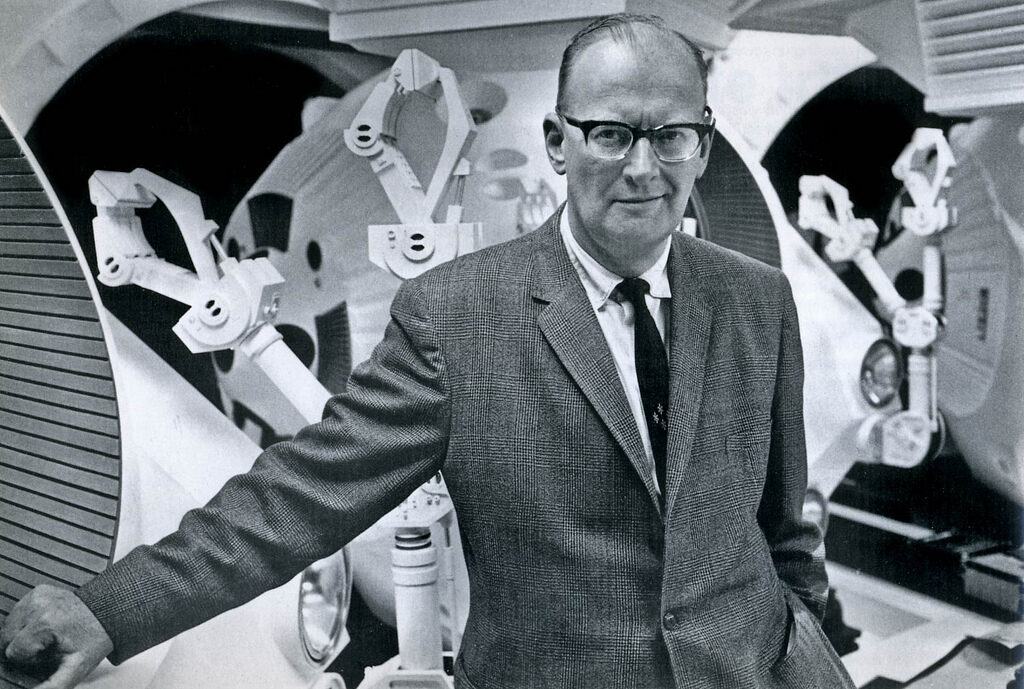

The professional fiction begins in 1946 in Astounding Science Fiction: Loophole appeared in April and Rescue Party, which was the first story he sold, in May. The novels of the first phase, with their first publication years, are the ones a single-author group could assume everybody had read:
- Against the Fall of Night (1948 as a novella, 1953 as a novel), rewritten again as The City and the Stars (1956)
- Prelude to Space (1951)
- The Sands of Mars (1951)
- Islands in the Sky (1952)
- Childhood's End (1953)
- Earthlight (1955)
- The Deep Range (1957)
- A Fall of Moondust (1961)
- Dolphin Island (1963) and Glide Path (1963)
Childhood's End is the one most often called his best, and it is also the one that later embarrassed him: it turns on extrasensory perception, and Clarke spent the following decades explaining that he had grown out of the subject. He wrote in the prologue to the 1990 Del Rey edition that after researching his Mysterious World and Strange Powers programmes he was an almost total skeptic, having seen far too many claims dissolve into thin air and far too many demonstrations exposed as fakes. A single-author group inherits that kind of self-revision as material: the author's later opinion of his own early book is a document in its own right, and arguing about which one to believe is a recognisable use of a slow room.
The short fiction is voluminous and was collected repeatedly — Expedition to Earth (1953), Reach for Tomorrow (1956), Tales from the White Hart (1957), Tales of Ten Worlds (1962), The Nine Billion Names of God (1967), The Wind from the Sun (1972) — and finally gathered in The Collected Stories of Arthur C. Clarke (2001). The Star won a Hugo in 1956. The single story that mattered most to his later career, though, failed the competition it was written for and reached print seven years overdue in a magazine nobody remembers.
The Sentinel, Kubrick, and a novel published after its own film
The Sentinel was written in 1948 for a BBC short-story competition, in which it failed to place. It was first published in the Spring 1951 issue of 10 Story Fantasy under the title Sentinel of Eternity. Its plot — an artefact left on the Moon by somebody else, waiting to be found — is the seed of the film 2001: A Space Odyssey, though the novel's opening also draws on Encounter in the Dawn (1953). Clarke was impatient with the shorthand: the story bore, he said, about as much relation to the film as an acorn to the resultant full-grown oak.
The making of 2001 is the part of Clarke's career that a discussion group could never quite finish arguing about, because the ordinary relationship between a novel and its adaptation is reversed and then tangled. Clarke and Stanley Kubrick met in New York in 1964. Kubrick's suggestion was that instead of starting with a screenplay they should let their imaginations soar free by writing a novel first and basing the film on that; in Clarke's own account the two documents ended up being written simultaneously, with feedback in both directions, and he rewrote sections after seeing the movie rushes — a rather expensive method of literary creation, which few other authors can have enjoyed. The film premiered at the Uptown Theater in Washington on 2 April 1968, was released in the United States the next day and in the United Kingdom on 1 May. The novel was published in June, credited to Clarke alone.
The order of publication had two consequences that outlived everyone involved. The first is bibliographic: a book conceived as the source of a film reached the public as what looks like a novelisation of it, and Clarke complained afterwards that this was the effect and that Kubrick had manipulated circumstances so as to play down his authorship. The second is textual: the two versions differ, and not trivially. In the novel the mission goes to Iapetus, a moon of Saturn; in the film it goes to Jupiter, because Kubrick and his effects supervisor could not produce a model of Saturn's rings they believed in. The film explains almost nothing, and the novel explains almost everything. Clarke published his own account of the process, with discarded versions of key scenes, as The Lost Worlds of 2001 (1972), and wrote a fresh foreword on the same subject for the Millennial Edition of the novel in 1999. The film was nominated for four Academy Awards and won one, for special visual effects, credited to Kubrick; Clarke shared with him the nomination for best story and screenplay written directly for the screen.
The sequence then ran on for three more novels, at intervals long enough that each arrival was an event for anyone following it: 2010: Odyssey Two (1982), 2061: Odyssey Three (1987) and 3001: The Final Odyssey (1997). Only the first was filmed — as 2010, directed by Peter Hyams, released in 1984. Clarke and Hyams conducted the production correspondence by electronic mail between Sri Lanka and California and published it in 1984 as The Odyssey File: The Making of 2010, which is worth noting on a page about a newsgroup: the author under discussion had been collaborating across the world by e-mail for a decade before the group existed, and would write his last novel the same way.
Rama, the Fountains, and the collaborations
Rendezvous with Rama (1973) is the other pillar. It won the British Science Fiction Association and Nebula awards for 1973 and the Hugo, Campbell, Locus and Jupiter awards in 1974 — effectively every major prize the field had. It was the first book of a three-novel contract, completed by Imperial Earth (1975) and The Fountains of Paradise (1979), which was reported at the time to involve a larger advance than had previously been paid in science fiction. The Fountains of Paradise repeated the trick on a smaller scale, taking the Nebula for 1979 and the Hugo for 1980. After them came The Songs of Distant Earth (1986), expanded from a 1958 novelette of the same title.
The sequels are where bibliographies go wrong, and the group's subject is one of the more reliably misdated in the genre. The Rama continuations were written with Gentry Lee and are not by Clarke alone: Rama II (1989), The Garden of Rama (1991) and Rama Revealed (1993). Sixteen years separate the first Rama book from the second, and it is a common error to file the sequels in the 1970s beside the original. The other collaborations, in order:
- Cradle (1988), with Gentry Lee
- Rama II (1989), The Garden of Rama (1991), Rama Revealed (1993), with Gentry Lee
- Richter 10 (1996), with Mike McQuay
- The Trigger (1999), with Michael P. Kube-McDowell
- The Light of Other Days (2000), with Stephen Baxter
- Time's Eye (2003), Sunstorm (2005) and Firstborn (2007), the A Time Odyssey trilogy, with Stephen Baxter
- The Last Theorem (2008), with Frederik Pohl, reviewed by Clarke days before his death and published after it
Clarke's solo novels of the same late period were The Ghost from the Grand Banks (1990) and The Hammer of God (1993). The authors' note to Time's Eye describes the Baxter trilogy as neither following nor preceding the Odyssey books but standing at right angles to them: not a sequel or a prequel but an orthoquel, a word coined for the purpose, time being orthogonal to space. Whether the collaborations are Clarke books at all, and in what proportion, is exactly the sort of question a room devoted to one writer exists to have out at length; this article records that the question is real and does not answer it.
The non-fiction, which was half the output
Clarke's reputation outside the genre rested at least as much on the explanatory books, and a group whose charter says writings rather than fiction had them in scope. Interplanetary Flight: An Introduction to Astronautics (1950) was a technical primer for the general reader. The Exploration of Space (1951) won the International Fantasy Award's non-fiction category in 1952 and is the book most often credited with carrying the case for spaceflight to people who did not read the specialist press; Wernher von Braun is reported to have used it in arguing the case for a lunar landing to President Kennedy.
The diving books — The Coast of Coral (1956), The Reefs of Taprobane (1957), The Treasure of the Great Reef (1964), all three with photographs by Mike Wilson — belong to the Sri Lankan life described below. The forecasting books are the ones the group argued with. Profiles of the Future: An Inquiry into the Limits of the Possible (1962) grew out of a series of magazine essays begun in 1958 and carried a timetable of anticipated inventions running to the year 2100. Voices from the Sky (1965), The Promise of Space (1968) and Report on Planet Three and Other Speculations (1972) followed. Ascent to Orbit: A Scientific Autobiography (1984) collected his technical papers, which is the volume in which the 1945 satellite material is most conveniently found. Astounding Days: A Science Fictional Autobiography (1989) and How the World Was One: Beyond the Global Village (1992) came later, and Greetings, Carbon-Based Bipeds! (1999) gathered 110 pieces written between 1934 and 1998, sixty-three of them not previously collected.
He received the UNESCO–Kalinga Prize for the popularisation of science in 1961. In the 1980s and 1990s he was, for a British and international television audience, primarily the presenter of Arthur C. Clarke's Mysterious World (1980), World of Strange Powers (1985) and Mysterious Universe (1994) — programmes about unexplained phenomena made by a man who had by then decided that almost none of them were unexplained. That combination of roles is one reason a group with his name on it could carry threads about ancient monuments, cryptozoology and satellite engineering in the same week without anybody finding it odd.
Wireless World, October 1945
The single most checkable fact available to this page is a magazine article. In the October 1945 issue of Wireless World — volume 51, pages 305 to 308 — Clarke published Extra-Terrestrial Relays: Can Rocket Stations Give World-wide Radio Coverage? It is four pages long, has four figures and an appendix on rocket design, and was written by a twenty-seven-year-old serving RAF radar officer who had not yet published a novel. By his own later account the paper was written in late June 1945, passed the RAF censor on 7 July, was sent to the magazine on 13 August and accepted on 1 September; the title was the editor's.
It was not the first statement of the idea in print under his name. A letter to the editor of the same magazine, Peacetime Uses for V2, had appeared in the issue of February 1945 on page 58; Clarke later wrote that he had forgotten about the letter entirely until the engineering staff of the Sri Lanka Broadcasting Corporation reminded him of it in 1968. In May 1945 he circulated privately, in six typed copies, a paper titled The Space-Station: Its Radio Applications; the top copy is held by the National Air and Space Museum of the Smithsonian Institution, and the text was reprinted in Spaceflight in March 1968 and again in Ascent to Orbit.
What the October paper actually argues is worth setting out, because it is routinely summarised as the invention of the communications satellite and it is not quite that. The argument runs: long-distance radio is at the mercy of the ionosphere and television cannot use the ionosphere at all, so a terrestrial television network needs repeaters every fifty miles and an intercontinental one is out of the question. A rocket that reaches orbital velocity becomes an artificial satellite. Orbital period rises with radius, and — the sentence the whole thing turns on — one orbit, with a radius of 42,000 km, has a period of exactly 24 hours, so a body there, over the equator, would neither rise nor set. Build a space station in that orbit, give it receivers and transmitters, and it can relay to an entire hemisphere.
The specifics are engineering, not hand-waving. One station covers half the globe, so three are needed for a world service, and the paper nominates the longitudes: 30°E for Africa and Europe, 150°E for China and Oceania, 90°W for the Americas, with the three linked by radio or optical beams. It estimates the power required — about 1.2 kW for a broadcast service using a directive array, possibly as little as 50 watts, and perhaps 10 watts for point-to-point beams — and compares that with the roughly 3 kW the London television service then used to cover an area less than fifty miles in radius. It proposes solar power, noting that a square metre normal to the solar radiation in space intercepts 1.35 kW, and works out the eclipse problem in detail: the station would be in darkness only near the equinoxes, at worst for 1 hour 9 minutes on 21 March, for a total of about two days a year, which is easily bridged by storage. It judges that frequencies from about 50 Mc/s to 100,000 Mc/s could be used without undue absorption. Its footnotes cite Hermann Noordung — the pen name of Herman Potočnik — and the Journal of the British Interplanetary Society.
Two things it does not do are as important as what it does. It does not claim to have invented the twenty-four-hour orbit, which Potočnik had described in the late 1920s in the very book the paper's own footnotes cite; and it does not describe the satellite as we now have it. Clarke's relay stations are crewed: the paper gives them living quarters, laboratories and everything needed for the comfort of a crew who would be relieved and provisioned by a regular rocket service. This is 1945, two years before the transistor; the unattended, solid-state, mass-produced object that actually occupies the orbit was not what the paper described. The proper home for the crewed-station half of that argument, and for the long quarrel about people versus machines in orbit that Usenet conducted at length, is sci.space.station, not this page.
What the paper did, and what it did not do
The honest answer to the influence question is uncomfortable for the legend and was given by NASA's own historians. In the account of communications-satellite history written by David J. Whalen for the NASA History Office, the 1945 article apparently had little lasting effect in spite of Clarke's repeating the story in his 1951/52 The Exploration of Space. The same account offers John R. Pierce of Bell Telephone Laboratories as perhaps the first person to evaluate the technical options and the financial prospects carefully, in a talk of 1954 and an article of 1955 that set a mirror in space against a medium-orbit repeater and a twenty-four-hour repeater.
The hardware, when it came, came from elsewhere and quickly. Harold Rosen's team at Hughes Aircraft designed the first geostationary satellite from 1959; Syncom 2 reached geosynchronous orbit in 1963 and Syncom 3, the first true geostationary satellite, in 1964, in time to relay the Tokyo Olympic Games to North America. Intelsat I, universally called Early Bird, the first commercial geostationary communications satellite, was launched on 6 April 1965 — nineteen and a half years after the article. Whether that counts as prophecy fulfilled or as an idea that several competent people would have had anyway is a question the paper itself cannot settle.
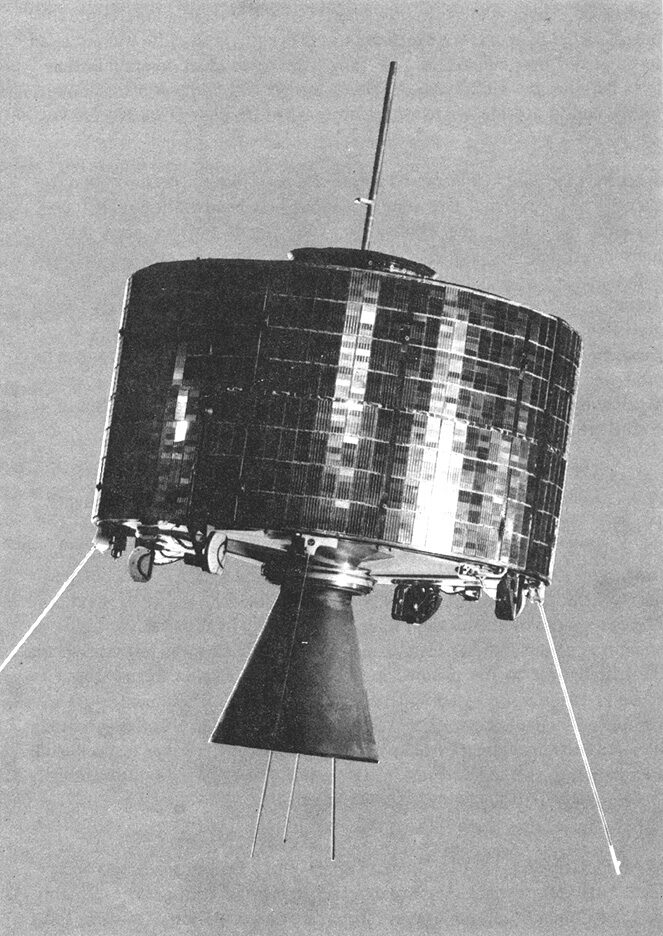

Clarke's own position on it was consistent and unflattering to himself. He said repeatedly that he had not originated the twenty-four-hour orbit but had only found a use for it, which is exactly what the 1945 paper, with its citation of Noordung, implies. Asked in an interview published by IEEE Spectrum in the month before his death why he had never patented the idea, he answered: A patent is really a license to be sued.
The name is worth checking rather than assuming, because it is repeated with more confidence than the evidence supports. Clarke orbit and Clarke belt are genuinely current informal usages for the geostationary orbit and for the ring of satellites occupying it. The frequent further claim that the orbit is officially recognised under that name by the International Astronomical Union traces, in the sources that carry it, to the Arthur C. Clarke Foundation's own biography, and this article has not been able to confirm it against anything published by the IAU. It is safest to say that the orbit has an affectionate second name and no official one.
The professional recognition, by contrast, is on the record and is not for the fiction. The Franklin Institute awarded him the Stuart Ballantine Medal in 1963 for the concept of satellite communications. He received the Marconi International Fellowship in 1982. In 1986 he was elected to the United States National Academy of Engineering, with the citation For conception of geosynchronous communications satellites, and for other contributions to the use and understanding of space. Engineers, in other words, settled the question in his favour rather earlier than historians did.
Three laws, and where they actually come from
The three laws are quoted constantly and dated wrongly nearly as often, usually by assuming that all three appeared together. They did not.
- First law. When a distinguished but elderly scientist states that something is possible, he is almost certainly right. When he states that something is impossible, he is very probably wrong. It appears in the essay Hazards of Prophecy: The Failure of Imagination, in the 1962 edition of Profiles of the Future, where it is simply Clarke's Law, there being only one.
- Second law. The only way of discovering the limits of the possible is to venture a little way past them into the impossible. It is in the same 1962 essay as an observation rather than a law; it was other people who numbered it, and it became the second law formally only when a third was added.
- Third law. Any sufficiently advanced technology is indistinguishable from magic. It was published in a 1968 letter to the journal Science and folded into the essay in the 1973 revision of Profiles of the Future, where Clarke remarked that as three laws were good enough for Newton he had modestly decided to stop there.
One account of how the numbering started is that the editor of Clarke's work in French began numbering the author's assertions. Isaac Asimov supplied the standard follow-up to the first law — that when the lay public rallies round an idea denounced by distinguished but elderly scientists, the elderly scientists are then, after all, probably right — and the third law has generated a small literature of variations, of which the neatest is Gehm's contrapositive: any technology distinguishable from magic is insufficiently advanced.
The space elevator
The other idea permanently attached to Clarke's name is the space elevator, and his relationship to it is unusually well documented because he documented it himself, in public, with citations.
The concept was invented repeatedly — by Clarke's own count in 1979, at least half a dozen times independently. Konstantin Tsiolkovsky described a tower to orbit in an 1895 paper, though a tower in compression is a different object from a cable in tension. Yuri Artsutanov, a Leningrad engineer, worked out the tensioned version in 1960. In 1966 John Isaacs, Allyn Vine, Hugh Bradner and George Bachus, of the Scripps Institution of Oceanography and the Woods Hole Oceanographic Institution — oceanographers being, as Clarke observed, about the only people who concern themselves with very long hanging cables — published the idea as a letter to Science. In 1975 Jerome Pearson of the Flight Dynamics Laboratory at Wright-Patterson Air Force Base invented it all over again, called it an orbital tower, and published in Acta Astronautica the most thorough treatment to that date: a cable thickest at geostationary altitude where the tension is greatest, a counterweight extending far beyond it, the first analysis of the structure's vibration modes, and the observation that it works in both directions, so that descending payloads can return the energy that ascending ones consume.
Clarke's contribution was to read all of that and put it in front of two audiences at once. The Fountains of Paradise, published in 1979, is about the building of such a structure from a mountain on the equatorial island of Taprobane, which Clarke described as about ninety per cent congruent with Sri Lanka, moved south to the equator; the mountain is Sri Kanda, recognisably Adam's Peak, and the ruined palace in the book's historical frame is recognisably Sigiriya. In the same year, on 20 September 1979, he addressed the thirtieth International Astronautical Congress in Munich on The Space Elevator: 'Thought Experiment', or Key to the Universe?, a semi-technical survey of the existing literature, published two years later in Advances in Earth Oriented Applied Space Technologies. Its abstract states the engineering case plainly: the idea, outrageous though it appears at first sight, is theoretically feasible, and its practical realisation could follow from the mass production of high-strength materials then known only as laboratory curiosities.
The material question is the one that has moved since. In the novel the cable is a hyperfilament of continuous pseudo-one-dimensional diamond crystal; Clarke later said he thought buckminsterfullerene would be the real answer, and the argument has run through carbon nanotubes ever since. The first gathering of people investigating the idea seriously as engineering was a NASA workshop at Huntsville, Alabama, in 1999. Asked in the IEEE Spectrum interview of March 2008 how long it would take, he answered: about 10 years after everyone stops laughing. Maybe 20 years. In the same conversation he called the geostationary communications satellite definitely his most important contribution, and added that maybe in a generation or so the space elevator would be considered equally important. It is a rare case of a writer ranking his own ideas on the record.
One footnote that belongs to the fiction rather than the engineering: Charles Sheffield's The Web Between the Worlds, a first novel on the same subject, appeared almost simultaneously with The Fountains of Paradise. Simultaneous independent invention had by then happened to the space elevator at least half a dozen times, and it proceeded to happen to the novel about it.
Religion, prophecy and the future: his positions, as stated
Clarke's opinions were part of the subject, because he published them and because his fiction is full of things that look like religion and are not. What follows is a record of positions he took, attributed to him, and nothing more.
On joining the Royal Air Force he insisted that his identity discs be marked pantheist rather than the default Church of England. In an essay of 1991 titled Credo he described himself as having been a logical positivist since the age of ten. In 2000 he told the Sri Lankan newspaper The Island, I don't believe in God or an afterlife, and identified himself as an atheist; he was named a Distinguished Supporter of the British Humanist Association the same year and was honoured as a Humanist Laureate by the International Academy of Humanism. He also, at times, called himself a crypto-Buddhist, on the ground that Buddhism is not a religion. The written instruction he left for his funeral is unambiguous: Absolutely no religious rites of any kind, relating to any religious faith, should be associated with my funeral.
His later remarks were sharper than his earlier ones. He is widely quoted as saying that one of the great tragedies of mankind is that morality has been hijacked by religion, and he told Popular Science in 2004 that religion was the most malevolent and persistent of all mind viruses and that we should get rid of it as quickly as we can. Against that sits his statement that any path to knowledge is a path to God, or to Reality, whichever word one prefers, and his description of himself as fascinated by the concept of God. J. B. S. Haldane wrote to him near the end of Haldane's life suggesting that Clarke deserved a prize in theology for being one of the few people to write anything new on the subject — adding that had his writings not contained multiple contradictory theological views, he might have been a menace. The contradiction is genuine and Clarke never resolved it, which is one reason it remained arguable.
On the future he was a forecaster with a published record, which is the honest way to assess him: not by the hits alone. In a 1959 essay he predicted global satellite television crossing national boundaries indiscriminately, and a personal transceiver so small and compact that every man carries one, by means of which one could call any person anywhere on Earth merely by dialling a number, and which would also mean that no one need ever again be lost. In a 1964 programme for the BBC's Horizon he described remote access to information and even remote surgery, with brain surgeons in Edinburgh operating on patients in New Zealand. In a 1974 interview for the Australian Broadcasting Corporation he described a console in an ordinary house through which its owner would get his bank statements and his theatre reservations, and would take it as much for granted as the telephone. Against those stand the timetable in Profiles of the Future, which put a global library at 2005, and the crewed relay stations of 1945. On extraterrestrial intelligence the formulation most often quoted from him is deliberately unhelpful to both sides: either we are alone in the universe or we are not, and both possibilities are equally terrifying.
He testified before the United States Congress against the Strategic Defense Initiative in 1984, an episode that cost him his long friendship with Robert Heinlein, who attacked his views on American foreign and space policy at a gathering at Larry Niven's house in California; the two were later reconciled formally but remained distant until Heinlein's death in 1988. Clarke, Heinlein and Isaac Asimov were the genre's informal Big Three, and Clarke and Asimov maintained a standing joke known as the Clarke–Asimov Treaty, an oral agreement under which each would publicly maintain that Clarke was the better science fiction writer and Asimov the better science writer. Clarke put it on paper in the dedication to Report on Planet Three in 1972.
Sri Lanka, the reef and the honours
Clarke moved to Ceylon in 1956 and lived there for the remaining fifty-two years of his life, first at Unawatuna on the south coast and later in Colombo. The reason he gave was diving. With Mike Wilson he travelled the coast with the Beachcombers Club, and in the mid-1950s, diving off Trincomalee, the two found submerged masonry, carved columns and stones in the form of elephant heads from the original Koneswaram temple; Clarke described the find in The Reefs of Taprobane (1957), the sequel to The Coast of Coral (1956). Sources differ on whether the temple dive was in 1956 or 1957, and this article does not choose between them.
The other underwater episode is better dated. In 1961, filming off the Great Basses Reef, Wilson found a wreck and brought up silver coins. The dive planned for the following year was stopped when Clarke was paralysed by what proved to be polio; he watched the salvage a year after that from the shore and the surface. The wreck was eventually identified as having belonged to the Mughal emperor Aurangzeb, and yielded fused bags of silver rupees, cannon and other objects, carefully documented; the documentation became The Treasure of the Great Reef (1964). The 1962 polio returned as post-polio syndrome, diagnosed in 1988, after which Clarke used a wheelchair most of the time and his speech became halting; most of his public communications in his last years were recorded.
He was not a Sri Lankan citizen but a resident, and the state's relationship with him was formal and long. The government offered him resident guest status in 1975. He was chancellor of the University of Moratuwa from 1979 to 2002. The Arthur C. Clarke Centre for Modern Technologies was established at Moratuwa by Act of Parliament No. 30 of 1984 and re-established in corporate form by the Science and Technology Development Act No. 11 of 1994, under the name it still carries, the Arthur C. Clarke Institute for Modern Technologies; in the same year it was appointed the country's national focal point for space technology applications by the United Nations Economic and Social Commission for Asia and the Pacific, and it has run an annual Arthur C. Clarke Memorial Lecture since his death.
The honours, in order: Commander of the Order of the British Empire in the 1989 Birthday Honours, for services to British cultural interests in Sri Lanka; first chancellor of the International Space University, 1989 to 2004; a knighthood conferred at a ceremony in Colombo on 26 May 2000, for services to literature, by the United Kingdom's High Commissioner to Sri Lanka rather than by the Queen in London, because his health no longer permitted the journey; and on 14 November 2005 the Sri Lankabhimanya, the highest civil honour of Sri Lanka, conferred by President Chandrika Kumaratunga. Nine people have received the Sri Lankabhimanya, and Clarke, a British citizen to the end, is the only one of them who was not Sri Lankan. The country's affairs and its diaspora had their own Usenet room at soc.culture.sri-lanka, a group with a very different subject and a rather harder decade.
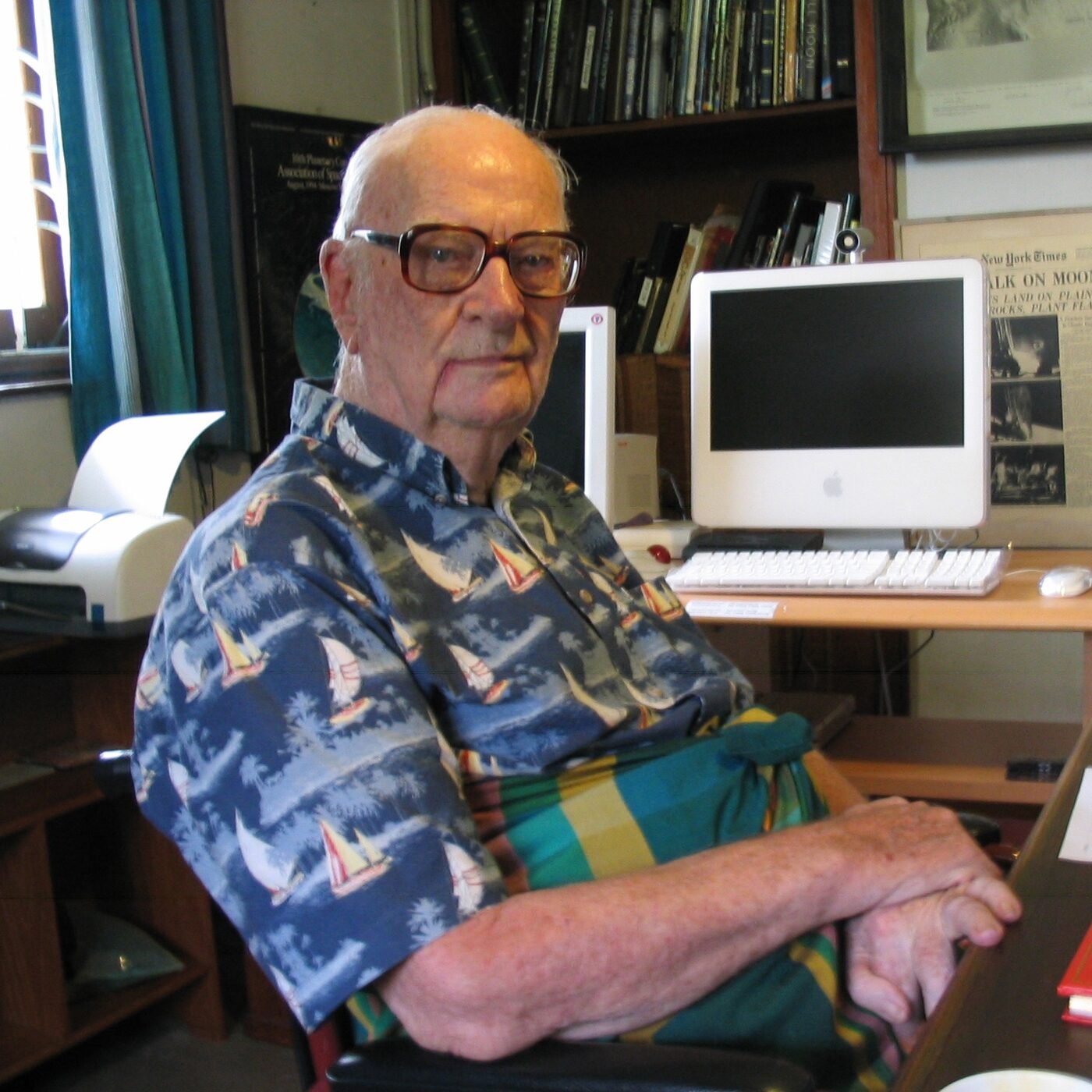

The Indian Ocean tsunami of 26 December 2004 left Clarke and his Colombo home unharmed but destroyed the diving school he had founded, by then trading as Underwater Safaris, at Hikkaduwa near Galle. He made public appeals afterwards, and the Arthur C. Clarke Foundation took up the cause of better disaster warning — a subject with an obvious relationship to the satellites he had written about in 1945, and one of the few occasions on which the two halves of his career visibly met.
He died in Colombo on 19 March 2008 of respiratory complications and heart failure arising from post-polio syndrome, and was buried there on 22 March in the traditional Sri Lankan manner, at Kanatte, Colombo's main burial ground. He shares the grave with Leslie Ekanayake, who had died in 1977 and to whose memory The Fountains of Paradise is dedicated.
What a slower single-author room was for
The directory's own summary above says the group offered a slower, single-author focus than the general written-science-fiction group. It is worth being precise about what that difference consisted of, because it is structural and can be described without inventing a single thread.
A general discussion group has a queue. Any subject in it competes with every other subject in it, and the competition is settled by volume: whatever most people are reading this week displaces whatever a few people were reading last week. A single-author group removes the competition entirely. Its subject cannot be crowded out, because there is nothing else in the room, and the practical consequence is that a thread can be slow without dying. A question about an inconsistency between the novel and the film of 2001, or about which edition of Profiles of the Future a given prediction appears in, does not need to be interesting to a thousand people; it needs to be interesting to three, one of whom owns both editions.
That shape suits some authors far better than others, and it suited this one unusually well. Clarke's output spans sixty years, four related novels published across three decades, several books rewritten and republished under different titles, a body of non-fiction that overlaps the fiction at every point, and a technical paper that people cite without having read. Those are reference questions, and reference questions reward a room with a long memory and no hurry. The same room also carries the compare-and-contrast work that a general group does badly: the same idea in a 1958 novelette and a 1986 novel, the same orbit in a 1945 paper and a 1979 speech.
What alt.* charged for that focus was reach. A Big-8 group of the same kind arrived on nearly every server automatically and could assume its readers had found it; an alt.* group existed on the machines whose administrators had chosen to carry it, which is why its creator sent two booster messages within three weeks of creating it. Whether the room stayed populated afterwards is not something the surviving record answers, and this article does not pretend otherwise.
The threads a group acquires as its subject ages
Any group named after a living person eventually stops being only a literary discussion. The base description above notes news threads during Clarke's final years, and the general shape of that transition can be stated from the dated record without inventing any thread in particular.
The events were these, in order. The knighthood ceremony in Colombo in May 2000. The tsunami of December 2004 and the destruction of the diving school. The Sri Lankabhimanya in November 2005. The recorded address to the Robert A. Heinlein Centennial in July 2007 in which he said goodbye to his readers, and the recorded greeting in September 2007 for the Cassini spacecraft's flyby of Iapetus — the destination of the novel of 2001, which is the sort of coincidence a group devoted to one author exists to notice. The ninetieth-birthday message of December 2007, audio only. The death on 19 March 2008 and the burial on 22 March. The publication of The Last Theorem later that year, the book he had reviewed days before he died.
Afterwards, the traffic a dormant literary group still generates: posthumous editions, adaptation news, and anniversaries. Rendezvous with Rama has been optioned and re-optioned for the cinema since the 1990s without a film appearing. In 2014 Clarke's papers were given to the National Air and Space Museum in Washington. On 8 January 2024 a sample of his DNA was launched towards the Moon aboard Peregrine Mission One, which failed and disintegrated in the Earth's atmosphere eleven days later. By then the group had been quiet for a very long time, and the last item on the list is offered as a date in the subject's afterlife, not as evidence that anyone posted about it.
There is one more coincidence in the record that Clarke would have enjoyed and which needs stating carefully. A gamma-ray burst catalogued as GRB 080319B, which set a record as the farthest object visible from Earth to the naked eye, reached Earth within hours of his death. A suggestion that it be informally named the Clarke Event circulated widely; it is a proposal, not a designation, and no astronomical body adopted it.
What the record does not show
Everything above rests on documents. It is worth being equally exact about the gaps, since this page is a reference for a newsgroup and most of what one would want to know about the newsgroup is missing.
There is no readership figure and there never could be: Usenet had no subscriptions to count, only the sampled estimates of the periodic readership reports, and no such estimate for this group has been located. There is no article count. The only contemporaneous statement about the group's traffic is its creator's own, in the booster messages of July 1995, that propagation was good and there was a considerable amount of traffic; that is testimony, not measurement, and the group was a fortnight old when it was written.
There is no governance history, because an unmoderated alt.* group has no governance to have: no moderator, no charter revision, no vacancy notice, no second vote. The control archive ends in August 1995 with a removal request that the standard configuration tells servers to ignore. Nothing else was ever filed under this name.
No thread, posting, participant or argument in the group is described in this article. The group's postings, so far as they survive, are in the Google Groups Usenet archive, which refused every request made while this page was being checked; rather than characterise an archive nobody here has read, the article says nothing about it. That is why the sections above are about the world the group belonged to rather than about its conversations: the conversations are the part that did not survive in any form this directory can verify.
Whether Clarke himself ever read or posted to the group named for him is unknown here. He was an early and enthusiastic user of electronic mail — the 2010 correspondence of 1983–84 and the composition of The Last Theorem by e-mail with Frederik Pohl both attest to that — and it would be an easy assumption to make. No evidence for it has been found, and the assumption is not made.
One body of material exists and is closed. Clarke's manuscripts and personal papers — the collection he called the Clarkives, kept for years by his brother Fred Clarke at Taunton in Somerset — include private diaries which Clarke said would not be published until thirty years after his death, that is, not before 2038. Asked why, he answered that there might be all sorts of embarrassing things in them. Whether anything in that material touches the network, the newsgroup or his readers is simply not known.
Scope and limits
This page is about a newsgroup, and the proportions reflect that. The bibliography is here because a single-author group is unintelligible without knowing what the author published and when, and because the sequels in this particular bibliography are misdated more often than not. The engineering is here because the group's subject was an engineer before he was a novelist and the charter says writings, not novels. The biography is here only where it is dated, documented and relevant.
The sources are of three kinds. The administrative documents mirrored by the Internet Systems Consortium — the control-message archive for this group, the current newsgroups and active files, and the reference control.ctl — are primary, and where this article gives a date, a time, a description line, a count or a configuration directive from them it is transcribed or counted rather than paraphrased. Clarke's own published texts, chiefly the October 1945 Wireless World paper and the 1979 Munich address, are quoted from copies of those texts. Everything else — publication years, prizes, honours, biographical dates — comes from general reference sources and was checked item by item.
Two things have been deliberately left out. No thread titles, post counts, participant names or dates of activity appear anywhere above, because none could be verified and a plausible invention would make the page worthless. And no verdict is offered on any of the questions the group existed to argue: whether the film or the novel of 2001 is the real one, whether the collaborations count, whether the 1945 paper was prophecy or coincidence, or whether Clarke's opinions about religion and the future were right. This directory records what was argued on Usenet; it does not join in.
The hierarchy's own history, and the mechanism by which a message becomes a newsgroup, are on the alt.* hierarchy page linked above. The formal alternative — the ballot, the thresholds and the FAQ culture of a Big-8 single-author group — is on the rec.arts.sf.written.robert-jordan page. The orbital-station and crewed-versus-robotic arguments touched on above belong to sci.space.station. The full set of groups this directory carries is on the all-groups list.
Reading alt.books.arthur-clarke today
- Historical archive: Google Groups — alt.books.arthur-clarke (coverage varies by group and era).
- Open in a newsreader:
news:alt.books.arthur-clarke— the original site offered exactly this link, and it still works if your system has a newsreader registered for thenews:scheme. - Live access: point an NNTP newsreader at a modern server — see accessing Usenet today.
- The original news2mail e-mail subscription service ended in the mid-2000s and no longer operates.