rec.sport.football.college
US college football.
Rankings arguments, rivalry weeks, recruiting rumours and the eternal playoff-vs-bowls war, conducted season after season at tailgate volume.
Its game-thread archives preserve how the sport was followed before live blogs and social media.
On this page
- Three groups out of one, December 1990
- Universities that field teams: the shape of the thing
- Conferences, and the years they kept moving
- Why there was no champion to win
- Coalition, Alliance, Series: three attempts at a title game
- The split championships, and who awarded what
- The polls: two electorates, sixty years apart
- The computers, and the people who wrote them
- The newsgroup's own front page
- The season, as the group experienced it
- Rivalries, with dates
- Recruiting becomes an industry
- The objection to publishing teenagers
- Amateurism, the Supreme Court and the long aftermath
- Where the following went
- Scope and limits
Three groups out of one, December 1990
Unusually for a group of its age, rec.sport.football.college has surviving paperwork, and the paperwork says it was not created out of nothing. Until the end of 1990 American football of every kind was argued about in a single room called rec.sport.football, and in the autumn of that year a proposal went to a vote to break the room up. The vote passed on 3 December 1990. Eight days later a control message went out across the network from Eliot Lear, then posting from the GenBank Online Service, carrying the newgroup instruction for rec.sport.football.college along with a set of instructions to news administrators written in the capital letters of a man who had explained it several times already: alias rec.sport.football now, an rmgroup will be issued for that group in about a week.
The message set out the whole reorganisation in a short table. rec.sport.football.pro and rec.sport.football.college were to be created by newgroup message; rec.sport.football.misc would be the old group under a new name. All three unmoderated. Then came the definitions, in the proposal's own wording: the first group for things specific to professional football, be it CFL or NFL, or any other professional football league which may exist; the second for things specific to college football, be it played in the US or in any other country in the world where college football exists (though I don't believe it exists outside the US - but I could be wrong); the third for whatever was specific to both. The parenthesis survives only because nobody edited it, and it is as good a one-line description of this group's subject as anyone has written since: a sport played by universities, in one country, followed by people in a good many others.
The removal order for the parent group followed on 14 January 1991, issued by the same hand within minutes of a second newgroup message for the college group that repeated the whole explanation over again. The Internet Systems Consortium's mirror of the Usenet control archive holds six newgroup messages for rec.sport.football.college altogether. Two are Lear's. The rest were sent by individual site administrators in May 1991, June 1991, April 1992 and January 1996 — the ordinary way a group that already existed on most of the network finally arrived at a server that had missed the original announcement, or had lost it, or had been rebuilt from an older tape. Two of those four carried no description at all; one offered the four words US-style college football, which is the description the group still carries today. There is no Request for Discussion or Call for Votes in the news.announce.newgroups archive for this group, which is what one expects for a 1990 creation: the archive of formal proposals is thin before about 1991, and the control messages are the record that survives.
What the group then did for the next fifteen years is the general business of a sports newsgroup, and the general business is told on the branch's own page: how the naming of sports was negotiated, why the unmarked word football in this subtree means the American game, and what a rooms-full-of-strangers medium turned out to be good at. See rec.sport.* for that, and rec.* for the hierarchy above it. What follows here is the part that belongs to the college game alone, which is a surprising amount, because almost nothing about American college football is self-explanatory to anyone who did not grow up inside it.
Universities that field teams: the shape of the thing
The first thing to understand, and the thing that a non-American reader most often is not told, is that these are not clubs. Every team in this argument is a university team: it is owned by the institution, its players are enrolled students, its stadium sits on or near a campus, and its results are a matter of institutional pride in a way that has no close European parallel. There is no relegation, no promotion by merit, no transfer market in the football sense and, for the whole of the group's active life, no wages. A university did not buy its way into the top tier; it applied, and was admitted, and could be moved down again by a committee.
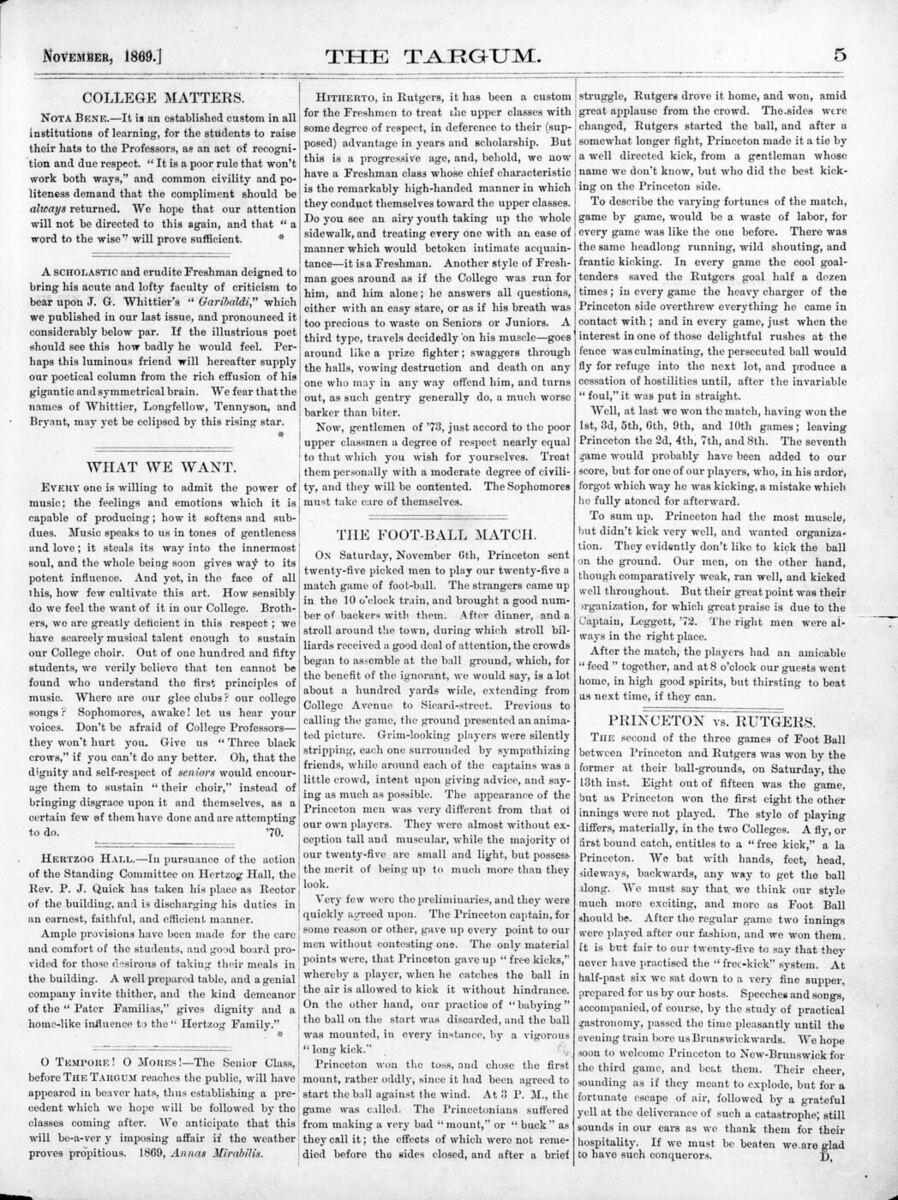

The governing body is the National Collegiate Athletic Association. Its internal geography changed twice in ways this group cared about. From the 1956–57 academic year the NCAA was divided into a University Division and a College Division, a split that began as a way of running two separate basketball tournaments and was then extended to football, where a school's classification was decided not by its own declaration but by outside sanctioning committees. In August 1973 those two divisions were replaced by the numbered Divisions I, II and III, the University Division becoming Division I and the College Division splitting according to whether a school wanted to offer athletic scholarships. Then, for football only, Division I split again: Division I-A was created in January 1978, and the Division I schools left outside it became Division I-AA. In 2006 the NCAA renamed the two: Division I-A became the Football Bowl Subdivision, or FBS, and Division I-AA the Football Championship Subdivision, or FCS. Both old names outlived the change comfortably in ordinary speech, and both appear throughout the group's archive, often in the same thread as the new ones.
The distinction the names encode is the whole postseason argument in miniature. The Championship Subdivision has, as advertised, a championship: a bracketed knockout tournament run by the NCAA, ending in a title game, with a winner nobody has to vote on. The Bowl Subdivision has bowls. It was for decades the only NCAA-sponsored sport at any level for which the association awarded no national championship of its own, and that single administrative fact generated more Usenet traffic than everything else on this page put together.
The other structural facts a reader needs are numerical, and for the whole of the group's lifetime they were set by rule rather than by budget. An FBS team could have eighty-five players receiving football aid, and could add no more than twenty-five new ones in an academic year. An FCS team was limited to the equivalent of sixty-three full scholarships — a figure cut from the original seventy with effect from 1994, and unchanged thereafter — and was allowed to spread that money across as many as eighty-five individuals as partial awards. Division II was limited to the equivalent of thirty-six. Some conferences awarded none at all: the Ivy League, which permits no athletic scholarships in any sport, and the Pioneer Football League, which consists of institutions that fund scholarships elsewhere but choose not to award them in football. Those numbers held until the settlement in House v. NCAA took full effect in 2025–26, when scholarship limits across Division I were replaced by roster limits; every argument in the archive assumes the older regime.
Membership of the top tier was never fixed. When the four-year grace period written into the 1978 split finally expired, forty-one schools that did not meet the I-A criteria were forced down to I-AA for 1982, the Ivy League among them, and some of the forty-one appealed successfully and stayed. The Missouri Valley Conference stopped sponsoring football after 1985. Through the following two decades individual schools moved up, moved down, joined conferences or dropped the sport. As of the 2025 season the Bowl Subdivision held one hundred and thirty-eight schools in ten conferences. During the group's active years the number sat somewhat lower and moved every few seasons, which is one reason the arithmetic in the next two sections was so hard: no team plays more than a tenth of the others, and the ones it does play are chosen partly by geography and partly by contract.
Conferences, and the years they kept moving
A conference is a membership association of universities that schedule each other, share broadcast money and award a championship among themselves. For most of the twentieth century they were also regional in a way that made intuitive sense. From 1990 onwards they stopped being regional, and the group watched it happen in real time, season by season, in threads that were half genuine analysis and half the specific pleasure of watching an institution one dislikes be publicly courted and then publicly jilted.
One rule change drove much of it. In 1987 the NCAA membership approved a proposal, sponsored by two Division II conferences — the Pennsylvania State Athletic Conference and the Central Intercollegiate Athletic Association — permitting any conference with at least twelve football-playing members to divide into two divisions and stage a championship game between the divisional winners without that game counting against regular-season limits. The rule sat unused for five years. Then the Southeastern Conference took it up, and the modern conference arms race began.
The individually verifiable moves of the group's active period, in order:
- 1989–93, Penn State to the Big Ten. Penn State's admission to the Big Ten was announced in December 1989; the football team, an independent since 1892, played its first Big Ten season in 1993.
- 1991–92, Florida State to the ACC. Florida State joined the Atlantic Coast Conference in 1991 and began conference football competition in 1992.
- 1991, the Big East begins sponsoring football. The conference recruited several independents and became a major football league in its own right.
- 1991–92, Arkansas and South Carolina to the SEC. Arkansas left the Southwest Conference for the SEC with effect from the 1991–92 academic year, its football team playing one final Southwest Conference season in 1991 while every other Arkansas sport moved immediately; South Carolina, a football independent since 1971, played its first SEC season in 1992. That took the SEC to twelve, and in 1992 it split into Eastern and Western divisions and played the first conference championship game in the top tier of college football.
- 1995–96, Conference USA. Formed in 1995 by the merger of the Metro and Great Midwest conferences, neither of which had sponsored football, it began sponsoring football in 1996.
- 1996, the Southwest Conference dissolves. Four of its Texas members joined the eight schools of the Big Eight to form the Big 12, which staged its own championship game in its first season. The Western Athletic Conference expanded to sixteen members the same year and staged one too. Across that single realignment twenty-seven schools changed conference.
- 1999, the Mountain West. Eight schools left the sixteen-member WAC to found it, and the WAC gave up its championship game.
- 2000–01, the Big West out and the Sun Belt in. The Big West stopped sponsoring football after the 2000 season; the Sun Belt Conference began sponsoring it in 2001, absorbing several of the same schools.
- 2004–05, the ACC raid on the Big East. Miami and Virginia Tech joined the ACC in 2004, Boston College in 2005. Twenty-three teams changed conference in the resulting cascade and Army became an independent. The Big East backfilled with five schools from Conference USA, which had to restructure in turn.
The pattern is legible once the dates are laid out: a rule permitting a lucrative extra game, a broadcast market that paid for national rather than regional inventory, and a set of institutions each individually acting sensibly and collectively producing a map nobody had designed. The wave that followed — Nebraska and Colorado leaving the Big 12 in 2011, Utah joining the Pac-12 the same year, Texas A&M and Missouri joining the SEC in 2012, Maryland and Rutgers joining the Big Ten in 2014, the Big East splitting along football lines — came after the years in which such groups were busiest, and the one after that, which moved Oklahoma and Texas into the SEC and four western schools into the Big Ten in 2024, came long after. The threads that greeted the first wave are still readable, and they read like people who had already seen the film.
Why there was no champion to win
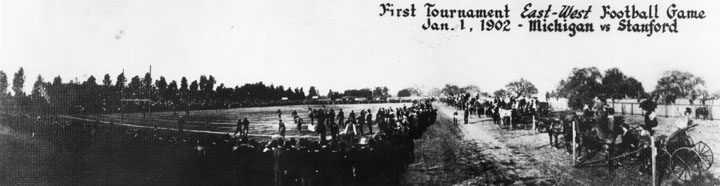
The oldest and best argument in the group requires one piece of history. American college football's postseason did not grow out of a competition. It grew out of a civic festival. On New Year's Day 1902, at Tournament Park in Pasadena, an East–West football game was staged to help pay for the Tournament of Roses parade; Michigan beat Stanford 49–0, the result was so lopsided that the organisers spent the next thirteen years running chariot races and ostrich races instead, and football did not return until 1916. By 1923 the fixture had moved into a new bowl-shaped stadium and taken the stadium's name. The stadium in turn borrowed its shape and its word from the Yale Bowl. In the 1930s the Sugar Bowl in New Orleans, the Orange Bowl in Miami and the Cotton Bowl in Dallas joined it, each of them a city's winter attraction first and a football fixture second.

Because these were the property of cities and committees rather than of the sport, the sport had to negotiate with them. By the 1940s conferences were signing contracts binding their champions to particular bowls, and in 1946, after eight years of argument over payments, rules and ticket allocations, the Big Ten's predecessor agreed a five-year exclusive deal to send its champion to meet the Pacific Coast Conference champion in Pasadena. The first game under it was the Rose Bowl of 1947. The pairing outlived the Pacific Coast Conference itself, was renewed with that conference's successors, and governed where the Big Ten and West Coast champions went until the BCS era began half a century later. The result was a postseason of fixed pipes. The best team in one part of the country went where its conference's contract sent it; the best team in another went where its contract sent it; and whether the two ever met was a question of plumbing.
They rarely did. Since the Associated Press began taking its final poll after the bowl games in 1968, the top two teams in the final regular-season poll met in a bowl only six times before special arrangements began in 1992, most recently after the 1987 season. With no game to settle it, the title was awarded by vote — and where there is more than one electorate, there can be more than one champion. That is the entire mechanism. It is not a scandal and it was not a secret; it was a structure, and the group spent a decade and a half arguing about whether to dismantle it.
The bowls themselves multiplied while the argument ran. The number of team-competitive bowl games grew from ten in 1971 to forty-three by 2023, and eligibility loosened to match: six wins became the standard qualification, and from the 2001 season teams with losing records were sometimes admitted to fill slots, to the point where more than a quarter of the teams in the 2023 bowls had not won more games than they lost. Both facts fed the group's standing complaint that the postseason rewarded mediocrity while refusing to identify excellence, a complaint made with more rhetorical energy than the situation strictly required.
Coalition, Alliance, Series: three attempts at a title game
Three successive arrangements tried to force the top two teams into the same bowl without building a playoff. Each failed in an instructive and slightly different way, and each failure is dated.
The Bowl Coalition ran for the 1992, 1993 and 1994 seasons. It bound five conferences — the SEC, Big Eight, Southwest, ACC and Big East — plus independent Notre Dame and seven bowls, and it selected matchups using a combined poll built from the AP and coaches' points. It worked immediately: in its first season Miami was first and Alabama second, and because Miami's conference had no rigid tie-in the two met in the Sugar Bowl, the first meeting of the consensus top two since 1987. Alabama won, 34–13. But the Big Ten and the Pac-10 stayed outside, contractually committed to the Rose Bowl, and the Tournament of Roses Association refused to release its champions for fear of breaching its television contract. In 1993 both Nebraska and West Virginia finished 11–0, and West Virginia's third place in the combined poll sent it to the Sugar Bowl rather than the title game. In 1994, the arrangement's last year, unbeaten Nebraska played third-ranked Miami in the Orange Bowl on New Year's night while unbeaten and second-ranked Penn State — recently arrived in the Big Ten — played Oregon in the Rose Bowl the following afternoon. Nebraska won, which spared everyone the argument by an accident of results rather than by design.
The Bowl Alliance replaced it for 1995, 1996 and 1997, reducing the arrangement to three bowls — Sugar, Orange and Fiesta, marketed together as the Great Games — played on three successive days, one on New Year's Eve, one on New Year's Day and one on 2 January, so that they did not compete with one another for viewers. The title game rotated among the three and was always played on 2 January. It still did not include the Rose Bowl. In 1996 the second-ranked team, Arizona State, was locked into Pasadena while first-ranked Florida State played third-ranked Florida for the title in the Sugar Bowl; Arizona State lost to Ohio State, which tidied the problem away. In 1997 the same structure produced the arrangement's terminal failure: Michigan was first in both polls and contractually bound to the Rose Bowl, so the Alliance staged second-ranked Nebraska against third-ranked Tennessee in the Orange Bowl the following night. Michigan won its game and Nebraska won its game, and college football finished the season with two champions.
That was the end of it. After a long negotiation the Tournament of Roses agreed to release the Big Ten and Pac-10 champions when necessary, in exchange for the Rose Bowl's inclusion in the title rotation and the retention of its New Year's afternoon slot, and the Bowl Championship Series began with the 1998 season. Roy Kramer, then the SEC commissioner, is generally called its father. The first BCS title game was the Fiesta Bowl of Monday 4 January 1999, Tennessee 23, Florida State 16. The coaches who vote in the AFCA poll were contractually bound to place the winner of the BCS game first, and the member conferences agreed to recognise that winner as the only champion — a promise, in effect, to stop having two.
The promise held for five seasons. It broke in 2003, when the BCS standings sent Oklahoma and LSU to the Sugar Bowl and left USC, ranked first in both human polls at the end of the regular season, out of it. LSU beat Oklahoma 21–14; three coaches broke the agreement and voted USC first anyway; the AP's voters made USC their champion outright. The formula was rewritten in response, and the Associated Press then withdrew its poll from the BCS altogether after the 2004 season, obliging the BCS to commission the Harris Interactive College Football Poll expressly to replace it from 2005. In 2004 the structure produced its other characteristic result: USC and Oklahoma played for the title while Auburn finished the season unbeaten, won the Sugar Bowl and was never given the chance. USC's win in that title game was subsequently vacated.
The BCS lasted through the 2013 season and was replaced by the College Football Playoff from 2014: four teams, two semi-finals, a title game at a bid-hosted site, and no polls or computers in the selection at all — a thirteen-member committee choosing and seeding the field instead. The playoff expanded to twelve teams for the 2024 season. The group's founding argument was therefore settled, in the sense that a bracket now exists, roughly a quarter of a century after it was first posted about; whether a four-team or twelve-team bracket is the thing the arguers wanted is a question the archive leaves open.
The split championships, and who awarded what
The two major polls disagreed on the national champion in eleven seasons: 1954, 1957, 1965, 1970, 1973, 1974, 1978, 1990, 1991, 1997 and 2003. The last four fall inside the group's lifetime or at its very beginning, and they are the ones its archive turns on.
- 1990. Colorado (11–1–1) took the AP poll; Georgia Tech (11–0–1) took the UPI coaches' poll by a single vote, 847 to 846. Colorado's season had included a victory over Missouri in which the officials allowed the team an extra down, a game remembered as the Fifth Down Game. Tom Osborne, then Nebraska's coach, later confirmed that he had moved his first-place vote from Colorado to Georgia Tech.
- 1991. Miami and Washington both finished 12–0. Washington, as Pac-10 champion, was locked into the Rose Bowl against Michigan; Miami played in the Orange Bowl. Both won convincingly. Miami took the AP poll and Washington the coaches' poll, and two consecutive split titles produced the Bowl Coalition.
- 1997. Michigan finished 12–0 with a Big Ten title and a Rose Bowl win over Washington State and was first in the AP poll. Nebraska finished 13–0 with a Big 12 title and a 42–17 Orange Bowl win over Tennessee and was first in the coaches' poll.
- 2003. LSU (13–1) won the BCS title game and the coaches' poll; USC (12–1) was the Associated Press champion. It remains the most recent split between those two polls.
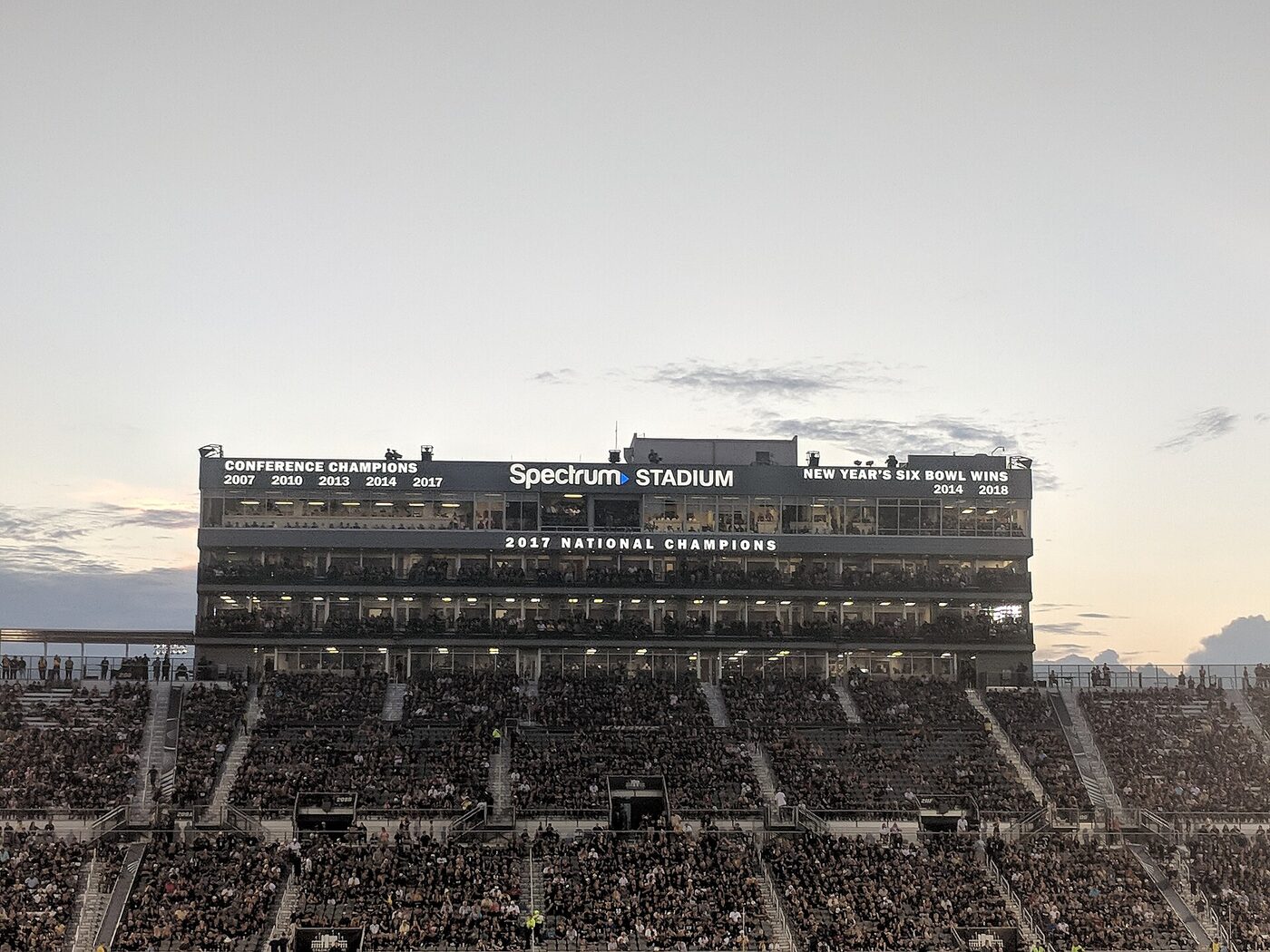
A further complication, and one the group enjoyed disproportionately, is that the AP and the coaches were never the only bodies entitled to say who had won. The NCAA does not award the championship but it does maintain, in its records book, a list of recognised major selectors — more than forty of them — and several of those selectors are computer systems whose output nobody negotiates. The Colley Matrix has named a champion in four seasons — 2011, 2012, 2016 and 2017 — that did not win the BCS or playoff title game, and in each of those years it was the only recognised major selector to do so. Its 2017 choice, the unbeaten University of Central Florida, put the claim on its own press box. Whether that constitutes a national championship is exactly the sort of question the group existed to fail to resolve.
The polls: two electorates, sixty years apart
The senior of the two polls is the Associated Press's, and it began in an argument. In 1935 the AP sports editor Alan J. Gould declared a three-way tie for the national championship between Minnesota, Princeton and Southern Methodist. Minnesota's supporters protested, colleagues led by Charles "Cy" Sherman suggested he create a poll of sports editors instead of relying on his own list, and the weekly AP college football poll began the following year. It has run continuously since 1936. Its ballots are published, which means that individual voters can be, and are, held publicly responsible for their rankings — a feature the group made thorough use of.
The AP ranked twenty teams from 1936, dropped to ten between 1961 and 1967, returned to twenty, and expanded to the current twenty-five in 1989. It has run a preseason poll since 1950 — a ranking, that is, of teams that have not played anyone, which the group treated with the respect it deserved.
The coaches' poll began in 1950 with a top twenty, published by United Press and, from 1958, by United Press International. It passed to USA Today and CNN in 1991, to USA Today and ESPN in 1997, and to USA Today from 2005. It expanded to a top twenty-five for the 1990 season, a year after the AP did; readers of the archive should not be surprised to find the older format discussed as recent memory.
The timing of the final ballot mattered more than it sounds. The AP took its final poll after the bowl games from the 1968 season onwards. The coaches did not, and the arrangement kept producing champions who then lost: Minnesota in 1960, Alabama in 1964, Michigan State in 1965, Texas in 1970. The 1973 season produced the reductio. Alabama was crowned coaches' champion in December and then lost the Sugar Bowl to Notre Dame on New Year's Eve. From the following season the coaches' final poll was also taken in January, and the top-ranked team promptly lost its bowl game in five of the next six years, with the polls now in a position to notice. Under the BCS the coaches' poll acquired an obligation the AP's never had — its voters were contractually bound to place the BCS title-game winner first — which is why the three defections of January 2004 were newsworthy, and why the Associated Press eventually preferred to withdraw its poll rather than have its journalism function as a component in someone else's formula.
The computers, and the people who wrote them
The BCS did not rank teams by opinion alone. From the beginning its standings combined poll results with the output of independent mathematical rating systems, and the composition of that computer component changed almost every year, in public, under pressure. The 1998 formula averaged three: Jeff Sagarin's, published in USA Today; Anderson & Hester's, published in The Seattle Times; and The New York Times ranking. Five more were added before the 1999 season — Richard Billingsley, the Dunkel system, Kenneth Massey, Herman Matthews for Scripps Howard, and David Rothman — with the lowest ranking discarded and the rest averaged.
Then the BCS began legislating about method. From 2001 Peter Wolfe's and Wes Colley's systems came in and the Times and Dunkel ratings went out, explicitly because the BCS wanted systems that did not lean heavily on margin of victory; the highest and lowest of the remaining rankings were discarded and the rest averaged. Before the 2002 season the purge continued, taking out the Matthews and Rothman ratings for the same reason; Sagarin supplied a BCS-specific formula with margin of victory removed, and the Times index returned in a margin-free form. From the 2004 rewrite the set settled at six — Sagarin, Anderson & Hester, the Billingsley Report, the Colley Matrix, Kenneth Massey and Peter Wolfe — with the highest and lowest discarded and the four survivors averaged and expressed as a percentage. Underneath, the arithmetic of combining human and machine rankings into one ordered list was a series of Borda counts, which is to say a voting system; the question of what a fair one would look like attracted actual mathematicians, among them Thomas Callaghan, Peter Mucha and Mason Porter, whose random-walker ranking for Division I-A football was published in The American Mathematical Monthly in 2007.
What makes this section belong on this page rather than in a reference work is who the authors were. These were not the products of institutions. Anderson & Hester was created in 1992 by Jeff Anderson and Chris Hester, who were roommates at the University of Washington, and it has been published weekly in a newspaper ever since. Kenneth Massey first had the idea as an undergraduate at Bluefield College, developed his rating models there and presented them as an honours project; while doing graduate work in mathematics at Virginia Tech he was invited by Roy Kramer to submit his ratings to the BCS, and they were part of the formula from 1999 to 2013. Massey publishes a good deal about how his system works while withholding enough detail that nobody can reproduce it exactly, which is roughly the settled convention among the authors in this section. Wesley Colley set out his matrix method in a paper written at Princeton, insisting that it used only Division I-A wins and losses, that margin of victory did not matter, and that it corrected for strength of schedule without bias towards conference, tradition or region. Peter Wolfe ran his from a personal page on a university host. Jeff Sagarin, who took a mathematics degree at MIT in 1970, had his ratings in the USA Today sports section from 1985 to 2023 and in the BCS for the whole of its existence.
.jpg)
Several of these systems were built, published and defended on the open Internet in the 1990s, before anyone was paying for them, by people who wanted the numbers to exist. That is a working description of the culture the group belonged to, and it is why the section that follows is not a digression.
The newsgroup's own front page
Sports newsgroups accumulated reference material, and this one accumulated an unusual amount of it in a single place. From a personal account on the University of Wisconsin–Madison engineering computing service, David Wilson maintained a site titled American College Football and subtitled, in its own heading, RSFC homepage — rsfc being the group's initials, and also the directory name. Its opening line described it as one of the rec.sport.football.college news group's home pages, and asked readers directly: do you have information that deserves a more permanent home than our news group? Columns, statistics, history, predictions? Consider posting it here.
The site did the clerical work a newsgroup could not. It carried scores for the week and by date across all NCAA divisions and the NAIA, Division I-A conference standings, full schedules for the coming season and the one after, a list of Division I-A head coaches, and separate standings and ratings pages for Divisions II and III, the NAIA and the junior colleges. There was a history section, a section for stadiums, rules and fight songs, a multimedia section of team logos and fight-song files, and a football pool run for the group's readers. Beside them sat signed columns contributed by named readers: preseason predictions, a running SEC update by Charles Hayes, a column by Steve Koreivo, two pieces by Bill Cherry — one on the decline of high-school football, one on the misfortunes of a single team — two separate arguments for splitting Division I-A in two, and one titled with sufficient candour Smoke and Mirrors - The BCS Farce!
Its most substantial page, though, was the rankings index, which carried the banner of the World-Wide Web Virtual Library for American College Football and asked visitors to send in any rating system they knew of or had written themselves. It indexed the polls, the power ratings and the prediction systems side by side, tagged the ones the BCS used, linked comparison pages that ran them against one another, and pointed at the raw score archives that made the whole exercise possible — Peter Wolfe's, Kenneth Massey's, and James Howell's historical results database. It listed well over a hundred rating systems alphabetically by author, each one classified in a private shorthand for the mathematics it used, the information it considered, whether it was meant to predict or to describe, and how many teams it ranked. And it indexed the quarrel as carefully as the ratings: a case against mathematical rating systems by Bob Kirlin, complete with critiques of two individual authors' retrospective ratings and a page on how to fake having your own formula; replies defending them; a general argument that all rating and polling methods are wrong; a counter-argument that computer rankings beat polls; and a run of playoff proposals from named individuals, plus a petition to replace the BCS with one.
The distinction between the newsgroup and the site is worth stating precisely, because it is the distinction between the two halves of that decade's Internet. The group carried the conversation, which scrolled away. The page carried the things the conversation kept needing — the schedule, the standings, the score archive, the list of who else had built a rating system and what they had said about each other's — and it was maintained by hand, by one person, at a university address, on behalf of the readers of a newsgroup. That arrangement was completely ordinary in 1996 and is almost unimaginable now.
The season, as the group experienced it
The rhythm was fixed and everybody knew it, which is what made the group readable. Play begins in late August or early September and runs to the end of November, almost entirely on Saturdays, with a regular season of eleven or twelve games in the top subdivision depending on the era. Because nearly every game is played on the same day of the week, the group's traffic was not continuous: it arrived in a weekly tide, with the pre-game thread on Friday, the results and the arguing on Saturday night, the polls on Sunday afternoon, and four days of comparatively reflective posting before the cycle began again.
Late November is rivalry weekend. A large proportion of the sport's oldest fixtures are scheduled as season finales, deliberately, so that a bad year can still be redeemed and a good one ruined in the last ninety minutes available. Early December then belongs to the conference championship games, which after 1992 multiplied until every conference in the top subdivision had one. The service academies close the regular season afterwards: the Army–Navy Game, which was played on Thanksgiving weekend for most of the group's life and moved to the second Saturday in December in 2009 precisely to get a weekend to itself, is most often held in Philadelphia, roughly equidistant from West Point and Annapolis, and it marks the end of the college football regular season.
The bowl period runs from mid-December to early January, and expanded across the group's lifetime from a cluster of New Year's fixtures into a month-long sequence of televised games in warm cities. February brings signing day and the recruiting reckoning; spring brings practice and an intra-squad game played in front of a crowd; and the summer brings the preview threads, in which the group put its predictions on the record where they could be retrieved in December by people with long memories and no mercy.
Rivalries, with dates
Rivalry claims in this sport are made with the confidence of heraldry and should be checked with the same care. Four that can be dated precisely:
- Minnesota–Wisconsin, first played on 15 November 1890 in Minneapolis and won 63–0 by Minnesota, which remains the largest margin in the series. It is the most-played rivalry in the Bowl Subdivision, and the longest continuously played one: the only year the two did not meet was 1906, when President Theodore Roosevelt's intervention over the sport's safety suspended rivalry games. It has never been played anywhere but Minneapolis and Madison. From 1933 to 1982, and again since 2014, it has closed both teams' regular seasons.
- Army–Navy, first played on 29 November 1890 at West Point and won 24–0 by Navy, and played every year since 1930. Between 1890 and 1893 the game alternated between the two academies before the superintendents suspended it; it was restored in 1899 at Franklin Field in Philadelphia, and Theodore Roosevelt, then Assistant Secretary of the Navy, had a hand in the restoration. He attended in 1901, the first sitting president to do so, and nine others have since.
- Auburn–Georgia, first played in 1892 and renewed annually since 1944. Both universities call it the Deep South's Oldest Rivalry, which is a documented claim about an ordering rather than a boast about quality; by number of meetings it stands second in the Bowl Subdivision behind Minnesota–Wisconsin.
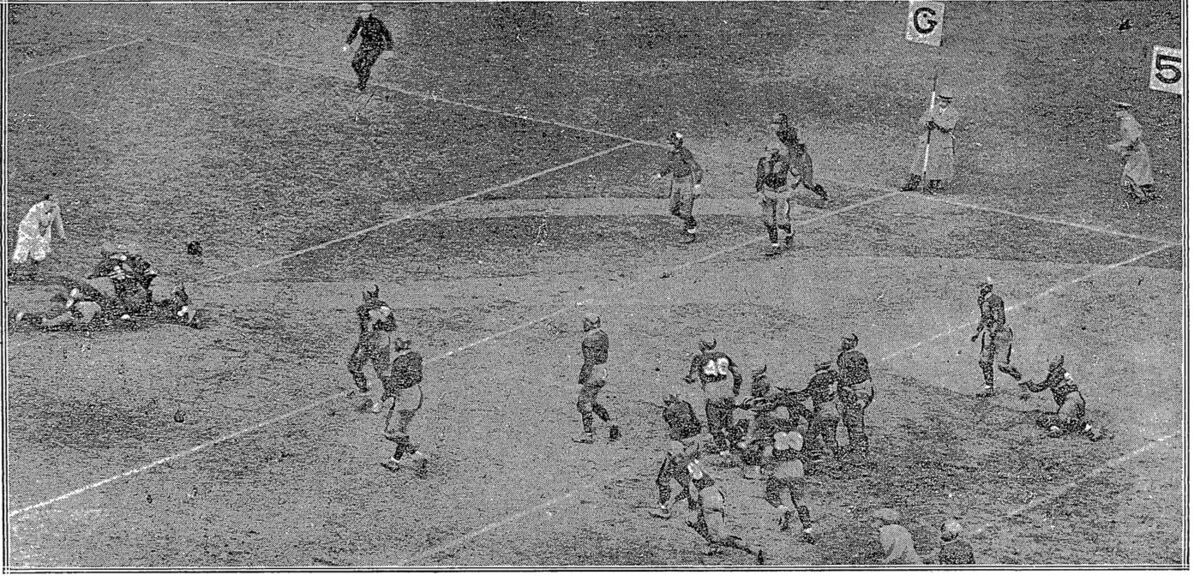
- Michigan–Ohio State, first played on 16 October 1897 at Regents Field in Ann Arbor, Michigan winning 34–0. Its followers call it The Game. Because it has been scheduled at the end of the regular season since 1935, and because the Big Ten champion was for half a century contractually bound to the Rose Bowl, its result frequently decided which of the two went to Pasadena; through 2010 the fixture settled the conference title outright twenty-two times and affected it a further twenty-seven. That is how a single game came to carry so much of the sport's national argument.

A note on the rest. Almost every institution in the sport claims a rivalry with at least one other, most of those claims are locally true, and very few of them are documented in a form that survives citation. Where this page gives no date, it is because no date could be confirmed, not because none exists.
Recruiting becomes an industry
Because a university may not buy a player, it must persuade one, and because for the whole of the group's life it could hold only eighty-five on aid at a time and add only twenty-five a year, the persuading is the closest thing the sport has to a transfer market. The paperwork dates from 1964, when J. William Davis, a professor of government and faculty athletics representative at what is now Texas Tech University, created the National Letter of Intent programme with the assistance of Howard Grubbs, then commissioner of the Southwest Conference. It began with seven conferences and eight independent institutions and was not run by the NCAA at all; the object was to bind both sides once a decision had been made. The NCAA took over its administration only in October 2007. Signing day for football was fixed in the first week of February. An early signing period of three days in December was added from the 2017 cycle, and the National Letter of Intent itself was retired in Division I in the autumn of 2024, though Division II still uses it.
What grew around that document across the group's lifetime was a publishing industry. Rivals was founded in 1996 and launched as Rivals.com in Seattle on 4 November 1998; it raised thirty-five million dollars from SoftBank in February 2000 and ninety million in venture capital altogether, switched to subscriptions in December 2000, and ceased operations in April 2001 when the dot-com bubble burst, though it never sought bankruptcy protection. Its assets were bought back for five hundred thousand dollars, the business returned, and Yahoo acquired it in June 2007 for around one hundred million. Scout.com was founded in 2001 and acquired by Fox Sports in 2005. 247Sports launched on 1 August 2010, struck a content partnership with CBS Sports in November 2012 and was bought by CBS in December 2015. All three were built on the same architecture: a national ranking of high-school players, expressed in stars, and beneath it a network of subscription message boards, one per university, where the ranking was discussed by that university's supporters.
That architecture matters to this page for a structural reason. It is precisely the newsgroup, disaggregated and charged for. A single room in which every team's supporters argued with one another was replaced by several hundred rooms in which each team's supporters argued among themselves, with the recruiting rankings supplied as the content that made a subscription worth renewing in February, when no football is played.
The objection to publishing teenagers
The people being ranked were school pupils. Most were seventeen or eighteen; some were younger when the coverage began; none had chosen public life. An objection to discussing them by name, in public, at length, was made throughout the period, and the clearest surviving statement of it is not a newspaper column but the NCAA's own rulebook, which restricts what the institutions themselves may say.
Under the Division I bylaws, before a prospective student-athlete has signed or accepted an offer, a member institution may comment publicly only to the extent of confirming its recruitment of the prospective student-athlete; it may not comment generally about the prospect's ability or about the contribution the prospect might make to its team, and it is precluded from commenting in any manner on the likelihood of the prospect committing to or signing with it. A companion provision states that athletics department staff shall not evaluate or rate a prospective student-athlete for news media, scouting services or recruiting services. Contact is regulated as well: as a general rule, telephone calls to a prospect or the prospect's family may not be made before 15 June at the end of the sophomore year of high school, with the detailed windows set sport by sport.
The objection, as it was put, ran roughly as follows: that a minor's athletic ability, character, family circumstances and indecision were being published, ranked and argued over by adults he had never met; that a public archive is permanent in a way a conversation is not; that the coverage created pressure on children to commit early and publicly; and that the commercial interest in the coverage belonged entirely to people other than its subjects. The answers offered were equally consistent: that the information was already circulating privately among coaches and boosters and that publishing it was a levelling rather than an intrusion; that the recruits and their schools increasingly courted the attention, holding announcement ceremonies and giving interviews; and that a scholarship worth several years of tuition is a public transaction at a public institution.
This page records that both arguments were made and takes no view on either. What can be said without taking a view is that the practice long outlasted the objection, that the rules quoted above bind universities and not publishers, and that the archives of the period contain a great many names of people who were fifteen when the thread began.
Amateurism, the Supreme Court and the long aftermath
Two legal facts shape everything above. The first is that the sport's money is television money, and that the television money was set free by a lawsuit. From the early 1950s the NCAA controlled the broadcast rights to all college football, limiting the number of games shown on the argument — supported by studies it commissioned from the National Opinion Research Center between 1952 and 1957 — that televising games depressed attendance at the games not televised. In 1977 sixty-three schools formed the College Football Association to negotiate their own contracts; when it reached an agreement with NBC in August 1981 the NCAA threatened to bar the participants from competition in every sport, and the Board of Regents of the University of Oklahoma and the University of Georgia Athletic Association sued.
In NCAA v. Board of Regents of the University of Oklahoma, 468 U.S. 85, decided on 27 June 1984, the Supreme Court held by seven votes to two that the NCAA's television plan was an unreasonable restraint of trade. Justice Stevens wrote for the majority; Justice White — a consensus All-American halfback for Colorado and the runner-up for the Heisman Trophy in 1937 before he was anything else — dissented, joined by Justice Rehnquist. The immediate effect was that far more games were televised and rights fees fell. The lasting effect was that broadcast rights devolved to conferences and to individual universities: by 1991 Notre Dame had its own five-year network contract for all its home games, conferences discovered that their bargaining power depended on which universities belonged to them, and every realignment listed earlier in this article follows from that. The College Football Association itself, having won, became redundant and ended its operations on 30 June 1997. Andy Coats, the lawyer who had argued the case for Oklahoma and Georgia, told NBC News in 2023 that the ruling had screwed up college football across the board, and that he did not think anyone could have predicted what would happen.
The second fact is amateurism, and here the American story is its own thing and should not be confused with the parallel argument in the Olympic movement, which is told on rec.sport.olympics. Through the whole of this group's active life the rule was simple: a player could receive a scholarship covering tuition, housing and books, and nothing else. That rule was enforced by an investigative apparatus, and the group's periodic scandals — payments, cars, boosters, sanctions, vacated victories — were violations of it.
What followed postdates the group and is set out here only so that a reader arriving from an old link is not left in 2004. In O'Bannon v. NCAA, Judge Claudia Wilken of the Northern District of California held on 8 August 2014 that the NCAA's restrictions on compensating players for the use of their names, images and likenesses were an unreasonable restraint of trade; the Ninth Circuit affirmed in part and reversed in part on 30 September 2015, at 802 F.3d 1049, and the Supreme Court declined to hear the case on 3 October 2016. California's Fair Pay to Play Act followed in 2019, and other states legislated in turn. In NCAA v. Alston, 594 U.S. 69, decided 21 June 2021, a unanimous Supreme Court upheld an injunction against NCAA rules limiting education-related benefits; Justice Gorsuch wrote for the Court and Justice Kavanaugh concurred separately and pointedly. The NCAA adopted an interim policy permitting name, image and likeness compensation with effect from 1 July 2021, and a settlement in House v. NCAA, approved on 6 June 2025, allows member institutions to distribute money directly to Division I athletes. Reported here as the record states them, and no further.
Where the following went
The migration had two stages and the first one is easy to miss, because it was not to social media at all. It was to the team board. A newsgroup is one room for a whole sport; what most supporters actually wanted was one room for their own university, populated by people who agreed with them about the important things and could therefore disagree productively about the rest. The recruiting networks supplied exactly that, and charged for it: Rivals from 1998, Scout from 2001, 247Sports from 2010, each running a subscription board for essentially every team in the top subdivision and many below it. The general-purpose newsgroup did not lose an argument to them; it lost a purpose.
The second stage moved reaction off the boards and onto general platforms, where it became faster, shorter and much larger, and where the results, the polls and the arguments now arrive at the same moment for everybody. What did not survive either move is the specific thing this group was: a single, public, permanently addressable thread in which supporters of every team in the country were obliged to read each other. That property was an artefact of the medium and not a virtue anyone chose, but it produced an archive with no modern equivalent, because the modern equivalents are sorted by allegiance before anyone speaks.
The group itself did not close. Traffic thinned through the 2000s as it did across Usenet, and the newsgroups file that servers distribute still lists rec.sport.football.college, described in the four words a site administrator gave it in 1991, alongside its two siblings from the 1990 split and unmoderated, exactly as the proposal specified.
Scope and limits
What this page can state about the group with confidence is short and is set out above: when and how it was created, out of what, by whose control message, with what stated remit, and what one of its readers built on the web to support it. Everything else here is context — the structure of the sport, the postseason arrangements, the polls and rating systems, the calendar and the law — verified independently and included because a reader who does not already know it cannot make sense of a single thread in the archive.
What this page deliberately does not contain is group-specific colour that cannot be checked. There are no thread titles, no posting counts, no readership estimates, no names of prominent posters and no quotations from the group itself. The named individuals who appear above are named because they signed their work on a public web page or in a published source, not because anyone has reconstructed who posted what. Newsgroups of this kind generated very little external documentation about themselves, and college football's Usenet years in particular were written up by nobody at the time, because the people who would have written them up were busy posting. The honest position is that the traffic is the record: it is archived, it is searchable, and it says what it says without an intermediary.
Readers who want the branch this group sat in, and the wider question of what sport did with a medium that had no clock, will find it at rec.sport.*; the ice and grass variants of another sport with a naming problem are at rec.sport.hockey; and the whole snapshot of the gateway's namespace is in the full group list. Everything in this article that carries a date, a name or a number was checked against a published source before it was written down, and where a check failed the sentence was made more general rather than more interesting.
Reading rec.sport.football.college today
- Historical archive: Google Groups — rec.sport.football.college (coverage varies by group and era).
- Open in a newsreader:
news:rec.sport.football.college— the original site offered exactly this link, and it still works if your system has a newsreader registered for thenews:scheme. - Live access: point an NNTP newsreader at a modern server — see accessing Usenet today.
- The original news2mail e-mail subscription service ended in the mid-2000s and no longer operates.