alt.autos.ford.focus
The Ford Focus: ownership, mods and maintenance.
The Focus was new to the US market in 2000; recall news, maintenance schedules, SVT enthusiasm and modification lore are what an owners’ group of that period was for.
This address originally listed the group’s recent messages; the live feed ended with the gateway, and the message archive is not preserved here.
On this page
- A line in the master catalogue that belongs to a different group
- Where the sentence actually comes from
- Eight names, one sentence
- How a description is supposed to arrive, and who is supposed to fix it
- The group's own paperwork
- The Ford shelf of the namespace
- A world car, and the two attempts that preceded it
- The European car, 1998 to 2005
- The American car, 2000 to 2007
- Where the two cars parted, and why it matters to a reader of the archive
- The performance versions, and why their names do not travel
- New Edge: the shape people argued about
- Control Blade: the suspension the reputation rests on
- The awards, dated
- Recalls, from the regulator's own record
- The Split Port engine, and the limits of what can be said about it
- What an owners' group carried, as genres
- Where owners went afterwards
- What the record does not show
- Scope and limits
A line in the master catalogue that belongs to a different group
Every Usenet server keeps two administrative files. The active file lists the group names the server will accept articles for; the newsgroups file gives each name a one-line description, and it is that second file which a newsreader displays when a user asks what a group is. The Internet Systems Consortium mirrors both, rebuilt hourly from the flow of control messages; the copy consulted for this article carries a server timestamp of 05:00 GMT on 26 August 2026 and runs to 45,003 lines, of which 20,466 are groups in the alt.* hierarchy. Line 821 reads, in full:
alt.autos.ford.focus An adjunct to the alt.ozdebate newsgroup, for the posting of binaries
That is not a description of a Ford Focus owners' group. It is not a description of a car, of an owners' group, or of anything a person arriving from a directory listing would expect to find. It is a precise and accurate description of something else entirely, and it has been sitting on this group's name in the file that news servers distribute for as long as the file has recorded the group at all.
The line also breaks the file's own house style, which is set out in the same archive's published policy: a description should begin with a capital, should not exceed 55 characters, and should leave the whole line inside 79 columns for a traditional terminal. This description is 69 characters, and with the group name and its tab the line renders 93 columns wide. It is not merely wrong; it is wrong at length.
A missing description would have been the ordinary outcome. Of the 45,003 lines in the current file, 9,827 read simply No description. and a further 189 carry the same placeholder with a moderation marker appended — including, some twenty-nine thousand lines further down at line 30,082, the Italian group free.it.ford.focus, which is about the same car and says nothing at all. Silence is the normal condition of the namespace. A confident, well-formed, entirely inapplicable sentence is a rarer and more interesting failure, because a reader will believe it.
Where the sentence actually comes from
The sentence is not orphaned. It has a rightful owner, and the owner is 1,530 lines further down the same file. Line 2351 reads:
alt.binaries.ozdebate An adjunct to the alt.ozdebate newsgroup, for the posting of binaries
Character for character the same. And for alt.binaries.ozdebate the sentence is not only accurate but self-authored, which the control archive proves. The newgroup control message that created that group survives in the Internet Systems Consortium's mirror of the Usenet administrative record. It was posted on 1 April 1999 at 04:01 GMT by David Andrew Proctor, through OzEmail, then a major Australian internet provider, and cross-posted to alt.config, alt.ozdebate and the new group itself. Its body opens with the line the archive's software looks for — For your newsgroups file: — followed by the description, and then by an explanation:
The ozdebate group has been successfully operating now for over 6 months, living first in the ozemail.debate newsgroup and more recetnly in the alt.ozdebate newsgroup when several of the group moved to new providers.
The misspelling is the sender's. The message goes on to say that moving into alt.* let members reach the group without dialling in through OzEmail's own servers, and that it had also let them attract, in the author's own word, a range of new weirdos, the most recent recruits being from Baltimore, London and Paris. Then the operative sentence: the alt.ozdebate group did not allow the posting of binaries, and so a companion group was being created that would.
The parent group's own paperwork is equally candid. alt.ozdebate was created three weeks earlier, on 10 March 1999, by the same sender, with a charter explaining that a change in OzEmail's charging arrangements was about to scatter the regulars of an internal provider newsgroup called ozemail.debate, and that a group in alt.* was proposed so that the members could remain in contact. A booster message re-issued in June 1999 supplied a shorter description for the file: a Seinfeld type group, a newsgroup about nothing. That shorter description did not survive either. In the current file alt.ozdebate itself reads No description. — the parent group has lost the sentence it wrote, while eight strangers have kept the one it wrote for its child.
None of which has the slightest bearing on a compact car built at Saarlouis and Wayne, Michigan. The sentence on line 821 is a true statement about a small Australian debating circle's arrangements for posting pictures, filed under the name of a car.
Eight names, one sentence
Searching the whole of the current newsgroups file for that sentence returns nine lines. One of them is alt.binaries.ozdebate, where it belongs. The other eight are:
- alt.autos.ford.focus — this group.
- alt.os.beos — the BeOS operating system.
- alt.outdoor.photo.chat — outdoor photography.
- alt.flame.kosovo-war — a flame group named for a war then in progress; NATO's air campaign had begun the week before the group was created.
- alt.masturbation.female and alt.masturbation.male.
- alt.fan.pst and alt.fan.pst.d — a binaries group named after an IRC channel, and its discussion counterpart.
No plausible reading connects a car, an operating system, a photography chat group and a wartime flame group to an Australian provider's debate club. What connects them is a date. Every one of the eight has a newgroup control message in the archive dated 1 or 2 April 1999, and several of them sit immediately beside alt.binaries.ozdebate in the archive's own numbering. The message that created alt.binaries.ozdebate is filed as control.newgroup:158815. The message that created alt.autos.ford.focus is 158816. alt.flame.kosovo-war is 158817; alt.masturbation.male is 158820; alt.masturbation.female is 158821; alt.os.beos is 158822. The Date headers of those five messages read 19:55:56, 19:55:59, 19:56:05, 19:56:08 and 19:56:13 GMT on 1 April 1999 — five unrelated newsgroups created inside seventeen seconds. Each carries a different and obviously disposable From address, and all five carry the same Organization header and the same NNTP-Posting-Host, a-lu4-31.tin.it: one consumer line on one Italian provider. The ozdebate message that precedes them in the archive came from Australia, nearly sixteen hours earlier, at 04:01 GMT the same day.
One more fact rules out the easiest explanation. The archive's published rule is that a group's description is whatever its most recent control message supplied. Three of the eight affected groups did supply one. alt.outdoor.photo.chat's message of 2 April 1999 carries a properly formed description of an outdoor and science photography group; alt.fan.pst's booster of the same day carries one naming its IRC channel; alt.fan.pst.d's carries one too. All three still show the ozdebate sentence in the file today. Whatever attached it, it was not the ordinary rule working on the ordinary inputs.
What that adjacency means is a separate question from what it proves. It proves that the eight names and the sentence's rightful owner passed through the same archive within a day of one another. It does not establish how one group's self-description came to be attached to eight other names, and no document consulted for this article establishes it. The consortium's own action log, which records every description change with a timestamp, begins in May 2003 — four years too late to have witnessed anything. This page therefore reports the correlation and declines to invent the mechanism. Guessing at causes for undocumented events is precisely the habit that put the line there in the first place.
How a description is supposed to arrive, and who is supposed to fix it
The archive publishes its rules. The document is titled GROUP CREATION POLICIES, was originally written by David Lawrence and is now maintained by Russ Allbery, and the copy consulted was last modified on 19 February 2018. On descriptions it is unambiguous:
The newsgroup descriptions in the newsgroups file are taken from the most recent control message for that group, whether a valid "newgroup" or "checkgroups" message.
And on this hierarchy specifically:
The "alt" and "free" hierarchies are special cases. In each hierarchy, all properly formatted newgroups (see below) are automatically executed, and all rmgroups are ignored. No manual changes will be made in either hierarchy except under very special circumstances, and will require substantial justification. Similarly, the moderation status and description of the newsgroup will be set to whatever was present in the last control message for that group.
Two consequences follow, and between them they explain why a wrong line can outlive the car it misdescribes. The first is that nothing about alt.* is curated. Descriptions are copied mechanically out of whatever the last control message said, and the archive is explicit that it will not edit them by hand: on the general quality of the lines it inherits, the same document says flatly that "we do not have the time to fix up the lines that are being automatically included from newgroup messages". The second is that the only correction route is a human one. The document invites it — readers who notice a discrepancy with another authoritative list are asked to write to the maintainers — but an invitation is not a process. Somebody has to notice, care, and send the mail. For a newsgroup with no moderator, no charter, no FAQ maintainer and, by the 2010s, no evident readership, there is nobody whose job it is to notice.
The machinery is not incapable of catching a missing description; it simply has no way of catching a wrong one. The action log contains, for instance, three entries logged in the same second on 11 April 2004, recording that newgroup messages for free.binaries.opie-and-anthony, free.binaries.ozdebate and free.binaries.pandora were archived with the note no description in body of newgroup. Absence is detectable, and logged, and reported alphabetically. Misattribution is not, because a misattributed line is syntactically perfect.
The practical harm is narrow and real. Anyone who checks the catalogue rather than the group — a directory compiler, a search engine, a student assembling a corpus, a news administrator deciding whether to carry the group — is told that alt.autos.ford.focus is a binaries annexe to an Australian debating group. It is the one thing about the group that a machine can read, and it is false. That is worth stating on the page that the same reader will arrive at next.
The group's own paperwork
alt.* leaves no vote. There was no Request for Discussion, no Call for Votes, no published tally and no waiting period, because the hierarchy dispenses with all of it: a group exists when somebody sends a newgroup control message, and it exists wherever administrators choose to honour it. Why the hierarchy was built that way, and what people made of it, is set out on the alt.* page.
What that leaves is the control archive, and for this group the archive holds one file of 487 bytes containing exactly one message. It is dated Thursday, 1 April 1999, 19:55:56 GMT. It was sent from the address [email protected], posted to control.newgroup, and injected through news.tin.it — an Italian consumer internet service belonging to Telecom Italia — from the host a-lu4-31.tin.it, using Forte Agent 1.5. It carries the header Control: newgroup alt.autos.ford.focus, an Approved line that simply restates the command, and a Lines count of 1.
The body is empty. There is no charter, no description, no statement of purpose, no keyword list, no name, and no address that a reply could reach. Under the rules the archive publishes today the message would not be automatically processed at all, because those rules require a body containing the exact line For your newsgroups file: followed by a valid description. In 1999 it was processed, and the group has been in the active file ever since. Compare alt.bmx, whose three control messages of 1998 and 2003 supply a description, a charter and a keyword list apiece: that is an unusually well-documented alt.* group, and it is documented because one person cared enough to send the messages properly. Nobody did that here.
The configuration file in which news administrators record whose control messages they trust, INN's control.ctl, sets out the position for this hierarchy with unusual candour, and two of its remarks bear directly on a message like this one. It warns that "Tons of alt.* newgroups are sent out regularly with the intent more to create nonsense entries in active files than to actually create a useable newsgroup", and recommends, as "one good initial filter", checking the control archive to see whether a syntactically valid newgroup message was ever issued for the group. It then concedes that "there is no official, generally accepted alt.* policy and all information about alt.* groups available is essentially someone's opinion, including these comments".
Whether alt.autos.ford.focus was one of the nonsense entries or a genuine request badly made cannot be settled from the record. What the record shows is that its creation message was one of a rapid sequence of unrelated group creations issued within seconds of each other, from throwaway addresses on a single consumer line, on 1 April 1999 — and that, whoever sent it, the group afterwards became real enough for a mail-to-news gateway to carry it and list it, which is the only reason this page exists. The date is what it is; this page notes it and draws no conclusion from it.
In the current active file the group is listed with the flag y: unmoderated, posting permitted. Twenty-seven years after that one-line message, the address is still open.
The Ford shelf of the namespace
Usenet's car groups grew the way alt.* always grew — by whoever cared enough to send a message — and the result is a shelf that is neither complete nor tidy. In the current file the Ford entries include alt.autos.ford ("Other Ford vehicles."), alt.autos.ford.escort ("Ford Motor's ubiquitous economy car."), alt.autos.ford.cdw-27 ("Ford Contour/Mondeo/Cougar/Mystique", named after the platform code rather than any car), alt.autos.ford.crown-victoria ("crown vic discussion"), alt.autos.ford.festiva and alt.autos.ford.flathead (both "No description."), and alt.trucks.ford ("purpose to discuss ford trucks"). There is also alt.auto.ford.pickups — singular auto, a typing slip in a name that can never be corrected, only superseded.
The Big Eight carried two Ford groups of its own, created through that half of Usenet's discussion-and-ballot procedure rather than by a bare control message: rec.autos.makers.ford.explorer ("1991+ Ford Explorer SUV.") and rec.autos.makers.ford.mustang ("Ford Mustangs in all their flavours."). The contrast is the whole argument between the two halves of Usenet in four lines of a text file: the voted groups have descriptions somebody wrote on purpose, and the unvoted ones have whatever turned up.
Outside English there were more. free.uk.cars.ford ("Cars made by Ford UK - like the Ford Cortina"), it.discussioni.auto.ford ("Per i clienti Ford", moderated, in Italian), free.it.ford.focus (blank), ee.auto.ford ("Fordijutud", Estonian for Ford talk), and the FidoNet echo fido7.ru.cars.ford, gatewayed into Usenet from a Russian store-and-forward network. A reader wanting the full extent of what this directory's gateway saw can consult its list of groups; the Ford shelf here is one page of it.
A world car, and the two attempts that preceded it
The car this group was named for was the third serious attempt by Ford to build a single small car for the whole world, and the first that worked. The programme sat inside Ford 2000, the reorganisation launched in 1995 under Alexander Trotman — chief executive from November 1993 to December 1998, and the first foreign-born head of the company — which set out to unify and consolidate Ford's manufacturing, marketing and product development around the world.
The two previous attempts are worth naming because they are why the Focus was remarkable. The 1981 Escort was announced as a world car and became two entirely different cars sharing a badge, one for Europe and one for North America, with only superficial similarities between them. The 1993 Mondeo was tried again, and reached the United States as the Contour and the Mercury Mystique with enough differences to make the claim embarrassing — a car whose Usenet group, alt.autos.ford.cdw-27, is filed under the platform code precisely because no single model name covered it. The first-generation Focus, developed under the code C170, came closer to the promise than either.
It very nearly launched under a different name. Ford had intended to keep the Escort badge, settled on Focus in early 1998, and was then told in July 1998 by a court in Cologne, acting on a suit brought by the publisher Burda, to avoid the name on German-market cars because the publisher's Focus magazine already held it. The eleventh-hour dispute was overcome in the weeks before launch and the car went on sale under one name everywhere, which for a programme whose entire point was one name everywhere was a closer-run thing than the marketing allowed.
Focus models were designed under the directorship of Richard Parry-Jones; the project manager at Ford's Dunton research centre in Essex was Rose Mary Farenden. The styling was overseen by Jack Telnack, Ford's vice-president of design from 1980 to 1997, and executed by Claude Lobo and the Australian designer John Doughty, concluding in January 1996 on programme approval. The name itself was second-hand: a Ghia concept car shown at Geneva in 1991 had used it first.
The European car, 1998 to 2005
The Focus was revealed at the Geneva Motor Show in March 1998 and went on sale in Europe in July of that year, replacing the Escort there and in South Africa, and the Laser in Asia and Australia. Three body styles were offered from the start: a hatchback in three- and five-door form, a four-door saloon, and a five-door estate. The wheelbase was 2,615 mm and the hatchback 4,175 mm long — a small car by any measure, and one whose interior was conspicuously larger than that measurement implied.
Petrol engines at launch ran from a 1.4-litre Zetec-SE through a 1.6 of the same family to 1.8- and 2.0-litre Zetec-R units taken from the Mondeo; the diesel was the 1.8 TDDi, a development of an older design, replaced in 2002 by the 1.8 Duratorq TDCi introduced with the facelift. Transmissions were a five-speed manual or a four-speed automatic, with a six-speed Getrag manual reserved for the performance cars. Assembly was at Saarlouis in Germany and Valencia in Spain. Halewood on Merseyside, which had built Escorts, did not get the Focus: it was being converted for the Jaguar X-Type, and went on building the outgoing Escort until 2000 as a budget alternative, with the van versions running to 2002. Production also ran at General Pacheco in Argentina, Santa Rosa in the Philippines, Chungli in Taiwan and Vsevolozhsk in Russia.
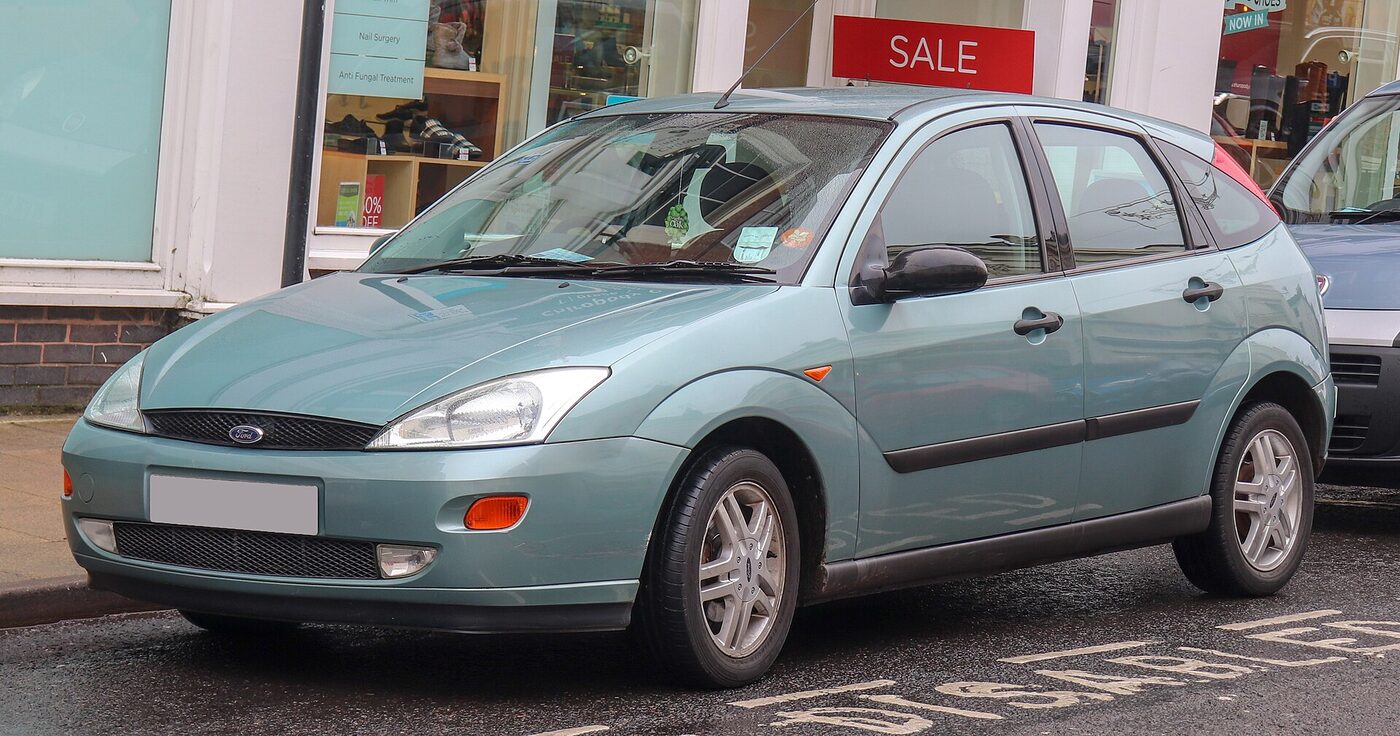

A facelift arrived in late 2001, retrospectively called the Mk1.5: revised headlamps with the indicators integrated and separate main and dipped bulbs, revised bumpers without indicators, a new grille and fog lights, optional xenon lamps and satellite navigation, and the TDCi diesel. European production of the first generation ended in 2005, though the car outlived that comfortably elsewhere — Argentina built it until 2008 and it remained on sale in Brazil until 2009.
The sales figures give the scale of the constituency an owners' group was drawing on. In Europe the Focus recorded 29,399 registrations in the part-year of 1998, then 488,679 in 1999, 513,347 in 2000, 543,378 in 2001, 519,451 in 2002, 440,383 in 2003 and 432,426 in 2004. A group with a few dozen active posters was a rounding error against that; but so is every owners' club, and the ratio is worth holding in mind when reading any claim about what "Focus owners" thought.
The American car, 2000 to 2007
North America got the Focus a year later, as a 2000 model. Production at Wayne Stamping and Assembly in Michigan began in September 1999, with Hermosillo in Mexico building alongside; the reference sources differ on whether Ford began marketing the car in September or October 1999, and this page does not resolve the discrepancy. The line-up was a three-door hatchback badged ZX3, a four-door sedan in LX, SE and ZTS trim, and a five-door wagon. A five-door hatchback, the ZX5, was added for the 2002 model year after a debut at the Canadian International AutoShow in Toronto, and the wagon gained a ZTW trim the same year.
The launch campaign is dated and documented, and it explains something about who ended up in the group. Ford aimed it at young buyers — Generation X and Generation Y, in the campaign's own vocabulary: sixty-four live television spots featuring the comedian Annabelle Gurwitch beginning on 6 September 1999 during the MTV Video Music Awards, a youth-destination website, co-sponsorship of Ricky Martin's North American tour in September 1999, and a partnership with the WB network series Dawson's Creek that put the car in two episodes and auctioned a cast-signed example on Amazon. In January 2001 Ford commissioned three short films around the car with Atom Films and J. Walter Thompson, at a reported cost of eighty thousand dollars, which were later shown at the Sundance Film Festival. All of which dates the car precisely: it was launched at the audience that was taking up consumer internet access in the United States in exactly those years, by a manufacturer that had already built it a website of its own.
The special editions came thick and fast, and their names recur in period ownership material: a Sony Limited Edition of 7,000 cars in January 2000 with a ten-inch boot-mounted subwoofer; a Kona Mountain Bike Edition of 5,000 in May 2000, complete with bicycle; a Street Edition of 7,500 in September 2000 fitted with the same springs, dampers and anti-roll bars as the European car, which is a telling thing for a manufacturer to sell as a limited edition; an S2 with European-tuned suspension for 2001; a Mach Audio ZTS; and a Centennial Edition of 3,000 announced on 20 December 2002 for Ford's hundredth anniversary, each including a copy of the commemorative book The Ford Century.
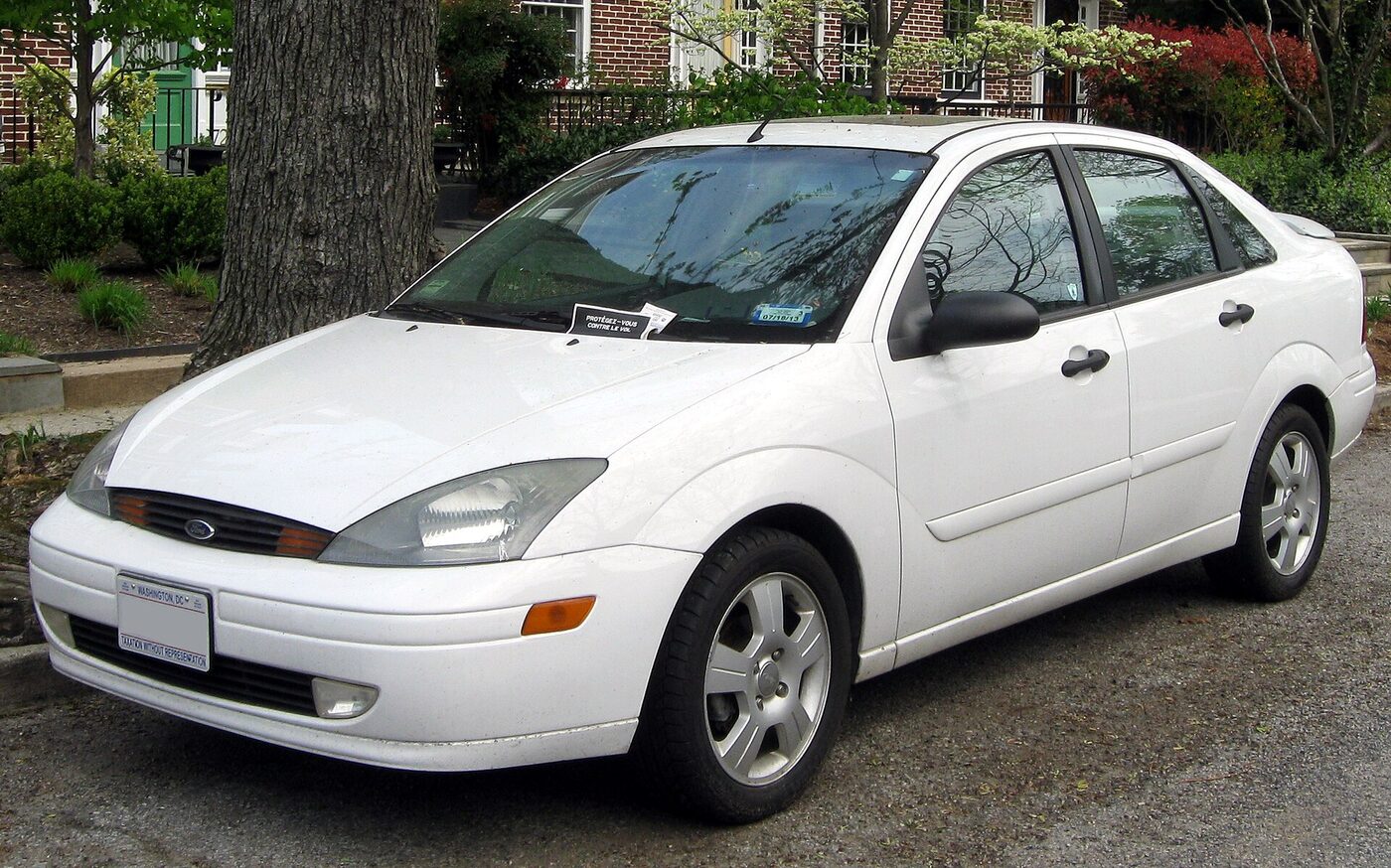

United States sales ran 55,896 in the part-year 1999, 286,166 in 2000, 264,414 in 2001, 243,199 in 2002, 229,353 in 2003 and 208,339 in 2004. The car became one of the ten best-selling cars in America shortly after its introduction, and its American customers are the population the line above this article describes.
For the 2005 model year the North American car was reworked rather than replaced, under Focus chief engineer John Sidelko and designer Larry Erickson. The naming was reorganised so that a body designation — ZX3, ZX4, ZX5, ZXW — was carried alongside a trim designation of S, SE or SES. The engine range was simplified: a 136 hp 2.0-litre Duratec replaced both the 110 hp single-cam unit and the 130 hp Zetec, with a 151 hp 2.3-litre Duratec for the ZX4 ST, and a partial-zero-emission version of the 2.3 also available in California, New York, Massachusetts, Vermont and Maine. Wagon production ended with the 2007 calendar year.
Where the two cars parted, and why it matters to a reader of the archive
On 25 September 2004 Ford launched the second-generation Focus in Europe at the Paris Motor Show, on the C1 platform that replaced C170: 25 mm more wheelbase, 168 mm longer overall, 138 mm wider and heavier, with a saloon following in mid-2005, a coupé-cabriolet added in 2007 and a Kinetic Design facelift in 2007–2008. North America did not receive it. The American car stayed on the C170 platform of 1998, was facelifted in 2005, and was then restyled again for the 2008 model year — unveiled at the 2007 Detroit show, built from September 2007 to December 2010, and offered only as a two-door coupé and a four-door sedan. The hatchbacks and the wagon were dropped. Reference sources treat that car as a separate North American second generation rather than as the European Mk2, because underneath the new bodywork the platform was still the first generation's.
The lines were reunited only with the third-generation car, shown at the 2010 Detroit show and launched in both markets in early 2011, with production having begun late in 2010.
This is not a footnote; it is the single most useful thing to know when reading anything a Focus owners' group produced. Between 2004 and 2011 the word "Focus" named two different cars on two continents, sharing a badge, diverging in platform, body styles, engines and model-year numbering. An American owner and a British owner comparing notes on "the new Focus" in 2005 were not discussing the same object, and neither was necessarily aware of it. Any archive of transatlantic car talk from that period has to be read with the market of each participant established first — which, for a group whose surviving catalogue entry is about an Australian debating club, is an appropriate degree of difficulty.
The performance versions, and why their names do not travel
Nothing about the Focus generates more confident error than its fast versions, because the same letters mean different cars in different markets and different years. Set out chronologically, with the market attached to each:
- Focus ST170 (Europe, launched 2002; internal codename Piranha). A 2.0-litre Zetec reworked with Cosworth involvement: a high-flow aluminium cylinder head, variable valve timing, a dual-stage intake manifold and a Cosworth stainless exhaust system and manifold, raising output from 127 to about 170 hp. A Getrag six-speed manual, 300 mm front and 280 mm rear discs, seventeen-inch wheels, optional Recaro seats. Final assembly at Saarlouis, with the subwoofer and other content assembled off-line at the ACÜ facility attached to the plant. An estate version, codename Swordfish, was offered in Europe only from 2003, with Nivomat self-levelling rear dampers.
- Focus SVT (North America, model years 2002 to 2004). The same car under the badge of Ford's Special Vehicle Team, the in-house performance group founded in 1991. Launched on the three-door ZX3 for 2002; a five-door ZX5 SVT followed for 2003, along with a European Appearance Package adding full Recaro trim and two exclusive colours. Discontinued after 2004.
- Focus RS (Europe, 2 October 2002 to 11 November 2003). A genuinely different machine: a turbocharged 2.0-litre with a Garrett turbocharger and water-cooled charge air cooler, a Quaife automatic torque-biasing differential, four-piston Brembo calipers on 324 mm front discs, eighteen-inch OZ Racing wheels and Sparco seats, in one metallic colour only, Imperial Blue. Tickford Engineering at Milton Keynes held the engineering contract, working with Ford's own engineers, and roughly seventy per cent of the standard car's mechanical content was upgraded or replaced. Production was limited to 4,501 cars, built largely on their own line at Saarlouis with specialist off-line work by the ACÜ group at Überhern. It was a limited run offered in twenty-one European countries; 2,147 of them were sold in the United Kingdom, by far its largest market.
- Focus ZX4 ST (North America, model years 2005 to 2007). The SVT's replacement, and a milder thing: the 151 hp 2.3-litre Duratec with its performance-tuned exhaust, a five-speed manual, sixteen-inch wheels and four-wheel anti-lock disc brakes. Dampers and anti-roll bars close to the SVT's, but significantly softer springs; the geometry was softened again for 2006.
- Focus ST (Europe, from 2005). A second-generation car with a 2.5-litre five-cylinder turbocharged engine of Volvo origin, rated at 225 bhp. It shares its two letters with the American ZX4 ST of the same years and nothing else.
Production totals for the SVT and the ZX4 ST circulate widely and are tabulated in the standard reference, but that reference carries no citation for them and flags the SVT section as unreferenced; this page therefore does not repeat them. The RS figure of 4,501 is given because it is stated consistently across the sources consulted and traced to a Ford press release of November 2003.
Two further variants belong to the record. The American tuner Saleen built modified Focuses as the S121 and the nitrous-equipped N20, sold new through some Ford dealers, with 200 made in 2005. And at Geneva in 1999 Ford showed a Focus Cosworth concept with a turbocharged and intercooled Zetec-E of more than 200 PS, inspired by the rally car and never produced.
The rally car deserves its sentence because it is the reason a great many people knew the name at all. The Focus RS WRC was built in 1999 to replace the Escort WRC, and debuted at the Monte Carlo Rally that year with Colin McRae and Simon Jean-Joseph driving. It set fastest stage times immediately and was then excluded from the event over an illegal water pump; McRae gave it its first win two events later on the Safari Rally in Kenya, finishing more than fifteen minutes ahead of the second-placed Toyota. The car was built for the works team by Ford of Europe with M-Sport, the British company that has run Ford's world rally entry since 1997 from Dovenby Hall near Cockermouth in Cumbria, under its founder Malcolm Wilson. The competition programme, the RS road car it lent its badge to, and the works team were all European. A European owner and an American owner of the same nominal car in 2003 therefore did not have the same set of associations attached to it — the divergence again, in a form no platform code records.
New Edge: the shape people argued about
The Focus was the volume car of a styling programme. New Edge was Ford's design language of the late 1990s and early 2000s, initially authored by Jack Telnack and described in a contemporary New York Times account as creating surface tension by adding creases to soft aerodynamic shapes. It appeared first on the GT90 concept of 1995, then on the Ka in 1996 as the first production car to use it, a revised Mondeo the same year, the Puma in 1997, the Focus and the Cougar in 1998, and a Fiesta front end in 1999. In North America it produced the 1999 facelift of the fourth-generation Mustang and touched the Taurus, Windstar and Explorer. In Australia it produced the AU Falcon, a design that reference accounts record as poorly received in that market. It began to be replaced by Kinetic Design from 2006.
On the Focus it produced a shape the contemporary press argued about in print. Michelle Krebs, reviewing the 2000 car for the New York Times in October 1999, wrote that it "features crisp lines and taut surfaces. The Focus will not be mistaken for anything else on the road. I found more people liked its look than hated it, and few were indifferent." James R. Healey in USA Today called the styling "a collision of curves and lines". Sherri Koucky in Machine Design said it "mixes round shapes with funky geometric ones and adds sharp angles, somehow making them all work together". Karl Brauer at Edmunds recorded that the New Edge philosophy "had editors split on loving or hating it". The reviewers did not agree with one another, which was rather the point: for a small family hatchback replacing the Escort, provoking an argument at all was the achievement. When the car took European Car of the Year, William Diem of the New York Times read the prize as a partial vindication of a risky design.
Underneath the styling was a packaging exercise that mattered more to owners than the creases did. Focus engineers worked from a computer-modelled interior with a long wheelbase, tall doors, a raised roofline and a raised H-point for the front seats, giving higher sight lines and increased rear footroom out of proportion to the car's footprint; Ford later marketed the raised seating position under the name Command Seating. Healey's summary was that the Focus "is bigger inside than cars much larger outside". A hatchback that is roomier than it looks, handles better than it needs to and costs less than a Golf is a specific kind of enthusiasm, and it is the kind an owners' newsgroup runs on.
Control Blade: the suspension the reputation rests on
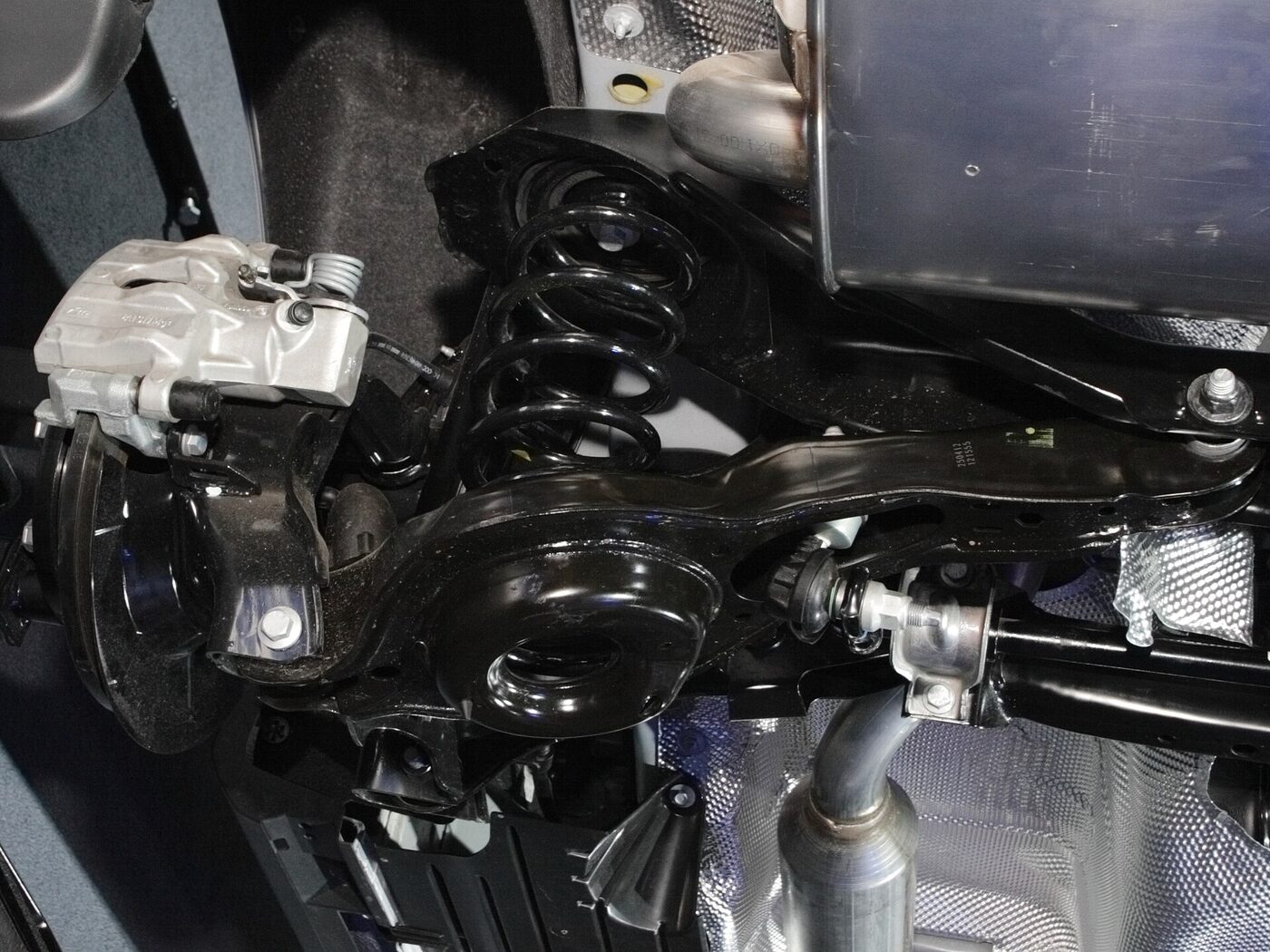
The engineering credited with the Focus's handling is at the back of the car. Where many competitors in the class used the cheaper semi-independent twist beam, the Focus used an independent multi-link arrangement that Ford marketed as Control Blade, combining the packaging of a trailing arm with the geometry of a double wishbone.
Its trick was to get that geometry at something close to trailing-arm cost. Instead of a cast knuckle located by two longitudinal rods, it used a single wide pressed-steel arm of uniform thickness — the blade — carrying the hub and reacting braking and traction loads, while a long rear lateral arm controlled toe and a pair of shorter front lateral arms, mounted one vertically above the other, controlled camber. Removing the casting and the rods took out cost and road noise and lowered the centre of gravity, which is why the arrangement was viable in a car sold in the hundreds of thousands. The design was developed from the CDW27 Mondeo estate and modified to be simpler and cheaper to build.

The effect that owners noticed was body control and steering accuracy without the ride penalty that usually accompanied them. Testing the car in 2000, Motor Trend's Jack Keebler recorded a slalom speed of 62.6 mph and observed that this made the Focus "faster around the cones than a $62,000 Jaguar XJ8L and a $300,000 Bentley Continental" — a comparison worth reading as a period road tester's flourish rather than a controlled result, but a flourish nobody was making about the Escort. Engineers also worked the front end, hunting friction and stiction out of each component.
The industry took the point. When Volkswagen replaced the Golf's rear twist beam with a multi-link design for the Mk5 in 2003, it was following where the Focus had gone in 1998. For an owners' group this matters because it sets the terms of the modification conversation: on a car whose rear suspension is its best feature, the arguments are about springs, dampers and anti-roll bars rather than about replacing the architecture — and Ford itself sold the European springs, dampers and anti-roll bars to Americans as a limited edition, which tells you where the conversation was going anyway.
The awards, dated
The Focus arrived decorated, and the dates are worth having straight because they are frequently transposed between the two markets.
- European Car of the Year, 1999 — awarded in the winter following the July 1998 launch, with 444 points against 269 for the Opel and Vauxhall Astra and 248 for the Peugeot 206. Ford's fourth success in the contest.
- North American Car of the Year, 2000 — the year of the American launch, ahead of the Audi TT and the Lincoln LS.
- Car and Driver Ten Best, 2000 to 2004 — five consecutive years on the American magazine's annual list, spanning the whole of the first-generation car's pre-facelift life in that market.
- Semperit Irish Car of the Year, 1999 — and again in 2005 for the second-generation car.
- R. L. Polk Automotive Loyalty Award — for the highest percentage of repeat buyers, four years running from 2000 to 2003.
Crash-test results, which are a different kind of award, were respectable rather than remarkable by the standards that followed. Euro NCAP gave the first-generation car four stars of five for occupant protection and two of four for pedestrian protection, on scores of 69 per cent frontal, 83 per cent side and 28 per cent pedestrian. Australia's ANCAP rated the 2002 car at four stars overall. Australia's Used Car Safety Ratings assessed the 2002 to 2005 car in 2006 as offering average occupant protection. Russia's ARCAP scored the car 11.6 out of 16 in a frontal test in 2003.
The larger tallies that circulate — more than sixty awards including thirteen Car of the Year titles across Europe and North America — appear in reference sources without a source for the count, and are reported here as a claim rather than adopted.
Recalls, from the regulator's own record
The one part of Focus ownership that is documented to a standard this page can use is the American recall record, because the National Highway Traffic Safety Administration publishes every campaign with a number, a date, a component, a summary, a stated consequence and a remedy. What follows is taken from that record as it stands today, and from nothing else. It is not a summary of what owners said; it is the paperwork.
Twelve campaigns issued by Ford Motor Company touch the 2000 model year Focus in the federal database. Six of them were filed between December 1999 and December 2000 — the car's first fourteen months in American showrooms, and the period during which this group was new. A thirteenth reached 2001-model-year cars. In order of the date the agency received the report:
- 99V346, 3 December 1999 — vehicle speed control. The speed-control cable end fitting could admit water to the servo assembly; resulting corrosion could cause intermittent operation or prevent the throttle returning to idle. Owner notification began 13 December 1999.
- 00V218, 11 August 2000 — structure. Certain vehicles failed to comply with Federal Motor Vehicle Safety Standard 201, occupant protection in interior impact, the head-injury value at one target location on the trim panel at the juncture of the A-pillar and roof side rail being greater than design intent. Notification was phased, beginning 30 November 2000 for three-door cars and 29 December 2000 for four-doors and wagons.
- 00V302, 12 October 2000 — speed control cables. On cars with speed control and automatic transmission, a cable core wire long enough to catch on the sleeve at the throttle-body end during wide-open-throttle acceleration.
- 00V303, 12 October 2000 — wheel fasteners. Rear wheel hub retaining nuts able to loosen, allowing the left rear wheel and brake drum assembly to separate from the vehicle.
- 00V411, 6 December 2000 — electrical wiring. Fatigue in the bend area of the decklid wire harness, with possible loss of stop or tail lamp function.
- 00V418, 14 December 2000 — filed by the agency under front seat recliner, but concerning the second seat. On wagons and three-door cars, the outboard hinge pivot of the folding second seat could disengage from the hinge under load.
- 01V108, 28 March 2001 (2001 model year) — front seat recliner. A seat back recliner handle spring possibly damaged during an in-process test.
- 01V258, 8 August 2001 — windscreen wiper motor. A switch in the plastic cover of the wiper motor gear case could malfunction and overheat, with consequences ranging from loss of wiper function to ignition of the cover material; the campaign covered vehicles from eight Ford assembly plants built between February and September 2000, of which Wayne Stamping and Assembly was one.
- 01I017, 29 November 2001 — rear wheel bearings. Surface corrosion of the bearing seal race where salt is used on winter roads, covering 2000 and 2001 cars sold or registered in twenty-one named states. The agency records this one explicitly as not a safety recall under the Safety Act but a safety improvement campaign.
- 02V288, 6 November 2002 — battery cables. Loose or broken attachments and misrouted cables on Zetec-engined cars, with possible insulation damage. Owner notification began 10 February 2003.
- 02V289, 6 November 2002 — steering linkages. Loose pinch bolts securing the lower control arm to the steering knuckle.
- 03V482, 19 November 2003 — fuel system. Contamination of the filter in the fuel delivery module, restricting fuel flow. Again recorded as a safety improvement campaign rather than a recall, with free replacement available for ten years from original purchase and no mileage limit.
- 05V030, 1 February 2005 — rear door latches. Corrosion at the pawl pivot, on four- and five-door cars sold or registered in twenty salt-belt states and the District of Columbia. The recall began 9 March 2005.
Three observations, all of them about the record rather than the car. First, the distinction between a recall and a safety improvement campaign is one the agency draws deliberately and one that informal summaries reliably lose; two of the entries above are the latter. Second, the same database returns a further six campaigns against the 2000-model-year Focus that were not issued by Ford at all: five separate recalls of aftermarket headlamp, corner and bumper lamp assemblies that failed Federal Motor Vehicle Safety Standard 108 for want of the required amber side reflector, and one of an aftermarket strut assembly, each recalled by the part's own maker between 2006 and 2012. A raw count of "recalls on the Focus" that does not separate these from the manufacturer's campaigns will overstate the car's record by half. Third, the federal record does not publish the number of vehicles affected in the responses consulted here, so no such figure appears above.
This page offers no view on the significance of any campaign and no guidance of any kind on what an owner should do. The agency's record is the authority, it is searchable by vehicle identification number, and what is reproduced here is campaign numbers, dates and subjects.
The Split Port engine, and the limits of what can be said about it
The base engine of the North American Focus from 2000 to 2004 was a 2.0-litre single-overhead-cam four sold simply as the Split Port — the last member of Ford's long-running CVH family, bored out from the 1.9 of the previous Escort to 84.8 mm, rated at 110 hp and 125 lb ft, with the words "2.0L Split Port" cast in raised letters on the top of the valve cover. Split Port Induction was a form of variable-length inlet manifold: each cylinder's inlet path divided into a primary passage carrying the injector and introducing air tangentially for maximum swirl, and a secondary passage opened by a deactivation valve at high speed and wide-open throttle to maximise volumetric efficiency. The engine was a non-interference design and drove its water pump from the timing belt. Production ended with the 2004 Focus LX and SE sedans and wagons; above it sat the twin-cam Zetec, and from 2005 the Duratec range replaced both.
Reference sources record a characteristic failure of the later CVH engines: a dropped valve seat, most often on number four and next most often on number two, occurring without warning and irrespective of maintenance, and capable of damaging the cylinder wall, piston and head when it falls, or being drawn through the intake manifold into another cylinder. The typical service life quoted for the 2.0 SPI in a Focus with the factory seats is 100,000 to 120,000 miles, with failures reported from about 70,000.
There is a footnote to that figure which belongs in an article about where knowledge lives. The mileage range is the one number in this section that the standard encyclopaedic reference cannot source to a manufacturer, a regulator or a journal: it is footnoted to a thread on a Ford Focus owners' forum. The community that this page cannot quote is, transitively, the authority for a fact this page can.
That aside, the failure is reported here because it is documented, and because it is exactly the kind of subject an owners' group carried. What cannot be reported is any of the things a reader would actually want: how often it happened to the people who read this group, what they said about it, whether it was a recurring topic or a rarity, or what remedies circulated. The archive is not preserved here, and characterising unread messages would be worse than saying nothing. This page also gives no maintenance or repair advice, on this or any other point.
What an owners' group carried, as genres
The paragraph above this article names four things: recall news, maintenance schedules, SVT enthusiasm and modification lore. Those are genres rather than threads, and they can be described honestly at the level of the genre — what such conversations consisted of, in general, for this kind of car in these years — without pretending to know what any individual posted.
Maintenance
The maintenance genre on a car sold in two divergent specifications has a structural problem built into it: the service schedule, the part numbers, the fluid specifications and the interval in miles or kilometres all differ by market, and the same model name covers both. An owner in Ohio and an owner in Yorkshire looking at a 2003 Focus were looking at different cars with different books. The single most valuable function of a model-specific discussion group in that situation is not expertise but disambiguation — establishing which car is being discussed before anything else is said. Nothing in the surviving record shows how well this group did that, and the catalogue entry that the wider network still distributes about the group suggests that disambiguation was not the era's strong suit generally.
Modification
Here there is a verified artefact, and it is a useful one because it is a taxonomy rather than an anecdote. A contemporary Focus modification site, focushacks.com, titled itself the "Ford Focus Hacks Database" in its Internet Archive capture of 3 June 2002 and sorted its material into eight categories: Suspension Hacks, Zetec Performance, SPI Performance, SPI and Zetec, I.C.E. and Audio, Interior Hacks, Exterior Hacks, and Miscellaneous. That list is a fair map of what a Focus modification conversation of the period contained, and its most telling feature is that three of the eight categories are engine-family splits. The car's own product planning — two engines in the same body, then a third — decided the shape of the knowledge that grew around it. The same captured page is candid about its own place in the ecology: it describes itself as an attempt to replace the by-then defunct focusmods.com, and credits its server space and bandwidth to another Focus site, focaljet.com.
The other structural feature of Focus modification was transatlantic. Ford had already conceded the point commercially by selling Americans the European suspension as the Street Edition and European Recaro trim as an appearance package, and several American companies made a business of supplying genuine Ford parts to bring North American cars up to full or partial European specification. A discussion group spanning both markets is, in that light, less a hobby forum than a parts-sourcing network with opinions attached.
Buying
The buying question on a car of this kind moves through three phases in about a decade: which trim and engine to order new; which of the special editions is worth a premium; and finally, once the cars are cheap, which model years and which engines to avoid. The published record supports the outline of all three — the trims and editions are documented above, the model-year changes are documented, and the recall campaigns are dated — but it supports nothing about what any particular person recommended. Two-wheeled ownership cultures organised the same three phases in their own hierarchies, in German-language scooter groups among others, under a quite different regulatory regime; that comparison is drawn on those pages and not here.
Where owners went afterwards
Model-specific web forums took this traffic, and for the Focus they can be dated from their own captures in the Internet Archive rather than from recollection.
- focaljet.com, earliest surviving capture 17 October 2000 — barely a year after the American launch — its front page then headed simply "focaljet.com | issue : 2.0".
- focushacks.com, earliest surviving capture 3 June 2002 as the "Ford Focus Hacks Database", organised as described above.
- focusfanatics.com, earliest surviving capture 31 July 2002. Its page title that day read, in full: "Focus Fanatics - Ford Focus Community : Ford Focus Forum - Ford Focus Message Board - Ford Focus SVT, ZX3, ZX5, ZTS, ZTW, RS, America, Asia, Europe, Africa, Australia".
That last title is worth reading twice, because it is a document of the transition. It is a list of trim codes and continents strung together for a search engine of 2002, and it advertises three things a newsgroup could not offer: a permanent searchable address, a message board with photographs attached, and an explicit claim on every market at once. The photographs are the pointed part. A newsgroup that wanted pictures needed a binaries group alongside it — which is exactly what the Australians who own the sentence on line 821 created for themselves in April 1999, and exactly the arrangement that web forums made unnecessary within three years. The stray description line is, entirely by accident, about the one capability whose absence helped push conversations like this one off Usenet and onto the web.
Within Usenet itself the traffic dispersed rather than moved. There was never a rec.autos.makers.ford.focus to migrate to; the voted hierarchy stopped at the Explorer and the Mustang. National groups — free.uk.cars.ford, it.discussioni.auto.ford, free.it.ford.focus, ee.auto.ford — carried what they carried in their own languages, and the FidoNet echo fido7.ru.cars.ford carried Russian owners through a network that was not the Internet at all. None of these consolidated. The Focus generated a very large owner population and no single online home, and the general history of the alt.* hierarchy's decline, along with the binaries traffic that eventually dominated it, is told on the hierarchy's own page.
What the record does not show
Being explicit about the gaps is the only defensible way to write this page, so they are listed rather than glossed.
- There is no readership figure, no message count and no traffic estimate for alt.autos.ford.focus at any date, from any source consulted.
- The identity of whoever created it is not recoverable. The sending address in the control message is a throwaway, the posting host was a consumer access line on an Italian provider, and no name appears anywhere in the file.
- The group never had a charter. The single control message that created it has an empty body.
- Whether it was created by a Focus owner, by an enthusiast anticipating demand, or as one item in a bulk run of newgroups is not established.
- How the alt.binaries.ozdebate description came to be attached to this name, and to seven others, is not documented anywhere consulted; the consortium's action log begins four years after the event, and the control archive contains no message that carries the sentence under any of the eight names.
- Whether anyone reading the group ever noticed the description, or tried to have it corrected, is unknown. No correction was ever logged.
- Whether the group's readership was principally American, as the launch dates and the line above this article imply, or included European owners, cannot be determined without the archive.
- Nothing is known about who posted, in what numbers, on what subjects, at what dates, or with what accuracy.
Some of that is recoverable in principle from archives held elsewhere. None of it is recoverable from this directory, and none of it is asserted above.
Scope and limits
No text posted to alt.autos.ford.focus was available to this page at any point in its preparation, and none was sought from third-party archives. Accordingly, nothing in this article quotes, counts, characterises, paraphrases or summarises any article ever posted to the group, and no statement above should be read as describing what its participants said. Every sentence in it is about the paperwork around the group or about the car the group was named for. There is nothing in hand to describe.
What the article is built from, and where a reader can check it:
- The Internet Systems Consortium's mirrors of the Usenet administrative record: the current newsgroups and active files, from which the description lines, the line numbers, the file counts and the posting flag are taken verbatim; the control-message archive for alt.autos.ford.focus, alt.ozdebate, alt.binaries.ozdebate and the seven other affected groups, which supplies the creation messages, their dates, headers and bodies; the archive's published GROUP CREATION POLICIES document, last modified 19 February 2018, for the rules on descriptions and manual changes; the monthly action logs, which begin in May 2003; and INN's control.ctl for the hierarchy's trust arrangements.
- The United States National Highway Traffic Safety Administration's recall record, queried by make, model and model year, for every campaign number, date, component, summary and remedy in the recall section. No other source contributed to that section.
- Encyclopaedic reference sources for the car itself: the model chronology by market, the platform codes, the body styles, the engines, the transmissions, the performance variants, the awards with their years and, where quoted, contemporary press reactions as recorded there with their writers and publications named.
- The Internet Archive's capture record, for the existence and dating of the three owner websites named, and for the page titles and category lists quoted from them.
Where the sources disagree with each other, the disagreement is reported rather than resolved: the clearest instance is the month Ford began marketing the car in North America, given as September in one reference article and October in another. Several claims that circulate about this car were considered and are not made here. Production totals for the SVT and ZX4 ST variants are omitted because the tables that carry them are uncited. The frequently repeated assertion that the Focus was the world's best-selling car for a run of years is omitted for the same reason. Award tallies are reported as claims rather than stated as fact. And the number of vehicles affected by each recall campaign is omitted because the regulator's published responses consulted here did not carry it.
Finally, the description line. It is quoted twice above because it is the reason this page has something to say, and it is quoted exactly. It is a true sentence about alt.binaries.ozdebate and a false one about this group. Nobody put it there on purpose, nobody owns the job of removing it, and it will be in the file that news servers exchange tomorrow morning.
Reading alt.autos.ford.focus today
- Historical archive: Google Groups — alt.autos.ford.focus (coverage varies by group and era).
- Open in a newsreader:
news:alt.autos.ford.focus— the original site offered exactly this link, and it still works if your system has a newsreader registered for thenews:scheme. - Live access: point an NNTP newsreader at a modern server — see accessing Usenet today.
- The original news2mail e-mail subscription service ended in the mid-2000s and no longer operates.