alt.bmx
BMX riding, racing and freestyle.
Riders traded setup advice, trick progressions, race-series news and video reviews through BMX’s 1990s revival into the X-Games era.
The group’s last control message, in October 2003, claimed more than 300 relevant messages a month — the only traffic figure anywhere in the record.
On this page
- Three control messages, and no vote
- The line the group still carries
- Where BMX sat in the namespace
- The sport, dated: Southern California to a rulebook
- Sanctioning bodies, and their unstable founding dates
- Going international: the IBMXF and the UCI
- What a race actually is
- The split: freestyle and its four disciplines
- Frames: geometry, materials, and the shape of the argument
- The bottom bracket problem
- Gearing, drivers and the freecoaster
- Brakes, rotors, and doing without
- Wheels, axles and pegs
- The second wave: magazines, tapes and a television series
- What a riding group carried
- The Olympic turn, which postdates this page’s snapshot
- Where it went
- What the record does not show
- Scope and limits
Three control messages, and no vote
alt.bmx has no founding document in the sense that a Big-Eight group has one. There was no Request for Discussion, no Call for Votes, no published tally of voters and no five-day waiting period, because the alt.* hierarchy dispenses with all of that: a group exists when somebody sends a newgroup control message, and it exists in practice wherever news administrators decide to honour it. The mechanism, and the long argument about whether it was a liberation or a nuisance, belongs to the alt.* hierarchy page and is not retold here. What it means for this page is narrower and more useful. The only paperwork alt.bmx ever generated is the control messages themselves — and those survive.
They survive because the Internet Systems Consortium mirrors Usenet’s administrative record, keeping one small compressed file per group under its control archive. The file for this group is about 1.6 kilobytes and holds three messages spanning five years. That is the entire official history of alt.bmx, and it is more than most alt.* groups can show.
The first is dated Friday, 12 June 1998, 02:05:32 GMT. It carries the header line Control: newgroup alt.bmx, a Summary line reading “booster”, and a keyword list — booster, bmx, freestyle, flatland, dirt, street, ramp, vert, bicycle motorcross — whose last entry is misspelt. The body is three lines long: the words “For your newsgroups file:”, then the group name, then its description.
Discussion of all aspects of the subculture of riding bmx bikes.
It was posted not to a control group but to alt.skate-board, whose readers had not asked to be consulted. That was ordinary practice rather than mischief. A control message travels the feed paths of the groups named in its Newsgroups header, so the way to reach a lot of servers was to post into a group a lot of servers already carried; a skateboarding group was a reasonable guess at where BMX readers would be found.
The second message, twelve days later on 24 June 1998, is the same instruction sent again. In the hierarchy’s vocabulary that is a “booster” — a re-issued newgroup intended to reach servers the first one missed. This one went to alt.bbs, quietly added “racing” to the keyword list, and for the first time carried a charter:
The topics for this newsgroup are will cover riding bmx bikes and the lifestyles associated with riding. This may cover tricks, technical information, comparisons of bikes, shoes, music, clothing, etc. Information about the features and prices of BMX products may be posted in a terse and factual manner but sensational advertising is not appropriate. SPAM such as for get rich quick schemes, adult service or massively crossposted articles are not welcome. The newsgroup is unmoderated, however SPAM is a likely target for being cancelled.
The grammatical stumble in the first sentence is the sender’s. So is the ordering: tricks, then technical information, then bikes, shoes, music and clothing — a charter that treats BMX as a way of dressing and listening as much as a way of riding, which is what the phrase “the subculture of riding” in the group’s one-line description also says.
The third and last message is dated 24 October 2003, and is the only one addressed where such things properly belong: to alt.config, the group in which alt.* creations are discussed, cross-posted to alt.bmx itself. It repeats the newsgroups-file line, this time capitalising BMX; it restates the charter in tidier prose, glossing the abbreviation as “Bicycle Moto Cross” and adding “places to ride” to the list of topics; and it prefixes both with a short history. Its opening sentence is the only statement of traffic volume anywhere in the record:
alt.bmx currently carries more than 300 relevant messages per month and (thankfully) has a very high signal to noise ratio.
The same message records that the group had been created in 1998 by a different sender in a form that, in its words, “resulted in poor distribution”; that its author had at the time been preparing a proposal for a group to be called alt.sport.bmx, addressing questions raised in alt.config “over the previous 29 months” about creating a BMX newsgroup; and that, alt.bmx having already been created, he issued correctly formatted booster messages rather than let two BMX groups exist. All of that is the message’s own account of itself. No independent trace of the earlier creation survives in the archive, which is exactly what a badly distributed control message would leave behind.
Three details are worth keeping. The 1998 messages were posted through Telstra, an Australian internet provider, and signed “Justice”; the 2003 message was signed “Lars Justice” and routed through Optus, a different Australian provider — but all three were injected from the same posting host, 203.2.218.1, five years apart. The person who rescued the group’s propagation in 1998 was still tending its paperwork in 2003. And the capitalisation that news servers distribute today is the 2003 message’s: BMX in capitals, not the lower-case “bmx” of the two 1998 versions.
What alt.* did not require, it also did not forbid anyone from second-guessing. INN’s control.ctl, the configuration file in which news administrators record whose control messages they trust, sets out the position for this hierarchy with unusual candour: sites are advised that “there is no official, generally accepted alt.* policy and all information about alt.* groups available is essentially someone’s opinion, including these comments,” and are told that one good filter for a proposed group is to look in the control archive and see whether a syntactically valid newgroup message was ever issued for it. For alt.bmx, three were.
The line the group still carries
The description a newsgroup carries is not decoration. It is a line in the newsgroups file that news servers exchange and newsreaders display, and for a group with no FAQ and no moderator it is the whole of the public interface. In the file distributed today, the name alt.bmx is followed by exactly this:
Discussion of all aspects of the subculture of riding BMX bikes.
That file runs to roughly 45,000 lines, of which about 20,500 are alt.* groups. Searching the whole of it for the letters BMX, in any case, returns one line: this one. There is no rec.sport.bmx, no alt.bmx.racing, no national BMX group in any of the regional hierarchies the file carries, and none in this directory’s own list of groups. In the namespace that news servers still distribute, alt.bmx is the sport’s only address.
The companion active file — the one that tells a server which groups it may accept articles for — lists alt.bmx with the flag y: unmoderated, posting permitted. Nearly three decades after the first control message, the group is still open.
Where BMX sat in the namespace
The absence of a Big-Eight BMX group was a decision, not an oversight, and the decision is on the record. In 1992 Les Earnest and Bruce Hildenbrand proposed splitting the single, overloaded rec.bicycles into a family of subgroups. Their Request for Discussion considered dividing the subject the way a rider would — by venue and machine — and rejected it in a sentence:
As an alternative to the scheme proposed above, one might be tempted to consider division along the lines of venue & bicycle types, such as: road, track, BMX, and off-road. However, with that kind of division, nearly all the traffic would appear in rec.bicycles.road, which would not meet our objectives.
The scheme that passed instead divided cycling by what a reader wanted to do rather than what they rode: marketplace, tech, rides, soc, racing, misc. The result was announced on 13 August 1992, with all six groups approved “by margins of at least 403 to 124”. Those six are still the whole of rec.bicycles.* in the current newsgroups file, glossed there as buying and selling, general discussion, racing, tours and routes, societal issues, and product design and maintenance. None of them is about a twenty-inch bicycle being ridden off a kerb.
The sports branch offered no shelter either. rec.sport.* carries fifty-six groups today, from sumo to unicycling to table soccer, and none of them is BMX; the branch and the naming politics that shaped it are the subject of the rec.sport.* page. A sport that had been organised since 1970, with national sanctioning bodies since the early 1970s and world championships since 1982, simply never went through the proposal-and-vote machinery — or went through it and was not carried, which the surviving record cannot distinguish.
So BMX ended up where subjects went when the formal hierarchies had no room for them. Its neighbours in alt.* tell the same story in miniature. alt.skate-board’s earliest surviving control message, from July 1991, is itself a booster — an earlier one “got stuck somewhere” — and explains that the group was needed because alt.skate “is being used primarily by in-line and rollerbladers”. alt.mountain-bike exists but its description is a redirection notice, “Use rec.bicycles.off-road instead”. alt.sport.bicycles.offroad got its newgroup message on 30 August 1994 and alt.collecting.bicycles on 14 January 1998; alt.bikes appears in the control archive only as a removal request, sent in June 1997. The wheeled corner of alt.* is largely made of groups that exist because the orderly hierarchies had already decided the subject did not need a room of its own.
One consequence of the late creation date is worth stating plainly. When the first newgroup message went out in June 1998, BMX was twenty-eight years old, had been an Olympic sport for exactly none of that time, and had already been through a boom, a collapse and most of a recovery. alt.bmx is not a record of the sport’s rise. It is a record of its second wave, arriving with the hardware and the argument already formed.
The sport, dated: Southern California to a rulebook
BMX begins with children in Southern California riding bicycles on dirt in imitation of motocross riders, and with one particular bicycle. The Schwinn Sting-Ray and the other so-called wheelie bikes of the period were cheap, everywhere, and easy to modify, which made them the natural machine for the purpose. The abbreviation itself is simply bicycle motocross.
The earliest organised racing usually dated to a place is Palms Park in West Los Angeles, where a park attendant with motorcycle-motocross experience, Ron Mackler, helped a group of boys who wanted to race; the first event is dated 10 July 1969. By 1973 the park was running back-to-back ten-week seasons of Thursday-night racing with an entry fee of $4.50, a dollar of which was a year’s insurance, and trophies for the season’s top three. The track ran on largely unchanged into the 1980s.
The first thing that looks like a governing body came from a fourteen-year-old. On 14 November 1970, in a field at Seventh and Bellflower in Long Beach, Scot Breithaupt put on an ad hoc race; thirty-five entrants paid him a quarter each, and the next one drew a hundred and fifty. Because he raced motorcycles he knew what a race meeting was supposed to have, and he supplied it: a rulebook, membership cards, a points system, proficiency promotion, and trophies from his own motorcycle collection handed to the winners. He called the arrangement BUMS, the Bicycle United Motocross Society, and by the time it had grown to seven tracks in California it was doing the thing that distinguishes a sanctioning body from a track — running several venues under one set of rules. He ran a state championship in 1972 and, in 1975, what is usually counted as the first professional BMX race, at Saddleback Park, for a purse of $200 — although the rider generally named as the professional in that race later said he had no memory of it, which is a fair sample of how firm the sport’s early record is.
What turned a Californian pastime into a national one is usually credited to a film. On Any Sunday, Bruce Brown’s 1971 motorcycle documentary, produced with Steve McQueen and nominated for an Academy Award, opens with children riding Sting-Rays off-road; the sequence is repeatedly named as the thing that put the idea in front of an audience that had never seen a dirt track. In 1974, in a joint venture between BUMS and the newly formed National Bicycle Association, Yamaha sponsored a Gold Cup series: qualifying races at Californian tracks, then a final to decide a “national” number one. The detail is not settled — one standard account gives three qualifiers and a final at the Los Angeles Coliseum, another four tracks and a finale at Anaheim on 14 September 1974 — and this page does not choose between them. It was not really national in any case, since nearly everybody in it was Californian, but it was the first event that behaved as though the sport had a country to be champion of.
Sanctioning bodies, and their unstable founding dates
This is the part of BMX history that is most often repeated and least often checked, and it does not survive checking cleanly. Reference sources disagree with each other, and sometimes with themselves, about when the first national body was founded. Wikipedia’s article on BMX racing says in one section that Ernie Alexander created the National Bicycle Association in 1972 and in another that it was formed in 1974; the article on the organisation itself says 1973, and dates the founding precisely to 1 November of that year. A page that quietly picked one of those would be inventing certainty. What is not in dispute is the shape of the thing.
The National Bicycle Association (NBA) was created in the early 1970s by Ernie Alexander, a race promoter with motorcycle-motocross experience who had opened the Yarnell track and modelled his organisation on the American Motorcycle Association. It was the first body to run true nationals, drawing riders from across the country to compete for a number-one plate, and it had a professional division from late 1974. In 1979 it renamed itself the National Bicycle Motocross Association, abbreviated NBmxA — reportedly so that its initials would stop colliding with the National Basketball Association’s. It then ran into financial difficulty, and after the 1981 season it stopped sanctioning races in its own right and passed its membership and its tracks to the National Bicycle League.
The National Bicycle League (NBL) was created in 1974 by George Edward Esser (1925–2006) as the bicycle division of his National Motorcycle League, initially in Florida — sources give both Deerfield Beach and Pompano Beach for its first base — and later in Hilliard, Ohio. Its first race was held at Miami Hollywood Speedway Park on 26 January 1974. Alone among the three, it was constituted as a non-profit organisation, with a Competition Congress at which track operators could be heard — a structure its historians credit with sparing it the periodic revolts that damaged the others. It absorbed the NBA’s membership and tracks after the 1981 season, which turned a body whose affiliations were overwhelmingly east of the Mississippi into a national one, and in 1997 it joined USA Cycling, bringing BMX inside the American federation that answers to the Union Cycliste Internationale.
The American Bicycle Association (ABA) was created in August 1977 by Merl Mennenga and Gene Roden. Its first national was held at Azusa, California, in 1978, with thirty-five tracks and three thousand entrants behind it; by 1979 it was the largest body in the sport. Its lasting contribution is procedural: the transfer system, in which the winners of each moto advance through quarter-finals and semi-finals to a main event, so that a bad start costs a rider a round rather than a day. By the organisation’s own published figures its membership was around ninety-three thousand in 1983, about sixty thousand in 2006 and about seventy thousand in 2017 — a curve that tracks the sport’s first boom and its long settling afterwards.
The competition ended in 2011. On 17 May the NBL’s chief executive appeared alongside the ABA’s to announce a letter of intent for the ABA to buy the NBL’s assets; the final documents were signed on 18 June, ending thirty-seven years of NBL operation, and the combined organisation, under ABA ownership, took the name USA BMX. American BMX racing has had a single national sanctioning body ever since — which is to say that the arrangement the group’s readers knew, of rival bodies with rival points series and rival calendars, ended a decade after the group’s last control message.
One artefact of the insurance era deserves recording because it changed what tracks looked like: in 1988 the NBL banned double jumps, and tracks were built tamer accordingly. Riders who wanted the older, rougher article increasingly found it somewhere other than a sanctioned course.
Going international: the IBMXF and the UCI
The International BMX Federation (IBMXF, also rendered International Bicycle Motocross Federation) was founded on 3 April 1981 by Gerrit Does, a Dutch former motocross racer who had brought the sport home from the United States in 1974 and started the first European sanctioning body four years later; George Esser of the NBL was co-founder, and the federation was based in the Netherlands. The first world championships were held in 1982. For a little over a decade BMX was governed internationally by a body of its own, outside the structures that ran road, track and cyclo-cross.
That ended in January 1993, when BMX was integrated into the UCI. The absorption ran through FIAC, the UCI’s amateur division, which had run its own separate BMX world championships from the mid-1980s and had been holding them jointly with the IBMXF since 1991. After a transitional period the UCI held its own first BMX world championship in 1996. The practical effect was that a sport invented by children on modified Sting-Rays acquired the same governing body as the Tour de France, with the licence system, the rainbow jersey and the national-federation pathway that go with it.
Growth outside the United States had already been rapid and largely independent. Australia’s first BMX track opened on 17 May 1975 at Tallebudgera on the Gold Coast in Queensland, built by a businessman, Bob Smith, who had admired the sport in the American magazines his son brought home; a national association was assembled in April 1981 out of the Victorian, Queensland and New South Wales bodies and became Australia’s representative to the IBMXF. Britain’s first track opened in 1980 at Landseer Park in Ipswich. The British craze proper arrived in 1982 and 1983, when the BMX bicycle became the thing a child had to have; the 1983 Australian film BMX Bandits did the sport no harm at all. It ended almost as fast: by 1986 and 1987 British sales had collapsed, and the all-terrain bicycle — another export from mid-1970s California — took the market.
It is worth noticing where the group’s own paperwork came from in this light. All three alt.bmx control messages were injected from an Australian address, in a sport whose institutions were overwhelmingly American and whose second-largest constituency in the 1980s had been British. A newsgroup was one of the few places in 1998 where that made no difference at all.
What a race actually is
A BMX race is a single lap, eight riders wide at most, over a purpose-built dirt circuit, and it is over in about half a minute; the winning times in the first Olympic finals were 36.190 and 35.976 seconds. Riders start from a gate on a hill, and the hill supplies most of the speed for the rest of the lap, which is why professional start hills are so much bigger than amateur ones.
The vocabulary of the course is standardised across sanctioning bodies. A berm is a banked turn, taken without braking. A roller is a bump too small to jump, built in groups called rhythm sections that test whether a rider can carry speed over them. A tabletop is a jump with a flat deck between take-off and landing, forgiving of a short jump. A double is a pair of mounds close enough to jump between; a triple is three. A step-up lands higher than it takes off and a step-down lower. A pro set has a lip and a landing and nothing in between, so failing to clear it means a crash rather than a slow lap.
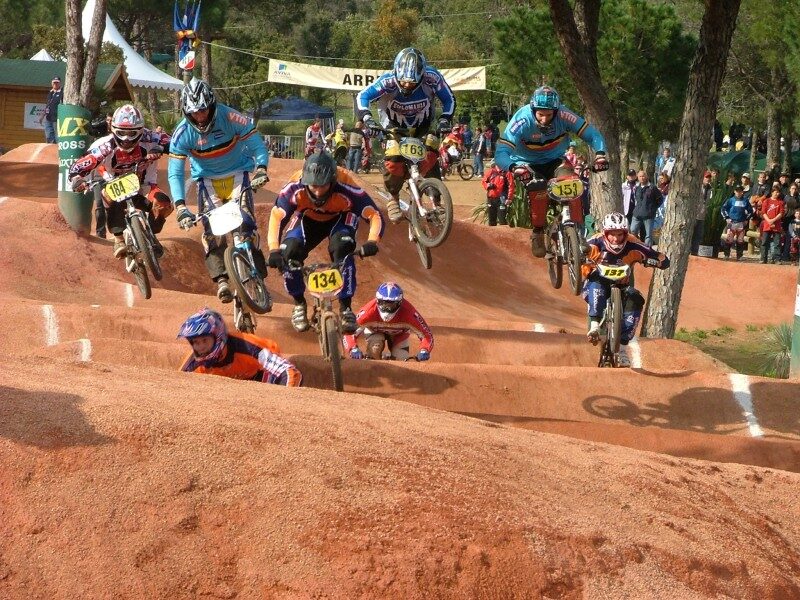

There are two machine sizes, and the rule is written around the tyre rather than the rim. Class bikes run twenty-inch wheels — ISO 406 in the bead-seat measurement that actually matters — with an outside tyre diameter up to 22.5 inches. Anything larger is a Cruiser, and in practice a Cruiser is a twenty-four-inch bicycle, ISO 507. Around those two sizes the sanctioning bodies built the class system a family entered on a Saturday morning: Novice, Intermediate and Expert by proficiency, Cruiser classes by wheel size, and age divisions on top, running from small children to veteran professionals.
The split: freestyle and its four disciplines
Freestyle is not a later fashion grafted onto racing; it starts almost as early and in the same places. The earliest photographic documentation usually cited shows Devin and Todd Bank in 1974 riding BMX bicycles on an eight-foot skateboard ramp they had built at home in West Los Angeles. Skateboarder magazine published photographs of children riding bikes in empty swimming pools in 1975. By late 1976 Bob Haro and John Swanguen were riding a concrete skatepark in San Diego, and by the summer of 1978 Southern Californian skateparks were setting aside sessions for bicycles.
The institutions followed. Haro was hired as a staff artist at BMX Action in the autumn of 1977, and the magazine published what is generally counted as the first freestyle how-to article — Haro performing a rock walk — in its January/February 1979 issue. Haro Bikes was founded in 1978. Trick teams appeared from late 1979 and began performing at race meetings, which is how most of the racing public first saw the thing. In 1982 Bob Morales founded the American Freestyle Association, the first governing body freestyle had, and its organised flatland and quarter-pipe contests became the discipline’s principal competition of the decade. In the summer of 1984 Bob Osborn launched Freestylin’, a magazine devoted to freestyle alone, and the industry reorganised around it within a year: freestyle-specific frames, freestyle-specific components, sponsored riders, and bike shops stocking both.
Popularity peaked in 1987 and then fell off a cliff. In the early 1990s large companies cut or ended their investment, and what refilled the space was smaller and rider-owned — companies run by people who rode, selling to people who rode, with the industry’s centre of gravity moving from mass-market bicycle manufacturers to specialists. That collapse and re-founding is the immediate prehistory of this newsgroup, and it explains the register of the group’s charter, which anticipates people posting prices and features and warns them off advertising.
By the 1990s freestyle had settled into four disciplines, which is how it is still divided:
- Street — riding the built environment: kerbs, ledges, handrails, stairs, banks. It became a distinct discipline in the late 1980s and pushed hardware harder than anything else, because the obstacles are made of concrete and steel and were not built for the purpose.
- Park — skateparks, of wood or concrete, ridden for transitions, bowls and jump boxes. Concrete parks are usually public and outdoor, wooden ones commercial and indoor, and the two encourage different styles.
- Trails — lines of compacted earth jumps, built and maintained by the riders themselves in packs of four, six or eight, with gaps typically from a few feet to twenty and a house style that values flow between jumps over the size of any one of them. Also called dirt jumping, though riders distinguish the two.
- Vert — a half-pipe of two facing quarter-pipes, typically ten to fifteen feet high, with a vertical section at the top and a metal coping at the lip for stalls and grinds.
- Flatland — no ramps, no jumps, no obstacles at all: a smooth surface, and tricks made of balance and rotation. Flatland sits slightly apart from the rest; riders of the other disciplines tend to dabble in each other’s, and flatlanders tend not to, partly because the bicycle a flatlander needs is unhelpful everywhere else.
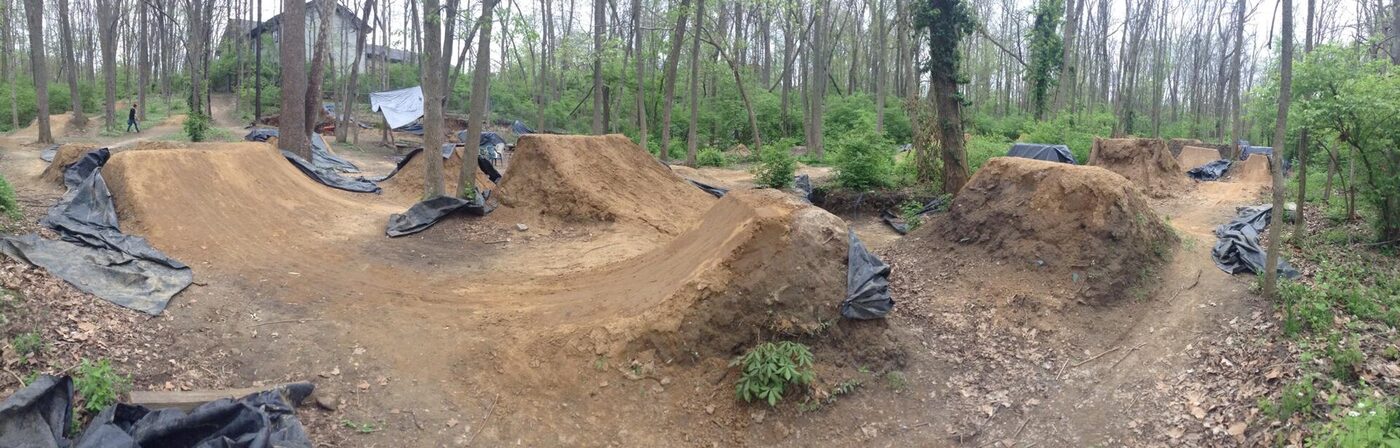

Those five entries cover four disciplines because vert and park are commonly grouped together, which is itself the kind of taxonomy question a newsgroup produces threads about.
Frames: geometry, materials, and the shape of the argument
A BMX frame is small, and being small it is one of the few bicycles where the whole machine can be discussed as a single object. There is essentially one size; the fit is adjusted with seat post, bar height and stem length rather than by buying a bigger frame. That is why the arguments were about millimetres of geometry rather than about sizing, and why a frame-choice thread could be read profitably by somebody who would never buy that frame.
The material of record is 4130 chromoly — a chromium-molybdenum alloy steel with an excellent strength-to-weight ratio, considerably stronger and harder than ordinary 1020 mild steel. Its inconvenient property, and the reason frame quality varied so much, is that it is not easily welded: proper practice requires thermal treatment both before and after welding to avoid cold cracking. A frame advertised as chromoly could therefore be anything from a carefully heat-treated race frame to a badly joined tube set, and the difference showed up months later at the head tube or the dropouts. Cheap bicycles sold in the BMX shape were plain high-tensile steel and are a different object entirely. Racing, which cares about mass above all, moved to aluminium and eventually carbon fibre; freestyle stayed with steel, which bends before it breaks and can be straightened.
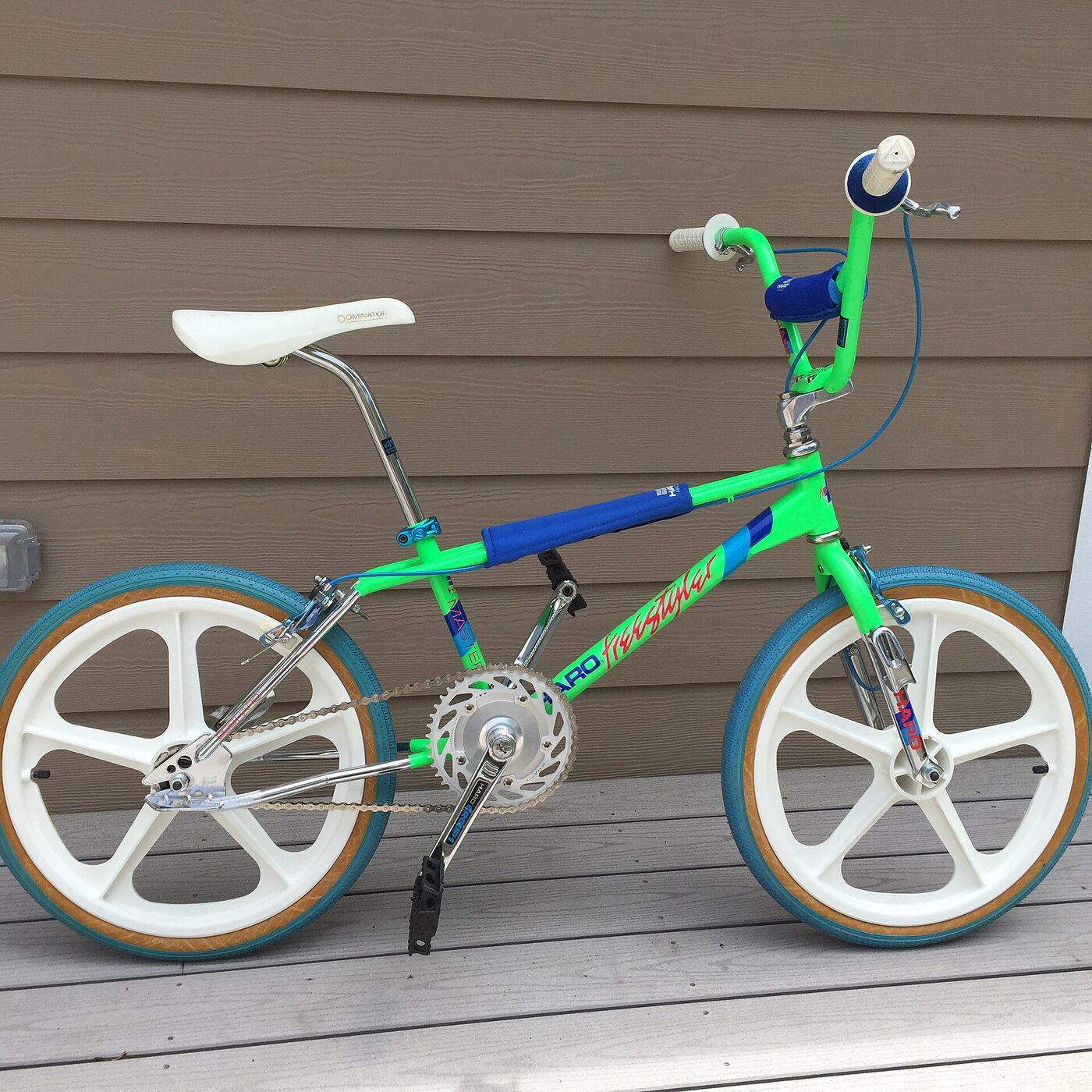

Geometry followed discipline, and the differences are legible even in summary. Street frames took steeper angles and shorter wheelbases, which makes the bicycle quicker to turn and to spin and less settled at speed — a fair trade when the fastest you go is the length of a car park. Trails frames went the other way, with longer chainstays, because a bicycle that is stable in the air is a bicycle you can land. Flatland frames took the shortest wheelbase of all, so that the machine pivots with minimal effort, and reinforced their tubes because flatland riders stand on the frame itself. Park frames could be built lighter, since the terrain is smooth and predictable. The one common feature of every freestyle bicycle is that it is heavier and more rugged than a race bicycle, and that it carries places to stand.
The bottom bracket problem
Nothing illustrates the technical culture of a BMX newsgroup better than the bottom bracket, because BMX managed to accumulate four mutually incompatible shell standards inside one wheel size, and a rider changing cranks had to know which one they owned.
The oldest is the one-piece Ashtabula crank, in which the spindle and both crank arms are a single S-shaped forging pressed through a large unthreaded shell. The shell is 68 mm wide and about 51.3 to 51.5 mm across, and in BMX it is called the American, or sometimes “Pro size”, bottom bracket. One-piece cranks are simple, cheap and reliable; they are also heavy. The bearing cups are pressed into the shell, the crank itself holds the cones, and the whole assembly is adjusted from the non-drive side. They were fitted to children’s bicycles, low-end road bicycles and BMX bicycles alike, which is exactly the pedigree the sport spent the 1990s escaping.
Three-piece cranks — two arms and a separate spindle — replaced them at the serious end, and immediately introduced a second axis of incompatibility, since BMX three-piece spindles come in 19 mm or 19.05 mm (three quarters of an inch), 22 mm or 22.2 mm (seven eighths), and 24 mm. Metric and imperial sizes that are nominally the same are not the same, and to complicate the matter further, a good deal of BMX hardware sold as 22 mm is genuinely 22 mm rather than seven eighths of an inch, so the nominal figure on the packet does not always settle the question. Then came the smaller press-fit shells: Spanish, 37 mm across and 68 mm wide, taking a 19 or 22 mm spindle, and Mid, 41.2 mm and 68 mm — both pressed in rather than threaded, and neither compatible with the American shell or with each other. A fourth convention, Euro, threads the shell to the ordinary 1.37-inch by 24 threads-per-inch pattern used by the rest of the bicycle industry.
The direction of travel is clear enough — from an enormous unthreaded shell with a one-piece crank through it, to progressively smaller press-fit shells holding sealed cartridge bearings and a light spindle — and it happened across the group’s decade and the one after it. What matters for a reader of the group is the consequence: at any moment in the late 1990s, the answer to “will these cranks fit my frame” required knowing two numbers and a thread convention, and getting it wrong cost the price of a frame. That is a question a mailing list answers well and a magazine answers badly, because it needs to be asked afresh for every combination.
Gearing, drivers and the freecoaster
The classic BMX gear was 44 teeth at the front and 16 at the back. Over the 1990s and 2000s the common combinations shrank repeatedly — 36/13, 33/12, 30/11, 25/9, the last of these what the trade calls micro-drive — and smaller still. The striking thing is what did not change. 44/16 is a ratio of 2.75 to one; 36/13 is 2.77; 33/12 is 2.75 exactly; 30/11 is 2.73; 25/9 is 2.78. Two decades of component development produced almost no change in how hard the bicycle was to pedal.
The gearing was never the point. A 44-tooth chainring on a twenty-inch bicycle hangs below the frame and takes the first impact on any ledge, rail or coping the rider grinds; it is also among the heaviest rotating parts on the machine. Shrinking both sprockets in proportion buys ground clearance and weight at no cost in ratio, which is a rare thing in bicycle engineering and explains why the change was so complete.
The rear hub had to change to allow it. A threaded freewheel screws onto the hub shell and cannot be made arbitrarily small, so nine-tooth and eight-tooth sprockets required the cassette hub, in which the ratchet lives inside the hub and a small removable driver carries the sprocket. That change also moved the load-bearing part of the drivetrain from a screwed-on component to the hub body itself, which mattered because street riders were now landing on it.
A third hub type has no equivalent outside the sport. A freecoaster permits the bicycle to be rolled backwards without the cranks turning backwards with it, which an ordinary freewheel or cassette hub will not do; internally it is closer to a coaster-brake hub than to a freewheel, without the brake. Riding backwards, or fakie, is a routine part of park and street riding, and a freecoaster removes the need to pedal backwards while doing it. It is also a component that changes how the bicycle feels at every moment, which is why the choice between freecoaster and cassette was a standing argument rather than a settled question.
Brakes, rotors, and doing without
The brake freestyle settled on is the U-brake, known in the trade by the mount pattern as a 990. In design it is essentially a centre-pull caliper whose two arms pivot on studs fixed directly to the frame or fork, above the rim rather than below it, and are drawn together by a transverse cable. Its advantage on a freestyle bicycle is geometric rather than mechanical: it protrudes very little sideways and what it does expose is smooth, so there is less for a rider’s leg, clothing or a ledge to catch. Mounted under the chainstays, out of the way of a rider’s feet, or on the seatstays, it is the shape almost every freestyle frame of the period was built around, and it is still the standard on freestyle frames and forks.
The characteristic BMX brake component, though, is not a brake at all. A detangler — a rotor, or, in the trademarked form, a Gyro — lets the handlebars turn through a full circle without twisting the rear brake cable into a knot. The single cable from the lever splits into two, running down opposite sides of the stem to a disc on a thrust bearing; a second disc below it, free to rotate independently, feeds two more cables that merge again and run to the brake. Squeezing the lever raises the whole assembly; turning the bars rotates the upper disc against the lower one. The cable is split in this way so that the mechanism is pulled evenly on both sides. Odyssey, founded in 1985, made the Gyro one of its first products and still owns the name; the front brake cable was dealt with more simply, by threading it through a hollow stem bolt and down inside the steerer tube — the Potts modification.
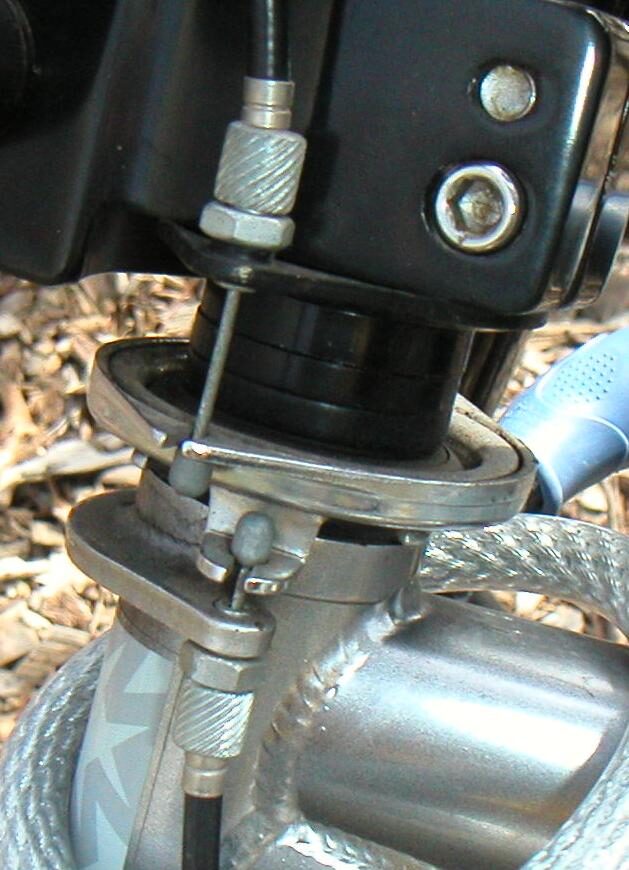

Street riding then took the argument in the other direction and removed the brakes altogether. If a bicycle has no cables, nothing can catch during a barspin or a tailwhip, and the frame has nothing bolted to it that a ledge can shear off; braking is done with a shoe against the top of the rear tyre. Riders who wanted a brake but also wanted to spin the bars kept a rear U-brake with an extended cable or a rotor — the standard trails setup is rear brake only plus a rotor, since a front brake is of no use in the air. Flatlanders ran a front brake, both, or none, and treated the choice as a matter of style. By the end of the 1990s a bicycle sold as a street frame might have no brake mounts on it at all, which is a remarkable thing for a bicycle industry to have arrived at, and the debate over whether it was progress or affectation is one the group was in existence for.
Wheels, axles and pegs
The twenty-inch wheel is the sport’s one fixed constant, and the number is misleading: what is standardised is the bead-seat diameter of 406 millimetres, onto which tyres of various sections are fitted. Racing runs narrow, lightly treaded tyres; trails riders run the heaviest tread of anything on a BMX bicycle; park and street riders run slicks and semi-slicks at high pressure, since a hard tyre rolls faster on concrete and is less likely to roll off the rim on a hard landing. Cruiser racing uses ISO 507, the twenty-four-inch size.
Axles are where street riding rewrote the specification. The traditional BMX axle is three eighths of an inch — about 9.5 mm — and it is still what race bicycles and front wheels use, because it is lighter. Street and park bicycles moved to a 14 mm rear axle, a difference of four and a half millimetres of diameter that buys a large increase in stiffness, and they did so because of pegs.
A peg is a cylinder bolted onto a protruding axle end, and it is what makes grinding possible: the rider stands on it, lands on it, and slides along a rail or ledge on it. Flatland bicycles carry four, one at each axle end, and the rider stands on them to hold the machine in positions it was not designed for. The peg is also a lever four inches or so long applied to the axle and the dropout, and the entire evolution of BMX axles, dropouts and rear hubs over the group’s era is a response to that lever. Materials moved too: metal pegs give way on rough street obstacles, and nylon-composite sleeves became the street standard because they slide better and survive concrete.
The other wheel argument of the period was spoke count. Heavier builds were an option and lighter ones were the fashion, and the trade-off between a wheel that stays true and a wheel that accelerates is precisely the sort of question that a group of riders with different weights and different landings will never resolve, and will therefore discuss indefinitely.
The second wave: magazines, tapes and a television series
By early 1992 the American BMX press had contracted to a single surviving title. Go: The Rider’s Manual stopped publishing without announcement — subscribers simply found that the magazine stopped arriving — leaving BMX Plus! as the only BMX magazine in the United States. In October 1992 a former Go staff photographer, Brad McDonald, used that magazine’s subscriber list to post out issue one of a new title, Ride BMX: forty-eight pages, black and white inside, on poor paper, with Tim “Fuzzy” Hall on the cover. McDonald’s own account of his reasoning is characteristic of the moment: “The only remaining BMX magazine at that time wasn’t very good, so I knew there was a need for someone to make a better magazine. I figured it might as well be me, so Ride was born.” It appeared six times a year, run out of his apartment bedroom — he reached issue nineteen before hiring anyone full time — and grew into an office, a second title (Snap, launched at the end of 1994 to cover racing and renamed TransWorld BMX in 2001), and a long list of video releases.
Video is the part of this history that is hardest to picture now, and it is the part that most directly explains what a text newsgroup was for. In April 1993 — “back in the days of VHS tapes and editing deck to deck”, as the company’s own history puts it — Chris Rye co-founded Props, a video magazine on videotape: scene reports, interviews, jam and contest coverage, issued bi-monthly and sold by post. It later produced the touring series Road Fools and Megatour. Alongside it circulated team and scene videos of the same kind, duplicated and mailed; the ESPN retrospective on Ride BMX’s first issue names Mark Eaton’s Dorkin’ in York series as its author’s “sole lifeline to the world of BMX” in the years before the magazine arrived.
The economics of that arrangement are worth stating, because they define the gap the newsgroup filled. A trick invented in one American city reached a rider in another country when somebody duplicated a tape and posted it — a process measured in weeks and costing money at every step. Text moved at the speed of a news feed and cost nothing. So the division of labour was clean and it was not sentimental: the footage travelled by post, and the description, the argument, the parts list and the classified advertisement travelled by Usenet. A written account of how a trick is done is a poor substitute for seeing it and an excellent supplement, and for most of the 1990s it was also the only version of the information that could be searched, quoted and replied to.
The third leg of the revival was television, and it was built by a rider. Mat Hoffman created the Bicycle Stunt series — the BS series — to give riders somewhere to compete and to show what they could do; in 1995 ESPN joined Hoffman Promotions to produce and televise it, and the Hoffman Sports Association became the organising body for BMX freestyle events worldwide, including the bicycle-stunt events at ESPN’s own new property.
That property was the Extreme Games, held from 24 June to 1 July 1995 in Newport and Providence, Rhode Island. BMX was there from the first edition: Jay Miron won BMX Dirt, and Hoffman won BMX Vert in 1995 and again in 1996. Renamed the X Games, the event moved to San Diego in 1997 and became the sport’s largest shop window. A rival arrived in 1999: the Gravity Games, launched in Providence and jointly owned by Primedia, Octagon and NBC Sports, with BMX vert, street and dirt on the programme; it moved to Cleveland in 2002 and ended after an Australian edition in Perth in December 2006.
The dates are worth holding together. In 1992 the sport had one magazine and no television. By 1999 two American networks were paying for BMX contests, video magazines and team tapes were going out by post, and the industry had been rebuilt by people who rode. alt.bmx was created in the middle of that, in June 1998, and its charter reads exactly like a document written for that world — a group where people compare bikes, shoes, music and clothing, and post prices in a terse and factual manner.
What a riding group carried
No archive of alt.bmx’s traffic is held here, and this page names no thread, no poster and no post count beyond the one figure the 2003 control message states about itself. What can be described honestly is the genre — the kinds of writing a riding group of that period consisted of, all of which its own charter anticipates.
Setup advice. The largest and most durable genre, and the one the preceding sections explain. A subject with four incompatible bottom-bracket shells, two axle diameters, two hub architectures, a brake standard people were actively abandoning and a gearing convention shrinking by the year generates a permanent supply of questions that have checkable answers. This is what a technical newsgroup does better than any other medium of its era: somebody who has already made the mistake answers in public, and the answer stays addressable.
Trick progression. Prose descriptions of how a manoeuvre is performed and in what order manoeuvres should be learned. This genre exists because of the video economics described above; the written version was the searchable one. It is also the genre that ages least well, because a paragraph explaining a tailwhip was obsoleted the moment anybody could watch one on demand.
Buying and selling. The charter legislates for this directly, permitting information about the features and prices of BMX products “in a terse and factual manner” while ruling out “sensational advertising”. That is not a general anti-commercial clause; it is a rule written by somebody who expected classified traffic and wanted it to look like classified traffic. Second-hand frames and parts were what a rider could actually afford, and a group with a national readership was the largest such market most of them had ever had.
Contest reports. Results and eyewitness accounts, posted after a meeting by whoever had been there, in a period before every series put finishing orders on a website the same evening. For riders outside the two or three cities where the big events happened, a posted report was frequently the first news of what had won.
Places to ride. Added explicitly to the topic list in the 2003 charter, and the one genre that a newsgroup is uniquely bad at preserving and uniquely good at producing: local knowledge about parks, trails and spots, contributed by people who lived there.
The group was unmoderated, and its charter’s only enforcement provision was the ordinary alt.* posture of the period: spam is not welcome and “is a likely target for being cancelled”. Cancellation was the era’s standard remedy, and its limits, along with the counting rules that grew up around bulk posting, are covered on the alt.* hierarchy page.
The Olympic turn, which postdates this page’s snapshot
Everything in this section happened after the group’s last control message, and most of it after the traffic had gone. It is included because a reader who arrives at a BMX page in the present will have met the sport as an Olympic one, and the sequence is easy to get wrong.
BMX racing was added to the Olympic programme in 2003, for the Games of 2008. The events were held at the Laoshan BMX Field in Beijing on 20 and 22 August 2008, with thirty-two men from twenty nations and sixteen women; the sources disagree over whether the women came from twelve countries or thirteen. Māris Štrombergs of Latvia won the men’s final in 36.190 seconds, his country’s first gold medal of those Games; Anne-Caroline Chausson of France, who had come out of retirement at thirty to try the discipline, won the women’s in 35.976. Thirty-eight years after a fourteen-year-old charged twenty-five cents a head in a field in Long Beach, the sport had an Olympic champion.
Freestyle BMX took thirteen years longer and arrived by a different road. The UCI gave freestyle BMX World Cup status in 2016, having never previously crowned a world champion in it; the first UCI Urban Cycling World Championships, which crowned the discipline’s first world champions, were held in Chengdu in 2017. In June 2017 the International Olympic Committee announced that freestyle park would be on the programme for Tokyo. The event was finally contested — after the Games were postponed — at the Ariake Urban Sports Park on 31 July and 1 August 2021, with nine riders from eight nations in each field. Logan Martin of Australia and Charlotte Worthington of Great Britain were the first Olympic champions in a discipline whose defining gesture, through the years this newsgroup was carried, had been taking the brakes off.
The wider history of the Olympic movement — the amateurism rules, their abolition, and what admitting sports like this one meant for both — belongs to the rec.sport.olympics page and is not retold here.
Where it went
The group’s own last message, in October 2003, describes a working newsgroup: more than three hundred relevant messages a month and, in its author’s judgement, a high signal-to-noise ratio. By that date the web had already taken most of what surrounded it. Magazines had message boards; brands and mail-order shops had message boards; ESPN had an action-sports site carrying results and features for the events it televised.
The decisive change was the same one that overtook every enthusiast newsgroup, and in BMX it arrived with unusual force because the subject is visual. YouTube was founded on 14 February 2005. Within a few years the entire logistical basis of BMX media — that moving pictures were objects which had to be duplicated, boxed and posted, and therefore cost money and took weeks — had simply evaporated. A video part became a link. The thing a text group had been uniquely good at, carrying descriptions of tricks between people who could not see them, stopped being scarce.
The venues that absorbed the rest were built by the same people. In 2006 Brad McDonald, who had started Ride BMX in 1992, left TransWorld to launch Vital Media Network, announced by him as an online media company for BMX and other action sports. Editorial, a discussion board and rider-uploaded video in one place is a fair description of the functions a newsgroup had performed, reassembled behind a login and a moderation queue. Usenet’s own infrastructure then thinned through the late 2000s as large providers dropped news service; that story is told on the alt.* hierarchy page.
What is left is the paperwork and the listing. alt.bmx is still in the newsgroups file, still flagged for posting in the active file, still described in the words a control message chose in 2003. The sport it was created for has an Olympic pathway and a single American sanctioning body; the group has three control messages, a charter and an open door.
What the record does not show
The gaps here are large and they are the ordinary gaps of an alt.* group, so it is worth being precise about them rather than filling them in.
- No proposal and no vote. Not lost — never created. alt.* groups do not generate a Request for Discussion, a Call for Votes or a result, so there is no list of the people who wanted this group and no statement of why they wanted it beyond the charter.
- No verified creation date before June 1998. The 2003 control message says the group had been created in 1998 by somebody else, badly enough to distribute poorly. Nothing in the archive corroborates that, which is consistent with the claim but is not evidence for it.
- No traffic figures. The only number anywhere in the record is the group’s own assertion, in 2003, of more than three hundred relevant messages a month. There is no subscriber count, no readership survey and no independent measurement.
- No FAQ. Many technical groups maintained a periodically posted frequently-asked-questions document; no such document for alt.bmx was located in the course of writing this page. Its absence is not proof that none existed.
- No moderator, and no moderation record. The group was unmoderated by charter and is flagged unmoderated today.
- No composition. Whether the readership was mostly racers or mostly freestyle riders cannot be recovered. The only hint in the whole record is that the first 1998 control message’s keyword list ran freestyle, flatland, dirt, street, ramp, vert — and that the second one, twelve days later, added racing.
Nothing in this article is a reconstruction of a conversation. Where a genre of posting is described, it is described as a genre, from the charter and from what the surrounding world made necessary, and not from any thread.
Scope and limits
This page is a description of one newsgroup’s administrative record and of the sport and industry that record belongs to. Every date, name and figure above was checked against a source: the three control messages, the current newsgroups line and the active-file flag against the Internet Systems Consortium’s Usenet archive; the counts of alt.* groups, of rec.sport.* groups and of BMX-named groups against the distributed newsgroups file itself; the rec.bicycles reorganisation against its own Request for Discussion and result posting in the news.announce.newgroups archive; the alt.* policy language against INN’s control.ctl; the sport’s chronology against encyclopaedic sources and, where they exist, the organisations’ and publishers’ own statements. Where a claim could not be sourced, it was removed or replaced with the weaker statement that could be.
Where sources conflict, the conflict is reported rather than resolved, and there are more conflicts in this subject than a tidy history admits. The founding year of the National Bicycle Association is the clearest case: reputable references give 1972, 1973 and 1974, and one of them gives two of those in a single article. The 1974 Yamaha Gold Cup is another: the number of qualifying rounds and the venue of the final differ between accounts. The first professional race at Saddleback Park in 1975 is a third, since the rider usually named as its professional has denied it took place. Component chronology has been handled the same way — the dimensions of the Spanish and Mid bottom-bracket shells are documented and are given; the years in which each was introduced are not documented in any source consulted here, and are therefore not stated.
Two exclusions are deliberate. The Olympic material is marked as postdating the group and the directory snapshot it belongs to, and the Olympic movement’s own institutional history is left to the rec.sport.olympics page linked above. The politics of how the rec.sport.* branch got its names, which explains why a subject like this one had nowhere obvious to go, is left to the rec.sport.* hub.
Finally, the weighting. Roughly half of what follows the paperwork is about hardware, which is disproportionate for a general history of BMX and exactly proportionate for a history of a BMX newsgroup. Frame geometry, bottom-bracket shells, axle diameters and whether to run a brake are what a text medium could usefully carry in 1998, and they are what the group’s own charter puts first after tricks.
Reading alt.bmx today
- Historical archive: Google Groups — alt.bmx (coverage varies by group and era).
- Open in a newsreader:
news:alt.bmx— the original site offered exactly this link, and it still works if your system has a newsreader registered for thenews:scheme. - Live access: point an NNTP newsreader at a modern server — see accessing Usenet today.
- The original news2mail e-mail subscription service ended in the mid-2000s and no longer operates.