alt.fan.regular-guys
The Regular Guys radio show (Atlanta).
A fan group for the Atlanta rock-radio morning show, tracking segments, station moves and suspensions through the 96rock era.
Local-radio fan groups like this one are period documents of a medium whose communities rarely wrote anything down elsewhere.
On this page
- The group's own paperwork
- A description line nobody ever wrote
- The date on the control message
- What an alt.fan group was for
- The radio corner of alt.fan.*
- The programme, part one: Los Angeles, 1995 to 1997
- Atlanta, 96 Rock, and the Clear Channel years
- March 2004 and its consequences
- 2005 to 2017: the later runs
- The 1996 Act and the shape of the industry
- Morning drive and its arithmetic
- The indecency statute and the safe harbour
- The enforcement shift of the mid-2000s
- Why a local radio fan group is worth preserving
- What the record does not show
- Scope and limits
The group's own paperwork
Almost nothing survives of this newsgroup except the two administrative messages that brought it into being, and those survive completely. The Internet Systems Consortium mirrors the Usenet control-message archive, and its file for this group holds exactly two articles. The first is dated Friday, 11 October 1996, 04:17:39 GMT. It was posted to alt.config from a NETCOM account, [email protected], over the signature name Kefka, with an X-Newsreader header of TIN version 1.2 PL1. Its subject line reads cmsg newgroup alt.fan.regular-guys, its Control header reads newgroup alt.fan.regular-guys, and its Lines header reads 0. There is no body. There is no charter, no rationale, no statement of what the group was for and no indication of who was expected to read it.
The second message is dated 2 May 1998 and comes from a small private site in Japan reached through a Japanese provider, [email protected], whose Organization header reads mononoke private site - via MediaWeb. It repeats the creation request, this time with the trailing moderation flag — newgroup alt.fan.regular-guys y, the y meaning unmoderated and open for posting — and carries a Newsgroups header of alt.fan.regular-guys.ctl. It too has an empty body. Re-issuing a newgroup message for an existing group was ordinary alt.* housekeeping: a server that had never seen the original request, or had discarded it, would only add the group to its active file if another control message arrived. There is no rmgroup in the archive. Nobody ever asked for the group to be deleted.
It is worth being exact about what those two articles are, because the word message flatters them. A Usenet control message is an ordinary article carrying a Control header, which news servers read as an instruction rather than as something to show a reader. A newgroup instruction asks the receiving server to add a name to its list of groups; an rmgroup asks it to take one out. Whether the server obeys is entirely a matter of local configuration. Neither message here says anything to a human being at all: they exist to be parsed, and the only editorial content either of them carries is the group name itself.
That is the entire documentary output of the group's administration: two articles, both empty, some eighteen months apart. It is worth dwelling on how little that is, because it is also completely normal. In the Big-8 hierarchies a group creation left a Request for Discussion, weeks of argument in news.groups, a Call for Votes, a published tally and a formal result — a paper trail sometimes running to tens of thousands of words, of the kind described on the soc.* hub. In alt.* the same act left a header and a date.
A description line nobody ever wrote
The other piece of the group's paperwork is negative. The newsgroups file distributed by the Internet Systems Consortium is the nearest thing Usenet has to a master index: a single tab-separated list pairing every group name it knows of with a one-line description. The copy read for this page, generated on 25 August 2026, runs to 45,003 lines. This group appears in it, and the whole of its entry is:
alt.fan.regular-guys No description.
No description. is not a description. It is the placeholder the list maintainers insert when no one has ever supplied a line — the field is required by the file format, so something has to sit in it. The group is also present in the companion active file as alt.fan.regular-guys 0000000000 0000000001 y: name, an empty article range, and the same y flag marking it unmoderated. Between the two files, the network's own reference documentation records that this group exists, that anyone may post to it, and nothing else whatsoever.
This is less remarkable than it looks, and the arithmetic of the same file says why. Of the 45,003 entries, 20,466 are in alt.*, and 1,984 of those are under alt.fan. — a namespace which, in that same file, is marginally larger than all eight Big-8 hierarchies put together, which between them account for 1,898 entries. Of those 1,984 fan groups, 998, slightly more than half, carry the identical No description. placeholder. The descriptions in the file are contributed: someone has to write one and get it into the maintained alt.* list. For a Big-8 group the charter is written before the vote and the description falls out of it automatically. For an alt.* group there is no charter to quote from, and unless a reader who cared happened also to care about namespace bookkeeping, the field stayed empty.
The consequence for a directory like this one is direct. The one-line summary at the head of this page was written for this archive; it was not inherited from any charter, because there never was one. The absence of a description line is therefore a small fact about how the hierarchy worked rather than a fact about this group in particular. It is the price of the arrangement described on the alt.* hierarchy page: creation cost one message, and one message buys no documentation.
The Usenet software's own configuration file is unusually candid about what this implies for administrators. The control.ctl distributed for use with news servers, mirrored on the same site, tells the reader plainly that there is no official, generally accepted alt.* policy, that tons of alt.* newgroups are sent out regularly with the intent "more to create nonsense entries in active files than to actually create a useable newsgroup", and that one good initial filter is to check the archive of control messages for a requested group to see whether a syntactically valid newgroup message was issued — precisely the check performed at the top of this page. The file adds, of its own advice: "all information about alt.* groups available is essentially someone's opinion, including these comments."
The date on the control message
The creation date raises a question the paperwork cannot answer, and it is more honest to state it than to smooth it over.
The newgroup message went out on 11 October 1996. According to the published accounts of the programme this directory's entry names — the morning show presented by Larry Wachs and Eric Von Haessler — the show was not in Atlanta on that date and would not be for another fifteen months. It was in Los Angeles, where it had been part of KLSX 97.1's talk line-up since the middle of 1995, and Wachs and Von Haessler did not begin their Atlanta run until 1998. If the group was created for that show, it was created for its Los Angeles incarnation, and the Atlanta era that the group is now remembered for was still in the future.
Three things follow, and only three. First, the group predates the Atlanta run by a wide margin, so any account that treats it as a product of the 96 Rock years is at best incomplete. Second, the phrase "regular guys" is generic enough that the name alone is not proof of subject: nothing in either control message identifies a show, a station, a city or a person. Third, the description at the head of this page is the only thing that ties the group to this programme, and it was written for this directory rather than taken from any source contemporary with the group's creation. All three statements are compatible with the group having been created for exactly the show the entry names, by a listener reading in Los Angeles. They are also compatible with it having been created for something else and later adopted. The archive does not distinguish between these, and this page will not pretend otherwise.
What an alt.fan group was for
The alt.fan. namespace is one of Usenet's larger accidents. It began as a place for enthusiasms that had no home in the topical hierarchies and grew, unchecked by any vote, into a directory of very nearly everything anyone had ever been keen on: authors, actors, bands, cartoon characters, brands of soft drink, individual posters to other newsgroups, and — with equal formality and equal ease — people who had annoyed somebody. Its nearly two thousand entries include admiration, parody, feud and pure noise, often in adjacent names. The current list carries two separately created spellings of the same Star Wars grudge group, alt.fan.starwars.jar-jar-binks.die.die.die and alt.fan.starwars.jarjarbinks.die.die.die, both with the same empty placeholder; this directory keeps a page for that corner of the namespace, which is a specimen from the far end of the range.
Within that sprawl, a fan group devoted to a broadcast is a distinct case, and the distinction matters for what such a group is worth. A group about a novel, a film or a band is a group about an artefact. The artefact persists: the book stays in print, the record can be bought, and anyone who reads the newsgroup twenty years later can go and acquire the thing being discussed. The discussion is a commentary on something that outlives it.
A group about a daily radio programme is not like that. The programme ran for hours, went out once, was heard by whoever happened to be awake and in a car, and then ceased to exist. Nothing was released. Commercial radio of the period kept air-checks for internal and regulatory purposes rather than for posterity, and the survival of any given morning's audio was a matter of whether a listener with a cassette recorder happened to press a button. A fan group attached to such a programme is therefore not a commentary on a durable artefact at all. It is, in the strict sense, the artefact's only written trace — a record produced by the audience because no record was produced by anyone else. That is the general claim this page makes for the form, and it applies to the whole radio corner of alt.fan. rather than to this group in particular.
The radio corner of alt.fan.*
The group did not stand alone. The same ISC list shows a substantial cluster of radio groups in and around alt.fan., and the pattern of what got a group is instructive. There are groups for national figures, which one would expect. There are also groups for individual stations and for individual local shows, which is the part worth noticing.
- Individual stations, named as stations:
alt.fan.cfny("A Toronto-area radio station."),alt.fan.edge102("Discussion about radio station Edge102, Toronto"),alt.fan.kroq("LA radio station KROQ, FM 106.7. Great monster name."),alt.radio.stations.wsia("WSIA 88.9 FM Staten Island NY"). - Whole local markets:
alt.fan.la-radio, which carries the same empty placeholder as this group. - Individual local or syndicated shows:
alt.fan.mark-brian("Discussion of the Mark & Brian radio program."),alt.fan.don-n-mike("Two radio guys."),alt.fan.dan-scott("Discussion of The Dan & Scott Show"),alt.fan.ron-and-fez,alt.fan.loveline,alt.fan.thebigshow. - Named presenters, with the national names attracting whole sub-trees of their own:
alt.fan.howard-sternand five descendants,alt.fan.art-belland ten more,alt.fan.don-imus,alt.fan.greaseman,alt.fan.rush-limbaugh.
Alongside them sits a separate alt.radio.* tree of thirty-nine groups — some of them about the medium, such as alt.radio.broadcasting, alt.radio.commercials, alt.radio.talk, alt.radio.pirate and alt.radio.oldtime, and some of them about presenters, such as alt.radio.paul-harvey, alt.radio.talk.dr-laura and alt.radio.george-noory. The two trees overlap rather than divide the subject between them, which is what one would expect of a namespace nobody planned.
How many radio groups there are in total cannot be answered from the list, because most entries carry no description at all. What can be counted is that eighteen of the 1,984 alt.fan. entries have the word radio somewhere in their description line, and that figure is certainly an undercount: alt.fan.dan-scott, which names a radio programme, is not among them, and neither is this group, which has no description to count. Two observations survive that limitation, both of them safe. The first is that the fan-group-for-a-local-show is a recognised form and not an oddity: it recurs across American and Canadian morning and drive-time programmes, and each one was created the same way this one was, by whichever listener first thought of it. The second is that the descriptions, where they exist at all, were written by fans in the register of fans. "Two radio guys" is the whole of the entry for a Washington programme that ran from December 1985 to April 2008. The namespace is a fan artefact from top to bottom, and its description lines are not authoritative about anything.
The programme, part one: Los Angeles, 1995 to 1997
What follows is the show's documented history, restricted to what reputable published sources record and attributed where accounts differ. It is included because the group is unintelligible without it and because, unlike the group, the show left a real trail.
Larry Wachs and Eric Von Haessler met working in radio in New York in the late 1980s and early 1990s and circulated demonstration tapes to other markets. The result was an engagement in Los Angeles. On 31 July 1995, KLSX 97.1 FM — until then a classic-rock station, which had carried Howard Stern's syndicated programme in mornings since July 1991 — dropped music on weekdays and relaunched as a hot-talk station under the name "Real Radio 97.1". Wikipedia's article on the station lists The Regular Guys among the shows in that new line-up, alongside a roster of comedians, sports hosts and personalities. The station was owned at that time by Greater Media, which in 1997 swapped KLSX and a sister AM station for three stations in Philadelphia and Boston, a deal that took KLSX into the ownership of CBS Radio.
The pair left KLSX in 1997. The account given in Wikipedia's article on the show is that they were dismissed following an on-air disagreement about management's involvement in the programme, and that the station's management took a different view of the episode; the source cited for this is a later interview in a local publication whose domain no longer resolves at all. Beyond the fact of the departure and its year, the record consulted here does not support a firmer statement, and this page does not attempt one.
The dates matter for one reason only: they place the show in Los Angeles in October 1996, when the newsgroup was created, and they mean that the format the group would later be associated with — an unscripted talk-and-comedy morning show, sold to men aged roughly 25 to 49 — was already formed before the group existed.
Atlanta, 96 Rock, and the Clear Channel years
In 1998 the show resumed in Atlanta on WKLS 96.1 FM, branded, as it had been since 1974, as 96 Rock. Ownership of the station at that moment is worth stating carefully, because two Wikipedia articles put it differently. The article on the show describes WKLS in 1998 as Clear Channel-owned; the article on the station has WKLS passing from Jacor Communications to Clear Channel with Clear Channel's purchase of Jacor, a deal announced in October 1998 and completed in 1999. The two are reconcilable only as a matter of which end of the transaction one dates the change from, and this page does not pick between them.
The branding is worth a paragraph of its own. WKLS had been an album-rock station under that name for twenty-four years by the time the show arrived and would keep it until November 2006, a thirty-two-year run. The station had begun life on 2 December 1960 as WGAA-FM, the FM counterpart of an AM station in Cedartown, Georgia, and was sold shortly afterwards to Kenco Broadcasting for $25,000; the WKLS call letters are the initials of Kenco's three partners, Kennedy, Lathom and Swan. It played easy listening into the early 1970s, moved to a middle-of-the-road format under the slogan "WKLS...That's 'Klass'", flipped to album rock in 1974, leaned towards heavy metal in the early 1980s, modified its playlist back towards a mix of older and newer titles in 1985, and became exclusively a classic-rock station in 2004 when a competitor vacated the format.
Into that station the show brought the format it had built in Los Angeles. Its own Wikipedia infobox records a running time of 210 minutes and a target demographic of men aged 25 to 49; the show aired in the morning-drive slot, from 6 a.m. to 10 a.m., and did so throughout its life until 2014. The Atlanta-based presenters "Southside" Steve Rickman and "Action Plan" Tim Andrews joined during the Atlanta runs. Rickman, importantly for what happened later, was employed on a separate contract from the two principals.
Ownership is not incidental colour here. Clear Channel had been a mid-sized operator with 43 radio stations and 16 television stations in 1995; by the early 2000s, after the change in law described further below, it owned more than 1,200 radio stations and as many as eight in a single market. What that meant in practice for a local morning show was that its employer was no longer a station, or even a station group in one city, but a national company with a single compliance policy and a single balance sheet across every market it operated in — a point that becomes the whole story of 2004.
March 2004 and its consequences
This section concerns a broadcast that led to the dismissal of named living people. It reports what the cited sources report and nothing else.
On 19 March 2004, during The Regular Guys on WKLS-FM, sexually explicit recorded material was audible underneath a commercial for Honda. The material was a taped interview with the adult-film performer Devinn Lane — a performer who is separately recorded as having been credited at times as Devin Lane and as Devon Lane, and both of the first two spellings appear across the Wikipedia articles that touch on this episode — which the presenters had recorded intending to play it reversed on air. The intent, as reported at the time and repeated since, was to comment satirically on the Federal Communications Commission's then-intensifying enforcement of the broadcast-indecency rules; the segment was referred to as "backwards smut". Contemporaneous reporting states that a microphone was accidentally left on during the taping and that the unreversed audio went out over the advertisement.
Clear Channel investigated and then removed the show. Its statement, carried by CBS News from an Associated Press report, was attributed to a company vice-president, Pat McDonnell: "In line with our zero-tolerance policy and after conducting a thorough investigation of a March 19 broadcast on WKLS-FM, we have decided we will no longer broadcast 'The Regular Guys.'" The same report describes the two as having been fired on the Friday, after Clear Channel finished its investigation, and notes that the move came a day after Howard Stern's programme was dropped. Wikipedia's article on the show gives the date as 9 April 2004, which was a Friday and which is the day after the Stern decision; the CBS page now carries a dateline of 12 March 2004, which cannot be right, since the article describes events that had not yet happened on that date. The published record is consistent on the sequence — broadcast on 19 March, investigation, dismissal in the first fortnight of April — and 9 April is the only specific date any source consulted here offers.
Two points of legal fact are worth stating precisely, because they are routinely blurred. The first concerns who can be penalised. The enhanced forfeiture provision Congress enacted two years later, amending section 503(b)(2) of the Communications Act, is drawn to reach a violator who is "a broadcast station licensee or permittee" or an applicant for a licence; the Commission's indecency enforcement in this period ran against the companies holding the licences, not against the people at the microphone. The second is that no FCC forfeiture against WKLS arising from the March 2004 broadcast appears in any source consulted for this page. The action taken against the show was its employer's, under a policy the employer had adopted earlier the same year, and it was taken in anticipation of regulatory liability rather than in response to a penalty already imposed.
Steve Rickman, on his separate contract, was retained by the station and took the morning slot temporarily alongside a former midday presenter; the syndicated Bob & Tom Show was installed as the permanent replacement, and the two temporary presenters moved to afternoons.
2005 to 2017: the later runs
Clear Channel re-engaged Wachs and Von Haessler in early 2005. They returned to air on 21 March 2005 on the co-owned Atlanta news-talk station WGST, 640 AM, and moved back to 96 Rock in May of the same year, the news format having proved an awkward fit. Rickman was by then working afternoons and began appearing on the show on a nearly daily basis from around late September 2006.
On 23 October 2006 Clear Channel dismissed both presenters a second time, ending the show's association with the company; a Saturday programme of Von Haessler's on the co-owned AM station was dropped at the same time. The published accounts connect the dismissal to a dispute with two presenters at another co-owned Atlanta station over a recording made in a lavatory and later broadcast as part of a segment; the two brought suit against the company and the show, and Wachs stated that the segment had been approved by station management. Wikipedia's article, citing a local television report that could not be retrieved for this page, records that a criminal case against Wachs was dismissed by the Fulton County district attorney in March 2007, and that Clear Channel subsequently settled his breach-of-contract claim on undisclosed terms. Those outcomes are set down here for completeness; this page takes no view on the underlying dispute and reproduces no characterisation of anyone's conduct beyond what the sources attribute to the parties themselves.
Fifteen months later the show returned to Atlanta on a different owner's station. At 5.45 a.m. on 28 January 2008, Wachs and Von Haessler announced the debut of "Rock 100.5" on 100.5 FM, a Cumulus Media property; the station's first song was Baba O'Riley by The Who, and the WNNX call letters moved to the frequency the following day. The show was simulcast into the Dallas–Fort Worth market on a Cumulus station from April 2009 until that September, when a format change ended the arrangement, and into Macon, Georgia, from October 2009. A three-year contract extension running through 2014 was reported by the Atlanta Journal-Constitution in January 2011.
Von Haessler left the show on 30 September 2013; Wachs stated publicly that the decision had been management's and not his. From 6 January 2014 the programme moved to 5.30 a.m.–9 a.m., having previously run 6 a.m.–10 a.m. throughout its life, and its content was reoriented towards celebrity interviews and entertainment news. On 5 December 2014 Wachs's employment at the station ended and the show with it; the other members of the cast remained for the station's replacement morning programme, which did not use the name, Wachs being reported to hold rights in it. A final incarnation ran from 24 July 2017 on WFOM, an Atlanta-area sports station on 1230 AM licensed to Marietta, Georgia and owned by Dickey Broadcasting, with the former Atlanta Falcons player Bob Whitfield as co-presenter, and was taken off the air on 14 November 2017.
The arc is worth stating baldly because it is the arc the newsgroup existed alongside: five separate runs across four owners and five stations in two cities over twenty-two years, with the two long Atlanta stretches — 1998 to 2004 and 2008 to 2014 — accounting for most of it.
The 1996 Act and the shape of the industry
Everything above happened inside a regulatory settlement that changed decisively eight months before the newsgroup was created, and the group's whole span sits on the far side of that change.
The Telecommunications Act of 1996 was signed into law by President Clinton on 8 February 1996, the first significant overhaul of American telecommunications law in more than sixty years. Among a great many other things, it eliminated the national cap on the number of radio stations a single company could own and relaxed the limits within individual markets. An FCC study cited in the standard account found that the Act led to a drastic decline in the number of distinct radio-station owners even as the total number of stations rose — the effect usually described as radio homogenisation, in which locally originated programming is displaced by material repeated across markets.

The consequences for the two companies in this article's story are documented and large. Clear Channel Communications owned 43 radio stations and 16 television stations in 1995. After the Act it bought more than seventy other media companies and individual stations; it acquired Jacor Communications — and with it WKLS — in 1999, announced the $23.5 billion purchase of AMFM Inc. on 4 October 1999, and completed it on 30 August 2000 after clearing federal review a fortnight earlier. Having spent something in the region of $30 billion, it owned over 1,200 stations nationwide. Cumulus Media, the show's later employer, was itself a creature of the Act: it was set up by the radio consultant Lewis Dickey Jr. and the entrepreneur Richard Weening explicitly on the strategy of buying up mid-sized markets while Clear Channel concentrated on the largest, and it grew fast on institutional capital raised for that purpose, acquiring over a hundred stations in thirty-one markets in its first twelve months of operation. Wikipedia's own account of the company's founding is internally inconsistent about the date, giving August 1998 for the establishment of the company and May 1997 for the start of full-scale operations, and this page does not choose between them.
This is the honest structural context for a page about a local fan group. The audience for a morning show in Atlanta in 2003 was listening to a programme made in Atlanta, but it was listening to it on a station whose owner had a thousand others, a single compliance policy, and a single balance sheet against which any regulatory penalty would be set. When that owner changed its policy on air content, the change reached every market at once.
Morning drive and its arithmetic
The daypart in which the show ran has a definition and an economics, both of which are matters of record. Nielsen Audio, the successor to Arbitron and the leading audience-measurement service in the United States, divides an American radio weekday into five dayparts: morning drive from 6 a.m. to 10 a.m., midday from 10 a.m. to 3 p.m., afternoon drive from 3 p.m. to 7 p.m., evenings from 7 p.m. to midnight, and overnight from midnight to 6 a.m. The two drive-time slots coincide with the rush hours and are traditionally the most listened-to parts of the schedule, because they are the hours in which most people are in cars; they are correspondingly the hours in which a commercial station can charge the most for advertising.
Measurement in the period was Arbitron's — renamed Nielsen Audio after Nielsen's $1.26 billion acquisition closed on 30 September 2013. Arbitron recruited respondents to keep a seven-day paper diary of their listening and post it back, surveying markets two to four times a year, and the resulting reports were universally called books, a carry-over from the era when they were mailed out as softcover volumes: the spring book, the summer book, the fall book, the winter book. Between the books came interim monthly reports, the Arbitrends. A station's fortunes turned on these. A morning show that moved a book moved the whole station's rate card, because morning-drive audience is the number that the rest of the schedule is sold against.
That economics explains the form. A music station's morning slot is the one place in the day where the product is people rather than records, because personality is what a listener will set an alarm for and what a competitor cannot replicate by buying the same playlist. The dominant American expression of this was the morning zoo, conceived in 1981 by Scott Shannon and Cleveland Wheeler at WRBQ-FM in Tampa and copied by stations across the country after Shannon repeated the trick at WHTZ in New York, where the first Z Morning Zoo went out on 2 August 1983 — two or more presenters, comic interplay, telephone stunts, contests and a run of news and traffic. The talk-and-comedy morning show on a rock station, of which the subject of this group was one, is a variant of the same commercial logic pushed further towards talk: less music, more conversation, and correspondingly more of the station's value concentrated in two or three individuals under contract.
It also explains why the events of 2004 and 2006 were events at all. A morning show is the most valuable and the most exposed thing a music station broadcasts: it goes out live, unscripted, into the daypart with the largest audience, in the hours when children are being driven to school, and it is the one part of the schedule that cannot be pre-cleared. The same features that make the format profitable are the ones that put it in front of the regulator.
The indecency statute and the safe harbour
The rules the show was working under are entirely public and worth stating exactly, since they are more often paraphrased than read.
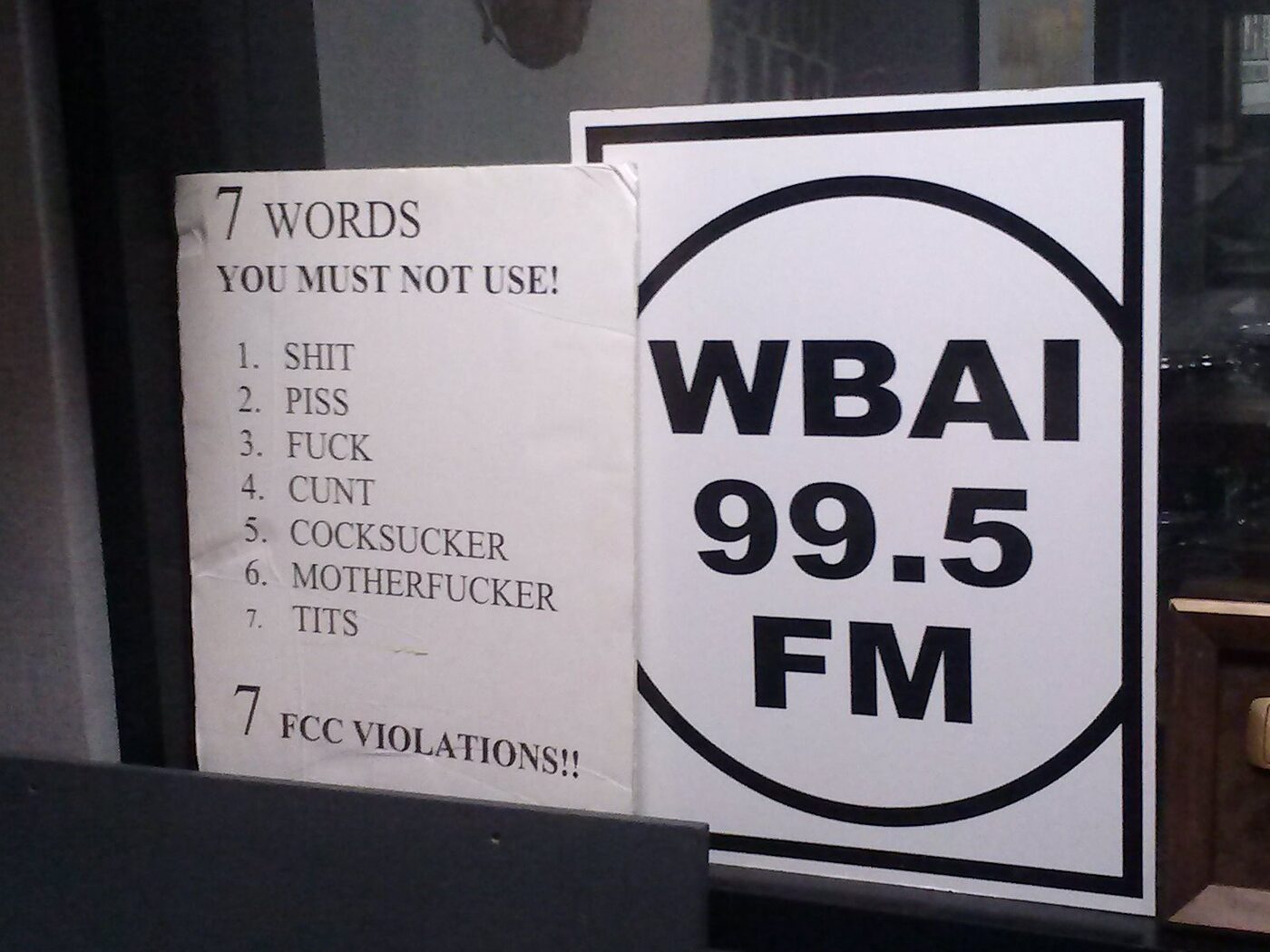
Obscene, indecent and profane broadcasting is prohibited by federal criminal statute, 18 U.S.C. § 1464, and enforced administratively by the FCC against licensees. The constitutional foundation of that enforcement is FCC v. Pacifica Foundation, 438 U.S. 726, decided on 3 July 1978. The case arose from the broadcast by WBAI in New York, on the afternoon of 30 October 1973, of George Carlin's monologue "Seven Words You Can Never Say on Television", and a complaint from a listener who said he had heard it on his car radio while driving with his young son. The Supreme Court held that because of the uniquely pervasive presence of broadcasting, and its unique accessibility to children, broadcast speech receives less First Amendment protection than other forms; Carlin's monologue, though not obscene, could be treated as indecent and restricted to certain times of day rather than banned outright.

From Pacifica the Commission derived the safe harbour: indecent material may be broadcast between 10 p.m. and 6 a.m., and not otherwise. The boundary has been fought over. In 1988, at the direction of Congress, the Commission announced a ban on indecent material with no safe harbour at all; the proposed round-the-clock ban was struck down as unconstitutional by the D.C. Circuit in 1991. A statutory attempt in 1992 to narrow the harbour to midnight-to-six was lengthened back to ten-to-six by further rulings of the same court. Ten to six is the rule that stood throughout the whole period this page covers.
Set the two definitions side by side and the structural position of every morning show in the United States becomes plain arithmetic. The safe harbour ends at 6 a.m. Morning drive begins at 6 a.m. A programme in the most valuable daypart in commercial radio is, by definition, broadcasting in the first four hours of the day in which indecent content is prohibited outright — and doing it live. That is not a comment on any particular programme. It is the shape of the regulatory box that every American morning show of the period worked inside.
The enforcement shift of the mid-2000s
The regime described above was stable for a quarter of a century and then changed sharply, over roughly two years, in exactly the window in which this group's subject was dismissed twice.
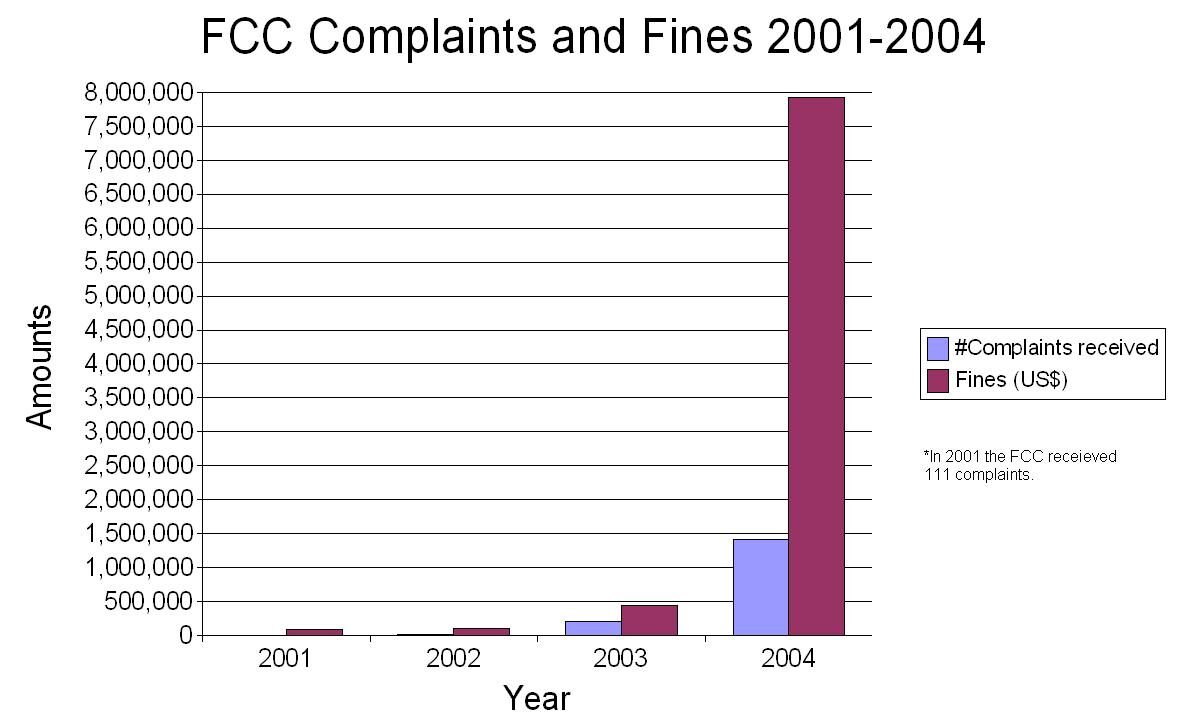
The sequence begins in January 2003, when Bono of U2, accepting an award at the Golden Globes broadcast by NBC, used an expletive adjectivally. In 2004 the Commission prohibited single uses of vulgar words in any circumstances, abandoning the leeway it had previously given to fleeting expletives that networks had unknowingly allowed on air. Then, on 1 February 2004, came the Super Bowl XXXVIII halftime show, broadcast live by CBS from Houston to an audience put at 150 million, in which Janet Jackson's breast was briefly exposed. The consequences for broadcast regulation were out of all proportion to the incident: the FCC received nearly 540,000 complaints about the halftime show alone, and both the volume of complaints reaching the Commission and the value of the forfeitures it issued rose in 2004 far above their level in the three preceding years.

The industry response was pre-emptive and fast. Clear Channel suspended Howard Stern's programme in February 2004 from the six of its stations that carried it, and dropped it permanently on 8 April, the day the Commission issued a notice proposing a $495,000 forfeiture against the company — $27,500 for each of eighteen violations found in a 9 April 2003 Stern broadcast. This group's subject was removed the following day, under the same zero-tolerance policy. In June 2004 the company settled with the Commission for $1.75 million, then a record, resolving that proposed forfeiture and other pending indecency investigations at once.
Congress then raised the stakes. The Broadcast Decency Enforcement Act of 2005 passed the House on 7 June 2006 by 379 votes to 35, with 18 not voting, and was signed into law by President Bush on 15 June 2006 as Public Law 109-235. Its operative section is one sentence long: it amends section 503(b)(2) of the Communications Act so that a licensee or permittee determined by the Commission to have broadcast obscene, indecent or profane language faces a forfeiture of up to $325,000 for each violation or each day of a continuing violation, with any continuing violation capped at a total of $3,000,000 for a single act or failure to act. The previous ceiling had been an order of magnitude lower. The Act became law four months before the show's second dismissal.
The courts then unwound a good deal of it. In FCC v. Fox Television Stations, decided on 28 April 2009, the Supreme Court held 5–4 that the Commission had not acted arbitrarily or capriciously in changing its fleeting-expletive policy, expressly declining to decide whether the new rule was constitutional and sending that question back to the lower courts. On the case's second trip, in 2012, the Court set the penalties aside on the ground that the standard applied had been unconstitutionally vague as against the broadcasters concerned. The Super Bowl fine itself — $550,000, the largest then placed on a television broadcaster — was voided by the Third Circuit in July 2008, sent back for reconsideration by the Supreme Court in May 2009, voided again on 2 November 2011, and left void when the Supreme Court declined the Commission's appeal on 29 June 2012.
None of this litigation involved the programme this group followed. It is set out because it is the weather the show worked in: an enforcement regime that tightened abruptly in early 2004, was reinforced by statute in mid-2006, and was substantially blunted by the courts only after the events that shaped this show's career had already happened. A page about a listener community that formed around a morning show in Atlanta between 1996 and the late 2000s is, unavoidably, a page about that regime.
Why a local radio fan group is worth preserving
The case for keeping a page like this one does not rest on the group having been important. It rests on the poverty of everything else.
Local commercial broadcasting of the 1990s and 2000s is among the worst-archived cultural products of its period. There is no legal deposit for a radio broadcast in the United States comparable to the copyright deposit of a book. Stations kept recordings for their own operational and compliance purposes and discarded them; when a station changed format, or was sold in one of the consolidations described above, the tapes went out with the furniture. The 96 Rock identity that had run since 1974 ended on 17 November 2006, when the station relaunched under a different name; the rock format itself was signed off on 29 August 2012 with a farewell message and a last record, ending thirty-eight years of rock on the frequency, and the WKLS call letters moved away a fortnight later. The frequency now carries a different format under the successor to the same corporate owner. Of the several thousand hours of a daily morning programme, what survives in public hands is essentially nothing.
Nor did the audience leave much. Radio listening is among the least documented forms of media consumption there is: it is done alone, in a car, while doing something else, and it generates no ticket stub, no receipt and no shelf. Ratings diaries measured it in aggregate and were not kept for posterity. Letters to a station were read and binned. Before the web, the ordinary listener's relationship to a morning show produced no written record of any kind.
A newsgroup is one of the very few places where that changed. For roughly a decade — from the mid-1990s until station message boards, then podcasts, then social platforms absorbed the function — Usenet was the default place for a dispersed audience to write things down about a broadcast, and what they wrote was propagated to thousands of servers, archived by third parties without asking anyone's permission, and preserved by accident rather than by policy. The historiographical value is not in any individual posting. It is that a category of experience which otherwise generated no documents at all generated some, in a medium designed for replication, at exactly the moment when the industry being discussed was being restructured by legislation and disciplined by a regulator.
This page makes that argument in general terms and stops there. It describes no thread, quotes no posting, and attributes no opinion to anyone who wrote in this group, because the work of reading the group's archive has not been done here and inventing its contents would be worse than leaving the space empty. What can be said is the general thing: local broadcasting left almost no trace, and this is one of the places a trace could have been left.
What the record does not show
The following are things a reader might reasonably expect this page to tell them, which it cannot.
It does not show who created the group. The 1996 control message was sent from an account at NETCOM, a large American provider of the period which claimed some 500,000 subscribers in 1996 and served them across the country, so the address places the sender nowhere in particular; the message is signed with a pseudonym, and nothing else in it identifies the sender or their reason.
It does not show what the creator meant by the name. No charter was ever written, the control message has no body, and the current reference list carries the placeholder rather than a description. The association between this group and this particular radio programme rests on the description at the head of this page, which was written for this directory.
It does not show how many people read or posted to the group, at any point in its life. Usenet produced no reliable subscriber figures for individual groups even when someone was trying to measure them, and nobody was trying to measure this one. The active file entry carries an empty article range, which is a property of the reference list rather than evidence about traffic.
It does not show when the group went quiet, or whether it ever did. No rmgroup was issued, so the name persists in the namespace regardless of whether anything was posted to it after any given date; the presence of a group in the current list is evidence about bookkeeping, not about life.
It does not show what was discussed. Whether the group tracked the events of 2004 and 2006 as they happened, whether it argued about them, whether it emptied out during the years the show was off the air and refilled in 2008 — all of that is answerable in principle from the archive and is not answered here.
It does not show any relationship between the group and the programme's makers. There is no evidence in the sources consulted that anyone connected with the show read the group, posted to it, or knew it existed.
And it does not resolve several loose ends in the published account of the show itself: the exact ownership of WKLS at the moment the Atlanta run began, on which two Wikipedia articles differ; the spelling of one participant's name, which appears in more than one form in her own credits as well as in the accounts of this episode; and the characterisation of the 1997 departure from Los Angeles, on which the parties are recorded as having taken different views at the time and where the cited source has gone.
Scope and limits
This article is assembled from three kinds of source and should be read with each kind's limits in mind.
The statements about the newsgroup's own paperwork — the two control messages and their headers and dates, the absence of an rmgroup, the wording of the entries in the current newsgroups and active files, the counts of alt.*, alt.fan.*, alt.radio.*, the Big-8 hierarchies and placeholder descriptions, and the quoted commentary from control.ctl — come from the Internet Systems Consortium's mirrors of the Usenet administrative record, read directly on 25 August 2026. These are primary documents and are quoted rather than paraphrased wherever the exact wording matters. Counts derived from a list are counts as of that list on that date; the alt.* namespace is maintained by volunteers and the file changes.
The statements about the radio programme, the stations, the companies, the statutes and the litigation come from Wikipedia and, where a specific claim needed checking, from the contemporaneous reporting Wikipedia cites, retrieved directly where it remains available. Several of the local Atlanta sources on which the show's article depends can no longer be retrieved: one publication's domain has lapsed entirely, and a television station's archive answers requests from outside its region with a notice rather than the article. Where a claim rests only on those, it is attributed to Wikipedia's account rather than asserted. Points on which sources disagree are flagged in the text rather than resolved.
The statements about the group's contents, its readership and its participants are absent, and their absence is deliberate. This page contains no invented thread titles, no invented statistics and no characterisation of anyone who posted here.
Finally, on register: this article concerns living people and their employment. It reports the dismissals because they are documented and because they are the events around which the show's public history is organised, and it attributes every characterisation to whoever made it. It passes no judgement on the conduct of any presenter, employer, complainant or regulator. The other groups this directory preserves are listed on the all-groups page.
Reading alt.fan.regular-guys today
- Historical archive: Google Groups — alt.fan.regular-guys (coverage varies by group and era).
- Open in a newsreader:
news:alt.fan.regular-guys— the original site offered exactly this link, and it still works if your system has a newsreader registered for thenews:scheme. - Live access: point an NNTP newsreader at a modern server — see accessing Usenet today.
- The original news2mail e-mail subscription service ended in the mid-2000s and no longer operates.