alt.food.mexican-cooking
Mexican cooking, argued authentically.
Recipes and technique for Mexican food, with the perennial border war between authentic regional cooking and Tex-Mex conducted at a simmer.
Its chile-variety threads and salsa lineages were reference material before food sites existed.
On this page
- One control message, and what it establishes
- Why a cuisine needed its own address
- The alt.food.* neighbourhood
- A cuisine described by region
- The regional map: the south and the Gulf
- The regional map: the west and the north
- What UNESCO inscribed in 2010, exactly
- The boundary, and the cuisines that live along it
- The books that carried the cuisine into English
- The Mexican culinary literature behind that
- Chiles: the name pairs, and what the numbers do not settle
- Corn: nixtamalisation, masa, and the packet
- The pantry problem, and why substitution was a technical subject
- What the group carried
- Recipes as plain text
- What the record does not show
- Scope and limits
One control message, and what it establishes
The Internet Systems Consortium keeps an archive of Usenet control messages, filed one compressed file per group. For alt.food.mexican-cooking that file contains exactly one message, and it is the whole of the group's paperwork. It was posted to alt.config on Tuesday 12 May 1998, timed 17:11:01 GMT, from a customer account on Pacific Bell's dial-up service — the posting host named in the headers is a dial-up port on a San Diego access point — and it carries a Control header reading newgroup alt.food.mexican-cooking, an Approved header naming the sender, and a Distribution header set to world. The headers declare a body of three lines. Two of them are the instruction every news administrator was expected to act on:
For your newsgroups file:
alt.food.mexican-cooking, for the discussion and posting of mexican recipes.
That sentence, lower-case m and all, is the group's charter. Nothing else was ever filed. There is no Request for Discussion, no Call for Votes, no result with a tally, because the alt.* hierarchy has never had any of those things. The companion archive that does hold RFDs, calls for votes and vote results is filed by hierarchy, and its hierarchy directories are comp, humanities, misc, news, rec, sci, soc and talk: there is no alt directory in it at all, and there could not be. The single newgroup message is not a fragment of a lost record. It is the record, complete.
What it establishes is narrow but solid. A group of this name was proposed to the network on that date, in a syntactically valid control message, by someone who wanted a room for Mexican recipes and was willing to spend five minutes creating one. It does not establish that any particular site honoured the message, how many did, or when the first article appeared, because none of that was ever written down anywhere that survives. The absence is structural rather than accidental, and it is the same absence that shapes every alt.* group's history.
The archive's evidentiary role is not this page's invention: it is written into the standard configuration file that news software ships with. INN's control.ctl, distributed from the same server, warns administrators that tons of alt.* newgroups are sent out regularly with the intent more to create nonsense entries in active files than to create a usable newsgroup, and advises them, as one good initial filter, to check the control-message archive for a requested group to see whether a syntactically valid newgroup message was ever issued — many of the junk control messages being invalid and therefore never archived at all. It is candid about the limits of the exercise, noting that there is no official, generally accepted alt.* policy and that all information about alt.* groups available is essentially someone's opinion, its own comments included. By that standard the group passes: a valid message, properly formed, archived where administrators were told to look.
Two footnotes from the same source. The group is still in the ISC active file today, flagged y for unmoderated and open to posting, with a high-water mark of zero — carried in the namespace, empty on that server. And it does appear in the companion newsgroups file, the one that holds the one-line descriptions, but the line reads No description. The charter sentence quoted above therefore survives in the control archive rather than in the list that would ordinarily display it.
Why a cuisine needed its own address
The structural question this group raises is not why anybody wanted to discuss Mexican cooking on Usenet in 1998. It is why the discussion needed a new address, when a large, busy and much older group for cooking already existed a hierarchy away.
That group was rec.food.cooking, and its seniority was not in doubt. It began as net.cooks, launched by Steve Upstill in Berkeley in January 1982, and acquired its present name in the Great Renaming — the reorganisation that replaced the flat net.* namespace with comp, misc, news, rec, sci, soc and talk. The dating deserves care, because two true statements sit next to each other: the long-maintained cooking FAQ dates the group's change of name to late 1986, while the Renaming as a whole is generally dated to 1987, having been made practical by the improvements Rick Adams introduced to B News during 1986 — version 2.11 dropped the fourteen-character uniqueness limit that flat storage had imposed on group names, among other changes. Both datings are correct at their own scale, and collapsing them into a single year loses information. A moderated sibling, rec.food.recipes, was split off later. All of that belongs to that page.
What belongs here is the consequence. rec.food.cooking covered all cooking, which is precisely why single-subject rooms kept appearing beside it — and why, when its readers tried to subdivide the subject by the proper method, the method proved slow. A Request for Discussion for rec.food.spicy was posted on 4 June 1993 by a proposer at Auburn University, proposing a group for the discussion of hot and spicy food, including recipes, methods and ingredients, on the ground that there was a large interest in spicy food. It went no further. No group of that name was ever created; none appears in the ISC active file today, and the archived file for the proposal contains nothing but the two 1993 requests for discussion.
The contrast with what the Big Eight demanded is worth stating with a real example, because the example is on file. When rec.food.recipes was proposed in January 1990, it went through a call for discussion, a call for votes, a published mass acknowledgement of every ballot received, and a final result posted on 12 March 1990: 349 votes cast, 233 in favour and 116 against, which cleared both of the standing thresholds — a two-thirds majority and a margin of at least a hundred — after which a five-day waiting period ran before the newgroup message could be sent. That is the machinery a cuisine would have had to pass through in the rec.* hierarchy, and it could still end with nothing, as rec.food.spicy did.
Three years after that failure, one person sent one message and a cuisine had a room. That is the honest answer to why alt.food.mexican-cooking existed as a separate group: not because a body of readers had established a need by any documented process, but because the alt.* hierarchy required no vote, and a subject could have a room simply because somebody made one. Whether the room filled was then a separate question, settled by readers rather than by procedure — and settled differently for the thousands of alt.* groups that were created and never used at all.
It is worth stating the corollary plainly, because the alt.* hierarchy is often described as though creation were the same as existence. A newgroup message was a request, not an instruction. Every administrator decided independently whether to honour it, and the same open channel that let one reader create a cooking group let anyone else create anything else, or forge a message in someone's name. The nearly identical alt.food.mexican illustrates the failure mode: its only archived control message, from 18 March 2001, carries a Control header naming that group and a body arguing at length for an unrelated fan group, with keywords about food, cooking, chiles and peppers bolted onto a proposal about something else entirely. The defect propagated: in the ISC newsgroups file today, the line for alt.food.mexican carries the fan group's name and description rather than any food description at all. Our group's message has no such defect. In a hierarchy with no gatekeeper, the difference between a clean control message and a mangled one was most of the quality control there was.
The alt.food.* neighbourhood
The stretch of the namespace the group landed in can be counted rather than characterised. The ISC control archive holds 55 files for groups whose names begin alt.food., out of some 36,000 for alt.* as a whole, and the current active file still carries fifty alt.food.* groups among its 20,466 alt.* entries. Read as a list, it is a fair portrait of what the unvoted hierarchy was for.
At one end sit the groups named for a subject with a literature behind it: alt.food.barbecue, alt.food.sushi, alt.food.wine, alt.food.coffee, alt.food.chocolate, alt.food.cajun, alt.food.professionals, alt.food.safety, alt.food.diabetic. In the middle are the single-ingredient rooms — alt.food.olives-or-olive-oil, alt.food.grits, alt.food.ramen, alt.food.lutefisk, alt.food.surstromming — where the subject is narrow enough that a general cooking group would have been a poor fit and a mailing list would have been a smaller audience. At the other end are the groups named after a company or a product: alt.food.mcdonalds, alt.food.taco-bell, alt.food.dennys, alt.food.red-lobster, alt.food.waffle-house, alt.food.pez, alt.food.mentos, alt.food.kinder-eggs. Several of the entries in the archive are plainly jokes, and the archive preserves the manner of their making: one such file holds six copies of a single control message, all bearing the same timestamp in the Date header, received at the archive within about a quarter of an hour of each other on a Saturday evening in June 2000.
A cuisine with several centuries of written literature therefore ended up filed between a fast-food chain and a confection, and the filing says nothing whatever about its standing. It says only that in 1998 the cheap way to get a room was to take one, and that nobody was sorting the neighbourhood.
A cuisine described by region
The argument the group is remembered for was durable partly because the thing under discussion is not one thing. The cooking of Mexico is conventionally described by region rather than by nation, and the regions keep distinctions that a single national label flattens. This is not a position taken on Usenet; it is the organising principle of the reference literature the posters were reading, and of the country's own culinary scholarship.
The elements common to nearly all of it are few and old: maize, beans and chile, with squash, tomatoes, tomatillos, avocado, cacao and vanilla among the native ingredients, and the Spanish contributions — wheat, rice, beef, pork, mutton, dairy, and a long list of European herbs — layered on after the sixteenth century. Capsicum annuum, the species that supplies most of the chiles named in the group, is one of the oldest cultivated crops, domesticated in what is now Mexico around six thousand years ago. Beyond that shared base, the regions diverge sharply, and it is the divergence that makes a single word for the whole so hard to defend.

The regional map: the south and the Gulf
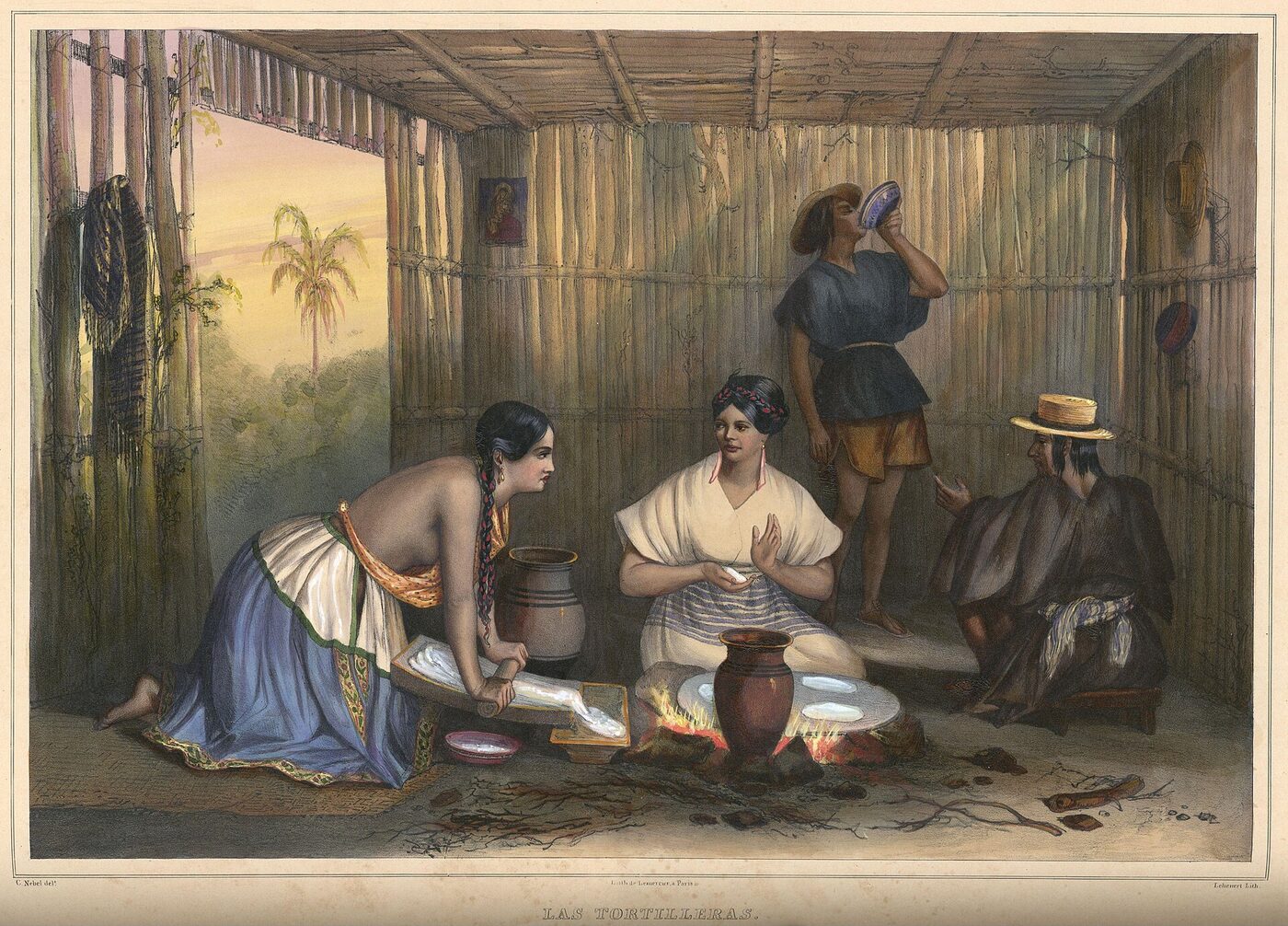
Oaxaca is the case usually made first, because it is the most documented. The state is known as the land of the seven moles, and the seven have names, colours and separate identities: negro, amarillo, coloradito, chichilo, rojo, verde, and the fruit-and-meat manchamanteles, whose name means tablecloth-stainer. The seven are a convention rather than an inventory — over two hundred mole preparations are recorded in the state. Oaxacan cooks work with chiles grown and named locally, among them the chilhuacle, the chilcostle, the costeño and the pasilla oaxaqueña, a red, hot and smoky chile which is not the pasilla of central Mexico; the defining herb is hoja santa; the local cheese is the Oaxacan quesillo, adapted from a mozzarella the Spanish brought; the large tlayuda, which can run to more than forty centimetres across and is baked drier than an ordinary tortilla, is the local bread; and chapulines — grasshoppers, seasoned with garlic and lime and eaten straight off the comal — are a Central Valleys speciality eaten there since well before the Spanish arrived.
Mole itself is older than any of the legends attached to it. The word descends from the Nahuatl mōlli or chīlmōlli, meaning chile sauce, and Bernardino de Sahagún's General History of the Things of New Spain records mollis used in a number of dishes, including those for fish, game and vegetables. The familiar story that mole poblano was improvised by nuns in a Puebla convent for a visiting archbishop is a legend, and is generally reported as one; what the sources do note is that few if any pre-Hispanic mole recipes contained chocolate, the Mexica having reserved cacao for drinking, and that Sahagún nowhere mentions it as a flavouring for dishes. The classic moles of central Mexico and Oaxaca are built on two or more of ancho, pasilla, mulato and chipotle, with black pepper, achiote, cumin, clove, anise, tomato, tomatillo, garlic, sesame, dried fruit and herbs among the rest, roasted and ground into a paste — a process that takes at least a day to accomplish by hand, which is why the dish belonged to festivals and why powered grinding changed it. San Pedro Atocpan, in the rural borough of Milpa Alta south of the centre of Mexico City, is the documented example: a maize-and-bean farming town where only four neighbourhoods made mole for the town festivals, and where a family who carried mole down to the La Merced market in the 1940s could bring only two kilos, because it was ground by hand. The paving of the main road and the arrival of electricity in 1947 changed the arithmetic. The town now produces about 60 per cent of the mole made in Mexico and 89 per cent of the mole eaten in Mexico City, and some 92 per cent of its own population lives by making and selling it — in small family workshops rather than factories.
Puebla holds mole poblano and chiles en nogada: poblano chiles stuffed with picadillo under a walnut cream sauce, strewn with pomegranate seeds and parsley, served at room temperature. The walnuts are traditionally of the Castilian cultivar; the dish is made in central Mexico in August and the first half of September, while the pomegranates are in season, which coincides with the independence anniversary. Its green, white and red are the colours of the national flag, and it is tied by tradition to the entry of Agustín de Iturbide into the city after the Treaty of Córdoba in 1821 — again a story the literature reports as tradition rather than as record, with rival convents named as its inventors.
On the Yucatán peninsula the base is Maya, with Caribbean, central Mexican, European and Middle Eastern layers on top. Achiote — the seed of Bixa orellana, annatto — gives the region its red seasoning pastes, the recados; the best known dish, cochinita pibil, is pork rubbed with recado rojo, wrapped in banana leaves and cooked in a pit oven, píib being the Maya word for buried. Bitter oranges supply the tang that characterises the region's marinades and broths, habaneros are served alongside dishes rather than cooked into them, and honey was used to sweeten there long before the Spanish arrived.
Veracruz, on the Gulf, mixes indigenous, Afro-Mexican and Spanish elements: vanilla is native to the state, the herbs acuyo and hoja santa are indigenous to the cooking, plantain arrived with enslaved Africans brought through the Caribbean, and the European herbs the Spanish brought — parsley, thyme, marjoram, bay, coriander — are what give the state's best-known dish, huachinango a la veracruzana, its character. Chiapas, further south, is distinguished by the simojovel, a chile used nowhere else in the country, and by the herbs chipilín and hoja santa.
The regional map: the west and the north
Michoacán's cooking rests on Purépecha foundations, with perhaps the widest range of maize uses in the country — atole made in more flavours there than elsewhere, including blackberry and cascabel chile, and tamales folded into the polyhedral shapes called corundas — and carnitas, pork cooked confit in its own fat, is found across Mexico but is often claimed as authentically Michoacán. It is also the state named in the UNESCO inscription discussed below.
The north is the region the boundary argument runs through, and it is different from the south for reasons of climate and history rather than of taste. Before the Spanish arrived the indigenous peoples of the arid north were largely hunter-gatherers with limited agriculture and few settlements; the Europeans found the land suited to cattle, goats and sheep, and the cuisine that resulted is built on meat and on grilling, a technique the ranch culture pushed outdoors and into the hands of men. Machaca, arrachera and cabrito are its signatures, roast kid being the emblematic dish of Monterrey and Nuevo León. Ranching produced the widest range of cheeses in the country. Wheat grows where maize struggles, so the flour tortilla is northern, in at least forty distinct types, and it was those large wheat tortillas that made the burrito possible in the border city of Ciudad Juárez. Preservation shapes the rest: in a desert climate meat, chiles, squash, maize, peas, lentils, beans and fruit are dried or canned, and drying is not neutral — many chiles are less hot after it.
This matters to the group's argument in a specific way. Beef, wheat tortillas and grilling — the three things most often cited outside Mexico as marks of an Americanised menu — are also, in their own right, the ordinary cooking of the Mexican north, on both sides of a border that the ranching culture predates. The line between a regional Mexican cuisine and a border cuisine is not drawn where the shorthand puts it.
What UNESCO inscribed in 2010, exactly
The best-known institutional recognition of the cuisine arrived after most of the group's active life, and it is narrower and stranger than the shorthand suggests. It is worth naming exactly.
In 2010, at the fifth session of its Intergovernmental Committee, UNESCO inscribed on the Representative List of the Intangible Cultural Heritage of Humanity an element titled Traditional Mexican cuisine — ancestral, ongoing community culture, the Michoacán paradigm, nomination file 00400, under decision 5.COM 6.30. What is described in the inscription is not a list of protected dishes. It is a comprehensive cultural model comprising farming, ritual practices, age-old skills, culinary techniques and ancestral community customs and manners, made possible by collective participation in the entire traditional food chain, from planting and harvesting to cooking and eating.
The text names its components with some precision, and they are the same components this article has been describing: a base founded on corn, beans and chili; farming methods including the milpa, glossed there as a rotating swidden field of corn and other crops, and the chinampa, the man-made farming islet of the lake areas; cooking processes including nixtamalisation, glossed as lime-hulling maize, which increases its nutritional value; and singular utensils including grinding stones and stone mortars. Native ingredients — varieties of tomatoes, squashes, avocados, cocoa and vanilla — augment the basic staples, and everyday tortillas and tamales are named as an integral part of Day of the Dead offerings. The inscription credits collectives of female cooks and other practitioners in the state of Michoacán and across Mexico with holding the knowledge, and frames the Michoacán case as underlining the importance of traditional cuisine as a means of sustainable development.
Two things follow for a page about a newsgroup. The inscription is recognition of a living community practice, not an adjudication between cuisines, and it says nothing at all about anything on the other side of the border. And it postdates the group's run and the gateway that fed this directory: it is a later document, not the verdict the threads never reached.
The boundary, and the cuisines that live along it
The other half of the group's standing argument concerns the cooking of the border and the American Southwest, and it is handled here as the literature handles it: as a set of documented culinary traditions with published histories, described rather than ranked.
Tex-Mex has the longest paper trail, and the paper trail begins nowhere near a kitchen. The unhyphenated form TexMex was first used to abbreviate the Texas Mexican Railway, chartered in southern Texas in 1875. By the 1920s the hyphenated form was appearing in American newspapers to describe Texans of Mexican ancestry. It attached to food only much later: the Oxford English Dictionary gives its first known uses in print in that sense as a 1963 article in the New York Times Magazine and a 1966 item in the Great Bend Daily Tribune of Kansas, and a syndicated newspaper article of October 1960 had already used the label for a set of recipes including chili and enchiladas. The cooking it names is older than the label by a long way, having originated with Tejanos as a mix of native Mexican and Spanish foods when Texas was part of New Spain and then of Mexico — a body of cooking sometimes distinguished as Old Tejano from the twentieth-century dishes that followed. What changed in the twentieth century was supply: with the railways, American ingredients and appliances became common on the northern side, cheap cheddar, jack and pimento cheeses entered the repertoire, and specific dishes acquired datable origins. Nachos were improvised in 1943 by Ignacio Anaya at the Victory Club in Piedras Negras, Coahuila, for a party of American customers from across the river. The fajita has a longer and better documented arc: the cut, the campfire grilling and the Spanish nickname turn up on the ranch lands of South and West Texas in the 1930s, where skirt steak was among the scrap meat given to the vaqueros at slaughter; the word is not known in print until 1971; Sonny Falcón, an Austin meat market manager, ran what is recorded as the first commercial fajita taco stand at a 16 de septiembre celebration in Kyle, Texas, in September 1969; and the dish was then popularised by restaurants in Houston, Austin and San Antonio. That the same cut is called arrachera in Mexico is the whole argument in miniature. The preference of some Texan cooks and writers — the San Antonio chef Adán Medrano among them — for the name Texas Mexican, on the ground that this was the indigenous cooking of South Texas long before the Rio Grande marked a border, is itself part of the documented argument.
New Mexican cuisine is a separate tradition again, and the group's readers who cooked with green chile were not cooking Tex-Mex. It fuses Pueblo food with Hispano Spanish and Mexican traditions in the old territory of Nuevo México, and it developed largely in isolation, which is why it is distinct from other Latin American cooking in the contiguous United States. Its defining ingredient has an agricultural paper trail of the kind few foods possess: the New Mexican chile cultivars were developed from local landrace plants by the horticulturist Fabián García at what is now New Mexico State University, who began selecting from fourteen local accessions in 1894 with the stated aim of a larger, smoother, fleshier, more tapering and shoulderless pod suited to canning, and whose major release, New Mexico No. 9, went to growers in 1913. The work was continued by later breeders — Roy Nakayama among them — and institutionalised in the Chile Pepper Institute, established at the same university in 1992. The state has an official State Question — Red or green? — and the spelling chile for the pod, as against chili for the Texan meat dish, was made official for the state by Senator Pete Domenici, who entered it into the Congressional Record. The Anaheim pepper of California is a mild variety of the same New Mexican stock, and carries its name because the farmer Emilio Ortega took seeds from New Mexico to the Anaheim area in 1894. A comparable regional literature exists: Historic Cookery, published in 1931 by the New Mexican educator and writer Fabiola Cabeza de Baca Gilbert, is among the first cookbooks to describe the cuisine.
Two facts about the group follow from all this, and both are honest to state. First, the boundary being argued about was not a single line but several, with Tex-Mex, New Mexican, Cal-Mex and Southwestern cooking each having its own history and its own defenders. Second, the group's readership sat overwhelmingly on the northern side of it: this was an English-language Usenet group started in 1998 from a Californian consumer dial-up account, and the reference literature it worked from was written in English for readers whose shops stocked none of the ingredients. A person defending a regional Mexican cuisine on that group was usually doing so at a considerable distance from the region. That is an inference from what the record shows about the group, not a measurement of who read it, and it is offered as one.
Which is why the argument could not resolve, and why the page takes no side in it. Mexico's regional cuisines differ from one another about as much as any of them differs from what was served in Mexican restaurants outside Mexico — which, the literature notes, was usually some form of Tex-Mex. The dispute was less about a boundary between two cuisines than about how many cuisines were being counted, and by whom.
The books that carried the cuisine into English
An argument conducted in English had a literature behind it, and the literature was recent enough that the group's older readers had watched it appear. Naming it is the most useful thing this page can do for a reader trying to reconstruct what the posters had on their shelves.
The Complete Book of Mexican Cooking, published in New York by M. Evans in 1967, was among the earliest full English-language surveys of the subject. Its author, Elisabeth Lambert Ortiz (17 June 1915 – 27 October 2003), was a British writer who had begun poetry and fiction in Australia and turned to food only after moving to Mexico City with her second husband, a diplomat, learning Spanish and Mexican cooking from his extended family there; she went on to write extensively for the American food press, and the book was revised as The New Complete Book of Mexican Cooking in 1997, by which time it had been in print for thirty years.
The book that set the terms of the argument, though, was The Cuisines of Mexico, published by Harper & Row in 1972. Its author, Diana Kennedy, was born Diana Southwood in Loughton, Essex, on 3 March 1923, moved to Mexico in 1957, and from 1969 taught Mexican cooking in her New York apartment at the urging of the New York Times food writer Craig Claiborne, who had told her he would only read a Mexican cookbook once she had written one. The classes produced the book. It laid out the distinction between the regional cooking of Mexico and Americanised Mexican food in terms that both sides of the later argument adopted, and it did so on the strength of field research: she visited every state in Mexico, travelling by bus, donkey and an unpowered pickup, and interviewed rural cooks in preference to restaurant ones. A shelf of regional books followed: The Tortilla Book (1975), Recipes from the Regional Cooks of Mexico (1978), The Art of Mexican Cooking (1989), My Mexico (1998), and much later Oaxaca al Gusto (2010), organised not by type of dish but by the eleven regions of that state, which took the James Beard cookbook of the year award in 2011. Mexico decorated her with the Order of the Aztec Eagle, its highest honour for a foreigner, in 1981, and Britain appointed her MBE in 2002. She described her own work as writing oral history that was disappearing with climate change, agribusiness and the loss of cultivated land, and her collected records of native edible plants have been digitised by Mexico's national biodiversity commission. She died on 24 July 2022, aged 99.
For an American readership the equivalent was Authentic Mexican: Regional Cooking from the Heart of Mexico (William Morrow, 1987), written by the chef Rick Bayless after more than six years of culinary research in Mexico, and described by Claiborne as “the greatest contribution to the Mexican table imaginable”. Its author's Mexico: One Plate at a Time (Scribner, 2000) took the James Beard cookbook of the year award in 2001 and served as a companion to the first season of the public television series of the same name, which PBS began broadcasting in 2000 — that is, in the middle of the group's run and in the same years the news2mail gateway was carrying it.
This was the common shelf, and its shape explains the shape of the argument. These were books organised by region; they gave regional names for chiles, herbs and techniques; and they were written for readers whose local shops stocked none of it. The canon a newsgroup could argue about was already in print before the newsgroup existed, which is why the threads could be specific about what was being claimed.
The Mexican culinary literature behind that
The English-language shelf was itself built on a much older Mexican one, and a page that named only the first would misrepresent the subject.
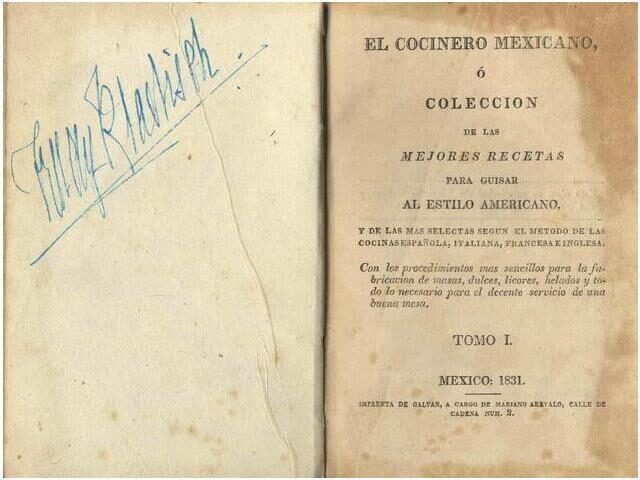
The founding document of the printed tradition is El cocinero mexicano, published anonymously in Mexico City by the Imprenta de Galván in 1831, ten years after independence, in three volumes; it is generally considered the oldest cookbook of Mexican cuisine as such, and it went through twelve editions. Its full title is a thesis in itself — El cocinero mexicano ó coleccion de las mejores recetas para guisar al estilo americano, the best recipes for cooking in the American style — and its prologue sets out the rest of the programme: to gather the traditional recipes of Mexican households, give the national cooking an academic footing and place it at the level of the European kitchens, applying the methods of the Spanish, Italian, French and English ones. It is written as instruction rather than definition, naming ingredients without quantities or cooking times, which tells you it was addressed to cooks who already knew what they were doing. It was later reissued in dictionary form under other titles, and the nineteenth-century Mexican cookbooks that followed it were heavily marked by the French Enlightenment in their prose, their indexing and their arrangement — several of the houses that published them were run by Frenchmen.

The twentieth-century equivalent is the work of Josefina Velázquez de León (7 June 1899 – 21 September 1968), who began publishing recipes in a Puebla magazine in the 1930s, founded a cookery school at the end of that decade and, by 1937, a publishing house that issued nothing but cookbooks and periodicals. She travelled to states across the republic for the school, promoting a national gastronomy built on the relation between good eating, household budgets, nutrition, history and regional cooking, and she ran her courses by post to students in other states into the 1960s. The resulting Platillos regionales de la República Mexicana (1946) is a state-by-state survey — of the then twenty-nine states — of exactly the kind the English-language regional books would later attempt. Her catalogue also records the period: Cómo cocinar en los aparatos modernos (1949) taught cooking in the pressure cooker and with the electric mixer, and Cómo cocinar en tiempos de carestía (1951) taught cooking under scarcity. She was also, from February 1946, a daily radio cook, and in the early 1950s made the first Mexican television cookery programme.
The connection to the English-language shelf is direct rather than inferred. It was Velázquez de León's documentation of the regional cuisines that first sent Diana Kennedy travelling around Mexico to record traditional recipes, and Rick Bayless has credited her with giving “a national face to regional Mexican cuisine”. The books the group argued from had a Mexican ancestor, and it was a woman with a printing press.
There is also a documented professional movement inside Mexico contemporaneous with the foreign interest. The Mexican Culinary Circle was formed in Mexico City in 1982 by a group of women chefs and other culinary experts, in reaction to a fear that traditional practice was being lost as foreign techniques and ingredients arrived. The concern that the group argued about in English was being argued in Spanish, on its own terms, at the same time.
Chiles: the name pairs, and what the numbers do not settle
Chiles came first in the group's reference traffic, and the reason is a feature of the subject rather than of the newsgroup: in Mexican usage a single fruit routinely has one name fresh and a different one dried, and the pairs defeat newcomers reliably.
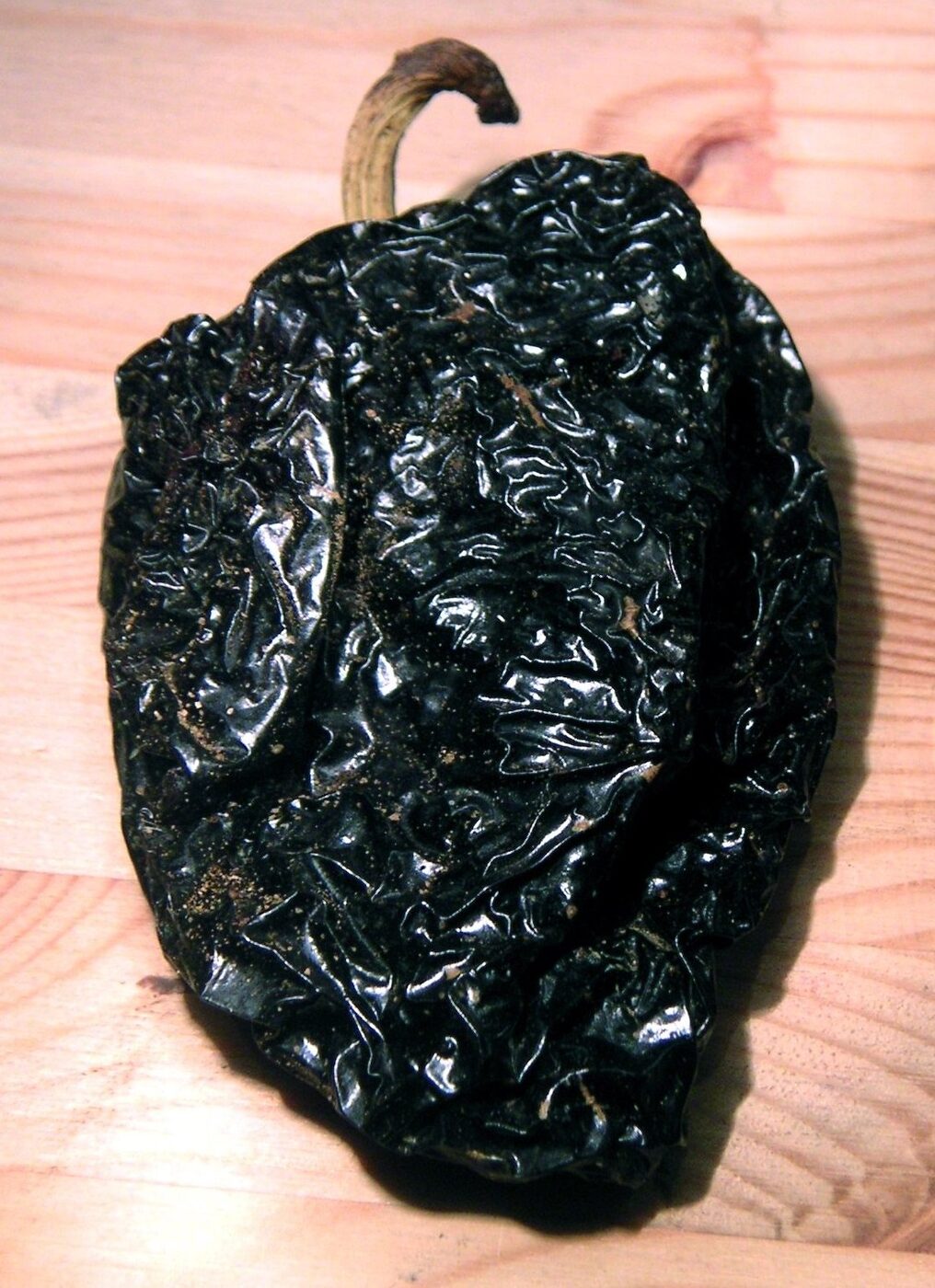
- The poblano, a mild chile originating in Puebla, becomes the ancho — the wide one — when dried. Beside it sits the mulato, darker, sweeter and softer in texture, described in some reference sources as a closely related variety and in others as the same pepper dried at full maturity while the ancho is dried green. Both descriptions are in the literature; the group inherited the ambiguity rather than creating it.
- The jalapeño, picked green for the fresh market, is left on the bush until it turns deep red and is then smoke-dried for several days to make the chipotle — a name from the Nahuatl chīlpoctli, smoked chile. Roughly ten pounds of jalapeños yield one pound of chipotles, the moisture falling from about 88 per cent to a final six. Two varieties are produced: the morita, smaller, reddish-purple, smoked for less time and the form usually found in the United States, and the larger, greyish, dusty-surfaced meco, smokier and largely kept for the domestic market.
- The chilaca, a long narrow chile that often grows twisted and turns from dark green to dark brown, dries to the pasilla — little raisin — also called chile negro. This is the pair that generates the most confusion outside Mexico, because producers and grocers in the United States routinely apply the name pasilla to the poblano instead. The pasilla de Oaxaca, smoked, is a different chile again and belongs to mole negro.
- The mirasol dries to the guajillo; the New Mexican pods, the same species selected for a smoother, fleshier, shoulderless shape suited to canning, are sold under their own names again.

Heat, at least, looked quantifiable, and the group had a number to hand. The Scoville scale was devised by the American pharmacist Wilbur Scoville in 1912 as an organoleptic test: an exact weight of dried chile is dissolved in alcohol to extract the capsaicinoids, the extract is diluted in sugar water in decreasing concentrations, and samples are given to a panel of five trained tasters until at least three can no longer detect the heat, the rating being that dilution expressed in multiples of a hundred units. Since the 1980s the figure has normally been obtained by high-performance liquid chromatography, which measures capsaicinoid concentration directly and converts to the same units.
The published ranges are wide, which is the useful part. Poblano is given at roughly 1,000 to 2,500 Scoville heat units, jalapeño and guajillo at 2,500 to 10,000, serrano at 10,000 to 25,000, habanero at 100,000 to 350,000. The organoleptic test's weaknesses are documented — it depends on the individual palate and on how many heat receptors it has, and the palate is quickly desensitised after a few samples in quick succession — and results are reported to vary between laboratories by as much as fifty per cent either way. Pungency for a given pepper varies by a factor of ten or more with seed lineage, climate, humidity and soil. Ratings are also defined per unit of dry mass, so comparing a fresh chile at about ninety per cent water with a hot sauce at ninety-five is comparing unlike things. A number settles less than it promises, which is precisely why substitution remained a matter of argument rather than arithmetic.
Corn: nixtamalisation, masa, and the packet
The other pillar of the subject is maize, and it is the one a text medium handled best, being settled by procedure and figures rather than by demonstration.
Nixtamalisation is the cooking and steeping of maize in an alkaline solution — usually limewater, calcium hydroxide, cal, though wood ash serves — followed by rinsing and hulling. The word comes from Nahuatl nixtamalli, a compound of nextli, ash, and tamalli, cooked maize dough; the discarded alkaline liquor has its own name, nejayote. The chemistry is well described. Hemicellulose and pectin in the cell walls are highly soluble in alkali, so the kernels soften and the pericarp loosens; the grain hydrates and takes up calcium from the solution; starches swell and gelatinise; some of the corn oil breaks down into emulsifying agents and the maize proteins bond to one another, with the divalent calcium acting as a cross-linking agent. Untreated cornmeal will not form a dough with water alone; nixtamalised maize will, and that dough is masa.
The nutritional consequences are the reason the process is ancient rather than merely useful. Tryptophan in the maize proteins is made more available for absorption, and tryptophan is the metabolic precursor of niacin, so a maize-based diet that is nixtamalised does not produce pellagra while one that is not can. Reported secondary gains include calcium content raised by some 750 per cent, with about 85 per cent of it available for absorption, along with increases in iron, copper and zinc, and reductions in mycotoxins — aflatoxins by 90 to 94 per cent, fumonisins by 82 per cent in the figures usually cited. The antiquity is documented archaeologically: the earliest evidence comes from equipment on Guatemala's southern coast dated between about 1200 and 1500 BCE. Maize cultivation spread worldwide after the Spanish conquest; nixtamalisation did not, which is why endemic pellagra appeared in maize-eating populations in Europe and in the poor of the American South.
From there the practical distinction the group returned to is a short one. Fresh nixtamal ground wet is masa. The same dough dried and milled is masa harina, to be reconstituted with water. That is the whole of the fresh-against-packet question, and it can be stated in a paragraph — but the industrial history behind it is worth a second one, because it explains what was actually available to buy.
The first industrial corn-flour plant in the world opened in Cerralvo, Nuevo León, in 1949 under the name Molinos Azteca, later shortened to Grupo Maseca and now Gruma. Masa harina existed to make mechanised tortilla production possible: wheat flour was fairly easy to process in machines, while wet masa was sticky, blocked the machinery and was hard to shape. The tortilla machine came into wide use in the 1950s, and the number of tortilla factories in Mexico rose from 2,214 in 1945 to 23,216 in 1980. In 1990 the Mexican commerce ministry capped the volume of fresh maize bought at support prices by the state food agency, requiring all further growth in the maize market to come from corn flour instead; the only two corn-flour producers at the time were Maseca and the state-owned Miconsa, and the latter lost almost all of its market share. Even so, 60 per cent of Mexico's population was still using fresh masa for tortillas in 2004, the last year of this directory's gateway — so the fresh-against-reconstituted question was live in Mexico at exactly the time it was being argued in English on Usenet, and for reasons of industrial policy as much as of taste.
The pantry problem, and why substitution was a technical subject
The detail that dates the group most precisely is the pantry. Outside the Southwest and the larger cities, a North American supermarket in the late 1990s carried none of the working ingredients by name: dried chiles as distinct named varieties, fresh masa, epazote, Mexican oregano, achiote, banana leaf, a tortilla press. The group's most consistently useful function was answering where to buy them, in years when mail order still meant a telephone call and a posted cheque, and when a specialist supplier's existence was itself a piece of information worth posting.
Nixtamalised corn flour was the standing exception, because it had industrial distribution ahead of everything else. Grupo Maseca opened a subsidiary in California in 1977, pioneering tortilla production in the United States, and opened that country's first nixtamalised corn flour plant in Texas in 1982. A cook could therefore often buy masa harina in a town where no shop sold a single dried ancho — an inversion of the usual order, in which the raw material is easier to find than the processed one.
Scarcity is what makes substitution a technical subject rather than a lazy one, and the technical content is mostly botanical. The herbs in question are not variants of familiar European ones; they are unrelated plants that happen to have been given borrowed names.
- Mexican oregano is generally Lippia graveolens, in the verbena family, native to Texas, southern New Mexico, Mexico and Central America as far south as Nicaragua — not Origanum, which is a mint and is not closely related to it. Its essential oil is rich in thymol and carvacrol, the compounds that carry the flavour of Mediterranean oregano, which is why the borrowed name works at all and why the substitution is approximate rather than exact. Other plants are sold under the same name in different regions, which is a second layer of ambiguity.
- Hoja santa is Piper auritum, a pepper-family herb endemic to tropical Central America, with velvety heart-shaped leaves that can exceed thirty centimetres, known also as acuyo, tlanepa and Mexican pepperleaf; the whole plant is said to smell of sassafras, and its flavour has been compared to eucalyptus, liquorice and more besides. Its leaf oil is around seventy per cent safrole. Nothing in a European or North American shop stands in for it.
- Epazote is Dysphania ambrosioides, formerly Chenopodium ambrosioides, a herb native to the Americas; its essential oil is dominated by ascaridole, up to seventy per cent, an uncommon constituent among spices and one that is slightly toxic and not especially pleasant on its own.
- Achiote is the seed of Bixa orellana, the annatto tree, which supplies colour as much as flavour — reddish, with a faintly peppery smell and a hint of nutmeg — and is the base of the Yucatecan recados.
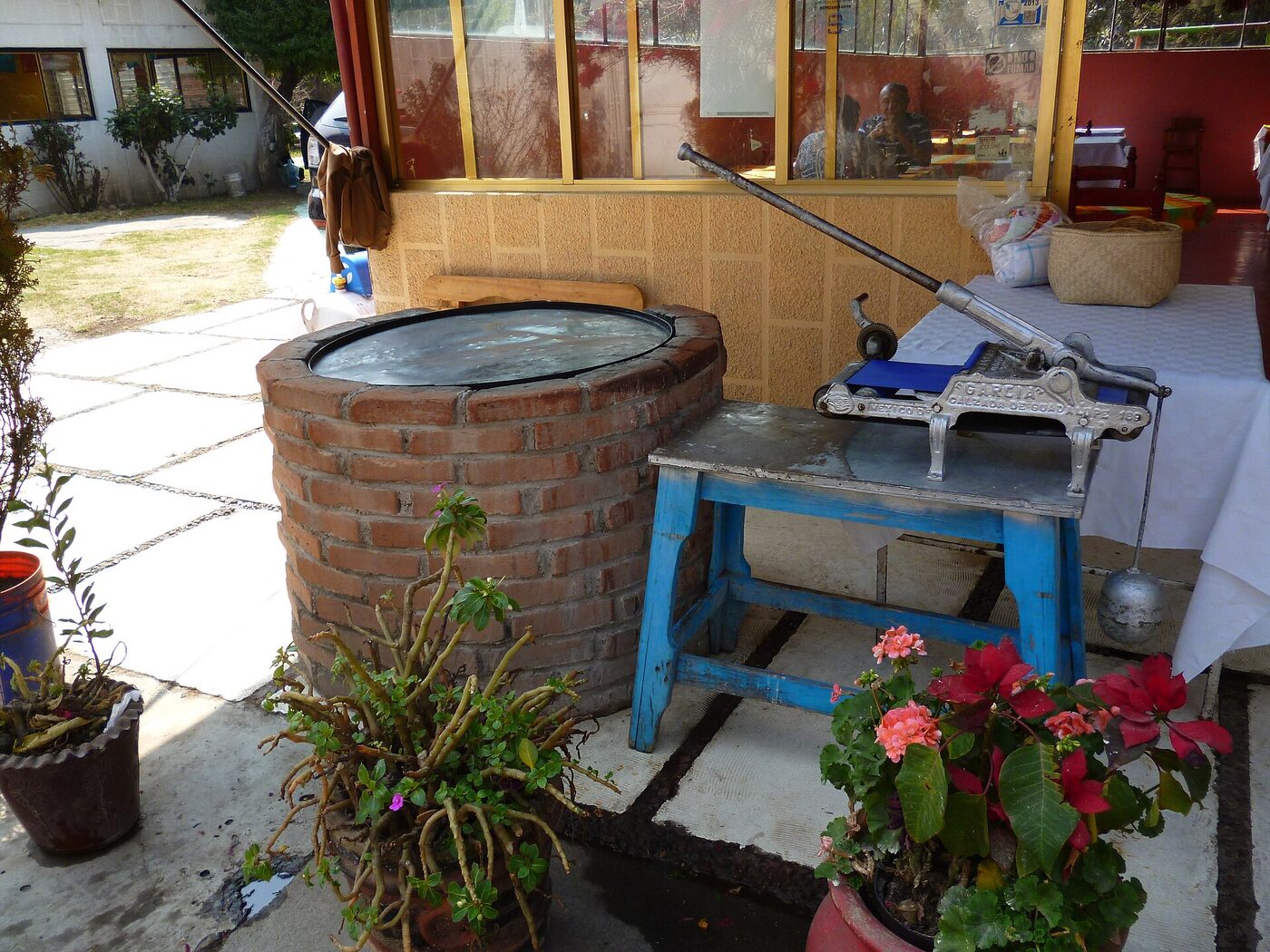
The equipment questions had the same character. A comal — from the Nahuatl comalli — is a flat griddle, made at home of heavy cast iron but also, still, of clay by indigenous makers in Mexico and Central America; a molcajete, from molcaxitl, is a basalt mortar with its tejolote pestle, from texolotl, and imitations pressed from concrete and volcanic rock particles behave differently; a metate is a ground-stone quern worked with a mano in a horizontal grinding motion, quite unlike the vertical crushing of a mortar and pestle. Those are the utensils UNESCO's inscription names, and they are also the objects that industrialisation displaced within living memory: in the years after the Mexican Revolution ended in 1920, rural electrification let households take nixtamal to a mechanical mill instead of grinding it by hand, tortilla presses became something bought in a shop, and by 1930 most neighbourhoods had a tortillería. A reader in Ohio in 1999 asking which of these to buy was asking a question about a technology in the middle of a two-century transition.

What the group carried
The run itself can be stated briefly and honestly. The group was created in May 1998 and was read through the later 1990s and into the 2000s; news2mail carried it to e-mail subscribers between 2000 and 2004; and an archive of the run survives on Google Groups, with the usual gaps. No message count, thread title or poster is asserted here; the classes of traffic below are the kinds a group of this charter carries, set out as classes and not as claims about particular postings.
- Recipe requests and recipe postings. The charter names them, and they are the base load of any cooking group: someone wants a dish they have eaten and cannot reproduce, and someone else posts a version.
- Sourcing questions. Where to buy dried chiles by variety, fresh masa, epazote, achiote, banana leaf, a tortilla press or a comal, and which mail-order suppliers shipped where — the questions the pantry problem above generated, and the ones a distributed group of strangers was unusually well placed to answer.
- Technique argument. Toasting and rehydrating dried chiles, grinding for mole, the handling of masa, the seasoning of a comal, the difference a metate or a mill makes: matters that a text medium can carry because they are procedural.
- Substitution and translation. Which chile can stand in for which and what is lost in the exchange; what a Spanish ingredient name denotes in one state and another; and the conversion of household measures and handfuls into cups and grams.
- The authenticity dispute. Standing weather rather than an episode: whether Mexican-American cooking is a dilution of regional Mexican cooking or a cuisine in its own right, and what the word Mexican denotes when the cooking of Oaxaca and the cooking of Sonora are both inside it. Both positions were held firmly and neither carried the group.
Recipes as plain text
The medium had consequences worth recording, because they are the reason a cooking discussion from the turn of the century is still legible. A posted recipe could be quoted line by line, corrected in the reply, re-posted in its amended state and archived by anybody with a mail spool. Usenet had rehearsed the form early: the USENET Cookbook, Brian Reid's electronic-publishing experiment of 1985–87, solicited recipes worldwide, edited them heavily for style and content, and distributed them weekly by e-mail and then on alt.gourmand as plain ASCII and in troff markup, so that a contribution could be reformatted by machine; it drew about 300 contributors and 13,000 subscribers and collected over 500 recipes. That experiment, and the recipe-archive and FAQ tradition it fed, belong to the rec.food.cooking page. Ordinary posts in an unmoderated alt.* group were looser, but carried the same expectation of a fixed, checkable text.
Provenance was therefore a live question in a way it is not in a video. A recipe posted by someone in the family that cooks it, with its household measures and its local name for a chile, is a different kind of document from a cookbook recipe retyped into a follow-up, and the difference was worth stating in the post. What the web and then video took over from the group, they largely did better; what they did not inherit is the quotability of a plain-text answer. A corrected recipe in an old post can still be searched, cited and pasted, which a filmed demonstration cannot.
What the record does not show
Setting out the gaps is part of the record, and for an alt.* group of this kind the gaps are large.
- Who read it, and how many. No subscriber count, readership estimate or traffic measurement for this group survives anywhere consulted for this page. The Usenet readership surveys that produced such figures for the Big Eight in the early 1990s predate the group entirely.
- Whether the newgroup message was widely honoured. Carriage was decided per site and was never centrally recorded. That the group is in the ISC active file today shows only that it entered the namespace and stayed.
- Who ran or steered it. There was nothing to run: an unmoderated alt.* group has no moderator, no committee and no charter beyond the sentence in the control message. No FAQ for this group was located.
- When it effectively ended. Unmoderated groups do not close; they thin. The gateway's own run gives a floor of 2004 for activity, but the active-file entry carries no article count that would date a last posting.
- What was actually argued in it. This page describes classes of traffic and the documented state of the subject. It quotes no posting, names no poster and reproduces no recipe, because verifying such material to the standard used here would require reading and citing the archive itself, and inventing it is not an option.
The one thing the record does establish precisely is the beginning: a date, a hierarchy, and a single sentence of charter, which is more than a good many alt.* groups can show.
Scope and limits
This page covers one alt.* newsgroup for one cuisine, the documented state of that cuisine's regional and border literature, and the practical and chemical questions that a text medium was well suited to carrying. It reports positions that were held; it takes none of them, and nothing here should be read as a verdict on what is or is not authentic.
Neighbouring subjects belong to their own pages. The history of rec.food.cooking, its FAQ and recipe-archive tradition, the conventions of a general cooking group and the naming of the food branch belong to rec.food.cooking; the structure of the recreation hierarchy is described on the rec hub. The alt.* hierarchy itself — alt.config, the newgroup-by-anyone mechanism, and what administrators did with control messages in general — belongs to the alt hub; this page covers only how that mechanism applied to this group. National cuisines other than Mexico's are discussed where their nations are discussed, in the soc.culture branch. Agricultural and crop-breeding subjects have their own home in sci.agriculture.
Sources are the Internet Systems Consortium's Usenet control-message archive, active file, newsgroups file and control.ctl for everything asserted about the group's creation and present status, and the same organisation's news.announce.newgroups archive for the rec.* proposals cited; UNESCO's own inscription record for the 2010 listing; and standard reference works for the culinary, botanical and industrial history. Where the literature disagrees — over the ancho and the mulato, over the origin stories attached to particular dishes, over whether to date a renaming to 1986 or 1987 — the disagreement is reported rather than resolved.
Reading alt.food.mexican-cooking today
- Historical archive: Google Groups — alt.food.mexican-cooking (coverage varies by group and era).
- Open in a newsreader:
news:alt.food.mexican-cooking— the original site offered exactly this link, and it still works if your system has a newsreader registered for thenews:scheme. - Live access: point an NNTP newsreader at a modern server — see accessing Usenet today.
- The original news2mail e-mail subscription service ended in the mid-2000s and no longer operates.