alt.netscape.sucks
Complaints about Netscape, from the browser wars.
A browser-wars artifact: bug complaints, crash reports and partisan mockery aimed at Netscape through its rise, bloat, fall and open-sourcing into Mozilla.
Read today, it is a surprisingly detailed user-side record of 1990s web-client pain.
On this page
- The group's own paperwork
- The browser its founders came from
- Mosaic Communications, the name it gave up, and the flotation of 1995
- Version 2, and the things it put into the web
- Market share, as the record actually states it
- The fourth generation, and what users complained about
- Vendor extensions against the emerging standards
- The other side of the war
- The court record
- Open source, the long rewrite, and the names that followed
- AOL, and the end of the browser
- The vendor's own newsgroups, and what a complaint archive is worth
- Who arrives here, and what this page does not claim
The group's own paperwork
Most of the groups in this directory arrived without documentation. This one did not. The Internet Systems Consortium's mirror of Usenet control traffic still holds the message that brought it into existence: a newgroup control posted to alt.config and misc.misc on 2 July 1997 at 19:09:34 GMT, from a Hotmail address, carrying the single line that every news administrator was invited to paste into the newsgroups file on their own machine — alt.netscape.sucks, General discussion of how Netscape sucks. That line is the group's entire charter. It is also the only description of the group anywhere in the surviving administrative record: the consortium's current newsgroups file still lists alt.netscape.sucks, and against it, where a description would go, prints No description.
Four minutes later, at 19:13:46, the same poster issued a second control message for alt.netscape.buggy-products, described as Buggy Netscape product discussion. Five days after that, on 7 July 1997, a second poster reissued both messages from a Netcom account, with the sibling group's description reworded to Netscape's various buggy products. Reissuing was ordinary practice: in the alt.* hierarchy a newgroup message is a request rather than an instruction, honoured server by server at each administrator's discretion, and a second issue improves a group's odds of propagating. The mechanics belong to the alt.* hierarchy page and are not repeated here.
The naming form was a recognised genre by 1997 — a company's name and a verdict, joined by a dot or a hyphen, the group's argument delivered before a single article was posted — and the genre, along with the trademark and gripe-site law that grew up around its web equivalent, is the subject of alt.verizon-sucks and is not retold on this page. What this page owns is the company the verdict was aimed at, and the commercial and technical war that produced enough grievance to fill a room.
The timing is worth fixing, because it places the group precisely inside that war. The control messages went out some three weeks after Netscape shipped Communicator 4.0 on 11 June 1997, and some twelve weeks before Microsoft released Internet Explorer 4 on 22 September 1997. The group was created, in other words, in the gap between the release that would define Netscape's reputation for the rest of its life and the release that would end its lead.
The browser its founders came from
The thread runs back to a federally funded supercomputing centre in Illinois. NCSA Mosaic was written at the National Center for Supercomputing Applications at the University of Illinois at Urbana–Champaign by Marc Andreessen and Eric Bina, who built it first for Unix and the X Window System under the name xmosaic. Andreessen announced the first release, styled an alpha/beta version 0.5, on 23 January 1993; version 1.0 followed on 21 April 1993, and ports to Microsoft Windows and the Macintosh appeared that September. The National Science Foundation supported further development from 1994 to 1997. Joseph Hardin, who directed the NCSA group the browser came out of, put downloads at up to fifty thousand a month by the middle of 1994.
Mosaic was not the first web browser — WorldWideWeb, Erwise and ViolaWWW preceded it — but it was the first to display images inline with the text rather than in a window of their own, and the first that could submit a form to a server. It was also, in the manner of its time, a general client for the whole Internet rather than for the web alone: built on the libwww library, it spoke FTP, Gopher, WAIS, telnet, Archie and NNTP as well as HTTP. A 1993 browser read newsgroups because newsgroups were one of the things there was to read.
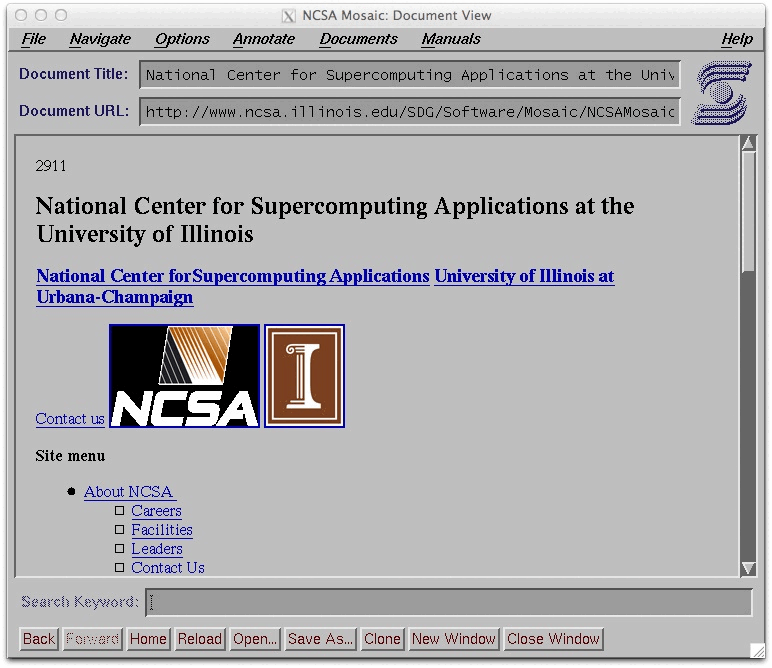

Its licensing was generous by the standards of proprietary software and was nonetheless proprietary: non-commercial use was generally free, source for the X Window System version was public, source for the other versions came only after an agreement was signed, and there were always constraints on what could be done without payment. Mosaic was never released as open source. NCSA licensed it out, and among the licensees was Spyglass, Inc., which took the Mosaic name rather than the Mosaic code — its browser was written from scratch — and relicensed that browser to other vendors, including, in a detail that decides a great many arguments about lineage, Microsoft. According to the former Spyglass developer Eric Sink, Internet Explorer was based not on NCSA's Mosaic directly but on Spyglass's version of it. Because Microsoft gave its browser away, Spyglass earned only the minimum quarterly fee under the deal; in 1997 Spyglass threatened a contractual audit and Microsoft settled for eight million dollars.
Mosaic Communications, the name it gave up, and the flotation of 1995
The company was incorporated as Mosaic Communications Corporation on 4 April 1994. It was Jim Clark's venture — he had left Silicon Graphics, which he had founded — and he recruited Andreessen as co-founder, brought in Kleiner Perkins as investors, and hired early staff from SGI and from the Mosaic team at NCSA. Jim Barksdale arrived as chief executive in January 1995. The first product, a public beta called Mosaic Netscape 0.9, was released on 13 October 1994; the company's first press release, issued the same day, promised the browser without charge to all non-commercial users.
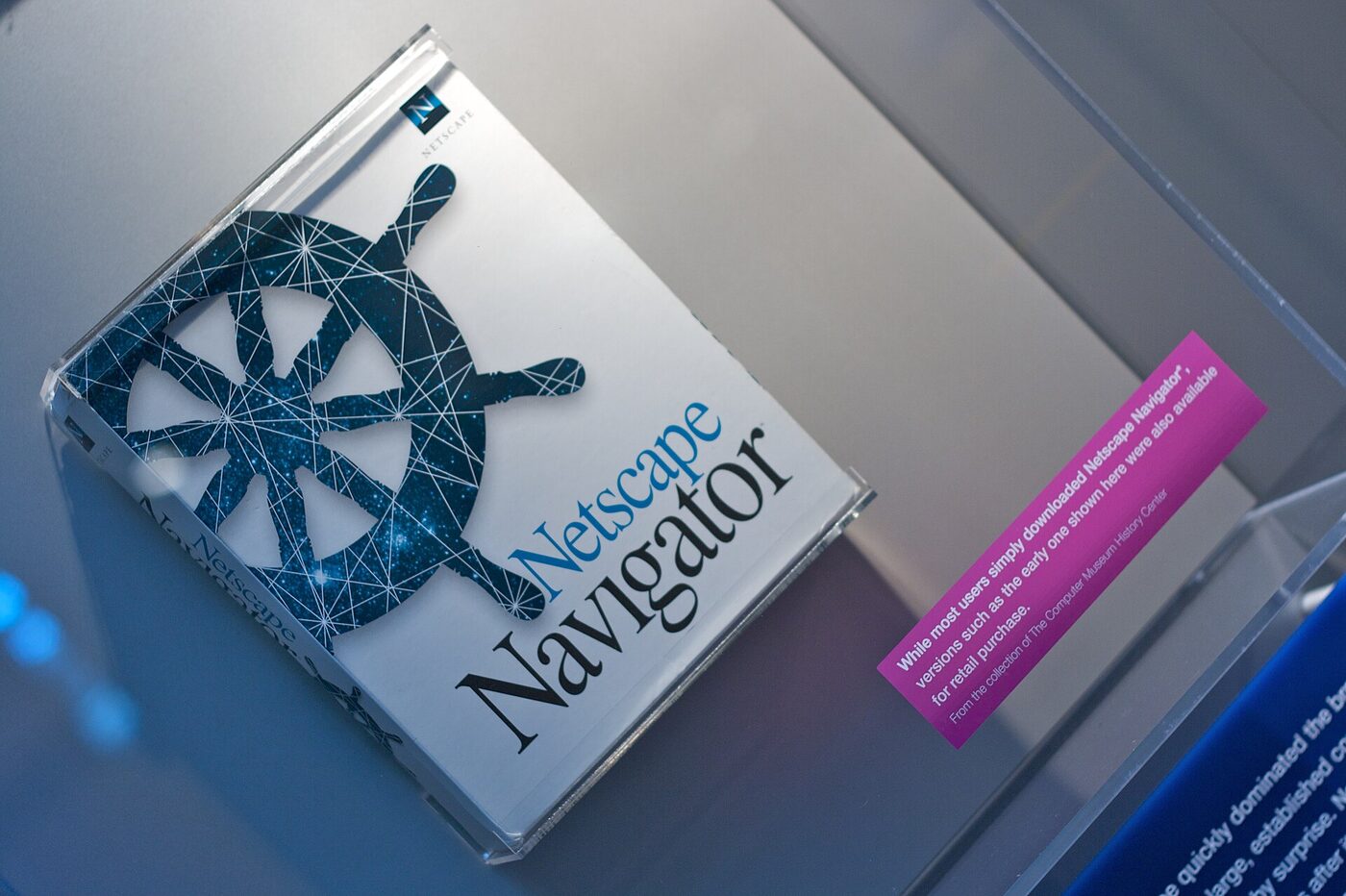
The name did not survive the year. The University of Illinois was unhappy with a private company trading on the Mosaic name, and rather than fight over it the company changed both names at once: in November 1994 Mosaic Communications Corporation became Netscape Communications Corporation, and the browser became Netscape Navigator, on a suggestion from the product manager Greg Sands. The point most often lost in retellings is that the dispute was about the trademark and not the code: the Netscape browser was written afresh and contained no NCSA Mosaic code.
Internally the browser had another name entirely. Mozilla was a contraction of Mosaic killer, the company's stated ambition, and it acquired a Godzilla-like lizard mascot drawn by an employee, Dave Titus, which featured prominently on the early website before the need to look respectable to corporate customers retired it. The codename also went into the browser's User-Agent string, and there it stuck: rival browsers began identifying themselves as Mozilla too, so that servers would send them the same pages they sent Netscape rather than a diminished version. Decades later, most browsers still begin their User-Agent line with the name of a product that lost.
Navigator 1.0 shipped on 15 December 1994, 1.1 in March 1995 and 1.22 in August 1995. The commercial arrangements moved about: the October 1994 promise of free non-commercial use was narrowed two months later to educational and non-profit use, and early builds came in paired "commercial" and "evaluation" editions — identical software, the letter N in the version number serving as a reminder to pay once you were satisfied. That distinction was dropped within a year, the browser stayed downloadable at no charge, and boxed copies on floppy disk and later CD sat in shops alongside the Internet starter kits of the period.
Then came the event that put the company in the general history books. Netscape floated on 9 August 1995, sixteen months after it was founded. The offering had been set at fourteen dollars a share and was doubled to twenty-eight at the last minute; the stock reached seventy-five dollars during the first day of trading and closed at fifty-eight and a quarter, valuing the company at 2.9 billion dollars. It traded on NASDAQ as NSCP.
.jpg)
What it signified was not the money but the terms. A company with no profits had been floated on prospects alone, and the market had accepted the trade; revenues had doubled in each quarter of 1995, which was taken as sufficient. The phrase Netscape moment entered the language to describe a flotation that announces an industry rather than a firm, and the wave of investment that followed became the dot-com bubble. Netscape's own publicity strategy, run by its head of public relations Rosanne Siino, packaged Andreessen as a rock star and put him, barefoot, on the cover of Time. Two and a half years later the same company would be laying people off.
Version 2, and the things it put into the web
The second generation is where Navigator stopped being a document viewer. Version 2.0 was announced on 18 September 1995, and the line introduced, among other things, HTML frames, a plug-in architecture, Java support, an integrated mail and news client, and looping animated GIFs — the looping achieved not through the GIF specification itself but through an application extension block of Netscape's own devising, which other browsers then copied. Several of those are still in the web; frames were later written into the official standards as the HTML 4.01 Frameset specification.
The plug-in interface — the Netscape Plugin Application Programming Interface, NPAPI — did not originate at Netscape. By the account in Mattias Andersson's history of PDF publishing, the Acrobat developer Allan Padgett and his fellow Adobe engineer Eshwar Priyadarshan reverse-engineered Navigator so that PDF files would open inside it rather than in a separate application, and when they demonstrated it to Adobe's John Warnock and to Clark, Padgett proposed generalising the trick: not a special case for PDF but an architecture in which any file type could be handled in place. Clark agreed, and Netscape designed the API. A plug-in declared the content types it could handle; when the browser met one it could not handle itself, it loaded the plug-in, set aside space in the page, and streamed the data to it. That is how RealAudio, Shockwave, QuickTime and eventually Flash arrived on the web — and, since a plug-in was loaded into the browser and drew inside the page, it is also why a plug-in's failure was indistinguishable, to the user, from the browser's.
The other addition was a programming language. In 1995 Netscape pursued two routes to making pages do things: embedding Sun's Java, and hiring Brendan Eich to build a scripting language of its own. Eich's language was called Mocha, then LiveScript — the name it carried in the Navigator 2.0 beta of September 1995 — and finally JavaScript. The joint Netscape and Sun press release announcing it is dated 4 December 1995 and carries the endorsements of twenty-eight other companies. Eich has since described the name as a marketing manoeuvre; Java was the fashionable language of the moment and the two had little in common. Microsoft produced its own implementation, JScript, in 1996, and the first edition of the ECMA-262 standard, under the compromise name ECMAScript, was adopted by the Ecma General Assembly in June 1997.
Navigator 3.0 followed on 19 August 1996, adding LiveAudio, LiveVideo, QuickTime and POP3 support, with a Gold edition that bundled a what-you-see-is-what-you-get page editor and was sold in shops as retail software. Around the same products Netscape ran a promotional scheme called the Netscape Now Program, under which a site owner applied for an authorised logo and displayed the Netscape Now button on its pages, in exchange for being "instantly identified as a leading-edge Internet user with a site that employs the advanced features found in Netscape products" — the words are Netscape's own, from the programme page. The best-viewed-in banner, which would shortly become a genre of its own, began as a marketing programme with an application form.
Market share, as the record actually states it
Browser market share in this period is quoted constantly and sourced rarely. The best-attested set of numbers is not in any trade press archive but in the district court's findings of fact of 5 November 1999, which recite the estimates the parties themselves used in their own planning, and name each source. They are reproduced here with those attributions intact.
According to estimates that Microsoft executives cited in their trial testimony and relied on in business planning, Navigator's share of all browser usage fell from above eighty per cent in January 1996 to fifty-five per cent in November 1997, while Internet Explorer's rose from around five per cent to thirty-six per cent over the same period; by April 1998 Microsoft was using an internal planning figure above forty-five per cent for its own browser. AOL, evaluating its acquisition of Netscape, put Navigator at around eighty per cent at the end of 1996 and in the "mid 50% range" by July 1998, with Internet Explorer between forty-five and fifty per cent of the domestic market by late 1998. Advertisement-delivery data collected by AdKnowledge, which logged the browser type behind each advertisement it served, showed Internet Explorer rising from twenty per cent of monitored hits in January 1997 to forty-nine per cent in August 1998, and Navigator falling from seventy-seven to forty-eight per cent across the same window.
The court also recorded the figure Microsoft itself watched most closely, which was not the installed base but the flow. On data the company then deemed reliable, fifty-seven per cent of the people who took up browsing software in the last six months of 1997 took Internet Explorer against thirty-nine per cent for Navigator; by February 1998 Microsoft's own data put sixty-two per cent of new Internet connections over the previous six months on Internet Explorer against thirty-eight per cent on Navigator. Share of new users turns over faster than share of all users, which is exactly why it was the number that mattered to a company measuring the effect of its own distribution deals.
These are measures of usage share derived from advertising impressions and from internal corporate documents, not a census of installed software, and the court used them for direction and pace rather than precision. What they establish beyond argument is the shape of the thing: a browser with four users in five at the start of 1996 had roughly half by the middle of 1998. The group at the centre of this page was created midway along that decline, in the summer that the flow of new users had already turned.
The fourth generation, and what users complained about
Netscape Communicator 4.0 was released on 11 June 1997, after five preview releases across 1996 and 1997. The rename was Barksdale's insistence: Navigator had been serving as the name of both the suite and the browser inside it, so the suite became Communicator and the browser stayed Navigator. The suite comprised Navigator, the Messenger mail client, the Collabra discussion and newsreading component, the Composer page editor, Netcaster and Conference. Its browser core, however, was substantially the Navigator 3 engine, updated. That is the technical fact underneath most of what was complained about for the next three years: a 1997 product running a 1996 layout engine, released in the exact months when the standards it would be judged against were being finished.
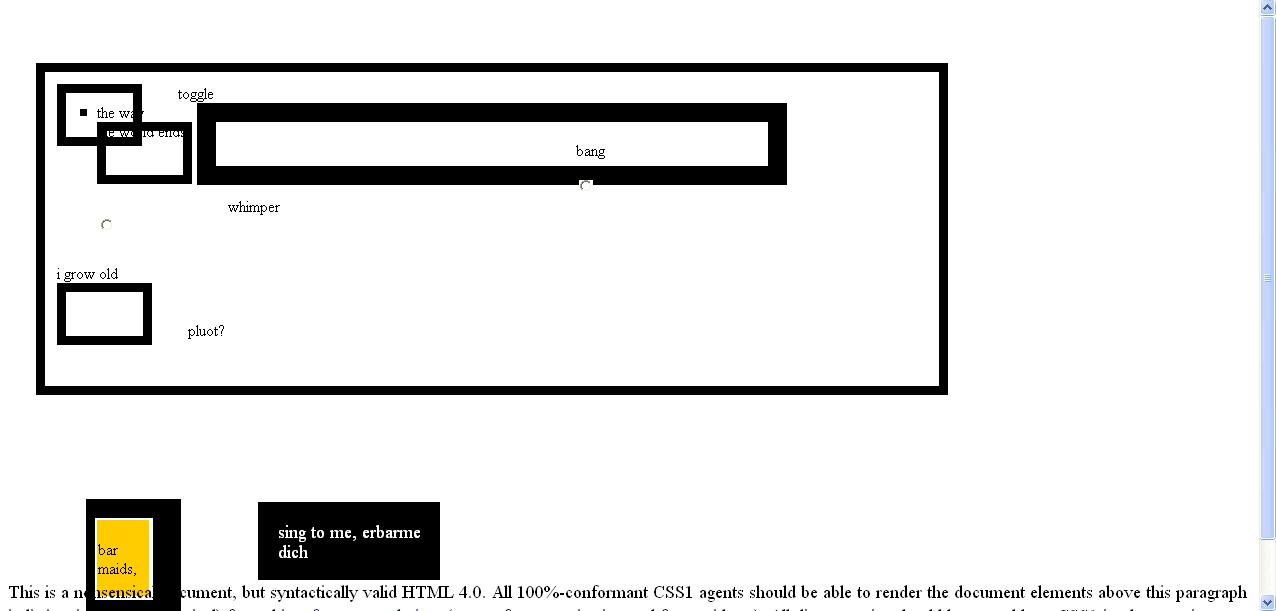
Style sheets are the clearest case. CSS level 1 became a W3C Recommendation on 17 December 1996. Communicator 4 supported certain CSS1 features, and proper CSS support never reached the 4.x line at all. Netscape had been backing a competing mechanism of its own, JavaScript Style Sheets, submitted to the W3C in 1996 and implemented by no browser but this one; when it became clear late in the development cycle that CSS would prevail, the company implemented a converter that translated CSS into JSSS and then processed it as JSSS. The consequence was one of the era's most-cited oddities: turning JavaScript off in Communicator 4 also turned off style sheets.
Around that sat the rest of the documented complaint. The 4.x browser was crash-prone; some versions re-downloaded an entire page in order to re-render it when the window was resized, which on a dial-up line was not a cosmetic problem; and the heavily illustrated, script-laden, table-built pages that the late 1990s produced were exactly what it handled worst — nested HTML tables, pressed into service as a layout tool precisely because CSS layout was not available, were notoriously hard on it. By the time Internet Explorer 5 arrived in 1999, Communicator 4.x was slower as well. Netscape had also attracted persistent criticism for what contemporaries called featuritis: a priority on adding features over making the existing ones work. Two of the company's own executives of the period, Mike Homer and Peter Currie, later described those years as hectic and crazy and the company as undone by causes both internal and external.

Two honest limits belong here. First, this page reproduces no thread from the group, quotes no post and cites no bug number; what is listed above is the documented technical record of the software, not a summary of the group's contents. Second, none of it was unique to Netscape — Internet Explorer of the same years had its own long charge sheet — but this group was pointed in one direction, and the fourth generation is what it was pointed at.
Vendor extensions against the emerging standards
The deeper grievance of the period was not that either browser was buggy but that the two of them were diverging on purpose. Both shipped markup of their own invention. Netscape's blink and Microsoft's marquee are the two elements everybody remembers, and they stand in for a much longer list of tags, attributes and scripting objects that existed in one browser and not the other.
The standards were arriving in parallel, and mostly behind. CSS level 1 became a Recommendation on 17 December 1996 and CSS level 2 on 12 May 1998. HTML 3.2 was published on 14 January 1997, largely codifying what browsers already did rather than directing what they should do next; HTML 4.0 followed on 18 December 1997, revised on 24 April 1998, with HTML 4.01 on 24 December 1999. The Document Object Model, Level 1 — the specification that finally said what a script was allowed to assume about the page it was running in — became a Recommendation on 1 October 1998, by which time both vendors had shipped two generations of incompatible object models. An author writing a page in 1997 was aiming at two moving vendor targets while the standard versions of the same features were still in committee.
Hence the badge. "Best viewed in Netscape" and "Best viewed in Internet Explorer" logos, usually linking to a download, became standard furniture of the late-1990s page; they were an honest admission that the author had tested in one browser and was not promising anything about the other. A counter-campaign, "Viewable with Any Browser", answered them with a badge of its own. In August 1998 George Olsen, Glenn Davis and Jeffrey Zeldman founded the Web Standards Project as a grassroots coalition aimed squarely at the browser makers; by 2001 it considered its primary goal — persuading Microsoft, Netscape, Opera and the rest to support HTML 4.01 and XHTML 1.0, CSS1 and ECMAScript accurately and completely — substantially achieved. It announced its dissolution in March 2013. In October 1998 Todd Fahrner produced the Box Acid Test, later called Acid1: a single page with a published reference rendering that made a browser's CSS1 conformance visible at a glance, and which was folded into the CSS1 test suite in 1999.
None of this argument was confined to complaint groups. The technical discussion had standing addresses of its own in the computing branch of the namespace — the group for the language Netscape had shipped is comp.lang.javascript, still described in the canonical newsgroups file as Netscape Communications Corp.'s JavaScript language. That branch is covered on the comp.* hub. What the alt.* group offered was the register the technical groups did not want.
The other side of the war
Microsoft's browser began as a licensed product and a bundled one. Internet Explorer 1.0 shipped on 24 August 1995 in the Plus! pack for Windows 95, built on Spyglass's Mosaic; version 2 added Macintosh support and was the first cross-platform release. The version that changed the argument was Internet Explorer 3, released on 13 August 1996 for Windows and on 8 January 1997 for the Mac. It was the first commercial browser with Cascading Style Sheets support; it added ActiveX controls, Java applets, inline multimedia and PICS content labelling, it supported Netscape's own plug-in interface, and it was the first version to carry the blue letter e. Internet Explorer 4 followed on 22 September 1997; at the launch party in San Francisco Microsoft had a ten-foot-tall letter e logo, and Netscape's employees arrived at work the next morning to find it on their front lawn, with a greeting card signed "Best wishes, the IE team".
Price and distribution mattered more than either. Internet Explorer was free to everyone, commercial users included, from the beginning; Navigator was not free to the general public until January 1998. And the court's findings of fact record, in detail, how Internet Explorer reached the desktop. As late as June 1995 Microsoft had not decided to bundle a browser with Windows at all: the plan was to ship it in a separate "frosting" package and charge for it. By April or May of that year senior executives had identified Netscape's browser as a threat to what the court called the applications barrier to entry — the difficulty of displacing Windows while the applications people wanted ran only on Windows — and concluded that the answer was to maximise their own browser's usage share at Navigator's expense.
What passed at the meeting between Microsoft and Netscape executives on 21 June 1995 is the most argued-over episode of the whole affair, and it is worth being exact. Microsoft has always denied proposing a division of the market. The district court, having heard both sides, found that Microsoft's representatives told Netscape that Microsoft would be marketing its own browser for Windows 95 and that, if Netscape did not compete there, Microsoft would be content to leave browsers for the Mac OS, Unix and its own 16-bit systems to Netscape — and that if Netscape shipped competing platform technology for Windows 95, Microsoft would treat it as a competitor rather than a partner. The court also found that Barksdale did not accept on the spot and that the meeting ended cordially. Two days later, the court found, Microsoft's John Ludwig wrote to Paul Maritz and other senior colleagues: [O]bviously netscape does see us as a client competitor ... [W]e have to work extra hard to get ohare on the oem disks — O'Hare being the browser's codename.
What followed is not contested at all. Internet Explorer 1.0 was bundled with the first version of Windows 95 licensed to computer manufacturers in July 1995, under a licence term forbidding those manufacturers from modifying or deleting any part of Windows, the browser included; the court found the term non-negotiable and the manufacturers without a commercially viable alternative. Apart from a few months in the autumn of 1997, when Microsoft supplied Internet Explorer 4.0 on a separate disk and allowed Windows 95 to ship without it, no manufacturer was ever permitted to leave it out. The other end of the market was addressed separately: in August 1997 Microsoft agreed to invest 150 million dollars in Apple, on terms that required Apple to make Internet Explorer the default browser in new Mac OS distributions.
The court record
There was history before the case. In July 1994 the Justice Department sued Microsoft over the terms of its licensing and developer agreements, and the parties settled by consent decree rather than go to trial. Three years later the department brought a civil contempt action under that decree, and in 1998 the D.C. Circuit held that Microsoft's technological bundling of Internet Explorer 3.0 and 4.0 with Windows 95 did not violate the relevant provision — expressly reserving the question whether such bundling might independently violate the Sherman Act. The two decisions are reported at 56 F.3d 1448 and 147 F.3d 935, and the appellate court in the later case referred to them as Microsoft I and Microsoft II.
On 18 May 1998, shortly before that second decision issued, the United States and a group of State plaintiffs filed separate complaints, soon consolidated, before Judge Thomas Penfield Jackson in the District Court for the District of Columbia. The appellate opinion later summarised what the case was about in a single clause:
Relying almost exclusively on Microsoft's varied efforts to unseat Netscape Navigator as the preeminent internet browser, plaintiffs charged four distinct violations of the Sherman Act.
Those four were unlawful exclusive dealing and unlawful tying of the browser to Windows 95 and Windows 98, both under section 1; and unlawful maintenance of a monopoly in the PC operating system market and attempted monopolisation of the browser market, both under section 2. Netscape was not a plaintiff. Its executives were subpoenaed and the company supplied a great deal of material, including the entire contents of an internal discussion forum called "Bad Attitude".
The trial opened on 19 October 1998 and ran to seventy-six days of bench trial, on an expedited schedule that limited each side to twelve witnesses plus two in rebuttal and required direct testimony to be filed as written declarations. Judge Jackson issued his findings of fact on 5 November 1999, holding that Microsoft held monopoly power in the market for Intel-compatible PC operating systems and had acted to protect it. That triggered two things at once: a briefing schedule on the legal conclusions, with Professor Lawrence Lessig invited as amicus, and a referral to mediation before Judge Richard Posner, which failed after nearly four months of talks. On 3 April 2000 Jackson issued his conclusions of law, finding Microsoft liable on the section 1 tying claim and on both section 2 claims, and finding the evidence insufficient on exclusive dealing. On 7 June 2000 he entered a final judgment adopting the plaintiffs' proposed remedy without substantive change: the company was to be split into an operating systems business and an applications business.
The appeal was heard by the D.C. Circuit sitting en banc on 26 and 27 February 2001, and decided per curiam on 28 June 2001, reported at 253 F.3d 34. The court affirmed in part and reversed in part the judgment that Microsoft had violated section 2 by using anticompetitive means to maintain its operating-system monopoly; on the licence restrictions imposed on computer manufacturers it held that, with the single exception of the restriction forbidding an automatically launched alternative interface, all of them were uses of market power unredeemed by any legitimate justification. It reversed outright the holding that Microsoft had attempted to monopolise the browser market, on the ground that the plaintiffs had not carried their burden on barriers to entry. On tying it held that platform software required a different analysis:


We hold that the rule of reason, rather than per se analysis, should govern the legality of tying arrangements involving platform software products. ... Accordingly, we vacate the District Court's finding of a per se tying violation and remand the case. Plaintiffs may on remand pursue their tying claim under the rule of reason.
It then vacated the remedy in full, for three stated reasons: the district court had held no evidentiary hearing despite remedies-specific factual disputes, had not provided adequate reasons for the remedy it decreed, and had rested it on liability findings the appellate court had drastically altered. Separately, it held that Judge Jackson's secret interviews with journalists and his public comments about the case while it was pending violated the judicial code of conduct — the violations were "deliberate, repeated, egregious, and flagrant", in the court's words — and, while finding no evidence of actual bias, required that the case be reassigned to a different trial judge on remand. The findings of fact were not thrown out; the court reviewed the record and left them standing under the clear-error standard.
The remainder is procedural. On remand before Judge Colleen Kollar-Kotelly, the Justice Department reached a settlement with Microsoft on 1 November 2001; the court accepted most of it on 1 November 2002. Nine states and the District of Columbia declined to join, arguing the terms did not go far enough, and on 30 June 2004 the D.C. Circuit approved the settlement over their objection. The obligations as originally drafted expired on 12 November 2007, with parts extended by consent. By the date of the appellate ruling, the browser at the centre of the case had belonged to another company for two years.
Open source, the long rewrite, and the names that followed
Netscape had a bad fourth quarter in 1997 and made large layoffs in January 1998. In the same month it announced that all future versions of its software would be free of charge and developed by an open-source community; Jamie Zawinski registered the domain mozilla.org the day after the announcement. In March 1998 the company published most of the Communicator code base under the Netscape Public License, a licence the Free Software Foundation classed as free but not compatible with the GPL, because it reserved to Netscape the right to publish proprietary work containing the released code. That asymmetry was removed years later, when Time Warner — exercising its rights under the licence, at the Mozilla Foundation's request — relicensed the code under a tri-licence of MPL 1.1, GPL 2.0 and LGPL 2.1. Parts of Communicator were never released at all, being encumbered by third-party agreements and stripped out before publication.
The plan was that the next Netscape, version 5, codenamed Gromit, would be built from the released code. It was not. The Communicator code base was very large, had to build on many operating systems at once, and bore the marks of years of short closed-source cycles in which modularity had been traded away for features; the features content authors most wanted — incremental layout with reflow, correct CSS, a Level 1 DOM — turned out to be the hardest to retrofit. The decision was taken in the development roadmap that Brendan Eich published on 26 October 1998, and the roadmap says so in as many words:
It's time to stop banging our heads on the old layout and FE codebase. We've pulled more useful miles out of those vehicles than anyone rightly expected. ... Moving to XPFE and NGLayout means moth-balling all of the old-style FEs, and of course mozilla/lib/layout and its friends. Coordinated development will cease right away on the old layout code.
What that bought was a new cross-platform user-interface layer, XPFE, and a new layout engine. The engine had begun inside Netscape in 1997, was unveiled as Raptor, had to be renamed NGLayout over a trademark, and was afterwards rebranded Gecko. Netscape announced in October 1998 that its next browser would use it, a decision popular with standards advocates and unpopular with the developers given six months to carry it out. Only two pre-alpha builds of Netscape 5 were ever written, one of them running an improved 4.x engine codenamed Mariner; Netscape 5 and Mariner were scrapped together, and the version number was skipped while the numbering carried on as though it had shipped.
What the rewrite cost is the hinge of the whole story. Netscape 6.0 did not ship until 14 November 2000, two years after the decision, built on a pre-release Mozilla 0.6 and released before it was ready. The reception was poor: at release it was widely judged too unstable for production use, and the new codebase carried its own widget set and an interface written in a custom XML dialect, XUL, that many mid-range PCs of the day were too slow to run. Versions 6.1 and 6.2 in 2001 addressed the stability problems and were better regarded, but by then Internet Explorer 6 had arrived. Mozilla 1.0 was released on 5 June 2002; Netscape 7.0, based on Mozilla 1.0.1, followed in August 2002, with 7.1 in June 2003.
The browser that eventually came out of the codebase was not a Netscape at all. Dave Hyatt, Joe Hewitt and Blake Ross, who thought the commercial requirements of Netscape's sponsorship and developer-driven feature creep had compromised the suite, built a stripped-down browser as an experimental branch of the Mozilla project. Version 0.1 was released on 23 September 2002 under the name Phoenix — for the bird that rises from the ashes of its predecessor, the predecessor in question being Navigator. A trademark claim from Phoenix Technologies forced a rename in 2003; the replacement, Firebird, drew an immediate objection from the Firebird database project; and on 9 February 2004 Mozilla Firebird became Mozilla Firefox, after a nickname for the red panda. Firefox 1.0 was released on 9 November 2004.
AOL, and the end of the browser
AOL announced its acquisition of Netscape on 24 November 1998, as a tax-free stock swap; the figure reported at announcement was a little over four billion dollars in AOL stock, and by the time the deal closed on 17 March 1999 the rise in AOL's shares had carried the value to about 10 billion. Development and marketing of the server products passed to an alliance with Sun Microsystems, branded iPlanet; the alliance ended in March 2002, with iPlanet becoming a division of Sun and Sun keeping the intellectual property and the engineering.
On 15 July 2003 Time Warner disbanded Netscape. Most of the programmers were laid off and the signage came off the building. The same day, the Mozilla Foundation was created as the project's independent legal steward, taking on many of the former employees; AOL transferred hardware and intellectual property, lent a three-person team for the first three months and donated two million dollars over two years, and Mitch Kapor gave three hundred thousand. AOL kept the brand for its portal and its discount internet service, and continued to put browsers out under it: Netscape 7.2, developed in-house with some work outsourced to Sun's Beijing centre, appeared on 18 August 2004; the Windows-only Netscape Browser 8.x, based on Firefox and shipping both the Gecko and the Internet Explorer Trident engines and switching between them from a compatibility list, ran from 2005 to April 2007; and Netscape Navigator 9, based on Firefox 2, was released on 15 October 2007.
By then the numbers had settled. The metrics firm Net Applications put the November 2007 shares at 77.4 per cent for Internet Explorer, 16.0 per cent for Firefox and 0.6 per cent for Netscape. On 28 December 2007 AOL announced that development would stop and support would end on 1 February 2008; on 28 January the date was revised to 1 March, and the company offered its remaining users a path to Firefox and to Flock. The last build, version 9.0.0.6, was released on 20 February 2008. The company had been incorporated, under a different name, thirteen years and ten months earlier.
The vendor's own newsgroups, and what a complaint archive is worth
Netscape did not lack an official channel, and it is worth being precise about how large that channel was, because it sets the terms for judging the unofficial one. Netscape carried a public newsgroup hierarchy of its own, and it propagated widely enough to sit alongside Usenet's own groups; the newsgroup list that the Internet Systems Consortium maintains still carries ninety-three groups under the netscape.public prefix. They include netscape.public.general for the products, a set of netscape.public.dev.* groups devoted to the standards themselves — css, dom, html, xml, xul, rdf — and, after the 1998 source release, an entire netscape.public.mozilla.* development tree: layout, netlib, xpcom, xpfe, editor, crypto, i18n, performance, patches, reviewers, qa.browser, wishlist, licence discussion, and check-in groups that carried the commit traffic. The beta-feedback groups are named for Seamonkey, which the list itself glosses as the browser version 5.0 project. Microsoft ran the same kind of thing on a public news server of its own, and that hierarchy has its own page here.
So the complaint group was not filling an absence of official channels. It was filling something else. A vendor forum, however open, has a shape imposed on it: to be useful there you must have a version number, a reproducible case, and an intention to help. A complaint group asks for none of those. What accumulates in one is the residue of ordinary use by people who had no build to test, no bug number to quote and no plan to file anything — which is precisely the population that a defect database never hears from.
The general case for reading such archives today is therefore a modest one, and it should be made without overstatement. They are user-side records of how software behaved in the field, at a date, in a version, on hardware the user actually owned. They record the faults that were noticed rather than the faults that were accepted for triage. Against that: there is no sampling frame, the population is self-selected and hostile, volume tracks irritation rather than defect count, and nothing in such an archive can establish how common a problem was. A complaint group is evidence that something happened to somebody; it is not a measurement.
Its value is also a function of what else survived, and here the Netscape case is unusually kind. Mozilla's public bug tracker outlived the company: Bugzilla was devised by Terry Weissman in 1998 for the nascent mozilla.org project, explicitly to replace the in-house system Netscape had been using to track defects in Communicator. Weissman wrote it first in Tcl and ported it to Perl before release, on the reasoning that more people would then be able to contribute; its release date of 26 August 1998 is itself sourced to a posting in netscape.public.mozilla.announce. The open-source record therefore survives in a form few commercial browsers of the era can match. The proprietary record before it does not. For the 4.x generation, the years this group was created to complain about, what remains on the user side is complaint groups, mailing-list archives and whatever the web archives caught — and that is the honest measure of what a room like this one is worth: not that it is a good bug database, but that for a stretch of the record it is one of the few things there is.
Who arrives here, and what this page does not claim
A reader who comes to a page like this one is usually after one of two things: the crash log, or the politics. The second is a real literature. Nettime, the net-criticism mailing list proposed in 1995 by Geert Lovink and Pit Schultz and hosted over the years by a succession of independent European sites including desk.nl, carried exactly the kind of writing the browser war produced outside the trade press — essays on the political economy of the early web, domain-name politics, internet governance, the inflation of the dot-com bubble. Its own group is preserved here and owns that subject; this page does not retell it. What this article tries to supply instead is the layer underneath the argument: the dates and holdings the politics ran on, exactly as the record states them.
The limits are worth stating plainly. No archive of this group's own traffic is presented, quoted or characterised here. There are no thread titles, no post counts, no participant names, no dates of individual articles, and no claim about what proportion of the group was argument, advice or abuse. The group's own surviving record consists of two control messages from July 1997, a one-line description, and an entry in the newsgroup lists — where, together with alt.netscape.buggy-products and the later alt.netscape.expatriates, created in September 2000 for users of Netscape products that have been mistreated, it still sits. Whoever created that last one posted the control message from a netscape.net address, and the headers name Netscape Communicator 4.7 as the client that sent it, which is as close to a summary of the whole affair as the record supplies.
Everything else on this page is about the world the group was pointed at, and every figure in it names the source it came from inside the sentence that carries it. Where the historical record is contested — the June 1995 meeting between Microsoft and Netscape executives, for instance, where Microsoft's denial and the district court's findings do not agree — this page says so rather than choosing. The browser war generated an unusual quantity of sworn testimony and published findings for a dispute about software, and there is no need to improve on it.
Reading alt.netscape.sucks today
- Historical archive: Google Groups — alt.netscape.sucks (coverage varies by group and era).
- Open in a newsreader:
news:alt.netscape.sucks— the original site offered exactly this link, and it still works if your system has a newsreader registered for thenews:scheme. - Live access: point an NNTP newsreader at a modern server — see accessing Usenet today.
- The original news2mail e-mail subscription service ended in the mid-2000s and no longer operates.