alt.nettime
Mirror of the nettime mailing list: net criticism.
nettime was the influential mailing list of 1990s net culture and media theory; this group carried its traffic into Usenet, bringing essays on tactical media, net.art and the political economy of the early web to a wider readership.
The archive doubles as a reader in early internet criticism, with many now-canonical texts first circulated here.
On this page
A list first, a newsgroup second
Most alt.* groups were born on Usenet and lived there. alt.nettime was different: it existed to carry someone else's conversation. Its centre of gravity lay on a mailing list — nettime-l, the English-language flagship of the nettime project — and the newsgroup was one of the channels through which that list's traffic reached readers who had never subscribed to anything. To understand the group is therefore to understand the list, and this page spends most of its length doing exactly that, because the list's record is rich, public and meticulously kept, while the newsgroup's own record is thin. Where the two diverge, we say so.
List-to-news gateways were a recognised genre on Usenet, covered on this directory's index page; the origins of the alt.* hierarchy that housed this one are told at our alt.* overview. The short version for this page: a gateway republished each list posting as a news article, and Usenet's flood-fill distribution did the rest. Traffic flowed essentially one way. A follow-up posted on the newsgroup reached other newsgroup readers, not the list; the conversation proper stayed on the mail side. What the newsgroup added was reach — and, for a period, that reach was considerable, since a text injected into Usenet propagated to every news server that chose to carry the group.
There is a certain irony in the arrangement: a list devoted to the politics of circulation was, at least, unusually well equipped to argue about the terms on which its own texts moved. It also, unusually, made those terms explicit. The footer appended to each posting identified the list and, in later years, stated its terms — “no commercial use without permission” — and the copyright policy posted on nettime's information page permits onward forwarding by e-mail so long as the footer travels with the text. A gateway that relayed whole postings, footer intact, operated at least in the spirit of those rules; few Usenet groups could say their upstream had provided for them so explicitly.
Venice, 1995
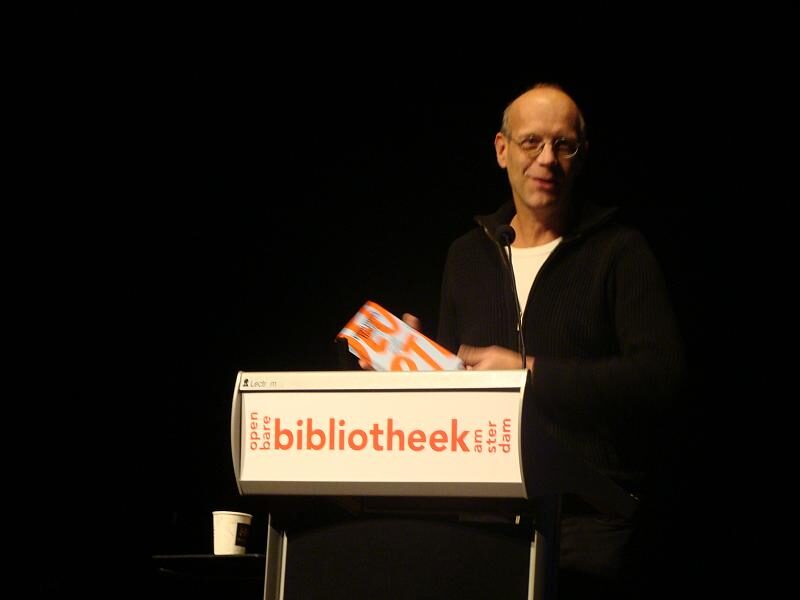
The founding is well documented, not least by the founders. nettime was proposed in 1995 by Geert Lovink and Pit Schultz — then half-jokingly styled “the nettime brothers” — at the second meeting of the “Medien Zentral Kommittee”, held during the Venice Biennale; the gathering in question was the Club Berlin event of June 1995. The list proper began that autumn: by the list's own record of its infrastructure, nettime-l started in October 1995 at in-berlin.de, running on Majordomo with MHonArc generating the web archive. From February 1996 until 1998, Lovink and Schultz themselves handled moderation duties.
.jpg)
Even the name was a position. Net time was chosen as a rebuke to the spatial metaphors — cyberspace, frontiers, homesteading — through which the mid-1990s preferred to imagine the internet. A draft introduction to the ZKP3 compilation, circulated in 1996, put the argument in the list's own cadence:
The time of nettime is a social time, it is subjective and intensive, with condensation and extractions, segmented by social events like conferences and little meetings, and text gatherings for export into the paper world.
That sentence, read against the group it here introduces, has a second life: “text gatherings for export” is as good a description of a list-to-news gateway as of a printed proceedings volume. From the beginning, nettime treated its own texts as portable — into print, into other lists, and, in the case documented on this page, into NNTP.
The early years also fixed the list's geography. In March 1996 nettime-l moved from Berlin to the Dutch host desk.nl, where it stayed through June 1999 — its longest single residence of the decade — and the Amsterdam–Berlin axis of its founders remained legible in the traffic: Dutch media-culture institutions, Berlin's post-reunification scene, and a steady stream of participants from further east. This matters for reading the archive: nettime's 1990s are not a chronicle of Silicon Valley observed from Europe, but of a European net culture with its own venues, festivals and quarrels, for which California was one subject among several.
Net criticism as a project
The list's stated project was Netzkritik — net criticism — pursued through what its boilerplate called “collaborative text filtering”: filtering done by people, in public, which was rather the point. The format favoured longer, substantive, deliberately non-academic writing — essays, interviews, conference reports, translations, manifestos — of a kind Usenet rarely produced natively, and the list served early on as a pre-publishing platform giving critical writers an international reach. Its self-description, still posted on nettime's information page, frames the list as an effort to formulate:
an international, networked discourse that neither promotes a dominant euphoria (to sell products) nor continues the cynical pessimism, spread by journalists and intellectuals in the 'old' media who generalize about 'new' media with no clear understanding of their communication aspects.
Because of its political style it was often read as a European online salon, though it had strong North American participation from the start; Bruce Sterling — whose 1996 novel Holy Fire drew on the list and its meetings — once called it “the world's most world list”. It sat within an early wave of net-culture ventures it partly inspired, among them Blast, Rhizome, Fibreculture and -empyre-. Unlike most of those, which sought institutional homes, nettime remained independent — at times fiercely so — declining, for instance, to let its moderators speak as representatives of an organisation even when the list was nominated for an Ars Electronica Golden Nica in 2004.
That independence had an infrastructural corollary: rather than settle under one institution's roof, the list migrated across a series of hosts, many of them culturally significant in their own right. Its own record runs: in-berlin.de (October 1995), desk.nl (March 1996), material.net and then bbs.thing.net (mid-1999), kein.org with a switch to Mailman (2007), and servus.at in Linz (2023), with the nettime.org website hosted by !Mediengruppe Bitnik since 2012. A list named against spatial metaphors spent a good part of its life deciding, carefully, where to live.
What travelled the list
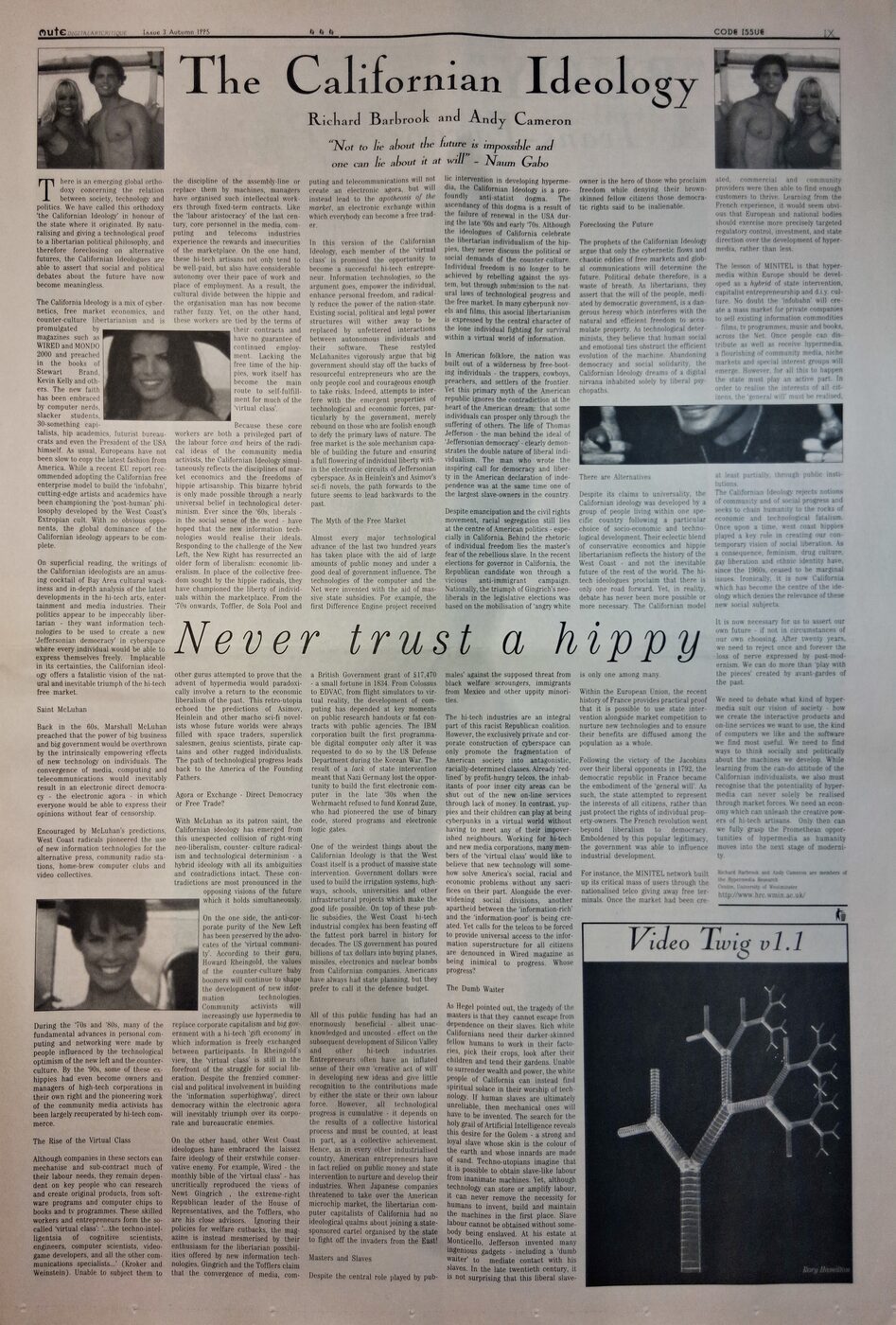
An early, defining exchange set the tone. Richard Barbrook and Andy Cameron's 1995 essay The Californian Ideology — written at the University of Westminster and later described by Barbrook as a “critique of dotcom neoliberalism” — was the European retort to Wired-era cyberlibertarianism, arguing that Silicon Valley's optimism fused New Left and New Right into a hopeful technological determinism. It circulated and was fought over in the list's orbit, and the questions it raised ran through the traffic for years: whether the net's economy would be gift, market or monopoly, and whose politics its architecture encoded.

Around that core ran the strands nettime is remembered for. Net.art found in the list one of its principal discursive venues — the March 1999 archive records, with no apparent sense of incongruity, the news of jodi.org's Webby award filed between war reports. Tactical media, the term of art for hit-and-run political media practice, was stimulated and disseminated through the list and its allied festivals. And the political economy of the dot-com era — domain-name politics, internet governance, the inflation and eventual burst of the bubble — supplied a running seminar in real time.
Strong Central and Eastern European participation shaped the agenda in ways that distinguished nettime from its American contemporaries: media and war in the former Yugoslavia, post-socialist transitions, festival reports from across the continent. Some posts were themselves works — text experiments and ASCII pieces sitting between the essays — a strand the list's printed anthology would later nod to in its subtitle. And, inevitably, there were threads about the list itself: mailing-list culture of the period was given to constitutional argument, and nettime had those arguments with unusual seriousness.
All of this is what a newsgroup reader of alt.nettime actually saw scroll past: not chat, but a curated flow of long texts with a footer explaining what nettime was. On a hierarchy better known for flame wars and binaries, it must have read like a little magazine that had wandered into the wrong newsagent.
Spring 1999: the war in the archive
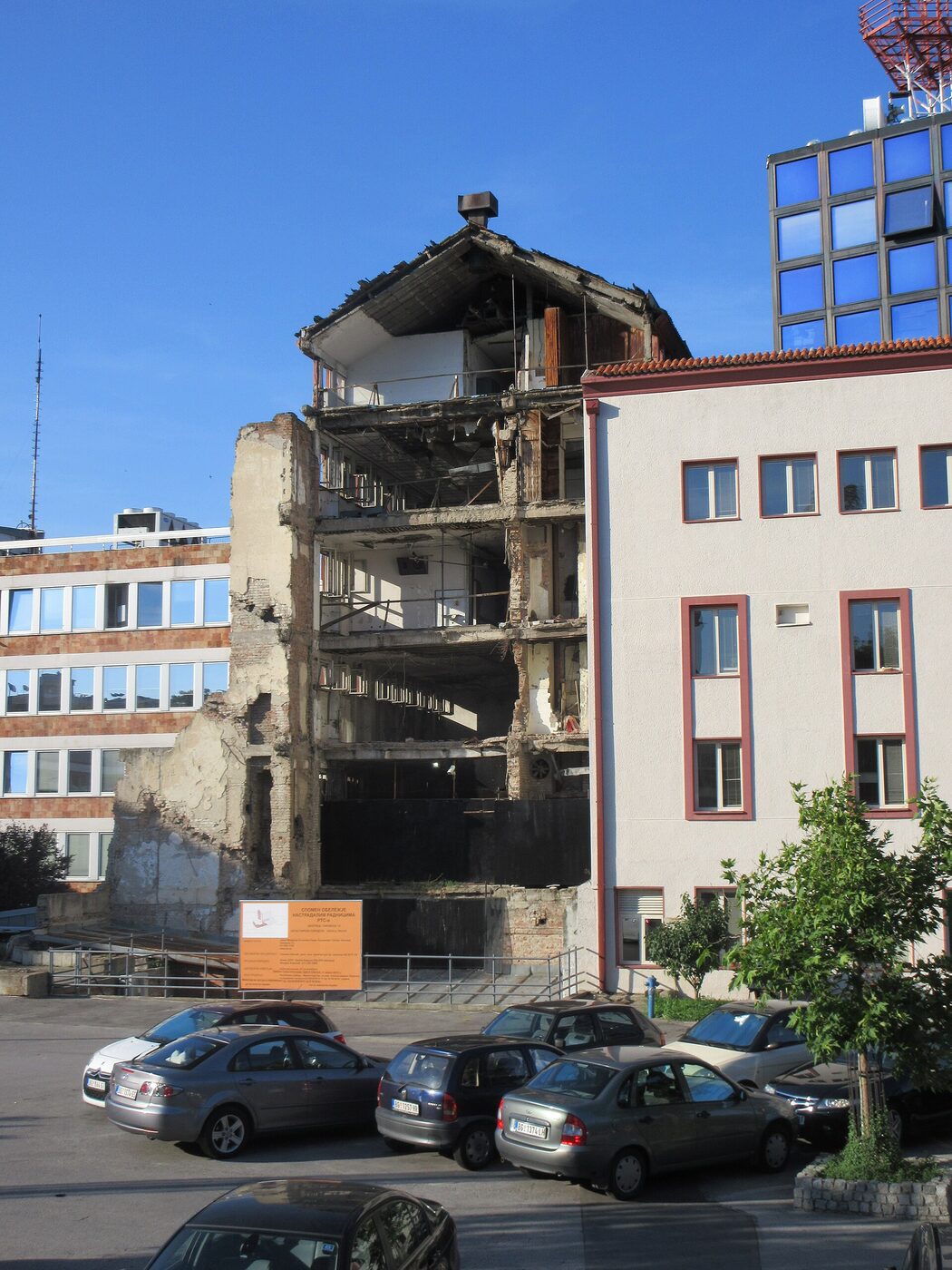
If one stretch of the list's history shows what the apparatus was for, it is the spring of 1999. The subject had been building on the list before the first strike — the March 1999 archive opens onto threads such as “Kosovo and what's related” — and when NATO began its air campaign against Yugoslavia that month, nettime became one of the channels through which first-hand reports moved out of the region. The list's own archive documents this directly: subject lines from March 1999 include “Strike on Yugoslavia”, “Information on Air Strikes in Yugoslavia”, statements forwarded from cultural organisations in Belgrade, and reports of damage to the city — alongside the news that Radio B92, the independent Belgrade broadcaster, had been closed and its founder Veran Matić arrested, and that a “Help B92” support campaign had been launched that night.
The volume was such that the moderators took to bundling material into composite postings — the “yugoslavia/nato digests” that recur through the April 1999 archive, each gathering several correspondents' contributions under one subject line. The traffic was not of one mind: the same weeks carry Serbian statements, Kosovo Albanian fact sheets, Institute for War and Peace Reporting despatches, International Crisis Group briefings, and arguments among list members about all of them. The list did not resolve these perspectives, and neither will this page; what the archive shows is that they circulated together, at speed, at a moment when that was rare.

For readers who came to the war through Usenet, this material overlapped with the newsgroups where the region argued about itself — see soc.culture.yugoslavia and soc.culture.albanian for that side of the story. The nettime traffic was different in kind: fewer combatants, more essayists; digests instead of flame wars; and behind it a moderation apparatus consciously deciding what a war reads like when filtered collaboratively. The episode has since become one of the standard exhibits in histories of the list, and it is the part of the archive most often revisited.
The moderation turn
The list ran open and unmoderated in its first years, and the mid-1990s format eventually met the mid-1990s problem: volume, and determined pseudonymous flooding that tested the open door. In 1998 nettime moved to moderation, and the debate over that decision became part of the archive in its own right — Lovink later anatomised it in “The Moderation Question”, a chapter of his 2002 collection Dark Fiber. For a community whose stated method was filtering, the question of who filters, and by what right, was never going to be procedural trivia; it was the subject matter turned inward.
The list's own records lay out the stewardship plainly. After the founders' initial spell, a wider “mod squad” worked in the late 1990s and early 2000s — the list's information page names six of that era's moderators, among them the media theorists McKenzie Wark and Matthew Fuller. The long stewardship, though, belonged to Ted Byfield and Felix Stalder, who moderated nettime-l from July 1998 until August 2023 — a quarter of a century — with Doma Smoljo also named in the list's record of that period's moderation group. Byfield and Stalder coordinated the wider family of lists and maintained nettime.org as its nexus, while declining, characteristically, to act as anyone's official representatives.
The result was a distinctive texture: the list today describes itself, with some understatement, as “slightly moderated”. Moderation on nettime never meant editorial gatekeeping in the journal sense; it meant keeping a shared text-space usable, in public, with the reasoning available for inspection. The 1998 turn is therefore best read not as a fall from openness but as the moment the list's theory of filtering acquired a practice — and the argument about it, preserved in the archive, remains one of the better documented case studies of how a 1990s open list decided to grow up.
Paper: the ZKP series
The list was never only a list. It convened in person — at the MetaForum conferences in Budapest in 1995–96, at the Chaos Computer Congress, at ISEA and Ars Electronica, at the Hybrid Workspace during Documenta X in Kassel in 1997, and at its one wholly self-made event, the “Beauty and the East” meeting organised by Ljudmila in Ljubljana in May 1997. And it printed itself: the ZKP series of compilations — the ZK Proceedings — was produced for such gatherings, filtered from the list's traffic and handed out on paper.
- ZKP1 — for The Next 5 Minutes 2, Amsterdam, January 1996
- ZKP2 — for Cyberconf 5, Madrid, June 1996
- ZKP3 (and a ZKP3.2.1 variant) — for MetaForum III, Budapest, October 1996
- ZKP4 — for Beauty and the East, Ljubljana, May 1997
- ZKP5 — Readme! ASCII Culture and the Revenge of Knowledge, the 556-page anthology of the list's first years, published by Autonomedia in Brooklyn in 1999
- ZKP6 — the catalogue of the Slovenian pavilion at the 2001 Venice Biennale
The sequence has a pleasing shape: a project proposed at one Venice Biennale closed its proceedings series as a national pavilion's catalogue at another, six years later, by way of Amsterdam, Madrid, Budapest and Ljubljana — the last a reminder of how much of the list's centre of gravity lay east of the venues where net culture was usually celebrated (for the local context, see soc.culture.slovenia). Few Usenet groups can point to a paper edition; alt.nettime could at least point to its upstream's shelf.
The English-language nettime-l also multiplied into a family of sibling lists — Dutch, French, Romanian, Spanish and Portuguese, south-eastern European, Chinese, plus an announcements channel — each with its own moderation and temperament. Within that ecology, alt.nettime was a minor tributary: one more route by which the same texts reached readers.
alt.nettime itself: an honest accounting
Now the awkward part, which this page owes its readers straight. The documentary record of alt.nettime as a newsgroup — as distinct from the list it carried — is thin. The group exists in Google's Usenet archive, where a group page for alt.nettime survives with a listing of archived threads; beyond that, we have not been able to point to a charter announcement in the usual alt.* records, a documented creation date, or an independent history of the gateway's operation, and we decline to invent any. alt.* was a hierarchy in which groups could be created with a single control message and no paper trail worth the name, and plenty of gatewayed groups left exactly this kind of shadow: present in the archives, absent from the histories.
What can be said with confidence is structural. The newsgroup was a downstream channel for the list's mail; the conversation lived upstream, and the archive of record has always been nettime's own. The gateway's value was distributional — a reader with an NNTP feed and no subscription, or no wish to be on a subscriber roll at all, could still read net criticism as it circulated. In the mid-1990s that mattered: Usenet reached institutions, countries and dial-up corners of the network that web archives and mailing-list culture did not, which for a list with nettime's geography was not a trivial audience.
The two media were also, in one respect, made for each other. nettime has always been a plain-text list, and its every posting shipped with a footer identifying the list, its purpose and where to learn more. That is very nearly the specification of a well-behaved Usenet article: plain text, self-describing, safe to propagate. Gatewayed web forums of a later era arrived on Usenet mangled and contextless; nettime's essays arrived looking as if they had been written for the medium. Whoever ran the gateway had, in that narrow technical sense, an easy job.
The tributary dried up first. This site's own e-mail gateway service ended in the mid-2000s, and the newsgroup faded along with most of text Usenet, while the list simply carried on. Anyone tracing a particular text should treat nettime's archives as the record of note and Usenet copies as just that — copies, useful mainly as evidence of how far the texts travelled. What this page documents is the carrier: the brief, odd period when net criticism also travelled by NNTP. (For the mechanics of the medium itself, see what Usenet is.)
Afterlife, and what to find where
The list demonstrably outlived the newsgroup era, and by a comfortable margin. Its own infrastructure log reads like a compressed history of independent net culture's hosting options: Mailman replaced the old software in 2007, a Twitter bot was bolted on in December 2015, and in August 2023 — after twenty-five years — Byfield and Stalder stood down and the list moved to servus.at in Linz. nettime's information page records the current moderation group as Jordan Crandall, Menno Grootveld, Christian Swertz and Paul van der Walt. The project has also grown a contemporary annex — tldr.nettime, a Mastodon instance for artists, researchers and activists, run alongside the list — but nettime-l itself still runs, still asks for plain-text messages of forty kilobytes or less, and still appends its footer. A format designed in 1995 turned out to need remarkably little revision.
For the reader who wants to go to the sources, the division of labour is clean:
- nettime.org's Lists-Archives — the primary record: the full run of nettime-l from October 1995, plus the sibling lists, threaded and searchable. This is where the texts live.
- The ZKP volumes and Readme! — the curated print snapshots of the list's first years, for readers who want the filtered version; Readme! remains findable in libraries and second-hand.
- Usenet archives — Google's Usenet archive holds a group page for alt.nettime; what survives there documents the gateway rather than adding to the corpus. For ways into Usenet's archives more generally, see this site's guide to accessing Usenet.
A last word on proportion. This directory documents newsgroups, and by that measure alt.nettime is a small entry: a mirror, thinly recorded, of a body of writing that lived elsewhere. But the mirror faced the right way. The texts it relayed — on tactical media, net.art, the Californian Ideology and its discontents, the wars and transitions of the continent's east — are among the era's most durable, and the list that produced them is still producing. Not many pages in this directory describe a subject that is, thirty years on, still running, still moderated, and still arguing. This one does.
Reading alt.nettime today
- Historical archive: Google Groups — alt.nettime (coverage varies by group and era).
- Open in a newsreader:
news:alt.nettime— the original site offered exactly this link, and it still works if your system has a newsreader registered for thenews:scheme. - Live access: point an NNTP newsreader at a modern server — see accessing Usenet today.
- The original news2mail e-mail subscription service ended in the mid-2000s and no longer operates.