alt.pets.chia
Chia Pets, kept with a straight face.
A novelty group for the terracotta pets of infomercial fame — part joke, part genuine houseplant advice, entirely alt.*.
Gardening resource pages of the 2000s linked it among chia-growing references, which keeps the address alive.
On this page
- What the record actually shows
- A newgroup message sent in a hurry
- The charter, and the four things it expected people to argue about
- Two more control messages, and the one traffic figure that exists
- Still in the catalogue
- The Chia Pet: the documented history
- Ch-ch-ch-chia: the jingle and the trade it belonged to
- Sales figures, and why this article prints only one
- The licensed range
- Salvia hispanica: the plant underneath the joke
- Mucilage: why the terracotta trick works at all
- Chia before the figurine: a Mesoamerican staple
- The modern food boom
- A novel food in the European Union
- Agronomy: what growing it as a crop involves
- Growing it on purpose: the sprout and the crop are different activities
- Why a gardening page linked a joke group
- What the record does not show
- Scope and limits
What the record actually shows
Most novelty groups in alt.* left nothing behind but a name in somebody's newsgroups file. alt.pets.chia is an exception, and the exception belongs at the top of the page because it inverts what a reader of a joke-group entry expects to find. The administrative record for this group survives; it is dated, it names the person who wrote it, and it carries a single dated measurement of the group's traffic. The Internet Systems Consortium, which mirrors Usenet's control traffic, holds a file for alt.pets.chia containing three newgroup control messages and no rmgroup, the earliest sent on 20 December 1992.
Everything specific said below about the newsgroup itself comes from those three messages and from the catalogue files the same archive still publishes. Everything else is about the product the group was named for and the plant that product is made of, and that part is much the longer, deliberately: the pages that send readers to this address are gardening and plant-reference pages, and the question they arrive with is usually about the seed rather than the sheep.
A newgroup message sent in a hurry
The first message in the file was posted from blaze.cs.jhu.edu and is timestamped Sunday, 20 December 1992 at 02:16:34 GMT. Its From header is the machine's own news account rather than a person, and its Organization header reads Johns Hopkins Computer Science Department, Baltimore, MD; the only human name attached to it is the signature at the foot, -dave heath, with the address [email protected]. It carried the header Control: newgroup alt.pets.chia, was addressed to alt.pets.chia and alt.config, and — a nice touch for a control message — filled in the optional Keywords header with the words ch ch ch chia.
In alt.*, that single message was the entire creation procedure: the hierarchy could be extended by anyone able to format a control article, which is why joke and novelty groups exist there in quantity, and that story is told on the alt.* hierarchy page rather than repeated here. What the hierarchy did have was a convention — that a proposal should first be aired in the newsgroup alt.config — and the message opens by breaking it, with a reason:
Sorry for not discussing this beforehand in alt.config, but Christmas is almost here and this group has to be created as soon as possible.
This is worth pausing on, because it is the only statement of intent the group ever produced, and it dates the group to the Chia Pet's own commercial rhythm. Most Chia Pet sales fall in the weeks before Christmas; the group was created five days before it, by someone who evidently thought the joke had a season and would keep badly. Whether the haste was earnest or part of the joke is not recoverable, and this page will not guess.
The charter, and the four things it expected people to argue about
The same message supplied the line that a news administrator would paste into the server's newsgroups file. In 1992 it read, with a tab between the two fields, shown here as spaces:
alt.pets.chia Discussions on the chia pet and chia herb garden
Then, unusually for a group of this kind, it listed what the proposer thought the traffic would consist of:
- Whether Chia Pet really makes a "great gift."
- What to do with the sprouts when they're dead.
- How to use your own seeds to grow other "herbs."
- and a thousand other questions.
Read as a document rather than as a gag, that list is a fair description of the group's intended register, and it explains why a plant-reference page could later cite the address without embarrassment. The first item is a joke about advertising copy. The second is an ordinary houseplant question, asked about a houseplant with an unusually short life. The third is a drugs joke of the period, and the quotation marks around the last word are the poster's own, not this page's. The fourth is an admission that the proposer had run out of material after three.
Many alt.* novelty groups had no charter at all; the name was the content, and the newgroup message said nothing beyond the name. That this one bothered to list topics is the strongest available evidence that it was meant to be posted in as well as laughed at.
Two more control messages, and the one traffic figure that exists
The second message in the file is dated 18 July 1994 and came from Daniel Hagerty at wizardz.com, whose Organization header reads Island Computer Consultants, Vineyard Haven, MA. Its body is one line — Minimal newsgroup creation, update uhog's active file — and its Newsgroups and Distribution headers, to.mit-eddie and uhog, confine it to one site's local traffic. This is housekeeping, not creation: a control message issued so that one server's list of groups would agree with what the rest of the network already carried. It is a useful reminder that in alt.* a group's existence was never a single fact but a per-server one, settled independently by every administrator who chose to act on it.
The third message is dated 11 June 1999 and was sent by Jay Denebeim from the machine deepthot.aurora.co.us, PGP-signed, and cross-posted to alt.config. It re-issued the newgroup for a reason it stated in full:
alt.pets.chia is an unmoderated newsgroup which received 76 messages on 6/9/99. Ahh, simpler times, this was made in '92.
-*BOOSTER*-
[ I'm issuing newgroups for groups that seem to have quite a bit of traffic and had an okay charter, but were not in ISC's newgroups file. - JAD ]
The bracketed note describes an ordinary piece of alt.* maintenance. Because the hierarchy had no authority to keep its own register straight, a group could be widely carried and widely posted to while still missing from the master list that administrators consulted when setting up a server; re-issuing a newgroup for such a group brought the list back into line with the network. Underneath its own text the 1999 message reproduced Heath's 1992 message almost exactly — the topic list word for word, and the newsgroups-file line with a full stop added at the end, which is the form the description has carried ever since. That is how the original wording comes to be preserved twice over.
It also supplies the only quantity anyone ever recorded about this group: seventy-six messages on 9 June 1999. That figure deserves the caveats it came with. It is one day, on one person's feed, reported in passing to justify an administrative action. It is not an average, not a subscriber count, and not evidence about any other year. It is, however, real, dated and attributable, which is more than most alt.* novelty groups can offer, and it settles the one thing a reader most wants to know: six and a half years after the joke, people were still posting.
Still in the catalogue
The group has never been removed. There is no rmgroup for alt.pets.chia in the control archive, and the descriptive files the archive publishes today still list it. In the newsgroups file — the plain-text catalogue that pairs each group name with a one-line description — the entry reads exactly as the 1999 message set it: Discussions on the chia pet and chia herb garden.
The companion active file lists the group with the flag y, meaning unmoderated and open to posting, and with the article counters of an empty group: a high-water mark of zero against a low-water mark of one. What that records is a namespace entry, not a readership. The group remains a legal address on Usenet, with nothing currently held against it in the catalogue as distributed. A name that outlives its traffic by decades is an ordinary condition in alt.*, where a removal message binds nobody and many administrators simply declined to act on such messages, so the hierarchy accumulated addresses rather than shedding them.
The Chia Pet: the documented history
The object the group is named for is genuinely well documented, if not always consistently. A Chia Pet is an unglazed terracotta figurine, grooved on the surfaces meant to sprout, sold with a sachet of chia seed; the buyer soaks the seed, spreads it over the wetted figurine, keeps the internal reservoir topped up, and within roughly two weeks the figurine has a coat of green sprouts standing in for fur or hair.
It was marketed by Joseph Pedott, an advertising man who ran his own agency in San Francisco and who founded Joseph Enterprises, Inc. in California in 1981. Pedott encountered the terracotta sprouting figurines — made in Oaxaca and imported into the United States — at a housewares trade show, learned from the importer that the item sold well without making money, bought the rights and built a business on them. The sources differ on the year. The account Wikipedia takes from a 2007 Smithsonian Magazine feature puts the trade show in Chicago in 1977 and names the importer as Walter Houston; the company's own current history page instead dates the trade show to 1980, and describes Pedott as a Chicagoan who had moved to San Francisco in 1958 to start his agency. A first Chia Pet dated 8 September 1977 also appears on Wikipedia, but the citation attached to it is an archived version of the company's own product page rather than the magazine. This page records the disagreement rather than resolving it.
The two accounts agree on what happened next. The ram, released in 1982, was the first Chia Pet marketed and distributed widely, and it is the figure that carried the product through the 1980s. Manufacture began in Mexico and later moved to China. Joseph Enterprises was bought in 2018 by the National Entertainment Collectibles Association, itself a subsidiary of Ad Populum, which is the owner of record today. Pedott died on 22 June 2023, aged 91.
One legal detail is worth stating because it explains the shape of the business. The name is trademarked; the figurine is not a patented invention. A shape anyone may copy, attached to a name nobody may use, is a product that lives or dies on advertising — which is precisely what Pedott, an advertising man, was equipped to supply. Published accounts of when the mark was first filed do not agree with one another, and no filing date is asserted here.
Ch-ch-ch-chia: the jingle and the trade it belonged to
The advertising is more famous than the object. The television spots showed the sprouts appearing in time lapse over a sung catchphrase — Ch-ch-ch-chia! — which, by the account Smithsonian Magazine gave and Wikipedia repeats, was invented at an agency brainstorming meeting when someone present pretended to stutter the product name. The company's own telling adds a shrug to it: the brainstorming session, or a night out at a bar, depending on who is asked, but a pretended stutter either way. The line has outlasted several of the figurines it sold.
The Chia Pet belongs to a specific commercial genre: American direct-response television, the world of the toll-free number, the red As seen on TV seal on the packaging, and the programme-length commercial. Infomercials in the strict long-form sense run to a standard 28 minutes 30 seconds or 58 minutes 30 seconds, and in the United States they were for years scheduled overnight and in the early morning, outside the peak hours a broadcaster could sell at full rate. The Chia Pet did not use that form. It used the short direct-response spot, which runs inside an ordinary commercial break. Joseph Enterprises produced a second landmark of the same trade, The Clapper, a sound-activated switch sold from the mid-1980s — the published dates are 1984 in one reference account and 1 September 1985 in another, with the company's own history simply saying 1985 — under a slogan built on the same principle as the chia jingle: Clap On! Clap Off! The Clapper!
The seasonality is not incidental. Most Chia Pet sales fall in the holiday period, which makes the product a gift rather than a purchase, and gift objects are judged by whether they are funny in the giving. The first question the 1992 charter put up for discussion was, precisely, whether the thing really made a great gift.
Sales figures, and why this article prints only one
Novelty products attract sales numbers that circulate without provenance, and the Chia Pet has more than most. The figure this article is willing to print is the company's own, attributed as such: the Joseph Enterprises history page states that more than 25 million Chia Pets have been sold to date, over what it calls a legacy spanning four decades. That is a manufacturer's claim about its own product, which is a known genre of claim, but it is at least sourced to the party that would know.
The figure this article declines to print is the widely repeated one of roughly 15 million sold annually. Wikipedia's Chia Pet article carries it as an annual rate, cited to the 2007 Smithsonian feature and to a version of the company's about page that is no longer online. It cannot be reconciled with the same company's cumulative claim — fifteen million a year across four decades would be an order of magnitude more than twenty-five million in total — and Wikipedia does not agree with itself about it either: its chia seed article reports the same fifteen million as a running total rather than an annual figure. One of those readings is wrong, or they measure different things and nobody has said which. Where that is the state of the evidence, the honest entry is a blank.
The licensed range
The generic animals came first and are still the core of the range: hedgehog, turtle, pig, puppy, kitten, frog, hippopotamus, and the ram that started it. From 2000, by the company's own dating, the line expanded into licensed characters, beginning with Looney Tunes planters; Garfield, Scooby-Doo, Shrek, The Simpsons and SpongeBob are among the licences recorded since. From 2008 it expanded again into figurines of living and recent public figures, beginning with Barack Obama and later including Bob Ross and Donald Trump.
Two artefacts of the object's cultural standing are worth recording with their attributions, because the sources do not quite line up. Wikipedia says a Chia Pet was placed in a New York Times time capsule in 2000, to be opened in the year 3000; the company's history page dates the same event to 2001. For 2003 the company records that the Smithsonian's National Museum of American History asked Pedott to donate a selection of Chia Pets, together with the company's papers and television advertising tapes, to its archive centre — a donation request to an archive rather than an acquisition for a display collection, and worth stating that way round. Neither item is independently confirmed here; both are given as their sources give them.
The relevance to a Usenet directory is narrow but real. By December 1992 the Chia Pet had been on American television for a decade, and a newsgroup named after it needed no explanation to anyone who read the name. That legibility is what makes a joke group viable: the joke has to land in the group name alone, because the group name is all most people will ever see of it.
Salvia hispanica: the plant underneath the joke
The plant is not a novelty. Salvia hispanica is a species of flowering plant in the mint family, Lamiaceae, named by Linnaeus in the 1753 Species Plantarum — the work chosen as the starting point for the botanical naming of most plants. It sits in Salvia, the largest genus in the family, with just under a thousand species of shrubs, herbaceous perennials and annuals; common sage, Salvia officinalis, is the genus's type species, and rosemary has been transferred into the same genus as Salvia rosmarinus. The specific epithet means "Spanish", which the plant is not: it is native to central and southern Mexico and Guatemala.
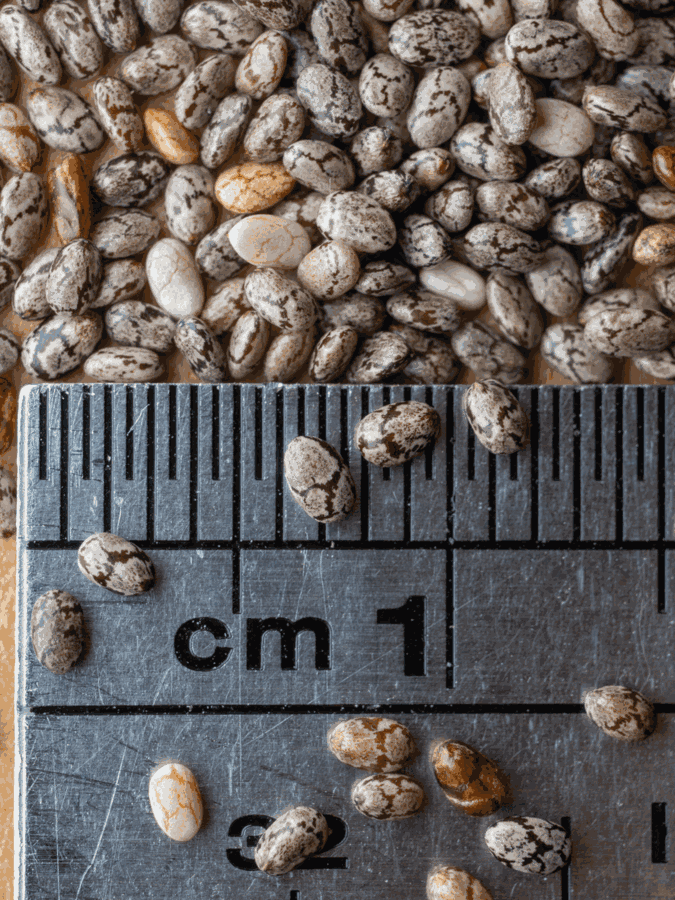
It is an annual herb growing up to about 1.75 metres, with opposite leaves 4 to 8 centimetres long and 3 to 5 centimetres wide, and purple or white flowers borne in numerous clusters on a spike at the end of each stem. It is hardy in USDA zones 9 to 12. Its seeds are small mottled ovals — brown, grey, black and white — with a diameter of around one to two millimetres.
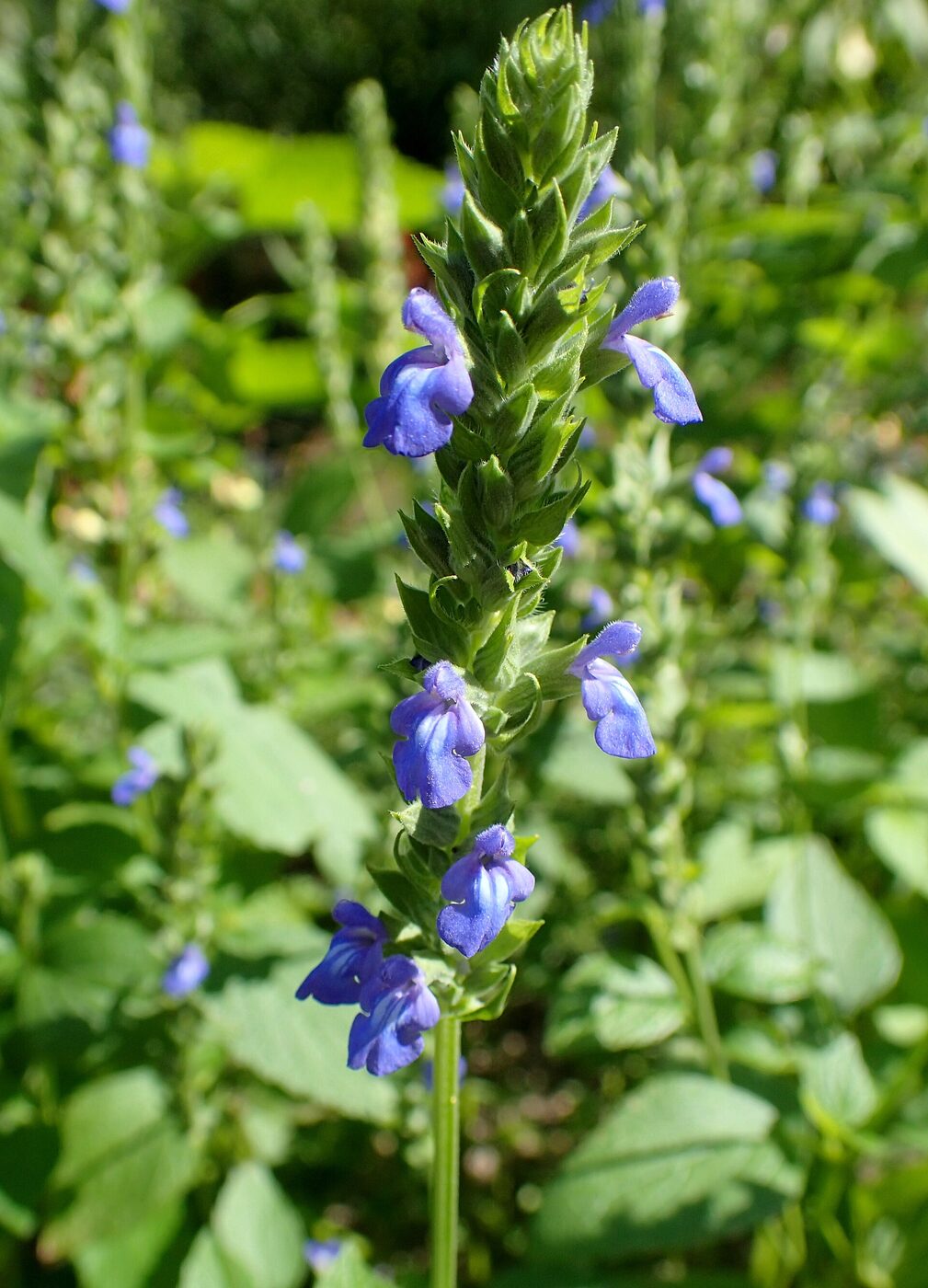

The English name is older than the botany. It descends from the Nahuatl chian, meaning oily, and it is embedded in the map: the name of the Mexican state of Chiapas is believed to come from the ancient city of Chiapan, which in Nahuatl means the place where the chia sage grows. Several other species are also called chia, most importantly Salvia columbariae, the golden or desert chia that grows in California, Nevada, Utah, Arizona, New Mexico, Sonora and Baja California, whose seeds are used in the same way and were an important food for Native Americans there. Salvia polystachia and Salvia tiliifolia carry the name too. A caution recorded in the reference literature is worth passing on: many plants cultivated as S. hispanica are in fact Salvia officinalis subsp. lavandulifolia, which is a different plant.
Mucilage: why the terracotta trick works at all
Everything peculiar about the Chia Pet follows from one property of the seed, and it is a botanical property rather than a manufacturing one. Chia seeds are flattened ovoids measuring on average about 2.1 by 1.3 by 0.8 millimetres and weighing roughly 1.3 milligrams each. They are hygroscopic to a remarkable degree, absorbing up to twelve times their weight in liquid, and as they take up water they develop a coating of mucilage — the thick, gluey polysaccharide substance produced by nearly all plants, which in seeds is associated with tolerance of water stress and with attachment to the surface the seed is lying against.

A soaked chia seed is therefore two useful things at once: sticky, and carrying its own reservoir. Spread on a wetted, grooved, unglazed terracotta surface, the seeds adhere where they are put, including on vertical and overhanging faces, and each one sits inside a small gel jacket that keeps it damp long enough to germinate. No soil is required, no compost, no adhesive, and no skill. The terracotta contributes the other half: fired earthenware is not watertight unless it is glazed or burnished, so water poured into the hollow figurine passes outward through the unglazed clay and keeps the seed layer wet from behind.
This is why the toy is made of chia and not of cress or mustard, which sprout quickly enough but will not glue themselves to a sheep. It is also why the same seed later became a food fashion: the gel that holds seeds to a terracotta ram is the same gel that turns a jar of soaked chia into a pudding, and the same coating that gives chia drinks their texture. The toy and the health food exploit one behaviour of one substance in water, some thirty years apart.
Chia before the figurine: a Mesoamerican staple
Chia's documentary record in Mesoamerica is unusually good, because the Aztec administration kept accounts and the Spanish had them recreated. The plant is described and pictured in the Codex Mendoza — the Aztec codex believed to have been created around 1541, written in traditional Aztec pictograms with a translation and explanation in Spanish, named after Antonio de Mendoza, viceroy of New Spain, who supervised its making, and held at the Bodleian Library in Oxford since 1659 — and in the Florentine Codex compiled by Bernardino de Sahagún. The codices bearing on chia date from between about 1540 and 1585.
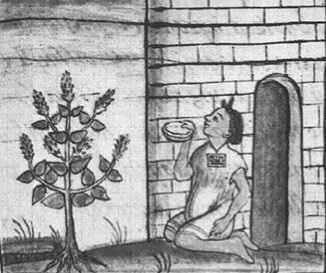

The tribute records are the most informative. Taken together, the Codex Mendoza, the Matrícula de Tributos and the Matrícula de Huexotzinco of 1560, read alongside colonial cultivation reports and linguistic studies, locate the growing regions with some precision: most of the provinces grew the plant, the exceptions being areas of lowland coastal tropics and desert, and chia was given as annual tribute to the rulers in 21 of the 38 Aztec provincial states. The traditional cultivation area covered parts of north-central Mexico, running south into Guatemala, with a second and apparently separate pre-Columbian area in southern Honduras and Nicaragua.
Its standing in the diet followed from that. Chia was a staple food for the Nahuatl-speaking cultures and may have been as important as maize; Jesuit chroniclers placed it third among Aztec crops, behind maize and beans and ahead of amaranth, and offerings to the priesthood were often paid in chia seed. Some of those preparations survive: pinole, roasted ground maize, is mixed with cacao, spices and sometimes chia seed to make the drink pinolillo, and pinole itself is reckoned the national beverage of Nicaragua. Readers following the culinary thread rather than the botanical one may find the directory's alt.food.mexican-cooking entry the better neighbour.
The modern food boom
The seed's return to the shelves is recent, and its timing is why this page has to carry two subjects at once: to a generation of readers in the United States the word chia meant a terracotta sheep for roughly thirty years before it meant a breakfast ingredient. Whole and ground seed now turns up in smoothies, breakfast cereals, energy and granola bars, yoghurt, tortillas and bread, and on its own to be soaked or sprinkled.
The nutritional profile behind the enthusiasm is straightforward enough to state without editorialising. Dried chia seed is about 6 per cent water, 42 per cent carbohydrate — of which a very large share is dietary fibre, at 34.4 grams per 100 grams — about 17 per cent protein and 31 per cent fat, supplying 486 calories per 100 grams. The seed yields 25 to 30 per cent extractable oil, and the typical composition of that fat is given as about 55 per cent omega-3, chiefly alpha-linolenic acid, 18 per cent omega-6, 6 per cent omega-9 and 10 per cent saturated. By the conventional threshold of 20 per cent of a daily value, the seed is a rich source of the B vitamins thiamin and niacin, and of calcium, iron, magnesium, manganese, phosphorus and zinc.
What that means for anyone's health is a separate question, and this page takes no position on it: the reference literature summarises the state of the evidence as preliminary research that remains sparse and inconclusive. Commercial growing has spread regardless. In the twenty-first century the crop is grown and consumed commercially in its native Mexico and Guatemala and in Bolivia, Argentina, Ecuador, Nicaragua, Australia, the United Kingdom and the United States; a companion reference list gives a slightly different roll, adding Colombia and the south-western United States and leaving out the United Kingdom, which is a fair indication of how fast the map has been moving.
A novel food in the European Union
European regulation treats chia as a newcomer, which produces one of the odder facts about the plant: a seed cultivated as a staple five hundred years ago is, in EU law, a novel food. The definition is procedural rather than botanical. A food or food ingredient with no significant history of consumption within the European Union before 15 May 1997 must be authorised before it can be sold — originally under Regulation (EC) No 258/97, and now under Regulation (EU) 2015/2283 of 25 November 2015, which replaced it and took effect on 1 January 2018. Chia falls on the wrong side of that date, and the finding that it does so is attributed to the Advisory Committee of Novel Foods and Processes.
Commission Implementing Regulation (EU) 2017/2470 of 20 December 2017 established the Union list of authorised novel foods, and chia sits on that list with conditions of use attached. Chia seeds may make up 5 per cent of the total matter in bread products; prepackaged chia seeds must carry additional labelling telling the consumer that the daily intake should be no more than 15 grams, and pure chia oil no more than 2 grams daily. Seed sold in the EU is imported mainly from South and Central American countries and requires inspection for levels of pesticides, contaminants and microbiological criteria.
Nothing about the plant changed between the Aztec tribute rolls and the Union list. What changed is the paperwork, and the paperwork is a reasonable illustration of what "novel" means in a regulatory register: not new, but new here, and recently.
Agronomy: what growing it as a crop involves
The single fact that governs chia agriculture is photoperiod. S. hispanica is a short-day flowering plant, and traditional cultivars show little photoperiodic variability, which limited commercial use of the crop to tropical and subtropical latitudes. In Arizona and Kentucky, frost stopped seed maturation of traditional cultivars before or after flower set, so the plant could be grown but the seed could not be harvested. Plant breeding changed that from 2012, when new early-flowering genotypes proved to give higher yields in Kentucky; traditional domesticated lines of Salvia species are now reported to grow naturally, or to be cultivable, in temperate zones at higher latitudes in the United States.
Within its range the crop is flexible about altitude and slow about maturing. Growing cycles run between 100 and 150 days across production sites in different ecosystems in Bolivia, Ecuador and north-western Argentina, and a span of 120 to 180 days from planting to harvest is reported for north-western Argentine fields at 900 to 1,500 metres. Commercial production fields lie between 8 and 2,200 metres of elevation, across ecosystems ranging from tropical coastal desert through tropical rain forest to inter-Andean dry valley.
The husbandry is undemanding by field-crop standards:
- Soil. Light to medium clay or sandy soils; well-drained and moderately fertile is preferred, though the plant copes with acid soils and moderate drought. Sown seed needs moisture to establish, but the maturing plant does not tolerate wet soils.
- Sowing. Traditional practice is to disrupt and loosen the soil and broadcast the seed. Modern commercial sowing runs to about 6 kilograms per hectare with rows 0.7 to 0.8 metres apart.
- Inputs. Chia can be grown on low fertiliser input — around 100 kilograms of nitrogen per hectare, and in some cases none at all. Irrigation ranges from none to eight applications per growing season depending on climate and rainfall.
- Weeds and pests. No major pests or diseases currently affect the crop, and essential oils in the leaves have repellent properties against insects, which suits organic cultivation; the first viruses found in chia, possibly whitefly-transmitted, were reported in 2014. Because chia is sensitive to most commonly used herbicides, weeds are controlled mechanically until the canopy closes.
- Yields. Commercial fields in Argentina and Colombia range from 450 to 1,250 kilograms per hectare; a small-scale study of three cultivars in the inter-Andean valleys of Ecuador produced yields up to 2,300 kilograms per hectare.
Breeders have a small and legible palette to work with: the wide range of wild and cultivated varieties rests chiefly on seed size, seed colour and shattering; seed weight and colour are highly heritable; and a single recessive gene is responsible for white seed colour. Readers who want the agricultural hierarchy rather than the novelty one will find it under sci.agriculture.
Growing it on purpose: the sprout and the crop are different activities
A reader arriving from a chia-growing link page is, in practice, standing in front of two unrelated undertakings that share a seed packet, and the most useful thing this page can do is separate them.
The figurine is a sprouting exercise. Seeds are germinated on a damp surface rather than in a growing medium, they draw on the reserves the seed already contains rather than on soil nutrition, and the result is harvested by the eye. The mucilage described above does the work a substrate would otherwise do: it fixes the seeds in place and holds moisture against them. The sequence is short — germination within days, a visible coat within a couple of weeks — and it ends there, because seedlings living on their own reserves on a bare ceramic surface have nowhere further to go. That is not a defect of the object; a fortnight is the product's whole design brief, and the 1992 charter's second discussion topic was what to do with the sprouts once the fortnight was over.
Sprouting seed on a damp surface is a general technique and a much older one than the toy: seeds germinated on wet paper or cloth are a standing classroom demonstration of germination, precisely because the process is visible without soil in the way. A grooved terracotta ram differs from a saucer of damp cotton only in being vertical, shaped and, in fairness, funnier.
Growing the crop is the other activity, and almost nothing transfers. It runs 100 to 150 days rather than fourteen; it requires the plant to flower and set seed, which is where the short-day photoperiod becomes decisive and where latitude, not skill, determines the outcome; and it involves soil preparation, weeding and a harvest. A figurine sprouting happily on a windowsill in a temperate country demonstrates nothing whatever about whether the same seed would make a crop in that garden, because the sprout never reaches the stage at which the question arises. The two activities are set out here so a reader can tell which one they are actually contemplating; nothing in this section is offered as advice.
Why a gardening page linked a joke group
Gardening and plant-reference pages of the 2000s listed alt.pets.chia among their chia-growing references, and that is the traffic this entry still serves. It looks, at first glance, like somebody's mistake. It is better understood as a property of how Usenet published itself.
Usenet maintained a machine-readable catalogue of its own contents: a plain text file, one line per group, the group name in the first field and a one-line description in the second, mirrored across the network and still distributed today. That file is a link-builder's dream — an exhaustive, free, keyword-searchable index of every subject anyone had ever created an address for. Web subject directories of the late 1990s and 2000s generated one page per group straight out of it, and this site is a specimen of exactly that practice: the directory whose front page is news2mail.com was assembled around a group-per-page catalogue, and the full list of groups is what remains of it.
Now consider what a person compiling a page of chia references would have done: searched such a catalogue for the string "chia". The canonical description of this group reads Discussions on the chia pet and chia herb garden — a line containing the word chia twice and the phrase "herb garden" once. It is close to the ideal keyword match for a horticultural link list, and no editorial judgement was exercised at either end of the transaction. A string matched a string, and a citation was born.
The result is the situation this page exists to handle: readers arriving with a horticultural question at an address created as a Christmas joke five days before Christmas 1992. The referring pages were right about the words and wrong about the room. Since the words in question are the name of a real and interesting plant, the sensible response is not to apologise for the group but to answer the question the reader actually brought, which is what the middle half of this article does.
What the record does not show
Being explicit about the gaps is part of the point of a page like this one, so here they are.
- No proposal, discussion or vote. alt.* required none, and the creator's message says outright that he skipped even the customary airing in
alt.config. There is no Request for Discussion, no Call for Votes and no result to cite, because none was ever produced. - No moderator. The group was unmoderated — the 1999 control message states it and the published active file still flags it that way. Nobody was ever in charge of it.
- No readership figure. Usenet had no subscriber list and no mechanism that could produce one; nothing of that kind exists for this or any other group, and no such number is invented here.
- One traffic figure, for one day. Seventy-six messages on 9 June 1999, reported by the person issuing the booster newgroup. Nothing establishes what a typical day looked like in 1993, or in 2003.
- No FAQ. No periodic posting or frequently-asked-questions document for this group turned up in the archives consulted for this article.
- No threads, no participants, no quotations. Beyond the three people whose names appear on the control messages, this page names nobody, quotes no posting and reproduces no subject line. Where a directory entry of this kind normally offers a flavour of the conversation, there is nothing verifiable to offer, and colour invented to fill that space would be worth less than the blank.
- No ending. The date the group went quiet is not recorded anywhere consulted here, and the group has never been removed, so there is not even an rmgroup to date the funeral by.
What can be said with confidence is narrow and, in its way, sufficient: a group of this name was created on a stated date for a stated reason, was carried across the network, was still being posted to in 1999, was never deleted, and is still listed.
Scope and limits
Three kinds of claim appear above, and they are not equally strong. Claims about the newsgroup come from primary sources — the three control messages preserved in the Internet Systems Consortium's mirror of Usenet control traffic, and the newsgroups and active files the same archive publishes — and are quoted rather than paraphrased wherever the wording matters. Claims about the Chia Pet come from published accounts that disagree with one another and, in several places, from the manufacturer's own history page; where the sources conflict, both are given, neither is adopted, and every figure is attributed to whoever supplied it. Claims about Salvia hispanica, its history, its nutrition and its agronomy come from the reference and agricultural literature and are the best-evidenced material on the page.
Two categories of statement have been kept off it. Nothing is said about what was actually posted in the group, because nothing about that survives in any archive consulted here. And nothing here is horticultural or dietary advice: the growing and nutrition sections are descriptive, reporting what the crop requires and how the sprouting exercise works in the terms the literature uses, and recommending nothing to anybody.
Reading alt.pets.chia today
- Historical archive: Google Groups — alt.pets.chia (coverage varies by group and era).
- Open in a newsreader:
news:alt.pets.chia— the original site offered exactly this link, and it still works if your system has a newsreader registered for thenews:scheme. - Live access: point an NNTP newsreader at a modern server — see accessing Usenet today.
- The original news2mail e-mail subscription service ended in the mid-2000s and no longer operates.