de.talk.liebesakt
A German-language talk group on love and intimacy (de.talk hierarchy).
Part of the de.talk.* branch for personal and social topics, conducted in German under the de.* hierarchy’s comparatively formal group-creation rules.
Kept as a directory entry for the record of the de.* hierarchy carried by the original gateway.
On this page
- The file in the control archive
- The ballot of 1998, read from a References line
- The two clauses the electorate refused
- The charter as a document
- The de.talk.* branch
- A hierarchy that had to answer the question in public
- The group's own FAQ
- The German legal frame, and what it was actually about
- Where the law met Usenet: the carrier, not the charter
- Pornography and art: the case in the background
- The medium before this one
- The deletion of 2026
- Absent from the newsgroups file, and what that does and does not mean
- What the record does not show
- Scope and limits
The file in the control archive
The Internet Systems Consortium keeps a public archive of Usenet control messages — the short administrative articles by which newsgroups are asked into and out of existence — filed one compressed file per group name. The policy document distributed with the archive states that it is updated hourly, and that propagation delays mean a control message may take longer than that to be reflected. The file for de.talk.liebesakt holds four messages. Twenty-eight years separate the first from the last, and between them they contain almost everything that can be established about this group with certainty.
The first is dated Wednesday, 18 March 1998, at 19:26 Central European Time. It comes from [email protected], the address of the moderation of de.admin.news.announce, and it carries a PGP signature computed over a named list of its own headers; the sending account is recorded in an X-Sender header as that of Lutz Donnerhacke. Its Control header reads newgroup de.talk.liebesakt. It was posted to de.admin.news.announce, to de.admin.news.groups and to de.talk.sex, with follow-ups directed to the second of those. Its body is not an announcement but a tally sheet; beneath the sheet stands the single tab-separated line a news administrator would paste into a server's newsgroups file, giving the group name and the one-line description Menschliche Geschlechtlichkeit., and beneath that the full text of the five proposals the ballot had put.
The second and third are both dated 31 October 2001 and both carry Control: rmgroup de.talk.liebesakt. They reached the archive some forty minutes apart; their own Date headers disagree with that order, disagree with each other by more than an hour, and name a weekday on which the date did not fall. They were posted to de.config, de.control, news.groups and the group itself from an address at baysec.org, they carry no signature of any kind, and their References header points at a removal message for an unrelated group in the same sweep. Their text asserts that the group is bogus and that any server which created it should remove it. They left no mark on the namespace, for a reason set out further down this page.
The fourth is dated Saturday, 18 April 2026. It comes from [email protected] again and is PGP-signed again, this time from an account recorded as that of Thomas Hochstein, and it carries Control: rmgroup de.talk.liebesakt. Its body is two sentences of English followed by a second tally sheet:
Please remove de.talk.liebesakt. Its deletion has passed its CfV on 2026-04-09 with 31:2 votes.
The group thus begins and ends with a signed control message from the same address, with two unsigned removal requests in between. What follows reads those four messages closely, and sets beside them the public record of the hierarchy that produced them.
The ballot of 1998, read from a References line
The 1998 newgroup message carries a References header seven items long, and because the de.* hierarchy dates its procedural articles inside their own message identifiers, that header is a calendar of the proposal. It records four Requests for Discussion, on 4 July 1997, 17 July 1997, 24 October 1997 and 23 January 1998; two Calls for Votes, on 4 February 1998 and 18 February 1998; and a Result on 9 March 1998. All seven identifiers name the group as de.talk.sex, which is what it was called until the last of them.
The public archive of the German Volunteer Votetakers — the standing pool of volunteers who have conducted ballots in the German-language Usenet since 1995, and who state that they have run more than 475 of them — records the same procedure from the other end. The proceeding is filed as the renaming and charter change of de.talk.sex, the votetaker was Christian Schulz, and the two Calls for Votes and the Result fall on exactly those dates. Its one-line summary is that the renaming of the group to de.talk.liebesakt, together with changes to the short description and the charter, was carried, the remaining ballot items being rejected. In that archive the entry stands between a ballot on the establishment of a banking and broking group and a ballot on the establishment of a television-technology group, all three conducted by the same votetaker in the same weeks, and recorded in the same form.
The tally sheet in the control message gives the arithmetic. One hundred and seventy valid votes were cast. Five items were put separately, each tested against two conditions printed as column headings on the sheet: a two-thirds requirement, and a floor of thirty affirmative votes. Three items cleared both. The renaming carried by 131 to 32. The change of short description — the one-line entry that appears in a server's newsgroups file and in some newsreaders — carried by 135 to 20, in favour of the wording Menschliche Geschlechtlichkeit, human sexuality. The change of charter carried by 138 to 17. Two items failed, and they are described in the next section.
The name the ballot adopted is a compound noun meaning the act of love. What the paperwork records, and all it records, is that a proposal running through four Requests for Discussion over eight months arrived at a new name, a new one-line description and a new charter; that the electorate took all three; and that it declined the two further clauses put to it at the same time. Why any of the 170 voters voted as they did is not in the file.
The procedure after the count is visible in the same document. The Result of 9 March opened a week in which objections could be lodged, with a deadline of 16 March; under the hierarchy's rules the moderation of de.admin.news.announce decides such an objection and may confirm the result, correct it, or annul the ballot. None succeeded, and the newgroup message went out on 18 March. The old name was not withdrawn at once: the Call for Votes had specified a transition period, and the removal was to follow the next regular checkgroups posting. Removal messages for de.talk.sex accordingly appear in that group's own control file on 21 April, 4 May and 5 May 1998 — three sendings of the same request, which is ordinary practice on a network where propagation could not be assumed. Each of the three carries the full result and the new charter in its body.
What preceded de.talk.sex is less clear, and the honest answer is that this page cannot establish it. The earliest message in that group's control file is a newgroup dated 22 September 1994, sent from a commercial site in Austria and posted to a control group rather than to the hierarchy's announcement group. That is where the mirror's coverage of the name begins; it is not evidence of when the group was made, and no proposal record for its creation was found in the votetakers' archive, which begins in 1995.
The two clauses the electorate refused
The two rejected items are the most detailed part of the 1998 sheet, because the result reproduces the wording that was voted on. Both concerned cancelling: the conditions under which an article in the group might be removed by someone other than its author.
The fourth item proposed adding to the charter a definition of what it called an EFP, an Excessive Flooding Posting. The name is built by analogy with the vocabulary Usenet had developed for measuring spam: EMP for excessive multi-posting, ECP for excessive cross-posting, and behind both the Breidbart Index, the cancel index that assigns different weights to the two methods and above whose thresholds substantively identical articles may be cancelled by third parties. The proposed clause defined an EFP as an article that, within a window of under six hours and over a period of more than three months, appears in dozens of other groups alongside dozens of other articles of essentially the same content, posted by people who take no part in discussion. It listed the points of the de-Netiquette such an article would typically breach, numbered as in the version of that text dated 5 July 1997. It provided that an article meeting the definition might be cancelled by third parties in the group, that the cancels were to be formed exactly like ordinary spam cancels except for the omission of one marker in the Path header, and that they had to be announced in the groups kept for that purpose. It added that the acceptance of such cancels rested not on censorship of content but on persistent and massive breach of the customs of the network, and that automatable detection criteria could be added to the charter later by a further ballot. It was rejected: 97 in favour, 49 against — a clear majority, and a fraction of a percentage point short of two-thirds.
The fifth item depended on the fourth and fell more heavily. It proposed that conversational articles be marked in the subject line with a bracketed tag, or else be identifiable as follow-ups by a Re: subject or a References header, and that unmarked articles might be cancelled by third parties, the sender being notified at most once in two months. The proposal recorded that the tag had been settled in a straw poll, and that the tag [dts] would become [dtl] if the renaming carried. The electorate rejected it by 49 to 89.
What the hierarchy did instead was general rather than local. A result published on 6 May 1999 fixed Breidbart-index limits for de.* as a whole, and the table it produced is still posted by the moderation: a limit of five for the hierarchy at large, two for the marketplace branch, one for the sub-hierarchy in which binaries are permitted, and zero for a single group reserved for testing bots. The same text sets out how the index is computed — the sum, over every incarnation of an article posted within seven days, of the square root of the number of groups in its Newsgroups header — lists what is to count as substantively identical, reserves cancelling in moderated groups to their moderators, and prohibits without exception the third-party cancelling of articles from the de.admin.news.announce moderation that are recognisable as authentic by their digital signature. Whether the general rule owed anything to the local one that failed is not recorded. What is recorded is that a group asked to write its own cancel rule declined, and that fourteen months later the hierarchy wrote one for every group at once.
The charter as a document
The charter adopted on 9 March 1998 is preserved in three places that agree word for word: in the body of the newgroup control message, in the removal messages for the old name, and in the list of de.* newsgroups with their charters that the hierarchy maintains on the web and posts to itself as a reference text. It is short. It defines the group's scope in three items — discussion of sexuality, expressly including its connections with other subjects, the examples given being feelings, law, health and social policy; sexually arousing stories and erotic verse; and other postings on the subject — and then spends most of its remaining length on conduct.
Three of those conduct clauses are worth stating precisely, because they are the group's only surviving self-description and because each is a decision about how a room should work.
- It draws attention, on account of the subject, to the points of the de-Netiquette concerning politeness and commercial postings. The de-Netiquette is a specific numbered text, not a general notion of good manners: it is posted weekly to de.newusers.infos and to the answers groups, its first point is that there is a human being at the other end, and its later points cover legal compliance, real names, commercial material and binaries.
- It departs, by name, from the Netiquette point on real names. That point instructs the reader to post under a real name and not a pseudonym — and then, in its own text, records that in some groups dealing with very sensitive subjects, sexual habits among the examples given, pseudonyms and articles sent through anonymous remailers are tolerated in exceptional cases. The charter converts that toleration into a rule: pseudonymous and anonymous postings are accepted, on the condition that they remain capable of being replied to. The condition preserves the ability to answer a poster without requiring the poster to be identified.
- It states that this is a conversation group and that contact advertisements do not satisfy the Netiquette's point on choosing the right group. The exclusion had somewhere to send people. A group for contact advertisements, de.soc.kontakte, had existed in the hierarchy since April 1993; five months after this charter was adopted, a ballot whose result was published on 10 August 1998 replaced it with a small sub-hierarchy, de.soc.kontakte.*, whose charters ask that articles carry a follow-up header directing replies to the poster rather than into the group, and state that binaries are unwelcome. Neither the old group nor the sub-hierarchy that replaced it is in the namespace today.
A fourth clause is administrative housekeeping: should any object named in the charter, such as a group or the Netiquette, be replaced by a successor, the successor takes its place. The clause anticipates the obsolescence of the documents the charter cites, and it is the reason the charter still reads coherently against a Netiquette that has been revised since.
The real-name derogation is the clause that most clearly marks the group out within its own hierarchy, but it is not unique there. The same list of de.* charters records that de.soc.weltanschauung.scientology accepts posting through anonymous servers, and gives its reason in the charter itself: that former members of the organisation under discussion in particular have an interest in not disclosing their identity. Two groups with nothing else in common wrote down, in public and in advance, a case in which the hierarchy's expectation of real names would not be pressed.
The de.talk.* branch
de.talk.* was never a large part of the hierarchy. The hierarchy's own reference list describes the branch in one line: it serves relaxed conversation rather than discussion and the exchange of information — a distinction the text plainly considered obvious and did not elaborate. Its present membership is five groups: de.talk.bizarre, for admirers of the nonsensical, the enigmatic and the bizarre; de.talk.jokes with its discussion counterpart de.talk.jokes.d; de.talk.misc, whose one-line description translates as assorted endless topics and ends with a winking emoticon; and de.talk.tagesgeschehen, for whatever is currently being talked about. In the checkgroups list of 26 August 2026 the branch is the smallest but one. The computing and communications branches carry forty groups each, de.alt.* thirty-eight, de.rec.* thirty-four, de.soc.* twenty-two, de.sci.* and de.etc.* twenty each, de.admin.* seven, de.talk.* five, de.org.* and de.newusers.* two each, beside the single groups de.markt, de.test and de.answers.
Neither de.talk.liebesakt nor de.talk.romance is on that list any longer, and their disappearance was recent and simultaneous. Until 2026 the two were the branch's personal-life pair, and their charters divided the ground between them explicitly. de.talk.romance carried the description Zwischenmenschliche (Liebes-)Beziehungen, interpersonal and romantic relationships, and its charter listed love, romance, infatuation, heartache, frustration and joy, relationship troubles, flirtation, stories, poems and experience — and then ruled out, in one sentence, postings of exclusively sexual content and the seeking of contacts, on the stated ground that there were specific groups for each. Both of the groups that sentence pointed at are now gone from the namespace, and so is de.talk.romance.
The branch has lost members before. de.talk.jugend was created on 4 February 1998, five weeks before the group this page describes was renamed, and removed on 3 June 2009 after a deletion procedure that ran from a Request for Discussion in March to a Result in May of that year, carried by 91 votes to 3 out of 94 valid votes. de.talk.chat left the branch earlier and by a different route: a ballot renamed it into de.comm.chatsystems by 125 votes to 25 out of 150 counted, its result circulated with the removal message of 23 February 1996, with a new charter covering chat systems as a technical and social subject. de.talk.bizarre has survived at least two attempts at deletion — one whose Result fell on 22 February 1997, and one whose Result of 24 January 2023 records the proposal as failing both the minimum-approval requirement and the quorum.
Two conventions from elsewhere on Usenet are worth naming here only to say that they were not this hierarchy's. The Big Eight split between soc.* and talk.* — social subjects on one side, open-ended argument on the other — is set out on the soc.* page, and the character of the English-language talk.* hierarchy is described on its own. de.* borrowed the word without the constitutional theory: only one of its talk groups points at an English-language model, de.talk.bizarre, whose charter says in its first line that the point of the group is to create a German counterpart to talk.bizarre. Elsewhere in the branch a de.talk group is simply a group for talking, and the burden of deciding what was worth talking about fell on the procedure rather than on the taxonomy.
A hierarchy that had to answer the question in public
The German Wikipedia article on the hierarchy describes de.* as themenvollständig — topic-complete: every possible subject has a place in some group, and a subject with no better home belongs in the catch-all de.etc.misc, whose own description translates as everything that does not fit anywhere else. That is an unusual property for a namespace to claim, and it has a consequence that bears directly on this page. A hierarchy organised on that principle cannot dispose of an awkward subject by declining to file it. It has to decide, in public, whether the subject gets a room of its own or is left to the catch-all.
The paperwork on this page is a record of that decision being taken in the ordinary way. Everything in the hierarchy's rules of establishment — the requirement that a proposal be published as a Request for Discussion in de.admin.news.announce, the minimum fortnight of argument in de.admin.news.groups, the Call for Votes with its ballot period of at least three weeks and at most a month, the votes cast by e-mail from an address the voter controls and which must be capable of receiving a reply, the published list showing each voter's name, address and vote save in justified individual cases, the week for objections afterwards — applies to a group about intimacy exactly as it applies to a group about banking law or television engineering.
The alternative arrangement existed inside the same hierarchy, one branch away. The rules of establishment carry an appendix exempting de.alt.* from all of it: the governing principle there is stated as fairness, and the procedure is to ask in de.alt.admin whether anyone objects, to wait long enough for objections to arrive — seven days is given as the customary period — and then, if the protest was not too fierce, simply to send the newgroup message. The configuration file that news servers use follows suit, accepting unsigned newgroup messages for de.alt.* while requiring a signature for everything else in de.*. The character of that branch is described at de.alt.motorroller. A subject could have been left there. This one was not.
Two later proceedings show the same machinery applied to the same corner of the namespace, and both failed. In January and February 2000 a ballot was held on establishing a more specialised subgroup beneath de.talk.liebesakt; the votetaker was Wolfgang Behrens, the two Calls for Votes fell on 18 January and 5 February 2000, and the Result of 25 February 2000 records the establishment of the group as rejected. The proposed name is on the public record in the votetakers' archive; this page does not print it, for the reason given at the end. In 1999 a proposal to rename de.talk.romance was likewise rejected, though the changes to its description and charter carried. That proceeding is worth a sentence more, because it shows the objection procedure doing something. A voter's ballot had been discarded as containing no vote; he objected; it emerged that his messages had arrived with their headers but without their bodies, through circumstances the decision does not claim to have established; his vote was counted, and the corrected result of 7 June 1999 turned the renaming from carried into rejected at 105 votes to 53, a majority short of two-thirds.
The point is not that the hierarchy was liberal or that it was strict. It is that the question of which personal subjects deserved a room was decided by counted votes, published tallies and a written appeal, in a language other than English, and that the paper survives. Very little else about this group does.
The group's own FAQ
The hierarchy's reference list of de.* newsgroups records, beneath this group's charter, a maintained FAQ described as being for newcomers to de.talk.liebesakt, with a web address on a private site. Copies of that page preserved in web archives give its title as the de.talk.liebesakt-FAQ, abbreviated in the group's own usage to the dtl-FAQ.
Its structure is the ordinary structure of a Usenet group FAQ, and can be described without going further into it than a catalogue would. The charter stands at the head of the page, reproduced in full, which is how a group without a moderator keeps its own rules in view. Below it sit a series of subject FAQs contributed by named regulars. One of those is a treatment of the legal position, written for Germany, for Austria and for Switzerland by different contributors — a reminder that a German-language group was not a German group, and that its readers sat under three sets of statutes. Beneath a heading marking them as belonging to an earlier time, the page also kept the older de.talk.sex FAQ and one inherited from an English-language group; then a short introduction to Usenet for readers who had arrived without one, a link into the group's archive on Google Groups, and a long list of external links.
The site that hosted it no longer answers, which is the ordinary fate of Usenet FAQs: maintained on a volunteer's personal web space, they outlive neither the volunteer's interest nor the hosting arrangement. The FAQ is recoverable only from web archives, and the hierarchy's group list is the record that it existed and was current.
The German legal frame, and what it was actually about
German law had settled its general position on adult material a quarter of a century before this group was renamed, and the settlement is easy to state. The Fourth Criminal Law Reform Act replaced the older statutory language of indecency with the term pornography and released simple pornography for adults; the new wording applied from 28 November 1973. Material depicting violence or sexual acts with animals remained criminal, as did material involving children, and later reforms extended the criminal law further in that direction. The centre of gravity of German regulation was therefore never a prohibition on adults reading things. It was a body of law about keeping particular material away from young people, and about who bears the duty of keeping it away.
The instrument of that policy is indexing. The federal review body for media harmful to young persons was formed on 19 May 1954, following a statute of 9 June 1953, and sits in Bonn. It has been known by three sets of initials: BPjS while it was the review board for youth-endangering writings, BPjM from 2003, when the Protection of Young Persons Act took effect and its remit was restated in terms of media rather than writings, and BzKJ since 2021, when it was reorganised as a federal centre for the protection of children and young people in the media. Its central function has not changed. It maintains a list; an item placed on the list may not be sold or made accessible to young people, may not be displayed where they have access, and may not be advertised. Under the 2003 statute a listing lapses automatically after twenty-five years, after which the item must be considered afresh if it is to be listed again.
The extension of that regime to online media arrived after this group's formative years, not before them. The Jugendmedienschutz-Staatsvertrag, the interstate treaty on the protection of human dignity and of young people in broadcasting and telemedia, was concluded on 10 September 2002 between all the German states and came into force on 1 April 2003. It applies youth protection to broadcast and online offerings alike, and it is the instrument under which certain adult content may be offered only inside a closed user group with age verification.
Before that, the relevant federal statute was the Informations- und Kommunikationsdienste-Gesetz, passed on 22 July 1997 and in force from 1 August 1997, with parts of it from the beginning of 1998. It was an omnibus act: it created a teleservices act setting out when a service provider is answerable for third-party content, a data-protection act for teleservices and a digital-signature act, and it amended the criminal code, the law on administrative offences, the youth-protection statute and the copyright act among others. It is the law under which the one German criminal case that touched Usenet directly was decided.
Where the law met Usenet: the carrier, not the charter
The German youth-protection regime met Usenet in 1995, and it met it at the wrong end. On 22 November of that year the Munich public prosecutor's office, investigating the distribution of illegal material, searched the German premises of the online service CompuServe. The service responded by blocking some 250 newsgroups that the investigators had identified. For technical reasons the block could not be confined to German subscribers and took effect worldwide, which produced a considerable protest in the United States, including a televised demonstration in San Francisco at which German beer was poured into a drain. A large proportion of the groups caught by the block carried nothing resembling the material at issue. The block was subsequently narrowed to German access and then, about two months later, lifted, five groups excepted.
The company's German managing director was charged on 26 February 1997 with having knowingly permitted illegal image files from Internet newsgroups to reach subscribers in 1995 and 1996, the indictment asserting that suitable technical and organisational measures could have prevented it. Part of the case concerned not newsgroups at all but two computer games on the federal index that had been left accessible in the service's file areas. The trial opened at the Amtsgericht München on 12 May 1998. Expert witnesses from the federal information-security office and from the Bundestag's legal affairs committee gave evidence that complete supervision of the content was not technically feasible, on grounds of volume and of cross-posting. Politicians and legal commentators called for acquittal, and by the close of proceedings the prosecution had joined them. The court convicted nonetheless, on 28 May 1998, imposing a suspended sentence of two years and a fine of a hundred thousand marks. Both the defence and the prosecution appealed in the defendant's favour, and on 17 November 1999 the Landgericht München I acquitted him.
The whole episode turned on what a provider made available to its subscribers. Nothing in it concerned the charter of any newsgroup. That is the practical shape of the German regime as it bore on Usenet: the pressure fell on carriage — on providers deciding which groups to take and which to drop — and not on the constitutional documents that groups like this one spent eight months and 170 votes producing. A hierarchy could regulate its own namespace with great care and still have no say whatever in whether a given reader's provider carried the result.
Pornography and art: the case in the background
The charter's admission of prose and verse in a single line settled, for one newsgroup, a question that German public law had been litigating over a single novel for most of a century. The novel is Josephine Mutzenbacher, published anonymously in Vienna in 1906, now generally attributed to Felix Salten and supported in that attribution by a stylometric study published in 2022. It has sold more than three million copies and has spent much of its life inside the indexing machinery described above.
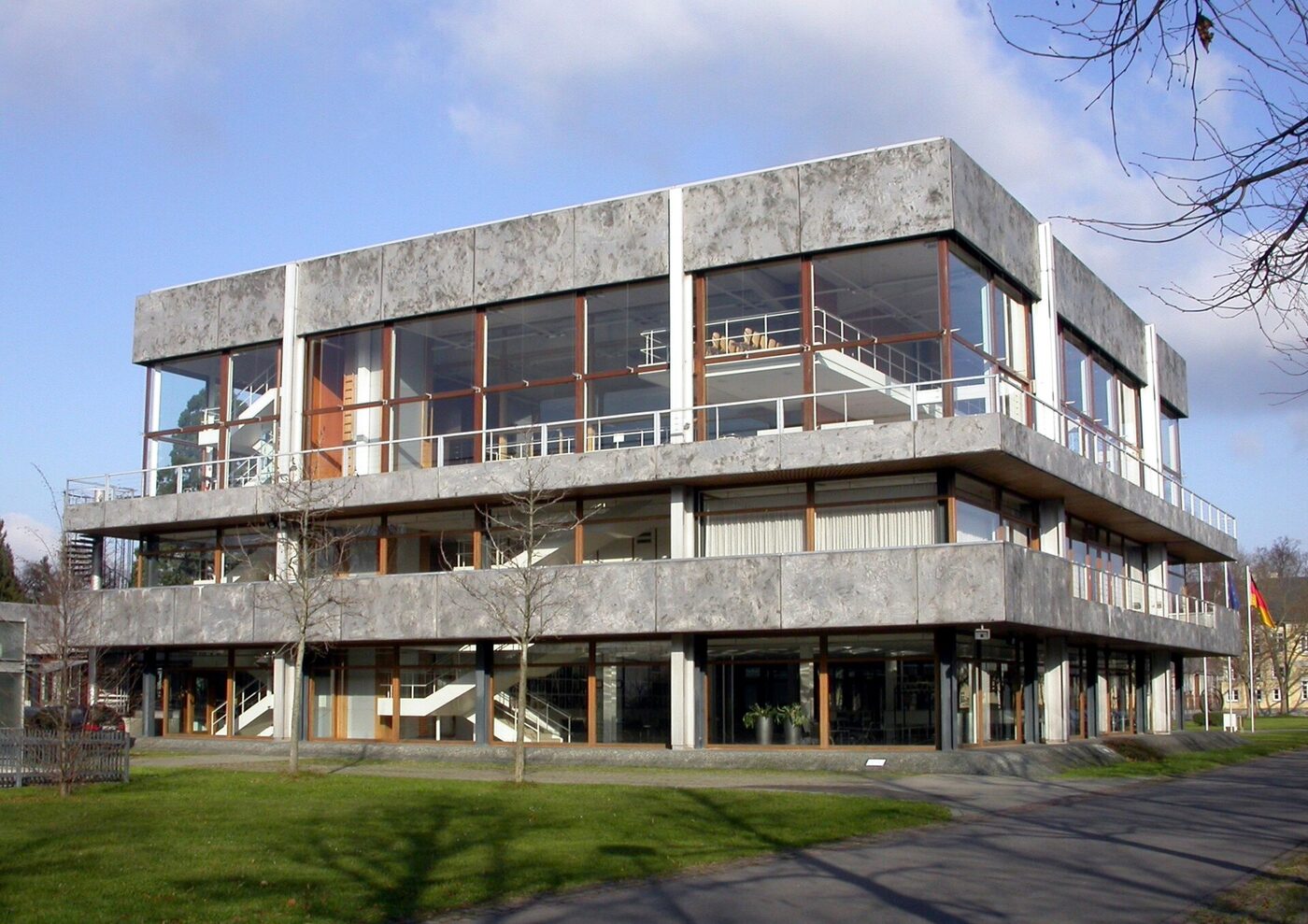

The decision usually cited is that of the Federal Constitutional Court of 27 November 1990, known as the Mutzenbacher decision, given on a publisher's constitutional complaint against the book's listing. Its holding is compressed into a single sentence at the head of the judgment: pornography and art are not mutually exclusive. A work does not cease to be art because it is also pornographic, and the freedom of art must therefore be weighed in the balance when a work is being considered for the index.
Weighed, but not necessarily decisive. In November 1992 the review board listed the book again, this time expressly considering the freedom of art and concluding that the protection of young people outweighed it; the publisher's challenge to that listing succeeded at first instance in 1995 and failed on appeal in 1997, with a further appeal refused in 1998. The listing then ran its statutory twenty-five years and lapsed, and in November 2017 the board decided that there was no longer reason to list the work anew, giving among its reasons the archaic language and parodic manner of the text and its standing in current scholarship. The whole sequence — a hundred and eleven years from anonymous publication to final delisting, with a constitutional court, two listings, three tiers of administrative litigation and an automatic time limit along the way — is the public-law context in which a German-language newsgroup wrote one clause admitting stories and poetry and moved on to the next paragraph.
The medium before this one
The online medium that reached German homes before Usenet did was Bildschirmtext, and its arrangements were the opposite of Usenet's in almost every respect that matters here. Btx was a videotex service run by the Deutsche Bundespost, launched nationwide on 1 September 1983 after a field trial begun in June 1980 in Düsseldorf and Berlin and an interstate treaty signed by the heads of the state governments in Bonn on 18 March 1983. Access was over the DBT-03 modem, which ran at 1,200 bits per second towards the subscriber and 75 in the other direction — the asymmetric V.23 arrangement of the period, sized for a system that sent whole screen pages down and single keystrokes up.
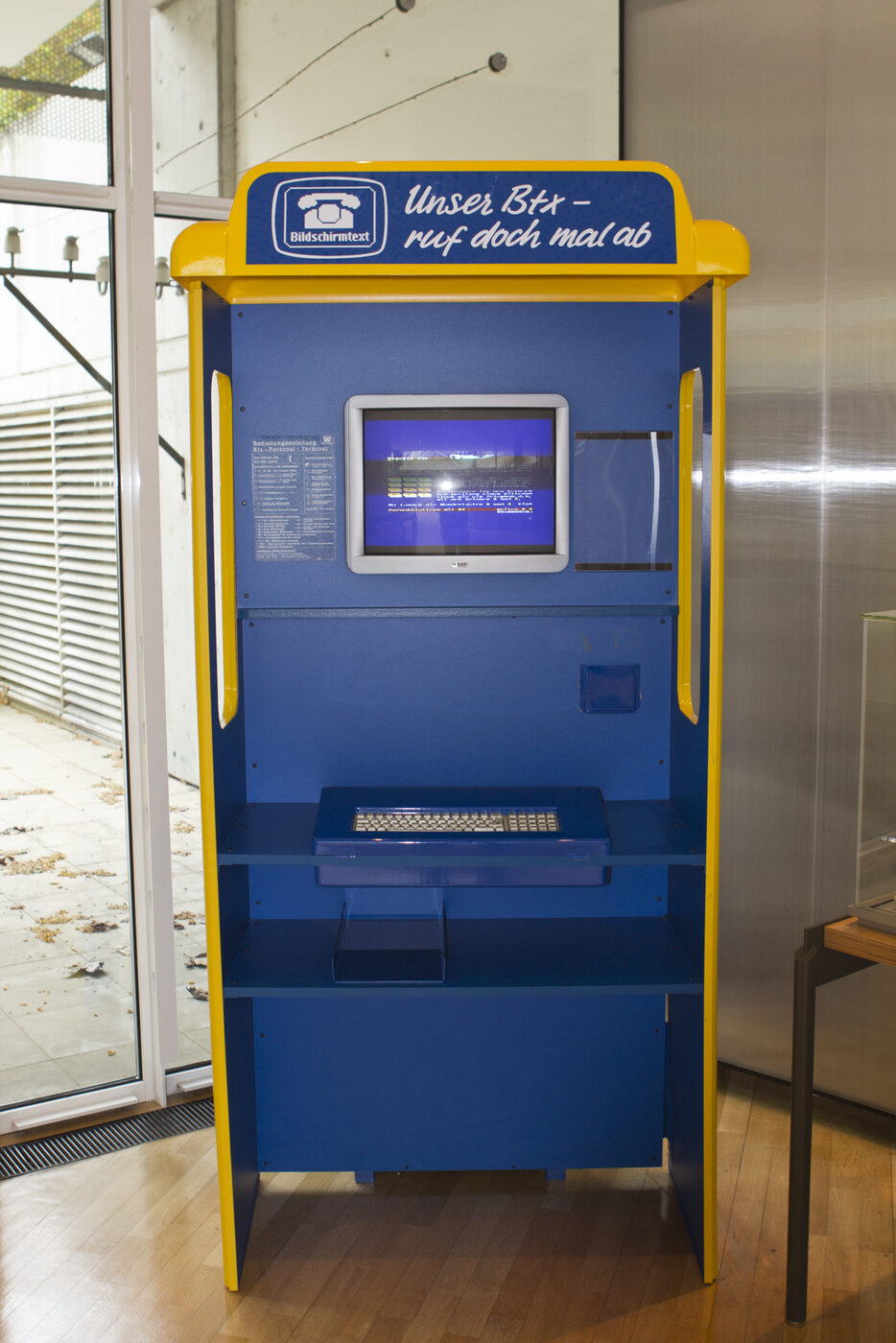

It was metered and it was closed. A subscriber paid a connection fee and a monthly charge — 55 marks and 8 marks respectively in 1983 — and paid again by the page, at a price the page's provider set, either per page retrieved or per minute; a message sent from one subscriber to another cost thirty pfennigs. Access was authenticated by a twelve-digit connection identifier burned into the modem's read-only memory, together with a subscriber number, a suffix identifying the individual user and a password; the modems were sealed and opening them was forbidden. A subscriber could create additional users under his own number, each identifiable as a sender and each with a spending account he could top up. There was one operator, and the operator was the post office. In 1993 Btx became part of the newly created Datex-J service, in order to separate the network infrastructure from the information service; the last Btx access was switched off at the end of 2001, and the underlying system ran on under another name, with strong encryption, until May 2007.
Usenet, arriving in German homes across the same decade, offered the reverse arrangement in each particular. It was unmetered at the point of reading. It had no operator: each server's administrator decided independently what to carry, which is why a control message is a request and not an instruction. And its texts were written by its readers rather than published to them by a page provider paying for the privilege. A subject conducted, in German, over a metered service with a single operator, and the same subject conducted over an unmetered network with many independent ones, are not the same subject conducted twice.
The deletion of 2026
The group's ending is documented as fully as its renaming, and by the same machinery. The removal message of 18 April 2026 carries a References header recording a Request for Discussion of 2 March 2026, Calls for Votes of 17 and 27 March 2026, and a Result of 9 April 2026. The tally sheet in its body reports 36 valid votes: 31 for deletion, 2 against, 3 abstentions and no invalid votes.
The columns on that sheet test the proposal against two-thirds and against a floor of fifteen affirmative votes. The floor printed on the 1998 sheet was thirty. The two figures do not bracket a steady decline: sheets from the intervening decades print a floor of sixty — the corrected de.talk.romance result of 1999, the de.sci.genealogie result of 2000 and the de.talk.jugend deletion of 2009 all do — so the requirement rose before it fell. The votetakers' archive records a ballot on the minimum-vote rule in the rules of establishment carried with a Result of 16 September 1998, and a later proposal to change the same rule rejected in 2008 after an objection that the moderation dismissed on 28 October of that year; the archive gives the subject and outcome of each but not its text, and this page does not assert which ballot produced which figure.
What the two sheets do measure, on the same procedure and the same group, is participation. The hierarchy counted 170 valid votes in 1998 and 36 in 2026.
de.talk.romance went the same way in the same season and by a few days' margin: a Request for Discussion of 1 March 2026, Calls for Votes of 16 and 30 March, a Result of 14 April recording 42 valid votes and 36 to 3 in favour, and a removal message on 1 May 2026. In 1999 the same group had drawn 164 valid votes on a question of its name. The two groups that had divided the personal-life ground between them in the branch since the 1990s were proposed for deletion within a day of each other and removed within a fortnight of each other.
Nothing in the surviving record explains the decision, and this page will not supply a reason it does not have. What can be said is that the proposals were published, argued for at least the statutory fortnight, balloted for at least the statutory three weeks, counted under real names, published with the count, and left open to objection for a week afterwards — the same sequence that had produced the group in 1998.
Absent from the newsgroups file, and what that does and does not mean
The Internet Systems Consortium also publishes a current view of the Usenet namespace: an active file and a newsgroups file, listing the groups servers are expected to carry, the second of them with each group's one-line description. The build examined for this page, dated 26 August 2026, contains 233 groups under de.*. Five of them are in de.talk.*: bizarre, jokes, jokes.d, misc and tagesgeschehen. de.talk.liebesakt is not among them, and the string does not occur in the file at all. The hierarchy's own checkgroups list, fetched on the same day, contains the same 233 groups.
That absence is exactly consistent with the control archive and means what the control archive says it means: the hierarchy removed the group in April 2026, and the namespace lists were updated accordingly. It does not mean the group was suppressed, nor that it vanished quietly, nor that its traffic was purged. A newsgroups file is a distribution list, compiled from control messages and from the hierarchy's own periodic checkgroups posting, and it describes what a conforming server ought to carry today. It is not a history and it does not remember.
The same file measures the hierarchy's contraction directly. The German Wikipedia article on de.*, citing the hierarchy's checkgroups list as retrieved in October 2019, records 378 groups. The same list today records 233. Whatever else the last few years of de.* have been, they have been a period of consolidation, and de.talk.* has taken its share.
The 2001 removal messages are the useful counter-example, and they explain themselves once the configuration is examined. The control.ctl file distributed with INN, the standard news server software, is the document that tells a server whose control messages to believe. Its entry for de.* drops every newgroup and rmgroup by default and honours only those from [email protected] that verify against a published PGP key, whose fingerprint is printed in the same file; the single relaxation is that any newgroup for de.alt.* is accepted, in keeping with that branch's exemption from the ballot procedure, while removals there still require the signature. The messages of 31 October 2001 carried no signature at all; the file's authors had anticipated precisely that case. A control message on Usenet has never been more than a request, and the de.* hierarchy is one of the places where the terms on which such a request is granted are written down and published.
What the record does not show
Almost everything a reader would naturally want to know about this group is not recoverable, and it is better to say so at length than to imply otherwise by silence.
There is no traffic figure. No article count, no monthly posting volume and no readership estimate for de.talk.liebesakt was found in the course of writing this page. The readership surveys that produced such numbers for well-known English-language groups in the early 1990s did not cover the German hierarchy in any form located here.
There is no subscriber or membership figure, and there could not be one: the group was unmoderated and open to anyone whose provider carried it, and Usenet had no mechanism by which a reader could be registered. It was also, like almost every group in de.*, a text group; the hierarchy confines binaries to the sub-hierarchy de.alt.dateien.*, which is why the branch appears separately in the Breidbart-index table quoted above.
No thread, no article and no individual poster from the group is described on this page, and none is quoted. This is partly a matter of the register the page keeps, stated below, and partly a matter of the record: public archives have always handled groups of this subject unevenly, and no claim is made here about what any particular archive does or does not hold.
No charter text is established here beyond the one carried in the group's own control messages and the hierarchy's group list. The charter that preceded the 1998 change is not reproduced in those documents and is not reconstructed here.
The reasoning behind the ballots is not recorded on this page because it was not recovered. The Requests for Discussion of 1997, 1998, 2000 and 2026 were published in de.admin.news.announce and argued in de.admin.news.groups, and their message identifiers are known from the References headers described above; their texts were not obtainable from the archives consulted. What survives in the control archive is the outcome and the arithmetic.
Nothing is claimed here about who founded, proposed, moderated or read the group. The names that appear on this page are those of people acting in a public administrative capacity — the moderation of de.admin.news.announce and the votetakers who conducted the ballots — and they appear because they are printed in the public procedural record.
Scope and limits
This page is a catalogue entry with a long note attached. It documents a newsgroup as an administrative object: what it was chartered for, how it came to exist, where it sat in a formally governed hierarchy, what the law of its country said about its subject in the period, and what the surviving paperwork does and does not record. It keeps the register of a library catalogue throughout, and does so deliberately. It contains no description of the group's traffic, quotes none of it, and describes no conduct. Where a fact could not be stated in that register it has been left out, and where a name on the public record could be omitted without losing a fact — as with the subgroup proposed and rejected in February 2000, and with the individuals in the two court cases and the ballot appeal recounted above — it has been omitted, with the omission declared rather than concealed.
The load-bearing sources are the group's own paperwork and the hierarchy's: the Internet Systems Consortium's archive of Usenet control messages, which supplied all four control messages and their headers; the German votetakers' public archive of completed ballots; the rules of establishment, the moderation's published decisions, the Breidbart-index table and the reference list of de.* groups with their charters; and the current namespace files. The German legal and technical material is drawn from the statutes, the courts and the responsible federal body, and was checked against encyclopaedic sources.
Two matters that other pages of this directory own are touched here only in passing and are not retold: the formation, rules and procedure of the German hierarchy, linked above, and the informal character of its de.alt.* branch, described there and at de.alt.augenoptik. For the online peer-support pattern that a different kind of personal-subject group developed elsewhere on Usenet, see alt.psychology.help.
Nothing above is an argument. The disputes recorded here — over a name, over a cancel rule, over a subject-line tag, over whether a subgroup should exist, over whether the group should — were argued by other people, in another language, a quarter of a century ago, and the outcomes were counted and published. This page reports the counts.
Reading de.talk.liebesakt today
- Historical archive: Google Groups — de.talk.liebesakt (coverage varies by group and era).
- Open in a newsreader:
news:de.talk.liebesakt— the original site offered exactly this link, and it still works if your system has a newsreader registered for thenews:scheme. - Live access: point an NNTP newsreader at a modern server — see accessing Usenet today.
- The original news2mail e-mail subscription service ended in the mid-2000s and no longer operates.