rec.sport.hockey.field
Field hockey.
The field game’s own room — rules evolution, international tournaments, and a posting base that ran India, Pakistan, the Netherlands, Australia and Britain in one conversation.
One of the quieter sport groups, kept alive by people who largely knew each other from tournaments.
On this page
- The group's own paperwork
- A majority sport with a qualifier in its name
- Before the federation: clubs, circles and a rules board
- The federation, and what it was founded to fix
- The World Cup, and the politics of its first edition
- The Champions Trophy, and what replaced it
- Indoor hockey, the winter branch
- Offside: the rule the group watched disappear
- The penalty corner, dated
- Substitution, time and the shape of a match
- The video umpire and the referral
- The surface, which changed everything else
- The record in numbers
- Two declines, on different clocks
- What a newsgroup did for a sport television mostly ignored
- What the record does not show
- Scope and limits
The group's own paperwork
The field game’s file in the Usenet administrative record is short, and complete. The Internet Systems Consortium’s mirror of the control-message archive holds three messages for rec.sport.hockey.field and nothing else, and the first of the three is the group’s birth certificate: a newgroup control message issued from Rensselaer Polytechnic Institute on 2 January 1992 by David C. Lawrence, then the moderator of news.announce.newgroups. Its opening sentence carries the whole result of the ballot.
rec.sport.hockey.field is an unmoderated newsgroup which passed its vote for creation by 157:30 as reported in news.announce.newgroups on 19 Dec 1991.
The arithmetic is worth doing, because the group-creation rules of the period demanded two things at once: at least a hundred more yes votes than no, and at least two-thirds of the valid ballots in favour. A tally of 157 to 30 is 187 valid votes, a margin of 127, and just under 84 per cent in favour. Both conditions are cleared with room to spare. Whatever else the creation of a field hockey group on an English-language network may have been, it was not contested.
The same message then gives the two lines that a directory of newsgroups is built from — the entry for the master file, and the charter, which the moderator notes was “culled from the call for votes”. Both are quoted here exactly as the archive has them.
For your newsgroups file:
rec.sport.hockey.field Discussion of the sport of field hockey.
This group will exclusively discuss field hockey and the various national and international events connected with this sport.
The address that vote approved files the field game as a child of the unqualified word, and the argument about how a namespace came to arrange the two codes that way belongs to the parent group and is set out there in full; it is not reopened here. What is worth recording from this side is that the qualifier was accepted without a fight by the people who proposed the group, and that the charter’s scope — “the various national and international events connected with this sport” — is an accurate description of the sport’s own calendar rather than a formula. Everything below in this article that concerns tournaments falls inside that one sentence.
One small piece of the record is unusually stable. The description line the 1992 message asked administrators to add is still, word for word, the line in the newsgroups file that the Internet Systems Consortium distributes today: rec.sport.hockey.field Discussion of the sport of field hockey. Directly above it in the same file sits the parent, glossed rec.sport.hockey Discussion about ice hockey. — which is how the file reads in the oldest ISC list consulted for this page, from January 1993, and how it reads in the current one. In the address the field game carries the qualifier; in the description it is the ice game that does. Both groups remain in the active file, each flagged y — unmoderated, and open to posting.
The other two control messages are the ordinary residue of propagation rather than events in themselves. On 1 April 1992 an administrator at the Stern School of Business at New York University issued a newgroup for the field hockey group with an empty body and a distribution limited to nyu; on 26 April 1992 the computer science department at the University of Maine did the same with a distribution of umcs. Three and four months after the group had been created, two American universities were still catching their own servers up.
What the archive does not hold is as informative as what it does. There is no Request for Discussion, no Call for Votes and no result posting for rec.sport.hockey.field in the news.announce.newgroups mirror; the rec directory there keeps files for a proposed air hockey group, for a proposed reorganisation of the ice-hockey group and for a proposed college hockey group — three requests for discussion, none of which produced a group in this hierarchy — but nothing for this one. Everything now known about the vote is what the newgroup message itself quotes. There is no later administrative notice either — no moderator to appoint or replace, no removal, no rename. It is the file of a group that was created once, correctly, and then left alone.
A last observation from the master file, offered with the hedge it needs. Searching the whole current newsgroups file for a group whose description says it is about field hockey returns exactly two: this one, and git.club.fieldhockey, glossed “this is for field hockey at georgia tech”, which is a campus-local group at a single American university. Several other groups whose names suggest the field game — alt.india.hockey and alt.sport.hockey.women among them — carry no description at all, so this is a count of descriptions rather than of groups. But it is a fair indication of how the network divided its rooms: one Big-8 group and one campus club for a sport played across five continents, against some seventy hockey-named groups in the active file, the great majority of them for leagues and teams of the code played on ice.
A majority sport with a qualifier in its name
Across most of the world the word hockey, used without qualification, means the game played on grass. It is chiefly in Canada and the United States that it defaults to the game played on ice, and it is there that the compound field hockey is the standard name for this sport; in Sweden and Finland the field game takes the qualifier instead, as landhockey and maahockey, ground hockey as against the more usual ice variety. That distribution of habits, rather than any distribution of players, is what put a suffix on this group’s name. The naming question itself is argued out on the parent page.
The modern game was codified in nineteenth-century English schools and clubs and exported along the same routes as cricket. It is played today, in the summary the general reference works use, particularly in western Europe, South Asia, southern Africa, Australia and New Zealand, Argentina, and in the United States chiefly in New England and the mid-Atlantic states. That distribution is the reason a single unmoderated newsgroup could plausibly serve the whole sport: the countries that matter to it are numerous but not innumerable, and they all met in the same tournaments.
The comparative figures are easier to state than they are often assumed to be, provided one is careful about what is being counted. The International Hockey Federation has 140 member national associations, grouped in five continental confederations: African, Asian, European, Oceania and Pan American. The international federation for the ice game had 84 members as of July 2026. On the membership roll alone, the field code is the more widely organised of the two by a margin of about two-thirds.
Registered players are harder, because only one of the two federations publishes a census. The ice-hockey federation compiles registered-player counts supplied by its member associations; the published table covers 77 of its 84 members, being those with more than a hundred registered players, and its largest entries in 2026 are the United States with 212,812 and Canada with 183,371, followed by Russia with 90,160, Sweden with 76,841 and Finland with 33,486. There is no equivalent worldwide table for field hockey, which makes a direct global comparison impossible and any confident total suspect. What can be set beside those numbers is national, and on a slightly different definition: the Royal Dutch Hockey Association — founded in Amsterdam on 8 October 1898, as the Netherlands Hockey and Bandy Association — reported 250,255 members across 322 clubs in 2018 and puts its present membership at around 255,000. One federation, in a country of some eighteen million people, therefore has more members on its books than any single national association of the other code has registered players.
The other useful national figure is English and is interesting for a different reason. England Hockey reported, for the 2008–09 season, 2,488 registered men’s teams, 1,969 women’s teams, 1,042 boys’ teams, 966 girls’ teams and 274 mixed teams. A club sport whose adult men’s and women’s sections are within a quarter of each other in size is unusual, and it is the structural fact behind something that follows for any room devoted to this sport: the women’s international game has a calendar, a World Cup and an Olympic tournament of the same weight as the men’s, and cannot be treated as an appendix to them. That is a fact about the sport rather than a claim about the group.
Two national attachments are worth setting out precisely, because they are frequently stated loosely. Field hockey is the national sport of Pakistan, as the standard references have it. In India it is very widely described as the national game, in school textbooks and on official pages alike, but the Ministry of Youth Affairs and Sports has stated, in reply to right-to-information requests reported in August 2012 and again in February 2020, that the central government has not declared any sport the national game of the country. The belief is older and more durable than the paperwork: in 2018 the chief minister of Odisha wrote to the prime minister asking that hockey be declared the national sport, and from February 2018 the Odisha state government took on the sponsorship of India’s national teams.
The plain summary, then, is this. On an English-language network whose centre of gravity was North America, the code with more member associations, a larger organised base in several countries, and a continuous Olympic history since 1928 was the one obliged to add a word to its name. The sport’s own institutions never treated the matter as a grievance, and neither, on the evidence of a 157-to-30 vote, did the people who proposed the group.
Before the federation: clubs, circles and a rules board
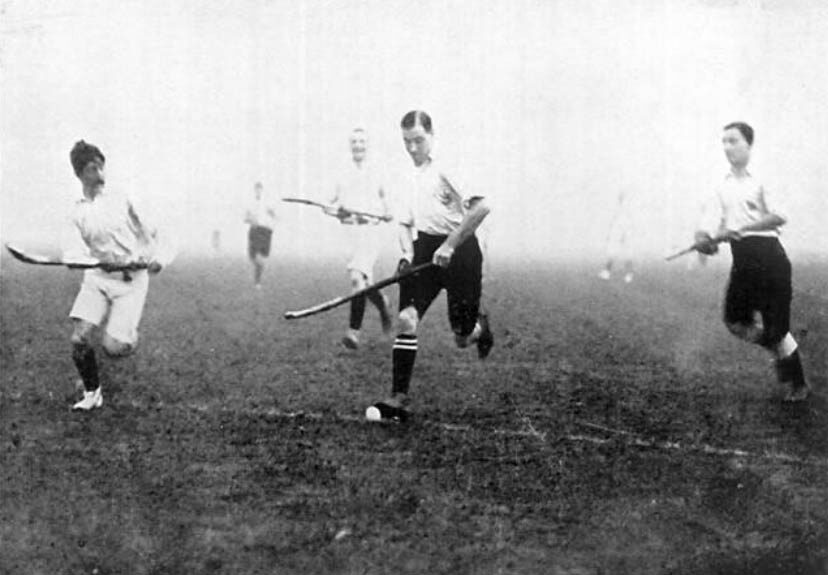
The chronology maintained by the sport’s own rules body is unusually good, and it begins before there was a governing body of any kind. The first known club was formed at Blackheath in south-east London in 1849. The version of the game that became the modern one came out of the Middlesex cricket clubs, played as a winter activity, and it was Teddington Hockey Club that introduced the two decisive features: the striking circle, without which the sport has no shape, and a spherical ball in place of a rubber cube.
A short-lived Hockey Association was established in England in 1875, and in January 1876 several London clubs drew up a set of rules; the second and final Hockey Association was formed in 1886. The 1876 rules survive through the minute book of Surbiton Hockey Club, and they describe a game a modern spectator would find only half-familiar: a pitch between 100 and 150 yards long and between 50 and 80 yards wide; goals of seven-foot posts six yards apart with a tape stretched across the top; sticks “curved wooden ones approved by the Committee of the Association” and an ordinary cricket ball; no circle marked on the pitch, but a rule that no goal counted if the ball were hit from more than fifteen yards from the nearest goalpost; and an offside law requiring three opponents to be nearer their own goal-line, applied over the whole pitch.
The 1886 code tightened all of it. The pitch became 100 yards by 55 to 60; the goals four yards wide with a crossbar seven feet up; a striking circle of fifteen yards radius appeared, with flags rather than lines marking the 25-yard area; teams were eleven — five forwards, three half-backs, two full-backs and a goalkeeper — and no substitutes were permitted, not even for injury. Hands and feet could both be used to stop the ball, provided they were then moved out of the way. Offside was applied from the halfway line. In 1894 reverse-stick play was permitted, along with shots at goal without first stopping the ball.
The body that would spend the next century revising all this was formed on 23 April 1900 in London, as the International Rules Board, by the men’s hockey associations of England, Ireland and Wales; Scotland’s association joined in the same year, and the Board’s first meeting was held on 25 July 1900. It later became the Hockey Rules Board. The first international match is usually dated to 1895, when Ireland beat Wales 3–0. The sport reached the Olympic programme at London in 1908 and again at Antwerp in 1920, and was then dropped for Paris in 1924.

The federation, and what it was founded to fix
The omission from the 1924 programme is the reason the international federation exists. It was founded on 7 January 1924 in Paris by Paul Léautey, who became its first president, expressly in response to hockey’s exclusion from the Games being held in that city that summer — an exclusion attributed to the absence of an international structure for the sport. The seven founding member countries were Austria, Belgium, Czechoslovakia, France, Hungary, Spain and Switzerland: a continental European body, formed to give an English-invented sport the international governance the Olympic movement had found it to be lacking. Hockey returned to the programme at Amsterdam in 1928 and has been on it continuously since. Men’s hockey united under the federation in 1970.
The women’s game organised itself separately and three years later. The International Federation of Women’s Hockey Associations was founded in 1927 by Australia, Denmark, England, Ireland, Scotland, South Africa, the United States and Wales — a different list of countries, and a reminder that the two halves of this sport grew from different roots. The first common rule book for men and women was published in 1975. The two federations merged in 1982; the women’s programme passed formally to the men’s body on 23 April 1983 and the women’s federation was dissolved. By the time Usenet reached the sport, one federation and one calendar covered both games, which is why a group of this size could follow all of it without splitting.
The federation was run from Brussels until 2005, when it moved to Lausanne. It now has 140 member associations in five confederations, and its remit has widened well beyond the eleven-a-side outdoor game: it governs indoor hockey, the five-a-side Hockey5s format, para hockey and beach hockey, each with its own rule book. Its president through the years in which the modern calendar was built was René Frank of Belgium, in office from 1966 to 1983, whose name recurs below in connection with the indoor game.
The World Cup, and the politics of its first edition
Nearly every fixture the newsgroup’s readers followed was an invention of the 1970s, and the largest of them has a documented origin. The World Cup was conceived by Pakistan’s Air Marshal Nur Khan, who put the idea to the federation through Patrick Rowley, the first editor of the magazine World Hockey. The proposal was approved on 26 October 1969 and adopted by the federation’s council at a meeting in Brussels on 12 April 1970. The inaugural tournament was to be held in Pakistan in October 1971.
It was not. The federation had scheduled the first World Cup for Pakistan during the Bangladesh Liberation War, and when Pakistan invited India to compete a crisis followed; protests against India’s participation were led by the cricketer Abdul Hafeez Kardar. In March 1971 the federation moved the tournament to the Real Club de Polo grounds in Barcelona as a neutral venue. It was played there with ten teams, the smallest field the competition has had, and Pakistan won it, beating Spain 1–0 in the final; India took third place, beating Kenya 2–1 after extra time. The trophy itself was designed by Bashir Moojid and made by the Pakistan Army, and was formally handed to René Frank, the federation’s president, in Brussels on 27 March 1971, in the same month as the change of venue.
The rhythm settled slowly. The first three editions were held every two years — 1971, 1973 and 1975 — and the fourth, in 1978, came three years after the third in order to sit exactly halfway between Olympic tournaments. It has been quadrennial ever since. Qualification has been part of the competition since 1977. The field has varied: ten teams in 1971, fourteen in 1978, sixteen in 2002 and again from 2018, and twelve for the other ten editions.
The women’s World Cup began at Mandelieu in France in 1974, under the separate women’s federation, and was won by the Netherlands, who beat Argentina 1–0. It was held in 1976, 1978, 1981 and 1983 before falling into step with the men’s tournament from 1986, since when the two have been played in the same year, mid-cycle between Olympic Games. It too expanded to sixteen teams in 2018, and in 2026 the two tournaments were staged together, at Wavre in Belgium and Amsterdam, for the first time.
The Champions Trophy, and what replaced it
Between World Cups and Olympic tournaments sat the Champions Trophy, and it came from the same man. Nur Khan and the Pakistan Hockey Federation founded it in 1978 as a short round robin among the leading nations; the first edition was played in Lahore and won by Pakistan, who also won the second, in Karachi in 1980. For most of its life it was an annual event for the top six ranked teams, expanded to eight from 2011, and it became biennial from 2014 once the World League had been introduced. A women’s Champions Trophy began in 1987.
Over forty years it was, in the plainest terms, an Australian and European competition. Australia won the men’s tournament fifteen times, Germany ten and the Netherlands eight; Pakistan, with three titles including the first two, is the only Asian winner. In the women’s tournament Argentina and the Netherlands won seven each and Australia six, with one apiece for Germany, China and South Korea. The 2018 edition was the last.
Two replacements arrived after the newsgroup’s active life and between them ended the calendar described above. The World League, created in 2012, ran three cycles — 2012–13, 2014–15 and 2016–17 — as the qualifying route to the 2014 and 2018 World Cups and the 2016 Olympic tournament, and was replaced from 2018–19. The Pro League, created in 2017 and first played in 2019, took over from both it and the Champions Trophy, replacing the tournament fortnight with a home-and-away round robin played from October to June. Nine teams were named for the first season; India had withdrawn in July 2017, judging its Olympic qualification chances better through the older route and citing a lack of clarity in the ranking system, and Spain was invited in its place; Pakistan was suspended in January 2019 after failing to play its first three matches, which left eight. India joined from 2020. From 2022–23 the bottom team has been relegated and replaced by the winner of a new Nations Cup.
Indoor hockey, the winter branch
The sport has a second code of its own, and it accounts for a good part of the northern European hockey year. Indoor hockey developed in Germany during the 1950s and spread quickly to neighbouring countries. In 1966 René Frank — the Belgian who led the international federation from that year until 1983 — persuaded the German associations to hand responsibility for the indoor rules to the federation, which recognised the code in its constitution in 1968. The first FIH-sanctioned indoor matches were played in 1972 and the first Indoor World Cup in 2003, at Leipzig; it drew in countries that do not compete at the top of the outdoor game.
It is a different sport in most of the ways that matter. Six players a side rather than eleven; a pitch of 18 to 22 metres by 36 to 44, roughly the size of a handball court, on wood or synthetic flooring; solid side-boards instead of sidelines, from which the ball rebounds and stays in play; goals two metres by three, the handball dimension, because the earliest indoor hockey was played on existing handball courts. The ball may be pushed or deflected but not hit, and may not be raised outside the shooting circle. Internationally the game is two halves of twenty minutes. In Germany, the Netherlands and Austria the season divides evenly, field hockey in summer and the indoor game in winter, so that for a club player there it is simply what one does out of season — and any room following those countries follows two sets of results rather than one.
Offside: the rule the group watched disappear
Rule changes are a standing subject in this sport rather than an occasional one, partly because a good share of any hockey readership umpires or coaches, and partly because the rules of hockey have changed more, and more consequentially, than those of most field games. The federation and its Hockey Rules Board have kept a published chronology, researched to mark the centenary of the Board in 2000, which is why nearly everything in the next three sections can be given a year.
The largest single change of the newsgroup’s own era was the disappearance of offside. Its history runs the length of the codified game. The 1876 rules put a player offside if fewer than three opponents were nearer their own goal-line, and applied the law over the whole pitch. The 1886 code applied it from the halfway line. That version stood, essentially untouched, for eighty-six years, until 1972 reduced the requirement from three defenders to two. In 1987 offside was confined to the 25-yard area. In 1996 “no offside” was introduced as a mandatory experimental rule, and in 1998 the Hockey Rules Board confirmed the abolition.
The aims recorded for the change in the histories of the rules are worth setting out, because they explain almost every other rule change of the following twenty years:
- to transfer the balance of power towards the attack;
- to create more space around the circle and in midfield;
- to help the flow of play — more goals and fewer whistles;
- to make the game more exciting and more appealing to spectators.
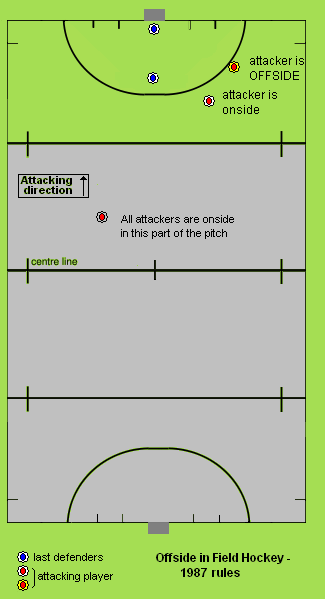

Removing an offside law from a field game is a rare event, and it produced exactly the argument one would expect: whether a sport that had lost its principal restraint on where forwards may stand had gained space or merely lost shape. What can be said without taking a side is that the change was made deliberately, with published objectives, and that offside has not been restored in the near thirty years since.
The 1996 experiment carried three other provisions in with it, of which two were confirmed in 1998: that players may not intentionally enter their opponents’ goal, stand on the opponents’ goal-line or run behind either goal, and that a corner be taken from a spot on the side line five yards from the corner flag. A fourth, requiring all players except the taker to be five yards from the ball at free hits, hits-in and 16-yard hits inside the 25-yard area, was abandoned.
The penalty corner, dated
If offside was the sport’s largest change, the penalty corner is its longest argument. It was introduced in 1908, for offences by defenders in the circle, and in its first form required only that the ball be stopped before a shot — a requirement, the federation’s own history notes drily, that was not umpired rigorously. Because the 1886 rules permitted the hand to be used to stop the ball, the early routine was three-handed: one player injected, a second stopped the ball with a hand, a third struck it. Nearly every subsequent change has been an attempt to manage the same two variables, the number of bodies in front of the goal and the danger of the shot.
- 1949 — deliberate offences by defenders inside the 25-yard area, and persistent offences by defenders at corners, became punishable by a penalty corner. In the same year the circle was enlarged to a radius of sixteen yards.
- 1961 — the number of defenders permitted behind the back line reduced to six; the rest of the defending side had to stand at the 25-yard line.
- 1963 — the remaining defenders moved back to the centre line. In the same year the penalty bully was replaced by the penalty stroke, taken from a spot eight yards out; the spot moved to seven yards in 1975.
- 1975 — the first common rule book for men and women required the ball to be stopped motionless by an attacker before a shot, with no latitude allowed.
- 1982 or 1983 — the use of the hand to stop the ball was prohibited, ending the hand stop and, with it, the three-player routine; the reason reported at the time was that too many goals were being scored from corners. Contemporary press accounts date the prohibition to 1982; the federation’s own chronology puts the abolition of the hand, except by a goalkeeper, in 1983. The conflict is not resolved here.
- 1987 — defenders behind the back line reduced from six to five, the figure still in force; and the first hit at goal was required to cross the goal-line no higher than eighteen inches, the restriction lapsing once the ball had travelled more than five yards outside the circle. It is this rule that introduced the backboards and sideboards now mandatory on every goal, 460 mm high — almost exactly the eighteen inches of the 1987 wording.
- 1995 — substitution was permitted at penalty corners and penalty strokes, and the injection point was fixed at exactly ten yards from the goal post rather than at least ten.
- 1996 — the ball was required to be stopped outside the circle before a shot at goal could be taken.
- 1998 — substitution at penalty corners was withdrawn again, except for an injured defending goalkeeper; and the whole rule book was restated in metric units, the 25-yard line becoming the 23-metre line.
- 2000 — the injection was moved to a marked spot on the back line inside the circle, at least 9.14 metres from the goal post, and a broken white line was marked five metres beyond the circle.
- 2003 — as a mandatory experiment, the ball no longer had to be stopped before a shot, only to travel outside the circle; defenders were permitted to use the stick above the shoulder to stop or deflect a shot at goal.
- 2005 — both 2003 experiments were confirmed as rules.
- 2006 — the maximum bow of the stick was reduced from 50 mm to 25 mm, the stated reason being the power some players could generate with an extremely bowed stick, particularly when shooting.
Two consequences of that sequence are worth naming. The first is technical: because the eighteen-inch limit of 1987 applies to the first hit, specialists moved to the drag flick, a low-slung dragging shot which is not height-restricted in the same way and which also answers the goalkeeper who goes to ground at a hit. It has been the dominant penalty-corner weapon at international level since, and the 2006 restriction on stick bow was a direct response to how hard it had become possible to flick. The second consequence is structural, and is the sport’s standing complaint about itself: a set piece this productive rewards attackers for winning a foul in the circle as much as for shooting from open play, and how far that has shaped the way the game is attacked is argued over every time the rule is revised.
Substitution, time and the shape of a match
The third strand of rule change is about how many players a team may use and for how long they play, and it moves in one direction throughout. The 1886 code allowed no substitutes at all, not even for injury. In 1973 two substitutes were permitted, but a player once replaced could not return. The maximum rose to three in 1989. Then, in 1992, came the change that altered how the game is actually played: substitution could take place at any time, a team officially consisted of sixteen players with eleven on the field, and the rolling substitution was born.
The modern rule is the 1992 rule with the edges filed off. There is no limit to the number of substitutions; they may be made at any point except between the award of a penalty corner and its completion; play is not stopped for them, except for a goalkeeper, and players leave and rejoin at the halfway line. The effect is that a hockey team at any serious level plays in shifts, which is only possible because nobody has to wait for a whistle.
Around that sit the smaller dated changes. Colour control cards — green, yellow and red — entered the rule book in 1979, having been in general use for some years before that; umpires had been empowered to suspend players temporarily as early as 1959, with a minimum of five minutes specified in 1975. Captains were made responsible for their team’s behaviour and substitutions in 1994, the same year goalkeepers were required to wear protective headgear. From 1999 a mandatory experiment allowed the edge of the stick to be used to play the ball, confirmed as a rule in 2002. In 2001 goalkeepers were confined to the half they were defending. From 2007 the rules moved to a two-year publication cycle, and teams were permitted to play either with a goalkeeper or entirely with field players, in which case nobody has goalkeeping privileges.
In 2009 the federation introduced the self-pass: a player taking a free hit may play the ball to themselves and continue. The stated purpose was free-flowing hockey, and the same revision closed off the other end of the problem by forbidding a free hit in the attacking 23-metre area to be played straight into the circle, which had become a hard and potentially dangerous habit, used to win penalty corners off a defender’s foot or stick. It is a small rule that changed the texture of the game considerably: a free hit stopped being a pause.
Match length went last. A hockey match was two halves of thirty-five minutes for the whole of the twentieth century. From 2014 some international matches were played as four quarters of fifteen minutes, with two-minute breaks between quarters and five at half-time; the format was used for both tournaments at the 2018 Commonwealth Games. In December 2018 the federation announced that quarters would be universal from January 2019. National associations adapted at their own pace: England Hockey confirmed the change would take effect at the start of the 2019–20 season and then, in July 2019, settled on quarters of 17.5 minutes for elite domestic club matches only. Taken with the loss of offside, the rolling substitution and the self-pass, the direction of travel over thirty years is consistent enough — fewer stoppages, more space, more substitutes, a quicker game to watch.
The video umpire and the referral
One further piece of machinery deserves a note, because hockey adopted it early and quietly. At world-level competitions where the facilities exist, a video umpire is appointed alongside the field and reserve umpires, and the role is deliberately narrow: it exists to decide whether a goal has been legally scored. The video umpire may rule on whether the ball crossed the goal line between the posts and under the bar; whether it was legally played or touched inside the circle by an attacker’s stick; whether, at a penalty corner, it travelled outside the circle before the shot; and whether a breach occurred in the attacking 23-metre area in the play leading to a goal being given or refused, which the field umpire then takes into account.
The referral may be asked for by a player of either team as well as by a field umpire, and the team’s right is rationed: one referral per team per match, retained if successful and forfeited if not, with no limit on referrals initiated by the umpires themselves. That arrangement is set out in the federation’s tournament regulations for outdoor competitions of October 2012, which is more than five years before association football wrote the video assistant referee into its Laws of the Game on 3 March 2018. The design is a useful contrast: hockey restricted the technology to the goal, and made part of it a resource the teams themselves must spend.
The surface, which changed everything else
The most consequential change in the modern history of this sport was not a rule at all. It was the ground.
The rule book registered the shift before the Olympic programme did. Until 1975 a note to the rules stated that matches did not have to be played on grass provided the surface was suitable; in the 1975 rewrite that note was deleted altogether, in explicit recognition of the growing use of synthetic surfaces, leaving the rules silent on what a hockey pitch is made of. The contemporary case for the change was made in the sport’s international magazine, World Hockey, that same year:
Artificial grass permits easier ball control and this in itself helps to reduce the number of infringements of the rules—which means less whistle and fewer stoppages. The game thus becomes easier to follow, as well as being a faster spectacle and much more interesting from a spectator point of view.
In 1976 the federation made artificial pitches mandatory at all major competitions. The Olympic tournament at Montreal that year was the first played on one, at a point when few of the players had seen or played on a synthetic pitch. It is still permissible to play on grass, but every national competition and international match must be played on an artificial surface, and the elite tournaments — the Olympic Games and the World Cup — require a water-based one.
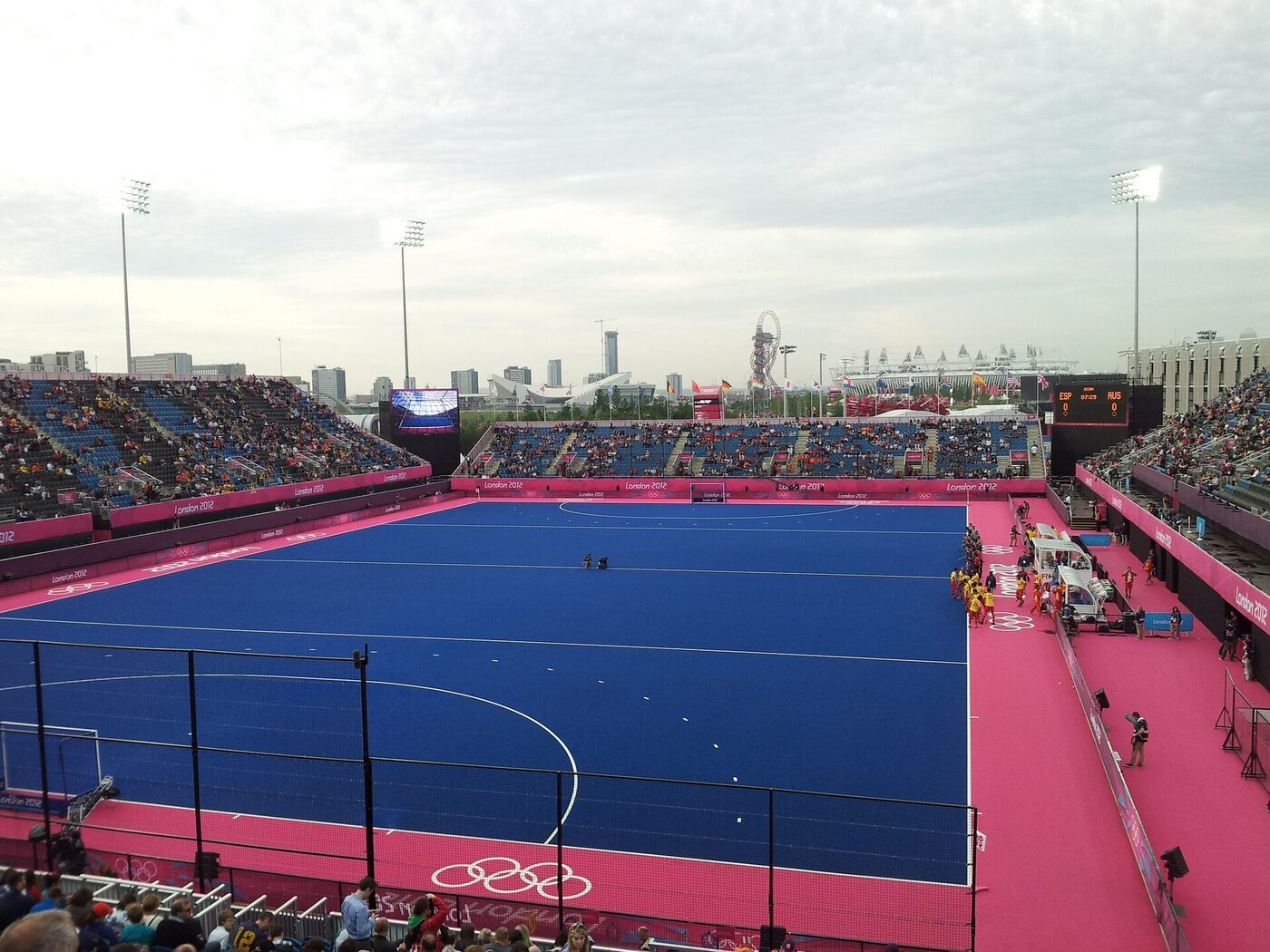

The three surfaces in use are not interchangeable, and the difference is the whole story. A water-based or unfilled pitch has short, densely packed fibres and must be irrigated; the wetted turf reduces friction and the ball runs faster and truer than on anything else. A sand-dressed pitch supports the fibres with sand for part of the pile depth; a sand-filled one for all of it. Sand-dressed costs more than sand-filled and is preferred for hockey because there is no sand at the playing surface. Water-based pitches must be watered before, during and after a match, and their maintenance costs are, in the sober phrasing of the pitch specifications, significant. The federation has for some years acknowledged that watering a pitch is not a long-term sustainable practice; after its 2018 congress it decided that new surfaces should be of a hybrid kind requiring less water, and alternative elite surfaces that need none are still being looked for.
Two things follow, and only one of them is about sport. The first is technical: the ball runs true, so control is easier, passing is flatter and faster, the number of stoppages falls, and the individual dribbling skills that grass rewarded — where an uneven bounce is an attacker’s ally — matter less than collective speed and positional discipline. The second is financial. A grass pitch is mown; a synthetic pitch is built, resurfaced on a cycle, and in the water-based case irrigated at every match. Once the major competitions were compulsorily played on a surface that had to be capitalised, the sport acquired an entry cost it had never had, and it has been argued from the beginning — in the Indian press most insistently — that the decision favoured the more affluent countries that could lay pitches in quantity. How much of the reshaping of the international order it accounts for, as against money, coaching and administration, is one of the sport’s permanent arguments, and it divides along national lines.
One late footnote belongs here because it is precisely the kind of thing this newsgroup’s successors argued about. The London Olympics of 2012 were played on a blue pitch with a contrasting surround, and the practice spread: on artificial surfaces the field of play may be green, ultramarine blue or signal blue, and blue was adopted because it makes ball and markings easier to see on television. A sport that had changed its ground to be watched then changed its colour for the same reason.
The record in numbers
The turf argument is easiest to weigh with the honours written out, and the break at Montreal is visible without commentary.
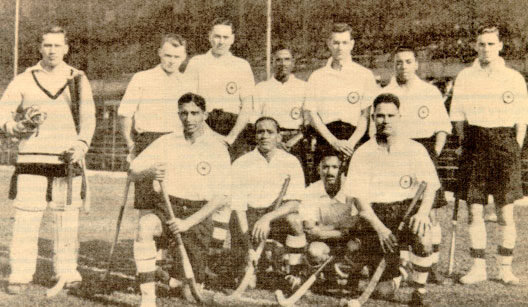
In the men’s Olympic tournament, twenty-five editions have been decided. India has eight golds — 1928, 1932, 1936, 1948, 1952, 1956, 1964 and 1980 — six of them consecutive from 1928 to 1956, and seven of the eight Games from 1928 to 1964. Germany and West Germany have four, in 1972, 1992, 2008 and 2012. Great Britain has three, in 1908, 1920 and 1988; Pakistan three, in 1960, 1968 and 1984; the Netherlands three, in 1996, 2000 and 2024. New Zealand won at Montreal in 1976, Australia in 2004, Argentina in 2016 and Belgium at the postponed Games of 2020. Of the thirteen titles decided from 1976 onwards, subcontinental teams have taken two.

The World Cup gives the same shape with different names. Through the sixteenth edition, held at Wavre and Amsterdam in August 2026 and won by Germany, who beat Spain 1–0, the honours stand at four titles each for Germany (2002, 2006, 2023, 2026) and Pakistan (1971, 1978, 1982, 1994), three each for the Netherlands (1973, 1990, 1998) and Australia (1986, 2010, 2014), and one each for India (1975, beating Pakistan 2–1 in Kuala Lumpur) and Belgium (2018). Six countries have won it in sixteen attempts.
The women’s record is a separate lineage with its own dates and a much narrower field. The Olympic tournament was added at Moscow in 1980 and won by Zimbabwe. Since then the Netherlands has won five times, in 1984, 2008, 2012, 2020 and 2024; Australia three, in 1988, 1996 and 2000; and Spain, Germany and Great Britain once each, in 1992, 2004 and 2016. The women’s World Cup has been won by only four countries in sixteen editions: the Netherlands nine times, Argentina three — the most recent in August 2026, beating the Netherlands 3–1 on a shoot-out after a 1–1 draw — and Australia and Germany twice each. Six winners in sixteen editions of the men’s tournament against four in sixteen of the women’s: the concentration is a feature of the women’s game, not of the sport.
Set beside that, the Champions Trophy tally quoted above is the same story told annually rather than every four years: fifteen men’s titles for Australia, ten for Germany, eight for the Netherlands, three for Pakistan and none for anyone else in Asia. Where a competition ran often enough to average out a good week, the concentration was tighter still.
Two declines, on different clocks
The two subcontinental hockey nations are usually spoken of together and their trajectories are not in fact the same. Both are matters of record and both are set out here without a verdict, because a newsgroup did not settle them and neither will a reference page.
India returned from Montreal in 1976 without a hockey medal for the first time in the sport’s Olympic history, then won the last of its golds at Moscow in 1980, in a six-team tournament thinned by boycott. From there it went forty-one years without an Olympic hockey medal, until a bronze at the Tokyo Games held in 2021, followed by a second bronze at Paris in 2024. Its single World Cup remains 1975. Its domestic infrastructure in the meantime has been substantially rebuilt, with a state government taking on the national teams’ sponsorship from 2018 and two World Cups hosted in Odisha within five years.
Pakistan’s clock runs about a decade earlier and has not turned. Its last Olympic hockey medal was a bronze at Barcelona in 1992; it finished sixth at Atlanta in 1996, the point from which its own accounts date the decline, and fourth at Sydney in 2000, the last time it played for an Olympic medal; its last World Cup was won in 1994. It failed to qualify for an Olympic tournament for the first time in 2016 and has missed the three editions since. It was suspended from the first Pro League season in January 2019 for being unable to play its opening matches, and was relegated from the competition ahead of the 2025–26 season. The country whose air marshal invented both the World Cup and the Champions Trophy has now gone more than thirty years without winning either.
How much of either story belongs to the pitch, and how much to money, coaching, selection and administration, is the argument; the sequence of dates is not in dispute. Field hockey remains the national sport of Pakistan throughout it. Meanwhile the countries that came up are the ones the surface and the calendar favoured: the Netherlands, Germany and Australia through the 1980s and 1990s, Belgium and Argentina in the 2010s, the latter with an Olympic gold in 2016 for the men and three world titles for the women.
What a newsgroup did for a sport television mostly ignored
Here is the honest case for a group like this one, and it does not require inventing a single thread. Field hockey in the 1990s was a global sport with a full international calendar and almost no broadcast presence outside a handful of countries. Outside the Netherlands, Germany, Australia, India, Pakistan and a few others, a follower of the sport could not watch a World Cup pool match, could not read a report of one in a general newspaper, and had no wire service to consult. The sport’s own magazine arrived by post. What existed instead was an unmoderated newsgroup whose charter promised to discuss “the various national and international events connected with this sport”, at a moment when the network reached universities and research institutions in every country that played the game.
The kinds of traffic such a group necessarily carried can be described from the shape of the sport without attributing any of it to a named poster, and that is the limit of what should be said. A tournament is a fortnight of results that a follower elsewhere has no other way of learning. A rule book that changes on a published cycle produces questions from umpires and coaches about what the change means in practice, and answers from people who have already had to apply it. A club sport produces fixture announcements, tour requests, queries about sticks and about which surface a club should lay, and parents asking practical questions on behalf of children who have taken the game up. An international sport whose leading nations are spread across five continents produces exactly the situation that Usenet was best at: people who would otherwise have met only at a tournament, in one room, out of season.
That is a different function from the one performed by the parent group, which served a sport already covered exhaustively by newspapers, radio and television in its heartlands, and whose newsgroup added argument and statistics to a torrent of existing coverage. Here the newsgroup was closer to being the coverage. It is also why the group could stay one room for its whole life: a sport with a modest online population and a single calendar does not generate the pressure to split that a continental professional league does. rec.sport is full of groups that fragmented into leagues, teams and score-only children; this one never needed to, and the archive shows no proposal that it should.
The limits should be stated as plainly as the case. A newsgroup reached the people who had network access, which in the early 1990s meant, in most of the sport’s countries, university students and staff and a thin layer of technical professionals. That is a particular slice of any sport’s following, and in South Asia in that decade a very thin one. Whatever the group was, it was not a representative sample of the people who play this game.
What the record does not show
Almost everything about the inside of this group is gone, and the honest thing is to say so rather than to fill the space. No subscriber estimate for rec.sport.hockey.field survives from any of the traffic surveys of the period that this compiler has been able to consult. No message counts, no ranked-group listings, no readership figures. No moderator existed, so there is no moderator’s log or annual report of the kind that survives for some moderated groups. There was no periodic FAQ posting that has come down in the news.answers archive under this group’s name.
Nor is there any documentary trace of the discussion the creation vote implies. The Call for Votes, from which the charter was quoted by the moderator, does not survive in the news.announce.newgroups mirror; neither does the Request for Discussion that must have preceded it, nor the result posting of 19 December 1991 that the newgroup message cites. We know 187 people voted and that 157 of them wanted the group, and we do not know who proposed it, what was argued in news.groups, or whether anybody suggested the alternative name that would have made both codes qualify.
What survives, then, is a birth certificate, two propagation messages, a charter of one sentence, a description line that has not changed in more than three decades, and an entry in the active file. For a Big-8 group of the early 1990s that is a normal amount of evidence, and it is enough to say precisely what the group was for and nothing at all about who was in it.
Scope and limits
This page is about the newsgroup and about the sport it existed to discuss. Everything above concerning the ice game — its own group, the subtree that was proposed and never built, the naming question and the paperwork that settles it — belongs to rec.sport.hockey and is treated there at length; the sentences given to it here are statements of outcome, not a summary of the case. The general politics of naming a code in this hierarchy, and the mechanism by which groups in it split, belong to the branch hub for rec.sport.
Dates and figures in this article have been taken from the sport’s own published rules chronology, from the Internet Systems Consortium’s Usenet archives for anything concerning the group itself, and from standard encyclopaedic references for tournament results, which were checked against the results tables rather than against summaries. Where a source conflicts with another — as over the year the hand stop was banned — the conflict is stated rather than reconciled silently. Where a claim about the group’s readership could not be documented, it has been left as a description of the sport rather than dressed up as a description of the group.
Nothing here is a judgement about the merits of any rule change, any surface, or any national sporting administration. Those were argued at the time by the people the arguments belonged to, and this page’s job is to record when and with what result, not to take a side thirty years later.
Reading rec.sport.hockey.field today
- Historical archive: Google Groups — rec.sport.hockey.field (coverage varies by group and era).
- Open in a newsreader:
news:rec.sport.hockey.field— the original site offered exactly this link, and it still works if your system has a newsreader registered for thenews:scheme. - Live access: point an NNTP newsreader at a modern server — see accessing Usenet today.
- The original news2mail e-mail subscription service ended in the mid-2000s and no longer operates.