sci.psychology.psychotherapy
Research and practice of psychotherapy.
Outcome research, therapy-modality comparisons (CBT, psychodynamic, humanistic) and ethics discussed at the boundary of clinicians and researchers.
The empirically-supported-treatments debate of the era is well represented, sources and all.
On this page
- A room made by vote
- Three audiences, one text file
- The outcome question, dated
- Empirically supported treatments, and the fight over them
- The schools in the room
- The professional and economic context
- The 1996 attempt to put a gate on the room
- The moderated sibling, 1997 to 2010
- Ethics on a public network
- What the room could and could not be
- Scope and limits
A room made by vote
sci.psychology.psychotherapy was created by control message on 12 June 1995. It was one of eight groups brought into being that day by a reorganisation of the sci.psychology namespace: ten had been placed on a single ballot, eight passed, and the two that failed were a group for unrefereed journals and a marketplace group. The proposal was put by John M. Grohol, whose name recurs throughout this page; the wider story of psychology on Usenet is told on the alt.psychology page and is not retold here. What belongs to this page is narrower: the single paragraph the proposers wrote to define this particular room, and the unusual audience that paragraph invited into it.
The charter, reproduced in the control message that created the group, ran as follows.
This newsgroup is for the discussion of all different modalities of psychotherapy, their efficacy, and their acceptance within the scientific psychology community. Future newsgroups, as needed, may be proposed to subdivide this topic into more specific areas, such as sci.psychology.practice.behavioral. Examples of appropriate topics for this newsgroup might be discussion of techniques used in IPT, cognitive-behavioral therapy, RET, client-centered therapy, etc. Ethical issues in practice as well as specific psychological techniques may also be discussed.
Three things in that paragraph are worth noticing before anything else. It names efficacy in its second clause, which is to say the group was chartered around an empirical question rather than a subject. It names four modalities — interpersonal therapy, cognitive-behavioural therapy, rational-emotive therapy and client-centred therapy — as examples and refuses to rank them. And it admits ethics as a topic in its own right, alongside technique. A charter is a short document and this one is unusually well aimed: nearly everything the group would spend a decade arguing about is already in it.
The sci.* branch conferred a particular kind of standing. Big Eight groups were not simply willed into existence; a proposal had to pass through a Request for Discussion, a Call for Votes run by a neutral votetaker, and a published result with the tally attached, after which a control message went out and each news administrator decided whether to honour it. Passage required both a two-thirds majority of the valid votes and at least a hundred more yes votes than no votes. This group cleared both bars, 122 to 18, and the result was announced in news.announce.newgroups at the beginning of June 1995. What the procedure bought a group was not authority over its readers but confidence among administrators, and therefore propagation: a sci.* group appeared on servers in universities and companies that carried very little else. It also bought a charter that existed as a public document, which anyone in an argument could quote — and did.
Its neighbours in the branch, once the reorganisation had settled, were sci.psychology.misc (which replaced the old catch-all sci.psychology), sci.psychology.theory, sci.psychology.personality, the moderated sci.psychology.announce and sci.psychology.consciousness, two moderated groups carrying electronic journals — sci.psychology.journals.psyche and sci.psychology.journals.psycoloquy — and the moderated sci.psychology.research, which predated the reorganisation and was left unchanged by it. The one-line entry for this group in the master newsgroups file that administrators install to describe the namespace still reads as it did in the control message of 1995: Practice of psychotherapy.
Three audiences, one text file
The proposal that created the group gave two reasons for wanting it, and both concerned who would be in the room. The first was to relieve the professional mailing lists: the rationale pointed at the InterPsych lists, naming psycho-therapy among them, and described them as having a very large volume and a subscription base of over 500 professionals. The second reason was stated plainly and is the more consequential of the two — the group would give professionals a place to interact directly and answer questions from consumers of mental health, in the way the proposers thought sci.med.psychobiology already did for psychotropic medications.
That intention is visible in the paperwork as well as the prose. The Call for Votes was crossposted to the newsgroups in the usual way and then, the document states, sent on to four mailing lists: the InterPsych Psychotherapy-Practice and Psychotherapy-Research lists, Psycoloquy and the Psyche discussion list. Part of the electorate that voted this group into existence was recruited from professional mailing lists, which is not how most Usenet groups acquired their founding constituency.
What the design could not supply was any way of keeping those constituencies distinct once they had arrived. A newsgroup is a single flat sequence of articles. There are no roles, no rooms within the room, no registration and no credential of any kind: a subscription-only mailing list at least required someone to have been added to it, whereas a Big Eight newsgroup was carried, unasked, on every server that took the branch. A clinician writing about supervision, a graduate student asking about effect sizes and a reader describing a bad experience of therapy all appeared in the same thread list, in the same typeface, in whatever order their articles happened to arrive. The standing tension of the group follows from that arrangement rather than from anybody's behaviour, and every subsequent episode in its history is a response to it.
The outcome question, dated
The argument the group inherited was nearly sixty years old by 1995, and it is worth setting out in order, because the newsgroup's charter turns on it and the dates do real work.
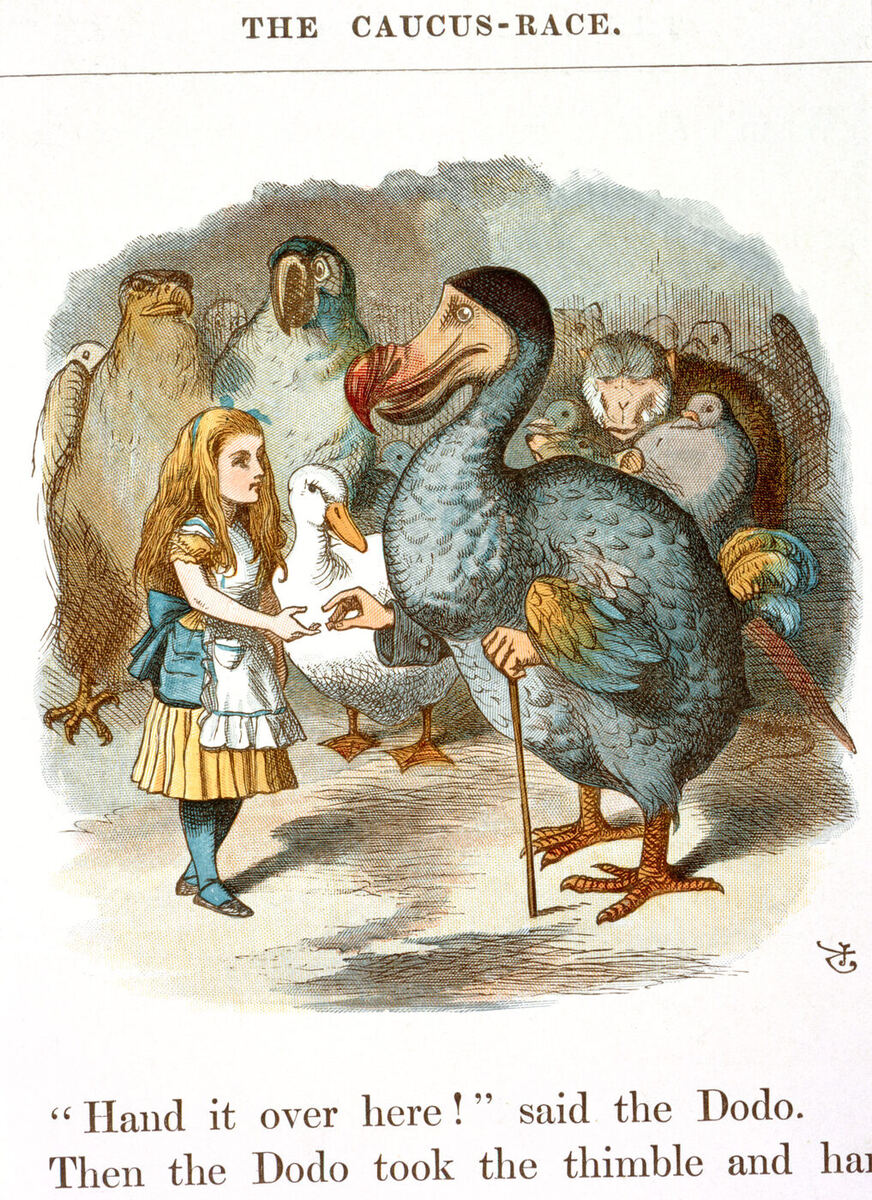
In 1936 Saul Rosenzweig published Some implicit common factors in diverse methods of psychotherapy in the American Journal of Orthopsychiatry. Borrowing the Dodo's line from Lewis Carroll's Alice's Adventures in Wonderland — everybody has won and all must have prizes — he argued that what different therapies shared mattered more than what distinguished them, and that they might therefore produce much the same results. The formulation acquired a name much later and is now generally called the dodo bird verdict.
_-_c06543_02.jpg)
In 1952 Hans Eysenck published The effects of psychotherapy: an evaluation in the Journal of Consulting Psychology. Reviewing the data then available, he concluded that they failed to support the hypothesis that psychotherapy facilitates recovery from neurotic disorder. The paper is conventionally treated as the starting point of modern psychotherapy outcome research, largely because so much of the field spent the following twenty-five years trying to answer it.
The answer, when it came, arrived with a new technique attached. In 1976 Gene V. Glass, writing in Educational Researcher, coined the term meta-analysis for the statistical aggregation of results across studies. The following year Mary Lee Smith and Glass published Meta-analysis of psychotherapy outcome studies in American Psychologist — the first large application of the method to this question. A book-length treatment by Smith, Glass and Thomas I. Miller, Benefits of Psychotherapy, followed in 1980 from Johns Hopkins University Press. Eysenck was unpersuaded and said so in 1978 in American Psychologist, under the title An exercise in mega-silliness; the objection was to the method, not merely to the conclusion.
Meanwhile the comparative question had been reopened. In 1975 Lester Luborsky, Barton Singer and Lise Luborsky published a review in Archives of General Psychiatry which took the Dodo's line for its title and reported few significant differences in outcome between the psychotherapies compared. That paper is what turned Rosenzweig's aside into a research programme, and it produced a generation of studies arguing both sides.
The most widely discussed trial of the period was the National Institute of Mental Health Treatment of Depression Collaborative Research Program. Its main outcome paper — Irene Elkin and colleagues, Archives of General Psychiatry, November 1989 — reported on 250 outpatients with major depressive disorder diagnosed by Research Diagnostic Criteria, randomly assigned to one of four sixteen-week conditions: interpersonal psychotherapy, cognitive behaviour therapy, imipramine plus clinical management as a standard reference treatment, and placebo plus clinical management. Patients in all four showed significant reduction in symptoms and improvement in functioning. In the primary analyses there was no evidence that either psychotherapy outperformed the other, and no evidence that either was significantly less effective than the drug condition; against placebo plus clinical management there was limited evidence of specific effectiveness for interpersonal psychotherapy and none for cognitive behaviour therapy. Secondary analyses splitting patients by initial severity found significant differences among treatments only in the more severely depressed and functionally impaired group. A trial designed to settle the comparative question had instead furnished quotable material to every party in it, which is roughly what happened to the literature as a whole.

.jpg)
Running alongside was the common-factors tradition, which held that the ingredients shared by therapies — the relationship, the rationale, the expectation of help — carried most of the effect. Jerome Frank's Persuasion and Healing of 1961 is its landmark statement; the empirical strand concentrated on the therapeutic alliance, and a meta-analysis by Daniel Martin, John Garske and M. Katherine Davis in the Journal of Consulting and Clinical Psychology in June 2000, aggregating 79 studies, reported the alliance-outcome relation to be moderate but consistent regardless of most of the variables thought to modify it. Bruce Wampold's The Great Psychotherapy Debate, published in 2001, argued the common factors case at book length. The opposing position — that particular treatments outperform others for particular conditions, and that the differences are what should guide practice — was argued just as vigorously and by people with just as much data. Both were live positions during the years such groups were busiest, and neither had conceded by the time it emptied.
Empirically supported treatments, and the fight over them
The dispute that dominated clinical psychology while this group was running began with a committee. In 1993, as president of Division 12 of the American Psychological Association — the clinical psychology division — and acting on an initiative from the division's Section III, David Barlow appointed Dianne Chambless to chair a Task Force on the Promotion and Dissemination of Psychological Procedures. Its brief was to develop criteria for evaluating psychological treatments empirically and to recommend how the results should be communicated to psychologists, to the public and to those paying for services. The context was not academic: the motivating pressures, as the task force's own published history records them, were concern about the future of psychological services under managed health care and a rising emphasis on accountability and cost containment.
The task force made three decisions that shaped everything afterwards. It evaluated treatments disorder by disorder rather than in general. It graded them into two categories, well-established and probably efficacious. And it set the boundary of what counted as a treatment by the availability of a treatment manual — which meant that an approach without a manual was not so much rejected as unassessable. Membership was deliberately drawn across theoretical orientations and occupational settings, which did not prevent the result from being read as a verdict on schools.
The paperwork trail is dated and public. A preliminary version was presented at the APA convention in the summer of 1993 and adopted by Division 12 that October. The report generated enough controversy that in 1994 the task force added an epilogue addressing what it considered common misconceptions — clarifying that the list was preliminary and incomplete, that a range of formats counted as a treatment manual, and, pointedly, that the list was not intended to guide payment for psychological services. In February 1995 the report was adopted by the APA Council of Representatives, and later that year the report with its epilogue appeared in the division's newsletter, The Clinical Psychologist. The initial report listed eighteen treatments as empirically supported and seven as probably efficacious.
It was then treated as a standing process rather than a document. The task force was renamed the Task Force on Psychological Interventions in 1995, with Chambless again as chair; an updated report followed in 1996, opening with caveats about the use of the list and closing with an addendum from Division 12 disclaiming any intention that it be read as treatment guidelines or used to decide payment. A further update, presented in mid-1997 and published in 1998, listed sixteen empirically supported treatments and fifty-six probably efficacious ones. Chambless and Steven Hollon set out the criteria formally in Defining empirically supported therapies in the Journal of Consulting and Clinical Psychology in 1998, and Chambless and Thomas Ollendick reviewed the whole controversy in the Annual Review of Psychology in 2001.
The case for the lists, as its proponents made it, was that psychology could not ask to be treated as a health science while declining to say which of its procedures had survived controlled testing, and that a profession which would not answer the question would find the question answered for it by insurers. The case against came in several distinct forms, and they are worth separating because they were often run together in argument.
- Manuals do not describe practice. The most-cited statement of this objection is Drew Westen, Catherine Novotny and Heather Thompson-Brenner, The empirical status of empirically supported psychotherapies: assumptions, findings, and reporting in controlled clinical trials, in Psychological Bulletin in July 2004. It questioned the assumptions built into the trials themselves — among them that patients present with one disorder at a time, and that manualised brief treatment resembles what practitioners deliver. The journal ran three comments and an authors' reply in the same issue, and two further comments with a reply in May 2005, which is a reasonable index of how much was felt to be at stake.
- Efficacy is not effectiveness. A treatment that works in a trial with screened patients and supervised therapists may not work in ordinary practice. Martin Seligman put the point in The effectiveness of psychotherapy: the Consumer Reports study, in American Psychologist in December 1995, arguing from a large consumer survey that the field's standard trial design measured the wrong thing; Hans Strupp replied in the same journal in October 1996 with The tripartite model and the Consumer Reports study.
- Allegiance. Luborsky and colleagues argued in 1999 that the researcher's own therapeutic allegiance functioned as a wild card in comparisons of treatment efficacy — that who ran the trial predicted a good deal of which therapy won it.
The eventual institutional settlement came after the years in which such groups were busiest. The APA's 2005 Presidential Task Force on Evidence-Based Practice drafted a policy statement that the association's Council of Representatives adopted as association policy in August 2005, and published its reasoning as Evidence-based practice in psychology in American Psychologist in 2006. Research, clinical expertise and patient characteristics were all held to be relevant to good outcomes — a formulation broad enough to accommodate several of the positions above, which was rather the point. None of this stopped the argument; it relocated it.
That the newsgroup was a venue for this is not an inference. The word efficacy sits in its 1995 charter; the charter proposed for its moderated sibling two years later listed research relevant to psychotherapy, diagnostic issues, therapist training and supervision, and trends in practice among its appropriate topics, and put career issues, establishing a private practice and coping with managed care on the same list. The economics and the evidence were understood to be one subject.
The schools in the room
The charters listed modalities without ranking them, and this article follows them in that. What follows is a register of the traditions whose adherents were present, with dates where dates are documented.
- Psychodynamic and psychoanalytic. The oldest tradition in the room and the one with the deepest internal divisions; object relations theory appears by name in the 1997 moderated charter as an example of a theory that could be discussed as it bore on the material of therapy. Analytical psychology and its founder are treated separately on the alt.psychology.jung page and not duplicated here.
- Behavioural. Joseph Wolpe's Psychotherapy by Reciprocal Inhibition, published by Stanford University Press in 1958, gave the tradition systematic desensitisation and much of its early clinical technique; the British strand ran through Monte Shapiro and Hans Eysenck at the Institute of Psychiatry in London, and the underlying learning theory through John B. Watson and B. F. Skinner.
- Cognitive and cognitive-behavioural. Albert Ellis presented rational therapy in 1955, the approach later known as rational-emotive and then rational emotive behaviour therapy — the RET of the 1995 charter. Aaron Beck's monograph on depression of 1967 set out the cognitive account, and his first treatment manual, Cognitive Therapy of Depression, written with A. John Rush, Brian Shaw and Gary Emery, appeared in 1979. That manual is one reason cognitive therapy was among the first approaches testable on the terms the trials demanded, which is a fact about manuals as much as about therapies.
- Humanistic and person-centred. Carl Rogers set out the approach in Counseling and Psychotherapy in 1942 and named it in Client-Centered Therapy in 1951, later preferring person-centred; On Becoming a Person followed in 1961. Rogers also ran empirical studies of his own methods' effectiveness, a detail that complicates the usual filing of humanistic therapy as the anti-empirical wing.
- Family and systemic. The double bind hypothesis of Gregory Bateson, Don Jackson, Jay Haley and John Weakland, published in Behavioral Science in 1956, is the usual starting point; Salvador Minuchin developed structural family therapy, which maps the relationships between family members and subsystems rather than treating an individual alone.
- Interpersonal psychotherapy. First developed in 1969 at Yale, under the name high contact therapy, as part of a study designed by Gerald Klerman, Myrna Weissman and colleagues; brief and time-limited by design, and one of the two psychotherapies tested in the NIMH collaborative trial. It is the IPT of the group's charter.


Newer methods were contested while the group ran, and the contest is a matter of record rather than of this article's opinion. Eye movement desensitisation and reprocessing was devised by Francine Shapiro in 1987 and argued over from the moment it was published. The recovered-memory controversy ran through the same decade, with the False Memory Syndrome Foundation founded in March 1992 and litigation, professional inquiries and mutual accusations of bad faith continuing for years. Both belong in an account of what the room argued about; neither is adjudicated here.
The proposed charters drew exactly one substantive line between methods, and it was a modest one. The 1997 moderated charter said there would be no restriction on the types of therapeutic modality that could be discussed, save for treatments that seemed to have no obvious connection to psychology — its examples were palm-reading and crystals — which would not be accepted unless a clear and plausible connection was made. Everything else was in.
The professional and economic context
A reader arriving from a subject directory in 2001 would have needed the surrounding world explained more than the therapies. Three parts of it mattered most.
DSM-III and what it changed for research
The third edition of the Diagnostic and Statistical Manual of Mental Disorders, published in 1980 by a task force that Robert Spitzer had chaired since 1974, replaced the descriptive, largely psychodynamic idiom of its predecessors with explicit operational criteria and a multiaxial scheme. Diagnostic reliability was the design goal — the revision followed work by Spitzer and Joseph Fleiss showing the second edition to be an unreliable instrument — and the reason that was the design goal is directly relevant to this page: if two clinicians assign different diagnoses to the same patient, research into causes and treatments has nothing stable to attach itself to. Outcome trials of the kind the NIMH ran, and lists of treatments graded disorder by disorder, both presuppose that the disorder in question means the same thing in one city as in another. The manual's critics — on reliability in ordinary practice, and on the medicalisation of distress — were audible throughout, and the argument did not end with the edition. DSM-III was revised in 1987 and replaced by DSM-IV in 1994, with a text revision in 2000.
Managed care
In the United States, managed care — a family of techniques for containing cost through utilisation review, selective contracting and benefit design, given its impetus by the Health Maintenance Organization Act of 1973 — had become the predominant arrangement by the 1990s. Mental health benefits were commonly separated out and handed to a specialist vendor under a carve-out contract: Pamela Peele, Judith Lave and Yihua Xu, writing in the Journal of Behavioral Health Services and Research in November 1999, opened by observing that more than half of Americans with insurance coverage for mental health services were by then enrolled in plans that carved those services out to such a vendor, and that utilisation management had not taken the place of benefit limits.
The federal Mental Health Parity Act, signed on 26 September 1996 and applying to group health plans for plan years beginning on or after 1 January 1998, is the clearest documentary evidence of where the pressure fell. It required that annual and lifetime dollar limits on mental health benefits be no lower than those for medical and surgical benefits — and expressly left employers their discretion over cost sharing, over medical-necessity requirements, and over limits on the number of visits or days of coverage. The statute closed one door and named the others as open; insurers and employers used them, and commentary at the time recorded the shift towards higher copayments and tighter visit and day caps. Close to nine hundred state laws regulating managed care were passed during the decade, which indicates how contested the arrangements had become. The research literature on effects was itself mixed: studies of individual carve-outs reported reductions in cost without the reductions in service that critics predicted, while the Peele study found that benefit limits bound only a small proportion of enrollees but bore hardest on children where inpatient limits were concerned. The one thing not in dispute is that a clinician's treatment plan had acquired a reader outside the room.
Who was allowed to call themselves what
The titles differed by country in ways that made cross-border argument confusing, and the group was international. In the United States, licensure sat with the individual states, and psychologists, psychiatrists, clinical social workers, marriage and family therapists and licensed counsellors were distinct regulated categories with distinct training routes; a psychiatrist held a medical degree and could prescribe, and a psychologist in general could not. In the United Kingdom, psychotherapy and counselling had no statutory register at all during the group's active years: the United Kingdom Council for Psychotherapy, which had grown out of a standing conference formed in the wake of the Foster report of 1971 and the Sieghart report of 1978, was formally inaugurated as a council in 1993, and the British Association for Counselling — founded in 1977, itself out of an earlier standing conference — added psychotherapy to its name only in September 2000. Voluntary registration by professional body, rather than protection of title by statute, was the British model of the period.
Germany moved in the other direction, and the timing is striking. The Psychotherapeutengesetz was dated 16 June 1998 and came into force on 1 January 1999, creating the protected professions of Psychologischer Psychotherapeut and Kinder- und Jugendlichenpsychotherapeut and allowing patients to consult one without going through a doctor first. Before it, only physicians with the appropriate additional qualification could provide psychotherapy under statutory health insurance as panel practitioners; psychologists reached patients through a delegation procedure in which a doctor retained responsibility, or through a reimbursement route that was in principle less restricted as to method.
German statutory insurance also answered, administratively, the question the newsgroup argued. Psychotherapy had been taken into panel care in 1967 through the Psychotherapie-Richtlinien, and the guideline procedures they recognised were at first only the psychoanalytically founded ones — analytic psychotherapy and depth-psychology-based psychotherapy. Behaviour therapy was added in 1987. A method outside the list was not reimbursed, whatever the trial evidence said: a research report commissioned by the federal government and delivered in 1991 by A.-E. Meyer and colleagues concluded that excluding client-centred therapy was unjustified given the empirical findings on its clinical effectiveness. Systemic therapy was admitted to the adult list only at the end of 2018, two decades after the years in which such groups were busiest. A list of approved procedures, maintained by a payer, with an evidence argument attached to every addition, is the empirically-supported-treatments dispute conducted by other means.
The 1996 attempt to put a gate on the room
On 15 May 1996, eleven months after the group was created, John M. Grohol posted a Request for Discussion proposing that sci.psychology.psychotherapy be converted from unmoderated to moderated. The rationale is the most detailed contemporaneous description of the group that survives, and it is worth quoting rather than paraphrasing.
Since this newsgroup was created a year ago, it has acted as a dumping ground for any miscellaneous article an author feels is appropriate, without regard to the group's charter. Instead of becoming a niche for professionals and laypeople alike to discuss psychotherapy techniques and similar topics, it has become a foggy mirror of sci.psychology.misc [...] Dozens of professionals who have contacted me in the past year have stated their desire to utilize the forum for discussions of psychotherapy topics, but are fearful to do so because of the flames and personal insults they have observed on it.
The proposal was careful to concede that criticism of psychotherapy was appropriate to the forum; the complaint was about volume and manner rather than about dissent. It offered a panel of five named moderators, four in the United States and one in Norway, and described the moderation as loose — a filter to screen out irrelevant articles, personal attacks and irrelevant political debate, and, in its own words, not the Usenet equivalent of editing a journal.
The discussion changed the proposal. A second Request for Discussion on 24 May listed the amendments made in response: a rationale added for moderating the existing group rather than creating an additional one, two more tentative moderators, psychopharmacology moved from the objectionable list to the appropriate one, and a set of edits to the submission guidelines whose stated purpose was to reduce the ability to edit a submission before approving it, to reduce the power of moderators to act individually or abusively to censor a poster, and to make the acceptance criteria more liberal. The revised text also characterised the group's traffic as relatively low volume, at less than 200 articles per day — the only contemporaneous figure of any kind for how busy the group was, and a proponent's characterisation rather than a count. The opposition's case is legible in that list even though the opposing articles themselves are not reproduced here: what worried people was the panel's discretion, and the panel's discretion is what got trimmed.
The voting period closed at 23:59:59 UTC on 12 July 1996 and the result was posted the following day by Jani Patokallio of the Usenet Volunteer Votetakers: 125 in favour, 48 against, 173 valid votes, two abstentions and two invalid ballots. The proposal failed. It is worth being precise about why, because the arithmetic is easy to misremember. At 125 to 48 the proposal cleared the two-thirds bar comfortably and missed the hundred-vote margin by twenty-three. A clear majority of those who cared enough to vote wanted the gate; the rules were written so that a clear majority was not enough.
The moderated sibling, 1997 to 2010
The following spring a different tack was tried. On 2 May 1997 Ed Anderson and Paul Bernhardt proposed a new group, sci.psychology.psychotherapy.moderated, leaving the existing group untouched. Their rationale conceded the earlier defeat and restated the problem in one sentence: personal attacks and off-topic posts predominate, driving away many prospective members, both lay and professional.
What they designed to meet it is the most elaborate governance scheme in this corner of the namespace, and it reads today like an early attempt to solve a problem the web would rediscover repeatedly. Articles would be screened first by a bot. Contributors who had posted three acceptable articles in succession could be added to a green list, after which their articles would be posted automatically without human review; everyone else's went to a moderator chosen at random. A moderator could approve or reject but not edit. A rejected author could revise, appeal, or simply post the article to the unmoderated group instead. Appeals went to the whole panel and a rejection could only be sustained by a unanimous vote, so that a single moderator's objection could clear an article but not block one. An elected ombudsman collected complaints about the moderators, published a monthly summary and ran the elections; the first moderators and ombudsman were to be elected by the members of the unmoderated group, with elections a year after the new group's inception and every two years thereafter, and a petition bearing ten valid addresses could trigger a recall election, which carried at seventy-five per cent.
This proposal, too, was amended in discussion. The second Request for Discussion, on 15 May 1997, recorded that no part of an article, including its header, would be edited by the moderators, that rejected articles would be returned untouched to their authors, that a few sentences had been added to protect the moderators from legal action, and — a clarification that matters for the last section of this page — that the group was not designed to be a support group.
The result was posted on 13 August 1997: 171 in favour, 34 against, 205 valid votes, two abstentions and four invalid ballots. The creating control message went out on 19 August 1997, naming a panel of five moderators — Nancy Alvarado, John Grohol, Rolf Lindgren, John Price and Silke-Maria Weineck — and a submission address at cmhc.com. (The removal proposal of 2010 gives the creation date as 22 August; the control message itself is dated the nineteenth.)
Its end is documented as exactly as its beginning. On 29 March 2010 Tim McNamara, by then one of eight moderators, filed a Request for Discussion proposing removal. The figures he gave are the only traffic record for either group: 2,240 posts across the group's whole life, of which fifteen were posted in 2008, nine in 2009 and none in 2010 up to the date of the proposal, with perhaps a third to a half of the recent ones being forge-approved spam. Three of the eight moderators had e-mail addresses that no longer worked; he had sent the proposal to all of them and had no reply from any. The Big-8 Management Board, which by then handled group creation and removal in place of the old mass vote, decided by consensus to remove the group, and the result was posted on 12 May 2010. The unmoderated group was not touched, and is still listed in the newsgroups file distributed by the Internet Systems Consortium — an outcome with a certain symmetry, given that the whole sequence began with an attempt to moderate it.
Ethics on a public network
The question of what a clinician could properly do in public was not raised on this newsgroup as an abstraction. It was in the charters. The moderation proposal of 1996 admitted case discussions as long as anonymity is ensured, and reminded participants always to be careful of confidentiality and ethical issues when posting such questions; the 1997 charter for the moderated group repeated the point more sharply, admitting case studies if and only if client anonymity is ensured. Both documents were written in the knowledge that a Usenet article, once posted, propagated to every server carrying the group and — from March 1995, when Deja News began archiving Usenet on the web — became searchable by anyone.
The professional bodies published on the subject during precisely these years, and what they published is more cautious and more interesting than it is usually remembered as being.
- The Ethics Committee of the American Psychological Association issued a statement on services by telephone, teleconferencing and internet on 5 November 1997, based on a 1995 statement on the same topic. Its position was that the Ethics Code was not specific with regard to telephone therapy, teleconferencing or any electronically provided services as such and had no rules prohibiting them, that complaints would be addressed case by case, and that until a more definitive judgement was available psychologists should follow the standard on boundaries of competence in emerging areas, together with the standards on assessment, therapy, informed consent and confidentiality. It noted that the subject would be taken up by task forces and considered in a future revision of the code. A profession telling its members that its rulebook does not yet cover the situation is an unusual document, and a useful marker of how new the situation was.
- The National Board for Certified Counselors published Standards for the Ethical Practice of WebCounseling, which defined the practice as professional counselling and information delivery occurring when client and counsellor are in separate or remote locations and use electronic means to communicate over the internet. Among its provisions: inform clients of the encryption methods in use and of how long session data are preserved; where identity is hard to verify, take steps to address impostor concerns, such as by using code words, numbers or graphics; contact the board or the client's own state or provincial licensing board to obtain the name of at least one Counselor-On-Call in the client's geographical region; and mention at the practitioner's website those presenting problems the practitioner believed inappropriate for the medium. The standards also conceded openly that no definitive answers were known to the question of whether the practice took place in the counsellor's location or the client's — a jurisdictional problem the medium had created and nobody had yet solved.
- The American Counseling Association's Ethical Standards for Internet On-Line Counseling were approved by its Governing Council in October 1999. They drew the line this section is about with unusual clarity, and drew it technically: one-to-one online counselling only through secure sites or e-mail applications using appropriate encryption, and from non-secure sites only general information — defined as non-client-specific topical material, third-party resource and referral information, addresses and telephone numbers, and links to licensure boards and certification bodies.
- A joint committee of the International Society for Mental Health Online and the Psychiatric Society for Informatics produced a set of suggested principles of professional ethics for the online provision of mental health services, endorsed by ISMHO on 9 January 2000 and by PSI on 13 May 2000. The principles covered informed consent, standard operating procedure — competence, legal requirements, confidentiality, records — and emergencies, including local backup. The committee's own report noted that the whole document had been developed online, by a group crossing disciplinary and national boundaries.
The gap between all of that and a public newsgroup was the subject of its own paper. Keith Humphreys, Andrew Winzelberg and Elena Klaw published Psychologists' ethical responsibilities in Internet-based groups: issues, strategies, and a call for dialogue in Professional Psychology: Research and Practice in October 2000. Its premise was that the growth of internet groups had outpaced the development of formal ethical guidance for psychologists taking part in them as facilitators, advisers or ordinary members, and its purpose was to open a discussion rather than close one. The standing difficulties it and its contemporaries identified were the same set every time: confidentiality of any case material, the impossibility of verifying identity or credentials in either direction, the ambiguity of what relationship had been formed with a stranger who had been answered, the permanence and searchability of the record, and the absence of any mechanism for handling an emergency at a distance. The set of concerns was stable; the answers were not, and were still being drafted while this group was running.
What the room could and could not be
People in distress posted to public newsgroups. This is a plain fact about the period, recorded in the charters of the groups themselves rather than inferred, and it is set down here without advice, recommendation or comment on what anybody should have done.
The documents show the drafters working the problem in real time. The 1996 moderation proposal said that individuals seeking help or information on a specific emotional, psychological or related physical problem might post questions about psychotherapeutic techniques and treatments, but were encouraged to seek out answers to those questions elsewhere first. The 1997 charter for the moderated sibling listed requests for information or advice about a specific problem among its appropriate topics and then immediately qualified them: the group was not an on-line support group, no therapy would be offered, and readers were told in the charter itself that there was no way to verify either the credentials or the competence of anyone posting to it. The revised charter added a sentence directing those looking for the exchanges characteristic of a support group to seek out an actual support group, on the grounds that this one was not designed to serve that function.
Elsewhere on Usenet, groups were designed to serve exactly that function. The alt.support.* family grew through the 1990s into a large set of condition-specific rooms, and this directory preserves several of them, including alt.support.ocd and its moderated companion. alt.psychology.help was created in November 1993 by the same John Grohol who would propose the sci.psychology reorganisation eighteen months later, and its founding message says plainly what it was for: people suffering psychological problems, or whose families did, looking for help, explanations or advice — and, in as many words, to relieve groups such as sci.psychology of those requests. The division of labour was deliberate and it predated this group's existence. Those pages cover the support-group form and what it did; the structural argument about a public room in which no credential can be checked belongs to the alt.psychology page and is not restated here.
What this page can add is the record of what the attempt cost. The professionals in this particular room spent two years, three formal proposals, three published ballots and one elaborate constitution trying to build something between a journal and a waiting room, and the moderated result ran for thirteen years and carried 2,240 articles before its own moderators let it go.
Scope and limits
This article draws on three bodies of evidence, and it is worth saying which claims rest on which.
The group's own history — dates, charters, vote tallies, moderator panels, traffic figures and the removal of the moderated sibling — comes from the Usenet administrative record: the Requests for Discussion, Calls for Votes, results and control messages archived by the Internet Systems Consortium, together with the current newsgroups file. These are primary documents with exact dates, and every figure quoted above appears in one of them. Where a number originates with a proponent rather than a measurement, that has been said: the estimate of less than 200 articles a day in 1996 is the proposer's characterisation of the traffic, not a count. Where the documents disagree with each other — as they do over the creation date of the moderated group — both readings are given and the control message is preferred.
The history of the field is cited by author, journal and year throughout so that a reader can check it. The professional-ethics documents are quoted from the bodies' own published texts as they stood at the time.
What the surviving record does not answer is a longer list. There is no reliable readership or subscriber figure for sci.psychology.psychotherapy at any point in its life. There is no way to establish what proportion of its participants were clinicians, researchers, students or readers with no professional connection at all — the medium recorded no such thing, which was the whole difficulty described above. The archives of the group's traffic are partial and their coverage varies by year, and this article therefore describes no individual thread, quotes no post and names no participant except those who signed formal proposals or were listed as moderators in the public administrative record. No thread titles, no post counts for individual years beyond those the removal proposal states, and no subscriber numbers have been reconstructed, because none survive to reconstruct.
One further point is worth recording for the reader who arrived here by following an old link. Directory listings of the early web are a poor guide to what they listed, and this group is far better evidenced by its own paperwork than by anyone's index of it: it was voted into existence 122 to 18, its charter and both of its moderation fights are preserved verbatim in the newsgroup-creation archives, and its one-line description still sits in the file that news administrators install today.
Reading sci.psychology.psychotherapy today
- Historical archive: Google Groups — sci.psychology.psychotherapy (coverage varies by group and era).
- Open in a newsreader:
news:sci.psychology.psychotherapy— the original site offered exactly this link, and it still works if your system has a newsreader registered for thenews:scheme. - Live access: point an NNTP newsreader at a modern server — see accessing Usenet today.
- The original news2mail e-mail subscription service ended in the mid-2000s and no longer operates.