alt.psychology
Psychology discussion outside the sci.* charter.
A general psychology room — therapy experiences, pop-psych claims examined and defended, student questions — looser than sci.psychology.* and more personal.
Its overlap threads with the support groups show early online mental-health conversation finding its manners.
On this page
A newsgroup created by mistake
The parent of the alt.psychology.* branch was created by accident. On 2 December 1994 a poster who wanted a group for neuro-linguistic programming sent a newgroup control message to the network and got the syntax wrong; what the news servers of the world received was an instruction to create alt.psychology. A second attempt roughly fifty minutes later repeated the error, its entire body an admission that the author had still not found the right form of words. Four minutes after that the intended group, alt.psychology.nlp, appeared.
The alt.* hierarchy has no vote and no committee, but it has custom, and the custom was that a proposal should be argued out in alt.config before any control message is sent anywhere. Within half an hour of the second misfire an rmgroup was issued against alt.psychology on three stated grounds: that its creation had been a mistake, that it had never been discussed in alt.config, and that it duplicated sci.psychology, which had existed since 1991. Further rmgroups followed on 3, 5 and 6 December, another on New Year's Day 1995, and one more that June against a malformed re-creation, its stated reason simply that the group was redundant and readers should use sci.psychology instead.
None of it took. An rmgroup is advisory: each administrator decides whether to honour it, many sites honoured none at all in alt.*, and a group carried anywhere tends before long to be carried everywhere. alt.psychology outlived every attempt to remove it and settled into the master newsgroups file, the descriptions list that news administrators install so that a reader sees more than a bare name. Its entry there never acquired a charter. In place of one it carries a redirection: Use sci.psychology.misc instead.
That is an odd thing for a directory to record about a group it lists. Nobody wrote a statement of purpose for alt.psychology because nobody had meant to create it, which is why the description at the head of this page is an editorial summary rather than a quotation from a charter, as it would be for a group of the sci.* hierarchy.
The branch it ended up parenting
By the ordinary logic of a naming hierarchy the parent comes first and the children follow. Here it went the other way round, because alt.* names are only names: nothing in the software requires alt.psychology to exist before alt.psychology.jung can. The oldest group in the branch is alt.psychology.personality, whose earliest surviving newgroup control message is dated 22 November 1992 — two years and ten days before the accident that produced its notional parent. The newsgroups file describes it as covering personality taxonomy, the Myers-Briggs type indicator named as the example.
Second came alt.psychology.help, newgrouped on 18 November 1993 by a psychology graduate student at the Center for Psychological Studies at Nova University in Fort Lauderdale. A booster control message re-issued the following May, asking administrators who had missed the first one to carry the group, set out the purpose in a single sentence: to provide a common forum for individuals seeking information about mental health questions they might have about themselves or others. The newsgroups file compressed the same idea into six words, calling it an alt.support group away from home.
The rest of the branch arrived over the following six years, each group the work of somebody who wanted one subject rather than a general room:
- alt.psychology.nlp — neuro-linguistic programming, 2 December 1994, the group the accident had been in aid of.
- alt.psychology.jung — the work and theories of Carl Jung, 6 May 1995.
- alt.psychology.adlerian — the psychology of Alfred Adler, 12 July 1995, created by the same person who had created alt.psychology.help; a booster message that July noted that some large sites, America Online among them, were still not carrying it.
- alt.psychology.transpersonal — transpersonal psychology, 25 August 1995, the proposal arguing at length that the subject fitted neither the help group nor the sci.* groups.
- alt.psychology.synchronicity — 11 September 1995.
- alt.psychology.mindmachine — described in the newsgroups file as light, sound and electrostimulation technology, 31 May 1996.
- alt.psychology.psychoanalysis — psychoanalytic theory and practice, 17 March 1998, after discussion in alt.config that January; the proponent wanted a group specifically for work following Freud and Lacan.
- alt.psychology.dramatherapy — the therapeutic use of drama and theatre, 10 January 1999.
Two further names sit in the control archives without ever becoming fixtures of the newsgroups file. The shape of the branch is the ordinary shape of alt.*: a general room that nobody planned, surrounded by specific rooms that several different people planned carefully, and no coordinating authority over any of it.
sci.psychology and the reorganisation of 1995
The sci.* hierarchy did things differently, and its psychology groups are unusually well documented because every one of them had to survive a public vote. sci.psychology was created on 23 May 1991 with the description Topics related to psychology, and on the same day a moderated companion, sci.psychology.digest, was created beside it.
By the middle of the decade one general group could no longer hold the traffic, and a reorganisation was proposed, discussed and voted on in the usual way. The results were reported in news.announce.newgroups on 6 June 1995 and the control messages went out on 12 June, issued by the volunteer who then administered group creation for the Big Eight. Seven groups came out of it, and the vote tallies are part of the public record:
- sci.psychology.misc, 129 to 28 — the catch-all, which formally superseded sci.psychology; the old group was removed on 14 August 1995.
- sci.psychology.theory, 131 to 18 — theories of psychology and behaviour, the charter offering Beck's cognitive theory of depression and rational-emotive therapy as sample topics.
- sci.psychology.personality, 122 to 19 — personality systems and measurement, the charter naming the MMPI-2, the MBTI and the personality disorders.
- sci.psychology.psychotherapy, 122 to 18 — the practice of psychotherapy, and specifically the different modalities, their efficacy, and their acceptance within the scientific psychology community.
- sci.psychology.announce, 138 to 18 — moderated; conferences, workshops and job vacancies.
- sci.psychology.consciousness, 124 to 23 — moderated, and gatewayed to the PSYCHE-D mailing list.
- sci.psychology.journals.psycoloquy, 129 to 26 — moderated; it superseded sci.psychology.digest, which was removed on 19 June 1995.
Those tallies are worth a moment. Between one and two hundred people voting is a large turnout by the standards of Big Eight group creation, and the margins record a constituency that knew what it wanted. The reorganisation also drew a line the alt.* branch never had to draw, because each charter said in writing which conversations belonged in which room.
The moderated groups, and the line they drew
The most consequential of the sci.* psychology groups had arrived a year before the reorganisation. sci.psychology.research passed its vote 222 to 11 — a margin unmatched anywhere else in the branch — as reported in news.announce.newgroups on 1 April 1994, and the control message creating it as a moderated group went out on 6 April. Submissions went to an address on a server at Nova University in Florida, the same institution from which alt.psychology.help had been launched five months earlier.
Its charter is the clearest surviving statement of what a professional psychology forum on Usenet thought it was, and it is defined as much by exclusion as by inclusion. The group was for research, academia, theory and the science of psychology. Explicitly outside it were advertisements, specific psychological techniques, pharmacological interventions, any research outside the purview of psychology — and two categories that matter here. The first was individuals seeking help or information about a specific psychological or physical problem. The second was the question of whether psychology is a science or not. Both, the charter said, would remain on other newsgroups.
The moderation was deliberately light. The document describes it as loose, meant to screen out irrelevant articles, personal attacks, arguments and political debate, and it states plainly that moderating the group is not the Usenet equivalent of editing a journal but is meant to work as a filter. Authors were asked to cite the literature or otherwise document their claims where they could, and, when disagreeing, to address the other person's ideas. A rejected article came back with a brief explanation and could be resubmitted, and an author who wanted a second opinion could ask the whole moderating panel to look at it.
The journal group was a different animal again. sci.psychology.journals.psycoloquy carried Psycoloquy, a refereed electronic journal with an ISSN, edited by Stevan Harnad and sponsored on an experimental basis by the American Psychological Association; the call for votes reported an estimated readership of forty thousand. It published short reports on which authors wanted rapid international peer feedback — a practice Harnad called scholarly skywriting — and it ran from 1990 to 2002. A reader moving between it and an unmoderated group in the same week crossed from refereed publication to open conversation without leaving the newsreader: the difference lay in what the software did with an article on its way in, not in who was allowed to read it.


Psychology across the rest of Usenet
The two hierarchies visible from this page were never the whole of it. Psychology had a presence in most of the national hierarchies: de.sci.psychologie and de.sci.medizin.psychiatrie in German, fr.sci.psychologie and fr.sci.psychanalyse in French, pl.sci.psychologia in Polish, it.scienza.psicologia in Italian, nl.gezondheid.psychiatrie in Dutch, fj.sci.psychology in Japanese and tw.bbs.sci.psychology in Chinese. Each was governed by its own hierarchy's rules and largely invisible to English-language readers, which is one reason the alt.* and sci.* groups can look, in retrospect, more central than they were.
There were also groups that existed entirely inside a single institution. The Georgia Institute of Technology carried eight parallel newsgroups for sections of one introductory psychology course, distinguished only by a trailing letter; Carleton University, the Technical University of Munich and at least one South African site ran general psychology groups of their own. These are the formal counterpart to the coursework question: where a campus provided a group, its students had somewhere official to ask, and where it did not, the question went to whatever public group would take it.
Nearby in the name space sat sci.cognitive, for perception, memory, judgement and reasoning, and sci.med.psychobiology, for psychiatry and psychobiology. Further out sat alt.flame.psychiatry, whose one-line description — flames against psychiatry — is a reminder that the era's arguments about the profession had rooms of their own and did not always stay in them.
How thoroughly the subject was scattered can be measured from a document that survives by chance. The newgroup message for alt.psychology.psychoanalysis in March 1998 quotes a readership-overlap table generated by Deja News, the web archive of Usenet, listing the groups in which psychoanalysis was then being discussed. The list runs from sci.psychology.psychotherapy through alt.support.ocd and alt.support.anxiety-panic to alt.astrology, alt.postmodern, talk.religion.buddhism, several groups about films and books, and a group devoted to criticism of Scientology. It is a crude instrument and should not be read as a survey, but it does show, with a period tool and without hindsight, that psychological vocabulary in the late 1990s was in general circulation rather than confined to the groups named for it.
The recurring arguments
An unmoderated general group develops genres rather than topics: kinds of posting that recur for structural reasons, whoever happens to be present. Three are visible in the surrounding record without reading a single thread.
The first is the coursework question. Campus newsgroups for individual course sections existed but reached only their own students, and a publicly propagated group with the word psychology in its name is the obvious place for a question a textbook has not answered. The second is the question shaped like a diagnosis: a description of a difficulty, sometimes one's own and sometimes a relative's, ending in a request for a name for it. That this was a recognised and recurring category is not a matter of inference. It is written into the charter of sci.psychology.research, which excluded it by name in 1994, and into the stated purpose of alt.psychology.help, which existed to receive it.
The third is argument proper, and it came in two perennial forms. One was the contest between schools of therapy, a dispute with a long and documented history in the discipline itself. The charter of sci.psychology.psychotherapy listed interpersonal therapy, cognitive-behavioural therapy, rational-emotive therapy and client-centred therapy as examples of what might be compared; the proponent of alt.psychology.psychoanalysis argued in his proposal that psychoanalysis was not at all the same thing as the other psychotherapies and needed a room away from them. Behind the newsgroup dispute lay the professional one. In 1936 Saul Rosenzweig had borrowed the Dodo's line from Alice's Adventures in Wonderland — everybody has won and all must have prizes — for the proposition that different therapies produce much the same outcomes; a 1975 paper by Lester Luborsky and colleagues in Archives of General Psychiatry took the same question as its title and found few significant differences between them, and the dodo bird verdict has been contested ever since by researchers reporting that particular treatments do outperform others for particular conditions.
The other perennial form was the argument about whether psychology is a science at all. It, too, has a documented ancestry. Karl Popper used psychoanalysis in The Logic of Scientific Discovery (1934) as his example of a theory that explains everything and therefore excludes nothing, and so predicts nothing; Paul Meehl's Clinical versus Statistical Prediction (1954) asked from inside the discipline whether trained judgement outperformed a simple formula, and unsettled a good many practitioners with the answer. That the dispute was a fixture of Usenet specifically is again attested rather than assumed: when the professionals wrote the charter for their moderated research group in 1994, the question of whether psychology is a science was one of the few things they named in order to keep it out. On an unmoderated group there was nothing to keep it out with.
The professional context of the era
The most visible marker was the Diagnostic and Statistical Manual of Mental Disorders, whose revisions bracket the era neatly. The first edition appeared in 1952 and the second in 1968; homosexuality ceased to be listed as a disorder from the seventh printing of the second edition in 1974. The third edition of 1980 introduced explicit operational criteria and a multiaxial scheme intended to produce a picture more amenable to a statistical population census, and it was revised as DSM-III-R in 1987. DSM-IV followed in 1994 — the same year sci.psychology.research opened — listing 410 disorders across 886 pages. A text revision, DSM-IV-TR, appeared in 2000; the fifth edition was not published until May 2013, long after Usenet's general audience had gone.
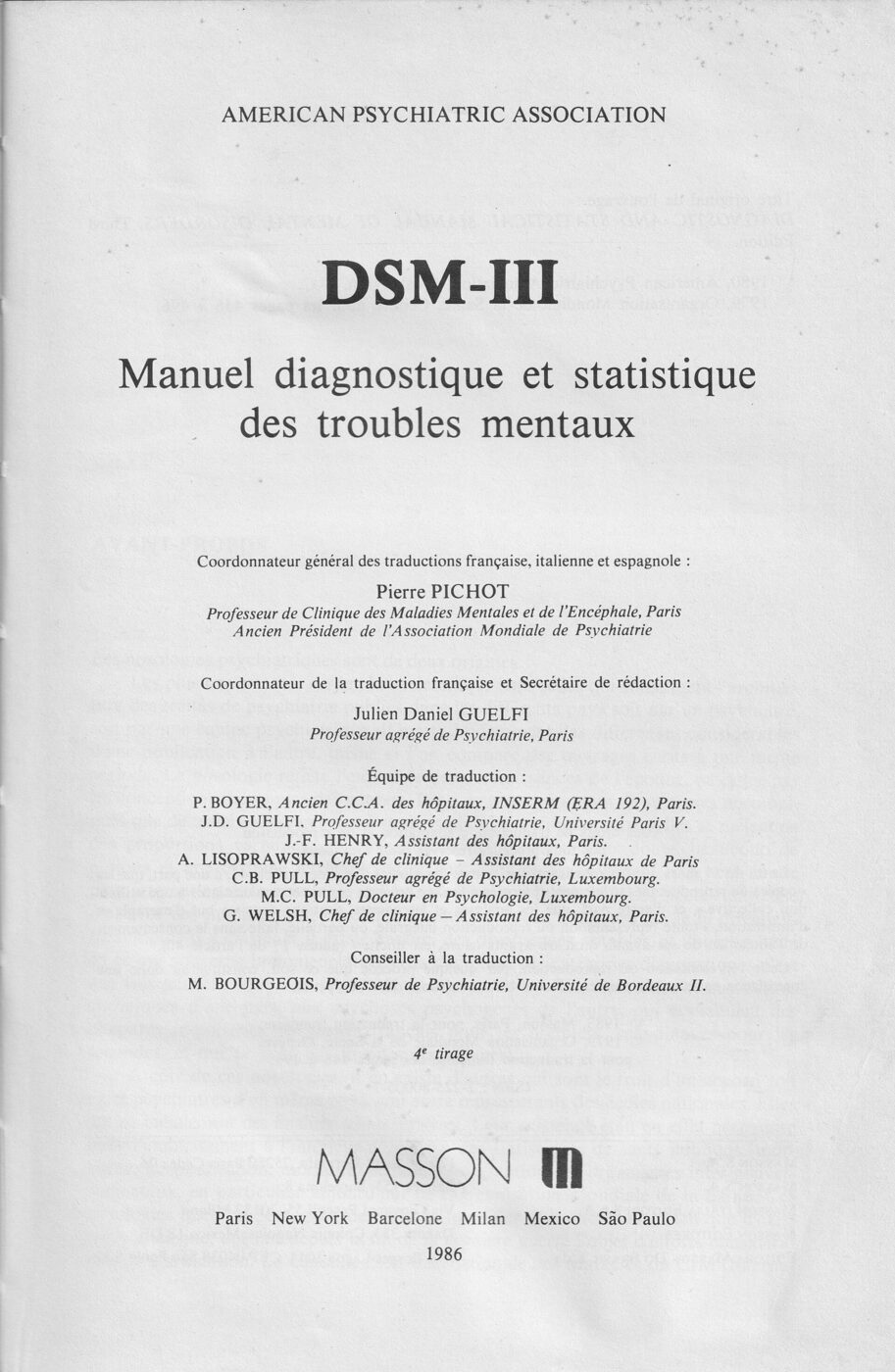

A reader watching that sequence was watching the vocabulary of the subject change every few years, and the manual's critics were audible throughout: the complaints of the period concerned reliability in ordinary clinical use and the medicalisation of human distress. In 2013, shortly before the fifth edition appeared, the director of the National Institute of Mental Health announced that the agency would stop funding research projects relying exclusively on DSM criteria, citing a lack of validity. The argument was not a fringe one, and it was available to anybody with a library card long before it reached a newsgroup.
Underneath the manual, training and evidence were also in motion. American clinical psychology had been built on the scientist-practitioner or Boulder model adopted in 1947, which required practitioners to be researchers as well; the practitioner-scholar or Vail model recognised in 1973 produced the PsyD as an alternative route, and the tension between the two is one of the discipline's standing arguments. Meanwhile the evidence-based movement was arriving from medicine. Archie Cochrane's Effectiveness and Efficiency of 1972 argued that health care strategies should be properly tested; the term evidence-based medicine was introduced by Gordon Guyatt in 1990 and first published in 1992. Psychology's version of that demand is visible in the newsgroup record itself: the 1995 charter for sci.psychology.psychotherapy put efficacy into the group's founding sentence, and the 1994 charter for sci.psychology.research asked posters to cite the literature. The pressure that eventually produced lists of empirically supported treatments was already shaping how people were expected to argue.
The story did not stop when the newsgroups emptied. The reproducibility project in psychology published by the Open Science Collaboration in August 2015 successfully replicated 36 per cent of ninety-seven studies with significant original results, at roughly half the original effect sizes, and the replication crisis that followed reopened, with data, precisely the question about the discipline's scientific standing that the moderated research group had tried to rule out of order twenty-one years earlier.
A room with no clinicians in it
The ethical difficulty that defines a group like this one is structural, and it does not depend on anybody behaving badly. A publicly propagated newsgroup with the word psychology in its name is, to a person in difficulty, indistinguishable from a place where help might be found. It is open at three in the morning, it costs nothing, it asks no name, and it answers. What it cannot do is anything a clinical relationship does. Nobody in it is under a duty of care, and no credential is checked, because none can be: a signature line claiming a doctorate and one claiming nothing look identical on the wire. There is no record, no continuity between one week and the next, no way to notice that somebody has stopped posting, and no mechanism whatever for acting on an emergency. An answer given in good faith by a person with no training is delivered in the same typeface as an answer given by a professor.
The people running the professional groups understood this and legislated around it. sci.psychology.research kept help-seeking out by charter in 1994, which had the effect of sending it somewhere else rather than making it disappear. Where it went, in large part, was to the alt.support.* hierarchy, which grew through the 1990s into scores of condition-specific groups, and to alt.psychology.help, whose whole stated purpose was to receive exactly the questions the research group declined.
One career shows the whole problem in miniature, and it is documented rather than inferred. The graduate student who created alt.psychology.help in 1993 and alt.psychology.adlerian in 1995, and who was a moderator contact for sci.psychology.announce and one of the moderators of sci.psychology.research, had begun answering mental health questions in Usenet newsgroups in 1991, having turned to that work after losing a friend to suicide. In 1995 he started a weekly online mental health chat and founded Psych Central, which grew into one of the larger independent mental health sites on the web, running hundreds of support forums before it was sold in 2020. The unmoderated newsgroup was not an aberration in the history of online mental health. It was the first room in it, and the people who worried most about its limits were often the same people who kept it open.
None of that resolves the difficulty, and this page does not attempt to. What the archives preserve is a period in which the question of what a room full of strangers owes a person who arrives in distress was being worked out in public, by amateurs and professionals in the same thread, with no precedent to consult and no way to know who was reading. The conventions that later governed online health communities — the disclaimers, the moderation policies, the referral language, the explicit refusal to diagnose — were not handed down. They were argued into existence in places like this one.
Reading alt.psychology today
- Historical archive: Google Groups — alt.psychology (coverage varies by group and era).
- Open in a newsreader:
news:alt.psychology— the original site offered exactly this link, and it still works if your system has a newsreader registered for thenews:scheme. - Live access: point an NNTP newsreader at a modern server — see accessing Usenet today.
- The original news2mail e-mail subscription service ended in the mid-2000s and no longer operates.