alt.binaries.autographs
Autograph scans, shared and authenticated.
A binaries address whose entire statement of purpose is the two words in the newsgroups file: "Scanned signatures." No charter survives, and nothing records what the group actually carried.
A Star Wars autograph-collecting site still lists this address among its references, which is how readers arrive here.
On this page
- Two words in the newsgroups file
- The control message, and the message that tried to undo it
- Four addresses for one hobby
- The vintage charter, and the line it drew
- How large the binaries branch actually is
- How a picture got onto a text network
- Splitting, reassembly and repair
- Autograph collecting as a documented field
- Provenance, and why it carries the weight it does here
- Authentication by comparison: the method as the field states it
- What a library of exemplars can do, and what it cannot
- Forgery, and the federal record of the group's era
- A reference room in a branch known for something else
- What the record does not show
- Scope and limits
Two words in the newsgroups file
The administrative record of a Usenet newsgroup is usually thinner than a reader expects and more exact than a reader hopes. For this address it begins with a single tab-separated line. The Internet Systems Consortium mirrors the network's housekeeping files for anyone who wants them, among these the newsgroups file, which pairs every group name that has persuaded enough servers to carry it with a one-line description. In the copy fetched while this article was written, the entry for this group is a name, a tab and two words. It is reproduced here with a dash standing in for the tab:
alt.binaries.autographs — Scanned signatures.That is the entirety of the group's stated purpose as the network records it: two words and a full stop, sitting in the file that news administrators consult when they decide what a server should carry. The companion active file, which tells a server what it may do with a group rather than what the group is for, carries the same name followed by the posting flag y — open to posting, unmoderated, no approval header required. The two long numbers between the name and the flag are the high and low article marks; in an aggregated network-wide snapshot of this kind they are placeholders rather than measurements, and nothing should be read into them.
The file's scale is what gives those two words their weight. The copy consulted here lists 45,003 groups. Of these, 20,466 have names beginning alt., and 2,618 of those sit beneath alt.binaries. Within that branch, 1,011 entries — a little under two in five — carry the placeholder string No description. Having any description at all therefore puts this group in a minority of its own neighbourhood. Having one that names a documentary function rather than a genre of file puts it in a smaller minority still. It is also the only statement of purpose that survives anywhere in the group's administrative record, for the reason set out in the next section.
The control message, and the message that tried to undo it
The same archive mirrors the control messages: the ordinary Usenet articles, distinguished only by a Control: header, by which groups are proposed into and out of existence. For alt.binaries.autographs the control archive holds exactly two, a day apart in the spring of 1995, and they are the closest thing the group has to a founding document.
The first is dated Wednesday 29 March 1995, 05:00 GMT. It was posted to alt.config, the discussion group where alt.* proposals are conventionally aired, by [email protected], identified in the From line as Paul Vranas. The Organization header reads Ripco Internet BBS Chicago — a bulletin board rather than a university or an employer, which was an ordinary way to reach Usenet in 1995 — and the X-Newsreader header records the software as TIN [version 1.2 PL2], a text-mode threaded newsreader of the period. The header block claims Lines: 13. The archived copy preserves no body whatsoever. Whatever case those thirteen lines made for the group, the control archive did not keep it, and no other copy has been found.
The second message is dated 30 March 1995 at 18:38 GMT, from a Netcom account signing itself “Just Say Yes”, and it is an rmgroup: a request that servers delete the group again. Unlike the newgroup, it does carry a body, of three short lines, reproduced here with slashes standing in for the line breaks:
Low interest subject / Not discussed in alt.config / Created by a 12 year old
Those are assertions by the person who issued the removal, and they should be read as such. The first two are the standard objections of alt.config in that period and are unfalsifiable at this distance; the third is an unsupported claim about the group's creator that appears nowhere else in the surviving record and cannot be checked. It is quoted here because it is the only contemporaneous comment anyone is known to have made about this group at its creation, not because it is established.
The removal did not take. In alt.* both the creation and the deletion of a group are requests addressed to several thousand independent administrators, each of whom answers privately by configuring their own server; that mechanism, and the reasons many administrators did not act on rmgroups, are described on the alt.* hierarchy page and are not retold here. The practical result is visible in the file: thirty-one years later the name is still listed, with a two-word description, while the message asking for its deletion survives only as an artefact in an archive of control traffic. Who wrote the description, and when, the record does not say.
Four addresses for one hobby
The group did not stand alone, and the shape of its neighbourhood is checkable in the same two files. Usenet's autograph collectors ended up with four separate addresses, created over seven years for visibly different purposes:
- alt.collecting.autographs — the general discussion group, whose earliest surviving newgroup message is dated 18 March 1993 and was sent from a Yale University address. Its body states that the group had been discussed in rec.collecting and approved in alt.config, and that it was “intended to provide a forum for autograph collectors to exchange celebrity addresses, which celebs tend actually to write back, other autograph tips, etc.” Its description in the current newsgroups file is one of the better period jokes preserved in the network's paperwork: WOW! You got Pete Rose's? What about Kibo's? — pairing a baseball signature with James Parry, the Usenet figure known as Kibo, known on the network for surrealist pranks and for the parody religion built around him.
- alt.binaries.autographs — created two years later, in March 1995, and described as scanned signatures.
- alt.autographs.transactions — “Autographs wanted and for sale.”, created on 9 May 1996 by the same Paul Vranas from the same Ripco account, separating trade from both discussion and pictures.
- alt.collecting.autographs.vintage — “Vintage autographs, manuscripts and documents.”, proposed in July 2000 for historical rather than contemporary material, and the only one of the four whose full charter survives.
The transactions group's creation is worth a paragraph of its own, because it shows the alt.* process behaving exactly as its critics described it. Vranas's newgroup message carried the header Lines: 0 — no charter, no justification, nothing. About seventeen hours later it was met by a PGP-signed rmgroup from Brian Edmonds at the University of British Columbia, which quoted the proposal's entire body as [ nothing at all ] and pointed the proposer at a document on writing better newgroup messages. Two days after that a second rmgroup arrived from another issuer listing its criteria as a bulleted charge sheet: creating an unnecessary second-level hierarchy, no attempt to justify the newsgroup, no description in the body, and “Bad formatting of control message, ie. missing info in body per RFC1036”. The group is nevertheless still listed in the newsgroups file today, with a description someone supplied later. Rejection in alt.* was advisory in both directions.
The four-address pattern — talk here, pictures there, trade somewhere else — was not peculiar to autographs. The pen and pencil collectors did the same thing, and their control messages show how untidy the doing of it could be. Over about thirty-six hours at the end of November 1998, three separate newgroup messages proposed a binaries annexe to the existing alt.collecting.pens-pencils under three different names: alt.collecting.pens-pencils.binary on 29 November, alt.collecting.pens-pencils.binaries a little over an hour later from a different sender, and alt.binaries.pens-pencils the following day. All three carried the same one-line description, Images of interest to writing instrument collectors, and all three are still listed in the newsgroups file, a hobby's indecision preserved as three permanent rooms.
What makes those messages useful here is that their charter, unlike this group's, survives. It states that the intent is “to provide a place for the convenient interchange of images of interest to collectors of writing instruments”, and that “such images would typically be used for the purposes of identification and assessment of old, rare, or otherwise collectible instruments as well as to educate and enlighten the reader with respect to repair and refurbishing techniques”, the group to be “an adjunct to the already-existing alt.collecting.pens-pencils”. A binaries group attached to a hobby's discussion group, and explicitly justified as a reference resource rather than a warehouse, was therefore a recognised arrangement on Usenet by the late 1990s. That is a documented parallel, not evidence about this group.
The vintage charter, and the line it drew
The autograph collectors themselves eventually wrote down where pictures were to go, and the document that did it is the single most useful thing in this corner of the control archive. The proposer of alt.collecting.autographs.vintage — who identified himself in the message as Paul Melzer, and whose Organization header named a rare-book and autograph business — posted a full charter with his control message in July 2000, noting that the proposal had been submitted to alt.config on 14 July and discussed through 21 July. It opens:
alt.collecting.autographs.vintage will serve as a forum for the discussion of vintage (i.e. “of old, recognized, and enduring interest, importance, or quality”) autographs, their collection, conservation, authentication and research.
The charter then does what charters of that period usually did, which is to legislate against the failure modes its author had already watched happen elsewhere. Discussion of contemporary autographs was to be avoided unless it bore directly on the group's subject. Individual want-to-buy and want-to-sell notices were permitted “in moderation (no more than one per day)” and had to be flagged as WTB or WTS in the subject header. Commercial firms were to limit their non-discussion posts to catalogue announcements and position openings. Then, in three consecutive sentences: “This is first and foremost a discussion group, so spam is not allowed. Cross-posting is discouraged. No binaries shall be posted.”
That last clause is the structural fact this page turns on, and its limits should be stated with it. It establishes that at least one autograph discussion group on Usenet prohibited images outright, in writing, as a founding condition, so that anything which had to be looked at rather than described needed an address of its own. It does not establish that the other three groups did the same, and it cannot have caused the existence of alt.binaries.autographs, which by then had been listed for five years. The chronology runs the other way: the separation of pictures from talk was already the shape of the namespace when someone finally wrote a rule that matched it.
The same charter carries one of the very few contemporaneous measurements of traffic anywhere in this corner of Usenet. Justifying the new group, its proposer reported a search of the Deja News archive covering 15 April to 15 July 2000, which returned “*exactly* 3920 matches for autograph&vintage, an average of 43 per day”. He also observed that the existing autograph groups reflected the popular interests of the day — sports figures, television and film stars, musicians and current politicians — to the exclusion of historic material, and that questions about literary, political, scientific, artistic, military and exploration autographs, along with conservation, archival research, valuations and auction trends, were “seldom answered”, with threads of substance appearing instead on academic and trade mailing lists. It is a small, dated, checkable snapshot of a community describing its own shortcomings.
One clerical detail dates the record as firmly as anything in it. The first control message gave the newsgroups-file line for a group called alt.autographs.vintage while its Control: header created alt.collecting.autographs.vintage; a second, corrected message headed “BOOSTER BOOSTER BOOSTER” followed on 31 July 2000, repeating the charter with the right name. Nothing in alt.* prevented the mistake and nothing punished it; the fix was to post again and hope more administrators noticed the second message than the first. The current newsgroups file still truncates the resulting description mid-phrase, at Vintage autographs, manuscripts and; the full wording quoted above comes from the control message rather than from the file.
How large the binaries branch actually is
The contrast that makes this group interesting is arithmetical, and it can be checked in the same file quoted above. The binaries branch of alt.* is enormous. Counted in the newsgroups file consulted here, 2,618 groups sit beneath alt.binaries. The entire Big Eight — comp, humanities, misc, news, rec, sci, soc and talk, the eight hierarchies whose group-creation process involved formal proposals, public discussion and, for most of their history, votes — accounts for 1,898. One branch of one hierarchy, created without ceremony one control message at a time, has nearly forty per cent more rooms in it than all eight of the deliberated hierarchies put together.
The disparity in traffic is larger still, and it is described on the alt.* page, which covers the branch as a whole, its share of the network's data and the economics that followed. What that page does not do, and what is worth doing here, is look at how the branch's own names are distributed. Of the 2,618 entries, 789 sit under alt.binaries.pictures.*, 295 under alt.binaries.sounds.*, 158 under alt.binaries.multimedia.*, and 94 under alt.binaries.warez.*. The rest is a long tail of subjects, languages, television series, file formats and abandoned experiments, more than a thousand of which never acquired a description at all.
The comparison with the Big Eight is not only a matter of size. Creating a group in the deliberated hierarchies meant a Request for Discussion, weeks of argument, a formal vote under published thresholds and a waiting period afterwards — a process described in detail on the soc.* hub. Creating this one took a single message from a Chicago bulletin board and survived an attempt to reverse it. The two-word description in the newsgroups file is therefore not a charter in any procedural sense. It is a label somebody wrote and other servers copied.
How a picture got onto a text network
Nothing about Usenet was designed to carry a scan. The article format is a text format: RFC 1036, the standard for interchange of Usenet messages, was published in December 1987 by Mark Horton and Rick Adams and specifies headers built from printing ASCII characters; the transport protocol beneath it, RFC 977, was written by Brian Kantor and Phil Lapsley and published in February 1986. Neither anticipated arbitrary binary data, and the store-and-forward links over which articles travelled could not be relied on to pass eight-bit bytes through unaltered. The successor specification, RFC 5537 of November 2009, which formally obsoletes RFC 1036, inherited the same fundamental assumption. Every binary that has crossed Usenet did so by being disguised as text.
The disguise came from electronic mail, and it predates the newsgroup by fifteen years. Uuencoding originated in the Unix programs uuencode and uudecode, written by Mary Ann Horton at the University of California, Berkeley in 1980, to let binary files survive mail systems that guaranteed only a common subset of printable characters. The scheme is simple enough to describe exactly. Three bytes of input — twenty-four bits — are split into four groups of six bits, each group giving a value between 0 and 63, and 32 is added to each value so that the result falls in the printable range from space to underscore. Three bytes in, four characters out. Each full line encodes 45 bytes of source data as 60 characters, prefixed by a single character giving that line's byte count, which for a full line is the letter M. A uuencoded file opens with a line reading begin, a three-digit Unix permission mode and the file name, and closes with a grave accent and the word end. The resulting object — a column of sixty-character gibberish, most lines starting with M — is the characteristic sight of a 1990s binaries group.
The price of the disguise is a third of the payload. Four characters carrying three bytes is a thirty-three per cent overhead before headers, which mattered on links that were still being paid for by the minute. The Internet's standards process addressed the same problem from a different direction: RFC 1341, published in June 1992 by Nathaniel Borenstein and Ned Freed, defined the Multipurpose Internet Mail Extensions and with them Base64, a cleaner sibling of uuencode with the same three-into-four arithmetic and a fully specified alphabet; the specification was reissued as RFC 2045 in November 1996. MIME also standardised the splitting of one logical message across several transmitted ones, as the message/partial content type defined in RFC 2046. On Usenet, however, MIME did not displace the older convention for binaries, and through most of the 1990s uuencode remained what posters used.
What eventually displaced it was not a standard at all. yEnc, developed by Jürgen Helbing, whose draft proposal document was made available on 31 July 2001, abandoned the printable-character discipline on the observation that by then the network did in fact carry eight-bit data. It passes 252 of the 256 possible byte values through unencoded, escaping only the null, line feed, carriage return and its own escape character, and adds 42 to each source byte so that long runs of zeroes do not need escaping. The overhead falls from a third to one or two per cent. Forté's Agent newsreader added support in version 1.91 on 21 March 2002, other clients followed, and by 2003 yEnc was the de facto standard encoding for binary files on Usenet. There is no RFC describing it and there never was; a number of news administrators and programmers published objections at the time, arguing that it reproduced flaws MIME had already addressed and that its reliance on the subject line for reassembly was unreliable. Those objections are on the record, and so is the adoption that followed them.
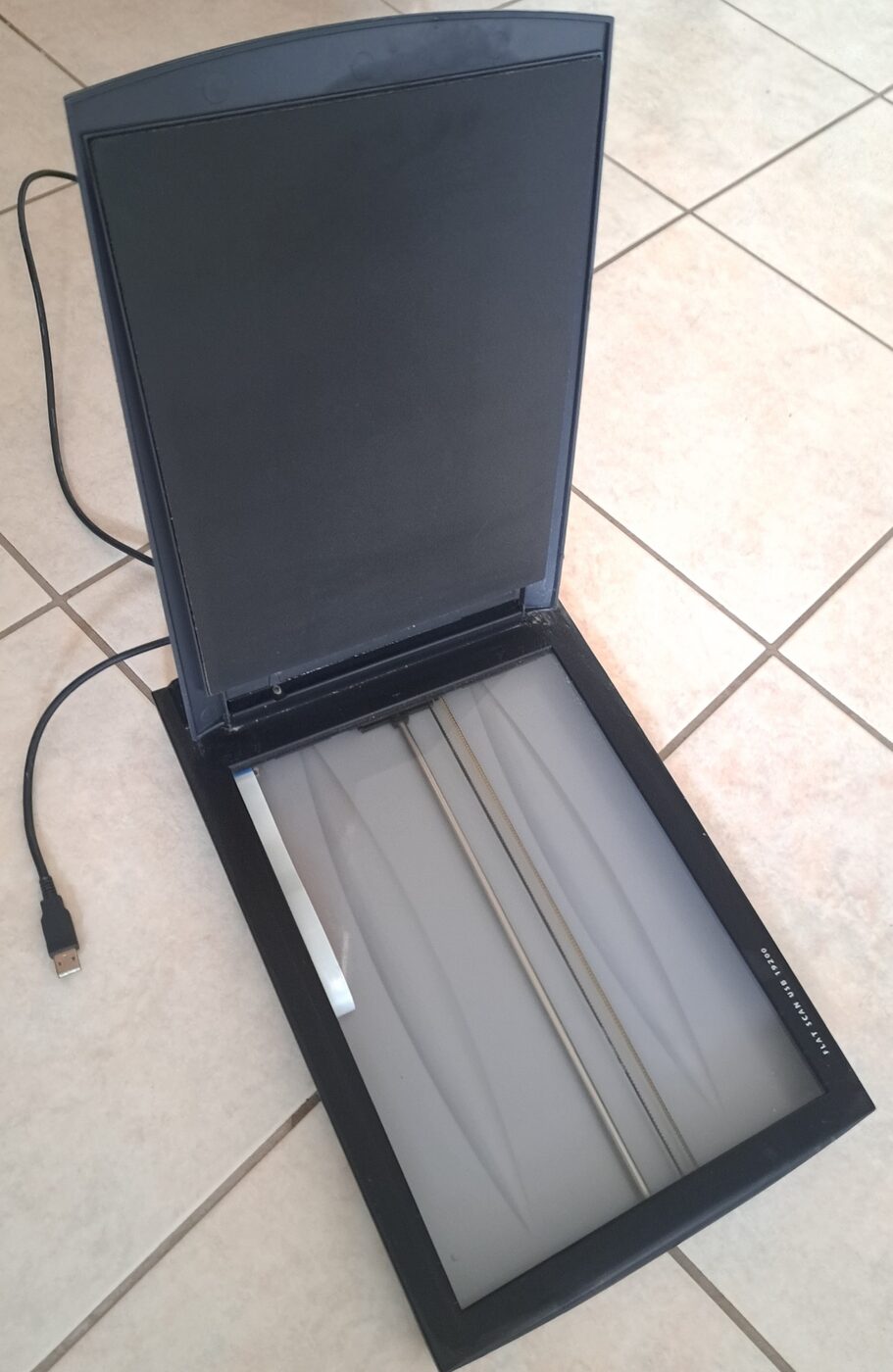
For this group, the arithmetic ran the friendly way. A scan of a signed card at a resolution useful for looking at line quality is a file of a few hundred kilobytes rather than a few hundred megabytes. Encoded and posted, it is a handful of articles — retrievable by a reader on a modem in a single sitting, and cheap for a news server to carry.

Splitting, reassembly and repair
Even a modest file had to be broken up. News servers imposed limits on article size, and a single article large enough to hold an image would in any case have propagated badly, so posters split encoded files across a numbered series of articles and left the reader's software to put them back together. The convention that emerged was purely typographic: the subject line carried the file name followed by a part number in brackets or parentheses, in the familiar form of one of twelve, two of twelve, and so on. Newsreaders selected, sorted and decoded by parsing that string.
It is worth being blunt about how fragile that was. Reassembly depended on a human-readable subject line surviving intact across every server between poster and reader, on nobody having posted a different file with a similar name, and on the whole series arriving. Usenet guarantees none of these things: articles expire at different times on different servers, propagation is best-effort, and a single missing part rendered the rest useless. The criticism of the arrangement is contemporaneous rather than retrospective; the practice was documented as unreliable while it was still universal.
The eventual answer was error correction. Parchive — the parity archive, formally the Parity Volume Set Specification — was proposed in July 2001 by Tobias Rieper and Stefan Wehlus specifically to make file sharing on Usenet more reliable, and version 1.0 of the specification was published in October 2001. It used Reed–Solomon coding to generate recovery volumes that could rebuild missing pieces, together with small index files carrying hashes so that a reader could verify what was present and calculate what was needed before downloading anything large. Version 1 had real limits — at most 255 files, and recovery volumes as large as the biggest input file — so in January 2002 Howard Fukada proposed a block-based successor working on sixteen-bit rather than eight-bit numbers, which Michael Nahas and Peter Clements took up in July of that year and which Nahas published as version 2.0 in September 2002. PAR2 came into general use on the binaries branch and remains the mature version of the format.
All of this machinery was built for traffic thousands of times heavier than a picture of a card. The e-book branch and the software branch, whose own histories and legal questions are covered on their own pages — alt.binaries.e-books and alt.new.cracks — are the traffic the tooling was designed around. A group posting scans of documents was a beneficiary of engineering it did not require, which is one reason it left so little technical trace.
Autograph collecting as a documented field
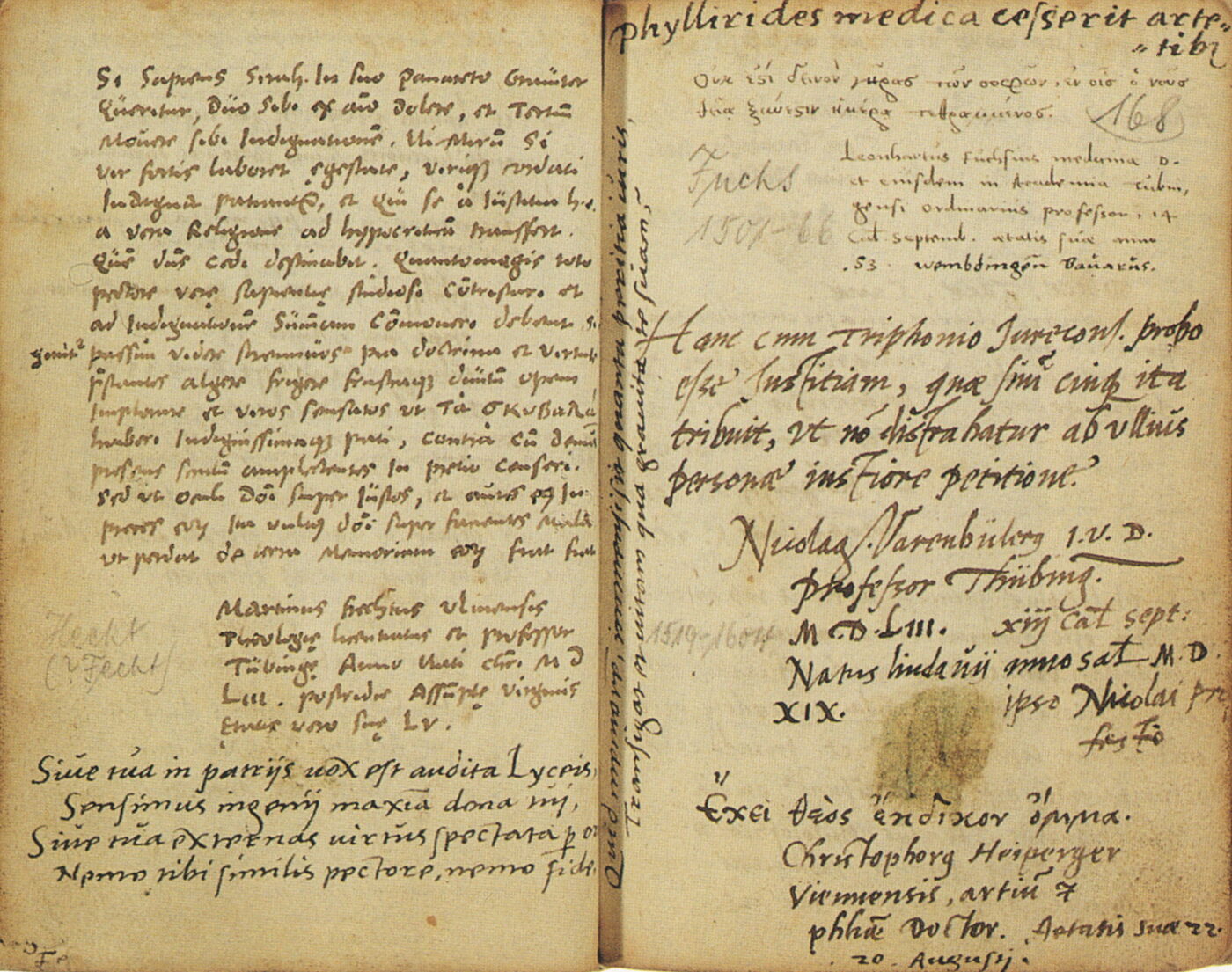
The recognisable European ancestor of the hobby is the album amicorum — the book of friends, or Stammbuch — which emerged during the Reformation, when it became fashionable to collect inscriptions from noted reformers, and which remained a fixture of Protestant, and especially German, university life into the early decades of the nineteenth century. A student carried the album from town to town, asking professors, patrons, clergy and fellow students to fill a page with a motto, a verse, sometimes a drawing, and a dated signature. The books doubled as letters of recommendation when a student changed universities, and asking a person of higher rank to write in one was a way of acquiring a patron — which meant that the value of an entry depended on who had written it, a recognisably modern idea arriving four centuries early. By the later eighteenth century pre-printed album leaves were being sold for the artistically unconfident.

A commercial trade in loose autographs followed. There is evidence of autograph dealing in France by the 1820s and in England by the mid-1830s, and the oldest surviving business of the kind is a Berlin house founded in 1830 and still trading, generally described as the oldest autograph shop in the world; it began holding autograph auctions in 1859. Auction catalogues in the field use a descriptive shorthand, and the abbreviations are worth setting out, because they encode what the field treats as significant:
- ALS — autograph letter signed: written and signed by the same hand. The most desirable ordinary category, because the content and the signature stand or fall together.
- LS — letter signed: the body written by someone else, frequently a secretary, and only the signature by the person collected.
- TLS and TNS — typed letter signed and typed note signed, the twentieth-century equivalents.
- DS and ADS — document signed, and autograph document signed.
- AMsS, AQS, AMusQs — autograph manuscript, quotation and musical quotation, signed.
- SP, APCS, ANS — signed photograph, autograph postcard signed, autograph note signed.
- AL, AD, AMs, AN — the same categories unsigned: letter, document, manuscript and note in the collected person's hand but without a signature.
- folio, quarto, octavo — the leaf sizes inherited from bibliography, since a great deal of the material is paper first and signature second.
Two further terms of art matter for what follows. A cut or clipped signature is a signature removed from its original document; standard accounts of the field treat clipped signatures as a category to be examined carefully, because a bare signature on a small piece of paper can be mounted onto a genuine period engraving of the same person, and the removed context is exactly the evidence a comparison would otherwise use. A facsimile autograph is a signature reproduced by printing — on an engraved portrait, in a book, on a photograph issued by a studio — and it is not a forgery, merely something that resembles an autograph and is not one. The dealer and paleographer Charles Hamilton invented the term philography as another name for his profession.
The field's periodic manias are documented, and each one produced its own crop of fakes. Encyclopaedic accounts of autograph collecting record a vogue among ageing American veterans in the 1880s for collecting Civil War signatures, and state that the signatures of all the Union and Confederate generals have since been forged, most often as a bare signature on a small piece of paper subsequently glued onto an authentic steel-engraved portrait of the subject. The same accounts record extensively written letters being forged as well. The pattern — a wave of new collectors, a shortage of supply, and forgeries arriving to meet it — recurs in the record.
Provenance, and why it carries the weight it does here
Almost every other collectable has physical substance that can be interrogated independently of its story. A stamp has a plate, a paper, a gum and a perforation gauge. A coin has a die, an alloy and a strike. A first edition has a printing history, a binding and a paper stock. An autograph, stripped to its essentials, is a few square centimetres of ink laid on a surface by a hand. Nearly everything that could confirm it is either the surrounding document or the account of where it came from.
The difficulty is compounded by a fact the field states to newcomers repeatedly: a large quantity of perfectly genuine, non-fraudulent material carries a signature the named person did not personally make. Secretarial signing is normal practice in public life and has been for a long time. Standard accounts of the field record American presidents ceasing to sign land grants personally from around the 1830s, with secretaries thereafter signing on their behalf; film stars having secretaries sign their letters and photographs; and, in a case reported in Smithsonian magazine in October 1986, one of Salvador Dalí's secretaries stating that she signed the artist's name to postcard reproductions of his paintings. A signature applied by an authorised hand is not a forgery. It is also not a mark made by the person named.
Machines make the same point mechanically. The ancestor of the modern signing machine is the polygraph, for which the British-American inventor John Isaac Hawkins received a United States patent in 1803, in which a second pen linked to the first reproduced a document as it was written; Thomas Jefferson used the device extensively and owned two. The automatic version arrived in the 1930s: the Robot Pen became commercially available in 1937, and the first commercially successful autopen was developed by Robert M. De Shazo Jr. in 1942. Early machines followed a signature cut as a channel into an engraved plate, driving a stylus linked to an arm that could hold the subject's own pen and ink. Their characteristic tell is documented: because the arm applies constant force, an autopen signature is made with even pressure and even indentation in the paper, where a signature written by a person varies. Almost all American presidents have had such a machine since the early 1950s — some accounts name Harry Truman as the first, restricting his use of it to signing cheques and answering mail — and standard accounts of the collecting field record the practice spreading from the 1960s to cabinet members, senators and some state governors, and NASA using an autopen for astronauts' correspondence, as Alan Shepard acknowledged. Rubber and steel hand stamps have their own history, from Andrew Johnson — who used one as a senator after a train accident injured his right hand, which is why his presidential signature differs from his earlier one — to Warren Harding, Woodrow Wilson and both Roosevelts.
What all of this produces is a field whose central question is evidential rather than aesthetic. The question asked of an item is rarely whether it is beautiful or rare; it is whether a specific physical act took place. Where a chain of custody exists — an item obtained in person, a letter with its envelope and postmark, a document in an archive with an accession record — the question is largely settled. Where it does not, which is the ordinary case for anything bought second-hand, the field falls back on comparison.
Authentication by comparison: the method as the field states it
Comparison of handwriting against known material is a recognised forensic discipline, questioned document examination, with a literature, a professional society and a standards apparatus. Its foundational textbook is Albert S. Osborn's Questioned Documents, first published in 1910 and heavily revised in 1929; Osborn founded the American Society of Questioned Document Examiners in 1942, out of informal gatherings he had begun hosting in 1913, and became its first president. The society describes itself as the oldest in the world devoted to the subject. The field's written standards passed through a long institutional relay: the American Society for Testing and Materials published guides through its subcommittee E30.02 until that subcommittee was disbanded in 2012 and the standards were progressively withdrawn, after which they were taken up by the Scientific Working Group for Document Examiners, and in 2015 the American Academy of Forensic Sciences formed an accredited standards board whose forensic document examination consensus body has since published replacements.
The method itself is stated in the discipline's own words. The principle of identification, in the formulation by Roy Huber and A. M. Headrick that the standards literature quotes, runs:
When any two items possess a combination of independent discriminating elements (characteristics) that are similar and/or correspond in their relationships to one another, of such number and significance as to preclude the possibility of their occurrence by pure coincidence, and there are no inexplicable disparities, it may be concluded that they are the same in nature or are related to a common source.
Applied to handwriting, that becomes a procedure generally known as ACE-V: analysis, in which the questioned item and the known items are each reduced to their discriminating elements — the habits of behaviour or performance that serve to differentiate between writers; comparison of those elements between the two; evaluation, in which the weight of each similarity or difference is considered and explanations for them proposed; and, optionally, a fourth step of verification or peer review by a second examiner. Huber and Headrick identified twenty-one discriminating elements. The features themselves are sorted into class characteristics — the style the writer was taught — and individual characteristics, the writer's own style, with a further division into gross and subtle features.
The statistical heart of the method is a distinction that intuition tends to get backwards. As the 2009 United States National Research Council report Strengthening Forensic Science in the United States: A Path Forward sets it out, an examination must compare interpersonal variability — how much handwriting features vary across a population of possible writers — with intrapersonal variability, how much one person's writing varies from sample to sample. Determining that two samples were written by the same person depends on showing that their degree of variability is more consistent with intrapersonal than with interpersonal variation. The corollary is stated plainly in the same report: “Some cases of forgery are characterized by signatures with too little variability, and are thus inconsistent with the fact that we all have intrapersonal variability in our writing.”
Conclusions are expressed on a graded scale rather than as a verdict. The report notes that five-point and nine-point scales are both in use worldwide, and reproduces the nine-point one: identification, strong probability, probable, indications that the same person did write both, no conclusion, indications that the same person did not, probably did not, strong probably did not, and elimination. The existence of the scale is itself informative: the discipline's own terminology assumes that most examinations will not produce certainty.
The best-known early demonstration in an American court of comparison against a corpus of genuine signatures is also the clearest illustration of why such a corpus is needed. In the Howland will forgery trial of 1868, the authenticity of a signature on a disputed page attached to a will was tested by Charles Sanders Peirce, who made pairwise comparisons of forty-two examples of the deceased woman's genuine signature, overlaid them, and counted how many of the thirty downstrokes in each coincided. On average six of the thirty overlapped. In the disputed pair, all thirty did. His father Benjamin Peirce, taking the stand, modelled the strokes as independent events and put the probability of such a coincidence between two genuine signatures at one in roughly 2.7 sextillion, adding that “so vast improbability is practically an impossibility”. The court decided the case on other grounds and the statistical evidence was not called upon in judgment — but the shape of the argument is the shape of every signature examination since, and it was only possible because forty-two known-genuine examples could be laid on the table at once.
What a library of exemplars can do, and what it cannot
This is the point at which a group of scanned signatures acquires a defensible reason to exist. If the diagnostic question is whether the variation between two samples looks like one person's normal range, then the answer depends on knowing what that range is, and a single reference signature cannot establish it. A larger set, spread across years, might. A collector holding one card and one book has no way to characterise a range; a pooled set of images, contributed by many people holding many items, at least approximates the sample the method assumes. It also has the property that no institution needs to be trusted for it to be useful, because the reader can look at the images themselves. That is the evidential function such a pool could serve, and it is the function the two-word description in the newsgroups file appears to name.
The limits are equally real and are best stated from the same sources. The National Research Council's list of what questioned document examination typically involves is dominated by examinations that require the physical object: determining whether a document is the output of a printer, copier or facsimile machine; identifying or eliminating the ink, the paper and the writing instrument; establishing the source, history and sequence of preparation of a document and any alterations or additions to it; deciphering and restoring obscured, deleted or damaged parts; recognising and preserving other physical evidence present in the document; and determining its age. Ink examination is described there as principally nondestructive optical work — visible, ultraviolet and reflected infrared illumination — together with chemical spot testing in which solvents are applied in small amounts to the ink line. None of that can be done to a picture. The autopen's characteristic even indentation, noted above, is a property of the paper, not of the image.
The imaging itself imposes further losses. A scan is a sampled, quantised approximation, and the fine features the method depends on — pen lifts, tremor, the taper at the end of a stroke, relative pressure inferred from line width — are the features that low resolution and lossy compression are least able to preserve. The formats of the period compounded this: GIF, released by CompuServe on 15 June 1987, allows a single image a palette of at most 256 colours; JPEG, created as a standard in 1992 and the dominant photographic format on the network thereafter, discards high-frequency detail by design and does so most visibly at exactly the sharp light-to-dark transitions that a pen stroke consists of. A heavily compressed scan can introduce artefacts that resemble features and erase features that matter.
And a scan has no provenance of its own. Nothing in a Usenet article establishes that the item on the scanner glass was genuine, that the poster owned it, or that the image had not been altered before posting. A shared exemplar library is only as good as the items contributed to it, and an unmoderated alt.* group had no mechanism — no accession register, no signing of the control messages, nothing — for establishing that. This is a limitation of the medium rather than a criticism of anyone who used it.
The discipline's own error record belongs here too, reported as the report states it. The National Research Council cited a 1997 proficiency study by Moshe Kam, G. Fielding and R. Conn in which more than a hundred questioned document examiners, and a control group of people with similar educational backgrounds, each made 144 pairwise comparisons: the professionals were much more accurate than the lay group, and nonetheless declared an erroneous match in 6.5 per cent of comparisons. A 2002 study by Sita, Found and Rogers, focused specifically on whether individual signatures were genuine, found professional examiners erring in 3.4 per cent of their judgments. The report's summary assessment of the discipline opened: “The scientific basis for handwriting comparisons needs to be strengthened.” It went on to say that recent studies of the individuality and consistency of handwriting suggested there may be a scientific basis for handwriting comparison “at least in the absence of intentional obfuscation or forgery”, and that although there had been only limited research quantifying the reliability and replicability of trained examiners' practices, “the committee agrees that there may be some value in handwriting analysis”. All three statements are the record; none of them is this page's opinion, and the qualification in the middle one is not incidental, since forgery is the case a collector is asking about.
Forgery, and the federal record of the group's era
The years in which alt.binaries.autographs existed and might have been useful were also the years in which the American market for signed material was the subject of a sustained federal investigation. This section reports that as documented history, from the investigating agency's own published account and from the standard secondary record; it makes no claim about this newsgroup's involvement in any of it, and none should be inferred.
The sequence began in Chicago. In the mid-1990s the FBI's Chicago Division ran a sports-memorabilia fraud investigation, known as Foul Ball, targeting a group who forged, fraudulently authenticated and distributed signed items associated with Chicago athletes. By the Bureau's account it resulted in the conviction of fourteen individuals in five states, and the information it developed suggested the problem might be national in scope.
In 1997 the FBI in San Diego, working with the United States Attorney's Office and the Internal Revenue Service, opened the undercover operation that became Operation Bullpen. An agent posed as a distributor of American memorabilia in Asia, operating through a front company the Bureau established in Oceanside, California; the cover story was designed so that evidence could be bought without forged items reaching the public, and so that sellers would speak freely about what they were selling on the assumption that it was going beyond the reach of American law enforcement. Phase I produced, on the Bureau's figures, well over a thousand consensually recorded audio and video tapes, and culminated on 11 April 2000 with the charging of twenty-six individuals, all of whom were convicted.
Phase II expanded the investigation from predominantly southern California to the country as a whole, added celebrity forgeries to sports forgeries, and followed the trade onto the internet. It generated more than two thousand consensual recordings, involved eighteen searches in twelve states — all executed after 11 September 2001 — and produced thirty-six further convictions and thirteen dismantled forgery rings, against five in the first phase, with roughly a fifth of the manpower. The Bureau's summary statistics for the operation as a whole, published in 2005, record sixty-three charges and convictions, eighteen forgery rings dismantled, seizures exceeding $4.9 million, over $300,000 in restitution paid to more than a thousand victims, and $15,253,000 in economic loss said to have been prevented, through seventy-five search warrants and more than a hundred undercover evidence purchases. A third phase shared the seized material with children's charities and crime victim agencies in San Diego; secondary accounts record that the forged signatures on it were defaced first.
The scale estimates published alongside those figures are the ones most often quoted since, and they should be quoted with their attribution attached. The Bureau's account stated that while it is impossible to estimate definitively the percentage of forged memorabilia, “most industry experts concede that over half of the most sought-after athletes' and celebrities' autographed memorabilia is forged”; that industry experts put the American market in autographed memorabilia at approximately a billion dollars a year; and that cooperating subjects and memorabilia experts estimated forged material at over a hundred million dollars of that each year. Of the celebrity photographs and posters sold on the claim that they had been obtained by people who caught a star in person, the same account concluded that the investigation would suggest they are almost all forged.
Two earlier cases from the same generation are cited in almost every account of the field, and both are matters of court record rather than trade rumour. Mark Hofmann built a career forging documents relating to the early history of the Latter Day Saint movement; when his schemes began to unravel he killed two people with bombs in Salt Lake City on 15 October 1985, and in 1987 pleaded guilty to two counts of second-degree murder along with theft by deception and fraud. The Hitler Diaries, sixty volumes forged by Konrad Kujau between 1981 and 1983, were bought in 1983 by the West German magazine Stern for 9.3 million Deutsche Marks; the historian Hugh Trevor-Roper authenticated them for The Sunday Times and publicly reversed himself at the press conference announcing publication, and when complete volumes were finally submitted for full forensic examination the initial results, available within days, reported modern components and ink not in common use in wartime Germany. In both cases the documentary evidence and the physical evidence pointed in opposite directions, and the physical evidence was the later of the two to be consulted.
The trade's institutional response is also on the record. Major League Baseball unveiled a memorabilia authentication programme in conjunction with the culmination of Bullpen's first phase, in which each item is witnessed by a person who places a uniquely numbered hologram on it, tracked in a database; the FBI's account noted that similar schemes were in place at several memorabilia companies, that these methods had never been pierced by the forgers, and that in the non-sports marketplace such programmes were almost non-existent. Other leagues later launched smaller-scale efforts. The logic of the response is the opposite of the logic of comparison: rather than examining the object afterwards, it documents the act at the moment it happens.
A reference room in a branch known for something else
alt.binaries.* is remembered for the traffic that made Usenet a commercial product: pictures, films, music and unauthorised software, in volumes that reshaped what it cost to run a news server. That story belongs to the hierarchy page. But a namespace is a filing system, and filing systems accumulate exceptions. Among the two and a half thousand rooms in this one are a handful whose stated purpose is documentary: images of interest to writing-instrument collectors, annexes for particular file formats, and one room whose two-word description says it holds scanned signatures.
The honest weight of that is limited, and it is worth stating the limit rather than the claim. What the record establishes is intent, and only at the level of a label: someone wrote that description, and the description is what the current file says. What the record does not establish is conduct. There is no surviving evidence of what was posted here, in what quantity, by whom, or whether a single image was ever used in a comparison. The neighbouring charters — one forbidding binaries in a discussion group, one justifying a binaries group as a place for identification and assessment — show why such a room was wanted; they do not show what happened inside this one.
It is also worth resisting the tidier version of the story, in which a virtuous reference library sits in a disreputable branch. The same hobby, in the same hierarchy, also created a group for buying and selling, and the same person created both addresses about thirteen months apart, with no justification surviving in the archived copy of either message. The collectors were not a different kind of Usenet user. They used the same tools, the same conventions and the same absence of process as everybody else in alt.*, and what distinguishes this address from its neighbours is a description, not a demonstrated practice.
What the record does not show
The gaps here are larger than the findings, and listing them is part of the point of a page like this one.
- There is no charter. The two-word description in the newsgroups file is all the statement of purpose that exists, and nobody knows who wrote it or when: the newgroup message's thirteen lines of body were not preserved in the control archive.
- There are no numbers. No subscriber estimate, no article count, no measurement of traffic in any year, no readership survey that reached this group.
- There is no surviving discussion. The rmgroup asserted that the proposal was not discussed in alt.config; nothing has been found to contradict or confirm that, and no alt.config thread about the group has been located.
- There is no FAQ, no periodic posting, no moderator, no volunteer, no named participant beyond the two people who sent the control messages.
- There is no evidence, either way, about the ratio of reference material to trade in whatever was actually posted, nor about whether the group was ever used for the purpose its description names.
- No connection has been found, and none is suggested, between this newsgroup and any of the investigations or cases described above. Those are the context the group sat in, not events it took part in.
Groups of this kind normally have essentially no external documentation of their own, and this one is no exception. The value of the entry is that the surrounding world — the file formats, the encoding standards, the collecting field, the authentication method and the fraud prosecutions — is very thoroughly documented, and that the group's own two words can be placed accurately inside it.
Scope and limits
The group-specific facts on this page come from three primary sources, all of them public: the Internet Systems Consortium's mirror of the Usenet newsgroups and active files, fetched while this article was written; the same archive's control-message collections for this group, its three siblings and the pens-pencils groups; and the text of those control messages, quoted exactly where quoted at all. The counts of groups were computed directly from the fetched file. The technical history rests on the relevant RFCs and on standard reference accounts of the encodings. The account of authentication method and error rates rests on the 2009 National Research Council report and on the standards literature it cites, and the account of the fraud prosecutions on the FBI's own published summary of the operation together with the standard secondary record.
Several things this page deliberately does not do. It names no dealer, auction house, marketplace or authentication service as a place to buy anything or as an authority to consult, and the historical firms and organisations it does name are named because published records or court records name them. It reproduces no individual's signature, genuine or disputed. It gives no account of how forgeries are produced beyond what is necessary to explain why examiners look at variability. It offers no opinion on the reliability of handwriting comparison, on any disputed item, or on any organisation's practices; where the sources qualify themselves, the qualifications are reported with them. And it gives no advice to collectors, which is not what a newsgroup directory is for.
The group is still listed in the files consulted here. What any particular server holds for it today is a matter of that server's retention policy rather than of history. Notes on reaching Usenet now, and on which archives cover which periods, are collected on the page about accessing Usenet.
Reading alt.binaries.autographs today
- Historical archive: Google Groups — alt.binaries.autographs (coverage varies by group and era).
- Open in a newsreader:
news:alt.binaries.autographs— the original site offered exactly this link, and it still works if your system has a newsreader registered for thenews:scheme. - Live access: point an NNTP newsreader at a modern server — see accessing Usenet today.
- The original news2mail e-mail subscription service ended in the mid-2000s and no longer operates.