alt.binaries.e-books
The e-book binaries group — a historical entry.
alt.binaries.e-books distributed electronic books as binary postings; in practice much of that traffic was unauthorised copies, and this directory preserves the entry as history, not as a source.
Early e-reader communities (the REB1200 era) referenced the group while the format wars played out — one such resource page still links this address.
On this page
- The whole administrative record is three control messages
- Why the description line is blank
- The twin address with a trailing space
- How a book got onto a text network
- What an electronic book was, before the word settled
- The dedicated reading devices, dated
- The competing formats and their locks
- The standards effort that eventually consolidated them
- The point at which a single retailer’s device reset the market
- alt.etext, February 1993: the same subject, a different shape
- The public-domain counter-current
- Copyright and the electronic book, as record
- What the group actually was
- What the record does not show
- Scope and limits
The whole administrative record is three control messages
What survives of this address as administration is three messages, sent inside a single fifteen-hour stretch and preserved together in the Internet Systems Consortium’s archive of Usenet control messages. That archive collects the newgroup, rmgroup and checkgroups traffic it receives and files each message under the name of the group it would have affected. The file kept under this name is 2,884 bytes compressed. Its own last-modified timestamp is 25 June 2003, and nothing has been added to it in the twenty-three years since.
The first message is a newgroup control message, posted to alt.config and alt.test and timestamped Tuesday 24 June 2003 at 10:50:58 UTC. Its Control header reads newgroup alt.binaries.e-books. Its Subject header, which by convention says the same thing, reads instead cmsg newgroup alt.pl.car-audio — a template reused without being edited, and a fair sample of the care with which alt.* creations were generally composed. The body is thirteen lines: a heading for the newsgroups file, a proposed name, a one-line description, and then six lines of explanation in which the sender says he cannot see the group on any server available to him, guesses that nobody among his users had been interested in e-books before, and adds that the group is “quite interesting and I cannot live without it”. It is signed with a first name; the posting path and the organisation header run out of a Polish access provider.
The second message asks for the group to be removed again. It is timestamped the same day at 15:06 local time in a summer-time zone two hours ahead of UTC — 13:06 UTC, two hours and a quarter after the first — and it is PGP-signed, which most alt.* control traffic of the period was not. Such a message was always allowed to explain itself, and this one gives three reasons in three lines: a “faulty newsgroupline”, and that the new name “duplicates alt.binaries.e-book” and “duplicates alt.binaries.e-book.d”. The first objection is visible inside the message it objects to. The control header creates e-books, plural; the newsgroups-file line offered in the body names e-book, singular. The other two objections were simply true. The singular parent had been created on 6 March 1999 and the discussion companion on 20 May 2001, so both had existed for years by the time the plural name was asked for. The rmgroup then quotes the newgroup in full — twice over, as it happens — which is why both texts survive inside a single archived file.
The rmgroup also carries, below its signature, a small anthology of alt.config sayings about the futility of the whole exercise: that “rmgroups are meaningless”, that “[a]ny idiot can SEND a control message for any reason, or for no reason”, and that “[n]ewgroups don’t create newsgroups; rmgroups don’t remove newsgroups”. The last of those is the operative fact about the hierarchy. A control message was a request that each news administrator was free to honour, ignore or filter, and in alt.* the honouring was uneven enough that neither creation nor removal could be treated as settled by the message alone.
The third message, timestamped 25 June 2003 at 00:52:57 UTC, is a second newgroup for the same name. Its body describes itself as a “Booster to reverse rogue rmgroup”, gives the word booster in German, English and French across a single line, and then states in English that it is a booster message to help propagation of alt.comp.* groups — which this name is not. Its headers are a small carnival: a relay path stuffed with joke and forged hostnames, a sender styling himself the administrator of a subhierarchy the group does not belong to, a Summary line about countermeasures and forged central-bank postings, and a long Comment header warning recipients against complaining. Whatever it was, it was the last word. The plural group is in the current census; so is the singular one; the removal request had no lasting effect.
That is the entire administrative life of the address as the record holds it: asked into existence at 10:50 on the Tuesday morning, asked out of it at 13:06 that afternoon, and asked back into it just under an hour into the Wednesday. It is not much of a founding, and it is more than many alt.* groups can show.
Why the description line is blank
The distributed newsgroups file — the census of publicly propagated groups that the Internet Systems Consortium republishes daily — carries one line per group: the name, a tab, and a one-line description. In the edition published on 26 August 2026 and checked for this article, that file lists 45,003 groups, of which 20,466 are in alt.* and 2,618 below alt.binaries. The line for this group reads, in full: the name, a tab, and the words No description.
That is not an editorial judgement on the group. It is what the file says when nobody ever supplied a usable description, and it is by a wide margin the commonest entry in the file: 9,827 of the 45,003 lines — better than one in five — say exactly the same thing. In this case the reason is legible in the paperwork above. A group’s description reaches the file from the newsgroups line offered in its own newgroup message, and the line offered in this one named a different group.
The singular parent is recorded the same way, for a different reason. Its control file holds three messages and a last-modified timestamp of 6 February 2002. The first is a newgroup timestamped 6 March 1999 at 23:01:56 Pacific time, posted to alt.binaries, whose entire body is four words: binaries for e-books. Two boosters follow it almost three years later, in February 2002, each carrying nothing but the word booster and a newsgroups-file heading with the group name and no description under it; one of them notes in a Summary header that the group had been “discussed alt.config substantial interest from @home users”. That was a reference to the American cable-internet service of that name, which ran from 1996 to 2002 and at its peak served 4.1 million subscribers in the United States and abroad. A description was therefore offered for the parent in 1999, dropped by the boosters that followed, and never made it into the file. Both groups are listed today as having none.
Around the two of them the namespace grew a family. The current file lists eighteen groups whose names begin alt.binaries.e-book or alt.binaries.ebook, and their surviving description lines are the most informative thing the paperwork contains about what the branch was for:
- alt.binaries.e-book.d — “text discussion of binaries for e-books”: the conventional companion group, where discussion went so that the binaries group stayed machine-readable.
- alt.binaries.e-book.msreader — “Exchange of Microsoft (MS) Reader (.lit) files.” Its first newgroup message is dated 29 July 2004, which puts a named commercial format inside the namespace.
- alt.binaries.e-book.technical — “For posting technical non-fiction e-books.”
- alt.binaries.e-book.textbooks — “Textbook scans.”
- alt.binaries.e-book.magazines — “For Digitally Archived Magazines”.
- alt.binaries.e-book.flood — “For posting whole directories of E-books at once”; the neighbouring .mathmad carries the same sentence truncated in mid-phrase, which is what a copied and half-edited newgroup message leaves behind.
- The language splits: .pl — “E-books in polish language only”; .technical.dutch — “e-book binaries in Dutch”; alt.binaries.ebook.french and alt.binaries.ebook.french.d — a posting group and its discussion group, spelled without the hyphen; and two groups, one under each spelling of the parent, whose whole description is “As requested in alt.config”.
- alt.binaries.e-book.christian — “Christian e-books”; .rpg and .palm, a subject corner and a platform corner, both recorded with no description at all.
One pair in that list bears on this page directly. The two groups whose description is “As requested in alt.config” are alt.binaries.e-book.german and alt.binaries.e-books.german, and their control files show newgroup messages sent by the same address on 16 December 2005 about a minute apart, then repeated together some two hours later. Whoever wanted a German-language e-book group in 2005 could not tell which of the two parent spellings was the real one either, and simply created a child under both.
Read together, those lines describe a distribution branch rather than a conversation: what to post, in which format, in which language, and how much of it at a time. The group at this address was the least specified member of the set, which is one reason its own line is blank and another reason its traffic is hard to characterise from the paperwork alone.
The twin address with a trailing space
This page has a twin. The same article is served at this address and at the same address with a single space on the end, which travels through the web as the escape sequence %20. The two files are byte-identical, and both carry a canonical link element naming the space-free form as the address of record. One entry in the directory produces both; there is no second article and no second version to keep in step.
The cause is ordinary and old. Somewhere in the markup of a page that linked here two decades ago, the address inside the link’s href attribute picked up a trailing space — the sort of thing a hand-edited page collects and nobody notices, because browsers and crawlers both follow the link and the visible text of the link looks perfectly clean. Crawlers, however, must turn what they find into a canonical byte string, and a space in a URL is encoded rather than discarded. The address that then circulates, gets recorded and gets followed is the one with %20 at the end. The surviving link-graph record for this page shows exactly that split: the anchor text is the address without the space, and the target is the address with it.
A restoration has three options in that situation. It can serve the clean address and let the encoded one fail, which spends the citation. It can redirect, which works but costs a hop and quietly rewrites somebody else’s twenty-year-old page. Or it can serve both and declare which is canonical, which is what happens here: the twin resolves, returns the same bytes, and points search engines at its sibling so that the two do not compete as duplicates. The reasoning is the one the front page of this directory sets out at length: the old links that point here should land on a page telling the truth about what they were pointing at.
It is a small artefact, and it is worth writing down because it is not a mistake in the restoration. It is a fossil of how the page was linked in the first place, preserved rather than tidied away.
How a book got onto a text network
Usenet carries text. A Usenet article is a header block and a body of printable characters, and nothing in the design of the protocol contemplates a file. Binary distribution therefore worked by translation: the file was converted into printable characters, the resulting text was cut into numbered parts small enough for servers to accept and relay, the parts were posted as separate articles, and a reader’s software collected them, put them back in order and reversed the encoding. Everything awkward about the binaries hierarchy follows from that: missing parts, mismatched part counts, the overhead of the encoding, and the peculiar etiquette of reposting.
That mechanism, with its history and its arithmetic, is described in detail on this directory’s page for alt.binaries.autographs, and is not retold here. Two points bear on books specifically. The first is that books are small. A novel as plain characters is a fraction of a megabyte, and even a marked-up or moderately illustrated edition rarely approached the size of a single music track, so an e-book fitted into a handful of articles where a film needed thousands. That made the e-book groups cheap to carry and unusually complete, and it made them a poor illustration of the storage and bandwidth problem that the alt.* hierarchy page sets out for the binaries branch as a whole. The second is that scans do not behave like text at all: a page-image edition of the same book could be two orders of magnitude larger, which is why the namespace eventually separated the scanned material into groups of its own.
One dated technical change touched every binaries group in the period, this one included. The encodings inherited from the 1980s spent four printable characters on every three bytes, a third of the traffic wasted by design. In early 2001 Jürgen Helbing released yEnc, which passes 252 of the 256 possible byte values through untouched and escapes only four — the null, carriage return and line feed characters, and the escape character itself — cutting the overhead to roughly one or two per cent. By 2003 it had become the de facto standard encoding for binaries on Usenet. The saving was real and the compatibility argument about it was long, and both are properly the subject of the autographs page.
What an electronic book was, before the word settled
The group was created into an argument that had not been resolved. For most of the decade either side of its creation the phrase “electronic book” could mean three quite different objects, and a reader who wanted one had to know which.
The first answer was a stream of characters: the text of the book and nothing else, in plain text, readable on any machine ever built and reformattable at will. It was the oldest answer, it was what the volunteer digitisation projects produced, and it threw away every distinction a typesetter had ever made.
The second answer was a marked-up document: the text plus structure — chapters, headings, emphasis, notes — expressed in a document language and rendered by the reading software to fit whatever screen it found. The major e-book formats of the period took this route, and the ones that were specified in public took it through a subset of the same web technologies, which is why the eventual standard looks like a zipped website. The tradition of describing a document’s structure rather than its appearance long predates the e-book, and this directory’s page for comp.text.tex covers the typesetting side of that argument.
The third answer was a page image: a photograph or rendering of the printed page, faithful to the last comma and the last stain, unreflowable, and large. It was the only workable answer for anything whose layout carried meaning — a textbook, a diagram, a music score, a scanned magazine — and it is what the page-description formats were built for. The working history of the dominant one is on this directory’s page for the Adobe groups.
The e-book branch of alt.binaries.* registered all three answers in its own group names, which is the clearest surviving evidence of what its readers wanted: a group for scans, a group for a specific proprietary reader’s files, groups for technical non-fiction and for magazines, and a parent group with no description at all, into which everything else went.
The dedicated reading devices, dated
The chronology of e-reading hardware is widely misremembered, usually by collapsing a decade of failures into the launch that succeeded. The record is more interesting than that, and every date below has been checked individually.
The idea of a purpose-built electronic book player is older than the web. Sony introduced the Data Discman in Japan in 1990 and to Western markets in late 1991 or early 1992: a portable player for reference works pressed on compact discs, many of them the small mini-CD size, for which more than 240 titles were eventually published. It was aimed at students and travellers and achieved limited commercial success outside Japan. The first devices recognisable as e-readers in the modern sense both appeared in 1998. NuvoMedia — founded on 15 April 1997 by Martin Eberhard and Marc Tarpenning, both of whom later became better known for founding an electric-car company — shipped the Rocket eBook late that year: a hand-sized LCD reader holding about ten books, loaded by connecting it to a computer, at a retail price of 499 US dollars. It sold about 20,000 units in 1999.
Its rival arrived in the same year from SoftBook Press, Inc. of Menlo Park, California, founded in 1996 by James Sachs and Tom Pomeroy. The SoftBook Reader was the more ambitious machine and the more prophetic one: a 9.5-inch greyscale backlit touchscreen behind a leather cover that folded back, 2 MB of storage expandable to 64, a stylus for highlighting and annotation, and — the important part — a built-in 33.6 kbit/s modem and a telephone socket, so that it bought and downloaded its own books without a computer in the room. It listed at 599.95 dollars, or 299.95 with a twenty-four-month content contract at 19.95 a month, and it was the first device to comply with the Open eBook specification, which was itself described at the time as based primarily on technology developed by SoftBook Press.
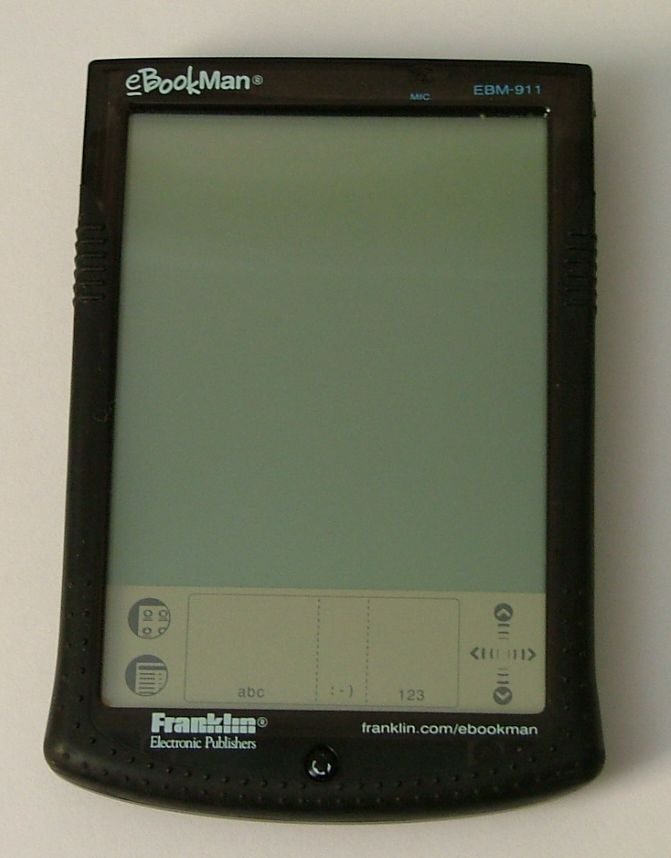
Others followed into the same narrow market. Franklin Electronic Publishers, which had been selling hand-held electronic reference books since the mid-1980s, produced the eBookMan from 1999 until development stopped in 2002 — a handheld that was half PDA and half reader, and whose copy-protection scheme was tied so tightly to the individual unit that a shop could not demonstrate one, because it would not work until its buyer had connected it to an internet-linked computer and downloaded a registered copy of its own operating system. In France, Cytale built the first Cybook and was the first European company to make an e-reader; when it failed in 2003 two of its engineers, Laurent Picard and Michaël Dahan, bought the intellectual property in the device and founded Bookeen, which is why the Cybook name outlived the company that invented it.

In January 2000 the market consolidated in one transaction. Gemstar–TV Guide International, a company otherwise in the business of interactive programme guides and video-recorder scheduling codes, bought both NuvoMedia and SoftBook Press — the NuvoMedia purchase has been reported at 187 million dollars — and merged them into a Gemstar eBook Group. The two designs returned to the market in 2001 under RCA branding as a matched pair: the REB1100, descended from the Rocket, a backlit monochrome 480 × 320 touchscreen with 8 MB of internal storage, a modem and a USB port, listed at 299 dollars and reading files in a format written .rb; and the REB1200, descended from the SoftBook, an 8.2-inch backlit colour touchscreen at 480 × 640, listed at 699 dollars and reading a format written .imp. Later units were sold under Gemstar’s own GEB numbers.
The pair had a short life. In June 2003 Gemstar disclosed that it was leaving the business: device sales stopped at once, and sales of content ceased on 16 July 2003. Customers were told that the titles they had bought would remain in their online accounts on Gemstar’s servers for three years, through July 2006. The hardware outlived the shop by a considerable margin: eBook Technologies, Inc. went on selling and supporting the two colour models and issued firmware that removed their dependence on Gemstar’s servers altogether. The dedicated-reader experiment of 1998–2003 thus reached its commercial end three weeks after this group was created, by somebody who could not find an e-book group on his news server.
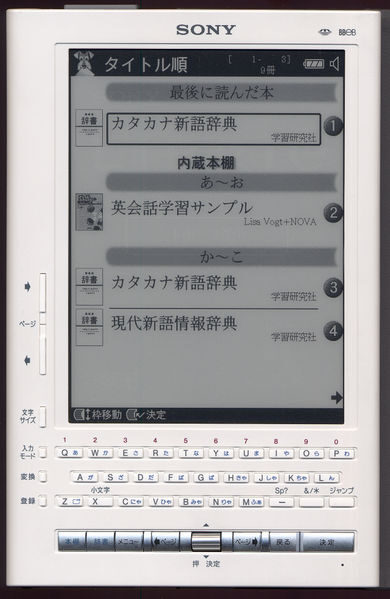
The technology that made the next attempt work was a display, not a business model. In 2004 Sony released the Librie in Japan, the first commercial e-reader with an electronic-paper screen from E Ink Corporation: reflective rather than backlit, holding an image without power, and readable in the conditions in which people actually read. Sony followed it with the Reader PRS-500 in September 2006 for the American market, announced in February 2014 that it was closing its Reader stores and moving its customers to another retailer, and said in August 2014 that it would release no further e-reader.
The competing formats and their locks
Each device sold books in its own format through its own shop, and each format carried its own scheme for restricting what could be done with a purchased file. Those schemes were not incidental: they were a standard feature of every commercial platform of the period, and the contemporaneous record described below documents them being applied to individual titles.
Microsoft released Microsoft Reader in August 2000, with the .lit format — technically an extension of the company’s compressed-HTML help format with rights management added — and with ClearType, a subpixel-rendering technique that made small text markedly more legible on the liquid-crystal screens of the day. Adobe entered the same year by acquisition, announcing in August 2000 that it was buying the e-book software company Glassbook: the Glassbook reader became Adobe Acrobat eBook Reader and the Glassbook content server became Adobe Content Server, the licensing back end that publishers and later libraries used to issue protected files. Mobipocket SA, a French company incorporated in March 2000 and based in Paris, took the opposite approach and targeted the handhelds people already owned — devices running Palm OS, Symbian, Psion and Windows — with a compact format written .mobi; Amazon bought the company in 2005, and shut its website and servers down on 31 October 2016. Sony had its own BBeB, short for Broad Band eBook and developed with Canon, alongside the Gemstar .rb and .imp already mentioned.
One precise contemporaneous description of what all this felt like from the reader’s side is a court document. In July 2001 a federal judge in New York, describing the products of one small e-book publisher, recorded that its titles could be read only after being downloaded into a computer holding Microsoft Reader, Adobe Acrobat Reader or Adobe Acrobat eBook Reader; that the files contained security features to prevent users from printing, e-mailing or otherwise distributing the text; and that although it was technologically possible to foil those features, anyone who did so would be violating the licensing agreement accompanying the software. That is three separate pieces of reading software for the catalogue of a single small publisher, stated flatly and without comment.
The schemes could reach further than infringement. In the October 2001 issue of D-Lib Magazine, Brewster Kahle, Rick Prelinger and Mary E. Jackson published an article titled “Public Access to Digital Material” with an appendix headed “An Example of E-Book Restrictions”. The appendix reproduces a screen shot of the usage restrictions that Adobe’s eBook reader reported for an edition of Alice in Wonderland — a text whose copyright had expired long before — and, as the authors put it, in that screen shot the software “declares that reading ‘Alice in Wonderland’ aloud is not allowed”. It is recorded here because it is dated, published and checkable, not because this page has a view about it.
The standards effort that eventually consolidated them
Running alongside the format war, and largely ignored by it, was an attempt to end it. An industry body called the Open eBook Forum came together in 1999, and the Open eBook Publication Structure, version 1.0, was released in September that year. It was built on XML, using a defined subset of XHTML for content, CSS for presentation and Dublin Core for metadata, packaged as a ZIP file with a manifest; and it was, as contemporary accounts had it, based primarily on technology developed by SoftBook Press. Maintenance releases followed: 1.0.1 replaced 1.0 in June 2001, and a recommended specification numbered 1.2 appeared in August 2002.
The forum renamed itself the International Digital Publishing Forum in 2005, with a broader remit. Under the new name it produced the successor that finally stuck. The Open Publication Structure 2.0, released in September 2007 and approved in October, superseded the 1.2 specification and was given a shorter name for the packaged whole: EPUB. Its architecture is the one Open eBook chose in 1999 — XHTML and CSS in a ZIP container with a manifest — which is why an EPUB file opened with an ordinary archive tool turns out to be, in effect, a small website in a box. The EPUB 3.0 recommended specification was approved on 11 October 2011 and added, among much else, fixed-layout documents and mathematical markup; version 3.3 was announced on 25 May 2023.
The institution then dissolved into a larger one. On 30 January 2017 the International Digital Publishing Forum was combined with and absorbed into the World Wide Web Consortium, on the stated reasoning that the publishing industry and core web technology should be fully aligned rather than parallel. The e-book, having spent twenty years arguing about how to be different from a web page, formally became one.
The dates matter for this group in one specific way. The consolidation arrived late. For the whole period in which this address was created and in which the e-book branch of the namespace was being subdivided — 1999 to about 2005 — there was no settled format, no settled device, and no settled place to buy from.
The point at which a single retailer’s device reset the market
Amazon bought Mobipocket in 2005 and said little about why for two years. On 19 November 2007 it released the first Kindle: a six-inch electronic-paper reader at 399 dollars, with a cellular data connection built in so that books arrived without a computer, a cable or a shop. It sold out in five and a half hours and stayed out of stock for months. The Kindle Store opened alongside it with more than 88,000 titles in the American store, and the format the device read was a descendant of the one Amazon had bought two years earlier.

What changed was not that a better format won. Technically the Kindle was a proprietary machine reading a proprietary format with proprietary rights management — the same arrangement that had failed for Gemstar, and that Microsoft and Sony were also running. What was different was that a single company now controlled the device, the shop, the delivery path and the catalogue at once. In July 2010 Amazon reported that over the previous three months it had sold about 143 Kindle e-books for every 100 hardcover books. The competitors reorganised around the same shape: Barnes & Noble announced the Nook in October 2009 and shipped it the following month, Apple shipped the iPad with a bookshop attached in April 2010, and Google opened an eBookstore of its own on 6 December 2010.
The older platforms closed in sequence. Microsoft announced in August 2011 that it was discontinuing Microsoft Reader and the .lit format, ended sales of the format on 8 November 2011, and retired it at the end of August 2012. Amazon shut Mobipocket’s servers in 2016. Sony left the consumer e-reader business in 2014. Each closure stranded whatever protected files its customers had bought, in the specific sense that the software licensed to open them stopped being distributed.
For a group like this one the effect was indirect but decisive. The questions that had given an e-book exchange its reason to exist — which reader, which format, where does one even obtain a file for the device one owns — had acquired a default answer, and the answer was a shop button. Usenet’s binaries hierarchy went on carrying enormous quantities of everything, but the specific problem the e-book groups had grown up around was no longer a problem most readers had.
alt.etext, February 1993: the same subject, a different shape
Six years before anyone asked for an e-book binaries group, the alt.* hierarchy had already produced a group for electronic texts, and its paperwork survives in full. The message itself records that the original proposal was posted to alt.config on 16 January 1993; the newgroup control message is dated 2 February 1993 and was issued by Thomas E. Dell, and unusually for alt.* it carried a version-numbered charter.
The charter is worth quoting because it defines, at the outset, the distinction this article has been circling. alt.etext was created for:
Announcements of new items of electronic text made available via FTP or Gopher, or other means. — Occasional reposting of ETEXT announcements made to other groups or mailing lists (such as PACS-L). — Permit contact between ETEXT people so that effort is not wasted OCR’ing or hand entering the same text twice. — Discussion of electronic text content and formats. — Posting of small items of electronic text, if necessary. (Not the main motive behind the group.)
Four purposes about coordination and one, explicitly deprecated, about carrying files. The accompanying note defines the term in use — “‘ETEXT’ usually (but not always) refers to material that existed on paper prior to its electronic form” — predicts “a low volume, high signal to noise ratio group”, and records that the group is unmoderated. The note also urges “major systems to carry this group” on the ground that announcements of available etexts would be posted there. The distribution itself was to happen elsewhere, over FTP and Gopher, with Usenet used for the announcement and the division of labour.
That is the shape the lawful side of electronic books took on Usenet, and it is a different shape from a binaries group. It is also the shape that the volunteer digitisation projects had already been using for two decades.
The public-domain counter-current
The oldest electronic-book project on the internet is older than the internet’s name for itself. In 1971 Michael S. Hart, a student at the University of Illinois, obtained an account with a virtually unlimited amount of computer time on a Xerox Sigma V mainframe in the university’s Materials Research Lab — a machine that happened to be one of the fifteen nodes then on the ARPANET. By the project’s own account he typed the text of the United States Declaration of Independence into it on 4 July 1971 and made it available to other users on the network, and called what he had started Project Gutenberg. He entered every text by hand until 1989, when image scanners and optical character recognition became good enough and cheap enough to change the arithmetic. By the mid-1990s he was running the project from Illinois Benedictine College, with Carnegie Mellon University administering its finances and volunteers taking over the daily work. When the project’s own site was checked for this article in August 2026, it listed 79,266 free e-books.
Two things about Project Gutenberg bear directly on this group. The first is its house format. The project’s releases were, for most of its history, plain text: no markup, no rights management, no reading software, and no device that could not open them. That was a deliberate choice about durability rather than an inability to do better, and it meant that the single most common thing an e-book reader of 1999 might legitimately want was already available in a format no format war could strand. The second is the licence position: the texts are public-domain works, distributed freely and lawfully, which is the plain reason why the existence of an e-book group is not by itself evidence of anything.
The volunteer apparatus grew around it. Distributed Proofreaders was founded in 2000 by Charles Franks as an independent site to assist the project, splitting scanned pages into single-page tasks that many people could proofread in parallel against the page image; it became officially affiliated with Project Gutenberg in 2002, and reached its fifty-thousandth digitised title on 7 December 2025. On the commercial side, the publisher Baen Books ran an experiment in the same direction: in late 1999 the science-fiction writer Eric Flint and the publisher Jim Baen opened the Baen Free Library, giving away complete novels without copy protection expressly in order to find out whether free electronic availability encouraged or discouraged sales of the paper editions. From 2002 Baen went further, binding CD-ROMs into some hardcovers that carried a prominent permissive licence expressly encouraging free-of-charge copying and sharing, including over the internet.
Institutional digitisation followed, and brought the argument with it. Google announced in 2004 that it would scan the holdings of several major research libraries; the Authors Guild sued it for copyright infringement in 2005. That litigation is outside this article’s scope, but its date is not: by the time large-scale library scanning became a public controversy, the small-scale version of the same activity had been running on Usenet for years.
None of this makes the traffic in this particular group lawful, and nothing here should be read as suggesting that it does. It establishes something narrower and necessary: that in the years this group existed, a very large, entirely legal, entirely free corpus of electronic books was in circulation, that its native format was the one Usenet carried most easily, and that an e-book group was therefore not, on its name alone, an infringement group.
Copyright and the electronic book, as record
The statutes of the period, and the enforcement machinery built on them, are treated at length on this directory’s page for alt.new.cracks, and are not repeated here. Only two dates need restating, because they landed a day apart in the autumn of 1998, just as the first e-book devices were reaching shops. On 27 October 1998 the Sonny Bono Copyright Term Extension Act was signed, adding twenty years to United States copyright terms and holding out of the public domain a large body of twentieth-century work that volunteer digitisers would otherwise have reached. On 28 October 1998 the Digital Millennium Copyright Act was signed, its section 1201 making it actionable to circumvent a technological measure controlling access to a work, whether or not any infringement of the copyright itself followed. The e-book industry described in the sections above was built in the eighteen months after those two signatures, and both of them are visible in its design.
Random House v. Rosetta Books, 2001–2002
The defining case about the electronic book was not about copying at all. It was about a phrase in old publishing contracts. In 2000 and the beginning of 2001 a small digital publisher, Rosetta Books, contracted with several authors to publish eight of their existing works in digital form over the internet: William Styron’s The Confessions of Nat Turner and Sophie’s Choice, Kurt Vonnegut’s Slaughterhouse-Five, Breakfast of Champions, The Sirens of Titan, Cat’s Cradle and Player Piano, and Robert B. Parker’s Promised Land. Rosetta launched its ebook business on 26 February 2001. Random House, which held contracts with the same authors dating from 1961, 1967, 1970 and 1977 — two of them made with a predecessor in interest — filed suit the next day for copyright infringement and tortious interference with those contracts, and moved at once for a preliminary injunction.
Each of the contracts used the phrase “print, publish and sell the work in book form” to convey rights from the author to the publisher. Random House argued that an electronic edition containing the complete text was a book in that sense. Judge Sidney H. Stein of the United States District Court for the Southern District of New York disagreed, and on 11 July 2001, in an opinion reported at 150 F. Supp. 2d 613, held that Random House was not the beneficial owner of the right to publish the eight works at issue in the format that had come to be known as the ebook. Because Random House could not establish a prima facie case of infringement it was not likely to succeed on the merits, was not entitled to a presumption of irreparable harm, and had shown none; nor, the court added, did the balance of hardships tip decidedly in its favour. The motion was denied. The opinion closes by declining the larger role on offer:
This is neither a victory for technophiles nor a defeat for Luddites. It is merely a determination, relying on neutral principles of contract interpretation, that because Random House is not likely to succeed on the merits of its copyright infringement claim and cannot demonstrate irreparable harm, its motion for a preliminary injunction should be denied.
The Court of Appeals for the Second Circuit affirmed on 8 March 2002, at 283 F.3d 490. Three organisations appeared as amici curiae on the appeal: the Association of American Publishers in support of Random House, and the Authors Guild, Inc. together with the Association of Authors’ Representatives, Inc. in support of Rosetta. That is a reasonable indication of how much the industry thought was riding on a preliminary-injunction motion about eight backlist titles.
New York Times Co. v. Tasini, 2001
The same question — who holds the electronic rights in a work licensed before electronic publication existed — reached the Supreme Court of the United States that summer in a different medium. Freelance journalists, led by Jonathan Tasini, sued over the inclusion of their newspaper and magazine articles in commercial full-text databases without further permission or payment. The case was argued on 28 March 2001 and decided on 25 June 2001, at 533 U.S. 483; the Court held 7–2, in an opinion by Justice Ginsburg, that the publishers could not license the freelancers’ individual contributions in that way. It had been heard at first instance by Judge Sonia Sotomayor, who held that the publishers were within their rights under the Copyright Act of 1976, and was reversed on appeal. The decision involved works by some 27,000 authors and the plaintiffs eventually won a compensation pool of 18 million dollars. Its practical effect was immediate at the newspaper that gave the case its name: subsequent freelance contracts there were drafted to cover electronic exploitation outright.
United States v. ElcomSoft, 2001–2002
The third case is the one where the e-book format and the circumvention statute met directly. Dmitry Sklyarov, a Russian programmer employed by ElcomSoft, travelled to the United States to give a conference talk in Las Vegas titled “eBook’s Security – Theory and Practice”; on 16 July 2001, as he was about to fly home to Moscow, he was arrested by the FBI. His employer had produced software that removed the restrictions from Adobe’s protected e-book files, and the charges were brought under the Digital Millennium Copyright Act. Adobe, whose complaint had brought the matter to the prosecutors’ attention, withdrew it; the prosecutors did not. Sklyarov was released on 50,000 dollars bail on 6 August 2001 and permitted to return to Russia on 13 December 2001, the government having agreed to drop the charges against him on condition that he testify at his company’s trial. On 17 December 2002, after a two-week trial in San Jose, a federal jury found ElcomSoft not guilty on all four counts.
Those three cases are set down here as record. Each is reported, dated and citable; each turned on a question the electronic book had newly created; and none of them is adjudicated on this page.
What the group actually was
Stated plainly, and with nothing added: alt.binaries.e-books was an unmoderated alt.* group created by a single control message on 24 June 2003, one of eighteen groups in a small family whose names run on the e-book stem, and it existed to carry encoded book files posted as ordinary Usenet articles. It never acquired a description line. It has no charter beyond the six explanatory lines of its founder’s note. Its parent group, created in 1999, is the older address, and the plural form at this page’s name was asked for by somebody who could not see an e-book group on any server available to him.
Much of what such groups carried was posted without the rights holders’ permission. That is not a contested reading: the family’s own group descriptions name textbook scans, digitally archived magazines and files for one commercial reader’s proprietary format, and the general accounts of the binaries hierarchy are consistent on the point. This directory records that as history. It names no source, describes no method, and links no archive of the material, and it takes no position on the conduct beyond noting the law of the period set out above.
Equally, the record does not support treating the name as a synonym for infringement. Public-domain texts were among the most widely circulated electronic books of the period and the easiest to carry over a text network. Authors and at least one publisher gave complete works away without protection in the same years. Nothing in the surviving evidence separates the proportions, and this page will not guess at them.
The honest summary is that this was a small distribution address in the largest and least documented branch of Usenet, created late and described never. What has kept it in this directory is not its own record but the durability of a single citation, made while the devices in the sections above were still on sale and never revised since; the page is served, in two spellings of its address, so that the citation still lands somewhere true after more than twenty years.
What the record does not show
Almost everything a reader might want to know about the group itself is missing, and it is worth being specific about which things and why.
- Traffic. There are no surviving figures for articles posted, files carried or bytes transferred in this group. The distributed active file records the name as existing and flagged for posting; its numeric fields in the copy consulted for this article read 0000000000 and 0000000001, exactly as they do on all 45,003 lines of that file, and cannot be read as counts.
- Readership. Usenet had no subscriber list. Nobody could count the readers of any group, and no reliable count for this one exists in any form.
- Propagation. Because the removal request had no lasting effect and the creation was honoured by an unknown number of administrators, there is no way to say on how many servers the group ever appeared, or when.
- Content. This article makes no claim about which specific works passed through the group, in what proportion, or from where. No thread, subject line or posting is quoted or characterised anywhere above, because none was examined for this article and none would be reproduced if it had been.
- People. The three control messages carry sender identities of the usual alt.config sort: a first name, a pseudonymous address, and a self-declared role title. None is identified further here, and no participant in the group — as distinct from its administrative traffic — is named at all.
- An end. There is no closure notice, no final posting and no removal that took effect. The name is still in the current census. Whether anything is posted to it now is not something this page can establish.
None of that is unusual. It is the ordinary evidential position of an alt.binaries.* group, and the reason the substance of this article is the world the group sat in rather than the group itself.
Scope and limits
The group-specific facts above come from two primary sources and nothing else: the Internet Systems Consortium’s archive of Usenet control messages, which holds the newgroup, rmgroup and booster messages for this name and for its siblings; and the newsgroups and active files that the same body publishes as the working census of publicly propagated groups, in the editions published on 26 August 2026 and checked while this article was written. Quotations from control messages are exact, including their spelling and their missing punctuation. Timestamps are given as the messages carry them, converted to UTC where the message states an offset.
The wider history — the devices, the formats, the standards, the digitisation projects and the litigation — is drawn from published reference sources, from the specifications’ own release records, and, for the three cases, from the reported opinions and their official citations. The Rosetta passage and the sentence quoted from it are taken from the text of the district court’s own opinion. Two figures are reported rather than asserted: the price paid for NuvoMedia, which is a press figure, and the 18 million dollar compensation pool in the Tasini litigation, which was reached after the decision rather than ordered by it. Where a claim could not be checked against a source of that quality it has been left out.
What this page is not: it is not a guide to obtaining anything, not an index, not an archive, and not a judgement on anybody’s conduct. The e-mail gateway this directory once fronted ran from 2000 to 2004 and delivers nothing now. The address is kept resolving, with its trailing-space twin, so that a link written a generation ago still arrives somewhere that tells the truth about what it was pointing at.
Reading alt.binaries.e-books today
- Historical archive: Google Groups — alt.binaries.e-books (coverage varies by group and era).
- Open in a newsreader:
news:alt.binaries.e-books— the original site offered exactly this link, and it still works if your system has a newsreader registered for thenews:scheme. - Live access: point an NNTP newsreader at a modern server — see accessing Usenet today.
- The original news2mail e-mail subscription service ended in the mid-2000s and no longer operates.