alt.new.cracks
A software-cracking group from the warez era.
Part of the 1990s warez-scene periphery on Usenet, trafficking in crack requests and releases. It is preserved here as a directory entry only — as cited by histories of the scene — not as an endorsement or a source.
Its existence documents why software publishers spent the decade experimenting with copy protection, and why comp.* groups kept their distance.
On this page
- The whole surviving record is two control messages
- Why the name is not in the current list
- In alt.* there is no vote to find
- Why such groups existed on Usenet at all
- The law of the group’s era: the American statutes
- The 1998 legislation and its anti-circumvention provisions
- The European frame
- Enforcement operations, 2001 onward
- The publishers’ side: copy protection as commercial history
- Activation, subscription and the change in the economics
- What scholarship says about the scene
- Why the comp.* hierarchy kept its distance
- Why the address is preserved here at all
- What the record does not show
- Scope and limits
The whole surviving record is two control messages
What survives of this address is not a discussion, an archive or a charter. It is two administrative messages, sent on the same day within about two hours of one another, and preserved together in the Internet Systems Consortium’s archive of Usenet control messages. That archive holds the newgroup, rmgroup and checkgroups messages it has received since early 1991, filed under the name of the group each one would have affected. The file kept under this name is 820 bytes compressed; its own last-modified timestamp is 30 December 1994, and nothing has been added to it since.
The first message is a newgroup control message, posted to alt.config — the group in which alt.* creations were conventionally aired — and timestamped Friday 30 December 1994 at 21:05:54 GMT. It carries a Control: newgroup alt.new.cracks header and, in its body, a hand-pasted second copy of the same instruction. It carries no charter, no description, and no statement of what the group was for. Its Path header records the ordinary relay trail of the period: out of a large commercial dial-up provider’s news machine, through several university and network relays, and into the collecting site whose spool the archive was built from.
The second message is an rmgroup, sent by a different person from a different network and timestamped the same day at 23:12:08 GMT — two hours and six minutes after the first. Such a message was always allowed to explain itself, and the standards-track description of the Netnews architecture, RFC 5537 of November 2009, still records that an rmgroup’s body “MAY contain anything, usually an explanatory text”. This one contains four lines of it. Three are stated as objections of namespace housekeeping:
- that the creation was “not discussed in alt.config”;
- that it “creates new unneeded top level alt heirarchy”;
- that it “creates orphan heirarchy”.
The spelling is the record’s. The fourth line asserts that the newgroup had been issued at another person’s instruction rather than on the sender’s own initiative; this page does not reproduce the epithet it uses, and names neither party. The rmgroup then quotes the newgroup message in full, which is why both texts survive inside a single archived file.
That is the entire administrative life of the address as the record holds it: asked into existence at 21:05 and asked out of it at 23:12, on the second-to-last day of 1994. The archive file’s timestamp is 23:16 that same evening, four minutes after the removal request. In the three decades since, nothing further has been filed against this name in an archive that has been collecting continuously throughout.
One internal oddity is worth recording, because it is characteristic of the genre rather than of this group. The pasted copy inside the newgroup’s body carries its own Date line, given as 16:04:14 with the numeric offset −0700 and the zone name (EST) alongside it. The two do not agree. Read by the zone name it resolves to 21:04 GMT, a minute before the envelope’s own timestamp; read by the numeric offset it resolves to 23:04, nearly two hours after. Control messages in alt.* were composed by hand in ordinary consumer newsreaders — the X-Newsreader header here names a Windows one of the period — and it shows.
Why the name is not in the current list
The group is absent from the newsgroups file the Internet Systems Consortium publishes as the working census of publicly available hierarchies. That file, in the edition published on 25 August 2026 and checked for this article, lists 45,003 groups, of which 20,466 are in alt.*. It contains no alt.new.cracks. It contains, in fact, no group at all whose name begins alt.new.: in the file’s own order it steps straight from alt.new-hampshire to alt.newage.angels, with the intervening branch empty. The control archive tells the same story from the other side. It holds 36,208 separate files for alt.* groups, and exactly one of them sits under alt.new.* — this one.
The reason for the absence is documented, and it is not simply that the rmgroup worked. The archive’s published group-creation policy treats alt.* and free.* as special cases: in each, it states, “all properly formatted newgroups … are automatically executed, and all rmgroups are ignored”. The control.ctl file distributed with the INN news server and mirrored on the same host says the same thing in configuration — newgroup:*:alt.*:doit against rmgroup:*:alt.*:drop — under a comment reading “Accept all newgroups … and silently ignore all rmgroups”. At this archive, an rmgroup for an alt.* group is a document, not an instruction.
The same policy, however, sets a bar the 1994 newgroup does not clear. To be executed automatically, it says, a newgroup message “must contain a valid newsgroup description for the created newsgroup, which means there must be a line in the body reading, exactly: For your newsgroups file:”, followed on the next line by a description. The message archived under this name contains no such line and no description of any kind. On the policy as it now stands, the creation would never have been executed, and the removal would never have been needed.
A caution belongs with that inference, and the dates make it plain. The group-creation policy quoted above carries a last-modified date of 2018 and the control.ctl file one of 2023; both are maintained decades after the event, and the record does not establish that the same test was applied in December 1994. The honest statement is therefore narrow, and it is worth stating narrowly: the group is not in the list; the record contains a newgroup message that does not meet the archive’s stated formatting requirement; and the record contains an rmgroup that the archive’s stated policy would ignore. Which of those actually governed, thirty years ago, on the independently administered servers that would each have decided for themselves, the record does not say. The same control.ctl commentary is unusually candid on the point: “there is no official, generally accepted alt.* policy and all information about alt.* groups available is essentially someone’s opinion, including these comments.”
In alt.* there is no vote to find
A researcher approaching a Big-8 newsgroup can normally read its whole birth certificate. The formal process left paperwork by design: a Request for Discussion, a Call for Votes, a published result with the tally attached, and often a later notice or two. The Internet Systems Consortium mirrors that paperwork, and its directory listing is a map of which hierarchies produced it — there are folders for comp, humanities, misc, news, rec, sci, soc and talk, alongside guidelines and group lists. There is no folder for alt; the corresponding address returns a 404. That machinery, and the arithmetic of the thresholds it enforced, is described on the soc.* hub page and is not repeated here.
alt.* never had it. Creation there required no proposal, no discussion period, no neutral votetaker and no electorate: it required one correctly formatted message, and thereafter the private judgement of every administrator who received it. The mechanism, and the conventions that grew up around it in alt.config, are set out on the alt.* hierarchy page. The consequence for this article is simply stated: for a group in this hierarchy there is no vote to find, and its absence is structural rather than a gap in the archive.
What follows from that is a short list of things this page cannot tell a reader, and will not pretend to. There is no charter, because nobody was obliged to write one. There is no vote, because there was no electorate. There is no moderator, because there was no appointment to make. There is no statement of purpose beyond what one person typed into a control message on a December evening, and no way to know from the record whether anyone else ever wanted the group at all. The one-line description at the head of this page is a directory’s summary of a name; it is not a charter, and no charter for this address exists.
Why such groups existed on Usenet at all
The interesting question about an address like this one is not why somebody typed the name, which requires no explanation, but why the medium made the attempt worth making. The answer is structural, and it is contained almost entirely in three properties of Netnews that had nothing to do with anybody’s intentions about software.
The first is the absence of a centre. Usenet has no operator. It is a set of protocols implemented independently by every participating server, whose administrators decide privately what to accept, what to store and for how long. Removal is not an operation anyone can perform on the network; it is a request that each server may honour or discard, which is exactly what the rmgroup above turned out to be. A hierarchy with no central authority also has no key to trust and no register of decisions — which is why, as noted above, even the reference documentation describes its own account of alt.* as an opinion.
The second is the propagation model. RFC 5537 describes Netnews as organised around newsgroups “with the expectation that each reader will be able to see all articles posted to each newsgroup in which he participates”, and states that the protocols “most commonly use a flooding algorithm that propagates copies throughout a network of participating servers”, with typically one copy stored per server and served locally on demand. For ordinary discussion this is simply how a global conversation was made to work on intermittent links and expensive long-distance calls. For anything else, it means that a single injection at any point produces copies held by many independent parties, none of whom is accountable to the others and each of whom can be asked, but not compelled, to drop them.
The third is the binaries branch. Usenet articles are text, and the practice of encoding files across many articles for reassembly produced a branch of the namespace — alt.binaries.* — whose data volume came to dominate the storage of the servers that carried it. The consequences are visible in how news came to be provided: the branch is one of the two things routinely dropped from a restricted newsfeed, running a full feed became one of the harder services an internet provider could offer, and the retention time a server could afford became the measure by which binary groups were judged usable at all. That story belongs to the alt.* hierarchy page linked above, which owns it, and none of it is retold here. Its relevance to this address is only that the branch existed, that it was in alt.*, and that it lowered the threshold for anyone who thought a new name in the same hierarchy would find an audience.
Put together, the three properties describe a medium that was cheap to enter, impossible to govern centrally, and structurally indifferent to what it carried. The first two were deliberate features of the design rather than defects in it, and for the great majority of the network’s traffic they worked as intended.
The law of the group’s era: the American statutes
The legal position of unauthorised software copying changed substantially during the decade in which this address was created, and the sequence is unusually well documented. It is set out here as the record states it, with dates and holdings, and with no view offered on any of it.
The starting point is a case decided two days before the control messages above. In United States v. LaMacchia, 871 F. Supp. 535 (D. Mass. 1994), decided on 28 December 1994, the District of Massachusetts dismissed a wire-fraud indictment brought under 18 U.S.C. § 1343 against a student who had run an electronic bulletin board on which others uploaded and downloaded commercial software. There was no allegation that he had profited. Following the Supreme Court’s reasoning in Dowling v. United States, 473 U.S. 207 (1985), the court held that copyright prosecutions must be brought, if at all, under section 506 of the Copyright Act, and that section 506 as it then stood reached only infringement undertaken for commercial advantage or private financial gain. The memorandum said in terms that this was a shortcoming for the legislature rather than the court to fix. The gap it identified became known as the LaMacchia loophole.
The coincidence of dates is worth stating and then leaving alone. The decision was handed down on 28 December 1994; the two control messages archived under this address are dated 30 December 1994. Nothing in the record connects them, and this page asserts no connection. They are simply two entries in the same week of the same year, one of which became the reason for a federal statute and the other of which became a directory entry.
That statute is the No Electronic Theft Act, Pub. L. 105–147, 111 Stat. 2678. Introduced as H.R. 2265 on 25 July 1997, passed by the House on 4 November and the Senate on 13 November, it was signed on 16 December 1997 and took effect the same day. It amended provisions of both title 17 and title 18 of the United States Code, and its operative moves were two. It redefined “financial gain” in 17 U.S.C. § 101 to include the “receipt, or expectation of receipt, of anything of value, including the receipt of other copyrighted works”. And it added, at 17 U.S.C. § 506(a)(1)(B), a threshold under which criminal liability could attach where the infringer neither obtained nor expected anything of value, by the reproduction or distribution — expressly including by electronic means — during any 180-day period of one or more copies of one or more works with a total retail value above 1,000 US dollars. Maximum penalties run to five years’ imprisonment and fines. The United States Sentencing Commission subsequently stiffened the sanctions for intellectual-property offences in response.
The first clause is the one that matters most to any account of the trading cultures of the period: the statute placed the receipt of other copyrighted works inside the definition of financial gain. What had previously been argued to be outside the criminal law because no money changed hands was, from 16 December 1997, expressly inside it. This page reports the text of that change and offers no view on it.
The first conviction under the new Act is recorded in 1999, when a student at the University of Oregon pleaded guilty in the federal district court at Eugene to distributing copyrighted material and allowing others to download it, and was sentenced to two years’ probation with conditions attached. It is a small case, and it is cited here only to date the point at which the statute began to be used.
The 1998 legislation and its anti-circumvention provisions
The second American statute of the period had a different target. The Digital Millennium Copyright Act, Pub. L. 105–304, 112 Stat. 2860, was introduced as H.R. 2281 on 29 July 1997, passed the House on 4 August 1998 and the Senate on 17 September, cleared conference and returned through both chambers in October, and was signed on 28 October 1998. Its stated purpose was to implement the two treaties adopted at the World Intellectual Property Organization’s diplomatic conference of December 1996: the WIPO Copyright Treaty and the WIPO Performances and Phonograms Treaty.
Where the 1997 Act extended the law of infringement, the 1998 Act added a separate prohibition alongside it. The provisions now codified at 17 U.S.C. §§ 1201–1205 — universally called the anti-circumvention provisions — address technological measures that control access to a work. They reach both the act of circumvention and the manufacture and trafficking in the means of it, and they operate independently of whether any copyright infringement occurs. The legislative reasoning recorded by commentators is that copyright law had never previously needed to concern itself with the medium of a work, because exact copies of analogue works were not practically obtainable; digital copies were, and lawmakers concluded that limits on devices and services had to be added to limits on acts.
Section 1201 carries a list of specific exceptions — among them limited reverse engineering and security research — and the Act created a rulemaking, revised every three years, in which the Register of Copyrights takes public submissions and recommends classes of use that the Librarian of Congress then exempts from the prohibition for the following three years. Section 1201(c) provides that the section does not alter the underlying substantive rights, remedies or defences of copyright; commentators observed early that this did not, in practice, make those defences available in a circumvention action, and that the section contains neither a fair-use exemption from criminality nor a requirement of guilty knowledge. The Act’s other titles are largely unrelated to this subject: Title II created the notice-and-takedown safe harbour for online service providers, Title III permitted the temporary copies made in the course of computer repair, and Title V added a separate protection for boat-hull designs.
The practical significance of the 1201 provisions for the culture this address belonged to is a matter of legal history rather than of Usenet history: from 1998 the American statute book contained an offence that did not depend on showing that a copy had been made or distributed at all. That is what the text says. What it has meant in application has been litigated ever since, and none of that is adjudicated here.
The European frame
Europe arrived at a comparable position along a different route and on a slower clock, and the sequence is worth having straight because the two systems are frequently conflated.
The baseline predates the group. Council Directive 91/250/EEC of 14 May 1991 on the legal protection of computer programs — published at OJ L122, 17 May 1991, pp. 9–13, and to be transposed by 1 January 1993 — required member states to protect computer programs, and their preparatory design material, by copyright as literary works within the meaning of the Berne Convention. Article 4 reserved to the rightholder the temporary or permanent reproduction of the program, its translation or adaptation, and its distribution to the public. Article 5 carved out what the lawful acquirer of a program may do without permission, expressly including the making of a back-up copy for personal use, and Article 6 permitted decompilation where necessary to achieve interoperability with another program, with the results usable for no other purpose. The Directive was formally replaced by Directive 2009/24/EC on 25 May 2009, which consolidated it. By the time this address was typed, in other words, software had been settled European copyright subject-matter since 1991, and the deadline for putting that into national law had passed two years earlier.
The anti-circumvention layer came a decade later. Directive 2001/29/EC on the harmonisation of certain aspects of copyright and related rights in the information society was made on 22 May 2001 and published at OJ L167, 22 June 2001, p. 10. It implemented the 1996 WIPO Copyright Treaty in Union law, distinguished the reproduction right in Article 2 from the right of communication and making available to the public in Article 3 — the latter framed specifically for transmission over networks — and set out in Article 5 a closed list of exceptions that member states might, with one exception, choose to adopt or not. The one exception they had to adopt is the transient or incidental copying that occurs in the course of a network transmission or a lawful use, which is why the servers that carry a transmission are not liable for what passes through them.
Its Article 6 is the European counterpart to the American section 1201. It requires member states to provide “adequate legal protection” against the intentional circumvention of “effective technological measures”, and separately against the manufacture, import, distribution, sale, rental, advertisement or commercial possession of devices, products, components or services that are marketed for circumvention, have only limited commercially significant purpose other than circumvention, or are primarily designed to enable it.
Transposition was slow and is documented as such. Member states had until 22 December 2002; only Greece and Denmark met the deadline. Italy, Austria, Germany and the United Kingdom followed during 2003, and the remaining eight — Belgium, Spain, France, Luxembourg, the Netherlands, Portugal, Finland and Sweden — were referred to the European Court of Justice for non-implementation, four of them being held responsible in 2004.
The WIPO Copyright Treaty itself, adopted in 1996 and in force since 2002, had 119 contracting parties as of August 2026. It is the common ancestor of both the 1998 American Act and the 2001 European Directive, which is why the two texts, drafted independently in different legal traditions, address the same subject in recognisably parallel terms.
Enforcement operations, 2001 onward
Statutes are one part of the record; the prosecutions brought under them are another, and for this subject the second is unusually well documented because the operations were publicised by the agencies that ran them.
Operation Buccaneer is among the earliest of the international sweeps and one of the best documented. An undercover investigation began in October 2000. On 11 December 2001, law-enforcement agents in six countries acted simultaneously against 62 suspects, with leads reported in twenty others; the American component was led by the United States Customs Service. Around seventy search warrants were served and roughly 150 computers seized for analysis, with raids also conducted in Canada, Britain, Australia, Finland, Norway and Sweden. Computers at several American universities were searched, the institutions themselves not being treated as targets of the investigation. By October 2002 seventeen people had been convicted of felonies in the United States, thirteen of them receiving federal prison terms of up to forty-six months; an Australian resident contested extradition for almost three years, lost, and was sentenced to fifty-one months with credit for time already served.
Operation Fastlink followed. The United States Department of Justice announced it on 22 April 2004, describing it as the culmination of four separate undercover investigations conducted simultaneously by the Federal Bureau of Investigation, coordinated by its Cyber Division, and by the Department through its Computer Crime and Intellectual Property Section; Interpol is also recorded as a participant, and a component operation described as the largest involved twelve nations. More than 120 searches were executed in the 24 hours before the announcement, across 27 American states and ten foreign countries — Belgium, Denmark, France, Germany, Hungary, Israel, the Netherlands, Singapore, Sweden and the United Kingdom. As of 6 March 2009 the Bureau recorded sixty convictions arising from the operation.
Operation Site Down, an FBI-led action with agencies from ten other countries, executed its raids on 29 June 2005; the reported figures are approximately seventy searches in the United States and about twenty abroad, with more than forty convictions following by May 2008. Its documented prosecutions are the clearest illustration of how the pieces of this record fit together: defendants pleaded guilty to violations of 17 U.S.C. § 506(a)(1)(B) and 18 U.S.C. § 2319(c)(1) — that is, under the threshold created by the 1997 Act — alongside conspiracy counts under 18 U.S.C. § 371, with sentences in the published cases running from probation and home confinement with restitution orders to terms of imprisonment measured in months.
Two things about this sequence are worth registering without comment. The first is that the statute drafted in 1997 to answer a 1994 non-commercial case is the statute under which the international operations of the following decade were actually charged. The second is that all of it postdates the address at the head of this page by seven years or more. The enforcement history explains the world the group’s name belonged to; it does not describe anything the group itself is recorded as having done.
The publishers’ side: copy protection as commercial history
The experiments that software publishers ran with copy protection across this decade have a commercial history of their own, and it can be described honestly at the level of categories and costs without describing any scheme’s workings. This page describes no mechanism, then or now.
The rationale was a straightforward calculation: a publisher adopted protection when it judged the cost of implementing it lower than the revenue recovered from purchasers who would otherwise have obtained a copy without paying. Both halves of that sum were contested. Opponents argued that people who take free copies largely consume what is free and would not have bought at all, so the recovered revenue was smaller than assumed; a number of publishers concluded that the inconvenience to paying customers outweighed the benefit and shipped without protection. From the buyer’s side, protection was always a cost and never a feature — support calls, failed installations, and legitimate uses obstructed.
Contemporary trade opinion was sceptical from early on, and the scepticism is on the record in the computing press of the time. Jerry Pournelle wrote in BYTE in 1983 that “for every copy protection scheme there’s a hacker ready to defeat it”, and, games excepted, refused to review software that used protection at all; in 1985 he noted of one heavily protected database product that its unbreakable system had taken about three weeks to break. Edward Mendelson, writing in The Yale Review in 1985, put the user’s case in one line: “The only real effect of copy-protection is to inconvenience honest users.” The objection was not confined to reviewers. Don Estridge, who had led the development of the IBM Personal Computer, told BYTE in 1983 that unauthorised copying was “a threat to software development” and in the same breath that “it’s wrong to copy-protect programs … There ought to be some way to stop [piracy] without creating products that are unusable”, adding: “I guarantee that whatever scheme you come up with will take less time to break than to think of it.”


At the level of categories, and no further, three broad families existed side by side through the 1980s and 1990s. There were hardware keys, commonly called dongles: a physical device supplied with the software, whose presence the program required. The word is dated by Merriam-Webster to 1981, with the etymology given as perhaps an alteration of dangle; the approach met sustained resistance in the mainstream consumer market and settled instead into expensive vertical-market software — computer-aided design and manufacturing, prepress and printing, professional audio production, translation memory — where a per-seat licence cost enough to justify shipping an object with it. There were serial numbers and registration codes supplied with the package and entered by the purchaser. And there were checks performed against the distribution medium itself, of the kind that made a program refuse to run from an ordinary copy of its disc. The categories are named here because the commercial history is unintelligible without them; nothing about how any of them functioned appears on this page.
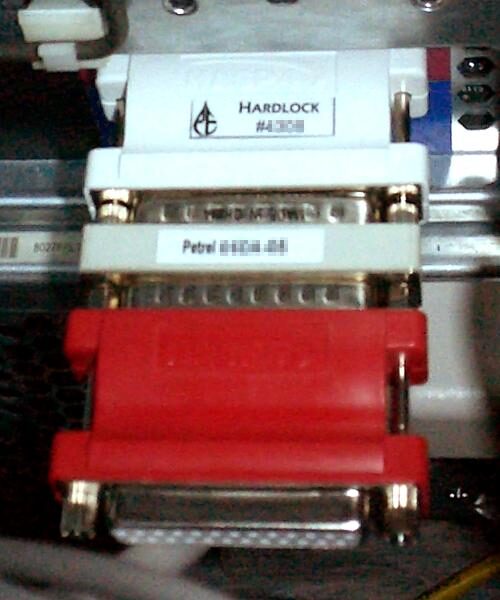

Alongside all three ran the industry’s loss estimates, which were the public justification for the whole programme and which have since been examined by an auditor. In April 2010 the United States Government Accountability Office reported to Congressional committees that “estimating the economic impact of IP infringements is extremely difficult, and assumptions must be used due to the absence of data”, and that “it is difficult, if not impossible, to quantify the net effect of counterfeiting and piracy on the economy as a whole”. Examining three widely quoted figures that had been supplied to American agencies — one from the Federal Bureau of Investigation, one from a Customs and Border Protection press release and one from a manufacturers’ association — the GAO found that they “cannot be substantiated or traced back to an underlying data source or methodology”. That is a finding about the quality of the estimates, not about the scale of the conduct, and it is recorded here in those terms.
Activation, subscription and the change in the economics
What eventually altered the position was not a better scheme but a different business model, and the shift is datable.
The first move was to make the licence a live relationship rather than a one-time transaction. Microsoft Product Activation transmits information about both the product key used to install a program and the user’s computer hardware, and inhibits or prevents use of the program until the licence is confirmed. It was introduced during the development of the operating system released as Windows XP — unveiled under that name on 5 February 2001, released to manufacturing on 24 August 2001 — and in the contemporaneous release of the company’s office suite; beta testers were objecting to it publicly by March 2001, particularly to the requirement that a change of hardware be followed by re-activation. The criticism, from consumers, analysts and technical writers alike, ran to design, inconvenience and efficacy at once, and the argument about all three has never entirely stopped.
The second and larger move was to stop selling copies. Software as a service — delivering an application as a managed service rather than a licensed artefact, and thereby separating, in the standard formulation, the possession and ownership of software from its use — began to appear around 2000 and had become the main form of application deployment by 2023. Its effect on the question of copying is structural rather than technical: a subscription has nothing to hand over.
The clearest single date in that transition, in the consumer-facing software most associated with the earlier era, is 6 May 2013, when Adobe announced that it would issue no further versions of its perpetually licensed creative suite and that future releases would be available only through a subscription; the first subscription-only versions followed on 17 June 2013. The reaction was hostile in the predictable quarters — among other responses, a petition against the change gathered more than thirty thousand signatures within weeks — and a survey conducted later the same year nonetheless found that most of the 1.4 million subscribers then reported intended to renew. Both facts are part of the record.
The historical point, stated without any claim about causation, is that the economic problem the copy-protection decade was trying to solve was eventually addressed by changing what was sold rather than by protecting what had been sold. By the time that shift was complete, the hierarchy this address belonged to had been in decline for a decade.
What scholarship says about the scene
There is a real academic literature on the warez scene as a social phenomenon, spread across management studies, criminology, human–computer interaction, contemporary history and literary studies. It is worth summarising here for two reasons: it is the honest way to say something substantive about the culture this address belonged to without recycling that culture’s own promotional material, and it does not agree with itself. Each claim below is attributed to the work that makes it. No participant is named on this page.
The earliest sustained academic treatment is Alf Rehn’s doctoral thesis Electronic Potlatch: A study of new technologies and primitive economic behavior (KTH, Stockholm, 2001), whose argument is announced in its title: that the exchange practices in question are better understood through the anthropology of gift economies than through the economics of theft. Rehn developed the same line in “The politics of contraband: the honor economies of the warez scene”, The Journal of Socio-Economics 33(3), July 2004, pp. 359–374, in which the organising claim is that status within such a community is distributed by honour rather than by money, and that the prohibition on selling is constitutive rather than incidental.
Criminology has approached the same object with different instruments. David Décary-Hétu, Carlo Morselli and Stéphane Leman-Langlois, in “Welcome to the Scene”, Journal of Research in Crime and Delinquency 49(3), pp. 359–382, took their data from an online index curating material made available between 2003 and 2009, and analysed it with social-network methods. Their reported findings are that there is a strong correlation between a group’s productivity and the recognition it receives from its peers; that the groups themselves generally have very limited life spans and low production levels; and that they work and compete in a community the authors describe as very distributed and democratic, in which they were unable to identify clear leaders. They are explicit about the limits: they had no data on the internal operations of any group, and their network matrix was aggregate.
Jonathan Basamanowicz and Martin Bouchard, in “Overcoming the Warez Paradox: Online Piracy Groups and Situational Crime Prevention”, Policy & Internet 3(2), May 2011, pp. 1–25, took the American federal enforcement operations of 2001–2005 as their subject, collecting data on 93 convictions arising from them to construct what situational-crime-prevention research calls a crime script. Their stated result is that the earlier finding holds: attempts to disrupt these groups are counterproductive, in that both policing and advances in protection technology functioned as further encouragement. They accordingly recommend that industry design around the participants’ motivations, and that enforcement concentrate its attention on a different point in the process. That is their policy recommendation, reported here and not endorsed.
Priyank Chandra’s “Order in the Warez Scene: Explaining an Underground Virtual Community with the CPR Framework”, in the Proceedings of the 2016 CHI Conference on Human Factors in Computing Systems, pp. 372–383, starts from the observation that the subculture governed and organised itself for more than three decades without economic incentives and outside any external regulation. Working by a directed content analysis of the traces the subculture left, the paper argues that the ludic competition at the centre of the scene is an institution of collective action, and can therefore be approached as a common-pool resource; it then applies Elinor Ostrom’s framework for long-enduring common-pool resource institutions to account for that longevity.
Ard Huizing and Jan A. van der Wal, in “Explaining the rise and fall of the Warez MP3 scene: An empirical account from the inside”, First Monday 19(10), October 2014, give an insider account of one music-focused sub-community, which they describe as growing exponentially from 1995 to 2004–2005 and then withering. Their explanation is that the same technological and organisational arrangements that drove the growth produced, through unforeseen side effects, the decline; the dominant mode of sociality shifted, in their terms, from a communal “We-mode” to an individual “I-mode”, and the early communal spirit was replaced by a more market-like form of sociality.
Patryk Wasiak has treated the European cracking milieu of the 1980s as a subject of contemporary history in “‘Illegal Guys’: A History of Digital Subcultures in Europe during the 1980s”, Zeithistorische Forschungen 9 (2012), issue 2. Working from magazines and published interviews with former participants, he describes a scene of adolescents, almost exclusively male, in several western and northern European countries, with its own ethical codes and rituals; argues that it understood itself not as a political counter-culture but as part of the diversifying popular and consumer culture of the decade; and dates its fading to the early 1990s, when prosecution became more determined, with its practices continuing afterwards in computer graphics, in electronic music and in the growing information-technology sector.
The most substantial single work is Martin Paul Eve’s Warez: The Infrastructure and Aesthetics of Piracy (Dead Letter Office, an imprint of punctum books, 15 December 2021, 444 pp., ISBN 978-1-68571-036-1), published open access and described by its publisher as the first scholarly book on the subculture. Eve is Professor of Literature, Technology and Publishing at Birkbeck, University of London. The book traces the movement of the culture from pre-Internet bulletin-board systems to private file-transfer servers in the mid- to late 1990s, works from the documentary material the culture produced about itself, and treats its norms and rules of participation, its forms of sociality and its artistic forms as objects of study. Its most-quoted claim is a corrective one: that what the evidence shows is a culture of competitive ranking and one-upmanship, at odds with the communalist readings that framings of piracy as equal access to knowledge and culture tend to produce.
The tension between that and Rehn’s gift economy, or Chandra’s commons, is the live question in the literature, and it is not this page’s to settle. What the literature agrees on, and what is worth carrying away from it, is narrower: that the object of study was a status economy with formal conventions, that those conventions were documented obsessively by their own participants, and that the participants’ own account of themselves is a primary source to be read critically rather than a description to be adopted.
Why the comp.* hierarchy kept its distance
The distance the professional hierarchy kept from this subject has an administrative explanation before an ethical one, and the administrative one is the more instructive.
A comp.* group could not be willed into existence. It required a Request for Discussion posted to a moderated announcement group, a public charter open to line-by-line objection in news.groups, a discussion period, a Call for Votes taken by a neutral third party under published thresholds, a waiting period, and finally a control message issued by the hierarchy’s own authority — latterly one carrying a digital signature that news servers were configured to require. Every one of those stages is a place where a charter of the relevant description would have failed, and the last of them still shows in the standard configuration distributed today: newgroup and rmgroup messages for the Big Eight hierarchies are dropped from any sender, and honoured only when they verify against the published key of the hierarchy’s announcement group. The comp.* hierarchy page and the soc.* hub between them describe that machinery; the point here is that it existed and that alt.* did not have it.
The result is visible in the namespace as it stands. The current newsgroups file lists 677 comp.* groups. Searched for any mention of licensing, legality, copyright or copying, exactly one of them answers: comp.software.licensing, described in three words as “Software licensing technology.” The nearest neighbour outside the hierarchy is misc.legal.computing, “Discussing the legal climate of the computing world.” Against 20,466 groups in alt.*, that is the shape of the difference: the professional hierarchy kept a group for discussing the law and a group for discussing licensing technology, and nothing else.
There was also a plain commercial consideration on the receiving end. comp.* was carried by universities and by companies as a working resource, at a time when a news feed was a real line item, and administrators chose branches deliberately. A hierarchy whose contents were a professional reference could be defended to a budget committee. This is the same calculation that made carriage of parts of alt.* a separate decision at many sites, and it needed no policy statement to operate.
Why the address is preserved here at all
The case for a directory entry on a group like this one is not a case for the group. It is a case about citations.
Names of this kind appear in the footnotes of published work — histories of the period, legal scholarship, media studies — and in the reference lists of older web pages that have outlived their subjects. A reader following such a citation arrives wanting to know what the address was. If the citation resolves to nothing, the reader learns nothing and the footnote quietly decays. If it resolves to an inflated account written in the register of the thing it describes, the reader learns something false. If it resolves to a short, sourced statement of what the administrative record contains, what it does not contain, and what the surrounding law and literature say, then the footnote still works and nobody has been misled.
That is the editorial theory of this page, and of its siblings in the same programme: alt.binaries.e-books and alt.binaries.autographs, both preserved as directory entries for the same reason. The directory’s standing instruction for this page is to keep it short. What the sources support is a long account of the law, the commercial history and the literature, and a short one of the group — because the group is the part about which almost nothing is known.
What the record does not show
It is worth listing the negatives explicitly, since a page of this kind is most likely to be misread by inference from what it omits.
- No traffic. No article posted to this group has been located in any collection consulted for this article. The administrative record establishes that a creation was requested and a removal was requested; it establishes nothing whatever about whether anything was ever posted, read, or carried anywhere beyond the machine the newgroup left. This page makes no claim in either direction.
- No charter. None was written, none was required, and none survives. The single line at the head of this page is a directory’s description.
- No participants. Two names appear in the control messages. Neither is reproduced here, and nothing in the record indicates that either was a participant in anything beyond the sending of one message each.
- No propagation data. Whether any news administrator honoured the creation is unknown and, given how alt.* worked, probably unknowable: the decision was taken privately on each server and left no central trace.
- No relationship to the enforcement history. Nothing connects this address to any investigation, prosecution or operation described above. Those are given as the context of the era, not as its consequences.
A general caution applies to all of the above. The absence of evidence in a hierarchy that kept no records is very weak evidence of absence, and it is equally weak evidence the other way. Where a Big-8 group leaves a paper trail whose gaps are meaningful, an alt.* group leaves a control message and silence, and the silence means nothing in particular.
Scope and limits
This article runs to rather more than the directory’s standing instruction for the page contemplated, and rather less than the subject would support if the subject were treated differently. That is deliberate, and the boundary is worth stating outright.
What this page declines to describe, it declines on purpose and not for want of sources. It names no site, board, group, release, tool, technique or method, current or historical. It does not explain how any copy-protection scheme worked, or how any was defeated, at any level of detail, including for technology now more than thirty years obsolete and including where that explanation is freely available elsewhere. It links to no archive of this group’s traffic and points to no collection of the material the group was named for. It quotes the administrative record, the statutes, the directives, the enforcement reporting and the scholarly literature, and nothing else.
It also declines the two registers this subject usually attracts. It does not adopt the scene’s own admiring vocabulary, in which the activity is craft and the enforcement is persecution; and it does not moralise, which would be equally beside the point in a directory entry. The statutes are reported as enacted, the cases as decided, the operations as conducted and the scholarship as argued. Where the sources disagree — and on the character of the culture they disagree substantially — the disagreement is reported and left standing.
Readers who arrived from the all-groups list looking for a functioning resource have come to the wrong page, and there is no other page here that is the right one. What is preserved at this address is a name, two control messages from a December evening in 1994, and an account of the world those messages were sent into.
Reading alt.new.cracks today
- Historical archive: Google Groups — alt.new.cracks (coverage varies by group and era).
- Open in a newsreader:
news:alt.new.cracks— the original site offered exactly this link, and it still works if your system has a newsreader registered for thenews:scheme. - Live access: point an NNTP newsreader at a modern server — see accessing Usenet today.
- The original news2mail e-mail subscription service ended in the mid-2000s and no longer operates.