sci.space.station
Space stations and orbiting platforms.
Created on 1 April 1999, the group covered the assembly and operation of the International Space Station, the last two years of Mir, and the continuing argument about whether an orbital station was worth its cost.
sci.space.* was a branch where working engineers, academics and well-read enthusiasts argued in the same thread; this room took the hardware and programme end of that.
On this page
- The paperwork, in order
- Where the group sat: sci.space.* and the 1993 reorganisation
- Announced, 1984: the station before it had a name
- Freedom, and the seven redesigns
- The votes that nearly ended it
- Salyut: the first stations
- Skylab: one station, three crews, and a long fall
- Mir: fifteen years of a five-year station
- Mir’s bad year: the fire and the collision
- Assembling the ISS, 1998 to 2004
- After the gateway: what happened next
- What orbital life does to the body
- Air, water and heat: the environmental control problem
- Orbital mechanics, resupply and rescue
- Debris
- Crewed versus robotic: the argument the group existed for
- Who was in the room, and how we know
- What the record does not show
- Scope and limits
The paperwork, in order
The creation record for this group survives complete in the Internet Systems Consortium’s mirror of news.announce.newgroups, and it is unusually tidy. A Request For Discussion went out on 4 January 1999, cross-posted to news.announce.newgroups, news.groups, sci.space.policy and sci.space.tech. Its rationale was blunt to the point of comedy: there were, it observed, no newsgroups for Earth’s orbiting space stations, for Mir or for the new International Space Station, and “these multibillion dollar projects currently have no Usenet support”. The proposed newsgroups line at that stage read simply Discussion of space stations.
By the time a neutral votetaker issued the first Call For Votes on 5 March 1999, the proposal had been edited in three small ways and in no large one. The one-line description had been rewritten into the form the group still carries — Space stations and orbiting platforms. — the rationale had picked up the words and future space stations, and the charter had quietly acquired one extra constituency. The RFD had listed governments, aerospace corporations, engineers, scientists, amateur radio operators and the private sector; the CFV added schools. Those three changes are the whole of the difference between the January and March texts, and they can be counted at all only because Usenet insisted on publishing every draft.
The charter as voted on, and as still recorded in the control message that created the group, reads in full:
This newsgroup is needed for international collaboration, discussion and support for world governments, aerospace corporations, engineers, scientists, schools, amateur radio operators and the private sector as well as the home enthusiast.
A second and last Call For Votes followed on 14 March 1999, superseding the first. Voting closed at 23:59:59 UTC on 26 March. The result was posted on 27 March 1999 under the heading RESULT: sci.space.station passes 194:25: 194 in favour, 25 against, 219 valid ballots in all, plus three abstentions and one ballot set aside by the counting software for carrying conflicting votes on the same form. Both thresholds were cleared comfortably — the two-thirds supermajority, and the requirement that yes votes exceed no votes by at least a hundred. The general machinery behind those thresholds is described on this site’s soc.* page and is not rehearsed again here.
After the five-day objection period that the result announcement provided for, the group was created by a PGP-signed newgroup control message issued from the Big-8 group administration address at the Internet Systems Consortium on 1 April 1999 — a date that falls out of the five-day rule rather than out of anybody’s sense of humour. The control message repeated the tally, the newsgroups line and the charter verbatim, and it was re-sent on the usual schedule, twice on the first day and then again on 2 April, 8 April and 1 May, so that servers which had missed it would pick it up.
One later control message deserves a footnote. On 4 November 2001 an rmgroup for sci.space.station was injected through a consumer Internet account in Quebec: unsigned, posted in the name of a well-known newsreader author, and carrying a one-line body followed by the sort of randomly generated closing line that characterised the forged control traffic of that period. It asked administrators to remove what it called a bogus newsgroup. Nothing removed it. The group had been signed into existence with a key the forgery did not have, and it remains in the ISC newsgroups file today, still described as Space stations and orbiting platforms.
Where the group sat: sci.space.* and the 1993 reorganisation
sci.space.station was a late arrival to a branch that had already been through one constitutional crisis. The parent group, plain sci.space, was dissolved by a reorganisation vote whose result was posted on 7 December 1993. Four hundred and eighty valid ballots were cast, and the package carried on every count: sci.space was removed and replaced by a moderated sci.space.tech (413 to 64); a new moderated sci.space.science was created (412 to 63); and talk.politics.space was renamed sci.space.policy (399 to 66). The two existing groups sci.space.news and sci.space.shuttle were left untouched, and all three groups in the new arrangement were to be gatewayed to the Space Digest mailing list, as sci.space had been.
That reorganisation matters here because of one clause. The 1993 charter for sci.space.tech listed, among the subjects the moderated technical group would carry:
space station design, engineering, operations, and goals
In other words, from December 1993 the station had a home — inside a moderated group, alongside launch vehicles, propulsion and everything else technical. The 1999 proposal was in effect an argument that six years of that arrangement had been enough, and that a subject with two flying stations, an assembly sequence under way and a permanent congressional argument attached to it deserved an unmoderated room of its own. The RFD and both CFVs were cross-posted precisely to the two groups that stood to lose traffic, sci.space.policy and sci.space.tech, which is one reason the electorate that turned out was as expert as it was.
The rest of the branch filled in around it. sci.space.history had passed 351 to 13, its result posted in October 1996. sci.space.moderated would pass 193 to 15 in March 2002. A Request For Discussion for sci.space.colonization went out in July 2000 and, on the evidence of the archive, never reached a Call For Votes; the group does not exist. Today the ISC active file lists six groups under sci.space — history, policy, science, shuttle, station and tech, with science and tech still flagged moderated — while sci.space.news, alive in 1993, has dropped out of the namespace altogether. The wider shape of the science hierarchy is set out on the sci.* hub page.
Announced, 1984: the station before it had a name
The programme the group was created to follow began, in its modern form, as a paragraph in a speech. In the State of the Union Address of January 1984 President Reagan directed NASA to develop a permanently crewed space station, with the line that supplied the project’s rhetoric for a decade: “We can follow our dreams to distant stars, living and working in space for peaceful economic and scientific gain.” The agency’s own framing, from Administrator James Beggs, was more managerial — the station was “the next logical step”.
The logic ran backwards through fifteen years of deferred decisions. As Apollo wound down at the end of the 1960s three successor programmes had been proposed together: a crewed Mars mission, a permanent station, and a reusable logistics vehicle to serve them both. Told by the White House to pick one, NASA picked the logistics vehicle, on the argument that a cheap Shuttle would make the station affordable later. The station was thus, from the beginning, the second half of a two-part plan whose first half had already consumed the budget.
A Space Station Program Office at Johnson Space Center produced a first reference configuration in April 1984: the “Power Tower”, a long central keel with mass concentrated at each end so that gravity-gradient torque would hold the structure Earth-pointing and reduce thruster firings. Definition contractors were selected in April 1985. The design then grew, as such designs do, into a “Dual Keel” configuration whose first cost assessment in 1987 came out at $14.5 billion. The political reaction to that number produced a compromise in March 1987: a cheaper Phase One station at $12.2 billion, completable in ten or eleven Shuttle assembly flights, with the $3.4 billion dual-keel structure and half the power generation left out. Congress then insisted on adding two more solar arrays for the sake of the scientific users. A National Research Council review endorsed the replanned baseline in September 1987, while recommending that somebody decide what the country’s long-term goals in space actually were before committing to a second phase.
The definition phase was contentious in ways that had nothing to do with engineering. In 1987 the Department of Defense briefly demanded full access to the station for military research, over strong objections from NASA and from the international partners, and the argument ran up to the final fiscal 1988 budget authorisation in July of that year. In the same years Reagan was pressing for other NATO countries to join a project whose Soviet counterpart had been flying international crews to its Salyut stations since 1971.
The international structure was assembled in those years, and it is the part of Freedom that survived everything else. The European Space Agency was invited in during 1984 and approved the Columbus laboratory by 1987; Japan’s National Space Development Agency announced the Japanese Experiment Module in 1985, in answer to a NASA request made three years earlier; Canada came in with robotics. An agreement signed in September 1988 allocated 97 per cent of the United States laboratory’s resources to NASA and 3 per cent to Canada, while Europe and Japan retained 51 per cent of their own modules — the kind of clause that reads like nothing and represents years of negotiation. The station was to be permanently staffed by six Americans and two international crew members.
Freedom, and the seven redesigns
The configuration was named Freedom by Reagan in 1988, and ten-year development contracts were signed that September. The station was designed for a thirty-year life. What followed instead was an annual ritual of cuts and re-scoping that has few parallels in the history of large engineering projects.
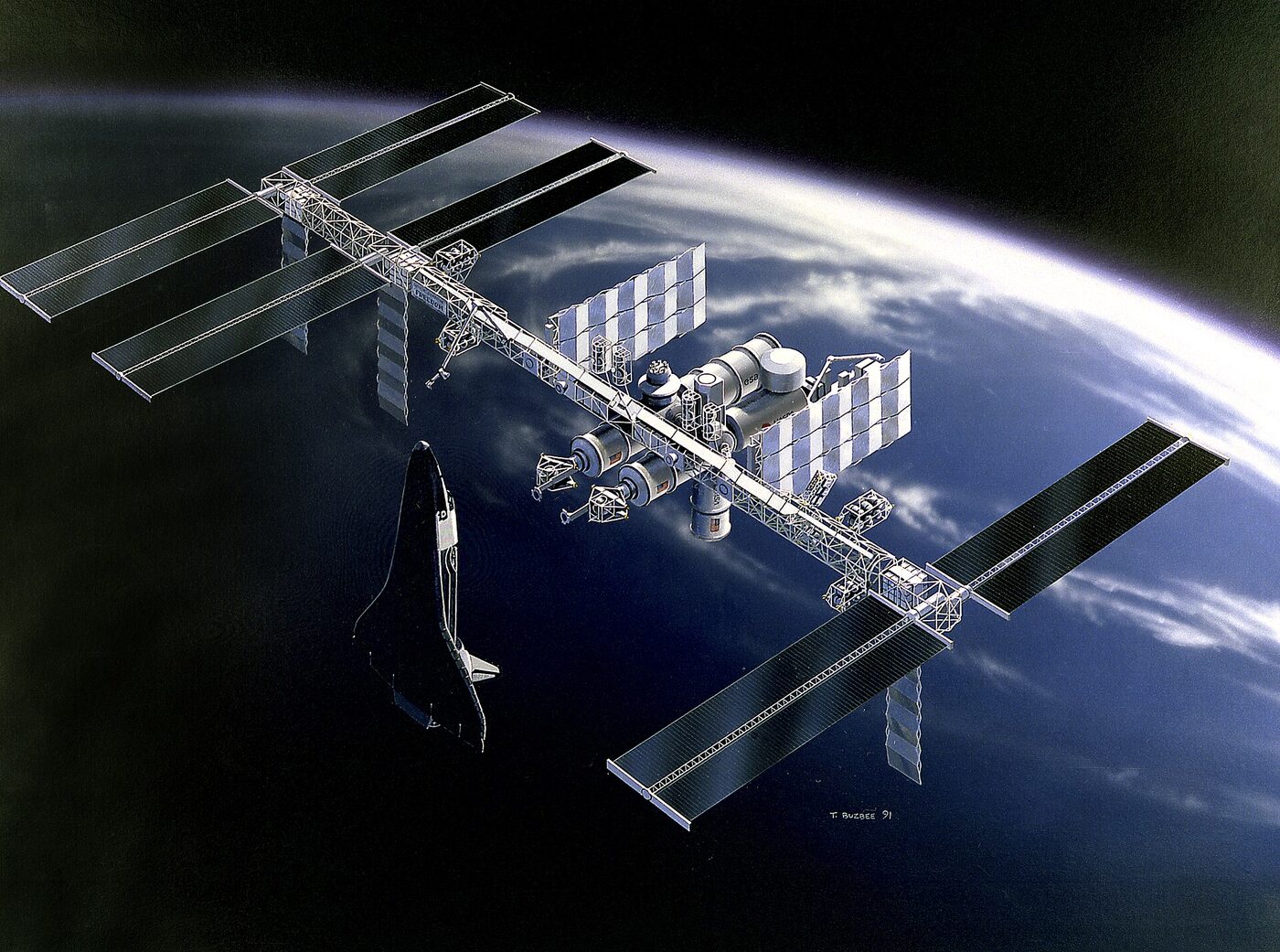

The design was modified in late 1989 after the fiscal 1990 budget was cut from $2.05 billion to $1.75 billion and the station was found to be 23 per cent overweight, too complicated to assemble, and short of power for its users. Congress demanded a further redesign in October 1990 and more cost reductions after the fiscal 1991 budget was cut from $2.5 billion to $1.9 billion. A new design was unveiled in March 1991. First launch had by then slipped to March 1995, permanent crewing to June 1997, completion to February 1998. Between 1984 and 1993 the station went through seven major redesigns, losing capability at each one; it was managed from NASA Headquarters and a dedicated programme office in Reston, Virginia, and not one Shuttle flew in its support. By the time the programme ended, roughly $11 billion had been spent; of the hardware already designed, built or in development, around a tenth found its way into the station that eventually flew.
Two outside events framed the early 1990s. The Space Exploration Initiative, announced by President George H. W. Bush on the twentieth anniversary of the Apollo 11 landing in July 1989, called for a return to the Moon and a mission to Mars and named the station as a component; the ninety-day study that costed it came back at roughly half a trillion dollars spread over twenty or thirty years, a number Congress declined to contemplate, and the initiative died. Then the Advisory Committee on the Future of the United States Space Program — the Augustine Committee, reporting in 1990 at the request of the Vice-President in his capacity as chairman of the National Space Council — recommended that space science be the highest funding priority among the five activities it identified, proposed an uncrewed launcher to take some load off the Shuttle, and called for a scaled-back redesign of Freedom.
One detail of that report is worth keeping, because it shows how such documents are made. The committee’s original ranking put human spaceflight fifth of five. At a dinner with the Vice-President, the director of the Office of Management and Budget observed that whatever came last would simply be deleted during the budget process; the committee went away and rewrote the list so that space science stood first and the other four activities shared equal priority behind it. A senior advisory body had, in effect, filed a brief in the crewed-versus-robotic argument and then softened its own filing. The station lost that round on paper and survived on the floor.
The votes that nearly ended it
The near-death of the American station programme is usually told as an anecdote about a single vote, and for once the anecdote is exactly right. The House Clerk’s electronic record has it as roll call 263 of the first session of the 103rd Congress: on 23 June 1993, at 4:05 in the afternoon, on H.R. 2200, the NASA authorisation bill, an amendment offered by Representative Roemer of Indiana to strip the station’s funding was recorded as Failed — 215 yea, 216 nay, eight not voting. The margin held by one member, and the split ran across the parties rather than between them: Republicans voted 61 to 112 against the amendment, Democrats 153 to 104 for it. A year later, on 29 June 1994, a further Roemer amendment — roll call 309, to the VA–HUD appropriations bill H.R. 4624 — failed far more comfortably, 155 to 278, which is the shape opposition takes once a programme has become international law.
Between those two votes the programme was rebuilt. In June 1993 a redesign team reported on three competing concepts, and the option that became known as Space Station Alpha was selected, reusing about three-quarters of the hardware designs intended for Freedom. That autumn, with the Russian programme short of money and the American one short of votes, NASA and NPO Energia discussed merging Alpha with the planned Mir-2, producing an interim option briefly called Russian Alpha. In late 1993 Freedom, Mir-2 and the European and Japanese modules were folded into a single International Space Station Alpha; “Alpha” was dropped internally by early 1995, and a House report of July 1995 retired the names Freedom, Alpha and ISSA together. The station design was scaled back again to fit the budget, the NASA segment’s crew capacity falling from seven to three. A treaty-level Intergovernmental Agreement was signed in January 1998 by fifteen governments — the United States, Russia, Japan, Canada and eleven European Space Agency member states.
This is the sequence the group was created at the end of, rather than during. By 4 January 1999, when the RFD was posted, the political argument that produced the ISS had been settled for five years and the first two modules were already in orbit. What sci.space.station inherited was not the fight over whether to build a station but the much longer argument about what the thing being built was worth — and a running commentary on an assembly sequence that would take another decade.
Salyut: the first stations
The world’s first space station reached orbit on 19 April 1971. Salyut 1 was the opening move in a Soviet programme that ran fifteen years and launched nine stations, of which six successfully hosted crews, and which concealed a second programme inside itself: the civilian DOS stations designed by Korolev’s bureau flew under the same Salyut name as the military Almaz reconnaissance stations designed by Chelomey’s, which is why the numbering makes so little sense from outside.
Salyut 1 also produced the programme’s catastrophe. Soyuz 11 docked on 7 June 1971 and its three cosmonauts lived aboard until 29 June, on a flight of some twenty-three days that was then the longest in history. During preparations for re-entry a pressure-equalisation valve opened early, the descent capsule depressurised, and the crew, who were not wearing pressure suits, asphyxiated. They remain the only human beings to have died above the Kármán line. Soyuz was redesigned afterwards to carry two suited cosmonauts instead of three unsuited ones, a trade of crew size for survivability that shaped Soviet station logistics for a decade.
The programme’s decisive operational advance came with the second generation. Salyut 6 and Salyut 7 were the first stations to make working use of a second docking port, which meant that two crewed Soyuz craft could be docked at once for a handover, and that the uncrewed Progress freighter — a Soyuz with its descent module replaced by tanks and cargo — could deliver air, water, food, propellant and spare parts while the resident crew’s own ferry stayed attached. Continuous occupation became possible for the first time. Of the 1,697 days of crewed occupancy the whole Salyut programme accumulated, 1,499 belong to those two stations.
Salyut 7 was last occupied in June 1986, when the Soyuz T-15 crew flew across from the newly launched Mir, spent fifty days stripping the older station of equipment, and flew back. Boosted that August to a record mean altitude in the hope of holding it in orbit until the Shuttle era, it was brought down early by unexpectedly high solar activity and re-entered uncontrolled over Argentina in February 1991. The line did not end there: the module that became the core of the Russian segment of the ISS is the last article of the same design series.
Skylab: one station, three crews, and a long fall
The American answer of the 1970s was built out of Apollo surplus and flown once. Skylab was launched on 14 May 1973 on a modified Saturn V. During the ascent the micrometeoroid shield tore away, taking one main solar array with it and jamming the other with debris; the station reached orbit short of power and without thermal protection, heating towards the point at which the plastic insulation inside it would have melted and released poisonous gases.
The first crew, launched on 25 May 1973, deployed a parasol sunshade through a small instrument port from inside the station to bring temperatures down, and then freed the jammed array on a spacewalk — the first in-orbit repair of that magnitude, and the episode that advocates of crewed flight have cited ever since. Three crews flew in all, staying 28, 59 and 84 days; the last of them left on 8 February 1974, extending the human endurance record from the 23 days of Soyuz 11 to 84. Before departing, the third crew’s Apollo spacecraft boosted Skylab into a higher parking orbit, forecast on the sunspot predictions of the day to hold until at least the early 1980s, on the assumption that a Shuttle would arrive to reboost it.
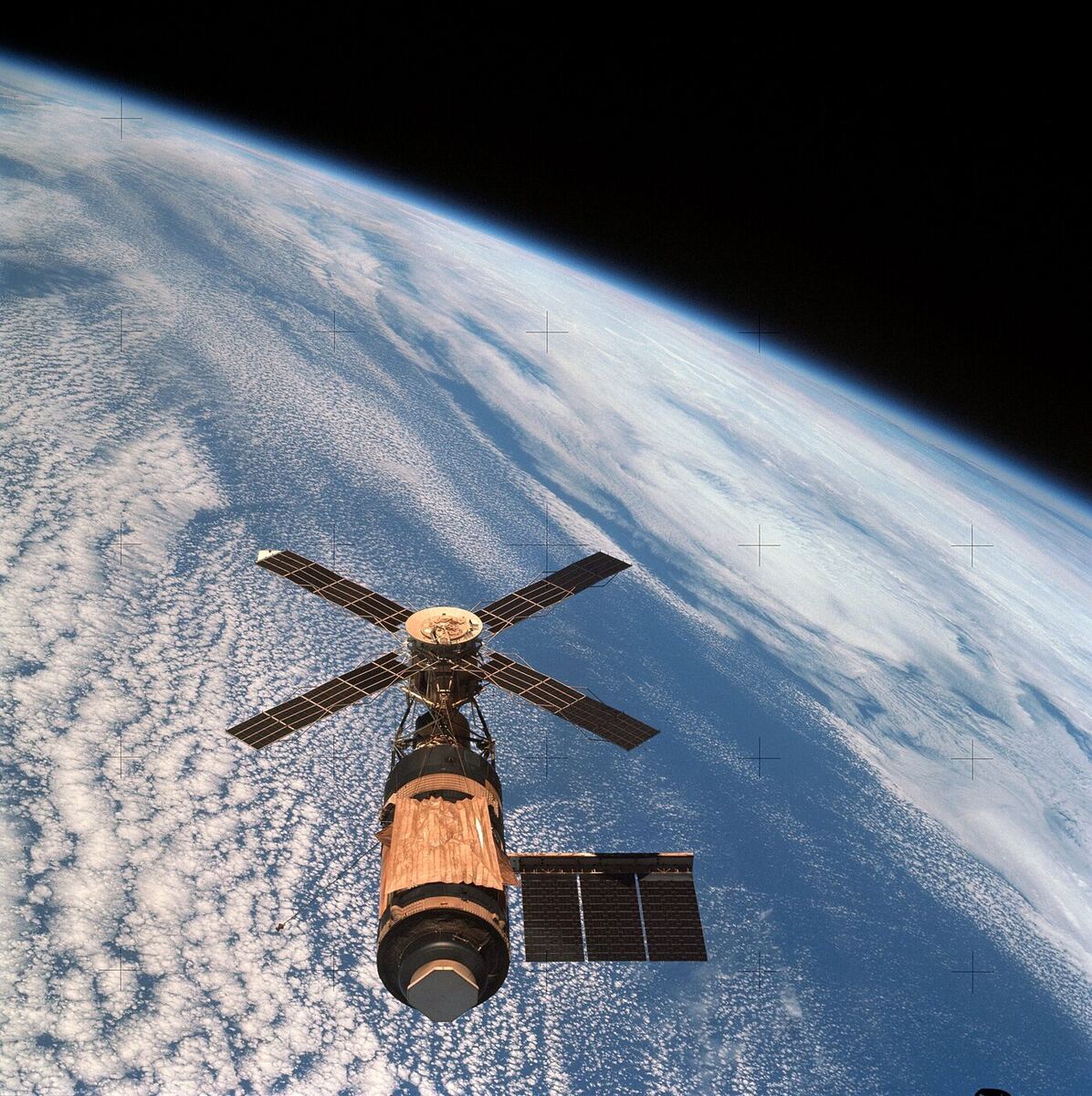

None arrived. Shuttle development ran late, solar activity ran high, and the orbit decayed faster than predicted. NASA had considered fitting the station with a disposal rocket as early as 1962 and had decided against it on grounds of cost and acceptable risk, so there was nothing aboard to steer the re-entry. Skylab came down on 11 July 1979 amid worldwide press attention, aimed at the southern Indian Ocean but breaking up lower than expected and scattering debris across a sparsely populated stretch of Western Australia. It is the only American space station to have flown before the ISS, and its orbital workshop remains the largest single pressurised space-station module ever put in orbit — roughly twice the volume of the largest module of the station that succeeded it.
Mir: fifteen years of a five-year station
The Soviet Union launched the core module of Mir on 20 February 1986 and then spent a decade adding to it: Kvant-2 in 1989, Kristall in 1990, Spektr in 1995, Priroda in 1996, each arriving under its own power, docking at the forward port and then being swung onto a radial port by an arm mounted on the module itself. It was the first modular space station, and at around 130 tonnes the largest artificial satellite in orbit until the ISS overtook it. It was designed to last about five years and lasted fifteen.
The political ground shifted underneath it halfway through. The crew launched on 2 October 1991 went up as Soviet citizens and came home on 25 March 1992 as Russians. The new agency could not afford to launch Spektr and Priroda and put them into storage; the fleet of tracking ships was withdrawn by Ukraine, and the Ukrainian government sharply raised the price of the Kurs docking systems built in Kyiv — a cost pressure that pushed the Russians towards manual docking tests and, in the end, towards an accident. On 17 June 1992 Presidents Yeltsin and Bush announced the cooperation that became the Shuttle–Mir programme, and the money that came with it is what eventually got Spektr and Priroda off the ground.
The programme itself was set out in September 1993, when Vice-President Gore and Prime Minister Chernomyrdin announced plans for a joint station and agreed that American Shuttles would fly to Mir first. Eleven Shuttle missions flew in the programme between February 1994 and June 1998, nine of them dockings. A Shuttle first rendezvoused with the station without docking in February 1995, closing to eleven metres; Atlantis made the first docking on 29 June 1995, the first joining of American and Russian crewed spacecraft since 1975. Seven American astronauts served long increments aboard Mir over the following three years, learning the trade of long-duration flight on somebody else’s hardware — which was, from NASA’s point of view, much of the point. The station also hosted the longest single spaceflight ever flown: 437 days, from January 1994 to 22 March 1995, roughly the duration of a Mars transfer.
Mir’s bad year: the fire and the collision
The three incidents that Mir’s chroniclers rank as the most alarming in its history all fall inside a single expedition in 1997, while the group’s future subscribers were watching. Two of them are worth stating precisely, because both are routinely garbled.
On 23 February 1997, during a handover period with two crews aboard, a backup solid-fuel oxygen generator malfunctioned and burned. Official accounts from the Russian control centre put the burn at about ninety seconds; the American astronaut aboard maintained it lasted around fourteen minutes. Either way it filled the station with toxic smoke for roughly three-quarters of an hour, forcing the crew into respirators — some of which turned out to be broken — while some of the fire extinguishers mounted in the newer modules could not be pulled from their brackets. The generator involved was a backup pressed into heavy use because the primary electrolysis unit kept failing.
On 25 June 1997 a Progress freighter was being flown in by hand from the station, using a remote-control system, as the second of two tests intended to show that the expensive automatic docking equipment could be left off future flights. Both tests failed; the first freighter narrowly missed the station, and Progress M-34 struck the Spektr module’s solar arrays, crashed into its outer shell and punctured the pressure hull. The crew cut the cables running through the hatchway and sealed the module before the station’s pressure fell far enough to force an evacuation in the docked Soyuz; Spektr, which contained the American astronaut’s experiments and personal effects, went to vacuum and stayed there. Because Spektr carried a large fraction of the station’s solar array area, the loss also produced a power crisis: the station powered down, lost attitude control and began to drift, and it took weeks of work to recover — including an “intra-vehicular activity” in which two cosmonauts entered the empty, depressurised module in suits and ran cables from its systems back to the rest of the station through a purpose-made hatch.
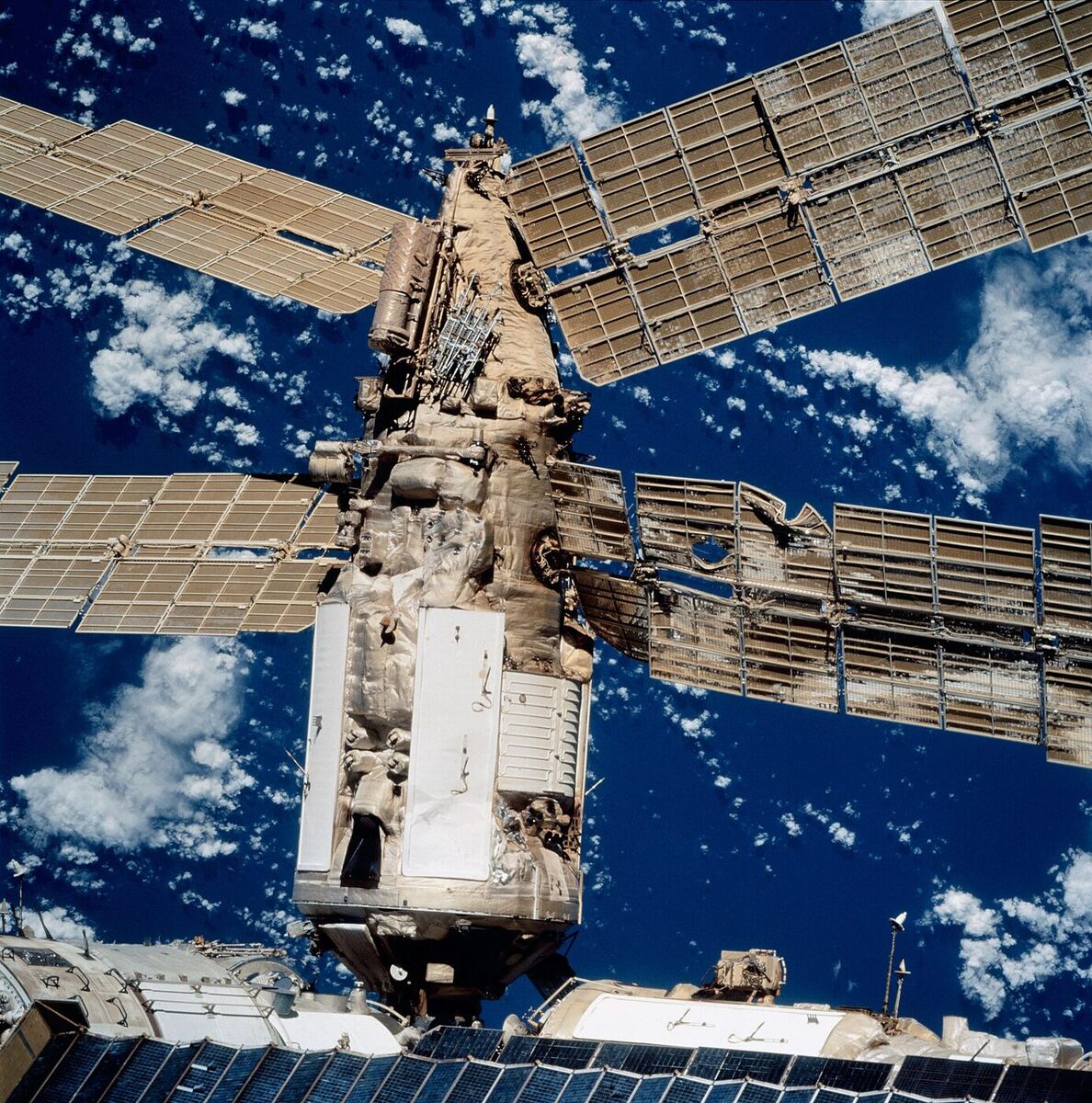

Congress and NASA both asked whether the American programme aboard Mir should be abandoned; the NASA Administrator decided to continue it. Two further American residents followed, and the last Shuttle–Mir flight landed on 12 June 1998. Mir itself outlived its funding: a privately financed crew flew up on 4 April 2000 in an attempt to demonstrate a commercial future for the station, and when that failed to materialise the station was deorbited under control on 23 March 2001, its final burns performed by the engines of a docked Progress over the South Pacific. For the first twenty-three months of the group’s existence both stations were in orbit, though never both occupied: Mir’s last crew landed on 16 June 2000, four and a half months before the first ISS crew moved in.
Assembling the ISS, 1998 to 2004
Assembly began before the group existed and continued right through the life of the mail gateway that produced this directory. The Russian-built, American-financed Zarya control module went up on a Proton on 20 November 1998. Two weeks later, on 4 December 1998, Endeavour carried the American node Unity up on STS-88 and mated the two. Then nothing much happened for a year and a half, because the Russian service module was late.
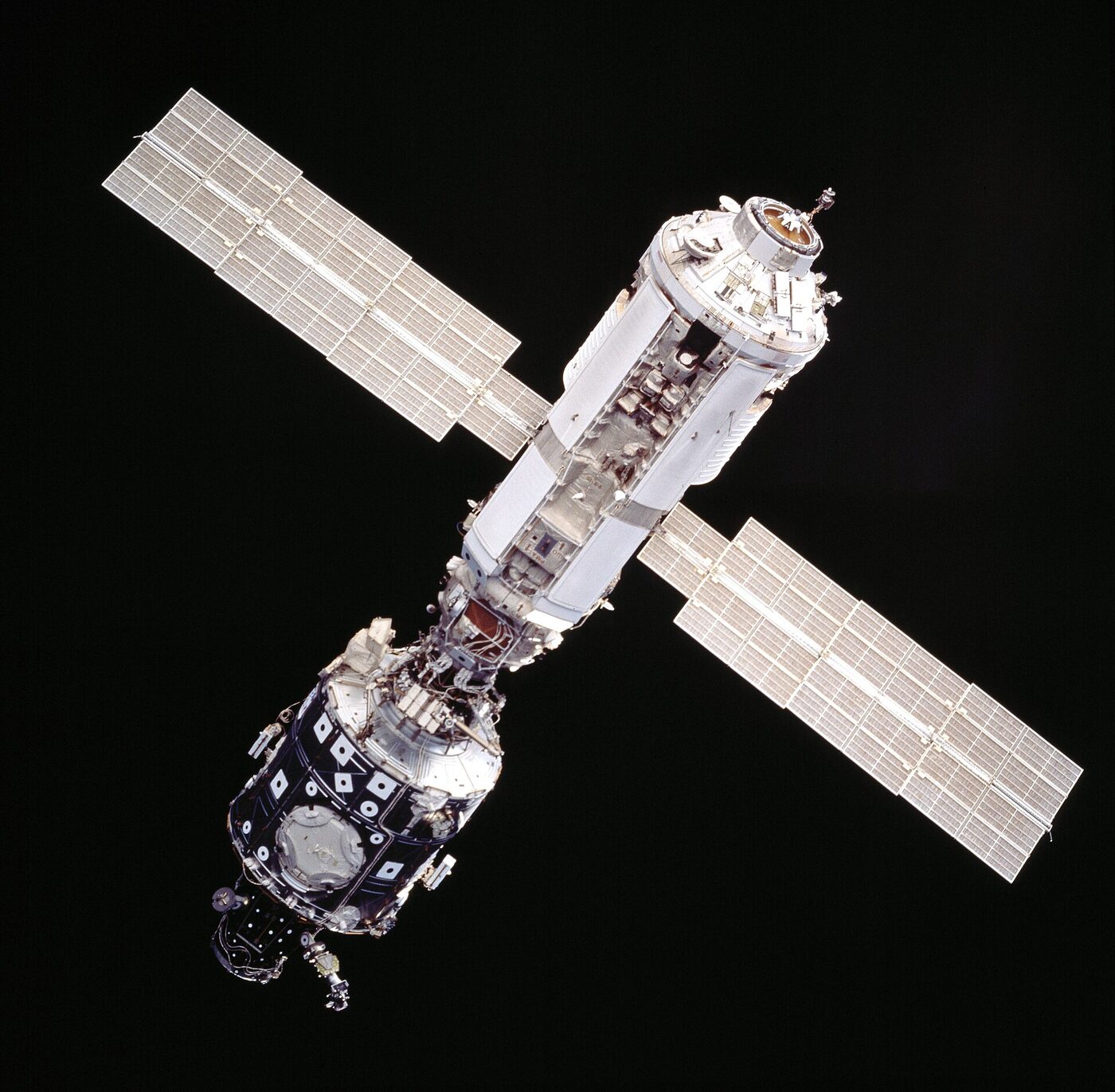

Zvezda — manufactured in the 1980s as the core of Mir-2, and thus the last article of the Salyut line — launched on 12 July 2000 and docked on 26 July. It brought living quarters and the life-support systems that made permanent occupation possible, and it is still the structural and functional centre of the Russian segment. The first resident crew docked on 2 November 2000 and stayed 136 days. Human beings have been aboard continuously ever since, which makes 2 November 2000 one of the few genuinely epochal dates in the subject and one that fell squarely inside this group’s active life.
Ten days after the first crew moved in, on 12 November 2000, the station made its first amateur radio contacts: one crew member reached the ARISS team in Russia on his own callsign, and later that morning, working as NA1SS, the crew spoke to the amateur radio clubs at two NASA centres in turn. The charter’s inclusion of amateur radio operators, which reads like boilerplate, turned out to describe an actual constituency within a fortnight.
The American laboratory Destiny was launched on 7 February 2001 and installation began three days later, giving the United States a laboratory in orbit for the first time since Skylab was vacated in 1974; the station’s robotic arm arrived later that year. In April 2001 the first fee-paying visitor flew to the station aboard a Soyuz on a mission of just under eight days — a flight the Russian agency had accepted and the NASA Administrator publicly objected to, which raised in the open, and for the first time, the question of who among the partners was entitled to decide who flew. Then, on 1 February 2003, Columbia was lost on re-entry, the Shuttle fleet was grounded, and the station’s assembly stopped where it stood. Expeditions 1 to 6 had carried three people; Expeditions 7 to 12 were cut to two-person caretaker crews, because a larger crew could not be resupplied by Progress alone. The gateway that carried this group to its e-mail subscribers shut down in the middle of that pause.
After the gateway: what happened next
Everything in this section postdates the news2mail gateway, which ran from 2000 to 2004; the group itself continued, and so did the programme.
Shuttle flights resumed and assembly restarted. The European Columbus laboratory was launched on 7 February 2008; the Japanese Kibō laboratory went up in three pieces across three Shuttle flights in 2008 and 2009, ending as the largest pressurised module on the station and the second largest space-station module ever flown, after Skylab’s workshop. The resident crew rose from three to six at the end of the decade. Assembly was substantially complete by 2011, at which point the Shuttle was retired and the station became dependent for crew transport first on Soyuz alone and later on commercial vehicles. The total cost of the station was put at about $150 billion as of 2010: some $58.7 billion of NASA station budget between 1985 and 2015, about $50 billion more for the thirty-six Shuttle assembly flights at an estimated $1.4 billion each, and the balance from Russia, Europe, Japan and Canada.
How much of that the group followed, and with what enthusiasm, is not something the surviving record establishes; Usenet as a whole thinned steadily through the same years. What can be stated is the administrative position: the current ISC active file still shows sci.space.station as an unmoderated group, with the same one-line description it was given in the Call For Votes of March 1999.
What orbital life does to the body
The station argument was never only political. Whether human beings can live in orbit indefinitely is an empirical question, squarely inside the charter, and by 1999 it had three decades of Soviet and Russian data behind it and rather less American.
The central fact is that bone is a load-responsive tissue: it grows denser where it is stressed and is resorbed where it is not. In orbit the measured loss ran at something like one to two per cent of bone mass a month for astronauts aboard Mir, concentrated in the weight-bearing structures — the lower spine, the hip, the long bones of the leg — which is a rate an order of magnitude above the one to one and a half per cent a year seen in the elderly on the ground. Muscle atrophies on the same principle. Fluid, no longer pulled towards the feet, redistributes towards the head, which produces the puffy faces and thin legs of every space-station photograph, and which the body compensates for by shedding what it reads as excess volume; the bill arrives on landing, as orthostatic intolerance. Red cell production falls. The immune system weakens. The vestibular system, deprived of a consistent down, recalibrates over the first days in orbit and then has to recalibrate again on return.
None of this is fatal on a station timescale and all of it is cumulative, which is why the countermeasure regime is as heavy as it is: crew members aboard the ISS spend at least two hours a day on resistive and aerobic exercise, strapped to treadmills with bungee cords and working against machines designed to substitute for gravity. Whether exercise alone actually prevents bone loss has never been settled by a properly controlled study, which is one reason the 437-day flight of 1994–95 was read at the time as a test of whether the countermeasures would hold for the length of a Mars transfer. Radiation is the constraint that exercise cannot address: low Earth orbit sits beneath the worst of the trapped-particle belts, but crews on Mir still accumulated on the order of a millisievert a day — roughly two years of terrestrial background radiation for each day in orbit — and the shielding that would fix it weighs too much to launch.
Air, water and heat: the environmental control problem
A space station is, in engineering terms, a small chemical plant with people living in it. The environmental control and life support system has to hold pressure, generate oxygen, remove carbon dioxide, strip trace contaminants, manage humidity, reject heat and process waste, and it has to do all of that without gravity to separate a gas from a liquid — which is why so much equipment that works on the ground does not work in orbit at all.
The Russian solution, developed across the Salyut stations and matured on Mir, is the one both stations of the 1990s used and the ISS still uses in part: an electrolysis unit splitting water to make oxygen and venting the hydrogen overboard; a regenerable system to scrub carbon dioxide out of the air; activated charcoal filters for the metabolic products that neither of those catches, methane from the gut and ammonia from sweat among them; bottled oxygen and solid-fuel oxygen generators as backup. Water is recovered from the sink, from the toilet and from condensate. It is a closed loop only in the sense that a leaky bucket is a container: every system has a resupply requirement, and the resupply requirement is what sets how often a freighter must arrive.
The consequences of that architecture were on public display in 1997. The fire aboard Mir started in a backup oxygen generator that was being used heavily because the primary electrolysis unit kept breaking; the depressurisation of Spektr four months later was a life-support emergency caused by a docking failure. Ventilation matters as much as generation: without forced airflow, a sleeping crew member can accumulate a bubble of exhaled carbon dioxide around their head and wake gasping. Nothing about the atmosphere of a space station takes care of itself.
Orbital mechanics, resupply and rescue
Much of what looks arbitrary about station operations is orbital mechanics being inflexible in public. The ISS flies at roughly 400 kilometres, circling the Earth about every ninety-three minutes, at an inclination of 51.6 degrees. That inclination was not chosen for the ground track. It is the lowest inclination directly reachable by Soyuz and Progress launched from the Baikonur Cosmodrome at 46 degrees north without overflying China or dropping spent stages on inhabited ground — the physical trace of the 1993 merger, written into the orbit itself. Freedom had been designed for 28.5 degrees, the latitude of the Florida launch site and the cheapest orbit a Shuttle could reach; moving to 51.6 degrees cost the Shuttle a substantial fraction of its payload on every assembly flight.
Plane changes, in orbit, are prohibitively expensive: turning an orbit through a large angle costs a change in velocity of the same order as reaching orbit in the first place. A launch site can therefore only reach a station when the station’s orbital plane passes over it, which is what produces the short, fixed launch windows that station schedules run on, and it is why a rescue vehicle cannot simply be sent up on demand from a convenient pad. Rendezvous is a matter of phasing rather than chasing: to catch something ahead of you, you drop into a lower and faster orbit and wait, and every approach is a sequence of burns computed days in advance.
The practical answer to rescue has been the same since Salyut: keep a lifeboat docked. A crewed Soyuz is attached to the station at all times, and the number of seats in the attached ferries sets the maximum crew — which is why the loss of the Shuttle in 2003 immediately reduced the station to two people, and why every debate about crew size is really a debate about ferry availability. The same arithmetic governs cargo. Progress freighters are expendable and burn up loaded with rubbish on the way down, which is efficient for delivery and useless for bringing anything home; the return of experiments has always been the scarce commodity, and the reason some Progress flights carried a small recoverable capsule good for about 150 kilograms.
Debris
The last of the constraints is the orbital environment itself, and it has had a name since June 1978, when two NASA researchers published a paper describing what happens when the density of objects in low Earth orbit rises far enough that collisions generate fragments faster than the atmosphere removes them: a self-sustaining cascade. The cascade scenario has been argued about ever since, both as a physical model and as a policy claim, and it bears directly on the design of a station that must stay in one orbit for decades. The same work found that a large share of the catalogued debris of the day came from a handful of events, mostly explosions of spent upper stages — which is why disposal practice, rather than collision avoidance, was the first thing the field tried to change.
The engineering response is layered. Objects large enough to be catalogued from the ground are tracked, and the station manoeuvres out of the way when a conjunction analysis warrants it; such manoeuvres are routine rather than rare. Objects too small to track but large enough to matter are handled by multi-layer shielding — on the American segment a Whipple arrangement of aluminium, Kevlar and ceramic fabric that makes a projectile shatter into a cloud before it reaches the pressure hull, spreading the energy of the impact over a wider area. In between sits a band of objects too small to see and too large to shield against, and that band is the residual risk everyone in the field acknowledges and nobody can design away. Spacewalkers are the most exposed of all, since a suit is a pressure vessel with a person inside it and no second layer.
Stations also become debris. Skylab’s uncontrolled re-entry in 1979 put fragments across Western Australia; Mir’s controlled re-entry in 2001 was a deliberate, engine-assisted disposal into the South Pacific precisely because the alternative was another Skylab at nearly twice the mass. Disposal planning is now part of station design, which is a lesson learned in the most public way available.
Crewed versus robotic: the argument the group existed for
Underneath the mass fractions and the assembly sequences sits the oldest standing argument in the field, and a group whose charter named engineers, scientists and governments in its first line was never going to avoid it. It is worth setting out the positions as positions.
The case against crewed spaceflight, in its strongest form, is a claim about scientific return per unit of money. Its most distinguished advocate was James Van Allen, principal investigator for instruments on two dozen Earth satellites and planetary missions and the discoverer, in 1958, of the radiation belts that carry his name. He argued from the 1970s onward that robotic spacecraft returned far more science per dollar and at far less risk; in a 1986 article in Scientific American he contended that the Shuttle and the proposed station would seriously diminish the opportunities for advancing space science, and he put the case at its bluntest in a 2004 essay for Issues in Science and Technology asking whether human spaceflight was obsolete. The physicist Robert Park made a related argument in public for years from the American Physical Society’s Washington office, which he ran from 1983 to 2006. On this account the life-support mass, the abort provisions, the launch-escape systems and the sheer conservatism forced on any vehicle carrying people are all overheads deducted from instruments, and a station whose principal research product is knowledge about how to keep people in orbit is close to circular.
The institutional version of the same argument is milder and was made from inside: the Augustine Committee’s 1990 recommendation that space science should be the highest funding priority, with a scaled-back station, is the clearest single statement of the position at official level. The 1993 House vote was the political version of the same dispute, and a one-vote margin is a reasonable measure of how finely it was balanced.
The case for crewed flight has three distinct strands, which are often run together and are better kept apart. The first is operational: humans in orbit repair things. The first Skylab crew saved a station that had arrived crippled; Mir crews spent 1997 keeping a punctured station alive; Shuttle crews serviced a telescope five times, replacing all five of its main instruments in the process. Nothing robotic in that era could have done any of it, and the proponents’ argument is that the returns from repair and adaptation do not show up in a per-kilogram comparison. The second is that long-duration human flight is itself the research programme — that if people are ever to go further, the physiology and the engineering have to be learned somewhere, and a station is the only place to learn them. The third strand is not a scientific argument at all but a political and cultural one, about presence, prestige and eventual settlement, and its honest advocates have generally said so.
The two sides tend to talk past one another because they are answering different questions — one asks what a given budget buys in knowledge, the other what a space programme is for — and neither the group nor this page settles that. The argument outlived the newsgroup and shows no sign of concluding.
Who was in the room, and how we know
Almost nothing survives of this group’s day-to-day traffic in the form of external documentation, which is normal for a Usenet group of its era and size. What does survive, unusually, is a public roll of the people who wanted it to exist. Big-8 votetakers stated in the Call For Votes that the addresses and votes of all voters would be published so that the count could be audited, and the March 1999 result therefore lists every one of the 219 valid ballots by name and address, along with the three abstentions and the single voided form.
Read as a document rather than a tally, the roll supports a few structural observations and no more. Of the 194 who voted yes, more than thirty wrote from university addresses — mostly American, with British, Australian, Canadian, Danish, Finnish, German, Italian, Lithuanian and Slovenian institutions among them. Two wrote from NASA’s Marshall Space Flight Center in Huntsville, Alabama, where much of the American segment’s hardware was then being built. One wrote from the European Space Agency’s operations centre at Darmstadt. There are addresses at the national standards laboratory in Boulder, Colorado, at the national laboratory at Oak Ridge in Tennessee, and at a scattering of aerospace, defence and telecommunications firms. Counting only the national suffixes, the roll spans nineteen countries, which is a fair test of a charter whose first stated purpose was international collaboration.
The twenty-five no votes are, if anything, the more interesting half. They are disproportionately academic — mathematics at Berkeley, computer science at Yale, an astrophysical centre at Harvard, Cambridge, Carnegie Mellon, Ghent, Bochum — and they include both of the people named as moderators in the 1993 sci.space reorganisation: the primary moderator of sci.space.tech and sci.space.science, and the secondary moderator of sci.space.science. That is not evidence of a motive, since Usenet ballots record no reasons, but it is a legible pattern: the objection to a new unmoderated station group came in part from the people already running the moderated technical rooms that station discussion had been assigned to six years earlier.
Beyond that the honest answer is that we do not know who posted, how much, or how often, and this page will not guess. What can be said is what the paperwork says: an electorate of two hundred and nineteen self-selected people, reached almost entirely through two existing technical groups, took the trouble to fill in a plain-text ballot and post it to a stranger, and seven-eighths of them thought the subject large enough to deserve its own address.
What the record does not show
It is worth being explicit about the gaps, because a page like this one is most useful when it marks them.
- No readership estimate for sci.space.station turned up in the archives consulted, and none is quoted here.
- No FAQ or periodic posting for the group turned up either. Several of its neighbours in sci.space.* maintained one; whether this group ever did is simply not established by anything findable.
- No moderation was ever proposed for it, and no moderator therefore exists to be named. The 2002 creation of sci.space.moderated was a separate proposal for a separate group.
- The volume of traffic, its peaks and its decline are not documented anywhere this page can verify. Any statement of the form “the group was busiest during X” would be invention.
- The proponent’s later involvement, if any, is not recorded in the administrative archive beyond his own yes vote, which is in the roll.
- Nothing in the record indicates why the RFD’s newsgroups line was rewritten before the first CFV, or who suggested adding schools to the charter. That discussion took place in news.groups and is not preserved in the group’s own file.
Where this page has had to choose between a plausible detail and no detail, it has chosen no detail.
Scope and limits
This article covers the newsgroup and the world it reported on. It does not cover the general mechanics of Big-8 group creation, which belong to the soc.* hub page, nor the shape of the science hierarchy as a whole, which belongs to the sci.* page; for a comparison of how a different sci.* research community used its room, see sci.geo.oceanography. Readers looking for the literary end of orbital habitation — the geostationary relay satellite, the space elevator, the station as a setting — will find that argument conducted in alt.books.arthur-clarke rather than here.
Dates, tallies and technical details above have been checked individually against the Usenet administrative archive held by the Internet Systems Consortium, the published roll-call record of the United States House of Representatives, and general reference sources; where two sources disagree — as they do, for instance, on how long the 1997 Mir fire burned — both figures are given rather than one being chosen. Every quotation is from a document, not from a posting.
A date governs everything else on this page: the group was created on 1 April 1999, by which time the political argument that produced the International Space Station had been settled for five years and the first two modules were already flying. sci.space.station covered the assembly, the operations and the continuing argument about worth — it did not sit through the design fight that preceded them, which had been conducted in sci.space, sci.space.tech and sci.space.policy.
Reading sci.space.station today
- Historical archive: Google Groups — sci.space.station (coverage varies by group and era).
- Open in a newsreader:
news:sci.space.station— the original site offered exactly this link, and it still works if your system has a newsreader registered for thenews:scheme. - Live access: point an NNTP newsreader at a modern server — see accessing Usenet today.
- The original news2mail e-mail subscription service ended in the mid-2000s and no longer operates.