alt.conspiracy.jfk
The Kennedy assassination, argued in depth.
An unmoderated alt.* group, listed in the newsgroups file as “The Kennedy assassination.”
A moderated sibling, alt.conspiracy.jfk.moderated, followed in January 1996. This directory holds no archive of the group’s messages and makes no claim about any post or thread.
On this page
- The group in the administrative record
- A namespace of siblings, and which room was busier
- 22 November 1963: the documented event
- The President’s Commission: charter, membership and method
- What the Commission concluded, and what it said it could not determine
- Twenty-six volumes: the record the Commission left behind
- Dissent, recorded late
- 1975: two inquiries that began somewhere else
- What the House Select Committee reported
- The acoustics episode
- The JFK Records Act and the Review Board
- The collection, and the release timetable
- The film as a document
- Why this subject and this medium fitted each other
- The kinds of argument the group carried
- Its place among Usenet’s long-running debates
- What the official bodies said they could not settle
- The limits of this page
The group in the administrative record
The creation of an alt.* group leaves one durable trace: the newgroup control message that told news servers the group existed. For this group that message survives in the Internet Systems Consortium’s mirror of the Usenet control archive, and it is dated Sunday 23 February 1992, timestamped 14:59:26 GMT, sent from a site in Clearwater, Florida. Above the sender’s signature its body runs to two lines:
As proposed in alt.config: Discussion of the JFK assassination and its investigations, offloading the swamped alt.conspiracy group.
Three things are worth drawing out of that sentence, because between them they explain almost everything about the group’s position in the namespace. First, it was a split rather than a founding: the subject already had a constituency, and that constituency was crowding out the parent group. Second, the charter named the investigations alongside the event — the proposal was not framed as a room for theories but as a room for a subject with a documentary apparatus attached to it. Third, it was proposed in alt.config, the group where alt.* creations were argued out, which is as close to due process as the alt hierarchy ever offered. There was no Request for Discussion, no Call for Votes and no published tally, because alt.* had none of that machinery; the Big-8 ritual described on the Usenet explainer did not apply here.
The archive holds two further control messages for the group, both from later in 1992 and both carrying a restricted Distribution header: one on 1 April 1992 from a machine at New York University’s Stern School of Business, propagated only within that site’s local distribution, and one on 26 April 1992 from the University of Maine’s computer science department, similarly local. Both had empty bodies. Neither created anything on the wider network. They are the residue of individual administrators making the group appear on their own campuses, and they are a useful reminder of how an alt.* group actually came into being: not by a single decree but by a control message being honoured, machine by machine, at each administrator’s discretion. No rmgroup message for the group appears anywhere in the archive. Nobody ever tried to delete it.
The description carried in the newsgroups file — the one-line gloss that a news server shows beside a group name, mirrored today in the ISC configuration set — is shorter still. In full, it reads: The Kennedy assassination. The corresponding entry in the active file gives the group the flag y, meaning open, unmoderated posting: anything submitted was carried, with no approval step and no gatekeeper. That is the whole of the group’s founding paperwork. It is more than most alt.* groups leave behind, and it is a good deal less than a reader would like.
A namespace of siblings, and which room was busier
What the record does document, and documents well, is that the subject repeatedly outgrew or dissatisfied its original room. Between 1995 and 2004 the control archive records at least five further groups on the same subject, each with its own announcement, and the announcements are unusually talkative.
On 5 November 1995 a newgroup message was issued from a New Mexico public-access site for a moderated group named alt.jfk.assassination, with a stated purpose — “To provide an environment in which serious researchers as well as the general public can examine issues related to the assassination of President John F. Kennedy” — and an explicit rationale: it would be moderated “to prevent the noise and chronic personal attacks which have plagued alt.conspiracy.jfk and made it nearly useless as a vehicle for intelligent research.” The group lasted less than a day in the control record. An rmgroup message cancelling it was issued from a California site at 07:29 GMT the following morning, 6 November 1995, which is a fair illustration of how alt.* group creation worked when the creation was contested.
The attempt succeeded on the second try. On 14 January 1996 a newgroup message created alt.conspiracy.jfk.moderated, its announcement noting that the group was “the final result of discussions in alt.config going back to late October of 1995” and that “more than twenty people voted in support of the group while four opposed it” — an informal alt.config straw poll, not a Big-8 vote, and quoted here as the announcement’s own claim rather than as a verified count. Its charter is the most interesting document in the whole file, because it tried to solve the problem of an unmoderatable subject with a structural device rather than an editorial one. The group, it said, “should always be co-moderated by two people representing opposite sides of the conspiracy question”, under a published seven-point policy whose first two clauses were that both moderators had to agree before a post could be rejected, and that “no posts will ever be rejected on the basis of a poster’s opinion on the case.” Whatever one thinks of the subject, that is a serious piece of institutional design, and it was arrived at by volunteers on a public network in 1996.
It did not last either. A newgroup message of 3 December 1997 created alt.assassination.jfk, describing itself as “the sucessor to alt.conspiracy.jfk.moderated, which was highly successful for a year and a half, and then succumed to disagreement among the moderators” — the spelling is the announcement’s. The same message claims that at its peak in early 1997 the moderated group “averaged over 50 posts per day” and that its noise level was low because “the chronic flames that afflict alt.conspiracy.jfk didn’t make it to alt.conspiracy.jfk.moderated.” In June 1998 an unmoderated counterpart, alt.assassination.jfk.uncensored, was newgrouped as “the only unmoderated and uncensored forum in the new alt.assassination hierarchy”; the same group was newgrouped again in June 1999, that time as “the first unmoderated newsgroup in the newly formed alt.assassination hierarchy”. Two further names were newgrouped just over a minute apart on 28 January 2004 from the same Teranews posting host, with identical boilerplate charters reading “this newsgroup is for discussion regarding the JFK thing”: alt.assassination.jfk.scam and alt.assassination.jfk.moderated-censored-hypocritical. The first of those still appears in the ISC newsgroups and active files; the second does not appear in either.
Which room actually carried the most traffic? The administrative record does not settle it, and this page will not pretend otherwise. Every quantitative claim about volume in the file — the fifty posts a day, the “chronic flames”, the twenty-odd supporting votes — comes from a party with an interest in the answer, written into a control message that nobody was in a position to audit. What the file does establish, and establishes several times over from independent hands, is the shape of the problem: that alt.conspiracy.jfk was the open room, that its openness was repeatedly cited as the reason for founding a gated one, and that every gated one either failed to take or broke apart over who was to hold the gate. That is a documented pattern, not a judgment on anybody’s posting. It is also, as it happens, the pattern the subject itself has followed in official hands since 1963, which is the rest of this article.
22 November 1963: the documented event
On Friday 22 November 1963 John F. Kennedy, the thirty-fifth President of the United States, was shot while riding in a motorcade through Dealey Plaza in Dallas, Texas. The presidential limousine entered the plaza at 12:30 p.m. central standard time. John Connally, the Governor of Texas, was riding in the same car; he was wounded in the attack and recovered. A bystander further down the street received a minor wound to the cheek. The President reached the emergency room of Parkland Memorial Hospital at 12:38 p.m. and was pronounced dead at 1:00 p.m., thirty minutes after the shots.
At 2:38 p.m. that afternoon, aboard the presidential aircraft at Love Field, Vice-President Lyndon B. Johnson took the oath of office from a federal district judge, with the President’s widow standing beside him. A suspect was arrested in Dallas about seventy minutes after the shooting and charged under Texas state law. On Sunday 24 November, at 11:21 a.m., while being escorted through the basement of Dallas police headquarters for transfer from the city jail to the county jail, he was shot dead; the shooting was broadcast live on television. A Dallas police patrolman had also been shot dead shortly after the assassination, a killing the first federal inquiry attributed to the same man.
The consequence of the second shooting was procedural, and it is the single most important fact for understanding everything that followed. The charge was never tried. The first inquiry put the point plainly in the foreword to its own report: after the arrested man was shot, “it was no longer possible to arrive at the complete story of the assassination through normal judicial procedures during a trial of the alleged assassin.” There would be no adversarial proceeding, no cross-examination in open court, no jury verdict and no appellate record. In their place the United States built something else — commissions, select committees, hearings, exhibit volumes, a statute and an archive — and the American public record of the case has been documentary ever since. A newsgroup arguing about a court case would have had a transcript to argue from. This one had a library.
The shooting itself was also photographed and filmed by onlookers. The best-known of those films runs for roughly twenty-six seconds and is numbered frame by frame, which gave every later inquiry — and every later argument — a common clock against which to time the shots. Its own archival history is set out further down this page.
The President’s Commission: charter, membership and method
Seven days after the assassination, on 29 November 1963, President Johnson created a commission of inquiry by Executive Order 11130. Its formal name was the President’s Commission on the Assassination of President Kennedy; it is universally known by the name of its chairman, the Chief Justice of the United States, as the Warren Commission. Congress then passed Senate Joint Resolution 137, which gave the presidentially appointed body statutory teeth: authority to compel the attendance and testimony of witnesses and the production of evidence.
The membership was drawn from public life rather than from criminal investigation. Beside the Chief Justice sat two United States senators, one from each party; two members of the House of Representatives, one from each party, one of whom would himself become President a decade later; a former Director of Central Intelligence; and a former president of the World Bank. Seven men in all, and the body was conceived from the outset as an evaluator of other people’s investigative work rather than as an investigator itself.
That conception was stated openly at the first formal meeting, held on 5 December 1963 on the second floor of the National Archives Building in Washington. The chairman set out the method he intended:
Now I think our job here is essentially one for the evaluation of evidence as distinguished from being one of gathering evidence, and I believe that at the outset at least, we can start with the premise that we can rely upon the reports of the various agencies that have been engaged in investigating the matter, the FBI, the Secret Service, and others that I may not know about at the present time.
On the same logic the chairman opposed giving the Commission subpoena power; the other members objected, and the Commission took the power — Congress granted it by Senate Joint Resolution 137 on 13 December 1963. The Commission also declined to hire its own investigators: because of what its foreword calls the diligence, cooperation and facilities of the federal investigative agencies, “it was unnecessary for the Commission to employ investigators other than the members of the Commission’s legal staff.” The scale of that reliance is set out in the same foreword, and the figures are worth stating because they define the corpus the group would later argue from. From 22 November 1963 the Federal Bureau of Investigation conducted approximately 25,000 interviews and reinterviews and, by 11 September 1964, submitted over 2,300 reports totalling approximately 25,400 pages to the Commission. Over the same period the Secret Service conducted approximately 1,550 interviews and submitted 800 reports totalling some 4,600 pages. Beginning on 3 February 1964 the Commission and its staff took the testimony of 552 witnesses: 94 appeared before members of the Commission itself, 395 were questioned by members of the legal staff, 61 supplied sworn affidavits and 2 gave statements.
Hearings were closed to the public unless the witness appearing before the Commission asked for an open one. By the Commission’s own account a single witness did so, on two occasions, and no other witness requested a public hearing; the stated reason for the practice was that premature publication of testimony might interfere with the right to a fair and impartial trial of the man then facing charges in Texas over the killing in the police basement. Later inquiries would return to the method rather than the manners — a body that evaluates rather than gathers is only as good as what it is handed — but the method was declared at the outset, in the minutes, and has never had to be inferred.
What the Commission concluded, and what it said it could not determine
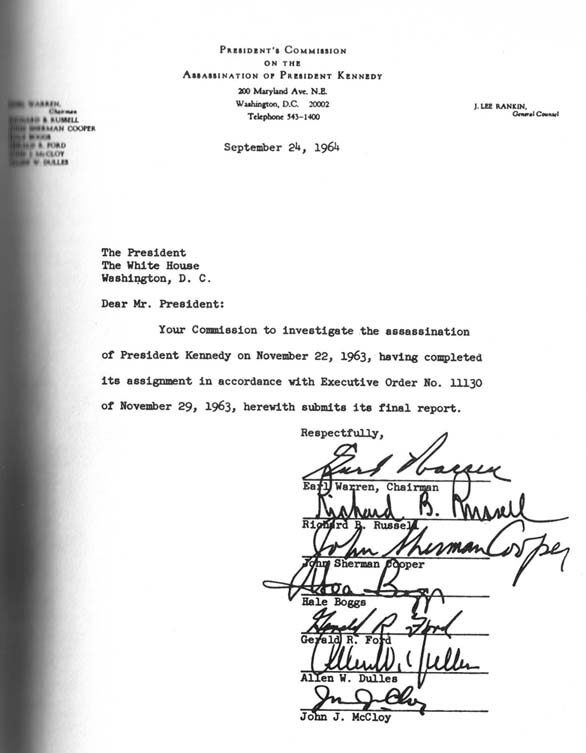
The Commission’s 888-page report was presented to the President on 24 September 1964 and made public three days later. Its summary of conclusions runs to a numbered list. It found that the shots that struck the President and the Governor were fired from the sixth-floor window at the south-east corner of the Texas School Book Depository; that the weight of the evidence indicated three shots; that there was no credible evidence of shots from ahead of the motorcade or from any other location; that the shots were fired by the man arrested that afternoon; that he also killed the Dallas patrolman some forty-five minutes later; and that the man who shot him two days afterwards had not been assisted by any member of the Dallas police.
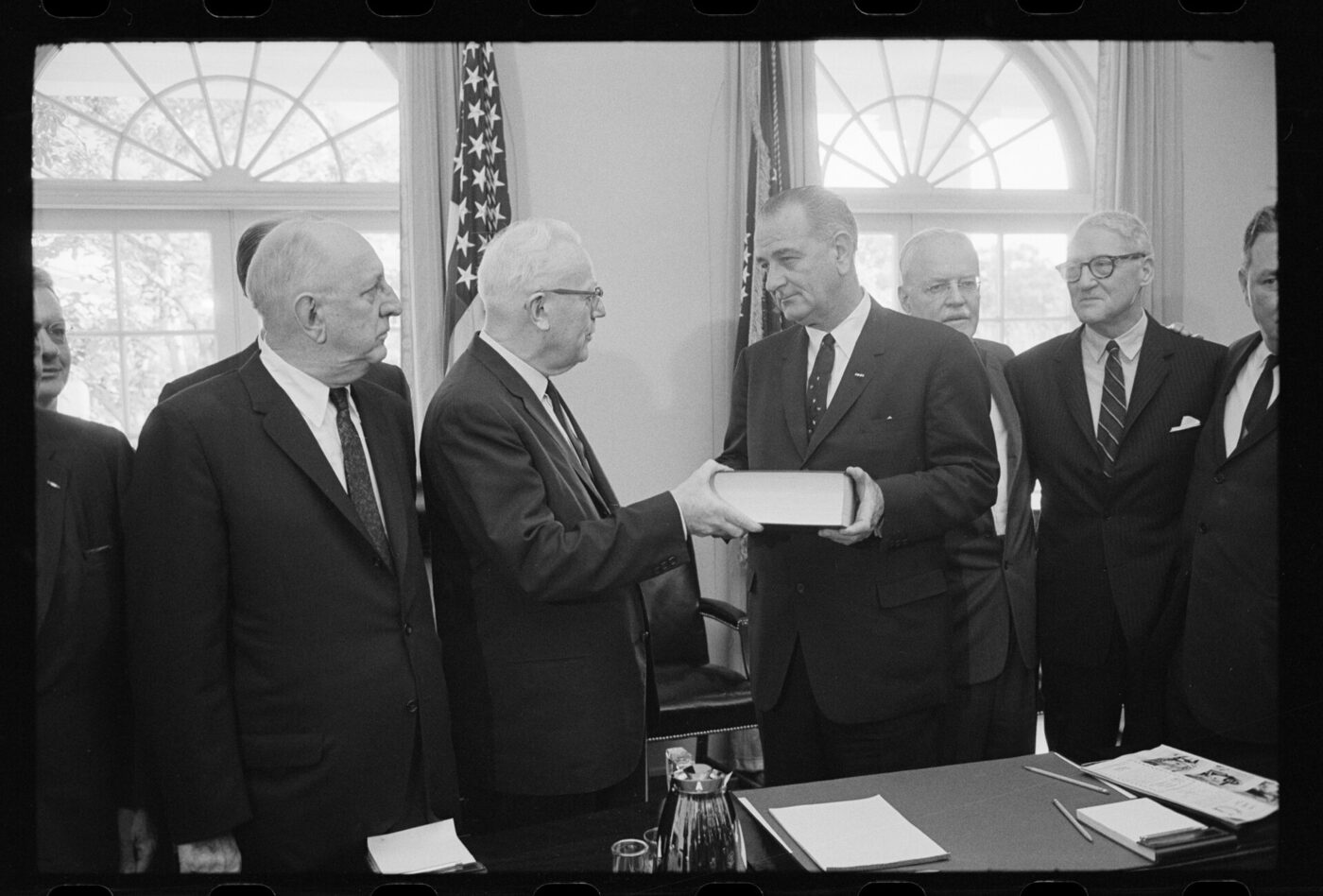
On the question the newsgroup would later be organised around, two of the numbered conclusions are the operative ones. The Commission found no evidence that either man “was part of any conspiracy, domestic or foreign, to assassinate President Kennedy”, and it stated:
In its entire investigation the Commission has found no evidence of conspiracy, subversion, or disloyalty to the U.S. Government by any Federal, State, or local official.
Two further conclusions in the same list matter more than they are usually given credit for, because they are the report’s own statements of what it had not established. The Commission recorded that it “could not make any definitive determination” of the accused man’s motives. And on the single-bullet question it recorded an internal qualification in the text of the finding itself: that while there was “very persuasive evidence from the experts” that one bullet caused both the President’s throat wound and the Governor’s wounds, the Governor’s testimony and certain other factors “have given rise to some difference of opinion as to this probability”. A report that names its own points of internal disagreement is handing a future reader a map of where to dig, and readers duly dug there for sixty years.
The Commission also apportioned responsibility for the killing of the accused. It found that the Dallas police department’s decision to transfer him to the county jail in full public view was unsound, that the arrangements made on the Sunday morning were inadequate, and that “of critical importance was the fact that news media representatives and others were not excluded from the basement even after the police were notified of threats” to his life; these deficiencies, it concluded, contributed to his death. Its chapter on the transfer gave a concrete example: “the acceptance of inadequate press credentials posed a clear avenue for a one-man assault.” It also held that the news media, as well as the police authorities who had failed to impose conditions more in keeping with the orderly process of justice, “must share responsibility for the failure of law enforcement” that followed, and said that the promulgation of “a code of professional conduct governing representatives of all news media would be welcome evidence”. On protection it recommended a committee of Cabinet members to review and oversee the protective activities of the Secret Service, and legislation making the assassination of the President and Vice-President a federal crime, which in 1963 it was not.
Twenty-six volumes: the record the Commission left behind
The report was the smaller half of what the Commission published. In November 1964, two months after the report itself, it issued twenty-six volumes of supporting documents: the testimony or depositions of those 552 witnesses and more than 3,100 exhibits, together running to more than sixteen thousand pages. This is the corpus that made document-level argument possible for anyone with a library card, and it underlies most of what has been published on the subject since. Almost every citation exchanged in a newsgroup thirty years later was ultimately a citation into these volumes, or into the House committee’s volumes published fifteen years afterwards.

It was published without an index. Twenty-six volumes of testimony and exhibits, no subject index, no concordance, no finding aid beyond the volume numbers themselves; one of the first-generation critics of the report called it “organized chaos” in print in 1966. That gap was filled privately. A Subject Index to the Warren Report and Hearings & Exhibits was compiled by an independent researcher and published by Scarecrow Press in March 1966, and a Master Index to the J.F.K. Assassination Investigation, extending the same apparatus to the House committee’s published evidence, followed from the same publisher, with a co-author, in 1980. The 1966 index stated its own purpose in terms that describe, fairly exactly, the method a document-driven newsgroup would later adopt:
It is hoped that this systematic, comprehensive key to all the source material on any specific subject will enable scholars to test the assertions and conclusions in the Warren Report against their independent judgment, on the basis of fidelity to the source data and impartiality of selection by the authors of the Report.
That is a sentence about citation practice, written in 1966 by someone with a card index, and it anticipates the norm of an online forum in which participants answered each other with volume and page numbers. The tooling changed; the epistemology did not.
The Commission’s own records were transferred to the National Archives on 23 November 1964. The unpublished portion was initially sealed for seventy-five years, to 2039, under a general Archives policy then applying to all federal investigations by the executive branch — a period described by a National Archives official at the time as “intended to serve as protection for innocent persons who could otherwise be damaged because of their relationship with participants in the case.” That seventy-five-year rule did not survive. It was overtaken first by the Freedom of Information Act of 1966 and then by the statute of 1992 described below: a release plan begun under President Johnson had put 98 per cent of the Warren Commission’s records into the public domain by 1992, leaving, on the later Review Board’s count, only some 3,000 pages of Commission material still to be opened. The seal is nonetheless part of the story, because for a generation the phrase “sealed until 2039” did a great deal of work in public discussion of the case, and it was true when it was first said.
Dissent, recorded late
The 1964 report was unanimous. All seven members signed the letter of transmittal, and no dissenting or concurring opinion was published with it — a point of some consequence, since a commission is not a court and has no convention of separate opinions. The dissent existed anyway, and it entered the record afterwards, in pieces, over three decades.
Three of the seven — the senator from Georgia, the senator from Kentucky and the House member from Louisiana — are documented as having disagreed with the single-bullet reasoning. The Georgia senator’s personal papers record his unease with it, with the limited Soviet material on the accused man’s years in Russia, and with the thinness of what was known about his Cuba-related activity; he asked the chairman to note his disagreement in a footnote, and the chairman declined. The Kentucky senator described the conclusions as premature and inconclusive. The Louisiana member said privately that he had strong doubts.
None of that is unusual for a commission, and none of it would belong on this page as gossip. It belongs here because a later official body put it in a published report. In a footnote to its 1998 final report, the Assassination Records Review Board wrote:
Doubts about the Warren Commission’s findings were not restricted to ordinary Americans. Well before 1978, President Johnson, Robert Kennedy, and four of the seven members of the Warren Commission all articulated, if sometimes off the record, some level of skepticism about the Commission’s basic findings.
A second late entry to the record concerns what the Commission was given rather than what it thought. A study by the Central Intelligence Agency’s chief historian, released to the public in 2014, concluded that the Agency’s Director in 1964 had been complicit in what the study itself called a “benign cover-up”: officers had been instructed to give the Commission “passive, reactive, and selective” assistance, and information about the Agency’s anti-Castro operations was withheld. The study’s own assessment of the consequence is the part worth quoting, because it is an agency historian writing about his own agency: the 1964 decision not to disclose that material “might have done more to undermine the credibility of the Commission than anything else that happened while it was conducting its investigation.”
This page takes no position on what any of that means. It records only that the correction came from inside, in official documents, published years apart, and that each such publication reopened arguments that the previous publication had been intended to close.
1975: two inquiries that began somewhere else
The record was reopened twice in 1975, and in both cases the assassination was a sub-plot. The occasion was a December 1974 newspaper investigation into illegal domestic activity by the Central Intelligence Agency, and the year that followed became known as the Year of Intelligence.
On 4 January 1975 President Ford established the President’s Commission on CIA Activities within the United States, chaired by the Vice-President and generally called the Rockefeller Commission after him. Its other members included a former Chairman of the Joint Chiefs of Staff, a former Secretary of the Treasury, a former Solicitor General, a labour leader, and a former governor of California who would himself become President; no member of Congress was appointed. Its remit was domestic intelligence abuses, and among the matters it took up were allegations of Agency involvement in the assassination: alleged Agency relationships with the accused man and with the man who killed him, and the claim that two Agency officers had been in Dallas at the time of the shooting. The Commission heard testimony, took depositions, consulted experts in forensic pathology and ballistics, examined photographic evidence including the film discussed below, and had the autopsy materials reviewed by a panel of medical consultants. It found no link between the Agency and either man, describing the allegations as “farfetched speculation”, and upheld the earlier finding of a single assassin. It presented its report to the President on 6 June 1975; the report was released on 11 June.
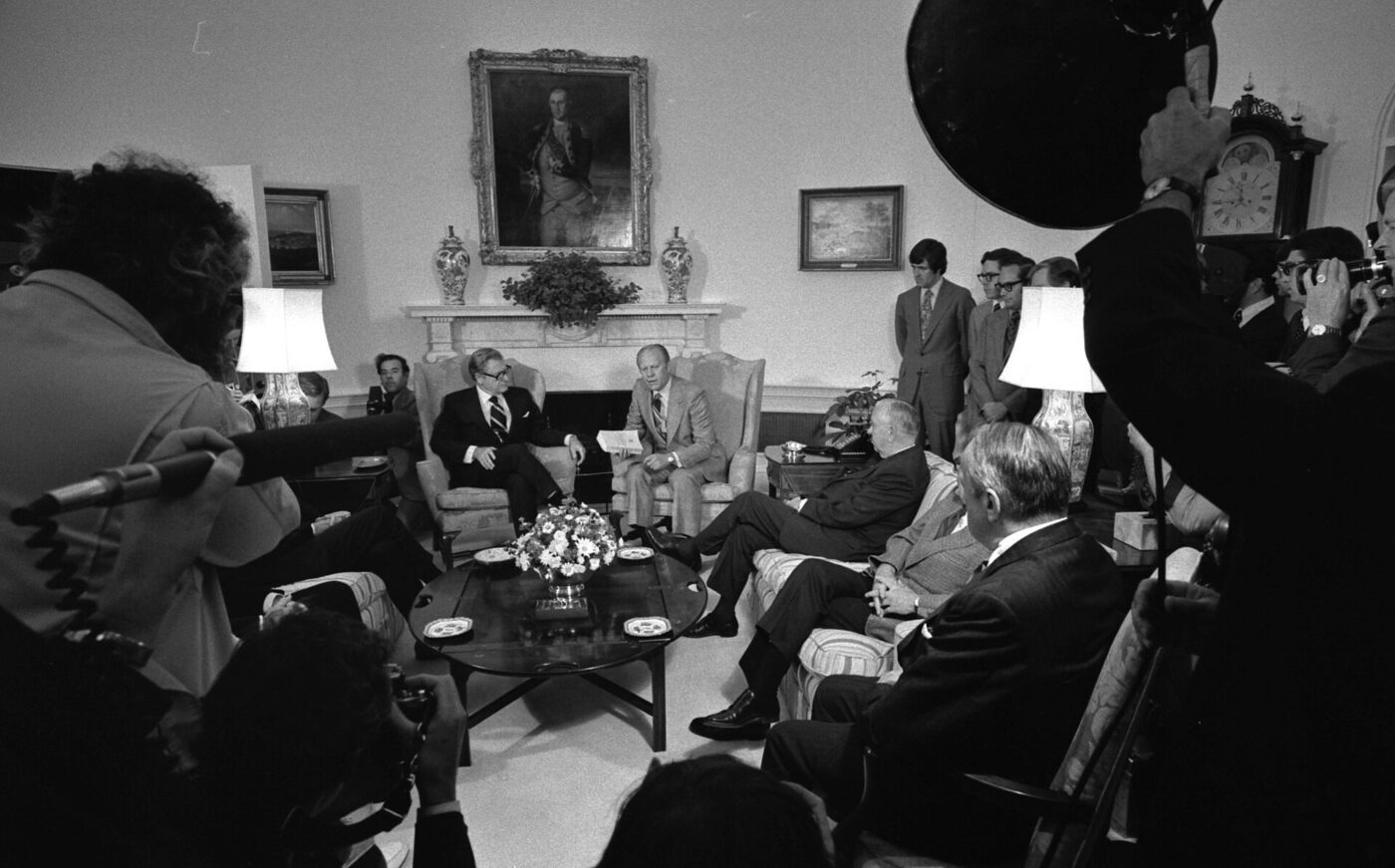

That report has itself since become a documented object rather than simply a source. Records secured for the public in the 1990s under the statute described below — held at the National Archives and at the Ford Library — show that the White House substantially edited the commission’s draft before publication, that an eighty-six page section on assassination plots was removed, that language characterising agency conduct as unlawful was softened, and that recommendations the panel had not voted were added. Whatever one makes of that, it is a clean example of the pattern this page keeps running into: a body reports, and twenty years later the record of how it reported is itself released.
Three weeks after that commission was created, on 27 January 1975, the Senate voted 82 to 4 to establish the Select Committee to Study Governmental Operations with Respect to Intelligence Activities — the Church Committee, after its chairman. Its subject was the conduct of the intelligence agencies at large; its assassination work was a defined slice of that, in which it questioned some fifty witnesses and worked through around three thousand documents, and it addressed not the shooting but the inquiry into the shooting. Its final report was published in April 1976 in six books, accompanied by seven volumes of hearings; the fifth book was devoted to the subject and titled The Investigation of the Assassination of President John F. Kennedy: Performance of the Intelligence Agencies. Its findings there were about process rather than about the event: it questioned the way information had been obtained, blamed federal agencies for failing in their duties and responsibilities, and concluded that the investigation into the assassination had been deficient. It also raised the question of a possible connection between plans to assassinate political leaders abroad, particularly in Cuba, and the death of the President.
A finding about the adequacy of an investigation is not a finding about the event it investigated, and the two are easily conflated in either direction; both readings were available to anyone quoting the report, and both were taken. The committee’s own material was later swept up by the 1992 statute: over fifty thousand pages of the Church Committee’s classified holdings were declassified under it.
What the House Select Committee reported
The Senate committee’s findings created the political conditions for a second full investigation of the assassination itself. House Resolution 1540, creating a select committee of twelve members to conduct a “full and complete investigation of the circumstances surrounding the deaths of President John F. Kennedy and Dr. Martin Luther King, Jr.”, was reported out of the Rules Committee and ordered printed on 15 September 1976 and adopted by the House two days later by 280 votes to 65. The committee expired with the 94th Congress and was re-established in the 95th by House Resolution 222, adopted on 2 February 1977, again with twelve members appointed by the Speaker; it worked through two subcommittees, one for each assassination. Its early months were turbulent: it lost a chairman, its chief counsel and that counsel’s deputy to disputes over control, budget and investigative method before settling into the configuration that produced the report.
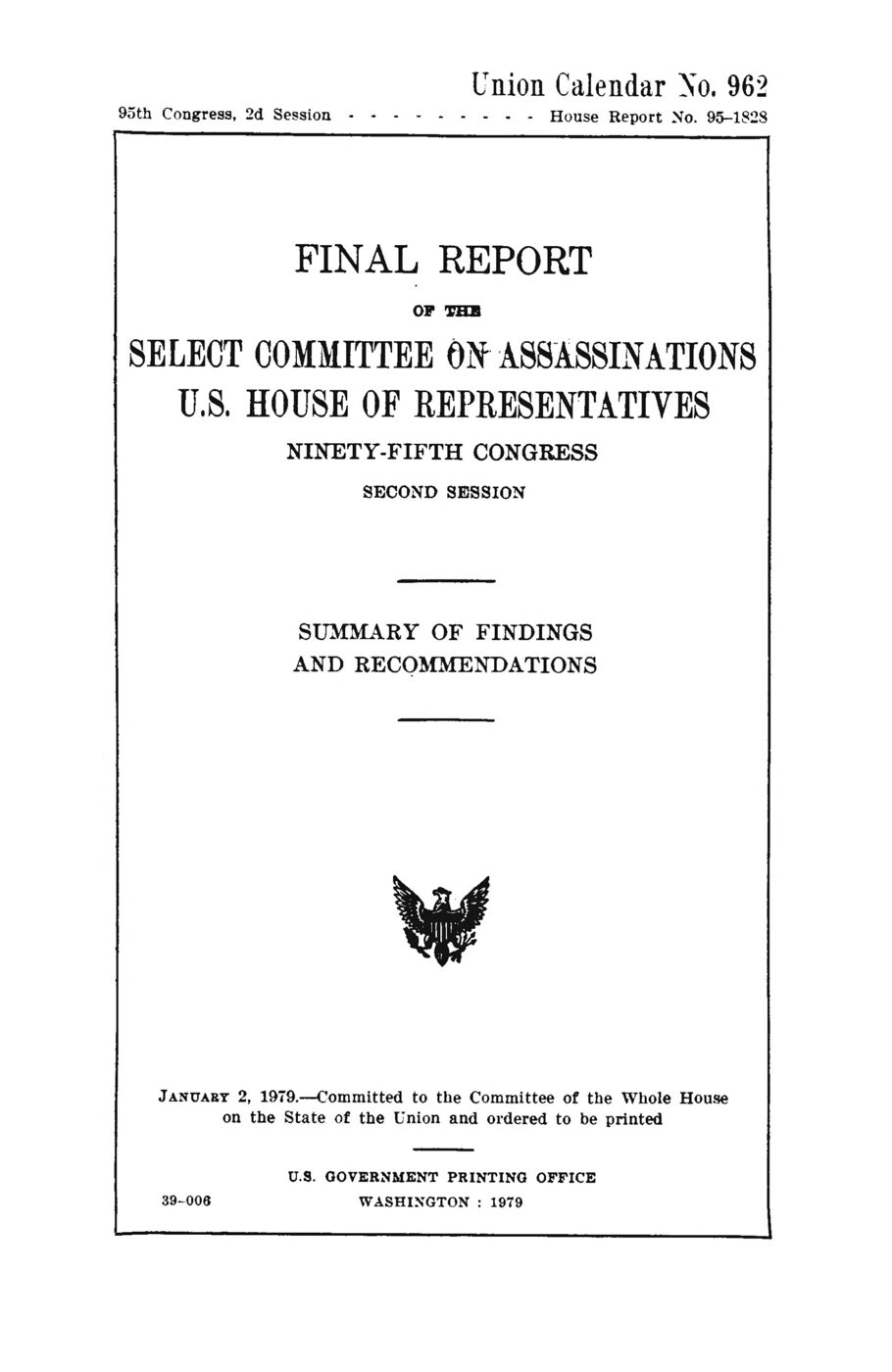
The House Select Committee on Assassinations published its summary of findings and recommendations as House Report No. 95-1828, ordered to be printed on 2 January 1979, and the full final report on 29 March 1979, accompanied by twelve volumes of appendices. Where the 1964 Commission had evaluated other agencies’ work, this committee commissioned its own: among other panels it convened nine forensic pathologists to review the authenticated autopsy photographs and X-rays, which the earlier Commission had never examined although it had the power to subpoena them.
.jpg)
The committee agreed with the earlier Commission on the shots that struck the President and disagreed with it on the question of a conspiracy. Its published findings state that the accused man “fired three shots at President John F. Kennedy”, that “the second and third shots he fired struck the President” and that “the third shot he fired killed the President”; that “scientific acoustical evidence establishes a high probability that two gunmen fired at President John F. Kennedy”; and that the committee believed, on the evidence available to it, that the President “was probably assassinated as a result of a conspiracy”, while stating that it was “unable to identify the other gunman or the extent of the conspiracy”. The finding was hedged in every direction it could be hedged: the committee recorded that on the evidence available to it the Soviet government was not involved, the Cuban government was not involved, and neither anti-Castro Cuban groups as groups nor the national syndicate of organised crime as a group were involved, while noting in the last two cases that the evidence did not preclude the involvement of individual members. It found that the Secret Service, the Bureau and the Agency were not involved in the assassination.
On the performance of the earlier bodies the committee issued a numbered series of findings that are quoted here in full because they are the sharpest thing any official body has said about the others. The Secret Service “was deficient in the performance of its duties”. The Department of Justice “failed to exercise initiative in supervising and directing the investigation by the Federal Bureau of Investigation”. The Bureau “performed with varying degrees of competency in the fulfillment of its duties”. The Agency “was deficient in its collection and sharing of information both prior to and subsequent to the assassination”. And the Warren Commission “performed with varying degrees of competency in the fulfillment of its duties”.
The committee’s assessment of the Commission was, in its own words, mixed rather than hostile, and both halves belong on the page. It recorded that “contrary to the allegations of some critics, the Commission was not part of a sinister Government coverup of the truth”, that it “acted in good faith”, and that “the mistakes it made were those of men doing their best under difficult circumstances”. Its concluding paragraph on the subject reads:
In conclusion, the committee found that the Warren Commission’s investigation was conducted in good faith, competently, and with high integrity, but that the Warren Report was not, in some respects, an accurate presentation of all the evidence available to the Commission or a true reflection of the scope of the Commission’s work, particularly on the issue of possible conspiracy in the assassination. It is a reality to be regretted that the Commission failed to live up to its promise.
Having disagreed with the Commission, the committee did not close the case. In December 1978 it recommended that the Department of Justice review its findings and determine whether further investigation was warranted. Its own working papers, meanwhile, went the way of the Commission’s: the twelve published volumes were the public part, and the majority of the underlying primary documents were sealed for fifty years under congressional rules. That seal, and the residue of withheld executive-branch material, is what the legislation of 1992 was written to break.
The acoustics episode
One strand of the 1979 findings deserves its own section, not because of what it concluded but because of what happened to it. It is the cleanest documented instance on this page of an official record correcting itself in public, on a scientific question, with every stage published and dated.
In December 1978 the committee had a draft final report in hand concluding that the accused man had acted alone. Late in its life it was presented with an acoustic analysis of a Dallas police radio recording — a Dictabelt from Channel 1, which carried routine traffic, on which a motorcycle microphone had apparently stuck open for about five and a half minutes beginning around 12:29 p.m. An acoustics firm engaged by the committee compared four impulse patterns on the belt with test firings conducted in Dealey Plaza in 1978 from the Depository’s sixth floor and from the stockade fence on the grassy knoll, and reported that three of the four matched shots from the Depository and that there was a 50 per cent chance the remaining one was a shot from the knoll. Two acoustics analysts at a New York college then reviewed the firm’s data and put the probability of a knoll shot at 95 per cent or better. On that basis the committee reversed its draft and adopted the conspiracy finding. It was explicit about how narrow the scientific footing was: in its own words, “scientifically, the existence of the second gunman was established only by the acoustical study”, the other scientific projects having corroborated that study rather than independently establishing a second shooter.
The review the committee itself had recommended then went to work on it. The Federal Bureau of Investigation’s Technical Services Division examined the acoustic data and issued a report dated 19 November 1980, released on 1 December, concluding that the committee had established neither that the impulses were gunshots nor that the recording had been made in Dealey Plaza. The Department of Justice then paid for an independent review by the National Academy of Sciences, which appointed a Committee on Ballistic Acoustics for the purpose. That panel released its findings on 14 May 1982. Its conclusion was unanimous, and it is quoted here in full:
The acoustic analyses do not demonstrate that there was a grassy knoll shot, and in particular there is no acoustic basis for the claim of 95% probability of such a shot. The acoustic impulses attributed to gunshots were recorded about one minute after the President had been shot and the motorcade had been instructed to go to the hospital. Therefore, reliable acoustic data do not support a conclusion that there was a second gunman.
The middle sentence is the decisive one and the least often quoted: not that the analysis was inconclusive, but that a faint spoken phrase audible on the belt at the relevant moment could be matched to the same phrase on a separate recording, fixing the impulses about a minute after the shooting. The committee’s own acoustics expert accepted that identification on the record.
In 1988 the Department of Justice reported the results of the review to Congress. Citing both the Bureau’s technical work and the Academy panel’s finding that “reliable acoustic data do not support a conclusion that there was a second gunman”, and stating that all investigative leads known to it had been exhaustively pursued, the Department concluded “that no persuasive evidence can be identified to support the theory of a conspiracy in either the assassination of President Kennedy or the assassination of Dr. King.”
The published argument did not stop there, and honesty requires saying so. A paper in the forensic-science journal Science & Justice in March 2001 proposed a different synchronisation between the two recordings and argued that the Academy panel had erred; several members of the original Academy panel, with a co-author, replied in the same journal in 2005, reanalysed the timings and reaffirmed the one-minute finding. Both exchanges are in the peer-reviewed literature under their own names and dates. This page reports that they exist and does not adjudicate between them; that is precisely the kind of question it is not the business of a newsgroup directory to settle.
What the episode gave the newsgroup, though, was structural rather than substantive: a documented case in which a congressional finding rested on one piece of technical evidence, and in which a scientific panel published a contrary assessment of that evidence three years later. Anyone arguing either side after 1982 had an official document to hold up. Both sides did.
The JFK Records Act and the Review Board
The President John F. Kennedy Assassination Records Collection Act of 1992 was introduced in the Senate on 22 July 1992, passed the Senate by voice vote on 27 July, passed the House without objection on 30 September, and was signed into law on 26 October 1992. Its long title states its purpose without ornament: an Act to provide for the expeditious disclosure of records relevant to the assassination of President John F. Kennedy.
The statute did three things. It directed that a single collection be assembled at the National Archives at College Park, Maryland, consisting of copies of all United States government records relating to the assassination, together with material from any state or local law-enforcement office that had assisted a federal inquiry. It set a deadline: each record was to be disclosed in full no later than twenty-five years after enactment — that is, by 26 October 2017 — unless the President certified both that continued postponement was made necessary by an identifiable harm to military defence, intelligence operations, law enforcement or the conduct of foreign relations, and that the harm was of such gravity that it outweighed the public interest in disclosure. And it created an independent agency, the Assassination Records Review Board, to decide contested postponements in the meantime.
The Review Board’s own final report, issued in September 1998, describes the design as unprecedented, and the description is defensible. The Board consisted of five private citizens trained in history, archives and law who were not government employees but who could order agencies to declassify documents — by the Board’s account the first time in history an outside group had held such a power — and once the Board decided a document should be declassified, only the President could overrule it. Agencies were required to search their own holdings and file a declaration under penalty of perjury describing the searches they had completed, the records they had located and any other action they had taken to comply.
The Board’s first task was definitional. The statute’s phrase was a record “related to the assassination of President John F. Kennedy”, which had to be made broad enough to command public confidence and narrow enough not to swallow the National Archives whole. After public notice, comment and hearings the Board published its definition in the Federal Register on 28 June 1995:
An assassination record includes, but is not limited to, all records, public and private, regardless of how labeled or identified, that document, describe, report on, analyze, or interpret activities, persons, or events reasonably related to the assassination of President John F. Kennedy and investigations of or inquiries into the assassination.
The Board also determined that agencies could not object to disclosure of all or part of a record “solely on grounds of non-relevance”, reserving relevance decisions to itself. The postponement standard it worked to was, by its own account, more disclosure-weighted than either the Freedom of Information Act or the executive order then governing classified information: the Act carried what the Board called a “presumption of immediate disclosure”, and required “clear and convincing evidence” before information could be held back. Decisions had to be taken not on documents in the round but, in the Board’s list, on “names, dates, places, crypts, pseudonyms, file numbers, sources of information and the method by which it was obtained”, one item at a time; the Board described the resulting body of precedent as a kind of common law.
It was not a comfortable four years. The Act allowed ninety days for the appointment of Board members, but the transition between administrations produced an eighteen-month delay between the statute’s passage and the members’ swearing-in on 11 April 1994, so a three-year mandate had to be extended to four; Congress did not appropriate money for the Board until 1 October 1994, and a final extension carried it to 30 September 1998. Agencies had already begun shipping documents to the Archives before the guidelines existed, so much early work had to be redone. Requests to Russia, Belarus, Cuba and Mexico for foreign records were, in the Board’s own summary, frustrating and fruitless. Against that, the Board held seven public hearings — one each in Dallas, Boston, New Orleans and Los Angeles, and three in Washington — issued more than a hundred press releases, and solicited private donations that materially enlarged the collection, among them the desk diaries of a Warren Commission member who later became President, the investigative files of the New Orleans district attorney who had brought the only prosecution ever mounted in the case, and the personal papers and diary of the man that prosecution tried and a jury acquitted.
The Board’s conception of its own role is the most quotable thing it wrote, and it is the sentence this directory would most like every reader of an old thread to have in mind:
Congress did not, however, direct the Review Board to draw conclusions about the assassination, but to release assassination records so that the public could draw its own conclusions. Thus, this Final Report does not offer conclusions about what the assassination records released did or did not prove.
What the Board claimed instead was custodial: that its “most substantial contribution has been to enhance, broaden, and deepen the historical record relating to the assassination.” It put its own legacy at “more than four million pages of records now in the National Archives and available to the public with remarkably few redactions”, and recorded that all Warren Commission records except those containing tax return information were by then available to the public with only minor redactions. The Board’s report also recorded, in its executive summary, that Congress had acted in part because it was “disturbed by the conclusions of Oliver Stone’s JFK” — a rare instance of a federal statute’s implementing agency naming a feature film in its own account of the law’s origins.
The collection, and the release timetable
The collection those decisions feed is very large. The National Archives describes the President John F. Kennedy Assassination Records Collection as consisting of “over six million pages of records, photographs, motion pictures, sound recordings, and artifacts.” The great majority of that material has been public for decades. It has nonetheless continued to grow in public availability on a schedule set by statute, presidential memorandum and executive order — a schedule that matters to anyone reading an archived thread, because it fixes what a given post could and could not have known.
The dates below are the Archives’ own, taken from its release pages; where its current figures differ from figures reported elsewhere, the Archives’ are used.
- 24 July 2017 — 3,810 documents: 441 records previously withheld in full and 3,369 previously withheld in part.
- 26 October 2017 — the statutory deadline. 2,891 records released; a presidential memorandum the same day ordered the release of all records collected under section 5 of the Act and gave agencies wishing to appeal until 26 April 2018 to do so.
- 3 November 2017 — 676 documents; 9 November — 13,213; 17 November — 10,744.
- 15 December 2017 — 3,539 further documents.
- 26 April 2018 — 18,731 documents, as the Archives counts them.
- 2021 — release of the remaining records postponed, the stated reason being the effects of the COVID-19 pandemic on the review.
- 15 December 2022 — 13,173 documents, under a presidential memorandum requiring disclosure of releasable records by that date.
- April to June 2023 — 2,672 documents containing newly released information, completing the review directed by a memorandum requiring disclosure of releasable records by 30 June 2023; a further 21 documents followed on 24 August. The review was reported complete, with 99 per cent of the collection public.
- 18–20 March 2025 — following Executive Order 14176 of 23 January 2025 and a presidential directive of 17 March, three batches: 31,419 pages in 1,123 PDF files, 37,127 pages in 1,062 files, and 14,318 pages in 161 files — 82,864 pages in 2,346 files in total.
- 26 March 2025 — 53 pages in 16 files; 3 April 2025 — 704 pages in 207 files.
- 30 January 2026 — 11,022 pages in 140 files.
Where information in the collection remains withheld or redacted, it is worth being precise about the mechanism rather than speculating about the motive, because the mechanism is written down. Under the Act, information could be postponed only on the statutory grounds in section 6 and only on clear and convincing evidence, with the Review Board deciding contested cases while it sat and the President alone able to overrule it. After the Board dissolved in 1998 the residual route was presidential certification of identifiable harm outweighing the public interest in disclosure, exercised by memorandum; the certifications and the accompanying agency documentation are themselves published by the Archives. Redaction, in this system, is a decision with a date, a legal basis and a paper trail attached to it. A good deal of what was written about the collection before 2017 was written when far more of it was closed.
The film as a document
One object in the collection deserves separate treatment, because it supplied the shared timebase for almost every technical dispute about the case. The Zapruder film is a silent 8 mm colour sequence shot on a home-movie camera by a bystander standing on a concrete pedestal along Elm Street. It runs 486 frames over about 26.6 seconds at an average of 18.3 frames per second, and because it is a frame-numbered continuous record of the seconds in question, it functions as a clock. Arguments about the timing and order of shots have for sixty years been conducted in the currency of frame numbers, which is why an archived thread from 1998 can look, to an outsider, like a dispute about integers.
Its archival history is instructive on its own account, and it is a history of a private object becoming a public record by stages. Individual frames were reproduced in black and white as Commission Exhibit 885, in volume eighteen of the hearings and exhibits, in 1964. The copyright was held commercially, and in 1967 the copyright holder sued a researcher and his publisher for copyright infringement over the reproduction of frames in a book. The following year a United States district court held that the use was fair. The court’s reasoning is a small landmark for everything on this page: it found that “there is a public interest in having the fullest information available on the murder of President Kennedy”, that the researcher “did serious work on the subject and has a theory entitled to public consideration”, and that “the copying by defendants was fair and reasonable.” A commercial copyright in the central visual evidence of a presidential assassination was, on that reasoning, not permitted to foreclose examination of it.
The film was not shown in full on American network television until 6 March 1975 — a broadcast that is itself part of the causal chain that produced the Senate and House inquiries described above. In 1978 the family that then owned it transferred the physical film to the National Archives for preservation while retaining ownership and copyright. The 1992 Act made the physical film an assassination record automatically, and therefore government property; the copyright stayed private. On 24 April 1997 the Review Board issued a formal Statement of Policy and Intent with regard to the film, reaffirming its status and directing its transfer into the Kennedy collection, which took place on 1 August 1998. Because the taking was an exercise of eminent domain over a unique object, compensation had to be determined by arbitration; it was set at sixteen million dollars in 1999. In December 1999 the family donated the copyright, together with first-generation copies and frame enlargements, to a museum housed in the former Depository building in Dealey Plaza. The original is held by the National Archives.
Thirty-five years from home movie to federal record, by way of a copyright suit, a television broadcast, a statute, an independent review board and an arbitration panel. Very little else in the documentary history of the twentieth century has been quite so thoroughly processed.
Why this subject and this medium fitted each other
Many long-running online arguments turn on premises that neither side can check. This subject is the opposite case, and that is a better explanation of the group’s longevity than any account of temperament. Three properties of the material, none of them peculiar to Usenet, did most of the work.
The first is a large primary corpus in the public domain. Twenty-six volumes in 1964, twelve more in 1979, six books and seven volumes of hearings from the Senate in 1976, and eventually a National Archives collection of over six million pages — published by the government, held in reference libraries, progressively digitised, and free of the licensing barriers that fence off most other bodies of evidence. Nobody could have read all of it, which meant that nobody could be presumed to have read all of it, which in turn meant that a citation was always potentially informative to the other party. In most online arguments a citation is a rhetorical gesture. Here it was frequently a genuine transfer of information.
The second is that the official record had reopened the question itself. This is the point most often missed by outsiders. It was not necessary to believe anything unusual to hold that the matter was unresolved in 1992: one federal body had found no evidence of conspiracy in 1964, a Senate committee had found the resulting investigation deficient in 1976, a House committee had found a conspiracy probable in 1979, a National Academy of Sciences panel had published a contrary assessment of that committee’s key evidence in 1982, and the Department of Justice had reported to Congress against the conspiracy finding in 1988. A diligent reader could assemble a fully documented case at either end of that range and cite chapter and verse for it, without inventing anything, because official bodies had already disagreed with each other in print.
The third is the medium’s own shape. Usenet imposed no length limit worth the name, threaded replies so that a disagreement could be followed years later, quoted the text being answered by convention, and cost nothing to write in. Those properties reward exactly one kind of contribution — a long argument built from cited documents — and penalise almost every other. A subject with a huge free corpus and an unresolved official record met a medium that rewarded citation and had infinite column inches. The fit was not a coincidence and it did not need explaining by anything about the participants.
Two further features follow from the subject rather than from the group. The evidentiary questions are finite and heavily documented — timing, trajectory, the medical and photographic record, the provenance and completeness of particular documents — so any venue with open membership meets each of them repeatedly, every reader arriving at them for the first time. And the argument has an external clock: a release of records in 2017, 2022, 2025 or 2026 changes what can honestly be said, and does so on a date nobody in the group controls.
The lay constituency for the subject was correspondingly large, which is unusual for a single-topic group. In ten polls between 1963 and 2023, the share of American adults telling Gallup that they did not believe the accused had acted alone never fell below half: 52 per cent in 1963 and 50 per cent in 1966, then between 74 and 81 per cent from 1976 through 2003, falling to 61 per cent in 2013 and 65 per cent in 2023. The National Opinion Research Center, in 1,384 in-person interviews conducted between 26 November and 3 December 1963 — before the Commission had met for the first time — found 62 per cent already believing that others had been involved, against 24 per cent who believed one person had acted. A newsgroup on this subject was therefore not a specialist backwater in the way most single-topic groups are: it addressed a question on which most of the country already held a view, and on which an enormous body of published material was available to anyone wanting to argue for one. How many people actually read the group is recorded nowhere this archive can check, and no figure for it appears above.
The kinds of argument the group carried
This directory holds no archive of the group’s messages and makes no claim about any individual post, poster or thread. What can be said, and said only in general terms, is what categories of dispute a group organised around this documentary record necessarily carries, because the categories follow from the documents rather than from anybody’s personality.
There were arguments about the physical evidence and its reconstruction: timing, sequence, trajectory, the interpretation of the photographic and film record, and the compatibility of the medical findings across the 1964 and 1979 inquiries. There were arguments about the acoustic analysis and the successive assessments of it, which had the unusual property of being a live technical question in the refereed literature as well as a popular one. There were arguments about provenance and completeness: whether a given document said what it was claimed to say, whether the version in circulation was the whole of it, what a redaction had removed and under which statutory ground. There were arguments about the conduct of the investigations themselves — a subject on which, as this page has set out, the official bodies had already been unsparing about one another. And there were arguments about the reliability of witness testimony taken decades earlier, a category that is not specific to this case at all.
Two things distinguish this from most online argument, and both are consequences of the corpus. Citation was cheap and, crucially, checkable: a claim pinned to a volume and page could be looked up by anyone who disagreed, which raises the standard of the better exchanges and shortens the worse ones. And the ground moved on external dates. A participant in 1996 was arguing against the state of the collection as the Review Board had left it; a participant in 2018 was arguing against a collection that had grown by tens of thousands of documents. Threads written before a release can read, afterwards, like weather forecasts.
Against that, the group was unmoderated, and the trade-off of an open room applies here as everywhere: nothing filtered what arrived, in either direction. The founding of several moderated siblings between 1995 and 1998, and the failure of each of them to hold, is the group’s own documented commentary on that trade-off, and it is the only commentary on the group’s conduct this page is prepared to offer, because it is the only one written down at the time by people who were there.
Its place among Usenet’s long-running debates
Usenet produced a small number of groups whose arguments outlasted the software generations they were conducted on. This directory carries several of them — the creation-and-evolution exchange in alt.evolution, scriptural argument in alt.bible, and the general-purpose disputation of talk.philosophy — and this one belongs in that company for the same reason they do: a question that cannot be settled inside the medium, plus a supply of participants willing to keep working on it for free. The broader phenomenon of conspiracy discussion on Usenet, and the shape of the alt.conspiracy.* branch as a whole, belong to the parent hub rather than to this page.
What distinguishes this group from its neighbours in that company is the documentary clock. An argument about scripture or about philosophy has no scheduled external event that changes the evidence; this one has had several, on dates fixed by statute and executive order. The years in which the news2mail gateway operated, 2000 to 2004, fall neatly between two of its ticks: after the Review Board closed in 1998, and well before the statutory deadline of October 2017. Anything posted in that window was written against a record that has since been enlarged several times over, most recently in January 2026.
A reader working through archived threads should therefore treat their factual claims as dated to the state of the collection at the time of writing, and check any document reference against the National Archives collection as it now stands. That is not a caution peculiar to this group. It is simply what reading a primary source from 1998 requires, and it is the single most useful thing this page can tell someone about to open a twenty-five-year-old thread.
What the official bodies said they could not settle
The point of this section is narrow and it is worth stating the boundary first. It does not list open questions in the abstract, and it does not endorse anybody’s. It lists only what the official bodies themselves, in their own published words, said they had not established.
- The 1964 Commission recorded that it “could not make any definitive determination” of the accused man’s motives.
- The same report recorded, inside the relevant finding, that the Governor’s testimony and certain other factors “have given rise to some difference of opinion” as to whether one bullet caused both his wounds and the President’s throat wound.
- The 1979 House committee, having found a conspiracy probable, stated that it was “unable to identify the other gunman or the extent of the conspiracy”, and recorded in several sub-findings that while particular organisations were not involved as organisations, the available evidence did not preclude the possibility that individual members had been.
- The same committee found that “the investigation into the possibility of conspiracy in the assassination was inadequate” and that the earlier conclusions, though arrived at in good faith, were “presented in a fashion that was too definitive”.
- The 1982 National Academy of Sciences panel stated what the acoustic data did not support rather than what happened: that reliable acoustic data do not support a conclusion that there was a second gunman. A negative finding about one item of evidence is not a finding about the event, and the panel did not present it as one.
- The Review Board declined to draw any conclusion at all, on the ground that Congress had not asked it to, and said so at the front of its final report.
- The Review Board also recorded that its requests for foreign records — from Russia, Belarus, Cuba and Mexico — had for the most part been frustrated, that this was “a genuine loss to the historical completeness of the assassination records”, and that it hoped surveillance material held abroad would eventually be added to the collection.
Those are the gaps the record itself acknowledges. What anyone makes of them is outside the business of this directory.
The limits of this page
This is a page about a newsgroup, written by an archive that preserves a directory of newsgroups, and it is worth being explicit about the constraints it works under, because they were chosen rather than accidental.
This page does not evaluate any theory about the assassination. No theory advanced in the group, or anywhere else, is endorsed, refuted, ranked or characterised here. Where two official bodies reached different conclusions, both are reported and each is attributed to the body that reached it; that is not neutrality as a pose, it is simply what the record contains. Nothing on this page should be read as the directory taking a side, because the directory does not have one and would not be competent to hold one.
Every substantive statement above is sourced to an official investigation, a statute, a released government record, a published court decision, a peer-reviewed scientific assessment, or the group’s own administrative paperwork in the Usenet control archive. That was the rule the page was written to, and it is the reason certain things a reader might expect are absent. There is no colour about what the group felt like, no characterisation of its regulars, no representative thread, no estimate of its readership and no anecdote, because none of that exists in any source this archive can verify. Where the record is thin — and on the question of which sibling group carried the most traffic it is thin — this page says so rather than filling the gap.
The group’s message archive is not preserved on this site. This directory holds the group’s entry, its charter line and this article; it holds no posts. No thread title, quotation, poster name, subscriber count or posting statistic appears anywhere above, and none has been reconstructed or estimated.
No living person is named on this page. The individuals named are historical officeholders, long deceased, identified in connection with acts performed in office and documented in published reports; where a source named a private individual — a moderator, a researcher, a witness, a participant — the name has been left out and the role described instead. Nobody’s beliefs are characterised here on their behalf.
The article is confined to the documented record by design. That constraint was set deliberately, it has been kept deliberately, and it is more important than length: the page stops where the verifiable material stops. On a subject with this much published evidence attached to it, that turns out not to be much of a restriction.
Reading alt.conspiracy.jfk today
- Historical archive: Google Groups — alt.conspiracy.jfk (coverage varies by group and era).
- Open in a newsreader:
news:alt.conspiracy.jfk— the original site offered exactly this link, and it still works if your system has a newsreader registered for thenews:scheme. - Live access: point an NNTP newsreader at a modern server — see accessing Usenet today.
- The original news2mail e-mail subscription service ended in the mid-2000s and no longer operates.