alt.bible
Bible discussion without denominational gatekeeping.
Scripture argued verse by verse among literalists, liberals, atheists and scholars — unmoderated, which meant genuine exegesis shared the room with permanent apologetics battles.
Translation-comparison threads (KJV vs. NIV vs. original-language appeals) were a fixture.
On this page
- The line in the newsgroups file
- Where the paperwork begins, and where it does not
- Why the argument happened in a room with no gatekeeper
- The procedural problem of quoting
- The Hebrew text and the Masoretic tradition
- Qumran, and what turning up older copies changed
- The Septuagint, and translation before there was a New Testament
- The Greek New Testament and its witnesses
- Variants, text-types and what a critical apparatus does
- The critical editions themselves
- English, from Tyndale to 1611
- The modern versions and the equivalence argument
- The King James Only position, described
- The canon question, as documented history
- Hebrew and Greek in seven bits
- Who posted
- Neighbours, and what happened afterwards
- What the record does not show
- Scope and limits
The line in the newsgroups file
The shortest document this group possesses is its own entry in the newsgroups file, the plain-text list of group names and one-line descriptions that news administrators feed to their software and that the Internet Systems Consortium still distributes as part of the Usenet administrative record. The line reads, in full:
alt.bible General discussion about the Holy Bible.
Six words, and the interesting thing about them is what they decline to settle. The description names a book without saying whose canon defines it, which language its text is in, which translation a reader might expect to see quoted, or which tradition of reading has the floor. Every one of those questions turned out to be a live subject inside the group. The line prejudges none of them.
The companion entry in the active file is equally terse: the group name, a pair of article-number fields, and the letter y. That final flag is the posting status, and y means unmoderated — articles go to the network, not to an inbox. Two of the group's neighbours in the same namespace carry m instead, and the difference between those two letters is the whole of the architecture this page is about.
The namespace around the group is worth reading as a document in its own right, because the descriptions vary in a way that maps the terrain. The current newsgroups file lists alt.bible.prophecy as Discussion of the Bible and its prophecies, alt.bible.errancy as Errancy in the Holy Bible. (Moderated) and alt.bible.rapture.mod as The end times described in Revelations. (Moderated). Alongside them sit alt.bible-errancy, alt.bible-thumpers, alt.bible.bashing, alt.bible.memorize and alt.biblesoft.users, each recorded with the same three words: No description. A group name in the alt.* hierarchy could be created by anyone who could send a control message; a description had to be written by somebody who cared, and for most of these nobody ever did.
Where the paperwork begins, and where it does not
The Internet Systems Consortium keeps an archive of every valid newgroup, rmgroup and checkgroups control message seen on Usenet since early 1991, filed one compressed file per group name, with roughly a month of 1992 missing. It is the closest thing the network has to a registry of births and deaths. For a group in one of the Big-8 hierarchies it is usually accompanied by a full proposal file — a Request for Discussion, a Call for Votes, a result with a tally — held in the same archive's mirror of news.announce.newgroups. For an alt.* group there is no such file and never was, because alt.* held no votes and filed no proposals. The entire documentary record of alt.bible is therefore whatever landed in one small compressed file, and that file can be described exactly.
It contains three articles. None of them created the group.
The first is a removal. It was sent on 22 August 1995 at 19:48:35 +0100 from the address [email protected], its Organization header reads BT Access Operations and Maintenance, its subject line is cmsg rmgroup alt.bible, and its body is zero lines long. What matters is the header below it: Distribution: uk. RFC 1036, the December 1987 standard for Usenet article interchange, defines that header in one sentence — it "is used to alter the distribution scope of the message" — and its effect here is that the removal request was addressed to servers within the United Kingdom distribution rather than to the network at large. A company news address, a distribution limited to the United Kingdom and an empty body are the marks of an operator tidying the group list on the service it ran; nothing in the file indicates an attempt to remove the group from the network at large.
The second is a creation, and an accidental one. It was sent on 18 April 1996 at 02:12:38 GMT through a PSINet UK public Usenet site, carries Distribution: bogo, and has a two-line body that explains itself: This group is automatically created by newjunk, followed by an invitation to send problems to the local postmaster. A script noticed a group name in its feed that was missing from its active file and issued the control message to close the gap. The group had existed for years by then.
The third is a creation too, and also not one. It was sent on 13 April 1998 at 17:28:26 GMT from a host at an American internet provider, carries an Approved header, and consists of a single blank line followed by the sentence Control message generated by Netscape Collabra Server. Groupware news servers of that period generated internal control traffic as a matter of routine housekeeping, and when such a server was connected to the public network some of that traffic escaped onto it. The same phenomenon, from a different country and a different hierarchy, is recorded on the page for fr.soc.religion. The archive keeps it because the archive keeps what arrives, not what was authorised.
That is the whole file. What is not in it deserves as much attention as what is. There is no forged rmgroup campaign against this group, no control message impersonating a Big-8 newgroup issuer, no rapid-fire exchange of creations and removals by rival administrators. The contrast with the immediate neighbours is sharp. The file for alt.bible.prophecy records a newgroup message on 17 January 1995 followed the same day by rmgroup messages from two separate senders, the second about five hours after the first; then a further removal in May, and two more creation-and-removal exchanges in June and July of the same year, the removal in each case following the creation within hours. The file for alt.bible.errancy records essentially the same newgroup message reissued fifteen times between April 1998 and June 1999, by one sender posting from more than one address. alt.bible itself attracted none of that. By the standards of the hierarchy it lived in, its administrative record is uneventful.
The absence of a creation message is the load-bearing gap. Either alt.bible was created before the archive begins in early 1991, or its newgroup message was never captured. Both are ordinary outcomes for an early alt.* group, and the record does not distinguish between them. This page therefore states no creation date. The general mechanics — how a newgroup message was only ever a request, how each administrator decided individually whether to honour one, and what alt.config grew into — belong to the alt.* hierarchy page and are not retold here. It is worth quoting only the standing advice that shipped with the news software itself, in the alt.* section of the sample control.ctl file: accept all newgroups, silently ignore all rmgroups, and be aware that "Tons of alt.* newgroups are sent out regularly with the intent more to create nonsense entries in active files than to actually create a useable newsgroup." A namespace administered on that principle produces exactly the kind of archive described above.
Why the argument happened in a room with no gatekeeper
Usenet had been arguing about religion since net.religion in the early 1980s, and by the time alt.bible was carrying traffic the territory had already been parcelled out. soc.religion.christian passed every submission through a volunteer moderator, at the cost of delay. talk.religion.misc took anything, which meant scriptural argument competed with everything else that had nowhere to go. The alt.* hierarchy, set up in 1987 by administrators impatient with the formal votes the mainstream hierarchies required, offered a third arrangement: a group needed little more than a control message and enough server operators willing to carry it, no charter had to be approved in advance, and none could be enforced afterwards. alt.bible offered a name that promised focus and a structure that guaranteed none.
What being unmoderated meant here was procedural rather than editorial, and the distinction matters. There was no submission queue and no approval step. An article reached whatever servers carried the group as soon as propagation allowed, and nothing short of a cancel message — which any administrator was free to ignore — could withdraw it. Nobody stood between a poster and the network, so nobody could be petitioned, appealed to, or blamed.
On a subject about which people hold settled convictions, that cut in both directions at once. No question was too elementary to ask and no line of argument could be ruled out in advance; a first-year student of Hebrew and a reader who had never opened a commentary posted through the same aperture. Equally, nothing was filtered, so proselytising, invective and off-topic crossposts arrived on precisely the same footing as a careful reading of a passage. The only instruments left to a regular were the killfile — a local list of authors and subjects the reader's own software would suppress — and the decision to stop replying. Both are private remedies. Neither removes anything from the network.
The deeper feature of the room, and the one that gives the group its interest as a historical object, is that the participants did not share a starting point. Some held that the text is verbally inspired and inerrant; some held that it is inspired but read through the authority of a church and its tradition; some approached it as the literature and history of ancient Israel and the early church, to be analysed with the ordinary tools of philology; some rejected the religious claims entirely and read it as a document to be cross-examined. These are not positions that can be reconciled by more evidence, because they disagree about what would count as evidence. In a moderated group a charter can require that a shared premise be assumed. In an unmoderated one it cannot, and the result was a room in which one text was argued over from premises that had nothing in common.
The kinds of argument that arrangement produced were recognisable and durable. There was exegesis proper: what a passage means, what surrounds it, and whose tradition of reading should govern. There were alleged-contradiction threads, in which a sceptic tabled two verses and defenders set about reconciling them. There were the doctrinal perennials — the nature of hell, predestination, sabbath-keeping — argued along lines a great deal older than the medium and by no means invented for it. And there was a standing meta-argument about method: whether a passage should be read against its ancient context or against the rest of the canon, and who is entitled to say. This page reports that these arguments occurred and describes their shapes. It takes no view on any of them.
The atheism-and-religion argument that ran across all of this had an institutional counterpart elsewhere on Usenet — organised humanism, with its published manifestos and its litigation record, which belongs to talk.philosophy.humanism. What alt.bible owned was the scriptural and manuscript end of the same disagreement.
The procedural problem of quoting
Underneath the subject matter sat a mechanical question that plain text made unavoidable: which text to quote from. A chapter-and-verse reference travels perfectly in ASCII, is version-independent, and was the common currency of the group. But a quotation has to come from some particular English version, and the choice of version was frequently the very thing in dispute. Pasting a verse therefore conceded the point before the argument began.
Two workarounds were available and both were used. The first was to cite a Strong's number. James Strong (1822–1894), professor of exegetical theology at Drew Theological Seminary, published The Exhaustive Concordance of the Bible in 1890: an index of every word in the King James Version, with each underlying Hebrew or Greek root assigned a number keyed to brief dictionaries at the back. Whatever else may be said about the scheme, a number survives any encoding intact and refers to a lexical item rather than to a translator's decision. It let a poster point at a word without choosing an English rendering of it.
The second was to name the underlying word itself, which raised the harder problem of how to write it down on a network that could not carry the alphabet it was written in. That problem has a section of its own below.
The unmoderated setting shaped the mechanics as much as the matter. Threads drifted: a question about a psalm could pass through textual criticism, church history and personal testimony before settling into a familiar two-poster duel, and a subject line was at best a loose guide to what its third week contained. Genesis supplied a disproportionate share of the traffic, and although talk.origins was the designated arena for the creation-and-evolution argument, that argument never respected group boundaries: flood geology, the age of the earth and the historicity of Eden recurred constantly here, frequently crossposted to several groups at once, so that no exchange stayed in one congregation for long. The substance of that particular dispute, and the archive it produced, is treated on the alt.evolution page.
The group's active life ran with Usenet's own. The waves of newcomers that followed the commercial online services' arrival from 1993 onwards — the Eternal September, in the network's own coinage — kept it supplied with first-time posters asking questions the regulars had answered at length, with citations, more times than anyone cared to count.
The Hebrew text and the Masoretic tradition
Everything argued in the group about the Old Testament rested, whether the posters knew it or not, on a specific line of manuscript transmission. The Masoretic Text is the Hebrew and Aramaic text of the twenty-four books of the Hebrew Bible as copied, edited and annotated by the scholars known as the Masoretes between roughly the seventh and tenth centuries of the common era. Their work was not translation and not commentary. It was the fixing of a consonantal text together with two layers added around it: vocalisation, written as points above, below and inside the letters, and accentuation, the cantillation marks that indicate both chant and syntactic division. The apparatus of marginal notes recording spellings and counts is called the masora, and it gives the tradition its name.
Two manuscripts carry that tradition into the modern world. The Aleppo Codex was written at Tiberias in about 920 and endorsed for its accuracy by Maimonides; it was kept for five centuries in the Central Synagogue of Aleppo, and when it resurfaced in Israel in 1958 roughly forty per cent of it, including most of the Torah, was missing. The Leningrad Codex, made in Cairo in 1008 or 1009 according to its own colophon and held at the National Library of Russia in Saint Petersburg, is the oldest complete manuscript of the Hebrew Bible in existence, and because it is complete it became the base text of the standard scholarly edition, the Biblia Hebraica Stuttgartensia of 1977.
The reason this matters to a newsgroup rather than only to a library is that the vowel points are the layer on which a great many exegetical arguments turn. The consonantal skeleton of a Hebrew word is often ambiguous; the pointing resolves it. A dispute about what a verse says can therefore be a dispute about a mark the size of a full stop, added centuries after the consonants it sits under. Anyone arguing such a case on Usenet had to find a way to put those marks on the screen of a stranger, which turned out to be the hardest technical problem the group faced.
Qumran, and what turning up older copies changed
Until the middle of the twentieth century the oldest substantially complete Hebrew biblical manuscripts available were the medieval Masoretic codices described above. The Dead Sea Scrolls moved that horizon by about a thousand years. They were found between 1946 or 1947 and 1956 in caves near Qumran on the north-western shore of the Dead Sea: an initial group of seven scrolls from the cave now numbered 1, and thereafter a decade of Bedouin searching and archaeological excavation that yielded material from eleven caves in the immediate vicinity. Cave 4 alone produced something like fifteen thousand fragments from some five hundred different texts. Scholars have assembled around 981 distinct manuscripts from the site, dating from the third century BCE to the first century CE, and have published them, with the details of their discovery, in the forty volumes of Discoveries in the Judaean Desert.
The best preserved of them is the Great Isaiah Scroll, catalogued 1QIsa-a, the only scroll from the Qumran caves to survive almost entire; it preserves very nearly the whole book of Isaiah and is displayed at the Shrine of the Book in the Israel Museum in Jerusalem. The scholarly consequence of the find, stated as neutrally as it can be, is documentary rather than doctrinal: the scrolls show that more than one form of the Hebrew scriptures was in circulation at the end of the Second Temple period, some readings agreeing closely with the later Masoretic tradition, others agreeing with the Greek translation, and others with neither. Whether a single original text ever existed behind them is a question textual scholars themselves dispute.
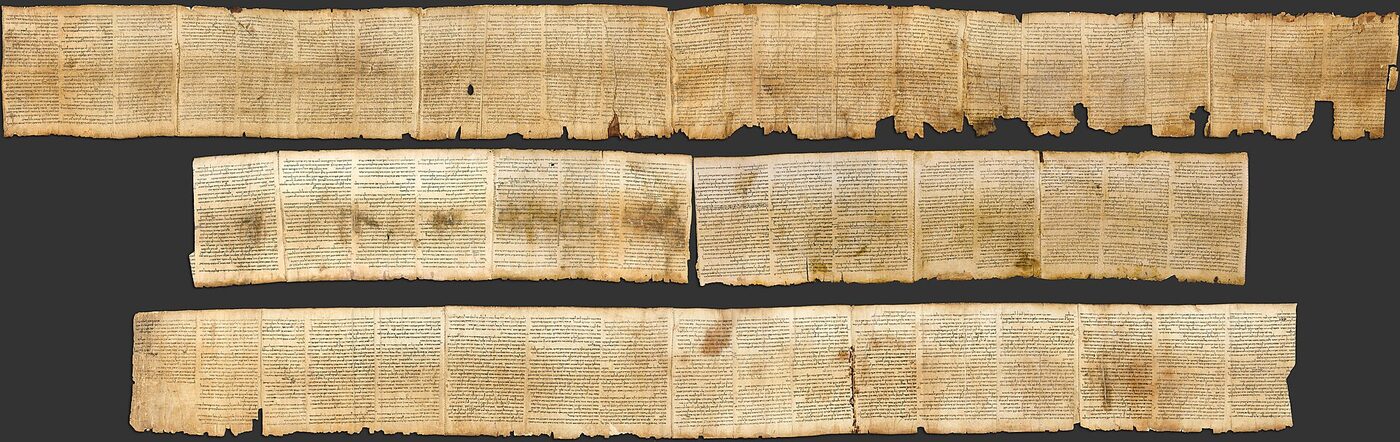

Every part of that is checkable, and none of it settles anything a religious tradition holds. It is material of the kind that was available to be cited, and was cited, by people who drew opposite conclusions from it.
The Septuagint, and translation before there was a New Testament
The oldest surviving translation of the Hebrew scriptures is itself ancient. The Septuagint is the Greek version of the Hebrew Bible made from about the third century BCE onwards, principally in Egypt, and its conventional name comes from the account in the Letter of Aristeas that the laws of the Jews were rendered into Koine Greek at the request of Ptolemy II Philadelphus by seventy-two translators, six from each of the twelve tribes. That account is regarded by some scholars as pseudepigraphical; the abbreviation LXX, seventy, survives from it regardless.
Its importance to the arguments this group hosted is threefold and entirely documentary. It is a witness to the Hebrew text as it stood before the Masoretes, and it sometimes differs from them. It is the form in which the Old Testament was read by Greek-speaking Jews and by the earliest Christian communities, so that quotations of scripture inside the New Testament often follow it rather than the Hebrew. And it contains books that later canons treat differently from one another — which is where a substantial part of the canon question, discussed below, begins.
The great fourth- and fifth-century Greek codices contain the Septuagint and the New Testament together, in one binding, which is why the same handful of manuscripts appears in arguments about both testaments.
The Greek New Testament and its witnesses
The New Testament survives in more Greek copies than any other work of antiquity, and the sheer scale of the evidence is itself a subject of argument. Catalogued Greek manuscripts number in the thousands — figures of the order of 5,600 to 5,800 are quoted, depending on the date of the count and on what is included — alongside Latin, Syriac, Coptic and other versional witnesses and the quotations of the church fathers. By way of comparison, the standard textbook contrast puts Homer's Iliad at 457 papyri, two uncial manuscripts and 188 minuscules.
They are conventionally sorted by material and script. The papyri are the earliest and the most fragmentary; the one generally cited as earliest is a scrap of the Gospel of John catalogued as Papyrus 52, held at the John Rylands Library in Manchester, whose first editor proposed a date between 100 and 150 and a later study one between 125 and 175; the dating is still argued over. The uncials are parchment codices written in continuous capitals. Four of them are known as the great uncial codices, of which three anchor most discussion: Codex Vaticanus, dated to the fourth century and held at the Vatican Library; Codex Sinaiticus, mid-fourth century, containing the oldest complete copy of the New Testament and now divided between the British Library, Leipzig University Library, Saint Catherine's Monastery in Sinai and the Russian National Library; and Codex Alexandrinus, dated to about 400 to 440 and held at the British Library. The minuscules are the later cursive manuscripts, far more numerous than the uncials and mostly medieval. Lectionaries, which arrange the text for liturgical reading, form a fourth class.
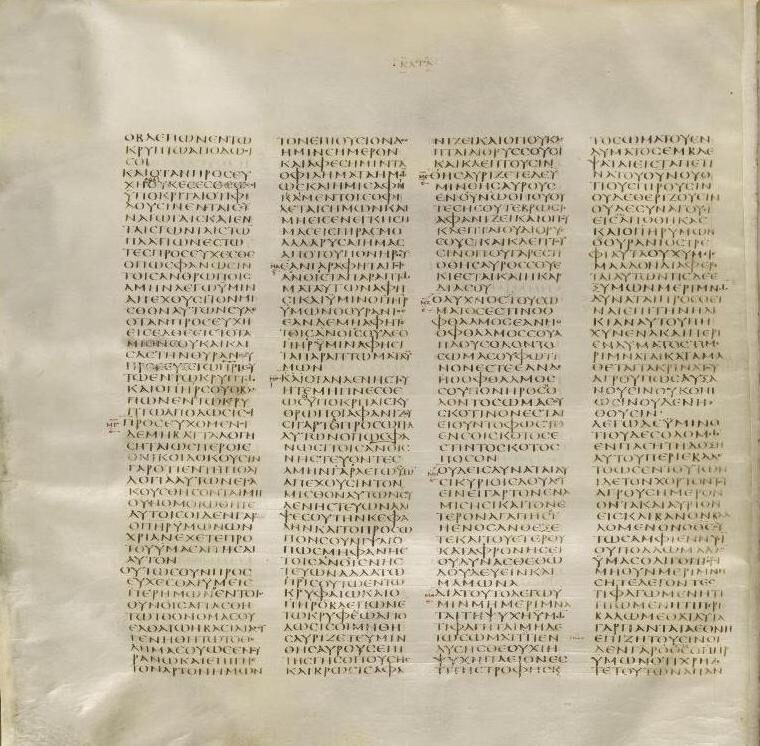

Palaeography — dating a manuscript by the typology of its script — is the ordinary method, and it is honest about its limits: a palaeographical date is a range, sometimes of a few decades and sometimes of a century or more. Radiocarbon dating gives a range too, and destroys a little of the object to do it. Precision of the kind a Usenet argument often wanted was not on offer.
Variants, text-types and what a critical apparatus does
Printed editions aside, no two handwritten copies of a long text are identical, and the discipline that deals with the differences is textual criticism. Its vocabulary is worth stating plainly, because it was frequently used loosely in the group and occasionally used precisely. A witness is a manuscript or version that attests the text. A variant reading is a point at which witnesses differ. The great majority of variants are accidental: an omitted word, a duplicated line, a misspelling, a transposition. A minority are deliberate — harmonisation of one gospel to another, clarification, correction against another exemplar — and telling the two apart is much of the work.
Estimates of the total number of variant readings across the New Testament tradition are large and imprecise; figures in the range of 300,000 to 400,000 are commonly quoted, and the number is a function of how many manuscripts have been collated and how a variant is counted. Spread across the catalogued manuscripts the higher figure works out at an average of about seventy variants each, and the count is taken across several languages, so the raw total carries less weight than its size suggests.
Witnesses are grouped by shared patterns of reading into text-types, of which the three usually named are the Alexandrian, the Western and the Byzantine. The Byzantine is by a wide margin the most numerous: more than eighty per cent of catalogued minuscules carry it. Whether numerousness is evidence of accuracy is exactly the point at issue between the mainstream eclectic approach and the Byzantine-priority position, and both are held by working scholars who have published critical editions.
A critical edition is what the discipline produces: a reconstructed text plus an apparatus criticus printed beneath it. The apparatus does three things. It lists the evidence the editor used, by manuscript name or by the abbreviations called sigla. It records the editor's assessment of that evidence. And it sets out the readings that were not adopted, so that a reader can see the alternatives and disagree with the editor on the editor's own evidence. That last property is why an apparatus matters to an argument conducted at a distance: it lets a disputed reading be checked against the evidence rather than against an assertion.
One worked example shows the whole apparatus at work, and it happens to be the passage most often produced in arguments of this kind. The clause at 1 John 5:7–8 known as the Johannine Comma stands in the King James Version but is absent from the overwhelming majority of Greek manuscripts, the earliest Greek witness to it being of the fourteenth century; it is attested mainly in Latin. Erasmus omitted it from his first two editions of the Greek New Testament because his Greek manuscripts did not have it, and added it in his edition of 1522 after criticism and after being shown a Greek manuscript containing it, while recording doubts about it in his Annotations. Modern critical editions print the shorter text and place the longer reading in the apparatus; the United Bible Societies edition rates its preference for the shorter reading at its highest confidence grade. Advocates of the Textus Receptus and of the King James Version have argued for the longer reading's authenticity. Those are the positions; this page records them and does not adjudicate between them. Two longer passages, the ending of Mark at 16:9–20 and the account at John 7:53–8:11, are handled by modern editions with similar bracketing and similar notes, and generated similar exchanges.
The critical editions themselves
The printed tradition divides into two lines, and almost every translation argument in the group was, at bottom, an argument about which line a version stood in.
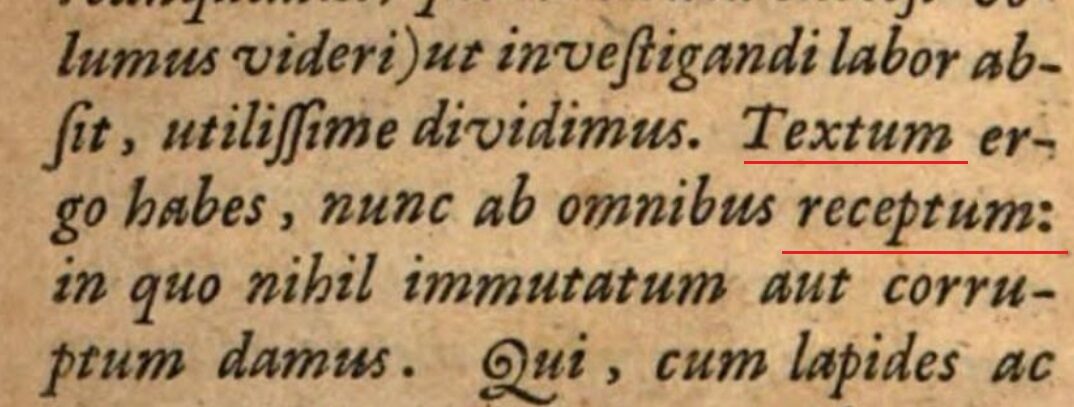
The first begins with Erasmus. His Novum Instrumentum omne of 1516 was the first published Greek New Testament, and the succession of editions that followed it — those of Stephanus, Beza, the Elzevir house, Colinaeus and later Scrivener — came collectively to be called the Textus Receptus. The label itself is an advertisement. The publisher's preface to the Leiden edition of 1633, produced by Bonaventure Elzevir and his nephew Abraham, tells the reader Textum ergo habes, nunc ab omnibus receptum — so you have the text, now received by all — and the phrase, shifted from accusative to nominative, became the name of the whole family.

The second line is the modern critical one. Brooke Foss Westcott and Fenton John Anthony Hort published their edition in 1881, resting heavily on the earliest uncials; their fiercest contemporary critic, John William Burgon, attacked the edition in the Quarterly Review in 1881 and reprinted those articles as The Revision Revised, published by John Murray in 1883. Eberhard Nestle published the first edition of his Novum Testamentum Graece in 1898, and the edition, later carried on by Kurt Aland and edited today by the Institute for New Testament Textual Research in Münster, has become the standard: the twenty-eighth edition, NA28, appeared in 2012, and its text is shared with the fifth edition of the United Bible Societies' Greek New Testament, the two differing only in paragraphing, punctuation, capitalisation and spelling and in how much of the apparatus each carries. A fuller collation still is being published as the Editio Critica Maior. On the Hebrew side the corresponding edition is the Biblia Hebraica Stuttgartensia of 1977, based on the Leningrad Codex.
Most modern English translations rest on the second line. The King James Version and the New King James Version rest, for the New Testament, on the first. That single sentence is the origin of a great deal of what follows.
English, from Tyndale to 1611
The English lineage is unusually well documented, and its dates are worth having in order.
- William Tyndale printed a partial New Testament at Cologne in 1525, of which one fragment survives in the British Library, and the first complete edition at Worms in 1526; revised editions followed in 1534 and 1536. He translated the Pentateuch, published at Antwerp in 1530, together with Jonah and a revised Genesis, and further Old Testament books that survive only as absorbed into later versions. He was declared a heretic in August 1536 and executed — strangled, then burned — in the Low Countries, on charges of promulgating Lutheran views rather than of translating scripture, which was not itself a crime there.
- Myles Coverdale published the first complete printed Bible in English in 1535, filling out from Latin, German and Swiss sources what Tyndale had not finished.
- The Matthew Bible of 1537, published by John Rogers under the pseudonym Thomas Matthew, carried the unpublished Tyndale material into print.
- The Great Bible of 1539 was the first royally authorised English edition, prepared by Coverdale under commission from Thomas Cromwell and appointed to be read aloud in the churches.
- The Geneva Bible of 1560 was the first complete English version translated entirely from the original languages, and the first English Bible to use both chapter and verse divisions throughout; its extensive marginal notes made it both popular and, to the crown, suspect.
- The Bishops' Bible of 1568, revised in 1572, was the Church of England's answer to Geneva; its 1602 edition was prescribed as the base text for what came next.
- The Douay–Rheims Bible, made from the Latin Vulgate by members of the English College at Douai and Rheims, appeared as a New Testament in 1582 and a complete Bible by 1610.
The King James Version was commissioned at the Hampton Court Conference in January 1604, convened in response to the Puritan grievances of the Millenary Petition, and published in 1611. The translators were instructed to follow the ecclesiology of the Church of England and to avoid marginal notes wherever possible — the Geneva notes being the specific irritant. For the New Testament they used the Textus Receptus; the Old Testament was a revision of the Bishops' Bible against the Masoretic Text; the Apocrypha was rendered from the Septuagint and the Vulgate. The 1611 edition contained eighty books: thirty-nine of the Old Testament, fourteen of the Apocrypha, twenty-seven of the New. The text in general use today is not the 1611 text but a standardisation, chiefly the Oxford edition of 1769.
The version was not given a settled name for a long time. Hobbes in 1651 called it "the English Translation made in the beginning of the Reign of King James"; a 1761 survey of English Bibles called it merely "a new, compleat, and more accurate Translation". King James's Bible appears as a name by the late eighteenth century, Authorised Version, capitalised and used as a name, as early as 1814. That a translation acquired its identity by usage rather than by decree is a small fact with a long shadow over the argument described below.
The modern versions and the equivalence argument
The nineteenth century reopened the question. The Revised Version, the first officially authorised British revision of the King James Version, published its New Testament in 1881, its Old Testament in 1885 and its Apocrypha in 1894; Westcott and Hort sat on its committee, which is why the edition and the revision are permanently linked in the argument. The American Standard Version followed in 1901, the Revised Standard Version in 1952, and after that the field opened: the New American Standard Bible in 1971, the New International Version on 27 October 1978, the New King James Version in 1982, the New Revised Standard Version in 1989, the English Standard Version in 2001, with further revisions throughout — the NIV alone was revised in 1984 and again, more substantially, in 2011.
The vocabulary in which the differences between these versions were discussed came from Eugene Nida (1914–2011), a linguist working on Bible translation, and it entered general use in translation studies. Formal equivalence keeps close to the lexical detail and grammatical structure of the source. Dynamic equivalence, a term Nida coined and later preferred to call functional, aims at a rendering to which a reader responds essentially as a reader of the original would have. English versions are conventionally ranged along that axis, with the King James and the New American Standard toward the formal end, the New International Version nearer the middle, and paraphrases at the far end. Publishers describe their own products in these terms, which is one reason the terms were so widely available to argue with.
The argument in the group, reduced to its shape, was over which end of that axis a translator ought to serve, and it was rarely conducted purely as a question of linguistics. A preference about translation method tends to travel with a view about who scripture is for and what a reader is entitled to be given without mediation. Both positions were held, at length, by people who could quote the underlying text at each other.
The King James Only position, described
The King James Only controversy is documented far beyond Usenet and surfaced in every group of this kind. Describing it accurately requires first noting that it is not one position but a range of them, and that its adherents themselves distinguish between the varieties.
The classification in general use comes from a Christian apologetic study of 1995, The King James Only Controversy: Can You Trust the Modern Translations?, published by Bethany House, which sorted the field into five kinds. The first is simple preference: the King James is a very good translation, it is what the reader's congregation uses, and it is what they prefer. The second is the textual argument: the Hebrew and Greek texts underlying the King James are the more accurate ones, and a modern translation resting on the same texts would be acceptable. The third holds that the received text tradition was providentially preserved and that translations departing from it are departing from the preserved word. The fourth holds that the King James translation is itself divinely inspired, an English preservation of the very words, not to be altered. The fifth, associated with the Independent Baptist minister Peter Ruckman (1921–2016) and commonly labelled Ruckmanism after him, holds that the 1611 translation constitutes a form of new or advanced revelation, capable of correcting the Hebrew and Greek where they are unclear. The classification's own author notes that the categories are not mutually exclusive and do not exhaust the field; other advocates argue for the version on the grounds of its manuscript tradition, its translation philosophy or its ecclesiastical authority instead.
The position has an ancestry that predates the movement's modern name. Burgon defended the traditional text against the Revised Version in articles of 1881, collected as The Revision Revised in 1883, and Edward Miller followed in 1886; both, notably, thought the Textus Receptus itself required correction against the wider Byzantine tradition. Benjamin G. Wilkinson (1872–1968), a Seventh-day Adventist theology professor, published Our Authorized Bible Vindicated in 1930. Later advocates included the Independent Baptist preachers Jack Hyles (1926–2001) and the tract publisher Jack Chick (1924–2016). Preference for the King James and the Textus Receptus is today most common among Independent Baptist congregations, and is also taught among Primitive Baptists and within some Laestadian Lutheran, Anabaptist, Methodist and Pentecostal bodies. Among some Presbyterian and Reformed Baptist writers a related position, placing its emphasis on the Textus Receptus rather than on the English version, travels under the name confessional bibliology.
Critics dispute both the textual premises of the position and its account of its own history; adherents dispute the critics. That exchange, conducted at length and with citations on both sides, is of the kind an unmoderated group with no credential filter carried, and this page's business is to say accurately what the positions were, who holds them, and where they came from. It delivers no verdict on any of them.
The canon question, as documented history
Which books belong in the Bible is not one question but several, answered differently by different traditions, and the differences are matters of record rather than of opinion.
In Rabbinic Judaism the Hebrew Bible comprises twenty-four books. Protestant Old Testaments contain the same material, counted as thirty-nine by dividing several of those books. The Catholic Old Testament contains forty-six, the additional books being those called deuterocanonical — the word means "of a second canon", referring to a later time of final approval rather than to a lesser degree of inspiration. Eastern Orthodox churches accept a further set, termed anagignoskomena, "things that are read", per the Synod of Jerusalem of 1672. The Orthodox Tewahedo churches of Ethiopia and Eritrea maintain the broadest canon of all, including works — Jubilees, Enoch, the three books of Meqabyan, Ethiopic Pseudo-Josephus, several church orders — that no other tradition includes. The New Testament canons of the Syriac, Armenian, Coptic and Ethiopian churches differ from one another in minor respects even where the churches are in communion.
The councils and lists that record the process are datable, and their authority is itself disputed between traditions. The Muratorian fragment, generally dated to around 200, shows a set of Christian writings broadly similar to the later New Testament. The thirty-ninth Festal Letter of Athanasius of Alexandria, of 367, lists exactly the twenty-seven books that became the New Testament and uses the participle for "being canonised" of them. A Council of Rome of 382 is traditionally credited with a list, though the historicity of that list is questioned. The Synod of Hippo of 393 and the Councils of Carthage of 397 and 419 accepted a canon including the disputed Old Testament books. The Council of Florence, in the decree Decretum pro Jacobitis of 1442, listed the received books without using the word canonical. The Council of Trent, at its fourth session on 8 April 1546, issued the decree De Canonicis Scripturis, which for the first time made the contents of the Bible an article of faith confirmed by anathema; the vote was twenty-four in favour, fifteen against and sixteen abstentions.
The Reformation-era settlements are equally documented. Luther kept the disputed books but grouped them separately, describing them as "not considered equal to the Holy Scriptures, but ... useful and good to read". Article VI of the Thirty-Nine Articles of 1563 states that the Church of England reads them "for example of life and instruction of manners" but does not apply them "to establish any doctrine", and English Presbyterian practice was fixed by the Westminster Confession of 1647. The King James Version of 1611 printed the fourteen apocryphal books between the testaments; most later printings of it do not, which is a publishing decision that a great many readers have taken for a textual one.
All of the above is history of a documented kind. Which canon is correct is a question this page does not touch, and the temptation to summarise the dispute as though one answer had prevailed is exactly the temptation a directory of newsgroups should decline.
Hebrew and Greek in seven bits
Usenet carried plain text in the seven-bit ASCII character set. The article format set out in RFC 850 in June 1983 and revised as RFC 1036 in December 1987 was defined as a subset of the RFC 822 mail format, whose body was specified as a sequence of lines containing ASCII characters. Nothing above code point 127 was contemplated. The alphabets at the centre of this group's subject matter were therefore not typeable, and an appeal to an original-language word had to be romanised in a notation the other party could read back. An argument about a Hebrew or Greek word began, in practice, with a negotiation about notation before it could reach the word.
The general machinery for Hebrew on a seven-bit network — the incompatible eight-bit code pages, the mail RFCs that specified how to move Hebrew through Internet messages, visual versus logical ordering, the bidirectional algorithm, and the competing romanisation standards — is treated at length on the soc.culture.jewish page, which carries the fullest account of it on this site. What follows is the biblical-text case, which has two particulars of its own.
The first is that for Greek there was an established scholarly answer, and it worked. Beta Code was devised in the late 1970s and adopted in 1981 by the Thesaurus Linguae Graecae, the digital library of Greek literature founded in 1972 at the University of California, Irvine. It represents the letters, accents and formatting of ancient Greek texts using ASCII alone, and it was designed to encode source texts faithfully rather than merely to romanise them. Its diacritics are postfix operators: / for the acute, \ for the grave, = for the circumflex, ) and ( for the smooth and rough breathings, + for diaeresis, | for iota subscript, with & for macron and an apostrophe for breve. Capitals are marked by a preceding asterisk, with the accents placed between the asterisk and the letter. Polytonic Greek written this way could be read exactly by anyone who knew the scheme, and not at all by anyone who did not — which describes the readership of an unmoderated group with some precision. Beta Code was also the working format of the Perseus Project, the Duke collection of documentary papyri and the epigraphy projects at Cornell and Ohio State, so a poster using it was using the same notation as the discipline.
The second particular is that Hebrew posed the problem twice over. Transliterating the consonants was straightforward and had a shelf of competing standards to be straightforward in. The vowel points and cantillation marks had no natural ASCII counterpart at all, and as noted above it is exactly those marks that a vocalisation argument turns on. Scholarship had met the problem a decade before the culture groups existed and solved it by brute force: a machine-readable Hebrew Bible in circulation from the 1980s onwards was the Michigan–Claremont transcription of the Biblia Hebraica Stuttgartensia, made at the University of Michigan in 1981 and 1982 with the Institute for Antiquity and Christianity at Claremont, which encoded a fully pointed and accented text — consonants, vowels and cantillation — entirely in plain ASCII. But such texts belonged to scholars with software to read them, not to a reader looking at a monospaced font in a newsreader.
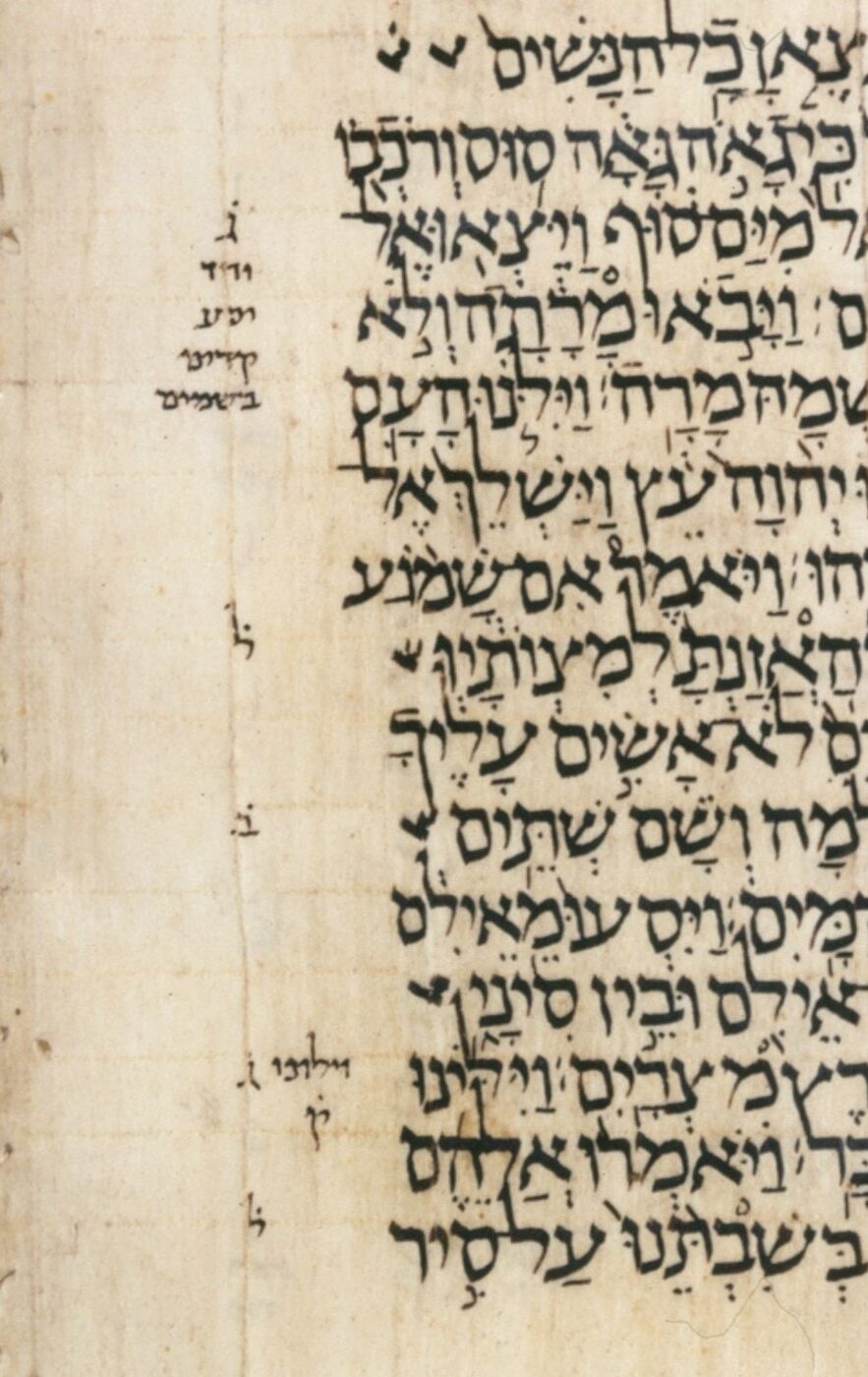

Unicode removed the theoretical obstacle in stages. The Hebrew block, U+0590 to U+05FF, was in the standard from the beginning, with fifty-two code points assigned in Unicode 1.0.0 of October 1991; the thirty-one cantillation marks arrived in Unicode 2.0 in 1996, with a handful of further characters in later versions. The Greek and Coptic block, U+0370 to U+03FF, was likewise present in 1.0.0 with 112 code points, its listed source being ISO 8859-7 — but that block holds the modern monotonic letters, and polytonic Greek needs the accented vowels of the Greek Extended block, U+1F00 to U+1FFF, whose 233 characters were encoded in Unicode 1.1 in 1993.
The practical obstacle lasted much longer than the theoretical one. A character reaches a screen only if the poster's software can produce it, every server in the path passes it through unmangled, and the reader's software can display it — for Hebrew, in the right-to-left order, with combining marks positioned correctly around the letters they belong to. Transliteration and Beta Code remained the safe option for years after the code points existed, and a poster who wanted to be understood used them.
Who posted
The readership was mixed in a way that a seminar or a parish study group is not. The categories of participant that a religion group of this kind drew are easily listed: clergy of several traditions; academics and graduate students in biblical studies, ancient history and linguistics; seminarians; a large population of autodidacts who had read widely and answered to no institution; adherents of traditions with sharply different views of the same text; sceptics and unbelievers who had read it closely in order to argue against it; and the merely curious, who arrived with one question and sometimes stayed. This page makes no claim about the proportions between them, because no source establishes any, and characterises none of them.
Nothing in the protocol distinguished between them. A newsreader asks for a name and an address, not for a degree. A claim to expertise in a signature block could be neither checked nor easily challenged, and a pseudonymous poster with a working knowledge of Aramaic looked, on the wire, exactly like a pseudonymous poster without one.
The effect on the arguments cut both ways, and this is the most interesting thing about the group's composition. Because standing could not be verified it could not be leaned on either: an assertion about a Greek participle or a manuscript reading persuaded only insofar as the post laid out the evidence for it, and the habit of quoting sources at length — chapter and verse, manuscript sigla, edition and page — grew directly out of that. Equally, no qualification was needed to make the assertion in the first place, and a confidently written paragraph looked identical on screen whether or not its author could read the language under discussion. Both consequences followed from the same missing feature, and the group had no mechanism for keeping one without the other.
Neighbours, and what happened afterwards
The group sat at a crossroads of Usenet's religious geography. Traffic flowed in from alt.atheism on one side and from the alt.christnet.* sub-hierarchy on the other, with soc.religion.christian available to anyone who preferred a moderator's shelter and talk.origins to anyone who wanted the origins argument at full strength. alt.bible was where those constituencies met without a referee, and crossposting ensured that a thread opened in one of them was read and answered in the others.
The neighbours differed in structure as much as in subject, and the structural difference had consequences that outlasted the traffic. talk.origins accumulated reference material that survived the newsgroup: an anonymous FTP site set up in 1994 to hold the group's collected FAQs became a maintained website in 1995, giving one side of that argument a citable corpus. soc.religion.christian's moderator filtered every submission, at the cost of delay. talk.religion.misc took anything at all. alt.bible had neither an archive of settled answers nor a gatekeeper, and so the same questions were asked and answered again every few months, from scratch, by whoever happened to be reading. That was the cost of the arrangement.
The openness gave it an afterlife as source material. Websites on every side of the creation-and-evolution debate quoted Usenet posts as specimens — arguments preserved exactly as written, datable and attributable — and unmoderated groups where the argument ran hottest made natural quarries. The public archive assembled by Deja News from 1995 and acquired by Google in February 2001 is what keeps such quotation checkable rather than anecdotal, and it is why an exchange from the middle 1990s can still be read in the form its author actually typed.
The genre of argument the group hosted did not end with it. It moved to web forums, then to social media, where it continues with less threading and shorter memories. alt.bible itself still exists on modern news servers — the newsgroups file entry quoted at the top of this page is the current one, not a historical one — far quieter than in its busiest years, its back catalogue a record of how scripture was contested when the internet was mostly text.
What the record does not show
A great deal of what a reader might reasonably want to know about this group cannot be established, and the honest thing is to say so specifically rather than in general.
- The creation date. The control archive begins in early 1991 and holds no newgroup message for alt.bible. The group either predates the archive or its creation was never captured. No date is given here because none is documented.
- The founder, and any founding statement. alt.* groups were often announced with a rationale posted to alt.config. No such announcement for this group survives in the administrative record consulted for this page, and the one-line newsgroups description is the only charter it has ever had.
- Volume, readership and reach. No article counts, no subscriber estimates, no readership survey figures for this group are cited here, because none were found. The active-file entry carries zeroed article numbers, which is a property of the distributed configuration file and not a measurement of anything.
- The content of any individual thread. No message archive is held on this site. This page names no poster, quotes no article, and invents no subject line. The families of argument described above are the documented shapes such groups took, not a summary of specific threads anybody here has read.
- Moderation history. The group is flagged unmoderated in the active file and there is no record of it ever having been anything else. Two of its siblings carry the moderated flag; this one does not.
This absence is normal. Most alt.* groups have essentially no surviving external documentation of their own, and filling that gap with plausible invention would be worse than leaving it open. What can be documented — the group's paperwork, the world its subject belongs to, and the technical conditions it operated under — is what this page contains.
Scope and limits
This is a page about a newsgroup, a text and a manuscript tradition. It is not a page about religion, and three limits follow from that.
It takes no position on the truth of any religious claim. Nothing above should be read as endorsing, doubting, recommending or disparaging any belief, any church, any denomination or any tradition of reading. Where traditions differ — on the canon, on the text, on the translation, on the method — the differences are reported as differences, with the holders named by category and the dates given where they are documented.
It describes textual scholarship as scholarship. The findings summarised here belong to the editions and the scholars that produced them, and they are contested within the discipline as well as outside it; a critical edition is an argument in print, not a verdict. Where estimates vary — the number of manuscripts, the number of variants — the range is given rather than the most quotable figure.
And it describes an argument without joining it. The people who posted to this group disagreed with each other from starting positions that could not be reconciled, and did so in a room that had, by design, no authority to appeal to. Recording what that was like, and what the record actually contains, is the whole of this page's business.
Reading alt.bible today
- Historical archive: Google Groups — alt.bible (coverage varies by group and era).
- Open in a newsreader:
news:alt.bible— the original site offered exactly this link, and it still works if your system has a newsreader registered for thenews:scheme. - Live access: point an NNTP newsreader at a modern server — see accessing Usenet today.
- The original news2mail e-mail subscription service ended in the mid-2000s and no longer operates.