talk.philosophy.* — philosophy debated
Philosophy argued in public, from formal logic to ethics, with the humanism branch carrying the secular-humanist current of the 1990s network.
On this page
- Two names, and the paperwork behind them
- How talk.philosophy.humanism was named
- The names that were proposed and refused
- Three philosophy groups that never existed
- Where philosophy actually lived
- Philosophy without credentials
- The perennial questions: free will, mind, and the existence of God
- Ethics, metaethics and the analytic-continental line
- Moderation, and why this subtree mostly declined it
- The form: a tree of objections, and no way to end one
- The reference shelf arrives
- Where it went, and what still carries the names
- Scope and limits
Two names, and the paperwork behind them
The philosophy subtree of talk.* is two names, and has been two names for as long as the record runs. The master newsgroups file distributed today lists thirty-one talk.* names in all — the parent page counts them — and the philosophy pair are described in the same telegraphic register as everything else around them.
talk.philosophy.humanism— “Humanism in the modern world.”talk.philosophy.misc— “Philosophical musings on all topics.”
Those two lines are the whole official statement of what this branch was for. Everything else a reader might want to know — what counted as on-topic, who was expected to turn up, whether anything was out of bounds — was left to be settled in the groups themselves, which is a decision of a kind even though nobody recorded making it.
The elder of the pair has no paperwork at all. talk.philosophy.misc is one of the branch’s undocumented originals: the archive of requests for discussion, calls for votes and results holds no file under that name, and no charter for it appears anywhere in the surviving group-creation record. Its earliest trace is administrative rather than editorial. On 23 May 1991 a control message issued from a commercial site in Wakefield, Massachusetts carried the group’s name and a one-line body — “Philosophical musings on all topics.” — as part of the sweep that supplied descriptions for the old talk.* names. Those five words have survived every subsequent revision of the master file unaltered, and they remain the group’s entire official description.
Two further messages in the same file show the group being propagated by hand rather than created. On 28 June 1991 a message from the Department of Computer Science at the University of Melbourne, with its distribution set to aus, repeats the newsgroups line for Australian sites, its author noting in passing that he was in the middle of creating something else entirely. On 26 April 1992 a message from the University of Maine’s computer science department, distribution umcs, creates the group locally with an empty body and no description whatever. Neither message founded anything. Both are the ordinary housekeeping of a network in which every site kept its own list, and in which a group existed, at any given machine, only because somebody there had told the machine it did.
The younger name is documented in full, and the file is worth walking through, because it is the only complete account this branch has of how one of its rooms came to exist.
How talk.philosophy.humanism was named
The proposal arrived on 1 September 1994, and it did not arrive under the name it ended up with. The first request for discussion, posted by Lucien Saumur through a community FreeNet account at Carleton University in Ottawa and cross-posted to news.groups, talk.religion.misc and alt.atheism, was for a group called talk.religion.humanism, summarised as “Discussion of secular morality in the modern world”. Its charter ran to three paragraphs. It said what the group was for; it said, unusually, what the group was not for — “not meant to serve as a forum to discuss the existence or non-existence of God, nor to catalogue the foibles of church people and their alleged misdeeds throughout history”; and it closed with a sentence about conduct that is as good a statement of the branch’s ambitions as anything else it produced: “Participants to this newsgroup are expected to discuss these matters with reason and without passion. And, if there must be passion, let it be a passion to be rational.”
A fortnight later all of it was gone. The second request for discussion, posted on 14 September 1994, moved the proposal from the religion branch to the philosophy branch and cut the charter to a single sentence: “This newsgroup should serve as a meeting place for individuals who consider themselves humanists.” The proponent gave his reasons in the open, and they are procedural rather than doctrinal. After some days of discussion it had become obvious, he wrote, “that the disagreement about the nature of humanism will jeopardize the creation of the proposed newsgroup and that the creation of the more neutral talk.philosophy.humanism would stand a better chance of receiving general approval”. He added that the group might in time reveal the need for more than one newsgroup, serving the different views of what humanism is.
Both halves of that manoeuvre repay attention. The second-level word was changed because religion was contested and philosophy was not, which indicates what each label was understood to commit a group to. And the charter shrank because every clause in it was something a voter might vote against. What began as an attempt to set the tone of a discussion ended as a sentence that sets nothing at all, and the shrinkage was the price of passage. It is a small, exact illustration of why so few groups in this branch have charters of any length: the documents that survive a vote are the documents that commit to least.
The vote itself ran the standard course. A first call for votes went out on 14 October 1994, conducted by Andrew Solovay on behalf of the Usenet Volunteer Votetakers; a second, superseding it, on 24 October; balloting closed at 23:59:59 GMT on 4 November. The result was posted on 8 November 1994: 145 in favour and 33 against, 178 valid votes in all, with one abstention and three ballots set aside, each of them recorded in the result as containing no vote statement. The margin cleared both of the arithmetic tests the Big Eight then applied — the rules are set out on the comp.* page and not restated here — and after the five-day objection period the moderator of news.announce.newgroups issued the newgroup control message on 14 November 1994, repeating it on 21 November and again on 14 December for the benefit of sites that had missed the first two. The message quotes the newsgroups line, talk.philosophy.humanism Humanism in the modern world., and appends the one-sentence charter with the note that it was “culled from the call for votes”.
What the group then did with itself, and what secular humanism meant to the people who argued about it there, belongs to that group’s own page and is not covered here. This page is about the shape of the branch and the conditions it argued under.
The names that were proposed and refused
A subtree of two names looks like a subtree nobody wanted more of. The administrative record says the opposite: philosophy was proposed repeatedly, in three hierarchies, and almost every proposal failed. The failures are better documented than the successes, and they are the clearest evidence there is about where Usenet thought philosophy belonged.
The first attempt came in January 1990, when T. William Wells called for discussion of talk.philosophy.objectivism, a group for the philosophy of Ayn Rand. Two features of that discussion matter more than its outcome. The proposal began life as a request for a moderated group, and moderation was dropped almost at once: in the proponent’s own summary, “very few people wanted a moderated group, so I abandoned that idea”. And a substantial faction argued that the group did not belong in talk.* at all but in sci.*, an argument that ran long enough in news.groups for the proponent to note that the pro-sci side “wrote a lot of stuff” there while a poll he ran contradicted them. He declined to run their vote for them; they ran it themselves.
That parallel vote is the useful one, because its result survives with the vote-taker’s own account attached. sci.philosophy.objectivism was put to the network by Robert W. Stubblefield of AT&T Bell Laboratories, with a call for votes on 2 February 1990 and a rationale that argued the case for the hierarchy word by word: sci “because of the approach participants should use… conclusions should be drawn by reasoning based on observations of reality”, with the explicit stipulation that neither “Ayn Rand says so” nor “I just feel it’s so” should serve as a premise. The result, posted on 10 March 1990, was 174 in favour and 221 against. The vote-taker’s summary of why is the single most informative sentence in the philosophy paperwork: “Many of the no voters indicated they would have voted yes for a group in another hierarchy, usually mentioning talk. Some objected to labeling philosophy in general and Objectivism in particular as science. Others were concerned about the amount of traffic that might be generated.”
Read plainly, that is Usenet declining to file philosophy under science — not on any view about philosophy’s epistemic standing, but on a mixture of taxonomy and traffic. The parallel talk.* proposal of 1990 has no result on file: the archive runs from the final call for votes of 5 March 1990 straight to a fresh request for discussion in November 1992. That second attempt was made by someone who described himself as “only just learning about Objectivism” and looking for somewhere to ask questions, and it failed on 6 January 1993 for want of the required margin; the exact arithmetic and the vote-taker’s comment on it are quoted on the talk.* page.
The same hesitation between the two hierarchy words appears in a proposal that had nothing to do with Ayn Rand. On 10 November 1992 Rick Horowitz, of the philosophy department at California State University, Fresno, requested discussion of sci.philosophy.language — a group for philosophy of language, philosophy of linguistics, theories of meaning and truth, reference, pragmatics and speech act theory. The request opens by noting that it supersedes an earlier proposal of his for talk.philosophy.language, because “it has been pointed out to me that a designation of sci might be more appropriate”. Two calls for votes followed, in January 1993, with the voting period ending on 31 January. The archive holds no result, and the name is not on the master list distributed today.
Ethics fared no better. In February 1990 David Goldfarb of Berkeley called for votes on talk.morality, a group “devoted to discussion of conflicting value systems”. The proposal had begun as something much narrower — a group for the debate over the morality of homosexuality — and had been broadened in news.groups into a room for “any and all debates/flame wars over conflicts of morality”, with the proposed topics listed as terrorism and civil disobedience, recreational drug use, sexual practices and euthanasia. It failed on 20 March 1990, 115 to 52. The vote-taker’s post-mortem did not flatter his own document: “The charter for this group was more unpopular than most.”
The pattern in these votes is consistent and slightly surprising. Nobody was voting on whether the questions were worth arguing about; those arguments were already running, in talk.philosophy.misc and half a dozen groups on either side of it. What was being voted on each time was whether a particular argument deserved a dedicated address, and the answer, in every case where a result survives, was no. A branch of two names is not evidence of indifference. It is the record of a network that kept deciding the general-purpose room was sufficient.
Three philosophy groups that never existed
The control archive for talk.philosophy holds five files, not two. Alongside the messages for the real groups sit files for talk.philosophy.cosmology, talk.philosophy.epistemology and talk.philosophy.metaphysics, and the imbalance between them is the striking thing. The two real groups have five control messages apiece, covering their whole existence. The three that were never created hold two hundred and ninety-three between them.
All three appeared on 4 and 5 May 1996, in newgroup control messages from a single account on a Californian consumer service, each carrying a description written in the same mock-official style as the real ones:
talk.philosophy.cosmology— “The origins of Usenet and the Universe”talk.philosophy.epistemology— “How do we find out what this is”talk.philosophy.metaphysics— “The ultimate study of reality”
The joke was aimed at news administrators rather than at philosophers. One message for each of the three appends the line “Please note that I’m not David Lawrence” — Lawrence being the moderator of news.announce.newgroups, whose approval was what made a Big-Eight newgroup message authoritative — and one goes further, addressing the reader as a system administrator whose “Usenet software may be misconfigured” and helpfully supplying the lines of control.ctl that would cause the machine to honour every newgroup message it received and discard every removal. The point being made was that a control message is only a request, and that a great many sites in 1996 were honouring requests without checking who had sent them.
Lawrence removed all three, with signed rmgroup messages issued on 8 May, 15 May and again on 8 June 1996, each carrying the same flat sentence: the group “is widely considered a bogus newsgroup given that it has not been approved by accepted USENET group creation procedures. Please remove the group from your active file.” The names came back anyway, and on a different scale. Forged newgroup messages for talk.philosophy.metaphysics resume in February 1998, and from late August 1998 into November all three were reissued in bulk, this time impersonating the Big-Eight group-admin address and carrying a fabricated provenance. Across the 1998 campaign, two hundred and ten forged newgroup messages announce that the group “is an unmoderated newsgroup which passed its vote for creation by” some tally “as reported in news.announce.newgroups” — 256:34, 160:35, 106:3 and so on. No vote was ever taken on any of the three and no such result was ever posted; the figures are invented, and almost no two of the two hundred and ten agree. The messages carry the organisation line “The Cabal” and sign off with a cat noise, which is as clear a signature of the period’s forgery campaigns as anything in the archive.
The two real groups were attacked from the other direction. In the first days of November 2001 both talk.philosophy.misc and talk.philosophy.humanism were the subject of rmgroup control messages asserting that each was a “bogus newsgroup” that “was never created in accordance to the accepted rules and methods for this hierachy” — boilerplate written for a different hierarchy altogether, as the messages’ own Newsgroups lines show, since they name that other hierarchy’s configuration groups. One of the messages puts the count of forged newgroup commands it was answering at over a hundred. This page takes no view on who was entitled to send what. The outcome is a matter of record: nothing was removed, and both names are on the master list today.
The episode is worth a section because of what it does to the evidence. Anyone reconstructing this subtree from the control archive alone would find five philosophy groups, three of them furnished with descriptions and hundreds of messages and one of them with a vote tally, and only careful reading separates the two that existed from the three that were a prank at the expense of news administrators. The archive records what was sent, not what was true, and in a branch this thinly documented the difference is the whole of the work.
Where philosophy actually lived
Two names could not hold the subject and never pretended to. Philosophy on Usenet was distributed across at least four hierarchies, and a reader reconstructing the period from group names alone will undercount it badly.
The technical and logic-adjacent half of the discipline sat in sci.*, where the master file still carries the addresses verbatim: sci.philosophy.tech, “Technical philosophy: math, science, logic, etc.”; sci.philosophy.meta, “Discussions within the scope of ‘MetaPhilosophy.’”; sci.logic, “Logic — math, philosophy & computational aspects.”; and sci.cognitive, “Perception, memory, judgement and reasoning.” Next door in the computing hierarchy sat comp.ai.philosophy, “Philosophical aspects of Artificial Intelligence.” That cluster is where the discipline’s technical vocabulary was most at home, and it is where the 1990 objectivism dispute wanted to be filed before the network declined.
The alt.* hierarchy took everything else, and took it without a vote. Eleven alt.philosophy names remain on the master list, and the range of what they were is visible in their own descriptions: alt.philosophy.taoism, “All aspects of Taoism.”; alt.philosophy.confucianism, “Confucius, Rujia and classical Chinese thought.”; alt.philosophy.debate, “Back to basics.”; and five names carrying no description at all. One of them, alt.philosophy.zen, has the only description in the set that is about Usenet rather than about philosophy: “Meditating on how the alt.* namespace works.”
And a great deal of actual philosophy was conducted in rooms named for other things. The physics groups argued interpretation; the religion groups argued epistemology; the politics groups argued ethics, mostly without calling it that. The creation-and-evolution dispute, which is philosophy of science conducted at industrial volume, had its own address in this branch and its own long history, told on the talk.* page and again, for the unvoted version of the same argument, on alt.evolution. Arguments about the existence of God had a dedicated room next door in talk.atheism, which the parent page covers.
The professional conversation, meanwhile, was largely somewhere else again. Academic philosophy in the 1990s ran on subscription mailing lists, where a membership roll did the filtering that no newsgroup could, and on the first generation of electronic journals. Postmodern Culture, established in 1990, is described as the first online-only peer-reviewed journal in the humanities; the Bryn Mawr Classical Review has been publishing reviews since November 1990; and closest of all to the arguments this branch cared about, Psyche ran as an online peer-reviewed journal on consciousness and its relation to the brain, with issues from 1994 to 2010, becoming the official journal of the Association for the Scientific Study of Consciousness in 2008. A reader who knew only the newsgroups saw a fraction of what was being written.
Philosophy without credentials
Here is the fact that distinguishes this subtree from every seminar room it resembled. On Usenet nobody’s argument arrived with a chair attached.
In a university department, standing does a great deal of quiet work before anyone opens their mouth. A reading list has already decided which texts are worth answering. A supervisor has already decided which objections a student must meet. An examiner will decide, later, whether the meeting was adequate. None of those three existed here. What arrived in a newsgroup was a claim and a name in a header, and the name certified an account rather than a qualification. A university address in the From line was the nearest thing to a badge the medium offered, and it established only that somebody had access to a particular network — in the early 1990s, admittedly, a narrower population than it later became, which is part of why the early traffic reads as it does.
Two consequences followed, and they pull against each other. The first is that deference went. An argument had to carry itself; an appeal to position bought nothing it had not already earned in the thread. The second is that the referee went with it. With no way to establish competence, a dispute about an argument could always slide into a dispute about who was entitled to make it, a move available to everyone and decisive for no one.
What that produced was genuinely mixed, and it should be described honestly rather than sentimentally. It admitted autodidacts who had read widely and carefully for decades and who had no institutional route to a conversation of that kind before the network existed. It admitted undergraduates three weeks into a first course, working out in public what they had half-understood in a lecture. It admitted retired engineers with complete systems in notebooks, and working academics reading over lunch, and people whose arguments would not have survived contact with a seminar. All of them could appear in the same thread, distinguishable only by what they wrote, and there was no mechanism whatever for telling them apart except the argument itself. Nothing marked the professional and nothing protected the amateur.
The consequences for the form of what was written are the part a reference page can document, because they follow from the mechanics of the medium rather than from any particular exchange.
- Length. Posts ran long, and ran longer as a thread aged. With no word limit, no editor and no cost per line beyond a few seconds of transit, the natural equilibrium was the point-by-point reply: the opponent’s article quoted in full and answered clause by clause, so that a fourth-generation post could be several times the length of the one that started the exchange. The technique is precise and hard to read, and it is the characteristic prose form of unmoderated argument groups of the period.
- Citation. A poster who wanted to cite a text was citing from memory, from a shelf, or from a library the other party could not reach. Paraphrase was therefore the currency, and paraphrase is contestable in a way a page reference is not. A dispute could turn on what a given author had actually said, with no shared copy to open. This is precisely the condition that the arrival of free online reference altered, and the change is datable; it is set out below.
- Recurrence. There was no syllabus and no cohort. Readers arrived and left continuously, so the same problems were opened again by new participants at intervals, with no memory of the previous round beyond what the regulars carried. The periodically posted FAQ was the network’s standard answer to that rhythm, and it was a partial one: a document can record what a group considers settled, but nothing obliges a newcomer to read it before posting.
- No closure. Nothing obliged anyone to concede. Threads could therefore end by exhaustion rather than by resolution, with the last poster left in possession of the field and the argument restarting later under a different subject line.
Whether that arrangement is the medium’s virtue or its defect is a question this page does not answer. What can be said without adjudicating anything is that the archive preserves the arrangement rather than resolving it. What survives of a thread is its text and its headers — who wrote, when, and in reply to what — and nothing at all about training. A reader today therefore assesses these posts on exactly the terms their authors were assessed on, which is either the point or the problem, depending on a prior view that this directory does not hold.
The perennial questions: free will, mind, and the existence of God
The recurring subjects were the ones the discipline itself has never closed, which is why they recurred. What follows describes the arguments and the kind of reasoning they use. It does not say who was right about any of it, and it does not reconstruct any particular exchange.
Free will and determinism
Free will is the standing example of a question that survives every attempt to settle it, and it has a stable shape. The dispute runs between the claim that every event, including a decision, is fixed by prior causes, and the claim that agents choose in some sense that matters for responsibility; the third position, compatibilism, holds that the two are not in conflict once the terms are defined carefully. That third position has a long pedigree: the classical statements are usually traced to Hobbes, Hume and John Stuart Mill, and twentieth-century compatibilists worked by departing from them.
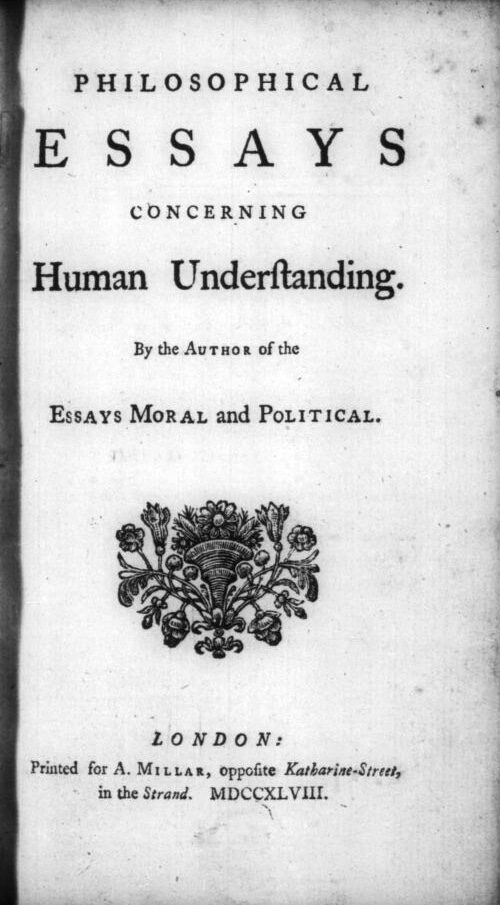
Hume’s own diagnosis of the dispute, in the section of the 1748 Enquiry headed “Of liberty and necessity”, was that all disputes on the subject had been merely verbal — disagreements produced by the absence of prior agreement about definitions. That diagnosis is worth recording here because it describes a hazard the medium was particularly exposed to. A discussion group has no shared reading, no agreed vocabulary and no chair to rule a term admissible, so the work of fixing definitions has to be done inside the argument or not at all.
Mind, consciousness and machines
The mind strand had the most live technical content available to it, for two reasons. It had current science attached, in a decade when cognitive science and artificial-intelligence research were supplying new vocabulary and new claims at speed. And it had one argument that everybody had to answer.
The Chinese room was set out by John Searle in a 1980 paper, “Minds, Brains, and Programs”, published in Behavioral and Brain Sciences, where it became the journal’s most influential target article; David Cole, writing the Stanford Encyclopedia’s survey of it in 2004, judged that it had “probably been the most widely discussed philosophical argument in cognitive science to appear in the past 25 years”. Its shape suited a newsgroup exactly. It takes a paragraph to state, it cannot be waved away, and it arrived equipped with a settled roster of replies — the systems reply, the robot reply, the brain simulator reply, the other minds reply — which a poster could invoke by name and an opponent was expected to recognise. An argument with named moves is an argument that a stranger can join at move six, which is the condition a public newsgroup imposes on everything it hosts.
Midway through the branch’s active life the subject acquired a second piece of shared vocabulary. The terms “hard problem” and “easy problems” of consciousness were coined by David Chalmers in a 1994 talk at the Toward a Science of Consciousness conference in Tucson, Arizona, published the following year as “Facing up to the problem of consciousness” in the Journal of Consciousness Studies and expanded in The Conscious Mind in 1996. The hard problem asks why physical processing is accompanied by subjective experience at all, as distinct from the tractable questions about discrimination, integration and report. What is worth noting here is the timing rather than the merits: this was vocabulary minted while the groups were running, in a literature their readers had access to, and a phrase costs nothing to transmit.
Behind both sat the older question, inherited whole from the seventeenth century, of how mental and physical description relate to one another at all. Descartes had put the problem in a form that has never quite gone away, and it is argued under every subsequent label: dualism and physicalism, identity theory and functionalism, qualia, zombies, inverted spectra and the standard thought experiments about duplication, division and gradual replacement that make up the personal-identity literature.


The existence of God, argued as an argument
This subtree carried the question in its philosophical form, which is a narrower thing than the disputes conducted next door in the religion and atheism groups. The material is argument types with names and known objections: the ontological argument, which reasons a priori from the concept of God to God’s existence; the cosmological arguments, which reason from the existence or contingency of the universe to a cause; the design or teleological arguments, which reason from apparent order to a designer; and, on the other side, the problem of evil, which asks how the existence of suffering is to be reconciled with an omnipotent and wholly good God, and whose best-known historical presentation is attributed to Epicurus.
These are, formally, exactly the kind of material a newsgroup handles well: each has a canonical statement, a canonical set of replies, and a literature that both parties can name. They are also material about which people are not neutral, which is the other half of the story and the reason the branch existed at all. This page describes the arguments as argument forms and adjudicates none of them. The dedicated groups where the same questions were pursued in a religious rather than a formal register have their own pages in this directory — alt.bible among them — and are not restated here.
Ethics, metaethics and the analytic-continental line
Two further strands are worth separating out, because each bears on the manner of argument rather than just its content.
Ethics and metaethics
An open-ended discussion group has no way to keep a first-order dispute — about an action, a policy, an obligation — separate from the second-order question of what a moral claim is and what would make one true, because there is no syllabus to say which question is on the table. That second-order enquiry is metaethics: the study of the nature, scope and grounding of moral judgement, as distinct from normative ethics, which asks what one ought to do, and applied ethics, which asks it about particular cases. Moral realism, the view that ethical statements can be true in the way factual ones are, is the position that most first-order argument presupposes without naming; so are its opponents, in the various forms that hold moral language to express attitudes, prescriptions or nothing truth-apt at all.
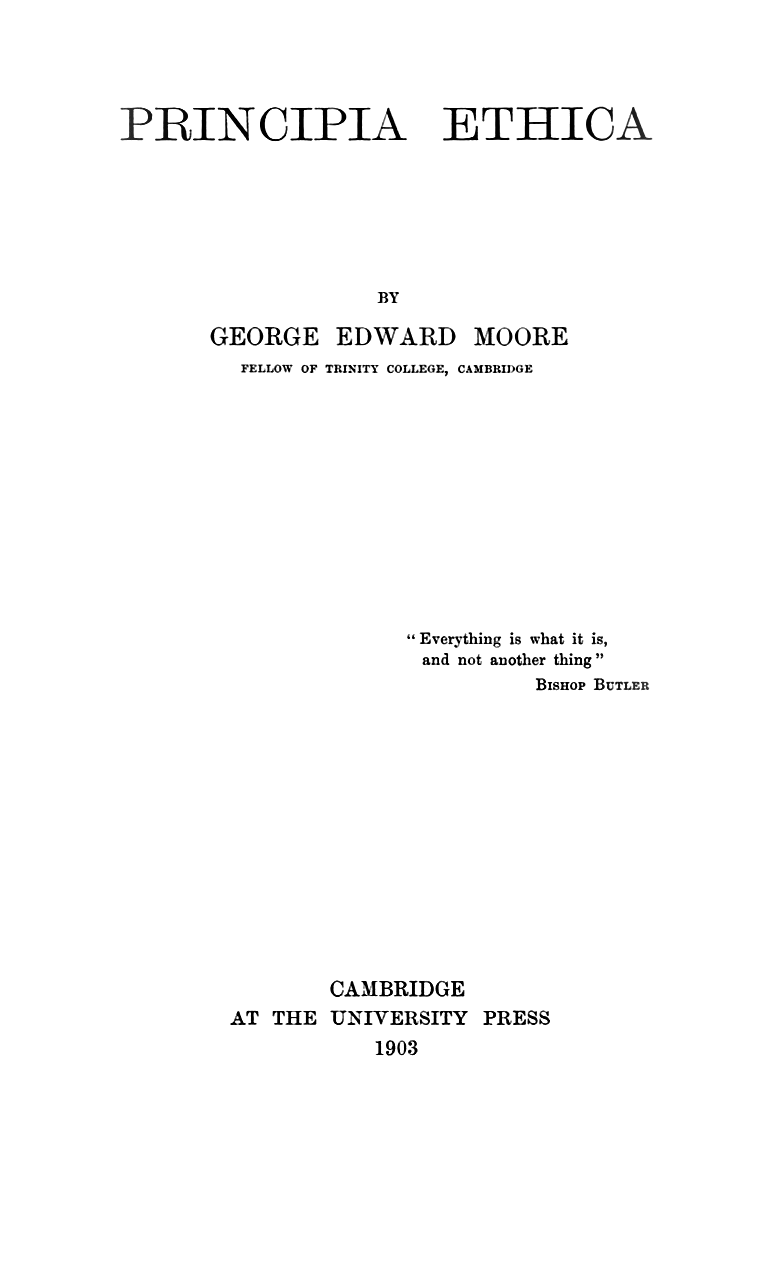
The twentieth-century text that set the terms is G. E. Moore’s Principia Ethica, published by Cambridge University Press in October 1903, in which Moore argued that “good” is a simple and indefinable property and that attempts to define it in natural terms commit what he called the naturalistic fallacy — the accompanying test being the open question, that for any proposed definition it remains an open question, not a tautology, whether the thing so defined is good. Whether Moore was right is not this page’s business. What is relevant is that his argument, like the Chinese room, is short, portable and equipped with named responses, and a portable argument is what travels through a medium in which nobody can be assumed to have read anything in particular.

The branch also inherited, from the failed talk.morality proposal of 1990, a lesson about scope: a group defined as the place for “any and all debates… over conflicts of morality” is a group defined as the place for everything, and the network declined to create it. Ethics stayed distributed across the politics groups, the religion groups and talk.philosophy.misc, which is roughly where the arguments had started.
The analytic and continental traditions
The last recurring subject is not a question but a division. Continental philosophy is the usual English-language label for a group of largely twentieth-century traditions of European origin — phenomenology, existentialism, structuralism, post-structuralism and their relations — and it came into wide use among English-speaking philosophers only in the 1970s, as a collective name for the philosophies then current in France and Germany. There is no academic consensus on its definition. Simon Glendinning has suggested that the term began as more pejorative than descriptive, functioning as a label for the kinds of philosophy that analytic philosophers rejected, which is a point about the history of a word rather than about the value of anything it names.
The differences usually cited are methodological: whether philosophical problems can be treated apart from their historical emergence; whether the natural sciences are the model for enquiry or one enquiry among others; how much weight to give the reading of texts as against the analysis of arguments. Those are real disagreements with a real literature. They are also, unusually among the subjects here, a disagreement in which each side’s standard of a good argument is part of what is in dispute, which leaves a public forum with nothing to appeal to. This page names the division, notes that both traditions have their advocates, and characterises neither as the more rigorous. That question is not one a newsgroup directory is competent to settle.
Moderation, and why this subtree mostly declined it
Moderation was the network’s one structural remedy, and it was narrower than it sounds. A submission to a moderated group is not injected into the network; it is mailed to a named volunteer, who either discards it or posts it with an Approved header attached, which is what makes servers propagate it. The parent page sets out the mechanism and the reasons the branch as a whole avoided it. What this section adds is the philosophy-specific record, which is unusually informative, because the question of what a moderated philosophy group would even be was put on paper more than once.
Neither talk.philosophy group has ever been moderated, and none of the discipline’s other designated addresses in the Big Eight is either: sci.philosophy.tech, sci.philosophy.meta, sci.logic, sci.cognitive and comp.ai.philosophy are all carried unmoderated on the current master list. On the alt.* side, exactly one philosophy name declares moderation and it does so in the name itself: alt.philosophy.rosicrucianism.moderated. That is the whole of it. On the list as it stands, no general philosophy group anywhere in the Big Eight or in alt.* has an editor.
The clearest statement of what one would have looked like comes from a proposal that failed. In October 1995 a request for discussion went out for sci.philosophy.natural, a moderated group for scholarly discussion of ancient natural philosophy, and its moderation policy was drafted in unusual detail. Articles containing personal attacks of any sort would not be approved. Lengthy quotation of source material — more than thirty lines — had to be accompanied by commentary. Articles consisting of material already available online would be refused in favour of pointers to it. And then the clause that a philosopher will read twice: “Flameless disagreements are welcome; but, if a thread looks as though it’s never going to be resolved, the moderator(s) reserve the right to terminate it or suspend it until new evidence is produced.”
That sentence is the crux of the whole question. A moderator who may close a thread for want of resolution is a moderator with a view about when an argument has run out, and a great many philosophical arguments have been running for two and a half thousand years without producing new evidence. The proposal also, candidly, gave its reason for wanting a gate: that minority viewpoints “are seldom embraced and are often actively discouraged” on specialist forums dominated by a small group of established experts, and that the new group would welcome them “justified by scholarship and which pass moderation”. It was a proposal to substitute one filter for another, and it said so. The vote closed on 12 December 1995 and the result was posted on 15 December: 101 in favour, 41 against. That is past the two-thirds test and forty votes short of the required hundred-vote margin, so it failed.
The one moderated philosophy group in the English-language Big Eight that did pass came out of the alt.* hierarchy’s difficulties rather than this branch’s. In March 1996 a proposal was posted for humanities.philosophy.objectivism, and its rationale is a first-hand description of what an unmoderated group can become: alt.philosophy.objectivism, the proponent wrote, had become “nearly useless as a forum for discussion of philosophy because of extremely high traffic of irrelevant crossposts, spaming and flaming”, and the perpetrators had been “repeatedly asked to leave” without effect. The proposed remedy is instructive precisely because of how little of it is editorial. The group was to be automoderated, with the automoderator overseen by a non-participating net administrator, and the rejection criteria were three: articles with lines longer than eighty characters, articles that were crossposted at all, and articles by authors the moderator had expelled for net abuse. Crossposting was banned outright, with the reason given in full — that a philosophy with applications in many areas generates threads that become irrelevant to one group or the other. The vote passed 362 to 46 in a result posted on 6 June 1996; the vote-taker recorded that the campaigning on both sides had been overdone and that he had found no evidence of fraud in the voting itself.
It was not a template. A parallel proposal for humanities.philosophy.religion, put to the network the same spring, failed on 28 June 1996 by 72 to 23 — short of the margin on the same arithmetic that had sunk sci.philosophy.natural six months earlier. Of the moderated philosophy groups proposed in the Big Eight in the 1990s, one passed and the rest did not.
Two things follow, thirty years apart. The first is that the unmoderated group was not replaced: alt.philosophy.objectivism is still on the master list, as it was throughout. The second is the moderated group’s ending, and it is the plainest available demonstration of moderation’s structural weakness. On 18 June 2025 humanities.philosophy.objectivism was removed from the Big Eight, in a batch of eighty-nine moderated groups deleted together after a series of four requests for discussion running from January to May 2025, a last call for comments on 5 May opening a five-day comment period, and a Big-8 Management Board vote of three in favour of deletion with one member not voting. The stated rationale applies to all eighty-nine and needs no gloss: “Currently, these groups cannot be used for discussion because of the lack of a moderator. Most of these groups haven’t had a moderator for a long time and have been unused for years.”
Set that against the two unmoderated names this page is about, which have needed nobody’s attention since 1991 and 1994 respectively and are on the list today. A moderated group is a group with a single point of failure, and the failure is a person losing interest. An open room has no such point, which is why the open rooms were harder to live in and considerably harder to kill.
The form: a tree of objections, and no way to end one
The medium suited philosophical argument better than almost anything that has hosted it since, and it is worth being precise about why, because the property in question was largely lost afterwards.
A newsreader rendered a dispute as a tree. Each article carried a References header naming its ancestors, and the reader’s software used those headers to draw the conversation as a branching structure rather than a queue. A reply hung from the exact claim it answered. A concession, a change of subject or the abandonment of a line showed up as a change in the shape of the tree, visible before a word was read. A reader arriving late could follow one branch of objection to its end without wading through the parallel traffic, and could see at a glance which claims had attracted twenty replies and which had attracted none. For an argument with several independent lines running at once — which is what a philosophical argument usually is — that display is not a convenience but a form of notation.
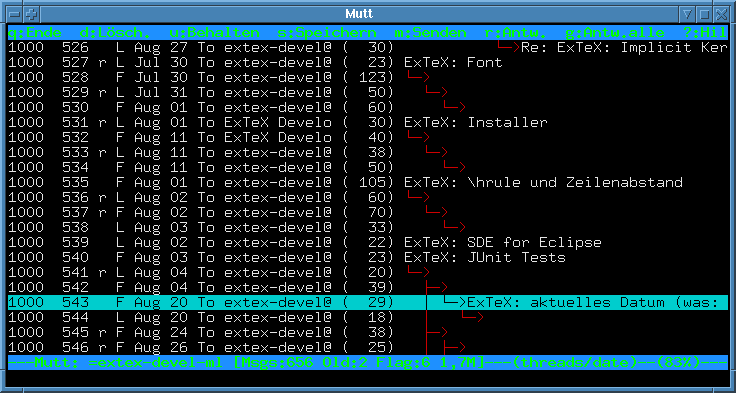

Web forums flattened it. A single chronological column with quoted excerpts records the same words and discards the structure, and the reader must reconstruct from quotation what the newsreader had drawn. Threaded comment systems recovered part of it later, usually with a depth limit that truncates exactly the long chains of objection this kind of argument produces.
What the form could not supply was closure, and the absence was structural rather than cultural. There was no chair, no motion, no vote and no clock. The one instrument a reader had for ending an exchange was the kill file, which ends it for that reader alone and for nobody else — the mechanism and its curious public performance are described on the talk.* page. So a thread ran until its participants tired of it, and the reputation the talk.* hierarchy earned for long discussion without conclusion was not undeserved. What that reputation leaves out is the other half: the arguments did not converge, but they were conducted, at length, in public, by people who had read the material and by people who had not, with everything preserved.
The reference shelf arrives
The single datable change in the conditions of argument in these groups had nothing to do with Usenet. Between roughly 1995 and 1998 a readership that had been arguing from memory and paraphrase acquired a free, citable, refereed reference literature, and the effect on what a thread could settle was real if unglamorous.
1995 produced two of the three pillars. The Stanford Encyclopedia of Philosophy was created that year by Edward N. Zalta. It is published and maintained by Stanford University through the Metaphysics Research Lab at the Center for the Study of Language and Information; each entry is written and maintained by a named specialist; and its charter allows rival articles on a single topic where scholars reasonably disagree — a provision with obvious utility to anyone trying to establish what “the standard view” is in the middle of an argument. It was developed initially with public funding from the National Endowment for the Humanities and the National Science Foundation, and free access has been sustained since by a library-consortium funding arrangement rather than by subscription.
The Internet Encyclopedia of Philosophy was founded in the same year by James Fieser, operating through a non-profit organisation; Bradley Dowden joined as co-general editor in 1999. It publishes only peer-reviewed, blind-refereed original papers, with subject-area editors supervising the refereeing and contribution generally by invitation, and it is written deliberately for students and non-specialist faculty rather than for the specialist. Both were free to read, which mattered enormously to a readership with no library card.
The third pillar was older and slower. Project Gutenberg had been digitising public-domain texts since Michael S. Hart typed the United States Declaration of Independence into a machine on the ARPANET on 4 July 1971, and for its first eighteen years every text was entered by hand, image scanners and optical character recognition only becoming practical around 1989. Through the mid-1990s it was run from Illinois Benedictine College with a growing volunteer base and an explicitly stated ambition — the ten thousand most consulted books available to the public at little or no charge by the end of the twentieth century. The pace is worth stating honestly: the collection did not reach roughly ten thousand items until the end of 2003. What that meant for a 1996 argument is that the canonical out-of-copyright texts were becoming available one at a time and unevenly, so that a poster quoting Hume or Mill or Kant was increasingly able to quote rather than paraphrase, while a poster wanting anything published in the previous seventy years still could not.

The commercial alternative arrived a few years behind and behaved differently. The Routledge Encyclopedia of Philosophy, ten volumes under the general editorship of Edward Craig, was first published by Routledge in 1998, in print and on CD-ROM, and was made available online on a subscription basis in 2002. For an argument in a newsgroup the distinction was practical rather than ideological: a reference that opens is worth more mid-thread than one the other party cannot check.
The effect on the traffic was modest and genuine. An unsupported claim became cheaper to test. A poster could be answered with a refereed article rather than with a recollection of one, and the recipient could read it within the minute. The recurring dispute about what a given author had actually written became, in principle, a dispute somebody could end by pasting a link. None of this settled any philosophical question, and it did not resolve the credential problem set out above so much as relocate it: the burden moved from the person making the claim to the source they could point at, which is roughly where the discipline had always kept it.
Where it went, and what still carries the names
The traffic left in stages, and for reasons that had little to do with philosophy.
Scholarly discussion had never been principally here, and it consolidated further onto subscription mailing lists through the 1990s, where a membership roll did the work no newsgroup could. Weblogs then took the essayists, offering an author control over a page that Usenet was expressly designed to deny: on Usenet a reply is an article of the same standing as the thing it answers, and on a weblog it is a comment beneath it. The question-and-answer web absorbed a further slice, a philosophy Stack Exchange providing the thing a newsgroup structurally cannot — a question with an accepted answer and a stopping point. And the literature itself acquired an index: PhilPapers, founded by David Bourget and David Chalmers, running from 2009 and maintained by the Centre for Digital Philosophy at the University of Western Ontario, with a substantial grant in early 2009 from the Joint Information Systems Committee in the United Kingdom.
The news2mail gateway from which this directory was built carried these names between 2000 and 2004, which places it in the later part of that movement rather than the earlier. What none of the successors reproduced is the arrangement this branch had: one room, no labels, and the professor and the amateur obliged to read each other, with no mechanism for telling which was which.
The namespace, meanwhile, simply stopped changing. Both talk.philosophy.misc and talk.philosophy.humanism are on the master list distributed today, unmoderated, with the same descriptions they were given in 1991 and 1994. Nothing has been added to the philosophy subtree since 1994 and nothing has been removed from it ever. Text-only news servers still carry both names, and a reader with a newsreader and an account can still post to a group created on 145 votes to 33 in the autumn of 1994. Whether anybody would answer is a separate question.
The surviving archives preserve what was posted exactly as it was posted, at whatever length it ran, which in this branch was frequently considerable.
Scope and limits
This page is an index and a history of two newsgroup names and the conditions under which argument was conducted in them. It holds no talk.philosophy messages. This site preserves no message archive for either group, and nothing on this page is drawn from reading the traffic: every specific claim above comes from the administrative record — requests for discussion, calls for votes, results, control messages and the master newsgroups file — or from the documented history of the wider subject.
No position argued in these groups is endorsed or refuted here, and none is adjudicated. Free will, the mind–body relation, the existence of God, the status of moral claims and the analytic–continental division are described as arguments with a structure and a literature, and no school, tradition or conclusion is characterised as more rigorous, more serious or more correct than another. Where a position has had to be named it has been named as its holders named it, generally by quoting the proposal or charter in which they named it.
No living person is characterised. Individuals appear only where the administrative record makes them a matter of public fact — a proponent, a vote-taker, the moderator of news.announce.newgroups — and appear as that and nothing else. The forgeries described above are attributed to no one; the account given is of what the messages say and what happened to the groups, not of who sent them or why.
Two gaps in the evidence are worth naming. The first is that talk.philosophy.misc has no founding document of any kind, so nothing can be said about the intentions behind it beyond the five words of its description; where this page describes the conditions of argument, it is describing properties of the medium and facts in the administrative record, not a charter that does not exist. The second is that this hierarchy was designed to be declinable, and a site that declined it had nothing in it to donate to an archive later — so the surviving record of talk.* should be expected to be thinner than that of its siblings for reasons that are about carriage decisions rather than about what was written. The parent page sets out that bias, and the seams in the surviving archives, in full.