alt.dcom.telecom
Data communications and telephony.
alt.dcom.telecom was the open annex to the moderated comp.dcom.telecom: PBX war stories, carrier billing mysteries, ISDN and later DSL provisioning pain.
This address originally listed recent messages; the live feed ended with the gateway, and the message archive is not preserved here.
On this page
- Two rooms with one subject
- The group's own founding document
- The TELECOM Digest, from August 1981
- Moderators, 1981 to the present
- What a digest cannot do
- The vote of 1993, and what it revealed
- Divestiture, and the same argument in other countries
- 1996, and the statutes that filled the mailbox
- The switch to digital carriage
- When the digital network failed
- ISDN and its reputation
- DSL, and the copper that turned out to have more in it
- Voice over IP
- The phone-phreak inheritance
- Who was in the room
- What became of both rooms
- Scope and limits
Two rooms with one subject
The place to start is the network's own description list. The Internet Systems Consortium mirrors the Usenet administrative record, and among the files it keeps is the newsgroups file — the shared list of one-line descriptions that a news server hands to a reader who asks what a group is for. Two of its lines, in two different hierarchies, describe two halves of a single arrangement:
comp.dcom.telecom— "Telecommunications digest. (Moderated)"alt.dcom.telecom— "Unmoderated discussion of telecommunications technology."
The companion active file, which tells a server what it may accept rather than what a group is about, records the same division in a single character: comp.dcom.telecom carries the flag m, for moderated, and alt.dcom.telecom the flag y, meaning that a reader on that server may post to it directly, with no approval step in between. That is the whole structure. On one side an edited journal with a named editor, a volume and issue number and a mailbox that submissions had to pass through; on the other side a room with the same subject on the door and nobody at it.
The unmoderated side belonged to the alt.* hierarchy, where a group needed no vote and no charter — only a control message and enough news administrators willing to honour it. That is a different constitutional position from the moderated group beside it, which lived in comp.* and was created and governed under the mainstream procedure of proposal, discussion and ballot: the Big Seven at the time, and the Big Eight only after humanities.* was added in April 1995. The two groups shared a subject, a naming convention and a good many readers; they did not share a system of government.
This page is about the unmoderated one. Its counterpart is named here only as the thing it was an annex to, because the moderated digest is far and away the better-documented of the pair, and without it the alt group's existence does not make sense.
The group's own founding document
alt.* groups rarely leave paperwork. This one did. The ISC's archive of Usenet control messages preserves, under alt/alt.dcom.telecom, the newgroup message that brought the group into being, sent by the news administrator of a Bull site at 900 Middlesex Turnpike in Billerica, Massachusetts, and carrying a Date header of 14 January 1991. Its body is short enough to give in full:
alt.dcom.telecom is for UNMODERATED discussion of anything to do with telephony or telecommunications and related technology. alt.dcom.telecom can also be used for "overflow" from discussions in comp.dcom.telecom, when the moderator of comp.dcom.telecom so chooses. alt.dcom.telecom is to comp.dcom.telecom as alt.sys.sun is to comp.sys.sun.
Three claims are made there, and all three matter. The group is unmoderated, and the word is shouted. Its purpose is defined by reference to the moderated group: it is where the digest's overflow may go. And the relationship is presented as an already familiar pattern — the writer expects his readers to know what an alt.sys.sun is, which is to say that by January 1991 the unmoderated alt.* shadow of a busy comp.* group was a recognised piece of Usenet furniture rather than an innovation requiring explanation. The comparison has outlived the thing compared: alt.sys.sun is still in the newsgroups file, described as technical discussion of Sun Microsystems products, while the plain comp.sys.sun it shadowed has long since been replaced by a family of comp.sys.sun.* subgroups.
One caution about the date. The archive stores these messages as mail, and the envelope line above this one reads 3 April 1991, three months after the Date header inside it. Control-message archives are assembled from what individual sites happened to keep, and their envelope lines record when a copy arrived somewhere rather than when the message was written. A later message in the same file, sent in April 1993, adds a third account by saying the group had been created "several months ago", which fits neither date and is a fair illustration of how precisely alt.* remembered its own history. The Date header is the group's own claim about itself; the honest statement is that alt.dcom.telecom was created in the first months of 1991, and that its founding text says what is quoted above.
The same file records what happened afterwards, which is the ordinary life of an alt.* group: a newgroup message re-issued at Magdeburg in June 1991, another at the University of Maine in April 1992, a maintenance re-issue from a site in Durham, North Carolina in April 1993, and a stray control message emitted by a Netscape Collabra server in Portugal in November 1997. None of these created anything. In alt.*, a newgroup message is a request that each administrator may honour or ignore, so a group that mattered to people was periodically re-announced in the hope of reaching servers that had missed it the first time.
The TELECOM Digest, from August 1981
The thing on the other side of the wall is one of the longest-running edited forums in the history of the network, and it is documented mostly by itself. Its archive is still online, and still holds its own first issue: volume 1, issue 1, dated Tuesday 24 August 1981 and sent by "the Moderator", Jon Solomon, from Rutgers. The opening item is administrivia, and it describes a publication founded to carry material that another forum had not printed:
Welcome to TELECOM. This digest is a spinoff from the HUMAN-NETS discussion on the telephone network and switching equipment. Parts of this digest are in fact submissions to HUMAN-NETS which were never published, and are presented here to spark the discussion.
It is worth pausing on that, because the same logic runs through this whole page. The digest that alt.dcom.telecom would later act as an annex to had itself begun as an annex: a place for telephone material that the forum it grew out of had no room for. A later note in the archive by Patrick Townson dates the start of publication to 24 August 1981 and mentions a test message sent to the original members three days earlier; the masthead the digest carried in its last decades gives that earlier date, 21 August 1981, as its founding. The two are the same event seen from either side of a mailing-list test.
The publication's introductory file, the text a new reader is still pointed at, compresses all of this into two sentences that successive editors have left alone: "Telecom Digest was started in August, 1981 by Jon Solomon as a mailing list on the old ARPA network. It was an offshoot of the Human Nets forum intended for discussion of telephones and related communications topics." The site's archive index describes its back issues as running "Since August 1981" and calls the publication "The oldest mailing list on the Internet" — a claim worth reporting as the publication's own and leaving there, since the field of candidates is crowded and the record thin. An independent check on the early years is available: a message from Geoff Goodfellow proposing electronic mail for people on the move was circulated in TELECOM Digest in 1982, in volume 2, which is consistent with a start in 1981 and with nothing later.
The passage to Usenet came almost immediately, and in two stages. Volume 1 of the archive includes a note from August 1981 explaining to UUCP readers how to submit articles to the digest through a gateway at Berkeley, because the digest was already appearing on the Usenet side as fa.telecom — the fa.* prefix marking a group fed "from ARPA" rather than originating on Usenet. Townson's own account of the archive says that after the reorganisation of the newsgroup namespace, conventionally dated to the Great Renaming of 1987, fa.telecom became comp.dcom.telecom. The digest was careful about the distinction ever afterwards, in a passage its introductory file has carried for three decades: "TELECOM Digest is not strictly speaking part of Usenet. It is an official Internet mailing list publication. A decision was made at some point in the past to ‘port’ the Digest to the Usenet news group ‘comp.dcom.telecom’, in order that Usenet readers would be able to participate in the Digest." The newsgroup was a distribution channel bolted onto an older mailing list, which is exactly what its one-line description in the newsgroups file records: not a discussion group that happened to be moderated, but a digest that happened to appear as a newsgroup.
Production and archive facilities were provided throughout by universities. A welcome file of the mid-1990s lists the digest's homes in order — MIT, Boston University, Rutgers, then about six years at Northwestern University in Evanston, Illinois, and back to MIT in November 1995 — while the 1991 text describes the moderator working from guest accounts "primarily" at Northwestern, with others at Boston University, MIT and the University of California. The archive settled at MIT, first under the Laboratory for Computer Science and later, after the 2003 merger that produced it, under the Computer Science and Artificial Intelligence Laboratory, whose thanks the site still carries at the foot of every page. Nothing about the digest was ever commercial infrastructure. It ran on borrowed accounts at institutions willing to lend them, which is how a great deal of the early network ran.
An older mailing list wearing a Usenet group as a second face was not a telephony peculiarity. The same directory holds comp.society.privacy, proposed in 1992 by the moderator of the telecom-priv mailing list, who wrote in the request for discussion that the group would be moderated and gatewayed to an Internet mailing list and that telecom-priv "will be folded into this newsgroup". It passed its vote 189 to 16 and entered the newsgroups file as "Effects of technology on privacy (Moderated)". The pattern was common enough that readers of the period had to be told, repeatedly, which of the two things they were actually reading.
Moderators, 1981 to the present
Four names carry the digest across forty-two years, and the succession is documented, if not always consistently.
Jon Solomon founded it in August 1981 and is named as founder in every version of the introductory file since. Patrick Townson (24 September 1942 – 9 August 2014) is the second and by far the longest-serving. Writing in a welcome posting to comp.dcom.telecom dated 19 January 1991, he says: "I've been the Moderator/Editor/facilitator of the Digest since the fall of 1988", and, separately, "I became Moderator of comp.dcom.telecom in 1989 in addition to being Moderator of TELECOM Digest." The distinction is characteristic and deliberate: the mailing list and the newsgroup were two offices, acquired a year apart.
A later revision of the same introductory page, rewritten by his successor, says instead that "Pat Townson moderated the Digest from 1996 until he suffered a stroke in 2007". The two statements are not reconcilable and there is no need to pretend otherwise. The 1996 date matches the compilation copyright line the site carried for years — "compilation-copyrighted by Patrick Townson, 1996-2008" — and looks very much like a copyright notice mistaken for a start date by someone editing an inherited page. That page is demonstrably a palimpsest: the sentence in which Townson wrote in 1991 that he became moderator of the newsgroup in 1989 still stands in today's version, in the first person, with the year changed to 2007 and the speaker now somebody else. Townson's own contemporaneous statement, made in 1991 about events three years earlier, is the better evidence: autumn 1988 for the digest, 1989 for the newsgroup.
Bill Horne (E. William Horne) took over after Townson's stroke. In the site's own capture of early 2009 he is billed as "Temporary Editor", a designation that later disappeared; the compilation copyright line was extended to "2008-2023 E. William Horne". It was Horne who announced Townson's death, in the digest itself — volume 33, issue 148, of 3 September 2014, whose single item is headed "R.I.P. Patrick Townson, September 24, 1942 - August 9, 2014". He had learned of it on returning from a holiday, judged the published obituary uninformative, and asked anyone with details of Townson's education, life, relationships, accomplishments and family to write to him. The issue carries, as its epigraph, a line of Townson's own: "There are advantages, you know, to being judgment-proof and obnoxious, to boot."
Dan Ritter is named as the digest's editor from 2023, both in the copyright line the site carries today — "2023-onwards Dan Ritter" — and in the introductory file, which calls him the current Moderator/Editor.
What moderation actually is as a mechanism — how a moderated group's postings are diverted to an approving mailbox, and what that did to Usenet's politics — is set out on the soc.* hierarchy page and is not repeated here.
What a digest cannot do
The structural case for an unmoderated annex does not require any guesswork about what people posted. It can be made from the moderated group's own published rules, in the moderator's own words, and the arithmetic is the argument.
The 1991 welcome posting states the volume: "We receive an average of 60-120 messages *each day* from readers", of which, set against the thirty to forty a day he printed, "I wind up publishing between a third and half of the submissions." Somewhere between half and two-thirds of everything sent to the moderated group did not appear in it. Some of that was duplication — the same observation from forty people — and the moderator says so. But the residue is a real and permanent flow of telephony discussion that had been written, addressed and sent, and had nowhere to go. The scale is not in doubt: the archive's directory for 1991 alone runs to 1,061 numbered issues of the digest.
The same document sets out what would not be carried at all: "I cannot -- will not -- publish messages which in my estimation are intended only as flames, deliberate attacks on myself or other users, or which are calculated to throw the Digest up for grabs and cause a big backlog of meta-discussions about the operation of the Digest itself." Two further exclusions follow in the same passage. He would not print "phreak/cracker messages which jeopardize the security of this net or the telephone network", and "I very rarely use anonymous messages", partly because the university sites lending him accounts did not support them. That is a defensible editorial policy and it is also, read from the other direction, a specification for the group next door. Argument about the moderator, argument that had turned personal, anonymous contributions and a whole category of technical curiosity were excluded by rule.
Then there is time. A digest is assembled, and assembly takes a day, or two, or five; the 1991 text describes putting out two or three issues on a normal day and warns that "there will be times that messages won't get out for a day or two because of the backlog". For a fault report, a rumour about a tariff filing, or a question that needs an answer before the engineer goes back on site, a day is a long while. An unmoderated group propagates at the speed of the news feed and no slower.
And there is shape. Digests arrive as issues — a table of contents and a sequence of articles chosen and ordered by an editor. Newsreaders of the period threaded on references and subject lines; a digest defeats threading by design, because the unit of transmission is the issue rather than the article. Readers who wanted to follow one argument rather than read a periodical had a reason to be elsewhere.
The archive's own record catches the point being made in practice. In April 1993 a news administrator in Durham, North Carolina re-issued the group's newgroup message to improve its propagation, and explained why in the message body. The group, he wrote, "has seem minor traffic and little controversy" since its creation — his typing, preserved as it stands — but the moderator of comp.dcom.telecom was "having a spot of personal difficulty and is unable to supervise the digest on a regular basis", and "in the interim, alt.dcom.telecom is seeing an increase in traffic." The same message supplied a description line, "Telephones and related technology", and what it called a "Pseudo Charter": "Alt.dcom.telecom is for the discussion of telephones and the related technologies. Postings in this alt group are not subject to the whims of the moderator, but it is hoped that a high quality group can be maintained by restraint."
That is as clear a statement of the annex principle as the surviving record contains, and it is worth noticing that it is not hostile. Nobody is proposing to replace the digest. The unmoderated group is offered as a place where the editorial bottleneck does not apply, with an explicit hope that its users will impose on themselves the restraint the moderator would otherwise have imposed on them — a hope that, on Usenet, was historically expressed more often than it was realised.
Those two clauses are also, so far as this article could establish, the only surviving description of the group's actual traffic by anyone who was watching it: quiet for its first two years, busier in the spring of 1993 while the digest faltered. Beyond that the record is silent. Nothing says which subjects migrated, in what proportion, whether the same people posted in both rooms, or how busy the annex was in any later year. No message archive for this group is preserved on this site, and nothing in this article is drawn from one. The argument above is structural, and is offered as nothing else.
The vote of 1993, and what it revealed
There is one episode in which the pressure between the two rooms surfaces in the formal record, dated and countable, and it is preserved in the ISC's archive of news.announce.newgroups rather than in any group's own postings.
On 12 August 1993 Ron Dippold of Qualcomm posted a Request for Discussion proposing a new unmoderated group, comp.dcom.telecom.tech, for "all general technology aspects of the telecommunications industry in an unmoderated format" — physical transport, wiring and antennas, switching and routing and ATM, and the wireless alphabet of the day, AMPS, NAMPS, PCN, PCS, CDMA, TDMA and GSM. The rationale, as printed in the calls for votes, states the position exactly:
Currently, the Telecom Digest is gated to Usenet via comp.dcom.telecom. Readers of this group and alt.dcom.telecom have expressed a strong interest in a main hierarchy group for informal technical telecommunications discussion to supplement the existing groups.
The Call for Votes went out on 8 September 1993, conducted by Andrew Solovay for the Usenet Volunteer Votetakers, with voting closing on 29 September. The standing rule it quoted was arithmetical: "100 more YES votes than NO votes and 2/3 of all votes being YES are the requirements for group creation." The result, posted on 5 October, was a failure: 621 in favour to 468 against out of 1,093 valid votes. The first test was passed by a margin of 153; the second was missed by a distance, and the group was not created.
What happened next is the interesting part, and it was conducted in public by the moderator of news.announce.newgroups, David C. Lawrence. On 12 October he posted that he was minded to create the group anyway. His reason was that the vote had not measured what it was supposed to measure: "the moderator of the sole existing mainstream telecom forum used his position for personal commentary against the proposal, to an audience which was not accessible by people in favour of the group", and there had been "no sizable opposition to the proposal voiced on USENET before it went to vote". Two days later he set out what he would do instead. Townson, he reported, had agreed to carry a special edition of the digest presenting both sides, which "would address that point fairly"; and the whole affair, he added, was "setting the stage for improving the policies by which new USENET groups are considered ‘valid’ by most sites" — a rewrite of the group-creation guidelines he had been contemplating for some time.
On 25 October Dippold accordingly posted a "Special Request for Discussion" — an unusual instrument — soliciting opinions by mail, to be digestified and handed to the Telecom Digest for publication. Attached to it is a note from the moderator of news.announce.newgroups explaining the purpose:
This is being done to clear up any doubts that might exist over the influence of heavily biased commentary against the proposal to an audience which was denied access by the people in favour. The poll will be reconducted a few days following publication of the digest. Comments should address only the actual merits of an unmoderated telecom forum in USENET, and refrain from vituperation of the personalities involved.
Strip out the diplomacy and the note describes the structural problem that the annex existed to answer. A moderated publication's readership can be addressed only through its moderator. If the case against a proposal reaches that readership and the case for it does not, the ballot measures the editor as much as the electorate — and the remedy adopted, extraordinarily, was to guarantee the proposal's supporters a passage into the digest and then re-run the vote.
The revote, taken by Jay Maynard and closing on 2 December 1993, passed 738 to 276 out of 1,016 valid votes; the result was posted on 7 December. Its charter contains a detail that survives nowhere else: the new group, it says, would in future be gatewayed with the Telecom Tech mailing list, "which is currently gatewayed with alt.dcom.telecom". The annex was not merely a place where overflow could go — by the end of 1993 it had a mailing list attached to it. comp.dcom.telecom.tech exists to this day, described in the newsgroups file as "Discussion of technical aspects of telephony" and flagged unmoderated. Every document in the affair — the RFD, both calls for votes and both results — carried alt.dcom.telecom in its Newsgroups line, which is how a reader of the alt group would have followed the whole business; the moderated group, by contrast, had to be petitioned separately, as the RFD itself notes.
Two things follow. First, demand for unmoderated telephony discussion was real, large and measurable: over a thousand people voted, twice, about a discussion group. Second, the alt group did not satisfy that demand on its own. A substantial constituency wanted an unmoderated forum inside the mainstream namespace — with a charter and a ballot behind it, carried by the conservative sites that declined alt.* wholesale, and with the reputational weight that a voted group carried and an alt.* group did not.
Divestiture, and the same argument in other countries
The subject these rooms existed to discuss was in the middle of the largest structural upheaval in its history, and the dates of that upheaval frame the group's whole life.
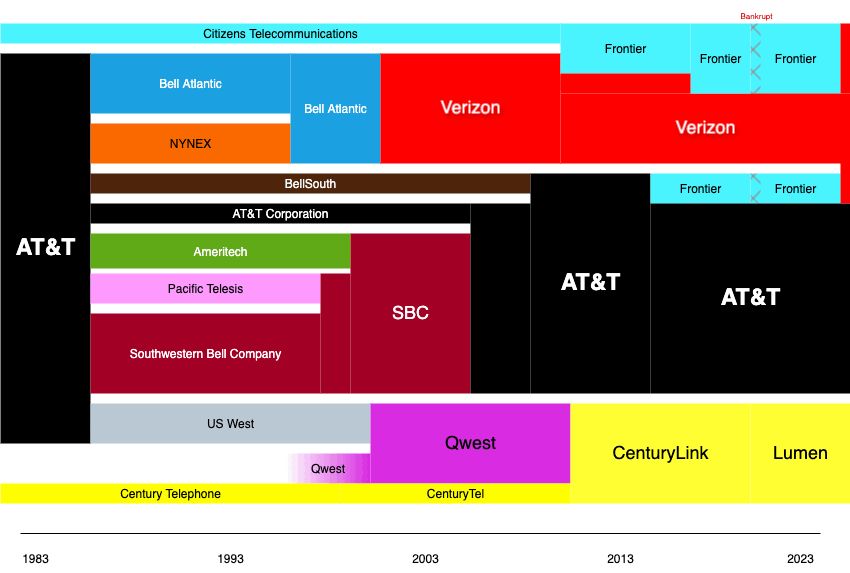
In the United States the breakup of the Bell System settled into a consent decree finalised on 8 January 1982, with the divestiture of the local operating companies taking effect on 1 January 1984 and producing seven independent regional Bell operating companies. Before it, one corporate group had held the long-distance network, most of the local exchanges, the manufacturer that built the equipment and the laboratory that designed it. After it, the interfaces between those pieces had to be written down, priced and argued about — which is the raw material of a telephony discussion forum. Nearly every recurring subject of the period descends from that fracture: which carrier a subscriber's calls were handed to and how the choice was recorded, how a call was rated when it crossed the boundary between one company's network and another's, and which of two companies was responsible for a fault that appeared to be in neither.

Two earlier decisions had already opened the other end of the network. In 1956 an appeal court struck down the tariff that had barred the Hush-A-Phone, a cup clipped over a mouthpiece, establishing that a subscriber could attach a device mechanically to a telephone without the carrier's permission. In 1968 the Federal Communications Commission's Carterfone decision extended the principle to devices connected electrically, provided they did the network no harm. Between them they created the customer-premises equipment industry — the private branch exchanges, answering machines, modems and terminal adapters that a whole profession then spent thirty years installing, configuring and complaining about.
The same argument was conducted, on its own timetable, elsewhere. In the United Kingdom, telecommunications was separated from the Post Office on 1 October 1981; a licence granted to Mercury Communications in 1982 broke the statutory monopoly; the Telecommunications Act 1984 created the regulator Oftel; and 50.2 per cent of British Telecommunications plc was offered to investors and employees in November 1984, with dealings beginning on 3 December and the government's remaining stake disposed of in December 1991 and July 1993. In Germany, the Deutsche Bundespost was restructured in 1995 and Deutsche Telekom emerged from it. Across the European Union the process culminated on 1 January 1998, the date on which the telecommunications market was opened fully to competition.
The point for a group like this one is that its subject was, for its entire existence, simultaneously a technology and a regulatory settlement, and that the settlement differed by country. A question about interconnection had a different answer in Ohio, Ontario, Kent and Bavaria, and a forum with an international readership had to keep saying so.
1996, and the statutes that filled the mailbox
The second great American landmark falls squarely in the middle of the group's active years. The Telecommunications Act of 1996 was enacted by the 104th Congress on 3 January 1996 and signed on 8 February 1996 — the first substantial overhaul of United States telecommunications law in more than sixty years, amending the Communications Act of 1934 and, for the first time, bringing the Internet within the scope of American broadcasting and telephony regulation.
Its practical consequence for the people in these rooms was the interconnection regime: the incumbent local carriers were required to open their networks to competitors, and an entire vocabulary of unbundling, resale and reciprocal compensation entered ordinary technical conversation. The decade of litigation and rulemaking that followed generated exactly the kind of material a telephony forum lives on — dense, dated, jurisdictional, and consequential for anyone who had to order a circuit.
Two other American statutes belong in the same paragraph because they shaped what the network could and could not do. The Telephone Consumer Protection Act of 1991 restricted telephone solicitation, automatic dialling and unsolicited fax, and is codified at 47 U.S.C. section 227; it is still generating rulemakings a third of a century later. The Communications Assistance for Law Enforcement Act of 1994, also known as the Digital Telephony Act, required carriers to build interception capability into their networks — a requirement that turned an operational question into a constitutional one, and whose debate belonged as much to the privacy groups as to the telephony ones. The privacy side of that argument is covered on alt.privacy, where CALEA sits among the group’s standing set texts.
It is a small closing symmetry that the last issue the digest published, in June 2023, carried three items, two of them on consent requirements under the 1991 Act then before the Federal Communications Commission. The subject outlasted the forum.
The switch to digital carriage
Underneath the law, the plant changed completely, and the change is what made much of the discussion technical rather than merely commercial.
Transmission went digital first. The T-carrier system, developed at Bell Laboratories from about 1957 and first employed in 1962, multiplexed twenty-four telephone calls onto a single copper path at 1.544 Mbit/s; outside the United States, Canada, Japan and South Korea the equivalent E-carrier arrangement carried thirty channels at 2.048 Mbit/s. That divergence — twenty-four channels against thirty, 1.544 against 2.048 — is the reason so many later standards, including ISDN's primary rate, exist in two national flavours, and the reason that so many threads about international circuits are really threads about arithmetic.
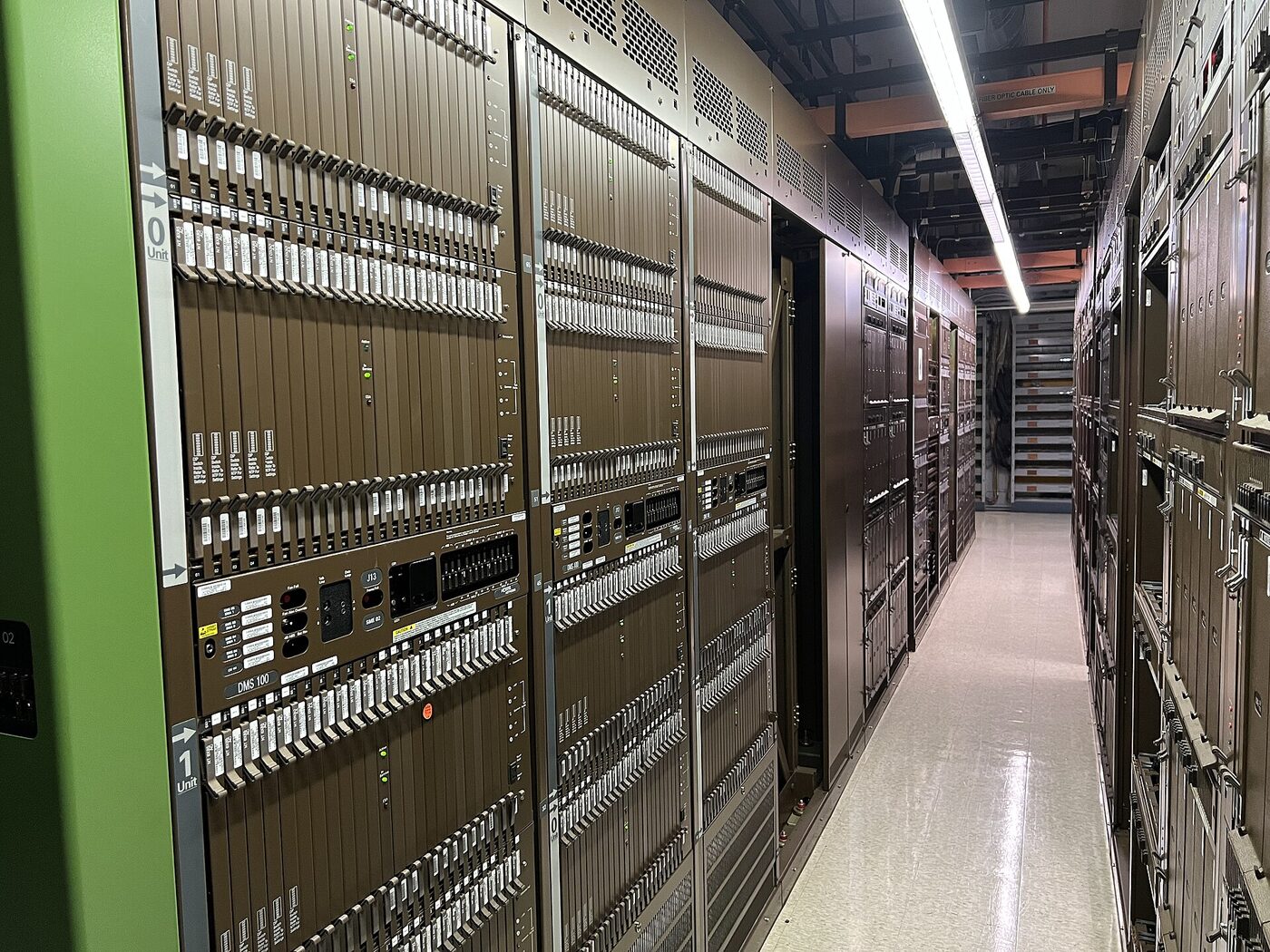
Switching followed. The Number One Electronic Switching System entered service at Succasunna, New Jersey in May 1965, the first large stored-program-control exchange in the Bell System, though its switching fabric was still a matrix of reed relays. The first digital toll switch, the 4ESS, was introduced in Chicago in January 1976; the last of the 145 in the AT&T network was installed in Atlanta in 1999. Northern Telecom's DMS-100, designed through the 1970s and released in 1979, could serve up to 100,000 lines. The 5ESS came into service in 1982 and the last one was produced in 2003. A telephone exchange had become, over about twenty years, a computer with a very large number of ports and an unusually low tolerance for downtime.

Signalling went last and mattered most. Call setup had historically travelled on the same path as the conversation; Signalling System No. 7, developed in the 1970s and adopted across most of the public switched telephone network of the United States and western Europe during the 1980s, moved it onto a separate network of its own. The immediate benefits were faster call setup and a set of services that had previously been impossible — caller identification, freephone number translation, and eventually number portability, all of which depend on a switch being able to ask a database a question before completing a call. The side effects were two, and both are recurring themes of the era: a network whose control plane was now a distributed software system with its own failure modes, and the closure of an entire generation of network manipulation, discussed further below.
When the digital network failed
Two American incidents from the period bracket the discussion, and both are the kind of event a telephony forum exists to dissect.
On Sunday 8 May 1988, a fire broke out in the main switching room of Illinois Bell's Hinsdale central office outside Chicago. The facility handled more than three and a half million calls a day and served some 38,000 customers, among them businesses, hospitals and Chicago's two airports; the outage that followed was protracted, and the RISKS Forum wrote it up under the heading "Risks of Single Point Failures". That write-up, dated 11 May 1988 and credited to Peter G. Neumann, Chuck Weinstock and Patrick Townson, appears in RISKS volume 6, issue 82, and is marked as excerpted from TELECOM Digest volume 8, issue 76. The digest was where the telephony community assembled the record, and other publications took it from there.
On 15 January 1990 the failure was of a different kind. Virtually the whole of AT&T's network of 4ESS toll tandem switches went in and out of service repeatedly, disrupting long-distance calling across the United States, and the condition subsided of its own accord as the day's traffic fell away. Nothing had burned down and nothing had been cut; the cause was found to be a software fault. An exchange had become a computer, and this was what a computer failure looked like at national scale.
Events of this kind are the reason a forum with a slow, edited channel and a fast, unedited one is a sensible arrangement rather than a redundancy. The considered post-mortem belongs in a digest. The first four hours belong somewhere else.
ISDN and its reputation
No technology of the period generated more discussion per subscriber than ISDN, and none has a worse press.
Work on it began at Bell Labs in 1980 and it was formally standardised by the CCITT in 1988. The design was elegant enough on paper: digitise the last mile, so that the local loop delivered signalling and data as well as speech. The Basic Rate Interface offered two bearer channels of 64 kbit/s and one signalling channel of 16 kbit/s — 2B+D, 144 kbit/s in all. The Primary Rate Interface scaled it to the carrier systems described above, which is why it exists in two shapes: 23B+D at 1.544 Mbit/s in North America and Japan, 30B+2D at 2.048 Mbit/s in Europe, India and Australia.
The standardisation itself was a small parable about the period. The American effort moved to an ANSI committee after the 1984 divestiture; Thomas Starr of the newly formed Ameritech led it, and the line code eventually adopted, 2B1Q, had been proposed by Peter Adams of British Telecom. Japan then chose a different scheme and Germany a third, all interoperable with the American standard but none identical to it. A globally standardised technology arrived in national dialects, which is a fair summary of telephony as a whole.
The reception in the United States was famously poor, to the point where the acronym acquired a small literature of derisive expansions — "It Still Does Nothing", "Innovations Subscribers Don't Need", "I Still Don't kNow" — driven by high tariffs, slow provisioning and a feature set that customers found impossible to specify correctly. One estimate has worldwide ISDN use peaking at about 25 million subscribers at a time when 1.3 billion analogue lines were in service.
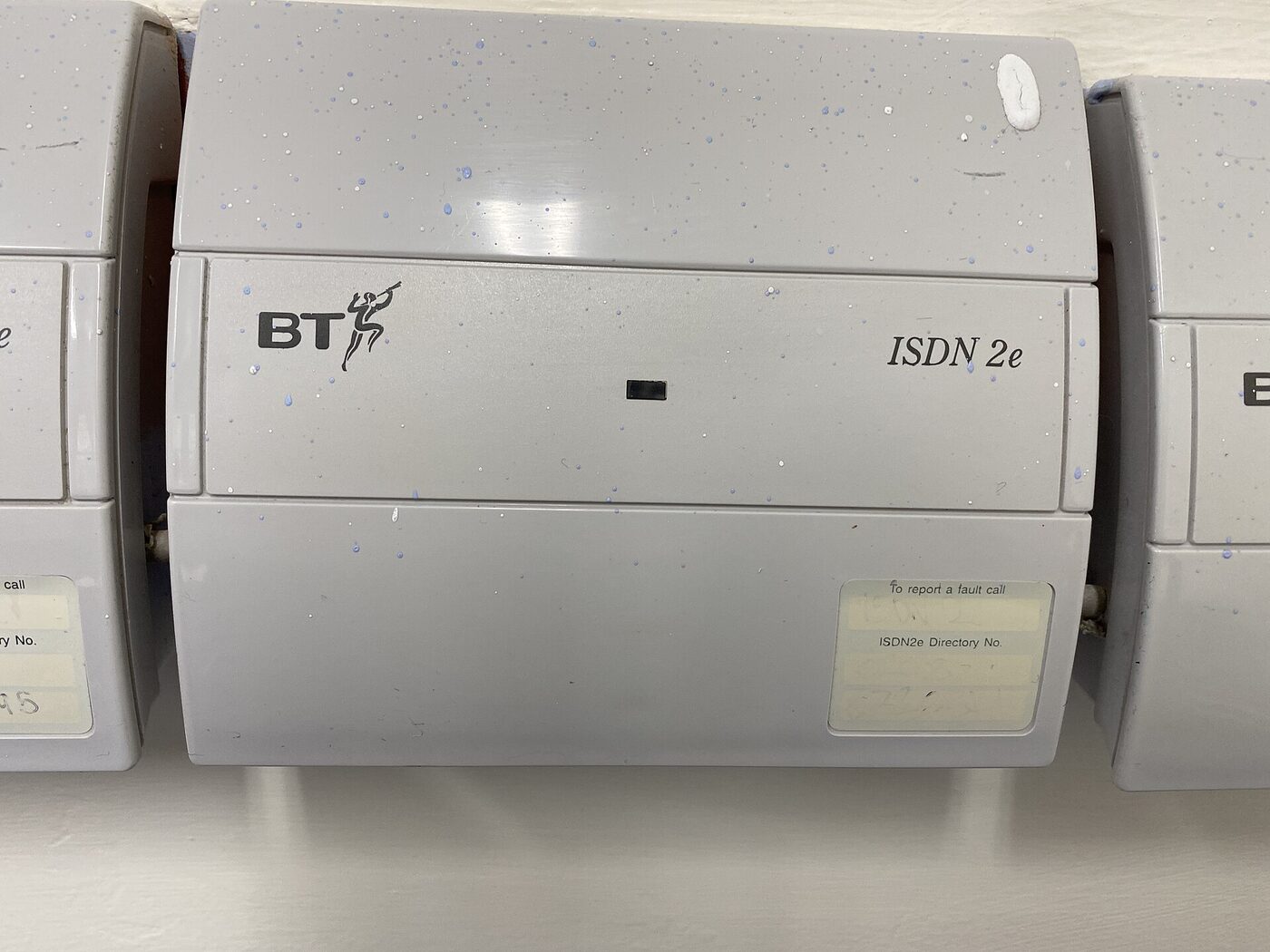
Elsewhere it was a success, and the contrast is the part most often left out. In Germany ISDN reached an installed base of some 25 million channels, about 29 per cent of all subscriber lines in the country as of 2003 and around a fifth of all ISDN channels in the world; competing operators frequently offered ISDN and no analogue service at all. France's Numeris ran for decades, with its phase-out in favour of voice over IP scheduled to begin only in 2023. In the United Kingdom, where basic-rate ISDN was sold as ISDN2e, BT announced in 2015 that it would retire the technology altogether, a switch-off since folded into the wider retirement of the public switched telephone network. A newsgroup whose readership spanned those markets was carrying irreconcilable national experiences of the same standard, which is precisely the kind of disagreement that keeps a forum alive.

DSL, and the copper that turned out to have more in it
What eventually delivered the promise ISDN had made was digital subscriber line technology, and the intellectual step was a counter-intuitive one. A patent on the basic concept was filed by AT&T Bell Labs in 1988. Joseph W. Lechleider (1933-2015) contributed the insight that an asymmetric arrangement — much more capacity towards the subscriber than away from them — yielded more than twice the usable bandwidth of a symmetric one. Lechleider had also proposed applying ISDN's echo cancellation and line coding to existing carrier circuits, and his 1.6 Mbit/s High-Speed Digital Subscriber Line won its own standards battle in 1991.
The consumer standards arrived at the end of the decade and then in quick succession: ITU-T G.992.1, known as G.dmt, in 1999; ADSL2 in 2002; ADSL2plus in 2003; VDSL in 2004 and VDSL2 in 2005. Each step was a claim about how much information a pair of copper wires laid for speech could be made to carry.
For the working population of a telephony forum, DSL was less a technology than a decade of provisioning. A DSL circuit shared the physical pair with the telephone service, which meant that whether it could be delivered at all depended on facts about a specific piece of buried copper that no ordering system reliably knew. The resulting genre of complaint is documented at length on alt.verizon-sucks and is not retold here. What belongs here is the structural consequence: DSL displaced ISDN as the mass-market digital access technology, which is why the German and French ISDN estates described above look, in retrospect, less like a lead than like a sunk cost.
Voice over IP
The last of the period's transformations inverted the relationship between the two networks that had spent thirty years borrowing each other's wires. Telephony had carried data since the first modem; now data carried telephony.
The Israeli company VocalTec released Internet Phone on Friday 10 February 1995 — by common account the first voice over IP application for ordinary personal computers, and sufficiently novel to be given most of a page in the Wall Street Journal the same day. Standards followed the product, as they usually do. The ITU published the first version of its H.323 recommendation, which addresses call signalling and control on packet networks, in November 1996. The IETF's Session Initiation Protocol, designed from 1996 by Mark Handley, Henning Schulzrinne, Eve Schooler and Jonathan Rosenberg, was standardised as RFC 2543 in 1999 and comprehensively revised as RFC 3261 in June 2002; it was accepted by 3GPP in November 2000 as part of the IP Multimedia Subsystem, which is how it ended up carrying mobile calls.
The consumer arrival was Skype, whose first public beta was released on 29 August 2003. Its long afterlife is its own comment on the period: acquired by Microsoft, gradually displaced by that company's own products, and finally retired on 5 May 2025.
The namespace registered the change as it happened. Alongside comp.dcom.telecom and its unmoderated annex, the dcom branch acquired comp.dcom.voice-over-ip, described simply as "Voice Over IP technology", and comp.dcom.xdsl, a "discussion area for different DSL technologies", while alt.dcom.telecom itself grew two children, alt.dcom.telecom.ip and alt.dcom.telecom.radius, the latter for the dial-up authentication protocol that briefly stood at the junction of the two industries. The first of the two has no description in the newsgroups file at all, which is normal for alt.*. Usenet hierarchies are, among other things, a fossil record of what people expected to need a separate room for.
The phone-phreak inheritance
A group about the telephone network of this period inherits the phreaking era as background, and the subject needs handling with some care, because phreaking is both a documented episode in the history of telecommunications and a subject about which a reference page has an obligation to say nothing useful to a practitioner. Nothing in this section describes a method, a technique or a device's operation, historical or current. What follows is the published record and its consequences.
The episode is straightforwardly documented. It reached a general audience in October 1971, when Esquire published Ron Rosenbaum's article "Secrets of the Little Blue Box", which made public figures of the blind experimenter Joe Engressia (1949-2007), later known as Joybubbles, and of John Draper, and which drew in, among others, Steve Wozniak and Steve Jobs before they founded Apple. The same year saw the first issue of YIPL, the Youth International Party Line, started by Abbie Hoffman and Al Bell, which became TAP in 1973 — a newsletter for a milieu that regarded the telephone monopoly as a political object as much as a technical one, and which ran until 1984. In January 1984, coinciding with the AT&T divestiture, Eric Corley — writing as Emmanuel Goldstein — and David Ruderman launched 2600: The Hacker Quarterly, which carried telephone switching among its standing subjects and is still published.
The reason the era ended is architectural rather than legal, and it has already been described above. While the network carried its control signalling on the same path as speech, the boundary between a conversation and an instruction was a matter of convention. Common-channel signalling removed that convention: once call control had moved onto the separate SS7 network, across most of the American and western European network during the 1980s, the older forms of manipulation stopped corresponding to anything. What had been a property of the network became a property of a historical network.
The legal and cultural aftermath is a large subject of its own. In the United States the Secret Service's Operation Sundevil, announced on 9 May 1990, produced raids in roughly fifteen cities, three arrests, a great deal of confiscated equipment, and — by way of the litigation that followed — the Electronic Frontier Foundation; Bruce Sterling's The Hacker Crackdown (1992) remains the standard narrative account. The European scene, its distinct institutions and the computer-crime legislation that grew up around it are covered on nl.comp.hacken and are not retold here.
The professional inheritance is the part that belongs to this page. A person who had spent the 1970s reading everything publishable about how the network was put together was, by the late 1980s, in possession of a rare and marketable body of knowledge: an unusually concrete mental model of switching, signalling, numbering and tariffing at a moment when the industry was hiring people who understood all four. Some of that generation ended up working for carriers, some for equipment vendors, some as consultants to the enterprises buying the equipment; and the curiosity that had produced the knowledge did not switch off when the pay cheque started. It is worth remembering, too, that the moderated group had ruled that curiosity out of bounds in as many words — no messages that in the moderator's estimation jeopardised the security of the network — which is one more entry on the list of things that had to happen somewhere else.
Who was in the room
No poster is named here, and none should be: this directory holds no message archive for the group, and inventing plausible participants would be worse than saying nothing. What can be described honestly is the professional structure that the subject implies, and it is unusually legible, because telephony in this period was a set of well-defined occupations.
There were carrier staff — people who worked in central offices, network operations centres and provisioning departments, who could say what a switch actually did as opposed to what the manual said, and who were correspondingly careful about what they said in public. There were private branch exchange administrators, the largest and least glamorous constituency: the person in a hospital, a university or an insurance company who owned the organisation's telephone system, negotiated with the interconnect vendor, moved extensions when departments moved, and discovered at first hand what a feature interaction was. There were equipment engineers, at the manufacturers and at the independent interconnect companies that grew up after Carterfone made customer-owned equipment legal. There were the regulatory watchers, who read tariff filings and rulemakings for a living or for pleasure. There were academics and students with institutional accounts, who were often the reason a thread had a citation in it. And there were hobbyists in the oldest sense of the word — people who collected exchange equipment, mapped numbering plans, and knew the history of their local network better than the company that operated it.

Two features of that mixture are worth stating. First, it was international by necessity rather than by aspiration: the subject was a global network of nationally regulated monopolies and ex-monopolies, and a question about one country's arrangements very often drew a correction from another's. Second, a substantial proportion of the participants were talking about their employers, which is a permanent constraint on what gets posted, and one that an unmoderated group with no editor to vouch for anyone does nothing to relieve.
What became of both rooms
The moderated side stopped first, and did so quietly. The Telecom Digest's own site carries, as its "latest issue", volume 42, issue 173, dated Thursday 22 June 2023, with a table of contents of three items on American telecommunications regulation. Every capture of that page taken since September 2023 shows the same issue, and the site's current-year archive, still headed 2023, ends at issue 173; the year-by-year list on the front page runs no further than 2022. Whatever the intention, the digest's last issue appears to be that one: forty-two volumes, from August 1981 to June 2023.
The archive, however, is still there and still hosted where it always was. The site remains online under the courtesy of MIT's Computer Science and Artificial Intelligence Laboratory, and its back-issue directories still reach volume 1 and August 1981. Its copyright lines have the slight incoherence of a document maintained by three people across four decades: the front page reads "Patrick Townson, 1996-2008" and then "2008-2023 E. William Horne, 2023-onwards Dan Ritter", while the introductory page credits "the estate of Patrick Townson, 1996-2007", Bill Horne from 2007 to 2023, and Dan Ritter thereafter. For a publication that spent four decades on borrowed university accounts, surviving as a read-only archive on the last of them is not the worst ending available.
The unmoderated side never stopped, in the sense in which Usenet groups never stop. alt.dcom.telecom is still listed in the current ISC newsgroups file with the description quoted at the top of this page, and still appears in the current active file with the posting flag y. So do its two children and, in the moderated column, comp.dcom.telecom with the flag m. A group that still appears in the namespace is a group that servers will still accept articles for; it is not a claim that anyone is posting them.
That is the ordinary end of an alt.* group and of most of Usenet: the name resolves, the flag says y, and the conversation has moved to vendor forums, mailing lists, trade press comment sections and the occasional stubbornly maintained web board. The subject, meanwhile, kept going without either room. The last thing the digest published was about unwanted telephone calls.
Scope and limits
Nothing above quotes, counts, characterises or summarises any article posted to alt.dcom.telecom. There is nothing here to quote from, and it would be dishonest to imply otherwise. Everything said about the group is taken from documents written elsewhere that happen to describe it, and those documents are named in the text so that a reader can go and look.
What the article is built from, and where a reader can check it:
- The Internet Systems Consortium's mirrors of the Usenet administrative record — the current newsgroups and active files, from which the description lines and the moderation flags are quoted verbatim; the control-message archive for alt.dcom.telecom, which supplies the founding newgroup message of January 1991, the 1993 maintenance message and its "Pseudo Charter", and the re-issues of 1991, 1992 and 1997; and the news.announce.newgroups archive for comp.dcom.telecom.tech, which supplies the 1993 Request for Discussion, the two Calls for Votes, the moderator's two statements of October 1993, the Special Request for Discussion and both results with their tallies. Those administrative documents were posted to alt.dcom.telecom among other groups, but they are quoted here from the Big-8 administrative archive, not from any archive of this group.
- The TELECOM Digest's own website and archive, for the digest's origin, its editors, its self-description, its relationship to the newsgroup and its final issue — including volume 1, issue 1 of 24 August 1981, the moderator's welcome posting of 19 January 1991, the mid-1990s new-reader file, the notice of Patrick Townson's death of 3 September 2014, and the introductory page as it stands today. Where the digest's own pages contradict each other, the contradiction is reported above rather than resolved silently.
- Encyclopaedic and standards sources for the dated technical and legal history: divestiture, the 1996 Act, T-carrier and E-carrier, the electronic switching systems, SS7, ISDN, DSL and voice over IP.
Several things could not be established and are therefore not asserted. There is no reliable figure for this group's readership or traffic at any point in its life; the only description of its traffic by a contemporary is the pair of clauses quoted above from April 1993. The identity of the individual at the Bull site who created it is recorded only as the site's news administrator role account. Whether the group's founding was prompted by any particular dispute in the moderated group is not recorded anywhere consulted. And the two accounts of when Patrick Townson took over the digest — his own statement of autumn 1988, and a successor's later statement of 1996 — are left standing side by side, with the reasons for preferring the earlier one given above rather than the discrepancy hidden.
Finally, the description of what the group was for rests on documents written by other people about it — its own newgroup message, a 1993 maintenance message, and a mainstream group proposal that named it — rather than on any observation of what was actually posted in it. That is a real limitation, and it is the honest state of the record for most alt.* groups of this period.
Reading alt.dcom.telecom today
- Historical archive: Google Groups — alt.dcom.telecom (coverage varies by group and era).
- Open in a newsreader:
news:alt.dcom.telecom— the original site offered exactly this link, and it still works if your system has a newsreader registered for thenews:scheme. - Live access: point an NNTP newsreader at a modern server — see accessing Usenet today.
- The original news2mail e-mail subscription service ended in the mid-2000s and no longer operates.