alt.impeach.bush
Advocacy and argument over impeaching George W. Bush.
A single-purpose political group from the 2000s: Iraq-war and surveillance-era arguments for and against impeachment, conducted with alt.politics intensity and heavy crossposting.
It documents grassroots online political organising and flame culture of the period in equal measure.
On this page
- A group created before its subject took office
- The single-purpose advocacy group as an alt.* form
- What the Constitution provides
- What removal does, and does not, entail
- The undefined standard
- The record: twenty-two impeachments
- Nixon, 1974: the case that was never voted
- The Downing Street memo
- The organisations, 2002 to 2005
- In Congress, 2005 to 2007
- June and July 2008: the articles
- The case against, as its opponents made it
- Resolutions from below: states, counties and towns
- The parallel motion at Westminster
- Organising online before social media
- Noticeboard, mailing list, database
- The character of an advocacy group, structurally
- What the archive is worth
- A note on neutrality
- Scope and limits
A group created before its subject took office
The Usenet administrative record fixes this group's origin more precisely than it fixes most. The Internet Systems Consortium's archive of alt.* control messages holds thirteen messages for the name alt.impeach.bush — eleven newgroup requests and two rmgroups — the earliest dated 16 November 2000 and propagating in the small hours of 17 November GMT. A later message of 18 February 2001, posted under a different From line but carrying the same address in its Approved header, opens by describing itself as a refresh of a group created, in its own spelling, 16 of November, 2000. For an alt.* group, that is about as close to a birth certificate as the record ever comes.
The date precedes the presidency the name refers to. The United States presidential election had been held on 7 November 2000; the Florida count was still in litigation, the Supreme Court would not decide Bush v. Gore until 12 December, and the inauguration was two months away. The group was therefore created before its subject held the office from which it proposed to remove him. That says less about anyone's intentions than about the medium: in this hierarchy, reserving a name cost one correctly formatted message and no deliberation whatsoever, so names could be reserved against outcomes rather than in response to them.
The creation message followed the shape that alt.config convention asked for — a one-line entry for the newsgroups file, a section headed Charter, and a section headed Justification of Readership. The newsgroups-file line read "Shrub needs some pruning". The justification consisted of a single claim about traffic: that "alt.politics has quadrupled traffic in the last two weeks", the two weeks in question being the ones after polling day. The charter proper was written in the jocular and deliberately provocative register that alt.* creation messages of the period often adopted, and included a clause purporting to encourage forms of protest up to and including unlawful ones. The record does not show how, or whether, that clause was ever taken seriously; and a newgroup message is in any case a request addressed to news administrators, not a statement binding on anyone who later posts.
The message was crossposted to seventeen distinct newsgroups. Some of them were the conventional destinations — alt.config, where alt.* creations were announced, and alt.politics and alt.politics.bush, where the subject lived. The rest were not: alt.test, rec.drugs, comp.dcom.telecom, microsoft.public.win2000.hardware, seattle.general, news.admin.net-abuse.usenet and alt.swedish.chef.bork.bork.bork among them. One of its headers, addressed in advance to anyone who might object, read: "Dear netcop, don't bother to send an rmgroup, nobody cares about usenet anymore." The archive nevertheless records two rmgroup messages for the name alongside the newgroups, emitted from a single public news server within a day of each other, which is the ordinary noise of alt.* control traffic: the same name can be created and removed several times over without anything being settled. Nothing was settled here either, because in alt.* the question of whether a group exists is answered separately by every administrator who receives the message. The mechanics of that arrangement belong to the alt.* hierarchy page and are not retold here.
The single-purpose advocacy group as an alt.* form
In a hierarchy where creation was free and deletion was advisory, one kind of group was inevitable: the group whose name is its whole argument. A newsgroup called alt.impeach.bush states a proposition before anybody posts to it, and continues to state it for as long as any server carries the name. In effect it is a standing petition that anyone can sign by posting and that nobody can count — a permanent placard in a namespace whose only mechanism for taking placards down was a message every administrator was free to ignore.
The form was not invented for this subject, and the control archive shows as much. alt.impeach.clinton was created on 6 March 1994 and rmgrouped twice the following day, one of the two removals coming from an administrator whose Organization header read "Secret Motss Cabal, Humorless News Administrators Division"; it was newgrouped again on 26 June 1995. A bare alt.impeach was created and removed on 14 March 2001, three minutes apart. A further group under the same prefix, created on 21 March 2006, pointed the identical machinery at a private individual rather than an officeholder. Four names under one verb, spanning twelve years and two presidencies, is a fair sample of what an open namespace does when the cost of a proposition is one message.
The contrast with the formal hierarchies is the point. A comparable group in the Big Eight would have required a Request for Discussion, weeks of public argument in news.groups about its name and charter, a Call for Votes run by a neutral third party, a supermajority, and a waiting period — a process in which a proposed group about a live political controversy would have spent longer being debated than most alt.* groups spent alive. That was substantially why the contentious material had been swept into talk.* in the first place, and substantially why alt.* existed at all. In alt.*, the argument and the group began together.
What the form could not do is worth stating as plainly as what it could. A newsgroup has no membership, no roll, no owner and no outbound channel. It cannot mail its readers, cannot count them, cannot certify that a reader agrees with the name over the door, and cannot present anything to a legislator. Its only visible output is traffic, and traffic counts opponents exactly as readily as supporters. An advocacy group on Usenet was a room with a slogan on the door; the campaign described later on this page was conducted almost entirely in other rooms, for reasons that were structural rather than ideological.
What the Constitution provides
The group's subject was not an opinion but a procedure, and the procedure is the most checkable material this page can carry. The relevant provisions are four, and they are short. Article I, Section 2, Clause 5 assigns the accusation:
The House of Representatives shall choose their Speaker and other Officers; and shall have the sole Power of Impeachment.
Article I, Section 3, Clause 6 assigns the trial, and fixes the majority required to convict:
The Senate shall have the sole Power to try all Impeachments. When sitting for that Purpose, they shall be on Oath or Affirmation. When the President of the United States is tried, the Chief Justice shall preside: And no Person shall be convicted without the Concurrence of two-thirds of the Members present.
Clause 7 limits what a conviction may impose:
Judgment in Cases of Impeachment shall not extend further than to removal from Office, and disqualification to hold and enjoy any Office of honor, Trust or Profit under the United States; but the Party convicted shall nevertheless be liable and subject to Indictment, Trial, Judgment and Punishment, according to Law.
And Article II, Section 4 states who is subject to the process and on what grounds:
The President, Vice President and all civil Officers of the United States, shall be removed from Office on Impeachment for, and Conviction of, Treason, Bribery, or other high Crimes and Misdemeanors.
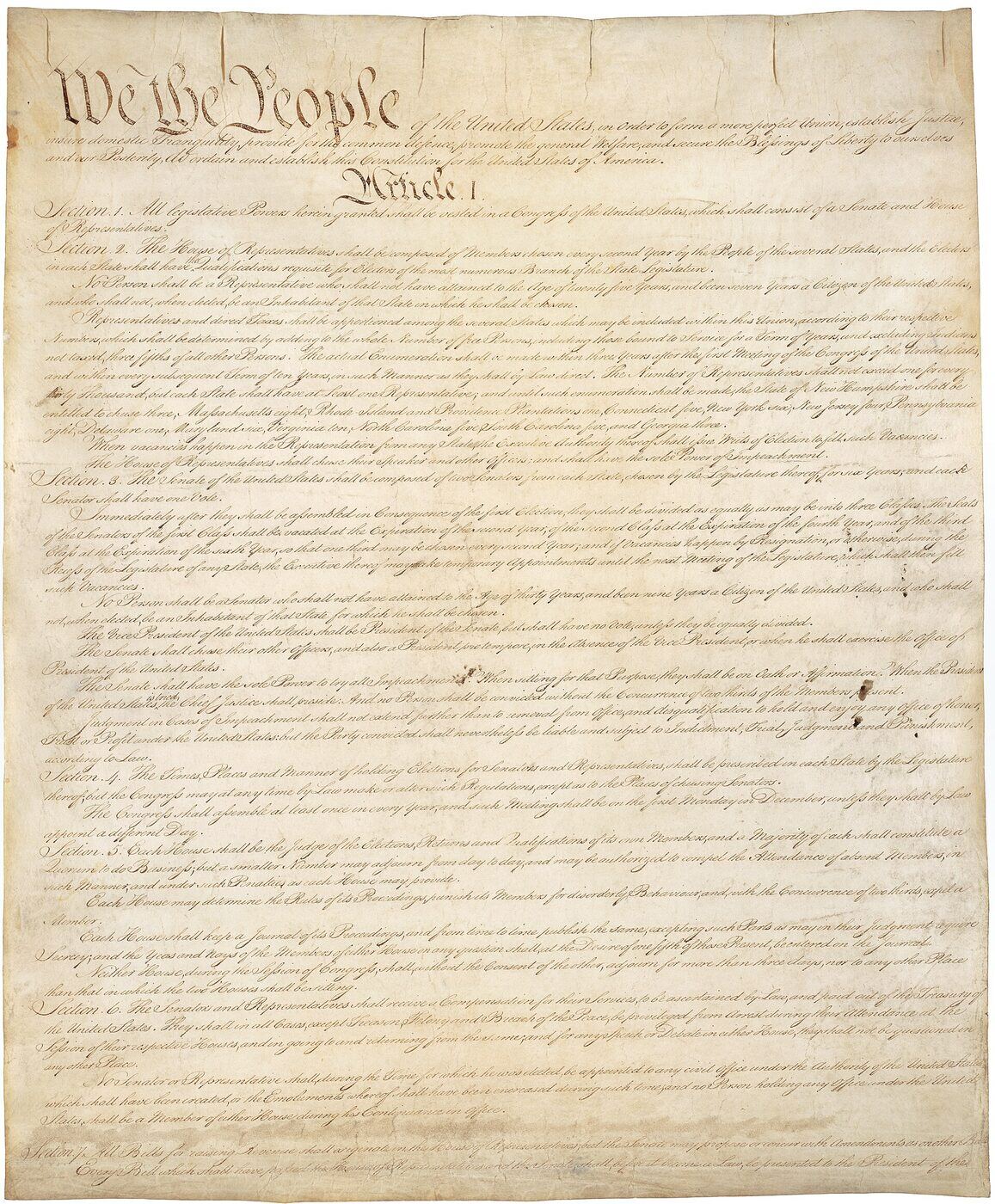

A fifth provision matters by exception rather than by grant. Article II, Section 2 gives the President power to grant reprieves and pardons for offences against the United States "except in cases of impeachment" — which is to say that the one federal proceeding a President cannot reach with the pardon power is the one directed at federal officers themselves.
Assembled, the machinery has two constitutionally required stages and one optional one. An inquiry may precede matters but is not required. The House then adopts articles of impeachment by simple majority of those present and voting; at that moment, and no earlier, the officer has been impeached, which is an accusation and not a removal. The Senate then tries the articles, with the Chief Justice of the United States presiding when the accused is the President, and conviction on any single article requires the concurrence of two-thirds of the senators present. If no article commands that majority, the accused is acquitted and nothing is imposed. The full record of the process, with its case law and its congressional practice, is set out at Federal impeachment in the United States.
What removal does, and does not, entail
Conviction removes the officer from the office held. It does not, by itself, bar them from holding another. Disqualification from future federal office is a separate question, put to a separate vote after conviction, and it carries only a simple majority of senators present rather than two-thirds. Of the eight officers ever convicted by the Senate, three have been disqualified; the other five were free to seek federal office again, and one of them — Alcee Hastings, removed as a federal judge in 1989 — was elected to the House of Representatives in 1992 and served there until his death in 2021.
Conviction imposes no criminal penalty. The Senate cannot fine or imprison, and Clause 7 expressly preserves the ordinary criminal liability of a convicted party, who "shall nevertheless be liable and subject to Indictment, Trial, Judgment and Punishment, according to Law". Impeachment is thus not a substitute for prosecution and not a bar to it; the two proceedings are formally independent, and the distinction was argued about at length in the 2000s by people who agreed on nothing else.
If a President is removed, the office passes to the Vice President. That is provided by Article II and restated, since ratification on 10 February 1967, by the first section of the Twenty-fifth Amendment: "In case of the removal of the President from office or of his death or resignation, the Vice President shall become President." This has a bearing on the campaigns described below, several of which proposed articles against the President and the Vice President together or in a particular order, and it is a purely mechanical point about who holds the office next, not a comment on anyone's motives.
Resignation is not clearly an escape, though the record is mixed. On 2 March 1876 William W. Belknap resigned as Secretary of War and the House impeached him the same day; the Senate held by 37 votes to 29 that it had jurisdiction to try him anyway, and then acquitted him. In three other cases — Mark W. Delahay in 1873, George W. English in 1926 and Samuel B. Kent in 2009 — the officer resigned and the Senate simply did not pursue the matter. The most recent test of the question, the second trial of Donald Trump in 2021, postdates this group's active life and is noted here only for completeness.
Finally, the courts do not supervise any of it. In Nixon v. United States, 506 U.S. 224 (1993) — brought by Judge Walter Nixon, no relation to the President — the Supreme Court held that whether the Senate had properly "tried" an impeachment was a political question with no judicial standard to apply, and therefore not reviewable. Impeachment is one of the few federal processes whose conduct is answerable only to the chamber conducting it.
The undefined standard
The single phrase that carried the entire argument of the 2000s — "high Crimes and Misdemeanors" — is not defined anywhere in the Constitution, and the omission was deliberate rather than accidental. At the Constitutional Convention of 1787 the early drafts listed only treason and bribery. George Mason proposed adding "maladministration". James Madison objected that a maladministration standard would in practice mean the President served at the pleasure of the Senate, and the convention adopted the present compromise instead. The result is a standard that plainly excludes mere incompetence and plainly includes treason and bribery, with a wide and permanently contested space between.
Two much-quoted positions bracket that space, and both were quoted constantly during the period this group covers. One is the frankly procedural view stated by Gerald Ford in April 1970, when as House Minority Leader he was urging the impeachment of Supreme Court Justice William O. Douglas: "An impeachable offense is whatever a majority of the House of Representatives considers it to be at a given moment in history." The other is the substantive view, that the phrase carries inherited legal content from centuries of English practice and cannot mean whatever a majority finds convenient. Neither has ever been settled, and after Nixon v. United States there is no forum in which it could be.
The most institutionally serious attempt to fill the gap remains a staff document. In February 1974 the House Judiciary Committee's impeachment inquiry staff, having examined the 1787 debates and the history of English impeachments, produced a sixty-four-page report titled Constitutional Grounds for Presidential Impeachment, which became the reference point for the committee's work. Its status is worth stating precisely: it was the work of committee staff, not an act of the committee or of the House, and it carries the authority of its reasoning and nothing else.
The record: twenty-two impeachments
Against the volume of argument, the actual federal record is small and easily stated. As matters stand in the mid-2020s the House has approved articles of impeachment twenty-two times against twenty-one officers. Fifteen were federal judges; three were sitting Presidents, one of them twice; two were Cabinet secretaries; one was a United States Senator.
The outcomes divide as follows:
- Eight officers were convicted and removed. Every one of them was a federal judge. Three of the eight were additionally disqualified from future federal office.
- Ten trials ended in acquittal.
- Three cases were not pursued to judgment because the officer resigned.
- One ended when the Senate concluded it lacked jurisdiction: Senator William Blount, whom the House voted to impeach on 7 July 1797 and whom the Senate expelled on its own authority the following day, and whose trial closed on 11 January 1799 with a vote of 14 to 11 that a Senator is not a "civil Officer of the United States".
The judicial cases, which supply all the convictions, run: John Pickering, impeached 2 March 1803, convicted and removed 12 March 1804; Samuel Chase, the only Supreme Court justice ever impeached, on 12 March 1804, acquitted 1 March 1805; James H. Peck, 1830, acquitted 1831; West Hughes Humphreys, 1862, convicted, removed and disqualified for supporting the Confederacy; Mark W. Delahay, 1873, resigned; Charles Swayne, 1904, acquitted 1905; Robert W. Archbald, 1912, convicted, removed and disqualified 1913; George W. English, 1926, resigned; Harold Louderback, 1933, acquitted; Halsted L. Ritter, 1936, convicted and removed. After a gap of fifty years the modern run begins: Harry E. Claiborne, impeached 22 July 1986 and removed 9 October 1986; Alcee Hastings, impeached 3 August 1988 and removed 20 October 1989; Walter Nixon, impeached 10 May 1989 and removed 3 November 1989. Two later cases complete the fifteen and postdate this group's active life: Samuel B. Kent, impeached 19 June 2009, who resigned; and Thomas Porteous, impeached 11 March 2010, convicted, removed and disqualified on 8 December 2010.
The Cabinet cases are Belknap, described above, and — clearly postdating this group — Alejandro Mayorkas, Secretary of Homeland Security, impeached 13 February 2024 by 214 votes to 213, with the Senate dismissing both articles as unconstitutional and out of order in April 2024 by 51–48 and 51–49.
The presidential cases are the ones the group's subject belonged to, and they are worth their dates:
- Andrew Johnson, impeached 24 February 1868 by 126 votes to 47, principally for violating the Tenure of Office Act. Acquitted in May 1868; the Senate divided 35 to 19 in favour of conviction, one vote short of the two-thirds required.
- Bill Clinton, impeached 19 December 1998 on two articles, perjury by 228 to 206 and obstruction of justice by 221 to 212. Acquitted 12 February 1999: 45–55 on perjury and 50–50 on obstruction.
- Donald Trump, impeached 18 December 2019 for abuse of power and obstruction of Congress and acquitted 5 February 2020; impeached again 13 January 2021 for incitement of insurrection and acquitted 13 February 2021, the Senate dividing 57 to 43 in favour of conviction, ten short of two-thirds. Both cases postdate this newsgroup's active life by more than a decade and are recorded here only because the record is incomplete without them.
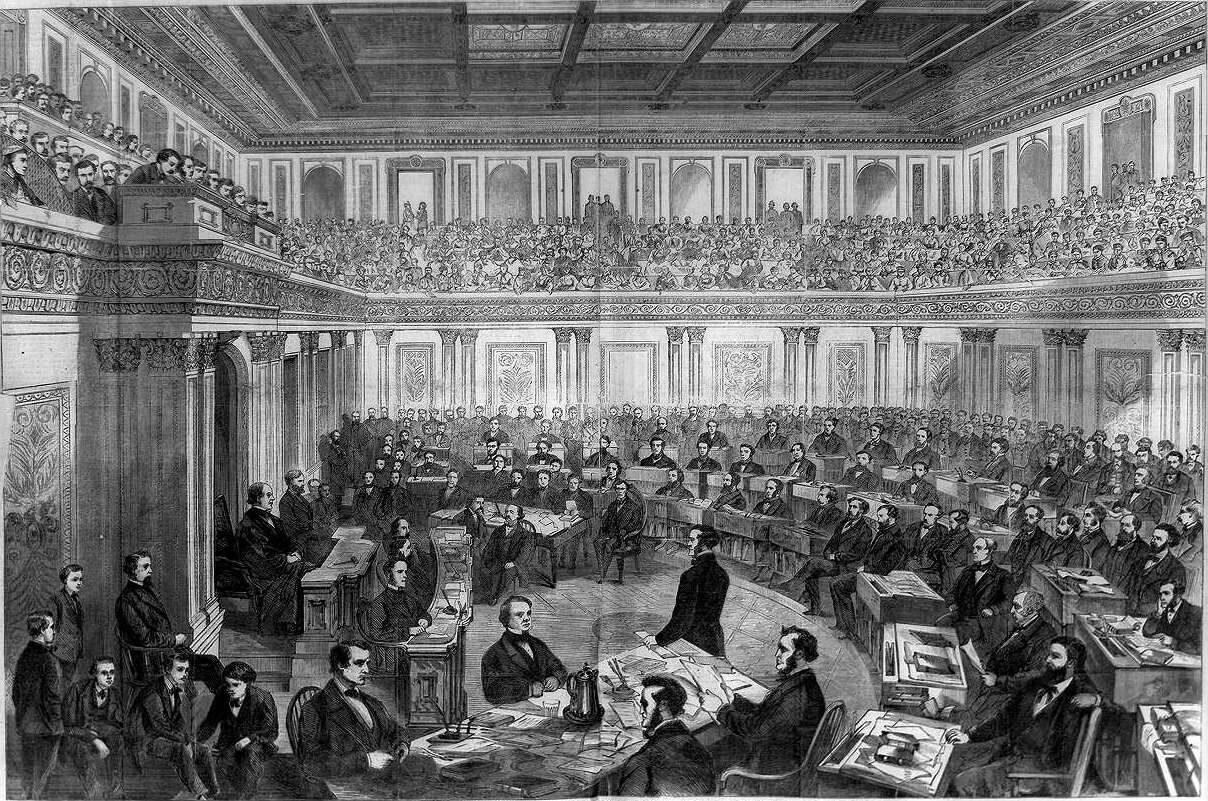

Three facts follow from the list. No President has ever been convicted by the Senate. Every officer ever convicted has been a judge. And on the two occasions when a Senate majority did vote to convict a President, in 1868 and in 2021, the majority was not two-thirds and the President remained in office.
Nixon, 1974: the case that was never voted
The most-cited precedent of the 2000s is one that never produced an impeachment at all. On 6 February 1974 the House authorised the Judiciary Committee to conduct a formal impeachment inquiry into President Richard Nixon, by 410 votes to 4. The committee's public markup of a resolution of impeachment ran from 24 to 30 July 1974 and produced five proposed articles, of which three were adopted:
- Article I, obstruction of justice, adopted 27 July by 27 votes to 11, with six Republicans joining all twenty-one Democrats.
- Article II, abuse of power, adopted 29 July by 28 to 10, with seven Republicans in favour.
- Article III, contempt of Congress for defiance of the committee's subpoenas, adopted 30 July by 21 to 17.
- Article IV, concerning the concealment of the bombing of Cambodia and the war powers of Congress, rejected 12 to 26.
- Article V, concerning improvements to Nixon's private residences at government expense and the underpayment of federal income tax, rejected.
No floor vote followed. Nixon resigned on 9 August 1974, and on 20 August the House voted 412 to 3 to accept the committee's final report, which was published two days later at 528 pages. Nixon was therefore never impeached: the House never adopted articles against him, and the only chamber-wide vote on the matter was the one receiving a report about a President who had already gone.
That outcome is why the case dominated later argument. It is the one modern instance of a President leaving office under impeachment pressure, and it supplied the vocabulary — obstruction of justice, abuse of power, contempt of Congress — that the resolutions of 2008 would reuse almost word for word. It also supplied a template that could be read in two opposite directions, as proof that the process works without needing to be completed, or as proof that it only works when a President's own party abandons him. Both readings were made, at length, in the period this group covers. The narrative of the inquiry itself is at Impeachment process against Richard Nixon.
The Downing Street memo
The document that gave the campaign of the mid-2000s its specific occasion was British, secret, and three years old when it surfaced. It is the note of a meeting held at 10 Downing Street on 23 July 2002 between the Prime Minister, Tony Blair, and senior ministers, officials and intelligence chiefs, written by the Downing Street foreign policy aide Matthew Rycroft and headed with an instruction that no further copies be made. A copy reached the journalist Michael Smith, and The Sunday Times published it on 1 May 2005, four days before the United Kingdom general election of 5 May.
The paragraph that carried the argument records the report given by the head of the Secret Intelligence Service, referred to in the minute by the traditional initial:
C reported on his recent talks in Washington. There was a perceptible shift in attitude. Military action was now seen as inevitable. Bush wanted to remove Saddam, through military action, justified by the conjunction of terrorism and WMD. But the intelligence and facts were being fixed around the policy. The NSC had no patience with the UN route, and no enthusiasm for publishing material on the Iraqi regime's record. There was little discussion in Washington of the aftermath after military action.
Other passages were quoted almost as often. The Foreign Secretary, Jack Straw, is recorded as saying that it seemed clear Bush had made up his mind to take military action but that "the case was thin", and as proposing an ultimatum to Iraq over weapons inspectors which "would also help with the legal justification for the use of force". The Attorney General, Lord Goldsmith, is recorded as advising that "the desire for regime change was not a legal base for military action". The meeting took place more than three months before United Nations Security Council Resolution 1441 was adopted on 8 November 2002, a point made repeatedly by those who argued the minute showed less than it appeared to.
The document's authenticity has not been seriously disputed. What its contents establish has been disputed continuously. Asked about the minute at a joint press conference with President Bush on 7 June 2005, Tony Blair answered: "No, the facts were not being fixed in any shape or form at all." Those who campaigned on it treated the phrase about intelligence and facts being "fixed around the policy" as evidence that the case for war had been assembled to fit a decision already taken. A third line of argument turned on the idiom itself, some readers taking "fixed around" in British usage to mean arranged or bolted on rather than falsified. The disagreement is about inference from an agreed text, which is why it never resolved. The document's own history, including the further papers Smith published in the following weeks, is at Downing Street memo.
Its route into American politics is itself a piece of media history relevant to this page. The American press was slow: the Los Angeles Times covered it on 12 May 2005 and The Washington Post on 13 May, nearly a fortnight after publication. In the interval the running was made by political weblogs, Daily Kos prominent among them, and by mailing lists — the same channels that would carry the campaign described below. Whatever else the episode demonstrates, it demonstrated to everyone watching that a story could be kept alive online for two weeks without a newspaper's help, which was a novel fact in 2005.
The organisations, 2002 to 2005
The public record of the impeachment argument in that decade is largely a record of organisations, and they can be dated.
The earliest of consequence predates the Iraq war. In 2002 the former United States Attorney General Ramsey Clark, founder of the International Action Center, established VoteToImpeach, an online signature campaign calling for the impeachment of the President and several members of his administration; its site drafted its own articles of impeachment against the President, the Vice President, the Secretary of Defense and the Attorney General. The campaign reported its own totals and no one else audited them: a New Jersey local paper reported Clark citing roughly 150,000 signatures in March 2003, Clark told a Washington rally in January 2005 that more than 500,000 had signed, and the site claimed over a million by January 2009. These figures are recorded here as claims made by the campaign, which is the only status the evidence supports.
The publication of the Downing Street minute produced a second wave, and a faster one. On 5 May 2005, four days after publication, Representative John Conyers and some ninety colleagues signed an open letter to the White House asking for a response to the document; on 17 May the White House press secretary told reporters that there was no need to reply, and no specific public response to the letter was ever made. On 23 May the lawyer John Bonifaz sent Conyers a memorandum arguing that the minute constituted evidence of conduct amounting to a high crime under Article II, Section 4. On 26 May 2005 a new coalition site launched; it described itself in its own words as "a coalition of veterans' groups, peace groups, and political activist groups" campaigning "to urge the U.S. Congress to begin a formal investigation into whether President Bush has committed impeachable offenses in connection with the Iraq war". It took its name from the document. On 16 June 2005 Conyers convened an unofficial meeting of members to discuss the minute and the question of grounds; on 21 July Representative Barbara Lee introduced a resolution of inquiry, H.Res. 375 of the 109th Congress, which would have directed the President and the Secretary of State to hand documents to the House, and which gathered eighty-three cosponsors.
Two further organisations formed that autumn, with very different constituencies. The World Can't Wait was founded at a meeting in New York in September 2005, chaired by activists associated with the Revolutionary Communist Party USA; its founding statement, the "Call", sought to create a political situation in which the administration's programme was repudiated and the President "driven from office"; by October 2006 the group counted some twenty-four thousand supporters, among them well-known figures from the arts. Then on 4 November 2005 came ImpeachPAC, a federal political action committee announced by Bob Fertik of Democrats.com under the slogan "Electing a Congress to Impeach Bush and Cheney"; its stated purpose was to support Democratic congressional candidates who backed impeachment, and its founding release led on a Zogby poll commissioned by the Downing Street coalition, which reported that Americans favoured impeachment by 53 per cent to 42 if the President had lied about the war in Iraq. The conditional clause in that question was material, and was pointed out at the time by people on both sides of the argument.
What is notable about the list, from the point of view of a Usenet directory, is that not one of these was a newsgroup, and none of them used one. They were websites with databases, mailing lists with addresses, and in one case a committee with a filing obligation. The reasons are taken up further down this page.
In Congress, 2005 to 2007
The congressional record of the same argument is a sequence of resolutions, none of which reached a vote on its merits. Reported exactly:
- H.Res. 635, 109th Congress, introduced by John Conyers on 18 December 2005: it would have created a select committee to investigate the administration's conduct in relation to the Iraq war and to report whether grounds existed for impeachment. It attracted thirty-eight cosponsors, was referred to the Committee on Rules, and expired with the Congress.
- S.Res. 398, 109th Congress, introduced by Senator Russ Feingold on 13 March 2006: a resolution relating to the censure of the President, arising from the warrantless surveillance programme rather than from the war. It gathered three cosponsors and was never voted on. Censure, unlike impeachment, has no constitutional machinery behind it; it is a statement.
- H.Res. 1106, 109th Congress, introduced by Cynthia McKinney on 8 December 2006, the last day of that Congress: three articles of impeachment, no cosponsors, referred to the Judiciary Committee and dead within hours.
- H.Res. 333, 110th Congress, introduced by Dennis Kucinich on 24 April 2007: articles of impeachment against Vice President Dick Cheney, with twenty-seven cosponsors. Referred; no action.
Between the resolutions came the report. In December 2005 the Democratic staff of the House Judiciary Committee published an investigative status report titled The Constitution in Crisis: The Downing Street Minutes and Deception, Manipulation, Torture, Retribution, and Coverups in the Iraq War, and Conyers released an expanded version on 4 August 2006. Its status needs stating precisely, because it is frequently described loosely: it was a minority-staff document, not a report of the committee, and it therefore carried the authority of its authors and no institutional authority at all. Its recommendations were the censure of the President and Vice President and the creation of a select committee with subpoena power. It did not recommend impeachment, and Conyers declined to back impeachment proceedings.
The one resolution of the period that produced recorded votes was H.Res. 799, introduced by Kucinich on 6 November 2007 as a further attempt against the Vice President and raised on the floor the same day as a question of the privileges of the House — a procedural route that forces the chamber to dispose of a matter it would otherwise ignore. The House disposed of it three times over. A motion to table failed, 162 to 251, with 135 Democrats and 27 Republicans voting to table and 165 Republicans and 86 Democrats voting against. The previous question was then ordered, 218 to 194. A motion to refer the resolution to the Judiciary Committee was then agreed, also 218 to 194. The resolution went to committee and stayed there.
The tabling vote is the one that repays attention, because the party breakdown runs the opposite way to the headline. The motion to bury the resolution was supported by 135 Democrats and opposed by 165 Republicans, a division running opposite to the two parties' declared positions on impeachment itself. It is a reminder that procedural votes in the House record positions about procedure, and that reading them as votes on the underlying question is usually a mistake.
June and July 2008: the articles
The most substantial step in the public record came in the summer of 2008. On 9 June, Dennis Kucinich rose in the House to give notice, under clause 2 of rule IX, of his intent to raise a question of the privileges of the House, and the full text of his resolution of impeachment was entered in the Congressional Record at that point, occupying pages H5088 to H5107 of volume 154. The resolution, H.Res. 1258 of the 110th Congress, carries an introduction date of 10 or 11 June depending on which congressional source is consulted; it had Robert Wexler as its leading cosponsor and eleven cosponsors in all, ran to 167 pages, and the last of its articles, in the Record's own numbering, is Article XXXV.
The articles' subject matter is a fair index of what the argument had accumulated by 2008. Fifteen of the thirty-five concerned the seeking of authority for the Iraq war and the conduct of the war itself; others addressed the disclosure of the identity of the intelligence officer Valerie Plame, the treatment and rendition of detainees, the case made regarding Iran, warrantless domestic surveillance and the collection of telecommunications records, the use of presidential signing statements, non-compliance with congressional subpoenas, the conduct of the 2004 elections, Medicare, the response to Hurricane Katrina, climate policy, and the attacks of 11 September 2001 and their aftermath. Two of those threads — surveillance and the collection of communications records — are treated elsewhere in this directory, on alt.privacy and its computing-side counterpart, and are not pursued here.
On 11 June 2008, at 3:08 in the afternoon, the House voted on a motion to refer H.Res. 1258 to the Committee on the Judiciary. It carried, 251 to 166, with 16 members not voting. The party division was 227 Democrats and 24 Republicans in favour; 166 Republicans against; no Democrat voted no. The Judiciary Committee took no further action on the resolution.
Kucinich returned on 15 July 2008 with H.Res. 1345, a resolution of a single article confined to the charge of deceiving Congress in order to obtain the 2002 authorisation for the use of military force against Iraq. It carried four cosponsors. The House referred it to the Judiciary Committee the same evening, by 238 votes to 180 — 229 Democrats and 9 Republicans in favour, 180 Republicans against, 16 not voting.
Ten days later, on 25 July 2008, the Judiciary Committee did hold a hearing, though not an impeachment inquiry. It was titled Executive Power and Its Constitutional Limitations, convened at 10:19 in the morning in room 2141 of the Rayburn House Office Building with Conyers in the chair, and its published transcript runs to several hundred pages. The witnesses included Kucinich, Maurice Hinchey and Brad Miller; the Republican Walter Jones; Elizabeth Holtzman, who had sat on the Judiciary Committee during the Nixon inquiry; Bob Barr, who had been a House manager in the Clinton impeachment and was by then the Libertarian nominee for President; Ross C. Anderson of High Roads for Human Rights; Bruce Fein, associate deputy attorney general in 1981 and 1982; the former Los Angeles County prosecutor Vincent Bugliosi; and the law professors Stephen Presser and Jeremy Rabkin, the second of whom told the committee he had been asked to appear by the minority. The committee reported no resolution and took no action.
The presidency ended on 20 January 2009 at the expiry of its second term, which mooted every resolution still sitting in committee. The whole arc — resolutions, cosponsor counts and outcomes — is catalogued at Efforts to impeach George W. Bush.
The case against, as its opponents made it
A page that records the campaign owes the same treatment to the arguments against it, and those are as well documented as the campaign itself.
The most consequential opposition came from the Democratic leadership rather than from the President's party. In May 2006, before the midterm elections, House Democratic leader Nancy Pelosi said that impeachment was "off the table", and she repeated the phrase after the elections of November 2006 had made her Speaker. Her reported reasoning was that impeachment would be divisive and unlikely to succeed. In July 2007 she said that she would probably advocate impeachment were she not in the House and not Speaker — a formulation that satisfied nobody and is quoted by both sides to this day. Whatever its merits, the position was decisive in practice: in the House, the majority leadership controls whether a matter reaches the floor, and it declined.
The arithmetic argument was made constantly and is simply a reading of Article I, Section 3. Impeachment by the House requires a simple majority; conviction requires two-thirds of senators present. No President has ever been convicted, and in 1868 a Senate that voted 35 to 19 for conviction still failed. Opponents of the campaign argued that a Senate of the 110th Congress would not produce sixty-seven votes on any of the articles proposed, and that a House impeachment which was certain to fail in the Senate would consume the legislative year for a foreseeable acquittal. Supporters answered that the Nixon precedent showed the process could have effects short of conviction, and that the constitutional duty did not depend on the arithmetic. Neither claim is testable, and this page does not attempt to weigh them.
The substantive objections are on the record of the 25 July 2008 hearing, in the words of the witnesses who made them. Stephen Presser, who had testified to the same committee during the Clinton inquiry in 1998, drew a distinction between the two cases: the Clinton allegations, he said, described conduct "undertaken for personal reasons", whereas the allegations against President Bush "seem different in character", and "if a President in good faith seeks to act in the national interest rather than in his own, his conduct is not impeachable". Jeremy Rabkin argued that the graver charge and the lesser ones did not reinforce each other: if the claim was that the President had knowingly taken the country into war on grounds he knew to be false, then "we should just zero right in on that charge", and disputes over signing statements or the Geneva Conventions added nothing to its credibility. He said of the central charge that he thought it "wildly improbable".
The committee's ranking member, Lamar Smith, made the political objection in the hearing's opening minutes. "Nothing is going to come out of this hearing with regard to impeachment of the President," he said. "I know it, the media knows it, and the Speaker knows it." He put the committee's own record against the charge — thirty-two hearings and more than 120 witnesses, in his count, without evidence of criminal wrongdoing by the President or Vice President — and characterised the proceeding as partisan. Representative Mike Pence, at the same hearing, argued that the President had not broken the law in his own interest and appealed to the intent of the framers.
The arguments in favour were made in the same room, by witnesses with their own standing: Holtzman from the Nixon committee, Fein from a Republican administration, Barr from the Clinton prosecution. That a sitting Republican congressman, a lawyer who had served under President Reagan and a former Republican congressman then standing as the Libertarian nominee for President were among those pressing the case is a fact about the hearing, and is recorded as such. The transcript is a public document and settles nothing; it is simply the best single place where both cases were put on the record at length, under the same chairman, on the same afternoon.
Resolutions from below: states, counties and towns
A distinctive feature of the period, and one with almost no analogue in earlier impeachment episodes, was the volume of subordinate-body resolutions. They had no operative effect — only the House of Representatives can impeach — but they were numerous, they were minuted, and they are therefore part of the documentary record.
Party bodies moved first. On 21 March 2006 the Democratic Party of New Mexico adopted a platform plank at its Albuquerque convention supporting impeachment and removal. On 24 March 2007 the Vermont Democratic State Committee voted to support a state legislative resolution to the same end. Municipalities followed in quantity: by June 2007, seventy-nine municipal governments had adopted resolutions supporting impeachment of the President or other administration officials, and county governments joined them, Dane County in Wisconsin among the first in August 2007.
The most fully documented state attempt is instructive precisely because it failed slowly. On 2 January 2008 Betty Hall, a fourteen-term member of the New Hampshire House of Representatives then aged eighty-seven, introduced House Resolution 24, petitioning Congress to commence impeachment proceedings. Its drafters leaned on an unusual authority: section 603 of Jefferson's Manual of Parliamentary Practice, which states that an impeachment may be set in motion in the House by charges transmitted from the legislature of a state. On 20 February 2008 the committee found the resolution "Inexpedient to Legislate" by ten votes to five; it was tabled by the full House on 16 April; three attempts to take it from the table failed; and it died on the table on 24 September 2008.
Whether such resolutions were a genuine constitutional route or a form of petition with an unusually formal letterhead was itself argued about at the time. The record shows only that they were passed, that the Jefferson's Manual theory was invoked, and that no state legislature's transmission ever produced an impeachment.
The parallel motion at Westminster
Because the document at the centre of the campaign was British, the argument had a British counterpart, and its mechanics differ enough to be worth a paragraph. Impeachment exists in the United Kingdom too, as a procedure of the House of Commons tried before the House of Lords, first used against William Latimer in 1376 and last completed against Henry Dundas, Viscount Melville, in 1806. It is generally regarded as obsolete; the most recent motion before the one described here was moved in 1848 by Thomas Chisholm Anstey against the Foreign Secretary, Lord Palmerston.
In August 2004 the Plaid Cymru member of parliament Adam Price commissioned and published a report, A Case to Answer, written by Glen Rangwala of the University of Cambridge and Dan Plesch, setting out a case for the potential impeachment of the Prime Minister over the invasion of Iraq. The Speaker's legal advisers approved the wording of a motion on 17 November 2004, and a cross-party group tabled it on 24 November — a motion not to impeach directly but to appoint a select committee of not more than thirteen members to investigate the Prime Minister's conduct in relation to the war and to report within forty-eight days whatever resolutions or articles of impeachment it thought fit. The three main parties instructed their members not to sign it. It was never selected for debate. The episode is documented at Parliamentary motion to impeach Tony Blair.
The two systems failed the campaigns in different ways, which is the only comparative observation this page will offer. In Washington the resolutions were introduced, printed, read into the record and referred to a committee by recorded vote — the procedure operated fully and produced nothing. At Westminster the motion was ruled in order by the Speaker's advisers, tabled, and then simply never called, the whips having ensured it would not be signed. One process buried the question in committee; the other never opened it.
Organising online before social media
The campaign of the 2000s ran on infrastructure that had been built, by both sides of American politics, during an earlier impeachment. That history is worth setting out, because it explains why a newsgroup was not the natural home for any of it.
In September 1998, as the House moved towards impeaching President Clinton, two software entrepreneurs in Berkeley — Joan Blades and Wes Boyd, the married co-founders of Berkeley Systems, a company best remembered for screen savers — circulated a one-sentence petition among under a hundred friends and relatives. It read: "Censure President Clinton and Move On to Pressing Issues Facing the Nation." The petition was launched publicly on 24 September 1998. Within a week it had a hundred thousand signatures; ultimately about half a million people signed. The organisation recruited some two thousand volunteers to deliver the petitions in person to members of the House in 219 congressional districts and directed some thirty thousand telephone calls to district offices. Congress impeached the President anyway, in December 1998. The organisation, MoveOn, did not disband; it became a political action committee and, over the following decade, one of the largest online campaigning operations in American politics — including during the period this group covers.
The symmetry of 1998 deserves recording, since it is the point most often lost. Online petitioning that autumn ran in every direction at once. A contemporary account of MoveOn's launch noted that a search for "censure Clinton" turned up no sites at all while a search for "impeach Clinton" turned up twenty, and that one of them, run by Scott Lauf, had already delivered sixty thousand petitions to Congress; a separate site run by the commentator Arianna Huffington, then of the political right, had collected 13,303 names calling on the President to resign. The technique was not the property of a faction. It was simply the first cheap way anyone had found to convert diffuse opinion into a number that could be carried into an office.
Between 1998 and 2005 the toolkit widened. General-purpose petition-hosting sites made it possible to start a campaign without owning a server. Mailing lists became the backbone of political organising, because a list is a set of addresses one controls and can speak to on one's own schedule. And the political weblog arrived: Talking Points Memo had appeared in November 2000 and Instapundit in August 2001, Daily Kos launched on 26 May 2002, and the term "netroots" — a compound of Internet and grassroots — was coined in 2002 by Jerome Armstrong for the resulting form of activism. By 2005 that wave was strong enough to keep the Downing Street minute alive in American discussion for a fortnight before the American press picked it up.
Every element of that toolkit shares a property that Usenet does not have: it produces a number. A petition produces signatures. A mailing list produces subscribers. A political action committee produces a filing with an itemised total. A weblog produces traffic figures and, from 2004 or so, comment counts. Numbers are what a campaign can carry to a congressional office, and the entire apparatus described in the sections above was built to generate them.
Noticeboard, mailing list, database
Set a newsgroup beside a mailing list and a campaign website and the practical differences are not matters of taste.
A newsgroup has no owner. Nobody holds a list of the people reading it; nobody can send them anything; nobody can add or remove them; nobody can even establish how many there are, since a reader who never posts leaves no trace on any server the campaign controls. Posting to a newsgroup is broadcasting into a room and hoping. There is no way to ask the room for money, no way to ask it to telephone a congressional office next Tuesday, and no way to report to anyone that the room agrees with you.
A mailing list inverts all of that. The addresses are an asset; the organisation decides when to speak and to whom; the response to any message can be counted; and the list can be segmented by state or district, which is precisely the unit in which congressional pressure is measured. A campaign website adds a database behind a form, so that a signature, an address and a donation can be recorded in the same transaction. A registered political action committee adds a legal identity that can make contributions and must disclose them, which is why a committee like the one launched in November 2005 could do something no newsgroup could ever do: give a candidate money and say publicly why.
The consequence for this page is straightforward. Usenet in the 2000s was a place where the impeachment argument was conducted; it was not a place from which it was run. Every organisation named in the sections above operated on the web and by e-mail. A group like this one was a noticeboard in a building the campaigners had mostly moved out of — which does not make its traffic uninteresting, but does define what kind of interest it can hold.
The wider story of how political argument moved from Usenet to the web over this period, and of the Usenet-politics genre in general, belongs to alt.politics.bush, which covers the two presidencies and the chronology of the period. This page confines itself to impeachment.
The character of an advocacy group, structurally
Certain things follow from the form itself, and can be stated without describing a single thread or naming a single poster — which is as well, since this directory has no reliable posting-level record for the group and will not invent one.
The first is crossposting. A group named for a proposition has an obvious interest in being read outside itself, and the adjacent political groups were the obvious targets; the group's own creation message, crossposted to seventeen newsgroups including several with no plausible interest in the subject, established the practice before the group had a single reader. Crossposting also works in the other direction: a thread begun elsewhere and copied in arrives under a heading its author did not choose. The header record of the period is therefore a better guide to which conversations spanned which groups than any account of what was said in them.
The second is that an advocacy group recruits its opponents. This is structural rather than incidental. A group whose name states a position is a standing invitation to anyone who holds the opposite one, and it is the easiest possible place to find an argument on a subject one cares about. No mechanism existed to prevent this: the group was unmoderated, as almost all alt.* groups were, which means there was no one empowered to rule a post off-topic, close a thread or exclude a participant. The available tools were the ones every unmoderated group had — the killfile, appeals to netiquette, and the periodic declaration that a subject was exhausted. In consequence a single-purpose advocacy group tends to contain rather less advocacy and rather more argument than its name implies, and the ratio is not a comment on the people involved but on what a room with a slogan over the door attracts.
The third is that the group could not end. Nothing in Usenet's machinery retires a group whose occasion has passed, and removing an established group from thousands of independently administered servers is harder than creating one. The presidency ended on 20 January 2009; the newsgroup did not. It remains in the master newsgroups list circulated to news administrators to this day, carried under its own name with the description field reading simply "No description."
What the archive is worth
The honest value of an archive like this one is not evidential in the ordinary sense. Nothing posted to the group establishes anything about the events it discussed; the facts of the period are established, so far as they are established at all, by the documents catalogued above — the minute of 23 July 2002, the resolutions and their roll calls, the committee transcript of 25 July 2008 — and those are available in better form elsewhere, from the bodies that produced them.
This directory holds no archive of the group, and characterises nothing that was posted to it. What such an archive would hold instead is the texture of a political argument conducted in public, in real time, by ordinary participants who did not know how it would end. That is the kind of material that becomes more useful, not less, as the events recede.
Such an archive would also record the argument's opponents, at length, and without the filtering that a campaign's own archive would apply. A supporters-only record of the impeachment argument exists in abundance, in the form of the campaign sites themselves; a record in which both cases were put by people who were not chosen for the purpose is harder to come by, and an unmoderated advocacy group is one place it survives.
A reader should not expect two things from it. It is not a source for what happened: it is a source for what was said about what happened. And it holds nothing whatever about its own institutional history — no membership, no leadership, no organisational record, no continuity with any of the campaigning organisations described above. So far as the surviving evidence shows, this group was created by one person with one control message and thereafter belonged to nobody.
A note on neutrality
The group existed to advocate. This page does not, and the distinction is worth making explicitly, as it is on the neighbouring pages of this directory that deal with contested subjects — see, for a comparable case, the note carried on soc.culture.yugoslavia.
Everything above is offered as documentation: what was proposed, by whom, on what date, under what authority, and with what result; and what was said against it, by whom, and where it is recorded. Where a claim is a claim rather than an established fact — a campaign's own count of its signatures, a poll's finding on a conditional question, a witness's characterisation of another party's motives — it has been attributed to whoever made it. Where a question was contested at the time and remains contested, it is described as contested.
No view is expressed here on whether the conduct alleged in any of the resolutions occurred, whether any of it would have amounted to a high crime or misdemeanour, whether the House should have proceeded, or whether the arguments made against proceeding were sound. Those were the questions the group existed to argue about, and a directory entry is not the place to answer them. Readers wanting the case for the campaign will find it stated at length in the resolutions and the coalition literature; readers wanting the case against it will find that stated at length in the same committee transcript. Both are cited above by name and date so that either can be read directly rather than through anyone's summary, including this one.
Scope and limits
This page owns impeachment: the constitutional mechanism, the historical record of federal impeachments, and the documented public campaign of the 2000s. It does not cover the two presidencies, the political chronology of the decade, or the Usenet-politics genre as a whole, which are handled on the alt.politics.bush page linked above; it does not cover the surveillance and privacy controversies except where an article of impeachment refers to them, those belonging to the privacy pages of this directory and to comp.society.privacy; and it does not cover the origins and governance of the alt.* hierarchy, which are on the alt.* page.
The limits of the evidence should be stated as clearly as its content. Everything asserted here about the group itself — its creation date, the wording of its newgroup message, its crosspost list, the rmgroup messages recorded alongside it, its continued presence in the newsgroups file — comes from the surviving Usenet control-message record, which is complete for those questions and silent on all others. There is no reliable record of the group's readership, its volume, its participants or its individual threads, and none has been reconstructed by guesswork. Everything asserted about the constitutional mechanism comes from the text of the Constitution and the congressional record; everything asserted about the campaign comes from resolutions, roll calls, committee documents, published journalism and the campaigning organisations' own statements of themselves, each identified in the text.
Where a figure or a date could not be verified against a primary or reference source, it has been left out rather than approximated. Several plausible-sounding details about this group and this campaign circulate online and are not in this page for exactly that reason.
Reading alt.impeach.bush today
- Historical archive: Google Groups — alt.impeach.bush (coverage varies by group and era).
- Open in a newsreader:
news:alt.impeach.bush— the original site offered exactly this link, and it still works if your system has a newsreader registered for thenews:scheme. - Live access: point an NNTP newsreader at a modern server — see accessing Usenet today.
- The original news2mail e-mail subscription service ended in the mid-2000s and no longer operates.