soc.culture.yugoslavia
Discussions of Yugoslavia and its people.
Created for one country and outliving it, soc.culture.yugoslavia became the shared room of a dissolving federation — through the wars of the 1990s it carried news relays, refugee messages and arguments of historic bitterness, crossposted with the successor-state groups as they split away one by one.
By the 2000s it hosted a quieter Yugonostalgia: shared music (rock from the SFRJ era), shared jokes, and the strange intimacy of people who had been one country arguing about whether they ever were.
On this page
One room, one country
The premise of the soc.culture.* hierarchy was simple bookkeeping: one nation, one room. The naming scheme that settled into place after Usenet's Great Renaming in the late 1980s handed out group names roughly along the lines of the atlas, and the atlas of the day listed a Socialist Federal Republic of Yugoslavia — six republics, two autonomous provinces, one seat at the United Nations, and accordingly one newsgroup. The mechanics by which soc.culture.* groups came into being are told on the family's own page, and the governance of the wider hierarchy on the soc.* page; what matters here is only that the scheme assumed nations hold still, and that this is the group on which the assumption was tested to destruction.
Before the fighting, soc.culture.yugoslavia was an unremarkable member of its family. Its traffic was the traffic of any national group of the era: food and music, football, requests for news from a particular town, advice for travellers, the practical questions of visas and universities, and the low-grade homesickness of people studying far from home. What distinguished it later was not what it discussed but what happened to its subject.
The group's population was never quite the country's. Network access inside Yugoslavia was scarce, reaching the region mainly through university computing centres, so the reliable posting base was the diaspora — students and researchers at North American, West European and Australian universities, alongside emigrants of earlier generations. They wrote mostly in English, or in Serbo-Croatian stripped of its diacritics, seven-bit ASCII having no accommodation for č, š or ž. The result was a national conversation conducted largely from abroad, by people watching their country on the evening news of other countries.
It also did something the country itself could not always manage: it put people from every republic in one place. At home, a student in Ljubljana and a student in Skopje inhabited different republics, different universities and increasingly different newspapers; abroad, they were both simply Yugoslavs on the same campus mailing lists and the same newsgroup, arguing in the same borrowed language. The diaspora room was, in that narrow sense, more federal than the federation.
While the federation stood, the word in the group's name did ordinary work. "Yugoslav" was a passport, a football team, an airline, an army and a category on foreign university enrolment forms; posters could and did identify by republic, city or university, but the shared label was uncontroversial enough to name a newsgroup, and for a few more years that was all it had to do. The group is thus a small record of something now hard to reconstruct: what the label sounded like while it still referred to a going concern.
Wiring a federation
Networking reached Yugoslavia the way it reached most of Europe outside the anglophone core: through the universities, in the late 1980s, over academic store-and-forward links and dial-up connections that moved mail and news in nightly batches rather than in real time. A post from Ljubljana or Zagreb might take a day or more to propagate to the servers where most of the group's readers actually sat; the conversation was intercontinental but never instantaneous.


The country's formal address on the young Internet dates from this period. The .yu country-code domain was assigned to the SFR Yugoslavia in 1989, registered by the computer scientist Borka Jerman Blažič with the University of Maribor and the Jožef Stefan Institute in Ljubljana as its official registrants. Yugoslavia's place in the global namespace was thus administered from Slovenia — a bookkeeping detail that would acquire a certain irony, Slovenia being the first republic to leave. The sequel to that arrangement belongs to a later section.
Inside the country, then, connectivity was a privilege of a few academic buildings; outside it, Yugoslav students had whatever their host universities provided, which by the early 1990s was quite a lot. This asymmetry shaped everything that followed. When the crisis came, the people with the best access to the group were precisely the people with the worst access to the events — reading wire services in Boston or Munich about towns their relatives could no longer telephone from.
The year the namespace broke
On 25 June 1991 Slovenia and Croatia declared independence, and the breakup of Yugoslavia moved from constitutional argument to armed fact: a ten-day war in Slovenia, a far longer one in Croatia over the months that followed, Macedonia's comparatively quiet departure in September, and from the spring of 1992 the war in Bosnia and Herzegovina, the deadliest of the three. Each stage arrived in the group within hours, in the form of wire copy, second-hand telephone reports and disbelief.
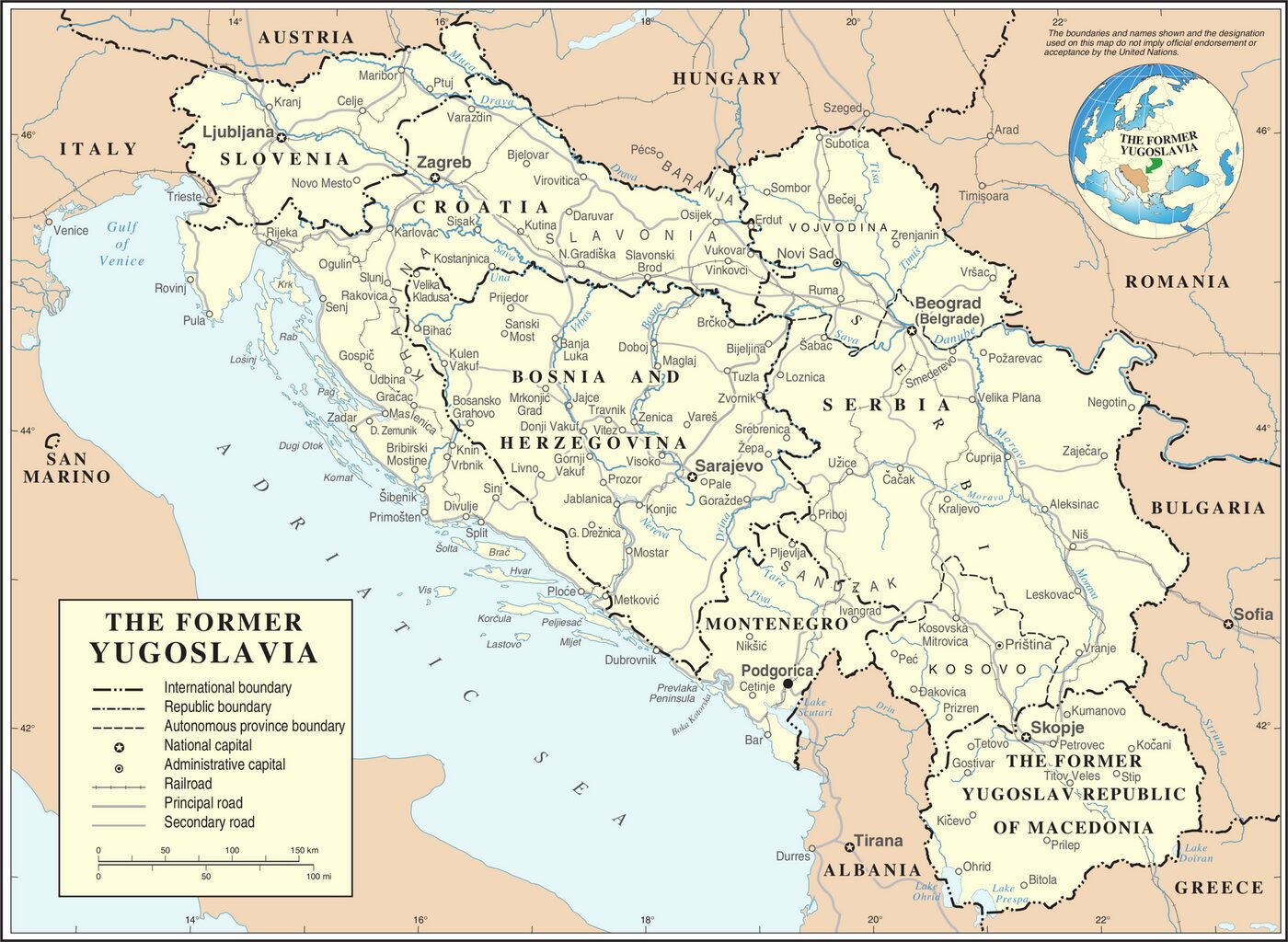

The wars redrew the neighbourhood of groups around soc.culture.yugoslavia. As the federation dissolved, per-republic groups appeared in the hierarchy alongside it — soc.culture.slovenia, soc.culture.croatia, and soc.culture.bosna-herzgvna, the last with its vowels sacrificed to the old fourteen-character limit on the components of a newsgroup name, a small technical indignity added to the larger ones. The story of each successor group belongs on its own page; the pattern is what belongs here. Usenet's directory of nations did not record the secessions so much as re-enact them, one group creation at a time, and a reader flipping through the hierarchy's control messages of the early 1990s can watch a country come apart in its table of contents.
The original group remained the common ground, in both senses: the one room still shared, and the one still fought over. Crossposting stitched the new groups back together whether their readers wished it or not — a thread begun in one republic's group and crossposted to the old federal room reached everyone's screen under the old federal name, and the choice of where to post, like every other choice in those years, was legible as a statement.
Relays, letters, and the war for the wire
During the war years the dominant traffic was news, and the argument about news. Posters relayed wire-service reports and articles from the international press; other posters disputed them line by line. Alongside this came word from home — what relatives had said by telephone before the lines went, what a letter that finally arrived contained, what a friend of a friend who had got out was saying — the kind of material that made the group read like a wire service at the time, and like testimony now.
A distinct strand of traffic was the search for people. As populations were displaced and cities cut off, the networks filled with queries of a form older than any technology that carried them: does anyone have news of this family, this street, this town. A poster with a working connection and reachable relatives became, for others, a relay station, and messages passed along chains of acquaintance from a newsgroup post to an e-mail to a telephone call to a doorstep. No statistics survive for how often the chains held, and none will be invented here; that the attempts were made, constantly, is visible on the face of the traffic.
The group mattered partly because the ordinary channels did not work. War severed telephone lines and postal routes across the new front lines; a Zagreb number could not reach a Belgrade one directly for long stretches of the decade, and besieged Sarajevo was for long periods reachable by almost nothing at all. Electronic mail, moving through neutral machines abroad, crossed lines that voice calls could not, and newsgroup posts — readable by anyone, anywhere, without knowing whom to ask — became a way of broadcasting to a scattered nation whose members no longer shared an infrastructure.
The best-documented of the improvised networks was the ZaMir Transnational Net — za mir, "for peace" — an e-mail and bulletin-board system launched in June 1992 with nodes in Zagreb and Belgrade, built by peace activists so that anti-war groups on opposite sides could keep communicating. Since a message could not travel directly between the two cities, it went the long way round, routed through bulletin-board systems abroad, notably in Bielefeld in Germany. Servers followed in Ljubljana and in besieged Sarajevo in early 1994, in Priština later that year, and in Tuzla in 1995. ZaMir was not Usenet — it was a parallel world of its own conferences and mailboxes — but it moved through the same modems and the same bad phone lines, and material from each world was carried into the other by hand, the way everything crossed boundaries in those years. The Dutch activist Wam Kat's "Zagreb Diary", written on ZaMir during the war, circulated far beyond the network and became one of the war's better-known electronic documents. The network's later history is told under the name ZaMirNET.
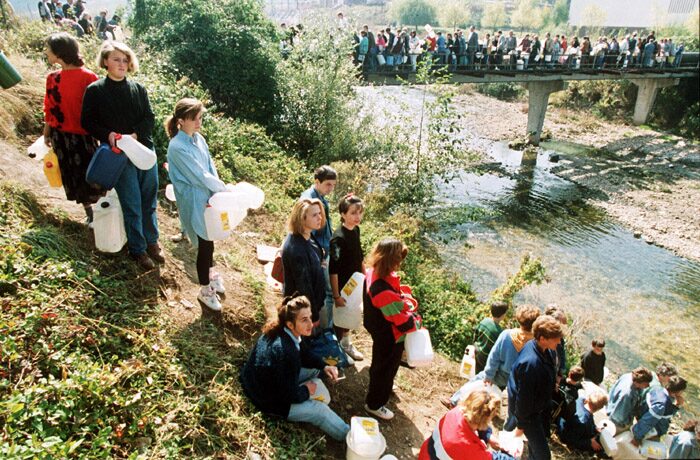

Seen from the group, all of this arrived simply as words on a screen: a report typed in a city under shellfire, forwarded through two countries, posted from a third, read in a fourth. The banal mechanics — store-and-forward, batch dial-ups, a relay in Germany — are worth recording precisely because the content they carried was not banal at all.
The argument culture
What was fought over, in the group, maps closely onto what was fought over on the ground: names, borders, histories, and the question of what was being done to whom. Accusations of propaganda ran in every direction, and the reliability of any given source was itself a standing topic — which agencies could be trusted, which newspapers were organs of which government, whether a given atrocity report was fact, exaggeration or fabrication. The group did not resolve these questions, and neither will this page; what the archive preserves is the shape of the dispute, which is itself historical evidence of a high order.
History was the perpetual undercard. The Second World War was refought at length and without resolution — Partisans, Chetniks and Ustaše, the counting of the dead, which grandfather had done what — with older arguments about medieval kingdoms and battles pressed into contemporary service behind it. These threads outlasted the wars that had sharpened them; on soc.culture.yugoslavia, history was rarely a settled subject and never a neutral one.
Language was a debate in its own right: whether Serbo-Croatian was one language, two or four; which script to use; what to call the thing one was writing in. The debate had the special sharpness of one conducted inside its own subject matter, every post an exhibit in the case it was arguing. A poster's spelling could be read as an allegiance, and frequently was.
The group was unmoderated, which in Usenet terms means there was no referee — no one empowered to rule a claim out of order, close a thread or eject a participant. The standard tools of an unmoderated group in distress were all in evidence: killfiles, appeals to netiquette, periodic attempts to declare subjects exhausted, and the discovery, made independently by every generation of readers, that no subject on this group was ever exhausted. It is worth stating plainly what this page's register requires: the arguments are documented here, not adjudicated. The group's participants were arguing about real events, many of them atrocities now exhaustively established by courts and historians; the archive records how those events were claimed, denied and contested in real time, which is a different thing from recording what happened.
The ordinary furniture
The rest was the ordinary furniture of a soc.culture group — recipes, football and basketball, films, music, the comparative merits of one another's coastline — with the complication that here no noun was safely apolitical. A recipe carried a provenance; a song carried a language; a map of anywhere carried borders. Threads that began with burek or a chart hit could end, a hundred follow-ups later, somewhere in the fifteenth century.
Even sport arrived freighted. United Nations sanctions imposed on the rump federation in May 1992 extended to sporting contact, and the Yugoslav national football team — qualified for that summer's European Championship — was excluded days before the tournament began; Denmark, admitted in its place, went on to win it, a footnote every reader of the group could recite. For years afterwards, international sport was one more register in which the question of who now was what got asked and answered.
The lighter threads mattered all the same. They were where the group's later, gentler register was first rehearsed — the discovery that people who could not agree on a border could agree on a bassist, and that the shared culture of the old federation, its rock bands and television and jokes, was the one piece of common property the wars could not be fought over territorially. That discovery had a long afterlife.
After Dayton
The Dayton Agreement, negotiated at an air base in Ohio in November 1995 and signed in Paris that December, ended the war in Bosnia and Herzegovina. It did not end the group's wars, which continued on schedule; arguments of that depth do not observe ceasefires, and the post-war years added their own subjects — the missing, the displaced, the tribunals, the question of return. But the proportion of the traffic that was news slowly fell, and the proportion that was memory slowly rose.
The respite was incomplete for another reason: a state called Yugoslavia still existed, and was not at peace for long. The federation of Serbia and Montenegro that kept the name was the state involved in the Kosovo war of 1998–99 and the NATO bombing campaign of 1999, so the group whose name matched the state on the news inevitably carried that argument too, alongside soc.culture.albanian and the rest of the neighbourhood. The last war fought by a country called Yugoslavia was discussed, fittingly, on the newsgroup that still bore the name.
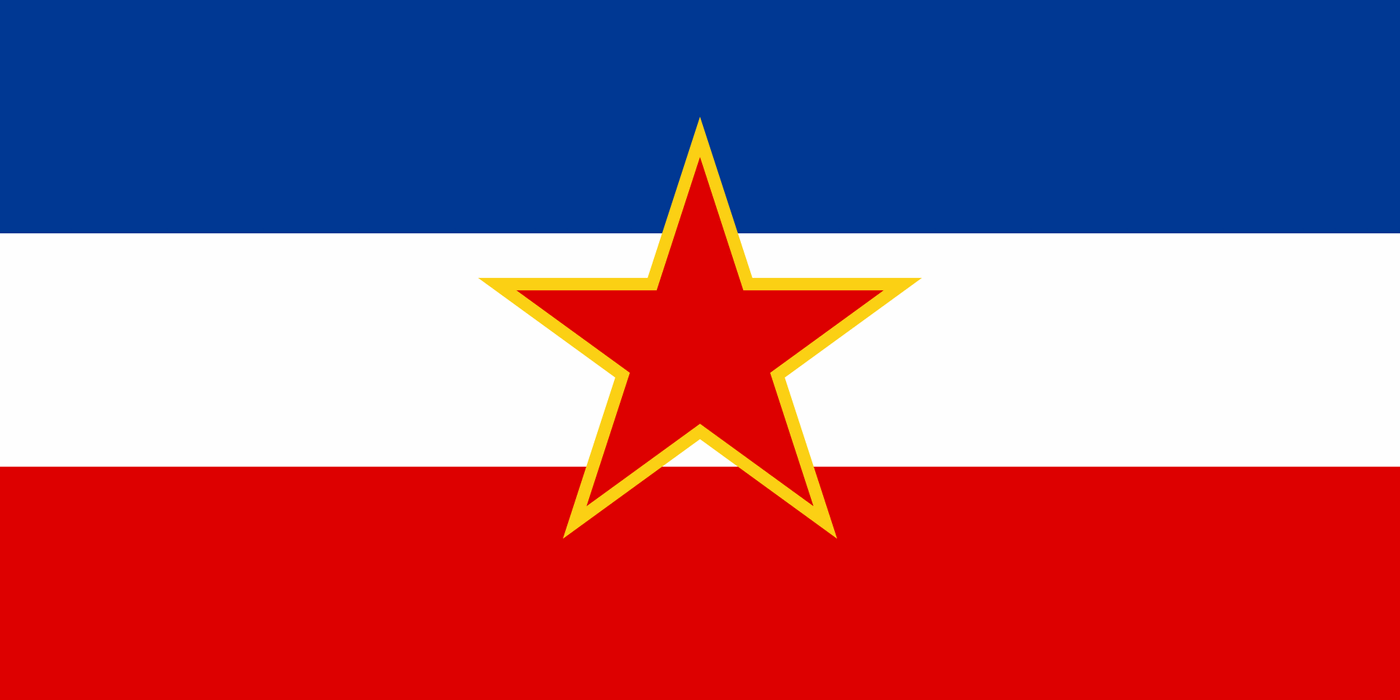
The name then outlived its referent by stages. The remaining federation renamed itself Serbia and Montenegro in 2003, at which point "Yugoslavia" ceased to be the name of any country; that union in turn separated in 2006. The newsgroup sailed on under the old flag, its charter — "Discussions of Yugoslavia and its people" — quietly changing meaning underneath it, from current affairs to remembrance.
.svg)
What filled the room in those later years has a name of its own: Yugonostalgia, the affectionate and complicated retrospect on the vanished federation. In the group it took the form it took everywhere in the ex-Yugoslav world — the rock of the old federation's golden decades, a scene — Bijelo dugme, Azra, Ekatarina Velika and the rest — that had always toured the whole country and never quite divided along the lines the country did; the films and television of the old state; the brands and holidays of a shared childhood — with the particular twist that here the reminiscing happened in the room named after the thing being missed. A group created to discuss a country had become the last institution of any kind still called after it, and its later threads have the quality of a reunion held in a building scheduled for demolition that somehow never comes.
The parallel case of .yu
The newsgroup was not the only piece of network namespace to outlive the state, and the fate of its sibling is instructive. The .yu domain, registered from Slovenia in 1989, became a succession question of its own when the federation dissolved: from 1992 to 1994 it was operated by ARNES, the Slovenian academic network, which used it only for e-mail and declined Serbian institutions' requests for new registrations under it. After the personal intervention of Jon Postel, the founder of the Internet Assigned Numbers Authority, the domain was transferred in 1994 to the Federal Republic of Yugoslavia and administered from the University of Belgrade. It survived the state's 2003 renaming and 2006 separation, and was finally switched off on 30 March 2010, with an estimated four thousand websites still active under it — a country deleted from the Internet's root zone a generation after it left the atlas.
The comparison flatters Usenet's inertia. The domain had an authority obliged to decide its fate, and eventually, one did. The newsgroup had no such authority: nothing in Usenet's machinery obliges anyone to retire a group whose subject has ceased to exist, and removing an established group from thousands of independently administered servers is in practice harder than creating one. So the directory kept a country the root zone eventually dropped. Of the two great namespaces that once said "yu", the older and shabbier one proved the more durable.
What the archive preserves
Within the soc.culture.* hierarchy, this group is the limiting case. The hierarchy gave each nation a room on the tacit assumption that nations hold still; soc.culture.yugoslavia demonstrated what the naming scheme does when one does not, which is nothing. That nothing turned out to be the interesting outcome. Because the room was never closed, it recorded not only a country but the entire arc of a country's ending — the before, the argument, the aftermath — in a single continuous thread of traffic under a single unchanging name.
That accident is what gives the archive its value. The surviving posts are a contemporaneous record of a state's dissolution as experienced, argued and mourned by its scattered citizens, written in real time and without the benefit of hindsight. Read that way, the wartime claims and counter-claims are not information to be trusted but artefacts to be studied — evidence of what people believed, feared and were told, at the moment of believing it. Decades on, that is much the more durable use, and it is the use scholars of the period actually make of such material.
Even the archive's structure is evidence. The crossposting headers show which conversations still spanned the successor groups and which had retreated behind their new borders; the shifting balance of languages and scripts, the appearance and disappearance of posting addresses in one country after another, the slow change in what a subject line could assume its reader already knew — all of it records the period as faithfully as the words do, and none of it was put there on purpose.
A reader coming to the archive now is best served by reading it against its neighbours: the Croatian, Slovenian and Bosnian groups linked above tell the successor states' stories from inside, while this group preserves the one perspective none of them can: the view from the shared room, before, during and after it emptied. It is the sound of a country arguing itself out of existence, and then — quieter, older, incurably attached — arguing about whether it had ever really existed at all.
Reading soc.culture.yugoslavia today
- Historical archive: Google Groups — soc.culture.yugoslavia (coverage varies by group and era).
- Open in a newsreader:
news:soc.culture.yugoslavia— the original site offered exactly this link, and it still works if your system has a newsreader registered for thenews:scheme. - Live access: point an NNTP newsreader at a modern server — see accessing Usenet today.
- The original news2mail e-mail subscription service ended in the mid-2000s and no longer operates.