The talk.* hierarchy
The debate wing of the Big 8: politics, religion, philosophy — subjects the Great Renaming deliberately quarantined into their own hierarchy so the arguments would have somewhere to live. talk.* groups were unmoderated almost on principle, and read like it.
On this page
- A branch designed to be declined
- How a site said no: the feed line
- The alt.* consequence
- The paperwork, and the gaps in it
- Politics, by geography and by question
- The 1992 attempt to subdivide politics
- Religion, and the groups placed elsewhere
- The single-subject rooms
- talk.philosophy
- talk.origins: the longest argument
- The archive that the argument produced
- talk.bizarre
- The words that left the room
- talk.answers, and the FAQ as a way of not starting again
- The killfile, and filtering as the reader's job
- Crossposting, and the Followup-To header
- Moderation, and why the branch mostly declined it
- What the design assumed
- What it left behind
- Scope and limits
A branch designed to be declined
The Great Renaming of 1986–87 is usually described as a tidying exercise, and for six of the seven trees it produced that is a fair description: subjects were gathered, named consistently and given a place to grow. The general account of why it happened, who made it stick and what the B News release of 1986 had to do with it belongs to the explainer on Usenet itself and is not repeated here. What matters on this page is the exception. One of the seven trees was not created to gather a class of subjects but to separate them, and to separate them in a form that let any site in the world decline the whole class in a single stroke.
The subjects were the ones that generated the most traffic and the least agreement: religion argued as a proposition rather than practised as a community, politics in every national and thematic variety, philosophy, and a handful of single questions large enough to need rooms of their own. The distinction between this branch and its nearest neighbour was drawn at the same moment and with the same care — soc.* for people talking as a community, talk.* for people disputing a claim — and the soc.* page sets that split out in full from the other side.
The reason for making the second category separable is on the record twice over, in two accounts that are not in conflict. The first is money. Transatlantic transit was billed by volume, and European networks objected to paying for high-volume, low-content groups on subjects such as religion and race; a categorised namespace let a site drop a whole branch rather than argue group by group. The second is institutional cover: contemporary accounts suggest that some of the administrators who ran the well-connected sites had an interest in bundling the most contentious groups under a label of their own, so that their employers would not object to what the company news feed was carrying. Both explanations circulate; the proportions have been disputed ever since.

The Great Renaming FAQ, compiled from a November 1994 discussion thread in comp.society.folklore and from correspondence with participants, records the mechanism in a participant’s own words. On the authority of a post by Joe Buck it reports that Rick Adams — the B News maintainer generally credited as the Renaming’s initiator — “proposed a ‘talk’ hierarchy for the high flame groups”, and that as the discussion progressed “it was generally understood that if a group was put in talk.* instead of soc.* it would not be as widely propagated”. The idea, on the account it quotes, was that a site administrator “could simply put ‘!talk’ in the configuration file for each connected site that didn’t want these groups”.
That understanding had immediate consequences for naming, and the clearest documented case is a group that ended up somewhere else because of it. The same FAQ records, on the authority of the group’s own FAQ, that what had been net.religion.jewish was widely expected to fare badly as talk.religion.jewish, and that the problem was solved by proposing it in soc.culture.* instead. A prefix, in other words, was not only a statement about subject matter. It was a prediction about how many machines in the world would hold a copy.
The consequence that gives this branch its character follows directly. Because a talk.* group could be refused wholesale and was widely expected to be, proposing a contentious subject there was a way of bringing it into existence without imposing it on anybody. A site that wanted nothing to do with the argument did not have to argue about the argument; it removed one word from a line in a file. The branch was, in that narrow and precise sense, optional by construction.
How a site said no: the feed line
The mechanism was ordinary and is fully documented. RFC 1036, Standard for Interchange of USENET Messages, written by Mark Horton and Rick Adams and published in December 1987 — the year the new names came into use — describes the file that governed what a machine sent to each of its neighbours. It has “one line per neighboring host (plus one line for the local host), containing four colon separated fields. The first field has the host name of the neighbor, the second field has a newsgroup pattern describing the newsgroups sent to the neighbor.” The specimen response printed in the RFC lists one site’s subscriptions as a bare comma-separated series: four local classes, then world,comp,sci,rec,talk,misc,news,soc,to,test.
That is the whole of it. A hierarchy was a word in a list, and a pattern could exclude as well as include. Deciding not to carry talk.* was neither a policy document nor a public act; it was an edit, made once, by one person, on one machine, and nobody outside that machine needed to be told. The decision was also genuinely local: the control message that asks servers to create a group carries no authority beyond the conventions of the software, and each administrator decides whether to act on it. A group therefore existed on the network only to the extent that administrators had independently chosen to hold it.
The clearest surviving statement of how that felt from inside comes not from 1987 but from 1995, in the request for discussion that proposed the paired groups talk.atheism and soc.atheism. Arguing about where in the namespace the new groups should sit, the proposal notes as a plain fact of administration that news maintainers “often treat certain branches of hierarchies similarly”, and adds the exception: “some sites specifically eliminate the *.religion.* groups to avoid controversy”. Its case for the name talk.atheism rests partly on that: “News administrators can easily find it and eliminate it if they so choose.”
It is worth pausing on that sentence, because it inverts the assumption a modern reader brings to the subject. Findability for the purpose of exclusion is being offered as an argument in favour of a name. Eight years after the Renaming, a proponent seeking to create a group about a contested subject treats the ease with which unwilling sites can refuse it as a feature of the proposal, and says so in the formal paperwork. Whatever the backbone administrators of 1987 intended, that is how the branch was understood by the people using it.
The alt.* consequence
The branch also produced, almost immediately, its own opposite. Brian Reid proposed the alt.* hierarchy in 1987 as an alternative to talk.* — a namespace carried outside the influence of the backbone sites, so that their willingness to carry a group would no longer decide whether it could exist at all — and created it with John Gilmore; the first group in it was Reid’s own alt.gourmand. The subject that had made the point sharpest during the Renaming discussion was drugs: the Great Renaming FAQ records that whether there should be a drugs newsgroup anywhere was one of the period’s big debates, and that this was the standard example of a group administrators believed they would never be able to justify to their employers. The alt side of that story — alt.config, the absence of any vote, and what a hierarchy with no gatekeeping did next — belongs to the alt.* page, and the Usenet explainer covers the founding. From this side, the point is simply that talk.* was contentious enough, in the year it was created, to call a rival hierarchy into being.
The paperwork, and the gaps in it
The Internet Systems Consortium still distributes the master files from which any news server can build its group table, and the edition consulted while this page was written — 45,003 names in all — carries thirty-one names beginning with talk. Two of them are marked moderated. The remaining twenty-nine are not, which is the single most informative number on this page and is returned to below.
The same archive holds the administrative record: the requests for discussion, calls for votes and results that news.announce.newgroups published for each proposal. For talk.*, that record is unusually incomplete, and the incompleteness is itself a fact about the branch. Of the thirty-one names on the list today, fourteen have a proposal file in the archive. The paperwork for talk.answers is filed with the other hierarchies’ answers groups under news.*. Three more — talk.politics.drugs, talk.politics.animals and talk.politics.tibet — have no proposal file, but their creating control messages preserve both a charter and a vote count, so the record of how they came about survives in the other archive rather than this one. The talk.politics.tibet message of 3 November 1993 records the largest ballot in the branch’s history: 905 votes for and 268 against. That leaves thirteen names — talk.abortion, talk.bizarre, talk.environment, talk.philosophy.misc, talk.politics.guns, talk.politics.mideast, talk.politics.misc, talk.politics.soviet, talk.politics.theory, talk.rape, talk.religion.misc, talk.religion.newage and talk.rumors — for which nothing survives at either address except a one-line description. They predate the paperwork.
How thoroughly they predate it can be read off the branch’s best-documented proposal. When talk.origins was put up for a change of moderation status in 1997, the proponents had to write the group a charter, because there was not one: “No copy of the original charter of talk.origins is currently available, so one is being defined in this proposal. (Apparently a formal charter was never issued.)” The busiest and most written-about group in the hierarchy had run for roughly a decade without a founding document that anybody could produce.
What does survive for the oldest names are those one-line descriptions, preserved because they were carried in the control messages that told servers to create the groups and in the checkgroups postings that kept the lists in step. RFC 1036 provides for exactly this: the body of a newgroup message “is expected to be a short paragraph describing the intended use of the newsgroup”. A control message of 23 May 1991 gives talk.abortion its description — “All sorts of discussions and arguments on abortion.” — and the identical wording is in the master file today, thirty-five years later. These sentences are the branch’s founding documents in the absence of charters, and their brevity is not carelessness: a description had to fit a line of a file that every server in the world would parse.
One further feature of the record deserves a warning, because anyone browsing the raw archive will meet it at once. The control-message archive for the branch holds 355 talk.* names. Thirty-one of them are on the newsgroup list. Roughly ten more were genuinely proposed and did not make it — a proposal file for them sits in the news.announce.newgroups archive. The great majority of the remainder are forged newgroup messages: a tree of twenty-eight talk.religion.christian.* names posted in May 1996, two later bursts of automated nonsense in 2000 and December 2002, and assorted one-offs. None of that majority appears on the Big-8 list. The branch’s name was evidently an attractive target for anyone testing what a forged control message could do; the durable list ignored the lot.
Politics, by geography and by question
Politics is the largest family in the branch and always was. Thirteen of the thirty-one names on the current list are talk.politics.*, and their descriptions, as the master file carries them, are these:
- talk.politics.misc — “Political discussions and ravings of all kinds.”
- talk.politics.theory — “Theory of politics and political systems.”
- talk.politics.guns — “The politics of firearm ownership and (mis)use.”
- talk.politics.drugs — “The politics of drug issues.”
- talk.politics.animals — “The use and/or abuse of animals.”
- talk.politics.medicine — “The politics and ethics involved with health care.”
- talk.politics.crypto — “The relation between cryptography and government.”
- talk.politics.libertarian — “Libertarian politics & political philosophy.”
- talk.politics.european-union — “The EU and political integration in Europe.”
- talk.politics.china — “Discussion of political issues related to China.”
- talk.politics.tibet — “The politics of Tibet and the Tibetan people.”
- talk.politics.mideast — “Discussion & debate over Middle Eastern events.”
- talk.politics.soviet — “Discussion of Soviet politics, domestic and foreign.”
The organising principle was stated explicitly in a 1992 proposal to extend the family, and it had three axes: geography, meaning a region argued about as a region; issues, meaning a question argued about wherever it arose; and countries. A fourth was proposed at the time for political organisations. The existing names divide neatly along those lines, and the divisions have held: talk.politics.mideast and talk.politics.china are places, talk.politics.guns and talk.politics.drugs are questions, talk.politics.libertarian is a position argued as such.
The charters that survive show how carefully some of those rooms were bounded. talk.politics.drugs, whose creating message of 12 November 1990 records a vote passed on 30 September, exists “to discuss all of the issues purtaining to the politics of drug issues” — the typing error is in the original — and lists legalisation, the abuse and usefulness of drug laws, the war on drugs, drug testing and privacy. talk.politics.animals, created on 5 December 1991 after a vote of 189 to 58, covers “the use and abuse of (non-human) animals” and then asks, in the charter itself, that questions with little bearing on animal welfare be taken elsewhere: the example it gives is “I’ve bought a cat, when should I feed it?”, which belongs in rec.pets.*. A charter in this branch was as often a request to keep traffic out as a statement of what belonged in.
talk.politics.soviet is the name that reads oddly now, and it reads oddly for the ordinary reason: the group outlived its subject by more than three decades and is still on the list. Nothing removed it. Removal on Usenet requires somebody to propose it, argue it and carry it, and for a quiet group nobody ever does; the namespace therefore preserves the political geography of the late 1980s the way a street name preserves a demolished building.
One politics group did leave, and its departure is instructive because it went in the direction nobody expects. talk.politics.space was created on 29 July 1991, having passed its vote 142 to 23, with a charter covering “the politics of space exploration, development, and scientific research” — funding levels, policy, the activities of legislators. On 14 March 1994 the moderator of news.announce.newgroups issued a removal message with a three-line explanation: the group “has been superseded by sci.space.policy, an unmoderated newsgroup which passed its vote for creation by 399:66” as reported on 7 December 1993. A subject arrived in talk.* as a political argument, acquired a constituency that preferred to treat it as policy, and moved into the science hierarchy by a vote nearly three times the size of the one that had created it.
The 1992 attempt to subdivide politics
The most complete single episode in the branch’s administrative history is a failure, and it is worth setting out because it explains why the politics family looks the way it does. On 2 June 1992 a proponent posted a request for discussion to expand talk.politics.* wholesale, on the ground that new groups would “ease the load on talk.politics.misc and make political discussions on geographical areas like Europe possible”. The proposal kept the existing three-axis taxonomy and added rooms along all of them: continents and regions, individual countries, thematic questions, and a new class for organisations, of which the two named examples were the United Nations and the European Community.
By the time it reached the ballot it had grown to thirty-nine groups voted on at once. The result was posted on 28 August 1992 and is unambiguous: 289 valid ballots were received, and every single proposal failed. The vote-taker gave one reason for all thirty-nine — “there was no 100 yes-vote margin over no-votes on any of the groups”. Several came close on the ratio: talk.politics.usa.misc led the field at 130 to 57, and talk.politics.antarctica brought up the rear at 66 to 90. The guidelines then in force barred the subject from being raised again for six months.
The Big-Seven rule required both a two-thirds majority and an absolute margin of a hundred votes, and the second condition is the one the omnibus could not meet: no group on the ballot drew more than 130 yes votes from an electorate of 289 spread across thirty-nine simultaneous questions. Whether a shorter ballot would have concentrated those votes is not something the record establishes, but the branch’s later history is at least consistent with it.
The corrective is on the record, and it began within ten weeks. talk.politics.medicine, proposed on its own, passed 137 to 26 in a result reported on 2 November 1992 and was created a fortnight later — seven fewer yes votes than the omnibus’s best performer had drawn, but less than half the opposition, and therefore a margin of 111. talk.politics.libertarian, which had failed in the omnibus at 134 to 70, was proposed again on its own and passed 266 to 23 in a result reported on 29 November 1994: twice the yes votes and a third of the no votes, for the same name and substantially the same subject. Every addition to the politics family arrived that way, one at a time — talk.politics.drugs in 1990, talk.politics.animals in 1991, talk.politics.china and talk.politics.medicine in 1992, talk.politics.crypto and talk.politics.tibet in 1993, talk.politics.libertarian in 1994, talk.politics.european-union in 1995. The branch could create groups perfectly well. It simply could not create them in bulk.
Religion, and the groups placed elsewhere
The religion family on the current list runs to six names: talk.religion.misc (“Religious, ethical, & moral implications.”), talk.religion.newage (“Esoteric and minority religions & philosophies.”), talk.religion.bahai, talk.religion.buddhism, talk.religion.pantheism and talk.religion.course-miracle. Only the first two are Renaming originals. The rest were voted in one at a time and late: talk.religion.buddhism on 19 October 1994 by 386 to 31; talk.religion.course-miracle in March 1996; talk.religion.pantheism on 17 March 1998 by 127 to 25; talk.religion.bahai on 26 August 1998 by 155 to 52.
What is absent from that list is as informative as what is on it. There is no talk.religion.christian, no talk.religion.jewish, no talk.religion.islam. Those subjects were placed, deliberately, in soc.religion.* and soc.culture.*, where the charters described faith as practised rather than faith as a proposition to be tested, and where moderation was the norm rather than the exception. The boundary the Renaming drew was between talking with people and arguing at them, and on the religion question it was drawn with unusual deliberation. It is still legible in the master file: the description of soc.culture.jewish ends with a cross-reference, “(cf. talk.politics.mideast)”, pointing readers who want the argument at the room built for it.
The most fully documented instance of that boundary being drawn again, from scratch, in public, is the 1995 proposal that created talk.atheism. The proponent asked for two groups at once and put them on opposite sides of the line: talk.atheism, unmoderated, for “debates about atheism … atheism vs. religion discussions, logical justifications of atheism, problems defining religion and gods, as well as critical evaluations of commonly held atheist views”; and soc.atheism, moderated, for “the social aspects, ramifications, and benefits of being an atheist”. Each charter excluded the other’s business by name, the soc.* charter listing “atheism vs. religion discussions, conversion attempts, and general discussions about correctness or justification of atheism” as specifically out of scope.
The moderation scheme proposed for the soc.* half was modest and mechanical: a central automated script to reject crossposted articles and obvious off-topic material, forwarding the remainder to one of three named moderators, on the reasoning that the traditional single moderator is “too prone to disaster (if the moderator leaves, for instance)”. Both groups passed in a result posted on 13 October 1995 — soc.atheism 191 to 55, talk.atheism 178 to 58 — and the two names entered the list together.
Only one of them is on it now. The Big-Eight group list of 16 October 2002 still carries both, soc.atheism described as “Living as an atheist and atheism in society. (Moderated)”; the list today carries talk.atheism alone, with the description “Debate about the validity and nature of atheism.” The moderated half of a matched pair, requiring volunteers to keep working, did not last; the unmoderated half, requiring nothing of anybody, did.
That is a pattern rather than an accident, and the two lists measure it. In October 2002 the soc.religion.* family held sixteen groups, fifteen of them moderated; today it holds three, one of them moderated. Over the same twenty-four years the six unmoderated names in talk.religion.* have not changed at all — including talk.religion.bahai, whose moderated counterpart soc.religion.bahai was on the 2002 list and is not on the list today. Wherever a group depended on a person continuing to read an inbox, the group is the one that went.
talk.religion.course-miracle is the branch’s most completely documented life cycle, and it is worth following because it shows every stage of the machinery in one file. A group for discussion of the book A Course in Miracles was proposed in April 1995 and failed on 11 July 1995 at 123 to 69 — short of the two-thirds majority the rules required, and far short of the hundred-vote margin. It was proposed again in January 1996 and passed on 19 March 1996 at 299 to 84. Its charter contains a clause of a kind that appears nowhere else in the branch: “Due to the nature of the teachings of A Course in Miracles, it is not necessary to discourage any flames in discussions about ACIM, but discussions unrelated to A Course in Miracles shall be discouraged.” A charter that declines, on doctrinal grounds, to discourage flaming is a genuinely unusual document.
Eight years later the same file records a request for discussion proposing the group’s removal, posted on 27 April 2004 by someone writing on behalf of the community that had asked for it. The rationale is a compact history of why a Usenet group stops being useful: it was created when there were few alternatives, at a time “when many people paid their ISPs per email” and the mailing lists were therefore not an option for everyone; that rationale, the proposal says, “is now passe”. It adds that the group “is not in conformity with its own Charter and new people coming to the group expecting to find a discussion of ‘A Course In Miracles’ are usually quite confused by what they find instead”. The removal did not happen. talk.religion.course-miracle is on the list today, twenty-two years after its own users proposed getting rid of it.
The single-subject rooms
Alongside the two large families sit the groups that took one question each, because no politics or religion room was going to hold them. The master file describes them in a line apiece: talk.abortion, “All sorts of discussions and arguments on abortion.”; talk.environment, “Discussion the state of the environment & what to do.” — the missing preposition is in the original and has survived every republication of the file since; talk.euthanasia, “All aspects of euthanasia.”; talk.rumors, “For the posting of rumors.”; and talk.rape, “Discussions on stopping rape; not to be crossposted.”
That last description is unique. Of all 45,003 names in the current master file, talk.rape’s is the only entry in the Big Eight whose description carries an instruction about crossposting, and the wording has been carried unchanged in the control messages since at least 23 May 1991. It is not a charter, it has no enforcement behind it and no software reads it as a rule; it is a request, addressed to every reader of every group list on every server in the world, written in the only field available. It is also the branch’s clearest single piece of evidence that its participants understood exactly which mechanism did the damage.
These rooms had a second life as reference points elsewhere in the namespace. Three descriptions in the alt.* hierarchy consist of nothing but a redirection to one of them: alt.flame.abortion reads “Use talk.abortion instead.”, alt.earth.crisis reads “Use talk.environment instead.”, and alt.internet.talk.bizarre reads “Use talk.bizarre instead.” The traffic between the two hierarchies did not run only one way. For subjects that already had a well-propagated Big-Eight room, alt.* names were sometimes created and then formally pointed back at it.
talk.philosophy
Philosophy occupies two names. talk.philosophy.misc — “Philosophical musings on all topics.” — is one of the branch’s undocumented originals, with no proposal on file and no charter. talk.philosophy.humanism was added by vote in 1994: it passed 145 to 33 in a result posted on 8 November 1994, with a charter of exactly one sentence culled from the call for votes, “This newsgroup should serve as a meeting place for individuals who consider themselves humanists.” The proposal began life on 1 September 1994 under the name talk.religion.humanism and was moved to the philosophy branch a fortnight later, in its second request for discussion, which is a small illustration of how much a second-level word was thought to determine.
The names that did not make it are documented too, and one of them is the omnibus argument in miniature. talk.philosophy.objectivism, for discussion of the philosophy of Ayn Rand, was put to a vote twice, in 1990 and again in 1992. The second attempt failed in a result posted on 6 January 1993, and the vote-taker set out precisely why: “There were 173 yes-votes and 78 no-votes … This satisfies the requirement that at least 2/3 of the votes be yes-votes. However, the number of yes-votes exceeded the number of no-votes by 95, which falls short of the required 100.” He added an editorial line of his own: “I am quite surprised that only 251 people in usenet.land cared enough to vote on this group.” The control archive separately holds newgroup messages for talk.philosophy.cosmology, talk.philosophy.epistemology and talk.philosophy.metaphysics, none of which ever reached the Big-Eight list and none of which has a proposal on file; the record does not say whether those were abandoned proposals or forgeries.
Both surviving groups, and the branch they form, are described in detail on the talk.philosophy page, which is where this directory keeps that material; talk.philosophy.humanism has a page of its own, linked from the group list above.
talk.origins: the longest argument
talk.origins is the best-documented group in the branch and one of the best-documented arguments on Usenet. Its subject is the dispute between evolutionary biology and creationism, and the charter written for it in 1997 defines the scope as “the scientific, religious, and political issues pertaining to various theories of the origins and evolution of life and the universe”. Its master-file description has never changed and is characteristically blunt: “Evolution versus creationism (sometimes hot!).”
The group came into the branch from net.origins, which dates from 1986; the 1997 paperwork records the descent in two words, “formerly net.origins”. Its placement was of a piece with the Renaming’s general logic: the dispute had been conducted in the science groups, and the new namespace gave it an address of its own outside them. The science hierarchy’s side of that story belongs to its own page, which notes the departure in passing. The same argument was also conducted, later and separately, in alt.* — see alt.evolution for one of those rooms, and alt.bible for another; both have pages of their own in this directory and neither is restated here.
What the group’s administrative record documents, across two years and four requests for discussion, is not the argument but the crossposting. The first attempt to do something about it was posted on 19 July 1995 and proposed installing a robomoderator that would reject any article naming any group other than talk.origins outright. The proposal’s distribution line names two newsgroups: talk.origins, and rec.arts.puppetry, annotated “latest victim”. That single line conveys the problem better than any description could. A thread in talk.origins could arrive, unbidden, in a group about puppetry.
The serious attempt ran from November 1996 through three successive requests for discussion into February 1997, and its rationale is precise about what it is and is not aiming at. The group, it says, “has of late seen a considerable increase in the amount of traffic crossposted to/from unrelated newsgroups, and also crossposts made to groups in a clear attempt to cause excessive amounts of flaming and off-charter discussion”. Against that, the proposal was to robomoderate on one criterion only: an article naming more than four newsgroups in either its Newsgroups or its Followup-To header would be returned to the sender. Everything else was to pass. The text is emphatic on the point: “It is to be stressed that no content-based moderation is proposed or advocated in this RFD.”
The charter goes further than most in guarding against the moderators it was creating. A copy of the moderation scripts was to be kept “on a publicly-accessible web site for inspection”. Cancellation of articles was permitted to the moderator only where they violated the crosspost limit. Requests for discussion and calls for votes carrying prior approval from news.announce.newgroups were exempted, so the group could not be used to suppress proposals about itself. And a clause required a full revote on the moderation status six months after it took effect, conducted by a neutral vote-taker, with the provision that if either the moderator of talk.origins or of any other group refused to permit or conduct that revote, “the revote shall be assumed to have passed, and the newsgroup shall immediately revert to an unmoderated status”. The people asking for a moderator wrote themselves a deadline and a default.
The vote was taken by a member of the Usenet Volunteer Votetakers. It was interrupted once: on 16 April 1997 the vote-taker posted a notice that the machine he counted ballots on was down — “due to an air conditioning problem” — and that ballots sent during the outage would bounce back to their senders, and a second call for votes was issued the following week. Voting closed at 23:59:59 UTC on 3 May 1997 and the result was posted two days later: 201 in favour, 63 against, out of 264 valid votes, with five abstentions and three invalid ballots. The named moderators were David Iain Greig and James Lippard. talk.origins is one of only two names in the branch marked moderated on the master file today, and what it moderates is the number of groups in a header.
The archive that the argument produced
The lasting thing talk.origins made was not a conclusion but a reference work, and its history is documented independently of Usenet. From the group’s early years its regulars had written and periodically posted FAQ documents on particular questions. In 1994 Brett J. Vickers collected several of those separately posted FAQs and put them on a single anonymous FTP site. In 1995, then a computer science graduate student at the University of California, Irvine, he turned the collection into a website. In 2001 he transferred it to Wesley R. Elsberry, who organised a group of volunteers to maintain it, and in 2004 Kenneth Fair incorporated the TalkOrigins Foundation as a Texas non-profit. The TalkOrigins Archive outlived the traffic that produced it by decades.
What it holds is an accumulation of the group’s working documents rather than a rewriting of them: FAQs and what it calls Frequently Rebutted Assertions, an index of creationist claims with responses and links to source material, a sub-site on hominid fossils, a project examining quotations taken out of context, and a monthly compilation of reader feedback with replies. The form is recognisably Usenet’s — a periodic posting, maintained by whoever cared enough to maintain it, kept in one place so that the same ground need not be covered again — scaled up and given a permanent address.
Its reception is a matter of record and is stated here as such. The New York Times described it in 1999 as a “good antidote” to the creationist websites then appearing; Scientific American singled it out in August 2002 for its detailed discussions and bibliographies; the web pages of the National Academy of Sciences, the Smithsonian Institution and other bodies recommend it; and it is referenced in college-level textbooks. It should be equally plain what the archive is: a participant in the dispute, presenting the scientific case against antievolution claims, not a neutral summary of a controversy. This page describes what the group and its archive are and how they came about, and adjudicates nothing.
The narrower historical point is the one worth keeping. An unmoderated newsgroup, on the most intractable subject its hierarchy contained, over roughly a decade, accreted a body of written reference material substantial enough to be incorporated, hosted, cited and taught. Nothing else in talk.* did that. It is a documented counter-example to the assumption that argument at volume produces nothing but volume — and it is exactly one instance.
talk.bizarre
talk.bizarre is filed with the politics and religion groups and has nothing whatever to do with them. It came into the branch from the old net.bizarre by the Renaming’s general sweep rather than by any kinship of subject, and it belongs to a different history: it was one of Usenet’s performance venues, a room where the writing itself was the point and a thread might be a collaborative exercise in tone rather than a dispute with sides.
Its description is the one place in the branch where the wording demonstrably drifted. The control message of 23 May 1991 that carries descriptions for most of the old talk.* names gives talk.bizarre’s as “The unusual, bizarre, curious, and often stupid.” The master file today reads “The unusual, bizarre, curious, and often interesting.” Nothing in the archive records who changed the last word, or when. It is a useful corrective to the impression the talk.abortion line gives, that these sentences were fixed for ever the moment they were written.
The group has no proposal on file, no charter and no recorded vote, and it is on the newsgroup list today, unmoderated, as it has always been. It very nearly was not. The control archive preserves a newgroup message declaring that “talk.bizarre has gotten totally out of control”, that “a responsible individual is needed to control cross-posting and followups”, and that the group would henceforth be moderated, with a named volunteer and an instruction to update the mailpaths file. The message is dated 1 April 1991, and nothing came of it. As a specimen of what an unauthorised control message looked like, and of how thin the line between administration and performance could be on this network, it is hard to improve on.
The words that left the room
The evidence that talk.bizarre was read far outside its own subscriber list is lexical. The Jargon File — the hacker lexicon that is the usual source for this vocabulary, and an idiosyncratic one — traces four items of general net language to the group, and its wording is worth quoting exactly, because the claims are narrower than they are usually reported to be.
- plonk, defined as “the sound a newbie makes as he falls to the bottom of a kill file”. The entry says it “originated in the newsgroup talk.bizarre” and was, as of 1994, “widespread on Usenet as a form of public ridicule”.
- newbie, a Usenet neophyte. The entry derives the word from British public-school and military slang for a new boy and says only that it “surfaced in the newsgroup talk.bizarre” before passing into wide use — a claim about where the term entered the network’s vocabulary, not about who coined it.
- newsfroup, a mistyping of newsgroup, “originally a typo but now in regular use on Usenet’s talk.bizarre”. It belongs to a small family of deliberately adopted typographical errors that the same dictionary lists together.
- the Eric Conspiracy, the running joke about a shadowy cabal of moustachioed hackers named Eric, which the entry dates to “an infamous talk.bizarre posting ca. 1987” and connects to the Monty Python material of the period.
One of the four escaped the network altogether: newbie is now ordinary English. Plonk is not, but it survives wherever people who learned to argue on Usenet still argue, and its interest here is structural rather than lexical: it is the noise of a private act being performed in public, and that combination is discussed below.
The form travelled as well as the vocabulary, and the clearest case of a joke of this kind outgrowing Usenet entirely happened in the German hierarchy’s own bizarre group. On 16 May 1994 Achim Held, then a computer science student at the University of Kiel, posted to de.talk.bizarre the claim that the city of Bielefeld does not exist — a satire built on three questions (do you know anyone from Bielefeld; have you been there; do you know anyone who has), to all of which most Germans could truthfully answer no. Held has said since that it was intended purely as a joke. The Bielefeld conspiracy outran him: the city council issued a press release on April Fools’ Day 1999 headed Bielefeld gibt es doch!, ran its 800th-anniversary celebrations in 2014 under the motto Das gibt’s doch gar nicht, and in August 2019 offered a million euros for incontrovertible evidence that the city does not exist. The competition was declared closed on 17 September 2019: more than two thousand entries had arrived from around the world and none had proved anything, and a boulder was set up in the old town, in Held’s presence, to mark the end of the affair. Chancellor Angela Merkel had alluded to the joke in public in November 2012, remarking of a town-hall meeting she had attended in Bielefeld that she had the impression she had been there.
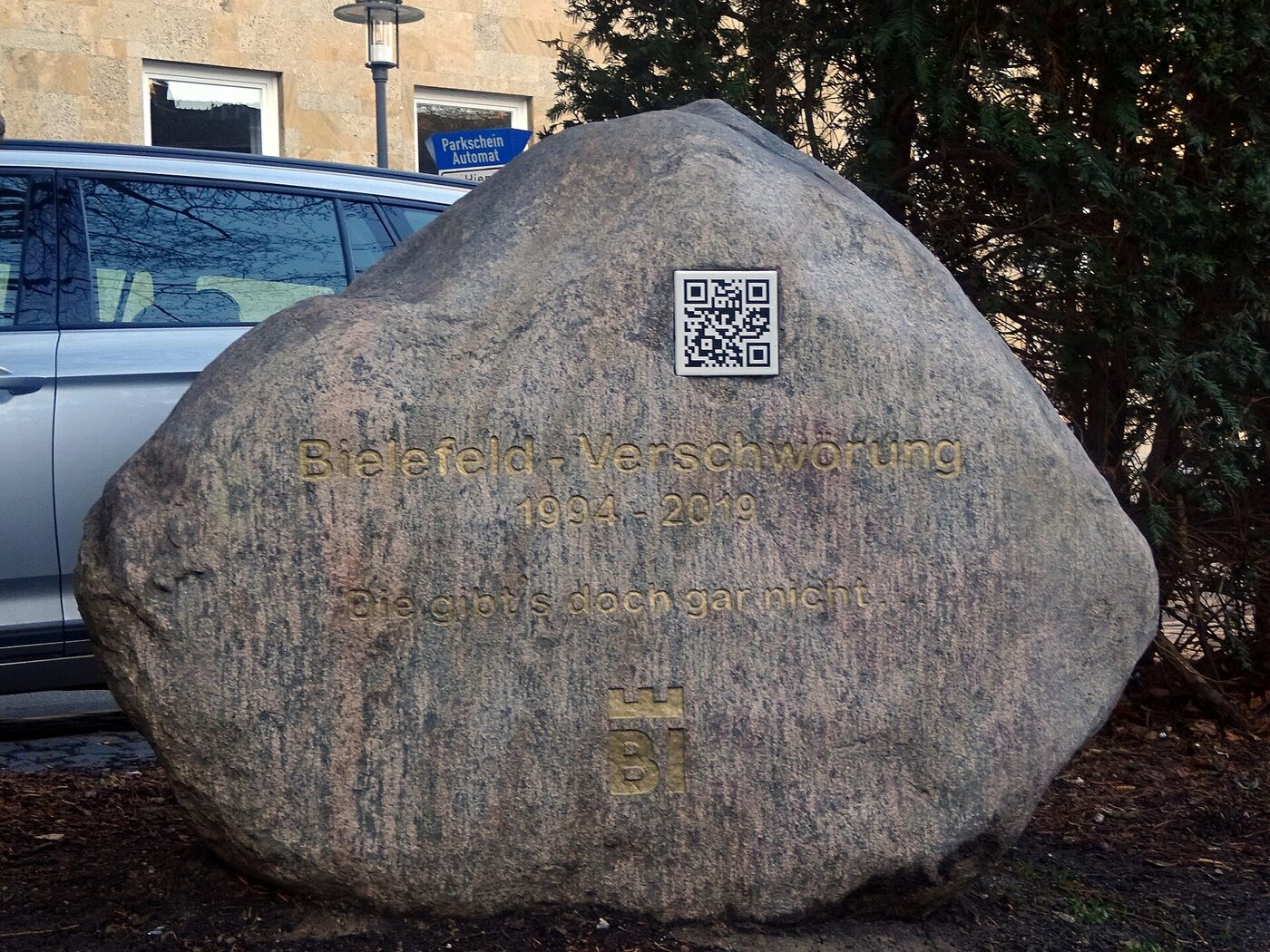

de.talk.bizarre is not a talk.* group; the German hierarchy is separately governed and merely shares the second-level word. But it is the clearest demonstration available of what the form invented in this branch could do once it left it.
talk.answers, and the FAQ as a way of not starting again
The one piece of editorial machinery the branch acquired was a shelf for its reference documents. The idea was put to Usenet on 10 April 1991 in a request for discussion for a group in which to crosspost FAQ lists, whose proposed charter ran to a single sentence: “A newsgroup devoted to assembling various Frequently Asked Question (and answer) lists (FAQ’s) in one place for ease of reference and archival.” The group that resulted, news.answers, was moderated from MIT by Jonathan Kamens.
Within eighteen months it was a victim of its own success, and the proposal to split it, posted on 18 October 1992, lists four problems with unusual candour. Some sites did not want to carry it because it was too large. Readers could no longer keep up with it, which defeated one of the purposes set out in its charter. Some users and administrators objected to the mingling of periodic postings of very different kinds in a single group — the moderator notes having received complaints about specific postings and requests that he withdraw permission for them. And the moderator’s own workload had grown: “Although it is certainly not yet unbearable, it’s getting there.”
The solution was one answers group per hierarchy, and the mechanism is worth stating precisely because it depends on a feature of Usenet that has no modern equivalent. A FAQ was not posted separately to each destination; it was posted once, naming several groups at a time, so that a FAQ for a hypothetical comp.foo would be crossposted to comp.foo, comp.answers and news.answers together. A single stored copy therefore appeared in all three. The proposal notes the corresponding trick for administrators who wanted the FAQs without the bulk: putting !news.answers in the feed configuration meant only the crossposted copies arrived, “therefore not taking up additional space in the news spool”. Crossposting, which is the mechanism that made this branch ungovernable, is the same mechanism that made its reference shelf cheap.
Six answers groups were voted on together. talk.answers passed 232 to 35 — the narrowest of the six, and comfortably clear all the same — and the result for all of them was posted on 6 January 1993, the voting period having closed on 20 December 1992. Kamens moderated all six initially and asked in the same posting for volunteers to share the work. The group is on the list today, described as a “Repository for periodic USENET articles”, and it is one of the branch’s two moderated names.
What a FAQ did inside a talk.* group is the part that matters here. It fixed, in a citable document, the ground the group considered settled — definitions, standard objections and the standard responses to them, the state of a factual question, the history of the group’s own recurring threads — so that a newcomer could be pointed at it instead of being answered from scratch yet again. It was a device for not re-arguing, in a hierarchy expressly built for arguing. It did not work particularly well, since nothing obliges a reader to read anything. But it is the reason the branch left written material behind at all: the FAQs that talk.origins accumulated, and that became the TalkOrigins Archive, are precisely these documents.
The killfile, and filtering as the reader's job
An unmoderated group leaves exclusion to the reader, and the network had the tool for it three years before this branch existed. The kill file arrived with rn, Larry Wall’s newsreader, released in 1984 — one of the first newsreaders to take full advantage of a character-addressable terminal, and the one in which the kill file was first implemented. The file was called, without ornament, KILL. It held regular expressions; an article that matched one was marked as already read and never presented. The Jargon File’s definition describes matching on “subject, author, or other header lines”, which is the range later implementations allowed.

The design assumption behind it is stated most clearly in the account of what came next. As volume grew, the model shifted — in the standard formulation — from “read most, kill few” to “ignore most, read few”, and a kill file could not keep up. Kim F. Storm’s nn was the first newsreader built for the new model, presenting a selectable menu of threads rather than a stream of articles. Wayne Davison’s trn brought threading to rn as a set of patches, so that a reader could discard an entire conversation with one keystroke rather than each of its articles in turn. Scoring — overlapping weighted rules that push an article above or below a threshold instead of simply killing it — began in a fork of trn called strn and was later folded back into trn itself. This directory’s page on the nn newsgroup covers that lineage and the arguments about it in detail.
The important property, for this branch, is what a kill file does not do. It removes a poster from one reader’s copy of a group and from nobody else’s. The articles remain, propagate normally, are stored on every server that carries the group, and are read by everyone who has not made the same decision independently. Filtering on Usenet is a statement about a reader, not about a group, and it is the exact inverse of moderation, which is a statement about a group made on behalf of every reader at once.
Which is what makes the branch’s contribution to the practice so odd. A kill file is silent by construction; the word for using one is not. To plonk somebody was to announce that you had killfiled them, in the group, in front of the audience the other person was writing for. The Jargon File records the term as widespread by 1994 specifically “as a form of public ridicule”. The private mechanism thus acquired a public performance, and in a hierarchy where the audience was the whole point, the performance was frequently the object of the exercise. The filter removed one reader’s exposure to a poster; the announcement was addressed to everyone else.
Crossposting, and the Followup-To header
If one mechanism explains the branch’s administrative history, it is crossposting, and the specification is short enough to quote. RFC 1036 provides that the Newsgroups header “specifies the newsgroup or newsgroups in which the message belongs. Multiple newsgroups may be specified, separated by a comma. Newsgroups specified must all be the names of existing newsgroups, as no new newsgroups will be created by simply posting to them.” One copy is stored and appears in each named group; a reader who has seen it in one is not shown it again in the next.
The companion header is the one that decides where the consequences land. The Followup-To line, the RFC says, “has the same format as ‘Newsgroups’. If present, follow-up messages are to be posted to the newsgroup or newsgroups listed here. If this line is not present, follow-ups are posted to the newsgroup or newsgroups listed in the ‘Newsgroups’ line.” It adds one special case: “If the keyword poster is present, follow-up messages are not permitted. The message should be mailed to the submitter of the message via mail.”
Read together, those two headers are a complete description of how an argument escapes the room built for it. An article naming six groups enters six conversations simultaneously and, if its Followup-To names a seventh, sends every reply somewhere none of the six chose. The branch was designed on the assumption that a contentious subject could be confined by giving it an address that unwilling sites could refuse. Nothing in that design addresses an article that names an unwilling group in its own headers. A site could decline to carry talk.origins; it could not decline to have talk.origins arrive inside an article addressed to rec.arts.puppetry.
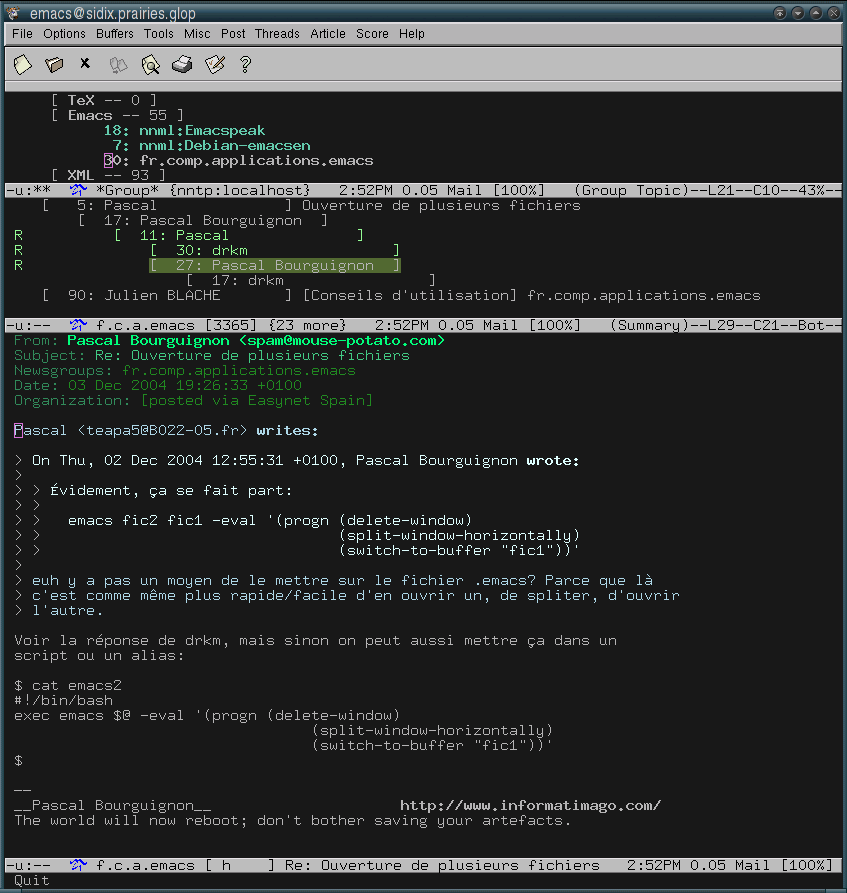

Every substantive administrative action in the branch’s history is about this. The 1995 and 1997 talk.origins proposals are about crossposting and nothing else. The talk.rape description asks, in the only field available to it, not to be crossposted to. The talk.politics.animals charter asks that off-topic questions be taken to rec.pets.*. The soc.atheism moderation scheme proposed in 1995 begins with a script to reject crossposts. The *.answers groups were designed around crossposting as a feature. Content was never the object of any of it; the address list always was.
Moderation, and why the branch mostly declined it
Moderation on Usenet is a mechanism before it is a policy. A submission to a moderated group is mailed to the moderator rather than injected; the moderator either discards it or posts it with an Approved header attached, which RFC 1036 makes “required for any message posted to a moderated newsgroup”, and conforming servers propagate articles in that group only if the header is present. There is no enforcement beyond the conventions of the software and the willingness of administrators to honour them.
The branch made almost no use of it. Of the thirty-one names on the current list, twenty-nine are unmoderated. The two exceptions are talk.answers, which is a repository for periodic postings rather than a discussion group, and talk.origins, whose moderator is a script counting entries in a header and whose charter forbids content-based judgement in terms. Neither of them moderates an argument. In a hierarchy created to hold the network’s most intractable disputes, no group has ever had an editor.
That is not because moderation was unavailable or untried. It was tried, repeatedly, and consistently landed on the other side of the boundary. The 1995 atheism proposal put moderation on the soc.* group and left the talk.* group open, by design and with reasons given. The 2002 group list shows the same division at scale: fifteen of the sixteen soc.religion.* groups moderated, none of the six talk.religion.* groups. The pattern is consistent enough to read as a convention: the Renaming had defined talk.* as the place where argument was permitted to run, and moderating a talk.* group would have contradicted the reason for putting a subject there in the first place.
The convention had a cost, and the 1997 talk.origins paperwork is honest about it. Having accepted robomoderation on one narrow criterion, the proponents surrounded it with the machinery of an institution that does not trust itself: published scripts, an explicit prohibition on content-based rejection, an exemption for proposals about the group, and an automatic revote after six months that would default to unmoderated status if anyone obstructed it. That is the shape of a community accepting the minimum viable amount of authority and building the fuse in before switching it on.
What the design assumed
It is worth stating, with attribution rather than as a verdict, what the branch was built to do and what the record suggests it actually did.
The design assumption is not in dispute and is recorded in several places. The Renaming’s participants, as the Great Renaming FAQ reports them, expected that a group placed in talk.* “would not be as widely propagated”, and treated that as the solution to a problem about cost and about what employers would tolerate. The encyclopaedic account of the alt.* hierarchy’s origins puts the reception more briefly: “the creation of the talk.* hierarchy for discussions of controversial or sensitive issues by the renaming did not go well”, and alt.* was suggested as an alternative to it. The 1995 atheism proposal shows the assumption still operating, and still being used as an argument, eight years later.
What the design achieved is what it was engineered for. A site could refuse the whole class of subjects in one line of a configuration file, and the paperwork of 1995 takes for granted that sites did. Whether that arrangement made the rest of the Big Eight easier for universities and companies to carry is a proposition the surviving record does not settle either way, and it is not asserted here.
What it did not achieve is containment of the argument, and the reason is mechanical rather than moral. Distribution is governed by the Newsgroups header, which is written by the poster, not by the branch. A hierarchy that can be excluded from a feed cannot be excluded from an article. The observation that follows — that the design treated argument as something that could be contained by naming a place for it, when the medium’s own addressing made every place reachable from every other — is an inference from the administrative record set out above, offered as such. Nobody in 1987 wrote it down; the branch’s entire subsequent paperwork is about crossposting.
Two further conclusions the record does not support are worth naming, since both are commonly asserted. The groups did not collapse: many ran for a decade or more and a number remain open. Neither did they converge, the subjects having been assigned here precisely because they were not expected to settle. What the branch demonstrates, over years and at volume, is the narrower proposition that an argument can be sustained indefinitely without being resolved, and that sustaining it required no moderator, no membership and no rule beyond the ones readers applied to their own copies.
What it left behind
Three things outlived the traffic. The first is documentary. The FAQs that the argument groups maintained had a life independent of the groups, because *.answers gave them an address and because a FAQ is a file rather than a conversation; the TalkOrigins Archive is the branch’s largest example, incorporated as a foundation seven years after the group that produced it was robomoderated, and it is still there. The second is lexical: newbie in general English, plonk and newsfroup in the residual dialect of people who learned to argue on this network, and the Bielefeld conspiracy in a German city’s own marketing.
The third is the argument itself, which went elsewhere. Political and religious dispute had less holding it to Usenet than most subjects did, and it left in stages: mailing lists, then web message boards, then comment sections beneath articles, each offering the same discussion with one addition Usenet could not supply — an owner who could remove a participant. Groups whose value lay in accumulated expertise, as in comp.* and much of rec.*, had a reason to stay where the expertise was. Groups whose value lay in the argument itself did not, and the usual account is that this branch thinned faster than its siblings. The news2mail gateway that produced this directory carried these names between 2000 and 2004, well after that movement had begun.
The namespace, meanwhile, simply stopped. The Big-Eight group list of 16 October 2002 carries thirty talk.* names; the list today carries thirty-one, and every one of the thirty is still on it. Nothing has been removed from the branch in almost a quarter of a century. Over the same period the soc.* list fell from 268 names to 213. Exactly one name has been added to talk.*: talk.us.rhode-island, created on 6 August 2008 after a last call for comments on 29 July had opened a five-day comment period, by a vote of the Big-8 Management Board — six in favour, two against. It is the branch’s last creation and its only one decided by a board rather than by a ballot of readers, the board having been assembled as a preliminary body in November 2005 and constituted in March 2006 as participation in the old votes fell away.
Thirty-one names, twenty-nine of them unmoderated, none of them removed, one of them added in eighteen years, and a description for talk.politics.soviet that has outlasted the Soviet Union by more than three decades. That is what a hierarchy looks like when the rules for creating things are strict, the rules for removing them require somebody to care, and everybody has gone.
Scope and limits
This page is an index and a history. It holds no talk.* messages, and this site preserves no message archive for any group in the branch. What it can honestly offer is an accurate account of what each name was for, what its administrative record contains, and what world it belonged to; where a group’s own documentation does not survive — which, as set out above, is the case for thirteen of the thirty-one — the page says so rather than filling the gap.
No position argued in any of these groups is endorsed or refuted here, and none is adjudicated. Where a position has had to be named it has been named as its holders named it, usually by quoting the charter or proposal in which they named it. No living person is characterised. Individuals appear only where the administrative record makes them a matter of public fact — a proponent, a moderator, a vote-taker — and appear as that and nothing else.
The surviving record has a bias that matters more here than anywhere else in the Big Eight, and it follows directly from the first section of this page. Usenet archives were assembled out of what institutions happened to have on their spools, and an institution held only what it had agreed to receive. A university that dropped talk.* from its feed — and the branch existed so that universities could — had nothing in that branch to donate to anyone afterwards. The hierarchy most often declined should therefore be expected to have come through in worse shape than its siblings: not because less was written in it, but because fewer copies of it survived to be collected. That is a statement about the evidence, not about the groups.
Two further gaps are the posters’ own, and both bite hardest where people argued under their own names. An X-No-Archive header kept an article out of the archives from the moment it was written. Deja News, which began indexing Usenet in March 1995 and made it searchable across all archived groups and by author, introduced a facility — after protests from users and legal pressure — for posters to remove their own messages permanently from its search results. A third gap is nobody’s fault: when the service was rebuilt around a shopping business in 1999 and its servers were relocated, many older messages became unavailable. Google acquired the archive in February 2001 and moved it to Google Groups, and by the end of that year had supplemented it with donated collections reaching back to 11 May 1981; it stopped supporting new Usenet content on 22 February 2024, the existing archive remaining readable.
A missing article in a talk.* thread may therefore record a spool nobody kept, a header the poster set, a message the poster later withdrew, or a server move in 1999 — rather than anything at all about what was said. The page on reading the archives sets out how the surviving record was assembled and where its seams fall.