fr.soc.religion
Les religions, les croyances et la spiritualité (French-language).
Part of the fr.* hierarchy, the self-governed French-language branch with its own charter-and-vote procedure. The group covered religion, belief and spirituality, in French.
fr.* ran a formal creation process of its own, distinct from both the Big-8 and the informal alt.fr.* branch; the French-language groups this directory carries are described on their own pages.
On this page
- What the group's own paperwork holds
- The charter of January 1997
- The fr.soc.* branch, counted from the archive
- Names that were removed
- The line drawn between religion and sectes
- The law of 9 December 1905
- The law in force, and what it does not say
- The constitutional provision
- Alsace-Moselle: the exception with the longest paper trail
- Belgium: recognition, and a state that pays
- Switzerland: twenty-six answers to the same question
- Quebec and the Canadian frame
- Religious dress in schools: 1989, 1994, 2004
- Sectes: the reports, the list, and the machinery
- Organising the second religion
- What the surveys of those years recorded
- Who was in the room
- Accents on a seven-bit wire
- What the record does not show
- Scope and limits
What the group's own paperwork holds
There is no file for this group in the Internet Systems Consortium's mirror of news.announce.newgroups, and there was never going to be one. That archive holds the formal creation record of the Big-8 hierarchies and nothing else: its directory listing contains folders for comp, humanities, misc, news, rec, sci, soc and talk, plus administrative material — guidelines, group lists, a public key, and folders for bogus groups and unapproved proposals. A proposal for a group in the fr.* hierarchy was never filed there because fr.* governed itself, ran its own discussion and its own ballot, and announced its results in its own groups. Looking for a Request for Discussion for this group in the Big-8 archive is like looking for a French statute in the United States Code.
What does survive is the control-message record, and for this group it is short enough to describe exactly. The ISC control archive keeps one compressed file per group name; the one for fr.soc.religion contains two articles and nothing more. The first is the creation message. It was sent from [email protected], is dated Sunday 19 January 1997 at 09:15:49 GMT, carries a PGP signature made with version 2.6.2i, and declares its own character set as ISO 8859-1 with eight-bit transfer encoding. Its body is bilingual, French first, and it states the outcome plainly: the unmoderated group fr.soc.religion had passed its vote, 82 to 12, and was therefore created. The same sentence records that the result had already been announced in fr.announce.newgroups. Below that comes the line for administrators to paste into their newsgroups file, and below that the charter in full.
The second article in the file is a curiosity rather than a record. It was posted on 13 July 1998 from proxy.hsr.it, a host at the San Raffaele hospital in Milan — the article's organisation header reads H San Raffaele — carried the header Distribution: collabra-internal, and consisted of a bare newgroup command for fr.soc.religion followed by two lines inviting administrators to add the group name to their newsgroups file, with no description, no charter, no signature and no explanation. Internal control traffic escaping from a groupware news server onto the public network is the ordinary explanation for an article of that shape, and the archive keeps it because the archive keeps what arrives rather than what is authorised. Under the hierarchy's own rules it had no effect whatsoever: the standard control.ctl distributed with news software drops every unauthenticated fr.* newgroup and rmgroup message and honours only those sent from the hierarchy's control address and verified against its published key.
The group is still in the master lists today. The ISC's current newsgroups file — the consolidated description list — carries the group name, then tabs, then the description Les religions, les croyances et la spiritualité. with the accent intact, and the matching active file carries fr.soc.religion with the posting flag y, meaning open and unmoderated. Both are worth putting side by side with what the 1997 creation message asked administrators to file, which was the flatter and unaccented Religion et spiritualite. The description was rewritten at some point between those two dates, from two nouns to three and from stripped ASCII to correctly accented text; the archive records both states without recording the moment of change.
The charter of January 1997
The charter distributed with the creation message is the closest thing this group has to a founding document, and it is unusually terse by later fr.* standards. It opens with a description — the group is a forum intended for discussion of religion and spirituality — and then does something that deserves noting, because it is a design decision and not a pleasantry: it states that discussions are not, of course, reserved for believers, but are open to everyone whom these subjects interest. A French-language religion group was constituted, in writing, from the first day, as a room in which belief and unbelief were both in scope.
The rest of the charter is housekeeping, and the housekeeping is revealing. Announcements of websites devoted exclusively to these subjects were acceptable if they described the site's content and were not repeated; everything else was to go to fr.comp.infosystemes.www.annonces for pages of general interest or fr.comp.infosystemes.www.pages-perso for personal pages. No commercial announcement of any kind would be accepted, the fr.biz.* branch existing for those. Binaries and photographs were forbidden. The group was francophone in expression. And then the last line, which is the one a reader coming to this page from a link twenty years old will find most eloquent: debates may be impassioned, but must be conducted with respect for the other participants.
That sentence is not boilerplate. Compare the charter for fr.soc.sectes, voted two and a half years later, which runs to over a hundred lines and is laid out in the hierarchy's standardised template — NOM, STATUT, DESCRIPTION, LANGUE, OBJET, RAISON, followed by reminders of good usage. The fr.soc.religion charter of January 1997 predates that template and has none of its scaffolding. What it has instead is a single sentence conceding, in advance, that this particular subject would generate heat, and asking for civility anyway.
Two further constraints came from the hierarchy rather than the charter and applied automatically. fr.* is organised by subject and does not create community forums: the hierarchy's own documentation still states the principle in one line, that the organisation of Usenet-fr is thematic and that community forums will therefore not be created there. And fr.* groups are subject to standing hierarchy-wide rules against binaries and commercial traffic, which the later charters recite as a matter of course. The general shape of that governance — the charter-and-vote procedure, the signing key, the relationship between fr.* and the informal alt.fr.* branch — is set out on the page for alt.fr.comp.os.ms-windows.xp and is not repeated here. What matters for this group is the consequence: one room, for every religion, every belief and every argument about whether any of them were true, with nobody appointed to keep order in it.
The fr.soc.* branch, counted from the archive
The ISC's current master list holds 144 fr.* group names. Ten of them are in fr.soc.*, and the branch as it stands today is small enough to set out in full: fr.soc.complots, fr.soc.divers, fr.soc.economie, fr.soc.environnement, fr.soc.feminisme, fr.soc.histoire, fr.soc.histoire.antique, fr.soc.politique, fr.soc.religion and fr.soc.sectes. That is the whole of the hierarchy's social-subjects branch — conspiracies, miscellany, economics, the environment, feminism, history, ancient history, politics, religion and sects. It is a deliberately thin taxonomy, and it reflects the rule against community forums: there is one history group, not one per period, and one religion group, not one per tradition.
The creation dates and vote tallies are preserved in the control messages themselves, and taken together they date the branch precisely. fr.soc.politique was created on 9 May 1996 by a vote of 175 to 6, in a message sent by Christophe Wolfhugel. fr.soc.religion followed on 19 January 1997, 82 to 12. fr.soc.economie and fr.soc.histoire were both created on 27 November 1998, by 115:8:7 and 225:28:18 respectively; fr.soc.complots four days later, on 1 December 1998, by 119:30:3. fr.soc.sectes passed on 3 June 1999 by 187:15:11, fr.soc.environnement on 30 December 1999 by 168:15:10, fr.soc.feminisme on 20 April 2000 by 128:24:20, and fr.soc.histoire.antique on 18 June 2002 by 143:12:12.
Two things fall out of that list. The first is a change in the hierarchy's own arithmetic: the 1996 and early-1997 results are reported as two numbers, for and against, while from late 1998 onwards they are reported as three, the last being blank or abstaining ballots. The second is that fr.soc.religion had the smallest electorate in the branch. Ninety-four people voted on it. Two and a half years later, 213 voted on fr.soc.sectes. Nothing should be built on that comparison beyond what it says — that the hierarchy's electorate grew considerably between 1997 and 1999 — but it is a reminder that the group was created by a modest and self-selected body of voters, as almost every Usenet group in history was.
The tenth group, fr.soc.divers, is the branch's documentary hole. Its file in the control archive contains exactly one message, sent on 3 June 1996 from a host belonging to an American software company, with no charter, no vote result and no signature. The official creation message for the group, if it was archived at all, is not in the ISC's fr.* collection. That is a useful corrective to any assumption that the archive is complete: it is a collection of control traffic that reached particular servers, not a register.
The opposite failure is more spectacular. The ISC's fr.* control directory holds files for 188 names beginning fr.soc., of which 166 begin fr.soc.histoire. — names such as fr.soc.histoire.1453-05-29-au-soir--1789-07-14-au-matin, fr.soc.histoire.mcdlv-mdcccxlviii, fr.soc.histoire.des.desserts.servis.a.la.table.de.louis.xiv and fr.soc.histoire.moderne-mais-drolement-vieille-quand-meme. Sampling them shows what they are: unsigned newgroup messages posted in June 2004 through a consumer French internet provider from a single pseudonymous address, most of them carrying a catalogue line describing the group as discussions on modern history, one of them adding that these are garanties sans nazis. The names themselves — rival date ranges for the beginning and end of the modern period, one of them specified down to the evening of 29 May 1453 and the morning of 14 July 1789 — record what the argument was about, and the method is the traditional Usenet one of proposing the reductio as a group name. None of them ever existed as a group; all of them exist as files. Anyone counting a hierarchy from a control archive should count the newsgroups file instead.
Names that were removed
Before fr.soc.religion existed, two other French-language religion groups were created and then unmade, and the archive holds both episodes in full. On 4 December 1995 a newgroup message for fr.religion.misc went out from a host at a Washington-area provider, sent and approved by the same person, carrying a two-line body and the newsgroups-file description Discussion de la réligion en français — with an accent on the first e, which is not how the word is spelt. One week later, on 11 December 1995, Christophe Wolfhugel sent the rmgroup from pasteur.fr. His stated reason was procedural and is worth reporting because it is the clearest available statement of how the hierarchy understood itself: fr.religion.misc had never been discussed nor voted and was not part of the official fr mainstream hierarchy; administrators wishing to conform to the official list should remove it.
Eight months later the same thing happened again with a different name. On 22 August 1996 a newgroup message created fr.religion.divers, posted through a French consumer provider, approved by the same American address that had featured in the December 1995 episode, and describing the group in English as Discussion of Unificationism. The fr.* control address removed it the same day, roughly thirteen hours later, with a two-line rationale in French and English: the group was not part of the standard distribution of fr groups. No judgement about the movement named in the description is being offered here, and none appears in the control message; the objection recorded in the archive is jurisdictional.
What these two episodes document is the practical meaning of a self-governed hierarchy. There was no technical barrier to anybody, anywhere, sending a control message that asked the world's news servers to create a group called fr.religion.anything. There was a social and configurational barrier, and it worked: the hierarchy maintained a canonical list, published it, and answered unauthorised creations with signed removals within hours. When fr.soc.religion finally arrived in January 1997, it arrived through the front door, with a vote count and a charter attached, and it is still in the master list twenty-nine years later. The two groups that arrived through the window are remembered only as four control messages.
The neighbouring group had a rougher passage still. On 22 March 1998 an unsigned rmgroup for fr.soc.sectes was posted from a French consumer connection, giving as its reasons that the group was illegal and that the votes had been mostly against its creation. Nine days later, on 31 March 1998, the hierarchy's own control address sent a properly signed rmgroup saying that fr.soc.sectes was widely considered bogus because it had not been approved by the accepted creation procedures. Both messages removed a group that, on the hierarchy's own account, had not yet been legitimately created; only in June 1999 did the real thing arrive, with a vote of 187:15:11 and a charter laid out in the hierarchy's standard template. The name had been fought over for more than a year before the group existed.
The line drawn between religion and sectes
The fr.soc.sectes charter of June 1999 is the single most useful external document about fr.soc.religion, because it defines itself against it. Having set out its subject — recruitment and conditioning techniques, consequences for adherents, personal experience, litigation brought by or against movements, francophone press coverage and literature, government measures adopted or under debate, conferences and documentation, infiltration of fields such as teaching and medicine, and relations with public authorities and the media — it stops to explain what it is not for. The word secte, it says, is ambiguous: historically it denoted minority religious groups, whereas in modern usage it denotes groups, religious or otherwise, that are more or less dangerous, where what is at stake is the power of the leader or the group and its hold over adherents. Sectarian groups of every kind can exist, the charter adds, including anticlerical ones; it is therefore not the doctrinal content, religious or not, that produces the harm.
Then comes the routing instruction: it being the modern sense of the word that the group is about, theological discussions of any real substance are reserved for fr.soc.religion. That single clause is worth more than any amount of speculation about what the older group carried. In 1999 the people writing the newer charter — and the 187 who voted for it, out of the 213 who took part in the ballot — treated fr.soc.religion as the francophone network's standing address for serious discussion of doctrine, and wrote that assumption into a document distributed to news servers worldwide. The charter's stated reason for wanting a separate group makes the same point from the other side: articles on some of its subjects were already being exchanged, it says, notably on fr.soc.religion, but movements of a sectarian character do not necessarily claim a religious identity.
The charter also anchors itself in a state document. For a definition it quotes report number 2468 to the French National Assembly, made in the name of the commission of inquiry into sects, which characterised the movements at issue as groups aiming, through manoeuvres of psychological destabilisation, to obtain unconditional allegiance from their adherents, a diminution of critical faculties and a break with commonly accepted ethical, scientific, civic and educational reference points, and thereby creating dangers to individual liberties, health, education and democratic institutions. A newsgroup charter quoting a parliamentary report as its working definition is not a common sight, and it says something about the register in which these subjects were discussed in French in the late 1990s. The report itself, and the machinery built on it, are described further below.
The law of 9 December 1905
Almost every argument that a French-language religion group could have about the place of belief in public life ran back, sooner or later, to one statute. The law of 9 December 1905 concerning the separation of the Churches and the State was voted by the Chamber of Deputies on 3 July 1905 by 341 votes to 233, by the Senate on 6 December 1905 by 181 to 102, promulgated on 9 December 1905, published in the Journal officiel on 11 December, and brought into force on 1 January 1906. It was prepared by a commission of thirty-three deputies chaired by Ferdinand Buisson, with Aristide Briand as rapporteur. The plural in the title is deliberate and is routinely lost in translation: the French state had recognised three cults before 1905 — Catholic, Protestant and Jewish — and the law separated itself from all of them at once.
Its first two articles are short enough to quote and are the ones that get quoted. Article 1: La République assure la liberté de conscience. Elle garantit le libre exercice des cultes — the Republic ensures freedom of conscience and guarantees the free exercise of religion, subject to restrictions in the interest of public order set out later in the text. Article 2: La République ne reconnaît, ne salarie ni ne subventionne aucun culte — the Republic recognises, salaries and subsidises no religion, and from 1 January following the law's promulgation all expenditure relating to the exercise of religion was to be struck from the budgets of the state, the departments and the communes.
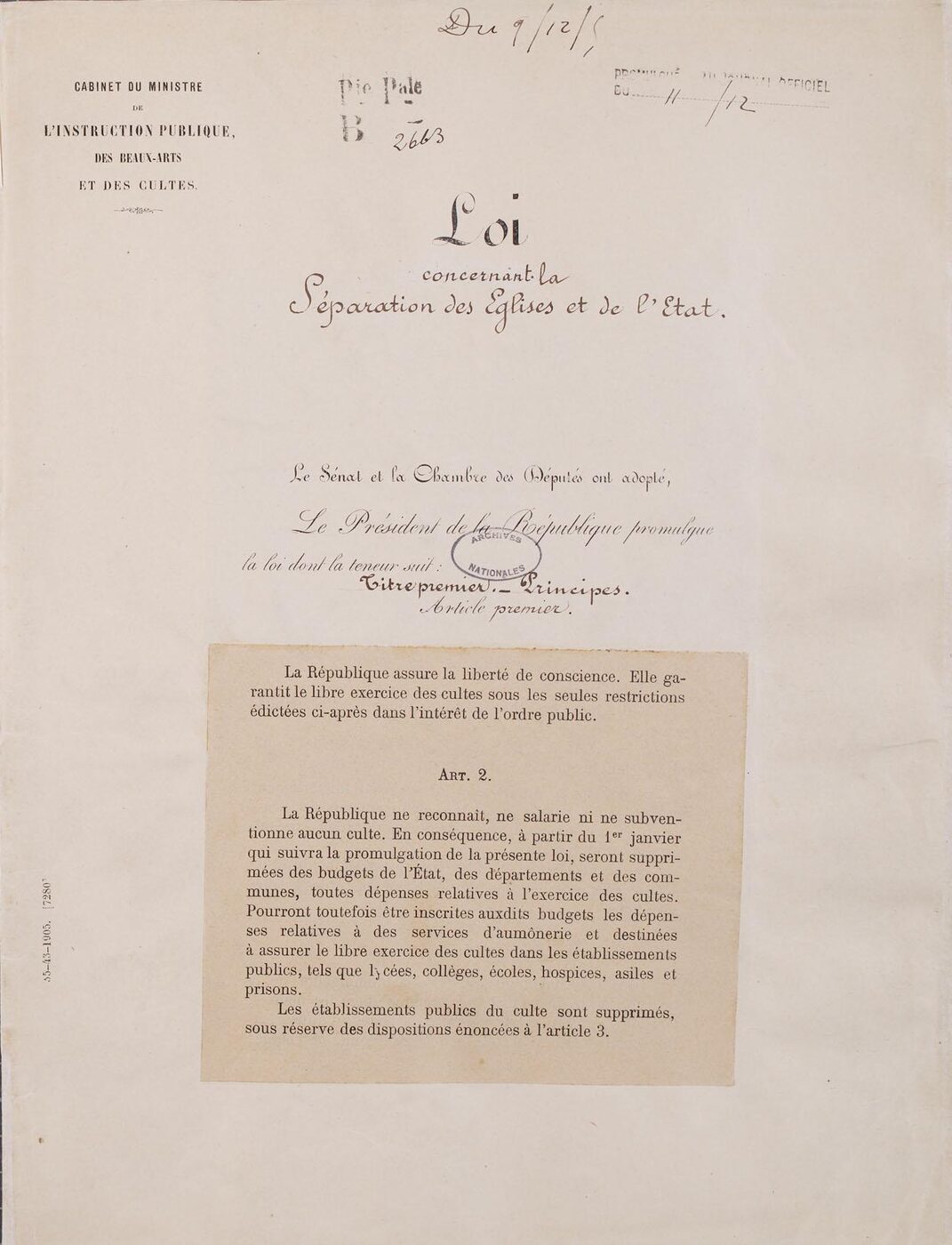

The consequences were concrete and financial. Ministers of religion ceased to be paid by the state, which had undertaken to pay them under the concordatory settlement reached with Rome in 1801 in exchange for the Church's abandonment of the property seized in 1790, and the state ceased to take part in the appointment of bishops. The public establishments of religion were dissolved and replaced by associations cultuelles, associations under the general law of 1901 whose exclusive object had to be the exercise of a religion, forbidden to pursue social, cultural, educational or commercial ends, and forbidden to receive subsidies from the state, the departments or the communes. Religious property taken by the state at the Revolution — the nationalisation decree is of 2 November 1789 — remained state property, but the state reserved the right to place buildings of worship at the free disposal of the new associations, which then bore repairs of every kind, insurance and the other charges on the buildings while remaining exempt from major structural works. To make free exercise effective, chaplaincies were instituted in certain public institutions — barracks, secondary schools, prisons, hospitals. A transitional allowance was paid to ministers of religion for four years.
One further provision matters to the arguments of the 1990s and 2000s. Article 28 forbids, for the future, the raising or affixing of any religious sign or emblem on public monuments or in any public place, excepting buildings used for worship, burial plots in cemeteries, funerary monuments, and museums or exhibitions. French administrative courts have since read that prohibition alongside the state of affairs existing on 9 December 1905: in 2019 an administrative tribunal held lawful a commune's installation of a statue of the Virgin on a parcel where a cross had stood for centuries and where processions had periodically been held, while in 2017 the Conseil d'État had found partly unlawful a commune's financing of a monument surmounted by a conspicuous cross erected long after 1905.
The law in force, and what it does not say
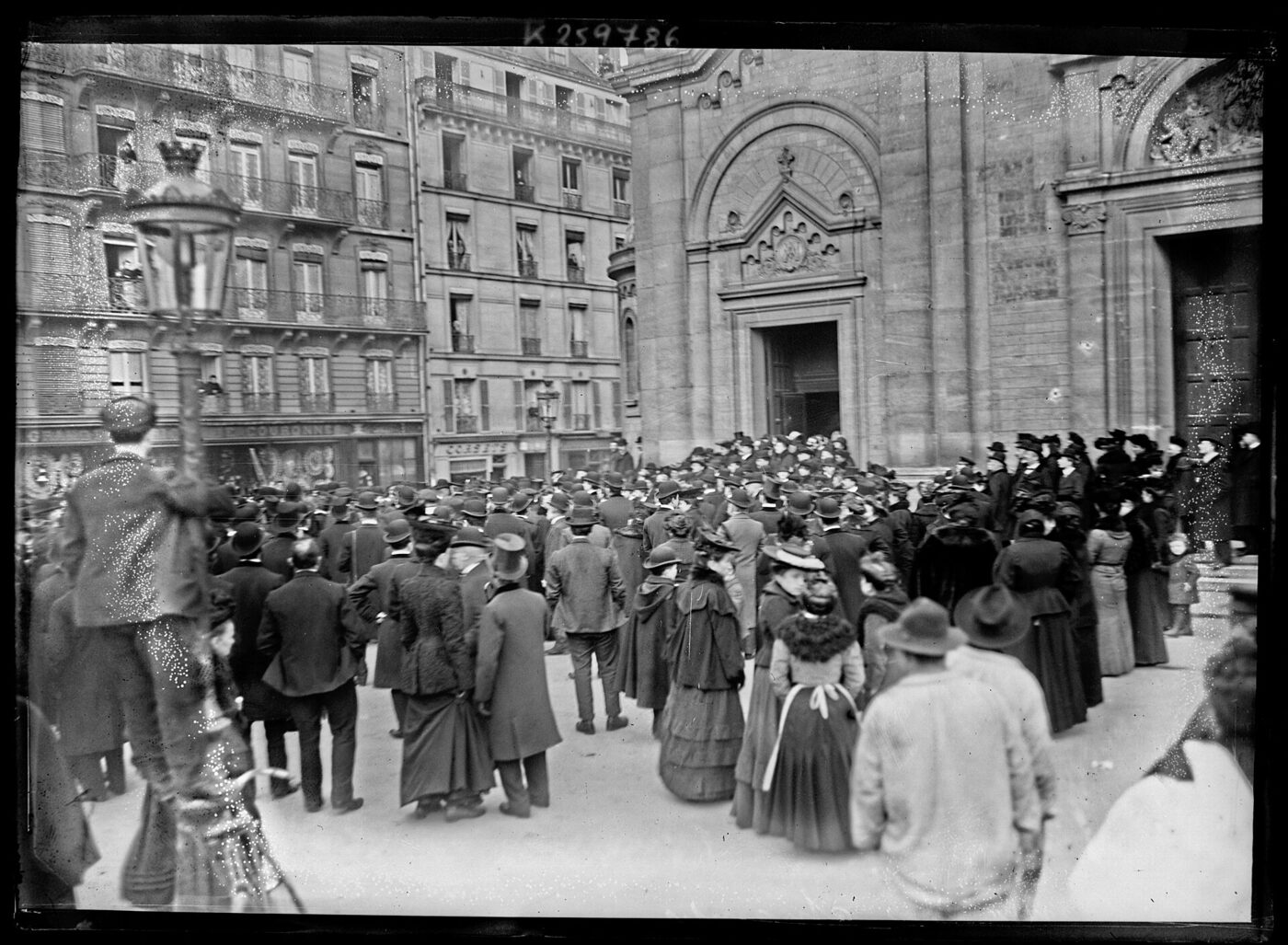
The law was not received quietly. Pius X condemned it in the encyclical Vehementer nos of 11 February 1906 and, in Gravissimo officii munere in August 1906, refused to permit the associations cultuelles on the ground that they were incompatible with the hierarchical organisation of the Catholic Church; a further condemnation followed in Une fois encore on 6 January 1907. In 1908 the Sacred Penitentiary confirmed that the deputies and senators who had voted the law incurred excommunication. Because Catholics were forbidden to form the associations, the cost of maintaining pre-1905 churches and cathedrals stayed with the state and the communes, where it largely remains. The inventories of religious property required by the law produced the sharpest crisis: they were carried out in an atmosphere of resistance, met crowds and barricades in a number of parishes, produced deaths, and were finally suspended by Clemenceau in March 1906. Jews and Protestants, whose congregational structures fitted the new arrangement more easily, received the law more calmly. Briand, defending it on 9 November 1906, insisted that the secular state was not anti-religious but non-religious.
_Dame_des_Champs_(manifestation_li%C3%A9e_aux_inventaires_des_biens_d'%C3%A9glise%2C_le_1er_f%C3%A9vrier_1906)_-_btv1b53210069k.jpg)
The deadlock was broken slowly and by compromise. A law of 2 January 1907 allowed buildings of worship to be left at the disposal of ordinary associations or of declared ministers of religion, and a law of 28 March 1907 removed the requirement of a prior declaration for public meetings, which had threatened to turn saying mass into an offence. The settlement was completed in 1924, when Pius XI and the French government agreed on associations diocésaines placed under the authority of the bishops, an arrangement the state accepted as satisfying the law and the Church accepted as compatible with its own order.
Two absences in the text are worth stating precisely, because both were argued about at length. The first is that the word laïcité does not appear in the 1905 law at all. The commission's report used it, and Ferdinand Buisson had helped to popularise the noun through his dictionary of pedagogy, but the statute that is universally described as the charter of French secularism never employs the term. The second is that the law imposes duties on the state, not on citizens. The obligation of neutrality it creates runs to public authorities and to those working within a public service; on the reading defended by, among others, the sociologist Jean Baubérot, it does not run to users of public services or to people in public places, and the elision between public meaning the Republic's own institutions and public meaning any street or square is the pivot on which most of the later disputes turned. Others read the same texts differently. This page records that the disagreement exists and is old; it does not resolve it.
Nor was the law ever uniform in its application. It has never applied in Alsace and Moselle, which were German territory in 1905; it has never applied in French Guiana, and the Mandel decrees of 1939 confirmed its absence there and in several other overseas territories, while a decree of 6 February 1911 extended it to Guadeloupe, Martinique and Réunion. A law of 19 August 1920 granted a subsidy of 500,000 francs towards the construction of the Grande Mosquée de Paris, a straightforward statutory derogation from Article 2 made fifteen years after the article was written. Since 2011, 9 December has been marked in France as a national day of laïcité. Since the Conseil constitutionnel's decision of 21 February 2013, which reproduced long passages of the 1905 law in its reasoning, the statute is generally treated as having been drawn into the body of constitutional norms.
The constitutional provision
The constitutional text is shorter than the statute and is quoted more often than it is read. Article 1 of the Constitution of 4 October 1958 begins: La France est une République indivisible, laïque, démocratique et sociale. Elle assure l'égalité devant la loi de tous les citoyens sans distinction d'origine, de race ou de religion. Elle respecte toutes les croyances. France is an indivisible, secular, democratic and social Republic; it ensures the equality of all citizens before the law without distinction of origin, race or religion; it respects all beliefs. A clause on decentralised organisation was added later. The adjective laïque had already been constitutionalised in the Constitution of 27 October 1946, and the constitution of 1958 carried it over.
A second provision belongs beside it. The thirteenth paragraph of the preamble to the 1946 constitution, which the Fifth Republic incorporated into its own body of constitutional norms, provides that the Nation guarantees equal access for children and adults to instruction, to culture and to vocational training, and that the organisation of free and secular public education at all levels is a duty of the State. Between them, those two texts and the 1905 law supply almost the entire vocabulary of the arguments that followed: neutrality, free exercise, equality before the law, respect for all beliefs, and a public education system that the constitution itself describes as secular.
The Conseil d'État has also been clear that the constitutional affirmation of laïcité did not sweep away pre-existing local arrangements. In a judgment of 6 April 2001 concerning religious teaching in Alsace-Moselle, numbered 219379, it held that the preambles of 1946 and 1958, in reaffirming the fundamental principles recognised by the laws of the Republic — among which the principle of laïcité figures — had not thereby implicitly repealed the law of 1 June 1924 that kept local legislation in force in the three departments. The Conseil constitutionnel reached a compatible conclusion in its decision of 21 February 2013, holding that the constitution had not intended to call into question the particular legislative and regulatory provisions applicable in several parts of the Republic's territory, relating to the organisation of certain religions, that were in force when it came into effect.
Alsace-Moselle: the exception with the longest paper trail
The exception is not an oversight and not a loophole; it is a promise that was kept. Alsace and the Moselle were part of the German Empire when the 1905 law was passed, so the law never reached them. When French forces returned during the First World War, undertakings to respect the recovered provinces' traditions were given — by Joffre at Thann on 7 August 1914, by President Poincaré in February 1915, by Pétain in 1918 — and a decree of 6 December 1918 provisionally maintained the essentials of local law, in matters of religion and education among others. After the Treaty of Versailles, a law of 17 October 1919 established a transitional regime, and the arrangement was subsequently made permanent. An opinion of the Conseil d'État of 24 January 1925 confirmed, against the Cartel des gauches, that the legislation applying the Concordat of 1801 remained in force there; the government of Édouard Herriot, faced with the opposition of the three departments' own representatives and with mass Catholic demonstrations, gave up the attempt to extend the 1905 law.
What that means in practice is a functioning concordatory system inside a constitutionally secular republic. Four religions are recognised and organised: Catholic, Lutheran, Reformed and Jewish. Their ministers — deacons, priests and bishops, Lutheran and Reformed pastors, and rabbis — are paid by the state through the Ministry of the Interior, their remuneration having been aligned in 1993 on category A of the French civil service, with entitlement to unemployment insurance. The Bishops of Strasbourg and Metz are appointed by decree of the President of the Republic after agreement with the Holy See, which makes the French head of state the last in the world to appoint Catholic bishops; chief rabbis and the presidents and members of the Protestant and Jewish consistories are appointed by the Prime Minister, and ministers of the three cults by the Minister of the Interior. Only the pastors of the two recognised Protestant churches, and the rabbis of the majority consistorial Judaism, are public agents; the liberal Jewish community pays its own rabbi.
Religion is taught in state primary schools and collèges in the three departments, with an exemption available on written request from parents at the start of the school year; exempted primary pupils attend lessons in morals, exempted collège pupils are simply excused. In many establishments the hour is called culture religieuse, and in some, particularly vocational lycées, faits religieux; it is not catechism, which is left to the parishes. The teachers of Catholic and Protestant religion hold qualifications from the corresponding faculties of theology at the University of Strasbourg or from the theology department of the University of Lorraine at Metz — which are, themselves, the only faculties of theology inside French public universities, and the only places in France awarding state diplomas in the subject. The Stasi commission of 2003 did not propose to end any of this: among its recommendations for the three departments were that Islam be added to the religious teachings on offer and that the choice of following religious instruction be left open. Even the document that produced the 2004 law on religious signs treated the concordatory departments as a case apart.
Belgium: recognition, and a state that pays
A francophone newsgroup was not a French newsgroup, and the constitutional arrangement a Belgian reader lived under was not merely a softer version of the French one but a different design. Article 181 of the Belgian Constitution sits in the title on public finances. Its first paragraph dates from 7 February 1831 and has never been revised: the salaries and pensions of ministers of religion are borne by the State, and the sums required are entered annually in the budget. That is the exact opposite of Article 2 of the French law of 1905, written seventy-four years later on the other side of the border.
Belgium therefore operates a system of recognised religions, admitted one at a time over nearly two centuries and each with an official interlocutor. The Jewish religion has had the Central Israelite Consistory of Belgium since 17 March 1832. Protestantism was recognised in 1839, Anglicanism in 1870, Islam by the law of 19 July 1974 — with the Executive of Muslims of Belgium recognised as its representative body by royal decree of 3 July 1996 — and Orthodox Christianity in 1985. Applications for recognition are examined by the Minister of Justice, and the queue is real: the Syriac Orthodox Church of Antioch applied on 26 August 2005, and the Belgian Buddhist Union applied on 20 March 2006 for recognition as a non-confessional philosophy. The federal government opened the Buddhist recognition procedure on 30 March 2007; a draft bill was adopted by the Council of Ministers on 17 March 2023 and withdrawn from the parliamentary agenda in April 2024, so that after twenty years the question is still open.
The most striking feature, from a French vantage point, is the second paragraph of Article 181, added on 5 May 1993 and modelled on the first: the salaries and pensions of the delegates of organisations recognised by law that offer moral assistance according to a non-confessional philosophical conception are likewise borne by the State. Organised secularism in Belgium is not the absence of a recognised religion; it is a recognised body, with paid delegates on the public payroll, whose central council was recognised by the law of 21 June 2002. In Belgian official schools pupils choose between courses in Catholic, Muslim, Protestant, Jewish or Orthodox religion and a course in non-confessional morals, the teachers' salaries falling on the state in every case. A Belgian reader arguing about religion in a French-language newsgroup was arguing from a country where his own unbelief had a constitutional salary line — a materially different starting position from that of a French reader, and worth knowing before reading any thread from either.
Switzerland: twenty-six answers to the same question
Switzerland answers the question by declining to answer it federally. The Federal Constitution of 1999 opens its preamble with an invocation — Au nom de Dieu Tout-Puissant ! — guarantees freedom of conscience and belief in Article 15, providing that nobody may be compelled to join or belong to a religious community, to perform a religious act or to follow religious instruction, and then, in the first paragraph of Article 72, disposes of the entire institutional question in one sentence: La réglementation des rapports entre l'Église et l'État est du ressort des cantons. The regulation of relations between church and state is a matter for the cantons. There are twenty-six of them.
The result is that most cantons, Geneva and Neuchâtel excepted, recognise official churches, the Landeskirchen, in every case Catholic and Swiss Protestant and in some cantons also the Old Catholic Church and Jewish congregations; these are financed by church taxes, and the Federal Supreme Court has held it lawful for cantonal taxes to support cantonal churches even where they are levied on legal persons whose shareholders may be irreligious or belong to unrecognised religions. Geneva — once described as the Protestant Rome, and home to the World Council of Churches since 1948 — is one of the two cantons with a full separation, which gives the francophone part of Switzerland an internal variety of its own.
The Swiss settlement also carries its own confessional scar tissue, and the last of it was removed inside this group's lifetime. The federal constitution of 1874 carried a set of exception articles aimed at Catholic institutions: a prohibition on the Society of Jesus and on the founding or refounding of convents, in articles 51 and 52; a bar on electing clerics to the National Council, which by extension kept them out of the Federal Council as well; and a requirement of federal authorisation for the erection of bishoprics. The Jesuit and convent articles were struck from the constitution by the federal popular vote of 20 May 1973, carried by 54.9 per cent of voters. The bar on clerics was simply not carried over when the constitution was rewritten in 1999. The bishoprics clause was carried over, as the third paragraph of Article 72, and was repealed by popular vote on 10 June 2001 — the last of the confessional exception articles to go, four years into this group's life. The same 1874 revision had also secured the separation of civil from religious marriage and of religious teaching from the rest of education. Then, on 29 November 2009, a federal popular initiative prohibiting the construction of minarets was carried by 57.5 per cent and written into the constitution as a new third paragraph of that same Article 72, the four existing minarets being left in place. A single unmoderated francophone room was open to readers governed by all of this at once.
Quebec and the Canadian frame
The fourth constituency in a French-language religion group had a fourth constitution again, and it is one whose preamble is unlikely to be mistaken for the French Article 1. The Canadian Charter of Rights and Freedoms opens by declaring that Canada is founded upon principles that recognise the supremacy of God and the rule of law, while guaranteeing freedom of religion; Quebec has its own Charter guaranteeing freedom of religion and conscience and equality of rights, and Canadian courts have read both as imposing a duty of state neutrality — the state, in the Supreme Court's phrase in a 2004 judgment concerning a Jehovah's Witness congregation and a Quebec municipality, being required to remain a neutral actor in relations between denominations and between them and civil society.
The Quebec debate of the group's later years turned on accommodement raisonnable, and it produced its own commission. The Consultation Commission on Accommodation Practices Related to Cultural Differences, universally known as the Bouchard-Taylor commission after its two co-chairs, the sociologist Gérard Bouchard and the philosopher Charles Taylor, was created on 8 February 2007 by Premier Jean Charest to examine accommodation granted on cultural or religious grounds. Its report, delivered on 22 May 2008, ran to 310 pages and 37 recommendations. On religious symbols it drew a narrow line: they should be forbidden to judges and Crown prosecutors, police officers, prison guards and the president and vice-presidents of the National Assembly, and permitted to all other agents of the state, teachers, civil servants and health professionals expressly included. It also recommended removing the crucifix hung above the Speaker's chair in the National Assembly; within minutes of the report's presentation the government tabled a motion to keep it, and the motion passed unanimously.
Both halves of that were reversed eleven years later. On 28 March 2019 the National Assembly voted unanimously to move the crucifix, which was taken down on 9 July 2019; and on 16 June 2019 the Assembly adopted the Act respecting the laicity of the State, whose first article reads L'État du Québec est laïque, with a general prohibition on religious symbols for state employees in positions of coercive authority and for teachers and school principals in the public school network, subject to acquired rights for those already in post on 27 March 2019. Both former commissioners opposed the bill. That legislation postdates the period in which such groups were busiest, and the qc.* hierarchy and Quebec's own politics are covered on qc.politique. What belongs here is only the structural point: four jurisdictions, one language, one unmoderated group, and no shared legal premise from which any of the four sets of readers could argue.
Religious dress in schools: 1989, 1994, 2004
The controversy that shaped French public argument about religion during this group's entire existence began eight years before the group did. On 18 September 1989 the head of a collège in Creil excluded three pupils who were wearing headscarves, telling their families that the veil was a religious mark incompatible with the proper functioning of a school and asking that they be instructed to respect the establishment's secular character. The affair became national within days. Lionel Jospin, then Minister of Education, said on 8 October that the secularism of the school must be respected — a school of tolerance, where signs of religious belonging were not displayed in a spectacular or ostentatious manner — while adding that the school existed to admit children, not to exclude them. The three pupils returned to class on 9 October under an arrangement by which the scarves came off at the school gate.
The government asked the Conseil d'État for an opinion, and the answer it received on 27 November 1989, opinion number 346893, framed the law for the next fifteen years: wearing the Islamic headscarf as a religious expression in a state school was, in itself, compatible with laïcité, and a refusal of admission or an exclusion in secondary education would be justified only by the risk of a threat to order in the establishment or to the normal functioning of the education service. A ministerial circular that December left the decision to teachers case by case.
The 1994 measure narrowed that. Circular number 1649 of 20 September 1994, issued under François Bayrou as Minister of Education, drew a distinction that entered the vocabulary permanently: signes discrets, which could be admitted in state establishments, and signes ostentatoires, which were to be prohibited. It did not settle the matter. Exclusions continued to be decided establishment by establishment and litigated afterwards; a published study of the period puts the number of girls excluded from state secondary schools for wearing the veil between 1994 and 2003 at about a hundred, with roughly half of those exclusions annulled by the courts, and describes head teachers as left to decide case by case. The figure is an estimate rather than a count, and is given here as one.
On 3 July 2003 President Jacques Chirac installed a commission of reflection on the application of the principle of laïcité in the Republic, chaired by Bernard Stasi. It reported to him on 11 December 2003. Its recommendations went considerably wider than school dress: a solemn charter of secularism; strict enforcement of compulsory-schooling rules and of curriculum content; better teaching of religion as a fact; substitute dishes in public canteens; the recruitment of Muslim chaplains in the army and in prisons; a national school of Islamic studies; and the addition of Yom Kippur and Eid al-Kabir to the school holiday calendar. In December 2003 the government took forward one of them.
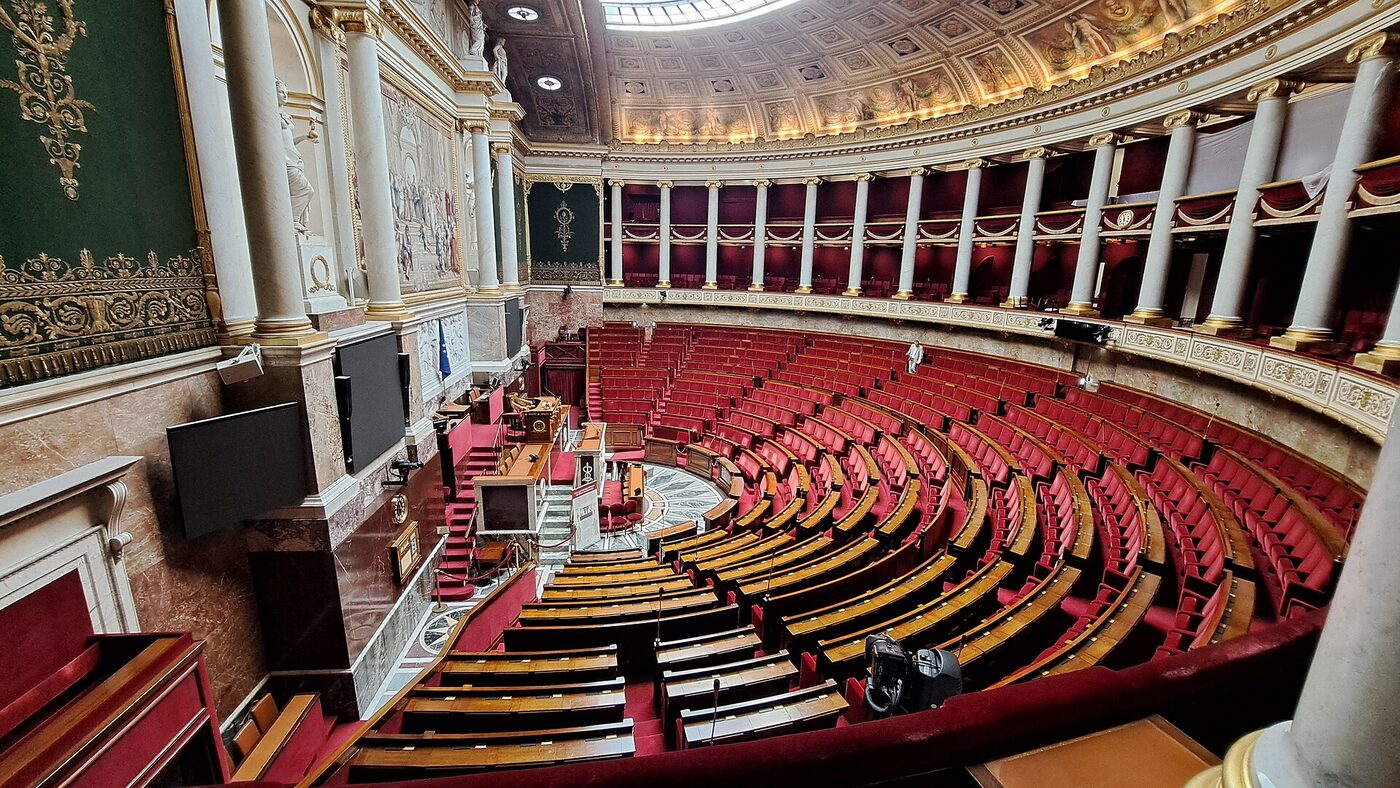
The resulting statute is law number 2004-228 of 15 March 2004, published in the Journal officiel of 17 March and intended to take effect with the school year beginning in September 2004. Its operative text, inserted into the Education Code, is two sentences: in state schools, collèges and lycées, the wearing of signs or dress by which pupils ostensibly manifest a religious belonging is prohibited; and the internal rules are to state that any disciplinary procedure is preceded by a dialogue with the pupil. The National Assembly passed it on 10 February 2004 by 494 votes to 36 with 31 abstentions, the Senate on 3 March 2004 without amendment by 277 to 20 with 20 abstentions. Both the majorities and the minorities crossed party lines. An interpretative circular of 18 May 2004 named the items covered — the Islamic veil under whatever name, the kippah, and a cross of manifestly excessive size — and confirmed that discreet signs remained permitted and that the law did not reach private schools.
_41.jpg)
The arguments were made in these terms and are recorded here as arguments. Supporters held that the religious neutrality of the pupil was a precondition of teaching in good conditions, that the school should not be a site of inter-religious confrontation, and that the law still allowed pupils discreet expression of their faith. Opponents held that the law misread the separation of church and state by conflating laïcité with a duty of neutrality owed by citizens, that it therefore infringed the religious freedom recognised by Article 1 of the constitution, and they relied specifically on the 1989 Conseil d'État opinion. The philosophy teacher Pierre Tevanian, analysing the coverage, recorded that the French press was overwhelmingly favourable to the law and that opinion moved sharply during the debate: in April 2003 polls put support for a ban at 49 per cent against 45 per cent opposed, and by October at 69 against 29. That characterisation of the press, and the inference drawn from the movement in the polls, are his.
Sectes: the reports, the list, and the machinery
The other great French argument about religion in these years concerned new religious movements, and it was conducted in a vocabulary that has no clean English equivalent. French official usage settled on dérives sectaires — sectarian excesses or drifts — precisely in order to describe conduct rather than doctrine, and the fr.soc.sectes charter quoted above shows how carefully participants in the francophone debate handled the distinction. Understanding the reports is necessary to reading any francophone religion group of the period, because they were the reference points on all sides.
The first was not parliamentary. In 1983 the deputy Alain Vivien produced a report for Prime Minister Pierre Mauroy — two hundred pages with some three thousand pages of annexes — which counted between 130 and 800 more or less active groups in France, concentrated in Paris, Lyon and the east, and named both long-established movements and newer arrivals from the United States. The second was the one that mattered. A commission of inquiry of the National Assembly adopted its report unanimously on 20 December 1995 and published it, as report number 2468, on 22 December. It had conducted twenty hearings totalling twenty-one hours, taking evidence from administrators, doctors, lawyers, clergy, victim-support associations, former adherents and leaders of the movements themselves, and it declared at the outset that neither novelty, nor small numbers, nor eccentricity could serve as criteria; the traditional religions were excluded from its field of study.
For a working test it adopted ten indicators used by the Renseignements généraux, describing them frankly as a bundle of clues each of which could be argued about at length. Five concerned danger to the individual: mental destabilisation; the exorbitant character of financial demands; an induced break with the person's original environment; attacks on physical integrity; and the enlistment of children. Five concerned danger to the collectivity: a more or less anti-social discourse; disturbances to public order; the scale of the movement's litigation; the possible diversion of conventional economic circuits; and attempts to infiltrate the public authorities. Applying them, the report published a list of 173 movements, and it is that list, rather than the criteria, that made the report famous and contested. Critics made both of the obvious objections at once: that the criteria as drafted would fit most established religions, and that it was odd to leave the definition of mental manipulation to police intelligence officers.
Its reception was shaped by an accident of timing. On 23 December 1995, the day after the report appeared, sixteen bodies were found in a clearing in the Vercors, the second of the collective deaths associated with the Order of the Solar Temple; the movement did not appear on the commission's list, the report having treated it as defunct. A second commission examined the finances of the movements and reported in June 1999, and a third, on the effects of sectarian practices on the physical and mental health of minors, reported on 19 December 2006 with fifty proposals.
Administrative machinery followed the reports in a straight line. An interministerial observatory on sects was created on 9 May 1996; on 7 October 1998 it was replaced by the Interministerial Mission for the Fight against Sects, the MILS, headed by Alain Vivien; on 12 June 2001 Parliament passed law 2001-504, known from its two sponsors as the About-Picard law, tending to reinforce the prevention and repression of sectarian movements infringing human rights and fundamental freedoms; and on 28 November 2002 decree 2002-1392 replaced the MILS with the Interministerial Mission of Vigilance and Combat against Sectarian Excesses, the MIVILUDES, which still exists and which a decree of 15 July 2020 attached to the Ministry of the Interior.
Every stage of this was contested, and the contest is part of the record. The MILS and its president attracted criticism from the International Helsinki Federation for Human Rights and from the United States Commission on International Religious Freedom, and the 1995 report was criticised in a United States State Department report of 1999 for having heard neither the groups it named nor any contradictory evidence; Vivien obtained police protection in January 1999 after threats and a burglary at his home, and resigned in June 2002. French administrative courts declined to treat the 1995 list as having legal force — in 2002 the administrative tribunal of Poitiers set aside a municipal refusal founded not on public order but on the sect designation attributed to a movement by the report of 22 December 1995, holding that the report, being devoid of legal value, could not serve as the legal basis for the decision, and the tribunal of Rennes annulled a comparable refusal the same year. Jacques Guyard was convicted of defamation in March 2000 for describing a movement as a sect on television, and acquitted on appeal in September 2001 on the benefit of good faith. And in a circular of 27 May 2005 on combating sectarian excesses the Prime Minister recommended abandoning recourse to lists of sects in favour of a bundle of criteria, acknowledging that the list annexed to the 1995 report had become less and less pertinent; the Ministry of the Interior repeated the instruction in a circular of 25 February 2008.
Organising the second religion
Running underneath both controversies was a structural problem the 1905 law had not been written to solve. The law recognises no religion and therefore knows no interlocutors; but French administration deals constantly with matters — chaplains in prisons and hospitals, burial grounds, the construction of places of worship, the training of clergy — for which an interlocutor is convenient. For Catholicism, Protestantism and Judaism, bodies existed by long usage: the bishops' conference, the Protestant Federation, the Central Consistory. For Islam, which became the second most practised religion in France during the group's lifetime, they did not.
The attempts to build one are dated and public. In 1990 Pierre Joxe, as Minister of the Interior, launched a Council of Reflection on Islam in France to propose an organisation for Muslim worship. In November 1999 Jean-Pierre Chevènement opened a wide consultation gathering the Muslim federations, the principal mosques and a number of individuals, which produced a signed statement of principles in January 2000. And in 2003 the French Council of the Muslim Faith, the CFCM, was created together with its regional councils — an association under the general law of 1901, placed under the aegis of the Ministry of the Interior, with the vocation of representing Muslims before the organs of the state on questions relating to religious practice. Its first elections were held on 6 and 13 April 2003, with nearly four thousand delegates representing 995 places of worship voting across 25 regions; the Fédération nationale des musulmans de France came first with sixteen of the forty-one board seats, the Union des organisations islamiques de France took thirteen and the Grande Mosquée de Paris six, and the rector of the Grande Mosquée took the presidency under an agreement concluded under government auspices on 20 December 2002.
Criticism of the arrangement came from several directions and is worth recording without adjudication. Some argued that a state-brokered representative body for one religion sat awkwardly with a law that recognises none, and described the CFCM as concordatory in logic and as a clericalisation of Islam in France. Others held that a body whose functions were confined to worship was persistently mistaken for a representative of a community, and that it suffered from weak representativeness — nearly half the mosques abstained from its elections in 2012. Dalil Boubakeur, its first president and again its president from 2013 to 2015, put the point himself: the body did not represent Muslims but the Muslim religion. The council split in 2022 and was set aside by the government at the beginning of 2023 in favour of a new forum. These were live arguments in French public life while this group was open, and they were arguments about institutional design rather than about theology, which is one reason a religion group whose charter admitted non-believers had material to work with.
What the surveys of those years recorded
The demographic backdrop shifted substantially during the group's life, and the survey record, while patchy in method, is consistent in direction. A frequently reproduced series for the proportion of French people declaring no religion runs: 10 per cent in 1981, 11 per cent in 1990, 23 per cent in 1994, 26 per cent in 2003, 31 per cent in 2007 and 35 per cent in 2012, the earlier figures taken from a reference annual and the later ones from opinion polling. The jump between 1990 and 1994 is large enough that a change of method should be suspected rather than a collapse of belief in four years, and this page flags it rather than smoothing it over. The direction, however, is corroborated elsewhere: studies in 2006 and 2007 put the number of French people without religion at 31 per cent of the total population, and a survey by the INED in 2008 and 2009 found that 45 per cent of metropolitan French people aged 18 to 50 declared no religion, against 45.5 per cent declaring Catholicism and 8 per cent Islam.
Practice fell faster than identification. Weekly attendance at mass was reported at 5 per cent in 2006 and at 1.5 per cent in 2021; the sources are not consistent about whether the base is the whole population or those identifying as Catholic, and this page does not resolve it. A CSA poll for Le Monde des religions in October 2006 found that 52 per cent of French people identifying as Catholic said they believed in the existence of God, which is a striking figure to place next to the identification numbers and points to the conclusion drawn by many observers at the time: that a large part of French Catholic identification had become cultural rather than confessional. Protestantism, meanwhile, moved the other way, from an estimated 1.5 per cent in a 1995 poll to 3 or 4 per cent, growth that the sociologist Jean-Paul Willaime attributed to evangelical movements.
For the longer view, the French national statistics institute compared its 2019-2020 survey of the population and its origins against the 2008-2009 edition of the same survey, on the age range common to both, 18 to 49. Over those eleven years the proportion declaring no religion rose from 45 to 53 per cent, Catholic affiliation fell from 43 to 25 per cent, other Christian affiliations rose from 2.5 to 9 per cent and Muslim affiliation from 8 to 11 per cent. None of these numbers describes the readers of a newsgroup, and none is offered as doing so. They describe the population from which the group's French participants were drawn, over the exact span in which it was active, and they explain why the same arguments recurred: the ground was moving under all sides simultaneously.
Who was in the room
Nothing survives that would allow an honest description of who actually posted to fr.soc.religion, and none is attempted here. What can be described is the structure of the room, because that is documented, and structure determines a great deal.
It was unmoderated. No article required an Approved header; no volunteer read submissions before they propagated; the only editorial control anyone exercised was a news administrator's decision whether to carry the group at all. The Big-8 handled the same subject differently, splitting it across two branches — a soc.religion.* branch in which moderation was normal and which the ISC's current list still shows carrying a moderated group for Islam, and an unmoderated talk.religion.* branch with half a dozen names of its own; that story is told on the soc.* hierarchy page. fr.* took neither route for this subject, and wrote a request for civility into the charter instead of appointing anyone to enforce one.
It was one room for everything. The hierarchy's rule against community forums meant there was no fr.soc.religion.catholicisme, no fr.soc.religion.islam, no fr.soc.religion.judaisme — a single group for religions, beliefs and spirituality, into which every tradition present in the francophone world, together with everyone who thought all of them mistaken, was directed by the namespace itself. The charter's explicit statement that discussion was not reserved to believers was therefore not a courtesy to a minority but a description of the room's design. Organised unbelief in France and Belgium was not a marginal position but an institutional one, with associations, a constitutional salary line in one of the two countries, and a long publishing history; the subject in its own right is treated on the page for talk.philosophy.humanism.
It was text, and only text. Binaries and photographs were forbidden by the charter and by hierarchy-wide rule, which in a religion group has a specific consequence: scripture, liturgy and iconography could only enter the discussion as typed characters. A citation had to be transcribed; a controversy about an image had to be described. Whatever else this did, it kept the group's traffic small enough to be carried anywhere, which for a group whose potential readership was spread across several continents was the difference between existing and not.
And it was multi-jurisdictional in a way almost no English-language equivalent was. A group about religion in English overwhelmingly meant a group in which American constitutional assumptions were the default and everything else was a variant. A group about religion in French was open, by construction, to people living under the 1905 law, people living under Belgian recognition and state salaries, people living under twenty-six different cantonal settlements, people living under a Canadian charter that invokes the supremacy of God, and people in francophone Africa living under arrangements different again — and, in the concordatory departments, French citizens whose priests were paid by their own constitutionally secular state. There was no shared premise to argue from. Whether that made the arguments better or merely longer is not something the surviving record can settle.
The one-room design was a choice, not a necessity, and the neighbouring hierarchies show it. The free.it.* hierarchy, an independent Italian-language branch, went the other way and carried a series of narrow groups under free.it.religioni. — for Buddhism, for Protestantism, for Jehovah's Witnesses, for gnosticism, for shamanism and for several particular movements — nine of which are still in the ISC's description list; the directory's page for free.it.religioni covers that address. fr.* could have done the same and did not, because its own rules told it not to.
Accents on a seven-bit wire
One small artefact of this group's paperwork belongs to a larger story told elsewhere. The newsgroups-file line the 1997 creation message asked administrators to install reads Religion et spiritualite., stripped of its accent, while the charter travelling in the same article carries spiritualité correctly in eight-bit ISO 8859-1, and today's master list carries Les religions, les croyances et la spiritualité. with the accent encoded in UTF-8; the history of a writing system is legible in three lines of one archive file. Why a network designed for seven-bit ASCII cost French speakers their accents for a decade and a half, and what they did about it, is told in full on soc.culture.quebec.
What the record does not show
It is worth being explicit about the size of the gap, because the temptation to fill it is exactly what makes directory pages untrustworthy. Nothing is known here about the volume of traffic in fr.soc.religion at any point in its life. No subscriber estimate exists. No thread is quoted, named or characterised on this page, because none has been read for it. No participant is named. Nothing is known about whether the group was busy in 1997 and quiet in 2007 or the reverse, nor about which traditions were best represented, nor about whether the charter's request for respect was honoured, ignored, or invoked in the arguments it failed to prevent.
Nor is the group's own administrative history complete. The Request for Discussion that must have preceded the January 1997 vote is not in the ISC archive, which keeps control messages rather than discussion; the announcement of the result was published in fr.announce.newgroups, as the creation message itself states, but that posting is not in the control record either. The identity of the proposer is not established. The date on which the newsgroups-file description was changed from the 1997 wording to the current one is not established. Whether the group was ever the subject of a removal proposal in fr.usenet.forums.evolution — the forum on which, since an announcement of 6 November 2008, creations and removals in fr.* are proposed and discussed instead of being voted — is not established either. What is established is that it survived: fr.usenet.8bits was removed by a signed control message on 4 June 2022 following discussions in that forum, and fr.soc.religion was not.
Google Groups holds the Usenet archive that Deja News began assembling in March 1995 and that Google acquired in 2001, and fr.* traffic of this period is generally within it, which means the primary material for a proper history of this group very probably exists; since February 2024 that service no longer carries new Usenet content, though the existing archive remains readable. It has not been read for this page, and no link is offered to a resource whose availability could not be confirmed at the time of writing. A reader wanting the group itself, rather than its context, should go to the archive and to a news server, both of which are covered in the box above.
Scope and limits
This article documents a newsgroup and the legal and social world it belonged to. It takes no position on any religion, on any movement described in any of the reports discussed above, on the merits of the French settlement or of any of the alternatives set beside it, or on any of the arguments recorded. Where a characterisation appears, it is attributed to whoever made it — a statute, a court, a parliamentary report, a named scholar or a named official — and the attribution is the point rather than an ornament.
Three classes of statement should be read with different degrees of confidence. Everything said about the group's control messages, its charter, its vote, its branch and the current master lists was read directly out of the Internet Systems Consortium's Usenet archive during the writing of this page, and can be checked there. Everything said about statutes, decrees, circulars, commissions and their dates was verified against reference sources and is stated with the numbers attached so that it can be verified again. Everything said about opinion polling and religious demography is survey data, is attributed to the body that produced it, and carries the ordinary uncertainties of survey data; the one internally inconsistent series has been flagged in place rather than tidied.
What is not here is the group itself. This directory preserves an old mail-to-news gateway's view of Usenet, and its entry for fr.soc.religion was, until today, a title and a description. The description has been verified and the paperwork behind it recovered; the conversation has not been. That distinction is the honest boundary of the page, and a reader following an old francophone link should know exactly where it falls.
Reading fr.soc.religion today
- Historical archive: Google Groups — fr.soc.religion (coverage varies by group and era).
- Open in a newsreader:
news:fr.soc.religion— the original site offered exactly this link, and it still works if your system has a newsreader registered for thenews:scheme. - Live access: point an NNTP newsreader at a modern server — see accessing Usenet today.
- The original news2mail e-mail subscription service ended in the mid-2000s and no longer operates.