free.it.religioni
Religion and belief, in Italian (free.it hierarchy).
free.it.* is an independent Italian-language hierarchy, administered separately from both the Big-8 and the it.* hierarchy, and this was its group for religion and belief.
free.it.* is administered outside the Big-8 machinery, but it is not undocumented: the master files the Internet Systems Consortium distributes carry nearly two thousand free.it.* names, nine of them under free.it.religioni. The bare name itself has no line in those files and no file of its own in the control archive; the address is preserved because it is still cited.
On this page
- What the Internet Systems Consortium's archive actually holds
- An open hierarchy, in the words of its own configuration file
- How free.it.* actually grew
- The free.it.religioni branch, message by message
- Two Italian hierarchies, and how each was governed
- Where it.* put religion, and what its charters said
- The concordat, and what the 1984 revision changed
- Eight per thousand: how the money works
- With an agreement, and without one
- The hour of religion, and the right not to attend it
- The crucifix in the classroom, in dates
- Newer religious movements, and the language used about them
- What the surveys of those years recorded
- Writing Italian on a seven-bit wire
- What the record does not show
- Scope and limits
What the Internet Systems Consortium's archive actually holds
One thing is worth settling at the top, because it is the most useful thing this page can tell a reader arriving from an old Italian link. free.it.* is administered outside the Big-8 machinery, but it is a common assumption that this leaves it undocumented, and that is wrong. free.* groups are present in the master lists the Internet Systems Consortium distributes, and the ISC does hold a control-message archive for the hierarchy. Both were checked directly for this article.
The consolidated newsgroups and active files fetched from the ISC while this page was written — the copies of 26 August 2026 — contain 45,003 group names spread across 479 distinct top-level hierarchies. Of those names, 3,565 begin free. and 1,997 begin free.it. That makes free.* the second-largest hierarchy in the file after alt.*, which contributes 20,466 names, and ahead of fido7.* with 3,242, microsoft.* with 1,770 and every national tree in the list, including it.* itself, which contributes 449. The control-message archive at the same site keeps a directory per hierarchy, and the one for free.* holds 5,601 compressed files, of which 2,214 have names beginning free.it. An independently administered hierarchy is not thereby an undocumented one.
What is genuinely absent is the exact name this page preserves. There is no file free.it.religioni.gz in the control archive — the URL returns 404 — and no line for free.it.religioni in either the newsgroups file or the active file. What is present is the branch beneath it. Nine names of the form free.it.religioni.something appear in today's master list, and ten have files in the control archive. Set out as the description file carries them, with the descriptions quoted exactly:
free.it.religioni.battisti— No description.free.it.religioni.buddhismo— Discussioni sulla religioni buddhista nelle sue varie formefree.it.religioni.cmas— Chiesa Magica dell'Antica Saggezzafree.it.religioni.gnosticismo— No description.free.it.religioni.krishna— No description.free.it.religioni.osho-rajneesh— Parlare del pensatore Osho Rajneeshfree.it.religioni.protestanti— Il protestantesimo nel cristianesimofree.it.religioni.sciamanesimo— No description.free.it.religioni.tdgeova— No description.
The tenth, free.it.religioni.cattolicesimointegrale, has a control message but no line in the master list. All nine that are listed carry the posting flag y in the active file, meaning open and unmoderated; not one of them is moderated.
Two conclusions follow, and only two. The first is that the branch free.it.religioni. was real, used and dated: its groups were created between April 2000 and April 2003 and are still in circulation as names. The second is that the bare name, the one this directory carries, cannot be shown from the ISC record to have been created by anyone. That absence has at least two innocent explanations — a name used only as a branch label, or a group whose creation message never reached the machine that fed the archive — and the record does not distinguish between them. This directory's own list of the 179 group names it carries does contain the bare name, which is why the address exists here; that list is a mail-to-news gateway's view of Usenet between 2000 and 2004, not a register, and it is treated as such throughout what follows.
An open hierarchy, in the words of its own configuration file
The reason free.* behaves differently from a national hierarchy is written down, in one of the least romantic documents on the network. INN's control.ctl — the file every news administrator installs to decide which control messages their server will obey — is distributed by the ISC and carries a stanza per hierarchy. The free.* stanza is four lines long and is headed, in the file's own words, FREE (Open Hierarchy where anyone can create a group). It reads:
newgroup:*:free.*:doitnewgroup:[email protected]:free.*:dropnewgroup:tale@*uu.net:free.*:droprmgroup:*:free.*:drop
Line by line: honour a newgroup message for a free.* group from anybody at all; except from the two addresses historically used to issue Big-8 control messages, which never issue free.* messages and whose appearance would therefore be a forgery; and ignore every removal request, from anybody, always. The hierarchy is thus a one-way ratchet. Groups can be added by any person with a news client; no group can ever be taken away. The four lines are the whole of its constitution.
Compare the it.* stanza in the same file. It names a contact address, [email protected]; a web site; an administrative newsgroup, it.news.annunci; a URL for the hierarchy's public key; and the key's fingerprint. Its operative lines drop every newgroup and rmgroup for it.* from everyone, then re-admit exactly those sent from the contact address and cryptographically verified against the published key. The Dutch and French stanzas have the same shape, with different addresses and different fingerprints. The it-alt.* stanza is a third case again: the file records that there is no single official issuer for that hierarchy, that several different people issue control messages for it which may or may not agree, and that administrators are encouraged to pick one — and, pending that choice, drops them all.
The distinction that matters here is not between real and unreal hierarchies but between hierarchies whose control messages administrators have agreed in advance to trust and hierarchies whose messages they have not. This directory has made the same point once already about a vendor branch: the page for adobe.acrobat sets out why a hierarchy can be perfectly real, and perfectly readable on the servers that carry it, and still leave no trace in the propagation record. free.* is the mirror image of that case. It leaves an enormous trace — 5,601 files in the control archive — precisely because its rule is to accept everything, and the archive keeps what arrives rather than what was authorised.
The hierarchy dates from July 1998 and its founding messages are in the archive. The oldest file in the whole free.* directory is free.pencils, dated 18 July 1998. free.control was created the next day by a message from Tim Skirvin at the University of Illinois at Urbana-Champaign, dated 19 July 1998 and cross-posted to news.admin.hierarchies and alt.config, with a two-line body giving the description Control messages for free.*. free.answers followed on 20 July, from Chris Baird in Australia, with the description "Free Information is worth only as much...". free.config arrived on 25 July 1998 from Dave Hayes, whose Organization header reads JetCafe - A Non-Profit ISP, and its body opens with the hierarchy's founding rationale:
I hereby create free.config for no other reasons than the following: a) I can; b) I want to; c) The free.* hierarchy is a -good- idea.
Nothing in those messages is Italian, and nothing in the hierarchy's founding suggests that Italy was on anyone's mind. free.* was an Anglophone experiment in an open namespace. What happened next was that Italian users took it over almost completely: of the 3,565 free.* names in today's master list, 1,997 — a clear majority — are Italian.
How free.it.* actually grew
The control archive's directory listing gives a last-modified date for every file, which is the date on which that file last received a control message. For the great majority of free.it.* names the file contains a single message, so the date is the creation date; for the rest it is the date of the most recent re-posting. Counted that way, the 2,214 free.it.* files fall by year as follows: four in 1998, one in 1999, 937 in 2000, 432 in 2001, 312 in 2002, 437 in 2003, 68 in 2004, thirteen in 2005, one in 2006, six in 2007, two in 2009, and a single late arrival, free.it.ai.general, on 6 April 2025. The hierarchy's Italian branch is, statistically, a phenomenon of the years 2000 to 2003.
That window matters for this directory, whose gateway operated between 2000 and 2004. The Italian free.* explosion and the gateway's working life are the same four years. Whatever a reader following an old link expects to find behind this address, the period is right.
The four oldest files are from 4 and 5 August 1998, within a fortnight of the hierarchy's founding, and all four are insults: free.it.lamers, free.it.hackers.patetici.lamers, free.it.hackers.per.modo.di.dire and free.it.lamers.mentore.lame.lame.lame. Then nothing for nine months but a single file, free.it.stanz of 18 May 1999, and then the flood. Whatever brought Italian users to free.* in early 2000, it was not a plan, and the first arrivals were not building a taxonomy.
What a free.it.* creation message looks like is worth setting out once, because it is the exact opposite of the paperwork described later on this page. Here is the whole of the message that created free.it.religioni.protestanti, headers trimmed:
Newsgroups: free.control,free.it.religioni.protestantiSubject: cmsg newgroup free.it.religioni.protestantiApproved: [email protected]Control: newgroup free.it.religioni.protestantiFrom: [email protected]Date: Sat, 29 Apr 2000 15:38:07 GMT
Below the headers, the entire body: the line For your newsgroups file:, and beneath it free.it.religioni.protestanti Il protestantesimo nel cristianesimo.
Two lines of content. The Approved header, which in a moderated Big-8 group certifies that a volunteer editor has read the article, here simply repeats the sender's own address, because in free.* the sender is the only authority there is. The article was injected through news.infostrada.it, a consumer Italian internet provider, as were most of the free.it.* messages of that spring: in a random sample of two hundred free.it.* control files taken for this article, 169 carry an infostrada machine in the Path header, and twenty-four of the twenty-six sampled messages dated between March and June 2000 do. There is no charter, no vote, no discussion period, no proposer distinct from the creator, and no record in the message of anyone having been consulted.
By mid-2000 the process had been automated. A large number of free.it.* creation messages of that year and later carry, in the body, a boxed advertisement in place of or alongside the description line. The box is six lines of dashes and centred text, of which the substance is:
Richiesta creazione Newsgroup inviata con FREENG. Copyright (c) 2000 Houston Production. Tutti i diritti riservati.
A final line of the box gives a web address for the tool. A variant of the same box, found in this article's sample under names such as free.it.polizia and free.it.regione.lombardia, is identical except that it reads CREANG in place of FREENG. Someone had written a utility that composed and posted free.* newgroup messages, and stamped its own copyright notice into every group it created. In several cases — free.it.religioni.gnosticismo of 1 July 2000 and free.it.religioni.battisti of 10 July 2002 among them — the banner occupies the place where the newsgroups-file description should have been, and the group entered the master list with no description at all. That is the mechanical explanation for a striking figure: of the 1,997 free.it.* entries in today's description file, 944 read No description. Very nearly half of the largest Italian hierarchy on Usenet consists of names about which the register records nothing whatever.
The register also records names that could never have worked. free..it.discussioni.religioni, with two consecutive dots, was posted on 14 July 2000 by the same FREENG tool; it has a file in the control archive and no line in the master list, because a Usenet group name cannot contain an empty component. Fifteen other names in the same directory share that defect. free.it.cattolicesimo, created on 18 July 2000 with the description Parliamo di cattolicesimo, was posted from the address [email protected] — the tool's placeholder, left unedited. The group is in the master list to this day.
The free.it.religioni branch, message by message
Ten names were created under the free.it.religioni. prefix, and the archive keeps a file for each; between them the ten files hold thirteen messages, because one group was re-posted three times. Their dates, taken from the Date header of the first archived message for each name, run:
free.it.religioni.buddhismo— 11 April 2000, from[email protected], description Discussioni sulla religioni buddhista nelle sue varie forme (the grammatical slip is in the original).free.it.religioni.krishna— 27 April 2000, from[email protected], no description supplied: the body carries the group name and nothing else.free.it.religioni.osho-rajneesh— 29 April 2000, from[email protected], description Parlare del pensatore Osho Rajneesh.free.it.religioni.protestanti— 29 April 2000, eighteen minutes later, from[email protected].free.it.religioni.sciamanesimo— 6 May 2000, from[email protected], description line left blank.free.it.religioni.tdgeova— 24 June 2000, from[email protected], carrying the line free.it.religioni.tdgeova i Testimoni di Geova, storia e dottrina.free.it.religioni.gnosticismo— 1 July 2000, from[email protected], description replaced by the FREENG banner.free.it.religioni.cmas— 20 February 2002, from[email protected], description Chiesa Magica dell'Antica Saggezza, re-posted three times on 21 February.free.it.religioni.battisti— 10 July 2002, from[email protected], description replaced by the FREENG banner.free.it.religioni.cattolicesimointegrale— 8 April 2003, also from[email protected], description again replaced by the banner.
Three of the ten came from a single address, and two each from two others. Seven of the ten were posted within twelve weeks of each other in the spring and early summer of 2000. Whether those weeks represent a coordinated attempt to lay out a religion branch, or several people discovering the same tool at the same time, the archive does not say; it holds the messages, not the reasons.
One of the thirteen messages is unlike the rest and deserves setting out, because it is the single piece of self-description the branch produced. The three re-postings of free.it.religioni.cmas on 21 February 2002 are each headed Booster, the conventional word for a repeated control message; two of them add the line this is a test of cmsg. The first of the three, timed at 11:07 GMT, carries beneath the description a single further line beginning CHARTER:, which states that the group is one for the forwarding and doctrinal discussion of the Chiesa Magica dell'Antica Saggezza. That is the whole of it — one sentence, in a message whose other purpose was to test whether control messages worked. It is nevertheless the only charter text of any kind that this article found anywhere under the free.it.religioni. prefix, and it is recorded here for that reason.
One discrepancy deserves recording rather than resolving. The June 2000 message for free.it.religioni.tdgeova plainly supplies a description — i Testimoni di Geova, storia e dottrina, the Jehovah's Witnesses, history and doctrine — and yet the master list carries that group as No description. The message's own heading reads For your newsgroups file without the customary colon. Whether that is the cause is not something the archive records, and it is not asserted here.
The religioni branch is not the whole of religion in free.it.*, either. Elsewhere in the same namespace the master list carries free.it.cattolicesimo (Parliamo di cattolicesimo) and its sub-name free.it.cattolicesimo.azionecattolica.acr; free.it.cultura.evangelica (La cultura evangelica protestante, created 30 June 2000); free.it.cultura.ebraica; free.it.rinnovamento.nello.spirito; free.it.sono.buddista; free.it.cultura.newage; free.it.magia; and free.it.discussioni.esoterismo. Six of those nine have no description in the register. The control archive holds one further stray, free.religioni.tdgeova of September 2000, which omits the it component altogether and has no line in the master list. A hierarchy in which anyone may create anything produces, over four years, a religious map with no cartographer: overlapping, unevenly detailed, and silent about most of its own contents.
Two Italian hierarchies, and how each was governed
Italian-language Usenet did not begin with a hierarchy of its own. The account given in the Italian Wikipedia's history of Italian Usenet, which draws on the coordinating group's own archived documents, starts with soc.culture.italian — a Big-8 group whose description, Italian people and their culture, framed it as a place for an international readership to discuss Italy, and which was promptly occupied by Italians discussing everything at once. A first national attempt, ita.*, was created around 1993 by Marco Negri of the Department of Information Science at the University of Milan together with other news administrators; it propagated badly between Italian servers and never took hold.
The successful attempt was a piece of deliberate institution-building, and it is unusually well dated. A proposal titled Una proposta di standardizzazione della gerarchia nazionale IT*, drafted by Stefano Suin and Alessio Bragadini of the SERRA project at the University of Pisa, was presented at the NIR-IT-2 conference in Milan on 13 December 1994. A core of groups was created on 10 January 1995. The manifesto of the coordinating group — the Gruppo di Coordinamento NEWS-IT, universally the GCN — was published on 8 February 1995, drafted by Luciano Guglielmi. The text still on the GCN's site, which carries the note aggiornamento: 5 novembre 1996, sets out eight lines of action, from interfacing with network providers to maintaining a virtual map of Italian news topology, and then states that the group will be open to all who wish to take part, whether news administrators or ordinary users, modelling itself on the IETF's working groups; it announces a freely joinable mailing list, and provides that the group's decisions will be made known through the newsgroup it.news.annunci. Draft creation rules followed on 22 February 1995 and came into force on 31 March. Distribution abroad opened on 13 March 1995. The first elections to the executive were called on 27 April and held on 4 and 5 May 1995, with twenty-five voters; Stefano Suin was elected to lead the group. The first Call for Votes under the new rules, for it.politica.reti, was published on 13 September 1995 and passed with 58 votes.
The rules the GCN wrote for itself departed from Big-8 practice in a way that shaped everything afterwards. There were no votes against: a group was created if at least fifty people declared an interest, or if it was to be gatewayed to a mailing list with at least 150 subscribers. Voting could be stopped early once the threshold was reached. The discussion period for a Request for Discussion was shortened from thirty days to fifteen. The coordinating group could remove a group for lack of traffic, with a reference figure of a hundred articles in three months. And proposals for groups immediately below it. were to be refused: names had to sit inside one of a fixed set of second-level branches — associazioni, comp, cultura, discussioni, hobby, fan, lavoro, news, notizie, politica, scienza, scuola, spettacolo, sport, test. A national hierarchy with a designed taxonomy and a standing committee is a very different object from a namespace whose configuration line reads anyone can create a group.
The machinery is legible in the control messages themselves, which is where this article read it. Creation messages for it.* through the 1990s were sent by Stefano Suin from [email protected], carried the Organization header SERRA University Network Center - University of Pisa, and were PGP-signed with the key whose identifier is 0x185317B9. Messages from 2002 come instead from Gruppo di Coordinamento NEWS-IT at [email protected], are signed with key 0xB28B9B51, and carry a standing notice in both the headers and the body: the PGP key and cmsg issuer for it.* changed on 2001-8-2, with an instruction to download the new key and update the local configuration. Where a group is moderated, the message states the submission address — [email protected] for it.cultura.cattolica, for example — and adds that the standard mapping <it.*:%[email protected]> is accepted in a site's moderators file. The Organization header of the later messages reads Italian Usenet Cabal, a joke with a long Usenet pedigree, filed in the one place where the paperwork is entirely serious.
Four Italian hierarchies existed side by side by the turn of the century, and the ISC's files show what each arrangement is worth in the register. it.* is PGP-signed and centrally maintained: 449 groups in the master list. italia.*, whose groups are thematic ones organised by province and which is administered from CINECA, is likewise signed: 170 groups. free.*, open by configuration, contributes its 3,565. it-alt.*, which has no single recognised issuer, has 350 files in the control archive and not one line in the master list, because control.ctl drops everything it sends. Four ways of governing a namespace, and four completely different footprints in the same file.
This is the third time this directory has documented the same shape, and the earlier two are not repeated here. The relationship between a self-governed national hierarchy with a signing key and the looser branch beside it is set out for French on the page for alt.fr.comp.os.ms-windows.xp, and for Dutch, where the alternative branch has its own janitor and its own key, on the nl.* hierarchy page. The Italian case differs from both in one respect worth naming: the looser Italian branch was not a national creation at all. It was a corner of an international open hierarchy founded in Illinois, which Italian users adopted in such numbers that they became most of it.
On who administered free.it.* there is a conflict in the sources, and it is left standing rather than resolved. The Italian Wikipedia states that free.it.* is managed by a body called the Free It Alt Group, one of the two groups it names as looking after it-alt.*. The standard control.ctl distributed with news software recognises no authority over free.* whatever, honours newgroup messages from any sender, and ignores removal requests from every sender including any such group. Both statements can be true at once — a management group can exist and publish recommendations without any server being configured to obey it — but nothing in the ISC record shows the free.it.* branch being administered by anybody, and the creation messages examined for this page were sent by private individuals through consumer providers with no reference to any authority at all.
Where it.* put religion, and what its charters said
Because it.* votes and publishes, its religion groups have exactly the documentation free.it.religioni lacks, and the comparison is instructive rather than invidious. Each it.* creation message carries the group's manifesto — its charter — the name of the person who proposed it, and the vote count. Read out of the ISC's it.* control directory, the branch dates as follows, with the figure in each case the tally the message itself reports:
it.politica.cattolici— 5 May 1997, moderated, 98 votes; I cattolici e la politica.it.cultura.newage— 17 July 1997, unmoderated, 84 votes; Le culture della Nuova Era.it.cultura.cattolica— 26 May 1998, moderated, 151 votes; Tradizioni, esperienze, dottrina cattolica.it.cultura.ateismo— 24 November 1998, unmoderated, 139 votes; Dedicato a chi non ci crede.it.cultura.ebraica— 24 March 1999, moderated, 84 votes; Storia, cultura e tradizioni ebraiche.it.cultura.religioni— 6 April 1999, unmoderated, 112 votes; Religioni e religiosita`.it.cultura.religioni.bahai— 20 December 1999, 120 votes; re-issued as moderated in January 2002.it.cultura.religioni.cristiani— 3 July 2002, moderated; Ripartire da Cristo.it.cultura.religioni.buddhismo— 17 January 2003; Il buddhismo.
Each of the messages down to 1999 also states the threshold it cleared, in a sentence whose misspelling is the template's own: We have stopped counting having reached the minumum of 75. The thresholds are not uniform and do not simply rise. Fifty is recorded for it.politica.cattolici in 1997, it.cultura.cattolica in 1998 and it.cultura.ebraica in 1999; seventy-five for it.cultura.newage in 1997, it.cultura.ateismo in 1998 and it.cultura.religioni in 1999; and a hundred for the Bahá'í group in December 1999. The archive records the figures without explaining the difference, and the vote counts are therefore floors rather than full tallies. The messages were generated by a program Suin wrote called mkitgrp and signed from serra.unipi.it. Group creation in it.* ran, quite literally, out of a university computing centre.
The charter of it.cultura.religioni, proposed by Paolo Basaglia and distributed with the April 1999 creation message, is four sentences long. It proposes a group for debate on spirituality in its various forms, historically constituted as religions; suggests that comparing conceptions of the human and the divine, including those distant from Western culture, may enrich both those who belong to a religious confession and those who identify with none; states that participation is open to all, followers of a religion or not, on the condition that respect for the beliefs and opinions of others is maintained; and ends by recording that the group will not be moderated. It is a general-purpose room, deliberately constituted to hold belief and unbelief together — the same design choice, arrived at independently, that the charter of fr.soc.religion made in French two years earlier.
The neighbouring charters draw their lines differently, and each says so in writing. it.cultura.cattolica, moderated, offers a service to Italian-speaking Catholics wishing to discuss their own experience and culture, requires respect for netiquette and for persons, declares itself open also to non-believers wishing to explore the subject, excludes purely political posts on the ground that another group exists for them, and states that attacks on the Pope, the Church and the Catholic faith will not be admitted while courteous questions from the unconvinced will be. Its charter adds that the moderator may suspend overheated threads or threads tending to monopolise discussion. it.cultura.ateismo, unmoderated, proposed by Antonio Fanelli and Marco d'Itri, lists the discussions it welcomes — the philosophical grounding of atheism, the figure of the atheist or agnostic in literature, cinema, television and other media, why people are or become non-believers, discrimination against non-believers, the separation of church and state, situations in which religion becomes a danger to society, how to live in a society steeped in religious elements, and how to be rid of unwanted evangelisers — and then states that contributions from believers are welcome provided they are not simple proselytising, and that mere anticlericalism is not appreciated.
Those texts are quoted here as documents, not as positions; what they demonstrate is a hierarchy in which the terms of a religious argument were negotiated in advance, in public, before the group existed. Under free.it.religioni. there is nothing of the kind beyond the single charter line in the CMAS booster message described above — no proposer distinct from the poster, no vote, and no statement of scope for nine of the ten groups beyond a description line that was in most cases never filled in. The two branches sat on the same servers, in the same language, about the same subject. Whether readers found the difference liberating or merely chaotic is not recorded anywhere this article could find.
The concordat, and what the 1984 revision changed
Everything a group about religion in Italian would have had to argue about rests on a settlement whose dates are exact and public. The Lateran Pacts were signed at the Lateran Palace on 11 February 1929, for the Kingdom of Italy by Benito Mussolini and for the Holy See by Cardinal Secretary of State Pietro Gasparri. The Senate voted approval on 25 May 1929, the Chamber followed, the instruments of ratification were exchanged on 7 June 1929 — the moment at which the Pacts entered into force and the Vatican City State came into being — and execution was given by Law No. 810 of 24 June 1929. They are usually presented as three instruments: a treaty of conciliation, which created the Vatican City State and settled the Roman question left open since the capture of Rome in 1870; a financial convention; and a concordat regulating the position of the Catholic Church in Italy. Article 1 of the treaty reaffirmed the principle of the Albertine Statute of 4 March 1848 that the Catholic, Apostolic and Roman religion is the only religion of the State.
The republican Constitution that took effect on 1 January 1948 did not sweep this away; it absorbed it. Article 7 declares the State and the Catholic Church each independent and sovereign in its own order, states that their relations are regulated by the Lateran Pacts, and provides that modifications of the Pacts accepted by both parties do not require the procedure for constitutional amendment. Article 8 declares all religious denominations equally free before the law, gives non-Catholic denominations the right to organise according to their own statutes so far as these do not conflict with Italian law, and provides that their relations with the State are regulated by law on the basis of agreements — intese — with their representatives. Articles 19 and 20 guarantee the freedom to profess a religious faith in any form and forbid special legislative limitations or fiscal burdens on associations or institutions with a religious purpose. The architecture is therefore asymmetrical by design: one church has a treaty, everyone else has a mechanism for negotiating one.
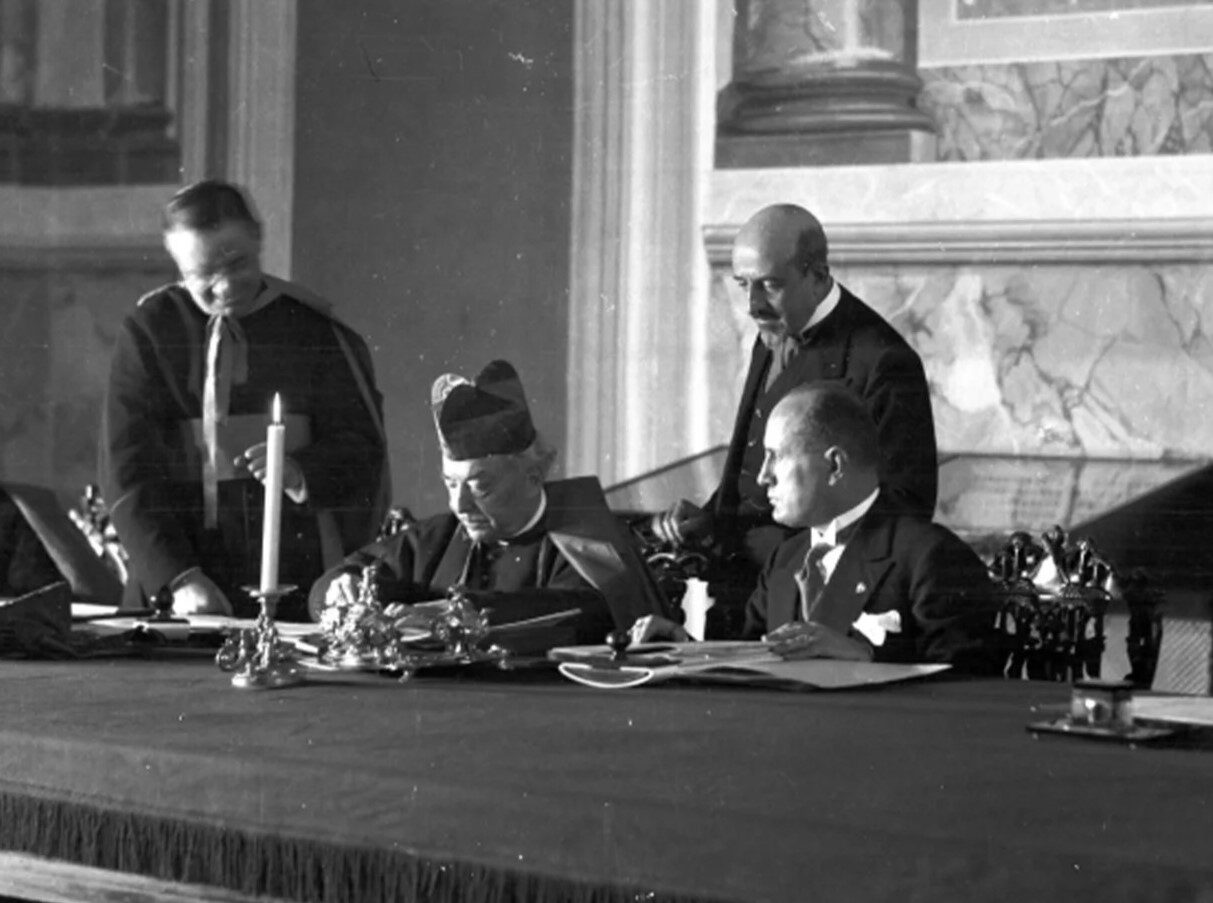

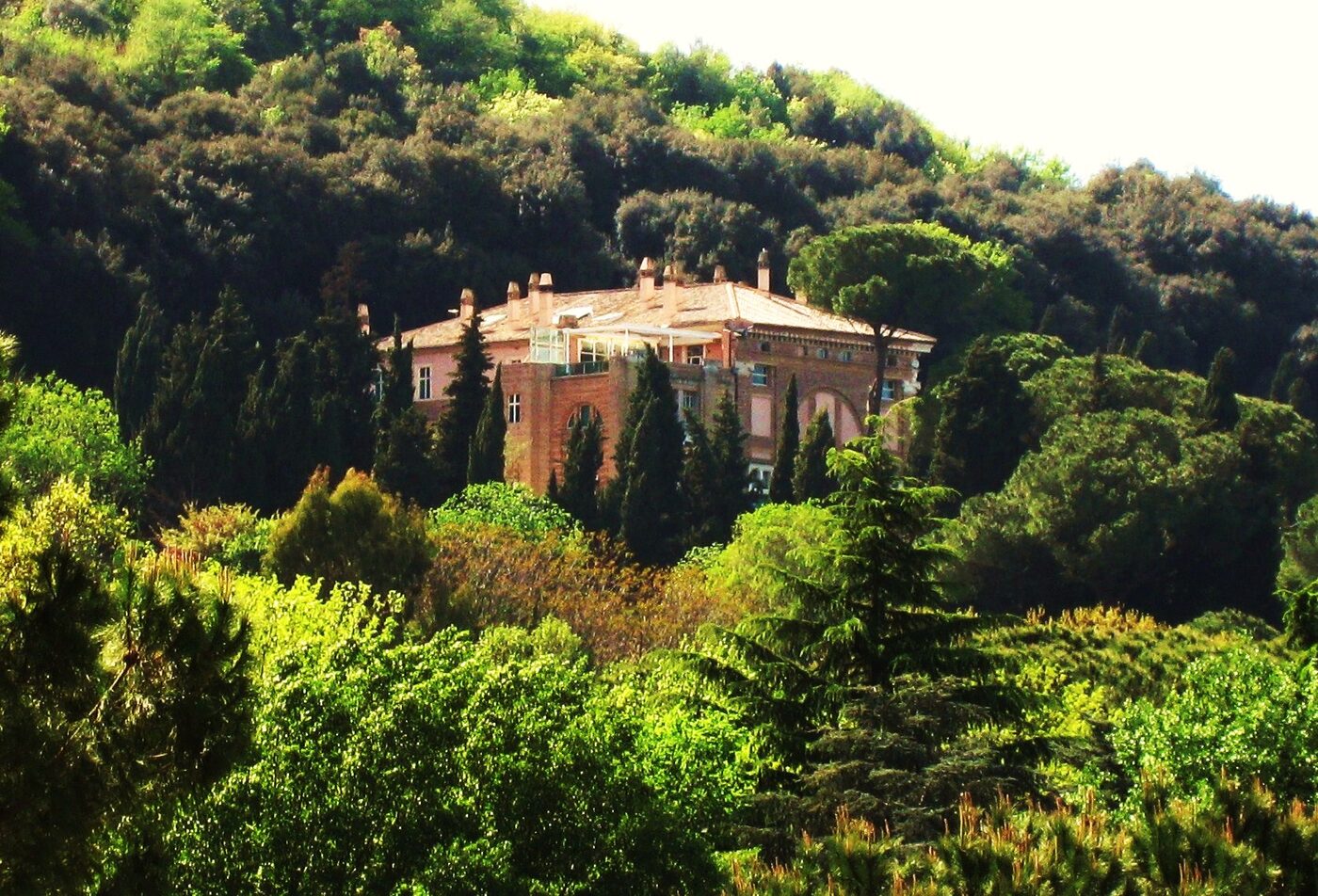
The concordat, though not the treaty, was renegotiated over many years and revised at Villa Madama in Rome on 18 February 1984, signed by the President of the Council, Bettino Craxi, and the Vatican Secretary of State, Cardinal Agostino Casaroli. It was ratified by Law No. 121 of 25 March 1985 and entered into force with the exchange of instruments on 3 June 1985. The sentence that did the work is not in the fourteen articles of the agreement itself but in point 1 of the additional protocol signed with it, and it is worth quoting because its phrasing is careful to the point of delicacy:
Si considera non più in vigore il principio, originariamente richiamato dai Patti lateranensi, della religione cattolica come sola religione dello Stato italiano.
In English: the principle, originally invoked by the Lateran Pacts, of the Catholic religion as the sole religion of the Italian State is considered no longer in force. Not abolished, not repealed: considered no longer in force, by common declaration of both parties.
The revision also ended the requirement that episcopal appointments be approved by the Italian government, and replaced the congrua — the state stipend paid to Catholic clergy since 1929 as compensation for nineteenth-century confiscations of church property — with a share of income-tax revenue. The Constitutional Court supplied the doctrinal coping stone four years later: in judgment No. 203 of 11 April 1989 it identified laicità, the secular character of the State, as a supreme principle of the constitutional order.

What Italy did not do, and had still not done during the years this group's branch was being created, was pass a general law on religious freedom to replace the pre-republican statute that governs everyone outside the concordat and the intese. That statute is Law No. 1159 of 24 June 1929 on culti ammessi, admitted cults, with its implementing Royal Decree No. 289 of 28 February 1930. Under it a religious body may be admitted so long as it does not profess principles or follow rites contrary to public order or public morality; recognition as a legal person is granted by decree of the President of the Republic on the proposal of the Minister of the Interior; and the appointment of ministers of religion entitled to celebrate marriages with civil effect requires the approval of the Minister of the Interior, applied for through the territorially competent prefecture. In practice recognition under the 1929 law has preceded the opening of negotiations for an intesa. A body of law drafted under the monarchy, in the same year as the Lateran Pacts, was thus still the general regime for religious minorities three-quarters of a century later.
Eight per thousand: how the money works
The mechanism that replaced the congrua is the one an Italian reader will recognise instantly and a foreign reader almost never understands correctly, so it is set out here in full. It was introduced by Article 47 of Law No. 222 of 20 May 1985, passed under the first Craxi government in implementation of the Villa Madama agreement; the old system was wound up over the second half of the 1980s, and the first allocations under the new rules were made from the tax declarations of 1990.
Eight parts per thousand — 0.8 per cent — of the total yield of the personal income tax, IRPEF, is set aside and distributed according to signatures collected on tax returns. The taxpayer may nominate the State, whose permitted purposes under the 1985 law and its later amendments include extraordinary intervention against world hunger, natural disasters, assistance to refugees and unaccompanied foreign minors, the conservation of cultural property and work on public school buildings; or the Catholic Church, whose permitted purposes are set out in Article 48 as the worship needs of the population, support of the clergy, and charitable intervention in Italy and the Third World; or any other denomination that has concluded an intesa providing for participation. Since 1984 the government has signed fourteen such agreements, of which thirteen have been approved by Parliament and turned into law, so the list of possible nominees lengthened steadily across the period this page covers and afterwards.
The feature that generates most of the argument is the treatment of taxpayers who sign nothing. Their share is not withheld. It is distributed among the beneficiaries in proportion to the choices that were actually expressed, save where a beneficiary renounces. Between 1990 and 2007 an average of 42.73 per cent of taxpayers expressed a choice at all, so the majority of the money each year was allocated by a minority of taxpayers. Among those who did choose, 76.17 per cent nominated the Catholic Church in 1990, rising to 89.81 per cent in 2004 and 89.82 per cent in 2005, then falling back to 86.05 per cent in 2006 and 85.01 per cent in 2007; nominations of the State fell from 22.31 per cent in 1990 to a low of 7.60 per cent in 2005 before recovering to 11.95 per cent in 2007. Because the unexpressed majority follows the expressed minority, the proportion of the fund reaching each beneficiary tracks the proportion of expressed choices rather than the proportion of taxpayers.
The arithmetic has consequences for small denominations too, and they run the other way. The Waldensian church, an Italian Protestant body whose origins lie in the twelfth century and which adopted Reformed theology after the Reformation, recorded 21,657 church members in Italy in its own 2017 report, and has been nominated by figures of a different order of magnitude; until Law No. 68 of 8 June 2009 took effect for the 2010 declarations it drew its share only from expressly declared quotas. The Assemblies of God in Italy likewise take only expressed quotas and renounce their portion of the unexpressed in favour of the State, as does the Chiesa Apostolica in Italia. The Church of Jesus Christ of Latter-day Saints, which concluded an agreement on 4 April 2007 ratified by Law No. 127 of 30 July 2012, declines to participate in the distribution at all.
None of this belongs to the group's period only. The years the free.it.religioni branch was created — 2000 to 2003 — sit just below the peak of the Catholic Church's share of expressed choices, which came in 2004 and 2005. Whatever was being argued about religion in Italian on Usenet in those years, the eight per thousand was one of the few subjects on which both sides could reach for published numbers.
With an agreement, and without one
Article 8 of the Constitution provides the route to a bilateral agreement; it does not oblige Parliament to take it. The chronology of Italian intese, which a reader of an Italian religion resource is likely to need and will not easily find in English, therefore reads as a list of pairs — the date the agreement was signed, and the date, often much later, when a law ratified it.
- Waldensian and Methodist churches: agreement of 21 February 1984, ratified by Law 449 of 11 August 1984; revised 25 January 1993, ratified by Law 409 of 5 October 1993.
- Italian Union of Seventh-day Adventist Christian Churches: agreement of 29 December 1986, ratified by Law 516 of 22 November 1988; revised 6 November 1996, ratified by Law 637 of 20 December 1996.
- Assemblies of God in Italy: agreement of 29 December 1986, ratified by Law 517 of 22 November 1988.
- Union of Italian Jewish Communities: agreement of 27 February 1987, ratified by Law 101 of 8 March 1989; revised 6 November 1996, ratified by Law 638 of 29 November 1996.
- Baptist Evangelical Christian Union of Italy: agreement of 29 March 1993, ratified by Law 116 of 12 April 1995.
- Lutheran Evangelical Church in Italy: agreement of 20 April 1993, ratified by Law 520 of 29 November 1995.
- Greek Orthodox Archdiocese of Italy, the Apostolic Church in Italy and the Church of Jesus Christ of Latter-day Saints: agreements of 4 April 2007, ratified by Laws 126, 128 and 127 of 30 July 2012.
- Italian Buddhist Union and Italian Hindu Union: agreements of 4 April 2007 — the Buddhist agreement first concluded on 20 March 2000 — ratified by Laws 245 and 246 of 31 December 2012.
Two things stand out for the period this page covers. The first is the gap between signature and ratification: agreements signed in 2000 and 2007 waited until 2012 for a vote, which means that for the whole life of the free.it.religioni branch the Buddhist Union had a signed agreement and no law. The second is the case that has never closed at all. An agreement with the Christian Congregation of Jehovah's Witnesses was signed on 20 March 2000 and signed again, revised, on 4 April 2007; a bill to give it effect was examined by the constitutional affairs committee of the Chamber in a later legislature without being approved, and it has never been ratified. The group free.it.religioni.tdgeova was created on 24 June 2000, three months after the first signature.
The absence with the largest constituency is Islam. No Islamic organisation may be nominated for the eight per thousand, and none has concluded an intesa; with the largest of the representative bodies, negotiations have not reached even a draft. A consultative body, the Consulta per l'islam italiano, was established at the Ministry of the Interior by decree of the Minister, Giuseppe Pisanu, in 2005 and confirmed in 2006 by his successor, Giuliano Amato, who added a group of academics and specialists; it was reformed in 2010 and reconstituted in 2016, each time with different names. Its stated task is to give opinions and formulate proposals on questions put to it by the Minister; it advises and does not negotiate.
Denominations without an intesa are not thereby illegal or unrecognised. They fall under the 1929 culti ammessi regime described above, which confers legal personality and certain tax advantages but leaves the state's approval of ministers, and much else, in administrative hands. The practical distinction between the concordat, an intesa and the 1929 law is one of degree of bilateral guarantee, and it was one of the standing subjects of Italian public argument throughout the period.
The hour of religion, and the right not to attend it
Religious instruction in Italian state schools is a creature of the concordat and was reshaped by the 1984 revision. Under the 1929 arrangement the ora di religione had been compulsory in middle and secondary schools as well as elementary ones, and was described as the foundation and crown of public instruction. Article 9, paragraph 2 of the Villa Madama agreement replaced that with a formula whose words matter:
La Repubblica italiana, riconoscendo il valore della cultura religiosa e tenendo conto che i princìpi del cattolicesimo fanno parte del patrimonio storico del popolo italiano, continuerà ad assicurare, nel quadro delle finalità della scuola, l'insegnamento della religione cattolica nelle scuole pubbliche non universitarie di ogni ordine e grado.
In English: the Italian Republic, recognising the value of religious culture and taking account of the fact that the principles of Catholicism are part of the historical patrimony of the Italian people, will continue to ensure, within the framework of the school's purposes, the teaching of the Catholic religion in public non-university schools of every order and grade.
The same article then provides that, in respect of freedom of conscience and of the educational responsibility of parents, each person is guaranteed the right to choose whether or not to avail themselves of that teaching; the additional protocol adds that the choice is exercised at enrolment, at the request of the school authority, and that it may not give rise to any form of discrimination. From that sentence descends the whole vocabulary of the Italian school year: avvalersi, to avail oneself, and the non avvalentisi, those who do not.
What the non-attenders were entitled to do instead took five years and litigation to settle. Ministerial circulars issued after the concordat had treated the choice as one between religion and an alternative activity, which implied that a pupil opting out remained obliged to be in school; a competing reading held the teaching wholly optional, so that those who declined were exempt from attendance altogether. Judgment No. 203 of 11 April 1989 — the same judgment that named laicità a supreme constitutional principle — held that a pupil who does not avail themselves is in a state of non obbligo, no obligation, and cannot be compelled to attend an alternative activity. Schools must nevertheless offer choices, and the four now standard are teaching and formative activities, assisted individual study, free individual study, and leaving the school building.
Two structural features of the arrangement were argued about throughout the period and are stated here as facts of the system. The teacher of Catholic religion must hold an idoneità, a certificate of suitability, issued by the diocesan ordinary, who may also revoke it for grave cause; and the qualifications accepted are those recognised by the Italian Episcopal Conference under the canon law provision on the subject and attested by the ordinary. Under the 1930 implementing law the post had been an annual appointment made by the head of the institute after consulting the diocesan ordinary, so that until 2004 essentially all such teachers held annual contracts without the tenured status of other teachers. Law No. 186 of 18 July 2003 provided for tenure by competitive examination for roughly fifteen thousand teachers out of some twenty-five thousand, covering about 70 per cent of the teaching hours, with nomination by the diocesan curia continuing for the remainder; the competition was held from April 2004 and remained, for many years, the only application of that law.
How many pupils took the hour is harder to state than it should be. The last ministry figures in general circulation, from 2005, gave a national average of 93 per cent of pupils availing themselves, falling to 87 per cent in upper secondary schools. Other series are produced by the Italian Episcopal Conference from diocesan questionnaires. Both sources are attributed here rather than reconciled, because they measure different things and neither is a census.
The crucifix in the classroom, in dates
No Italian religious argument of the period travelled further than this one, and almost all of it happened inside the group's years. The obligation, such as it is, rests not on a statute but on two royal decrees of the fascist period that were never repealed. Article 118 of Royal Decree No. 965 of 30 April 1924, on the internal ordering of state secondary institutes, provides in a single sentence that every institute has the national flag and every classroom the image of the crucifix and the portrait of the King. Royal Decree No. 1297 of 26 April 1928, the general regulation on elementary schooling, achieves the same through its schedule of classroom furnishings, in which the crucifix stands first on the list. Law No. 641 of 28 July 1967 extended the 1928 furnishing powers to middle schools; a ministerial circular of 19 October 1967 set out the resulting inventory with the crucifix first and the portrait of the President of the Republic second, in place of the King's. Neither the 1929 concordat nor the 1984 revision mentions the crucifix at all.
The Council of State gave an opinion in 1988, No. 63 of 27 April, holding the two decrees still legitimately operative, on the reasoning that they do not concern the teaching of the Catholic religion and do not constitute implementation of the commitments the State entered into in the concordat, and describing the crucifix as, apart from its meaning for believers, the symbol of Christian civilisation and culture in its historical root, as a universal value independent of any specific confession.
Then came the litigation. In 2002 Soile Tuulikki Lautsi, an Italian national of Finnish origin, asked the school council of a middle school at Abano Terme, in the province of Padua, to remove the crucifixes from the classrooms her children attended. The council refused and she applied to the Veneto regional administrative court, which in 2004 found the question not manifestly unfounded, suspended the proceedings and referred a question of constitutionality. The Constitutional Court answered with an order in 2004 declining to decide it, on the ground that the provisions attacked were regulatory rather than legislative and so outside its review. The Veneto court then decided the case itself in 2005, rejecting the application on the ground that in present social reality the crucifix should be considered not only a symbol of a historical and cultural development, and thus of the identity of the Italian people, but also a symbol of a system of values of liberty, equality, human dignity and religious tolerance, and therefore of the secularity of the State.
Alongside that case ran a second, noisier one. In March 2003 the Unione Musulmani d'Italia, an association founded in 2001 by Adel Smith, formally called on the Ministers of Education, Health and the Interior to remove crucifixes from premises in their charge; they did not reply, and the Lazio administrative court held the silence lawful. At the start of the 2003–04 school year Smith, resident at Ofena in Abruzzo, asked the teachers at the local nursery school — for which no rule requires a crucifix — either to remove it from his son's classroom or to hang beside it a framed text of the 112th sura of the Koran. The teachers hung the frame; the head teacher had it taken down the next day. On 23 October 2003 the court of L'Aquila ordered the school authority to remove the crucifixes from the classrooms in question. The order was extensively reported and was not carried out; on 19 November 2003 the same court declared that the ordinary courts had no jurisdiction over the matter, and in 2006 the Court of Cassation, in an order of 10 July, confirmed that jurisdiction lay exclusively with the administrative courts.
Positions were taken in public by institutions on both sides, and are reported here strictly as positions taken. An opinion of the state legal service in Bologna of 16 July 2002 held that the provisions requiring the display remained in force and that the display did not injure religious liberty. Answering parliamentary questions in September 2002, the Senate education committee stated that the presence of the crucifix in classrooms did not conflict with religious freedom and described it as a universal symbol. A resolution of the culture committee of the Chamber of Deputies of 6 November 2003 held that removing the crucifix would injure the sensibility and shared culture of a great majority of the Italian population, and that the crucifix, besides being the symbol of the Christian religion, was the emblem of values including individual liberty, respect for all faiths and the separation of God and Caesar. The Union of Rationalist Atheists and Agnostics litigated the opposite case, including an unsuccessful challenge in the Lazio administrative court in May 2002 to the presence of religious symbols in polling stations. In a related matter a polling clerk who had refused to serve in 1994 because of the crucifix in his polling station was fined by the magistrate at Cuneo in 1999; the Court of Cassation quashed the conviction in 2000, holding that no offence had been committed.
The end of the story falls outside the group's years but is what the earlier stages became. The Council of State returned to the question in 2006, in opinion No. 556, restating that the royal decrees remained in force, that the nature of the regime that issued them was a meta-legal consideration incapable of repealing them, and that the crucifix in a classroom should be understood as a symbol of the principles of liberty, equality and tolerance and thus of the secularity of the State itself; the Veneto court's rejection of the Lautsi application was upheld on appeal by the supreme administrative court in the same period. Lautsi applied to the European Court of Human Rights on 27 July 2006. A Chamber of the Court's Second Section held on 3 November 2009 that there had been a violation of Article 2 of Protocol No. 1 taken together with Article 9, reasoning that among the plurality of meanings the crucifix might have the religious meaning was predominant, and that negative freedom of religion extended to symbols as well as services. Italy appealed in January 2010; twenty states had expressed support for the appeal by that July; and on 18 March 2011 the Grand Chamber reversed by fifteen votes to two, granting that the regulations conferred on the country's majority religion a preponderant visibility in the school environment but holding that this was not in itself sufficient to denote a process of indoctrination, and that a crucifix on a wall is an essentially passive symbol. A judgment of the united civil sections of the Court of Cassation of 10 September 2021 held that display is neither obligatory nor discriminatory, cannot be imposed, and is for each school to decide by reasonable accommodation between the parties. Anyone reading Italian Usenet arguments about the crucifix from the years 2000 to 2004 is reading them before any of the last three outcomes existed — which is worth remembering before treating a contemporary posting as either prescient or mistaken. See also the page for Lautsi v. Italy for the Strasbourg proceedings in detail.
Newer religious movements, and the language used about them
The names in the free.it.religioni branch include several that belong to what Italian public discussion of the period called nuovi movimenti religiosi, and the legal and administrative frame around that category is documented well enough to describe without characterising anybody.
The criminal-law question had been settled a generation earlier, and against the prosecutors. Article 603 of the penal code, enacted in 1930, punished with five to fifteen years anyone who subjected a person to their own power so as to reduce them to a total state of subjection — the offence of plagio. It was successfully used once. In October 1964 a complaint under the article was lodged in Rome against the artist and former Communist local official Aldo Braibanti; he was arrested on 5 December 1967, sentenced by the Rome assize court on 14 July 1968 to nine years, reduced on appeal on 28 November 1969 to four, released on 12 December 1969, and confirmed by the Court of Cassation in 1971, serving two years with the remainder remitted for his service in the Resistance. He remains the only person convicted under the article. In proceedings arising from a later case, an investigating judge at the Rome tribunal referred the article to the Constitutional Court on 2 October 1978, and by judgment No. 96 of 1981 — decided on 9 April and deposited on 8 June — the Court struck it down as incompatible with the principle that criminal offences must be precisely defined, enshrined in Article 25 of the Constitution. The Court's reasoning, summarised here because it is the pivot of everything that followed, held that psychological dependence of a high degree arises in ordinary relationships — it named the relations of lovers, of priest and believer, of teacher and pupil, of doctor and patient — and that it is extremely difficult if not impossible to identify and distinguish in practice, for legal purposes, the psychic activity of persuasion from that of suggestion, there being no secure criteria for separating them.
Administrative attention continued nonetheless. In February 1998 the Central Direction of the Prevention Police, within the Department of Public Security at the Ministry of the Interior, produced a 105-page document titled Sette religiose e nuovi movimenti magici in Italia, transmitted on 29 April 1998 to the constitutional affairs committee of the Chamber of Deputies. It contained an introduction and seventy profiles, thirty-four of new religious movements and thirty-six of new magical movements, and reported, on the basis of returns collected from police headquarters over about two years, 76 new religious movements with some 78,500 adherents and 61 new magical movements with some 4,600. The analysis published by CESNUR — the Centre for Studies on New Religions, founded at Turin in 1988 by Massimo Introvigne — observed that the report had drawn its structure, its terminological distinctions and its classification of movements from Introvigne's own books, frequently reproducing passages without attribution, and criticised parts of it as out of date or inaccurate. Both the document and the criticism are cited here as what they are: an official survey, and a scholar's review of it.
Attempts to legislate returned in the group's own period. On 4 March 2005 the justice committee of the Senate approved a bill sponsored by Senator Renato Meduri of Alleanza Nazionale introducing an Article 613-bis into the penal code, on manipolazione mentale: two to six years for anyone who, by techniques of conditioning the personality or of suggestion practised by material or psychological means, places another in a continuing state of subjection such as to exclude or greatly limit their freedom of self-determination, with the penalty increased by a third to a half where the act is committed within a group promoting or practising activities aimed at creating or exploiting the psychological or physical dependence of those taking part, or where the offender acted in order to commit a crime. The bill went no further. Objections were entered from several directions; the Commission of the Evangelical Churches for Relations with the State recorded on 30 May 2005 that while coercion of individual will by conditioning techniques did genuinely exist, the vagueness of the proposed offence appeared to reproduce the very features that had led to plagio being declared unconstitutional, and risked treating as a crime any conversion induced by preaching and example.
Against that background the branch's own names read as a period document and nothing more. free.it.religioni.tdgeova, for the Jehovah's Witnesses, was created while their intesa was three months old and unratified, and remains unratified now. free.it.religioni.osho-rajneesh, free.it.religioni.krishna, free.it.religioni.sciamanesimo and free.it.religioni.gnosticismo name movements and currents belonging to the broad categories the 1998 report used. free.it.religioni.cmas — Chiesa Magica dell'Antica Saggezza — is the only one of the ten to describe itself as a church in its own description line. What was said inside any of them is not known to this page, and no inference from a group's name to its contents is offered.
What the surveys of those years recorded
Numbers on Italian religious belonging come from several bodies using different questions, and are given here with the body attached because they do not agree and were not designed to. The Italian statistical institute, ISTAT, does not record religious affiliation, which it treats as sensitive data; it asks instead how often respondents attend a place of worship.
For the years around this branch's creation: the Eurobarometer poll of 2005, conducted for the European Commission, found 74 per cent of Italians saying they believed there is a God, 16 per cent that there is some sort of spirit or life force, and 6 per cent that there is no sort of spirit, God or life force. A Eurispes survey of 2006 put Catholics at 87.8 per cent of Italian citizens, of whom 36.8 per cent described themselves as observant; by the same survey's later rounds those figures were 76.5 and 24.4 per cent in 2010, and 71.1 and 25.4 per cent in 2016. ISTAT's series records that the proportion of Italians who have never practised a religion doubled between 2001 and 2022, from 16 per cent to 31 per cent; its 2015 figures put weekly attendance at a place of worship at 29.0 per cent nationally, ranging from 37.3 per cent in Sicily and 32.4 per cent in Veneto down to 19.4 per cent in Tuscany and 18.6 per cent in Liguria.
Estimates of the Muslim population, the demographic change that most altered the terms of Italian religious debate during the period, vary widely with the definition used and with who is counting, and this article gives only figures it could attribute. A Pew Research Center projection put the number at about 1.4 million, some 2.3 per cent of the Italian population, of whom around 250,000 held Italian citizenship. CESNUR's more recent count, which incorporates data on foreign residents supplied by Caritas Italiana, gives about 2.3 million for 2023. Because no official source records affiliation, every such figure is an estimate built either from residence data or from survey responses, and estimates built the two ways are not comparable with one another. Orthodox Christianity grew quickly over the same decades through immigration, the Romanian Orthodox Church being the largest single body; the same CESNUR count gives about 1.8 million Orthodox Christians for 2023. Fuller demographic detail sits in the general article on religion in Italy.
One caution applies to all of it. A newsgroup's population is not a random sample of a country, and nothing in these figures says anything about who read or wrote in any Italian religion group. They describe the society the arguments came out of, not the arguments.
Writing Italian on a seven-bit wire
Italian is one of the cheaper European languages to squeeze into ASCII. It has no letter outside the basic Latin alphabet; what it needs is the grave and acute accents on final vowels — à, è, é, ì, ò, ù — which carry real work: they mark stress, and they distinguish words. All of them exist in ISO 8859-1, so eight-bit Italian was complete in a way that, for instance, eight-bit French was not. The general mechanics of why the eighth bit was unsafe on Usenet are set out for French on soc.culture.quebec and for Dutch on the nl.* hierarchy page, and are not repeated here. What is specific to Italian is the workaround, and the workaround is visible in this group's own neighbourhood.
Italian typists had an ASCII convention ready-made, because Italian typewriters and later Italian keyboards carry the accented vowels as dedicated keys in lower case but not in upper case: to write È at the start of a sentence one types E and an apostrophe. Extended to the whole alphabet, that gives the familiar seven-bit Italian of the period — citta', perche', piu', cosi', e', cio', societa'. A second convention used the backtick for the grave accent, giving religiosita` and e`. Both appear in the it.* control messages quoted earlier in this article: the April 1999 message creating it.cultura.religioni asks administrators to file the description Religioni e religiosita` with a backtick, while the charter travelling in the same article writes spiritualita' and puo' with apostrophes, and the November 1998 charter of it.cultura.ateismo writes e`, piu` and perche`. Today's master list carries the same group as Religioni e religiosità, the accent restored as an eight-bit byte. The history of a writing system, again, legible in one archive file.
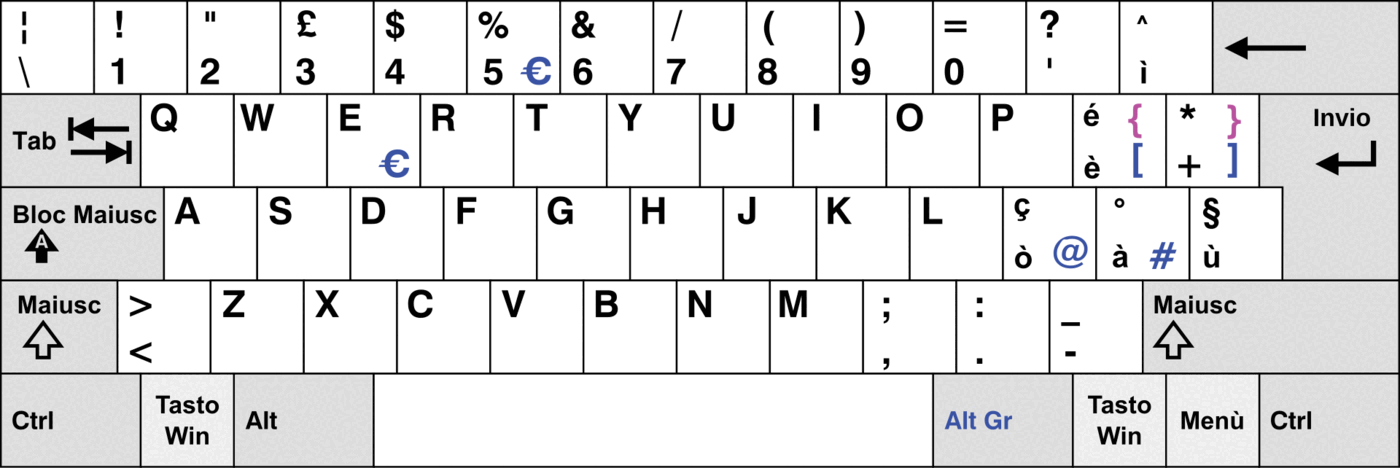

Counted across the whole description file, Italian Usenet is still mostly seven-bit. Of the 1,997 free.it.* entries, 78 contain any byte above 127; of the 449 it.* entries, 22 do. Fifteen free.it.* descriptions spell an accented final vowel with a trailing apostrophe instead — citta', cio', piu', e', societa', cosi' — and none of the it.* ones do. The file as a whole is a patchwork rather than a document in a single encoding: of its 1,907 lines containing high bytes, only 119 are valid UTF-8 and the remaining 1,788 are eight-bit legacy encodings, mostly Latin-1.
One line in it preserves a failure in miniature. The description of free.it.citta.perugia is stored as the bytes Citt, then 0x85, then di Perugia. Byte 0x85 is à in the MS-DOS code pages 437 and 850; in ISO 8859-1 it is a control character with no printable form, and in Windows-1252 it is an ellipsis. Somebody typed Città di Perugia on a DOS-era machine, the byte travelled unlabelled, and the register has carried a broken character ever since. Nothing about that is peculiar to religion, or to free.it.*; it is simply what an open hierarchy with no editorial layer preserves that a signed and curated one quietly fixes.
What the record does not show
This is the part of the page that a reader following an old link most needs, and it is longer than usual because for this address the gaps are most of what there is.
Nothing is known here about the contents of free.it.religioni or of any group beneath it. No article has been read for this page. No thread is named, quoted, characterised or counted. No participant is identified. No estimate of readership, traffic, longevity or activity is offered for any of the ten groups, because none exists in any source located during this work, and constructing one from the archive would be invention.
Nor is the bare name's own status established. There is no control message for free.it.religioni in the ISC archive and no entry in the current master lists. Three possibilities are consistent with that — that the name existed only as a branch prefix and was never a group; that a creation message was posted and never reached the machine feeding the archive; or that servers carried it locally because their administrators added it by hand, which in free.* required no message at all. The record does not choose between them, and neither does this page.
Several further things were looked for and not found. Apart from the one-line charter in the CMAS booster message of 21 February 2002, no charter, FAQ, welcome message or posting-guidelines document for any free.it.religioni.* group turned up anywhere. No free.it.* equivalent of the GCN — no coordinating body with a published document set, a signing key or an administrative newsgroup — appears in the ISC configuration, though a management group is named in one secondary source, as recorded above. No archived discussion of the branch's creation exists in the control record, which by construction holds control messages rather than conversation, and the free.* hierarchy's own discussion group, free.config, has no surviving digest known to this page. The identity behind the FREENG and CREANG tools is not established beyond the copyright line the tools stamped into their own output. The reason Italian users adopted an American open hierarchy in such numbers from early 2000 is not established either; the archive shows that they did, and stops.
Finally, the relationship between the two Italian branches on any actual server is undocumented here. Whether readers of it.cultura.religioni also read the free.it.religioni.* groups, whether the narrow free.* groups drew traffic away from the broad voted one or fed it, whether the free.* branch was regarded within Italian Usenet as a useful overflow or as noise — all of that would have been argued at the time in the it.news.* groups, and none of it has been read for this page. Google Groups holds the Usenet archive that Deja News began in 1995 and that Google acquired in 2001; Italian traffic of this period is generally within it, which means the primary material for a real history of these groups very probably exists. It has not been consulted here.
Scope and limits
This article documents a newsgroup address, the two hierarchies it sits between, and the legal and social world in which an Italian-language argument about religion took place. It takes no position on any religion, movement, church or belief; on the merits of the Italian settlement or of any alternative to it; or on any of the arguments summarised above. Where a characterisation appears — of the crucifix, of a religious movement, of the eight per thousand, of anything else — it is attributed to the statute, court, committee, ministry, survey body or named scholar that made it, and the attribution is the substance rather than a formality.
Three classes of statement here should be read with different degrees of confidence. Everything about control messages, configuration files, group names, descriptions, dates, counts and character encodings was read directly out of the Internet Systems Consortium's Usenet archive and configuration files, or out of the coordinating group's own published documents, while this page was written, and can be checked at source. Everything about statutes, decrees, agreements, judgments and reports was verified against reference sources and is given with numbers and dates attached so that it can be verified again. Everything about religious demography and opinion is survey or estimate data, is attributed to the body that produced it, and carries the ordinary uncertainties of such data — most sharply in the estimates of the Muslim population, where the spread reflects differences of method rather than of arithmetic.
What is not here is the group. This directory preserves a mail-to-news gateway's view of Usenet between 2000 and 2004, and its entry for this address was, until now, a name and a line. The name has been placed in its hierarchy, the hierarchy in its configuration, and both in the country whose arguments they carried. The conversation itself has not been recovered, and no attempt has been made to imagine it. A reader arriving here should know precisely where that boundary falls, and that everything on this side of it can be checked.
Reading free.it.religioni today
- Historical archive: Google Groups — free.it.religioni (coverage varies by group and era).
- Open in a newsreader:
news:free.it.religioni— the original site offered exactly this link, and it still works if your system has a newsreader registered for thenews:scheme. - Live access: point an NNTP newsreader at a modern server — see accessing Usenet today.
- The original news2mail e-mail subscription service ended in the mid-2000s and no longer operates.