soc.culture.quebec
Quebec society and culture, mostly in French.
The francophone room of North American Usenet: the 1995 referendum lived here in real time, alongside language-law debate, joual appreciation, Canadiens hockey and a running seminar on why France and Quebec misunderstand each other.
It operated largely in French with English tolerated, a policy enforced by gravitational field rather than moderation.
On this page
- One subject, three addresses
- The paperwork, in full
- The charter, and a clause about accents
- Who voted, and from where
- Writing French on a seven-bit network
- What the archived file itself shows
- fr.*, and the other francophone Internet
- Joual, and the argument about how Quebec speaks
- The terminology office and the vocabulary of a separate market
- Cinema
- Chanson, the record industry, and four million viewers
- The table
- Winter as a calendar
- The literature
- The referendum of 30 October 1995
- Before it: 1980, and the accord of 1992
- After it: the courts and the legislatures
- What a result that close does to an unmoderated group
- The neighbours: Franco-Ontarians and Acadians
- The migration south
- The later years, and one forged control message
- What the record does not show
- Scope and limits
One subject, three addresses
Most groups in the soc.culture.* branch answered to a passport. A country was proposed, a country was voted on, a country got a room. Quebec got three rooms, in three different buildings, and it is that arrangement rather than anything in the group's own traffic that makes soc.culture.quebec structurally unusual. A reader in Montreal with a full news feed in the middle 1990s could reach the same subject by three separate roads: soc.culture.quebec, in the Big Eight's worldwide culture branch; the provincial hierarchy qc.*, whose groups carried French names; and fr.*, the French-language hierarchy, open in principle to any francophone anywhere. None of the three was a subset of another. Each had its own creation procedure, its own electorate, its own administrators and its own reasons to exist.
The three were built on three different organising principles, and the differences are exact rather than atmospheric. The Big Eight sorted the world by subject, and inside soc.culture.* the subject was a people: a group was created when a worldwide, overwhelmingly anglophone electorate voted that one should be. A regional hierarchy sorted the world by territory, and its unit was carriage: a news administrator took the whole prefix or declined the whole prefix with one line in a configuration file. A language hierarchy sorted the world by language, and its unit was the reader's competence rather than the reader's address. Quebec is one of the few subjects on Usenet that had a settled, populated address under all three principles at once.
The counts, from the canonical newsgroups file that the Internet Systems Consortium publishes as the description of the world's namespace, give the shape of it. In the copy fetched on 30 August 2026, that file lists 45,003 groups. soc.culture.* holds 139 of them and soc.* as a whole 213. fr.* holds 144. can.*, the bilingual national hierarchy, holds 48. qc.* holds three. Two further layers sat underneath: mtl.*, the Montreal city hierarchy, which holds five and which already existed in 1994; and, in the loosely governed alt.* tree, a scatter of francophone groups including alt.politics.regionalism.quebec and alt.sports.hockey.nhl.que-nordiques.
What the arrangement meant in practice is best put as a question of who was in the room. In soc.culture.quebec the audience was the world, and a Quebec argument had to be made in terms a reader in Adelaide or Antwerp could follow — which is why so much of the group's recorded output has the character of explanation. In qc.* the audience was the province, and nothing had to be explained. In fr.* the audience was francophone and mostly European, and what needed explaining was North America. The same poster could hold the same view in all three and would have written it out three different ways.
This page is about the first of the three. The provincial hierarchy — its two founding control messages, its three-group shape, its absence of any governing document, and the question of what a provincial namespace offered that the others did not — is set out in detail on qc.politique, and is not retold here. The Canadian national picture belongs to soc.culture.canada. The mechanics of Big-Eight group creation, which the next section relies on, are described on the soc.* hub.
The paperwork, in full
soc.culture.quebec is one of the better-documented groups in this directory, for the simple reason that the Big Eight made people write things down. The Internet Systems Consortium mirrors the archive of news.announce.newgroups, the hierarchy's register of record, and its file for this group runs to 1,490 lines: a request for discussion, two calls for votes, and a result posting carrying the complete roll of everyone who voted, by name and address. A separate archive holds the control messages themselves. Between them the two files fix every date in the group's creation to the minute.
The request for discussion is dated 8 June 1994 at 17:15:55, four hours behind Greenwich. It names two proposers: Yves De Repentigny, writing from the Universite de Montreal, and Claude Boucher, writing from Fredericton, New Brunswick, over a provincial network whose signature line advertised a toll-free support number. It was posted to news.announce.newgroups and news.groups — the Big Eight's own machinery — and cross-posted to soc.culture.french, soc.culture.belgium, soc.culture.canada and soc.culture.swiss; its own text adds fr.announce.newgroups, the French hierarchy's announcement group, to that list. The choice of rooms is worth pausing on. The proposers went looking for their electorate among francophones of four countries and among Canadians generally, and nowhere among the readers of the provincial hierarchy that had come into existence a month earlier.

The document is bilingual, English first and then French, and its English half opens with an argument about naming that is unusually candid about the Big Eight's difficulty with sub-national territories, and rests on the one precedent the branch already had, soc.culture.puerto-rico:
Several culture-oriented groups have names reflecting a particular region or population, whose culture is distinct to a nation. There currently exists the newsgroup soc.culture.puerto-rico, for example. Puerto-Rico in the United States, like Quebec, a province of Canada, has a specific culture, language and territory.
The rationale that follows makes three claims, and one of them is a traffic estimate the proposers were prepared to put in writing: that Quebec was already being discussed in soc.culture.french and soc.culture.canada, groups in which, they wrote, it was not uncommon to see more than a hundred messages posted daily, and that a dedicated group could be expected to take a little of that load. The second claim is about the diaspora — that Quebecers living outside Quebec would find news from home in their own language. The third is the flat assertion that Quebecers form a community with interests of its own, for linguistic, historical, political, sociological and cultural reasons. Under the heading UNMODERATED the document explains the choice in a single sentence: the group would be unmoderated in order to invite expression of the widest range of viewpoints on all possible topics.
A first call for votes went out on 11 July 1994, and a second on 28 July. Both were posted by Mark James, writing under the organisation line of the Usenet Volunteer Votetakers — the standing pool of neutrals who ran Big-Eight ballots — and both were bilingual throughout. Voting closed at 23:59:59 GMT on 13 August 1994. The result posting, dated 15 August 1994 at 21:02:55 Eastern, is headed VOTE RESULT and prints the arithmetic in a table: 440 yes, 80 no, two-thirds satisfied, hundred-vote margin satisfied, group passes. Beneath it a single line records that there were no abstentions.
The result was not itself the creation. Under the rules of the day a five-day correction window followed, during which irregularities in the count could be raised; the votetaker's posting says so explicitly. The window passed without incident, and on 22 August 1994 at 14:31:43 GMT David C Lawrence, then the moderator of news.announce.newgroups, sent the newgroup control message. Its opening lines are as plain as the process was elaborate:
soc.culture.quebec is an unmoderated newsgroup which passed its vote for creation by 440:80 as reported in news.announce.newgroups on 16 Aug 1994.
Seventy-five days from proposal to creation, and every step of it on the record. The control message was re-sent twice in the ordinary course of business, on 29 August and 22 September 1994, which was routine housekeeping for a hierarchy whose members joined and left the network constantly.
The charter, and a clause about accents
The charter as it was put to the electorate is short, and the newgroup message reproduces it under the heading The charter, culled from the call for votes. Its operative paragraph is two sentences:
The newsgroup soc.culture.quebec is to be an international forum for discussion open to all people who wish to share their views on Quebec. With this in mind, discussion may cover a wide scope of issues including, but not restricted to, social life, culture, economics and politics in Quebec.
The one-line description that goes into a news administrator's newsgroups file was specified in the call for votes, and it has not changed in thirty-two years. In the ISC list consulted on 30 August 2026 the entry is a name, a tab, and four words:
soc.culture.quebec Quebec society and culture.
Charters of this period are usually silent about the machinery of writing. This one is not, and the exception is the single most useful thing the paperwork contains. Under the heading LANGUAGES AND CHARACTER SETS the proposal states that the everyday language of the group is French; that messages in English are expected and will be welcome, given the linguistic makeup of both Quebec and Usenet; and that messages in other languages are accepted but that their authors should not expect a large audience. It then legislates the bytes:
The use of the 7 bit ASCII character set is preferred. The standard 8 bit ISO 8859-1 (Latin-1) character set (accented characters) is also permitted, albeit optional. The use of any other standard or character set is not authorized.
A charter that ranks character encodings, and prohibits all but two of them, is a charter written by people who had watched their own accents disappear in transit. The French half of the same document renders the last clause as a flat interdiction: the encoding of accents according to any other standard will be forbidden. Nothing in the Usenet of 1994 gave a group any means of enforcing such a rule, and the proposers plainly knew it; the clause is a statement of hope in the imperative mood. The reasons it was needed are the subject of the next two sections.
Who voted, and from where
Big-Eight ballots were public. The result posting for soc.culture.quebec prints all 520 voters by electronic address, most of them with a name attached, in alphabetical order of account name, divided into a yes column of 440 and a no column of 80. The roll is therefore a rare thing: a dated census of the people who cared enough about a Quebec newsgroup, in August 1994, to send an e-mail about it.
The addresses cannot be read as a map of where people lived — a Quebecer at an American university has an .edu address, and a Montrealer with a commercial account may have a .com one. Read only as a proxy, and counting the top-level domain of every address on the roll, the distribution is nonetheless informative. Every one of the 520 addresses resolves to a top-level domain, and Canadian ones are the largest single group at 182. American educational and commercial domains follow, at 93 and 87. Then, in a cluster that is the whole point of the exercise, come 35 addresses in .fr and 33 in .be, with 12 in .ch. The rest is a long thin tail: 18 in .org, 12 in .net, 11 in the United Kingdom, 10 in Australia, nine in Germany, four in Japan, three in Finland, three under .mil, and one each in Denmark, the Netherlands, Israel, Singapore, Norway, Italy and the United States, with one .gov.
Thirty-three Belgian voters in a ballot on a Canadian province is not an accident, and it is not evidence of unusual Belgian interest in Quebec. It is the crosspost list doing its work. The request for discussion had been posted into soc.culture.belgium and soc.culture.swiss as well as soc.culture.french, on the reasonable theory that a French-language group concerned the francophone world; and every one of the 33 Belgian addresses is in the yes column. The francophone European reader, invited into an argument about a North American province, voted for the room and then, in most cases, presumably never went back.
This is the ordinary condition of a Big-Eight culture group and is worth stating plainly, because it is the structural difference between the Big Eight and a regional hierarchy. The people who decided whether Quebec would have a newsgroup were not the people who would read it. They were a worldwide electorate assembled ad hoc by the crosspost list of a proposal document, and the margin they returned — 440 to 80, five and a half to one — reflects a general disposition to let communities have rooms rather than any judgement about Quebec. The alternative, in which the affected population settles the question among itself with a control message, is the subject of the qc.politique page, and it produced a hierarchy in one hundred and fourteen seconds.
Writing French on a seven-bit network
The mechanics are worth stating plainly, because they shaped what the group looked like on a screen. RFC 1036, published in December 1987 by Mark Horton and Rick Adams as the Standard for Interchange of USENET Messages, took the shortest available route to a message format. Rather than invent one, it adopted the Internet mail standard wholesale: the rule, in the document's own words, is that all USENET news messages must be formatted as valid Internet mail messages, according to the Internet standard RFC-822. That lineage carried an assumption with it. RFC 822 mail was seven-bit US-ASCII, and a great deal of the software an article passed through on its way across the network — gateways, batchers, mail-to-news bridges, ageing transports — was not eight-bit clean. For English the assumption was invisible. For French it removed every accent in the message.
The eight-bit answer was ISO 8859-1, universally called Latin-1, standardised in 1987 and covering almost all of written French. Almost. It omits the ligatures Oe and oe and the rare Y with diaeresis — letters that had been present in Digital's Multinational Character Set in 1983, from which Latin-1 was ultimately derived, and were dropped along the way. They were restored only in 1999, by ISO 8859-15, the revision better remembered for adding the euro sign; the four replaced positions were the currency sign, the diaeresis, the acute accent and the cedilla. A French text that needed to be shouted in capitals had, for twelve years, no standard way to write the capital Y with diaeresis at all.
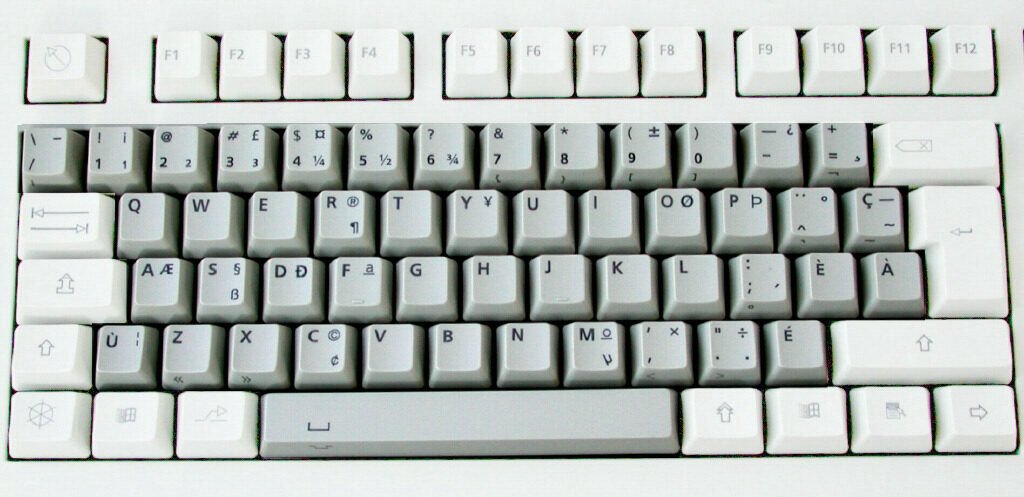

Even where the eighth bit survived the journey, sender and reader had to agree on what the eighth bit meant. The MS-DOS code pages and Apple's Mac OS Roman arranged the upper half of the byte range their own way, and neither matched Latin-1. A correctly typed e-acute could therefore arrive as an entirely different character because the two machines disagreed about the value 233. There was no header in common use that reliably said which set was in play, and there was no negotiation; there was only the reader's guess, informed by what the mangling looked like.
The standards-track fix was MIME's quoted-printable encoding, which rewrites each eight-bit byte as an equals sign followed by two hexadecimal digits, so that the article travels down a seven-bit path unharmed. An e-acute travels as =E9 and an e-grave as =E8. Software that understands the encoding reconstructs the text exactly; software that does not shows the reader a rash of equals signs, which is worse than the disease it cures. The third option needed no standard, no negotiation and no software: write French without accents and let the reader supply them from context. That is what most of Usenet's francophone traffic did, and it is what the group's own charter recommended.
What the archived file itself shows
The point does not have to be taken on trust, because the group's own founding document is a specimen of the disease. The 1,490-line archive file for soc.culture.quebec contains no byte above 127. Not one. The English halves of the four postings are unaffected, being English. The French halves are not.
In the request for discussion the damage is of a particular kind: accented letters have not been replaced, they have vanished. The archive reads Le Qubec est une province du Canada, le Quebec possde une culture, un toponyme bien dfini, tant donne la realite linguistique. Each gap is exactly one character wide and sits exactly where an accented vowel belongs. The pattern is what happens when the eighth bit is cleared from a byte and the result falls in the control range, where a later stage of processing quietly discards it.
One surviving artefact identifies the machine. The French half of the request for discussion is headed APPEL K DISCUTER, where APPEL A DISCUTER, with an A-grave, was intended. Clearing the eighth bit from an A-grave in Latin-1, where it is 0xC0, yields 0x40, the commercial at sign. Clearing it from an A-grave in Mac OS Roman, where it is 0xCB, yields 0x4B — the capital letter K. The one accented character in the document that survived the journey survived because its Macintosh encoding happened to land on a printable letter, and the letter it landed on is the letter in the file. The accented vowels that vanished are, in the same encoding, in the range that clears to control characters. It is a single data point and the inference should be held loosely, but it is the only reading of that K that requires nothing else to be assumed.
The two calls for votes and the result behave differently. Their French is written entirely without accents from the start — defini, possede, decrit, modere, realite, with no letters missing and nothing broken. Whoever prepared them had reached the same conclusion the charter reached, one paragraph after recommending Latin-1 as an option: on this network, in this decade, the only French that arrived intact was French that had nothing to lose.
There is a smaller irony in the vocabulary. The French text of the call for votes describes the ballot it is announcing as a referendum: the votes must be received by the stated hour, and the referendum will be conducted in a neutral manner. The result posting repeats the word twice more. The group was voted into existence in a document that called its own creation vote a referendum, fifteen months before the province held one.
fr.*, and the other francophone Internet
Of the group's two sibling namespaces, fr.* is the one this page has to characterise, because the way it differed from soc.culture.quebec explains what soc.culture.quebec was for. fr.* was organised by language and not by country. In principle any francophone anywhere was at home in it; in practice its administration, its documentation, its conventions and its centre of gravity were European, and its 144 groups in the current list are overwhelmingly the concerns of readers in France. A Quebecer in fr.* was a francophone abroad. A Quebecer in soc.culture.quebec was at home, in a room whose charter said in terms that the everyday language was French.
The divergence had a history considerably older than Usenet, and it is the reason the two ends of the francophone network did not meet as equals. French-language computing in France had not arrived by the North American route at all. From the early 1980s France had Minitel, a videotex service run through the state telephone monopoly: a trial with 55 residential and business customers opened at Saint-Malo on 15 July 1980, two days after the system was shown to the President of the Republic; commercial service followed across France in 1982; and from 1984 the state put terminals into homes by giving them away. By the end of 1999 France Telecom counted close to nine million terminals with access to the network and some 25 million users in a country of 60 million; by 1996 nearly 26,000 separate services, built by about ten thousand companies, were available on it. The first mass-market online medium of the pre-web era was therefore centralised, metered, commercial and national — the opposite in every respect of the university-and-hobbyist Usenet that francophone North America had joined. Minitel outlived the thing it prefigured, and was switched off on 30 June 2012.
Quebec's own path onto the network ran through its universities. RISQ, the Reseau interordinateurs scientifique quebecois, was created in 1989 by the computing directors of the main Quebec universities in association with the Centre de recherche informatique de Montreal, and connected the province to the American NSFNET; it was the first Internet service in Quebec, and from 1993 the provincial research networks were gathered under the national CA*net. That is the plumbing behind the ordinary observation that Usenet populations began at universities: in Quebec it means graduate students and engineers first, joined through the 1990s by home users as Montreal and Quebec City dial-up providers multiplied.
The national hierarchy sat between the two. can.* holds 48 groups in the current list and is a small monument to how a bilingual federation organises a namespace: can.english for the English-speaking population in English, can.francais for the francophone population in French, can.politics for the politics of the whole, and can.talk.bilingualism, whose official one-line description reads, in full, Flames about Canadian English or French, depending. Francophone religious argument, which was conducted in fr.* rather than in any of these, is covered on fr.soc.religion; the branch-generic account of how soc.culture.* worked is on the soc.* hub.
Joual, and the argument about how Quebec speaks
Everything from here to the referendum is the material a culture group carried and a politics group did not. It begins with the language itself, which in Quebec is not a neutral medium but a subject in its own right, argued over continuously for sixty years by people with strong views and good sources.
Joual is the name given to the features of Quebec French associated with the francophone working class of Montreal. Its etymology is the word cheval as it sounds when spoken quickly, and its popularisation is generally credited to the journalist Andre Laurendeau, who used it in an article in Le Devoir in October 1959 criticising the French spoken by French-Canadian schoolchildren; the term itself was in circulation before he wrote. The following year the Marist brother Jean-Paul Desbiens published Les insolences du Frere Untel, an attack on the quality of Quebec's schools and on the spoken and written French of the younger generation, which sold more than a hundred thousand copies in a market where ten thousand made a best seller, and which is credited with an important effect on the Quiet Revolution. In 1959 and 1960, in other words, the way ordinary Quebecers spoke was a public scandal discussed in the newspapers.
Within a decade it was a literary language. Michel Tremblay's play Les Belles-soeurs, written in 1965, was staged at the Theatre du Rideau Vert in Montreal on 28 August 1968 under the direction of Andre Brassard, with a cast of working-class women speaking joual on a Montreal stage. An English translation reached Toronto's St Lawrence Centre on 3 April 1973. The play is the conventional pivot in every account of the subject, and the question it opened — whether writing the working-class vernacular was a liberation or a lowering — was still arguable thirty years later, which is precisely why it made good newsgroup traffic. Both positions had literary champions, both had a case, and neither could win.
The linguistic facts underneath the argument are not in dispute and are worth separating from it. Quebec French is the dominant variety of French in Canada and the ordinary language of education, media and government in the province; it differs from the French of France in pronunciation, in vocabulary and in a set of grammatical preferences, and it is a full standard variety with its own norms and its own reference works rather than a deviation from a metropolitan original. Joual is one register within it, associated with a particular class and a particular city, and treating the two as synonyms — which outsiders in a worldwide newsgroup did constantly — was the sort of error that generated long and patient replies.
The terminology office and the vocabulary of a separate market
Quebec has an institution devoted to the vocabulary question, and its existence is one of the things that made the language a standing topic rather than an occasional one. The Office de la langue francaise was established on 24 March 1961 by the Liberal government of Jean Lesage, with a mission its 1964 report defined as aligning with international French, promoting good Canadianisms and fighting anglicisms. It was renamed the Office quebecois de la langue francaise under a bill adopted by the National Assembly on 12 June 2003. Its terminological work is published as the Grand dictionnaire terminologique, and it is the body that supplies French replacements for English computing and commercial vocabulary as that vocabulary arrives.
The result is a documented divergence between the two large varieties of French that a newsgroup shared by both could hardly avoid noticing. Where European French frequently adopts an English term outright, Quebec French frequently coins a French one and uses it in earnest: the road sign that says stop in France says arret in Quebec, and the same asymmetry runs through the vocabulary of the week, of parking, of shopping and, by the 1990s, of the network itself. Neither practice is a mistake and both are internally consistent; the interesting thing, from the point of view of a group that contained both kinds of speaker, is that each side found the other's usage faintly comic, and said so, at length, for years. It is the purest form of the running seminar on why France and Quebec misunderstand each other.
The legal framework around the language belongs to the politics page and is given here as a date only: the Charter of the French Language was adopted in 1977 and made French the language of work, schooling and public signage in the province. Its provisions, its amendments, its litigation and the political argument about it are set out on qc.politique, which owns language legislation as a political fact. What belongs here is the smaller cultural consequence — that spelling and usage acquired a public audience. The Dictee des Ameriques, an international French spelling competition broadcast by Tele-Quebec, was first held in 1994, the year the group was voted into existence, and ran for sixteen editions until 2009; a different writer dictated the text each year, and the first of them was the Acadian novelist Antonine Maillet. A province in which a spelling bee is broadcast is a province in which a newsgroup thread about a menu can run to two hundred posts without anyone finding it odd.
Cinema
Film projection reached Montreal early — the first film projection in Canada is dated 27 June 1896, when the Frenchman Louis Minier held one in a Montreal hall — but a Quebec film industry in the modern sense emerged only in the 1960s, and it is that industry, not the century before it, that supplied the group with things to argue about. The National Film Board's French unit was its engine, and the films that came out of it were formally ambitious and locally specific in a way that made them travel unexpectedly well.
The canonical example is Claude Jutra's Mon oncle Antoine, made for the National Film Board in 1971 and set in an asbestos-mining village at Christmas. It was voted the best film made in Quebec in a critics' poll conducted by the magazine Sequences in 1980, and the best Canadian film in polls run by the Toronto International Film Festival in 1984 and again in 1993; it has twice been voted the greatest Canadian film in the decennial poll associated with Sight and Sound. Michel Brault's Les Ordres followed in 1974, a drama about civilians imprisoned without charge during the invocation of the War Measures Act in 1970 — a subject that in 1974 was four years old.
Denys Arcand supplied the industry's international breakthrough and its longest-running scoreboard. Le Declin de l'empire americain, written and directed in 1986, was at the time the highest-grossing film ever released in Quebec, took the international critics' FIPRESCI prize at Cannes, won nine Genie awards including best motion picture, and became the first Canadian feature nominated for the Academy Award for best foreign-language film, at the ceremony of 1987. Jesus de Montreal repeated the performance three years later, adding the Jury Prize at the 1989 Cannes festival, twelve Genies, and a second foreign-language nomination, at the ceremony of 1990. Fourteen years later Les Invasions barbares won the award outright, at the ceremony of 29 February 2004, together with the Cannes screenplay prize, an Academy Award nomination for Arcand's original screenplay, and the French Cesars for best film, best director and best screenplay.
None of this is offered as a verdict on the films, which is not a directory's business. It is offered because a small francophone film industry nominated at three separate Academy Award ceremonies, and a winner at the third, is a fact about the group's subject matter: soc.culture.quebec existed in a decade when its readers could reasonably expect the rest of the world to have seen at least one Quebec film, and the resulting threads had a confidence that the equivalent threads in smaller culture groups did not.
Chanson, the record industry, and four million viewers
The song tradition is older than the film industry and, within the province, larger. The line most often quoted from it is a single sentence by Gilles Vigneault: Mon pays ce n'est pas un pays, c'est l'hiver — my country is not a country, it is winter — from the song Mon pays, written for the National Film Board film La neige a fondu sur la Manicouagan in 1965. The line passed into proverbial use in Quebec, and the song, along with Vigneault's later Gens du pays, is widely described as one of the province's unofficial anthems. The songwriter's own politics were publicly sovereigntist, which is a fact about him and not about everyone who sang the song; a directory records the description and does not adjudicate it.
The commercial apparatus around the music is substantial and dates from the same period. ADISQ, the association of the Quebec record and live-performance industry, was created in 1978; it has presented the Felix awards, named after the singer Felix Leclerc, annually since the first ceremony on 23 September 1979. A francophone market of a few million people supporting its own awards season, its own charts and its own touring circuit is not the usual condition of a minority-language music industry, and it is one reason the group's music threads were about domestic careers rather than about imports.
Television makes the same point with a harder number. La petite vie, a sitcom broadcast by Radio-Canada from 1993 to 1999 and grown from a stage sketch by the duo Ding et Dong, became the first Canadian television programme in either official language to draw more than four million viewers, a figure it reached twice in 1995. The provincial electoral roll for the referendum held in October of that same year carried 5,087,009 names. The arithmetic does not need commentary. A culture group whose members had all watched the same programme the previous evening behaves differently from one whose members had not, and the archive of any national television market shows it.
The table
Food was the group's most reliable generator of long threads, for the ordinary reason that everybody eats and the specific reason that in Quebec the ownership of certain dishes is genuinely contested. The best-documented case is poutine, which emerged in the Centre-du-Quebec region in the late 1950s and whose exact origin has never been settled. Two claims dominate. At Warwick, the restaurateur Fernand Lachance of Le Cafe Ideal — later Le Lutin qui rit — is said to have exclaimed in 1957, when a regular asked him to drop cheese curds into a bag of chips, that it would make a damned mess; the dish appears on the establishment's 1957 menu, and gravy was added from 1962 to keep it warm. At Drummondville, the drive-in Le Roy Jucep served chips with gravy to which customers added curds; its owner Jean-Paul Roy began serving the combination in 1958 and put it on the menu in 1964 under the name fromage-patate-sauce, later shortened. The restaurant displays a copyright registration certificate alluding to Roy having invented the dish. No consensus exists, which is exactly the condition under which a newsgroup thread becomes immortal.
The dish's reputation moved as well as its origin. For many years poutine was used to mock Quebec society; it was later celebrated as a marker of Quebecois culture, and its subsequent adoption across Canada has itself been argued about, with some writers describing that adoption as an appropriation. All three positions are on the record, held by people who mean them, and a culture group in the 1990s carried all three.
The calendar dishes are less contested and more revealing. Tourtiere, a meat pie of minced pork, veal or beef with potato, and in some regions game, is a traditional part of the reveillon — the meal eaten after midnight mass at Christmas — and of New Year's Eve; it is also standard in New Brunswick, which is a hint about where the Acadian and Quebec kitchens overlap. The sugar season supplies the other fixed point. Quebec produces about 72 per cent of the world's maple syrup, the sap runs for a few weeks between the late-winter freeze and the spring thaw, and the sugar shack where it is boiled down is both a working building and a social institution with a menu of its own. A cuisine organised around when the sap runs and when the fast ends is a cuisine with a calendar, and the group's food threads followed it.
Winter as a calendar
Winter in this group was not weather. It was a season with a programme, and the programme is documented to the year. The Carnaval de Quebec had been held intermittently in Quebec City since 1894 and has run annually since 1955, the year its mascot Bonhomme first appeared; up to a million people attended in 2006, which made it at that time the largest winter festival in the world, a description since transferred to the ice festival at Harbin. Its ice palace is rebuilt each year and is the one structure in the province that exists only in February.
The rest of the calendar fills the other seasons with the same density. The Festival d'ete de Quebec has been held in Quebec City since 1968. The Montreal jazz festival was first staged on 10 May 1980, with an attendance of twelve thousand, and grew into an event that holds a Guinness record as the world's largest of its kind. The comedy festival Juste pour rire was founded in Montreal in 1982. And on 24 June comes the Saint-Jean-Baptiste, the oldest of them: given a patriotic character by Ludger Duvernay's banquet of 1834, made a legal holiday in Quebec in 1925, and declared the provincial holiday by an order in council of 1977 issued by the Lieutenant Governor on the advice of the Premier. It is, by government regulation, celebrated in French.
Hockey is the winter institution the group's own lede singles out, and it has two dates that mattered to it. The first is 17 March 1955, when the suspension of Maurice Richard of the Montreal Canadiens for the remainder of the season, imposed by the president of the National Hockey League after Richard struck a linesman, produced a riot in Montreal; the team's largely francophone support held that the length of the suspension had to do with Richard's ethnicity, while opinion outside Montreal generally held the suspension justified or too lenient. Both readings are in the record, and the episode has been argued over by historians ever since. The second date is contemporary with the group: in May 1995 the Quebec Nordiques, who had played at the Colisee de Quebec since 1972, were relocated to Denver and renamed. A newsgroup created in August 1994 lost one of its two professional hockey teams nine months later, and the alt.* hierarchy still lists a group named for the departed side.
The literature
The literary tradition gave the group its longest sight-lines, and a directory can record the fixed points without pretending to weigh them. The novel that fixed the rural image of Quebec for a century, Maria Chapdelaine, was written in 1913 by Louis Hemon, a Breton then living in Quebec; it entered school curricula, was translated widely and has been adapted repeatedly. That a Breton wrote the standard novel of French Canada is the kind of fact that a culture group discovers, disputes and then re-discovers every few years; Brittany's own group is covered at soc.culture.breton.
The modern line begins with Gabrielle Roy's Bonheur d'occasion, published in 1945 and set among the working people of the Saint-Henri district of Montreal. The French original won the Prix Femina in 1947; the English translation, The Tin Flute, won the Governor General's Award the same year, sold more than three-quarters of a million copies in the United States, and was made a Literary Guild selection. The novel is conventionally described as one of the works that prepared the ground for the Quiet Revolution.
After it the awards accumulate steadily. Anne Hebert won the Governor General's Award three times, twice for fiction and once for poetry; her Kamouraska of 1970 was filmed by Claude Jutra in 1973, and Les Fous de Bassan took the Prix Femina in 1982. Rejean Ducharme's first novel L'Avalee des avales appeared in 1966, was shortlisted for the Prix Goncourt when its author was twenty-four and unknown, and won that year's Governor General's Award; Ducharme then declined to appear in public for the remaining fifty-one years of his life, which is its own contribution to the mythology. Michel Tremblay, having changed the theatre in 1968, went on to a cycle of novels set in the same Montreal streets.
A small francophone literature with two Prix Femina, a Goncourt shortlisting and a long shelf of Governor General's Awards is a literature whose readers do not need to be told that it exists. What it did need, in the 1990s, was somewhere to discuss it in French with people who had read the same books, and the case that soc.culture.quebec supplied that is made in the group's own proposal, which lists literature, poetry, music, theatre, festivals and art as the identity the group was meant to serve.
The referendum of 30 October 1995
The referendum of 30 October 1995 is the centre of gravity of any archive of this group, and the figures are all published, so this page gives them exactly and stops there.
The question was presented on 7 September 1995 for a vote on 30 October. Its French text, the version in which it was drafted and passed, reads: Acceptez-vous que le Quebec devienne souverain, apres avoir offert formellement au Canada un nouveau partenariat economique et politique, dans le cadre du projet de loi sur l'avenir du Quebec et de l'entente signee le 12 juin 1995? The English version on the ballot asked whether the voter agreed that Quebec should become sovereign, after having made a formal offer to Canada for a new economic and political partnership, within the scope of the bill respecting the future of Quebec and of the agreement signed on 12 June 1995. Federalist critics objected at once that the question was unclear and that it did not contain the word country; sovereigntist drafters held that the partnership offer was integral to the proposal being put. Both objections are on the record and neither is settled here.
The electoral roll carried 5,087,009 names. Turnout was 93.52 per cent, the highest recorded at any provincial or federal vote in Canadian history. 4,757,509 ballots were cast; 86,501 of them, or 1.82 per cent, were rejected, leaving 4,671,008 valid votes. No took 2,362,648 of them, or 50.58 per cent. Yes took 2,308,360, or 49.42 per cent. The margin was 54,288 votes, or 1.16 percentage points.
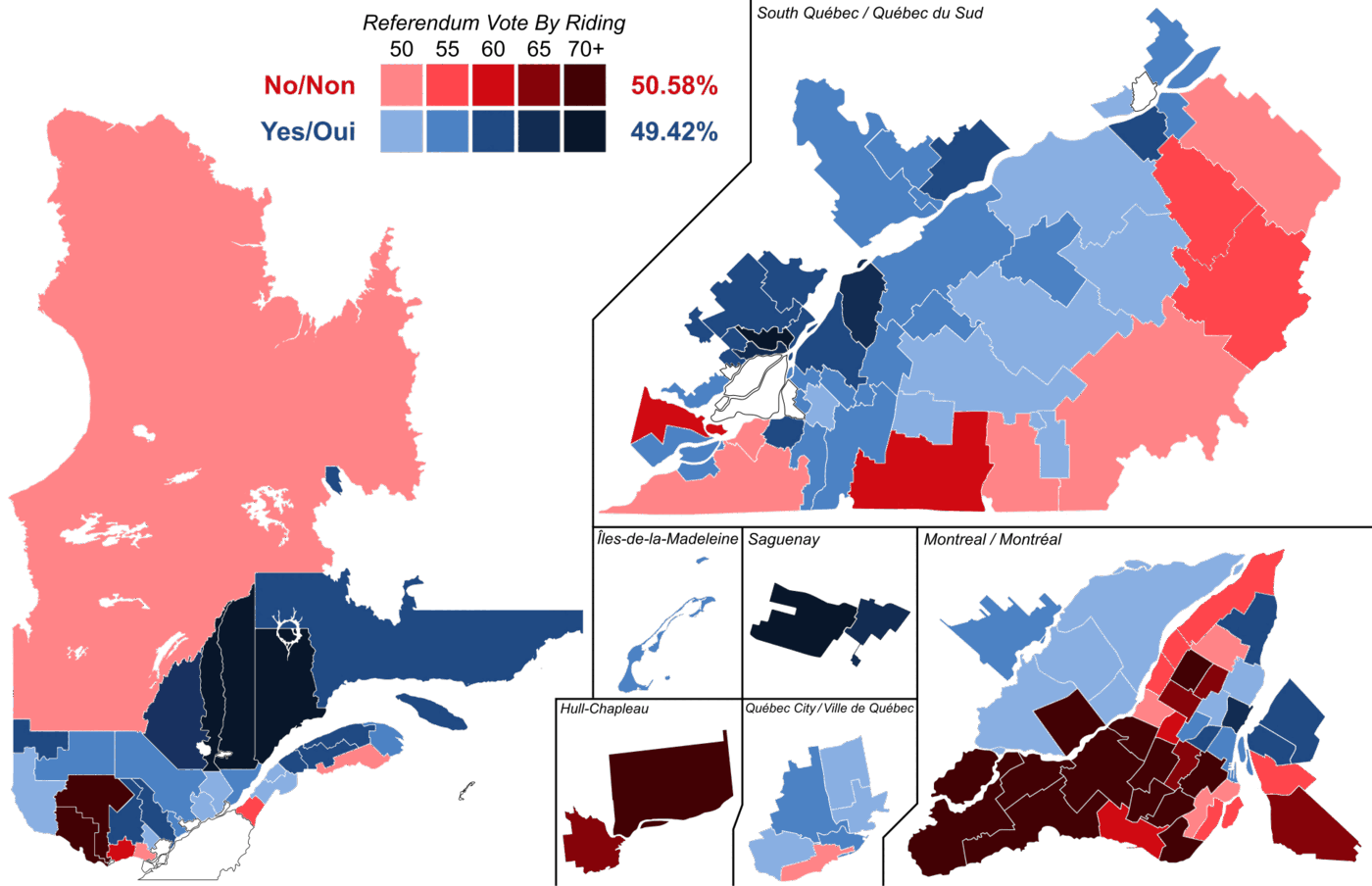

The geography is as documented as the total. Yes carried a majority in 80 of the 125 National Assembly ridings, with its strongest support in the Saguenay-Lac-Saint-Jean region, the Gaspe, the Centre-du-Quebec and the suburbs of the two large cities; No was concentrated in Montreal, the far north, the Outaouais, the Beauce and the Eastern Townships. According to the returns published by the province's chief electoral officer, the highest Yes share in any riding was 73.3 per cent in Saguenay and the highest No share 96.38 per cent in D'Arcy-McGee in western Montreal; the closest riding was Vimont in Laval, carried by Yes by six votes; the highest turnout anywhere was 96.52 per cent in Marguerite-D'Youville. Estimates of how the vote broke down by mother tongue exist in the published literature — one widely cited account puts Yes support among French speakers at about 60 per cent and No support among anglophones and allophones at about 95 per cent — and are estimates rather than returns, since ballots do not record the voter's language.
Two further votes were held in the same month and are part of the record. On 24 October 1995 the Grand Council of the Crees put its own question to the James Bay Cree, asking whether they consented as a people to the separation of the Crees and their traditional territory from Canada in the event of a Yes result; 96.3 per cent of the 77 per cent who voted said no. The Inuit of Nunavik held a comparable vote, in which 96 per cent voted no. These were community votes with no legal effect on the provincial count; they are recorded here because they are part of what the archive of that month contains.
Before it: 1980, and the accord of 1992
The 1995 vote was the second of its kind, and the first is the measure of how much had changed. The referendum of 20 May 1980 asked a longer and more cautious question: it sought a mandate to negotiate a new agreement with the rest of Canada based on the equality of peoples, under which Quebec would acquire the exclusive power to make its laws, levy its taxes and conduct its external relations while maintaining an economic association including a common currency — and it promised that no change of political status resulting from those negotiations would be implemented without a second referendum. The electorate numbered 4,367,584; turnout was 85.61 per cent; 3,738,854 ballots were cast, of which 65,012, or 1.74 per cent, were rejected. The proposal was defeated 59.56 per cent to 40.44 per cent.
Between the two referendums came two attempts to settle the constitutional question by agreement, both of which failed, and the second of which produced a national vote whose Quebec numbers belong here. The Charlottetown Accord, agreed by the federal and provincial governments on 28 August 1992, was put to the electorate on 26 October 1992 in two simultaneous referendums — one run by the Quebec government within Quebec, one run by the federal government everywhere else. It was rejected in both. Nationally the No share was 54.3 per cent on a turnout of 71.8 per cent; in Quebec it was 56.7 per cent to 43.3 per cent on a turnout of 82.8 per cent, on 3,945,189 ballots. The earlier Meech Lake Accord had lapsed unratified in June 1990. The full constitutional chronology, including the patriation of 1982 and the accords in detail, is set out on qc.politique.
The two margins are the measure of the change. In 1980 the proposal was defeated by 19.12 percentage points; in 1995 by 1.16. The Yes share rose from 40.44 per cent to 49.42, a little under nine points, across fifteen years and one failed constitutional round. Whatever else the group's readers disagreed about, they had those numbers in common, and they are the reason the second campaign was fought as though a third were imminent.
After it: the courts and the legislatures
The consequence of a result that close was procedural, and it took five years to work through. In 1996 the federal government referred three questions to the Supreme Court of Canada. On 20 August 1998 the Court answered in the Reference re Secession of Quebec that Quebec could not secede unilaterally under Canadian or international law; that secession would require a constitutional amendment; and that a clear majority on a clear question would nonetheless place the rest of the federation under an obligation to negotiate. It also held that the Parliament of Canada had the power to determine whether a referendum question was clear enough to trigger that obligation.
Parliament then legislated the finding. The bill that became the Clarity Act was tabled in the House of Commons on 13 December 1999 as Bill C-20, passed the House on 15 March 2000, cleared the Senate in its final form and received royal assent on 29 June 2000. Section 1(4) provides that a question offering only a mandate to negotiate, or contemplating other arrangements with Canada, is to be regarded as unclear — wording that describes the 1995 question and the 1980 question in turn. The legislation was supported in the Commons by the New Democrats and the Alliance and opposed by the Bloc Quebecois and the Progressive Conservatives; the Premier of Quebec described it as an assault on good sense and democracy.
The National Assembly replied. Bill 99, introduced on 15 December 1999 — two days after the federal bill — and adopted on 7 December 2000 by 69 votes to 41, asserts the right of the Quebec people to self-determination, the right of the National Assembly to set referendum questions, and the sufficiency of a majority of fifty per cent plus one. Its constitutionality was then litigated for two decades: the Quebec Superior Court upheld the challenged provisions in a judgment made public on 19 April 2018, and the Quebec Court of Appeal maintained that judgment on 9 April 2021. Between the statute and those judgments, on 22 November 2006, the Prime Minister of Canada tabled a motion in the House of Commons that the Quebecois form a nation within a united Canada; it was approved on 27 November by 265 votes to 16, with supporters in every party in the House.
That sequence is the documented aftermath and it is stated here as chronology. What any of it settled, or failed to settle, is precisely the thing the people in this newsgroup disagreed about, and a directory has no standing to arbitrate it.
What a result that close does to an unmoderated group
The effect of a 1.16-point margin on a discussion group is structural rather than anecdotal, and it can be described without inventing a single thread. Nothing is settled by such a result. Neither case is refuted; both sets of counterfactuals stay live; the arguments about turnout, about the rejected ballots, about who was persuaded by what and when remain formally open, because the evidence that would close them does not exist. A moderated forum can rule a subject exhausted and enforce the ruling. An unmoderated one has only the patience of its regulars and the finite life of an article on a news spool.
A national question decided on that margin also changes who is in the room. It brings in posters with no standing in the group, no memory of what has already been said and no intention of staying, and it brings them in from the whole of an anglophone network for which the story was news. The regulars — federalist and sovereigntist alike, who by then knew one another's positions by heart and had refined them across hundreds of exchanges — were left conducting the same argument in front of an audience that kept restarting it. This is the ordinary fate of any Usenet group whose subject makes the news, and it is why the archive of a group like this one is never an even record of a decade. The constitutional dates stand up out of it like ridges.
None of which was abstract for the participants. The language of a child's schooling, the viability of a career conducted in one language or the other, the prospect of a country appearing or not appearing on the map: these were household matters, and the group's federalists and sovereigntists were arguing about their own lives, frequently with their own neighbours. Usenet gave that argument a register the era's talk radio and letters pages could not: unlimited length, a permanent record, and a guaranteed audience of the other side.
The neighbours: Franco-Ontarians and Acadians
The group's charter said Quebec, but francophone North America does not stop at the provincial line, and the readers who lived outside it had their own histories and their own dates. The largest such community is in Ontario: the provincial government counted 652,540 francophones there in 2021, on its own inclusive definition, which makes it the largest French-speaking population in Canada outside Quebec. It is concentrated in eastern and north-eastern Ontario and in the centre of the province including the Toronto area. Its links to Quebec are direct as well as historical: of the francophones counted in Ontario in 2016, about a fifth had been born in Quebec.
Its documentary history has three fixed points. Regulation 17, issued by the Ontario Ministry of Education in July 1912, restricted the teaching of French beyond the second year in the province's separate schools and was fought for fifteen years before being abandoned. The Franco-Ontarian flag, designed by the Laurentian University historian Gaetan Gervais with three students, was flown for the first time at the University of Sudbury on 25 September 1975, adopted by the province's francophone association in 1977, and recognised in provincial statute in 2001. And the French Language Services Act, passed by the province in 1986 and in force from 1989, guaranteed provincial services in French in designated areas of Ontario. A number of municipalities responded by declaring themselves English-only; the most publicised was Sault Ste Marie, whose council resolved on 29 January 1990 that English was the sole working language of the city government. That resolution became a flashpoint in the national argument over the Meech Lake Accord then under way, and was struck down by a court in 1994.
The Acadian communities of the Maritimes have a longer and separate history. Acadian settlement dates from the early seventeenth century around Port-Royal; the deportations carried out by Britain between 1755 and 1764 dispersed the population across the continent and to Louisiana, where the descendants of those who went are the Cajuns. Acadian French is a distinct variety, distinct from Quebec French, and it has a literature: Antonine Maillet's Pelagie-la-Charrette, written in the Acadian vernacular, won the Prix Goncourt in 1979, making its author the first recipient from outside Europe.
One Acadian date belongs beside the group's own. The first Congres mondial acadien was held from 12 to 22 August 1994 in Moncton and nine other communities of south-eastern New Brunswick, with an estimated two hundred thousand participants and an opening ceremony at Cap-Pele on 13 August attended by the Prime Minister of Canada, the Secretary-General of the United Nations, the Premier of New Brunswick, the French ambassador, a Quebec minister and Antonine Maillet. The vote on soc.culture.quebec closed at midnight GMT on 13 August 1994, and the result was posted on the 15th, while the congress was still running. One of the group's two proposers was writing from Fredericton, in the same province. The archive records the coincidence and says nothing about whether anyone noticed it; this page will not improve on the archive. The current namespace does at least record the linguistic interest: alt.fr.lettres.langue.acadienne, whose one-line description is Entretien du parler acadien, is in the list to this day.
The migration south
The largest francophone community outside Canada was built by emigration, and it is the reason genealogy questions arrived in this group steadily and from unexpected addresses. Approximately 900,000 residents of Quebec, French Canadian for the great majority, left for the United States between 1840 and 1930 — pushed by rural overpopulation under a land-tenure system that could no longer support them, and pulled by the most industrialised economy on earth. About half are reported to have eventually returned. Those who stayed concentrated in the mill towns of New England: Lowell, Holyoke, Fall River and Fitchburg in Massachusetts, Manchester in New Hampshire, Lewiston in Maine, Woonsocket in Rhode Island, and the border counties of Vermont. The neighbourhoods they built were called Little Canadas, and the name stuck.
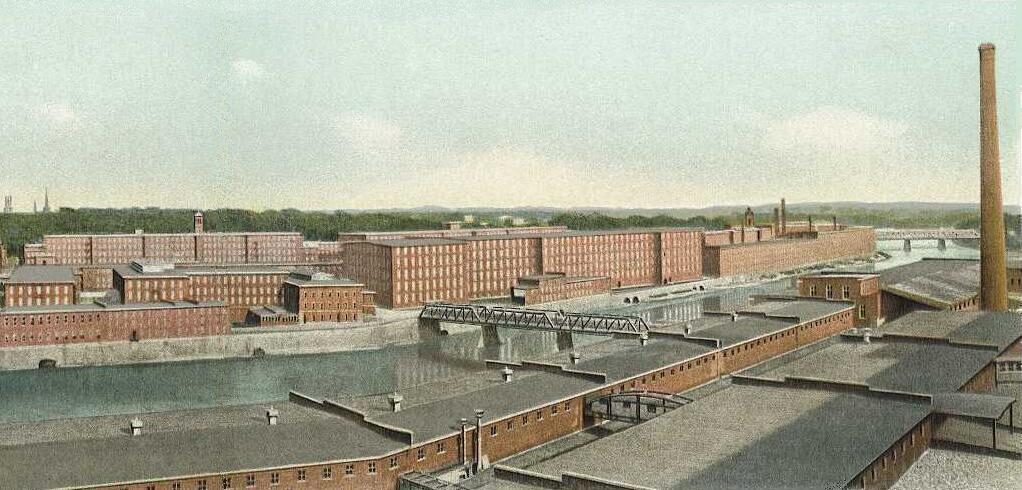

The institutions came with the people. Parishes, parish schools, mutual-benefit societies and French-language newspapers were founded under the ideology of la survivance, on the reasoning that keeping the language would keep the faith; the attempt to form national parishes with French-speaking pastors produced a long conflict with the established Irish-American hierarchy. The credit union arrived the same way: the institution founded at Manchester in 1908 by the pastor of Sainte-Marie parish, to let a population of Franco-American mill workers save and borrow, was the first credit union in the United States, and it was organised with the help of Alphonse Desjardins, who had built the caisse populaire model in Quebec. It took the name La Caisse Populaire Sainte-Marie in 1925.
The reception is documented too, and not flatteringly. A Massachusetts state report of 1881 described the French-Canadian migrants as the Chinese of the Eastern States; the community objected loudly and publicly, and refused the comparison. Nativist campaigns followed, and in the 1920s the revived northern Ku Klux Klan, anti-Catholic as much as anything else, turned on a population that was both francophone and Catholic; Maine, with its Acadian and French-Canadian minority, is the documented case. The Quebec diaspora in New England is thus a well-recorded case study in what happens to a language community across three generations of industrial employment, which is exactly why the genealogical enquiries that reached this newsgroup from New England addresses tended to be about parishes and mills rather than about seigneuries.
It also produced one writer whose relationship to the language is unusually well documented. Jack Kerouac was raised in a French-speaking household in Lowell, learned English at the age of six and spoke it with a marked accent into his late teens; he wrote fiction in the French of that childhood, including two novels and long sections of a third, which remained unpublished in his lifetime and were collected in a single volume published in Montreal in 2016. A francophone North American literature written in Massachusetts and published in Montreal forty-seven years after its author's death is the sort of thing a culture group exists to notice.
The later years, and one forged control message
The group's decline followed Usenet's, with local colour. Traffic thinned through the 2000s as discussion moved to web forums — francophone Quebec built a lively set of its own — and then to blogs and social platforms, while spam rose to meet the departing signal. the period in which such groups were most used and Canada's constitutional decade were the same years, which is either a coincidence of network history or a small mercy, depending on how much of the archive one reads.
The control-message archive records two later events worth setting down. On 27 September 1995 a news server in Switzerland emitted a newgroup message for soc.culture.quebec whose entire body reads For your newsgroups file: followed by the group name and nothing else — a site re-announcing a group into its own feed with the description left blank, which was routine and harmless.
The second is not routine. Dated 4 November 2001, it carries the header Control: rmgroup soc.culture.quebec and a one-line body asking that the bogus newsgroup soc.culture.quebec be removed. Its From, Sender and Approved headers carry the name and address of the maintainer of the tin newsreader, at that project's own domain; its Organization line names an association in Karlsruhe and its message-ID a host at the university there. Its Path and posting-host headers, however, place its injection at a news server in the qc.ca domain, and its abuse contact is a Quebec consumer provider. Its signature block is a line of machine-generated nonsense. Forged rmgroups were a routine hazard of the period, which is why the Big Eight's own control messages were signed and why administrators configured their servers to ignore unsigned ones. Whatever this message was, it did not take.
The proof is the file this page began with. In the canonical newsgroups list fetched on 30 August 2026, thirty-two years and eight days after David Lawrence sent the newgroup message, soc.culture.quebec is still there, and the description beside it is still the four words the call for votes specified in July 1994.
What the record does not show
A great deal. The administrative archive is complete and the world the group discussed is documented to the day, but the group's own traffic is another matter, and the honest position is worth stating in full.
No readership estimate for soc.culture.quebec was found in any source consulted for this page, and none is offered here; the network-wide readership surveys that supply the subscriber figures quoted for some older groups in this directory are not the source of any number on this page. There is no message count, no archive statistic and no record of the ratio of French to English in the group's traffic across its life. The proposers' claim that soc.culture.french and soc.culture.canada were carrying more than a hundred messages a day in mid-1994 is their claim, made in a document intended to persuade, and this page reports it as such rather than adopting it.
No moderator ever existed, so there are no moderation records, no rejected-post logs and no policy postings. No FAQ for the group has been found in the archives consulted for this article. The group had no charter beyond the two sentences quoted above and no governing body except the general disposition of news administrators to carry what the Big Eight created. There is no roll of regular participants, and this page names no poster who was not the signatory of an archived administrative document.
Nor does the record answer the most interesting question about the group's position. Nothing in the paperwork explains why the proposers of a Big-Eight Quebec group cross-posted to four soc.culture.* groups and to the French hierarchy's announcement group, and to neither of the two provincial groups that had existed for a month by then. The likeliest explanation is prosaic — a worldwide electorate mostly could not read a Canadian regional feed, so there was nothing to be gained by citing groups the voters could not see — but the documents do not say so, and this page will not pretend they do.
Scope and limits
The claims made here about the newsgroup itself come from four sources, all mirrored by the Internet Systems Consortium and all consulted directly on 30 August 2026: the news.announce.newgroups archive file for soc.culture.quebec, which holds the request for discussion, both calls for votes and the result with its complete voter roll; the control-message archive for the group; and the canonical newsgroups and active files of that date, from which the group counts, the one-line descriptions and the current status of the namespace were read off or computed rather than taken from any secondary account. Quotations from those files are exact. The domain breakdown of the voter roll was computed from the roll itself and is offered as a proxy for geography, not as a substitute for it.
The historical, political, legal and cultural dates were checked individually against encyclopaedic sources during the writing. Where a source gave a date only to the month, this page gives it only to the month. Vote totals, turnout figures and percentages are given as the official returns give them. Accented characters have been set aside in some proper names and titles for reasons the fifth section of this page explains at length; no disrespect to the orthography is intended and the spellings are recoverable from any of the sources cited.
What this page deliberately does not cover: the qc.* hierarchy, its founding control messages, its governance, the constitutional rounds in detail, the provincial elections, the parties, and language legislation as a political fact, all of which belong to qc.politique; Canada as a subject, which belongs to soc.culture.canada; francophone religious argument, which is treated on fr.soc.religion; Brittany and the French state, on soc.culture.breton; and the mechanics of Big-Eight group creation, which are on the soc.* hub.
Finally, the register. Sovereignty and federalism are live questions with committed adherents on every side, and many of the people who argued them in this newsgroup are still alive and still of the same mind. This page documents what was proposed, voted, legislated, decided and counted, and what the administrative record of a newsgroup contains. It reaches no verdict, offers no advice, and nothing in it should be read as doing either.
Reading soc.culture.quebec today
- Historical archive: Google Groups — soc.culture.quebec (coverage varies by group and era).
- Open in a newsreader:
news:soc.culture.quebec— the original site offered exactly this link, and it still works if your system has a newsreader registered for thenews:scheme. - Live access: point an NNTP newsreader at a modern server — see accessing Usenet today.
- The original news2mail e-mail subscription service ended in the mid-2000s and no longer operates.