soc.culture.south-africa.afrikaans
The Afrikaans language and its speakers.
A sub-group for Afrikaans — language threads, poetry, and the identity questions of a language negotiating its post-1994 place, posted in Afrikaans and English.
One of the few public online homes the language had in the 1990s.
On this page
- A group that took two votes to exist
- The paperwork of 1995
- What the charter says, and what it does not
- Who voted, and from where
- A language descended from Dutch
- The origins debate, with names attached
- Malay, Khoi and the other strands
- Written in Arabic script
- Making a written standard
- The word Dutch is declared to include Afrikaans
- A hundred years of the spelling book
- Who speaks it
- The state, the decree and 1976
- One of eleven, then one of twelve
- The universities, and what the courts held
- The Sestigers and the writers who broke with the state
- The prize culture
- What a language group carried
- What the record does not show
- Scope and limits
A group that took two votes to exist
The administrative record for this group begins a year before the group did, and it begins badly. On 7 September 1994 Reinier de Vos, posting from a South African academic address at ccwr.ac.za, issued a Request for Discussion for a newsgroup to be called soc.culture.afrikaans, with the one-line description “Afrikaans language and culture.” The RFD was crossposted to news.announce.newgroups, news.groups, soc.culture.african, soc.culture.belgium, soc.culture.netherlands and the South African groups za.misc and za.net.misc, and it carried a full Afrikaans translation after the English. A Call for Votes followed on 9 October 1994, taken by Dave Cornejo of the Usenet Volunteer Votetakers, with a second call on 19 October.
On 11 November 1994 Cornejo posted a result headed RESULT: soc.culture.afrikaans vote invalidated. Two things had gone wrong. An e-mail forged in the votetaker’s own name had circulated on several mailing lists and, he wrote, apparently in some newsgroups, campaigning for NO votes and giving incorrect voting instructions; and, more seriously, 350 forged YES votes had been submitted. Cornejo published the headers of both specimens. The bogus yes-ballots, he noted, were inserted from terminal-server hosts at a United States university and relayed through South African sites, all sent with the same mail client and all carrying an unverified sender header; three domains were involved.
His own summary was blunt about the effect: “I hope it serves as a lesson that had it not been for this attempt, the group would easily have passed despite the opposition.” David Lawrence, then moderator of news.announce.newgroups, appended a note of his own. He waived the customary six-month delay before a failed proposal could be retried, since the vote had been invalidated rather than lost, and — “rather than appear to be hiding something” — disclosed that without the 350 discounted ballots the tally would have stood at 645 yes to 311 no. He then set out his position on the substance of the argument that had grown up around the proposal:
I would have supported the creation of the group following a clean vote. I do not approve of racism, but I am also not impressed by the attempts by some to suppress speakers of a certain language because it is associated with racism. Nearly every language in the world could be considered to be tarnished by that brush.
That is the whole of what the surviving paperwork says about the objections. It records that they were made, that they were framed around the language’s political associations, and that a campaign against the group and a forgery operation in its favour ran at the same time. It does not identify who forged what, and neither does this page.
The paperwork of 1995
The proposal came back the following summer under new sponsorship. On 21 June 1995 Robert Wagenaar, writing from the mathematics and computer science department of Leiden University in the Netherlands, posted a fresh RFD for soc.culture.afrikaans, now described as “the Afrikaans language and all of its speakers”. Three weeks later, on 11 July 1995, he posted a second RFD for the same group under a different name: soc.culture.south-africa.afrikaans, described as “the Afrikaans language and all of its speakers, including those in Namibia”. The relocation put the group inside the existing national branch rather than beside it, and the Afrikaans half of the July document still carries the old name in one paragraph, an editing seam left in the archive.
The stated reason for wanting the group at all is worth quoting because it is not the reason a reader might expect. The RFD’s background section argues from isolation and its ending:
Due to South Africa’s and Namibia’s recent past, Afrikaans speakers have been isolated from most of the rest of the world in many different ways. One way was the cultural boycotts by numerous governments. In particular, the boycotts by the Dutch and Belgian governments reduced the number of cultural and lingual exchanges between Afrikaans speakers and the Dutch speaking people. Now new multi-cultural governments are in place in South Africa and Namibia, and it has become time to renew these and other ties.
A second argument was jurisdictional. South Africa had its own za.* hierarchy, in which, the proposal noted, articles were predominantly written in English; a za.culture.afrikaans group was possible, but the za.* groups were “less well known outside South-Africa, and in some cases less accessible” than the international hierarchy. A third was practical: an Afrikaans mailing list already existed and was, in the proposer’s words, “a big success”, and the intention was stated to gateway it to the newsgroup. Both the July RFD and the later Call for Votes were mailed to that list, which was hosted at a South African address, and to LOWLANDS-L at the University of Washington, a list for the languages of the Low Countries and their relatives. The RFD was crossposted to news.announce.newgroups, news.groups, soc.culture.south-africa, soc.culture.netherlands, soc.culture.belgium, za.misc, za.net.misc and the Dutch-language group nlnet.taal; the Call for Votes went to the same set without the two za.* groups.
The First Call for Votes went out on 28 August 1995 and the last on 12 September, both taken by Robert Haas for the Usenet Volunteer Votetakers, with the ballot closing at 23:59:59 UTC on 18 September 1995. The result was posted on 26 September under the heading RESULT: soc.culture.south-africa.afrikaans passes 272:19:
There were 272 YES votes and 19 NO votes, for a total of 291 valid votes. There were 2 abstains.
Against the Big-Eight thresholds — at least two-thirds of valid votes in favour, and at least a hundred more yes than no — that is not a close call: 93.5 per cent in favour and a margin of 253. The result announcement set the customary five-day period in which irregularities could be raised; the file records none. On 2 October 1995 the newgroup control message was issued by David Lawrence from uunet.uu.net, and reissued on 9 October and 2 November, with a further newgroup message from a different site in March 1996.
What the charter says, and what it does not
The line that a news administrator would paste into the server’s newsgroups file was set out in the control message itself:
soc.culture.south-africa.afrikaans The Afrikaans language and speakers.
That is the description still carried in the current Big-8 newsgroups file at the Internet Systems Consortium. It is not quite the text the voters approved: both Calls for Votes gave the Newsgroups line as “The Afrikaans language and its speakers.” The possessive was lost somewhere between the ballot paper and the control message, and thirty years of newsgroups files have carried the shorter form, while this directory carries the longer one at the head of the page. Nothing turns on it, but the two texts are not identical and the group has been listed under both.
The charter proper opens by defining its own terms, and the definition is the most deliberate sentence in the document:
In this proposed charter, the term ‘Afrikaans speakers’ will be taken to include all people who speak Afrikaans, regardless of race, colour, creed or national origin, whether they consider themselves to be ‘Afrikaners’ or not. This includes both mother-tongue speakers and others, including those who speak ‘alternative’ Afrikaans.
Read as a piece of drafting, that clause does three separable things. It severs the group’s subject from any ethnic definition; it names, without naming it, the distinction between Afrikaners and the far larger body of Afrikaans speakers who are not Afrikaners; and, with the quotation marks around ‘alternative’ Afrikaans, it admits the non-standard varieties — Kaaps above all — while conspicuously declining to give them a name. What the charter does not do is make any claim about who the speakers are in fact: no numbers, no communities, no proportions. The rationale attached to the Call for Votes supplies the only figure in the record, and supplies it as the proponent’s own estimate rather than as a citation: “Between 10 and 12 million people use it everyday as their first or second language.”
The scope clause is correspondingly wide. The group was intended as a platform for “all discussions about social, cultural, political, economical, historical, geographical and other issues that are, in one way or the other, related to Afrikaans speakers, Afrikaans or the southern African region”, and it was hoped it would be “a meaningful means for contact between Afrikaans speakers at home and abroad”. The rules clause is the ordinary unmoderated formula — anyone may post, everything should have “something” to do with southern Africa, Afrikaans or Afrikaans speakers “however remotely”, and insults and flames are “strongly discouraged”, which on Usenet was a wish rather than a mechanism. The languages clause is the part that made the group unusual: postings were expected primarily in Afrikaans, “also in ‘alternative’ Afrikaans”, Dutch and English, with any other language welcome.
Who voted, and from where
Big-Eight votetakers published the full roll of voters with the result, addresses and names, so that anyone could check the arithmetic; the Call for Votes said so in advance. That roll is the single richest piece of evidence about this group, because it is the only surviving list of people who wanted it. Sorted by top-level domain, the 272 yes votes fall out like this: 106 from .za, 35 from .com, 33 from .nl, 26 from .be, 22 from .edu, 10 from .de, seven each from .uk, .net and .au, six from .ca, four from .org, three from .nz, one each from Sweden, Norway, Iceland, Israel and Hungary, and one address in a non-standard domain form that resolves to none of these.
Two features of that distribution are worth stating. The first is that the Low Countries together supplied 59 votes, more than a fifth of the total — almost exactly what the RFD’s argument about severed Dutch and Belgian ties would predict, and a reminder that the constituency for this group was never only southern African. The second is the shape of the South African contingent: of the 106 .za addresses, 68 sat under .ac.za, 36 under .co.za and two elsewhere in .za. The largest single clusters were up.ac.za with 24 votes and unisa.ac.za with twelve — the University of Pretoria and the University of South Africa — followed by sun.ac.za, Stellenbosch, and nac.ac.za with ten each. The .co.za half was not a consumer-subscriber population either: its largest groupings were csir.co.za with eleven, eskom.co.za with nine, aztec.co.za with four — the host of the Afrikaans mailing list named in the RFD — and telkom.co.za with two. Commercial internet access in South Africa had begun in June 1992, three years before the ballot closed, and the roll shows how young it still was: the universities and the large parastatals were where most of the country’s keyboards were.
The nineteen no votes came from nine .edu addresses, five .com, two .net, and one each from the United Kingdom, the Netherlands and Belgium. Not one came from a South African address. Of the two abstentions, one was cast from a Finnish university address and one from a United States corporate address. None of this says anything about opinion in the country, since the electorate was whoever had e-mail and read news.groups; it does say that the opposition recorded in the file was, in its own address book, an overseas opposition.
A language descended from Dutch
The charter’s own account of where the language came from is compressed and, for a document written by a proponent, notably even-handed:
Afrikaans evolved in southern Africa from the interaction between 17th-century Dutch, African languages, Portuguese, Malay and other influences. Although it is a uniquely African language, it is nonetheless classed as a member of the Germanic languages, and is similar to the Dutch language, which is predominantly spoken in the Netherlands and a large part of Belgium.
The 1994 version of the same paragraph had used the older term “Teutonic” and had spoken of “the Dutch/Flemish language”; the 1995 revision modernised both. On the classification, the charter is orthodox. Afrikaans is a West Germanic language of the Low Franconian group, descended from the Dutch — mainly Hollandic and Zeelandic varieties — spoken at the Cape from the founding of the Dutch East India Company’s refreshment station in 1652. Estimates of the proportion of the Afrikaans lexicon that is ultimately of Dutch origin cluster at 90 to 95 per cent. Where the two languages diverge most is in morphology and orthography: Afrikaans is markedly the more analytic and the more regularly spelled, having shed grammatical gender, most verb inflection and a good deal of Dutch consonantal spelling — Dutch slechts becomes slegs, zuid becomes suid, the digraph ij becomes y.
Mutual intelligibility between the two is high, particularly in writing, and asymmetric: Dutch speakers meet fewer non-cognates reading Afrikaans than Afrikaans speakers meet reading Dutch. Breyten Breytenbach, asked to give English speakers a sense of the distance, offered the gap between Received Pronunciation and Southern American English. The Dutch language itself, and the nl.* hierarchy in which its own Usenet traffic ran, belong to their own page in this directory; what belongs here is the descent, and the fact that the descent was contested for most of the language’s written life. Until the early twentieth century Afrikaans was widely treated as a dialect of Dutch, and its earlier names record the attitude: Cape Dutch, Kaap-Hollands, and the dismissive kombuistaal, kitchen language, from its use by the slaves of colonial settlers.
The origins debate, with names attached
How a seventeenth-century Dutch dialect turned into a separate language is not a settled question. The positions have names.
For much of the later twentieth century the standard account was the Eastern Border Hypothesis associated with the South African linguist Christo van Rensburg (1938–2018). On that view the Dutch of the eastern frontier of the Cape Colony, spoken by the Trekboers, developed directly and naturally out of Hollandic and Zeelandic varieties, stabilising around 1775 into a comparatively homogeneous dialect which was then written down and standardised through the nineteenth century; the other two major varieties, Kaaps and Orange River Afrikaans, were held to have undergone substantial creolisation because so many of their speakers had acquired Dutch as a second language rather than a first.
Against and around that stand the contact-language accounts. Sarah Grey Thomason and Terrence Kaufman, in Language Contact, Creolization, and Genetic Linguistics (1988), argued that the emergence of Afrikaans as a separate language was “heavily conditioned by nonwhites who learned Dutch imperfectly as a second language”, and reported M. F. Valkhoff’s argument that 75 per cent of the children born to enslaved women at the Dutch Cape between 1652 and 1672 had a Dutch father. Hans den Besten traced a route from Khoekhoe foreigner-talk through what the older literature called Hottentot Dutch to Afrikaans, describing the outcome as the creation of a novel grammar. Paul Roberge’s chapter “Afrikaans – considering origins” in Language in South Africa (2002) surveys the argument, and Ana Deumert’s Language Standardization and Language Change: The Dynamics of Cape Dutch (2004) reconstructed the period in detail.
The direction of more recent work has been away from any single-origin story. What Deumert and others describe is a linguistic landscape that stayed highly diverse into the early twentieth century, running from communities whose Dutch differed little from contemporary Dutch in Europe to communities for whom Dutch was a second or third language, all interconnected, with the variety a speaker used depending on proficiency and on social class, ethnicity and race. Whether the word creole is the right label for any part of that has been argued in journals for more than a century and is not going to be settled on a directory page. What can be said is that the question was never purely technical: an origin story that made Afrikaans a natural descendant of Dutch and an origin story that made it a language forged by slaves and Khoi speakers carried entirely different political weight in the country that was arguing about it, and both were available to anyone posting in the group’s first years.
Malay, Khoi and the other strands
The population that produced the language was not the settler population alone. The Cape’s enslaved people came from East and West Africa, Mughal India, Madagascar and the Dutch East Indies; Khoisan people were employed as interpreters, servants and labourers; up to a sixth of the free burgher community was of French Huguenot origin and a seventh German. Political exiles from the Dutch East Indies were brought to the Cape as well, among them Sheikh Yusuf, a nephew of the Sultan of Gowa, received at the Cape on 2 April 1694 by governor Simon van der Stel with a party of forty-nine followers and housed on the farm Zandvliet, well outside Cape Town, in the hope of limiting his influence on the Company’s slaves. The plan failed: the settlement became a refuge for slaves and the first cohesive Muslim community in South Africa, and after Yusuf’s death in 1699 the area around the farm was renamed Macassar after his birthplace.
The lexical traces of all this are real but modest against the Dutch base: borrowings and syntactic influence from Malay, the Khoisan languages, Portuguese, German, the Bantu languages, and later heavily from South African English, especially in the Western Cape. The Khoisan contribution is the one most often over- and under-stated in turn, and the honest statement is that it is agreed to exist and disputed in extent. The charter’s formula — “17th-century Dutch, African languages, Portuguese, Malay and other influences” — is about as far as a one-paragraph summary can responsibly go, which is presumably why the proponent wrote it that way.
The charter’s other careful phrase, ‘alternative’ Afrikaans, points at the varieties the standard did not take in. The largest of them is Kaaps, the Cape variety spoken chiefly by working-class coloured communities of the Cape Flats. It is among the most stigmatised varieties of Afrikaans, commonly associated with low status and with comedy, and under apartheid it was treated as a colloquial deviation from the standard rather than as a variety in its own right — a perception the literature records as persisting after 1994. Its status is contested in the scholarship and remains so. A trilingual dictionary of Kaaps — Kaaps, Afrikaans and English — was launched in 2021 by the Centre for Multilingualism and Diversities Research at the University of the Western Cape with the Heal the Hood Project; the project has in turn been criticised by variational linguists who argue that features which are regional, dialectal or merely colloquial across Afrikaans are being claimed as distinctively Kaaps, and who dispute the dating the project attaches to the variety. This page records that the argument exists and takes no side in it; what is not in dispute is that a charter written in 1995 went out of its way to include the speakers concerned.
Written in Arabic script
The earliest surviving body of writing in something recognisably Afrikaans rather than Dutch was not produced by the settler community at all, and was not written in the Latin alphabet. In the Muslim schools of Cape Town, Afrikaans progressively displaced Malay as the language of instruction during the early nineteenth century, and from the 1830s the madrasas of the city produced a literature written in the Perso-Arabic script: Arabic Afrikaans. Seventy-four texts survive. The earliest, the Hidyat al-Islam, is dated 1845, though its source manuscript no longer exists; the oldest surviving manuscript, which describes basic Islamic learning, was written in 1868 by the imam Abdul-Kahhar ibn Abdul-Malik. Setting aside a sixteenth-century German manuscript in Arabic script, it is the only Germanic language known to have been written in the Perso-Arabic script.
The best-known work in the tradition has an Ottoman author. Sheikh Abu Bakr Effendi (c. 1814–1880), a Kurdish scholar from Shahrizor, was sent to the Cape in 1862 by Sultan Abdulaziz at the request of Queen Victoria, to teach and to settle disputes in the Cape Muslim community; he travelled by way of Paris, London and Liverpool and arrived on 17 January 1863. His Bayan al-Din, known in Afrikaans as Uiteensetting van die Godsdiens — an exposition of Islamic law in the Hanafi tradition, covering ablution, prayer, pilgrimage and dietary law — was printed in 1877 by the Turkish Ministry of Education in Istanbul, set throughout in Arabic script but transcribing Afrikaans. It opens:
Iek bagent diesie kitab met Allah (ta’ala) sain naam. Allah (ta’ala) es rizq giefar ien dunya fer al wat liefandag ies.
In modern standard Afrikaans that is Ek begin hierdie boek met Allah se naam. Allah is onderhouer in die wêreld vir al wat lewendig is — I begin this book in the name of Allah; Allah is the sustainer in the world of all that lives. The italicised words are Arabic, and several of them sit where a modern text would use a Germanic word: dunya for wêreld, world. The German scholar Hans Kähler, one of the principal linguists of the tradition, reckoned that about twenty people were responsible for the text and named five as the most important contributors to Arabic Afrikaans, among them Abdul Kahhar ibn Hajji Abdul Malik, Ismail ibn Muhammad Hanif and Abu Bakr Effendi. The modern scholarly recovery of the corpus is above all the work of Achmat Davids, whose study of the Afrikaans of the Cape Muslims was followed by the posthumous The Arabic-Afrikaans Writing Tradition 1815–1915.
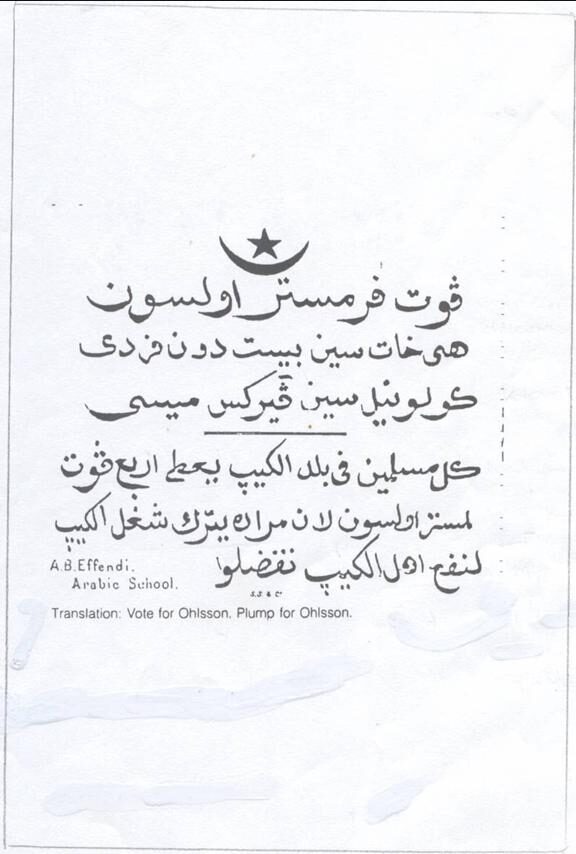

The dating matters for a reason that has nothing to do with piety. The Arabic-script material predates the Latin-script standardisation movement by two generations, which means the first sustained written Afrikaans was produced by a community that the later standard did not have in view, and in a script the later standard did not use.
Making a written standard
The Latin-script tradition begins later and self-consciously. The earliest deliberate imitations of Cape speech are eighteenth-century squibs — an anonymous 1795 poem mocking the inhabitants of Swellendam is the usual first exhibit — and a dialogue transcribed by a Dutch traveller in 1825. The first book generally counted as published in Afrikaans is L. H. Meurant’s Zamenspraak tusschen Klaas Waarzegger en Jan Twyfelaar of 1861, a conversation between Nicholas Truthsayer and John Doubter. In 1874 the teacher Arnoldus Pannevis put the question directly in the pages of De Zuid-Afrikaan, under the title “Is die Afferkaans wesenlijk een taal?” — is Afrikaans really a language?
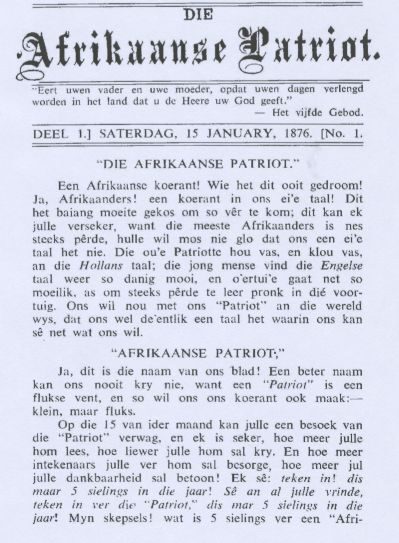
The organised answer came the following year. On 14 August 1875, in the town of Paarl, eight men founded the Genootskap van Regte Afrikaners, the Society of True Afrikaners, with the explicit aim of turning a spoken language into a written one. From 15 January 1876 it published a journal, Die Afrikaanse Patriot, and it issued grammars, dictionaries, religious material and histories. The first grammar appeared in 1876; a bilingual dictionary followed in 1902.

Spelling was the harder problem, and its solution was borrowed. In 1891 the Dutch linguist Roeland Kollewijn proposed a phonetically simplified Dutch orthography which the Netherlands and Belgium largely rejected as too modernistic or worse. In South Africa the same scheme was read as a bridge across the widening gap between written and spoken usage, and Kollewijn’s Vereenvoudigde Nederlandse spelling was adopted in 1905 as the official orthography of Dutch in South Africa. That decision is the direct ancestor of modern Afrikaans spelling.
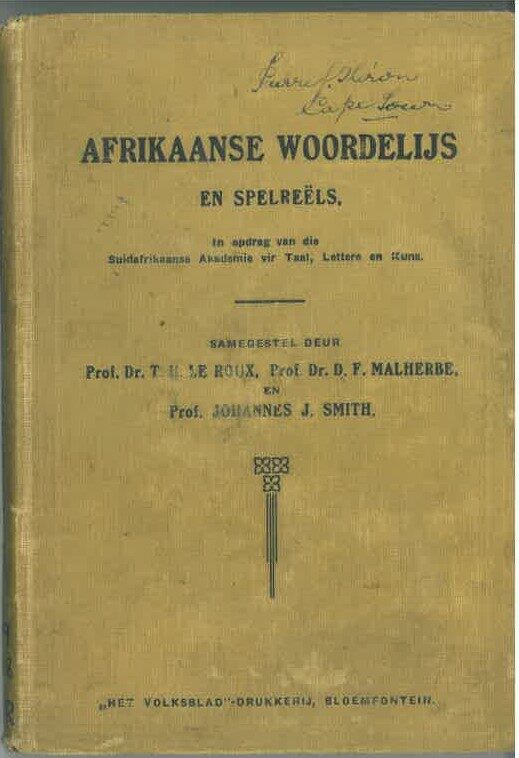
The institutional machinery followed. The South African Academy was founded in Bloemfontein on 2 July 1909 to promote Afrikaans and Dutch language and literature, South African history, antiquities and the arts. It began compiling spelling rules in 1914; the first word list appeared in the Academy’s yearbook that year, the first spelling rules were approved on 8 September 1915, the two were issued together as a pamphlet in 1916, and in 1917 they appeared in book form as the Afrikaanse Woordelys en Spelreëls. A landmark of a different kind came in 1933, when J. D. du Toit, E. E. van Rooyen, J. D. Kestell, H. C. M. Fourie and B. B. Keet completed the first official translation of the whole Bible into Afrikaans; a fresh translation followed in 1983, and an ecumenical one, Die Bybel: ’n Direkte Vertaling, in November 2020.
The word Dutch is declared to include Afrikaans
Section 137 of the South Africa Act 1909, the constitution of the Union, made English and Dutch the official languages “on a footing of equality”. Whether that included Afrikaans was genuinely unclear, and the ambiguity was not merely legal: many Afrikaans speakers still regarded themselves as speaking a substandard Dutch, and standard Dutch remained the written and formal language.
The Official Languages of the Union Act, 1925 resolved it by definition rather than by promotion. It was passed on 8 May 1925 at a joint sitting of the House of Assembly and the Senate, received assent on 22 May and came into force on 27 May with its publication in a Government Gazette Extraordinary, but was deemed to have had effect since the creation of the Union in 1910. Its single substantive provision reads in full:
The word “Dutch” in section one hundred and thirty-seven of the South Africa Act, 1909, and wheresoever else that word occurs in the said Act, is hereby declared to include Afrikaans.
In theory this recognised Dutch and Afrikaans as equal varieties of one pluricentric language. In practice it displaced standard Dutch from South African government almost entirely. The Constitution of 1961 reversed the polarity — English and Afrikaans became the official languages, and Afrikaans was deemed to include Dutch — and the Constitution of 1983 dropped the mention of Dutch altogether.
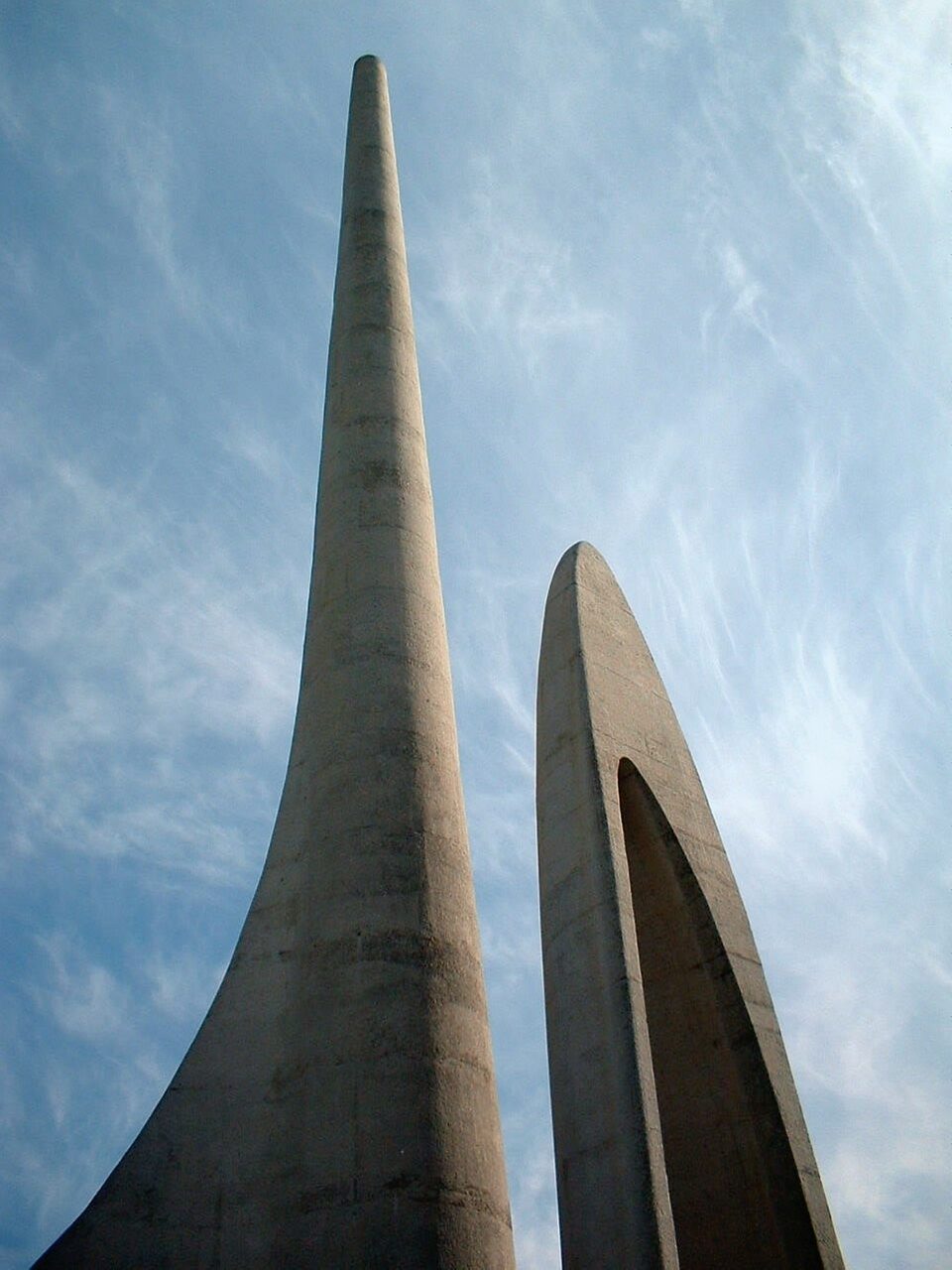
Fifty years on, the anniversary was built in concrete. The Afrikaans Language Monument was opened above Paarl on 10 October 1975, marking both the semicentenary of 1925 and the centenary of the Genootskap; its structures are labelled for the influences its designers wished to acknowledge, among them “Clear West” for the European inheritance, “Magical Africa” for the African one, a bridge between the two, and a separate structure for Malay language and culture. The plaque at the entrance carries a passage by N. P. van Wyk Louw which in translation calls Afrikaans the language that connects Western Europe and Africa.

A hundred years of the spelling book
The Afrikaanse Woordelys en Spelreëls is the closest thing Afrikaans has to a constitutional document about itself, and its revisions map the language’s changing sense of what it was. The 1917 first edition, compiled by T. H. le Roux, D. F. Malherbe and Johannes J. Smith with a commission that included C. J. Langenhoven, J. D. du Toit and Gustav Preller, ran to 15,680 entries and 48 rules and set out five founding principles:

- each sound is represented by a separate letter, and no unnecessary letters are used;
- words, prefixes and suffixes are spelled consistently wherever possible;
- historical forms are respected only where practical;
- Afrikaans should deviate as little as possible from the Simplified Dutch Spelling;
- the most common pronunciation is normative.
The fourth of those is the giveaway: even in the document that fixed Afrikaans spelling, proximity to Dutch was an explicit design goal, and the 1917 system accordingly differs sharply from the older Patriot orthography of the Genootskap. Successive editions loosened the tie. The 1921 revision dropped the silent w (opbouw became opbou) and replaced ij with y. The 1931 edition, prepared after the language commission received a comprehensive revising mandate in 1926, and the 1937 edition consolidated the standard. The 1953 edition expanded the technical and scientific vocabulary and cut variant forms. The 1964 “Brown Book” systematically Afrikaansised loanwords — cheque became tjek.
Then a gap of twenty-seven years. The 1991 “Blue Book” rewrote every rule for clarity, added phonetic guidance and recognised a wider range of Afrikaans words of African-language origin. That was the edition in force when the newsgroup was created and for most of its active life; the 2002 “Rainbow Book” — which reorganised the rules alphabetically, numbered them, and for the first time included a list of colloquial Afrikaans words — appeared while the news2mail gateway was running. The colloquial list was removed again in the corpus-based 2009 “Green Book”. The centenary “Red Book” of 2017 carries more than 34,000 entries and 457 rules. Anyone reading archived articles from this group is reading Afrikaans spelled to the 1991 rules, by writers who in some cases had been taught the 1964 ones.
Who speaks it
The composition of the Afrikaans-speaking population is the fact most often got wrong outside South Africa, and the censuses are specific about it.
Afrikaans is the third most spoken home language in South Africa. Statistics South Africa recorded it as the first language of 14.4 per cent of the population in 1996, 13.3 per cent in 2001, 13.5 per cent — 6,855,082 people — in 2011, and 10.6 per cent in 2022, a fall of 2.9 percentage points across the last intercensal period. Second-language speakers are counted at roughly 10.3 million, which puts total speakers in South Africa in the region of seventeen million.
The composition of the first-language population is the point. In the 2011 census Afrikaans was the first language of 3,442,164 coloured South Africans — the term in its specific South African sense — or about 74.6 per cent of that population, and of 2,710,461 white South Africans, about 59.1 per cent of theirs. Coloured Afrikaans speakers therefore outnumbered white ones by roughly seven to five. Standard reference works state the consequence bluntly: contrary to popular belief, the majority of Afrikaans speakers today are not Afrikaners or Boers but coloured South Africans, and the South African Institute of Race Relations has projected that a growing majority of speakers will be coloured. The 1995 charter’s insistence that “Afrikaans speakers” meant everyone who spoke Afrikaans, “whether they consider themselves to be ‘Afrikaners’ or not”, was drafted against exactly this misapprehension.
The geography is equally specific. In the Northern Cape, Afrikaans was the home language of 57.2 per cent of the population in 1996 and 54.6 per cent in 2022; in the Western Cape it fell over the same period from 58.5 per cent to 41.2 per cent; in Gauteng from 15.6 to 7.7; in KwaZulu-Natal it has not exceeded 1.6 per cent in any of those four censuses. The heartland of the language, measured by proportion of speakers, is the arid west of the country, several hundred kilometres from Soweto.
Beyond South Africa, the charter’s specific mention of Namibia reflects a real constituency. Afrikaans was the main language of 11.4 per cent of Namibian households at the 2001 census and 10.4 per cent at the 2011 census, on the order of 220,000 speakers, concentrated in the southern regions; Afrikaans, German and English had equal official status while Namibia was administered by South Africa, and at independence in 1990 English was made the sole official language, Afrikaans becoming one of several recognised national languages. It remains the main lingua franca of the south, and is widely spoken alongside English in Windhoek. Elsewhere the diaspora counts are those of any emigration: 49,375 speakers in Australia in 2021, 36,966 in New Zealand in 2018, 29,670 in Canada in 2021, 28,406 in the United States in 2016, 8,082 in Botswana in 2011, 7,489 in the United Kingdom in 2021, and a Patagonian remnant at Sarmiento in Argentina, descended from Boers who settled there after 1902, where fieldworkers counted no more than about forty fluent speakers in 2018.
The state, the decree and 1976
None of the linguistic history above explains why the group needed a defence of its own existence, and the political history is where the explanation sits. It has to be set down as record, because the record is specific.
Afrikaans was the language of the National Party governments that held power from 1948 to 1994 and of much of the state administration, and the second Afrikaans language movement that carried it to official status in 1925 was bound up with Afrikaner nationalism from the start. In 1974 the Bantu Education Department issued what is generally called the Afrikaans Medium Decree. The regional director for the Northern Transvaal, J. G. Erasmus, informed circuit inspectors and school principals that from 1 January 1975 Afrikaans was to be used for mathematics, arithmetic and social studies from standard five; English would be the medium for general science and the practical subjects; indigenous languages were left with religious instruction, music and physical culture. Punt Janson, the Deputy Minister of Bantu Education, was quoted on the question of consultation: “No, I have not consulted them and I am not going to consult them. I have consulted the Constitution of the Republic of South Africa.”
The decree was resented immediately; teacher organisations objected, and the phrase used by black South Africans about the language and recorded ever since was “the language of the oppressor”. On 30 April 1976 pupils at Orlando West Junior School in Soweto refused to attend, and the strike spread. Students formed an action committee — later the Soweto Students’ Representative Council — and organised a march for 16 June, carrying placards reading “Down with Afrikaans” and “If we must do Afrikaans, Vorster must do Zulu”. Police fired on them. The Soweto uprising that followed ran for months and across the country.
The casualty findings should be given as findings, with their sources, because they differ. The original government figure was 23 students killed. The count usually given for 16 June itself is 176. The Cillié Commission, appointed to investigate the uprising and its aftermath, estimated 575 deaths from the violence up to 28 February 1977, of which 390 were in the Transvaal and 137 in the Western Cape, and gave the breakdown as 496 black Africans, 75 coloured people, two whites and two Indians. The Times reported more than 700 killed nationally by the end of 1976. Two white people were killed during the uprising, one of them Melville Edelstein, a social worker in Soweto. The United Nations Security Council condemned the events in Resolution 392 of 19 June 1976.
The policy did not survive the month. The government rescinded it, and when black schools were given the choice, 96 per cent chose English as the medium of instruction over Afrikaans or an indigenous language. The 1974 decree had been intended to arrest the decline of Afrikaans among black South Africans; what followed it was a decisive and durable move away from Afrikaans in black schools, at the cost recorded above. By 2006 there were 300 single-medium Afrikaans schools where there had been 2,500 in 1994, most having converted to dual-medium teaching.
Both of the facts in this section and the last are true at once, and the group existed in the space between them: a language with millions of first-language speakers across several communities, most of them not Afrikaners, and a language the apartheid state had tried to impose by decree on children who did not speak it. Neither fact cancels the other, and the archive of the group is a record of people arguing about how to hold both.
One of eleven, then one of twelve
The transition settled the question of status by multiplying it. Chapter 1, section 6 of the 1996 Constitution names eleven official languages — Sepedi, Sesotho, Setswana, siSwati, Tshivenda, Xitsonga, Afrikaans, English, isiNdebele, isiXhosa and isiZulu — and requires that all of them “enjoy parity of esteem and must be treated equitably”, while directing the state, in recognition of “the historically diminished use and status of the indigenous languages of our people”, to take practical and positive measures to elevate them. Parliament voted in May 2023 to add South African Sign Language as a twelfth, and the amendment was signed into law on 19 July 2023. The constitutional settlement itself belongs to the parent group’s page; what belongs here is that Afrikaans went, at a stroke, from one of two to one of eleven.
The practical consequences arrived quickly and were highly visible. On 4 February 1996 the South African Broadcasting Corporation reorganised its three television networks as SABC 1, 2 and 3, with the stated aim of making them more representative of the country’s language groups; SABC 1 and SABC 2 were to carry the eleven official languages between them, and SABC 3 was to broadcast entirely in English. The reported effect on Afrikaans was a reduction of its airtime from 50 per cent to 15 per cent, and it alienated many Afrikaans speakers. South African Airways dropped Suid-Afrikaanse Lugdiens from its livery; South African diplomatic missions stopped displaying the country’s name in Afrikaans, showing it in English and the host country’s language instead. Running the other way, the Constitution of the Western Cape, in force from 1998, made Afrikaans an official language of that province alongside English and isiXhosa.
Those changes were read in two incompatible ways, and the group carried both readings. One reading was that a language which had held half of a two-language monopoly was simply being brought to parity with ten others, exactly as the Constitution required. The other was that parity in law was producing displacement in fact, with English rather than the indigenous languages taking up the space. Attempts to reverse what its participants call the marginalisation of Afrikaans have been described as a third Afrikaans language movement, the successor to those of 1875 and 1902. This page records that both readings were held and argued; it does not adjudicate between them, and neither the decade nor the newsgroup did.
The universities, and what the courts held
The sharpest of the post-1994 disputes concerned the medium of instruction at the historically Afrikaans universities, and it is one of the few strands of the argument that has documented endings.
The constitutional text at issue is section 29(2) of the Bill of Rights: “Everyone has the right to receive education in the official language or languages of their choice in public educational institutions where that education is reasonably practicable.” In giving effect to it, the state must consider all reasonable educational alternatives, including single-medium institutions, taking into account equity, practicability, and the need to redress the results of past racially discriminatory laws and practices. The qualifier “reasonably practicable” and the redress clause are what the litigation has turned on.
The University of the Free State had taught in parallel medium since 1993, formalised in 2003; in 2016 it resolved to make English the primary language of instruction. AfriForum and the trade union Solidarity jointly challenged the decision. In AfriForum and Another v University of the Free State, handed down on 29 December 2017 with Chief Justice Mogoeng Mogoeng writing, the Constitutional Court upheld the university’s new policy.
Stellenbosch, historically the most emphatically Afrikaans of the universities — the £100,000 bequest of Jannie Marais, who died in 1915, is what established it — adopted a new language policy in 2016. It was challenged by the group Gelyke Kanse. Gelyke Kanse and Others v Chairperson of the Senate of the University of Stellenbosch and Others was heard on 8 August 2019 and decided on 10 October 2019; the Court ruled unanimously in the university’s favour in a judgment written by Justice Edwin Cameron. A complaint was later laid with the Judicial Service Commission over an offer of the university’s chancellorship made to Cameron while the case was pending — he had declined it and offered both parties full disclosure — and the Commission dismissed the complaint in 2020 as lacking in substance. Cameron took up the post in January 2020.
The demographic backdrop to both cases is in the universities’ own reporting. Stellenbosch recorded in 2021 that 48.7 per cent of its students gave English as their home language and 37.4 per cent Afrikaans; between 2017 and 2021 the share of undergraduates preferring English as the language of learning rose from 68.2 to 80.8 per cent. It remains the only one of the four universities in the Western Cape offering degree courses in Afrikaans. These disputes postdate the years in which such groups were busiest by a decade and more, but the arguments in the archive are their direct ancestors, and the archive preserves them in the state they were in before any court had ruled.
The Sestigers and the writers who broke with the state
The literature is the part of the subject the group carried most reliably, and it has the advantage of a well-dated record.
The Sestigers — the Sixtiers, also called the Beweging van Sestig — were a dissident literary movement of Afrikaans poets and writers formed in the early 1960s in the Cape Town beach suburb of Clifton by André Brink and Breyten Breytenbach, under the mentorship of Uys Krige and Jack Cope. Those counted among them include Ingrid Jonker, Etienne Leroux, Jan Rabie, Elsa Joubert, Adam Small, Bartho Smit, Chris Barnard, Hennie Aucamp, Reza de Wet, Dolf van Niekerk and Abraham H. de Vries. Many had studied abroad, mostly in Paris; they brought existentialism, modernism and a deliberate willingness to write about politics, race and sex into a literature that had largely avoided all three. Ingrid Jonker’s biographer Louise Viljoen called the movement “a cultural revolt within the heart of Afrikanerdom”. The writers established their own publishing house, Taurus, to print what the state was trying to suppress.
The state suppressed a good deal. Brink’s Kennis van die aand (1973) was the first Afrikaans book banned by the South African government; Brink translated it himself and published it abroad as Looking on Darkness, and wrote in both languages thereafter. Several of Etienne Leroux’s books were banned. Breytenbach, who had returned to South Africa in 1975 on a false passport, was arrested, charged under the Terrorism Act 1967, and sentenced to nine years’ imprisonment for high treason, the first two in solitary confinement; retried in June 1977 on further charges, he was convicted only of smuggling letters and poems out of jail and fined. He served seven years and was released in December 1982 after international protest and the intervention of President François Mitterrand, took French citizenship and lived in Paris until his death in 2024. In prison he wrote the ballade in which he compared himself, Peter Blum and Ingrid Jonker to unfaithful lovers who had betrayed Afrikaans poetry by taking their leave of it.
The dissenters were candid about how few they were. Writing in 1971, Brink alleged that “essentially more than ninety-percent of the Afrikaans writers are more or less pro-establishment, pro-system, pro-government”, and called it “a very simple, if disgusting fact”. By 1978 Jan Rabie could tell an audience at Stellenbosch that he wondered whether there remained a writer in the country who still had any respect for the government’s apartheid policy. Uys Krige, looking back, put the distinction the whole literature depended on: “One of the biggest mistakes is to identify the Afrikaans language with the Nationalist Party.”
Adam Small (1936–2016) sits slightly apart and is the writer whose reception says most about the standard language. A coloured writer, an academic philosopher, one of the founding staff of the University of the Western Cape in 1960 and later a figure in the Black Consciousness movement, he wrote in Kaaps — the Cape variety associated with working-class coloured speakers — in collections such as Kitaar my kruis (1962) and Sê Sjibbolet (1963) and in the play Kanna hy kô hystoe (1965). The choice was attacked at the time from more than one direction, including by critics who felt he was exposing the community’s own language to ridicule. He was pressed to resign from UWC in 1973. He received the Hertzog Prize for drama only in 2012, an award widely described as overdue and made in breach of the Academy’s own rule that the prize go to a writer who has published substantial new work in the genre within the previous three years; his last play had appeared in 1983.
Ingrid Jonker died by suicide in 1965 at thirty-one. On 24 May 1994, opening the first democratically elected Parliament, Nelson Mandela praised her as a critic of apartheid and read, in English translation, her poem Die kind (wat doodgeskiet is deur soldate by Nyanga) — the child who was shot dead by soldiers at Nyanga. An Afrikaans poem, read by a Xhosa-speaking president, in the chamber of a parliament that had just been elected by everyone: it happened sixteen months before the group existed.
The prize culture
Afrikaans has a dense apparatus of literary prizes for a language of its size, and the most prestigious is the Hertzog Prize, awarded by the Suid-Afrikaanse Akademie vir Wetenskap en Kuns and established in 1914 as part of the second language movement; its first award went to Totius for the collection Trekkerswee. It is given in poetry, prose and drama, and was formerly given for scientific writing as well.
The roll of winners through the newsgroup’s own decade is a fair index of what its readers would have had to discuss. In poetry: Antjie Krog for Lady Anne in 1990, T. T. Cloete in 1993, Ina Rousseau in 1996, Breytenbach in 1999 for Oorblyfsels and Papierblom, Henning Pieterse in 2002. In prose: Wilma Stockenström in 1992, Karel Schoeman for Hierdie lewe in 1995, Elsa Joubert for Die reise van Isobelle in 1998, André Brink for Donkermaan in 2001, Ingrid Winterbach for Niggie in 2004. Two of those — Brink’s and Winterbach’s — fall inside the years the news2mail gateway was running, from 2000 to 2004.
Around the prize sat the rest of a functioning literary economy: Marlene van Niekerk’s Triomf (1994) and Agaat (2004), Antjie Krog’s Country of My Skull (1998) on the Truth and Reconciliation Commission, the novels of Deon Meyer, the fiction of Dalene Matthee, and E. K. M. Dido, the first black author to publish a novel in Afrikaans. Music supplied the other constant. The Voëlvry movement — the word means both free as a bird and outlaw — is generally dated to a packed Johannesburg club night on 4 April 1989, and grew out of the Shifty mobile recording studio started by Lloyd Ross, which had been recording Afrikaans rock before there was much of a market for it. The movement addressed itself to Afrikaner youth, and its practical achievement was to establish that Afrikaans rock existed at all.
What a language group carried
Structurally the group was an oddity. Groups in soc.culture.* ran in English by default, English being the one language every reader could be assumed to share; here the default was reversed, and Afrikaans was the medium rather than the object of study, with English and Dutch used freely alongside it — exactly as the charter’s languages clause had anticipated. Placing it one level below soc.culture.south-africa divided the parent along an unusual line: not a region and not a topic, but a language. The wider naming conventions that made such a split possible are described on the hierarchy’s own page, and the continent-wide group that the 1994 proposal had originally been crossposted to has a page of its own.
A technical circumstance made the reversal cheap, and the group’s own paperwork demonstrates it. Usenet’s base standard assumed seven-bit ASCII, and eight-bit character sets travelled reliably only where the software at both ends agreed. Afrikaans is written in the Latin alphabet — the twenty-six letters of the basic Latin set, with sixteen further vowel sounds written by adding diacritics — and carries a light diacritic load: the diaeresis of spieël, mirror, the circumflex of wîe, wedges. Where an eight-bit path could not be trusted, the accents could be transliterated or dropped without destroying sense. The 1995 RFD simply declared a convention for its Afrikaans text and got on with it:
(In hierdie dokument dui die " -karakter voor ’n letter ’n deelteken aan (bv. "e), en die ^ -karakter voor ’n letter dui sirkumfleks aan (bv. ^e)).
That is a language solving the seven-bit problem in one sentence. Languages needing Cyrillic, Arabic, Devanagari or Chinese had no equivalent shortcut until Unicode-aware software became ordinary; Afrikaans could simply be typed. What the same constraint cost the country’s other official languages is a matter for the parent group’s page and is not repeated here.
What the group was for, in ordinary use, follows from all of the above. There were the reference-desk genres familiar from any group about a language: usage queried, idiom explained, spelling adjudicated, translations requested — with an authority to appeal to, since the AWS existed and had rule numbers. There was literature and music, poetry among the material posted. There was the argument about the language’s public position, which the decade forced on everyone. And there was distance. South Africans and Namibians who left in the 1980s and 1990s took Afrikaans into households where nothing outside the front door spoke it, and for a few years a newsgroup was among the cheapest ways to keep a language in working order: something to read in it, and somebody to answer in it. Public places in which Afrikaans was the working language rather than the subject were scarce online in the 1990s. This was one, reachable from anywhere with a news feed — academic networks first, commercial subscribers later, and emigrants alongside both.
What the record does not show
The administrative file is unusually complete for a soc.culture group. Everything after it is thin, and the honest course is to say what is missing rather than to fill it.
- There are no subscriber or readership figures for this group. The network-wide readership surveys of the early 1990s are the usual source for such numbers, and none consulted for this page counts it.
- There is no record in the ISC files that the promised gateway between the Afrikaans mailing list and the newsgroup was ever built. The intention is stated twice, in the RFD and the CFV; the outcome is not stated anywhere.
- No thread, no subject line and no participant of this group is documented in any source consulted for this page, apart from the voter roll and the four names on the control and vote messages. The proponent, the two votetakers and the moderator of news.announce.newgroups are the only people the record positively places in the group’s history.
- What proportion of the traffic ran in Afrikaans rather than English is unknown. The charter expected mostly Afrikaans; whether that held is a question only the archive can answer, and only by being read.
One later event is on file and needs its context. On 3 November 2001, by the clock of the posting host, a control message purporting to remove the group was posted — “please remove the bogus newsgroup soc.culture.south-africa.afrikaans” — over the name and address of a Usenet software maintainer at tin.org, from a Canadian host, with a nonsense signature block. The group was not removed. It survives in the current Big-8 configuration files at the Internet Systems Consortium, listed as active and unmoderated, with the same one-line description issued in October 1995.
Scope and limits
This page is about the newsgroup and about the language it was created for. It is not the page for South Africa. The transition, the elections, the Truth and Reconciliation Commission and the connectivity history of the country belong to soc.culture.south-africa, the parent group; the continent-wide group is soc.culture.african; the Dutch language, the nl.* hierarchy and Dutch orthography belong to the Dutch-language page of this directory. The general shape of soc.culture.* — how the groups were named, proposed and voted into existence — is on the branch page.
On the subject itself this page has tried to do one thing consistently: to report what is documented, attribute what is contested, and decline to arbitrate. The origins of the language are a live scholarly argument with named positions on several sides, and this page names them rather than choosing among them. The claims made about Kaaps and its status — including the dictionary project run from the University of the Western Cape and the criticisms made of its premises by variational linguists — are disputed in the literature, and are described here as disputed. The casualty findings of 1976 are given as findings, with the bodies that made them. The post-1994 changes are given with the two readings that were placed on them at the time.
The last word belongs to the paperwork, because it is the only part of this story written by the people who wanted the group. They asked for a place where Afrikaans could be the working language rather than the subject; they defined its speakers as everyone who spoke it, regardless of race, colour, creed or national origin; and 291 people voted, 272 of them yes. Whatever was said in the group afterwards, that is what it was created to be.
Reading soc.culture.south-africa.afrikaans today
- Historical archive: Google Groups — soc.culture.south-africa.afrikaans (coverage varies by group and era).
- Open in a newsreader:
news:soc.culture.south-africa.afrikaans— the original site offered exactly this link, and it still works if your system has a newsreader registered for thenews:scheme. - Live access: point an NNTP newsreader at a modern server — see accessing Usenet today.
- The original news2mail e-mail subscription service ended in the mid-2000s and no longer operates.