soc.culture.south-africa
South Africa and its people.
From the last apartheid years through the 1994 election and the Mandela era, soc.culture.south-africa carried one of the network’s most consequential national conversations — sanctions, negotiation, the TRC — between South Africans at home and a large emigrant diaspora.
Rugby, cricket and load-of-history arguments filled the years between elections; the group’s archive tracks the transition in real time.
On this page
The group and its era
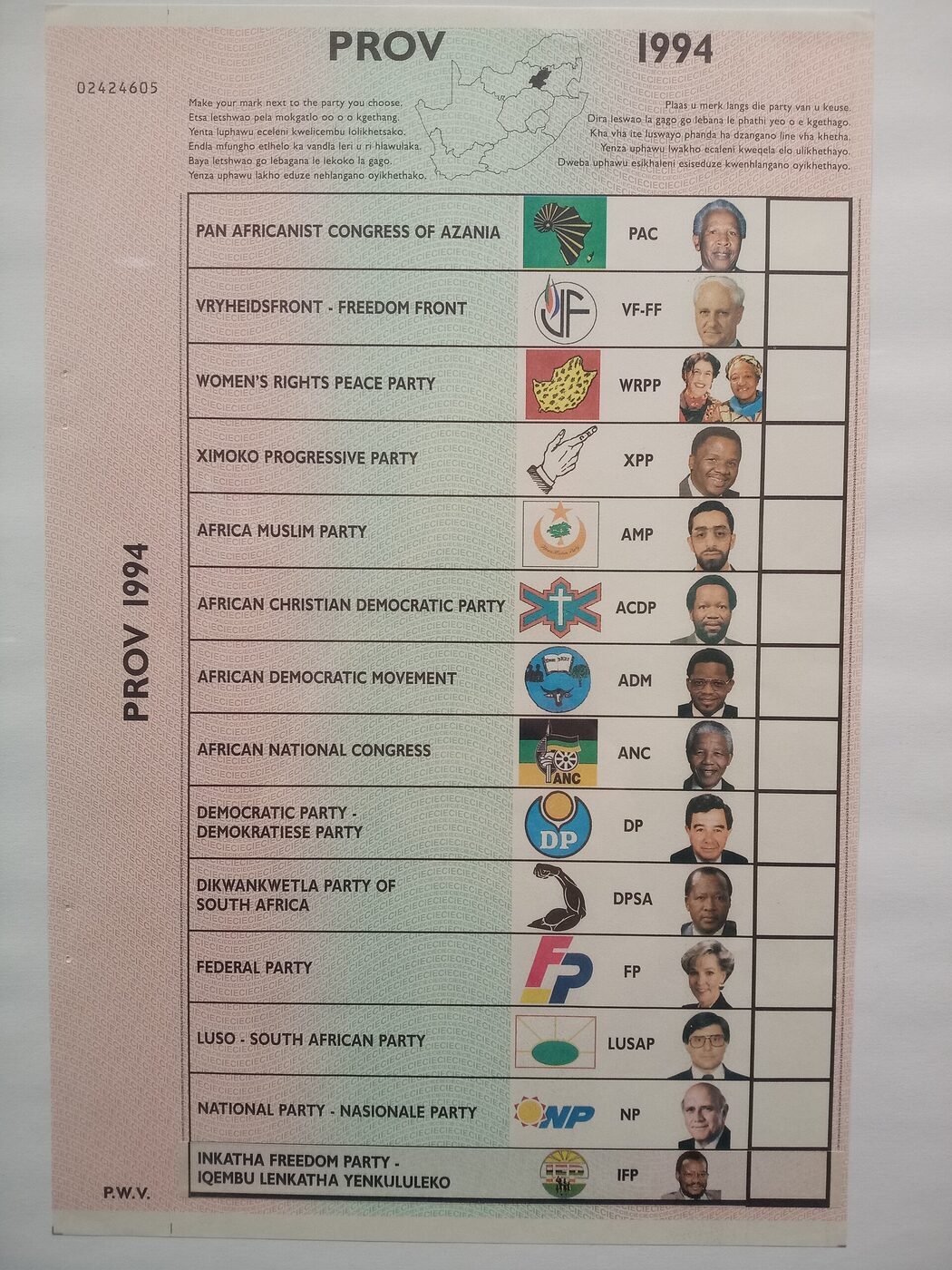
The group’s subject was rewritten underneath it, repeatedly and at speed. The ban on the African National Congress and other organisations was lifted at the opening of parliament in February 1990 and Nelson Mandela was released on 11 February 1990; the multi-party CODESA talks opened in plenary on 20 and 21 December 1991 and reconvened on 15 and 16 May 1992; an interim constitution was ratified in the early hours of 18 November 1993; and the first election held under a universal franchise ran from 26 to 29 April 1994. A newsgroup whose subject was a country doing all that carried the argument while it was still an argument.
Access at home was unusual by the standards of the continent. The first South African IP address was granted to Rhodes University in 1988, and on 12 November 1991 the first IP connection was made between its computing centre and a host in Oregon; commercial access began in June 1992 with the registration of the first .co.za subdomain. South Africans could post from inside the country in years when much of the continent was still waiting for a link at all, so the group had a resident half as well as an emigrant one.
The name space was in place before the wire was. IANA’s root database records the delegation of za on 7 November 1990, a year before the Oregon link and more than eighteen months before the first commercial subdomain, and the second-level structure beneath it preserves the order in which the country arrived: ac.za for the universities, then co.za for commercial use, with org.za and gov.za alongside. The academic side had been reachable for longer still: the first electronic mail sent out of the country went from the Rhodes system over FidoNet to Portland, Oregon, on 2 February 1989, and by November 1991 the universities reached the internet through the shared academic network UNINET.
The other half of the readership was abroad and growing, in Britain, Australia, New Zealand, Canada and the United States. Like most of soc.culture.*, the group was unmoderated, which describes its contents as much as its administration: alongside serious argument it carried racist posting, at times sustained. No honest account of the archive can leave that out, and none needs to reproduce it.

What was discussed
The transition was argued from every side, including sides that have since stopped speaking in public: sanctions and disinvestment, the sequencing of the talks, the shape of the constitutional settlement, minority guarantees, and the terms on which amnesty would be granted. The argument restarted with each development and was rarely concluded.
The Truth and Reconciliation Commission supplied years of material. Its first human rights violations hearing was televised live on 15 April 1996, and the proceedings were carried afterwards in a weekly television programme that ran until June 1998; what the whole country could watch, the group could argue about. The question at the centre of it — amnesty in exchange for disclosure — was argued there as it was argued everywhere else.
Emigration was a standing subject, not merely a fact about the readership. Those who had left and those who had stayed read one another directly, on crime and policing, the currency, employment policy, schooling, and what obligation a departure carried. The language settlement recognised in the 1996 constitution, which made eleven languages official, ran alongside those exchanges; Afrikaans questions eventually had a room of their own in soc.culture.south-africa.afrikaans.
Sport was the dependable truce and, just as dependably, its opposite. South Africa played its first official international cricket series since 1970 in India in November 1991, was readmitted to international rugby in 1992, and hosted the 1995 Rugby World Cup, winning the final at home against New Zealand by 15 points to 12 in what is generally described as the first major sporting event staged in the country after apartheid. Selection, quotas and the ownership of particular codes were argued over with no truce at all. From the late 1990s the government’s position on HIV, AIDS and antiretroviral treatment — the presidential advisory panel convened in 2000, the international AIDS conference held in Durban that year, the litigation that preceded the public treatment programme — ran through the group as well.
Context
The South African diaspora was the group’s second map. Its main destinations were English-speaking countries that came early to the internet themselves, which left emigrants well placed to post. The scale shows in later counts: the 2021 censuses recorded 217,180 South African-born residents in England and Wales and 189,207 in Australia. Much of that movement happened during the years the newsgroup was active.
Within the hierarchy the group sat beside soc.culture.african and soc.culture.zimbabwe, and the main destination countries had groups of their own — soc.culture.british, soc.culture.australian, soc.culture.canada. How the naming scheme came about is set out on the soc and soc.culture pages.
What the surviving archive holds is not settled history but the state of the argument before the history existed. Formal accounts of the transition were written afterwards by people who knew how it turned out; the group was written by people who did not, while the outcome was still open, and it preserves positions that were commonplace then and are seldom stated now — a country arguing with itself, and with the part of itself that had gone abroad.
Connectivity and who could post
How narrow the resident half of the readership was can be measured. The World Bank series for individuals using the internet puts South Africa at 0.2 per cent of the population in 1994, 0.8 per cent in 1996, 2.9 per cent in 1998, 4.1 per cent in 1999, 5.3 per cent in 2000 and 8.4 per cent in 2004 — exactly the years in which the transition was argued. A South African posting during the April 1994 election was writing from inside a fraction of one per cent of the country; by the second general election, on 2 June 1999, the fraction was about one in twenty-five.
The emigrant half sat in countries much further along the same curve. In 2000, when 5.3 per cent of South Africans used the internet, the same series records 26.8 per cent in the United Kingdom, 43.1 per cent in the United States, 46.8 per cent in Australia and 47.4 per cent in New Zealand. That gap is the most useful single fact about the make-up of a culture group for a country outside the wealthy north. Relative to its share of South Africans the diaspora was heavily over-represented in the traffic, because far more of it had a keyboard attached to a network; nothing in the archive corrects for that, and no reading of it should treat the contents as a sample of the country.
The kind of access matters as much as the quantity. Fixed-line telecommunications ran through Telkom, a state-owned enterprise until 2024 that long held the fixed-line monopoly, and the domestic experience through the whole period the group documents was dial-up over that network: the first consumer ADSL product launched in 2001, and wireless broadband did not overtake fixed-line broadband until 2007. The web reached South African politics later than the argument did. The African National Congress registered anc.org.za in 1997 and the Freedom Front vryheidsfront.co.za at about the same time — years into the period this connectivity history covers.
The dated record
What follows is a chronology and nothing else: the group argued over most of these items, and the list takes no position on any of them and characterises no party. The dates are set out because a reader needs to know what had already happened when a given article was written.
The constitutional record
- 17 March 1992 — a referendum restricted to white voters asked, in the official wording, whether the voter supported “continuation of the reform process which the State President began on 2 February 1990 and which is aimed at a new Constitution through negotiation”. The result was a majority for “yes”; it was the last occasion on which only the white electorate voted.
- 10 April 1993 — Chris Hani, general secretary of the South African Communist Party, was shot dead outside his home in Dawn Park, Boksburg.
- 27 April 1994 — the Interim Constitution of 1993, drafted in the Multi-Party Negotiating Process convened in April 1993, came into force.
- 8 May 1996 — the Constitutional Assembly adopted a new constitutional text with the support of 86 per cent of its members.
- 6 September 1996 — in the First Certification judgment the Constitutional Court refused to certify that text.
- 11 October 1996 — an amended text was adopted, and certified on 4 December in the Second Certification judgment.
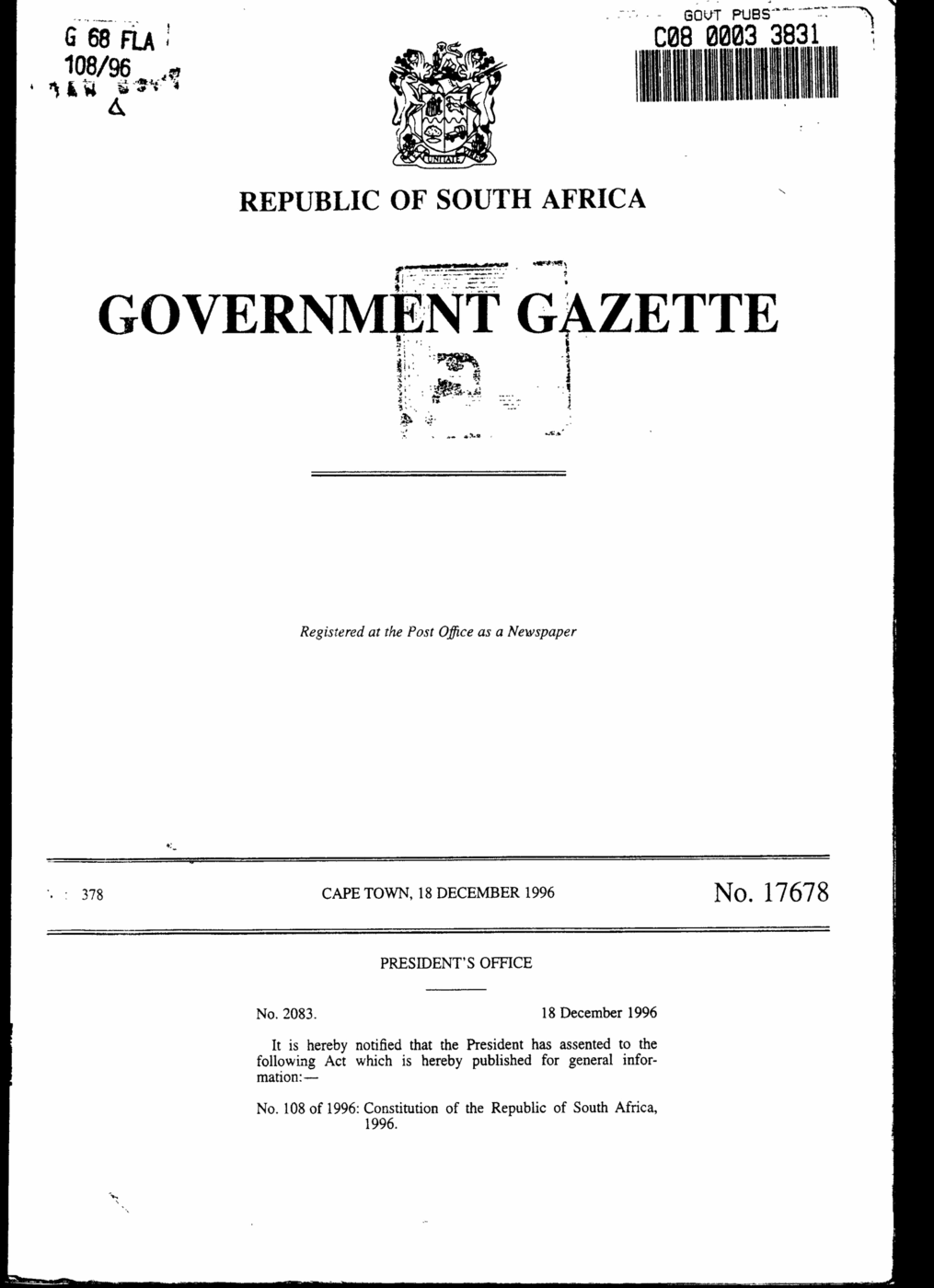
- 10 December 1996 — the Constitution was signed by President Mandela, published in the Government Gazette on 18 December as Act No. 108 of 1996, and brought into operation by proclamation on 4 February 1997.
- 2 June 1999 — the second general election under a universal franchise; polling day was declared an ad hoc public holiday, as later election days were.
The readmission record
- 1991 — the International Cricket Council reinstated South Africa as a Test nation; a non-racial Olympic committee was founded and affiliated to the IOC months later; a non-racial football association was formed and admitted to FIFA.
- 10 November 1991 — the first sanctioned international cricket match since 1970, and the country’s first one-day international, against India in Calcutta; South Africa lost by three wickets.
- April 1992 — the first Test after readmission, against the West Indies at Bridgetown; South Africa lost by 52 runs.
- 7 July 1992 — the first football international, a 1–0 win over Cameroon at Kings Park in Durban.
- 1992 — the Barcelona Olympics, the first Games entered since 1960, with 93 competitors in 19 sports; the flag and anthem being unresolved, the team competed under a specially designed sporting flag, with Beethoven’s “Ode to Joy” in place of an anthem.
- 1992 — readmission to international rugby; New Zealand toured for the first time since 1976 and won 27–24, and Australia won the following month 26–3.
- 1996 — South Africa hosted and won the Africa Cup of Nations, beating Tunisia 2–0 in the final of a tournament from which Nigeria withdrew.
Two boundaries are worth marking. Everything before June 1992 predates commercial internet access in South Africa, so a resident writing about the 1990 unbanning or the March 1992 referendum as it happened wrote from an academic or research account; the public at home could not yet post. And the record continued after the traffic did: the Constitution Eighteenth Amendment Act, making South African Sign Language a twelfth official language beside the eleven spoken ones, was signed on 19 July 2023 and came into force on 26 June 2026, decades after the arguments recorded here.
The commission, as documented
Because the commission generated so much of the group’s material, its documented shape is worth setting down. It was established under the Promotion of National Unity and Reconciliation Act, No. 34 of 1995, based in Cape Town, and worked through three committees: on human rights violations, on amnesty, and on reparation and rehabilitation. The Department of Justice describes the period it examined as running from March 1960 to May 1994.
Amnesty was conditional and the conditions were published: the act had to have been politically motivated and proportionate, and the applicant had to make full disclosure. No side was exempt, and applications were considered from the apartheid state and the liberation movements alike. Hearings were held around the country, among them at the University of the Western Cape, the Central Methodist Mission in Johannesburg and the Rhema Bible Church in Randburg.
The published figures are specific. More than 19,050 people were identified as victims of gross human rights violations and a further 2,975 through the amnesty applications, the commission noting with regret how little the two groups overlapped. It counted 7,000 political deaths under apartheid between 1948 and 1989, 73 of them in detention in the hands of the security police. Of 7,111 amnesty applications, 849 were granted and 5,392 refused, the rest falling into other categories such as withdrawal; more than 300 unresolved cases went to the National Prosecuting Authority when the commission closed.
Seven of the seventeen commissioners were women; special hearings on women were held in Cape Town, Johannesburg and Durban, and women gave more than half of all statements, though fewer than half of those reporting violations against themselves. The weekly programme that carried the hearings to the rest of the country was the Truth Commission Special Report, presented by Max du Preez from April 1996 to June 1998.
The commission was contested while it sat and afterwards, and the contest is part of the record. A 1998 study by the Centre for the Study of Violence and Reconciliation and the Khulumani Support Group, surveying several hundred victims, found that most did not believe it had achieved reconciliation between black and white communities, and regarded justice as a precondition of reconciliation rather than an alternative. Scholars have noted too that the mandate’s definition of a gross violation, framed as harm to an individual, excluded systemic measures such as forced removals and pass arrests. Those arguments ran through the group; this page records that they were made, not who was right.
Eleven languages on a seven-bit network
The settlement the group argued about was also a typographic problem. The 1996 Constitution is published in all eleven official languages, the English text authoritative in the event of conflict, and ten of the eleven are written in the Latin script. Usenet was defined on a narrower base. RFC 1036, the December 1987 standard for the interchange of Usenet messages, required every article to be a valid Internet mail message under RFC 822, the 1982 standard for ARPA Internet text messages — plain seven-bit text. MIME, the machinery for anything else, appeared as RFC 1341 in June 1992 and was restated as RFC 2045 in November 1996, but seven-bit ASCII stayed the safe assumption on Usenet for years afterwards.
What that cost depended on the language. isiXhosa and isiZulu got off lightest: isiXhosa uses the twenty-six basic Latin letters with digraphs, trigraphs and even tetragraphs for the sounds it has no single letter for, writes the three plain clicks as c, x and q, and generally marks neither tone, stress nor vowel length. Nguni-language text therefore passes through a seven-bit channel unaltered.
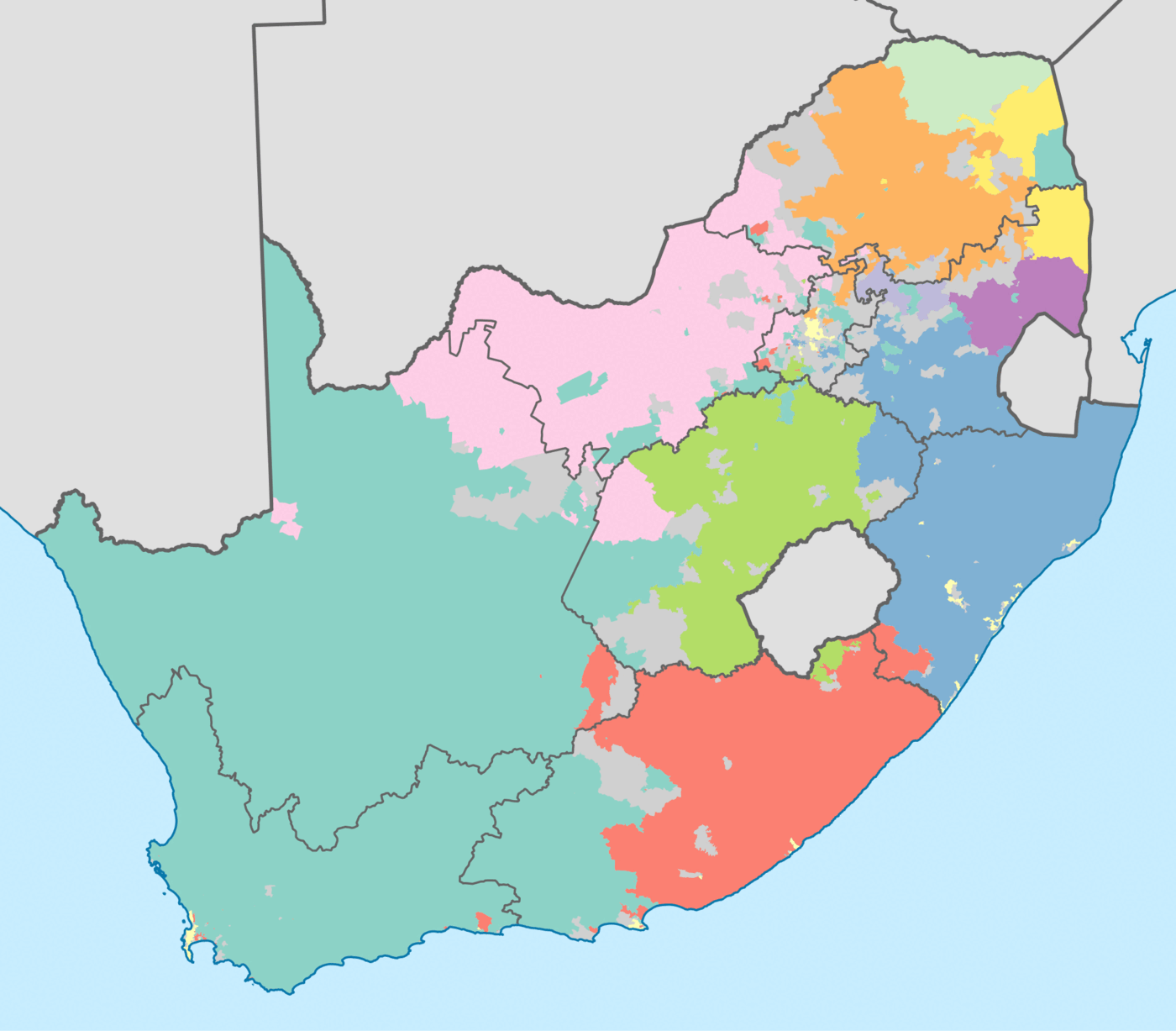

Afrikaans sat one step out. Its orthography adds sixteen accented vowels carrying acute, grave, circumflex or diaeresis, and each has a code point in ISO/IEC 8859-1, the Latin-1 standard first published in 1987, which lists Afrikaans among the languages whose letters it covers completely; eight-bit transport, when it worked, sufficed. The indefinite article is a happier accident: modern Afrikaans writes it as an apostrophe followed by n, two separate characters and both ASCII. A single-glyph variant exists at U+0149, but it was deprecated in Unicode 5.2 in favour of exactly that two-character form.
The accents are not decorative, which is what makes stripping them consequential: sê means “say”, se is a possessive. Wherever an eight-bit path could not be trusted the accent was what got dropped, and a search for the correctly accented spelling will not match a message posted without it.
Two official languages had no single-byte answer at all. Tshivenda needs five letters outside the basic alphabet — four dental consonants written with a circumflex below, one velar nasal with an overdot — which sit at U+1E12, U+1E3C, U+1E44, U+1E4A and U+1E70 with their lower-case pairs, in the Latin Extended Additional block, introduced with Unicode 1.1 in 1993. No part of the ISO 8859 family encodes them, so the only substitute available in a news message was the unmarked letter. Sesotho sa Leboa needs š at U+0161, absent from Latin-1 but present in ISO/IEC 8859-2, in the 1999 revision ISO/IEC 8859-15 and in Windows-1252 — an encoding routinely mislabelled as ISO-8859-1, a confusion later written into HTML5 rather than resolved.
For anyone searching the archive the consequences are three: Tshivenda and Sesotho sa Leboa material is likelier to be found under stripped spellings than correct ones, Afrikaans threads exist in both forms and must be searched twice, and the language names themselves are unstable — Venda or Tshivenda, Northern Sotho or Sepedi or Sesotho sa Leboa.
Where the readers were
The destination censuses give the diaspora’s shape more precisely than any figure from the period itself. The 2011 UK census recorded 186,355 South African-born residents in England, 10,607 in Scotland, 4,668 in Wales and 1,847 in Northern Ireland; by 2021 those counts were 211,447, 15,253, 5,733 and 2,627. The 2021 American Community Survey identified 123,461 in the United States, and the 2023 New Zealand census 95,577 — 1.52 per cent of that country’s population and its fifth-largest immigrant origin, more than ninety per cent of them arrivals since the early 1990s.
Direction of travel is documented as well as volume. Statistics South Africa’s compilation for 2006 to 2016 ranks the destinations as Australia at 26.0 per cent, the United Kingdom at 25.0, the United States at 13.4, New Zealand at 9.5, Germany at 6.0, the United Arab Emirates at 4.2 and Canada at 3.0 — proportions that postdate the years in which such groups were busiest, but in an order matching the countries the archive itself points at.
A readership spread like that has no home hour. South African Standard Time is UTC+02:00 and observes no daylight saving, so the country keeps one clock all year; eastern Australia in standard time runs eight hours ahead of it and New Zealand ten, the eastern United States seven hours behind and the Pacific coast ten. A group with regular readers in Johannesburg, London, Sydney, Auckland and California has no evening in common and no quiet period either, and Usenet — a batched, store-and-forward medium in which each site chose its own transmission arrangements — added delays of its own. Replies in the archive do not reliably follow the article they answer, and the ordering of a long thread should be treated as approximate.
What carried the group between crises
Politics is why the group is remembered and not the bulk of what it carried. The everyday material of a culture group is food, music, books, festivals and the calendar — each with a documentary record far better kept than that of any particular thread.
The braai supplies the vocabulary. The word is Afrikaans, shortened from braaivleis, grilled meat; the custom spread well beyond the community the term came from, and the standard components — boerewors, sosaties, chops, pap with a tomato and onion sauce or with chakalaka — are the fixed points of a thousand recipe arguments. The pairing was a national cliché before the network arrived: General Motors South Africa advertised in the 1970s with a localised jingle running “braaivleis, rugby, sunny skies and Chevrolet”.
The calendar was itself rewritten during the group’s life. The present list of public holidays came in with the Public Holidays Act, No. 36 of 1994, and one entry came out of a dispute: 24 September had been observed in KwaZulu-Natal as Shaka Day, the 1994 bill omitted it, the Inkatha Freedom Party objected, and the compromise reached in parliament produced Heritage Day.
Music gave the group an argument nobody had to win. Ladysmith Black Mambazo, singing in the isicathamiya and mbube styles, reached an international audience through Paul Simon’s Graceland in 1986; both Simon and the group’s leader Joseph Shabalala were accused of breaking the cultural boycott, the album sold sixteen million copies, and the follow-up Shaka Zulu took a Grammy in 1988. At home, kwaito emerged from Soweto between the late 1980s and the 1990s, its name taken from the Afrikaans slang kwaai by way of a township usage in which the word had turned from “fierce” to “excellent”.
Literature was a standing subject with dated events behind it. Nadine Gordimer, Booker winner in 1974 for The Conservationist, was awarded the Nobel Prize in Literature on 3 October 1991; J. M. Coetzee took the Booker in 1983 for Life & Times of Michael K and again in 1999 for Disgrace, the first writer to win it twice, and the Nobel in 2003. Those awards fall inside the group’s active years, and arrived as news rather than literary history.
The festival calendar was the other fixture. The National Arts Festival at Grahamstown, now Makhanda, ran a first main programme of 64 events in 1974 and added a Fringe of 10 in 1979; it occupies eleven days from the last week of June and by 2010 had passed 350 events. Asking what was on, and what was worth seeing, is the sort of exchange an emigrant newsgroup exists for, and the sort that leaves no trace in a political history.
Reading soc.culture.south-africa today
- Historical archive: Google Groups — soc.culture.south-africa (coverage varies by group and era).
- Open in a newsreader:
news:soc.culture.south-africa— the original site offered exactly this link, and it still works if your system has a newsreader registered for thenews:scheme. - Live access: point an NNTP newsreader at a modern server — see accessing Usenet today.
- The original news2mail e-mail subscription service ended in the mid-2000s and no longer operates.