soc.culture.african
Discussions about Africa and things African.
soc.culture.african was the continent-wide group — a meeting point predating most country-specific groups, covering everything from Yoruba naming traditions to structural adjustment debates. Its charter deliberately spanned "Africa and things African", including the diaspora.
The group spawned many of the per-country soc.culture groups as traffic grew; crossposts between them kept a shared continental conversation alive well into the 2000s.
On this page
- One address for a continent
- The group’s own paperwork
- The reorganisation proposed in 1997
- August 1998: eleven groups nobody proposed
- Where the writing came from
- The arithmetic of a thin pipe
- What an umbrella carried that a country group did not
- Continental politics, with dates
- Pan-Africanism, the diaspora and the Atlantic
- Arts, books and music across borders
- The language question, part one: the languages of wider communication
- The language question, part two: scripts on a seven-bit wire
- The country groups beneath it
- The company it kept
- What the record does not show
- Scope and limits
One address for a continent
Every group in soc.culture.* chose, implicitly, a unit of humanity to stand for. Most chose a country; a handful chose a language, a people or a region. soc.culture.african chose a continent, and the choice determined nearly everything the group could and could not be. The African Union today counts fifty-five member states. Estimates of the number of languages natively spoken in Africa run from roughly 1,250 to roughly 2,100, and on some counts past 3,000; Nigeria alone accounts for more than five hundred of them. For most of the 1990s all of that had, in the Big-Eight namespace, one address.
The asymmetry is easy to measure and easy to misread. Count the soc.culture.* groups in the active file that the Internet Systems Consortium still distributes: of 139, sixteen take an African country, region or people as their subject — soc.culture.african itself, together with algeria, berber, egyptian, ethiopia.misc, guinea-conakry, kenya, liberia, maghreb, malagasy, nigeria, sierra-leone, somalia, south-africa, south-africa.afrikaans and zimbabwe. By the same rough test Europe has thirty-eight, a namespace with separate standing rooms for the Bretons, the Cornish, the Occitans and the Asturians. Where exactly the line falls is arguable at the edges — Russia and the former Soviet Union sit in two continents at once, and soc.culture.europe is counted here as a European entry just as soc.culture.african is counted as an African one — but not by enough to change the shape.
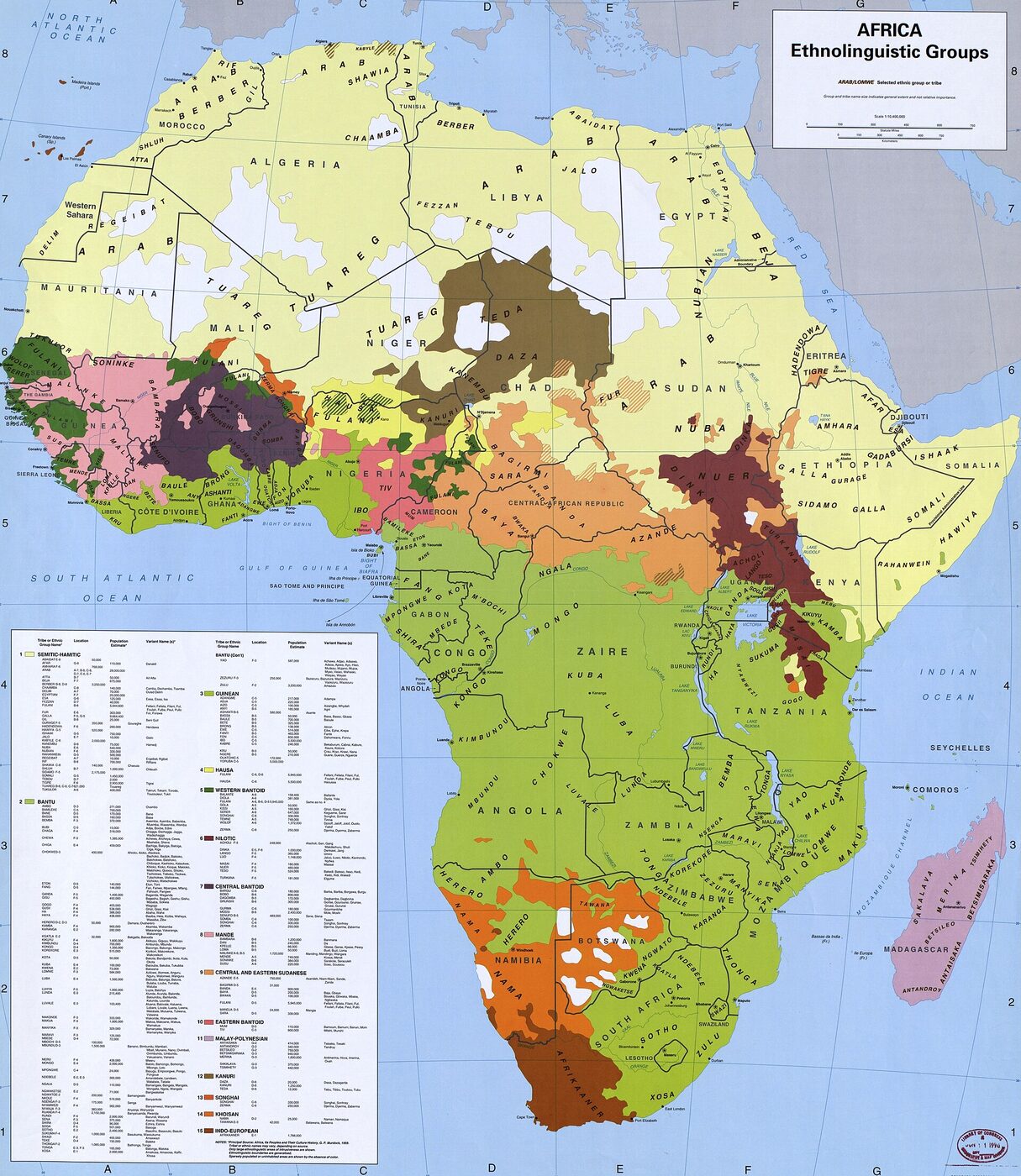

That shape is a fact about where the network’s early users sat rather than a fact about Africa, and the fifth and sixth sections below give the figures behind it. The structural consequence is worth stating first, because it explains the traffic. A group covering fifty-odd states cannot be about any one of them for long. Whenever the specific business of a country accumulated enough writers to sustain itself, it left: the group’s own 1997 reorganisation proposal describes the process in exactly those terms, and the roster of national groups that surrounds it in the namespace is the evidence.
What remained, and what an umbrella of that scale can honestly be about, is the continent as a category. The comparative question, which no single country group can hold. The regional body and the treaty. The border and its history. The migration between neighbours. The diaspora, which is organised by no one country at all. And, perennially and without resolution, the argument about what the category contains and who belongs inside it — a question the charter’s breadth left wide open and the group returned to for as long as it was busy.
The group’s own paperwork
The group’s formal description has not changed in more than thirty years. In the newsgroups file that the Internet Systems Consortium distributes today, the entry is a name, a tab and a sentence:
soc.culture.african Discussions about Africa & things African.
The ampersand is the file’s own. The form with and, used at the head of this page, is the one that travelled through the web directories that reprinted the soc.culture.* roster. Nothing else about the entry has moved. The group is still listed in the active file, still flagged as open for posting, and still undescribed beyond that one sentence — which is, in the terms of the newsgroups file, the whole of its charter.
The administrative record behind the line is thinner than the group’s standing would suggest, and the reason is chronological rather than mysterious. The earliest item in the Internet Systems Consortium’s control-message file for this group is dated May 1991; soc.culture.african is older than that. The file holds five messages in all, and not one of them was issued by the moderator of news.announce.newgroups, the account through which genuine Big-Seven creations were announced. All five are the ordinary background noise of a distributed network:
- 23 May 1991, from the news account at Compass, Inc. of Wakefield, Massachusetts, with
Distribution: world, its single line of body text being the newsgroups-file description quoted above; - 26 April 1992, from a named user account in the University of Maine’s computer science department, with
Distribution: umcs— that is, a newgroup meant to travel no further than one campus — and an empty body; - 21 October 1992, from an account signing itself System Administrator at Colorado State University, with
Distribution: csu, aControl: newgroupheader and a body consisting of the single linechkgroup soc.culture.african. There is nochkgroupcontrol command in Usenet; the command for verifying a group list ischeckgroups; - 21 September 1995, from a Swiss news server, prefaced For your newsgroups file: and then giving the group name with the description field left empty;
- 4 November 2001, an
rmgroup— a request to delete the group — sent over the name of the maintainer of the tin newsreader, one line long, asking that the bogus newsgroup soc.culture.african be removed. Its headers are internally inconsistent, and the group is still in the active file.
Four local re-creations and one dud deletion: that is the entire control record. The absence of a proper newgroup message is itself the dating evidence, and it is corroborated from an unexpected direction. On 13 March 1990 Eric Deering, then at Oracle Corporation, posted a Call for Discussion for a new group to serve people of African descent in the United States, Canada and the Caribbean. Explaining where the demand had come from, he wrote:
So far, there has been a lot of interest in creating this group, via local discussion on soc.culture.african and various emailings.
That places soc.culture.african in ordinary working use at the beginning of 1990, within about three years of the Great Renaming, carried out in 1987 after software changes the previous year made it practicable, which carved soc.* out of the old flat namespace and set it aside for social and cultural subjects. The mechanics of that reorganisation, and of the voting ritual that governed Big-Seven creations afterwards, belong to the culture branch’s own hub page and are not retold here. One detail from the 1990 paperwork is worth keeping, because it is characteristic: the Call for Discussion of 13 March proposed the name with a dot, the Call for Votes of 27 March asked for it with a hyphen, and the group that resulted has a dot. Usenet’s naming arguments were rarely settled tidily.
Like almost every group in soc.culture.*, soc.culture.african was unmoderated. Nobody vetted arrivals and nobody enforced anything; the group’s character at any given moment was the sum of whoever had turned up. That arrangement served it perfectly well in quiet periods and was tested hard whenever the news from home was bad — and, as the next section shows, its readers eventually tried to change it.
The reorganisation proposed in 1997
The one substantial document the group generated about itself is a Request for Discussion posted through news.announce.newgroups on 17 January 1997 and filed in the archive under the name soc.culture.african-reorg. Its own Lines header puts it at 556. It is the closest thing the group has to a self-portrait.
The proposal was to rename soc.culture.african as a moderated group and to spin four others out around it. Its newsgroup lines, in the compact form that would have gone into the newsgroups file, read:
soc.culture.african.arts— African arts.soc.culture.african.horn— Culture, peoples, and affairs of Horn of Africa.soc.culture.african.moderated— African culture, peoples, and affairs. (Moderated)soc.culture.african.west-africa— Affairs of West Africa.talk.politics.african— Current political and social issues in Africa.
The last of those was not fully settled even within the document: the heading and the newsgroup line call it talk.politics.african, while the rationale written for it is headed soc.politics.african and argues for the group under that name throughout.
The rationale states the umbrella problem in the proponents’ own words, and incidentally settles the question of the group’s seniority:
A few years ago, soc.culture.african was created to discuss issues regarding the culture and peoples of the African continent. Over the years, some national and regional newsgroups in the soc.culture.* hierarchy have sprouted off this newsgroup. In spite of these, the group has witnessed continued growth and diversification. This has brought with it its attendant problems, such as off-topic and irrelevant posts, junks mails, spams, and other posts on topics that should otherwise have been directed to or discussed in appropriate newsgroups, had they been available.
The charter drafted for the moderated group opens by defining membership as widely as it is possible to define it:
Soc.culture.african is a moderated forum for all discussions, debates, and information about Africa and her peoples. Therefore, Africans within and outside the African continent and friends of Africa all over the world or all persons interested in Africa, irrespective of nationality, race, creed, sex, age, or language, who can follow USENET netiquette, basic rules of polite human interaction, and any further requirements imposed by the charter are welcome to participate.
What follows is a long and careful rulebook, and the shape of its worries is a better guide to the group’s daily weather than any summary could be. Posts were to be rejected for exceeding seventy-five characters a line; for quoting so much of a previous article that less than a third of the text was new; for being commercial advertisements, robot-generated articles or spam; for profanity, personal abuse, slander or libel, or unauthorised reference to private e-mail addresses or mailing lists; and for carrying binaries larger than a PGP signature. The drafters were at pains to say what moderation would not be: the moderators, the charter states, shall not enforce any censorship of opinions or views, no matter how strongly expressed, and would not screen for grammar, spelling, syntax or intellectual content. A grievance procedure allowed a rejected author to appeal to the whole panel, with a tie resolved in favour of publication. Moderators were to renew their membership every twenty-four months, and a clause reserved the right to write a robomoderator later.
One rule required the drafters to define a term, and the definition is a small period document in itself. Anti-African articles were to be off-topic, and the charter explains the boundary it is drawing:
(Note that an “anti-african” article is an article of which the original purpose is to denigrate Africans or Africa, or to cause hatred of Africans or Africa by people from other continents, races, and colors. Anti-African is not the same as “anti-African-governments”. Again, if you don’t understand this distinction, contact the moderators with your submission.)
The proposal was signed by five proponents with a sixth listed as mentor, and named a moderation panel of eight. Two of the eight carried short biographies: a lecturer in computer science at Coventry who had grown up in Zambia and had travelled widely on the continent, and a former agricultural development worker, by then a state legislator in the United States, described as strongly concerned with better access by Africans to the Internet. The other six are names and e-mail addresses only.
The distribution list is as informative as the charter. The RFD’s own distribution section records it as posted to news.announce.newgroups, news.groups, soc.culture.african itself and seven other Africa-related groups: bit.tech.africana and the Kenya, Zimbabwe, South Africa, Nigeria, Liberia and Sierra Leone groups. The Newsgroups header on the archived copy does not match that list exactly — it carries soc.culture.ethiopia.misc and soc.genealogy.african and omits bit.tech.africana, Kenya and Zimbabwe. Three mailing lists are named and given with subscription instructions: Naijanet, described as the main Nigerian list, running on a LISTSERV at MIT; the Zambia Network at Mississippi State; and a Cameroon network hosted on a machine of Italy’s national research council. The proponents undertook to post it in a further thirteen groups themselves, from soc.culture.egypt and soc.culture.maghreb to soc.culture.caribbean and soc.culture.brazil. The map of an Africa-related readership in January 1997 is right there in the header.
So, incidentally, is a rough sense of scale. The RFD’s Xref header records the article numbers it was given on the UUNET server as it was filed into each group: 66,082 in soc.culture.african, against 30,616 in soc.culture.nigeria, 27,275 in soc.culture.south-africa, 3,444 in soc.genealogy.african, 2,881 in soc.culture.sierra-leone, 2,610 in soc.culture.liberia and 1,585 in soc.culture.ethiopia.misc. Those are counters on one machine, not message totals: they run from whenever that server started numbering the group, they take no account of articles that expired, and a different server would give different numbers for the same article. They are worth reading only as a rank ordering, and as a rank ordering they say the obvious thing — the umbrella was carrying several times the traffic of any single national group beneath it.
What happened next is not in the record. The archive holds the Request for Discussion and nothing else: no Call for Votes, no result, no withdrawal. None of the five proposed groups exists in the namespace today, and soc.culture.african remained unmoderated for the rest of its active life. Whether the proposal was voted down, abandoned, or simply overtaken, the surviving paperwork does not say.
August 1998: eleven groups nobody proposed
On 26 August 1998 newgroup control messages began appearing for eleven groups that had never been proposed at all: soc.culture.african.ashanti, .ewe, .hausa, .ibo, .mandingo, .somali, .swahili, .tuareg, .xhosa, .yoruba and .zulu. The first wave was dense — 275 of them in the four days to 29 August — and the traffic then continued at intervals until 19 November 1998, with two isolated stragglers in February and April 1999. Each message purported to come from the address of the then moderator of news.announce.newgroups, carried the organisation line The Cabal and a block of PGP signature, and closed with a sentence in the standard house form — that the group was unmoderated and had passed its vote for creation by such-and-such a margin, as reported in news.announce.newgroups on such-and-such a date.
They had not. The forgery is visible in the arithmetic. The control archive preserves complete files for nine of the eleven names, holding 683 newgroup messages and 225 rmgroups between them, and within each of those nine files every newgroup reports a different vote tally: 69 messages and 69 distinct results for soc.culture.african.yoruba, 89 and 89 for .mandingo. soc.culture.african.ashanti is announced as having passed by 315 to 21 on 27 August and by 108 to 5 the following day. No count of actual ballots produces that pattern.
The moderator settled the question in the ordinary way, by publication. The periodically posted Bogus Usenet Groups article — a list of group names that had achieved propagation without legitimacy — carried all eleven in the issue dated 22 October 1998 and filed in the archive as 19981019, each annotated with the list’s standard verdict, no proposal. They arrived in a batch of 4,833 new entries, alongside such names as news.admin.culture.african and news.misc.culture.african, annotated should be soc.culture.african. The scale of that batch is the point: the previous issue, of 10 August 1998, ran to 710 lines; the October one ran to more than ten thousand. This was the debris of a flood of forged control traffic that hit the whole namespace that autumn rather than this group in particular. The list was scrupulous about its own authority, and the note it printed above the names is a fair statement of how the network actually worked:
While Usenet is a cooperative anarchy, and doesn’t really have “official” and “bogus” groups that are enforcable anywhere other than at each individual site, groups listed in this article are considered by a majority of admins to be not valid based on the reasons above.
None of the eleven survives in the active file, and two of them — .tuareg and .xhosa — survive in the archive only as truncated fragments, filed with the suffix partial. Who sent the messages, and why the names chosen were ethnolinguistic rather than national, the record does not show, and this page will not guess. What can be said is narrower and still worth saying: for three months in the autumn of 1998 an automated hand wrote eleven African peoples into the Usenet namespace on the strength of votes that never happened, and the correction, when it came, was a line of annotation in a list ten thousand lines long.
Where the writing came from
The mismatch between what the group was about and where it was written from was a matter of infrastructure, and the infrastructure arrived in a particular order. Research and education networks came first, and in Africa they came first by a wide margin. Where a country had an international link at all in the early 1990s, it generally terminated in a university computer centre — which is precisely the kind of place from which a Usenet feed can be taken and an article posted.
The best-documented sequence is South Africa’s, because it was first and because its participants wrote it down. The first South African IP address was granted to Rhodes University in 1988. On 2 February 1989 the first e-mail from the country was sent from the Rhodes system, over FidoNet, to Randy Bush in Portland, Oregon. On 12 November 1991 the first IP connection was made between the Rhodes computing centre and the same correspondent in Oregon; by that month South African universities were connected to the Internet through UNINET, and commercial access followed in June 1992.
The Oregon end of that link was not a coincidence. From 1988 Randy Bush and John Klensin had been giving unpaid technical help to network engineers in southern Africa; the arrangement was formalised in 1992 with a grant from the United States National Science Foundation, as the Network Startup Resource Center, and the NSRC moved to the University of Oregon in 1996. West Africa’s early connections had a comparable figure in Nii Narku Quaynor, who returned to Ghana from the United States in the early 1990s, established some of the continent’s first Internet connections, helped set up the African Network Operators Group, and served as founding chairman of AFRINIC, the continent’s regional Internet registry, established in 2004 and based at Ebene in Mauritius. All of that is later than the group’s birth; AFRINIC in particular postdates the years in which such groups were busiest by a decade.
Donor money followed in the middle of the decade. The implementation phase of the United States Agency for International Development’s Leland Initiative, named after the congressman Mickey Leland, began in March 1996: a five-year, fifteen-million-dollar programme to improve Internet connectivity in Africa, working chiefly by pressing for the policy changes that would let private providers sell access. Its method was criticised, then and since, for routing connectivity through incumbent state telecommunications operators and so cutting across efforts already under way locally.
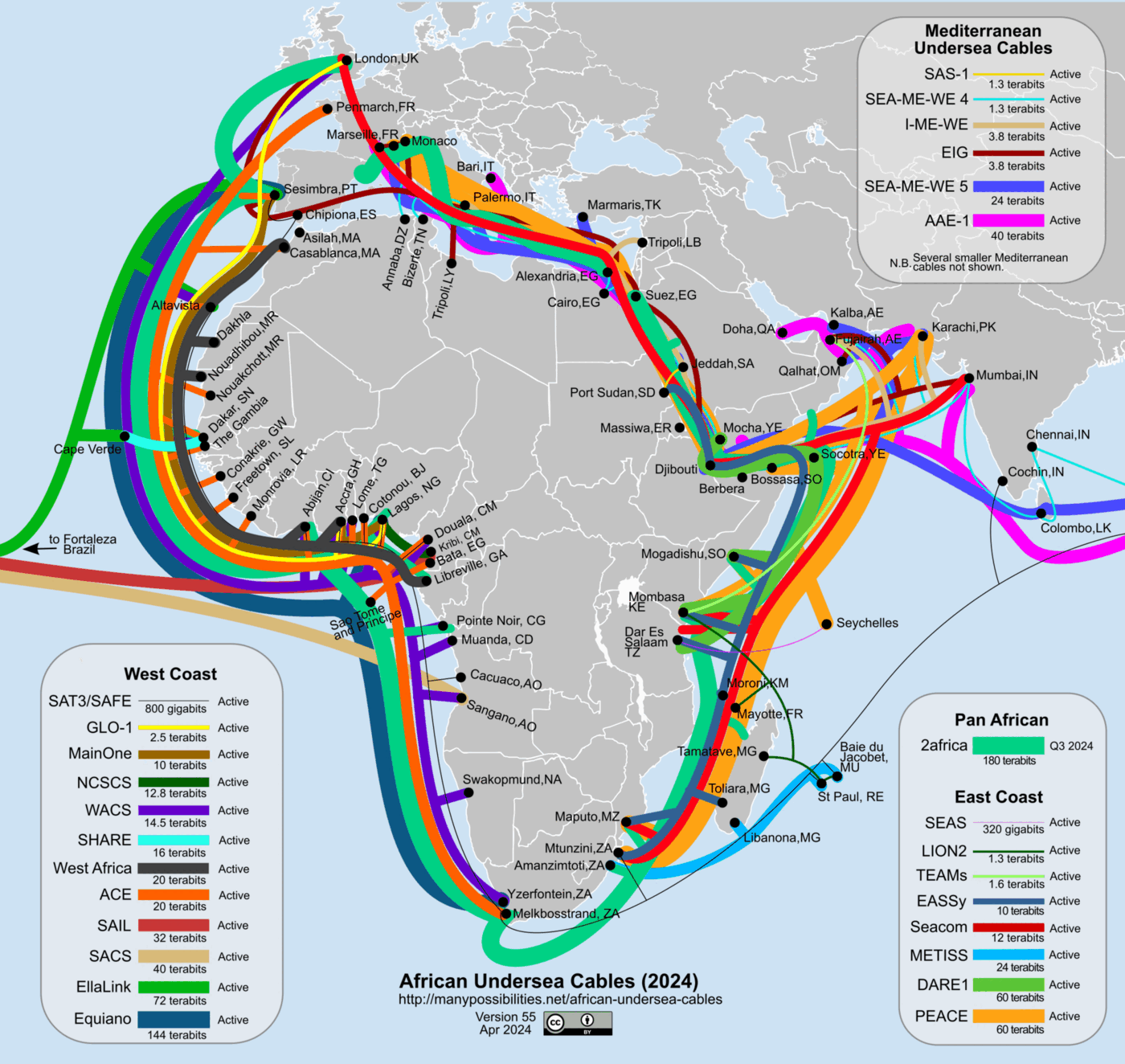
What these programmes bought, for most countries, was a share of a satellite link. Fibre changed the arithmetic on the west coast, and late. The SAT-3/WASC cable, thirteen thousand kilometres of it, runs from Chipiona and Sesimbra in Spain and Portugal by way of Dakar, Abidjan, Accra, Cotonou, Lagos, Douala, Libreville and Cacuaco to Melkbosstrand in South Africa; it entered service in 2001 and gave West African users their first fibre path to Europe. Capacity on it was sold under monopoly control of access, and the price stayed high: a 2008 study for the Association for Progressive Communications put bandwidth on the route at four and a half to twelve thousand US dollars per Mbit/s per month, more than fifty times the contemporary United States price. The east coast waited longer still: SEACOM entered service on 23 July 2009, EASSy on 16 July 2010, WACS on 11 May 2012 — every one of them after the newsgroup’s traffic had already moved elsewhere.

The arithmetic of a thin pipe
Aggregate figures make the position plainer than any anecdote. In 2007, by the International Telecommunication Union’s count, all of Africa’s international Internet connections together came to roughly 28,000 Mbit/s. Asia had about 800,000 and Europe more than 3,000,000; the total available to the whole continent was less than the 49,000 Mbit/s available to Norway alone. Sixteen African countries had a single international connection of 10 Mbit/s or less. South Africa by itself had over 800 Mbit/s. Because so little capacity terminated on the continent, most Africa-generated traffic — estimates in the same period run between seventy and eighty-five per cent — was routed through servers elsewhere, mainly in Europe.
Host counts told the same story from another angle. A survey of Internet hosts for the end of 2007 found about 1.8 million hosts in Africa against more than 120 million in Europe; that Africa as a whole had fewer hosts than Finland; that Nigeria, with some 155 million inhabitants, had about a third as many as Liechtenstein, with thirty-five thousand; and that almost ninety per cent of all African hosts were in three countries, South Africa, Morocco and Egypt.
And those are figures for 2007 — years after the period in which such groups were most used. For the years when soc.culture.african was busiest, the ITU’s series for individuals using the Internet gives, for the year 2000, percentages of the population such as these: Democratic Republic of the Congo 0.01, Republic of the Congo 0.03, Chad 0.04, Central African Republic 0.05, Burundi 0.08, Angola 0.11, Tanzania 0.12, Equatorial Guinea 0.13, Eritrea 0.14, Uganda 0.16, Djibouti and Zambia 0.19, Benin and Côte d’Ivoire 0.23, Cameroon 0.25, Zimbabwe 0.40, Algeria 0.49, Egypt 0.64, Togo 0.80, Cape Verde 1.82, Tunisia 2.75. In 2000, by the same body’s reckoning, sub-Saharan Africa as a whole had fewer fixed telephone lines than Manhattan; in 2006 the continent accounted for two per cent of the world’s telephone lines.
The consequence for an African newsgroup is not a matter of inference. Through the years in which soc.culture.african carried the most traffic, the overwhelming majority of the people who could reach a news server at all were reaching it from somewhere other than Africa: students and academics at North American and European universities, expatriate professionals with employer accounts, and readers who had wandered in from elsewhere in the namespace. Posts sent from the continent itself, over expensive and precarious links, were correspondingly scarce and correspondingly noticed. That is the honest core of this page. An address for a continent was, for its first decade and more, written mostly by Africans abroad — and the 1997 reorganisation proposal shows the group knew it, singling out for particular concern Africans coming on-line from Africa, or recently arrived in western countries, who found the prevailing manners hard to take.
What an umbrella carried that a country group did not
Described by kind rather than by thread, the traffic sorts into five recognisable streams, and the mixture is what distinguishes a continental group from a national one.
The steady state was question and answer. Language and etymology; naming practices and what a name meant; music and, above all, where to obtain it; customs and their regional variation; requests from students writing term papers; requests from readers who had just finished a novel and wanted to know what to read next. This is the traffic that any large cultural group generates, and on a continental group it had a particular character, because the person best placed to answer a question about Senegal was frequently reading from Illinois.
The second stream was comparative, and it is the one a country group structurally cannot hold. Regional bodies and their treaties; two countries’ experience of the same institution; a border and how it came to be where it is; migration between neighbours and the politics of it; the recurring question of whether an experience in one country generalised to another. Somebody who knew more than one case could set them against each other in public, which is not a thing the surrounding national groups were built to do.
The third was news, and it arrived in bursts. The group’s lifetime coincided with an extraordinary run of continental history: the negotiated end of apartheid in South Africa between 1990 and 1993 and the first non-racial elections in 1994; Eritrea’s de facto separation in 1991 and its de jure independence on 24 May 1993 after a United Nations-supervised referendum; the early-1990s wave of transitions away from single-party rule; the Rwandan genocide of 1994 and the wars that followed it in the Great Lakes region. When such events broke, the group filled with relayed agency copy, first- and second-hand accounts, analysis, argument and grief. People on opposite sides of the same conflicts read and answered one another in the same threads. The group settled none of these disputes; it carried all of them.
The fourth was definitional, and it never went away. Who and what counted as African: North Africa’s place in the conversation, white Africans, the standing of the diaspora, the relationship between continental Africans and African-Americans. The charter’s single sentence conferred no help whatever in answering any of that, and the question kept coming back.
The fifth stream was the ordinary entropy of an unmoderated group on an open network — crossposted flame wars, and from the mid-1990s advertising in industrial quantities. The group documented that itself: the 1997 proposal’s complaint about off-topic and irrelevant posts, junks mails, spams is a contemporaneous witness, dated and signed.
Continental politics, with dates
A continental group inherits a continental politics, and the institutional dates are worth having in one place because they recur in any archive of the period.
The Organisation of African Unity was established at Addis Ababa on 25 May 1963 by the independent African states then in existence — the number of signatory governments is given as thirty-two or thirty-three depending on the source — with the eradication of colonialism and the encouragement of political and economic integration among its stated aims. In April 1980 the OAU adopted the Lagos Plan of Action, a programme of self-sufficiency intended to minimise the continent’s dependence on Western economies. The following year the World Bank published Accelerated Development in Sub-Saharan Africa, written by Elliot Berg in response to a 1979 request from the African Governors of the Bank and universally known since as the Berg Report; where the Lagos Plan looked inward, the Berg Report argued for outward-looking policies and increased international trade. The structural adjustment programmes that the International Monetary Fund and the World Bank attached to lending through the following decade are the practical continuation of that argument, and the argument was still entirely live when such groups were at their busiest. The group inherited that argument; it did not start it.
The institutional succession came at the end of the group’s life. The Sirte Declaration of 9 September 1999, issued in Libya, called for a new union. The Constitutive Act of the African Union was signed at Lomé on 11 July 2000 and entered into force on 26 May 2001, once two-thirds of the fifty-three signatory states had ratified it. The New Partnership for Africa’s Development was adopted at the assembly in Lusaka in July 2001. The African Union was launched at Durban on 9 July 2002, and the OAU was disbanded the same day. The Union now has fifty-five member states, all of which have ratified the Act, South Sudan and Morocco being the last to do so.
Below that sat the regional communities, and the newsgroup’s own paperwork records one of them precisely. The 1997 proposal for soc.culture.african.west-africa describes the Economic Community of West African States as a 16-nation community, which is what it was in January 1997; ECOWAS had been founded by the Treaty of Lagos on 28 May 1975, and today it has twelve members, Mali, Burkina Faso and Niger having announced their withdrawal in January 2024 and left on 29 January 2025. The proposed charter’s topic list is a fair inventory of what continental economic argument looked like on the wire: the ECOWAS Fund, the role of the IMF and other financial institutions, monetary issues, immigration, regional cooperation, and education systems down to the level of the West African Examinations Council.
Pan-Africanism, the diaspora and the Atlantic
Pan-Africanism gave the group an intellectual tradition older than the network by most of a century: a movement to strengthen solidarity among the peoples of Africa and of African descent, with a support base in the Americas and Europe as substantial as its base on the continent. Its literary wing supplied much of the vocabulary the group argued in. Négritude was developed in the 1930s largely by francophone writers in Paris — Aimé Césaire of Martinique, Léopold Sédar Senghor of Senegal, Léon Damas of French Guiana among them — as a framework for cultivating black consciousness across Africa and its diaspora. Présence Africaine, founded in Paris in 1947 by Alioune Diop, became the movement’s journal and, from 1949, its publishing house and bookshop on the rue des Écoles in the Latin Quarter. A reader arriving in soc.culture.african in 1994 with a question about Senghor was asking about a body of argument then sixty years old.
The diaspora’s relationship to the continent was not an abstraction in this group; it was a structural feature, since so much of the readership was itself diasporic. It also produced the one offspring whose paperwork names this group by name as its source. The Call for Discussion of 13 March 1990 quoted earlier proposed soc.culture.african.american explicitly out of discussion held on soc.culture.african, and its draft charter defined the new group’s scope as people of African descent living in the United States, Canada, and the islands of the Carribean — the misspelling is the document’s. Its topic list is almost word for word the standard soc.culture.* inventory: politics and legislation, culture, history, philosophy, education, business, societies and traditions, literature, languages, science, food, media, local events, communities abroad.
That Atlantic scope is where this group’s subject touches another. The transatlantic diaspora connects soc.culture.african to soc.culture.caribbean, and the connection was live in the namespace: the Caribbean group is one of the thirteen the 1997 proponents undertook to post the reorganisation proposal in. The Caribbean’s own history, and its own newsgroup’s, belong to that page and are left there.
The northern edge of the continent sits in two scopes at once for the same reason. North African subjects were African and arabophone together, and the namespace reflected it: soc.culture.maghreb and soc.culture.egyptian stood alongside soc.culture.arabic, soc.culture.algeria and soc.culture.berber. The 1997 proponents undertook to post their proposal in the Maghreb, Egypt, Algeria and Berber groups; soc.culture.arabic is not on any of the document’s lists. This page treats North Africa as African; the Arabic-language community that also claims it is soc.culture.arabic’s subject and is not duplicated here.
Arts, books and music across borders
The cultural traffic that crossed national borders is the part of the group’s life that its own paperwork describes best, because one of the 1997 proposals was for an arts group and its drafters set out, at length, what they wanted discussed. The charter for soc.culture.african.arts is essentially a list of questions, and it is the most vivid surviving evidence of the register in which this material was argued. It asks what role African art played in indigenous cultures and what role it plays in modern African life; what parallels exist between African, European and Eastern art; what constitutes a real piece of African art as against a fake; what becomes of private Western collections kept out of public view, and whether their owners have a responsibility to share them; how communities are coping with the removal of their cultural heritage; where the latest archaeological digs are, and what they are yielding. It adds photography, video and film, fashion and fabric design, cooking and art education to the scope, and asks how imported religions have affected the use of art as religious or cultural icon.
Books crossed borders more easily than objects did, and the reading-list question was permanent traffic. The generation a newcomer was most often pointed towards — Chinua Achebe, Wole Soyinka and their contemporaries — had by then acquired institutional recognition: Soyinka received the Nobel Prize in Literature in 1986, the citation crediting a wide cultural perspective and poetic overtones. The argument about which language that literature ought to be written in was equally permanent, and the next section takes it up.
Music was the traffic with the fewest borders and the most awkward vocabulary. The term world music is older than the marketing category that carried it: it is credited to the ethnomusicologist Robert E. Brown, who coined it at Wesleyan University in the early 1960s. The commercial usage a 1990s reader would have met in a record shop dates from a single meeting: on 29 June 1987 interested parties in the London independent-label trade agreed to promote non-Western folk music under that heading, following the success of Paul Simon’s Graceland the year before, and marked the campaign with a compilation cassette given away on the cover of the NME. Whether that category was a doorway or a display case is exactly the sort of question that had no natural home in any country group, because it was about a whole continent’s relationship with an export market.
The language question, part one: the languages of wider communication
A continental group had to run in something. In practice it ran in English, with French, Portuguese and Arabic present and Swahili occasionally attempted — which is to say that a group about Africa was necessarily conducted, most of the time, in the languages that colonial administration had left behind as languages of wider communication.
That is not a peculiarity of Usenet. The continent’s own institutions had reached the same accommodation and written it into a treaty. Article 25 of the Constitutive Act of the African Union provides:
The working languages of the Union and all its institutions shall be, if possible, African languages, Arabic, English, French and Portuguese.
The conditional in the middle of that sentence has done a great deal of work. The Protocol on the Amendments to the Constitutive Act, adopted at Maputo on 11 July 2003, would replace it with a flat list — Arabic, English, French, Portuguese, Spanish, Kiswahili and any other African language — which makes Swahili the one African language named in the Union’s own language clause. The Union declared 2006 the Year of African Languages.
The newsgroup’s 1997 drafters wrote a language clause of their own, and it lands in almost exactly the same place:
Postings in any of Africa’s native languages, as well as Pidgin, Swahili, English, French, and Portuguese shall be accepted. Postings in languages other than these are welcome provided that the English and/or French translations of the articles are supplied. Africans are encouraged to provide, where necessary, English or French translations to articles written in vernacular in order to improve readership.
The companion charters said the same in shorter form: the Horn of Africa group was to welcome English and the indigenous languages of the region, and the West African group English, French, Portuguese, Pidgin and the indigenous languages of the ECOWAS states, with an English translation supplied where possible. Every one of these documents wants African languages used and expects a European one to be needed for anyone to be read.
That expectation was the subject of the period’s sharpest literary argument, which reached the group in miniature. In Decolonising the Mind (1986), the Kenyan novelist Ngũgĩ wa Thiong’o argued for linguistic decolonisation and put the question that soc.culture.african then rehearsed at intervals for a decade: whether African literature written in European languages is African literature at all. The argument is Kenyan in origin and is treated at length on soc.culture.kenya; what belongs here is only that a continental group had a structural stake in the answer, since the medium it ran in was itself the thing in dispute.
The language question, part two: scripts on a seven-bit wire
The second half of the language question was technical, and the group answered it in its own charter before anyone had to ask. What a Usenet article could legally carry was US-ASCII and nothing else: RFC 1036 of December 1987 built the interchange format on RFC 822, whose text is defined that way. MIME made more possible — RFC 2045 and RFC 2047 reached their current form in November 1996 — and were deployed unevenly for years afterwards. The 1997 proposal states the working assumption of the period with no ambiguity at all:
Articles should be sent in the standard 7 bit ASCII character set, conform to RFC822. If accented characters are necessary one is allowed to use the standard 8 bit ISO-8859-1 character set. Other language or machine-specific character sets are not acceptable in this newsgroup.
Set that beside the language clause quoted in the previous section and the tension is complete. The same document welcomes postings in any of Africa’s native languages and forbids the character sets in which most of them are written.
The difficulty begins before any non-Latin script is reached. Writing an African language in Latin script has for a century meant using letters that English does not have. The Africa Alphabet was devised in 1928 by the International Institute of African Languages and Cultures, under the direction of Diedrich Westermann, by combining the English alphabet with letters borrowed from the International Phonetic Alphabet — the explicit aim being to let African languages be written without diacritics; by one count it became the basis for the transcription of about sixty languages. Nigeria’s National Language Centre followed the same road, standardising a thirty-three-letter Pan-Nigerian alphabet during the 1980s intended to write all the country’s languages without digraphs. None of the additional letters in either scheme exists in ASCII, and few of them were in ISO-8859-1, the eight-bit set that the charter above nominates as the fallback. In Unicode they are scattered: many of the hooked consonants and the letters used for click sounds have been in Latin Extended-B since Unicode 1.0 in October 1991, while others sit in IPA Extensions or Latin Extended Additional. A writer wanting to type them still needed an input method, a font and a newsreader willing to send eight-bit text, and the chain had to hold at every link.
The continent’s own writing systems were admitted to Unicode in stages, and the dates are the point. The version-to-date tables published by Wikipedia and by the Unicode Consortium give month and year only, so that is what is given here:
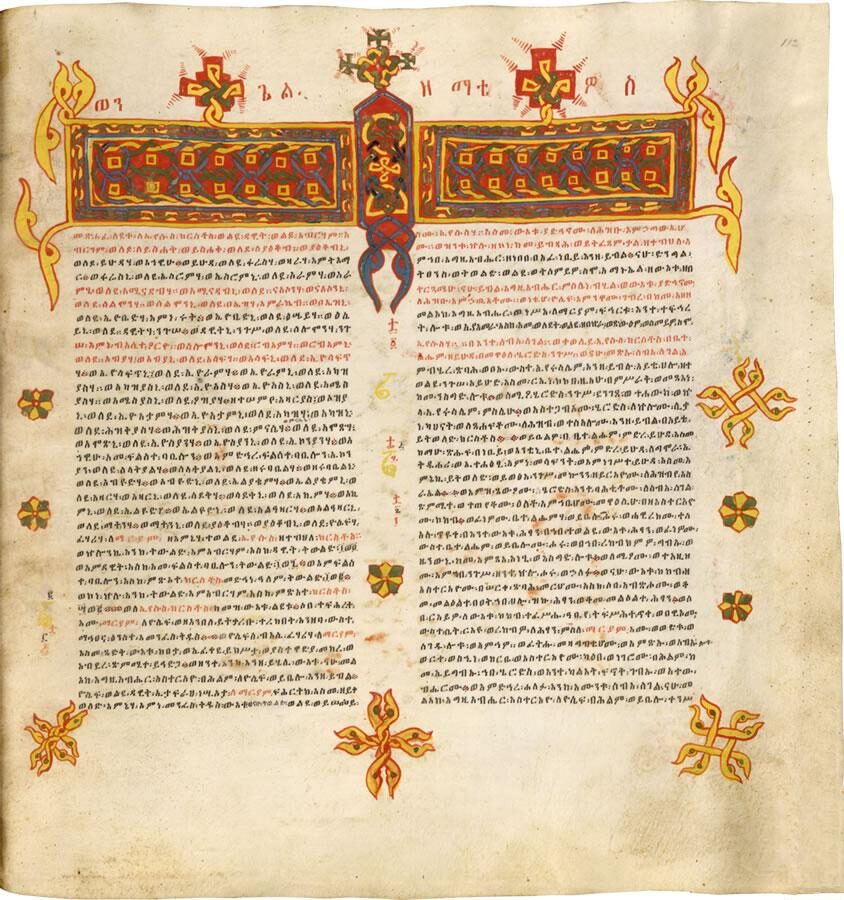

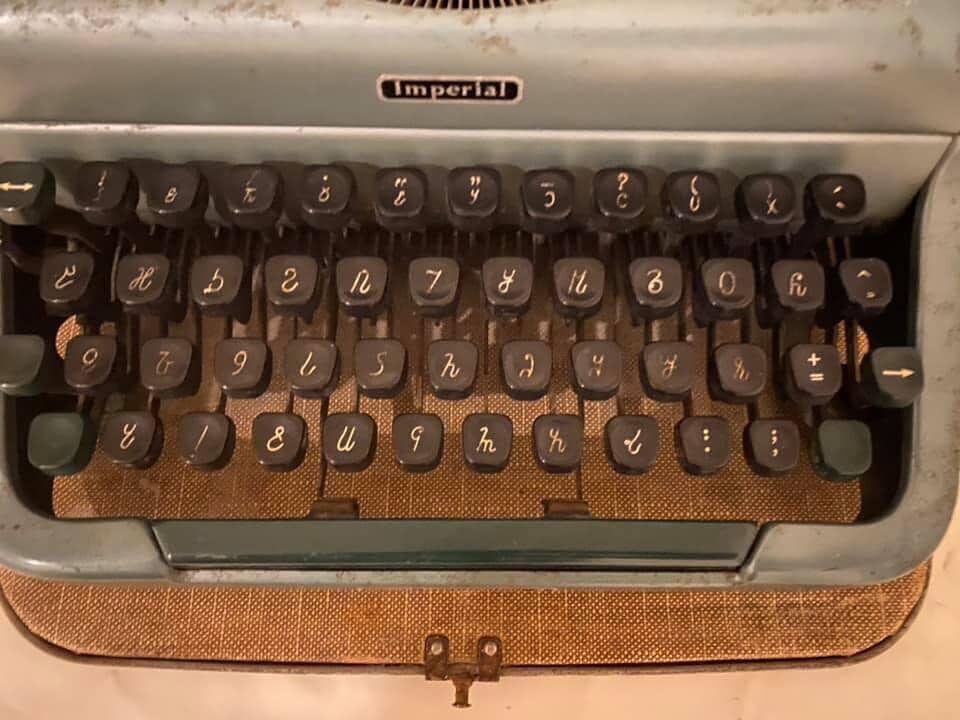
- Ethiopic, the block for the Geʽez script used to write Geʽez, Amharic, Tigrinya, Tigre and other languages of Ethiopia and Eritrea — 345 characters in Unicode 3.0, September 1999. Its consequences for one group’s archive are set out on the soc.culture.ethiopia page.
- Osmanya, devised for Somali — 40 characters in Unicode 4.0, April 2003.
- Tifinagh, used for Berber and Tuareg — 55 characters in Unicode 4.1, March 2005, with four more added in later versions; the soc.culture.berber page follows what that meant in practice.
- N’Ko, devised by Solomana Kanté in 1949 as a modern writing system for the Manding languages of West Africa — 59 characters in Unicode 5.0, July 2006, with three more in version 11.0 of June 2018.
- Vai, the syllabary of Liberia and Sierra Leone — 300 characters in Unicode 5.1, April 2008.
- Adlam, devised for Fulani — 87 characters in Unicode 9.0, June 2016.
Every one of those dates falls at or after the end of the years in which such groups were busiest, and encoding was in any case only half the problem: newsreaders and the servers between them handled eight-bit data unevenly, and plain ASCII remained the only safe assumption long after it stopped being the only possible one. The practical effect on the archive is straightforward and worth knowing before searching it. The group discussed African languages far more often than it was written in them. Names, greetings, proverbs and etymologies appear in ad hoc romanisations, spelled differently by different writers; the writing systems themselves were things to describe rather than things to type. A search for a name in any one spelling will miss most of its occurrences, and a search for strings in any of the scripts listed above will return almost nothing from the 1990s, because almost nothing was ever sent that way.

The country groups beneath it
The relationship between the umbrella and the national groups was the one its own proponents described in 1997: the national groups sprouted off it, and the umbrella did not empty out when they did, because a country group cannot hold a comparative conversation. This directory preserves eight of those groups, each with its own long article, and they are the right place to go for anything specific:
- soc.culture.ethiopia, with its siblings soc.culture.ethiopia.misc and soc.culture.ethiopia.moderated — of which only soc.culture.ethiopia.misc is still in the current active file.
- soc.culture.kenya, whose creation paperwork survives in the news.announce.newgroups archive, as does that of most of the groups in this list.
- soc.culture.liberia and soc.culture.sierra-leone, both already carrying traffic when the 1997 reorganisation was circulated to them.
- soc.culture.somalia, one of the groups the proposed Horn of Africa group was meant to sit alongside rather than replace.
- soc.culture.south-africa, and beneath it soc.culture.south-africa.afrikaans.
- soc.culture.zimbabwe.
- soc.culture.berber, which takes a people rather than a state as its subject.
Two more sit at the edges of the set. soc.culture.algeria is here, and its own page is still short. alt.culture.zambia is in the alt.* hierarchy rather than this one, which is a reminder that the Big-Eight roster was never the whole map: a country whose diaspora wanted a group and did not want a vote could simply create one next door.
The company it kept
The newsgroup was never the whole of African discussion online, and it is misleading to read the archive as though it were. Through the 1990s a great deal of the diaspora’s organised conversation ran on e-mail mailing lists, typically hosted on university accounts and arranged country by country. The 1997 proposal names three of them in its distribution list — Naijanet at MIT, the Zambia Network at Mississippi State, and a Cameroon network in Italy — with subscription instructions attached, and the proposed Horn of Africa and West African charters both included clauses permitting national mailing lists to be gatewayed into the new groups on two weeks’ notice. The newsgroup was the open commons alongside the lists: readable by anyone with a news server and answerable by anyone at all, which was its advantage and, on bad days, its problem.
The academic overlap was direct enough to trace. H-Net began in 1992 as an initiative of the historian Richard J. Jensen at the University of Illinois Chicago and moved its operations to Michigan State University from 1994; among its networks was H-Africa, which describes itself as encouraging discussion of Africa’s history, culture, and African studies generally and invites Africanists of all disciplines, with sibling networks including H-SAfrica and H-West-Africa. The African Studies Association, founded in 1957, supplied much of the same readership. All of it ran on the same university accounts as the newsgroup. That did not make the group scholarly — nothing could have — but it meant that a claim about a date, a treaty or a text could be answered by somebody with the sources to hand, and that asking for a reference was ordinary traffic rather than an imposition.
Scholars also came to the group from the other direction, as a source. The soc.culture.* groups were among the early places researchers went to study online diasporas and long-distance nationalism, and Africa-related groups appear in that literature: a public, dated, machine-readable record of a scattered community arguing about home was a novelty in the early 1990s and is a primary source now. What the archive is good for and what it is not is set out two sections below.
The namespace around the group is worth a glance too. bit.tech.africana, described in the newsgroups file as Information Technology and Africa, was on the 1997 distribution list and is still in the active file, as is alt.music.african, whose description is African music. soc.genealogy.african, soc.history.african.biafra and soc.history.african.misc all have paperwork in the news.announce.newgroups archive and none of them survives in the active file today. And ClariNet, the commercial wire-copy service that fed subscribing sites, sliced the continent into five moderated groups where the discussion hierarchy had one, with descriptions that are small monuments to editorial geography: clari.world.africa.eastern, Sudan through Tanzania; clari.world.africa.northwestern, Morocco, Algeria, Libya, Sahara countries; clari.world.africa.western, Gulf of Guinea states, Congo, Zaire; clari.world.africa.southern, From Angola and Zambia southward; and clari.world.africa.south_africa, News from South Africa. A news agency was prepared to divide Africa into five. The people talking about it had one address.
What the record does not show
The gaps in this page are large, and a reader is entitled to know their shape.
- The creation. There is no Request for Discussion, no Call for Votes, no result and no newgroup message from the news.announce.newgroups moderator for soc.culture.african. The archives that would hold them begin after the group already existed. The firmest date available is indirect: the group was in ordinary use by 13 March 1990.
- Size. No subscriber count, readership survey or message total for this group has been located. The article numbers in the 1997 Xref header are per-server counters and support a rank ordering, nothing more.
- The 1997 outcome. Whether the reorganisation reached a Call for Votes, and what happened to it if it did, is not in the archive. Only that none of the five proposed groups exists.
- The 1998 forgeries. Who sent the forged newgroups, and why the names were ethnolinguistic, is unrecorded. The messages themselves and the bogus-groups listing are all that survive, and for two of the eleven names even the messages survive only as fragments.
- Composition. What proportion of posters wrote from the continent, and how that proportion changed, cannot be recovered from the surviving material. The connectivity figures make the general direction certain and the precise mixture unknowable.
- Content. No thread title, poster, quotation or message count from the group itself is asserted anywhere on this page, because none could be verified. Everything quoted above comes from administrative postings — the charter, the reorganisation proposal, the control messages and the bogus-groups list — which survive precisely because they were filed rather than discussed.
Scope and limits
This article is about a newsgroup and the world it belonged to, and it stops where the verifiable material stops. It makes no claim about any country or people, offers no view on any of the arguments the group carried, and reports the continental politics of the period only in the form of dates and documents, because that is the form in which they are checkable.
The division of labour with the rest of this directory is deliberate. The eight country groups listed above own their countries: their creation records, their national histories, their languages and their own connectivity stories are told there and not here. The branch hub owns the machinery common to all of soc.culture.* — the ancestry of the branch, the voting ritual, the naming constraints and the family resemblance. soc.culture.arabic owns the Arabic-language community whose territory overlaps this one along the Mediterranean, and soc.culture.caribbean owns the western half of the Atlantic connection. What is left, and what this page holds, is the umbrella itself: the paperwork, the reason one address had to serve a continent, and the shape of what that address carried.
The group’s afterlife has been quiet and oddly durable. Its one-line description travelled a great deal further than its posts: web directories of the 2000s republished the soc.culture.* roster wholesale, and the sentence about Africa and things African still appears on pages that never carried a single article. The conversation itself moved to web forums and then to social media. The address, however, is still there — carried in the active file, still open for posting, still described in one sentence. For as long as it was busy it was a place where fifty-odd cases could be set against one another by people who knew more than one of them.
Reading soc.culture.african today
- Historical archive: Google Groups — soc.culture.african (coverage varies by group and era).
- Open in a newsreader:
news:soc.culture.african— the original site offered exactly this link, and it still works if your system has a newsreader registered for thenews:scheme. - Live access: point an NNTP newsreader at a modern server — see accessing Usenet today.
- The original news2mail e-mail subscription service ended in the mid-2000s and no longer operates.