alt.astrology.metapsych
Astrology meets metaphysics and psychology.
A quieter offshoot of alt.astrology for the psychological and metaphysical end of the practice — Jungian archetypes, humanistic astrology in the Rudhyar tradition, and symbol-system discussion that the main group’s noise drowned out.
The ISC control archive holds twenty-five messages for the group, the earliest dated 27 November 1996 and the last 1 August 1999; this directory preserves no archive of what was posted to it.
On this page
- The group's own paperwork
- What the charter asked for
- What “metapsych” points at
- From prediction to character: Alan Leo and the British institutions
- Marc Edmund Jones, Dane Rudhyar and humanistic astrology
- Jung, on astrology specifically
- Psychological astrology becomes a school
- The chart as computer output
- What testing has found
- The charter war, 1997–1999
- Offshoots and namesakes
- What an alt.* offshoot was for
- What the record does not show
- Scope and limits
The group's own paperwork
A Big-Eight newsgroup leaves a thick paper trail: a Request for Discussion, a Call for Votes, a published tally, a result. In the alt.* hierarchy there is no vote to find, because there was never a vote to hold. What a researcher gets instead is the control traffic — the messages an aspiring group's proponent sends out asking the world's news administrators to add a name to their servers — and for this group that traffic survives in full. The Internet Systems Consortium keeps an archive of Usenet control messages arranged one file per group. The file for alt.astrology.metapsych holds twenty-five messages. Twenty-four are newgroup requests; one is an rmgroup. The earliest is dated 27 November 1996 and the last 1 August 1999.
The first two went out about three hours apart on that November day in 1996, both from Edmond Wollmann, posting to alt.config from a San Diego State University machine. The first gave his organisation as an astrological consultancy in La Jolla, California; the second gave the university. Both carried the same opening sentence: This unmoderated newsgroup is being proposed and being created for discussion of the psychological/metaphysical/spiritual aspects of astrology and its applications. Proposed and created, in one breath, by the same person, in the same message — which is the whole of alt.* procedure compressed into a participle. How that hierarchy came to work that way is told on the alt.* hierarchy page and is not retold here.
Both messages also carried the line that administrators were meant to paste into their servers' descriptions file:
alt.astrology.metapsych Discussion of astrology metaphysically/psychologically/spiritually.
In the message as sent, that line wrapped after the word astrology, with the adverbs carried over onto a second line.
The truncated first line is the part that survived. The master descriptions list distributed by ISC today — the file a news administrator installs so that readers see something more than a bare name — carries the group with a one-line description, and the line is: Discussion of astrology. Nothing else. The two documents break at exactly the same word, which makes it a strong inference, though not a documented one, that the second line was lost at the wrap somewhere between the 1996 control message and the compiled newsgroups file, and that the three adverbs which were the entire point of the name went with it. The companion active file lists the group as unmoderated, and it is one of fourteen names in the alt.astrology family still carried in that namespace.
Even the creation date is not settled by the record. Five later messages in the same archive — the two superseding charters described further down this page and the boosters that carried them — state Created: November 24, 1996, 2:05 am, California, USA. Boosters Wollmann sent in July 1999 say the group was created by myself on November 26, 1996. The earliest control message ISC actually holds is dated the twenty-seventh. In the Big Eight a result posting would settle the question; in alt.* nothing adjudicates, and all three dates simply stand in the file together.
What the charter asked for
The 1996 messages did not stop at a description. They carried a charter — an unusually long one for alt.*, and unusually specific about who the group was for. It opened by naming its intended constituency as astrologers and students of astrology or practicing therapists and psychologists, and listed five kinds of discussion it existed to hold:
- Personal analysis of horoscopes based on full data and information.
- Psychological approaches and remediation methods in counsel.
- Psychological fields of approach.
- Metaphysical and/or spiritual approaches and their connections.
- Humanistic, holistic or other modern or otherwise defined as new age approaches.
It then listed five classes of posting that were not welcome: advertisements, images, personal abuse, argument that strayed from the subject — and, second on the list, this:
Arguments as to the validity of astrology AT ALL, either scientifically or theologically.
The capitals are in the original. That clause is the reason this group exists as something other than a duplicate. Its parent, alt.astrology, was five years older — the earliest newgroup message in ISC's file for the parent is dated 29 July 1991 — and the validity argument, however and wherever it was actually conducted, belongs to the parent's page. The offshoot's charter proposed to fence it out and talk about something else: symbol systems, counselling practice, and the metaphysical and psychological frameworks that twentieth-century astrological writing had built around them.
The difficulty with fencing anything out of an unmoderated newsgroup is that a charter is a document, not a mechanism. Nothing in the news software reads it. An alt.* group has no moderator, no submission address and no Approved: header to withhold; a charter binds only those who choose to be bound, and its only enforcement is persuasion, social pressure, and complaint to somebody's service provider. Later parties to this group's history made that argument in so many words, and the archive preserves their wording: the original rules, one of them wrote, could only be policed by a moderator, and in the abscence of an official moderator, soon became onerous and unenforceable. The spelling is as sent.
What “metapsych” points at
The name is a compression of two words, metaphysics and psychology, and the charter spelled out a third that the name could not fit — spiritual. All three appear in the description line and all three in the opening sentence of every control message the group's creator sent. It is worth being precise about what each half denotes, because both have a real and datable literature, and because this directory allocates that literature to this page: the parent group's page owns astrology in general, its long history and its Usenet career, while this one owns the psychological and metaphysical strand within twentieth-century astrological writing.
The metaphysical half is the older. Astrological practice has long rested on a doctrine of correspondence — the proposition that the pattern above and the pattern below are the same pattern, expressed at different scales — and in the modern era that doctrine reached astrology largely through the occult revival of the late nineteenth century, and specifically through the Theosophical Society, whose members worked concepts such as karma and reincarnation into their astrology and used the Society's international connections to publish and translate it. The connection was personal as well as doctrinal: Alan Leo and Dane Rudhyar, the two figures at the centre of the next two sections, were both Theosophists.
The psychological half is younger and, in the period the newsgroup belonged to, noisier. It consists of the attempt, running from roughly the 1910s to the 1990s, to reinterpret the horoscope as a description of character and development rather than a schedule of events — to replace prediction with what its authors called insight. That attempt produced books, schools, examining bodies, professional associations and a house style, and the newsgroup's charter is written in its idiom throughout. When a 1996 control message addresses itself to practicing therapists and psychologists and speaks of remediation methods in counsel, it is speaking the language of a specific, well-documented tradition, and one that by then was about eighty years old.
From prediction to character: Alan Leo and the British institutions
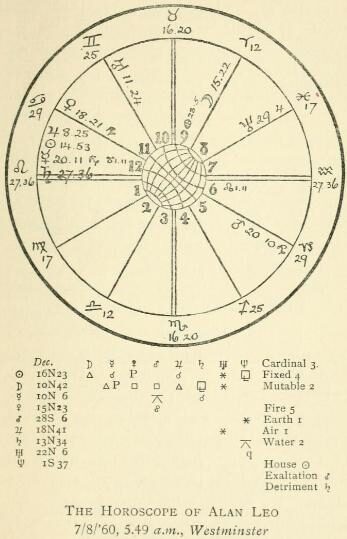
The conventional starting point is Alan Leo (1860–1917), born William Frederick Allan in Westminster, a Theosophist who took the name of his sun sign as a pseudonym and who is routinely described in the literature as the father of modern astrology. His importance to this page is narrow and specific: he is credited with being the first astrologer to argue for a loose interpretation of possible trends of experience in place of the specific prediction of events. Everything the newsgroup's charter takes for granted follows from that move.
He did not arrive at it purely by reflection. In 1914, at fifty-four, Leo was prosecuted on a charge that he had unlawfully pretended to tell fortunes; the case was dismissed for want of evidence, and by the account in the literature it left him convinced that astrology needed revising if it was to be legitimised. In 1917 he was tried again on a similar charge, insisted at trial that he told only tendencies and not fortunes, lost, and was convicted on 16 July and fined five pounds with costs. He spent the following weeks at Bude in Cornwall, on a holiday meant to restore his health, rewriting hundreds of pages of his own textbooks to — in the account left by his widow Bessie Leo — recast the whole system and make it run more along the lines of character reading and less as the assertion of an inevitable destiny. He died there of a cerebral haemorrhage on 30 August 1917, six weeks after the verdict, with the revision unfinished; a colleague, H. S. Greene, completed it.

The institutions came afterwards, and their dates are firm. Leo had founded the Astrological Lodge of London in 1915. Under the Lodge's auspices, on 7 June 1948, Charles E. O. Carter, Margaret Hone and others founded the Faculty of Astrological Studies as an independent examining body; the prospectus issued that August set out its functions as drawing up a syllabus of a high standard, instituting courses of tuition, and preparing and holding examinations at both intermediate and final standards. Carter was the Faculty's first principal and Hone its second. On 21 June 1958, in London, founding members drawn from the Astrological Lodge of the Theosophical Society — notably John Addey and Brigadier Roy Firebrace — formed the Astrological Association. Firebrace was its first president and Addey its first secretary; Addey took the presidency when Firebrace resigned in 1961, and edited the Association's magazine, the Astrological Journal, from 1962 to 1972. The Association publishes that journal six times a year and a second journal, Correlation, twice a year. By 2002 it put its membership at something over a thousand.
None of this is incidental to a newsgroup charter written in 1996. A tradition that had been examining candidates since 1948, running annual conferences and publishing journals had a professional self-image, an examining standard and a body of accepted terminology, and the charter's insistence that the group was proposed on the basis of ethical and respectable service oriented counsel reads very differently once one knows that such phrasing had institutional referents behind it.
Marc Edmund Jones, Dane Rudhyar and humanistic astrology
The American line ran through two men who knew each other. Marc Edmund Jones (1 October 1888 – 5 March 1980), born in St Louis and raised in Chicago, came to astrology in 1913 by way of Christian Science neighbours and a Theosophist aunt, wrote silent-film scenarios for a living, founded a study group called the Sabian Assembly in 1923, was ordained a Presbyterian minister in 1934 and later took a doctorate at Columbia. In 1925, working with a clairvoyant named Elsie Wheeler, he produced the Sabian Symbols, a set of images assigned one to each of the 360 degrees of the zodiac; he published them as The Sabian Symbols in Astrology in 1953. He also developed the seven horoscope shapes — splay, splash, bundle, bowl, locomotive, bucket, seesaw — into which the distribution of the planets around a chart is classified. His papers are held at the Harry Ransom Center at the University of Texas at Austin.
It was Jones who taught astrology, by mimeographed lessons, to Dane Rudhyar (23 March 1895 – 13 September 1985). Rudhyar was born Daniel Chennevière in Paris, graduated from the Sorbonne at sixteen, studied at the Paris Conservatoire, and arrived in New York in November 1916 as a composer; his orchestral writing was performed by the Metropolitan Opera the following April, in one of the earliest polytonal pieces heard in the United States. He took the name Rudhyar between 1917 and 1919, encountered Theosophy in 1920 when asked to compose music for a production at the Society's Los Angeles headquarters, and was naturalised in 1926. In 1930 he married Marla Contento, secretary to the independent Theosophist Will Levington Comfort, and it was Comfort who introduced him to Jones.
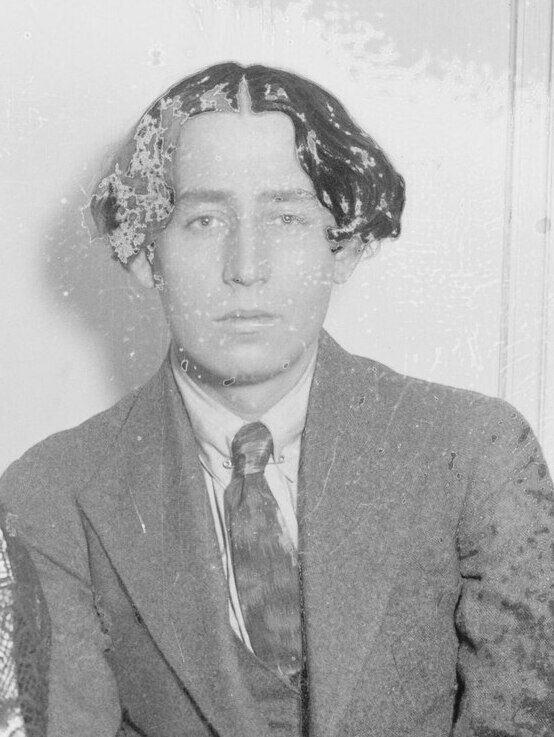

Rudhyar was reading Jung's psychological writings during the same years, and began to think in terms of bringing astrology and depth psychology together; he also cited Jan Smuts's Holism and Evolution as an influence. The synthesis he proposed had a specific shape: that the planets do not cause anything, but that the sky at a birth and the person born under it are two pictures of one moment, aligned without a causal link between them. That move, whatever one makes of it, was what let him drop the deterministic apparatus of older practice and keep the symbolism. He called the result harmonic astrology at first and then humanistic astrology, and set it out in The Astrology of Personality: A Reformulation of Astrological Concepts and Ideals, in Terms of Contemporary Psychology and Philosophy, published in New York in 1936 by Lucis Publishing — the press of Alice A. Bailey, the Theosophist generally credited with putting the phrase New Age into circulation.
For three decades the book was known inside astrology and almost nowhere else. That changed with the publishing conditions of the 1970s: Penguin issued The Practice of Astrology in 1970, Doubleday, Harper and Random House followed, and Rudhyar, by then in his seventies, produced several books a year for a decade. In 1969 he founded the International Committee for Humanistic Astrology, a small professional society intended to develop the perspective. By the middle of the decade he had moved past it: absorbing the work of the transpersonal psychologists, he began calling his position transpersonal astrology, and titled a 1975 book From Humanistic to Transpersonal Astrology.
The chronology there is worth laying out flat, because it is the clearest evidence that this literature was tracking academic psychology rather than merely borrowing its words. Abraham Maslow, building on the work of Otto Rank and Carl Rogers, established a third force in psychology in the 1950s. In 1969 Anthony Sutich, with Maslow and other humanistic psychologists, founded the Journal of Transpersonal Psychology, formally establishing transpersonal psychology as a field; the Association for Transpersonal Psychology followed in 1972 and the International Transpersonal Psychology Association in 1973. Rudhyar's committee dates from 1969 and his change of terminology from the mid-1970s. Humanistic astrology took its adjective from humanistic psychology, and transpersonal astrology took its adjective from transpersonal psychology, each within a few years of the source.
Jung, on astrology specifically
Jung is genuinely part of this story and is emphatically not this page's subject: alt.psychology.jung carries the long account of his life, his break with Freud, the vocabulary of analytical psychology and Psychological Types, and none of that is repeated here. What belongs here is the narrow question of what can be documented about his astrological writing in particular, which is less than the astrological literature usually implies and more than nothing.
The earliest firm datum is a letter to Freud of 12 June 1911, in the published correspondence: I made horoscopic calculations in order to find a clue to the core of psychological truth. The most substantial is an experiment. Jung gave his first major outline of synchronicity in a lecture at the Eranos conference in 1951, and the following year he and the physicist Wolfgang Pauli published The Interpretation of Nature and the Psyche, the volume that contained his central monograph on the subject, Synchronicity: An Acausal Connecting Principle. That essay describes an astrological experiment Jung had conducted himself to test the idea, and uses it as his worked example of an acausal correspondence. Pauli, his collaborator on the volume, objected to those experiments.
The reception is on the record too, and it is not favourable. Jung invoked synchronicity to explain the lack of statistically significant results in the single study he conducted; the study was subsequently heavily criticised for its non-random sample, for its use of statistics and for its lack of consistency with astrology, and synchronicity itself is considered neither testable nor falsifiable. Rudhyar took the concept up regardless, and so, after him, did Liz Greene, who later wrote a book-length study of Jung's own astrological work; it supplied the thing their position most needed, which was a way of describing a correspondence without claiming a cause. The concept had a room of its own next door in the namespace for a time: alt.psychology.synchronicity was created on 11 September 1995, fourteen months before this group, as an interdisciplinary forum for discussion of meaningful coincidence. It no longer appears in the current ISC namespace files, and this page has no account of what happened to it.
Psychological astrology becomes a school
By the time the newsgroup existed, the tradition had a name of its own — psychological astrology — a teaching institution in London, a publishing programme and a recognisable set of authors. The most prominent is Liz Greene, born in Englewood, New Jersey, on 4 September 1946, an astrologer who is also a qualified Jungian analyst. Her first book, Saturn: A New Look at an Old Devil (1976), took a planet that traditional practice treated as a bringer of misfortune and recast it in Jungian terms; her later titles include The Astrology of Fate, The Outer Planets & Their Cycles and, with Howard Sasportas, The Luminaries. In 1983 she and Sasportas, a psychosynthesis psychotherapist and, like her, a former tutor at the Faculty of Astrological Studies, founded the Centre for Psychological Astrology in London. Sasportas died in 1992; the astrologer Charles Harvey took over as co-director until his own death in 2000. In April 2010 the history department at the University of Bristol awarded Greene a doctorate for a thesis on the Kabbalah in British occultism between 1860 and 1940.
Stephen Arroyo, born in Kansas City on 6 October 1946, holds a master's degree in psychology and wrote the other body of work the period's readers cite alongside hers: Astrology, Psychology and the Four Elements: An Energy Approach to Astrology and Its Use in the Counseling Arts, which was awarded the Astrological Association's Astrology Prize, and Astrology, Karma & Transformation. His stated project was to recast astrological concepts in psychological and energy terms and to reject what he regarded as the fatalism of older practice — the same programme as Leo's, restated for a paperback readership sixty years on.
The Swiss line is separate and equally institutional. Bruno Huber (1930–1999) and his wife Louise spent three years from 1958 at Roberto Assagioli's Psychosynthesis Institute in Florence, where Huber studied the horoscopes and psychological profiles of Assagioli's patients. The couple returned to Zürich in 1963; in 1968 they began giving seminars on their results and founded the Astrological Psychology Institute. Professional diploma training followed from 1973, and Huber schools were later established in Britain and Spain. Their method is explicitly built on psychosynthesis rather than on analytical psychology, which is a distinction the specialist literature maintains and general accounts usually flatten. In the United States, Noel Tyl took a different psychological source again, allying astrological symbolism with Maslow's hierarchy of needs across the twelve volumes of The Principles and Practice of Astrology (Llewellyn, 1975) and developing the blend fully in Holistic Astrology: The Analysis of Inner and Outer Environments (1980).
What all of these have in common, and what makes them the right background for this particular newsgroup rather than for its parent, is the counselling frame. These are books about consultations. They address a reader who sits with a client, and they borrow their ethics, their caution about determinism and much of their working vocabulary from the psychotherapies — a field with its own page in this directory, sci.psychology.psychotherapy, and its own considerable literature on what a practitioner owes a person in the chair. The charter's first excluded category, advertising, and its repeated appeals to ethical and respectable practice, are recognisably drawn from that world.
The chart as computer output
One clause of the charter is easy to read past. The first thing the group was for was personal analysis of horoscopes based on full data and information — that is, on an exact birth time and place, from which a chart has to be calculated. For most of astrology's history that calculation was the practitioner's principal labour, done by hand from printed ephemerides and tables of houses. By the mid-1990s it was a keystroke, and the people posting to the group knew it.
Robert Hand, born in 1942, began writing chart programs for microcomputers in 1977 and founded Astro-Graphics Services in 1980, later Astrolabe; in 1997 he founded Arhat Media, an archive for the retrieval and publication of translations of historical astrological texts. Liz Greene began working in 1985 with Alois Treindl of the Swiss firm Astrodienst on computer-generated horoscopes, and in 1987 they presented a Psychological Horoscope Analysis — a machine-produced chart synthesis intended to simulate her own method of interpretation in a personal reading. That is psychological astrology arriving as software, nine years before the newsgroup. By 1996 a person pasting a chart into a Usenet posting was pasting the output of the same class of machine that carried the posting; the software threads themselves, and the ephemeris arguments they produced, belong to the parent group's page.
What testing has found
This directory states the position once, plainly, and then goes back to reporting. Astrology has no accepted scientific basis. It has been rejected by the scientific community as having no explanatory power; there is no proposed mechanism by which the positions of planets could produce the effects described that does not contradict well-established physics and biology; it has not demonstrated effectiveness in controlled studies; where it has made falsifiable predictions, those predictions have been falsified; and by the criterion of falsifiability it is classified as a pseudoscience. The summary of the experimental record that follows is drawn from the published studies named and from the survey of them at Astrology and science.
The best-known controlled test is Shawn Carlson's, published in Nature in 1985 (volume 318, pages 419–425) under the title A double-blind test of astrology. Its protocol was agreed in advance between a group of physicists and a group of astrologers: advisers nominated by the National Council for Geocosmic Research helped draw up the central proposition of natal astrology to be tested, agreed that the test was fair, and themselves chose twenty-six of the twenty-eight participating astrologers, the remaining two being interested volunteers. The astrologers, who came from Europe and the United States, were asked to match over a hundred natal charts to personality profiles produced by the California Psychological Inventory. They performed no better than chance, and the paper reported that the testing clearly refutes the astrological hypothesis.
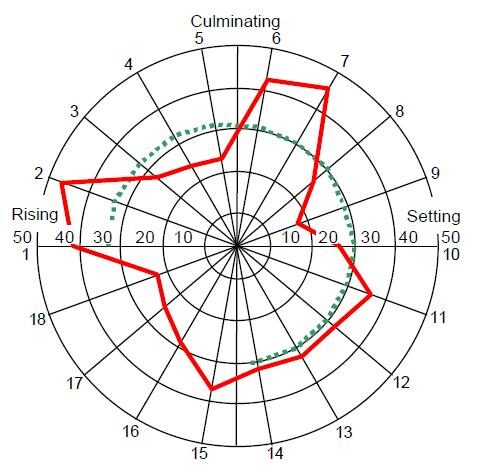
The other landmark is more tangled and is usually cited by both sides. In L'influence des astres (Paris, 1955) the French psychologist and astrologer Michel Gauquelin reported that he had failed to find evidence for the zodiacal signs or the aspects, but had found positive correlations between the diurnal positions of certain planets at birth and success in the professions those planets traditionally govern. The best known of these became the Mars effect, based on the position of Mars in the natal charts of successful athletes. Later attempts to validate the data and replicate the effect produced uneven results across four decades, chiefly owing to disagreements over the selection and analysis of the data set. A study by seven French scientists found no statistical evidence for the effect and attributed it to selective bias on Gauquelin's part; a major French study by the Comité pour l'Étude des Phénomènes Paranormaux, reported in 1994, found no evidence either. Geoffrey Dean has suggested that the effect arose from birth times reported by parents rather than from any fault in Gauquelin's study, in a period when belief in astrology was more common, and noted that Gauquelin failed to find the effect in more recent populations whose birth information was recorded by a nurse or doctor.

Beyond the two famous cases the record is consistent. Geoffrey Dean, a scientist and former astrologer, and the psychologist Ivan Kelly conducted a large-scale test across more than a hundred cognitive, behavioural, physical and other variables and found no support for astrology. In a further test, forty-five astrologers who rated themselves confident and averaged ten years' experience were given 160 test subjects drawn from an original sample of 1,198, chosen because they favoured certain characteristics in the Eysenck Personality Questionnaire to extremes; the astrologers performed much worse than a decision based on the subjects' ages alone, and much worse than forty-five control subjects who did not use birth charts at all. A meta-analysis pooling forty studies, some 700 astrologers and over a thousand birth charts found that once dates and other obvious clues were removed, no significant results suggested any preferred chart interpretation.
One strand of that research belongs to this page more than to its parent, because it concerns the psychology of reading a description of oneself. In 1949 Bertram Forer gave every student in his class the same personality assessment while telling each that it was individual. The descriptions he used were taken from a book on astrology. More than forty per cent of the students rated the accuracy at the top mark of five out of five, and the average rating was 4.2. The result — the Barnum or Forer effect — has been replicated many times, and study of it has focused mostly on the level of acceptance of fake horoscopes and fake astrological personality profiles; on the evidence of a 2009 study consistent with earlier work, believers in astrology are generally more susceptible than sceptics to giving credence to a Barnum profile. A separate line of work on self-attribution finds that people with knowledge of astrology tend to describe their own personalities in terms of traits compatible with their sun signs, and that people unfamiliar with astrology show no such tendency.
That is the record. This page does not use it to reach a verdict about the newsgroup or the people who posted there, and it should be noted for completeness that the group's own paperwork changed position on the question. The original 1996 charter excluded validity arguments outright. The rewritten charters circulated from 1998 added a sixth permitted topic — The testability and validity of astrological and psychological systems — and stated that sceptical posts and posts containing discussion of testing and validity were welcome. Which of those documents any given news server ended up displaying is the subject of the next section.
The charter war, 1997–1999
Before the substance, a word about the form, because the sequence is unreadable without it. In alt.* a newgroup message propagates unevenly: some servers process alt.* control messages automatically, some queue them for a human, many ignore them, and a group can be present on one continent and absent on another for months. The customary remedy is the booster — a repeat of the original message, sent weeks or years later, asking administrators who missed the first one to create the group now. Boosters are ordinary and unremarkable. Nineteen of the twenty-four newgroup messages in this group's file call themselves boosters, which is not ordinary at all.
The first is innocent enough: a booster of 21 January 1997, announcing itself as sent to assist in propogation of this group, spelling as sent. Then, on 26 November 1997, the file's single rmgroup arrives. Its From line is [email protected], which is not a deliverable address, its organisation is given as News admins for coherent active files, and its entire body is two lines: vantity group created by Edmond Wollmann and Please remove. The typo is in the original.
Wollmann's answer was volume. Newgroup messages went out on 30 November, 13 December, 18 December, 25 December and 28 December 1997, most reproducing the 1996 charter in full, one explaining that it was sent at the request of individuals in some parts of the world still not recieving it. Through 1998 and 1999 he added his professional signature block, a copyright notice, a publisher's SAN and a set of URLs at which the charter could be read.
In the first week of September 1998 the dispute changed character. Wollmann sent another booster on 6 September. Two days later, on 8 September, a control message went out under the name Hosokawa, from a commercial internet consultancy's address, carrying a document headed Superseding Charter version 1.1 and dated inside itself to 6 September 1998; its keywords included skepticism. It did not ask for the group to be removed; it asked for the group's description and charter to be replaced. The rewrite is detailed. It widened the constituency from students of astrology to students and critics; it added the sixth topic quoted in the previous section; it deleted the ban on validity arguments and replaced it with a set of procedural rules — no more than five groups in a crosspost, no follow-ups set only to the sender, no follow-ups set only outside the group, and canned screeds or boilerplate copy cannot be posted more than once every six months. It also proposed a new description line: Discussion of astrology/metaphysics/psychology/skepticism/spirituality. Its justification section made the structural argument in full, and ended with an invitation that turned out to be prophetic: posters insistent on control issues, it said, were free to create an alt.astrology.metapsych.moderated group and post there.
A booster for the superseding charter followed about two and a half hours later, asking administrators to disregard all previous charters and boosters. Later the same day, three messages went out from Wollmann's university address reasserting the 1996 text, one of them adding a line that says more about the state of things than any charter clause: This is a booster message to the one issued in 1996 and again in 1997 below. They will be continually sent until the abusive attempt to take over this group is stopped. Another followed on 9 September, and two more on 12 November 1998, one of them headed simply *****BOOSTER*******.
The last round came in the summer of 1999. On 12 July Wollmann sent a booster to thwart attempts to takeover and spam this group, restating that the original charter had been in place from the beginning and would remain. On 13 July a message to alt.config from a pseudonymous address opened a discussion on removing the group altogether, arguing in intemperate terms that it was a vanity group, that it carried no meaningful traffic, and that a moderated group would serve better; the argument was conducted largely in personal terms and is not quoted here, and the message's own control line was a newgroup, with the word rmgroup appearing only in its keywords. Two further boosters from Wollmann went out on 14 July. On 17 July came Superseding Charter version 1.2, sent from an anonymous address, its organisation given as Responsible Newsgroup Re-Chartering Inc. and its posting software as CharterSupercederPro(tm) — headers that are plainly a joke, attached to a document that is not one, since it is the 1998 rewrite again with the screed interval shortened from six months to two weeks, the description line altered again, and a list of eight websites where the official charter could be consulted. On 1 August 1999, two messages headed BOOSTER - BOOSTER - BOOSTER went out from a news administrator at a service provider in Harrisburg, Pennsylvania, carrying version 1.1 once more. They are the last entries in the file.
Not one of these documents had authority over anything. Every newgroup and rmgroup message on Usenet is a request addressed to some thousands of independent administrators, each of whom decides individually whether to act on it, and in alt.* a great many acted on none. What a given site's readers saw depended on which message that site's software happened to process, and when, and whether anybody there was reading alt.config at all. The ISC descriptions file today carries neither of the rewritten descriptions. It carries the truncated first line of the November 1996 message.
Offshoots and namesakes
Both superseding charters ended with the same invitation, and in the end somebody accepted it. On 30 January 2002 a newgroup message created alt.astrology.metapsych.moderated. It is not what it appears: its From line carried a misspelling of Wollmann's surname at an invalid address, its Approved and Sender lines named a third party entirely, its organisation line and several of its headers are jokes at Wollmann's expense, and its body announced that this group, despite appearances, is unmoderated. There are NO topicality restrictions of any sort whatsoever except that spam ... is forbidden. The headers make plain that it was written by neither of the people it names.
The following day, 31 January 2002, Wollmann sent two newgroup messages of his own for the same name, describing a moderated group for the same subject as the 1996 charter and stating that because of the tremendous defamation and harassment by abusive ISPs and their users this group was necessary. The forged message was sent again on 1 February; two more newgroup messages followed, on 6 March and 17 September 2002, the first of them over the signature of an IRS Agent; and an rmgroup on 17 September 2002 closes the file. The name survives in the ISC files, listed as moderated, with the description Metaphysical Astrology (Moderated).
In January 2003 the components were rearranged into alt.astrology.moderated.metapsych, and that name has the most chaotic control record of the four. A newgroup message on 9 January 2003, from a sender styling itself the Newsgroup Creation Authority, was met by an rmgroup the same day; over the following six weeks, down to 24 February, the group was created and removed repeatedly by a rotating cast of pseudonymous senders whose organisation lines are plainly jokes, and several of the newgroup messages were posted to newsgroups with no connection to the subject at all. It too remains in the namespace files, where its description is the flat and rather eloquent No description. (Moderated).
Finally, on 25 March 2006, somebody created alt.astrology.metapsych.cujo, whose entry in the master descriptions file reads Cujo kook-hunter of alt.astrology.metapsych; a parallel group, alt.astrology.cujo, is described as Cujo the resident kook-hunter of alt.astrology. Both names point at a participant rather than at a subject, and both are listed to this day. Of the fourteen names in the alt.astrology family that ISC still carries, four contain the string metapsych.
What an alt.* offshoot was for
The structural observation, made once. The alt.* hierarchy's distinctive property was that a constituency did not need permission to leave. There was no vote to lose, no quorum to reach and no committee to persuade; the cost of creating a group was one message, and the cost of creating a redundant one was the same. That made splitting cheap, and splitting is what a minority inside a noisy group can do when the noise is not what it came for. What the 1996 charter's second exclusion tells a reader is what its author expected to find in the parent and did not want: the argument about whether astrology is valid at all. The offshoot was proposed with a charter that fenced that argument out in capital letters.
The economics of that arrangement produced the alt.astrology.* landscape visible in the ISC files. Fourteen names are carried there: the general group; a moderated one; alt.astrology.pro, which carries no description at all, and a business-advertisements group; one for Asian astrology and one for tropical astrology; alt.astrology.scam, described as discussion of astrology as a con, and alt.astrology.toadology, described as discussion of toadology versus astrology; one whose description in the master file is not repeatable in a reference work; a group named after a participant; and four variants on the name this page is about. Splitting solved the noise problem and created a discovery problem; a reader looking for the quiet room had to know it existed, and the descriptions file that was supposed to tell them carried half a sentence.
Whether the quiet room worked is a question the surviving evidence cannot answer, and this page will not pretend otherwise. What can be said is that the arrangement was normal. A great many alt.* groups are exactly this: a smaller constituency, a more specific charter, and a founder who cared about the boundary more than anyone else did.
What the record does not show
It is worth being explicit about the size of the gap, because a page of this length can create the impression that the group itself is well documented. It is not. What is well documented is its administrative shell.
No readership or subscriber figure for alt.astrology.metapsych is known to this directory, and none was found in any source consulted for this page. No article counts survive, and the archive files that record its control traffic contain no postings to the group itself — a control message is addressed to news administrators, not to readers, and every one of the twenty-five messages described above was addressed to alt.config or to a control pseudo-group, four of them crossposted into the group as well, and not one of them is a contribution to its discussion.
No group-specific FAQ survives at any location this directory can verify. The 1997 signature blocks point to an alt.astrology FAQ on a personal website, the 1998 and 1999 signature blocks to charter pages on the proponent's own site, and the later charters to charter pages on eight further personal and free-hosting sites. Every one of those addresses was tried for this page; not one of them now returns the document, the domains having lapsed, been withdrawn or been parked. This page does not cite what it cannot read. Because the group was unmoderated there is no moderator, no moderation log, no rejection notice and no submission address, so the ordinary secondary record that a moderated group leaves behind does not exist here either.
We do not know how many sites carried the group, nor which of the competing descriptions any of them installed. We do not know whether the practising therapists and psychologists the charter addressed ever arrived, or in what numbers, or whether the astrologers who did arrive were the humanistic and psychological practitioners the name implies rather than general readers who followed a crosspost. We do not know who, apart from the handful of people who signed control messages, was reading. We do not know when the traffic stopped.
No thread titles, no post counts, no participant names beyond those in the control record, and no quotations from discussion appear anywhere on this page, because none could be verified. Where the surviving evidence stops, this page stops.
Scope and limits
This page covers the psychological and metaphysical strand within twentieth-century astrology — its authors, their books, their dates and the institutions they built — because that is the strand the group's name and charter describe, and because that allocation is this directory's. Astrology in general, its long history, its Usenet presence and the believer-and-sceptic argument as it actually played out on the network belong to alt.astrology. Carl Jung, analytical psychology and its vocabulary belong to alt.psychology.jung; the alt.psychology.* branch belongs to the psychology hub; psychotherapy as a field belongs to its own page in the sci.* hierarchy.
On the substance, the method here is deliberately narrow. Claims about what astrology does are attributed to the people who made them and reported in their own terms; the scientific position is stated once, in its own section, on the sources named there. This page does not argue for the practice and does not argue against it, offers no assessment of the people named in the control record beyond what they wrote over their own signatures, and gives no advice of any kind.
All dates, quotations and descriptions attributed to Usenet's administrative record were read for this page from the Internet Systems Consortium's control archive and its current namespace files. Everything else is attributed where it is used. Where the two disagree — as they do about the date this group was created — all the readings are given and none is preferred.
Reading alt.astrology.metapsych today
- Historical archive: Google Groups — alt.astrology.metapsych (coverage varies by group and era).
- Open in a newsreader:
news:alt.astrology.metapsych— the original site offered exactly this link, and it still works if your system has a newsreader registered for thenews:scheme. - Live access: point an NNTP newsreader at a modern server — see accessing Usenet today.
- The original news2mail e-mail subscription service ended in the mid-2000s and no longer operates.