alt.astrology
Astrology: charts, techniques and debate.
Practising astrologers, curious newcomers and dedicated sceptics shared one unmoderated room — chart-reading requests and technique debates (placements, houses, progressions) ran alongside permanent believer-vs-sceptic trench warfare.
The group’s FAQ and its ephemeris-software threads document astrology’s early software era.
On this page
- The group's own paperwork
- Twinkle, twinkle, little planet
- The branch, counted from the files
- What a chart is
- Houses, and why there are so many ways to draw them
- Aspects, transits and progressions
- Precession, and the zodiac that moved
- From printed tables to a keystroke
- What testing has found
- Why one room held both sides
- How busy it was, according to the people who counted
- What the record does not show
- Scope and limits
The group's own paperwork
A Big-Eight newsgroup leaves a thick paper trail: a Request for Discussion posted to news.announce.newgroups, a formal discussion of the proposed name, description and charter, and a decision taken and recorded in public before anything is created. In the alt.* hierarchy there is none of that. An unsigned newgroup message in alt.* is not an instruction to anybody but a formalised proposal, and objections to it are expressed by sending an rmgroup. What survives, therefore, is the control traffic: the messages somebody sent to the world's news administrators asking them to add a name to their servers. The Internet Systems Consortium keeps that traffic archived one file per group, and the file for alt.astrology is a thin one. It holds six messages. The first is dated 29 July 1991 and the last 22 June 1998, and only two of the six say anything at all about what the group was for.
The first is the one that matters. At 08:22 GMT on 29 July 1991 a message went out from Colin Panisset, posting from socs.uts.edu.au, a machine in the domain of the University of Technology, Sydney. Its organisation line read Dis Organization, of course... It was addressed not to alt.config, where such proposals were normally argued, but to alt.astrology.ctl — one of the short-lived control pseudo-groups that some sites used to route creation requests. Its body was a single line, offered as the description that administrators should paste into their servers:
Discussion on serious astrology/tarot etc.
Five words, and two of them worth noticing. Serious is doing the work that a charter would normally do: it distinguishes, before anyone has arrived, the subject as practised from the subject as a newspaper column. And tarot is there because in 1991 the divisions that later hardened into separate groups had not been drawn; the group's first description put cartomancy in with astrology and did not argue the point. Neither word survives in the group's current listing.
The next three messages, all from 1992, are of a different kind entirely. On 1 March 1992 a message went out from the news account at Lockheed in Sunnyvale, California, carrying the header Distribution: lmsc. On 1 April a message went out from the Stern School of Business at New York University, with Distribution: nyu. On 25 April one went out from the Department of Computer Science at the University of Maine, with Distribution: umcs. All three have empty bodies. All three are newgroup requests for alt.astrology, and all three are addressed to nobody outside the site that sent them.
That header is the whole story. A Distribution line asks the news software to keep an article inside a named region — a company, a campus, a country — instead of letting it flood the network. What these three messages record is three local administrators, over eight weeks in 1992, telling their own servers to create a group that had existed elsewhere for seven months. Nobody was proposing anything. They were catching up. Somewhere between Sydney in July 1991 and the University of Maine in April 1992, alt.astrology had become a group that a site's users noticed was missing and asked for; in the absence of a vote, that is the only measure of its arrival the record offers.
Then a gap of five and a half years, and on 14 November 1997 a message that is not what it claims to be. Its From line reads [email protected] (Fredmond Wollyman). There is no top-level domain called edyou; the address cannot receive mail; and the name is a transparent play on one that appears, correctly spelled, throughout the control record of the group's best-documented offshoot, described on the alt.astrology.metapsych page. Its organisation line is an acronym, P.U.F.A.T.A.A., which is not expanded anywhere in the message. This page does not know who wrote it and will not guess. What it did carry, under the heading For your newsgroups file, was a description line and then, for the first time in the group's six-year existence, an actual charter:
Discussion on serious astrology/tarot etc (pro and con). Advertisements and promotion of astrology based businesses are prohibited. Discussion of whether astrology works or not is welcome. Name calling is specifically discouraged. Posting of complaints about off-topic posts are themselves off topic and are not welcome. Posting more than 3 copies of the same material (or substantually the same material) will be considered spam and subject to cancelation.
The spelling of substantually is as sent. Whatever the intent behind the forged headers, the document is the only text anywhere in the record that states what alt.astrology was for. It opens by quoting the 1991 line, adds three words — pro and con — and then makes explicit, twice, that the argument about whether astrology works is welcome. It forbids advertising. It discourages name-calling without claiming that it can prevent it. And it closes off the recursive complaint that circulates in unmoderated groups: posts complaining about off-topic posts are themselves declared off topic. Nothing in the news software could enforce a word of it, and no evidence has been found that any site installed it.
The sixth and last message in the file, dated 22 June 1998, was not written by a person at all. It came from the news account at the Fachhochschule Aachen, the University of Applied Sciences in Aachen, and its body is a single sentence: Control message generated by Netscape Collabra Server. A piece of groupware, reconciling its list of groups against a feed, emitted a creation request for alt.astrology and posted it to the world. It is the last entry in the file: a seven-year administrative record that begins with a person in Sydney and ends with a piece of server software in Aachen announcing itself to the network.
Twinkle, twinkle, little planet
The group is still in the namespace. The master descriptions list that the Internet Systems Consortium distributes — the file a news administrator installs so that readers see something more than a bare name — carries it, and the line, with the tab shown here as a gap, reads:
alt.astrology Twinkle, twinkle, little planet.
The companion active file lists it as unmoderated. So this is what a reader browsing the group list is told about a group that ran for at least a decade and carried, by one contemporaneous count, thousands of articles a month: a nursery rhyme, adjusted.
The adjustment is the joke. Twinkle, Twinkle, Little Star is about a star, and stars are the one class of object that mainstream Western astrology mostly does not use; the working bodies are the Sun, the Moon and the planets, which do not twinkle, because they are near enough to present a disc rather than a point. Substituting the planet for the star is a correction, delivered as a joke, in a file that has room for one line per newsgroup.
Where the line came from is not documented. The 1997 message described above proposed a description too, and it was nearly this one: Twinkle twinkle little star, without the commas and with the star still in it. The version now distributed has both commas, a full stop, and a planet. No message in the archive records the change. It is possible that the 1997 line was installed somewhere and later edited by whoever was maintaining the compiled list; it is equally possible that the two are independent, and that two different people arrived at the same nursery rhyme for the same reason. The archive does not say, and this page will not choose.
What can be said is that the descriptions file is not a neutral instrument. It was compiled from control messages of exactly the kind described above, most of them unverified and some of them forged, and it has no editor. Elsewhere in the same branch it carries a description that consists of the words No description., another that names a single participant, and one that cannot be reproduced in a reference work. A reader who used it to decide what to subscribe to in 1999 was reading whatever had last been shouted at their news server.
The branch, counted from the files
Fourteen names beginning alt.astrology are still carried in the Internet Systems Consortium's current namespace files. Four of them contain the string metapsych and belong to the offshoot documented on its own page in this directory. The other ten, with the dates of the earliest control message in each group's ISC file, are these:
- alt.astrology — 29 July 1991. Twinkle, twinkle, little planet.
- alt.astrology.asian — 9 May 1995, from William L. Cassidy. The stars as they appear over the Orient.
- alt.astrology.marketplace — 29 June 1996, over the name of Robert Roosen. Astrology business; for-sale, want-to-buy ads.
- alt.astrology.scam — 31 March 1998. discussion of astrology as a con
- alt.astrology.moderated — 8 November 1998, from Gail Klein. Study and practice of astrology. (moderated)
- alt.astrology.toadology — 11 November 1998. discussion of toadology vs. astrology
- alt.astrology.pro — 15 August 2001. No description.
- alt.astrology.ghouls — 13 September 2001. Description not reproducible here.
- alt.astrology.tropical — 18 September 2001, moderated. Study & debate of tropical astrology.
- alt.astrology.cujo — 25 March 2006. Cujo the resident kook-hunter of alt.astrology
Set the parent aside and sort the nine offshoots by purpose rather than by date, and they fall into four kinds. Two are ordinary subject splits: one for Asian traditions, one for the tropical zodiac. Three are functional: a marketplace for advertisements the parent's charter excluded, a moderated general group, and a professionals' group whose entire creation message consisted of the word create and which was removed within twelve hours. Three exist to attack the subject. One names a participant.
The attacking groups are, awkwardly for a directory, the best documented of the lot, because their creators wrote charters and the polemical ones took trouble over them. alt.astrology.scam was created on 31 March 1998 from an address at the invented domain help.stamp.out.cons, over the organisation line Death to con persons, and its description — discussion of astrology as a con — was elaborated in the body as a forum for free and open discussion about the use of astrology to con money from "clients", quotation marks in the original. It was removed three days later by a sysop posting from a bulletin board, whose stated grounds were an illegitimate From and Approved address, no justification of readership and no discussion in alt.config; it was created again in September 2001.
alt.astrology.toadology, created that November, is a parody, and the file shows it working from two documents at once. The charter in its first creation message reads, in full, All discussion of toadology and the failings of astrology is welcome, followed by six categories of unwelcome post: advertising of any kind; binaries; canned material, with an exception carved out for the toadology FAQ; complaining about off-topic posts; quoting another post without adding any content; and cross-posting for the purpose of entrapping follow-up posts. Set that list beside the 1997 charter quoted in the first section and three of the six line up: the same prohibition on advertising, the same prohibition on complaining about off-topic posts, the same objection to repeated canned material. The two later creation messages, of 14 and 18 November, drop the short charter and substitute a much longer one, which takes the charter of alt.astrology.metapsych — the 1996 offshoot described on its own page — and rewrites it clause by clause with toads in it, keeping the structure, the numbered lists of welcome and unwelcome postings, the capitalised refusal of arguments about validity AT ALL, and a signature block with a publisher's name and number at the foot. Whoever wrote it had read the branch's charters closely enough to reproduce their shape and then invert their subject. Four creation messages went out between 11 and 18 November 1998, and all four were sent within twenty minutes of the same hour of the night, between 03:31 and 03:51 GMT.
alt.astrology.ghouls, created on 13 September 2001 from the same address as toadology, has a description whose central noun is unprintable here. Its one salvageable word is postdictions — the retrospective fitting of an explanation to an event that has already happened — which is a term of art in the sceptical critique and tells you exactly which side of the argument named the group.
The removals are as characteristic as the creations. alt.astrology.pro was created on 15 August 2001 and removed twelve hours later by somebody whose organisation line read Proud Cabal Member (TINC) — a reference to the backbone cabal, the informal group of large-site news administrators that existed from about 1983 to about 1988, and to the standing denial that it existed at all. An hour after the removal a booster newgroup went out from a third party to cancel it, announcing itself as the work of software that scans for rmgroups it judges malicious; the name is in the namespace today. alt.astrology.asian was created twice in five hours on 9 May 1995 and removed twice within the following day, its proponent noting in the second message that it had been a few hours and nobody had removed it yet, although he was not holding his breath. It was created again on 13 July from a different site and removed again about four hours later, and it is nevertheless in the current namespace file. This is what the absence of a vote looks like in practice: creation and removal are the same kind of act, cost the same, carry the same authority, which is none, and can be repeated indefinitely by anyone with a news feed.
What a chart is
A reference page that cannot describe its subject is not much use, so this section and the two that follow set out what the practice consists of, in the terms its practitioners use, with the technical vocabulary checked against standard references. Nothing here is an endorsement of any claim; the standing of those claims is the business of a later section. This is a description of a system.
The object at the centre of the practice is the chart, also called the horoscope or, when it is cast for a person's birth, the natal chart. It is a diagram of the apparent positions of the Sun, the Moon and the planets, together with a set of calculated points, for one specified moment at one specified place on the Earth's surface. The word comes from the Greek for time and observer. Casting one requires three data: date, time and place. Time matters more than newcomers expect, because two of the chart's principal elements depend not on where the planets are but on how far the Earth has turned, and the sky moves through roughly one degree every four minutes.
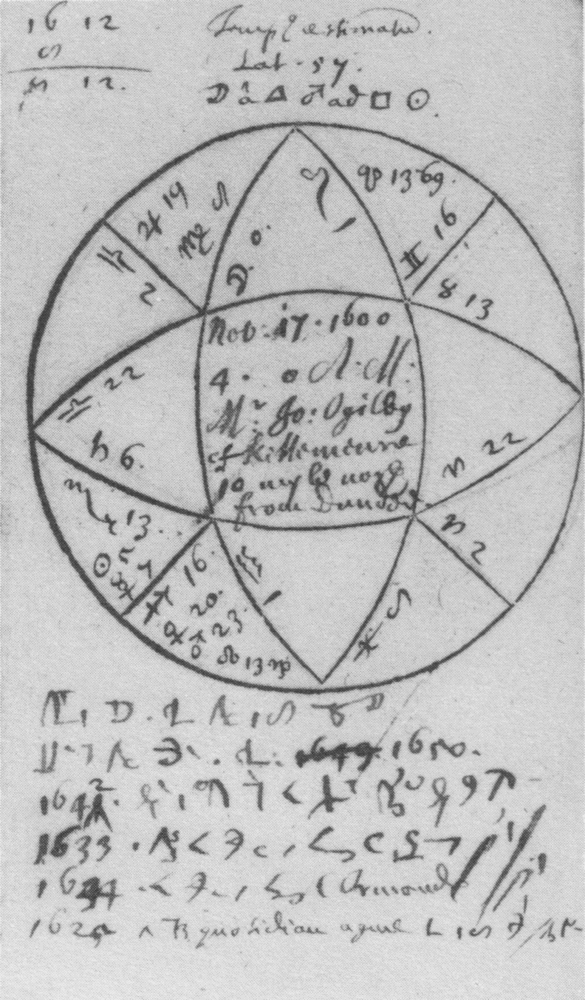

Positions are measured along the ecliptic, the apparent annual path of the Sun against the stars. The zodiac is the belt extending about eight degrees either side of it, within which the Moon and the bright planets are found; it is divided into twelve equal parts of thirty degrees each, called signs. In the tropical system used by most Western practice the division begins at the March equinox, so that zero degrees of Aries is the equinox point by definition. The twelve names — Aries, Taurus, Gemini, Cancer, Leo, Virgo, Libra, Scorpio, Sagittarius, Capricorn, Aquarius, Pisces — are inherited from constellations the Sun once crossed in those sectors, and the relationship between the names and the constellations is the subject of the section on precession below.
A position is therefore written as a sign, a degree and a minute of arc: a body at eighteen degrees and twenty minutes of Libra is at 198 degrees 20 minutes of ecliptic longitude, counted from the equinox. The working set of bodies in modern Western practice is the Sun and Moon (called, jointly, the lights or luminaries), the five planets visible to the unaided eye, and the three discovered since 1781; the lunar nodes, where the Moon's path crosses the ecliptic, are almost universally included, and beyond that the set expands by school. Contemporary software will supply the larger asteroids, the trans-Neptunian bodies, a set of hypothetical points inherited from an early twentieth-century German school, dozens of planetary moons and a list of fixed stars, and the argument about which of these belong in a chart is old and unsettled.
Four points in every chart are not bodies at all but intersections. The ascendant is the degree of the ecliptic rising on the eastern horizon at the given moment and place; the descendant is the degree setting opposite it; the midheaven is the point where the ecliptic crosses the observer's meridian above the horizon, and the imum coeli is its opposite below. These four are the angles, and they are the reason a chart needs a birth time and a latitude rather than merely a date. Two people born on the same day in the same city, four hours apart, have planetary positions within a fraction of a degree of one another — the Moon excepted, which moves about half a degree an hour — and share none of their angles.
Houses, and why there are so many ways to draw them
Between the signs, which depend on the date, and the angles, which depend on the time and place, sits the third layer of the diagram. Most horoscopic traditions divide the chart into twelve houses, numbered anticlockwise from the first cusp, whose positions depend on time and location rather than on date, and which practitioners read as fields of experience — the areas of life in which the signs and planets are said to operate. A planet in a sign is described as having a quality; the same planet in a house is described as having a place to put it.
The trouble, and the reason this is one of the standing technical arguments of the field rather than a settled convention, is geometrical. The ecliptic is inclined to the celestial equator by about 23.4 degrees, and both are inclined to the horizon by an amount that depends on the observer's latitude. Dividing the sky into twelve is therefore not one problem but a family of them, and the answer depends on which circle you choose to divide into equal parts and how you project the result back onto the ecliptic where the planets are. Different choices give demonstrably different house cusps for the same birth.
The principal systems, and what each of them divides:
- Whole sign — each sign is one house entire; the sign containing the ascendant is the first house, regardless of the ascendant's degree within it. Thought to be the oldest system, the main one in the Hellenistic tradition and still standard in Indian practice. It fell out of Western use around the tenth century and was reintroduced into Western astrology in the 1980s and 1990s.
- Equal house — twelve arcs of exactly thirty degrees along the ecliptic, beginning at the degree of the ascendant. Its advocates argue that it distorts least at high latitudes.
- Porphyry — each of the four ecliptic quadrants between the angles is divided into three equal parts. The oldest of the quadrant systems; attributed to Porphyry of Tyre but first described by Vettius Valens in the second century.
- Alcabitius — the predecessor of Placidus, widely used in Europe before Regiomontanus displaced it; the time the ascendant takes to reach the meridian is divided into three.
- Regiomontanus — the celestial equator is divided into twelve and projected onto the ecliptic along great circles through the north and south points of the horizon. Named for Johann Müller of Königsberg.
- Campanus — the same projection, but the circle divided is the prime vertical. Attributed to Campanus of Novara, though the method predates him.
- Morinus — division along great circles through the ecliptic poles; one of the few systems in which the midheaven is not the tenth cusp.
- Placidus — the most commonly used system in modern Western astrology. The time each degree of the ecliptic takes to travel from the horizon to the meridian is trisected. Named after Placidus de Titis (1603–1668), a monk and mathematician at the University of Pavia, though the method is older than his published account of it.
- Koch — a variant of the same idea built on equal increments of right ascension, developed by the German astrologer Walter Koch (1895–1970) and defined only between 66 degrees north and 66 degrees south.
- Topocentric — devised in Argentina by Wendel Polich and A. Page Nelson, who said they had arrived at it empirically. Its cusps are always within a degree of the Placidus values, and it can be described as an approximation to that system.
The standard summary of the design problem is worth repeating. The goals a house system might satisfy include ease of computation, agreement with the quadrant convention that puts the ascendant on the first cusp and the midheaven on the tenth, defined and meaningful behaviour in the polar regions, sensible handling of bodies at high ecliptic latitude, and symbolic coherence. No system satisfies all of them, so each represents a different compromise; and the two most popular, Placidus and Koch, can return undefined results inside the polar circles, because a degree of the ecliptic that never touches the horizon cannot be assigned a rising time. Research and debate on the merits of the systems is, in the words of the standard reference, ongoing.
For a newsgroup this had a practical consequence that needs no invention to state. Any chart posted without naming its house system is, to a reader using a different one, a chart with four of its twelve boundaries in the wrong place. The software of the period made the choice a menu item — Astrolog, described below, offers twenty-three house systems — which removed the labour of the calculation and left the disagreement entirely intact.
Aspects, transits and progressions
The last two layers are the ones that turn a static diagram into something practitioners use to talk about time. An aspect is an angle between two points in the chart, measured as the difference in their ecliptic longitude. Five of them are traditional, and because they were set out by Ptolemy in the second century they are still called the Ptolemaic aspects: the conjunction at zero degrees, the sextile at sixty, the square at ninety, the trine at a hundred and twenty, and the opposition at a hundred and eighty. Modern practice sorts them, loosely, into easy aspects (sextile and trine) and hard ones (square and opposition), with the conjunction taken either way depending on which bodies are involved. The medieval vocabulary of benefic and malefic survives in the literature but carries less weight in twentieth-century writing.
No two bodies are ever at exactly ninety degrees, so an aspect is allowed a tolerance called an orb: Venus at ninety-two degrees from Mars is a square with an orb of two degrees. The size of the orb permitted is not standardised. Different astrologers and different traditions use different values, almost all of them allowing a wider orb for the conjunction than for anything else, and the choice determines how many aspects a chart is held to contain. Two practitioners can therefore disagree about whether an aspect exists at all, for reasons that are arithmetical rather than interpretative — the same structural feature as the house systems, at a smaller scale.
Beyond the five, the field admits a longer list derived from other divisions of the circle. Kepler set out thirteen aspects in Harmonice Mundi in 1619, generated from the ratios he was using to describe musical consonance; the twentieth-century revival of that approach under the name of harmonics is associated chiefly with John Addey. The minor aspects that appear in modern software — semisextile, semisquare, quincunx, quintile, sesquiquadrate and their relatives — come from that tradition.
Transits are the simplest of the timing techniques and the one most often meant when a practitioner speaks of what is happening now. The current positions of the bodies are compared with the natal chart, and attention is paid to changes of sign and house and to the aspects the transiting bodies make to the natal ones. Because the outer planets move slowly, a transit of Saturn, Uranus, Neptune or Pluto to a natal position occupies months or years, which is what makes them the material of the long-range forecasting the literature is full of.
Progressions are stranger and more purely symbolic, and there are several. In secondary progression, much the commonest, the chart is advanced one day for each year of life: the positions on the twenty-fifth day after a birth are read for the person's twenty-fifth year. In solar arc direction the entire chart is advanced by about one degree per year — the Sun's daily motion — so that every body moves the same distance, producing a configuration that never existed in the sky. Tertiary progression equates a day with a lunar month; converse progressions run the same arithmetic backwards from the birth. None of these claims to describe where anything actually is; they are avowedly symbolic transformations of the natal figure, and the literature is explicit about that.
The point worth carrying out of these three sections is a technical one. Everything described in them — the positions, the angles, the twelve house cusps in whichever of the ten systems, the aspects and their orbs, the transits and the several kinds of progression — is arithmetic performed on tabulated astronomical data. It is checkable, reproducible and, from about the middle of the 1980s, free. Only the last step, the reading, is not. That division is what the software era did to the practice, and it is the subject of the section after next.
Precession, and the zodiac that moved
Nothing in this section is in dispute between astronomers and astrologers. The Earth's rotational axis is not fixed in space. Under the gravitational pull of the Sun and Moon on its equatorial bulge it traces a slow cone about the pole of the ecliptic, with a half-angle of about 23.4 degrees — the obliquity of the ecliptic — and completes a circuit in roughly 26,000 years. This is axial precession, and its consequence for anybody measuring positions is that the reference point moves.
The rate is about 50.3 seconds of arc a year, which works out at one degree in a little under 72 years; at the present rate a full circuit takes 25,772 years. The effect was detected by Hipparchus in the second century BC. Ptolemy, comparing his own measurements with Hipparchus's some 265 years later, put it at one degree per hundred years, which is around 36 seconds of arc and too slow; al-Battani measured one degree per 66 years, and the tables compiled at the Maragheh observatory in the thirteenth century gave 51 seconds of arc a year, within a second of the modern figure. The point of that sequence is that this is not a modern discovery embarrassing an ancient art. Precession was known to astrology's own classical authorities, measured by them, and improved on by the astronomers whose tables astrologers used.
What precession does to a zodiac depends on how the zodiac is defined, and the two available answers are the fault line that runs through world astrology. In the tropical system the twelve signs are fixed to the seasons: zero degrees of Aries is the March equinox, by definition, permanently, and the signs are twelve equal thirtieths of the year rather than twelve regions of sky. In the sidereal system the signs are fixed to the stars, and the offset needed to keep them there is called an ayanamsa, from the Sanskrit for the component of the movement. Hindu astrology uses several, the Lahiri ayanamsa most widely, with the Raman a common alternative; Western sidereal practice, a much smaller tradition, generally uses the Fagan–Bradley value.
The two frames coincided about two thousand years ago and have been separating ever since at the rate given above. The gap is now on the order of a whole sign, its exact size depending on which ayanamsa is applied. As of 2020, sun signs computed on the Sri Yukteswar ayanamsa ran about twenty-three degrees behind tropical sun signs, so that a birth between 12 March and 12 April yields Pisces on that reckoning and, on the tropical reckoning for the neighbouring dates of 21 March to 19 April, Aries. A tropical Cancer mostly corresponds to the constellation Gemini. None of this is contested; it is the same measurement made from two different origins.
A third frame exists and belongs to neither tradition. In 1930 the International Astronomical Union fixed the boundaries of the constellations for astronomical convenience, without any thought for astrology, and those boundaries are neither equal in size nor twelve in number along the ecliptic: thirteen constellations touch the Sun's path, Ophiuchus among them. On the IAU boundaries the Sun enters Aries on 19 April, at a corner of the constellation that lies visually closer to the body of Pisces. The recurring popular story that astronomers have added a thirteenth sign and everyone's sign has changed is a restatement of this 1930 decision, and it lands on a tropical zodiac that never claimed to be measuring constellations in the first place.
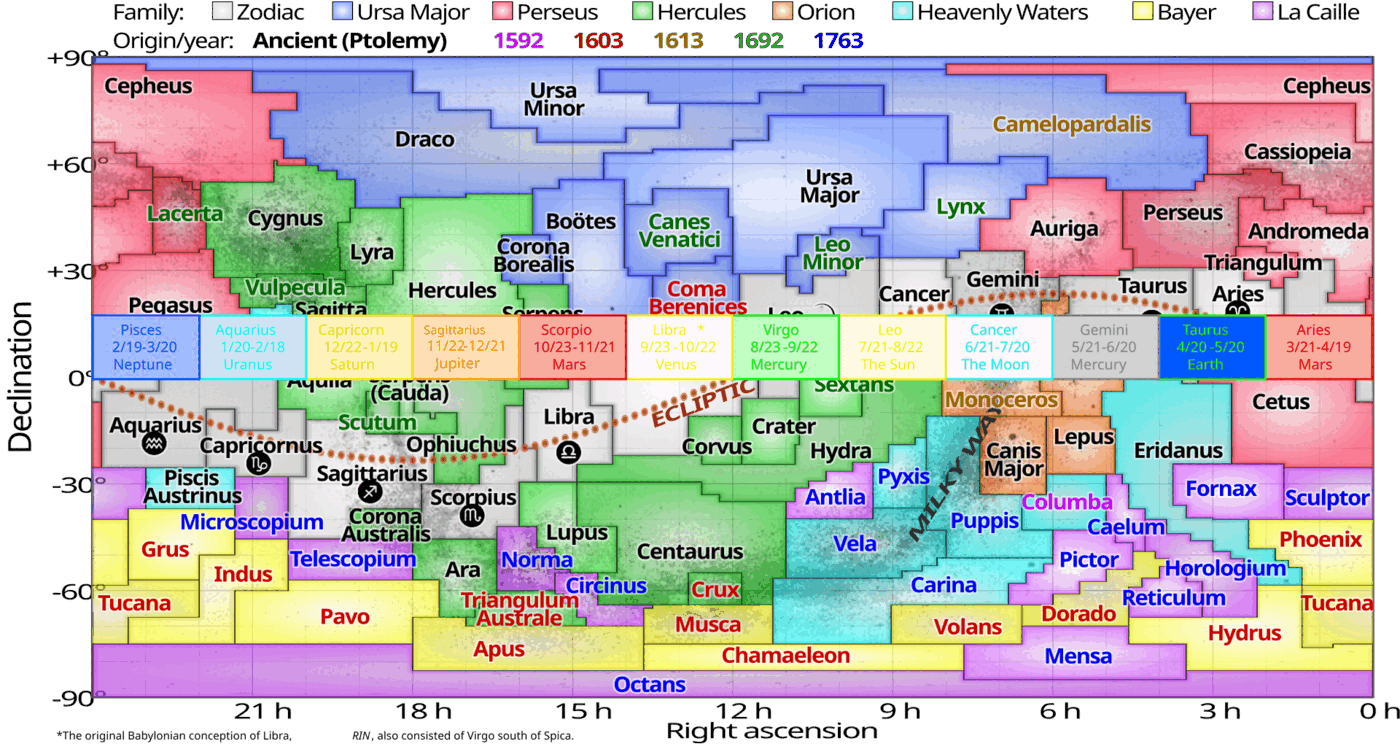
_Zodiac_Signs_Overlaid.svg)
Both traditions know all of the above and answer it differently, and reporting the two answers is as far as this page goes. Tropical practitioners hold that the signs are a seasonal framework whose meanings derive from the solar year, so that precession is simply beside the point; sidereal practitioners hold that a system named after constellations ought to keep pointing at them. That the disagreement was live on Usenet is documented in the namespace itself: alt.astrology.tropical, created in September 2001 as a moderated group, is a newsgroup named after one side of this question, and its charter describes itself as being for the discussion, debate and study of tropical astrology specifically.
From printed tables to a keystroke
For most of the practice's history, the calculation was the work. An ephemeris — the word is astronomy's, not astrology's — is a table of the computed positions of celestial bodies at regular intervals of date and time; the compilation of such tables was among the first applications to which mechanical computers were put. A practitioner working from print took the planetary longitudes for the noon or midnight nearest the birth, interpolated for the actual hour, calculated the local sidereal time, looked the house cusps up in a separate volume of tables of houses indexed by latitude and sidereal time, and then drew the figure. Between an hour and an evening's work, depending on care, and every step of it a place to make an arithmetical mistake.
The tables themselves come from a chain that ends a long way from astrology. The Astronomical Almanac, produced jointly by H.M. Nautical Almanac Office in the United Kingdom and the Nautical Almanac Office of the United States Naval Observatory, has since the volume for 1984 taken its positions for the Sun, Moon and planets from the Jet Propulsion Laboratory Development Ephemeris, the series of numerically integrated solar-system models that JPL produces for spacecraft navigation. DE200 served the almanac from the 1984 volume to the 2002 one, DE405 from 2003 to 2014 and DE430 from 2015; the volume for 2025 is derived from DE440, which JPL published in 2021. The data are distributed as Chebyshev polynomial coefficients fitted in segments of thirty-two days; DE405 recovers inner-planet positions to about a thousandth of a second of arc, which at the distance of Mars is on the order of a kilometre.
Astrology's own computing history begins in the 1970s. Astro Computing Services in San Diego, founded by Neil Michelsen in 1973, published a computer-generated ephemeris in 1976 under the title The American Ephemeris. Michael Erlewine — a Michigan blues musician who had played in a band with the young Iggy Pop, and who would later found the AllMusic database — founded Matrix Software in the late 1970s, sources giving 1977 and 1978, and in 1980 published a volume containing the algorithms and data a microcomputer owner needed to write a complete chart program without help. A few hundred fixed-purpose astrology machines were also built; one of them, the Digicomp DR-70 Astrology Minicomputer, is catalogued in the collection of the Computer History Museum.
The reception inside the field is worth recording, because it is the opposite of what an outsider expects. The standard account is that American astrologers initially opposed the introduction of computers into their practice, and that acceptance came as it became clear how much more efficient and profitable the software was. A 1983 article in PC Magazine headed Microastrology: Casting a Horoscope With a PC made the same observation from the other side: the arithmetic of planetary and house positions was exactly what a microcomputer was good at, and the interpretation was exactly what it was not. The division of labour that this page has been describing since the section on charts was therefore plain on both sides of the counter by the early 1980s: the trade press could see which half of the work a microcomputer would take over, and, on the account given above, the astrologers who bought the machines came to the same conclusion.
Which brings the story to the newsgroup, because one of those programs was distributed through it. Astrolog, written by Walter Pullen and first released on 10 September 1991 — six weeks after the newgroup message that created alt.astrology — was free, was shipped with its source code from the beginning, and was, by the standard account of it, originally distributed via postings to this newsgroup. It has been ported to Unix, MS-DOS, Windows, the Macintosh, OS/2 and the Amiga; it computes twenty-three house systems and twenty-four aspects; its early astronomical routines derived from formulas implemented by Michael Erlewine, and later versions used the Placalc and then the Swiss Ephemeris libraries. In November 1995 The Mountain Astrologer reviewed a batch of astrology programs and included Astrolog as the one piece of freeware in the set, describing it as good enough to be worth reviewing alongside the commercial products. For a period in the 1990s it was also the only readily available program that would compute the diurnal sectors used in Michel Gauquelin's statistical work. Most of the complaints about it concerned the command-line switches.
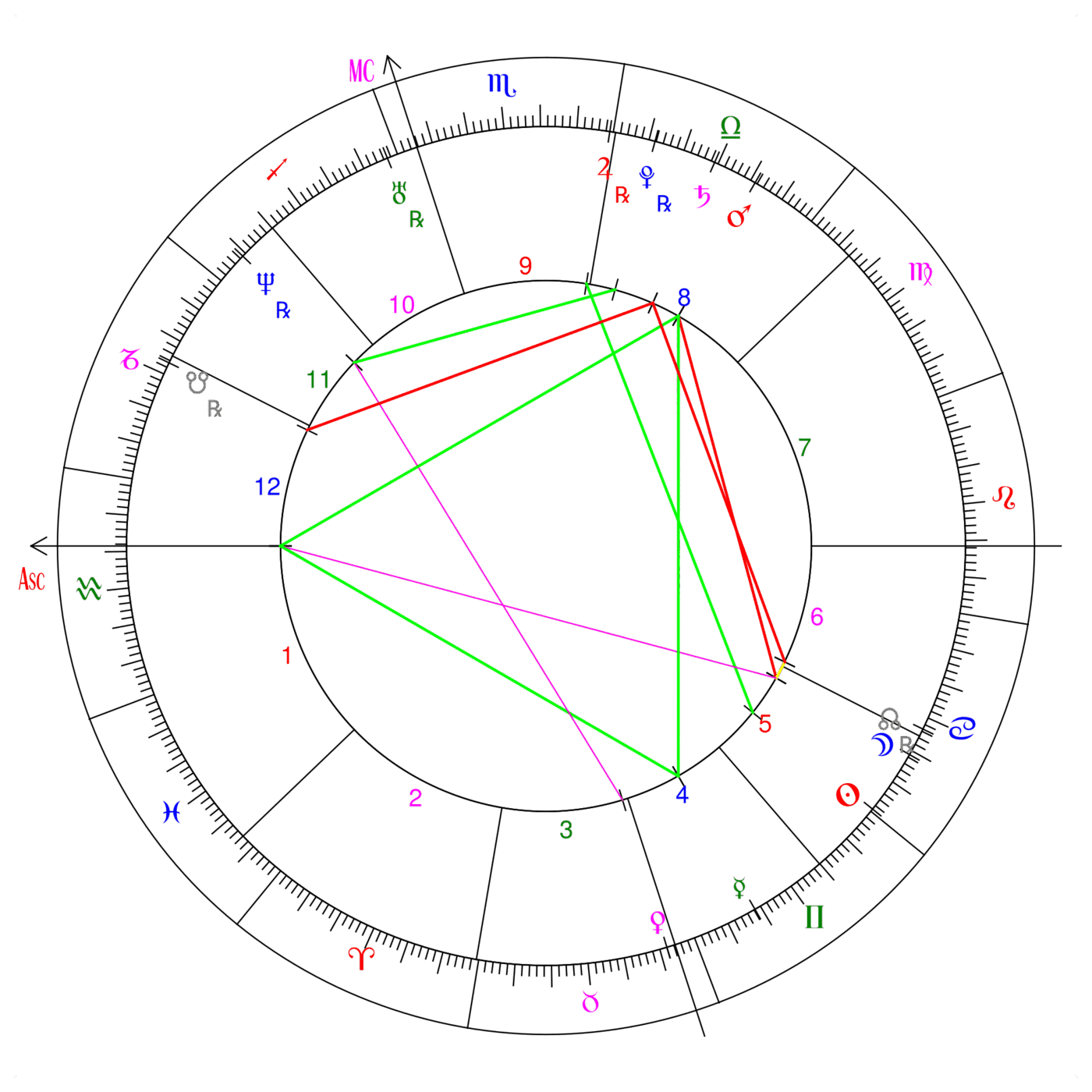

The Swiss Ephemeris closes the loop. It is a calculation library produced by the Swiss firm Astrodienst and used by a large proportion of the astrological software written since; by the firm's own documentation, the original release in 1997 was based on JPL's DE405 and DE406, version 2.00, issued in February 2014, on DE431, which JPL had released in September 2013, and the version current at the time of writing on DE441. The path from a spacecraft-navigation model integrated at the Jet Propulsion Laboratory to a wheel chart on a hobbyist's screen runs through two intermediaries. As astronomy, the positions in a modern horoscope are accurate to a precision many orders of magnitude finer than the orbs described earlier on this page.
What all this did to a discussion group is structural and can be stated without inventing a single thread. A group founded in 1991 was founded at the exact moment when the calculation stopped being the difficulty and started being a menu. The craft that had distinguished a competent practitioner from an incompetent one for two millennia — the arithmetic — became something a reader could do in a second and check against somebody else's program. What was left to argue about was interpretation, which cannot be checked at all, and settings, which can be checked exactly. That is an unstable combination in any forum, and it is a fair description of what the surviving charters of the group's offshoots complain about.
What testing has found
This directory states the position once, plainly, and then goes back to reporting. Astrology has no accepted scientific basis. It has been recognised as pseudoscientific since the eighteenth century and is rejected by the scientific community as having no explanatory power; no mechanism has been proposed by which the positions of planets could produce the described effects without contradicting well-established biology and physics; it has not demonstrated effectiveness in controlled conditions; and where it has generated falsifiable predictions, those predictions have failed. The detailed experimental record — Shawn Carlson's double-blind test published in Nature in 1985, the four-decade argument over Michel Gauquelin's data, Geoffrey Dean and Ivan Kelly's large-scale tests, the meta-analyses, and the work on the Forer effect — is set out at length on the alt.astrology.metapsych page and is not repeated here. The summary is that astrologers asked to match natal charts to personality profiles have performed at chance, repeatedly, under protocols they helped design.
What belongs to this page rather than to that one is the public form the argument took, because that is what reached Usenet. Its landmark document is not a study but a statement. In its issue for September and October 1975, amid a surge of popular interest in the subject, The Humanist published Objections to Astrology, drafted by the astronomer Bart J. Bok, Lawrence E. Jerome and the philosopher Paul Kurtz and signed by 186 astronomers, physicists and other scientists. It warned the public against accepting astrological advice uncritically, and rested its case on the absence of a mechanism:
We can see how infinitesimally small are the gravitational and other effects produced by the distant planets and the far more distant stars. It is simply a mistake to imagine that the forces exerted by stars and planets at the moment of birth can in any way shape our futures.
The most interesting signature on that document is the one that is not there. Carl Sagan declined to sign it, and said explicitly that this was not because he thought astrology had any validity. His objection was to the tone, which he found authoritarian, and to the argument, which he thought insufficient: dismissing a claim because no mechanism is known was, he wrote, certainly a relevant point but not in itself convincing. In a letter published in a later issue he said he would willingly have signed a statement that described astrology's principal tenets and refuted them, and that such a statement would have persuaded more people and caused less trouble.
That disagreement is worth recording because it marks a real division inside scepticism itself, and one that bears directly on the subject of the next section. There is a scepticism that declines to engage on the ground that there is nothing to engage with, and a scepticism that insists on taking the claims one at a time and testing them. They produce very different postings; and an unmoderated newsgroup, having no mechanism for admitting one and not the other, has no way of choosing between them either. The instruments the tests used — personality inventories, self-report questionnaires and the statistical machinery for validating them — have their own page in this directory at sci.psychology.personality, and the strength of any test of astrology against a personality profile is bounded by the strength of the profile.
This page reaches no verdict about the people who posted to alt.astrology, offers no assessment of anybody's practice, and gives no advice. It states the scientific position because a reference work that omitted it would be misleading, and it states it once.
Why one room held both sides
The obvious question about alt.astrology is why the practitioners and the sceptics did not simply go to separate groups, and the answer is partly structural and partly documented. The structural half is the easier one. An unmoderated newsgroup has no mechanism for excluding anything. There is no moderator, no submission address and no Approved header to withhold; a charter is a document, and nothing in the news software reads it. The only enforcement available is persuasion, social pressure and complaint to somebody's service provider. How alt.* came to work that way is told on the alt.* hierarchy page and is not retold here.
Crossposting finishes the job. A Usenet article carries a list of newsgroups in its header rather than a single destination, and follow-ups go by default to all of them, so a boundary drawn in a charter is undone by a line in a header. The control record shows the habit at work even in administrative traffic: the messages creating alt.astrology.toadology were addressed simultaneously to alt.astrology, alt.config and the group being created; the alt.astrology.scam messages went to alt.astrology, alt.config and a regional configuration group in Los Angeles; the 1997 charter message was addressed to alt.astrology and alt.config together. If the paperwork was crossposted, the arguments certainly were.
The documented half is better than the structural half, because four separate attempts to build a room where the validity argument was not the subject survive in full, with their exclusion clauses intact. In chronological order:
- alt.astrology.marketplace, June 1996. Its charter admits five categories of business posting and then lists four that are unwelcome, the second of which is Arguments about the legitimacy of astrology. The first is Discussions of any sort.
- alt.astrology.metapsych, November 1996. Its charter's second exclusion is arguments as to the validity of astrology at all, either scientifically or theologically, with the words AT ALL capitalised in the original. That group's own long history is told on its own page.
- alt.astrology.moderated, November 1998. Eighth in its list of prohibited postings: Posts skeptical of the general validity of astrology, which are more properly posted to sci.skeptic, or other newsgroups. The referral is to a real place; sci.skeptic is still in the namespace, described as skeptics discussing pseudo-science.
- alt.astrology.tropical, September 2001. This one does not exclude the argument; it timetables it. Sceptical discussion of astrology in general was to carry subject lines beginning VALIDITY:, discussion of moderation methods and decisions subject lines beginning RFD:, and the moderators reserved the right to add the prefixes themselves.
Read together, those four documents are a five-year record of people trying every available design. Exclude the argument by charter; exclude it by moderation; redirect it to another hierarchy; permit it but label it. The fourth is the only one that treats the problem as a problem of attention rather than of membership, and it is also the only one written by people who had watched the previous three fail.
The traffic ran the other way as well, which is the part that a page written from the practitioners' side would miss. alt.astrology.scam, alt.astrology.toadology and alt.astrology.ghouls were all created by people who wanted the argument, not the subject, and who built rooms for it exactly as the practitioners built rooms away from it. The record does not show one constituency being shut out by the other; it shows two constituencies wanting the same name, and a namespace that ended up holding fourteen of them.
The 1997 charter in the parent group's own file is the only document in the record that takes the third position, which is to accept the shared room and try to make it habitable: discussion pro and con, validity explicitly welcome, name-calling discouraged, meta-complaint declared off topic. It was posted from a forged address, over a name that parodies a real person's, and it is the only one of the four documents that proposes keeping both constituencies in the same room.
None of this is peculiar to astrology. The same shape — a general unmoderated group that no charter could partition, ringed by specialist groups that tried — is the standard result whenever Usenet hosted a subject on which two populations disagreed about whether the subject existed. The creation-and-evolution argument produced it in a more elaborate form, with a moderated flagship, a maintained FAQ archive and a dedicated set of satellites, and that story is told at alt.evolution.
How busy it was, according to the people who counted
No independent readership figure for alt.astrology is known to this directory, and none was found in any source consulted for this page. Usenet kept no subscriber list; the two numbers a group's carriage generated — how many sites took the feed and how many articles crossed it — were recorded, if at all, by individual news administrators, and those records are gone. What survives is two hand counts, both made by people who were proposing new groups and therefore had a direct interest in the parent sounding busy. They are quoted here as claims, with their provenance attached.
The first is in the alt.astrology.moderated proposal of November 1998. Anticipating medium to high traffic for the new group, it gives as its basis 500 to 750 on-topic posts on the alt.astrology newsgroup in the time period between August 17th through August 30th, 1998 — a fortnight — and adds that it expects a further influx from people who had until then confined themselves to mailing lists, and from newcomers to Usenet. The proposal also records its own procedural history, which is unusually orderly for alt.*: first posted on 6 September 1998, revised and reposted on the 15th, revised again in line with suggestions made in alt.config and reposted on the 25th, with the control message following on 8 November. It names its moderator and gives both a submission address and a contact address. One of its headers reads X-Astrologically-Correct: yes.
The second count is three years later and much more specific. The alt.astrology.tropical proposal of September 2001 reports a hand count conducted in alt.astrology for the 30 days preceding September 6th, 2001, which produced 813 posts that would have been on topic in the proposed group out of 2,850 in total, or roughly 28 per cent, the count excluding flames and off-topic material on what it calls a strict definition. It estimates the total for the three months before that date at 25,400 articles. No method is described beyond the phrase hand count, and the definition of on-topic was the counter's own.
The two figures inside that second document do not agree with each other. A count of 2,850 articles in thirty days implies rather under nine thousand in three months, not the 25,400 the same paragraph estimates, and no working is shown for either number. What can be said, taking both counts no further than face value, is that the group was carrying articles by the thousand each month at the turn of the century, and that its own would-be secessionists reckoned something like seven in ten of them would not have been on topic in the group they were proposing. Two cautions attach to that ratio: the people who produced it were arguing for a separation, and the definition of on-topic was their own.
The same document supplies the only contemporaneous description of the parent group's condition that this page could verify, and it is not a flattering one. Under the heading of justification of readership it states that most of the unmoderated astrology groups were poorly created spam traps, that The main unmoderated group suffers from massive trolling, spam, kook and flamewars, and that the existing moderated group does not allow the discussion of validity (effectively decapitating the group) and suffered besides from poor server acceptance, poor communication and consequently few users and low traffic. Its closing appeal to posters asks them to restrain themselves from making exaggerated claims or responding overly harshly to such claims, and expresses a wish to minimise what it calls the savage flamewars endemic to the rest of the alt.astrology hierarchy.
That is an advocacy document written to persuade news administrators, and it exaggerates in the direction its authors needed. It is also the closest thing to a description of daily life in alt.astrology that survives anywhere this page could reach, and it was written by people who had been reading the group for years and counting its articles by hand.
What the record does not show
It is worth being explicit about the size of the gap, because a page of this length can leave an impression that the group is well documented. It is not. What is well documented is its administrative shell, its offshoots' paperwork and the world it belonged to.
No archive of the group's own postings could be cited for this article. The obvious place to look is the Usenet archive at Google Groups, and at the time of writing a request for this group's listing did not return one to the machine used here; this directory does not link an address it has not opened, so no link to it appears above. Nothing in the six control messages is a contribution to the group's discussion — a control message is addressed to news administrators, not readers — and while two of the six were posted into alt.astrology itself, that makes them announcements in the group, not conversation in it.
No group FAQ could be retrieved. That one existed is likely: the periodic posting of a frequently-asked-questions document was standard practice for a group of this size, the 2001 charter of alt.astrology.tropical tells a newcomer to read the FAQ without saying whose, and the toadology parody of 1998 makes its joke by exempting the toadology FAQ from a ban on repeated canned material, which is only funny if the parent group had one. The news.answers mirrors and FAQ archives consulted for this page either no longer serve the relevant files or no longer serve requests at all, and this page does not cite what it cannot read.
We do not know how many sites carried the group, when the first article was posted to it as distinct from when its name was created, or when the traffic stopped. We do not know whether the 1997 charter was ever installed in any server's descriptions file, or how the line now distributed came to differ from it. We do not know who wrote the 1997 message, or the 1998 and 2001 messages sent from invented addresses, and this page has declined to speculate. We do not know who Cujo was, beyond that the namespace records two groups named after that person and a role, kook-hunter, that both descriptions assign to them.
No thread titles, no post counts other than the two attributed hand counts above, no participant names other than those who signed control messages over their own addresses, and no quotations from discussion appear anywhere on this page, because none could be verified. Where the surviving evidence stops, the page stops.
Scope and limits
This page covers alt.astrology — its administrative record, its place in the alt.astrology.* namespace, and the practice and the argument that the group existed to carry. The psychological and metaphysical strand within twentieth-century astrological writing, its principal authors and institutions, Carl Jung's documented interest in the subject, and the controlled studies in their detail all belong to alt.astrology.metapsych and are summarised here only far enough to point at them. The creation and government of the alt.* hierarchy belong to the hierarchy's own page. Personality measurement belongs to sci.psychology.personality. The group remains listed, joke description and all, in this directory's full newsgroup list.
On method: the practice is described in the terms its practitioners use, in reporting register, because a reference page that could not say what a house system is would be useless to the reader it is for. The scientific position is stated once, in its own section, on the sources named there. Advocacy in either direction is not this page’s business. passes no judgement on anyone named in the control record beyond what they wrote over their own signatures, and gives no advice of any kind.
On sources: every date, quotation and description attributed to Usenet's administrative record was read for this page from the Internet Systems Consortium's control archive and its current namespace files, on the date of writing. The astronomical and technical statements were checked against standard references, and the figures for precession, the Development Ephemeris series and the Swiss Ephemeris releases come from astronomical and vendor documentation rather than from astrological sources. Where sources disagree — as they do about the year Matrix Software was founded — both readings are given and neither is preferred. Where the control record is self-contradictory or forged, it is described as such rather than tidied.
Reading alt.astrology today
- Historical archive: Google Groups — alt.astrology (coverage varies by group and era).
- Open in a newsreader:
news:alt.astrology— the original site offered exactly this link, and it still works if your system has a newsreader registered for thenews:scheme. - Live access: point an NNTP newsreader at a modern server — see accessing Usenet today.
- The original news2mail e-mail subscription service ended in the mid-2000s and no longer operates.