alt.cellular.nokia.ringtones
Nokia ringtones, composed one note at a time.
Before polyphonic audio, Nokia owners keyed in monophonic ringtones by hand — and traded the note sequences here, along with RTTTL files and composer tips, at the height of the early-2000s ringtone craze.
A period piece of mobile culture: the group’s traffic died with the arrival of MP3 ringtones, but hobby archives of that era still link this page.
On this page
- The paperwork the group left behind
- A ringtone that was one line of notes
- How an RTTTL line is put together
- Why a text format was the right thing for a text network
- The composer on the handset, and its other notation
- The handsets, dated
- How a tone reached a handset without a cable
- The tune everybody already had
- The trade that grew around it
- The regulators, and what they ruled
- What the group carried
- What ended the craft: polyphony, then recordings
- What the record does not show
- Scope and limits
The paperwork the group left behind
Most alt.* groups arrive without documents. This one arrived with a complete set, and the set survives. The Internet Systems Consortium's mirror of the Usenet control traffic holds three messages under the name alt.cellular.nokia.ringtones, and the first of them is the group's birth certificate: a newgroup control message posted to alt.config by David Thornton, from his own site at davidthornton.com, dated Sunday 31 January 1999 at 00:33 UTC and approved under a newsmaster address at the same domain. Its Path header runs back through Pipex and its posting host was a United Kingdom dial-up line, which places the sender in Britain and the moment squarely in the dial-up era.
Control messages of this kind carry, by convention, the exact line an administrator was meant to paste into the server's newsgroups file. Under the heading For your newsgroups file: this one reads, in full:
alt.cellular.nokia.ringtones Ringtones for Nokia Cellular PhonesBeneath it came the charter, and it is worth reading closely because it sets out the group's business in the order its proponent thought important:
This newsgroup is specifically for the discussion of the ringtone facility available on many modern Nokia cellular phones. It contains information on how to create, obtain and transfer ringtones to Nokia cellular phones. The newsgroup is also a place for Nokia cellular phone owners to make requests for ringtones to be sent to them via SMS or email. Ringtones may also be posted in a non-binary format.
Three things are settled by that text. The first is the verb order: create, obtain and transfer. Composition is named first, but obtaining a tone from somebody else and getting it onto the handset are given equal billing, which is an accurate description of what the hobby actually involved. The second is the delivery mechanism the charter expects — a request answered via SMS or email, that is, by the requester's telephone number or mailbox rather than by the newsgroup itself. The third is the last sentence, which reads today like a throwaway and is in fact the technical hinge of the entire group: a ringtone could be posted as text, so this did not need to be a binaries group. Everything else on this page follows from that one line.
The second control message is a booster, reissued a fortnight later on Saturday 13 February 1999 to reach servers that had missed the first. Boosters were ordinary practice in a hierarchy with no central authority, and the mechanism is described on the alt.* hub page rather than here; what is particular to this group is what the sender chose to put in his. He recorded that the group had already propagated onto many news servers, that it was receiving what he called a substantial number of postings, and that it was doing the job it had been created to do — drawing ringtone traffic out of the general Nokia group. That is the proponent's own account of his own group, made a fortnight after founding it, and it should be read as such rather than as a measurement; but it is the only contemporary statement of the group's health that exists, and it is at least a statement made in public to an audience able to contradict it.
The parent had its own paperwork. alt.cellular.nokia was proposed in alt.config on 10 August 1997 and first created a week later, on 17 August, at the instance of a German proponent, Michael Pauels; the surviving control message was reissued on 16 September 1997 by Konrad Roeder on the proponent's behalf, with a summary line explaining that the initial message had not issued its headers properly. Its newsgroups-file line was alt.cellular.nokia — Nokia mobile phone specific discussions, and its justification was the standard one for a split: that the existing alt.cellular.* groups already carried enough Nokia-specific traffic to warrant a room of their own. Eighteen months later the same argument was made one level further down, and produced the group this page is about.
That is how the hierarchy grew. Anyone who could send a control message could make a group in alt.*, so the namespace accumulated addresses for handset makers and for network operators without anybody deciding that it ought to — the mechanism, and the etiquette that grew up around it in the absence of any authority, belong to the hub page. The relevant consequence here is local and slightly absurd: alt.* ended up with a permanent address not merely for a manufacturer but for one feature of one manufacturer's products. It also ended up with addresses for individual carriers, in tones ranging from the technical to the aggrieved; alt.verizon-sucks is the same accretion in a worse mood.
Two later entries close the file. On 20 January 2000 an automated newgroup went out from AT&T WorldNet's news administration, one of the housekeeping messages a large provider generated to add groups across its own servers — evidence that a year in, the group was being carried by consumer ISPs in the United States as a matter of routine. Then, on 22 and 23 June 2001, the same person who had created the ringtones group created two siblings, alt.cellular.nokia.operatorlogos and alt.cellular.nokia.groupgraphics, for the monochrome network logo and the caller-group icon respectively. Their charters are the ringtone charter with the nouns changed, and they carry a sentence of retrospect: that they complement the ringtones group, created on 31 January 1999, and that interest in ringtones, operator logos and group graphics for Nokia handsets had, in the proponent's word, spiralled since. They also carry a sentence that will matter later on this page — that the new groups would allow the items to be exchanged freely, as an alternative to the many web sites that offered them for a fee.
The name is still in the record. ISC's current master newsgroups file lists alt.cellular.nokia.ringtones with the same one-line description it was given in 1999, alongside its two siblings and the parent group; the corresponding entry in the active file shows an empty article range, which is what a group looks like when it has been kept in the namespace and has stopped receiving posts.
A ringtone that was one line of notes
The technology sets the shape of everything that follows. A late-1990s GSM handset announced a call through a small transducer driven by a square-ish waveform at one frequency at a time. There were no chords, because there was only one voice. There was no instrument, because there was no sample and no envelope worth the name — a note was a pitch held for a duration and then stopped. There was no dynamic range: notes were on or off, and the volume control belonged to the whole ringer rather than to any note in it. What the hardware could do, it could do across a little more than three octaves. The reference document for the notation gives the compass of one representative Nokia range as running from concert A at 440 hertz up to the B a little under four kilohertz, which is the band a small transducer in a pocket can usefully produce. Everything below it was left out, not as a musical decision but because the speaker could not reproduce it audibly.
A tone of that kind is not a recording of anything. It is a list: pitch, duration, pitch, duration, with the occasional silence. Lists of that sort have been written down for a thousand years, and they can be written down in fewer characters than almost any other kind of music, because a single voice needs no score layout, no part assignment and no simultaneity. This is the whole reason a music hobby ended up living on a plain-text discussion network, and it is why the hobby died the moment the underlying object stopped being a list.


The constraint had a second half. Handset memory for user-composed tones was measured in single figures: a phone might carry three dozen built-in tones and leave room for seven of the owner's. A tune that had taken twenty minutes to key in was therefore always one edit away from being overwritten by the next one, which supplied a reason — quite apart from sociability — to write the thing down somewhere outside the telephone before losing it. A newsgroup is a place to write things down where other people can find them, and it does not run out of slots.
How an RTTTL line is put together
The notation the group traded in was RTTTL, the Ring Tone Text Transfer Language: the format in which Nokia monophonic ringtones were distributed, and the one thing about this page's subject that is completely and permanently specifiable. It is worth setting out properly, because a reader who follows this section should be able to pick up any surviving line of it and read the music off.
An RTTTL string is one line of printable ASCII divided by colons into exactly three parts: a name, a control section of defaults, and the note data. Whitespace anywhere in the string is to be ignored by any program reading it, which is what allows a line to survive being wrapped, indented or re-flowed by a mail program on its way through the network.
- Name. A label for the tune. The format specification caps it at ten characters and forbids the colon, for the obvious reason that the colon is the delimiter. Nokia's Smart Messaging specification allows fifteen, and software written against that specification accordingly accepts longer names than software written against the older document — the first of several places where two reasonable readings of the format disagree.
- Control section. Comma-separated pairs of a key and a value. There are three keys and no more:
dfor the default note duration,ofor the default octave,bfor the tempo in beats per minute. Unknown keys are to be ignored rather than treated as errors. A control section readingd=4,o=5,b=108makes every note that does not say otherwise a crotchet in octave five, at 108 to the minute. If a key is left out altogether, the specification's fallbacks ared=4,o=6andb=63— which is a trap, becauseo=6is an octave higher than the value most published tunes set explicitly, and a line that omits the octave will sound wrong rather than merely different. - Note data. Commas again, one note to a field. Each field carries, in order, an optional duration, a mandatory pitch, an optional octave and an optional dot.
The pitches are the letters a to g, in either case, with a hash appended for a sharp: a#, c#, d#, f#, g#. There are no flats — an E flat is written d# — and no distinction is drawn between enharmonic spellings, because a single square wave does not care. The thirteenth symbol is p, for a pause: a rest, which takes a duration like any other field and takes no octave, because silence is not in an octave. Some implementations additionally accept h for B, following the German and Central European convention in which the scale runs C D E F G A H, though this is not in the format's own specification and a line relying on it is not portable.
Durations are written as the denominator of the fraction, exactly as a musician would name them: 1 for a semibreve, then 2, 4, 8, 16 and 32. A full stop appended to the field dots the note, adding half its length again, so a dotted quaver is one and a half quavers. Octaves are the digits 4, 5, 6 and 7, numbered as in scientific pitch notation: the A in octave four is concert A at 440 hertz, in octave five 880, in octave six 1,760 and in octave seven 3,520. Four octave numbers are therefore the whole compass the notation offers, and the specification records where that compass came from: on the Nokia 61xx range the lowest playable note is the A in octave four and the highest the B in octave seven — three octaves and a whole tone, the reach of the handset rather than of the notation.
Tempo is the one field where the published descriptions diverge from what a programmer would expect. The format's own grammar simply takes a number, but the tables circulated with the format enumerate a fixed list of thirty-two permitted values — 25, 28, 31, 35, 40, 45, 50, 56, 63, 70, 80, 90, 100, 112, 125, 140, 160, 180, 200, 225, 250, 285, 320, 355, 400, 450, 500, 565, 635, 715, 800 and 900 — spaced in a roughly geometric series, each about twelve per cent above the last, with the default of 63 the ninth value up from the bottom. Whether a given handset enforced that list or accepted any integer is exactly the sort of question a compatibility thread was for.
The example most often reproduced with the specification is the opening of Beethoven's Fifth Symphony, a piece comfortably out of copyright since long before the mobile telephone:
fifth:d=4,o=5,b=63:8p,8g5,8g5,8g5,2d#5Read it in three parts. The name is fifth. The control section sets crotchets, octave five and sixty-three beats to the minute. The data is five fields: a quaver rest, three quavers on G in octave five, and a minim on D sharp in octave five — the three shorts and a long, with the pickup rest that makes them land off the beat. The octave digits after each note are redundant, since o=5 has already been declared, and lines were frequently written that way; the format permits the belt and the braces. At sixty-three to the minute a crotchet lasts a little under a second, so the whole line runs to a little under four seconds, which is about as long as anybody wanted a telephone to shout at them before they answered it.
That is the entire format. It has no repeat marks, no key signature, no time signature, no ties, no slurs, no articulation and no dynamics; it cannot express two notes at once, and it has no way to say how loud anything is. The scheme is a close relative of the Music Macro Language of early microcomputer BASIC — the string syntax behind the PLAY statement, a term documented in print by May 1982 — and the resemblance is not coincidence so much as convergence: anybody encoding one voice of simple music as a short string arrives at something very like it.
One consequence deserves stating plainly, because it shaped what the group could and could not be. A format this thin makes transcription an act of editing rather than copying. Reducing a piece of music to a single voice with no sustain, no harmony and no dynamics means deciding what to throw away, and two competent people will throw away different things. The arguments a transcription group has are therefore arguments about arrangement, not about accuracy, and they have no resolution — which is a reasonable description of what such a group is for.
Why a text format was the right thing for a text network
Usenet's article format was plain seven-bit US-ASCII, and had been since the specification was written down. Anything that was not text had to be dressed up as text to travel: encoded into printable characters at the sending end, split across articles if it was large, and reassembled and decoded at the other end. That machinery worked, and an enormous quantity of material moved through it, but it imposed costs at every step — a missing part meant a broken file, decoders and encoders had to agree, and the reader needed software beyond a newsreader. The encoding-of-non-text problem is the standing subject of the binaries branch and belongs to the pages that cover it: alt.binaries.e-books and alt.binaries.autographs both turn on it.
This group's position is the mirror image. An RTTTL ringtone needed no encoding whatever, because it already was text — short text, at that — commonly a hundred-odd characters, and so comfortably inside a single article or a single mail message, and frequently inside a single 160-character SMS. That one property gave it every operation a discussion network is good at, and gave them for free:
- It could be posted in the body of an ordinary article, with no attachment and no part numbering, and read by anyone with any newsreader on any machine.
- It could be quoted in a follow-up, with the quoting characters that newsreaders add doing no harm, since the format ignores whitespace and a reader could strip a prefix by eye.
- It could be corrected a note at a time, in public, by someone who disagreed with one field of it — the ordinary Usenet motion of quoting a line and amending it, applied to music.
- It could be mailed, which is what the charter expected: a request answered by e-mail to the requester.
- It could be printed, or written on paper, and typed back in by hand at the other end by somebody with no cable, no software and no connection between their telephone and their computer. For most owners in 1999 that was not a fallback; it was the normal case.
- It could be searched and indexed as text, which is why the surviving archives of the group are readable at all rather than being a heap of undecodable attachments.
None of this would have been true of a sound file. A recording is opaque to quoting, meaningless to correct in fragments, useless when printed, and large enough to need splitting. Even the smallest recognisable recording of the same four notes would have been thousands of times the size of the line that describes them, and would have arrived as something to be decoded rather than something to be read.
RTTTL was not alone in having noticed this. Ericsson's eMelody, and the iMelody format that replaced it — defined by Ericsson and Sony Ericsson together with other manufacturers — were also plain text, with begin and end markers, a version line, a tempo line and a melody string, and could likewise be sent by simply typing the notation into an SMS or saving it as a small text file. iMelody went further than RTTTL by adding codes to drive the vibration motor, the backlight, the indicator lamps and the volume alongside the notes, which is a reminder that these formats were describing an event on a device rather than a piece of music. The cross-industry Enhanced Messaging Service, an application-level extension to SMS drawn up in the same years by a group of manufacturers, likewise carried special ringtones alongside its text formatting, icons and sound effects. Between them, the two families meant that for a few years the interchange format for mobile ringtones across most of the industry was something a person could read, and consequently something a person could argue about in a follow-up.
It is worth separating this from a different Usenet story that these pages also tell. Several of the culture groups spent years working around the same seven-bit limit for writing systems — how to carry a script the network's character set did not contain. That is a problem of representing language, and the culture pages own it. This one is the opposite case: a notation that happened to fit the network exactly as it stood, needing no workaround at all, and a hobby that existed because of the fit.
The composer on the handset, and its other notation
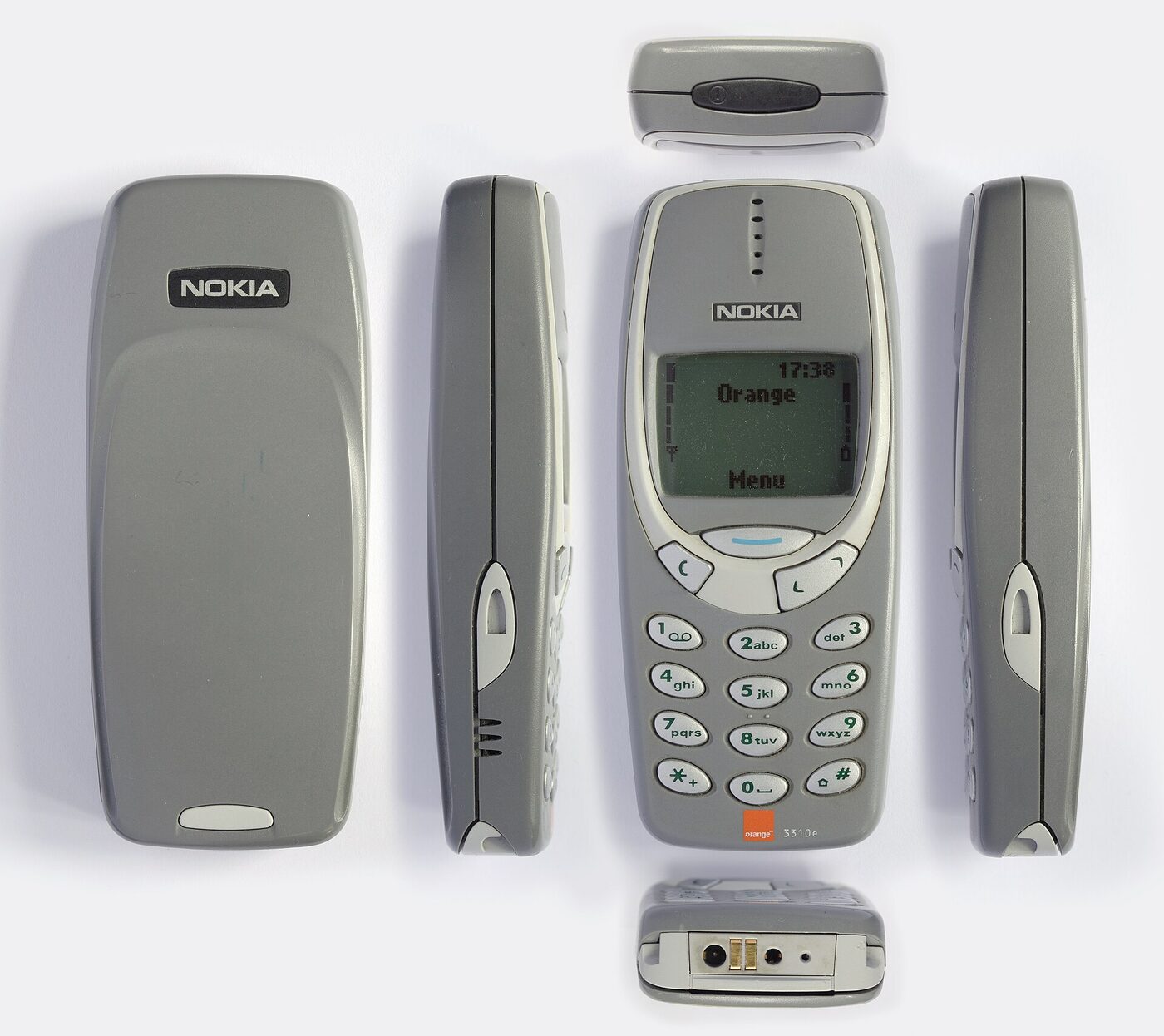
Nokia supplied the other half of the mechanism in the handset itself, as a menu item called Composer. On the Nokia 3310 it sat at Menu 5-4, and the user guide's description of it is the clearest surviving account of what keying in a ringtone actually involved. Notes were entered on the number keys, one key to a scale degree, the phone sounding each note as it was pressed. Further keys adjusted what had been entered: two to shorten and to lengthen the duration of a note or a rest, one to insert a rest, one to set the octave for notes entered from then on, and one to sharpen the note. Holding a note key down lengthened it by half — the dotted note, entered by touch. Completed tones were saved with a name and appended to the end of the ringing-tone list, and a separate Tempo option set the beats per minute for the tone as a whole.
The interesting part is that what appeared on the screen while this was going on was not RTTTL. It was a closely related notation with different conventions at almost every point, and the differences are precisely the sort of thing that generates traffic in a hobby group:
- The duration went in front of the note, as in RTTTL — a sixteenth on D shown as
16d— but the dot went after the duration rather than after the whole field, so a dotted quaver on A was shown as8.awhere RTTTL writes the dot at the end. - The sharp was written before the note, as
#f, where RTTTL writes it after, asf#. - The rest was the hyphen character, not
p, and took the duration of the preceding note by default rather than the default duration. - The octave was a digit after the note, as in RTTTL, but numbered from one rather than from four — the guide's own worked example runs from
a1toe3— so the octave digits of the two schemes do not line up. - The default duration was a crotchet, matching the format; and the sharp was simply unavailable on E and on B, the two notes whose sharps have other names, for which RTTTL likewise provides no symbol.

So an owner reading the screen of their own telephone saw a string that looked almost, but not quite, like the strings being posted to the newsgroup, with the dots and the hashes on the wrong side and the octave digits counted from a different starting point. Translating between the two was a small, entirely mechanical, entirely error-prone task, performed by hand, by a person, at a keypad. It is a fair guess that a large share of the group's routine traffic consisted of exactly that translation being requested, supplied and got wrong, though the archive is not organised in a way that lets the share be measured.
It also explains a genre of posting that looks strange until the hardware is understood: the same tune written out not as notes at all but as a sequence of key presses, in order, for somebody to thumb in while standing at a bus stop. Where there was no data cable — and for most owners there was none — the keypad was the only input device, and a list of key presses was the most directly usable form the information could take.
The handsets, dated
The hobby's window was set by the hardware, and the hardware can be dated exactly. It is worth noting first that the idea did not begin in Finland. In September 1996 the Japanese operator IDO sold the Digital Minimo D319, made by Denso, which is generally recorded as the first mobile telephone on which a user could enter an original melody rather than choose from the ones the manufacturer had supplied. The practice took hold in Japan first and took hold hard: a 1998 handbook of keypad transcriptions, explaining how to enter snippets of popular songs on a mobile telephone, sold more than three and a half million copies. That book and this newsgroup are the same artefact in different media — a shared repository of transcriptions for a device with no other way of acquiring them.
Nokia's line runs as follows. The Nokia tune arrived on the Nokia 2110, announced and released in January 1994, as one ordinary entry in a numbered list of ringing tones. The Nokia 6110, announced on 18 December 1997 and released the following year, was the first of the 6000-series business handsets, the first GSM telephone built on an ARM processor, and the model on which Nokia began giving its ringing tones names instead of numbers.
The Nokia 3210 was announced at the CeBIT fair on 18 March 1999 and is the pivotal handset for this story. It was the first consumer mobile telephone without a protruding external aerial, it was advertised, in a first for the industry, predominantly at young people, and is generally recorded as having found its market among those aged roughly fifteen to twenty-five, it shipped with three games and interchangeable covers, and it is recorded as the first device to come preloaded with Nokia's Composer. It sold in the region of 160 million units, which makes it one of the best-selling telephones ever made and means that the number of people who could compose a ringtone went from negligible to enormous inside about two years.
Note the date against the group's. The newgroup message went out on 31 January 1999, some six and a half weeks before the 3210 was announced. The group therefore predates the handset that gave it its mass audience, which is consistent with its charter: in January 1999 the emphasis was on obtaining and transferring tones — having them sent to you over the air or by e-mail — rather than on composing them, because the handset most people owned could receive a tone but could not yet make one. The composition side of the hobby arrived with the hardware, a few months after the address did.
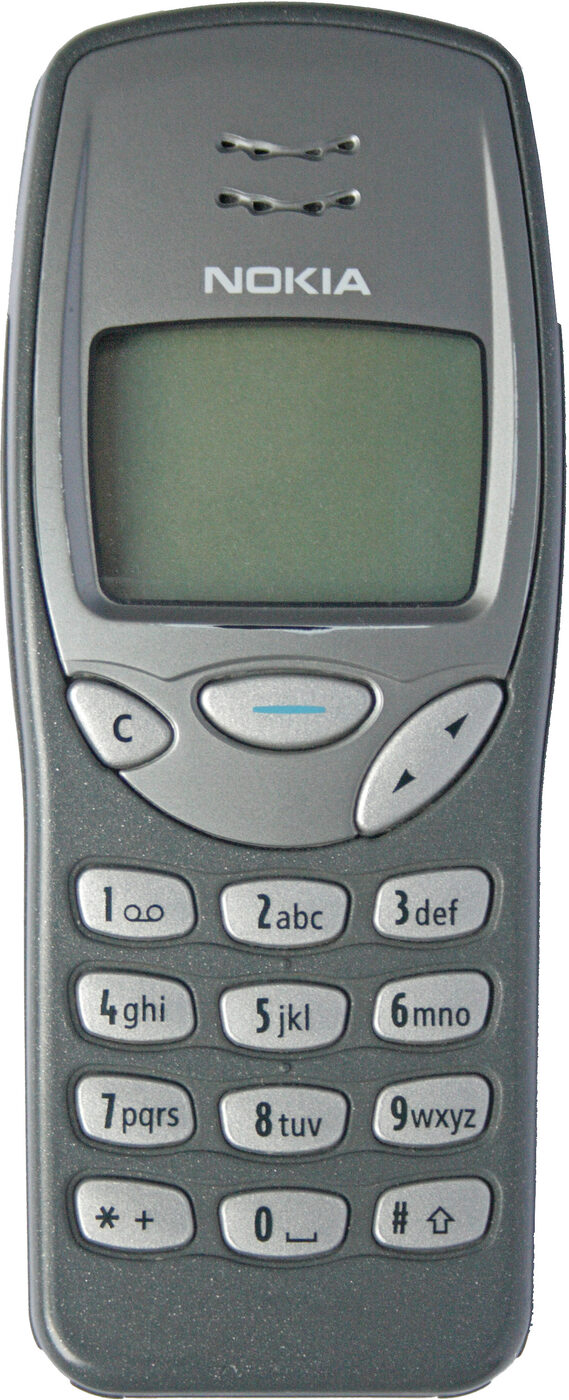

The 3310 followed: announced on 1 September 2000, on sale in the fourth quarter, some 126 million units sold, and remembered chiefly for being extremely difficult to break. For this subject its relevant specification is the ringing-tone provision — over thirty-five tones built in, and space for seven of the owner's own, either composed on the handset or received. It also had an unusually good text-messaging arrangement for its date, including concatenated messages of up to 459 characters, which mattered for a hobby whose subject matter travelled by SMS.
The format's own reference document names the Nokia 61xx range when describing the playable compass, giving the lowest note as the A at 440 hertz and the highest as the B three octaves and a whole tone above it — a small, precise reminder that the specification was written against particular hardware and not in the abstract.
The end of the line, for present purposes, is the Nokia 3510, introduced on 12 March 2002: the successor to the 3310, the first Nokia handset to bring GPRS to the mass market, and the first to ship with a software-based sound engine capable of playing several notes at once. From that model onward a Nokia ringtone was no longer necessarily a single line of single notes, and the premise of this newsgroup began to expire.
How a tone reached a handset without a cable
Composing a tone on the keypad and sending one to somebody else were different problems, and the second was solved by Nokia's Smart Messaging, a proprietary layer riding on ordinary SMS. Its principle was to address a text message to a port number on the receiving handset rather than to the messaging inbox, so that the telephone would route the payload to a subsystem instead of displaying it. The header carried information elements identifying the destination port and, where the payload was too big for one message, the concatenation details: a reference number, the total number of parts, and the index of this one. A ringtone, an operator logo or a caller-group icon was then simply the payload on the appropriate port.
The graphical members of the family give a sense of the scale involved. An operator logo — the small monochrome image that replaced the network name across the top of the screen, and which owners promptly repurposed to display something about themselves rather than about their carrier — was typically 72 by 14 pixels and arrived as two concatenated messages, or one if it was trimmed to 72 by 13. A picture message, which many monochrome Nokias would also accept as a screen saver, was typically 72 by 28 pixels and took three. Those figures are the reason the sibling newsgroups created in June 2001 exist at all: three different payload types, three different sets of tools and pitfalls, and enough traffic in each to justify a separate room.
For the group's purposes Smart Messaging had one decisive property: a tone could arrive over the air, from a service or from another handset, with no cable and no computer anywhere in the chain. It also had one decisive limitation: sending a Smart Message required something able to compose the binary payload and hand it to an SMS gateway, which for most people meant a web service. The newsgroup sat between the two — a place to obtain the notation for free, and then a separate problem of getting it onto the telephone, solved either by the keypad or by whatever gateway one could find.
The over-the-air route was not new. The first tool for making monophonic tones and delivering them by SMS was Harmonium, written by the Finnish programmer Vesa-Matti Paananen for use with Smart Messaging and released in 1997; the Finnish operator Radiolinja, later Elisa, launched it as a downloadable ringtone service in 1998, which is the usual date given for the first such service anywhere. In November 1998 Digitalphone Groupe, later part of SoftBank Mobile, started something comparable in Japan. Both of these predate the newsgroup by months, and both are the commercial version of exactly what the newsgroup did for nothing — which is a tension the group's own paperwork acknowledges, in the June 2001 charters that offer free exchange as an alternative to the sites charging a fee.
Telephony had older addresses on Usenet, and the general questions — networks, tariffs, equipment, the regulatory tangle — were argued in alt.dcom.telecom and its relatives long before any of this. What was new in 1999 was that the interesting part of a telephone had become its personalisation rather than its plumbing.
The tune everybody already had
One tune needed no transcribing, and it is the most persistently misreported fact in the whole subject, so it is worth setting down with the dates attached. The Nokia tune is a phrase from Gran Vals, a waltz for solo guitar composed in 1902 by Francisco Tárrega — born at Villarreal, in the province of Castellón, on 21 November 1852, died at Barcelona on 15 December 1909 — a late-Romantic guitarist and composer better known to guitarists for Recuerdos de la Alhambra and Capricho Árabe, and generally credited with laying the foundations of twentieth-century classical guitar playing and with the instrument's revival as a recital instrument. The phrase Nokia used is taken from bars thirteen to sixteen. It is in A major, and it differs from the original in its last note: in Tárrega's score the phrase closes on an E, and in the ringtone it closes on an A.
The route from the score to the handset is documented and is longer than the folklore allows. In 1992 Nokia used a 1989 recording of Gran Vals by the Czech guitarist Lubomír Brabec as background music in a television commercial for the Nokia 1011; the excerpt used already contained the phrase. In 1993 Anssi Vanjoki, then an executive vice-president of Nokia, played the whole of Gran Vals to Lauri Kivinen, then head of corporate communications, and the two of them chose the four bars. The tune then appeared on the Nokia 2110 of January 1994 — not as a signature, but as an unremarkable item in a numbered list, identified only as ringing tone Type 5, and numbered differently on other models. When the 6110 introduced named tones in December 1997 it acquired the name Grande valse. Only in 1998 was it renamed the Nokia tune and made the company's flagship default, and some later handsets, including some 3310s, still listed it by number.
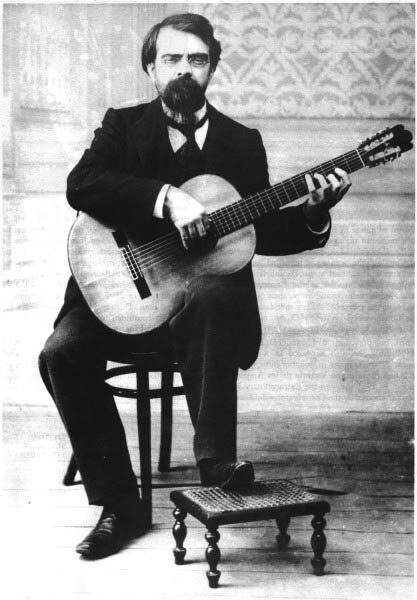

Four years, in other words, elapsed between the tune shipping and the tune becoming the tune. It is generally described as the first identifiable piece of music to serve as a mobile telephone's ringtone, and by 2009 it was being reported as heard worldwide an estimated 1.8 billion times a day — on that arithmetic about twenty thousand times a second — in circumstances its composer would have found difficult to anticipate.
Its later history tracks the hardware precisely, which makes it a useful yardstick for the transition this page describes. The first polyphonic MIDI arrangement of the tune was written by the composer Ian Livingstone — often misattributed to Thomas Dolby, whose company supplied the synthesiser rather than the arrangement — and was introduced in 2001 on two handsets sold only in South Korea, the Nokia 8877 and 8887; the Nokia 3510 of 2002 was the first globally released model to carry it. A recorded piano version, an actual audio file rather than a synthesised score, arrived on the Nokia 9500 Communicator in 2004. Monophonic notation, polyphonic score, recording: the same four bars carried through all three eras, and only the first of the three was something a person could post to a newsgroup.
For a group of this kind the tune was the baseline rather than the material. Nobody needed a transcription of it, because every handset already had it and a great many of them were still set to it. Keying in something else was, among other things, a way of not being the fourth person in the carriage to reach for a pocket.
The trade that grew around it
Alongside the free exchange there grew a business, and for a few years it was a very large one. Its foundation was not the product but the billing arrangement. A tone was bought by sending a text message to a short code, and the charge appeared on the telephone account — no card, no separate account, no age check to speak of, and a payment mechanism already in the hands of buyers too young to hold a payment card. Premium-rate messaging turned a few seconds of synthesised melody into something that could be sold impulsively at a price out of all proportion to its content.
The figures vary with who was counting and what was being counted, and they should be attributed rather than merged. The scholar Sumanth Gopinath put the global ringtone industry at somewhere between 2.5 and 3.5 billion US dollars in 2003, with the Japanese market alone worth around 900 million dollars that year, of which 66.4 million was accounted for by sound-file rather than synthesised tones. The New York-based consultancy Consect estimated worldwide sales of 4 billion dollars in 2004, the figure most often quoted for the peak. Fortune reported worldwide sales of more than 2 billion dollars during 2005. For the United States alone, the research firm SNL Kagan estimated in 2009 that sales had peaked at 714 million dollars in 2007 and fallen to 541 million in 2008. The estimates disagree about levels; they agree about shape, which is a steep climb across the first half of the decade, a peak somewhere in the middle of it, and a fast decline after.
The trade's emblematic firm was Jamba, founded in the Kreuzberg district of Berlin in 2000 and trading as Jamster in the United States and the United Kingdom. VeriSign bought it in late 2004 for 270 million dollars; by the company's own account its turnover went from 15 million dollars a quarter at acquisition to 150 million a quarter three quarters later, and revenue for 2005 approached 600 million dollars. News Corporation announced on 12 September 2006 that it would pay about 188 million dollars for a 51 per cent stake. The advertising was proportionate to the arithmetic: Jamba spent 90 million euros on German television in 2004 alone, concentrated on youth channels.
Its best-known product illustrates how far the object had drifted from anything a newsgroup could trade. Crazy Frog began as a recording made in 1997 by Daniel Malmedahl, then a seventeen-year-old student in Gothenburg, imitating the noise of a two-stroke engine; the recording circulated on file-sharing networks and websites for years, acquired an animated character, and was sold as a ringtone. Released on 23 May 2005, a dance record built on it — a cover of Harold Faltermeyer's Axel F produced by the German act Resource — entered the British singles chart at number one and stayed there four weeks, outselling the week's biggest conventional release. A ringtone had become a hit single rather than the other way round.
The mechanism that made the money was also the mechanism that produced the complaints. In the arrangement that attracted the most of them, a purchase presented as a single tone in fact enrolled the buyer in a recurring subscription charged to the telephone account until cancelled — and cancelling was a second grievance in its own right. In December 2005 the company's German site was noted for omitting, from its published answers to common questions, the text code needed to end all subscriptions. Charges of this kind fell on accounts held by parents and were discovered on bills rather than at the point of sale, which is why the subject moved out of consumer complaint and into regulation.
The regulators, and what they ruled
The United Kingdom offers the best-documented sequence, because its advertising regulator published its adjudications. Premium-rate services themselves had been supervised since 1986 by the Independent Committee for the Supervision of Standards of Telephone Information Services, universally abbreviated ICSTIS, which was set up at the request of three network operators — British Telecom, Mercury Communications and Vodafone — and which renamed itself PhonepayPlus in June 2007 and the Phone-paid Services Authority in November 2016 before its functions passed to Ofcom on 1 February 2025. Advertising, as opposed to the service behind it, fell to the Advertising Standards Authority, and it is the ASA's file on the ringtone campaigns of 2005 that survives in usable detail.
The sequence ran as follows.
- 2 February 2005. Sixty complaints about a ringtone campaign were adjudicated and not upheld. The objections were of three kinds: that the animated character used to sell the tone was anatomically explicit; that the advertisement was unsuitable for children; and that it was broadcast far too often. The Authority found that because the advertisement invited viewers to order by text and therefore carried a premium-rate number, it had automatically been given a restriction keeping it away from programmes made for children; that, although twenty-two complainants were worried children might see the advertising and five were parents embarrassed by the questions their children had asked, no complainant had reported a child being upset by it; and that how often a commercial is shown is a matter for the advertiser and the broadcaster rather than for the regulator. The advertiser nonetheless censored the character in later broadcasts. A parallel complaint in Australia produced a comparable outcome.
- 6 April 2005. Complaints that the advertisements failed to make sufficiently clear that the viewer was subscribing to a service rather than paying once for a ringtone were upheld. This is the substantive finding of the whole affair: not that the product was offensive, but that the price was not what it appeared to be.
- May 2005. Complaints about sheer volume of transmission arrived in unprecedented numbers. The Guardian reported that the advertiser bought 73,716 television spots across all British channels in that month alone, at a cost of around 8 million pounds, close to half of it on a single network.
- 21 September 2005. The Authority ruled that the campaign, along with other ringtone advertisements from the same seller, could not be shown before nine in the evening. The adjudication was revised on 25 January 2006, keeping the decision upheld and altering the wording of one point.
Two things are worth drawing out of that record, both of them relevant to why a free-exchange newsgroup existed in the same years. The first is that the regulator's own reasoning turns on the premium-rate number: the presence of a paid short code was what triggered the scheduling restriction, which is a neat illustration of how completely the billing mechanism had become the product. The second is that the substantive breach was about disclosure of a subscription. A newsgroup where strangers posted note sequences at each other had no billing mechanism to disclose, and the June 2001 charters of the sibling groups say so in as many words, offering free exchange explicitly as an alternative to the sites that charged.
That is a description of what was argued and decided at the time, not an assessment of it. The rulings are quoted here because they are dated, published and specific, and because they are the only part of the ringtone trade that generated a public documentary record of the kind this directory can cite.
What the group carried
No archive of alt.cellular.nokia.ringtones has been indexed in a way that supports counting threads by subject, and this page invents none. What can be described honestly are the classes of posting the group's own charter provides for, and which any group of this shape necessarily carried:
- Transcription requests. The charter's own provision — owners asking for a particular tune, and other readers supplying it. Filled and unfilled in the usual proportions, and with the usual dynamic in which the request is easy to make and the work is not.
- Transcriptions offered unasked. The other half of the same traffic: somebody having done the arrangement and posting it because there was somewhere to post it.
- Format questions. How a field is written, which of the two dot conventions applies, whether a given implementation accepts a name longer than ten characters, what a line does when the octave is left out. A format with two published descriptions that disagree in small ways generates this traffic indefinitely.
- Handset compatibility. Which models hold how many user tones, which accept a tone over the air and which do not, what a given handset does with a tempo value outside the enumerated list, and how the on-screen composer notation maps onto the notation being posted.
- Transfer questions. Getting the thing from the article into the telephone: keypad entry, gateway services, data cables and the software that drove them.
- Advertising. As the trade described above grew, an unmoderated group whose subject was the thing being sold became an obvious target, and alt.* offered no admission control and no reliable way to withdraw a posting once made.
That last category is not incidental to reading the archive. A group of this name, in these years, sitting directly upstream of a business selling the same object for money, was in the position of a shop window that anybody could dress. Whatever proportion of the surviving messages is discussion rather than solicitation, the proportion is not one a reader should assume.
What ended the craft: polyphony, then recordings
The succession happened in two steps, and only the second of them was fatal to a text newsgroup.
Polyphony. Hardware capable of sounding several notes at once reached handsets at the end of the 1990s. Yamaha specified its SMAF format for portable devices in 1999 and built a series of MA sound chips to play it: the MA-1 offered four FM voices, the MA-2 sixteen FM voices with ADPCM playback, and the MA-3 thirty-two FM voices and eight wavetable voices. SMAF resembles MIDI but packages the instrument data — synthesis parameters, or sampled audio — inside the file alongside the notes, so that a tune sounds the same on every handset carrying the same chip. Software synthesis arrived beside the chips: Beatnik's miniBAE, an optimised version of the Beatnik Audio Engine previously used in products such as WebTV, shipped on the Nokia 3510 in 2002. The MIDI world met the constraint halfway with Scalable Polyphony MIDI, a variant of the standard for low-powered devices that lets the polyphony of a piece scale to whatever the playback device can manage, so that one file could sound sensible on a four-voice handset and better on a thirty-two-voice one.
All of that is still notation. A polyphonic ringtone was a score with several parts instead of one, carried in a file of a few kilobytes, and Usenet had been carrying structured data as encoded text since the 1980s. It could in principle still have travelled, and the hobby could in principle have followed it. In practice it did not, for a reason that has nothing to do with transport: a multi-part arrangement with instrument assignments is not something a person keys in on a numeric keypad, and it is not something two strangers correct one field at a time in a follow-up. The tool for making one was a sequencer on a computer, and the natural place to distribute the output was a website with a download button. The first step did not remove the subject matter; it removed the amateur.
Recordings. The second step did remove the subject matter. The first commercial truetone service — an actual audio recording rather than any kind of synthesis, known in Japanese as chaku-uta — was launched by the Japanese operator au in December 2002, with My Gift to You by the duo Chemistry as the first song distributed in the form. A recording is not a notation. Its size is set by its duration and its sampling rate rather than by how many notes it contains; it cannot be corrected, quoted, abbreviated or typed in; and, decisively, the recording is the thing being sold, so distributing it is distributing somebody's master rather than somebody's arrangement. Once a ringtone was an excerpt of a commercial record in MP3 or AAC, the entire premise of a text newsgroup for ringtones had evaporated — not because the network could not carry the bytes, but because there was nothing left for a reader to do with them except play them.
The trade that had grown on premium SMS died shortly afterwards and for related reasons. Once handsets could play ordinary audio files and had internet connections of their own, an owner could make a ringtone from a track they already possessed, or buy the whole song from an online store for less than the excerpt had cost by text message. SNL Kagan's American figures record the fall — 714 million dollars in 2007, 541 million in 2008 — and the decline continued through the 2010s.
The group's own dates fit the arc without needing to be forced. Its founding control message is January 1999, its sibling groups June 2001, and the last administrative message in the ISC archive January 2000. The handset that broke the monophonic premise is March 2002; the service that broke the notation premise is December 2002. A window of roughly three or four years is what the record supports, and it is the window in which a mobile telephone stopped being an appliance and became a possession that people expected to sound like themselves.
What the record does not show
A great deal about this group is simply not documented, and the honest course is to say which parts.
- Who read it. There is no subscriber count, no readership estimate and no reliable traffic series. The proponent's booster message of 13 February 1999 says the group was receiving a substantial number of postings; that is one interested party's characterisation a fortnight in, and nothing corroborates or contradicts it.
- What was in it. No thread has been identified here by title, no participant by name beyond those who signed the control messages, and no message is quoted from the group itself. The archive exists, but it has not been sampled in a way that would let anybody state what the group's typical thread looked like, and a plausible reconstruction is not evidence.
- When it stopped. There is no rmgroup message and no closing announcement. Groups in alt.* generally do not end; they stop receiving posts, and the name stays in the newsgroups file, which is precisely the state this one is in.
- How much of the archive is advertising. This is knowable in principle and unknown in fact. Any figure given for it here would be a guess.
- Whether the transcriptions were lawful. A monophonic arrangement of the melody line of a copyrighted song, distributed for nothing, sat in a legal position that was being actively worked out at the time — the first ringtone licensing arrangements with collecting societies date from the late 1990s — and no court appears to have addressed a Usenet posting of one. The question was live; the answer is not in the record.
What is documented, and unusually well for an alt.* group, is the paperwork: an exact creation date, a named proponent, a verbatim charter, a booster, a corporate housekeeping message and two sibling groups with dated charters of their own. That is more administrative record than most groups in this directory can show, and it is the reason this page can be specific about the group's own history while remaining silent about its contents.
Scope and limits
This page documents a newsgroup and the technical and commercial world it belonged to. A few boundaries are worth stating explicitly.
- No tune data is reproduced here. The syntax of RTTTL is a specification and is set out above in full, with a worked example drawn from a piece of music first performed in 1808. The RTTTL rendering of a particular popular song is a different object, and this directory does not publish one.
- The format's authorship is genuinely uncertain. RTTTL is universally described as Nokia's, and it was the format in which Nokia ringtones circulated; but Nokia's own Smart Messaging specification defines a binary ringing-tone payload and does not name RTTTL, and it has been argued that the text notation originated in third-party software rather than at the manufacturer. This page describes what the format is and how it was used, and does not adjudicate who wrote it.
- Figures are attributed, not merged. The market estimates in this article come from different counters using different definitions in different years, and are given with the counter named. They should not be read as a series.
- The regulatory material is a record of decisions, not an opinion about them. The adjudications are cited because they are dated and published. Nothing here takes a view on whether they were correctly decided.
- The alt.* mechanism belongs elsewhere. How groups were created in this hierarchy, what a control message actually is and what each administrator decided to do with one are the subject of the alt.* hub page; this page uses that machinery without re-explaining it.
The Google Groups archive under this name is the largest surviving body of the group's own text — on the order of thirty thousand messages, with the usual caveats about coverage and with a heavy admixture of later advertising. Read with those caveats, it records a short period in which owning a mobile telephone involved composing music on it, and in which the ordinary way to share a tune was to type it out in one line and let somebody else correct it.
Reading alt.cellular.nokia.ringtones today
- Historical archive: Google Groups — alt.cellular.nokia.ringtones (coverage varies by group and era).
- Open in a newsreader:
news:alt.cellular.nokia.ringtones— the original site offered exactly this link, and it still works if your system has a newsreader registered for thenews:scheme. - Live access: point an NNTP newsreader at a modern server — see accessing Usenet today.
- The original news2mail e-mail subscription service ended in the mid-2000s and no longer operates.