alt.psychology.nlp
Neuro-linguistic programming: practice and critique.
Practitioners, trainers and determined sceptics shared this room; technique threads (anchoring, reframing) ran beside long empirical-evidence battles.
Created on 2 December 1994 and contested within days: the control-message file records nineteen attempts to create the group and fourteen to remove it. The message archive is not preserved here.
On this page
- The group's own paperwork
- The rmgroup war of December 1994
- The argument the control messages preserve
- What NLP claimed, and where it came from
- The founding books, and the market that met them
- The signature techniques, described and not taught
- The evidence, stated plainly
- Where the professional bodies stood
- The training industry
- The lineage disputes, and how they ended
- What happens when a contested practice and its critics share an unmoderated room
- After Usenet
- What the record does not show
- Scope and limits
The group's own paperwork
Groups in the Big Eight hierarchies leave a thick paper trail: a Request for Discussion, a Call for Votes run by a neutral, a published tally, a result posting, and only then a control message. The Internet Systems Consortium mirrors that archive, and its directory listing has folders for comp, humanities, misc, news, rec, sci, soc and talk. There is no folder for alt. There never was a vote on alt.psychology.nlp because in the alt.* hierarchy there is nothing to vote in: no electorate, no votetaker, no threshold, no result to publish. What alt.* had instead was custom — that a proposal should be argued out in alt.config before anybody sent a control message anywhere — and custom leaves a thinner record than procedure does.
The thinner record is not no record. Every syntactically valid control message affecting the group was archived, and the file survives. It is the only substantial primary source this newsgroup has, and it is unexpectedly rich: thirty-three messages, nineteen of them attempting to create the group and fourteen attempting to destroy it, running from 2 December 1994 to 9 February 1998. Twenty-six of the thirty-three were sent in December 1994.
The first is dated Friday 2 December 1994 at 19:22:57 GMT, sent from a Netcom shell account and crossposted to alt.config, alt.psychology and the group it was creating. Its entire body is four lines: a single sentence announcing the group, an invitation to administrators, and the line they were being invited to install:
alt.psychology.nlp Neuro-Linguistic Programming
That last line is the whole of the group's founding documentation. A newgroup control message may carry a one-line description for the master newsgroups file — the descriptions list that administrators install so a reader sees more than a bare name — and this one carried three words. It is not a charter. It does not say who the group is for, what belongs in it, or what does not. Nobody wrote such a document for this group at any point, which is normal for alt.* and is why the summary at the head of this page is editorial rather than quoted.
The same account had, minutes earlier that evening, twice mangled the syntax and created alt.psychology by accident. That mishap belongs to the parent group's page and is not retold here; what matters for this page is that the intended group appeared four minutes after the second misfire, and that the accident and the intention were the work of the same hand on the same evening.
Three decades later the group is still in the namespace. The master newsgroups file distributed from the ISC mirror carries it between alt.psychology.mindmachine and alt.psychology.personality, and the description has been quietly re-set in the intervening decades:
alt.psychology.nlp Neuro-linguistic programming.
The change is small and worth noticing. The 1994 control message wrote the term as a proper noun in initial capitals and left it unpunctuated, in the manner of a brand; the surviving entry lower-cases it and adds a full stop, in the manner of a subject heading. Nobody announced the edit. A few lines above it in the same file, the accidental parent alt.psychology no longer carries a description at all but a redirection — Use sci.psychology.misc instead. The child kept its subject; the parent was told where to go. The companion active file, which is what a server actually reads to decide whether a group exists, still carries the group with the unmoderated flag y and an article range that begins and ends at zero: present, and empty.
The rmgroup war of December 1994
Three days after the group appeared, at 01:24 GMT on 6 December 1994, an rmgroup was issued against it by John M. Grohol, then a graduate student at the Center for Psychological Studies at Nova Southeastern University in Florida, co-moderator of sci.psychology.research and — by his own signature block — founder of over a dozen Usenet newsgroups. He is the same person who in 1995 would propose the reorganisation of the sci.psychology namespace that produced sci.psychology.psychotherapy. His control messages were addressed not to the group but to a pseudo-group, alt.psychology.nlp.ctl, a name that existed only to carry control traffic and that no reader ever subscribed to.
The group's creator answered eight hours later with a newgroup message that was also, unusually, a plea: it asked, in plain words, for advice on how to correct whatever he had done wrong. That is the tone of the first exchange and it does not survive the month.
What follows in the archive is a pattern that repeats for three weeks. An rmgroup goes out; within hours or days a newgroup goes out to undo it; the rmgroup is re-sent. On 7 December Grohol stated his intention in one sentence — the group was, from then on, on automatic rmgroup pilot, his software answering every creation attempt with a removal. On 9 December an administrator in Penn Valley, California, sent an rmgroup reproducing Grohol's reasons verbatim over his own name and from his own site, which is how a two-person dispute becomes a network-wide one.
On 17 December the dispute acquired its most determined participant. Jonathan Grobe, posting from an Iowa service provider, issued a booster newgroup carrying an eighty-line point-by-point rebuttal and a declaration of policy:
Since Mr. Grohol deliberately lied in this rmgroup message, as a matter of principle I will be sending out a booster newgroup message each time he sends out a rmgroup message. [I personally have zero interest in the subject matter of this group.]
The bracketed sentence is the characteristic note. Grobe was not defending neuro-linguistic programming; he was defending a procedure, and he says so inside the parenthesis. The dispute had by then detached itself from its subject entirely.
On 21 December a newgroup message arrived purporting to come from Grohol's own address, carrying his own signature block and his own five numbered objections with the first three of them negated and the closing paragraph turned inside out — the topic was not suited for a mailing list, a need had been cleverly shown to exist, and the group had been removed by an irresponsible individual who was not properly deformed by the alt.config newgroup process. Two administrators identified it as a forgery within a day, one of them signing his rebuttal with PGP, which in 1994 was a considered gesture rather than a routine one, and the other offering, inside his own removal message, a patch to the news software that would detect such fakes automatically. The forgery is preserved in the archive alongside everything else, because the archive keeps valid control messages and says nothing about who really sent them.
The tail of the file records the dispute running down rather than being settled. On 2 January 1995 the group's creator sent a booster whose covering note reads, with a shrug audible across three decades, that the newgroup/rmgroup controversy over this newsgroup seems to be dying down — and then misspells the group's own name in the newsgroups-file line beneath it. On 11 January a site in Korea sent an rmgroup with its Distribution header set to rok, scoping the removal to one country: a reminder that these messages were requests with a geography, not commands. Two further boosters went out in February 1995, their covering text conceding that there had been some confusion about the legitimacy of this group. After that the war stops.
The last three entries in the file are not part of it at all. In June 1995 an administrator at Unisys in Roseville, Minnesota, sent a newgroup with Distribution set to unisys; in February 1998 a server at the National University of Ireland, Maynooth sent two with Distribution set to collabra-internal. These are ordinary housekeeping — one site adding a group to its own active file — and they are in the global archive only because the archive catches everything.
The group survived for a reason that had nothing to do with the merits. The conventional default configuration in alt.*, then and now, is to honour newgroup messages and silently ignore rmgroups; INN's widely distributed control.ctl still ships that policy, with a comment attached that is the honest last word on the whole affair — that there is no official, generally accepted alt.* policy, and that all information about alt.* groups is essentially someone's opinion, including that of the comment itself. An rmgroup in alt.* is an argument, not an instruction. Grohol lost not because he was outvoted, since there was nothing to vote in, but because the network's software was configured to disagree with him.
The argument the control messages preserve
Because both sides wrote at length inside their control messages, the founding argument about this group survives in full, which is more than can be said for the group's actual conversation. It is worth setting out, because it is not the argument a reader might expect.
Grohol's case, refined over successive rmgroups from five numbered points to seven, was this: the topic was better served by a mailing list, and one was being set up; no need for a group had been demonstrated; sci.psychology had carried the subject perfectly well for ten years; NLP was not exclusively a subject within psychology, so the name was wrong; alt.seduction.fast already covered part of the ground; traffic accumulated after a group's creation is a self-justifying argument that would justify any group whatever; and the new room was being used by people from that seduction group as a second shop window for commercial products.
Grobe's rebuttal, sent as the body of a booster newgroup, answered on procedure. The group had been proposed in alt.config as alt.nlp; the alt regulars had insisted that it sit under an existing hierarchy; the name alt.psychology.nlp had been recommended, he wrote, by Michael Grubb, a news administrator at Duke University, and preferred over alt.self-improve.nlp. Most of the discussion had been supportive. And the group had, he said, received 231 posts in its first fortnight according to UUNET's active file — a number that is the only traffic measurement anybody ever offered for this newsgroup, and one that reaches us as a partisan assertion in a control message rather than as an independent count.
Grohol's reply to that figure went to its logic: the argument that a group is justified because it already has traffic is circular, and, he added, the traffic might be no more than the effect of a new newsgroup on the block. He also enumerated, as a reductio, the sub-topics that would deserve groups if this one did — from Jung to Skinner to ELM to biofeedback. alt.psychology.jung was created five months later, in May 1995, and alt.psychology.personality had in fact existed since 1992; the reductio was overtaken by events almost immediately, which is the usual fate of reductios about namespaces.
The taxonomic half of the argument turned on a point about charters that is easy to miss and worth stating, because it applies to most of the rooms this directory catalogues. Grohol's answer to the claim that NLP had been found unwelcome in sci.psychology was that nothing could have been found unwelcome there: that group was unmoderated and had no charter, so there existed no instrument by which anybody could rule a subject in or out of it. The same was true of the room being fought over. Neither side, in three weeks of argument about where a conversation belonged, was arguing from a written rule, because neither room had one.
One further exchange in the file is worth recording because it fixes who the participants were. Grobe's booster of 20 December had told administrators that his opponent was a serious academic psychologist acting on an undisclosed motive. Grohol answered inside the next rmgroup, and the answer is the only self-description he gives anywhere in the archive: the assertion was untrue, he wrote, because he was a graduate student in psychology, as his finger entry stated, and would be a clinical psychologist on graduation. That is the whole of what the primary source establishes about him, and nothing beyond it is asserted here.
The objection about alt.seduction.fast was not a smear and is straightforwardly documented. That group had been created three weeks before this one: its own control-message archive at the same mirror opens on 15 November 1994 and records a newgroup-and-rmgroup exchange of exactly the same shape, fought by several of the same administrators, among them the one who would later identify the alt.psychology.nlp forgery. Its subject was the commercial system marketed as speed seduction by Ross Jeffries, a set of techniques built out of NLP material. Grobe conceded the overlap in as many words — one application of this, he wrote, but not the whole area — and countered that the seduction group had itself been created without discussion, was badly named, and might have commercial overtones of its own. Both men, in other words, agreed that NLP had a commercial wing and disagreed only about which newsgroup should absorb it.
The last third-party voice in the file belongs to neither combatant. In his rmgroup of 28 December Grohol quoted at length, with one passage elided, a posting made two days earlier by Lee Lady of the mathematics department at the University of Hawaii, described in the quoting message as a long-time NLP advocate on the net. Lady opposed the group:
There is already a perfectly good place for discusssions [sic] of NLP, the group to which I have always posted my articles --- sci.psychology. I think it is very important that such discussions take place in a venue where academics who hold rather bizarre beliefs about NLP [...] will have the opportunity to learn what NLP really is.
The position is worth setting down plainly: an advocate of the practice arguing against giving the practice its own room, on the ground that it should be argued out in front of sceptics rather than away from them. In the part of the posting that Grohol elided, Lady added that no equivalent groups existed for gestalt therapy, rational-emotive therapy, transactional analysis or psychodynamic work, and asked why this subject should be the first to get one.
What is nowhere argued in thirty-three control messages, finally, is whether neuro-linguistic programming works. The question is glanced at once, and not on the evidence. Predicting the next rmgroup in his booster of 20 December, Grobe told administrators that his opponent would remove the group for the reason an astronomer would remove alt.astrology, and conceded in the same breath that the group could be characterised as popular psychology lacking a foundation in controlled experimentation — an odd concession from the man sending the message that kept it alive. Grohol never made that argument in any of his fourteen removals; he answered on procedure every time. Nobody in the file defends the practice on the evidence and nobody attacks it on the evidence. The dispute is about taxonomy, procedure and where a conversation should be held — the characteristic Usenet argument, conducted with complete seriousness at the door of a room whose contents nobody involved was discussing.
What NLP claimed, and where it came from
The room the argument was about had a subject, and the subject has a documented history that is frequently misdated in secondary retellings. The account below is drawn from the published record and the dates are those on the books themselves.
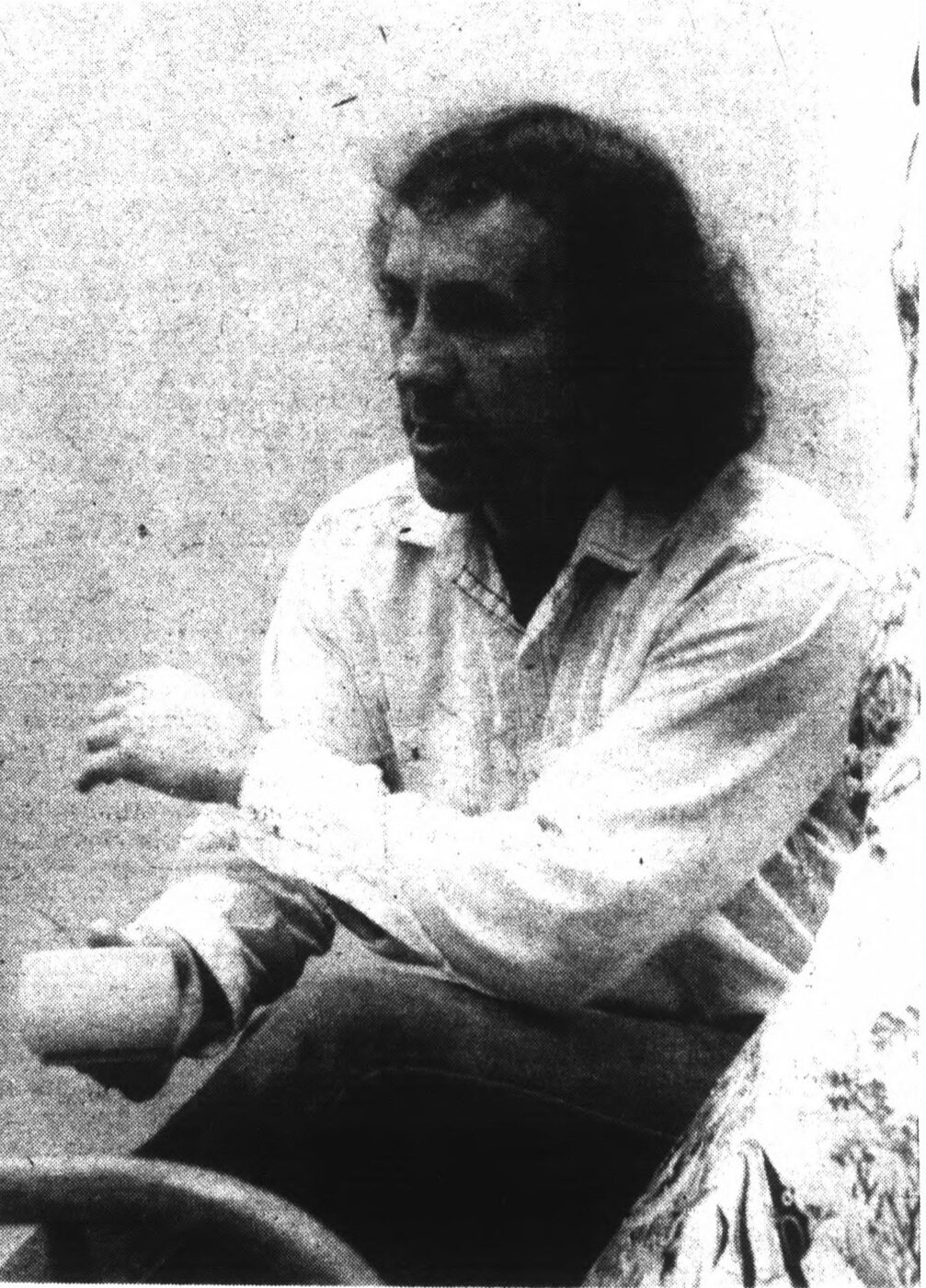
Neuro-linguistic programming originated at the University of California, Santa Cruz in the first half of the 1970s, in the collaboration of two people with markedly different standing. John Grinder, born in 1940, took a doctorate in linguistics at the University of California, San Diego in 1971 with a dissertation on deletion phenomena in English, worked in George A. Miller's laboratory at Rockefeller University, and took a full-time post as an assistant professor of linguistics at Santa Cruz, publishing on transformational grammar with Paul Postal and co-authoring a textbook on it with Suzette Haden Elgin. Richard Bandler, born in 1950, was an undergraduate at the same campus, taking a bachelor's degree in philosophy and psychology in 1973 and a master's in psychology from Lone Mountain College in San Francisco in 1975. Bandler had worked on transcripts for the publisher Science and Behavior Books and ran a student group in Gestalt therapy; Grinder, according to the standard account, told him that the questions he was asking in that group could be described in the vocabulary of transformational grammar. Later histories written from inside the field add Frank Pucelik as a third member of the early Santa Cruz group; the founding books carry two names.
.jpg)
The premise they announced was called modelling. Bandler and Grinder asserted that the effectiveness of an exceptional practitioner is not a personal gift but a describable structure of language and behaviour; that the structure can be extracted by close observation; and that, once extracted, it can be taught to somebody else. The three practitioners they said they had modelled were Milton Erickson, the psychiatrist known for his approach to clinical hypnosis and founding president of the American Society for Clinical Hypnosis; Virginia Satir, the clinical social worker known as a founder of family therapy; and Fritz Perls, who with Laura Perls had developed Gestalt therapy, who lived at the Esalen Institute at Big Sur from 1964 until 1969, and who died in Chicago in March 1970, before the collaboration described here began. They also invoked Gregory Bateson, the anthropologist and cyberneticist, and Noam Chomsky's transformational grammar.
Those invocations were contested early and have been contested since. The linguist Karen Stollznow, writing in Skeptic in 2010, characterised the citations as name-dropping and observed that apart from Satir the figures named did not collaborate with Bandler or Grinder; Chomsky has no association with the field, and, she wrote, other than borrowing terminology NLP does not bear an authentic resemblance to any of his theories. The psychologist Jean Mercer, in the Encyclopedia of Clinical Psychology (2015), wrote that Chomsky's theories appear to be irrelevant to it. André Muller Weitzenhoffer, a hypnosis researcher who had known Erickson, wrote in 1989 that the major weakness of the linguistic analysis is that so much of it is built upon untested hypotheses and supported by totally inadequate data.
Grinder's own retrospective account of the project's ambition is on the record and is unusually candid. In a 1996 interview he recalled that during the founding years — he dates them 1973 to 1978 — he and Bandler were explicit that they were out to overthrow a paradigm, and that he planned the campaign partly by reference to Thomas Kuhn's The Structure of Scientific Revolutions, adding that he considered it useful that neither of them was qualified in the field they first went after. The philosopher Robert Todd Carroll replied, in The Skeptic's Dictionary, that Kuhn's book is a work of history and not a manual, that paradigm shifts are not planned by volition, and that nothing in NLP made it impossible to continue doing psychology without it.
The founding books, and the market that met them
The literature has a clear spine, and its dates matter because they are so often reported wrongly.
- The Structure of Magic I: A Book about Language and Therapy (Science and Behavior Books, 1975), by Bandler and Grinder, with a foreword by Virginia Satir and an introduction by Gregory Bateson. It presents the Meta-Model, a scheme for interrogating a speaker's language, and is offered as a codification of what Perls and Satir did.
- Patterns of the Hypnotic Techniques of Milton H. Erickson, M.D., Volume I (Meta Publications, 1975) by Grinder and Bandler, and Volume II (1977) with Judith DeLozier. These set out what became known as the Milton-Model, described by its authors as deliberately vague and metaphorical language.
- The Structure of Magic II: A Book about Communication and Change (Science and Behavior Books, 1976).
- Changing with Families (Science and Behavior Books, 1976), written with Virginia Satir.
- Frogs into Princes: Neuro Linguistic Programming (Real People Press, 1979), edited by Steve Andreas from seminar transcripts. It is the book most people met the field through, and it has sold more than 270,000 copies.
- Neuro-Linguistic Programming: Volume I — The Study of the Structure of Subjective Experience (Meta Publications, 1980), by Robert Dilts, John Grinder, Richard Bandler and Judith DeLozier: the nearest thing the field produced to a systematic statement.
- Trance-Formations: Neuro-Linguistic Programming and the Structure of Hypnosis (Real People Press, 1981) and Reframing: Neuro-Linguistic Programming and the Transformation of Meaning (Real People Press, 1982).
The phrase that named the whole enterprise arrives late in that list. The 1975 and 1976 books do not use it in their titles; it appears as the subtitle of Frogs into Princes in 1979 and as the title of the Dilts volume in 1980. The field was four or five years old before it was branded.
The setting was the northern-Californian growth industry in personal transformation. The Esalen Institute at Big Sur, the best-known institution of the human potential movement, had been the venue for Perls's Gestalt seminars; Satir was an early leader there and Bateson a guest teacher. By the late 1970s that movement had become a market, and Bandler and Grinder entered it. The best-documented account of the transition is a 1989 investigation by Frank Clancy and Heidi Yorkshire in Mother Jones, which records that after 150 students each paid a thousand dollars for a ten-day workshop the pair gave up academic writing in favour of books made from seminar transcripts, and which cites court documents from the later intellectual-property litigation showing that Bandler earned more than $800,000 from workshops and book sales in 1980. The same article supplies the slogan under which the material was sold beyond therapy: if any human being can do anything, so can you.


The claims made in the books themselves were not modest. Bandler and Grinder wrote that the methods could address phobias, depression, tic disorders, psychosomatic illness, learning disorders and more, often in a single session; in a seminar they claimed effects on short-sightedness and the common cold. A 1993 book of Bandler's opens by asserting that in single sessions practitioners can accelerate learning, neutralise phobias, eliminate allergies and lead firewalks without roasting toes. These are recorded here as claims made by the originators in their own books and seminars, which is the only status the record gives them.
The signature techniques, described and not taught
What follows describes what the practices were asserted to do and how their proponents accounted for them. It is a description of a literature, not an instruction in anything, and no operational detail is given.
Representational systems, predicates and eye-accessing cues
The best-known theoretical claim holds that a person's inner experience is coded in sensory modalities — visual, auditory, kinaesthetic, and more marginally olfactory and gustatory — and that individuals show a bias towards one of them, the preferred representational system. The bias was said to be detectable from outside in two ways: from the sensory verbs a speaker chooses, so that a visual person says I see what you mean where an auditory one says I hear what you say; and from the direction in which the eyes flick while the person is thinking, the so-called eye-accessing cues, charted in Frogs into Princes as six positions corresponding to constructed and remembered images, constructed and remembered sounds, bodily feeling and internal dialogue. The central practical hypothesis attached to the model, as the later systematic reviewers phrased it, was that communication is more effective or more persuasive when it is matched to the other person's preferred system. This is the part of the theory that was tested, and the section below reports what the testing found.
Rapport, pacing and mirroring
Rapport in this literature is not a mood but a claimed technique: the practitioner is said to establish it by pacing and then leading the other person's behaviour, matching verbal choices and non-verbal conduct before attempting to influence them. It is presented as the precondition of everything else, and in the standard sequence described in a 1984 account in Canadian Family Physician it comes first, ahead of gathering information, intervening, and rehearsing the change.
Anchoring
Anchoring is the assertion that an emotional state present at the moment of a distinctive stimulus becomes attached to that stimulus, so that later presentation of the stimulus re-evokes the state, and that such associations can be established deliberately as well as accidentally. Its proponents traced the idea to Satir. Its critics point out that as stated it is classical conditioning under another name, and the authors of the 2012 systematic review made exactly that mapping when explaining why they excluded single-technique studies: rapport corresponds to person-centred counselling, modelling to vicarious learning, well-formed outcomes to goal setting, reframing to techniques from cognitive behavioural therapy, and anchoring to classical conditioning.
Reframing
Reframing is the claim that changing the context or the described meaning of an event changes the response to it — that the same behaviour understood differently is responded to differently. It is not claimed to be original even inside the field, and the authors of the 2012 systematic review mapped it directly onto techniques from cognitive behavioural therapy. It has an obvious ancestry in ordinary rhetoric and in the older schools of psychotherapy, and it is the NLP technique most often reported as having crossed over into other practices, among them the brief and systemic therapies.
The models, and the rest
Two named language schemes bracket the practice: the Meta-Model of 1975, a set of challenges to vague or absolute statements, and the Milton-Model, its deliberate inverse, a vocabulary its authors called artfully vague and metaphoric, attributed to Erickson and used to soften. Around them accumulated a large and never-standardised inventory of named procedures — future pacing, the swish pattern, visual-kinaesthetic dissociation, well-formed outcomes, sleight of mouth, and many others recorded in the field's own encyclopaedias. The inventory grew rather than settled, and its growth is itself a documented feature: as the number of practitioners rose, the field became, in Stollznow's phrase, even less uniform than it was at its foundation.
The evidence, stated plainly
The theoretical claims of NLP were tested repeatedly from the early 1980s onwards, and the sequence in which that testing happened is on the record with citations attached. What follows is that sequence.
The claims were tested first because they were testable. The preferred representational system, being an assertion that an observable — word choice, or the direction of an eye movement — indexes an internal state, is exactly the kind of proposition counselling psychology in the early 1980s was equipped to check, and it attracted a wave of studies. Christopher F. Sharpley reviewed them in the Journal of Counseling Psychology in 1984 under the title Predicate matching in NLP: a review of research on the preferred representational system (volume 31, pages 238–248), and found the model unsupported. In 1985 M. Elich, R. W. Thompson and L. Miller published, in the same journal, Mental imagery as revealed by eye movements and spoken predicates: a test of neurolinguistic programming (volume 32, pages 622–625); their results did not support the claimed relationships, and the paper described the practice as a psychological fad.
Practitioners answered. Eric Einspruch and Bruce Forman, also in the Journal of Counseling Psychology in 1985 (volume 32, pages 589–596), argued that the research literature had misunderstood what it was testing and catalogued methodological errors in it. Sharpley returned to the question in 1987 with Research findings on neurolinguistic programming: nonsupportive data or an untestable theory? (volume 34, pages 103–107), which considered that defence and concluded against it, finding little support for a preferred representational system detectable either in word choice or in eye movement. A 1987 study by Buckner and colleagues did report that eye movement could indicate visual and auditory — though not kinaesthetic — components of thought at a given moment, which is the nearest thing to a positive finding in the sequence and considerably narrower than the claim it was testing.
Two reviews closed the first period. In 1988 the United States National Research Council published Enhancing Human Performance: Issues, Theories, and Techniques, edited by Daniel Druckman and John Swets, whose committee examined a range of proposed performance-enhancement methods; its treatment of NLP found little support for the influence of preferred representational systems as described in Frogs into Princes and The Structure of Magic. The report also records a detail that no summary should omit: at a meeting with Richard Bandler in Santa Cruz on 9 July 1986, the committee's influence subcommittee was informed that the preferred representational system was no longer considered an important component of NLP, and that NLP had been revised. In the same year Michael Heap published Neurolinguistic programming: an interim verdict as a chapter in Hypnosis: Current Clinical, Experimental and Forensic Practices (Croom Helm, pages 268–280), reaching the same negative conclusion about the representational-system claims.
Interest then faded, and the fading is itself documented. Fewer studies evaluating the methods of NLP appeared in the 1990s than in the decade before, a decline Tomasz Witkowski attributes to the debate having run out of empirical support to argue about. Grant Devilly, writing in the Australian and New Zealand Journal of Psychiatry in 2005, gave the same account of the trajectory: NLP was advertised in the early 1980s as an important advance, attracted research interest, and lost it as controlled trials failed to show benefit while its advocates' claims grew.
Later work has not reversed any of this. Tomasz Witkowski's Thirty-Five Years of Research on Neuro-Linguistic Programming in the Polish Psychological Bulletin (2010, volume 41 number 2) surveyed the accumulated database and concluded, in a formulation that has been quoted ever since, that the analysis led undeniably to the statement that NLP represents pseudoscientific rubbish. Gareth Roderique-Davies, in the Journal of Applied Research in Higher Education in 2009, argued that dismissing negative findings on the ground that the studies misunderstood the practice constitutes an admission that NLP does not have an evidence base and that its practitioners are seeking a post-hoc credibility.
The most systematic single piece of evidence is the review by Jackie Sturt and colleagues in the British Journal of General Practice (November 2012, volume 62, pages e757–e764). Searching seven bibliographic databases plus specialist NLP sources, professional associations and training providers, the authors screened 1,459 titles and found ten experimental studies fit to include — five randomised controlled trials and five pre-post studies, covering anxiety disorders, weight maintenance, morning sickness, substance misuse and claustrophobia during MRI scanning. Four of the five trials reported no significant difference between groups; one favoured the NLP arm. Risk of bias across all ten was high or uncertain. The conclusion is quoted here exactly, including the qualification that accompanies it:
There is little evidence that NLP interventions improve health-related outcomes. This conclusion reflects the limited quantity and quality of NLP research, rather than robust evidence of no effect.
That second sentence is part of the finding and is left in deliberately. The literature's position is that the claims are unsupported; it is not, in the words of the most rigorous review, a demonstration that nothing whatever happens. Separately, in July 2012, Richard Wiseman, Caroline Watt, Leanne ten Brinke, Stephen Porter, Sara-Louise Couper and Calum Rankin published The Eyes Don't Have It: Lie Detection and Neuro-Linguistic Programming in PLoS ONE, testing the specific proposition that the eye-movement patterns distinguish truthful from fabricated statements. It did not.
Taken together the reviews are consistent across three decades, several countries and two disciplines, and the position they arrive at is the one recorded in reference works: the theoretical claims of NLP have been tested and are not supported, and the practice is classified as pseudoscience. That is the state of the literature, reported here with the citations by which a reader can check it.
Where the professional bodies stood
Formal position statements on NLP are scarcer than reviews, partly because it never sought or received recognition from a licensing body, and partly because the discipline's usual instrument for this sort of judgement is the expert survey rather than the proclamation.
Those surveys exist. In 2006 John C. Norcross, Gerald P. Koocher and Ariele Garofalo published a Delphi poll of experts in Professional Psychology: Research and Practice (volume 37, pages 515–522) asking which psychological treatments and tests were discredited; NLP appeared there, rated comparably with dolphin-assisted therapy, equine-assisted therapy and scared-straight programmes. In 2010 Norcross and colleagues, writing in the Journal of Addiction Medicine, placed it seventh in a list of the ten most discredited interventions in the addictions.
On medical claims the position is blunter. The American Cancer Society Complete Guide to Complementary and Alternative Cancer Therapies (second edition, 2009) records that NLP has been promoted as able to treat conditions including Parkinson's disease, HIV/AIDS and cancer, states that no medical evidence supports such claims, and notes the specific hazard that using it as a treatment may delay effective medical care. That is the American Cancer Society's own statement rather than a summary of it, and the body that wrote it is named here because it is the point on which a reader is likeliest to want the source.
In educational and clinical-psychology teaching, NLP has acquired a settled secondary role as a worked example. It is used as a standard illustration of pseudoscience in textbooks on critical thinking in psychology and on scientific thinking in speech and language therapy, and appears in the science-versus-pseudoscience teaching literature. That is a kind of institutional position too: not a condemnation issued by a body, but a consensus visible in what the discipline teaches its students.
The one measurement of official uptake comes, unexpectedly, from the 2012 review team. Before conducting their systematic review, Sturt and colleagues sent a Freedom of Information request in June 2009 to every NHS primary care trust, mental health trust, hospital trust, ambulance trust, care trust and strategic health authority in the United Kingdom — 414 organisations, of which 326 replied. The responses recorded £802,468 of spending on NLP-related activity over a three-year period and more than 700 staff trained, three-quarters of them in administrative or managerial roles rather than clinical ones; the clinical minority included counsellors and clinical psychologists. The authors describe the spending as modest but widespread. Its largest single item, £200,000 on weight-loss counselling, was itself a research study.
The training industry
NLP's commercial architecture was in place before most of its research literature existed. In 1979 Bandler and Grinder established the Society of Neuro-Linguistic Programming to handle the commercial side — training, materials and certification — with exclusive rights to profit from training and certification conferred on Bandler's corporate entity. The product was a tiered credential; the levels most often offered, then and later, are diploma, practitioner and master practitioner, awarded on hours of study and practice. The tiers had no external validator, and after the litigation described below they had no owner either.
The spread was rapid and it was lateral rather than clinical. The techniques were generic enough to be re-badged, and by the 1990s NLP material was being sold into sales, negotiation, management training, teaching, coaching, team building, public speaking and recruitment. Two figures illustrate the routes it took into the wider culture. Steve Salerno's Sham: How the Self-Help Movement Made America Helpless records that Tony Robbins, whose Unlimited Power appeared in 1986, trained with Grinder and used a few NLP ideas in his own self-help and motivational programmes. In Britain the material reached a mass audience through Paul McKenna, the television hypnotist whose self-help books sold in very large numbers and who has presented seminars in hypnosis and neuro-linguistic programming since the 1990s.

.jpg)
Because nobody owns the terms, anybody may certify anybody. The consequences of that were demonstrated in October 2009, when Chris Jackson, a presenter on the BBC regional programme Inside Out, registered a cat named George with three United Kingdom industry bodies, one of them the British Board of Neuro Linguistic Programming, each of which accepted a certificate from a non-existent Society of Certified Advanced Mind Therapists as proof of the animal's credentials. The board's response, as reported by the BBC, was that it exists only to provide benefits to its members and not to check or certify credentials — a candid statement of what an accrediting body in this field was and was not doing. The stunt repeated an earlier American demonstration by the clinical psychologist Steve Eichel, who had certified his own cat with several lay hypnosis organisations.
The commercial life of the practice is also, incidentally, what put it on Usenet in the shape it took. The objection recorded in the December 1994 control messages — that a new psychology group was being used as a second shop window by people selling a seduction system — is an objection about the training industry, made about this newsgroup three years before Bandler's British trademark in the term was revoked and six before the founders finally settled with one another.
The lineage disputes, and how they ended
The originators spent two decades in litigation over the thing they had founded, and the outcome shaped what NLP is administratively — which is to say, nothing that anybody owns.
The published summaries of the court record run as follows. Bandler and Grinder ceased collaborating around November 1980. On 25 September 1981 Bandler sued Grinder's corporate entity in the Superior Court of California for Santa Cruz County, seeking an injunction and damages over Grinder's NLP-related commercial activity; judgment was entered in Bandler's favour on 29 October 1981, and the settlement that followed granted Grinder a ten-year licence to run seminars, certify practitioners and use the name, against royalties.
Bandler litigated again in July 1996 and January 1997, this time against Grinder's company, a range of other figures in the field and two hundred initially unnamed defendants, alleging breach of the earlier settlement and seeking damages of not less than ten million dollars from each. In February 2000 the court ruled against him, the judgment holding that he had misrepresented his exclusive ownership of the intellectual property and his sole authority over Society of NLP membership and certification. Separately, in December 1997, a civil proceeding brought in the United Kingdom by Tony Clarkson resulted in the revocation of Bandler's British trademark in the term.
In late 2000 the two men settled, acknowledging one another as co-creators and co-founders and undertaking not to disparage each other's activities. The consequence is the one that matters for anybody reading a certificate: the terms NLP and neuro-linguistic programming are in the public domain, no party holds exclusive rights, there is no restriction on offering certifications, and nothing prevents a person from describing themselves as a master practitioner or a master trainer. The field's decentralisation is thus not an accident of enthusiasm but the direct legal result of its founders failing to divide it.
Karen Stollznow noted the irony available in this — that a practice advertising itself as a technology of communication and conflict resolution should have been unable to settle its own founding dispute without twenty years of courts. Grant Devilly, less gently, described the resulting proliferation of associations as granfalloons, borrowing Vonnegut's word for an organisation whose members share no real common purpose. Both remarks are opinions of named critics and are recorded here as such.
What happens when a contested practice and its critics share an unmoderated room
The summary at the head of this page describes alt.psychology.nlp as a room that held practitioners, trainers and determined sceptics together. That is a documented Usenet pattern rather than a peculiarity of this group, and the structural consequences of it can be stated without quoting a single thread — which is fortunate, because no thread from this group is quoted anywhere on this page.
Begin with what the software provided. An unmoderated newsgroup has no gate, no membership, no roles and no persistence of authority. Nobody could be excluded and nobody could be admitted, because there was no act of admission; the group propagated to every server that carried alt.*, and anybody reading news at such a server could post to it at no cost and under any name. There was no charter to appeal to — this group never had one — and no moderator to appeal to either. The only editorial instruments available were the ones every reader held individually: the kill file, the Followup-To header, and the decision to stop replying.
Four consequences follow from that architecture, and they follow whoever the participants happen to be.
- No accumulation. A newsgroup has no state. Nothing that was established in March is established in April except in the memory of whoever was present, and every arrival restarts the discussion from the beginning. Periodic FAQ postings were the standard remedy and were only ever partial, since nothing compelled anyone to read one.
- Asymmetric cost. A claim can be made in one line; an answer citing the literature takes paragraphs, and the person supplying it has to find the citations again each time. In a medium with no editorial filter, the effort required to assert and the effort required to refute are not equal, and the imbalance favours whichever side is content to repeat itself.
- No terminating move. Threads on Usenet do not end in a finding; they end when the last person loses interest. A contested empirical question therefore never closes inside the group, however thoroughly it may have closed outside it.
- Porous borders. Crossposting meant a dispute could be carried into neighbouring rooms and back — and the neighbouring rooms here were sci.psychology, alt.hypnosis and alt.self-improve, named in this group's own control messages as the places the conversation had previously been split across, together with alt.seduction.fast, named in the same messages as an overlapping room rather than a former home.
What makes this group unusual is not that it exhibited the pattern but that its founding paperwork argues about the pattern explicitly. One side held that a subject already discussed in a general scientific group should stay there, so that its advocates and its critics remained in the same room; the other held that a distinct interdisciplinary subject deserved its own address, and that readers of the general group would benefit from being able to filter it out. Both positions are on the record in December 1994, both are stated with reasons, and the person who put the first of them most sharply — that discussions should take place where academics with what he considered bizarre beliefs about NLP could learn what it really was — was an advocate of the practice, not a critic of it. Whether the room that resulted worked as either side predicted is not something this page can tell you, because the evidence for that would be the traffic, and the traffic is not what survived.
After Usenet
Two things went their separate ways after the late 1990s: the newsgroup and the subject.
The newsgroup followed the ordinary path. Usenet's general readership drained away to the web through the 2000s; the searchable archive that had made the network feel permanent passed from Deja News, operating since March 1995, to Google, which bought it in February 2001 and rebuilt it as Google Groups. That gateway lasted twenty-three years: Google stopped supporting the posting and viewing of new Usenet content on 22 February 2024, leaving the existing archive readable. alt.psychology.nlp remains in the master newsgroups file and the active file to this day, which is a statement about the durability of a line of text and not about the presence of readers.
The subject went in the opposite direction, and it went commercial. The 2010s literature places NLP squarely inside the coaching industry: Siegfried Greif's chapter Pseudoscience and Charlatanry in Coaching, in the International Handbook of Evidence-Based Coaching (2022, pages 755–772), treats it as a leading example of the genre. The 2012 systematic review found training organisations and practitioner registers internationally widespread across Europe, North America and Australia, and observed that the targeting of medical and healthcare professionals by NLP organisations was at that point concentrated in the United Kingdom. The seduction wing that alt.seduction.fast had represented moved off Usenet too, into the web forums, mailing lists and blogs that grew out of it and that are documented in the histories of that scene.
NLP outlived the newsgroup, outlived the research interest that had once tested it, and outlived the litigation that failed to give anybody ownership of it. What the reviews summarised above report that it has not acquired, in the half-century since The Structure of Magic I, is an evidence base. The record of the industry that grew in the meantime is, in any case, considerably better documented than the record of this newsgroup ever was.
What the record does not show
The honest inventory of gaps for this group is long, and stating it is part of what a page like this is for.
- No readership figure. There is exactly one traffic number anywhere in the record — 231 posts in the group's first fortnight — and it appears inside a partisan control message, attributed to UUNET's active file, offered by a participant who was arguing for the group's survival. It should be read as a claim, not a measurement. No subscriber estimate, no site-count and no later traffic figure exists.
- No charter and no statement of purpose. Three words in a newsgroups-file line are all the group was ever given.
- No moderator, no FAQ, no group-run archive. Nothing was found under any of those headings, and their absence is unremarkable for an unmoderated alt.* group of the period.
- No thread-level record consulted here. Not one posting to the group itself is quoted on this page. Everything quoted comes from the control-message archive, including the single posting by a third party that survives because an opponent quoted it into a removal request.
- No identities beyond the headers. The people in the control archive are known here only as their From lines and signature blocks present them; nothing further has been established about them and nothing further is asserted.
- No date of death. When the group stopped carrying meaningful traffic is unknown. Its continued presence in the namespace proves only that no one has removed the line.
- No external notice. No research paper, professional body, textbook or press account has been found that mentions this newsgroup. That is the normal condition of an alt.* group and it is stated so that nobody mistakes silence for suppression.
One further gap is worth naming precisely, because it is the one a reader is most likely to want filled. The evidential dispute described earlier in this article — the reviews, the failed replications, the fading of research interest — demonstrably happened in the journals between 1984 and 2012. That some version of it also happened in this newsgroup is the summary at the head of this page and is entirely plausible given who the paperwork shows was present. It is not, however, something this article can document, and it is not documented here.
Scope and limits
This page is historical and documentary. It records what a newsgroup was, when and how it was created, what fight attended its creation, and what its subject was claimed to be by the people who made the claims. It gives no instruction in any technique, offers no assessment of anybody's practice, and is not a source of guidance of any kind about health, therapy or personal difficulty.
Every claim about the practice itself is attributed to whoever made it. Where the originators are described, the descriptions come from their own books and interviews; where critics are described, they are named and dated. The empirical section reports what named reviews in named journals concluded, quotes the 2012 systematic review verbatim including the qualification its authors attached, and does not go beyond it. The judgement that the theoretical claims are unsupported is the literature's judgement, not this directory's editorial addition, and the citations are given so that a reader can check it rather than take it.
The group-specific material is drawn from one source: the archived control messages for alt.psychology.nlp, together with the current master newsgroups and active files, both mirrored publicly by the Internet Systems Consortium. Quotations from those messages are exact, including their spelling. Nothing about the group's contents, membership, size or lifespan has been inferred and presented as fact.
Adjacent subjects belong to their own pages and are not restated here: alt.psychology for the branch, its accidental creation and the 1995 reorganisation of the sci.* psychology groups; sci.psychology.psychotherapy for psychotherapy as a field, outcome research and the empirically-supported-treatments argument of the era; alt.psychology.jung and alt.psychology.personality for the neighbouring rooms in the same branch.
Reading alt.psychology.nlp today
- Historical archive: Google Groups — alt.psychology.nlp (coverage varies by group and era).
- Open in a newsreader:
news:alt.psychology.nlp— the original site offered exactly this link, and it still works if your system has a newsreader registered for thenews:scheme. - Live access: point an NNTP newsreader at a modern server — see accessing Usenet today.
- The original news2mail e-mail subscription service ended in the mid-2000s and no longer operates.