alt.psychology.personality
Personality theory and type systems.
MBTI, Big Five, enneagram and older typologies compared, tested on volunteers and argued over — the group where type-system enthusiasm met psychometric criticism head-on.
Its test-construction threads were a lay introduction to reliability and validity for many readers.
On this page
- The group's own paperwork
- What the one-line description was asking for
- 1995: the science hierarchy calls it the lay-person newsgroup
- The Myers-Briggs instrument, as it was used
- The enneagram: a figure, then a typology
- The older typologies the room inherited
- The other systems in circulation
- Type against trait
- Reliability, validity and the amateur questionnaire
- The commercial and institutional life of the popular instruments
- The online test as a genre
- What the record does not show
- Scope and limits
The group's own paperwork
The alt.* hierarchy has no ballot. A group there exists once somebody sends a newgroup control message and enough news administrators decide to honour it; the only governance is custom, and the custom was that a name should be argued out in alt.config first. alt.psychology.personality followed the custom, and the document that created it survives in the Internet Systems Consortium's mirror of the Usenet control traffic. It is dated 22 November 1992 and was issued from a news account at Amherst College in Massachusetts, in the name of Tim Pierce.
The message header gives the body as thirteen lines. It opens:
The group alt.psychology.personality, for the discussion of personality typology and tests such as the Myers-Briggs test, is being created after a discussion period in alt.config. The candidate names included alt.personality, alt.personality.types, alt.myers-briggs, and some others. alt.psychology.personality was selected by popular consensus as the best balance between descriptiveness and generality.
The rejected names are on the record too. alt.myers-briggs would have given a commercially published questionnaire its own room in the global namespace; alt.personality.types would have settled the central question of the subject in the name, before anybody posted. The name chosen instead placed the topic under psychology and left open whether personality comes in types at all. The message closes by naming Jon Noring, at a netcom.com address, as the newsgroup's original instigator, and by supplying the line that news administrators were asked to paste into their descriptions file. That line was, and remains, exactly this:
alt.psychology.personality Personality taxonomy, such as Myers-Briggs.
Three later control messages sit in the same archive: a reissue on 18 December 1997 from an address styled the MHN Newsgroup Daemon at Mental Health Net (cmhc.com), and a pair sent about ten minutes apart on 12 January 2003 from a Hotmail address. All three carry the same one-line description, with and without its full stop. There is no rmgroup at all. That is a quieter record than its notional parent managed: alt.psychology was created by accident two years later and drew repeated removal attempts in its first seven months, a story told on the branch page. This group was proposed in alt.config, named there by consensus, and has never carried a removal message.
It also came first. Its 22 November 1992 control message predates the creation of alt.psychology by two years and ten days, making it the oldest group in the branch it appears to hang from. Naming hierarchies imply descent; alt.* names imply nothing of the kind, because nothing in the news software requires a parent to exist before a child can.
The group acquired exactly one descendant of its own, and not a flattering one. On 6 April 2006 an anonymous control message, carrying a French-language newsgroup in its own Newsgroups header and posted through an anonymising host, created alt.psychology.personality.pinku-sensei — a name formed from a pseudonymous poster's handle, with a description that is a personal jibe rather than a topic. It is still carried in the master newsgroups file, and no removal message for it appears in the archive either. Vanity and attack groups of this kind were an ordinary hazard of alt.* by the mid-2000s.
What the one-line description was asking for
The description line is five words long — Personality taxonomy, such as Myers-Briggs — and each of them does work. Taxonomy is the business of classification: of deciding what the kinds are, what belongs in each, and how the kinds relate. It is not the same activity as measurement, which asks how much of something a person has. The difference between those two activities runs through everything set out below.
The example is more unusual than it looks. Newsgroup descriptions normally name a subject, not a product. This one names a commercially published questionnaire, still in print and still under copyright, as the illustration of what the room was about — as though a group about cameras had been described as photographic equipment, such as Leica. Whether that matched the group's actual traffic cannot be checked against the surviving record; what it does show is how far one instrument had come to stand for the whole subject by 1992.
The surrounding namespace shows the division of labour. alt.support.personality, a separate group, is described in the newsgroups file as a group for those with personality disorders: clinical categories, not taxonomies of the normal. alt.psychology.jung took the theory the Myers-Briggs instrument descends from, and is documented separately in this directory. In the Big Eight, sci.psychology.personality carries the description All personality systems & measurement. That group's subject is the research literature: factor structure, construct validity, behaviour genetics, the replication years. It has its own page in this directory, linked below, and this one does not trespass on it.
What the description leaves to the alt.* room is the popular end: the systems as a general reader met them, in a paperback, a training day, a magazine quiz or a web form. The sections below set out what those systems were, where they came from, who published them, and what has been argued about them in the open literature.
1995: the science hierarchy calls it the lay-person newsgroup
On 14 March 1995 a Request for Discussion was posted to news.announce.newgroups proposing a reorganisation of the sci.psychology hierarchy. Its author was John M. Grohol, posting from an address at Nova Southeastern University in Florida; the votetaking was handled by Michael Handler, posting under the organisation line of the Usenet Volunteer Votetakers, with a first Call for Votes on 12 May, a second on 23 May, and the result posted on 5 June 1995. Nine newsgroups were carried in the cross-post header, and alt.psychology.personality was one of them. The organisers of the science hierarchy treated this group's readers as a constituency to be consulted about a proposal that concerned them.
It concerned them because one of the ten proposed groups was aimed squarely at what this room's description covered. The rationale for sci.psychology.personality reads, in full:
To create a discussion area that moves scientific discussion of personality systems from the general newsgroup, sci.psychology, as well as the lay-person newsgroup, alt.psychology.personality, to one group. Although it does not seek to remove alt.psychology.personality, it is suggested that this newsgroup would supersede it.
That is the allocation this page and its sci.* counterpart still observe, set down in a 1995 proposal document: one for scientific discussion, one for the lay-person, and no intention of closing the second. The accompanying charter listed the topics the new group hoped to attract — the psychodynamic conceptualisation of personality, Dollard and Miller, the PAI-2, the MBTI, the MMPI-2 — and said the group would encourage discussion of personality disorders as well as of healthy personality systems.
The result posting recorded 171 valid votes across the package. sci.psychology.personality passed 122 to 19, crossing the threshold on 30 May 1995; sci.psychology.psychotherapy passed 122 to 18 and sci.psychology.theory 131 to 18. Two of the ten proposals failed, not for want of support but for want of margin: the proposed journals.misc group took 122 yes to 28 no and the proposed marketplace group 113 to 30, and neither cleared the requirement that yes votes exceed no votes by a hundred. The wider reorganisation and its other groups belong to the branch page.
The supersession never happened. alt.psychology.personality was not removed, was not proposed for removal, and outlived the discussion by many years; the two groups ran side by side, one voted into existence with a written charter and one created by consensus in alt.config with a five-word description. Whether readers actually migrated is not recoverable from the surviving record.
Those four postings do, however, leave behind the only quantitative trace of this group's traffic that this article was able to find, and it is worth setting out with its caveats. Each carries an Xref header listing the article number the receiving server had assigned in every group of the cross-post. At the UUNET machine that filed them, alt.psychology.personality stood at article 8,596 on 14 March 1995, 9,438 on 12 May, 9,570 on 23 May and 9,761 on 5 June — 1,165 article numbers in eighty-three days, an average of about fourteen a day, and between twelve and fifteen a day across each of the three intervals. Article numbers are assigned per server and never reused, so they count everything that arrived at that one machine, cross-posts and later-cancelled articles included, and they say nothing about how many people were reading. As an order of magnitude for a specialist alt.* group in the spring of 1995 they are the best evidence there is.
The Myers-Briggs instrument, as it was used
The ancestry is short to state and belongs elsewhere: the instrument's first three letter-pairs derive from the attitudes and functions Jung set out in Psychological Types of 1921, and that derivation, along with Katharine Cook Briggs and Isabel Briggs Myers's wartime construction of the questionnaire, is covered in full on the Jung page. What matters here is the object as it circulated.
The Myers-Briggs Type Indicator sorts respondents on four dichotomies — extraversion or introversion, sensing or intuition, thinking or feeling, judging or perceiving — and reports the result as a four-letter code, one of sixteen. The Jungian model supplies the first three dichotomies; the fourth pair, judging and perceiving, was added by Myers and Briggs. The instrument's own manual is explicit that it indicates preferences rather than abilities, and that its terms are not to be read in their everyday senses: preferring judging does not make a person judgemental, and preferring thinking does not make them a better thinker. Myers held the direction of a preference to be more important than its strength, which is precisely the assumption the next fifty years of criticism would fasten on.
The publication history explains the object's institutional weight. Isabel Myers's work attracted Henry Chauncey, head of the Educational Testing Service, under whose auspices the first MBTI manual appeared in 1962. Publication passed to Consulting Psychologists Press in 1975 — later CPP, and later still The Myers-Briggs Company — and in the same year the Center for Applications of Psychological Type was founded as a research laboratory. Mary McCaulley updated the manual after Myers's death in 1980, producing a second edition in 1985 and a third in 1998. Along the way the questionnaire itself multiplied into forms: Form G, the long Form J with the 290 items of Myers's that had survived her earlier item analyses, Form M, and the expanded scoring systems marketed as Step II and Step III, the last developed jointly by the publisher, the Center and the family trust.
What circulated, though, was not the apparatus but the four-letter code. The publisher's own marketing has described the questionnaire as the world's most widely used personality assessment, with as many as two million assessments administered annually; that figure is the publisher's, and is reported here as such. What is separately documented is that the letter codes are used as everyday shorthand, including on social media and dating profiles, in a way that a profile of scores on continuous scales is not.
The enneagram: a figure, then a typology
The second system the room's subject matter required is the enneagram of personality, and it is a good case study in how a modern typology gets assembled from parts of different ages. The figure comes first and the psychology second, by a considerable margin.
The geometric figure — a circle, an inner triangle joining the points numbered 3, 6 and 9, and an irregular six-sided path through 1-4-2-8-5-7, the repeating decimal of one-seventh — is credited to G. I. Gurdjieff, who died in 1949 and who is the sole known source for it. Gurdjieff used it for various purposes, including the sequences of sacred dance known as the movements. He did not attach nine personality types to it.


The types came from Oscar Ichazo (1931–2020), a Bolivian teacher who began leading self-development programmes in the 1950s, called his method protoanalysis, founded the Arica Institute in Chile and moved it to the United States in the 1970s, and coined the term “enneagram of personality” — initially the “enneagon of personality” — for a scheme of ego fixations, holy ideas, passions and virtues mapped onto the nine points.
The Chilean psychiatrist Claudio Naranjo (1932–2019) studied the system under Ichazo in 1970 and then taught his own version in the United States, principally at the Esalen Institute and to students in Berkeley. Two of Naranjo's students, both Jesuit priests, adapted it for Christian spirituality programmes at Loyola University in Chicago. Ichazo objected to what Naranjo and his successors had made of it, regarding their adaptations as misreadings of the original.
Publication did the rest. Books by Don Richard Riso (1987), Helen Palmer (1988), Eli Jaxon-Bear (1989), Elizabeth Wagele (1994) and Richard Rohr (1995) put the nine types into general circulation; Riso and Russ Hudson issued the Riso-Hudson Enneagram Type Indicator in 1993, a questionnaire constructed to assign a type rather than leaving the reader to recognise themselves in a description. In 1994 the first International Enneagram Conference was held at Stanford University with some 1,400 attendees, co-sponsored by the university's psychiatry department, one of whose faculty was a conference co-director.
The system also produced one of the clearest legal statements anywhere about who owns a personality typology, and it landed in the group's founding year. Ichazo's Arica Institute sued over the enneagram material, and in 1992 a United States court of appeals held that Ichazo was the original author of the application of the enneagram figure to a theory of ego fixations, while denying him copyright protection: he had published statements that his theories were factual, and facts cannot be copyrighted. The symbol itself was a discovery rather than an invention; the contested question was whether the symbol plus the words attached to each point could be owned. A separate settlement in July 1990 had already had several authors acknowledge in writing that Ichazo was the sole originator of the theory of the ego fixations.
Criticism of the enneagram in the room's period came from two directions that rarely coincide. In 2000 the United States Conference of Catholic Bishops' Committee on Doctrine produced a draft report on the system's origins for bishops evaluating its use in their dioceses, observing that while it shares little with traditional Christian doctrine or spirituality, it also “shares little with the methods and criteria of modern science”, and that the burden of proof lay with its proponents. A 2003 Vatican document on New Age spirituality said the enneagram, used as a means of spiritual growth, “introduces an ambiguity in the doctrine and the life of the Christian faith”. From the other direction, a systematic review of the empirical work published in the Journal of Clinical Psychology in 2021 found mixed results for reliability and validity, with the forced-choice version of the Riso-Hudson indicator running into validity problems that the non-forced-choice version did not, and reported that 87 per cent of people could correctly identify their own enneagram type from hearing the nine descriptions, before taking any test at all.
The older typologies the room inherited
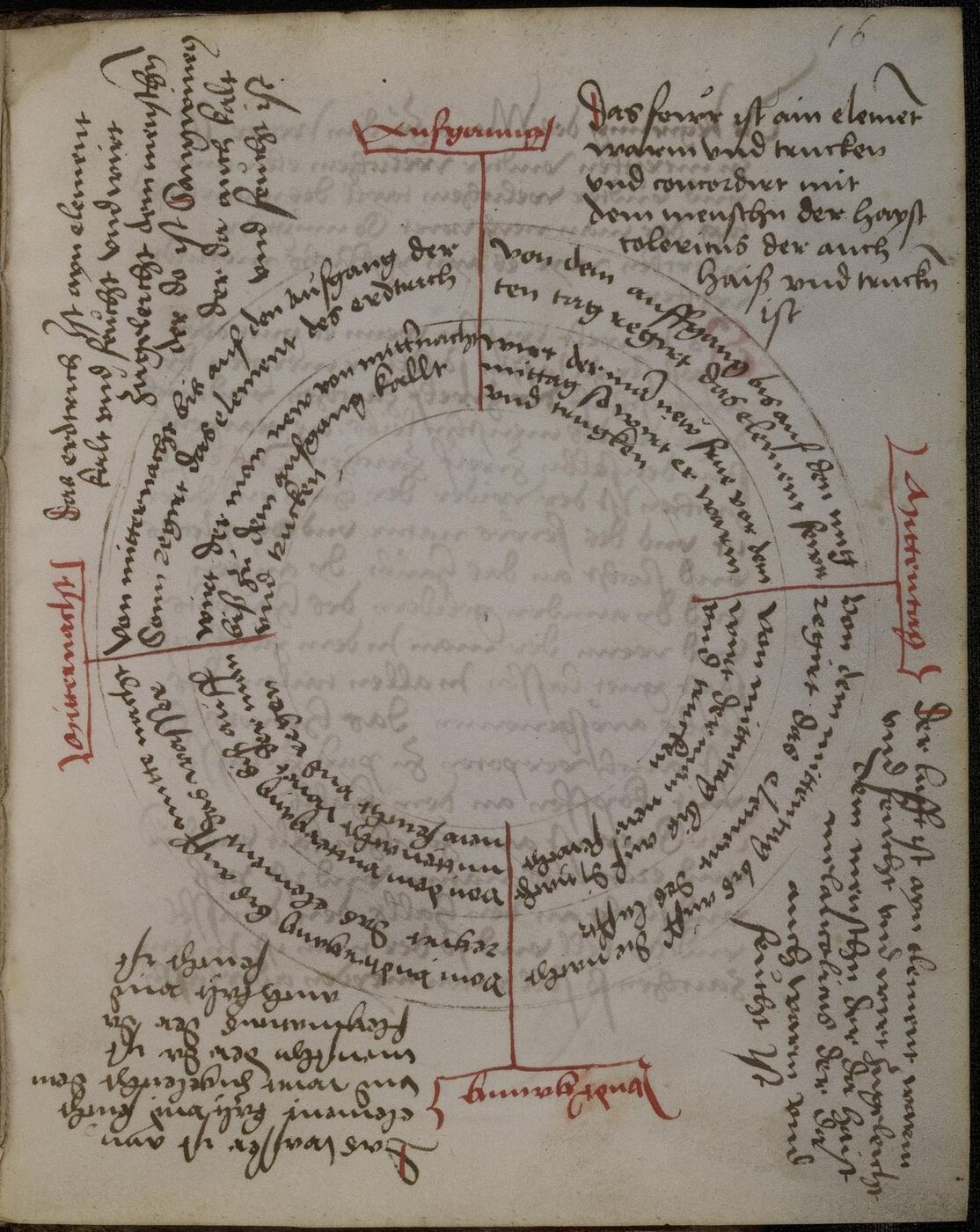
Nothing in this subject is new, and its more historically minded material had a long shelf to draw on. The four temperaments — sanguine, choleric, melancholic, phlegmatic — began as a medical doctrine. Humourism may be older still, but it was Hippocrates (c. 460–c. 370 BC), and afterwards Galen, who developed it into a theory in which four bodily fluids governed mood and behaviour; the four names are Galen's. Modern medical science rejected the physiology; the four labels outlived it, and are still in circulation.

Two traditions that flourished in the late eighteenth and nineteenth centuries read character off the body. Physiognomy, which is far older but was revived and popularised by the Swiss pastor Johann Kaspar Lavater, inferred it from the face; his illustrated Physiognomische Fragmente of 1775–78 were its most influential modern statement. Phrenology, developed by the German physician Franz Joseph Gall in 1796 and most influential between about 1810 and 1840, inferred it from the contours of the skull; its central claim is discredited by empirical research, and its principal British centre, the Edinburgh Phrenological Society of 1820, is now studied as a chapter in the history of pseudoscience rather than of psychology.
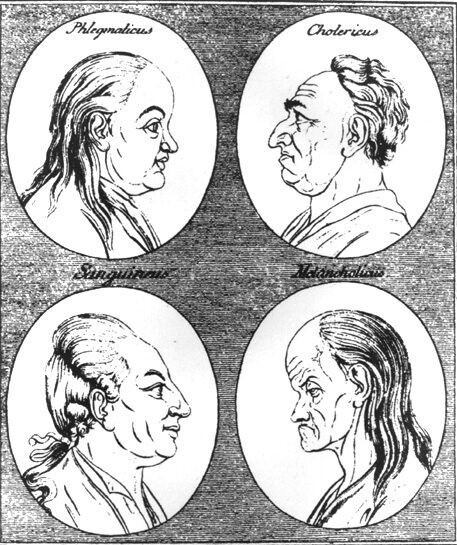

The four temperaments kept being re-theorised. Immanuel Kant, Erich Adickes, Alfred Adler, Eduard Spranger, Ernst Kretschmer and Erich Fromm all produced fourfold schemes under different names. Ivan Pavlov, working on the properties of the nervous system, identified strength, mobility and the balance of excitation and inhibition, and derived four types from those three properties — a physiological restatement of a humoral idea.
Constitutional typology was the twentieth century's version. In 1921 — the same year as Jung's Psychological Types — the German psychiatrist Ernst Kretschmer published Körperbau und Charakter, setting out the asthenic or leptosome, the athletic and the pyknic builds and correlating them with temperament and with vulnerability to particular disorders. In the 1940s the American psychologist William Herbert Sheldon proposed somatotypes, classifying physique by the relative contribution of endomorphic, mesomorphic and ectomorphic components, names borrowed from the three germ layers of the embryo. Both schemes attached character to build. Sheldon's association of body type with temperament and moral character was later disputed, and the somatotype categories survive mainly in the revised descriptive form used in the study of physique rather than personality.
One practical feature of this back catalogue is worth stating, because it applies to any discussion room. The older material is largely out of copyright: Galen, Kant and Lavater can be reproduced at length without a publisher's permission, and the items of a currently published questionnaire cannot be reproduced at all. What a room may lawfully quote and what it may only describe are therefore different things, and they fall on different sides of the subject.
The other systems in circulation
Between the ancient typologies and the professionally published inventories sat a middle layer, and it is the layer a general-audience newsgroup was likeliest to meet.
The Keirsey Temperament Sorter reached that audience in the cheapest possible format. David West Keirsey, an American psychologist and professor emeritus at California State University, Fullerton, encountered Kretschmer's and Sheldon's work in the late 1940s and the Myers-Briggs instrument in 1956, and set out a questionnaire of his own in Please Understand Me (1978), written with Marilyn Bates; a revised and expanded Please Understand Me II followed in 1998. Keirsey's four temperaments took their names from Plato — Artisan, Guardian, Idealist, Rational — and each divides into role variants that correlate with the sixteen Myers-Briggs codes. The differences from Myers are real and documented: Myers attended primarily to how people think and feel, Keirsey to behaviour that can be observed from outside; Myers, following Jung, emphasised the extraversion-introversion dichotomy, while Keirsey's model gives greater importance to the concrete-abstract distinction between sensing and intuition. The book, and the sorter printed inside it, put a self-scoring sixteen-type questionnaire on a paperback shelf.
DISC came from a different lineage: workplace behaviour rather than depth psychology. Its theory was first outlined in Emotions of Normal People (1928) by William Moulton Marston, a psychologist better remembered as a promoter of the polygraph and as the creator of Wonder Woman, with likely contributions from Olive Byrne and Elizabeth Holloway Marston. Marston described four behavioural categories — dominance, inducement, submission, compliance. He built no test and never patented the framework, which is why the instruments descended from it differ from one another. The first self-assessment based on his theory was the Activity Vector Analysis, an adjective checklist created in 1956 by the industrial psychologist Walter Clarke, who published findings on a successor instrument with Peter Merenda in the Journal of Clinical Psychology in January 1965. The instruments in this line are designed for personnel management, and reference summaries note both that they show high test-retest consistency and that there is little to no evidence for the claims made about what they predict.
Against these stood the clinical and research inventories, which a discussion group could discuss but not administer: the Minnesota Multiphasic Personality Inventory, first published in 1943 and restandardised as the MMPI-2 in 1989, and Raymond Cattell's 16PF, first published in 1949, among them. They differ from the popular instruments in every respect that matters to a discussion group. They measure psychopathology or trait structure rather than assigning a kind; their use is restricted to qualified purchasers; and several of them carry validity scales built to detect exaggerated or implausibly favourable answering, which the Myers-Briggs instrument does not. Their literature is the subject of the sci.* page rather than this one. The common ancestor of all of them, popular and professional alike, is the Woodworth Personal Data Sheet, first used in 1919 to screen United States Army recruits thought liable to shell shock: the first modern personality test was a wartime filter, and a good deal of what followed inherited the logic of selection.
Two more systems belong in the picture because they show the same idea arriving independently elsewhere. Socionics was developed in the 1970s and 1980s, primarily by the Lithuanian researcher Aušra Augustinavičiūtė, combining Jung's typology with Antoni Kępiński's theory of information metabolism; it produced sixteen types of its own and an elaborate theory of the relations between them, and it is used mainly in Russia and eastern Europe, with studies of it largely confined to those countries. The Type A and Type B scheme came from cardiology rather than psychology: Meyer Friedman and Ray Rosenman proposed that habitually competitive, impatient people ran a greater risk of coronary disease, a claim that shaped early health psychology, attracted lasting controversy over tobacco-industry funding of the early research, and is now treated as historical. And the blood-type personality theory, a belief prevalent in East Asia that the scientific community treats as superstition, is a reminder that the appetite for four or nine or sixteen kinds of person is not a Western peculiarity.
Type against trait
Underneath all of it lies one question: do people come in kinds, or do they vary along dimensions? A type claims a qualitative difference — you are one of these, not one of those. A trait claims a quantitative one — you are further along this axis than most people. The distinction is not merely verbal, because the two claims make different predictions about what the numbers should look like.
The prediction that has been tested most often concerns distributions. If a population really divided into two kinds on some dimension, scores on a good measure of that dimension should pile up in two humps with a valley between them. Most studies of the Myers-Briggs scales have found the opposite: scores are distributed in a centrally peaked manner, with the majority of respondents near the middle rather than at either end. Tammy Bess and Robert Harvey addressed the question directly in a 2002 paper in the Journal of Personality Assessment asking whether bimodal score distributions on the instrument were fact or artefact, and concluded that the absence of empirical bimodality removes a line of evidence previously available to defenders of types. The practical consequence of a centrally peaked distribution is that a dichotomy has to be produced by cutting the scale somewhere, and the cut falls in the middle — the region where the most people are, and where a small difference in answers moves a person from one side to the other.
Retest data behave as that account predicts. A standard reliability review of the instrument, R. J. Harvey's chapter in the 1996 collection MBTI Applications, reports that on Form G about 83 per cent of individual dichotomy classifications are unchanged when a person is retested within nine months, falling to around 75 per cent after nine months; but because four dichotomies must all hold for the four-letter code to hold, about half of those retested within nine months come out with the same overall type, and about 36 per cent after longer than nine months. The instrument's third-edition manual reports higher figures for the later Form M. Shorter-interval studies in the critical literature give wider ranges still, and are set out on this directory's alt.psychology.jung page alongside the 1991 National Academy of Sciences review.
The most-cited comparison came from the trait side. McCrae and Costa, in 1989, correlated the four Myers-Briggs indices with five-factor measures in a sample of 267 men and 201 women drawn from a longitudinal study of ageing, and concluded that the indices did measure aspects of four of the five major dimensions of normal personality, so that the five-factor model offered an alternative basis for interpreting the results within a broader and more commonly shared framework. They also reported finding “no support for the view that the MBTI measures truly dichotomous preferences or qualitatively distinct types”, describing it instead as measuring four relatively independent dimensions.
A second technical argument concerns the answer format. An ipsative, or forced-choice, questionnaire makes each respondent's scale scores sum to a constant: choosing “I like parties” over “I keep my work space tidy” necessarily adds to one scale and withholds from another. Formats of this kind can be useful for ranking traits within one person, and they make faking harder; what they cannot straightforwardly support is comparison between people, because a high score means only that the trait outranked the others in that respondent, not that it is high in any absolute sense. The 2021 enneagram review found the pattern this predicts, with the ipsative version of the Riso-Hudson indicator running into validity problems that the non-ipsative version did not. Reference summaries note that ipsative instruments are frequently misused in recruitment and selection, where they are treated as though they were normative measures.
The case for types is not empty, and it is worth stating in its own terms. Hans Eysenck, whose Dimensions of Personality (1947) described the extraversion and neuroticism axes, noted himself that the two-dimensional space they define resembles the four types attributed to Galen — a type, on this reading, being a region of trait space rather than a rival to it. Person-centred methods have continued to look for genuine clusters: Donnellan and Robins reviewed the resilient, overcontrolled and undercontrolled types and the controversies around them in 2010, and in 2018 Gerlach, Farb, Revelle and Nunes Amaral reported in Nature Human Behaviour that a data-driven approach identified four personality types across four large data sets. The existence of personality types remains, in the standard summaries, extremely controversial — which is the description of a live question, not of a settled one.
What of the appeal itself? The documented observations are modest and mostly about form rather than truth. The instrument's vocabulary has been criticised as vague and general enough that any behaviour can be fitted to any type, with the Barnum effect offered as the mechanism; defenders reply that the type descriptions, though brief, are distinctive and precise, and Keirsey was among those who built more detailed portraits in answer to that charge. A four-letter code is easier to remember, to disclose and to look up than a percentile on five continuous scales, and no part of that is an argument about whether the code is true.
This page reports these positions and does not adjudicate between them. The research literature they belong to — the consolidation of the five-factor model, psychometric theory proper, behaviour genetics and the replication years — is the subject of the sci.psychology.personality page.
Reliability, validity and the amateur questionnaire
The summary at the head of this page describes the group's test-construction threads as a lay introduction to reliability and validity. That is best read as a claim about form rather than a count of postings. Anyone who writes a questionnaire, tries it on other people and compares the results has walked into the territory of classical test theory, because most objections that can be raised to an amateur quiz are the standard objections with their labels removed. What follows is that vocabulary at the level such a discussion reaches; the theory itself, with its history and its arguments, belongs to the sci.* page.
Reliability is consistency: whether an instrument gives the same answer twice. Test-retest reliability asks whether the same people score the same way after an interval, and it is the property the type-versus-trait dispute keeps returning to, because a classification that changes between sittings has told you something about where the cut falls rather than about the person. Internal consistency asks a different question — whether the items on a scale behave as though they are measuring one thing — and is most often reported as the coefficient alpha Lee Cronbach published in 1951. Reliability is necessary and not sufficient, which is the point most easily missed in an argument about a quiz: a bathroom scale that reads three kilograms heavy every time is perfectly reliable.
Validity is the harder idea, and it is about the inference rather than the instrument. Does the questionnaire cover the thing it claims to cover, do its scores relate to anything outside themselves, and does the whole construct behave as the theory says it should? The last of these, construct validity, was named by Lee Cronbach and Paul Meehl in 1955 and cannot be settled by a single study: on their account it requires a nomological net, an accumulation of results that fit a network of expectations, any one of which can fail without telling you whether the test or the theory was at fault. Later validity theory, associated with Samuel Messick, makes the point that matters most for a page like this one. Validity is not a property an instrument owns; it is a judgement about the inferences and actions supported by a particular score, for a stated purpose.
Norms are the leg an amateur questionnaire never has. A raw score means nothing until it is placed against the distribution of scores from a defined reference sample, and every number derived from it — a percentile, a standardised score, a type assignment — inherits that sample's composition and its date. A quiz circulated among the readers of a newsgroup has no norms at all, and its respondents are not a sample of anything.
Then there are the ways a self-report instrument is defeated without anybody cheating. Answers drift towards what the respondent takes to be the creditable reply, and towards agreement whatever the item says. Some inventories carry scales designed to catch implausibly favourable response patterns; the Myers-Briggs instrument does not, with the documented consequence that a respondent motivated to produce a particular type can do so.
Last comes the problem that has nothing to do with the questionnaire and everything to do with reading the result. In 1948 Bertram Forer gave a personality test to thirty-nine of his students and, a week later, handed each of them what was presented as an individual profile; every profile was the same text, assembled from a newsstand astrology book, and the students rated its accuracy at an average of 4.3 on a scale of 0 to 5. He published the demonstration the following year as the fallacy of personal validation, and the Barnum or Forer effect has been replicated many times since. It is the standing reason why a reader's conviction that a type description fits is not by itself evidence about the instrument that produced it. This directory's page on alt.astrology.metapsych sets out the experiment and the research around it in detail, since it bears even more directly on that group's subject.
All of this has a published home in the Standards for Educational and Psychological Testing, issued jointly by the American Educational Research Association, the American Psychological Association and the National Council on Measurement in Education, and treated by courts as an authoritative source on testing practice. The point for a reader of the archive is not that a discussion group was doing psychometrics, but that the questions a quiz provokes are, item for item, the questions the discipline formalised: does it give the same answer twice, does it measure what it says, compared with whom, and how would anyone know if it did not.
The commercial and institutional life of the popular instruments
An unusual amount of the argument in this subject is really an argument about property and access. The best-known instruments are commercially published, copyrighted, sold by the administration, and in several cases restricted to purchasers who have met the publisher's training requirements. The Myers-Briggs instrument has been published exclusively by Consulting Psychologists Press and its successors since 1975. The MMPI is copyrighted by the University of Minnesota and published by its press, and any clinician using it must meet the publisher's training and experience requirements. Keirsey's sorter, by contrast, was printed inside a mass-market paperback, and the old temperament schemes belong to nobody.
Qualification is the mechanism through which a proprietary instrument acquires an industry around it. One commonly offered explanation for the Myers-Briggs instrument's persistence is precisely this — that a great many people are qualified to administer it, that it is not difficult to understand, and that a large supporting literature of books and websites is readily available to anyone. Reviewers have also noted a closed circuit in the literature: it has been estimated that between a third and a half of published material on the instrument was produced either for the conferences of the Center for Applications of Psychological Type, which provides the training and is funded by sales of the instrument, or as papers in the Journal of Psychological Type, which is edited and supported by its advocates and by the same sales. The same reviewers argue that this reflects a lack of critical scrutiny.
The workplace market has a dateable inflection point. Personality testing goes back to the First World War, but the broad adoption of personality questionnaires by American employers is usually traced to 1988, when federal law made it illegal for most employers to use polygraphs: the demand for a screening instrument did not go away, and the questionnaires inherited it. By 2013 the personality assessment industry in the United States was being estimated at between two and four billion dollars a year. Assessment is used across counselling, clinical and forensic work, schools, careers guidance, employment testing and occupational health; the employment end is where the documented criticism is heaviest.
That criticism is specific and it is old. The National Academy of Sciences committee that reviewed the Myers-Briggs research in 1991 concluded that there was not sufficient well-designed research to justify the instrument's use in career counselling programmes, and that its popularity in the absence of proven scientific worth was troublesome; the committee's findings are quoted at length on the alt.psychology.jung page. The instrument's own manual expressly discourages its use as a predictor of job success, and the research literature reports poor predictive validity for job performance ratings. A 1996 review by Gardner and Martinko in the Journal of Management found efforts to detect simple links between type preferences and managerial effectiveness disappointing, and concluded that no definitive conclusion about those relationships could be drawn from research of such mixed quality. David Pittenger's critiques — in the Review of Educational Research in 1993 and, twelve years later, as cautionary comments in the Consulting Psychology Journal — are the standard citations of the room's period. The psychometrician Robert Hogan wrote in 2007 that most personality psychologists regard the instrument as little more than an elaborate fortune cookie, and the historian of astrology Nicholas Campion has called it a fascinating example of disguised astrology, masquerading as science in order to claim respectability. Reference works now describe the questionnaire as widely regarded as pseudoscience by the scientific community. The DISC instruments attract the parallel complaint: widely used in personnel management, with little or no evidence for what they are said to establish, and at least one study finding their dimensions better explained as combinations of five-factor traits than as independent ones.
Two things follow for a reader of the archive. The first is that the criticism was fully available, in print, in journals a university library carried, throughout the group's active life; none of it had to wait for the internet. The second is that a discussion room sits awkwardly between a proprietary instrument and a free one. A participant could quote the criticism at length and the questionnaire not at all, could pass around the paperback sorter and the public-domain temperament schemes freely, and could not lawfully reproduce the items under dispute. Where the argument is about a copyrighted object, the argument tends to be conducted around it.
The online test as a genre
The web changed the popular end of this subject more than it changed the research end, and it changed it during the group's own lifetime. What a web form added was not a new theory but a new distribution: instant scoring, no fee, no administrator, no appointment, and a result that could be pasted into a signature line or a profile the same minute.
The dating is checkable from archived captures of the sites themselves, which give the date by which a site was running rather than the date it launched. keirsey.com was captured on 19 April 1997 describing itself as the official web site for the Keirsey Temperament Sorter and temperament theory, and offering the sorter as, in its own words, an online personality temperament test — with Spanish and German versions of the questionnaire alongside the English one and a Russian version announced as forthcoming. enneagraminstitute.com and humanmetrics.com, the latter presenting itself as a site of online relationship and personality tests, were both captured in December 1998. similarminds.com, later a large aggregator of free type questionnaires, first appears in March 2002. By the years news2mail was gatewaying Usenet to e-mail, a reader who wanted a four-letter code or a nine-point number did not need a book, a publisher or a consultant.
One development on the research side had unusually direct consequences for the free web tests. Lewis Goldberg's International Personality Item Pool, a public-domain collection of personality items managed at the Oregon Research Institute and assembled expressly because the established broad-bandwidth inventories were proprietary and could not be freely deployed, was captured online in January 1998, with Goldberg's paper describing a broad-bandwidth public-domain inventory following in 1999. It now holds 3,329 items, and more than 250 inventories have been built from them. That is why free five-factor questionnaires exist on the web at all, and why the trait side of the argument became available to lay readers on the same terms as the type side. Its place in the research literature is the sci.* page's subject; its effect here was that a reader could compare a type result with a trait result the same afternoon, for nothing.
What is documented about how most web questionnaires were constructed is very little. A published instrument comes with a manual, a normative sample, item analyses and reliability coefficients that a critic can attack. The characteristic web test of the period published none of these; the reader saw a series of items, a result, and a description. This is a statement about the documentary record rather than an accusation: some free instruments are built on the public-domain pool described above and are traceable to the literature, and others are not traceable to anything. The genre's recurring features are easy enough to list — short forced-choice items, immediate categorical output, and profile text written in the positive, widely applicable register that the Forer demonstration showed people find persuasive.
The later history postdates the gateway entirely and is marked here as such. 16Personalities.com, described in reporting as offering a free approximation of the official paid test, is the site credited with setting off a Myers-Briggs boom among young people in South Korea around the time of the COVID-19 pandemic: one survey reported that by December 2021 nearly half of the population had taken such a test, the letters became an issue in the 2022 presidential election, and reporting in the Korean press described companies asking job candidates for their type, with 60 per cent of surveyed job-seekers in their twenties opposed to the practice. Both independent experts and a representative of the instrument's publisher cautioned against using it to choose a partner. South Korea had had a comparable enthusiasm for blood-type personality theory in the early 2000s, and a similar fad followed in China. The volume of data that free online questionnaires generate is also what makes work such as the 2018 Nature Human Behaviour paper on data-driven personality types possible — the popular end of the subject feeding back into the research end. None of this was visible from a newsreader in 2004.
What the record does not show
This group has left almost no external documentation of its own, which is the normal condition for an alt.* discussion group and is stated here plainly rather than papered over.
- No charter beyond the paragraph in the 1992 control message and the five-word description line. There was no Request for Discussion for this group, no Call for Votes, no result posting and no tally, because alt.* has none of those things; the 1995 paperwork described above belongs to a sci.* proposal that merely consulted this group's readers.
- No archived FAQ for alt.psychology.personality: the by-newsgroup index of the news.answers collection returns nothing for the group. If it ever maintained one, it did not reach the standing archives.
- No subscriber or readership figures. Usenet readership estimates of the period came from voluntary surveys of a sample of sites and were never available for most groups; none survives for this one.
- No record of the alt.config discussion the control message refers to. The Internet Systems Consortium archive holds control messages, not the debates behind them.
- No moderator, no moderation policy and no posting conventions, the group having been unmoderated throughout.
- No reliable account of who posted, in what numbers, or for how long. Archive coverage of alt.* groups varies by era and by the archiving site's feed, and the surviving corpus is a sample of unknown completeness.
The description at the head of this page is therefore an editorial summary written for this directory, not a quotation from a charter. Where it characterises what the group did, it describes the kind of activity such a room supported and the kind the surviving material is consistent with. It is not a reconstruction from counted threads, and no thread, poster or exchange is named anywhere on this page, because none can be verified.
Scope and limits
This page is documentary. It records what type systems are, where they came from, who published them, how they were sold and used, and what has been argued about them in the open literature. It does not evaluate any instrument, does not report what any score or letter code means, and takes no position on whether any of these systems describes anything real. Nothing on it is guidance for choosing, taking, administering or interpreting a personality questionnaire, and nothing on it should be read as a statement that any instrument named here is suitable for any purpose, including employment, education, counselling or self-understanding.
Where the criticism of an instrument is quoted, it is quoted as the position of the named committee, author or reference work that took it, and the same applies to the defences. The distinction the whole subject turns on — between kinds and degrees — is reported here as an open question in the research literature, because that is what the standard summaries say it is.
Readers looking for the science rather than the popular history want sci.psychology.personality, linked above; for Jung, analytical psychology and the instrument's ancestry, alt.psychology.jung; for the branch these groups belong to and the ethics of an open psychology room, alt.psychology; and for another technique with a large lay following, a proprietary training apparatus and a contested evidence base, alt.psychology.nlp.
Reading alt.psychology.personality today
- Historical archive: Google Groups — alt.psychology.personality (coverage varies by group and era).
- Open in a newsreader:
news:alt.psychology.personality— the original site offered exactly this link, and it still works if your system has a newsreader registered for thenews:scheme. - Live access: point an NNTP newsreader at a modern server — see accessing Usenet today.
- The original news2mail e-mail subscription service ended in the mid-2000s and no longer operates.