alt.culture.zambia
Zambia: culture, news and diaspora.
A small group for Zambian topics — Bemba and Nyanja phrases for learners, Kenneth Kaunda’s legacy, copper-economy news and football — serving a diaspora scattered thin enough that one newsgroup was the meeting point.
Its charter, preserved in the control message of 22 August 1998, commits it only to being unmoderated; this directory holds no archive of what was posted to it.
On this page
- The group's own paperwork
- An entry that says nothing
- Two routes to a room
- The neighbours the proposal named
- A second Zambian address, and how to tell the two apart
- Before 1964: the territory and the ore
- Independence and the one-party decades
- 1991 and after: the years the group was open
- Copper, and the institutions built on it
- Who could actually post, and from where
- A documented case, and what it says about the wire
- Language on a seven-bit medium
- What a small alt.* group was like, structurally
- Scope and limits
The group's own paperwork
Almost everything that can be established about the founding of alt.culture.zambia is contained in a single file. The Internet Systems Consortium mirrors the Usenet control-message archive, and the entry for this group is one compressed message of about 1.3 kilobytes, timestamped 22 August 1998. There is no second file. No later newgroup message, no rmgroup, no checkgroups correction, no moderator notice. For a group in the alt.* hierarchy that is not a gap in the record; it is the whole of the record.
The message is an ordinary Usenet article that happens to carry a Control header. It was posted to alt.culture.zambia and alt.config together, under the subject line cmsg newgroup alt.culture — the subject is truncated, though the Control header itself correctly reads newgroup alt.culture.zambia. It is dated Saturday, 22 August 1998, 17:52:10 GMT. The Organization header says simply alt.culture.zambia; the Summary header says the topic zambia; the Keywords header says for the discussion of everything concerning zambia. The posting software identified itself as News Xpress 2.01, and the NNTP-Posting-Host header records a dial-up host on the Norwegian access provider online.no. The Path header traces the rest of the journey: a feed at the University of Oslo's informatics department, then the American backbone operators of the day, then the archive.
The body opens with the line for your new group file, followed by new group alt.culture.zambia as per proposal quoted below, and then quotes, in full and with the quoting marks left in, a proposal dated 1998/08/19 and addressed to the newsgroup alt.config. The proposal names its author and gives a contact e-mail address. Its charter section reads, exactly as the control message preserves it:
alt.culture.zambia an unmoderated newsgroup, will be used as an area of discussion for those interested in the country and topic “Zambia”. It will be used to discuss the nation, culture. politics, geography, current affairs, arts and sciences etc.
That is the group's charter in its entirety: two sentences of scope and one word of governance. The word that does the governance is unmoderated, and it is the only structural commitment the document makes. The punctuation error in the middle of the list has been carried, unedited, in the Usenet control archive for twenty-eight years, because nothing in the alt.* hierarchy exists to tidy it.
The rest of the proposal is a section headed Justification of Readership, and it is the longest part of the document, because it shows a proposer doing empirical homework rather than asserting a need. The evidence offered is a set of searches run on Deja News, the Usenet search engine of the late 1990s. The proposal reports 442 hits for a plain search on Zambia and three for Zambian Culture; a power search over what it describes as roughly six months, 1 February to 19 August 1998, returning about 8,800 hits for Zambia, a figure the proposal itself immediately calls unreliable on account of crossposting, and 36 for Zambian Culture. Two long Deja News query URLs are pasted in, with an apology for their length. These are the proposer's own numbers, presented as the proposer presented them; they cannot now be re-run, because the index they were run against no longer exists in the form it was queried.
The proposal closes by pointing at two Zambian mailing lists it had located at an address on zamnet.zm, the domain of Zambia's first internet service provider. One of them, it says, had been started in the mid-1990s and had a membership estimated at 350 by the list owner. That single clause is the only quantitative statement anywhere in the group's paperwork about how many Zambians were reachable online in 1998, and it is second-hand, self-reported and about a mailing list rather than about this newsgroup. It is nevertheless a pointer to real infrastructure, and it is picked up again further down this page.
What is absent from the file is as informative as what is in it. There is no Request for Discussion, no Call for Votes, no result posting, no tally of voters, no neutral votetaker, no mandatory waiting period. None of those things is missing; in alt.* none of them exists. The proposal was aired, by convention rather than by rule, in alt.config, and three days later somebody sent a message. The mechanics of alt.* group creation — the control message as a request rather than a command, the absence of any canonical list of what exists — are set out on this directory's alt.* hierarchy page and are not repeated here.
An entry that says nothing
The Internet Systems Consortium also publishes the current shape of the Usenet namespace: an active file listing every group it knows of, and a newsgroups file pairing each of those names with a one-line description. The archive's own policy document states that it updates hourly. Checked for this article on 25 August 2026, each file carried 45,003 entries.
alt.culture.zambia is in both. Its line in the active file ends with the flag y, which means local posting permitted and the group unmoderated; the two article counters on the line are placeholders and carry no information about traffic. Its line in the newsgroups file reads, in full:
alt.culture.zambia No description.
No description. is not a description. It is the placeholder the archive writes when it has never been given one, and it is worth spelling out why this group never was. The archive's policy document explains that newsgroup descriptions are taken from the most recent newgroup or checkgroups control message for a group, and that a newgroup message must contain a line in the body reading, exactly, For your newsgroups file:, with no leading whitespace, followed on the next line by a valid description line — the group name, a tab, and the text. The 1998 message opens with for your new group file and never supplies such a line at all. Under the policy as it now stands, a newgroup message lacking that line would not be processed automatically in the first place; this group exists and its description field is empty, which is one indication that the archive's rules in 1998 were not the rules it applies today. The policy text in its current form is dated 19 February 2018 and is therefore later than the message, so the connection between the malformed line and the empty field is an observation rather than a documented cause. What can be stated flatly is the outcome. The description field for this group has been empty since the day it was created, and the mechanism that would have filled it was never used.
The scale of that outcome is measurable, and it is one difference between alt.* and the Big Eight that can be counted rather than characterised. Of the 45,003 entries in the newsgroups file, 9,827 read No description. Within alt.* alone, 7,694 of 20,466 entries do — a little over thirty-seven per cent of the hierarchy. Within the alt.culture.* branch, 29 of 126. Within soc.culture.*, which has 139 groups, the count is zero: every single one carries a written sentence. soc.culture.zimbabwe reads Culture and other issues pertaining to Zimbabwe. soc.culture.kenya reads Kenyan peoples, politics, culture, and affairs. soc.culture.african reads Discussions about Africa & things African.
The difference is procedural rather than editorial. A Big-Eight group's description is written into its proposal, argued over during the discussion period, and then re-asserted at intervals by a signed checkgroups message issued by a recognised authority for the hierarchy, so a missing or mangled description gets fixed. alt.* has no such authority and no such message, so a description that was not correctly formatted in the original newgroup never arrives at all. The consequence is that a directory of alt.* is a directory of names, and the name is frequently the only documentation a group has.
The branch is not entirely silent, and one neighbour shows how much a single line can carry. The entry for alt.culture.somalia does not describe that group; it reads Use soc.culture.somalia instead. Somebody with the right to write that line used it to redirect readers to the Big-Eight room. It is not an isolated gesture: nine of the 126 alt.culture.* entries use the description field to point at another group, and across alt.* as a whole 174 entries do. The alt.* newsgroups file holds not only descriptions but, occasionally, arguments.
Two routes to a room
The structural question this page exists to answer is why a Zambian discussion group is in alt.culture.* rather than soc.culture.*, and the first half of the answer is checkable: soc.culture.zambia never existed. It is not in the ISC active file, which carries 139 soc.culture.* groups. It is not in the newsgroups file. And there is no file for it in the news.announce.newgroups archive, which is where a Big-Eight proposal's paperwork lands and stays — an archive that does hold soc.culture.south-africa, dated 4 November 1994; soc.culture.zimbabwe, dated 22 August 1995; soc.culture.kenya, dated 5 December 1995; and a soc.culture.african reorganisation package from 17 January 1997. For Zambia there is nothing, which means nothing was ever proposed far enough to leave a trace. The absence is not the record of a lost vote. It is the record of a route not taken.
The two routes were not remotely comparable in cost. The Big-Eight creation guidelines archived alongside that paperwork — the text as it stood in 2003, the earliest revision the archive keeps — required a Request for Discussion posted to the moderated announcement group with all discussion carried in news.groups, a discussion period of at least twenty-one days, then a Call for Votes prepared and run by a member of the Usenet Volunteer Votetakers, a voting period of twenty-one days, a public tally naming every voter, and a five-day window in which objections could be raised before the result was validated. The threshold had to be cleared twice over: a proposal passed only if it received at least a hundred more yes votes than no votes and at least twice as many yes votes as no. The guidelines tell proponents that the whole process typically takes three months, and note in the same breath that creating groups in other hierarchies, alt.* among them, is often quite different and sometimes much less formal. The full machinery, and what it felt like from inside a scattered community, belongs to this directory's soc.culture.* branch page; the mechanics of the alternative belong to the alt.* hierarchy page. Neither is retold here. What matters at this address is the arithmetic that separates them.
The hundred-vote net margin was indifferent to population. It did not ask how many people lived under a flag or spoke a language; it asked how many of them had an e-mail account, could be found within a voting window of three weeks, and cared enough to send a correctly formatted ballot to a stranger. Set that requirement against the numbers for Zambia in the relevant years. The World Bank puts the country's population at about 9.5 million in 1998 and the share of individuals using the internet at three hundredths of one per cent in the same year — a few thousand people in total, before any allowance for how many of them read Usenet. The alt.* route asked for one correctly formatted message and no votes at all.
That contrast should be stated and then not overstated. Nothing in the surviving paperwork says the proposer weighed a ballot and judged it unwinnable. The proposal does not mention soc.culture.* as an alternative venue for the group at all; it mentions Big-Eight groups only as places where Zambian topics were already being discussed. What the record shows is narrower and still worth having: the cheap route was used, the expensive one was never attempted, and a country whose online population in 1998 was numbered in the low thousands ended up with a room anyway. In alt.* the cost of creating a group did not vary with the number of people available to vote for it.
The neighbours the proposal named
The 1998 proposal is unusually explicit about where Zambian conversation had been happening before it, and the answer it gives is the Big-Eight rooms of the neighbouring countries. Its justification section states that a number of newsgroups such as soc.culture.south-africa, soc.culture.zimbabwe have discussions on zambia from time to another. Both of those groups are in this directory and have pages of their own: soc.culture.south-africa, whose country had the continent's earliest and densest connectivity, and soc.culture.zimbabwe, immediately across the Zambezi. Neither is summarised here.
Above them sat the continental room, soc.culture.african, which for years was the only address a great many African subjects had. Zambia's absence from soc.culture.* is not explained by any general absence of African countries from that branch. The current active file's 139 soc.culture.* groups include national rooms for Algeria, Egypt, Ethiopia, Guinea, Kenya, Liberia, Madagascar, Nigeria, Sierra Leone, Somalia, South Africa and Zimbabwe, plus soc.culture.maghreb and soc.culture.berber for regions that cross borders. There is no soc.culture.zambia among them. The two-layer arrangement was slightly uncomfortable everywhere it occurred: the umbrella group offered a larger audience, the national group a more precise one, and the question of which a given thread belonged to was a standing argument in both. Zambia, until August 1998, had only the umbrella and the neighbours.
Inside alt.culture.* the African cluster is thin and mostly undocumented. alt.culture.malawi and alt.culture.zaire sit in the current newsgroups file with the same empty placeholder as Zambia, as does alt.culture.tunisia; alt.culture.uganda, alt.culture.swahili and alt.culture.morocco carry written descriptions, though two of those are cut off mid-sentence; alt.culture.egyptian and alt.culture.somalia carry redirection notices instead. That is the whole of the pattern, and it is not a statement about the continent. It is a statement about who was sending control messages in the late 1990s, and about the fact that in alt.* the documentation is written by whoever happens to create the group.
A second Zambian address, and how to tell the two apart
The ISC control archive holds one other file with Zambia in the name, and reading the two side by side is the clearest lesson this page has to offer about what alt.* paperwork is worth. The second file is alt.fan.countries.zambia, dated 2 June 2000.
It contains six newgroup control messages rather than one. All six carry the same date and time, 2 June 2000 at 18:08:45 GMT, and six different message identifiers whose domains do not correspond to any real host. All six were posted not to the group itself and not to alt.config, but to alt.test. All six give the Organization header as idiot. All six carry X-No-Archive: yes, a header the Usenet search services of the period honoured by leaving the article out of their indexes. The body of each is a single line: For your newsgroups file: alt.fan.countries.zambia — which is, as it happens, the exact phrase the 1998 Zambian proposal failed to use, though here it is followed by nothing but the group name and no description, so this group too ends up in the newsgroups file reading No description.
It was not an isolated act. The current active file carries 188 groups under alt.fan.countries.*, running alphabetically from alt.fan.countries.afghanistan to alt.fan.countries.zimbabwe. That is a namespace generated from a list of country names rather than from anyone asking for a room, and the six duplicate messages for one of them are the signature of an automated spray rather than a proposal.
The same mechanism produced both files. Two years and one bulk script apart, alt.* accepted a message with a written charter, a stated scope and an argued justification of readership, and a message whose sender described his own organisation as idiot. The hierarchy could not tell them apart and did not try: both groups exist today, both are unmoderated, both read No description. in the descriptions file. Only the control messages distinguish them, which is the reason a page like this reads control messages at all.
Before 1964: the territory and the ore
The country the group was named for has a documented history that a reader of an eight-line directory entry will not have, and the chronology below is the honest bulk of this page. It is given as a chronology; the arguments about it are noted as arguments and are not settled here.
European commercial claims to the territory begin with the British South Africa Company, which in 1888 obtained mineral rights from the Litunga, the paramount chief of the Lozi, over the area that became Barotziland–North-Western Rhodesia. In 1895 Cecil Rhodes asked the American scout Frederick Russell Burnham to look for minerals and for ways to improve river navigation in the region, and on that expedition major copper deposits were identified along the Kafue River. The two administrative halves, Barotziland–North-Western Rhodesia and North-Eastern Rhodesia, were amalgamated in 1911 as Northern Rhodesia, a British protectorate whose economy was organised from the outset around extraction. Copper production in the Copperbelt began near Solwezi in 1908, and foreign investment, mostly American and South African, drove the industry's expansion between 1924 and 1969. The lead mine at Kabwe was the largest in Africa between 1925 and 1975; the copper mine at Nkana has been in operation since 1931 and Mufulira since 1933.
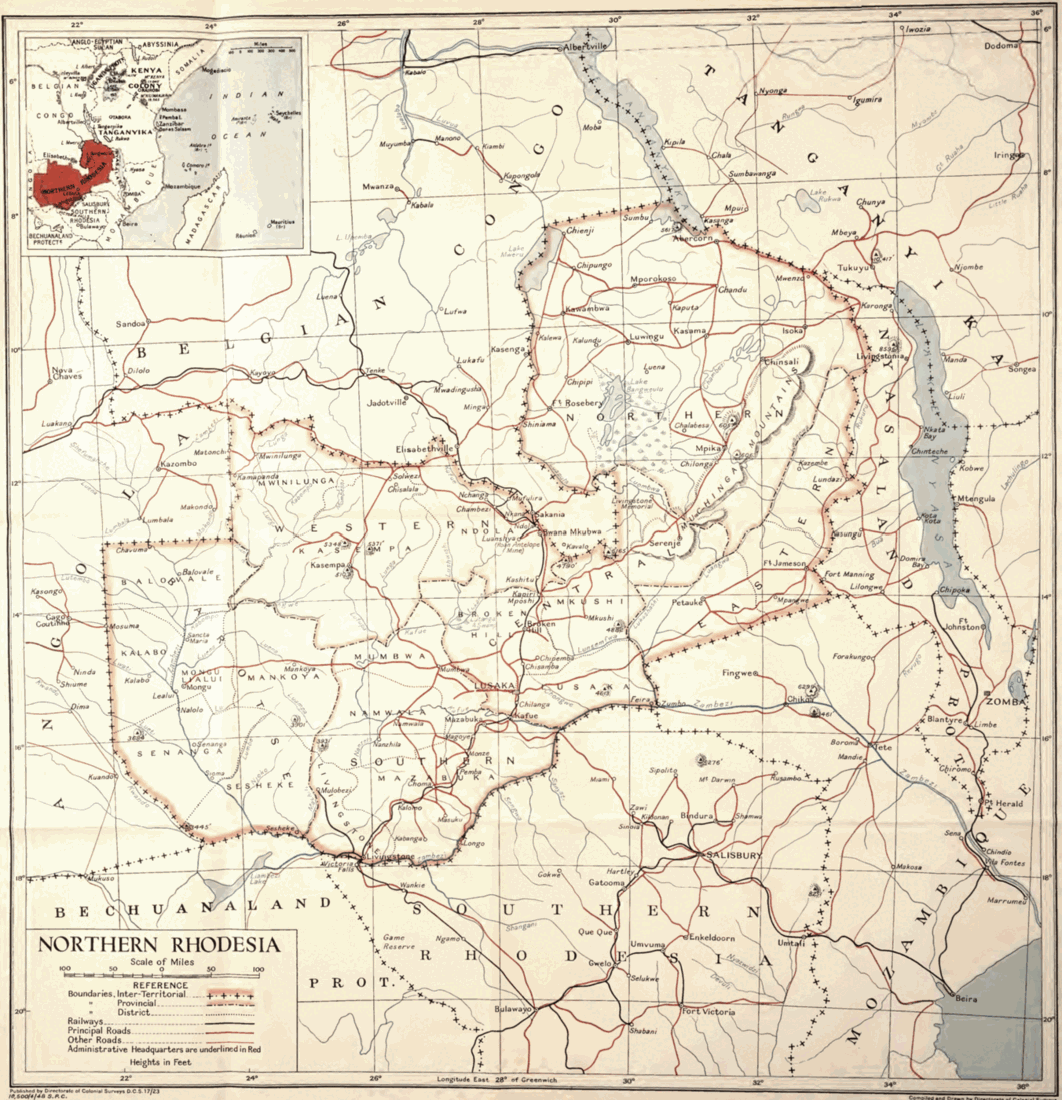

In 1953 Northern Rhodesia was grouped with Southern Rhodesia and Nyasaland into the Federation of Rhodesia and Nyasaland, a single semi-autonomous region created despite opposition from a sizeable minority of the population, who demonstrated against it in 1960 and 1961. The federation was formally dissolved on 31 December 1963 and its assets distributed among the territorial governments.
The largest single engineering project of the federal decade was the Kariba Dam on the Zambezi. The double-curvature concrete arch dam was constructed between 1955 and 1959. Filling the reservoir forced the resettlement of about 57,000 Tonga people living along the river on both banks, and the assessment of that resettlement is genuinely contested rather than merely uncertain. The British writer David Howarth, in The Shadow of the Dam (1961), described a serious government effort on a meagre budget — demonstration gardens, cooperative markets, loans to farmers, more schools than the Tonga had had before. The anthropologist Thayer Scudder, who has studied the displaced communities since the late 1950s, wrote that most of them remain development refugees living in less productive, problem-prone areas. The American writer Jacques Leslie, in Deep Water (2005), called Kariba the worst dam-resettlement disaster in African history. Those are characterisations by named observers and are recorded here as such. The Zambian power station on the north bank has been in operation since 1976.
Independence and the one-party decades
Northern Rhodesia became the Republic of Zambia on 24 October 1964, with Kenneth Kaunda as its first president; in January of that year he had won the only election ever held for prime minister of Northern Rhodesia, and he held that office from 22 January until independence. The new state inherited considerable mineral wealth and very few trained administrators, and more than seventy thousand Europeans were resident in the country at independence, retaining a disproportionate weight in the economy.
The economic reorganisation began in April 1968 with the Mulungushi Reforms, which sought to bring foreign-owned corporations under national control through the Industrial Development Corporation; the mining acquisitions that followed are described in their own section below. The political reorganisation ran alongside it. Accounts of Kaunda's presidency differ sharply in their characterisations — reference works describe a leader of the independence campaign who subsequently governed as an autocrat, and the description is contested by his defenders — but the sequence of formal steps is documented and uncontroversial. Parties other than the United National Independence Party were banned following violence around the 1968 elections. In early 1972 Simon Kapwepwe left UNIP to found the United Progressive Party. In February 1972 Kaunda appointed a commission under Mainza Chona whose terms of reference did not permit it to consider whether Zambia should become a one-party state, only to work out the practical details of the move. Harry Nkumbula accepted the Choma Declaration on 27 June 1973, and the new constitution was formally promulgated on 25 August 1973. At the first election under it, in December of that year, Kaunda was the only candidate; he was again the only presidential candidate in 1978, 1983 and 1988, each time returned on official figures above eighty per cent. The governing ideology of the period was Zambian Humanism, which combined mid-twentieth-century central planning and state control with values Kaunda described as traditional African principles of mutual aid, trust and community loyalty.
Geography made foreign policy expensive. Kaunda's endorsement of the guerrilla movements fighting white-minority rule in Southern Rhodesia led to the militarisation and then, in 1973, the closure of that border; the Benguela railway west through Angola was essentially closed to Zambian traffic by the late 1970s; and cross-border raids reached Zambian soil. On 3 September 1978 a civilian airliner was shot down near Kariba, and Rhodesia responded with Operation Gatling, an attack on guerrilla bases in Zambia including a military headquarters just outside Lusaka. A landlocked copper exporter had lost most of its routes to the sea.
The answer was the TAZARA Railway, built from 1970 to 1975 as a turnkey project financed and supported by China: 1,860 kilometres of single track from the port of Dar es Salaam to Kapiri Mposhi in Zambia's Central Province, giving the Copperbelt a route to the Indian Ocean that crossed no white-ruled territory. It was the largest single foreign-aid project China had undertaken at the time, at a construction cost of about 406 million United States dollars. China sent roughly 50,000 personnel to the project between 1965 and 1976, of whom 30,000 to 40,000 were workers, and an estimated 60,000 Africans took part in the construction. The first passenger train reached Dar es Salaam on 24 October 1975, the eleventh anniversary of Zambian independence, and on completion the line was the longest railway in sub-Saharan Africa. It was also difficult to operate from the start: it never reached its design capacity of five million tonnes a year, the locomotives supplied were not powerful enough for the escarpment between Mlimba and Makambako, and too few African technicians had been trained to take over management. With donor support, annual freight rose from 1.0 to 1.9 million tonnes between 1986 and 1991; in the early 2000s the end of the civil wars in Angola and Mozambique opened further rail outlets for Zambian copper.
Then the ore price moved. Copper prices fell sharply worldwide in the mid-1970s, the cost of moving Zambian copper the long distance to market was an additional strain, and the state borrowed against a recovery that did not come. Kaunda's dealings with the International Monetary Fund ran through a stabilisation programme, a public break in May 1987, a New Economic Recovery Programme in 1988 and a new understanding with the Fund in 1989. By the mid-1990s, despite limited debt relief, Zambia's foreign debt per head of population was among the highest in the world.
1991 and after: the years the group was open
The group was created in August 1998 and this directory records the mail-to-news gateway that carried it as operating between 2000 and 2004. The Zambian political record for that window, and for the decade immediately before it, is dense and dated, and readers arriving at this page from a hierarchy index are likely to want it in order.
In June and July 1990 riots against the government in Lusaka were followed by an announcement that a referendum on the single-party system would be held in October, and within hours of that announcement an army officer, Mwamba Luchembe, went on the radio to declare Kaunda overthrown; the attempt was broken after about three to four hours. The referendum was first delayed to August 1991, then cancelled in September 1990 in favour of constitutional amendments ending UNIP's monopoly, which Kaunda signed into law in December; a general election due in 1993 was brought forward to 1991.
That election was held on 31 October 1991 — the first multi-party general election since 1968. The Movement for Multi-Party Democracy, led by Frederick Chiluba, chairman of the Zambia Congress of Trade Unions, won it decisively. On the Electoral Commission's figures Chiluba took 972,605 presidential votes, or 75.8 per cent, against Kaunda's 311,022, or 24.2 per cent; the MMD won 125 of the 150 elected seats and UNIP was reduced to twenty-five. Turnout was about forty-five per cent. Chiluba took office on 2 November 1991 and on 29 December 1991 declared Zambia a Christian nation.
Before the next election the constitution was amended again. The changes imposed a two-term limit on the presidency, required presidential candidates to have been born to two Zambian citizens by birth or descent, and required National Assembly candidates to give up any chieftaincy. UNIP and five allied parties held that the provisions were aimed at Kaunda, whose parents were Malawian, and at their own vice-president, who was a chief; a court challenge failed and the parties boycotted the poll. The election of 18 November 1996 accordingly returned the MMD with 131 of the 150 elected seats and Chiluba with about seventy-three per cent of the presidential vote. Of an estimated 4.5 million eligible voters, 2,267,382 had registered, and turnout among those registered was fifty-eight per cent. Kaunda's citizenship remained in dispute; he lost it in 1998, was declared stateless by the Ndola High Court in 1999, and was restored to citizenship by a ruling of the Supreme Court of Zambia in 2000.
On 28 October 1997, between six and nine in the morning, a group of soldiers led by Captain Steven Lungu, known as Captain Solo, seized the national radio station and announced that a coup had taken place. It lasted no more than three hours. President Chiluba declared a state of emergency the following day. Human Rights Watch recorded that the number of detainees peaked at 104 in early January 1998 and had fallen to eighty-two by May; Kaunda himself was arrested on 25 December 1997 and placed under house arrest on 31 December. The state of emergency was lifted on 17 March 1998. Fifty-four soldiers were convicted and sentenced to death; the Supreme Court commuted ten of those sentences in 2003, and in 2004 President Levy Mwanawasa commuted twenty-two more and released fourteen prisoners who had served their sentences. That state of emergency was less than six months in the past when the newgroup message for alt.culture.zambia was sent.
The defining domestic argument of the group's own years was the third-term question. Chiluba's second term ended in 2001, and whether the constitution should be amended to allow him a third was argued inside and outside the governing party through that year. The documented outcome is precise and worth stating precisely, because it is often summarised loosely: no member of parliament moved a motion to amend the constitution, the government presented no paper on the matter, and no referendum was held. Chiluba left office at the end of his term on 2 January 2002.
General elections were held on 27 December 2001. The MMD won 69 of the 150 National Assembly seats and its candidate, Levy Mwanawasa, won the presidential vote with about twenty-nine per cent against about twenty-seven per cent for Anderson Mazoka of the United Party for National Development. The results were disputed by opposition parties, and some observers held that the opposition had won. Three opposition candidates petitioned the Supreme Court in January 2002 to overturn the result; the court agreed that the poll had been flawed but ruled in February 2005 that the irregularities had not affected the outcome and declined the petition. That dispute is recorded here as a dispute.
The economic record of the same window is equally dated. The World Bank's series for total external debt stock puts Zambia at about 5.8 billion United States dollars in 2000, rising through the group's active years to about 6.9 billion in 2003 and about 7.5 billion in 2004, before relief brought it down to about 2.3 billion by 2006. In December 2000 the executive boards of the International Monetary Fund and the International Development Association agreed that Zambia had reached the decision point under the enhanced Heavily Indebted Poor Countries initiative, committing relief worth about 2.5 billion dollars in net present value terms and more than 3.9 billion over time, conditional on performance criteria. In January 2003 the government told the Fund and the World Bank that it wished to renegotiate some of those criteria, which concerned the privatisation of the Zambia National Commercial Bank and the national telephone and electricity utilities. The completion point was not reached until April 2005, after the years covered here.
The last of those years produced a domestic argument of its own. On 6 February 2004 the finance minister, Ng'andu Magande, presented a budget of 8.3 trillion kwacha that raised pay-as-you-earn tax to as much as forty per cent and froze the salaries of more than 120,000 public service workers. On 16 February the labour movement declared 18 February a day of national protest against the tax rises and the wage freeze. That was the last year of the gateway that produced this directory.
One further dated item belongs in any chronology a Zambian reader of the period would have carried. On the evening of 27 April 1993 a de Havilland Canada DHC-5 Buffalo of the Zambian Air Force, carrying most of the national football team to a World Cup qualifier against Senegal in Dakar, crashed into the Atlantic shortly after taking off from Libreville in Gabon; all twenty-five passengers and five crew were killed. The official investigation found that the pilot had shut down the wrong engine after an engine fire, with fatigue and a faulty instrument contributing. A rebuilt team reached the final of the 1994 Africa Cup of Nations in Tunisia and finished third in 1996. From 1998 to 2006 the team did not pass the first round of the tournament, except in 2004, when it did not qualify. Zambia won the competition for the first time in 2012, in a final played in Libreville, eight years after this directory's gateway had closed.
Copper, and the institutions built on it
The Copperbelt is the reason the country's twentieth-century institutions took the shape they did, and the ownership of its mines changed hands twice within the memory of anyone reading a Zambian newsgroup in 1998.
The nationalisation came first. The Mulungushi Reforms of April 1968 opened a series of measures through which the government acquired fifty-one per cent of the major mining companies, Anglo American and the Roan Selection Trust. By January 1970 those holdings had been reconstituted as Nchanga Consolidated Copper Mines and Roan Consolidated Mines, operating alongside a state Mining Development Corporation; in 1982 the two were merged into a single state company, Zambia Consolidated Copper Mines. ZCCM operated ten mines, three smelters, two refineries and a tailings leach plant. Mining income financed real expansion elsewhere, education in particular. It also concentrated the national accounts on one commodity: copper production peaked at 708,000 tonnes in 1969 and fell to 259,573 tonnes in 2000, as the price stayed low, the ore got deeper and more complex, and investment did not keep pace.
The privatisation came second, and it ran through exactly the years this group was created in. Discussions ran from 1992 to 1996 after the change of government; the privatisation report and plan for ZCCM was approved in 1996 by the government and the boards of ZCCM and the Zambia Privatisation Agency, with the London firms N M Rothschild & Sons and Clifford Chance engaged on the financial and legal sides. The stated objectives included transferring operations to private mining companies as quickly as practicable, mobilising new capital, transferring or extinguishing ZCCM's liabilities, diversifying ownership of Copperbelt assets and promoting Zambian participation. The company's assets were unbundled into separate packages and sold in 1998 for 627 million United States dollars in total, split into seven units, among them Konkola at 25 million, Kansanshi at 28 million, Luanshya at 35 million, Chambishi at 20 million and Chibuluma at 17.5 million. The residual entity became ZCCM Investments Holdings, retaining minority interests of not more than twenty-one per cent in each package. The final transfer of ZCCM's assets took place on 31 March 2000. Environmental liabilities left behind were addressed through a Copperbelt Environment Project supported by the World Bank and the Nordic Development Fund, which became effective on 31 July 2003.
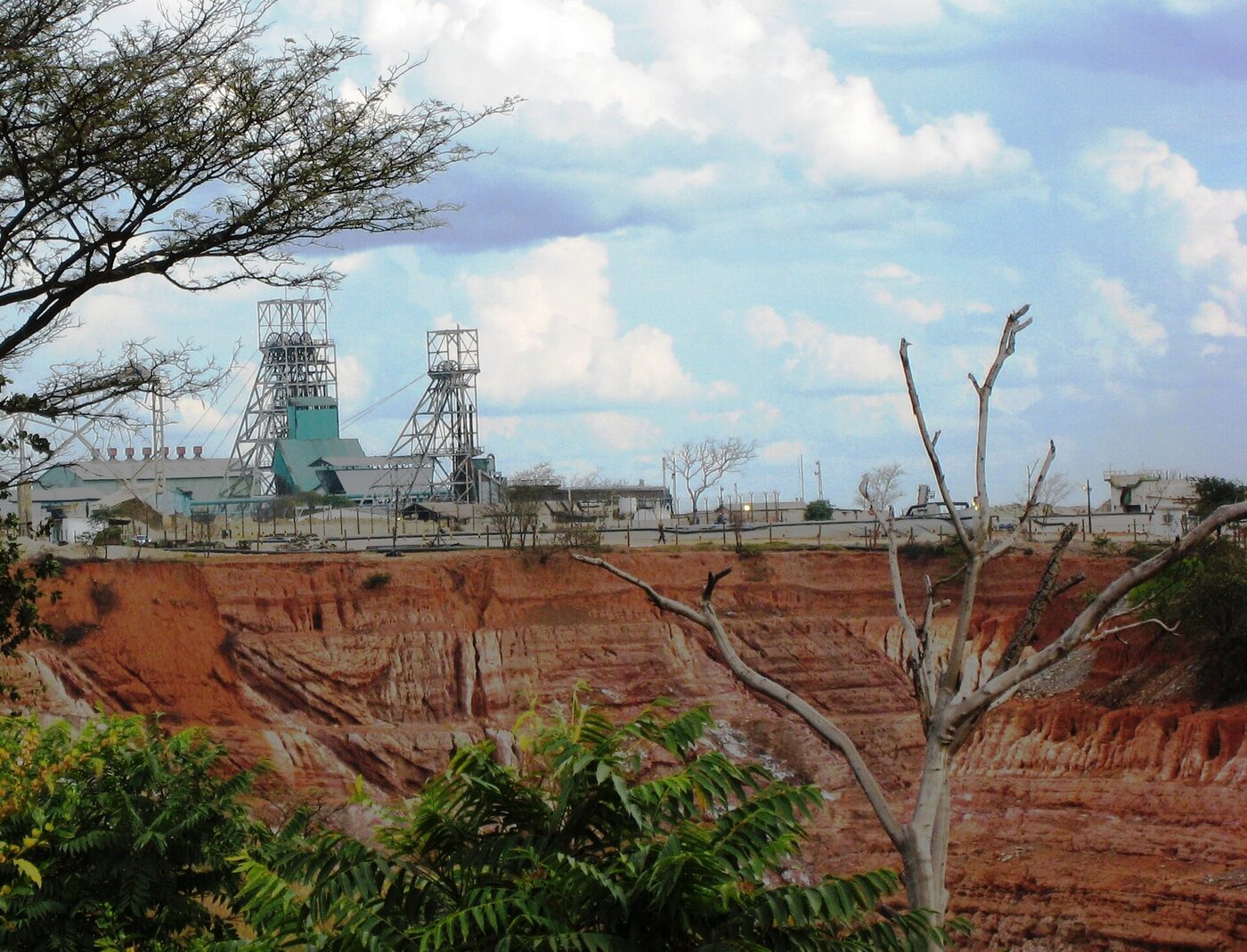

How to judge that transaction is precisely the sort of question this page declines. It records instead that the judgements differ and are on the record: studies of the re-privatisation have noted that the investment agreements concluded in the late 1990s often gave private operators favourable fiscal terms, which helped attract foreign investment while constraining the state's ability to capture mineral rents, and that local communities in the mining districts saw few development benefits in the years that followed, which produced protests and strikes. Others credit the sales with ending a haemorrhage of public money and with the recovery in output that followed the commodity boom of the 2000s. Both characterisations are attributed to those who make them.
The physical geography of all this is a line of towns — Kitwe, Ndola, Chingola, Mufulira, Luanshya, Kalulushi and Chililabombwe — strung along the Copperbelt in the country's north, plus Kabwe in the centre and the capital, Lusaka, to the south. Bemba is the main language of the Copperbelt towns and Nyanja the second, the reverse of the order in Lusaka. The trade union movement was a national political force long before 1991: the president elected in that year had been chairman of the Zambia Congress of Trade Unions from 1974.
Who could actually post, and from where
For a group named after a country with a small online population, the most useful thing a reference page can establish is who was physically able to reach it. Zambia's place in African internet history is documented and unusually early, and several of the load-bearing dates can be checked against primary records rather than inferred.
The namespace came first. IANA's root database records the registration date of the .zm country-code top-level domain as 25 March 1994. IANA's redelegation report of 1 February 2014 records that the designated manager up to that point was ZAMNET Communication Systems Ltd, and transfers the domain to the Zambia Information and Communications Technology Authority, which is the manager the root database shows today. That arrangement had lasted twenty years. The same report supplies a further dated fact from the period: the Communications Authority was established as a statutory body on 3 June 1994 under the Telecommunications Act No. 469 of 1994. The same Act split the Post and Telecommunications Corporation into a postal company and Zamtel, the telephone operator; Zamtel remained the country's fixed-line and international-gateway operator long afterwards, and studies of the sector describe its exclusive access to the international gateway as persisting well beyond the years covered here, protected in part by a licence fee that made entry impractical.
ZAMNET Communication Systems Ltd was established in Lusaka in 1994 and is described by the domain registry's own encyclopaedic record, and by studies of the sector, as Zambia's first internet service company; it is owned by the University of Zambia. What preceded it can be read in a contemporaneous primary document. Mark Bennett, then director of the University of Zambia's computer centre, wrote a review of electronic mail in Zambia dated June 1992, archived by the University of Pennsylvania's African Studies Center. It records that the university ran a FidoNet-based store-and-forward system using FrontDoor software, that it had been running a trial for some nine months at the time of writing, that mail was originally routed through GreenNet in London until the telephone costs proved prohibitive, and that routing then moved to Rhodes University in South Africa, which had offered on behalf of the UNINET academic network to bear the cost of the calls. In Bennett's words, Rhodes were currently polling some three times a day and effectively providing a free e-mail service to Unza. A one-minute call to Europe, he noted, cost the local equivalent of seven United States dollars.
Full connectivity followed. A 2021 survey of Zambian telecommunications reform by Zimba and colleagues dates it to 22 November 1994, and states, citing a 1996 account by Robinson, that this made Zambia the first country in sub-Saharan Africa apart from South Africa to have full access to the internet and the fifth in Africa overall; the same survey records that the first connectivity was spearheaded by the University of Zambia and the government, and that in 1996 ZAMNET was authorised to establish its own VSAT-based data gateway. The 1994 establishment and the .zm delegation are attested independently; the precise November date and the ranking are that survey's account and are given as such. The South African end of the earlier dial-up arrangement is the same academic network that carried the continent's first university connections, a story told on its own country page.
What that infrastructure amounted to in practice can be read off the World Bank's indicator series, and the numbers deserve to be set out plainly because they are the closest thing this page has to a measurement of its subject's audience. The share of Zambians using the internet was 0.009 per cent in 1997; 0.030 per cent in 1998, the year the group was created; 0.147 per cent in 1999; 0.19 per cent in 2000; 0.23 per cent in 2001; 0.48 per cent in 2002; 0.98 per cent in 2003; and 1.1 per cent in 2004. Over the same period the population rose from about 9.5 million to about 11.3 million. Fixed telephone subscriptions stood at 0.82 per hundred people in 1998 and 0.81 per hundred in 2004 — no growth at all across the group's active life. Mobile subscriptions went from 0.09 per hundred in 1998 to 4.1 per hundred in 2004. Access to electricity covered about nineteen per cent of the population in 1998, and about thirty-seven per cent of Zambians lived in urban areas.
Two conclusions follow from those figures and no more than two. The first is that the domestic online population in 1998 was small in proportion but not nil: three hundredths of one per cent of 9.5 million is a few thousand people, and the proportion grew more than thirtyfold by 2004. The second is arithmetic about how that growth happened. It cannot have come from household telephone lines, because there were no more of those at the end of the period than at the beginning; it came through shared and institutional access — universities, offices, and the public access points that spread through African cities in exactly those years.
What none of this establishes is who actually read or posted to this particular group, and the honest position is to say so rather than to assume. There is no subscriber list, no readership survey, no traffic sample and no archived thread available to this research. The two pointers inside the group's own paperwork point in opposite directions. The proposal cited a Zambian mailing list hosted at zamnet.zm — infrastructure inside the country, with a membership the list owner put at around 350. The newgroup message that created the group was injected into Usenet from a dial-up host on a Norwegian access provider. A reader who assumes a diaspora-only readership is guessing; so is a reader who assumes otherwise. The available record supports the weaker and more useful statement: by 1998 it was possible to reach Usenet from inside Zambia, and there is direct evidence that at least one person involved in the group's creation was reaching it from Europe.
A documented case, and what it says about the wire
One episode from two years before the group's creation establishes something that is rarely establishable for a small African newsgroup: that what appeared on Zambian internet infrastructure was already being read attentively by the state.
On 5 February 1996, ahead of the general election of November that year, President Chiluba banned edition 401 of The Post, an independent Lusaka newspaper founded in 1991, under Section 53 of the Penal Code, the provision headed Prohibited Publications, which empowers the president to ban a publication in the public interest. The edition had reported that the government was planning to hold a referendum on a proposed constitution at little notice to the public. That day's online edition was banned as well. Human Rights Watch, reporting in 1996, described that as the first act of censorship on the internet in Africa; the internet measurement organisation OONI, recounting the episode two decades later in a report on Zambian election monitoring, describes it as Africa's first known case of internet censorship and adds, citing Freedom House, that the government also threatened to hold the site's internet service provider, ZAMNET, criminally liable for the content. Three of the paper's editors — Fred M'membe, Bright Mwape and Masautso Phiri — were arrested and charged with receiving and publishing classified information, an offence carrying a maximum of twenty-five years. The characterisations belong to the organisations that make them; the ban, the statutory basis and the arrests are on the record.
The same newspaper and its editor recur through the group's active years. In 1999 M'membe and ten members of his staff were charged with espionage over an article stating that Zambia was unprepared to withstand a possible military attack from Angola, and the newspaper's offices were surrounded by police; his co-defendants were acquitted by the Lusaka High Court on 18 August 2000 and he was acquitted in December of the same year. In 2001 he was charged with defaming the president, charges that The New York Times described as efforts to muzzle the press ahead of the impending elections. These are court and press-freedom records, reported here for the dates and the documented facts, without endorsement of any characterisation attached to them by any party.
What this establishes for the present page is narrow and factual. The environment in which a Zambian discussion room existed on Usenet from 1998 was one in which the country's principal internet provider had already been threatened with criminal liability over a web page, and in which the boundary between publishable and unpublishable political material was actively litigated. An unmoderated newsgroup carried on servers outside the country sat outside all of that machinery, which is a structural observation about the medium rather than a claim about anything anybody posted.
Language on a seven-bit medium
English is the official language of Zambia and was declared the national language at independence in 1964. It is used for government, education and law; it is the first language of about two per cent of the population and the most widely used second language. Zambian English has developed its own features — the omission of object pronouns that would be obligatory elsewhere, simplified phrasal verbs, particles borrowed from the indigenous languages — and the country's urban slang draws on the languages around it.
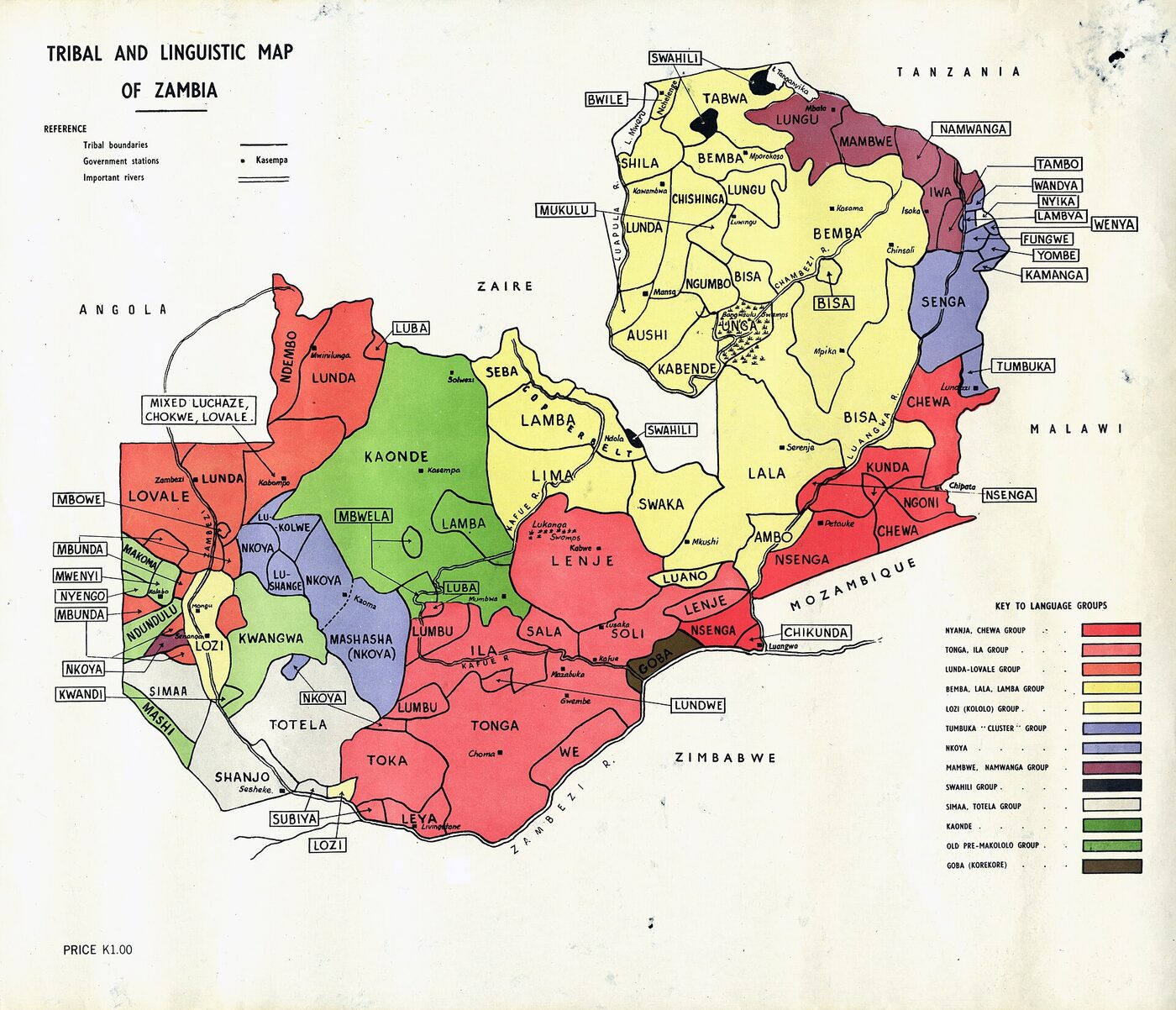
Seven indigenous languages are conventionally listed as Zambia's regional languages: Bemba, Kaonde, Lozi, Lunda, Luvale, Nyanja and Tonga. All of Zambia's major languages belong to the Bantu family and are closely related. Bemba and Nyanja are the languages of the towns — Nyanja predominantly in Lusaka and the east, Bemba in the Copperbelt with Nyanja second there. Counts of the total number of Zambian languages vary with the method: many texts give seventy-three, a figure attributed to counting dialects separately, while linguistic sources put the number of distinct languages at about twenty or thirty on a mutual-intelligibility criterion, or around forty on a fuller listing. Most Zambians speak more than one.

Usenet in the group's years was, for practical purposes, a seven-bit ASCII medium, and that constraint fell very unevenly across the culture groups. For a group writing in English it cost essentially nothing. Zambia's major languages are written in the Latin alphabet as well, so even a thread in Bemba or Nyanja needed no transliteration scheme, no negotiation over character sets and no argument about which encoding a distant reader's software could render. Communities whose language used a non-Latin script spent years of collective effort on precisely that problem, inventing romanisations and standardising them by use; that is a real chapter of the soc.culture.* story and it belongs to the pages of the groups that lived it, not to this one.
The one place where the constraint did bite was the namespace itself, and it bit everyone equally. The ISC archive's policy sets out the rules a newsgroup name must satisfy: each component may contain only the characters a to z, the digits, plus and hyphen, must contain at least one non-digit, may not begin with anything but a letter or digit, and the whole name may be no longer than eighty characters. The policy adds that only pure ASCII newsgroup names are accepted, and that Unicode names will be considered should they ever be standardised. The word zambia fitted the rules without difficulty. Not every community in the culture branch was so fortunate, and some carry compressed or anglicised names to this day for reasons that were purely mechanical.
What the record does not show is which languages were actually used in the group. The charter is in English, the control message is in English, and the ISC description field is empty. Nothing preserved permits a statement about the traffic.
What a small alt.* group was like, structurally
Nothing in this section is anecdotal, because no anecdotes survive. What can be described is the structure a group of this kind had, which is knowable from the paperwork and from how the hierarchy worked.
It was unmoderated, and the active file still says so with a single character. There was no moderator, no approval queue and no submission address. An article posted to the group by anyone, anywhere, propagated directly to every news server that carried it. That is the default condition of nearly every group in the culture branches of both hierarchies, and it means the group's character at any moment was simply the sum of whoever had turned up.
It had a charter that nobody was appointed to enforce. The single sentence quoted at the top of this page exists inside a control message and nowhere else. In the Big Eight a charter could at least be pointed at during a scope dispute, and a badly behaved group could in principle be taken to a removal vote. In alt.* the charter is a statement of intent by one person, filed once, and the hierarchy has no procedure that refers to it again.
Its existence was decided separately by every news administrator who received the newgroup message, which is why there has never been a canonical list of alt.* groups and why two readers on two providers could correctly disagree about whether a group was real. That mechanism, and its consequences, are set out on the alt.* hierarchy page and are not restated here.
It is, however, effectively permanent. The ISC archive's policy for alt.* and free.* is that all properly formatted newgroup messages are executed automatically and all rmgroup messages are ignored, and that no manual changes will be made in either hierarchy except under very special circumstances and with substantial justification. A group in this hierarchy cannot be closed by the mechanism that opened it. alt.culture.zambia is in the active file in August 2026 and would be there whether or not a single article had been posted since 1998, which is a useful thing to know before reading anything into the fact that it still exists.
What the record does not show should be listed rather than glossed over, because on a page like this the absences are load-bearing. There is no traffic figure of any kind: the two counters on the active-file line are placeholders. There is no subscriber or readership estimate. There is no surviving FAQ for the group in the public FAQ archives that this research reached. There are no thread titles, no quotations and no named participants beyond the proposer whose name and address the control message carries. The index the proposal itself relied on no longer exists in the form it was queried: the Deja News Research Service, started in March 1995 by Steve Madere in Austin, Texas, was acquired by Google in 2001 and became the basis of Google Groups, which stopped supporting the posting or viewing of new Usenet content on 22 February 2024 while keeping the existing archives available. This page therefore makes no claim whatever about what was discussed in the group, and the two sentences of editorial summary that stand above this article are exactly that — an editorial summary written for this directory, not a finding drawn from an archive.
In general terms, and stated as a generalisation, a small country room in alt.* had none of the apparatus that kept the larger culture groups going. There was no periodic FAQ posting because there was nobody to maintain one, no charter dispute because there was nobody to dispute it with, and no organised defence against crossposted provocation or automated advertising, both of which arrived in the alt.* hierarchy in quantity from the middle 1990s. A room of that size lived or emptied on the strength of a handful of regulars. Which of those happened here is not recoverable from anything preserved.
Scope and limits
This page rests on four kinds of source, and it is worth separating them so that a reader can weigh each. The group's own history rests on primary documents: the control message of 22 August 1998 in the ISC Usenet control archive, the companion file for alt.fan.countries.zambia, the ISC group-creation policy, the archived Big-Eight creation guidelines, and the ISC active and newsgroups files as they stood on 25 August 2026, all consulted directly for this article. The connectivity section rests on IANA's root database and its published redelegation report for .zm, on the World Bank's indicator series, on a contemporaneous 1992 review by the University of Zambia's computer centre, and on one academic survey whose distinctive claims are attributed to it in the text. The country chronology rests on standard encyclopaedic sources, on the World Bank and the International Monetary Fund for the debt figures, and on Human Rights Watch and OONI for the press and censorship record. The characterisations of contested matters — the Kariba resettlement, the conduct of the one-party period, the terms of the mining privatisation, the disputed election of 2001 — are attributed to those who make them and are not adjudicated here.
Zambian politics of the period is argued about by people with a great deal more standing in the argument than a directory page has. This article documents what was argued and by whom, gives the dates, and stops. It offers no verdicts and no advice, and where two accounts of the same event conflict it says so rather than choosing.
The limits on the group side are sharper still. There is no external documentation of alt.culture.zambia anywhere that this research could find: no scholarly citation, no contemporary write-up, no preserved FAQ, no thread. That is the normal condition of a small alt.* group and it is stated here as a finding rather than apologised for. The honest value of the page lies in the two things that can be established — precisely what the group's paperwork says, and precisely what the world it belonged to looked like in the years it was open — and in the discipline of not filling the gap between them with invention.
If an archived posting from the group ever resurfaces, it will be the first piece of evidence about the group's contents in existence, and this page is written so that it could be extended by such a discovery rather than contradicted by one.
Reading alt.culture.zambia today
- Historical archive: Google Groups — alt.culture.zambia (coverage varies by group and era).
- Open in a newsreader:
news:alt.culture.zambia— the original site offered exactly this link, and it still works if your system has a newsreader registered for thenews:scheme. - Live access: point an NNTP newsreader at a modern server — see accessing Usenet today.
- The original news2mail e-mail subscription service ended in the mid-2000s and no longer operates.