soc.culture.somalia
Somalia and Somalis worldwide.
Created as the state collapsed, the group was a diaspora address for news, clan-politics argument and family tracing.
This directory holds no archive of what was posted to it.
On this page
The group and its era
soc.culture.somalia belongs to the years after the collapse of the Somali state. Siad Barre fled Mogadishu on 26 January 1991, and the country entered a long period without an effective central government; transitional administrations followed only in 2000 and 2004. Like nearly all of soc.culture.*, the group was unmoderated, its character set by whoever turned up to post.
Who turned up was decided by infrastructure. Somalia established its first internet service provider in 1999, so for most of the group’s active life almost nobody inside the country could reach it. It was a diaspora institution by necessity, written from Minneapolis–St Paul, the American metropolitan area with the largest Somalia-born population, from Toronto, from London, the centre of Britain’s Somali population, and from the Nordic capitals, the Gulf cities and Nairobi.
Its arc was the one common across soc.culture.*: activity that followed the news from home, and a slow move of the conversation to web forums in the 2000s. It sat alongside the continental group and the other East African addresses.
The country’s own address on the network can be dated exactly. IANA’s root database gives 28 August 1997 as the registration date of the .so country-code domain, several years into the group’s life. The delegation went to Monolith Innovation Group, a company in Pittsburgh, rather than to any body in Somalia; its ml.org service ceased operating at the end of 1998 and the firm is now defunct, but the domain stayed delegated to it until 17 April 2009, when the root zone record was changed to the servers of the Ministry of Post and Telecommunications. IANA’s report on that redelegation is dated 3 February 2009, and the domain was relaunched on 1 November 2010, after the group’s active period had passed. For the whole of the group’s active life the country’s own domain was not in working use.
What the connection figures show
The World Bank’s series for individuals using the internet records Somalia at 0.0139 per cent of the population in 1999, the year the first service provider opened, and 0.02 per cent in 2000. It reaches 0.38 per cent in 2003, passes one per cent only in 2004, and stands at 1.08 per cent in 2005. On the same source, fixed telephone lines ran at roughly two per thousand people throughout the group’s active years — 0.212 per 100 in 1990 and 0.283 per 100 in 1999 — and mobile subscriptions are entered as zero for every year from 1988 to 1999.
Those figures set the ceiling on domestic participation. For the years in which soc.culture.somalia was busiest the proportion of the population with any internet access at all was a small fraction of one per cent. Whatever reached the group from inside Somalia came through the handful of commercial providers that opened from 1999 onward.
Telephony, by contrast, grew without a state to license it. Al-Barakat, founded in 1987, sold telephone and internet service alongside its money transfer business; Hormuud Telecom, established in Mogadishu in 2002 and originally consisting of sixteen telecommunication sites, is recorded as its successor. The first non-zero mobile figure in the World Bank series is 0.9 per 100 people in 2000; it reaches 2.0 in 2003 and 5.0 by 2006. By that year the Somali Telecommunication Association counted 22 established internet service providers and 234 cyber cafes. In 2004 the installation time for a landline in Somalia was three days, while in neighbouring Kenya waiting lists ran to years.
The bandwidth arrived later still. Somalia’s first fibre-optic connection followed an agreement between Hormuud Telecom and Liquid Telecom in November 2013, and Dalkom Somalia reached the EASSy cable in the first quarter of 2014. Both postdate the group’s active life by roughly a decade.
What was discussed
News relay came first. With no functioning national press or broadcaster, readers depended on what could be had at second hand: wire reports retyped, broadcast bulletins summarised, word passed on from relatives reached by telephone. Relay of that kind could not be verified from where it was read.
The international interventions supplied the longest-running political argument. UNOSOM I was created in April 1992; Security Council Resolution 794 of 3 December 1992 authorised the American-led Unified Task Force, whose first troops came ashore at Mogadishu on 9 December; UNOSOM II was established by Resolution 814 on 26 March 1993, assumed responsibility on 4 May, and the last UN forces left in March 1995. Whether those operations saved lives, prolonged the fighting, or did both was argued at the time and long afterwards, by people who had watched the war from inside the country and from outside.
Somaliland declared independence on 18 May 1991, following a conference of northern representatives held at Burao between 27 April and 15 May that year; no state recognised it during the years the group was active. Terminology was contested along with substance: what to call the territory, whether its administration constituted a government, and what the word Somalia now denoted.
Clan politics ran beneath all of it. It was argued about constantly, and it shaped who could say what: a poster was liable to be read as speaking for a descent group whether or not they claimed to, so the question of who was speaking for whom recurred as often as any question of substance.
Alongside ran the traffic of a dispersed population: appeals for news of relatives lost track of between cities and camps, questions about resettlement paperwork, and the logistics of sending money home through the informal networks that carried remittances where banks did not operate.
Language was not a side topic. Somali has had an official national orthography only since 1972, when the Latin script was adopted; it uses every letter of the English alphabet except p, v and z, and needs no diacritics, so it passed through plain seven-bit text without loss — not something true of every script in the region, as the neighbouring soc.culture.ethiopia illustrates. The group ran in English and Somali together, and the defining formal feature of Somali verse is obligatory alliteration — a pattern of letters, which transcribes to a screen intact.
The calendar was not neutral ground either. Somalia’s list of public holidays carries two independence dates: 26 June, marking the independence of British Somaliland in 1960, and 1 July, marking the union with the Trust Territory that formed the Somali Republic that same day. The first refers to the territory whose representatives declared independence again in 1991. The religious calendar was not uniform across the readership: Eid al-Fitr falls on 1 Shawwal and is fixed by lunar observation, so the announcement reached Minneapolis, London, Dubai and Mogadishu on different days.
A dated record
The following are given as dates and nothing more. Several fall outside the group’s life and are marked accordingly.
- 26 June 1960 — British Somaliland becomes independent as the State of Somaliland. Predates the group.
- 1 July 1960 — the State of Somaliland unites with the Trust Territory of Somaliland, forming the Somali Republic. Predates the group.
- 15 October 1969 — President Abdirashid Ali Shermarke is shot dead at Las Anod. Predates the group.
- 21 October 1969 — a military coup places the Supreme Revolutionary Council in power. Predates the group.
- October 1972 — the Supreme Revolutionary Council adopts the Latin script as the official orthography of Somali. Predates the group.
- 13 July 1977 to 23 March 1978 — the Ogaden War. Predates the group.
- 1992 — the Dadaab camps Ifo, Dagahaley and Hagadera are constructed in north-eastern Kenya, with a capacity given as about 90,000.
- 28 August 1997 — the
.socountry-code domain is registered in the IANA root. - 1 August 1998 — Puntland is established following a conference at Garoowe; Abdullahi Yusuf Ahmed becomes its first president.
- 1999 — Somalia’s first internet service provider begins operating.
- 2000 — a conference at Arta in Djibouti produces a Transitional National Government; Abdiqasim Salad Hassan becomes its president.
- November 2001 — United States authorities close Al-Barakat’s overseas remittance channel and list the company.
- 10 October 2004 — legislators elect Abdullahi Yusuf Ahmed the first president of the Transitional Federal Government.
- 17 February 2012 — the UN Security Council delists all Al-Barakat companies. Postdates the group’s active life.
- November 2013 — Somalia’s first fibre-optic connection is agreed. Postdates the group’s active life.
Script, orthography and what the wire could carry
The 1972 orthography was the work of a commission rather than of one hand: among those credited with developing it are Musa Haji Ismail Galal, the linguist B. W. Andrzejewski and Shire Jama Ahmed. It sets 21 consonants and five vowels and admits three consonant digraphs, dh, kh and sh; the apostrophe marks the glottal stop, which does not occur word-initially. Tone is not marked, and front and back vowels are not distinguished.
The device that keeps the orthography free of diacritics is the reassignment of letters English leaves idle. In Somali, c carries the pharyngeal ayn, x the voiceless pharyngeal fricative, q a uvular stop and dh a retroflex d. A language with those consonants written in almost any other Latin orthography would need a layer of dots, macrons or underdots; Somali needs none, which is why Somali prose entered a seven-bit news article unchanged and left it unchanged.
It was not the only script Somali had used. Wadaad’s writing, an Arabic-based orthography of 32 letters, ten of them vowels, was long established among clerics and their associates. Osman Yusuf Kenadid devised the Osmanya alphabet between 1920 and 1922; Sheikh Abdurahman Sheikh Nuur devised the Borama alphabet around 1933 and it was used in and around his home town; Hussein Sheikh Ahmed Kaddare devised a third in 1952, which a government commission is recorded as having favoured before judging it impractical. All three were set aside when the Latin script was adopted in October 1972.
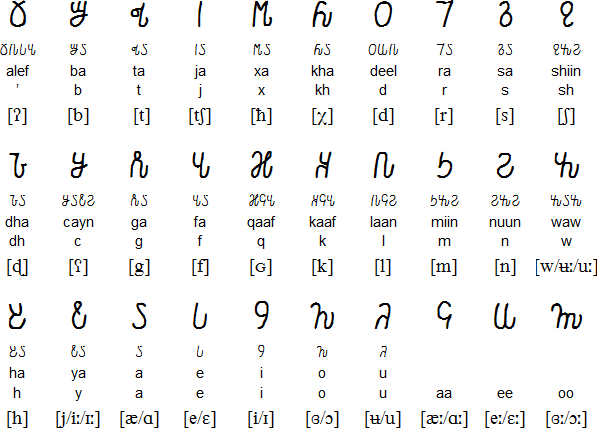

Their encoding histories diverge sharply. The Arabic script had a single-byte standard early: ISO/IEC 8859-6, also issued as ASMO 708 and ECMA-114, was first published in 1987, and it encodes nominal letters only, leaving the shaping to the display software. The Arabic block at U+0600 to U+06FF was present in Unicode 1.0.0 in 1991. Osmanya waited: it was added at U+10480 to U+104AF with Unicode 4.0 in April 2003, in the Supplementary Multilingual Plane, which UTF-16 implementations reach only through surrogate pairs. Before that date the script had no standard encoding, so Osmanya could not be sent as text at all during the group’s active years.
For a reader searching that archive today the practical consequences are two. Somali text in the 1972 orthography survives exactly as typed, with no mojibake and no encoding guesswork, so a search on a Somali word matches; the contrast is with archived material in Arabic or Ethiopic script, where a pre-Unicode code page has to be guessed before the bytes mean anything, as the neighbouring Ethiopian groups show. Against that, because tone is unmarked and front and back vowels are not distinguished, distinct Somali words are spelled identically, and a search returns them together with no way to separate them.
Money without banks
The transfer networks the group’s readers used were older than the crisis they served. Hawala is a debt-settlement practice with a documentary record reaching back to 1327 in one 2003 study; the Somali firms that grew into the diaspora’s payment system in the 1990s were applying a long-standing method to a country whose formal banking had stopped.
Dahabshiil was founded in 1970 by Mohamed Said Duale at Burao, in what is now Somaliland. It began as general trading and moved into remittances during the 1970s as Somali workers went to the Gulf states; through the 1980s it worked mainly through franco valuta, a trade-based system in which value moved as imported goods, the government’s foreign exchange controls making direct transfer impractical. The business collapsed inside Somalia during the war, was re-established from Ethiopia and Djibouti, and opened its first London office, in Whitechapel, in 1989.
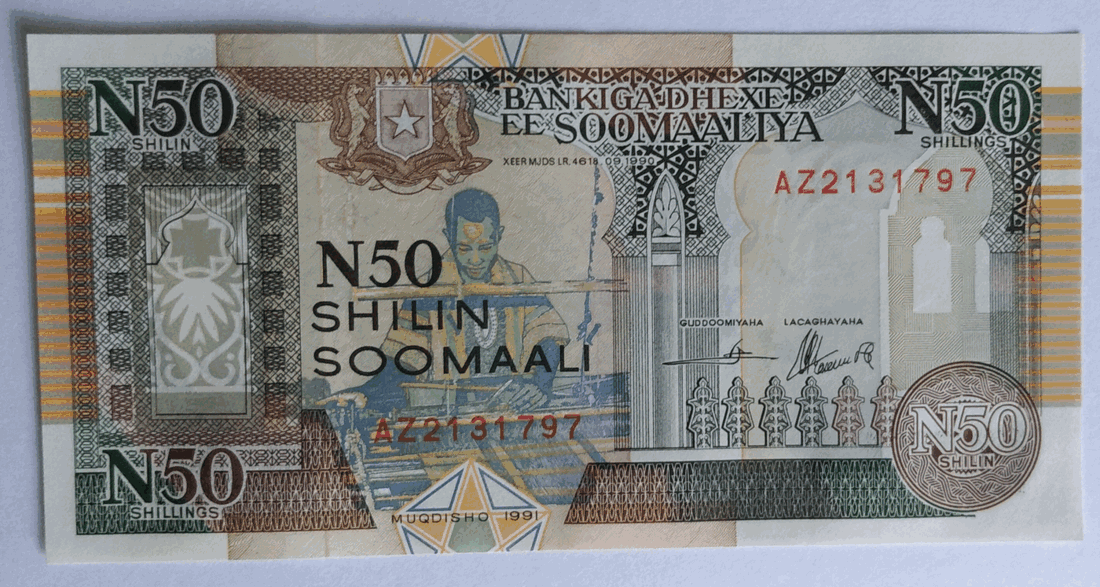

Al-Barakat was founded in 1987 by Ahmed Nur Ali Jim’ale and Ahmed Sheikh Ali Samatar. By 2001 it had outlets in 40 countries and handled about US$140 million a year from the Somali diaspora, alongside its telephone and internet operations. In November 2001 United States authorities closed its overseas remittance channel and listed it as a terrorist entity. The 9/11 Commission found no direct evidence linking the firm to terrorist funding. The unwinding took years and is dated: the Swedish branch was removed from the UN list in October 2009, all Al-Barakat companies were delisted by the Security Council on 17 February 2012, Jim’ale was removed from the OFAC listing on 30 June 2016, and the remaining Barakaat companies and executives were delisted on 12 February 2020.
The sums involved are large relative to the economy and are estimates rather than counts. A figure of about US$1.6 billion a year remitted by Somalis abroad through money transfer companies is widely cited, with estimates putting remittances at between a fifth and a half of the Somali economy; Dahabshiil is credited by industry observers with roughly two-thirds of transfers to Somali-speaking regions, and now reports more than 24,000 agent and branch locations across 126 countries.
What the official statistics show is instructive by omission. The World Bank’s series for personal remittances received by Somalia carries values only for 1979 to 1983, ending at about US$21.7 million in 1983, and records nothing at all thereafter. The money that kept households alive through the years the group covers moved through channels no balance-of-payments return captured.
Where the readers were
The Somali diaspora was not created by the 1991 collapse, though it was multiplied by it. Somali seamen were arriving in British ports from the 1880s, many of them from British Somaliland, and settled mainly at Cardiff and South Shields; the 1938 count records 116 Somalia-born sailors at Cardiff and 47 at South Shields. That community predates the group by half a century.
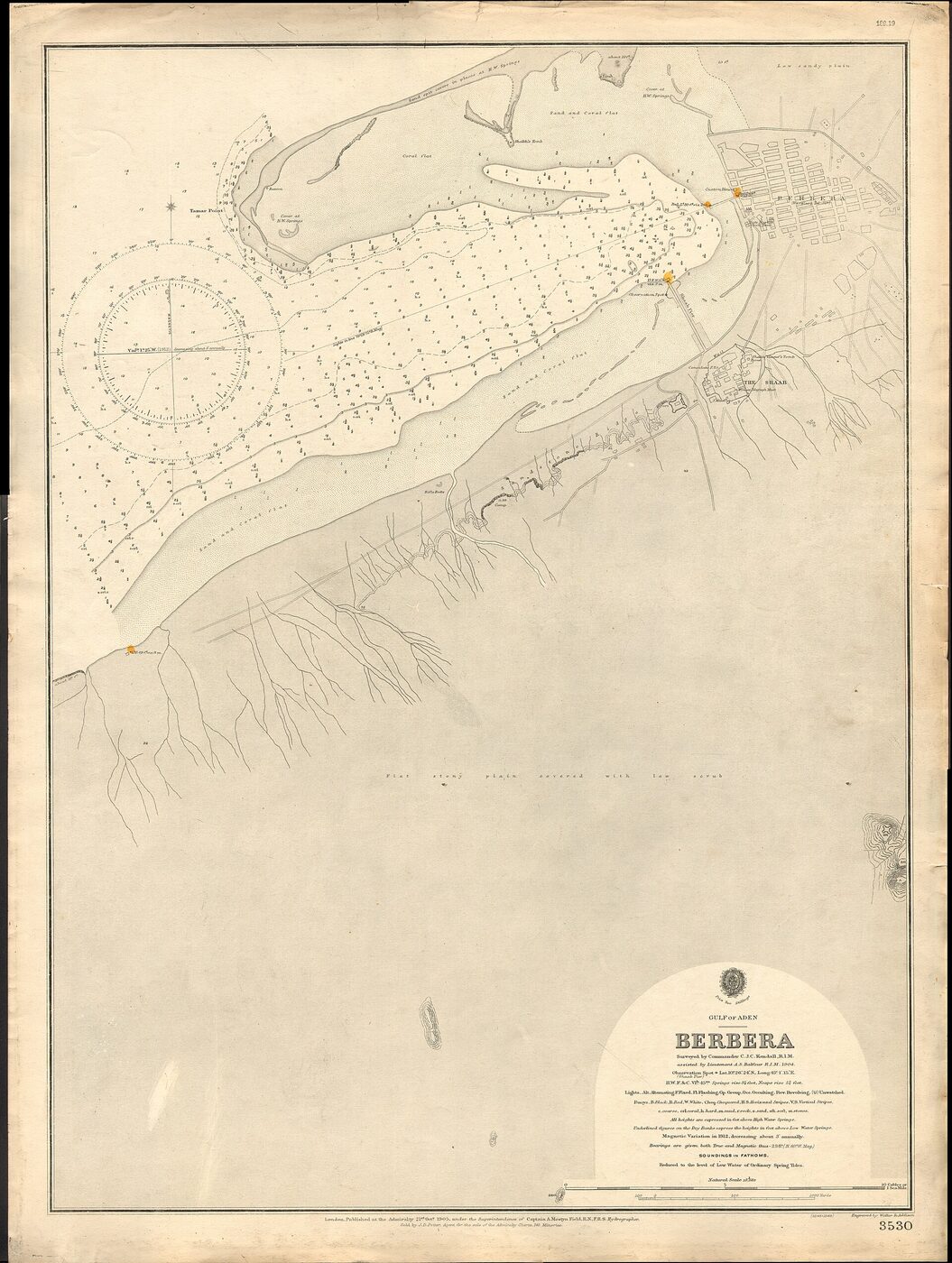

For the years the group was active the firmest single number is the 2001 United Kingdom census, which recorded 43,532 Somalia-born residents. Ten years later the 2011 census returned 99,484 in England, 1,886 in Wales, 1,591 in Scotland and 88 in Northern Ireland, with 65,333 of the England total in London and 7,765 in Birmingham. Those later figures postdate the group’s active life and are given as the trend line, not as its readership.
The Minnesota Department of Health records 23,915 refugees arriving from Somalia between 1979 and 2017; by 2018 approximately 43,000 people born in Somalia were living in Minnesota, 0.77 per cent of the state’s population. Canada’s 2011 National Household Survey recorded 44,995 people claiming Somali descent. The Nordic figures, all later than the group, run to 66,369 in Sweden and 43,196 in Norway in 2016 and 39,465 in the Netherlands in the same year.
The largest concentrations were never in the West: about two thirds of the Somalis living outside Somalia were in Djibouti, Ethiopia, Kenya and Yemen. The Dadaab camps in north-eastern Kenya were built in 1992 for about 90,000 people; Kenya was hosting more than 313,000 Somalis in April 2017 and about 255,000 were registered as refugees in Ethiopia. Yemen’s Somali population was estimated at 500,000 before that country’s own war.
A dispersed readership has no shared working day. Mogadishu has kept East Africa Time, three hours ahead of UTC, since 1893, and observes no summer time; the Gulf cities are one hour further east and Minneapolis six behind UTC, or five in summer, so the extremes are nine or ten hours apart depending on the season. A post written after the evening meal in Dubai landed in Minnesota in the middle of the working morning; a post written at a Minneapolis kitchen table at midnight was waiting at breakfast in Hargeisa. Nothing in the group could be synchronous, and a thread that ran for a week was in practice a relay, each city adding to it while the others slept.
The cultural traffic
Verse is described in Somali by its metre, and the classical metres are counted. Halaanhal, of twelve syllables, is identified as the oldest. The gabay, of fourteen to sixteen syllables, is classed with it as a classical metre. The geeraar runs to seven syllables and is associated with the mounted poems of Ali Bu’ul in praise of horses; the jiifto is likewise a seven-syllable metre. Alongside the classical forms sit the many kinds of hees, work and dance songs of four to eleven syllables. The obligatory alliteration, hikaad, binds all of them.
The modern forms are datable. Abdi Sinimo, who rose to fame in the early 1940s, pioneered the balwo; it developed into the ten-syllable heello, which turned Somali song towards love and physical beauty and, carried by Radio Hargeisa, acquired mass appeal among the young. Abdullahi Qarshe, called the father of Somali music, introduced the oud, the kaban, as accompaniment. Radio Kudu at Hargeisa, later renamed Radio Somali, is recorded as the first station in the country to air popular Somali music. Recordings made in the 1970s were preserved at Hargeisa by being buried, and are now held by the Red Sea Foundation and Radio Hargeisa; most of the musicians had emigrated before 1991.
Canjeero, also called laxoox, is the thin fermented breakfast pancake, smaller, thinner and sweeter than Ethiopian injera; sabaayad is the flatbread eaten at midday with a curry, soup or stew, and muufo the thicker, puffier flatbread of the south. Lunch is often bariis iskukaris, rice spiced with cumin, cardamom, cloves and sage and served with a banana. Xalwo, made with sugar, cornstarch, cardamom, nutmeg and ghee, belongs to Eid and to weddings; sambuus, the triangular pastry, is eaten at afur, the breaking of the fast; shaah, black tea with ginger, cardamom and cinnamon, goes with breakfast.
The Somali Football Federation was founded in 1951; the first international was played at Mombasa in 1958, a 4–0 win over Kenya, and the record win listed for the team is 5–2 against Mauritania at Casablanca on 7 August 1985. After the war began, FIFA-sanctioned matches could not be played inside the country for many years, so any fixture a diaspora readership could follow was played abroad.
The Olympic record is short and precisely dated. The Somali Olympic Committee was founded at Mogadishu on 12 December 1959 and recognised by the International Olympic Committee shortly before the 1972 Summer Games at Munich, which were Somalia’s first. Somalia joined the boycotts of the 1976 Montreal and 1980 Moscow Games and did not take part in 1992 because of the famine. The best placing by a Somali athlete remains sixth, in the final of the 1500 metres at Atlanta in 1996. Somalia has never won an Olympic medal.
Context
For most of a decade a nation’s public conversation was conducted outside its borders. There was no parliament to report on, no paper of record, and for long stretches no address at which the country as a whole could be said to speak. A newsgroup reachable from Minneapolis and Nairobi but not from Mogadishu was one of the open and archived places where Somalis from different regions and positions read one another.
That is not the same as a national conversation. Posting required a network account and the literacy to use it, which in those years meant a university, an office or a paid connection abroad; most Somalis, inside the country and in the camps around it, were absent entirely. What the archive holds is the argument of the connected part of a scattered nation.
Those arguments were often bitter, and the record does not soften them. People who supported opposing factions, held incompatible accounts of what had happened in a particular town, and disagreed about whether the state should be rebuilt at all wrote in the same threads and answered one another directly. Nothing was settled there. What survives is testimony rather than conclusion: an unedited record of how Somalis abroad described and disputed events at home while the outcomes were still open.
Reading soc.culture.somalia today
- Historical archive: Google Groups — soc.culture.somalia (coverage varies by group and era).
- Open in a newsreader:
news:soc.culture.somalia— the original site offered exactly this link, and it still works if your system has a newsreader registered for thenews:scheme. - Live access: point an NNTP newsreader at a modern server — see accessing Usenet today.
- The original news2mail e-mail subscription service ended in the mid-2000s and no longer operates.