soc.culture.sierra-leone
Sierra Leone through the war years.
The 1990s civil war dominated the group — news relays, diaspora organising, and the long accounting afterwards — with Krio threads and quieter cultural traffic between crises.
Another archive whose value is testimony.
On this page
The group and its era
soc.culture.sierra-leone belonged to the national roster of soc.culture.*, the Big Eight’s atlas of country groups: unmoderated, carried by any server that took the feed, shaped by whoever arrived to post. Its subject was never in much doubt. The Revolutionary United Front crossed from Liberia into Sierra Leone on 23 March 1991, and President Ahmad Tejan Kabbah declared the conflict over on 18 January 2002; estimates of the dead run between 50,000 and 70,000, and some 2.5 million people were displaced.
Domestic connectivity was slight, and stayed slight long after the fighting stopped — recorded internet users still numbered about 14,900 in 2009 — so the population able to post was a diaspora one, writing from Britain, the United States and the West African countries where Sierra Leoneans had settled or taken refuge.
The dates behind that sentence are checkable ones. Sierra Leone’s country-code top-level domain, .sl, carries a registration date of 9 May 1997 in IANA’s root database, with the state operator Sierratel as sponsoring organisation — a delegation that postdates the start of the war by six years and precedes the gateway years by three. The internet-use series the World Bank publishes from ITU returns puts the share of the population online at 0.12 per cent in 2000 and 0.20 per cent in 2004: on the order of one person in eight hundred when the gateway began carrying the group, and one in five hundred when it stopped. Fixed telephone subscriptions across the same years never reached 0.5 per 100 people. Submarine capacity did not arrive until the ACE cable was landed at Freetown in the second half of 2011, and recorded users passed one per cent of the population only in 2012. Whoever was writing to a Usenet group about Sierra Leone between 2000 and 2004 was, as a matter of arithmetic, almost never doing so from Sierra Leone.
The news2mail gateway carried the group from 2000 to 2004, a stretch that took in the British deployment of May 2000, the declared end of the war, and the first years of the accountability arrangements that followed.
What was discussed
Much of the traffic was informational. Requests for news of a district, appeals for word of particular families and relayed news copy formed a standing genre — the kind a dispersed readership depends on when reporting from home is thin, as it was around the coup of 25 May 1997, the recapture of the capital by the West African force in March 1998, and the fighting that reached Freetown in January 1999. Alongside ran the practical business of displacement: immigration and asylum procedure, remittances, the logistics of keeping a scattered household in touch.
Diamonds became a subject of international policy during the group’s own lifetime, which is unusual for a newsgroup’s subject matter. The fields in the east supplied a legitimate export trade and, through channels outside it, the financing of armed groups. The UN Security Council embargoed Sierra Leonean rough diamonds outside a government certificate-of-origin scheme on 5 July 2000 and lifted the measure in June 2003. The producers’ meeting at Kimberley in May 2000, the General Assembly resolution of December 2000 and the certification scheme that took effect in 2003 all fell inside the years the gateway served the group — material that, for a Sierra Leonean readership, was news from home before it was a commodities story.
The certification machinery has a documented calendar of its own, most of it running alongside the gateway years. The process took its name from the meeting of diamond-producing and trading states convened at Kimberley, in South Africa’s Northern Cape, in May 2000. After some two years of negotiation among governments, the diamond industry and non-governmental organisations, the Kimberley Process Certification Scheme was settled in November 2002 and came into effect the following year. Its membership has continued to grow since: as at 1 January 2024 it listed 59 participants representing 85 countries, two decades after the gateway shut down.
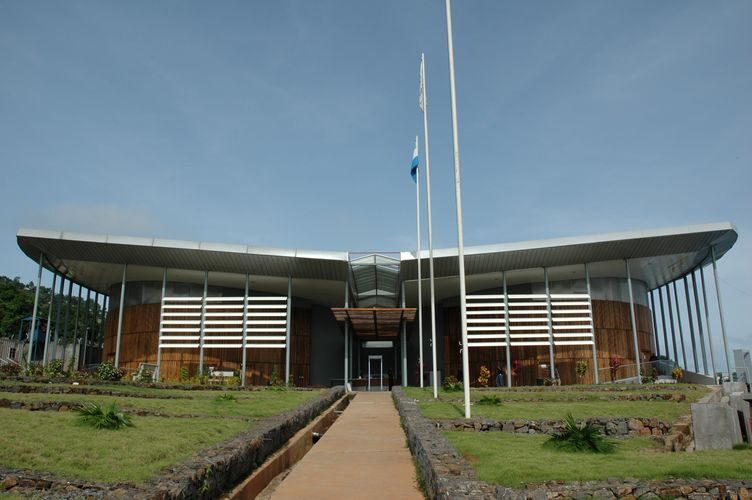
Accountability was the argument that outlasted the fighting. The Lomé agreement of 7 July 1999 paired a settlement with an amnesty; the Security Council asked the Secretary-General to negotiate a tribunal on 10 August 2000, and the agreement of 16 January 2002 created the Special Court for Sierra Leone, with jurisdiction over those bearing the greatest responsibility for serious violations committed after 30 November 1996. A Truth and Reconciliation Commission sat from 2002 to 2004 and presented its report in October 2004; the court’s Freetown courthouse opened on 10 March 2004. Whether amnesty, public testimony or prosecution served the country better was disputed at length while those institutions were being built.
Language and history supplied the other continuities. Krio, the English-based creole that grew out of the settlement of Freetown, is the lingua franca and de facto national language, spoken by the great majority of Sierra Leoneans, while English is the sole official language; both travel with the diaspora, and setting down a mainly spoken tongue in text carries its own spelling and orthography questions. So does the history behind it: the Province of Freedom of 1787, the Nova Scotian settlers of 1792, the Jamaican Maroons of 1800 and the liberated Africans landed at Freetown in the decades after abolition; the protectorate declared over the hinterland in 1896; and the division of the administration into Colony and Protectorate in 1924, whose afterlife in relations between Freetown Krio society and the rest of the country is a long-running subject. Between the crises there is also football, music and the ordinary business of a small country’s diaspora.
The years the gateway ran, as dated record
What follows is a chronology, not an argument. The entries are dated events recorded by the United Nations and by standard reference sources; no party is characterised and no cause assigned. Items falling outside the years news2mail carried the group are marked as such, because a reader working through the archive needs to know which of them the group could have discussed as news and which it could not.
- 30 November 1996 — the Abidjan accord was signed in Côte d’Ivoire. The date was later written into the Special Court’s temporal jurisdiction. Predates the gateway.
- July 1998 — Security Council Resolution 1181 created the United Nations Observer Mission in Sierra Leone, UNOMSIL, with an initial six-month mandate. Predates the gateway.
- 7 July 1999 — the Lomé agreement was signed in Lomé, Togo. The United Nations Special Representative appended a reservation that the organisation would not recognise the amnesty as applying to genocide, crimes against humanity, war crimes and other serious violations of international humanitarian law. Predates the gateway.
- 22 October 1999 — Resolution 1270 established the United Nations Mission in Sierra Leone, UNAMSIL, with a maximum of 6,000 military personnel. Predates the gateway.
- 7 February 2000 — the authorised military strength of UNAMSIL was raised to 11,100.
- 1 May 2000 — United Nations personnel were detained at Makeni; within days close to 500 were held. Between 16 and 28 May, 461 were released by way of Liberia.
- 7 May 2000 — the British Operation Palliser began, mounted to prepare the evacuation of entitled personnel; the wider British operation was mostly complete by September 2000.
- 19 May 2000 — the authorised military strength of UNAMSIL was raised to 13,000.
- 30 March 2001 — the authorised military strength of UNAMSIL was raised to 17,500, its maximum.
- early 2002 — UNAMSIL recorded more than 75,000 former combatants, among them children, as disarmed and demobilised.
- 14 May 2002 — presidential and parliamentary elections were held, with 2,309,338 registered voters. Ahmad Tejan Kabbah was returned with 70.06 per cent of the presidential vote and Ernest Bai Koroma recorded 22.35 per cent; the Sierra Leone People’s Party took 83 of the 112 elected parliamentary seats.
- 5 October 2004 — the Truth and Reconciliation Commission’s final report was presented to the United Nations Security Council. The commission was chaired by Bishop Joseph Christian Humper.
- 30 June 2005 — Resolution 1610 extended the UNAMSIL mandate by six months. Postdates the gateway.
- 31 December 2005 — UNAMSIL withdrew. Postdates the gateway.
- 1 January 2006 — the United Nations Integrated Office in Sierra Leone, UNIOSIL, became operational; it ran until September 2008. Postdates the gateway.
The court’s record, by date
The court’s documented output is almost entirely later than the group. Twenty-three persons were indicted in all. The first indictments were issued on 7 March 2003, within the gateway years; the Freetown courthouse opened on 10 March 2004, in their last year. Every judgment came afterwards.
- 20 June 2007 — in the AFRC case, Brima, Kanu and Kamara were each convicted on eleven of fourteen counts. On 19 July 2007 Brima and Kanu were sentenced to 50 years and Kamara to 45.
- 2 August 2007 — in the CDF case, Kondewa and Fofana were convicted; sentences of eight and six years followed on 9 October 2007 and were raised on appeal to twenty and fifteen years on 28 May 2008.
- 25 February 2009 — in the RUF case, Sesay and Kallon were convicted on sixteen of eighteen counts and Gbao on fourteen; on 8 April 2009 Sesay was sentenced to 52 years, Kallon to 40 and Gbao to 25.
- 26 April 2012 — Charles Taylor, indicted on 7 March 2003, arrested and taken into the court’s custody on 29 March 2006 and tried at The Hague from 4 June 2007, was convicted on all eleven remaining counts; he was sentenced to 50 years on 30 May 2012.
- 2 December 2013 — the court was dissolved. A Residual Special Court took over its continuing functions.
Two of those judgments are cited in the literature as firsts for an international criminal court: the June 2007 convictions for conscripting or enlisting children into armed forces, and the February 2009 convictions for forced marriage as a crime against humanity. Both postdate the gateway by years. What the archive holds is therefore the argument about the institution rather than any reaction to its findings: the years in which the court existed as a proposal, a signed agreement, a set of indictments and a building, and in which nobody yet knew what it would decide.

Freetown, and the settlement behind Krio
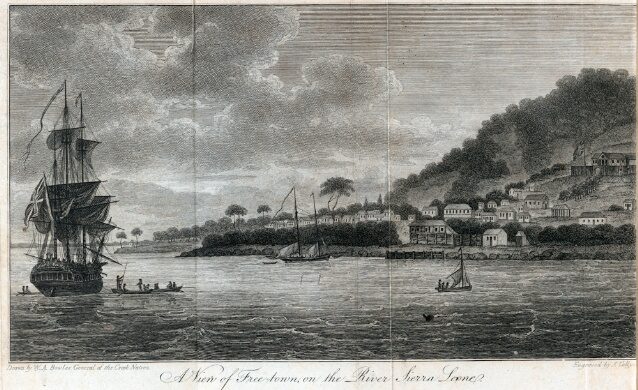
Freetown’s founding is closely dated, because it was an administered project with paperwork. Some 411 settlers, African American and Afro-Caribbean, arrived in May 1787 to establish the Province of Freedom. The city itself was founded on 11 March 1792 by settlers who had embarked at Halifax on 15 January that year, more than 1,100 in number, reaching Sierra Leone at the end of February and the beginning of March under the direction of Lieutenant John Clarkson. About 550 Jamaican Maroons were transported there in 1800. The British made Freetown a Crown Colony in 1808, and from 1807 into the 1830s liberated Africans taken from intercepted slaving vessels were landed and settled there. Fourah Bay College, described as the oldest university in West Africa, was founded in 1827.

The linguistic result is a language much larger than the community named for it. Ethnologue’s 2021 figures give Krio about 860,000 first-language speakers and some 6.9 million second-language speakers; the 2015 census recorded the Krio as an ethnic group at 1.3 per cent of the national population, against Mende at 31.9 per cent and Temne at 31.4 per cent. A creole carried out of one city has become, in the standard descriptions, the language 96 or 97 per cent of Sierra Leoneans use with each other, without ever acquiring official status. Its documentary apparatus is datable: Fyle and Jones’s A Krio-English Dictionary appeared in 1980, and Krio translations of the New Testament and the Old Testament were published in 1986 and 2013.
Freetown counted 469,776 people in 1985, 772,873 in 2004 — the gateway’s last year — and 1,055,964 in 2015.
Writing Krio on a seven-bit network
Krio’s standard orthography is Latin, but not the Latin of a British keyboard. It drops Q and X and adds three letters taken from the African reference alphabet: open E, written Ɛ and ɛ; eng, written Ŋ and ŋ; and open O, written Ɔ and ɔ. The reference alphabet itself has a datable pedigree — proposed at a UNESCO conference at Niamey, Niger, in 1978, building on an earlier UNESCO meeting on harmonising African transcriptions held at Bamako, Mali, in 1966; a substantial revision put forward in 1982 was rejected at a follow-up conference at Niamey in 1984.
None of those three letters exists in ISO 8859-1, the eight-bit set most Western European Usenet software assumed. They did have a standard home before Unicode: ISO 6438:1983, Documentation — African coded character set for bibliographic information interchange, encoded open E, open O and eng among a wider repertoire of African letters, but the standard saw little use outside libraries. Usenet’s own baseline was narrower still. RFC 1036 of December 1987, the Standard for Interchange of USENET Messages, defines the article format by reference to RFC 822, which, as RFC 2045 later summarised it, “leaves the message content, or message body, as flat US-ASCII text”. Labelling a body as being in some other character set is what MIME added, and MIME’s first part was only reissued as RFC 2045 in November 1996.
Unicode was not the obstacle. Eng sits in the Latin Extended-A block, U+0100 to U+017F; capital open O and capital open E sit in Latin Extended-B, U+0180 to U+024F; the lower-case open e and open o sit in IPA Extensions, U+0250 to U+02AF. All three blocks have been in the standard since version 1.0, released in 1991. The obstacles were transport, fonts and keyboards. The practical consequence for anyone searching the archive today is mechanical: a string containing ɛ or ɔ will not match the same word typed with a plain e or o, and a search using plain ASCII will not match text that used the proper letters. Both spellings have to be tried, and neither result is the whole of what is there.
The region’s indigenous scripts arrived in the standard later still, and both admissions fall after the gateway closed. The Vai syllabary, devised by Momolu Duwalu Bukele and first documented in the 1830s, is used chiefly in Liberia and by the small Vai population of Pujehun District in south-eastern Sierra Leone; it entered Unicode in April 2008 with version 5.1, at U+A500 to U+A63F. The Mende Kikakui syllabary, devised around 1917 by the Islamic scholar Mohamed Turay with about 42 characters and enlarged by his student Kisimi Kamara with more than 150 more, was added in June 2014 with version 7.0, at U+1E800 to U+1E8DF. Neither could have been posted as text in the gateway years: whatever a correspondent wanted to show of either script had to be described in words or not sent at all.
Where the readership was
Sourced counts of the readership do not exist, but sourced counts of the population it was drawn from do. In Britain, there were 17,048 Sierra Leone-born residents of the United Kingdom in 2001, and the Office for National Statistics recorded 23,000 Sierra Leoneans in England and Wales in 2011. Roughly 17,000 Sierra Leonean refugees are recorded as arriving in the United Kingdom between 1992 and 2003 — a span that brackets the gateway years exactly. London holds the largest community, with smaller ones in Manchester, Sheffield, Liverpool, Cardiff, Birmingham, Leicester and Bristol.
In the United States, the American Community Survey for 2019 counted 29,153 people reporting Sierra Leonean ancestry. The largest concentration is in the Baltimore and Washington, D.C. metropolitan area, with further communities in New York, Boston and Philadelphia. Those two countries are where most of the English-language, English-keyboard readership of a Sierra Leonean group in 2000 would have been sitting, along with the West African states where people had settled or taken refuge.
Sierra Leone keeps Greenwich Mean Time, UTC+00:00, under the IANA identifier Africa/Freetown, and has never observed daylight saving. Freetown and London therefore share a clock through the British winter and differ by one hour when British Summer Time is in force; the eastern United States runs five or four hours behind. A group with this readership has no single working day: a message posted in the London evening lands in the American afternoon, and a reply from the American east coast arrives in Freetown and London overnight. Mail and news differ mechanically here: mail accumulates and waits, whereas reading news requires a session with a server.
Between the crises
The calendar a Sierra Leonean group argued over is documented independently of the group, and it is a shared one. Pew Research Center’s 2020 estimate puts the population at 78.5 per cent Muslim, 20.4 per cent Christian and 1.1 per cent other; the Inter-Religious Council of Sierra Leone’s own figures are 77, 21 and 2 per cent. The list of public holidays reflects both: Korité at the end of Ramadan, Tabaski and Mawlid stand alongside Good Friday, Easter Monday, Christmas Day and Boxing Day, with Independence Day on 27 April, Armed Forces Day on 18 February and International Women’s Day on 8 March. Independence from the United Kingdom is dated 27 April 1961 and the republican constitution 19 April 1971.
Sierra Leone’s named musical genres are well recorded. Maringa is the local palm-wine style, first popularised by the Creole musician Ebenezer Calendar (1912–1985) and his Maringar Band, active from the early to the middle twentieth century. Gumbe is a Creole genre whose line runs back to the Jamaican Maroon settlers and which is still played by their descendants in both Jamaica and Sierra Leone; it fed into asiko, maringa and milo jazz, the last of which is associated above all with Dr Oloh. S. E. Rogie, born at Fonikoh in Pujehun District in 1926, recorded “Please Go Easy with Me” at his home studio in 1960, moved to the San Francisco Bay Area in 1973 and to England in 1988 at the invitation of a BBC Radio 1 presenter, played the Cambridge Folk Festival in 1989, and died at Lewisham in London on 4 July 1994, six years before the gateway began carrying the group. Sierra Leone’s Refugee All Stars formed among musicians who met in the Kalia refugee camp in Guinea and were later moved to Sembakounya; they returned to Freetown in 2004, were the subject of a documentary film in 2005, and released Living Like a Refugee on 25 September 2006, after the gateway had closed.
Football supplies the fixed points. The national side, the Leone Stars, played its first international on 10 August 1949, losing 0–2 to Nigeria at Freetown. It has reached the Africa Cup of Nations finals three times — in 1994 and 1996, both before the gateway years, and again in 2021, long after — and went out at the group stage each time.
Literature produced Sierra Leonean books about the war while the war was still being argued over. Syl Cheney-Coker, born in Freetown on 28 June 1945, won the Commonwealth Writers’ Prize for the Africa region in 1991 for The Last Harmattan of Alusine Dunbar, published the year before; he spent long periods abroad, in the United States, the Philippines and Nigeria, and returned to Sierra Leone in 2003. Aminatta Forna’s memoir The Devil that Danced on the Water, an account of her search for what had happened to her father, was published in 2002, inside the gateway years. Later Sierra Leonean writing about the period — Forna’s Ancestor Stones of 2006 and The Memory of Love of 2010, which took the Commonwealth Writers’ Prize Best Book award in 2011 — belongs to the years after the archive stops.
Context
The nearest group in subject was soc.culture.liberia. The 1991 incursion crossed the Liberian border, and the West African force that later intervened here, ECOMOG, had been established by ECOWAS in 1990 for the war next door. Above both sat the wider soc.culture.african.
What the archive holds is not a history of the war but a contemporaneous record of people following one: dated messages, the gaps where news failed, and arguments conducted before anyone knew how they would end. The court and the commission gathered testimony under procedure and after the fact; a newsgroup preserves what a dispersed population said in public while events were still running, unedited and with no convening authority.
Reading soc.culture.sierra-leone today
- Historical archive: Google Groups — soc.culture.sierra-leone (coverage varies by group and era).
- Open in a newsreader:
news:soc.culture.sierra-leone— the original site offered exactly this link, and it still works if your system has a newsreader registered for thenews:scheme. - Live access: point an NNTP newsreader at a modern server — see accessing Usenet today.
- The original news2mail e-mail subscription service ended in the mid-2000s and no longer operates.