soc.culture.liberia
Liberia during and after the wars.
Carried by the diaspora through two civil wars — eyewitness relays, refugee tracing, and the American-Liberian identity threads unique to a country with that founding.
The first civil war ran from December 1989 to August 1997 and the second from April 1999 to August 2003; this directory holds no archive of what was posted to the group.
On this page
The group and its era
soc.culture.liberia sat in the country-by-country run of the soc.culture.* hierarchy, and was shaped less by its charter than by timing: the years in which such groups were busiest were also the years in which Liberia was at war with itself. The first conflict ran from 24 December 1989 to 2 August 1997, killing an estimated 200,000 people and pushing around a million into refugee camps in neighbouring countries; fighting resumed on 21 April 1999 and ended on 18 August 2003 with the Comprehensive Peace Agreement signed at Accra.
That history determined who could write. Much of the country’s communications infrastructure was destroyed or plundered across the two wars, the fixed-line network nearly completely so, and internet access inside Liberia was negligible for most of the newsgroup’s busy years. A group named for the country could in practice only be written from outside it.
The exodus itself set out the map. Liberians displaced by the wars settled in Rhode Island — Providence and Pawtucket — on Staten Island, in Philadelphia, in the Minneapolis–Saint Paul area, in Virginia and in Georgia, most sharply after the second war, with others in Europe and in the West African states carrying the refugee burden, among them Ghana, where the UNHCR opened the camp at Buduburam in 1990. A newsgroup with a global feed and no subscription cost was one of the few instruments able to hold a readership that dispersed.
What was discussed
During the wars the group took on work no charter would have described. One function was news relay: agency reports named towns and counties, and readers with family in them could add what they had heard, correct what was wrong, and pass on whatever a telephone call to a third country had produced. The other was tracing — asking after named people, whether a family had reached a border, which camp a household had been counted in. For several years there were few open, worldwide places to ask, and a newsgroup with a public posting address was one of them.
The other constant was the country’s founding. Liberia’s origin in the American Colonization Society, established at Washington in December 1816, in the settlement at Cape Mesurado from 1821 and in the declaration of independence of 26 July 1847, gave it a history unlike its neighbours’: a state founded by settlers from the United States, whose descendants and the True Whig Party they built dominated its politics from 1877 until the coup of 1980. The subject kept returning because the wars kept making it current, and it was disputed: over how the settler and indigenous strands of the population should be described, and over what weight that inheritance carried in the origins of the wars. The group recorded the argument; it did not settle it.
Language was a related and quieter thread. English is the official language, spoken alongside more than twenty indigenous languages — Kpelle, Bassa, Vai, Kru, Grebo, Mano, Loma, Gola, Kissi and Mandingo among them — and in several distinct varieties: Standard Liberian English; the Settler English, or Merico, of the nineteenth-century immigrant communities; the now moribund Kru Pidgin English of migrant workers and mariners; and Kolokwa, the creole descended from the West African Pidgin English of the coast. Rendering colloquial speech in a written medium with no settled orthography produced its own recurring exchanges.
After 2003 the subject changed. The transitional administration, disarmament, resettlement and the return of refugees, the Truth and Reconciliation Commission created in May 2005 with a mandate covering January 1979 to 14 October 2003, and the general election of that year, which brought Ellen Johnson Sirleaf to the presidency, all reached a readership that had followed the country from a distance for the length of both wars.
Context
The nearest neighbour in the directory was soc.culture.sierra-leone, and the kinship was not merely alphabetical: the two conflicts were connected across the border, and refugees moved in both directions. That war is described on its own page. Both groups belong with soc.culture.african and with soc.culture.somalia among the soc.culture groups whose subject was, for years at a stretch, an emergency.
The Commission’s own method is a useful measure of what a group like this one had been doing informally. It gathered more than 20,000 statements from Liberia, the United States, Nigeria, Ghana and Europe, taking testimony from refugee and emigrant communities abroad — reportedly the first truth commission to work that way — on the premise that a war fought in one country had left its witnesses in several. The newsgroup answered to no mandate and kept no formal record; what it carried was written while the events were happening, by people who did not yet know how any of it would end.
Connectivity, and who was able to post
The most checkable measure of who could write to a country group is when public internet access reached the country. Liberia’s country-code top-level domain, .lr, carries a registration date of 9 April 1997 in IANA’s root database — more than seven years after the first war began, and less than four months before the date recorded for its end. The sponsoring organisation is Data Technology Solutions, Inc.; the administrative contact in the same record has a Liberian telephone number, and the technical contact named beside it is at Bainbridge Island, Washington, in the United States. Delegation is an administrative act and not the same thing as public access.
The penetration figures are starker. The World Bank series for individuals using the internet, compiled from International Telecommunication Union returns, puts Liberia at 0.00 per cent of population in 1997 and 1998, 0.01 per cent in 1999, 0.02 per cent in 2000 and 0.03 per cent in each year from 2001 to 2004. It first shows more than half a per cent in 2005, holds near that level through 2008, and reaches 2.00 in 2009; thereafter 2.50 in 2011, 3.20 in 2013, 5.41 in 2014 and 10.00 in 2015. Through the whole of the decade in which such groups were busiest, fewer than one Liberian in a thousand was counted as an internet user of any kind.
The physical explanation is straightforward. No international submarine cable landed in Liberia until the Africa Coast to Europe system — some 17,000 kilometres of cable, built by a consortium of twenty members — carried its first traffic on 15 December 2012; the Cable Consortium of Liberia, the public-private partnership that owns the country’s landing point, had been formed in 2010. Everything before that ran on satellite capacity. Mobile telephony arrived faster than internet access did, reaching fifty subscriptions per hundred persons in 2011 and 2.4 million lines by 2012, but both figures fall well after the years in which such groups were busiest.
What follows for the group’s composition is arithmetic, not inference from a survey. In the years of the wars, a newsgroup named for Liberia had a potential home readership numbered in the hundreds, and a diaspora readership with the ordinary access of universities and workplaces in North America and Europe. What survives is a diaspora record about Liberia rather than a record from Liberia.
The record, dated
What follows is a chronology and nothing else. It is set out as dates because dates can be checked without adopting anybody’s account of cause; no item is offered as an explanation of any other. Every entry before 1989 predates the newsgroup itself and could only ever have reached it as history; the entries from 2009 onward postdate the years in which such groups were busiest.
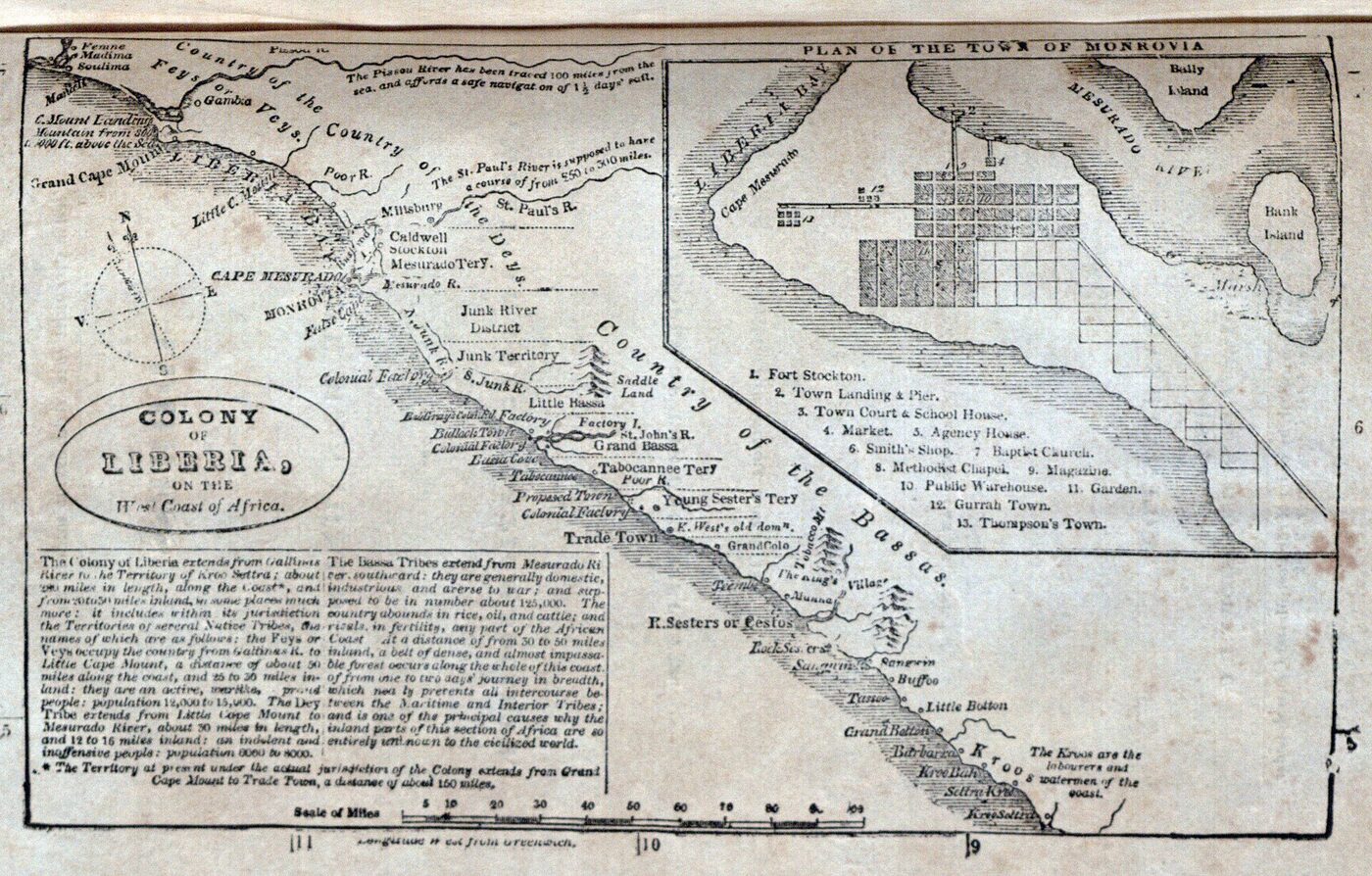

- 1816 — the American Colonization Society is founded in the United States.
- December 1821 — agents of the Society acquire Cape Mesurado, a strip of coast some 58 kilometres long.
- 7 January 1822 — settlers are landed on Dazoe Island, now called Providence Island, at the mouth of the Mesurado River, and go ashore to found a settlement named Christopolis.
- 1824 — Christopolis is renamed Monrovia, after James Monroe, then president of the United States.
- 1839 — the separate settlements are joined as the Commonwealth of Liberia.
- 26 July 1847 — eleven signatories to the Liberian Declaration of Independence establish the Republic of Liberia.
- 1862 — the United States establishes diplomatic relations with Liberia.
- 12 April 1980 — a coup ends the presidency of William R. Tolbert Jr., who is killed; ten days later thirteen members of his cabinet are executed publicly.
- 15 October 1985 — a presidential election is held.
- November 1985 — an attempt on the government by an estimated 500 to 600 people, led by Thomas Quiwonkpa, fails.
- 24 December 1989 — the first civil war begins.
- 1990 — the United Nations High Commissioner for Refugees opens the settlement at Buduburam, in Ghana, for Liberian refugees.
- August 1990 — the Economic Community of West African States creates a military intervention force.
- 1997 — a presidential election is held; the winning candidate, Charles Taylor, is recorded with 75.33 per cent of the vote.
- 21 April 1999 — the second civil war begins.
- July 2000 — the dissident groups coalesce as LURD.
- 4 June 2003 — the Economic Community of West African States opens peace talks at Accra.
- 18 July to 14 August 2003 — fighting in and around Monrovia, in which about a thousand people are killed.
- 11 August 2003 — President Taylor resigns and is flown into exile in Nigeria.
- 19 September 2003 — the Security Council establishes the United Nations Mission in Liberia by resolution 1509.
- 1 July 2009 — the Truth and Reconciliation Commission releases its final report.
- June 2010 — refugee status for most Liberians in Ghana formally ceases.
- 15 December 2012 — the Africa Coast to Europe cable carries its first traffic, giving Liberia its first submarine cable landing.
The list brackets the group on both sides: the first war began when Usenet was nine years old, and the submarine cable that would have let Liberians write to a Liberian newsgroup in numbers arrived in December 2012.
The commissions and the courts
Two formal accounting processes touch this history, and they are separate in law. The Truth and Reconciliation Commission of Liberia was a Liberian body with a Liberian mandate and no power to try anybody. The Special Court for Sierra Leone was an international criminal court whose jurisdiction was confined to crimes committed in the territory of Sierra Leone.
The Commission’s work abroad was carried out with The Advocates for Human Rights, an organisation based in the United States, which took statements from more than 1,600 Liberians in the diaspora and recorded testimony from more than twenty witnesses at public hearings. Statements were gathered at Minneapolis and Saint Paul, Atlanta, Chicago, Philadelphia, Washington, New York, Providence and Boston, in the United Kingdom, and at the Buduburam settlement in Ghana. The organisation describes the hearings it hosted at Saint Paul, Minnesota, in June 2008, with Hamline University, as the first public hearings a national truth commission had held in a diaspora; the diaspora project published its own report, A House with Two Rooms, in 2009. The Commission’s final report followed on 1 July 2009: nearly four hundred pages, with lists naming 98 individuals as having committed gross violations of human rights, 57 recommended for further investigation and 50 recommended for sanctions.
The Special Court was constituted by an agreement of 16 January 2002 between the United Nations and the Government of Sierra Leone, following Security Council resolution 1315 of 10 August 2000, with jurisdiction over crimes committed in Sierra Leone after 30 November 1996. Its Liberian connection runs through one defendant. An indictment against Charles Taylor was signed in March 2003 and unsealed in June 2003; he was taken into custody on 29 March 2006 and transferred to The Hague on 20 June 2006, the Security Council having approved the move on 16 June; the trial opened on 4 June 2007. Judgment was delivered on 26 April 2012 on eleven counts of aiding and abetting war crimes and crimes against humanity in Sierra Leone; a sentence of fifty years followed on 30 May 2012 and was upheld on appeal on 26 September 2013, after which he was transferred to prison in England on 15 October 2013. The Court was dissolved on 2 December 2013 and succeeded by a residual mechanism. The Liberian process of record for events inside Liberia is the Commission, which took statements and published findings but conducted no trials.
Language, script and encoding
Usenet was built for seven-bit ASCII, and its transport and its readers long assumed it. Where eight-bit text was carried at all, the set most commonly assumed was ISO 8859-1, which covers the accented letters of the western European languages and little else. That is a poor fit for Liberia’s vernacular orthographies: Kpelle, for one, is written with the African reference alphabet, which uses letters such as the open o and open e, the hooked b and d, and the velar nasal eng. None of those letters exists in ASCII, and none exists in ISO 8859-1 either.
A standard did exist for the purpose, and almost nobody used it. ISO 6438:1983, “Documentation — African coded character set for bibliographic information interchange”, encoded this class of letter as an eight-bit set for library catalogues. It saw little use, was never part of the ordinary Usenet toolchain, and survives today mainly by having had its forms retained in Unicode. Unicode carried the letters from the start: the IPA Extensions block at U+0250 to U+02AF and Latin Extended-B at U+0180 to U+024F both date from Unicode 1.0 in 1991. What Unicode did not carry for a long time were the writing systems invented in Liberia itself.
The Vai syllabary is the best known of them, and it is not a curiosity: it is described as one of the two most successful indigenous scripts in West Africa, measured by the number of current users and the literature available in it. It is attributed to Momolu Duwalu Bukele of Jondu, in what is now Grand Cape Mount County, and was first documented in the 1830s; its inventory was regularised in the 1960s, when the University of Liberia modified certain glyphs with dots and extra strokes so as to cover all the consonant-vowel syllables then in use. A conference held at the University of Liberia in 1962 was part of that work. Vai entered the Unicode standard only at version 5.1, published in April 2008, in the block U+A500 to U+A63F, of whose 320 code points 300 are assigned.
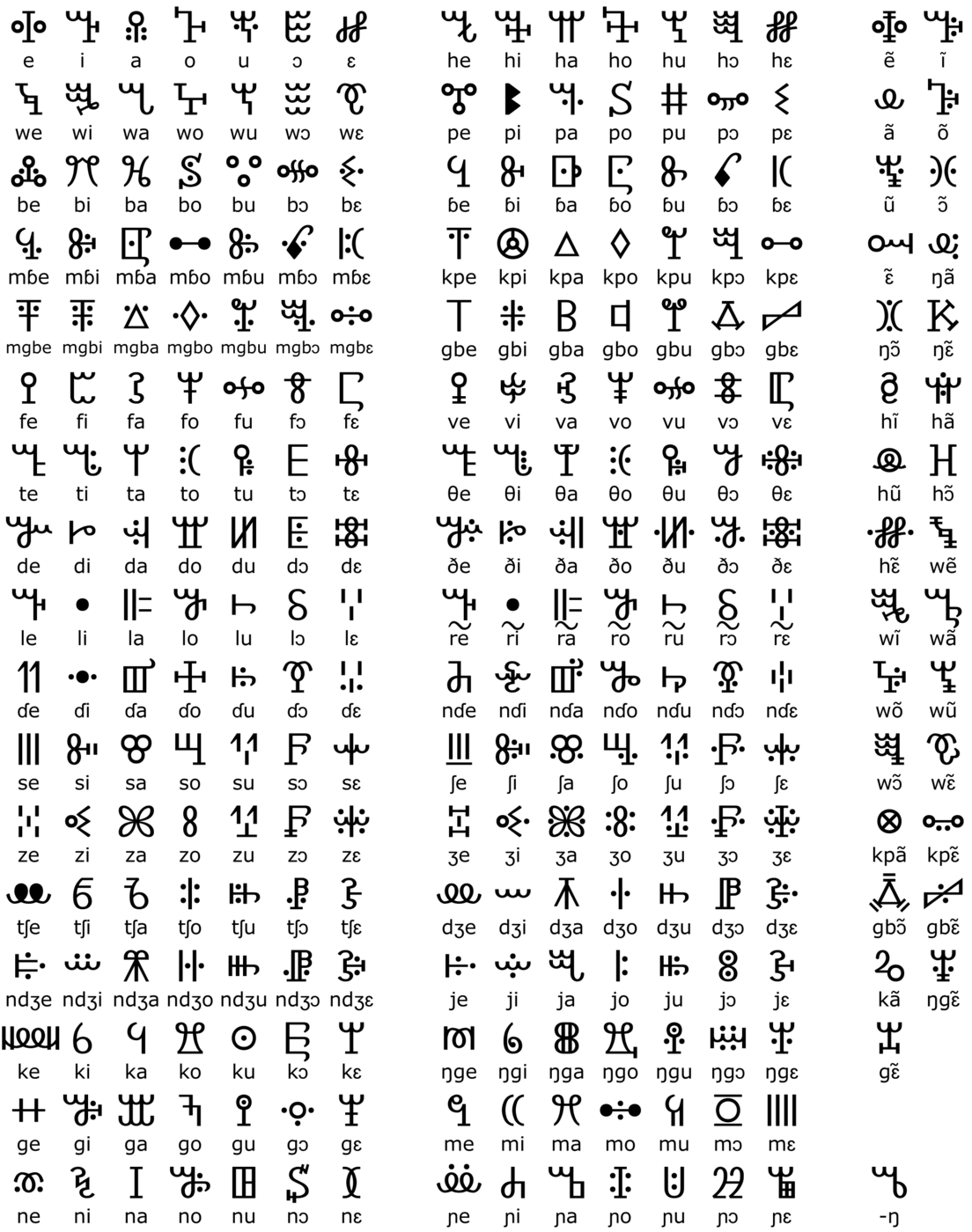

The second Liberian script is Bassa Vah, an alphabet of twenty-three consonants, seven vowels and five tone marks, revived after the script was found in use among Bassa people in Brazil and the West Indies; type was cast and an association formed in Liberia in 1959. It is not used today and has been classified as a failed script. It reached Unicode later still, at version 7.0 in June 2014, in the block U+16AD0 to U+16AFF.
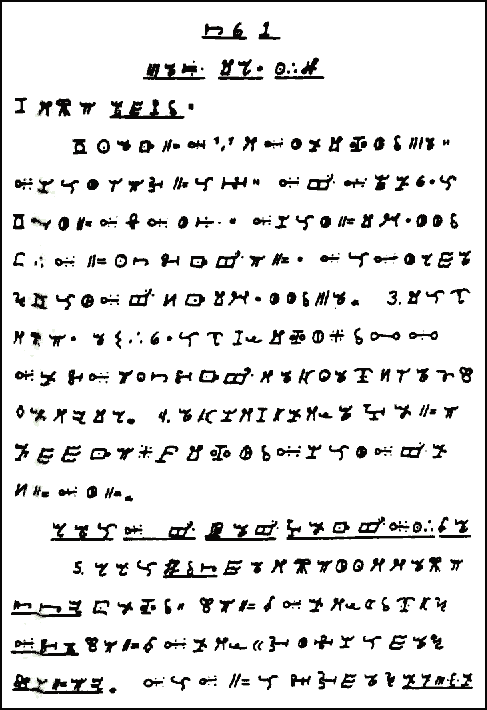

Those dates matter to anyone reading the archive. Both Liberian scripts were admitted to Unicode after the years in which such groups were busiest, and neither could have been carried in an ordinary Usenet article of the period; nor could a correctly spelled Kpelle or Bassa word. Everything in the archive is therefore romanised, and romanised without a standard to romanise towards: tone goes unmarked, open and close vowels collapse into the same Latin letters, and the same personal, place and ethnic names appear in several spellings at once. Searching it is a matter of trying the variants rather than of finding the correct form.
Where the readership actually was
The readership cannot be counted, but the population it was drawn from can be, approximately. American Community Survey estimates for 2017 to 2021 put the number of Liberian immigrants in the United States at 95,300; Liberian American organisations put the number of Liberians in the country, immigrants and descendants together, at between 250,000 and 500,000. The two figures measure different things; the gap is a difference of definition, not a dispute. Temporary Protected Status was extended to Liberians in the United States in 1991, covering some 9,000 people in that year alone.
Local concentrations show up more sharply than national totals, and they move. The Clifton and Park Hill neighbourhoods of Staten Island, around Targee Street, held an estimated 6,000 to 8,000 Liberian immigrants in 2007 and were then reported as the largest Liberian community of any city outside Liberia; in the 2020 census, 78 people in the Tompkinsville–Stapleton–Clifton–Fox Hills area recorded themselves as Liberian. The two numbers are not comparable, a community estimate and a census self-identification count being different instruments. An estimated 4,700 Liberian Americans lived in the Fargo area of North Dakota in 2017. In West Africa, the settlement at Buduburam, opened in Ghana in 1990, stayed a Liberian place for two decades: refugee status for most Liberians in Ghana ceased in June 2010, and demolition of structures there began in early 2024.
Dispersal of that kind has a technical consequence. Liberia keeps Greenwich Mean Time, UTC+00:00, and observes no daylight saving; it adopted GMT on 7 January 1972, having previously kept Monrovia Mean Time at forty-four minutes and thirty seconds behind Greenwich, and its zone in the IANA database is Africa/Monrovia. A reader in Minnesota was five or six hours behind Monrovia depending on the season, one on the eastern seaboard four or five, one in London on Liberian time or an hour ahead of it, one at Buduburam exactly on it. A synchronous medium would have had to pick an hour and lose most of its readership to sleep; a store-and-forward medium that propagated overnight and held articles for days did not have to pick.
The cultural traffic
Between the crises the group did what culture groups do, and that material is better documented than the politics. Food is the most durable subject. Rice is the staple, commercial or country, and turns up as jollof rice among much else; cassava is the other, boiled into dumboy or dried and pounded into fufu, and stewed as the leaf dish called cassava leaf, or gbassajama. Palm butter, peanut soup, pepper soup and palava sauce are standard, glea-gbar or geebee is served with a spiced meat soup, and palm wine is fermented from palm sap. The cuisine carries an African American and Caribbean inheritance by way of the Americo-Liberian settlers.
Music divides along comparable lines. Gbema, the palm-wine music of the coast, is the older stratum from which highlife and hiplife descend, and those are as popular in Liberia as elsewhere in West Africa. Hipco — rap and singing performed in Kolokwa, the “co” of the name being the dialect itself — developed through the war years of the 1980s and 1990s but was not established as a branded genre until 2002 or 2003, at the very end of the second war. Miatta Fahnbulleh and Fatu Gayflor are among the singers of the older generation, Takun J, DenG and MC Caro among the high-profile hipco performers.
Literature has a canonical figure. Bai T. Moore, born at Dimeh on 12 October 1916 and died at Monrovia on 10 January 1988, published the poetry collection Ebony Dust in 1962 and the novella Murder in the Cassava Patch in 1968; the latter is described as a Liberian literary classic and has been part of the school curriculum since publication. Moore founded Liberia’s National Cultural Center, served as under-secretary of state for cultural affairs and later as minister for cultural affairs and tourism, and in 1962 was one of the team of Vai scholars at the University of Liberia conference that standardised the Vai script.
Sport supplies the other fixed points. The national football team, the Lone Stars, reached the Africa Cup of Nations finals in 1996 and in 2002 and has never qualified for a World Cup. George Weah, who began with Young Survivors, Bong Range United, Mighty Barrolle and Invincible Eleven in Liberia before Monaco, Paris Saint-Germain and Milan, was named African Footballer of the Year in 1989 and in 1995 and won both the Ballon d’Or and the FIFA World Player of the Year award in 1995. He was sworn in as president of Liberia on 22 January 2018, well after the group’s active life.
The calendar carries the most history in the least space. The public holidays include Armed Forces Day on 11 February; National Decoration Day on the second Wednesday in March; the birthday of Joseph Jenkins Roberts, the first president, on 15 March; Fast and Prayer Day, established by an act of the national legislature in 1883, on the second Friday in April; National Unification Day on 14 May; Independence Day on 26 July; National Flag Day, made a holiday in 1915, on 24 August; Thanksgiving Day, also established in 1883, on the first Thursday in November; and the birthday of William V. S. Tubman on 29 November. Matilda Newport Day, made a holiday in 1916 and kept on 1 December, was abolished in 1980. National Unification Day, established in 1960, carries the founding directly: its stated purpose was to improve relations between the descendants of the American settlers and members of the indigenous population.
Reading soc.culture.liberia today
- Historical archive: Google Groups — soc.culture.liberia (coverage varies by group and era).
- Open in a newsreader:
news:soc.culture.liberia— the original site offered exactly this link, and it still works if your system has a newsreader registered for thenews:scheme. - Live access: point an NNTP newsreader at a modern server — see accessing Usenet today.
- The original news2mail e-mail subscription service ended in the mid-2000s and no longer operates.