alt.new-england
New England: the six states, argued locally.
Regional talk for Maine through Connecticut: town-meeting culture, foliage and frost-heave seasons, the Red Sox as a shared medical condition, and precise adjudication of what counts as a real clam roll.
One of the healthier regional groups, with genuine local-knowledge threads on hikes, history and dialect.
On this page
- Two lines in the master file
- Thirty-seven hours in April 1995
- What the objectors were actually pointing at
- Counting the namespace: how many names cover these six states
- ne.*: the hierarchy that was already there
- How ne.* governed itself, on the evidence
- Why a region wanted a room of its own
- What makes New England a region
- Town meeting, checked state by state
- The dialect boundaries linguists actually draw
- Foliage as an economic season
- Frost heave, mud season and the road year
- The storms that set the local calendar of memory
- Eighty-six years, with dates
- The food arguments, as documented disputes
- Local knowledge as the group's actual product
- Where it went
- What the record does not show
- Scope and limits
Two lines in the master file
The nearest thing Usenet keeps to a register of itself is a pair of plain-text files published by the Internet Systems Consortium: active, which lists the names that exist and whether posting to them is permitted, and newsgroups, which pairs each name with a one-line description for the benefit of newsreaders and the humans reading them. In the copies retrieved for this article on 26 August 2026, both files carry 45,003 names, 20,466 of them in alt.*. One of those names is this group, and its entry is complete in the sense that a tombstone is complete.
alt.new-england The USA's north eastern region.
That is the whole of the group's public documentation: thirty-one characters of description, after the name and two tab characters. There is no charter in the file, no maintained FAQ, no periodic posting explaining the group to newcomers, no moderator and no moderator's note. The companion active entry adds the flag y, which records that posting is permitted — not that anything has been posted — and two article-number fields. Those fields carry the identical placeholder pair 0000000000 0000000001 on every one of the file's 45,003 lines, so they say nothing about traffic in this group or in any other. How alt.* description lines come to be written, and how little the file's maintainers have ever claimed for them, is set out on the page for alt.america and is not repeated here.
One detail is worth establishing at the outset, because the rest of this page depends on it. That description was not written by whoever created the group. The control message that created alt.new-england carried no description line at all, and the absence was one of the specific objections raised against it within a day. Nothing in the ISC control archive for this group records who later supplied the words The USA's north eastern region, or when. The sentence that now stands in for the group's charter in every newsreader on the network arrived from somewhere the archive does not name.
Thirty-seven hours in April 1995
The alt.* hierarchy leaves no vote, no result posting and no roll of voters. What it leaves instead is the control-message archive, and for this group that archive is short enough to read in full and unusually informative for its length. It contains five messages, dated over three days.
The first is the creation. At 19:28:05 GMT on Monday 3 April 1995, Charles Bennett, posting as [email protected] using TIN version 1.2 PL2, sent a newgroup control message for alt.new-england to alt.config. Its header count is Lines: 2, and the two lines are blank. There is no charter, no rationale, no newsgroups-file line, no statement of what the group was for. The Organization header reads Tyrell Corporation - 800-TYRELL-1 - POP's in 504/816/913/316: an internet provider advertising dial-up points of presence in four area codes, none of which is a New England area code.
The replies came quickly, and all four were rmgroup messages: control messages instructing news servers to delete the group again. Matt Schnierle at Indiana University of Pennsylvania sent the first at 15:10:58 GMT the next day, with a body of one line — Can you say:local hierarchy? — above a quotation of the original. Thirty-five minutes later Brian Edmonds, posting from the computer science department at the University of British Columbia, sent a PGP-signed one with three numbered objections:
1. Not discussed in alt.config. 2. Badly placed in the hierarchy. 3. No newsgroups description line.
At 21:01:04 GMT, Bob Trieger, posting from Netcom, sent the third. His body is two sentences and his signature is a joke at the expense of Usenet's most durable piece of folklore, the backbone cabal: Maybe we do need the Usenet cabal. The two sentences are these:
Created without tagline, discussion or clue. This is redundant with the whole ne.* hierarchy
The last arrived at 08:18:28 GMT on 5 April, from Joe Provo at the provider UltraNet. Its Summary header reads Just another advisory rmgroup. and its Organization field carries the standing denial that the cabal existed — There is no cabal. — the joke whose history is told on the soc.* hierarchy page. His four bullet points are the fullest statement of the case against the group that survives anywhere, and are given here verbatim, spelling included:
- creates needless second-level heirarchy
- duplicates existing ne.* heirarchy [get a feed]
- broken control [no FYN, no desc, etc]
- not discussed in a.config
Four deletion orders in the thirty-seven hours after creation is a brisk response even by the standards of alt.config in 1995. The outcome, however, was the one that mattered: an rmgroup was advice, not law, and each news administrator decided independently whether to honour it. Enough of them declined. The group is in the ISC files today; the four messages that tried to kill it are in an archive directory. That asymmetry is the whole practical difference between alt.* and the Big Eight, and it is described in general terms on the alt.* hierarchy page.
What the objectors were actually pointing at
It is worth separating the four objections, because three of them are procedural and one is substantive, and the substantive one is the reason this page has a second half.
- Procedure. Two objectors noted that the proposal had never been discussed in
alt.config, the group wherealt.*creations were conventionally aired. This was a convention rather than a rule;alt.*had no enforceable procedure, which was the point of it. - Paperwork. The message carried no For your newsgroups file line —
FYNin Provo's shorthand — and therefore no description at all. A control message without one left administrators to invent a description or leave the group undescribed, and the line that stands in the master file today shows that somebody eventually did the former. - Placement. Schnierle's Can you say:local hierarchy? and Provo's needless second-level heirarchy are the same objection: a place is not a topic, and the network already had a machinery for places that was not
alt.*. - Redundancy. Trieger and Provo both named the alternative outright —
ne.*, the New England regional hierarchy — and Provo added the two-word remedy, get a feed.
The redundancy objection was factually correct in April 1995, and remains checkable today. What the objectors did not say, and what the record does not settle, is whether the redundancy mattered to the people who wanted somewhere to talk about New England. A hierarchy your provider does not carry is not an alternative; it is a fact about somebody else's news server.
Counting the namespace: how many names cover these six states
The claim that New England was already well served is arithmetic, and the arithmetic can be redone from the same files. Taking the ISC newsgroups file of 26 August 2026 and looking for names that contain the region, one of its six states, or a place inside it, the totals are these.
In the Big Eight — comp, humanities, misc, news, rec, sci, soc and talk — there is exactly one such name in the whole file: talk.us.rhode-island, described as Issues related to the State of Rhode Island, USA. It is also the only talk.us.* group of any kind. Its paperwork is complete in the way alt.* paperwork never is. The control message that created it survives in the ISC archive, was issued by the Big-8 group-admin account on 6 August 2008 over a PGP signature, and states its own authority in the body: a Last Call for Comments on 29 July 2008 opened a five-day comment period, after which the Big-8 Management Board voted to create the group, six in favour and two against. It carries a newsgroups-file line and a two-sentence charter. New England's single chartered Big-Eight room was created thirteen years after this group, on the votes of eight people, for the smallest of the six states.
In alt.*, fourteen names denote the region or a place within it. Besides this group they are alt.new-hampshire; alt.rhode_island and its companion alt.rhode_island.sucks; alt.boston.moderated and alt.boston.unmoderated; the six members of the alt.fan.states.* block for Connecticut, Maine, Massachusetts, New Hampshire, Rhode Island and Vermont; and alt.real-estate.commercial.ma and alt.real-estate.commercial.nh. Five more name a sports franchise rather than a place — the Red Sox, the Patriots, the Celtics, the Bruins and the Hartford Whalers, who left Connecticut in 1997 and whose group is still in the file — and five name a television programme or a congregation. There is no alt.vermont, no alt.maine, no alt.massachusetts, no alt.connecticut and no bare alt.boston.
Three of those entries repay a closer look, because together they show how little a name in the file proves.
alt.rhode_island is the oldest of them. Its earliest control message in the archive is dated 9 July 1991, was sent by Terry K. Morrical at Hughes LAN Systems in Mountain View, California, on the other side of the continent, and has a body of exactly one line: Created Tue Jul 9 15:17:14 PDT 1991 to hold articles found in junk. That is a machine-shaped origin, a site administrator creating a group because articles addressed to it were piling up in the local junk bucket, and it predates this group by nearly four years. Its description today is A little state with apparently world wide interest., which is at least a sentence somebody wrote on purpose.
alt.new-hampshire is the counter-example, and shows what a competent alt.* creation looked like. It was created on 7 February 1999 by a poster signing as Xet, from a Concentric Internet Services dial-up host whose name marks it as being in New Hampshire, and the message carries a Summary header, a newsgroups-file line and a short charter opening This group will be open to discussion for any issues involving the state of New Hampshire or events occuring therein. The description in the master file today is Newgroup for any topics relevant — a phrase that stops mid-clause, because the intended line ran onto a second physical line of the control message and the file kept only the first.
The alt.fan.states.* block is the most instructive of the three, because it looks like evidence of regional demand and is not. Fifty-three names sit under it; fifty are states, one for each, with Pennsylvania misspelt as pennslvania, and every one of the fifty is described in the master file as No description. The reason is visible in the control archive. The whole set was issued in a burst in the small hours of 22 May 2000 by two throwaway addresses — one signing itself [email protected] with the Organization header NHL, the other [email protected] with the Organization header joe — each sending the same message several times over for each state, addressed to alt.test, each a single line reading For your newsgroups file: followed by the bare group name and nothing else. Within hours every one of them was met by a PGP-signed rmgroup from the alt.config removal account, giving two reasons: No charter and No traffic measurements. The removals were no more binding than the ones aimed at this group, and the names are still in the file. Six New England states acquired a group apiece that night, from senders who plainly had no particular interest in any of them.
Outside the Big Eight and alt.*, New England still holds a standing footprint of fifty-one names across four regional hierarchies: ne.* with twenty-eight groups, me.* for Maine with ten, ri.* for Rhode Island with nine, and nh.* for New Hampshire with four. There is no vt.*, no ma.* and no city hierarchy for Boston in the file. There is a ct.*, and it is a trap: its two groups are ct.diskussion and ct.talk.projekte, German words rather than English ones, and neither has anything to do with Connecticut. The full directory listing of these and other names is at the all-groups list.
ne.*: the hierarchy that was already there
Two of the four objectors named ne.*, and the file confirms them. The hierarchy is still in the ISC listings with twenty-eight groups, twenty-six of them unmoderated and two — ne.jobs.company and ne.weather.moderated — carrying the flag m. By count of names it is twenty-eight times the size of the answer this group offered to the same question.
Its shape is that of a working municipal service rather than a conversation. There is a general group and a configuration group; classified advertising split three ways into ne.forsale, ne.wanted and ne.housing; employment split three ways again into ne.jobs, ne.jobs.contract and the moderated ne.jobs.company for direct postings by employers; a group for internet service and another for the advertisements of the providers selling it; four for a body called the New England Community Internet Project; and then the subject groups — ne.arts, ne.food, ne.politics, ne.seminars, ne.singles, ne.transportation, ne.weather, ne.motorcycles (described as The Northeast branch of the Denizens of Doom) and ne.motss, for issues pertaining to homosexuality in New England.
Two sub-branches date the hierarchy. ne.org.bcs is the Boston Computer Society and ne.org.decus is described as CRIMLUG discussion, the Southern NE Decus group, a regional chapter of the Digital Equipment Computer Users' Society; both are artefacts of the minicomputer era. More telling are ne.nearnet.general and ne.nearnet.tech, for the New England Academic and Research Network, a high-speed regional network for education and research established in 1988 by a consortium led by Boston University, Harvard and MIT, and formed after DARPA announced plans to dismantle the ARPANET. New England did not acquire a regional Usenet hierarchy because someone thought regions were a nice idea. It acquired one because the region had built itself a network, and the network needed somewhere to talk about itself.
The dates in the ISC control directory bear that out. The two oldest surviving messages in the hierarchy are older still: a newgroup for ne.org.bcs from Joe Ilacqua at Software Tool & Die, dated 3 May 1991, and one for ne.politics from Warren J. Lavallee at Bull Worldwide Information Systems, dated 1 October 1991. Then, in a single run of messages issued between 00:14 and 00:16 GMT on 26 April 1992, the archive records newgroups for ne.food, ne.forsale, ne.general, ne.housing, ne.news, ne.politics, ne.seminars, ne.wanted, ne.org.bcs, ne.org.decus and both ne.nearnet groups. That is very nearly three years before this group existed.
How ne.* governed itself, on the evidence
The interesting thing about ne.* is not its size but that it had a procedure, and the procedure is legible in the surviving control messages. Regional hierarchies were not obliged to have one. This one behaved like a small Big Eight.
The 1992 run was issued from gandalf.UMCS.Maine.EDU by Steve E. Goldsmith of the University of Maine Department of Computer Science, with Lines: 0 and no body at all. By December 1994 the practice had settled into something recognisably deliberative. On 2 December that year the newgroup for ne.weather was sent from the MITRE Corporation's Research Computer Facility in Bedford, Massachusetts, with the note that The group was discussed and approved in ne.news and that this message existed to fix propagation problems with an earlier one. Two hours later Christopher Davis, posting from KEI, sent a second and a third with the words As discussed in ne.news without dissent and a proposed description that a bureaucracy would not have written:
ne.weather If you don't like it, just wait ten minutes; it'll change.
Three more followed within a day and a half, one from Warren Lavallee, a system administrator at a church in Milford, New Hampshire, whose entire body reads I never saw the newgroup. Here is one. If you see this, send me mail!, and two from Lowell J. Gray at the provider North Shore Access, offering a rival wording: Don't like the weather? - just wait ten minutes! Four senders, in other words, independently pushed the same group onto the network inside two days, because none of them could tell whether anybody else's message had arrived. Neither joke survived. The current master file gives ne.weather as No description.
In April 1995 John Carr at MIT created ne.transportation, again Following discussion in ne.news, and quoted the agreed scope in the message itself: transportation in New England, including but not limited to driving (roads, routes, construction, places to see, speed traps, etc.), MBTA, and bicycling. Eighteen days later Jonathan Kamens created ne.config with the fullest piece of paperwork the hierarchy left behind — a charter culled from the discussion, a note that the group had passed its vote for creation by 18:1 as reported in ne.news on 25 Apr 1995, and a scheduled removal date of 5 May 1995 for the group it superseded. On that date he issued both a booster newgroup for ne.config and the rmgroup for ne.news, recording that the removal had itself passed by 17:1.
An eighteen-to-one vote is a small electorate, but it is a vote, publicly reported, with a supersession plan and a second, separately counted vote attached — which is more procedure than this group's creation, twenty-five days earlier, had assembled in total.
The postscript is less cheerful. INN ships a file called control.ctl that tells a news server whose control messages to honour for which hierarchy; the copy fetched for this article, last modified in August 2023, carries more than three hundred hierarchy stanzas. Among the New England hierarchies only Maine has one, naming a maintainer at maine.maine.edu for checkgroups, newgroup and rmgroup alike. There is no stanza for ne.*, none for nh.* and none for ri.*, while New Jersey, New York State and New York City all have theirs. The twenty-eight ne.* names persist in the namespace lists, but no one is on record as authorised to add to them or take them away. The hierarchy that was the correct answer in 1995 is now, administratively, a set of names nobody signs for.
Why a region wanted a room of its own
The general question — what a sub-national namespace offered that a group inside a global hierarchy did not, and why anyone bothered when the alternatives already existed — is worked through in detail elsewhere in this directory, from the surviving paperwork of a francophone provincial hierarchy, on the page for qc.politique. The arguments there about carriage, electorates and naming apply here without modification and are not restated.
What can be added from the New England record is narrower and more concrete. The chartered route was genuinely closed to this subject for most of Usenet's active life: the soc.culture.* branch, whose creation machinery is described on the culture branch page, was organised around nations and peoples, and a six-state region inside the United States was not a candidate for it. The Big Eight has produced exactly one New England name in the whole of the current master file, and it took a board vote in 2008 to produce that. The regional-hierarchy route was open, was taken, and worked — for as long as somebody in the region kept a feed and kept the discussion going in ne.news. When that stopped, the alt.* name was the one that needed no maintainer at all, which is why it is the one still standing. Durability and vitality are not the same property, and the ISC files record only the first.
What makes New England a region
The six states are Connecticut, Maine, Massachusetts, New Hampshire, Rhode Island and Vermont. The region is bordered by New York to the west and by the Canadian provinces of New Brunswick to the north-east and Quebec to the north; the Gulf of Maine and the Atlantic lie to the east and south-east, and Long Island Sound to the south-west. Boston is its largest city. The Boston–Worcester–Providence combined statistical area, which spans four states and takes in Worcester, Providence and Manchester, holds more than half the region's total population, which means that a majority of the people the group notionally covered lived inside one metropolitan cluster and the rest were spread very thinly indeed over the remainder.
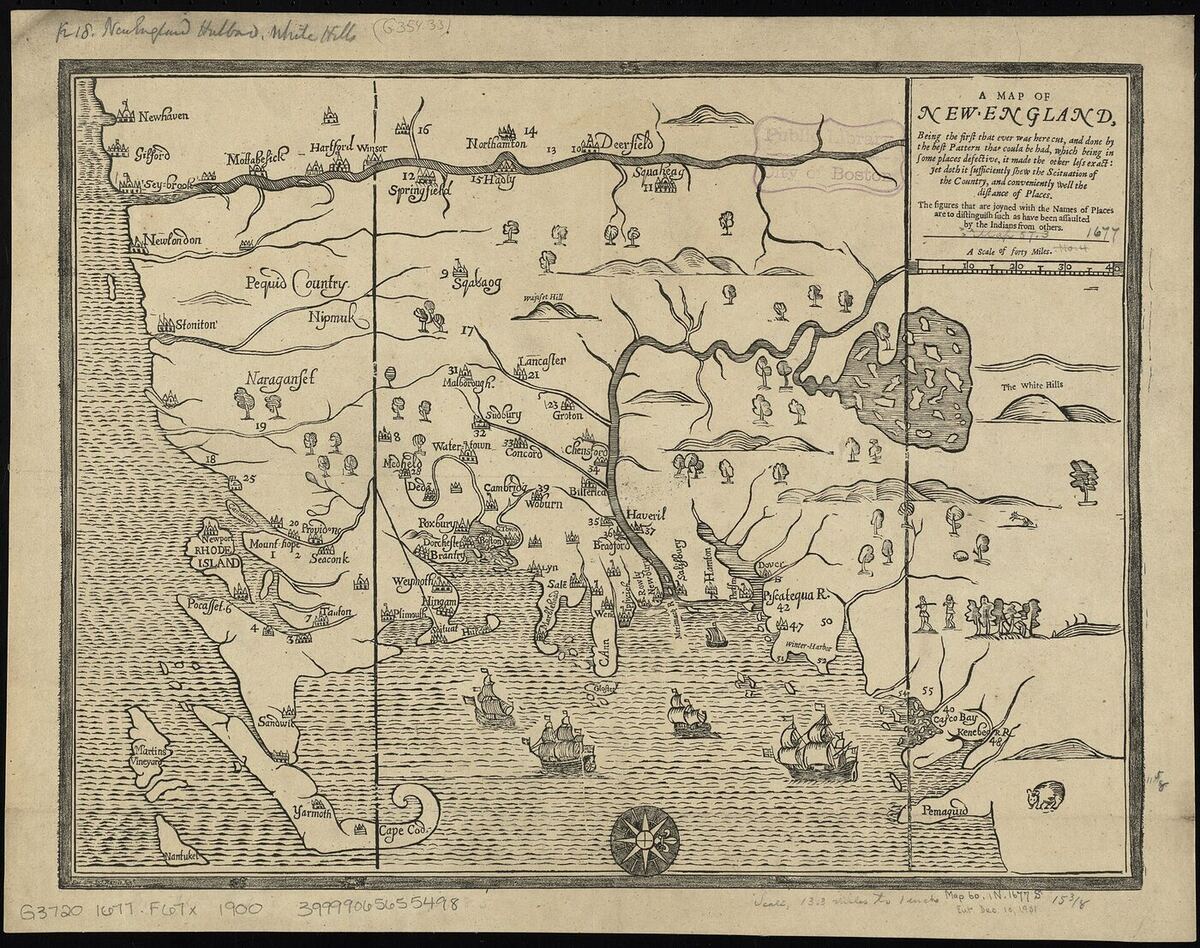
The regional identity is older than the states and older than the country. Plymouth Colony was established in 1620 and Massachusetts Bay ten years later; over the following 126 years the colonies fought through four French and Indian wars along a frontier that ran through what is now northern New England. The name was in printed use as a unit early: in 1677 the Boston engraver John Foster cut a woodcut map titled A map of New-England, being the first that ever was here cut, to accompany the clergyman William Hubbard's narrative of King Philip's War. It is the first map known to have been published in the Western Hemisphere, and it was a map of this region. A region that had its own printed map before it had its own newspaper is a region with a strong prior claim to being one thing.

That said, the coherence is unevenly distributed, and this is the fact that makes regional forums argumentative. Rhode Island covers 4,001 square kilometres; Maine covers 91,633, nearly twenty-three times as much. Fairfield County in south-western Connecticut is functionally part of the New York metropolitan area, and the Census Bureau groups it, with New Haven and Litchfield counties, into the New York combined statistical area rather than the Boston one. Northern Maine and northern Vermont share a land border with Quebec and New Brunswick and very little else with Boston. Whether the region is one place or three has been a live question in every medium that has ever hosted it.
Town meeting, checked state by state
Town meeting is the claim most often made for New England exceptionalism and the one most often overstated, so it is worth setting out what is actually the case in each state. Town meeting proper is a form of direct democracy in which the town's eligible voters themselves constitute the legislative body, gathering to vote a budget, pass bylaws and elect officers. It has been practised in New England since colonial times and has been the primary form of town government in the region since the seventeenth century. It has never covered the whole region, and its coverage has been shrinking.
The first and largest qualification is that town meeting is a form of town government. Cities do not have it. Boston, Providence, Hartford, Worcester and Manchester are run by elected councils and mayors or managers, not by assemblies of their voters, and between them they hold a very large share of the region's population. A claim that New Englanders govern themselves by town meeting is, before anything else, a claim about the minority of them who do not live in cities.
The second is that the practice varies by state to the point where the shared name conceals more than it reveals.
- Massachusetts retains it most systematically: towns of fewer than 6,000 residents must adopt open town meeting, and towns of 6,000 or more may adopt either open or representative town meeting, in which the voters elect town-meeting members by precinct. The select board summons the meeting by issuing a warrant listing the articles to be voted; a moderator presides; a finance or advisory committee makes recommendations on money articles. An article reaches the warrant by request of the select board or on a petition of ten registered voters.
- Vermont holds it on a fixed date — the first Tuesday in March, Town Meeting Day — and backs it with employment law: state employees are given the day off, and a private employee has a statutory right to unpaid leave to attend, subject to the essential operation of the business and on at least seven days' notice. Many towns nonetheless now decide substantive questions by Australian ballot rather than from the floor, though no state law requires them to and several still conduct all business from the floor.
- New Hampshire is where the erosion is documented in numbers. Traditional meeting is held on the second Tuesday in March. In 1995 the legislature created an alternative, universally called SB 2, under which the binding decisions are taken not at the meeting but by secret ballot at the municipal election, with the meeting reduced to a deliberative session that may amend the wording and dollar amounts of articles but takes no vote on their merits. In 2002, according to studies by the University of New Hampshire's Center for Public Policy, 171 towns still had traditional town meeting, 48 had adopted SB 2, and another 15 municipalities, most of them incorporated cities, held no annual meeting at all. Because the traditional-meeting towns tend to be the small ones, only one third of the state's population was governed by traditional town meeting that year, and only 22 per cent by traditional school-district meetings.
- Maine keeps the form widely but has professionalised the execution unevenly. Camden adopted a special charter in 1927 and became the first Maine town to graft a town manager onto the meeting-and-selectmen framework; from 1927 to 1939 eleven other towns adopted similar special-act charters. The older meeting-selectmen arrangement is still the commoner of the two: the undated figures in the standard account give 209 towns using it against 135 with the meeting-selectmen-manager form.
- Connecticut restricts it structurally: a Connecticut town meeting is usually bound to a published agenda, and participants may not add new business or alter the proposed items. Votes are taken by voice, and by show of hands if close. Some towns use a financial town meeting with jurisdiction over money alone, the legislative power having been vested in a council.
- Rhode Island has largely let it go. Its municipalities have a greater degree of home rule than their neighbours, the direct-democracy tradition is now uncommon there, and ten towns retain town-meeting government — Barrington, Exeter, Foster, Glocester, Hopkinton, Little Compton, Richmond, Scituate, Tiverton and West Greenwich.
The honest summary is that town meeting is a real and living institution in all six states but a diminishing one, strongest in the small towns and thinnest in Rhode Island, where ten towns keep it; and that the New Hampshire figures show a documented majority of one state's population outside it as long ago as 2002. It is precisely the kind of claim a regional forum is good at correcting, because the correction requires someone who knows what their own town actually does.
The dialect boundaries linguists actually draw
New England is among the most thoroughly surveyed dialect areas in the English-speaking world, and the surveys do not agree with the states. The foundational work is the Linguistic Atlas of New England, edited by Hans Kurath in collaboration with Miles L. Hanley, Bernard Bloch, Guy S. Lowman, Marcus L. Hansen and Julia Bloch, and published in 1939. It was the first component of the projected Linguistic Atlas of the United States: the Linguistic Society of America's council had asked in 1930 for a trial run in a limited area so that a method could be established, and approved New England as that area in 1931. Yale provided the headquarters; fellowships from Brown and the University of Vermont paid for staff; the fieldworkers were trained over six weeks in the summer of 1931, partly by Jakob Jud and Paul Scheuermeier, who had mapped the dialects of Switzerland and Italy. Marcus L. Hansen first worked through the history of New England settlement to decide which communities to sample. Data collection then ran for twenty-five months, ending in September 1933, and produced 416 informants in 213 communities, answering a questionnaire of 734 items, published as three volumes of maps.
Its most famous finding is the boundary between eastern and western New England, and its most famous error is instructive about how hard the subject is: the atlas reported the cot–caught merger as present in Rhode Island, and Raven McDavid later concluded that the fieldworker who transcribed the Rhode Island data spoke a merged dialect herself and had applied the merger inadvertently in her transcriptions.
The modern reference is the Atlas of North American English of 2006, by William Labov, Sharon Ash and Charles Boberg, and it divides New England English along two axes. The east-west axis is rhoticity: eastern New England historically drops the r except before a vowel, western New England pronounces it. The north-south axis is that same cot–caught merger: northern New England merges the two vowels, southern coastal New England keeps them apart. Both features cross state lines without apology, and all four combinations occur:
- North-eastern — non-rhotic, merged, with strong fronting of the vowel in park the car. Centred on Boston and extending into New Hampshire and coastal Maine.
- South-eastern — non-rhotic, unmerged, without the fronting. Centred on Providence and Narragansett Bay.
- North-western — rhotic, merged, with the fronting. Centred on Vermont.
- South-western — rhotic, with the merger absent or transitional, without the fronting. Centred on the Hartford-Springfield corridor and western Massachusetts.
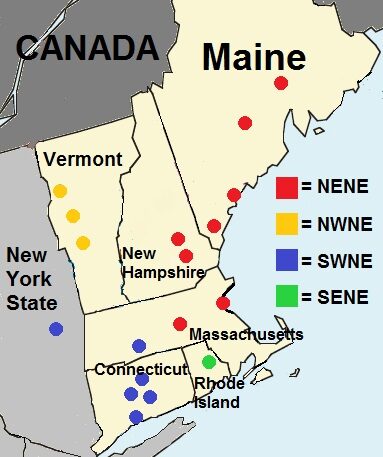

Two of those four quadrants split Massachusetts down the middle, and the sharpest single boundary in the region — Boston against Providence, about fifty miles apart — separates two states that a regional group treated as one place. The non-rhotic area is conventionally marked by the shibboleth Park the car in Harvard Yard, and it runs from Boston north to Maine and as far west as Worcester, which is to say that it stops well short of the Massachusetts state line. It is also moving: studies of Boston speech find younger speakers noticeably more rhotic than older ones. Any argument about how the region sounds is therefore an argument about a moving target, and both sides of it can be right about different generations.
Foliage as an economic season
Autumn colour in New England is a tourist industry with a vocabulary, a marketing budget and a measurable revenue line, and treating it as scenery understates it. The activity has a name of documented origin: the Oxford English Dictionary records the first use of leaf peeping in 1966, in the Bennington Banner, a Vermont newspaper. Fall colour in the United States runs from September to early November, and New England and New York are the principal destinations — in New England's case, on the plain mechanical ground that the temperate forest sits close to a large population.
The money is real and the states compete for it openly, with advertising aimed at tourists and discounted lodging in hotels and inns. The Vermont Agency of Commerce and Community Development has put the state's annual take from foliage tourism at around 600 million dollars, up from 332 million in 2009 — for a state whose entire population is smaller than that of Boston. New England states as a whole are reported to receive in the region of eight billion dollars a year in tourism revenue, of which the autumn season is a substantial and heavily promoted part.
The consequences of that are the practical, faintly irritable local matters that a regional forum handles well and a brochure does not: which roads are already jammed, when the colour will actually peak at a given elevation and latitude, where the visitors park, and the recurring friction between foliage traffic and the people who live on the roads it uses. Reporting from Vermont in 2024 records residents criticising leaf-peeping tourists for trespassing on private property and jamming traffic. The season also turns out to be climatically fragile: early leaf withering, increased pest damage, floods, wildfires and hurricane damage to trees have all been recorded as spoiling it, and a decline in the season has been discussed in the press as an economic risk to New England rather than an aesthetic one.
Frost heave, mud season and the road year
The other end of the calendar is less photogenic and more consequential. Frost heaving is the upward swelling of soil as ice grows within it. The mechanism is not simply water expanding on freezing: as the freezing front descends into the ground, capillary action draws further water up to it from a water table below, and the water freezes on arrival into lens-shaped bodies of ice within the soil. Those lenses keep growing as long as water keeps arriving, and their growth displaces the soil above them. The soil has to be in a narrow band for this to happen — fine enough between the grains to promote capillary flow, not so dense that water cannot move and not so open that capillary flow breaks down — and soils in that band, silts and loams principally, are called frost susceptible. Dense clays and clean sands and gravels are not.
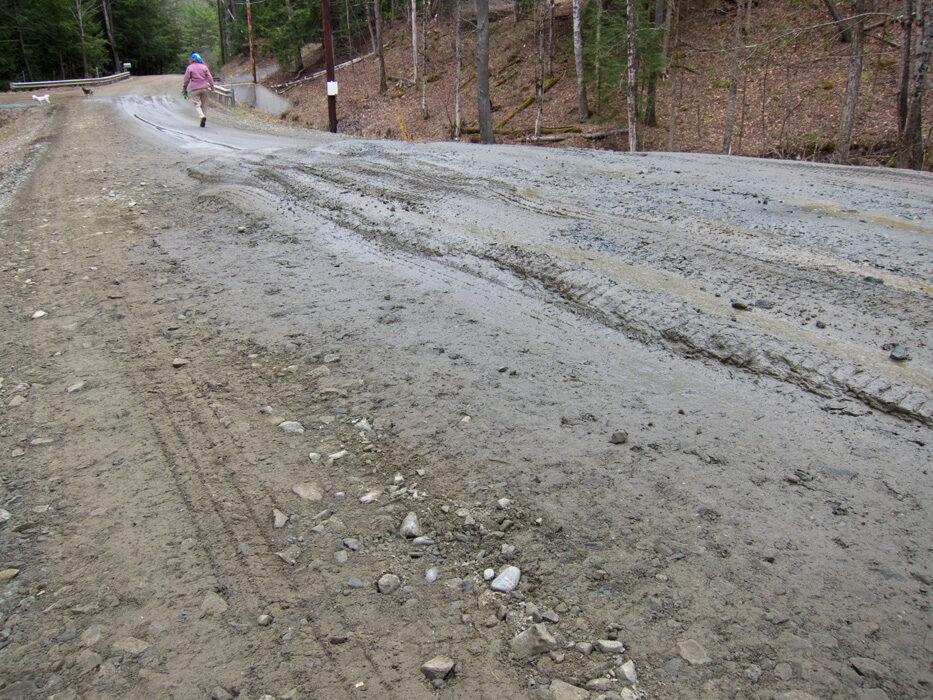
For a region built on glacial till and served by a dense network of secondary roads, the consequences arrive every March. Differential frost heaving cracks road surfaces and is a direct contributor to springtime pothole formation; it damages building foundations; and as the ground thaws from the top down, the still-frozen lower layers stop meltwater percolating away, so the surface saturates. That is the physical basis of mud season — the interval in late winter and early spring when travel over ice is no longer safe and travel overland has become difficult. It is expensive as well as annoying: one report put the cost of re-engineering Vermont's dirt roads so that they would stay passable through mud season at as much as 140,000 dollars a mile.

The region takes this seriously enough to have built an institution around it. The United States Army's Cold Regions Research and Engineering Laboratory, publisher of the standard review of index tests for the frost susceptibility of soils, is in Hanover, New Hampshire. Frost heave is not folklore in New England; it is a funded engineering discipline with a laboratory in the middle of it, and the practical questions it generates — which road is closed, which is posted, which is merely awful — are exactly the kind that had no public index at all before the web.
The storms that set the local calendar of memory
Coastal New England dates itself by storms, and the storms have real dates. The characteristic winter system is the nor'easter, a large extratropical cyclone that typically forms within a hundred miles of the shore between North Carolina and Massachusetts and is named for the direction of its winds. The contraction is older than the storms it now describes: the spelling Noreast appears on a printed compass card of 1607, and the Oxford English Dictionary dates the compound nor'easter to 1837, in a translation of Aristophanes. They develop most often and most powerfully between November and March, because that is when the contrast is greatest between the cold polar air coming down from central Canada and the warm ocean water off the upper East Coast.
Four events dominate the regional memory, and they can be dated exactly.
- The 1938 New England hurricane made landfall on Long Island on Wednesday 21 September 1938 as a Category 3, having reached Category 5 at sea. It is estimated to have killed 682 people, damaged or destroyed more than 57,000 homes, and caused property losses put at 306 million dollars in the money of the day. Over 35 per cent of New England's forest area was affected, and damaged trees and buildings were still visible as late as 1951. It remains the most powerful and deadliest hurricane on record to strike New England and New York State, with the possible exception, in landfall intensity, of the colonial hurricane of 1635.
- The Blizzard of '78 formed on Sunday 5 February 1978 and broke up on the 7th, with snow falling mostly from the morning of Monday the 6th to the evening of Tuesday the 7th while the low-pressure centre stalled off Martha's Vineyard. Boston recorded 27.1 inches and Providence 27.6, both records. Sustained winds reached about 86 miles per hour with gusts to 111, and drifts reached fifteen feet. Because the storm developed at new moon the accompanying tides were unusually high and the coastal flooding severe. About 100 people died in the north-east and about 4,500 were injured; fourteen died in their cars on the I-95/Route 128 corridor near Boston when piled snow stopped exhaust fumes escaping from idling vehicles; I-95 had in the end to be evacuated by cross-country skiers and snowmobilers, and motor traffic was banned across eastern Massachusetts for the rest of the week.
- Hurricane Bob made landfall twice in Rhode Island on 19 August 1991 as a Category 2, first on Block Island and then at Newport, before coming ashore again in Maine as a strong tropical storm early on 20 August. It was one of the costliest tropical cyclones in New England history, and it remains the most recent tropical cyclone to make landfall in New England at hurricane strength — a fact that had already been true for nearly four years when this group was created, and has stayed true for the thirty-five years since.
- The 1991 Perfect Storm, known at the time as the no-name storm and locally as the Halloween gale, ran from 28 October to 2 November 1991. It began as an extratropical low east of Nova Scotia, was forced south by a blocking ridge, absorbed Hurricane Grace, and eventually became a small Category 1 hurricane at the start of November — left unnamed by the National Hurricane Center specifically to avoid confusing a media and public who had been following it for days under another description. Most of the damage was done in the extratropical phase, by waves reaching thirty feet as far north as Maine; the phrase perfect storm was coined by the author Sebastian Junger after a conversation with Robert Case, the deputy meteorologist at the National Weather Service's Boston office. In parts of New England the damage was worse than that caused by Bob two months earlier.
Behind all of this stands the region's meteorological folly. The Mount Washington Observatory, founded in 1932 on the 6,288-foot summit in New Hampshire, recorded a wind speed of 231 miles per hour on the afternoon of 12 April 1934: the world record until 1996, and still the highest straight-line, non-cyclonic wind ever measured. The observatory's slogan, Home of the World's Worst Weather, comes from a 1940 article in Appalachia by Charles Brooks, the man generally credited with creating it — an article titled The Worst Weather in the World which concluded that Mount Washington most likely did not have it. New England's relationship to its weather is not modesty about a mild climate; it is a settled conviction, backed by an instrument reading and undented by its own founder's caveat, that the weather here is worth arguing about.
Eighty-six years, with dates
The lede above jokes about the Red Sox as a shared medical condition. The chronology behind the joke is exact. The Boston Red Sox won the 1918 World Series, beating the Chicago Cubs four games to two. It was their fifth title in five attempts going back to 1903, and it is the only World Series in history played entirely in September — the regular season had been cut short on 2 September by the wartime work or fight order. They scored nine runs in the whole series, the fewest by a winning team in World Series history, and it was one of only four Series in which neither side hit a home run.
Babe Ruth's sale to the New York Yankees was completed on 3 January 1920. The Red Sox did not win again for eighty-six years. The explanation offered for this in the intervening decades — the Curse of the Bambino — is younger than most people assume: the phrase was not in common use until Dan Shaughnessy published a book of that title in 1990, five years before this group existed. It spread fast once it had a name: Yankees fans were chanting 1918! at the visiting Red Sox in Yankee Stadium by September of that same year.
The drought ended within the group's nominal lifetime. In the 2004 American League Championship Series the Red Sox lost the first three games to the Yankees and then won four straight, becoming the first team in Major League Baseball history to lose the opening three games of a best-of-seven series and win the last four, and only the third in North American professional sport, after two National Hockey League teams. They then swept the St Louis Cardinals in the World Series played from 23 to 27 October 2004, taking their first title since 1918.
Two things about that are worth stating plainly for a page of this kind. The first is that a regional newsgroup created in April 1995 spent its most active years in the last decade of the drought, which is to say that the shared condition really was shared and really was unresolved for the whole period in which the group would have had readers. The second is that no claim is made here about what was posted. This directory has no article-level archive of this group; the Red Sox are documented, the threads are not. Team-specific discussion had its own rooms in any case: alt.sports.baseball.bos-redsox is in the master file, alongside groups for the Patriots, the Celtics, the Bruins and the departed Hartford Whalers.
The food arguments, as documented disputes
Regional food disputes are the most reliably recurring content of any regional forum, and in New England's case several of them have proper documentation, which is unusual. What follows is what is on the record about the disputes themselves; the outcome of an argument about which is better is not a matter of record and is not offered here.
Chowder. The dispute is three-cornered, not two. New England clam chowder is milk- or cream-based and white; Manhattan clam chowder substitutes tomatoes and omits the dairy; Rhode Island clam chowder is clear and omits both. All three are documented styles with distinct histories. The Manhattan style is commonly attributed to Rhode Island's Portuguese fishing communities, whose tomato-based stews and frequent traffic to New York's Fulton Fish Market in the mid-nineteenth century supply the mechanism; in Rhode Island the tomato version has long been known as Rocky Point chowder, after the Shore Dinner Hall at the amusement park of that name, where it was a popular menu item. The Manhattan label itself is first attested in a cookbook of 1934, and the earliest documented clam chowders contained no milk at all, being thickened during cooking with crackers or stale bread. The New England style is thus neither the oldest nor the only local one, which is a useful fact to have to hand in an argument. There is also a Long Island clam chowder, half cream and half tomato, whose name is a deliberate joke about where Long Island sits.
The clam roll. The fried clam has a claimed date: 3 July 1916, at a small roadside restaurant in Essex, Massachusetts, run by Lawrence Chubby Woodman, who already kept large vats of fat for frying potato chips and used clams he had dug himself from the mud flats of the Essex River. Served in a New England-style hot dog bun, the same thing is a clam roll. The live distinction is between whole-belly clams — the entire soft-shell clam, gastrointestinal tract included, which is what the New England version means by a fried clam — and clam strips, which are the sliced foot of the Atlantic surf clam. The strips have an author too: Thomas Soffron of Ipswich, Massachusetts, created them and sold them to Howard Johnson's under an exclusive deal, and as that chain spread, the strip became what most of the country understood a fried clam to be. Clam strips remain commoner on menus outside New England than in it. The whole-belly-versus-strip argument is therefore not snobbery about texture; it is a regional dish objecting to the national franchise version of itself.
The lobster roll. Two styles and a contested origin. The Maine style is cold lobster meat dressed with mayonnaise; the Connecticut style is warm meat in drawn butter. The invention is commonly credited to Milford, Connecticut, with the Encyclopedia of American Food and Drink placing it as a hot dish at a restaurant called Perry's there as early as 1929, though other accounts credit English and Portuguese fishermen and sailors, and one National Geographic treatment credits Perry's with only the Connecticut style. Chopped lobster heated in drawn butter was being served on a hot dog bun at Maine roadside stands, Red's Eats among them, as far back as 1970. So the dish most associated with Maine was probably invented in Connecticut, in the style Maine does not use — which is the sort of fact a regional argument thrives on.
The pizza. New Haven-style pizza, known locally as apizza, is a thin, often oblong, coal-fired Neapolitan pizza, baked above 650 degrees Fahrenheit, sold whole rather than by the slice, and characterised by charring. It originated in 1925 at Frank Pepe Pizzeria Napoletana; the plain version is crust, oregano, tomato sauce and a little grated pecorino romano, with mozzarella an optional topping, and Pepe's is credited with inventing the white clam pie. The dispute is between Pepe's, Sally's Apizza and Modern Apizza, and it is documented in the ordinary press rather than in folklore: the New Haven Register ran a piece headed You say Sally's, I say Pepe's on 21 July 2002. It has also reached the national record. In May 2024 a Connecticut member of Congress, Rosa DeLauro, read into the Congressional Record a statement declaring New Haven to have the best pizza in the country, and it caused the argument it was presumably intended to cause. Since 9 October 2025 the New Haven Museum has run an exhibition on the subject, holding among other things the oldest known pizza box, dated 1936.
The pattern across all four is the same and is the reason food dominates regional forums: each dispute has a real historical basis, a real geographic boundary, and no possible resolution, which makes it renewable. It is also, unlike the town-meeting question or the dialect question, a subject on which every participant is genuinely an authority on their own answer.
Local knowledge as the group's actual product
Strip out the arguments and what a regional newsgroup did that nothing else did was index local knowledge. The class of information involved is easy to describe and was, before the web, almost impossible to obtain at a distance: whether a trail is passable this week, which river crossing is running high, what used to be on that mill site, where in the region one can still buy or repair a particular thing, which town clerk holds which records, whether the road over the notch is posted.
None of that was published anywhere a stranger could reach. Some of it was in a guidebook that was accurate when printed and is not now. Some of it was in a town office open on Tuesday afternoons. Most of it was in somebody's head. The characteristic property of this information is that it decays — a washout, a closure, a business that shut — and that its authoritative source is a person who happened to be there recently. A newsgroup is an unusually good match for that shape: it is asynchronous, so the question can wait for the one reader who knows; it is regional, so that reader is plausibly present; and it is archived, so the answer outlives the asking, at least until it goes stale.
New England is a good test case for the claim because the region already had institutions doing the formal version of the same job, which lets one see what the informal version added. The Appalachian Mountain Club — the oldest outdoor group in the United States, organised in Boston in 1876 by the MIT professor Edward Charles Pickering to explore and conserve the White Mountains, and incorporated in 1878 — has published guides, maps and a journal for well over a century and maintains trails and eight mountain huts. The Mount Washington Observatory has kept records on the summit since 1932. The Appalachian Trail runs through five of the six states, all but Rhode Island, on its way from Springer Mountain in Georgia to Katahdin. There is no shortage of authority. What there was no mechanism for, before the network, was the one-week-old observation from someone who had just walked it.
The ne.* hierarchy is the best surviving evidence of how this information was actually categorised by the people who wanted it, because its group names are a taxonomy someone argued out in public: transportation defined to include roads, construction, places to see, speed traps and the MBTA; separate rooms for things offered, things wanted and housing; a seminars group; an arts and entertainment group; a food and restaurant-review group; and a weather group whose proposed description was a joke about how quickly the answer would be out of date. That is a list of exactly the questions a region asks itself, drawn up between 1991 and 1995 by people who had no other way to ask them.
No thread from this group is quoted or characterised anywhere on this page, because none is available to quote. The argument above is a general one about what the format was good for, and it is offered as that.
Where it went
The displacement of regional Usenet happened in two waves, and both are datable.
The first was classified advertising and hyperlocal news on the web. Craigslist is the clearest case, not least because its founder cites the ancestry directly: Craig Newmark has said he was influenced by the community-oriented interactions he had observed on early network services including the WELL, MindVox and Usenet, and began in 1995 with an e-mail distribution list to friends carrying notices of local events in the San Francisco Bay Area. It became a web service in 1996. Jim Buckmaster joined in January 2000 and built the multi-city architecture; the site expanded into nine further US cities that year, four more in each of 2001 and 2002, and fourteen in 2003. Every one of those expansions took a slice of what ne.forsale, ne.wanted, ne.housing and ne.jobs had existed to carry — and, tellingly, the categories grew the same way the hierarchy's had, by users pushing postings into a list that had not been designed to hold them.
Two New England-specific instances are worth naming. Front Porch Forum began in 2000 as the Five Sisters Neighborhood Forum, a Burlington e-mail list started by Michael and Valerie Wood-Lewis, who were new to the area and wanted to meet their neighbours; it was incorporated in 2006 and is a Vermont public benefit corporation. It is the closest living relative of the thing this page is about: posts are read and aggregated by human moderators in Vermont and sent out as community-specific e-mail digests, with no anonymity, no commenting on posts, no infinite scroll and a deliberately slow publication rhythm. Patch has the more telling origin story. It was founded in 2007 by Tim Armstrong, then president of Google's Americas operations, with Warren Webster and Jon Brod, after Armstrong found how little information was available online about his own neighbourhood — Riverside, Connecticut. AOL acquired it on 11 June 2009, shortly after Armstrong became AOL's chief executive, for an estimated seven million dollars, and announced in 2010 that it would invest fifty million or more. The expansion was extraordinary and brief: from 46 markets to over 400 during 2010, and to some 800 communities by early 2011, making it briefly one of the largest employers of professional journalists in the United States. It was spun out of AOL in 2013 as a joint venture, and in January 2014 the new owners announced layoffs of 400 journalists and other staff. The hyperlocal web arrived, consumed the regional forum's function, and then contracted sharply, all within about six years.
The second wave was general-purpose social platforms with a geographic filter, which required no local operator at all. Nextdoor, founded in 2008 and launched in the United States in October 2011, built a hyperlocal social network in which users submit their legal names and addresses; by 2024 the company claimed 88 million members. Alongside it, and far larger in practice, ran the town-level and neighbourhood-level group on a general social platform: no charter, no control message, no hierarchy, no administrator of record, and no archive that anyone outside the platform can consult.
What was lost in the transition is not community — the town forum is, if anything, busier now than the newsgroup ever was. What was lost is the property that makes this page possible at all: an open, mirrored, publicly archived administrative record. The four rmgroups of April 1995 are still readable, in full, with their objections and their headers, thirty-one years later. The equivalent record of a town's social-media group is not readable by anyone, and will not be.
What the record does not show
Several things a reader might reasonably expect this page to establish cannot be established from the sources consulted.
- Whether the group was ever busy. The
activefile's article-number fields carry identical placeholder values on every line of the ISC listing and contain no traffic information. No subscriber estimate, posting count or readership figure for this group has been found, and none is offered. The lede above calls it one of the healthier regional groups; this article can neither confirm nor quantify that. - Who wrote the description. The creating control message carried none. The current line, The USA's north eastern region, appears in the master file with no attribution, and nothing in the control archive records its origin or date.
- Why Charles Bennett created it. The message contains no charter, no rationale and no signature text. Nothing further about the creator's intentions survives in the archive, and the objectors' inference that he had simply not looked for
ne.*is an inference, not a documented fact. - Whether the group replaced ne.* in practice. Both names exist in the current files. Which one people actually used, in which years, is not determinable from namespace listings, and no traffic measurement covering both has been located.
- Anything about individual threads. No thread title, subject line, participant name beyond those in the control messages, or quotation from any posting in this group appears on this page, because none was verified. Where this article describes what regional groups were good for, it is arguing from the format and from the
ne.*group taxonomy, not from posts. - Whether the rmgroups were ever honoured anywhere. The group's survival in the ISC listings shows that they were not universally honoured. Which sites dropped the group and which kept it is not recoverable.
- Who issued the alt.fan.states.* burst. The sending addresses and
Organizationheaders on those messages are transparently fictitious, and no person is identified here on the strength of them.
Scope and limits
The administrative facts on this page come from the Internet Systems Consortium's Usenet mirror: the control-message archives for alt.new-england and for each of the comparison groups named, the archived control message that created talk.us.rhode-island, the ne.* control directory, and the active, newsgroups and control.ctl files as published on 26 August 2026. Counts of names were made against those files on that date and will drift as the files are updated; anyone rechecking them should expect small differences and should recount rather than trust the figures here. Where a control message is quoted, it is quoted as it stands, misspellings included.
The regional facts — the six states, the government forms, the dialect surveys, the storms, the baseball chronology, the food histories and the successor platforms — are drawn from standard reference sources and are cited in the text where a date, a figure or a named study carries weight. Where a source is itself hedged or undated, the hedge has been kept: Maine's town-meeting town counts are undated in the standard account and are labelled as such; the New Hampshire proportions are those of a 2002 study by the University of New Hampshire's Center for Public Policy and no more recent equivalent has been checked; the tourism revenue figures are agency and press estimates rather than audited accounts; the lobster roll's origin is reported as disputed because the sources report it as disputed.
Nothing on this page describes what was posted in this group, because no archive of its postings was consulted. Nothing on it takes a position on any of the disputes it reports. Where New Englanders have argued for two centuries about which chowder is the real one, whether the region includes Fairfield County, and how far the town meeting has really receded, this article's job is to say accurately that the argument exists, what it is about, and what the documented facts on each side are — and then to stop.
Reading alt.new-england today
- Historical archive: Google Groups — alt.new-england (coverage varies by group and era).
- Open in a newsreader:
news:alt.new-england— the original site offered exactly this link, and it still works if your system has a newsreader registered for thenews:scheme. - Live access: point an NNTP newsreader at a modern server — see accessing Usenet today.
- The original news2mail e-mail subscription service ended in the mid-2000s and no longer operates.