alt.america
An alt.* catch-all for American subjects — a group with no charter of any kind.
An alt-hierarchy catch-all for American identity and culture — looser and rowdier than the soc.* equivalents, covering everything from regional stereotypes to constitutional arguments conducted at alt.* volume.
Its unmoderated nature made it a mirror of 1990s–2000s American online discourse in the wild.
On this page
- The line in the master file
- The only control message in the archive
- How alt.* descriptions were written
- Why the line was never revised
- What the word America was being asked to cover
- Four ways Usenet held a country
- What it cost to charter American culture
- Regionalism, and where it ended up instead
- The Constitution as a popular pastime
- Immigration, assimilation and the hyphen
- What is actually documented about political talk online in this period
- Who was in the room
- What the record does not show
- Scope and limits
The line in the master file
The nearest thing Usenet has to a master list is a pair of files — one called active, one called newsgroups — published and updated hourly by the Internet Systems Consortium. The first says which group names exist and whether posting to them is permitted; the second pairs each name with a one-line description, so that a newsreader can tell a subscriber what a name means before they subscribe to it. In the copy published on 25 August 2026, which lists 45,003 group names, the entry for this group consists of the name, two tab characters, and fifty-six characters of description.
Created by a British cluebag; probably now has USA talk.
That is the whole of the group's documentation. There is no charter, no founding statement of purpose, no maintained FAQ, no moderator's note, nothing posted periodically to explain the group to newcomers. Standing in place of all of that, in the file that every news administrator on the network can download, is one sentence that insults the person who created the group and then declines to say with any confidence what the group is about. The description characterises a founder, offers a guess about the traffic, hedges the guess, and stops.
Two checkable details set the tone before the sentence is unpacked. The first is that the line breaks the file's own house style. The archive's documentation prescribes a preferred format — group name, at least one hard tab, then the description — asks that the whole line fit within 79 columns, for legibility on a traditional terminal, and sets the description itself at no more than 55 characters. Expanded at eight-column tab stops, this line is 80 columns wide and its description is 56 characters. It overshoots each figure by one.
The second is that the file's maintainers have never pretended the line is theirs to be proud of. The same documentation — written originally by David Lawrence and now maintained by Russ Allbery — says in as many words that they do not have the time to fix up the lines that arrive automatically from control messages, and that the format guidance is published so that the people who send those messages can craft better ones. The description of alt.america is one of the lines nobody had time to fix.
The companion active file adds one fact and, read carefully, withholds a great many. It carries the name with the flag y, which records that posting is permitted, not that anything has been posted; across the whole file 39,188 names are marked that way, 5,809 are marked moderated and six are closed to posting. The two article-number fields that follow each name in that file are identical on all 45,003 lines. They are placeholders. Nothing in either published file measures traffic, and no reading of them can be made to.
The only control message in the archive
The same archive mirrors Usenet's control messages, filed by hierarchy and by group name. For most alt.* groups this is the only birth record that exists, and it is a partial one: it captures what reached the sites whose control traffic the archive collects, which is not the same as everything that was ever sent. For alt.america it holds exactly one message. It is a newgroup control message dated 17 April 1996 at 14:16:34 GMT, and at seventeen lines including headers it is shorter than this paragraph.
Its salient headers, quoted from the archived copy, are these:
- A
Fromline readingnews@mail (news)— a machine account, not a person — and anOrganizationline reading PSINet UK Public Usenet Site. - A
Controlheader readingnewgroup alt.america, with theSubjectline repeating it in the older form,cmsg newgroup alt.america. - An
Approvedheader carrying an address atweb-uk.net, and anNNTP-Posting-Hostofmail.bogo.co.uk. - A
Distributionheader readingbogo. - A
Pathheader whose hops run back through a public news server atpub.news.uk.psi.netand then through uknet, Keele, Daresbury, a Cambridge machine and a machine at Imperial College before reaching the American sites that archived it.
The body is two lines long. The first is the entire explanation the message offers of itself:
This group is automatically created by newjunk
The second line reads problems to postmaster at this host. and that is the whole document.
Read that against the description in the master file and the joke acquires a second layer. The description characterises a creator. The message records that there was not obviously one: it announces itself as the output of a program called newjunk, sent from a machine's news account, with no name attached and no statement of what the group is for. Whatever newjunk was — the archive does not say, and no documentation for a program of that name was found in the course of writing this page — it was emitting newgroup messages without human review.
That such messages were common enough to need a policy is documented in the archive's own configuration file. The comment block introducing alt.* in the distributed control.ctl — the file that tells news software whose control messages to honour for which hierarchy — advises the administrator of a small site to drop alt.* control messages altogether and add groups only when a user asks, on the stated ground that Tons of alt.* newgroups are sent out regularly with the intent more to create nonsense entries in active files than to actually create a useable newsgroup. Its recommended filter is to look the group up in the control archive and read the first and last few messages there. The procedure followed on this page for alt.america is the one the configuration file recommends to anybody deciding whether to carry a group at all.
The Distribution header is the detail a Usenet administrator of the period would have noticed first. RFC 1036, the 1987 standard for the interchange of Usenet messages, defines the header as a way of narrowing where an article travels, and states the point without ambiguity: The intent of this header is to restrict the distribution of a newsgroup further, not to increase it. A distribution named after the posting site's own domain is about as local as a tag can be, and the posting host here was mail.bogo.co.uk. A control message wearing it should have gone nowhere in particular. This one crossed the Atlantic and was filed in an archive that is still being served thirty years later.
What the message establishes and what it does not are worth separating, because the temptation to over-read a single document is strong. It establishes that an article of that date, bearing that control header and that body, propagated far enough to be collected. It does not establish that this was the first attempt at the name, that any particular server acted on it, that anyone read the group afterwards, or who wrote or ran the program that sent it. The older control archive, which keeps the same messages in an earlier compression format, holds this one and nothing further for the name; and because alt.* has no votes, no Request for Discussion and no charter, there is no second document to check the first against.
One substantive claim in the description can be tested against the headers, and it survives. The posting host is in the .uk domain, the approving address is at a British network, the sending organisation identifies itself as the United Kingdom arm of PSINet, and every hop in the article's path before the transatlantic links is a British site. On the narrow question of nationality, the master file and the control message agree.
How alt.* descriptions were written
The obvious next question is who wrote the sentence, and the honest answer is that the public record does not say. It is worth setting out why, because the reason is a genuine piece of Usenet administration rather than an archival accident.
The archive treats two hierarchies as special cases. In alt.* and free.*, its documentation explains, all properly formatted newgroup messages are executed automatically and all rmgroup messages — the messages that ask for a group to be deleted — are ignored; no manual changes are made in either except under very special circumstances. It then states the rule that governs this page's subject: the moderation status and description of the newsgroup will be set to whatever was present in the last control message for that group. Descriptions in the alt.* portion of the file are not editorial work by the archive's maintainers. They are quotations from whatever the last person to send a control message happened to type.
The current requirement is that such a message contain a line reading exactly For your newsgroups file: followed by the description. The one archived message for alt.america contains no such line and no description of any kind. The sentence in the master file therefore did not come from the message that survives; it came from somewhere the public archive does not record — an earlier or later control message that was not collected, or one of the hand-maintained alt.* group lists that circulated in the 1990s. The record does not show which, and this page does not choose between them.
What can be documented is the genre the sentence belongs to, and here the file is its own evidence. Of the 20,466 names beginning alt. in the August 2026 copy, 7,694 carry the placeholder No description. The rest were written by whoever was moved to write them, and the register wanders accordingly. alt.wholesale is described as Nobody else pays retail, why should you? alt.banjo as Someone's in the kitchen with Dinah. alt.rhode_island as A little state with apparently world wide interest. alt.config, the group in which alt.* creations were conventionally announced and argued over, has a description consisting of the single word config. These are not summaries in the sense that a library catalogue contains summaries. They are asides.
The construction used for alt.america — a description of the creator rather than of the group — has exactly one clean sibling in the file. alt.love is described as Created by someone who couldn't find alt.romance. Seventy alt.* descriptions begin with the words Created by; sixty-eight of them are a single boilerplate sentence, repeated verbatim, crediting one prolific creator of nuisance groups, and most of those groups are attacks on named individuals which are not reproduced here. Two lines out of twenty thousand, then, use the newsgroups file to editorialise about the person who sent the control message. One of them is this group's.
The vocabulary is period-specific and worth glossing for a reader meeting it cold. The Jargon File, the long-running glossary of programmer and network slang, has no entry for clue, clueless or cluebag; the one entry it does carry from that family is clue-by-four, marked in the file's own bracketed style as Usenet usage and as a portmanteau of clue and two-by-four, and defined as the notional stick with which one whacks an aggressively clueless person. That entry is enough to place the word in the file's description: a compound built on the same noun, formed the same way, and used to the same end. It is an insult, and it is aimed at a founder in the one document that a network of independent administrators consulted to find out what the group was.
The archive's own configuration file is candid about the epistemics of all this. The comment block introducing alt.* in control.ctl ends with a sentence that could serve as an epigraph for this entire page: Be aware that there is no official, generally accepted alt.* policy and all information about alt.* groups available is essentially someone's opinion, including these comments.
Why the line was never revised
The line has stood, unaltered, for as long as any public record covers it. The reason is not indifference but mechanism: there was no procedure by which it could be changed.
A description in the alt.* portion of the file changes when a new control message arrives carrying a new one. Nobody sent one. Nobody was obliged to, because an alt.* group has no owner: the person who creates a group acquires no rights over it, and neither the archive nor any other body appoints a custodian. There is no moderator to petition, no charter to amend and no vote to hold, because the hierarchy has none of those instruments — that is the whole point of it, and the arrangement is described at length on the alt.* hierarchy page rather than here. Deletion was not an option either: rmgroup messages for alt.* are ignored by the archive as a matter of policy, so a name once recorded tends to stay recorded whether or not anything is happening inside it.
That the mechanism never fired can be checked rather than assumed. The archive logs every action it takes on the two files and the disposition of every control message it processes, in monthly files. The series begins on 16 May 2003 — more than seven years after the surviving newgroup message — and runs to August 2026, 280 files in all. Across the whole of it the name alt.america does not appear once: no newgroup, no change of description, no change of moderation status, no removal. The log is not quiet about the hierarchy in general over those years; it records 3,798 alt.* group creations and 508 alt.* description changes. Whatever set this line set it before the log begins, and in the twenty-three years the log does cover, nothing has touched it.
Nor did anything accumulate on top of the name that might have prompted a tidy-up. In the current file, the only entry beneath alt.america is alt.america.online, whose description reads Use alt.online-service.america-online instead. — a misfiled group about a dial-up service provider, not about a country. Its immediate neighbour in the file, alt.america-online.wurk, is named for the same service, though its description says nothing about either the service or the place: it reads, in full, He's still no match for The Cypher. A group named for a nation therefore has, as its entire sub-branch, one redirect notice concerning an internet company, filed next to a line whose referent is now unrecoverable.
The practical consequence for anyone using this page as a source is that the famous sentence is a primary document about the newsgroups file and about alt.* description-writing. It is not a primary document about the newsgroup. It records what one anonymous writer thought of the group's creation, preserved by an automated pipeline that had no opinion at all, in a file whose maintainers say openly that they cannot proofread it.
What the word America was being asked to cover
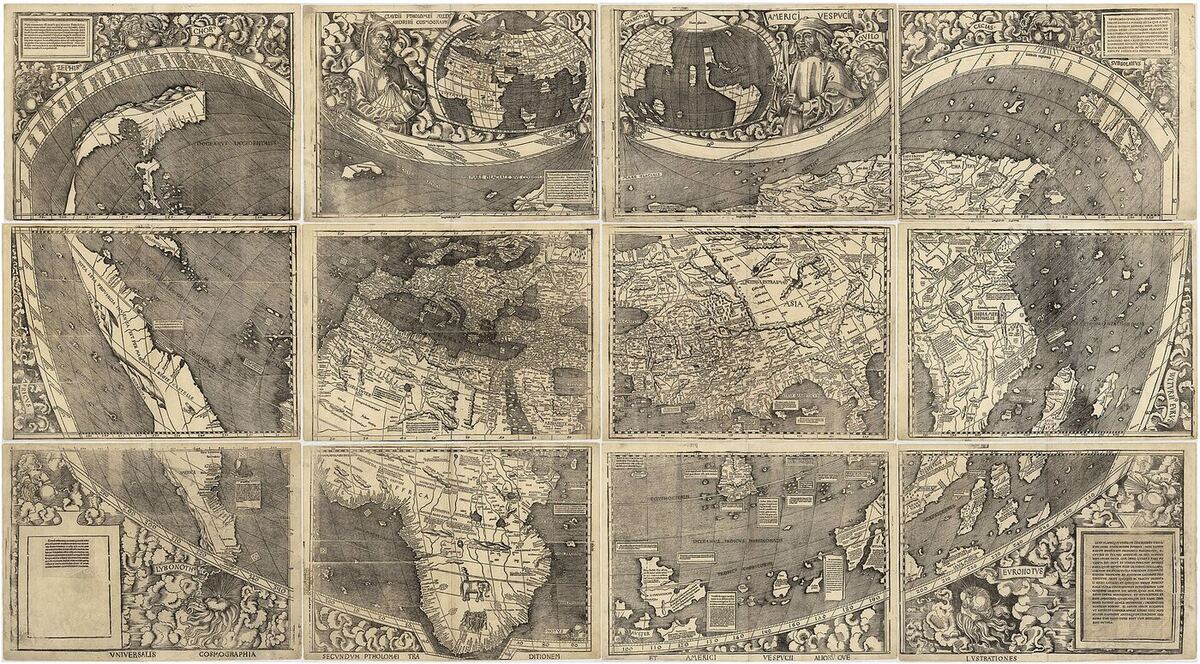
The name is doing less work than it appears to. America, and the adjective built from it, entered European languages as a label for newly charted land rather than for a country: the name was coined by the cartographer Martin Waldseemüller and printed on his twelve-panel world map of 1507, from the Latinised form of the name of the Florentine navigator Amerigo Vespucci, and it was attached there to the southern landmass alone. Waldseemüller is understood to have intended it for a particular stretch of what is now Brazil; other mapmakers spread it, and by Mercator's map of 1538 it named both continents. In contemporary English the noun is used almost universally for the United States and its people, to the point that any other sense has to be flagged. Other languages did not settle so neatly: Spanish carries estadounidense beside americano, Portuguese usage in the press favours norte-americano, and German has US-Amerikaner and US-amerikanisch where the context does not already make the nationality plain.

Esperanto went as far as a separate country name. Usono was proposed in 1905 by Gaston Moch, in a pacifist journal he published himself, on the explicit ground that the United States and its citizens had no name of their own; by 1908 it was being used without explanation in Esperanto periodicals in America, the Philippines and Japan, and Zamenhof used it in his address to the 1910 World Congress in Washington. The problem the newsgroup name walks into is old, and it was old before there were newsgroups.
A group called alt.america therefore commits to nothing. It does not say which America, does not say whether the subject is the country's politics, its culture, its language or its foreign relations, and — having no charter — never says afterwards. That is not a criticism of the name so much as a description of what a catch-all is: a room defined by exclusion, holding whatever does not fit anywhere more specific.
The namespace around it shows how little consensus there was about how to spell the subject. In the August 2026 file, 119 group names have america, american, americas or usa as one of their dot-separated components; 49 of those are in alt.*, 48 belong to a single commercial news hierarchy discussed below, and four are in soc.*. Within alt.politics the duplication is plain: alt.politics.us.christian-democrat and alt.politics.usa.christian-democrat both exist, with separately written descriptions, as do alt.politics.us.regionalism.midwest and alt.politics.usa.regionalism.midwest, whose descriptions are word for word identical. Both spellings survived because creating the second name cost exactly what creating the first had cost: one message.
Four ways Usenet held a country
By the time alt.america's control message was sent in 1996, the network already had several rooms addressed to the same subject, each produced by a different mechanism and each carrying the marks of it.
- soc.culture.usa, described in the file as The culture of the United States of America. — a group in the chartered branch, one of the family that gave a great many countries and peoples a standing address. The branch, its ballot machinery and its habits are the subject of the soc.culture.* hub and are not retold here.
- us.*, a national hierarchy in its own right, of the same species as the German, Dutch and British trees. The current file lists twenty groups in it, among them us.politics, us.politics.elections, us.issues, us.legal, us.taxes, us.military with its army, navy, history and national-guard children, and us.talk.constitution. Its administrative group, us.config, is described as Planning a USA national network news hierarchy. — a project stated, in the present participle, as still under way.
- clari.usa.*, twenty-nine groups in the ClariNet hierarchy: not discussion at all but wire copy, delivered in Usenet format by a company founded in 1989 that carried United Press International material and, from 1994, Associated Press and Reuters, to paying subscribers. The group names read like a newspaper's section list — Presidential news., The U.S. Supreme Court., Party politics and electioneering., Top U.S. news. — and every one of the twenty-nine is marked moderated, because a wire feed has an editor by definition.
- alt.america, produced by a program in Britain that emitted a control message with a local distribution tag and a two-line body.
The four differ in what it cost to make them and therefore in what they can be taken to mean. A chartered group is evidence that some number of people argued for it in public and enough of them voted. A national hierarchy is evidence of administrators agreeing to carry a tree. A commercial feed is evidence of a contract. An alt.* name is evidence that one message was formatted correctly. None of the four is evidence of readership, but the first three at least record a decision by somebody, and the fourth records a decision by nobody in particular. The older attempt to solve the same problem structurally — sweeping open-ended argument into its own branch so that sites could decline it in a single line of configuration — has its own page here, at talk.*.
What it cost to charter American culture
The contrast is not hypothetical, because the chartered branch tried twice to give American regional culture a group of its own, and the paperwork of both attempts survives in full in the same archive that holds alt.america's single control message. Both attempts failed.
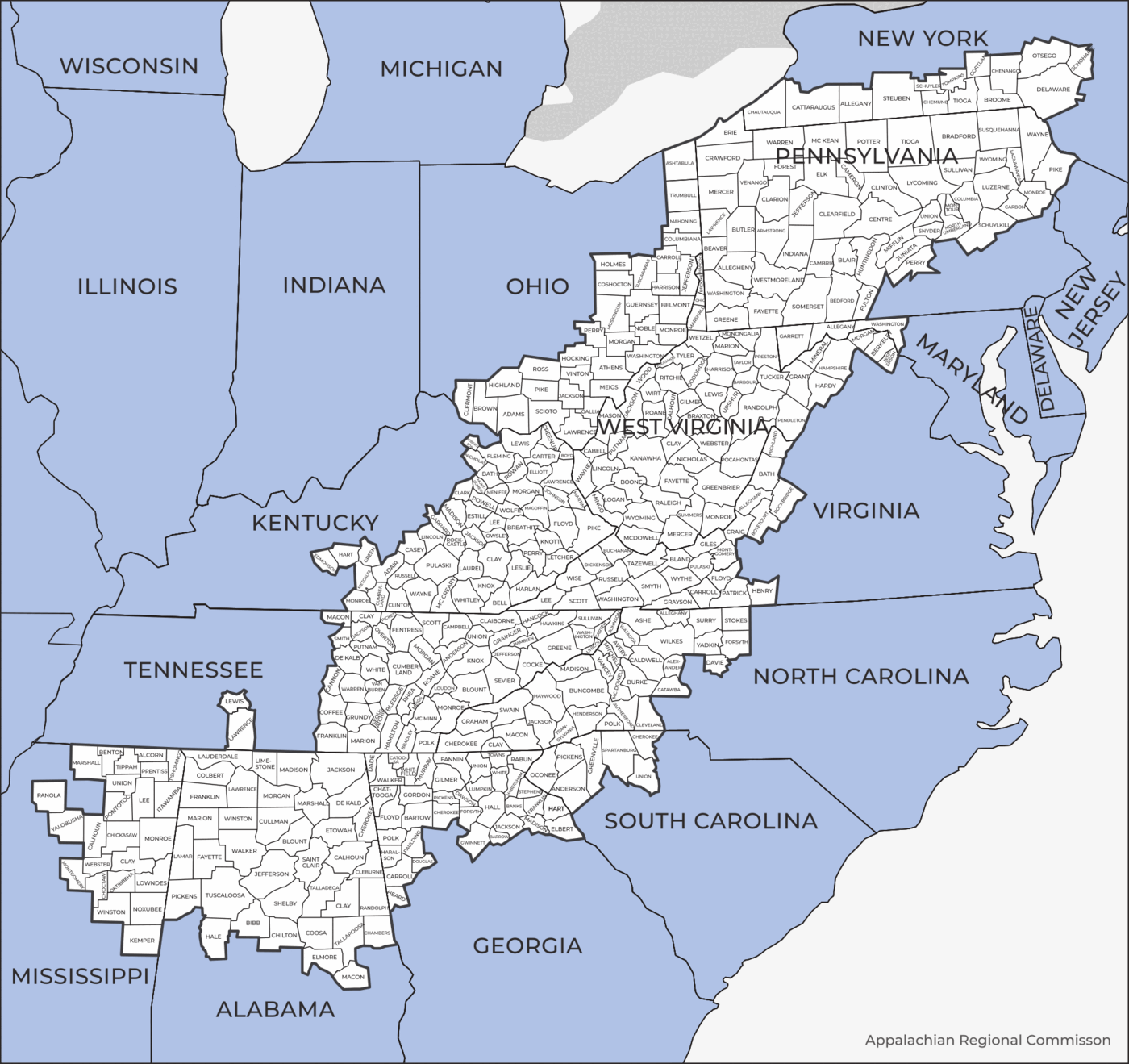
The first began on 6 July 1992, when Joel Furr, posting from Virginia Tech, issued a Request for Discussion for a group to be called soc.culture.appalachian. His reasoning inverts the usual direction of travel: an alt.* group already existed and was working, and the problem was that it was in alt.*.
As some of you may be aware, the newsgroup alt.appalachian has been up and running for a while, and we were enjoying chatting about appalachian issues, but now someone's gone and rmgrouped it out of a sense of civic duty or something, I dunno, and I'm getting all this mail from people wondering where it went. Plus, I get mail from people asking if I know how to have alt.appalachian 'gateway'ed to their site since they don't receive alt. groups.
The charter he proposed to carry across was nine numbered clauses long and refreshingly concrete: current events, regional awareness, local colour and history, Appalachian patriotism, research on the region's culture and economy, folklore explicitly enumerated as moonshining, stock-car racing, snake-handling, feuding, coal mining and ginseng-hunting, indigenous crafts from quilting to basketry, music and dancing down to the dulcimer and the Galax Old Fiddler's Convention, and recreation from the Blue Ridge Parkway to the Appalachian Trail. Between the Request for Discussion and the Call for Votes three weeks later the name changed, and the change is the interesting part: soc.culture.appalachian became soc.culture.usa.appalachian. A region could have a group, but it would be filed beneath its country.
The mechanics of the ballot are recorded with it. Voting ran twenty-one days, from 28 July to 18 August 1992, and a vote was cast by sending a line of text to an automated mail server at MIT. On 19 August 1992 the result was posted by Furr and approved for the moderated announcement group by David Lawrence — the same person who wrote the archive's group-creation policy quoted earlier on this page. It read 104 yes, 44 no, failing both the two-thirds requirement and the requirement that yes votes exceed no votes by at least one hundred. The full list of voters' names and addresses was published with the result, as the process of the day required, and runs to more than a hundred lines.

The second attempt ran through 1997 and was more elaborate still. A first Request for Discussion on 12 May proposed a moderated soc.culture.usa.southern; a second on 21 July settled on soc.culture.usa.south; two proponents and two mentors were named, one mentor at the University of Georgia and one at Princeton; a neutral votetaker at the Georgia Institute of Technology ran the ballot; Calls for Votes went out on 4 and 16 September. The proposal's rationale is a period document in its own right, opening with the claim that the culture of the south is as old as the Americas themselves and working through architecture, food, music, literature and history before turning to the 1996 Atlanta Olympics as evidence of international interest.
The result was posted on 29 September 1997: 120 yes and 37 no from 157 valid votes, with four abstentions and four invalid ballots. That is comfortably past the two-thirds bar and a margin of 83 where 100 was required, so the group failed by seventeen votes' worth of margin. The result carried, as such postings did, the newsgroups-file line the group would have had if it had passed — Southern U.S. culture. (Moderated) — a description written to the format the archive prefers, for a group that never existed. Neither soc.culture.usa.appalachian nor soc.culture.usa.south appears in the newsgroups file today; the only name under soc.culture.usa is soc.culture.usa itself.
Five years apart, two proposals about American regional identity, each with a written charter, a public discussion period, a neutral votetaker and a published tally of every ballot cast — and neither produced a newsgroup. In the same window, one program in Britain produced alt.america by sending a message that nobody discussed, nobody voted on and nobody signed.
Regionalism, and where it ended up instead
What the ballot declined, the open namespace absorbed without noticing. alt.appalachian is still in the current file, described as Appalachian region awareness, events, and culture. — the group whose removal prompted the 1992 proposal in the first place, still listed decades after the chartered replacement failed to come into existence. alt.new-england, which this directory also preserves, is described simply as The USA's north eastern region. alt.california is The state and the state of mind. Rhode Island's group, as quoted above, is credited with world wide interest. Midwestern regionalism has two groups, one under each spelling of the country, carrying the same description twice.
The pattern is worth stating carefully, because it is easy to turn into a moral and it does not support one. Regional identity was a live subject on the network in the 1990s; the formal process required its advocates to assemble a hundred-vote margin from a scattered electorate voting by e-mail, and twice they could not; the informal mechanism required one correctly formatted message and no electorate at all. The result is a namespace in which American regions are represented almost entirely on the unchartered side of the network, with no charters, no moderators and no records of what was said in them beyond what the general archives happened to keep. Anyone studying how Americans discussed their own regions online in that decade is therefore reading alt.* material by default — not because alt.* was better suited to the subject, but because it was the only place the subject could get a room without a ballot.
The directory's own entry for one of those rooms is at alt.new-england, and it is as thin as the record allows, for the same reasons set out at the end of this page.
The Constitution as a popular pastime
One strand of American argument had an unusually early presence on networks, and the reason is textual rather than political. The founding documents of the United States are old enough to be out of copyright and short enough to retype, and they were among the very first things anyone put into machine-readable form for public distribution. Project Gutenberg began in 1971, when Michael S. Hart typed the Declaration of Independence into a machine that was one of the fifteen nodes then on the ARPANET and made it available to other users. The project's catalogue still numbers its first items in the order they appeared: the Declaration of Independence, dated December 1971; the Bill of Rights, December 1972; Kennedy's inaugural address and the Gettysburg Address, both November 1973; and, fifth, the United States Constitution, dated December 1975.
Two decades before the newsgroups described on this page were carrying arguments about it, the full text of the instrument being argued over was already free, copyable and a few keystrokes away for anyone with an account on a connected machine. That is an unusual position for a contested primary text to be in, and it is not the position most subjects of online argument were in.
The namespace records the appetite. us.talk.constitution, in the national hierarchy, is described as The US Constitution & its impact on our lives. alt.politics.usa.constitution is described as U.S. Constitutional politics. A child of it, alt.politics.usa.constitution.gun-rights, carries a description that breaks off mid-phrase — Constitutional ramifications of gun — a small reminder that these lines were captured from control messages by machine and never proofread by anybody.
What that infrastructure made cheap, as a form, was the pasted clause: a poster in an argument could quote the operative text in full at no cost and with no risk of misquotation. Whether the arguments that followed were any good is not a question this page can answer. What is documentable is that the primary text was universally available to the participants, which was not true of most subjects people argued about online. Impeachment as a constitutional mechanism, with the text of the relevant clauses, is handled on this directory's page for alt.impeach.bush, and is not duplicated here.
Immigration, assimilation and the hyphen
The other perennial American subject visible in the namespace is who counts as an American, and it appears in two forms: as policy and as identity.
As policy it is a single alt.* group, alt.politics.immigration, described with unusual flatness as All issues related to immigration., with misc.immigration.usa beside it in another hierarchy. As identity it is a family, and the family is older and better documented. The chartered branch carries soc.culture.african.american (Discussions about Afro-American issues.), soc.culture.asian.american (Issues & discussion about Asian-Americans.) and soc.culture.mexican.american (Mexican-American/Chicano culture and issues.) alongside soc.culture.usa itself; the alt.* side adds groups such as alt.culture.us.asian-indian, described as Asian Indians in the US and Canada.
The construction those names use has a history of its own. Hyphenated American was itself a term of abuse in the United States, current from roughly 1890 to 1920 and used to allege divided national loyalty on the part of citizens of foreign birth or ancestry. By the time the group names were written the compound was ordinary usage and the newsgroup namespace takes it for granted, hyphen and all, without any of that argument visible in the one-line descriptions.
How seriously those names were taken is measurable, because one of them was renegotiated in public. Between August 1996 and March 1997 soc.culture.african.american went through a full reorganisation proposal: three successive Requests for Discussion, two Calls for Votes and a result posted on 17 March 1997 recording 188 valid votes, three invalid ones and a split outcome. A proposal to rename the existing group to soc.culture.african.american.misc failed 89 to 82; a proposal to add a moderated companion, soc.culture.african.american.moderated, passed 159 to 22. Both proposed groups were to have carried the same one-line description, African-American perspectives., distinguished only by the moderation marker. Seven months of procedure, conducted by e-mail ballot with a neutral votetaker, over the naming and moderation of a single community's room.
The rationale posted with the ballot is explicit about what prompted it: it describes two years of crossposting, spamming, flaming and ethnic baiting in the existing group, and argues that the problem was not soluble by voluntary means. That is the proponent's characterisation, recorded here as such. The current newsgroups file lists soc.culture.african.american and no siblings, but the file describes the present state of the namespace rather than its history, and no inference about what happened in between should be drawn from that alone.
This page documents that these groups existed, what their one-line descriptions said, and what procedures were used to create and rename them. It does not summarise the positions taken inside them, on immigration or on identity, and it takes none. The arguments were long, they were conducted by people who are mostly still alive, and a directory entry is the wrong instrument for characterising them.
What is actually documented about political talk online in this period
Political argument on Usenet is one of the few things about the 1990s network that was studied while it was happening, by researchers who counted messages rather than remembering them. None of the studies below examined alt.america; all of them sampled the kind of group it nominally was. They are cited here for their methods and their published findings, not as verdicts about anybody's arguments, and each is described with the limits of its own sample attached.
The earliest large content analysis was the ProjectH collaboration, reported by Sheizaf Rafaeli of the Hebrew University of Jerusalem and Fay Sudweeks of the University of Sydney as Networked Interactivity, in volume 2, issue 4 of the Journal of Computer-Mediated Communication, in 1997. Working across three network types — Bitnet mailing lists, Usenet newsgroups and CompuServe forums — the researchers sampled runs of a hundred messages per group, beginning on 15 March 1993, and coded 4,322 messages from 1,450 different authors across 32 completed groups, twelve of them Usenet, against a codebook of 46 items. A caveat the paper states itself: of those 4,322 records, 3,322 are unique messages and the remainder are second codings of the same messages, retained to measure agreement between coders.
Their headline distinction was between reactive messages, which refer to one earlier message, and interactive ones, which take account of how earlier messages related to each other. Just over half the corpus, 52.5 per cent or 2,269 messages, was reactive; fully interactive messages amounted to just under a tenth of it, 388 messages in all, and the level varied from about 40 per cent in some groups to none at all in others. Their other tabulations are worth having beside the reputation of the medium: 57 per cent of messages contained statements of fact, more than one in five contained at least an attempt at humour, and agreement outnumbered disagreement on both of the measures they used.
The largest measurement of Usenet as a system came the following year: Steve Whittaker, Loren Terveen, Will Hill and Lynn Cherny presented The dynamics of mass interaction at the ACM's Computer Supported Cooperative Work conference in November 1998. Their corpus, collected from December 1996, was over 2.15 million messages produced by 659,450 people in 500 representative newsgroups over six months. Their own scale-setting figures are a useful measure of how the network had grown and of how much of it any study could see: fewer than 500 newsgroups in 1988, over 17,000 at the time of their collection, and an estimate of roughly three million users worldwide. The file this page began with lists 45,003 names today. Their framing explains why the network attracted researchers at all: Usenet supported conversations among hundreds or thousands of participants at a time, a phenomenon they called mass interaction, about which, as they noted, basic descriptive data simply did not exist.
Two studies looked specifically at politics. Kevin A. Hill and John E. Hughes published Cyberpolitics: Citizen Activism in the Age of the Internet with Rowman & Littlefield of Lanham, Maryland, in 1998, a book of 207 pages drawing on content analysis of explicitly political Usenet groups and America Online chat. Anthony G. Wilhelm's Virtual sounding boards: how deliberative is on-line political discussion? appeared in Information, Communication & Society, volume 1, issue 3, pages 313 to 338, in September 1998, and was reprinted the following year as a chapter in Digital Democracy, edited by Barry Hague and Brian Loader for Routledge; it applied a deliberative standard to samples drawn from political newsgroups and AOL fora.
Their findings, as summarised by Lincoln Dahlberg of Massey University in a critical review published in the Journal of Computer-Mediated Communication in October 2001, point in two directions at once. On Wilhelm's numbers — and the sample is small enough that the number should be quoted with it, a random sample of fifty messages drawn from ten political newsgroups — only about twenty per cent of messages were directed at a previous message at all; but three out of four postings across the Usenet and AOL fora he studied supplied reasons justifying their statements. On Hill and Hughes's, debate constituted the majority of the content of explicitly political Usenet groups; thirty-nine per cent of Usenet debates and thirty-two per cent of AOL chat exchanges met their definition of a flame fest, which required that a majority of the messages in a thread be flames; sourced information was drawn upon in over sixty per cent of the political Usenet groups they studied; and there was more than five times as much of it in the Usenet groups as in the chat rooms.
One discrepancy in that review is worth flagging rather than smoothing over, since it bears on how such figures travel. Dahlberg summarises the Rafaeli and Sudweeks corpus as forty-four randomly sampled bulletin boards of which more than sixty per cent of the 4,322 messages responded to previous postings; the paper itself reports 32 completed groups and 52.5 per cent. The figures given above are the ones in the primary article.
Those clusters of findings are frequently quoted separately and mean rather different things together. A medium in which most messages are not replies, a substantial minority of exchanges degenerate, and three-quarters of postings nonetheless give reasons and cite sources is not well described either as a deliberative public sphere or as a shouting match. It is a place where both behaviours were cheap, and the record contains a great deal of each. The forms that behaviour took — crossposting, the kill file, the periodic FAQ, the flame war — are described in this directory on the page for alt.politics.bush, which carries the period chronology as well, and are not restated here.
Who was in the room
Nothing in the record identifies a single participant in alt.america, and this section makes no attempt to invent any. What can be said is structural, and it follows from the two facts already established: that the group was named for one country, and that it sat on a network that was not confined to it.
A newsgroup has no membership and no locality. There is no registration, no residency test and no way to weight a room towards the people it is nominally about. Posting to a group named for a country costs the same from outside that country as from inside it, and carriage was worldwide wherever an administrator chose to take the feed. Whatever else a group called alt.america was, it was addressed to an audience that could include the subject's admirers, its citizens, its critics and people with no view at all, in unknown proportions, all reading the same articles.
The namespace shows what that produced elsewhere, and the evidence is in the file rather than in anyone's recollection. Other national hierarchies kept their own rooms for the same subject. The Australian tree carries aus.flame.usa, described — under a parent group whose own description reads Abusive noise, posted by morons. — as Careful, reasoned criticism of the United States of America. The Norwegian tree carries no.alt.diskusjoner.usa, described in Norwegian as Debatt om alt som kan assosieres med USA., debate about everything that can be associated with the USA: a catch-all for the same country, in another language, sitting in a branch whose published rule in control.ctl honours a newgroup message from any address in the .no domain. The Russian FidoNet gateway carries fido7.ru.usa, a moderated echo named for the United States. An Italian free.* branch carries four groups — named for the Pentagon, Washington, the twin towers and the world — that share one description, USA sotto Attacco.
Within alt.* itself the same subject generated a small cluster of names carrying propositions rather than topics: alt.usa.the-only-superpower, described as usa is THE superpower; alt.usa.the-only and alt.usa.the-only.superpower, both described as the usa owns the world; alt.nuke.the.usa, described as People not especially fond of the US of A.; and alt.usa-sucks, whose description, Not like an Electolux., is a play on a vacuum-cleaner advertising slogan with the brand name misspelled. That cluster is not evidence about anybody's opinions. It is evidence about the cost of a name: in a hierarchy where a proposition can be published as a group title for the price of one message, the namespace fills with propositions, and reading it as a survey of sentiment would be a serious methodological error.
The one thing the record does say about who was in the room concerns the door. The group about America was, on the evidence of the only surviving control message, created in Britain by a machine — and the master file's description of it was written by somebody who thought that fact worth recording, and worth being rude about. It is a small illustration of a general condition of the medium: on a network where any group could be created from anywhere and read from anywhere, the outsider's view of a country was an ordinary rather than an exceptional perspective.
What the record does not show
The gaps here are larger than the findings, and they should be stated in full sentences rather than implied by omission.
There is no traffic figure of any kind for alt.america. No message count, no posting rate, no readership estimate, no year-by-year comparison, and nothing from the readership surveys of the early 1990s, which in any case predate the group's earliest surviving control message. The published active file, which is the only file that carries numbers at all, carries the same placeholder pair on every one of its 45,003 lines. Anyone quoting a traffic figure for this group is quoting something they have made up.
There is no charter. The group has no founding statement beyond the description line, no statement of scope, no posting guidelines, no rules about crossposting, and no document of any kind that a participant could have been referred to. The description line is not a charter and was not written by anyone with authority to write one.
There is no thread. No individual discussion in this group has been identified, dated or read in the course of writing this page, and none is described above. No subject line, no participant, no exchange and no characterisation of the group's prevailing opinions appears here, because none could be sourced.
There is no named creator. The archived control message gives a machine account, an approving address and the name of a program; it does not give a person. The description in the master file characterises a founder, but the description's own author is equally unrecorded, so the file's only statement about the group's origin is anonymous testimony about an anonymous act.
There is no carriage record. Because every administrator decided independently whether to honour the newgroup message, there is no answer to the question of how widely the group existed, or when, or where. Two readers on two providers could have disagreed, correctly, about whether alt.america was a real group.
There is no date for the sentence. The change log begins in 2003 and is silent about this name; the surviving control message carries no description; the alt.* group lists that circulated privately in the 1990s are not part of the public archive. The description could have been written at any point between the group's creation and the start of the log, and nothing in the record narrows it further.
Scope and limits
What this page establishes is narrow, and the boundary is worth marking precisely so that the page can be relied on for the things it does say.
Established. That the newsgroups file published by the Internet Systems Consortium on 25 August 2026 carries alt.america with the description quoted at the top of this page, separated from the name by two tab characters, and that the description runs to 56 characters against the file's own 55-character preference, the whole line to 80 columns against a preference of 79. That the group carries the posting-permitted flag in the companion active file, and that this file records no traffic information for any group. That the control archive holds exactly one message for the name: a newgroup dated 17 April 1996, sent from a British host by a program identifying itself as newjunk, with a local distribution tag and no newsgroups-file line in its body. That the archive's change log, running monthly from May 2003 to August 2026, contains no entry for the name at all. That the same archive holds full paperwork for two chartered proposals about American regional culture, soc.culture.usa.appalachian in 1992 and soc.culture.usa.south in 1997, both of which failed on the hundred-vote margin, and for a seven-month reorganisation of soc.culture.african.american in 1996 and 1997 with a split result. That the current namespace holds soc.culture.usa, a twenty-group us.* hierarchy and twenty-nine moderated clari.usa.* wire groups alongside this one name in alt.*.
Not established. Who wrote the description, when it was written, or which control message carried it. Who wrote or operated the program that sent the 1996 newgroup message. Whether an earlier attempt at the name was ever made. How many people read or posted to the group, in any year. Which servers carried it. What was discussed in it, in what proportions, or by whom.
Deliberately left to other pages. The origins of alt.* and the mechanics of group creation, on the alt.* hub; the chartered culture branch and its ballot machinery, on the soc.culture.* hub; the talk.* hierarchy and the Great Renaming's attempt to quarantine open-ended argument, on the talk.* page; the forms of pre-platform political argument and the chronology of the 2000s, on alt.politics.bush; impeachment as a constitutional mechanism, on alt.impeach.bush.
A final note on register, since the subject invites the opposite. This page documents a newsgroup and the administrative record around it. It takes no position on any American political question, on any characterisation of the country made by anyone inside or outside it, or on the merits of anything argued in any of the groups named above. Where the surviving documents are rude — and the central document here is rude — they are quoted as documents and attributed to the record rather than endorsed. Where the record is silent, this page says so and stops, which on this subject is most of the time.
Reading alt.america today
- Historical archive: Google Groups — alt.america (coverage varies by group and era).
- Open in a newsreader:
news:alt.america— the original site offered exactly this link, and it still works if your system has a newsreader registered for thenews:scheme. - Live access: point an NNTP newsreader at a modern server — see accessing Usenet today.
- The original news2mail e-mail subscription service ended in the mid-2000s and no longer operates.